EP1764112B1 - Verfahren zur Herstellung von linearen Cyclodextrin-enthaltenden Copolymeren - Google Patents
Verfahren zur Herstellung von linearen Cyclodextrin-enthaltenden Copolymeren Download PDFInfo
- Publication number
- EP1764112B1 EP1764112B1 EP06024721A EP06024721A EP1764112B1 EP 1764112 B1 EP1764112 B1 EP 1764112B1 EP 06024721 A EP06024721 A EP 06024721A EP 06024721 A EP06024721 A EP 06024721A EP 1764112 B1 EP1764112 B1 EP 1764112B1
- Authority
- EP
- European Patent Office
- Prior art keywords
- cyclodextrin
- copolymer
- deoxy
- moieties
- monomer
- Prior art date
- Legal status (The legal status is an assumption and is not a legal conclusion. Google has not performed a legal analysis and makes no representation as to the accuracy of the status listed.)
- Expired - Lifetime
Links
- RGHPCLZJAFCTIK-RXMQYKEDSA-N C[C@H]1NCCC1 Chemical compound C[C@H]1NCCC1 RGHPCLZJAFCTIK-RXMQYKEDSA-N 0.000 description 1
Classifications
-
- B—PERFORMING OPERATIONS; TRANSPORTING
- B82—NANOTECHNOLOGY
- B82Y—SPECIFIC USES OR APPLICATIONS OF NANOSTRUCTURES; MEASUREMENT OR ANALYSIS OF NANOSTRUCTURES; MANUFACTURE OR TREATMENT OF NANOSTRUCTURES
- B82Y5/00—Nanobiotechnology or nanomedicine, e.g. protein engineering or drug delivery
-
- A—HUMAN NECESSITIES
- A61—MEDICAL OR VETERINARY SCIENCE; HYGIENE
- A61K—PREPARATIONS FOR MEDICAL, DENTAL OR TOILETRY PURPOSES
- A61K47/00—Medicinal preparations characterised by the non-active ingredients used, e.g. carriers or inert additives; Targeting or modifying agents chemically bound to the active ingredient
- A61K47/50—Medicinal preparations characterised by the non-active ingredients used, e.g. carriers or inert additives; Targeting or modifying agents chemically bound to the active ingredient the non-active ingredient being chemically bound to the active ingredient, e.g. polymer-drug conjugates
- A61K47/69—Medicinal preparations characterised by the non-active ingredients used, e.g. carriers or inert additives; Targeting or modifying agents chemically bound to the active ingredient the non-active ingredient being chemically bound to the active ingredient, e.g. polymer-drug conjugates the conjugate being characterised by physical or galenical forms, e.g. emulsion, particle, inclusion complex, stent or kit
- A61K47/6949—Medicinal preparations characterised by the non-active ingredients used, e.g. carriers or inert additives; Targeting or modifying agents chemically bound to the active ingredient the non-active ingredient being chemically bound to the active ingredient, e.g. polymer-drug conjugates the conjugate being characterised by physical or galenical forms, e.g. emulsion, particle, inclusion complex, stent or kit inclusion complexes, e.g. clathrates, cavitates or fullerenes
- A61K47/6951—Medicinal preparations characterised by the non-active ingredients used, e.g. carriers or inert additives; Targeting or modifying agents chemically bound to the active ingredient the non-active ingredient being chemically bound to the active ingredient, e.g. polymer-drug conjugates the conjugate being characterised by physical or galenical forms, e.g. emulsion, particle, inclusion complex, stent or kit inclusion complexes, e.g. clathrates, cavitates or fullerenes using cyclodextrin
-
- C—CHEMISTRY; METALLURGY
- C08—ORGANIC MACROMOLECULAR COMPOUNDS; THEIR PREPARATION OR CHEMICAL WORKING-UP; COMPOSITIONS BASED THEREON
- C08B—POLYSACCHARIDES; DERIVATIVES THEREOF
- C08B37/00—Preparation of polysaccharides not provided for in groups C08B1/00 - C08B35/00; Derivatives thereof
- C08B37/0006—Homoglycans, i.e. polysaccharides having a main chain consisting of one single sugar, e.g. colominic acid
- C08B37/0009—Homoglycans, i.e. polysaccharides having a main chain consisting of one single sugar, e.g. colominic acid alpha-D-Glucans, e.g. polydextrose, alternan, glycogen; (alpha-1,4)(alpha-1,6)-D-Glucans; (alpha-1,3)(alpha-1,4)-D-Glucans, e.g. isolichenan or nigeran; (alpha-1,4)-D-Glucans; (alpha-1,3)-D-Glucans, e.g. pseudonigeran; Derivatives thereof
- C08B37/0012—Cyclodextrin [CD], e.g. cycle with 6 units (alpha), with 7 units (beta) and with 8 units (gamma), large-ring cyclodextrin or cycloamylose with 9 units or more; Derivatives thereof
-
- C—CHEMISTRY; METALLURGY
- C08—ORGANIC MACROMOLECULAR COMPOUNDS; THEIR PREPARATION OR CHEMICAL WORKING-UP; COMPOSITIONS BASED THEREON
- C08G—MACROMOLECULAR COMPOUNDS OBTAINED OTHERWISE THAN BY REACTIONS ONLY INVOLVING UNSATURATED CARBON-TO-CARBON BONDS
- C08G73/00—Macromolecular compounds obtained by reactions forming a linkage containing nitrogen with or without oxygen or carbon in the main chain of the macromolecule, not provided for in groups C08G12/00 - C08G71/00
- C08G73/02—Polyamines
-
- C—CHEMISTRY; METALLURGY
- C08—ORGANIC MACROMOLECULAR COMPOUNDS; THEIR PREPARATION OR CHEMICAL WORKING-UP; COMPOSITIONS BASED THEREON
- C08G—MACROMOLECULAR COMPOUNDS OBTAINED OTHERWISE THAN BY REACTIONS ONLY INVOLVING UNSATURATED CARBON-TO-CARBON BONDS
- C08G73/00—Macromolecular compounds obtained by reactions forming a linkage containing nitrogen with or without oxygen or carbon in the main chain of the macromolecule, not provided for in groups C08G12/00 - C08G71/00
- C08G73/06—Polycondensates having nitrogen-containing heterocyclic rings in the main chain of the macromolecule
-
- Y—GENERAL TAGGING OF NEW TECHNOLOGICAL DEVELOPMENTS; GENERAL TAGGING OF CROSS-SECTIONAL TECHNOLOGIES SPANNING OVER SEVERAL SECTIONS OF THE IPC; TECHNICAL SUBJECTS COVERED BY FORMER USPC CROSS-REFERENCE ART COLLECTIONS [XRACs] AND DIGESTS
- Y10—TECHNICAL SUBJECTS COVERED BY FORMER USPC
- Y10S—TECHNICAL SUBJECTS COVERED BY FORMER USPC CROSS-REFERENCE ART COLLECTIONS [XRACs] AND DIGESTS
- Y10S977/00—Nanotechnology
- Y10S977/70—Nanostructure
- Y10S977/788—Of specified organic or carbon-based composition
-
- Y—GENERAL TAGGING OF NEW TECHNOLOGICAL DEVELOPMENTS; GENERAL TAGGING OF CROSS-SECTIONAL TECHNOLOGIES SPANNING OVER SEVERAL SECTIONS OF THE IPC; TECHNICAL SUBJECTS COVERED BY FORMER USPC CROSS-REFERENCE ART COLLECTIONS [XRACs] AND DIGESTS
- Y10—TECHNICAL SUBJECTS COVERED BY FORMER USPC
- Y10S—TECHNICAL SUBJECTS COVERED BY FORMER USPC CROSS-REFERENCE ART COLLECTIONS [XRACs] AND DIGESTS
- Y10S977/00—Nanotechnology
- Y10S977/902—Specified use of nanostructure
- Y10S977/904—Specified use of nanostructure for medical, immunological, body treatment, or diagnosis
- Y10S977/906—Drug delivery
Definitions
- the invention relates to methods of preparing water-soluble, linear cyclodextrin copolymers and water-soluble linear oxidized cyclodextrin copolymers.
- Cyclodextrins are cyclic polysaccharides containing naturally occurring D(+)-glucopyranose units in an ⁇ -(1,4) linkage.
- the most common cyclodextrins are alpha ( ⁇ )-cyclodextrins, beta ( ⁇ )-cyclodextrins and gamma ( ⁇ )-cyclodextrins which contain, respectively, six, seven or eight glucopyranose units.
- the cyclic nature of a cyclodextrin forms a torus or donut-like shape having an inner apolar or hydrophobic cavity, the secondary hydroxyl groups situated on one side of the cyclodextrin torus and the primary hydroxyl groups situated on the other.
- ( ⁇ )-cyclodextrin is often represented schematically as follows:
- the side on which the secondary hydroxyl groups are located has a wider diameter than the side on which the primary hydroxyl groups are located.
- the hydrophobic nature of the cyclodextrin inner cavity allows for the inclusion of a variety of compounds.
- Cyclodextrins have been used as a delivery vehicle of various therapeutic compounds by forming inclusion complexes with various drugs that can fit into the hydrophobic cavity of the cyclodextrin or by forming non-covalent association complexes with other biologically active molecules such as oligonucleotides and derivatives thereof.
- U.S. Patent 4,727,064 describes pharmaceutical preparations consisting of a drug with substantially low water solubility and an amorphous, water-soluble cyclodextrin-based mixture. The drug forms an inclusion complex with the cyclodextrins of the mixture.
- U.S. Patent 5,691,316 a cyclodextrin cellular delivery system for oligonucleotides is described.
- an oligonucleotide is noncovalently complexed with a cyclodextrin or, alternatively, the oligonucleotide may be covalently bound to adamantine which in turn is non-covalently associated with a cyclodextrin.
- cyclodextrin containing polymers and methods of their preparation are also known in the art. ( Comprehensive Supramolecular Chemistry, Volume 3, J.L. Atwood et al., eds., Pergamon Press (1996 )).
- a process for producing a polymer containing immobilized cyclodextrin is described in U.S. Patent 5,608,015 .
- a cyclodextrin derivative is reacted with either an acid halide monomer of an ⁇ , ⁇ -unsaturated acid or derivative thereof or with an ⁇ , ⁇ -unsaturated acid or derivative thereof having a terminal isocyanate group or a derivative thereof.
- the cyclodextrin derivative is obtained by reacting cyclodextrin with such compounds as carbonyl halides and acid anhydrides.
- the resulting polymer contains cyclodextrin units as side chains off a linear polymer main chain.
- U.S. Patent 5,276,088 describes a method of synthesizing cyclodextrin polymers by either reacting polyvinyl alcohol or cellulose or derivatives thereof with cyclodextrin derivatives or by copolymerization of a cyclodextrin derivative with vinyl acetate or methyl methacrylate. Again, the resulting cyclodextrin polymer contains a cyclodextrin moiety as a pendant moiety off the main chain of the polymer.
- a biodegradable medicinal polymer assembly with supermolecular structure is described in WO 96/09073 A1 .
- the assembly comprises a number of drug-carrying cyclic compounds prepared by binding a drug to an ⁇ , ⁇ , or ⁇ -cyclodextrin and then stringing the drug/cyclodextrin compounds along a linear polymer with the biodegradable moieties bound to both ends of the polymer.
- Such an assembly is reportably capable of releasing a drug in response to a specific biodegradation occurring in a disease.
- These assemblies are commonly referred to as "necklace-type" cyclodextrin polymers.
- Cyclodextrin polymers in which the cyclodextrin moiety is part of the main chain and not a pendant moiety off the main chain and a method for their preparation are described in JP 58 167 613 , and are obtained by reacting a cyclodextrin with a diepoxy compound in a random monomer.
- JP 58 167 613 Cyclodextrin polymers in which the cyclodextrin moiety is part of the main chain and not a pendant moiety off the main chain and a method for their preparation, are described in JP 58 167 613 , and are obtained by reacting a cyclodextrin with a diepoxy compound in a random monomer.
- linear cyclodextrin-containing polymers there still exists a need for linear cyclodextrin-containing polymers.
- This invention answers this need by providing a method for preparing a water-soluble, linear cyclodextrin copolymer comprising:
- One possible method involves iodinating a cyclodextrin monomer precursor to form a diiodinated cyclodextrin monomer precursor, aminating the diiodinated cyclodextrin monomer precursor to form a diaminated cyclodextrin monomer precursor and then copolymerizing the diaminated cyclodextrin monomer precursor with said linker precursor to produce the linear cyclodextrin copolymer.
- the linear oxidized cyclodextrin copolymer as defined above may be a linear cyclodextrin copolymer which contains at least one oxidized cyclodextrin moiety of formula VIa or VIb: Each cyclodextrin moiety of a linear cyclodextrin copolymer may be oxidized so as to form a linear oxidized cyclodextrin copolymer having a repeating unit of formula VIa, VIb, or a combination thereof.
- the invention further provides a method for bounding at least one ligand bound to the cyclodextrin copolymer.
- the ligand may be bound to either the cyclodextrin monomer moiety or the comonomer A moiety of the copolymer.
- a linear cyclodextrin copolymer is a polymer containing cyclodextrin monomer moieties as an integral part of its polymer backbone. Previously, cyclodextrin moieties were not a part of the main polymer chain but rather attached off a polymer backbone as pendant moieties. According to the invention, a linear cyclodextrin copolymer may have a repeating unit of formula Ia, Ib, or a combination thereof.
- C is a substituted or unsubstituted cyclodextrin monomer moiety and A is a linker moiety bound, i.e . covalently bound, to the cyclodextrin O monomer moiety.
- A is a linker moiety bound, i.e . covalently bound, to the cyclodextrin O monomer moiety.
- Polymerization of a cyclodextrin monomer precursor with a linker precursor results in a linear cyclodextrin copolymer of the invention.
- the cyclodextin monomer moiety may be the same or different and, likewise, the linker moiety may be the same or different.
- a cyclodextrin monomer precursor may be any cyclodextrin or derivative thereof known in the art.
- a cyclodextrin is defined as a cyclic polysaccharide most commonly containing six to eight naturally occurring D(+)-glucopyranose units in an ⁇ -(1,4) linkage.
- the cyclodextrin monomer precursor is a cyclodextrin having six, seven and eight glucose units, i.e ., respectively, an alpha ( ⁇ )-cyclodextrin, a beta ( ⁇ )-cyclodextrin and a gamma ( ⁇ )-cyclodextrin.
- a cyclodextrin derivative may be any substituted cyclodextrin known in the art where the substituent does not interfere with copolymerization with the linker precursor as described below.
- a cyclodextrin derivative may be neutral, cationic or anionic.
- substituents include, but are not limited to, hydroxyalkyl groups, such as, for example, hydroxypropyl, hydroxyethyl; ether groups, such as, for example, dihydroxypropyl ethers, methyl-hydroxyethyl ethers, ethyl-hydroxyethyl ethers, and ethyl-hydroxypropyl ethers; alkyl groups, such as, for example, methyl; saccharides, such as, for example, glucosyl and maltosyl; acid groups, such as, for example, carboxylic acids, phosphorous acids, phosphinous acids, phosphonic acids, phosphoric acids, thiophosphonic acids, thiophosphonic acid and sulfonic acids; imidazole groups; and sulfate groups.
- hydroxyalkyl groups such as, for example, hydroxypropyl, hydroxyethyl
- ether groups such as, for example, dihydroxypropyl ethers, methyl-hydroxy
- a cyclodextrin monomer precursor may be further chemically modified (e.g. halogenated, laminated) to facilitate or affect copolymerization of the cyclodextrin monomer precursor with a linker precursor, as described below.
- Chemical modification of a cyclodextrin monomer precursor allows for polymerization at only two positions on each cyclodextrin monomer precursor, i.e . the creation of a bifunctional cyclodextrin monomer moiety.
- the numbering scheme for the C1-C6 positions of each glucopyranose ring is as follows:
- polymerization occurs at two of any C2, C3 and C6 position, including combinations thereof, of the cyclodextrin monomer precursor.
- one cyclodextrin monomer precursor may be polymerized at two C6 positions while another cyclodextrin monomer precursor may be polymerized at a C2 and a C6 position of the cyclodextrin monomer precursor.
- the lettering scheme for the relative position of each glucopyranose ring in a cyclodextrin is as follows:
- the cyclodextrin monomer moiety has the following general formula (II).
- n and m represent integers which, along with the other two glucopyranose rings, define the total number of glucopyranose units in the cyclodextrin monomer moiety.
- Formula (II) represents a cyclodextrin monomer moiety which is capable of being polymerized at two C6 positions on the cyclodextrin monomer moiety.
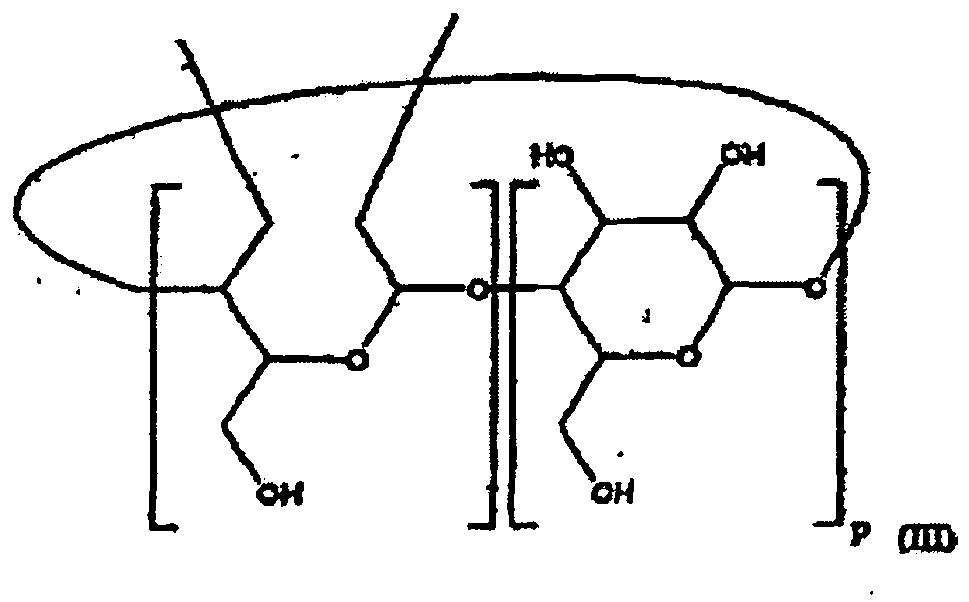
- formula (III) one of D(+)-glucopyranose units of a cyclodextrin monomer moiety has undergone ring opening to allow for polymerization at a C2 and a C3 position of the cyclodextrin monomer moiety.
- Cyclodextrin monomer moieties of formula (III) are commercially available from Carbomer of Westborough, MA.
- Examples of cyclodextrin monomer moieties of formula (III) include, but are not limited to, 2 A ,3 A -deoxy-2 A ,3 A -dihydro- ⁇ -cyclodextrin, 2 A ,3 A -deoxy-2 A ,3 A -dihydro- ⁇ -cyclodextrin, 2 A ,3 A -deoxy-2 A ,3 A -dihydro- ⁇ -cyclodextrin, commonly referred to as, respectively, 2,3-deoxy- ⁇ -cyclodextrin, 2,3-deoxy- ⁇ -cyclodextrin, and 2,3-deoxy- ⁇ -cyclodextrin.
- a linker precursor may be any straight chain or branched, symmetric or asymmetric compound which upon reaction with a cyclodextrin monomer precursor, as described above, links two cyclodextrin monomer moieties together.
- a linker precursor is a compound containing at least two functional groups through which reaction and thus linkage of the cyclodextrin monomer precursors can be achieved.
- Examples of possible functional groups, which may be the same or different, terminal or internal, of each linker precursor include, but are not limited to, amino, acid, ester, imidazole, and acyl halide groups and derivatives thereof. In a preferred embodiment, the two functional groups are the same and terminal.
- two cyclodextrin monomer moieties may be linked together by joining the primary hydroxyl side of one cyclodextrin monomer moiety with the primary hydroxyl side of another cyclodextrin monomer moiety by joining the secondary hydroxyl side of one cyclodextrin monomer moiety with the secondary hydroxyl side of another cyclodextrin monomer or by joining the primary hydroxyl side of one cyclodextrin monomer moiety with the secondary hydroxyl side of another cyclodextrin monomer moiety. Accordingly, combinations of such linkages may exist in the final copolymer.
- Both the linker precursor and the linker moiety of the final copolymer may be neutral, cationic (e.g . by containing protonated groups such as, for example, quaternary ammonium groups) or anionic ( e.g . by containing deprotonated groups, such as, for example, sulfate, phosphate or carboxylate anionic groups).
- the charge of the linker moiety of the copolymer may be adjusted by adjusting pH conditions.
- suitable linker precursors include. Copolymerization of a linker precursor with a cyclodextrin monomer precursor leads to the formation of a linear cyclodextrin copolymer of the invention containing a linker moieties of the following general formula:
- x 1-50.
- the linker moiety is biodegradable or acid-labile.
- the linker precursor and hence the linker moiety may be selectively chosen in order to achieve a desired application. For example, to deliver small molecular therapeutic agents, a charged polymer may not be necessary and the linker moiety may be a polyethylene glycol group.
- a linear cyclodextrin copolymer may be modified with at least one ligand attached to the cyclodextrin copolymer.
- the ligand may be attached to the cyclodextrin copolymer through the cyclodextrin monomer moiety or the linker moiety.
- the ligand is attached to at least one cyclodextrin monomer moiety of the linear cyclodextrin copolymer.
- the ligand allows a linear cyclodextrin copolymer to target and bind to a celL
- the additional ligand or ligands may be bound to the same or different cyclodextrin monomer moiety or the same or different linker moiety of the copolymer.
- suitable ligands include, but are not limited to, vitamins (e.g . folic acid), proteins ( e.g . transferrin, and monoclonal antibodies) and polysaccharides.
- the ligand will vary depending upon the type of delivery desired.
- receptor-mediated delivery may be achieved by, but not limited to, the use of a folic acid ligand while antisense oligo delivery may be achieved by, but not limited to, use of a transferrin ligand.
- the ligand may be attached to a copolymer of the invention by means known in the art.
- the diiodinated cyclodextrin monomer precursor may be prepared by any means known in the art. ( Tabushi et al. J. Am. Chem. 106, 5267-5270 (1984 ); Tabushi et al. J. Am. Chem. 106, 4580-4584 (1984 )).
- ⁇ -cyclodextrin may be reacted with biphenyl-4,4'-disulfonyl chloride in the presence of anhydrous pyridine to form a biphenyl-4,4'-disulfony) chloride capped ⁇ -cyclodextrin which may then be reacted with potassium iodide to produce diiodo- ⁇ -cyclodextrin.
- the cyclodextrin monomer precursor is iodinated at only two positions.
- a linear cyclodextrin polymer having a repeating unit of formula Ia, Ib, or a combination thereof, also as described above may be prepared.
- the iodine or iodo groups may be replaced with other known leaving groups.
- iodo groups or other appropriate leaving group may be displaced with a group that permits reaction with a linkeR precursor, as described above.
- a diiodinated cyclodextrin monomer precursor of formula IVa, IVb, IVc or a mixture thereof may be aminated to form a diaminated cyclodextrin monomer precursor of formula Va, Vb, Vc or a mixture thereof:
- the diaminated cyclodextrin monomer precursor may be prepared by any means known in the art ( Tabushi et al. Tetrahedron Lett. 18:1527-1530 (1977 ); Mungall et al., J. Org. Chem. 1659-1662 (1975 )).
- a diiodo- ⁇ -cyclodextrin may be reacted with sodium azide and then reduced to form a diamino- ⁇ -cyclodextrin.
- the cyclodextrin monomer precursor is aminated at only two positions.
- the diaminated cyclodextrin monomer precursor may then be copolymerized with a linkeR precursor, as described above, to produce a linear cyclodextrin copolymer having a repeating unit of formula Ia, Ib, or a combination thereof, also as described above.
- the amino functionality of a diaminated cyclodextrin monomer precursor need not be directly attached to the cyclodextrin moiety.
- amino functionality may be introduced by displacement of the iodo or other appropriate leaving groups of a cyclodextrin monomer precursor with amino group containing moieties such as, for example, SCH 2 CH 2 NH 2 , to form a diaminated cyclodextrin monomer precursor of formula Vd, Ve, Vf or a mixture thereof:
- a linear cyclodextrin copolymer may be oxidized so as to introduce at least one oxidized cyclodextrin monomer into the copolymer such that the oxidized cyclodextrin monomer is an integral part of the polymer backbone.
- a linear cyclodextrin copolymer which contains at least one oxidized cyclodextrin monomer is defined as a linear oxidized cyclodextrin copolymer.
- the cyclodextrin monomer may be oxidized on either the secondary or primary hydroxyl side of the cyclodextrin moiety.
- a linear oxidized cyclodextrin copolymer with oxidized secondary hydroxyl groups has, for example, at least one unit of formula VIa or VIb:
- C is a substituted or unsubstituted oxidized cyclodextrin monomer moiety and A is a linker moiety bound, i.e. covalently bound, to the oxidized cyclodextrin monomer moiety C.
- oxidation of the secondary hydroxyl groups leads to ring opening of the cyclodextrin monomer moiety and the formation of aldehyde groups.
- a linear oxidized cyclodextrin copolymer may be prepared by oxidation of a linear cyclodextrin copolymer as discussed above. Oxidation of a linear cyclodextrin copolymer may be accomplished by oxidation techniques known in the art ( Hisamatsu et al., Starch 44:188-191 (1992 )). Preferably, an oxidant such as, for example, sodium periodate is used. It would be understood by one of ordinary skill in the art that under standard oxidation conditions the degree of oxidation may vary or be varied per copolymer. Thus in one embodiment of the invention, a linear oxidized copolymer may contain one oxidized cyclodextrin monomer. In another embodiment, substantially all to all cyclodextrin monomers of the copolymer would be oxidized.
- Another method of preparing a linear oxidized cyclodextrin copolymer involves the oxidation of a diiodinated or diaminated cyclodextrin monomer precursor, as described above, to form an oxidized diiodinated or diaminated cyclodextrin monomer precursor and copolymerization of the oxidized, diaminated cyclodextrin monomer precursor with a linker precursor.
- An oxidized diaminated cyclodextrin monomer precursor of formula VIIIa, VIIIb, VIIIc or a mixture thereof: may be prepared by amination of an oxidized diiodinated cyclodextrin monomer precursor of formulae VIIa, VIIb, VIIc, or a mixture thereof, as described above.
- an oxidized diaminated cyclodextrin monomer precursor of formula IXa, IXb, IXc or a mixture thereof may be prepared by displacement of the iodo or other appropriate leaving groups of an oxidized cyclodextrin monomer precursor disubstituted with an iodo or other appropriate leaving group with the amino group containing moiety -SCH 2 CH 2 NH 2 .
- an oxidized diiodinated or diaminated cyclodextrin monomer precursor may be prepared by oxidizing a cyclodextrin monomer precursor to form an oxidized cyclodextrin monomer precursor and then diiodinating and/or diaminating the oxidized cyclodextrin monomer precursor, as described above.
- the oxidized diaminated cyclodextrin monomer precursor may then be copolymerized with said linker precursor, as described above, to form a linear oxidized cyclodextrin copolymer.
- a linear oxidized cyclodextrin copolymer may also be further modified by attachment of at least one ligand to the copolymer.
- the ligand is as described above.
- a linear cyclodextrin copolymer or a linear oxidized cyclodextrin copolymer terminates with at least one linker precursor or hydrolyzed product of the linker precursor, each as described above.
- at least one free functional group exists per linear cyclodextrin copolymer or per linear oxidized cyclodextrin copolymer.
- the functional group may be an acid group or a functional group that may be hydrolyzed to an acid group.
- the functional group may be further chemically modified as desired to enhance the properties of the cyclodextrin copolymer, such as, for example, colloidal stability, and transfection efficiency.
- the functional group may be modified by reaction with PEG to form a PEG terminated cyclodextrin copolymer to enhance colloidal stability or with histidine to form an imidazolyl terminated cyclodextrin copolymer to enhance intracellular and transfection efficiency.
- the modified functional group may be used to extend a polymer chain by linking a linear cyclodextrin copolymer or linear oxidized cyclodextrin copolymer, as described herein, to the same or different cyclodextrin copolymer or to a non-cyclodextrin polymer.
- the polymer to be added on is the same or different linear cyclodextrin copolymer or linear oxidized cyclodextrin copolymer which may also be terminated with at least one linker precursor for further modification, each as described herein.
- At least two of the same or different linear cyclodextrin copolymers or linear oxidized cyclodextrin copolymers containing a terminal functional group or a terminal modified functional group, as described above, may be reacted and linked together through the functional or modified functional group.
- a degradable moiety such as, for example, a disulfide linkage is formed.
- modification of the terminal functional group with cysteine may be used to produce a linear cyclodextrin copolymer or linear oxidized cyclodextrin copolymer having at least one free thiol group.
- the functional or modified functional groups may be selected to offer linkages exhibiting different rates of degradation (e.g . via enzymatic degradation) and thereby provide, if desired, a time release system for a therapeutic agent
- the resulting polymer may be crosslinked, as described herein.
- a therapeutic agent, as described herein, may be added prior to or post crosslinking of the polymer.
- a ligand, as described herein, may also be bound through the modified functional group.
- a linear cyclodextrin copolymer or linear oxidized cyclodextrin copolymer may be attached to or grafted onto a substrate.
- the substrate may be any substrate as recognized by those of ordinary skill in the art.
- a linear cyclodextrin copolymer or linear oxidized cyclodextrin copolymer may be crosslinked to a polymer to form, respectively, a crosslinked cyclodextrin copolymer or a crosslinked oxidized cyclodextrin copolymer.
- the polymer may be any polymer capable of crosslinking with a linear or linear oxidized cyclodextrin copolymer of the invention ( e.g .
- polyethylene glycol (PEG) polymer polyethylene polymer
- the polymer may also be the same or different linear cyclodextrin copolymer or linear oxidized cyclodextrin copolymer.
- a linear cyclodextrin copolymer may be crosslinked to any polymer including, but not limited to, itself, another linear cyclodextrin copolymer, and a linear oxidized cyclodextrin copolymer.
- a crosslinked linear cyclodextrin copolymer may be prepared by reacting a linear cyclodextrin copolymer with a polymer in the presence of a crosslinking agent.
- a crosslinked linear oxidized cyclodextrin copolymer may be prepared by reacting a linear oxidized cyclodextrin copolymer with a polymer in the presence of an appropriate crosslinking agent.
- the crosslinking agent may be any crosslinking agent known in the art. Examples of crosslinking agents include dihydrazides and disulfides.
- the crosslinking agent is a labile group such that a crosslinked copolymer may be uncrosslinked if desired.
- a linear cyclodextrin copolymer and a linear oxidized cyclodextrin copolymer may be characterized by any means known in the art. Such characterization methods or techniques include, but are not limited to, gel permeation chromatography (GPC), matrix assisted laser desorption ionization-time of flight mass spectrometry (MALDI-TOF Mass spec), 1 H and 13 C NMR, light scattering and titration.
- GPC gel permeation chromatography
- MALDI-TOF Mass spec matrix assisted laser desorption ionization-time of flight mass spectrometry
- 1 H and 13 C NMR light scattering and titration.
- ⁇ -Cyclodextrin (Cerestar USA, Inc. of Hammond, IN) was dried in vacuo ( ⁇ 0.1 mTorr) at 120 °C for 12 h before use.
- Biphenyl-4,4'-disulfonyl chloride (Aldrich Chemical Company, Inc. of Milwaukee, WI) was recrystallized from chloroform/hexanes.
- Potassium iodide was powdered with a mortar and pestle and dried in an oven at 200°C. All other reagents were obtained from commercial suppliers and were used as received without further purification. Polymer samples were analyzed on a Hitachi HPLC system equipped with an Anspec RI detector and a Progel-TSK G3000 PWXL column using water as eluant at a 1.0 mL min -1 flow rate.
- a 40 mL centrifuge tube equipped with a magnetic stirbar, a Schlenk adapter and a septum was charged with 1.02 g (7.2 mmol) of 1, 3.54 g (21.3 mmol) of dry, powdered potassium iodide (Aldrich) and 15 mL of anhydrous N,N-dimethylformamide (DMF) (Aldrich).
- the resulting suspension was stirred at 80°C under nitrogen for 2 h. After cooling to room temperature, the solids were separated by centrifugation and the supernatant was decanted. The solid precipitate was washed with a second portion of anhydrous DMF and the supernatants were combined and concentrated in vacuo.
- a 20 mL scintillation vial was charged with a solution of 92.6 mg (7.65 x 10 -5 mol) of the bis(hydrogen carbonate) salt of 4 in 1 mL of water.
- the pH of the solution was adjusted to 10 with 1 M NaOH before a solution of 30.9 mg (7.65 x 10 -1 mol) of dithiobis(succinimidyl propionate) (DSP, Pierce Chemical Co. of Rockford, IL) in 1 mL of chloroform was added.
- the resulting biphasic mixture was agitated with a Vortex mixer for 0.5 h.
- the aqueous layer was then decanted and extracted with 3 x 1 mL of fresh chloroform.
- aqueous polymer solution was then subjected to gel permeation chromatography (GPC) on Toyopearl HW-40F resin using water as eluant Fractions were analyzed by GPC and appropriate tractions were lyophilized to yield 85 mg (85%) as a colorless amorphous powder.
- GPC gel permeation chromatography
- a ⁇ -cyclodextrin-DSS copolymer, 6 was synthesized in a manner analogous to the ASP polymer, 5, except that disuccinimidyl suberate (DSS, Pierce Chemical Co. of Rockford, IL) was substituted for the DSP reagent Compound 6 was obtained in 67% yield.
- Comparative Example 10 Oxidation of ⁇ -cyclodextrin-DSS copolymer 6 to obtain 10 (Hisamatsu et al., Starch 44 , 188-191 (1992))
- the ⁇ -cyclodextrin-DSS copolymer 6 (92.8 mg, 7.3 x 10 -5 mol) was dissolved in 1.0 mL of water and cooled in an ice bath before 14.8 mg (7.3 x 10 -5 mol) of sodium periodate was added. The solution immediately turned bright yellow and was allowed to stir in the dark at 0°C for 14 h. The solution was then subjected to gel permeation chromatography (GPC) on Toyopearl HW-40 resin using water as eluant. Fractions were analyzed by GPC. Appropriate fractions were combined and lyophilized to dryness to yield 84.2 mg (91%) of a light brown amorphous solid.
- GPC gel permeation chromatography
- Example 12 ⁇ -cyclodextrin-PEG 600 copolymer
- Comparative Example 13 ⁇ -cyclodextrin-DSP copolymer, 13 .
- a 8 mL vial was charged with a solution of 102.3 mg (8.80 x 10⁻⁵ mol) of 2 A ,3 A -diamino-2 A ,3 A -deoxy- ⁇ -cyclodextrin in 1 mL of water.
- the pH of the solution was adjusted to 10 with 1 M NaOH before a solution of 36.4 mg (8.80 x 10 -5 mol) of dithiobis(succinimidyl propionate) (DSP, Pierce Chemical Co. of Rockford, IL) in 1 mL of chloroform was added.
- the resulting biphasic mixture was agitated with a Vortex mixer for 0.5h.
- the aqueous layer was then decanted and extracted with 3 x 1 mL of fresh chloroform.
- the aqueous polymer solution was then subjected to gel permeation chromatography.
- aqueous polymer solution was then subjected to gel permeation chromatography on Toyopearl HW-40F resin. Fractions were analyzed by GPC and appropriate fractions were lyophilized to dryness. This afforded 21.3 mg (100%) of 15 as a white powder.
- Example 16 ⁇ -cyclodextrin(cystamine)-DMS copolymer
- FMOC-PEG 3400 -NHS Shearwater Polymers, Inc. of Huntsville, AL
- 1 mL of anhydrous N,N-dimethylformamide (DMF) is added to 10 equivalents of hydrazide 2-chlorotrityl resin (Novabiochem USA of La Jolla, CA) swelled in DMF.
- the mixture is stirred at 60°C until all the polymer is coupled to the resin, as determined by a GPC system equipped with a UV detector.
- the resin-polymer is then transferred to a sintered glass column for all further reactions.
- the unreacted hydrazide groups on the resins are capped with acetic anhydride and the acetic acid products are neutralized by diisopropylethylamine.
- the FMOC protecting group is removed by two washes with 20% piperidine in DMF (1 mL total volume). The resin is then washed 10 times with 1 mL DMF and 5 times with 1 mL H 2 O.
- Folic acid-linker is reacted with 6 equivalents of a cyclodextrin copolymer (oxidized as in Example 10) by mixing in 50 mmol borate (pH 8.5). The reaction mixture is analyzed and conjugation polymer confirmed by a GPC system with a UV detection at 285 nm.
- FMOC protecting group was removed with 20% piperidine in DMF. The solvent was removed in vacuo and product redissolved in 1.3 mL of DMSO.
- Folic acid-linker is reacted with 6 equivalents of a cyclodextrin copolymer (oxidized as in Example 10) by mixing in 50 mmol borate (pH 8.5). The reaction mixture is analyzed and conjugation polymer confirmed by a GPC system with a UV detection at 285 nm.
- iron-free human transferrin (Sigma of St. Louis, MO) is dissolved in 30 mM sodium acetate buffer and cooled to 0°C. To this solution is added 20 mg of sodium periodate dissolved in 4 ⁇ L of 30 mM sodium acetate. The mixture is stirred at 0°C overnight. Next 1 g of AG501-X8 resin (Biorad) is added to remove salts before the solution is lyophilized.
- FMOC-PEG 3400 -NHS Shearwater Polymers, Inc. of Huntsville, AL
- azide 2-chlorotrityl resin Novabiochem USA of La Jolla, CA
- the resin-polymer was then transferred to a sintered glass column for all further reactions.
- the unreacted hydrazide groups on the resins were capped with acetic anhydride and the acetic acid products were neutralized by diisopropylethylamine.
- the FMOC protecting group was removed by two washes with 20% piperidine in DMF (1 mL total volume). The resin was then washed 10 times with 1 mL DMF and 5 times with 1 mL H 2 O.
- Transferrin linker is reacted with 6 equivalents of a cyclodextrin copolymer by reductive amination with sodium cyanoborohydride: first, the copolymer is added to transferrin linker dissolved in 0.05 M sodium carbonate and 0.1 M sodium citrate buffer. 5 M cyanoborohydride in 1N NaOH is added and the reaction is stirred for 2 hours at room temperature. Unreacted aldehyde sites are blocked by adding ethanolamine and reacting for 15 minuted at room temperature. The resulting conjugate is purified by dialysis.
- Cyclodextrin-based copolymer (CD-polymer) is dissolved in water, buffer, or organic solvent at the appropriate concentration. The small molecule is dissolved in a solvent miscible with the solvent of the CD-polymer solution and is added to the CD-polymer solution. The mixture is then stirred for 1 ⁇ 2 hour and then allowed to come to equilibrium overnight.
- Copolymer 15 or 16 (138 ⁇ M equivalent of CD monomer) was not toxic to KB or KB-VI (a multidrug resistant derivative of KB) cell lines in the absence of doxorubicin.
- a ligand such a folate is covalently attached to the CD-polymer used for doxorubicin complexation.
- Cell Line CD-polymer IC 50 ( ⁇ M of doxorubicin) KB none ⁇ 0.1 KB-VI (multidrug resistant) none ⁇ 10 KB-VI copolymer 15 or 16 (138 ⁇ M equivalent of CD monomer) -2-3
- 1 ⁇ g of DNA at a concentration of 0.2 ⁇ g/ ⁇ L in distilled water was mixed with 10 ⁇ L of copolymer 15 at polymer amine: DNA phosphate charge ratios of 2.4, 6, 12, 24, 36, 60, and 120.
- the solution was mixed manually by a micropipette and then gently mixed overnight on a lab rotator.
- 1 ⁇ g/ ⁇ L of loading buffer (40% sucrose, 0.25% bromophenol blue, and 200 mM Tris-Acetate buffer containing 5mM EDTA (Gao et al., Biochemistry 35 :1027-1036 (1996) was added to each solution the following morning.
- Each DNA/polymer sample was loaded on a 0.6% agarose electrophoresis gel containing 6 ⁇ g of EtBr/100 mL in 1 x TAE buffer (40mM Tris-acetate/1 mM EDTA) and 40V was applied to the gel for 1 hour.
- the extent of DNA/polymer complexation was indicated by DNA retardation in the gel migration pattern.
- the polymer (15) retarded DNA at charge ratios of 6 and above, indicating complexation under these conditions.
- Copolymer 15 or copolymer 16 is oxidized as in Example 10. Oxidized copolymer 15 or 16 is then complexed with a DNA plasmid as in Examples 23 and 26. A crosslinking agent (for example, PEG 600 -Dihydrazide) is then added to encapsulate the DNA. Encapsulation success is determined by light scattering and visualized by electron microscopy.
- a crosslinking agent for example, PEG 600 -Dihydrazide
- Equal volumes of a CD-polymer and DNA plasmid solutions in water are mixed in appropriate polymer/plasmid charge ratios.
- the pH of the mixture is adjusted to form a charged CD-polymer.
- the mixture is then allowed to equilibrate and self-assemble at room temperature for 30 minutes.
- a crosslinking agent for example, PEG 600 -Dihydrazide
- a concentrated buffer solution is then added to render the pH and thus the CD-polymer neutral. Encapsulation success is determined by light scattering and visualized by electron microscopy.
- BHK-21 cells were plated in 24 well plates at a cell density of 60,000. cells/well 24 hours before transfection. Plasmids encoding the luciferase gene were encapsulated by the CD-polymer as in Examples 23 or 25 such that the DNA/polymer complexes were assembled at polymer amine: DNA phosphate charge ratios of 6, 12, 24, 36, and 60 as described in DNA binding studies of Example 23. Media solution containing the DNA/polymer complexes was added to cultured cells and replaced with fresh media after 5 hours of incubation at 37°C.
- the cells were lysed 48 hours after transfection. Appropriate substrates for the luciferase light assay were added to the cell lysate. Luciferase activity, measured in terms of light units produced, was quantified by a luminometer. DNA/polymer complexes successfully transfected BHK-21 cells at a charge ratios of 6, 12, and 24. Cell lysate was also used to determine cell viability by the Lowry protein assay. ( Lowry et al., Journal of Biological Chemistry, Vol. 193, 265-275 (1951 )). Maximum toxicity was seen at a polymer amine: DNA phosphate charge ratios of 36 and 60 with 91 % cell survival.
- BHK-21 cells were plated in 24 well plates at a cell density of 60,000 cells/well 24 hours before transfection. Plasmids encoding the luciferase gene were encapsulated by the CD-polymer as in Example 23 except copolymer 15 was replaced with copolymer 16 and that the DNA/polymer complexes successfully transfected BHK-21 cells at charge ratios of 10, 20, 30, and 40 with maximum transfection at polymer amine:DNA phosphate charge ratio of 20. Media solution containing the DNA/polymer complexes was added to cultured cells and replaced with fresh media after 24 hours of incubation at 37 °C. The cells were lysed 48 hours after transfection.
- luciferase light assay Appropriate substrates for the luciferase light assay were added to the cell lysate. Luciferase activity, measured in terms of light units produced, was quantified by a luminometer. The results are illustrated below. DNA/polymer complexes successfully transfected BHK-21 cells at a charge ratios of 6, 12, and 24. Cell lysate was also used to determine cell viability by the Lowry protein assay. ( Lowry et al., Journal of Biological Chemistry, Vol. 193, 265-275 (1951 )). The results are illustrated below. Maximum toxicity was seen at a polymer amine: DNA phosphate charge ratios of 40 and 50 with 33% cell survival.
- Plasmids encoding the green fluorescent protein are encapsulated by the CD-polymer as in Examples 23 or 25.
- Media solution containing the DNA/polymer complexes is added to cultured cells and replaced with fresh media after 5 hours of incubation at 37°C.
- the cells are detached from the surface with trypsin, washed, and resuspended in Hanks Balanced Salt Solution with propidium iodide.
- the cells are then analyzed by fluorescence activated cell sorting (FACS). Cell viability is determined by cell size and propidium iodide exclusion, and transfection success by GFP protein fluorescence.
- FACS fluorescence activated cell sorting
- Antisense oligos directed against the luciferase gene are encapsulated by the CD-polymer as described in Example 29.
- Media solution containing the oligo/polymer complexes is added to HeLa X1/5 cells (HeLa cells that constitutively express the luciferase gene, donated by CLONTECH) and replaced with fresh media after 5 hours of incubation at 37°C.
- Cells are lysed 48 hours after transfection and appropriate substrates for the luciferase assay are added to the lysates.
- Luciferase activity measured in terms of light units produced, is quantified by a luminometer. Transfection success is determined by knockout of luciferase activity.
- copolymer 15 The acute toxicity of copolymer 15 was investigated using Swiss-Webster "white mice.” A total of 48 mice were used as described in the table below. Single intravenous (i.v.) or intraperitoneal (i.p.) injections of sterile saline solutions or of copolymer 15 were given to the mice. The animals were followed for five days after which they were sacrificed and gross necropsy was performed. No mortality and no toxicity was observed. Group No.
- Plasmids encoding the luciferase gene were encapsulated by the CD-polymer as in Example 23 except copolymer 15 was replaced with copolymer 16.
- the DNA/polymer complexes were used to successfully transfect BHK-21 or CHO-K1 cells, each plated in 24 well plates at a cell density of 60,000 cells/well 24 hours before transfection, at various charge ratios in 10% serum and serum-free conditions following the procedure outlined in Example 27. The cells were lysed 48 hours after transfection. Appropriate substrates for the luciferase light assay were added to the cell lysate.
- Luciferase activity measured in terms of light units produced (i.e ., relative light units (RLU)), was quantified by a luminometer. Cell lysate was also used to determine cell viability by the Lowry protein assay. ( Lowry et al., Journal of Biological Chemistry, Vol. 193, 265-275 (1951 )). Toxicity was measured by determining total cellular protein in the wells 48 hours after transfection. The transfection and cell survival results in 10% serum and serum free media are illustrated below.
- Luciferase protein activity in BHK-21 cells transfected in serum-free conditions reached a stable maximum at 30+/- with ⁇ 5 x 10 7 RLUs.
- the presence of 10% serum in the transfection media decreased luciferase activity at all charge ratios except 70+/-.
- With CHO-K1 cells, increasing charge ratio also enhanced the transfection for all conditions tested. Additionally, transfection in serum decreased light units by an order of magnitude.
- Copolymer 16 showed toxicity only to BHK-21 cells for transfections in the absence of serum. Toxicity was minimized with the presence of 10% serum during transfection. No noticeable toxicity was observed from transfections to CHO-K1 cells.
- Example 32 transfection efficiency and toxicity of various non-viral vectors with BHK-21 and CHO-K1 cells were studied and compared against those achieved with DNA/copolymer 16 complexes.
- the BHK-21 and CHO-K1 cells were transfected at a range of charge ratios and starting cell densities for all vectors in semm-free media. The results are illustrated below and illustrate the optimum transfection conditions found for each vector.
Landscapes
- Chemical & Material Sciences (AREA)
- Health & Medical Sciences (AREA)
- Engineering & Computer Science (AREA)
- Medicinal Chemistry (AREA)
- Life Sciences & Earth Sciences (AREA)
- General Health & Medical Sciences (AREA)
- Organic Chemistry (AREA)
- Polymers & Plastics (AREA)
- Chemical Kinetics & Catalysis (AREA)
- Bioinformatics & Cheminformatics (AREA)
- Molecular Biology (AREA)
- Pharmacology & Pharmacy (AREA)
- Nanotechnology (AREA)
- Materials Engineering (AREA)
- Epidemiology (AREA)
- Biochemistry (AREA)
- Veterinary Medicine (AREA)
- Public Health (AREA)
- Animal Behavior & Ethology (AREA)
- Biotechnology (AREA)
- Biophysics (AREA)
- Crystallography & Structural Chemistry (AREA)
- General Engineering & Computer Science (AREA)
- Medical Informatics (AREA)
- Polysaccharides And Polysaccharide Derivatives (AREA)
- Medicinal Preparation (AREA)
- Polyamides (AREA)
- Polymers With Sulfur, Phosphorus Or Metals In The Main Chain (AREA)
- Other Resins Obtained By Reactions Not Involving Carbon-To-Carbon Unsaturated Bonds (AREA)
- Macromolecular Compounds Obtained By Forming Nitrogen-Containing Linkages In General (AREA)
- Peptides Or Proteins (AREA)
- Medicines That Contain Protein Lipid Enzymes And Other Medicines (AREA)
- Pharmaceuticals Containing Other Organic And Inorganic Compounds (AREA)
Claims (13)
- Ein Verfahren zur Herstellung eines wasserlöslichen, linearen Cyclodextrincopolymers, wobei das Copolymer ein lineares Polymergrundgerüst aufweist, wobei das Copolymer eine Mehrzahl an Cyclodextrinmonomereinheiten und Linkereinheiten im linearen Polymergrundgerüst beinhaltet, wobei, außer wenn die Cyclodextrinmonomereinheit oder die Linkereinheit am Ende einer Polymerkette vorhanden ist, jede der Cyclodextrinmonomereinheiten an zwei der Linkereinheiten gebunden ist und jede der Linkereinheiten zwei Cyclodextrinmonomereinheiten kovalent verbindet; und wobei die Cyclodextrinmonomereinheiten unsubstituiert oder mit Resten substituiert sind, die die Copolymerisation mit der Linkereinheit nicht beeinträchtigen,
und
wobei die Linkereinheiten einen Polyethylenglykolrest oder einen Rest mit der folgenden Struktur umfassen -SCH2CH2NHC(NH2 +)(CH2)xC(NH2 +)NHCH2CH2S-, wobei x = 1 bis 50;
wobei das Verfahren umfasst:Bereitstellen eines diaminierten Cyclodextrinmonomer-Vorläufers; undCopolymerisieren des diaminierten Cyclodextrinmonomer-Vorläufers mit einem Linker-Vorläufer, der mindestens zwei funktionelle Gruppen enthält, über die eine Bindung an den Cyclodextrinmonomer-Vorläufer erzielt werden kann. - Das Verfahren gemäß Anspruch 1, wobei die Cyclodextrinmonomereinheiten im gesamten Polymer gleich oder voneinander verschieden sind.
- Das Verfahren gemäß Anspruch 1, welches Wiederholungseinheiten der Formel Ia, Ib oder einer Kombination davon umfasst:


- Das Verfahren gemäß einem der Ansprüche 1 bis 3, wobei die Cyclodextrinmonomereinheiten α-, β-, γ-Cyclodextrin oder eine Kombination davon sind.
- Das Verfahren gemäß einem der Ansprüche 1 bis 4, wobei die Cyclodextrinmonomereinheiten unabhängig voneinander ausgewählt sind aus: 6A,6B-Deoxy-α-cyclodexhin, 6A,6C-Deoxy-α-cyclodextrin, 6A,6D-Deoxy-α-cyclodextrin, 6A,6B-Deoxy-β-cyclodextrin, 6A,6C-Deoxy-β-cyclodextrin, 6A,6D-Deoxy-β-cyclodextrin, 6A,6B-Deoxy-γ-cyclodextrin, 6A,6C-Deoxy-γ-cyclodextrin, 6A,6D-Deoxy-γ-cyclodextrin und 6A,6E-Deoxy-y-cyclodextrin.
- Das Verfahren gemäß einem der Ansprüche 1 bis 4, wobei die Cyclodextrinmonomereinheit die allgemeine Formel (III) aufweist:
- Das Verfahren gemäß Anspruch 6, wobei die Cyclodextrinmonomereinheiten unabhängig voneinander ausgewählt sind aus 2A,3A-Deoxy-2A,3A-dihydro-α-cyclodextrin, 2A,3A-Deoxy-2A,3A-dihydro-β-cyclodextrin und 2A,3A-Deoxy-2A,3A-dihydro-γ-cyclodextrin.
- Das Verfahren gemäß einem der Ansprüche 1 bis 7, wobei die Linkereinheit biologisch abbaubar oder säurelabil ist.
- Das Verfahren gemäß einem der Ansprüche 1 bis 8, wobei das Cyclodextrincopolymer an ein Polymer vernetzt ist.
- Das Verfahren gemäß einem der Ansprüche 1 bis 9, wobei mindestens ein Ligand an das lineare Cyclodextrincopolymer gebunden ist.
- Das Verfahren gemäß einem der Ansprüche 1 bis 4, wobei mindestens eine Cyclodextrinmonomereinheit oxidiert ist.
- Das Verfahren gemäß Anspruch 11, wobei im Wesentlichen alle Cyclodextrinmonomereinheiten oxidiert sind.
- Das Verfahren gemäß Anspruch 12, wobei alle Cyclodextrinmonomereinheiten oxidiert sind.
Applications Claiming Priority (3)
| Application Number | Priority Date | Filing Date | Title |
|---|---|---|---|
| US9155098P | 1998-07-01 | 1998-07-01 | |
| US09/203,556 US6509323B1 (en) | 1998-07-01 | 1998-12-02 | Linear cyclodextrin copolymers |
| EP99931889A EP1093469B1 (de) | 1998-07-01 | 1999-06-25 | Lineare cyclodextrincopolymere |
Related Parent Applications (2)
| Application Number | Title | Priority Date | Filing Date |
|---|---|---|---|
| EP99931889.2 Division | 1999-06-25 | ||
| EP99931889A Division EP1093469B1 (de) | 1998-07-01 | 1999-06-25 | Lineare cyclodextrincopolymere |
Publications (3)
| Publication Number | Publication Date |
|---|---|
| EP1764112A2 EP1764112A2 (de) | 2007-03-21 |
| EP1764112A3 EP1764112A3 (de) | 2007-05-23 |
| EP1764112B1 true EP1764112B1 (de) | 2013-02-13 |
Family
ID=26784076
Family Applications (2)
| Application Number | Title | Priority Date | Filing Date |
|---|---|---|---|
| EP06024721A Expired - Lifetime EP1764112B1 (de) | 1998-07-01 | 1999-06-25 | Verfahren zur Herstellung von linearen Cyclodextrin-enthaltenden Copolymeren |
| EP99931889A Expired - Lifetime EP1093469B1 (de) | 1998-07-01 | 1999-06-25 | Lineare cyclodextrincopolymere |
Family Applications After (1)
| Application Number | Title | Priority Date | Filing Date |
|---|---|---|---|
| EP99931889A Expired - Lifetime EP1093469B1 (de) | 1998-07-01 | 1999-06-25 | Lineare cyclodextrincopolymere |
Country Status (18)
| Country | Link |
|---|---|
| US (1) | US6509323B1 (de) |
| EP (2) | EP1764112B1 (de) |
| JP (2) | JP4741729B2 (de) |
| KR (1) | KR100851315B1 (de) |
| CN (1) | CN100365024C (de) |
| AT (1) | ATE361321T1 (de) |
| AU (1) | AU763114C (de) |
| BR (1) | BR9911754B1 (de) |
| CA (1) | CA2336390C (de) |
| CY (1) | CY1106797T1 (de) |
| DE (1) | DE69935982T2 (de) |
| DK (2) | DK1093469T3 (de) |
| ES (2) | ES2285844T3 (de) |
| HU (1) | HU229473B1 (de) |
| IL (2) | IL140552A0 (de) |
| MX (1) | MXPA01000206A (de) |
| PT (1) | PT1093469E (de) |
| WO (1) | WO2000001734A1 (de) |
Families Citing this family (138)
| Publication number | Priority date | Publication date | Assignee | Title |
|---|---|---|---|---|
| KR100848121B1 (ko) * | 1998-07-01 | 2008-07-24 | 캘리포니아 인스티튜트 오브 테크놀로지 | 선형 사이클로덱스트린 공중합체 |
| US6509323B1 (en) * | 1998-07-01 | 2003-01-21 | California Institute Of Technology | Linear cyclodextrin copolymers |
| US7091192B1 (en) * | 1998-07-01 | 2006-08-15 | California Institute Of Technology | Linear cyclodextrin copolymers |
| DE69935526T2 (de) * | 1998-12-04 | 2007-11-22 | California Institute Of Technology, Pasadena | Supramolekulare komplexe enthaltende arzneimittel |
| US7375096B1 (en) * | 1998-12-04 | 2008-05-20 | California Institute Of Technology | Method of preparing a supramolecular complex containing a therapeutic agent and a multi-dimensional polymer network |
| US6740643B2 (en) * | 1999-01-21 | 2004-05-25 | Mirus Corporation | Compositions and methods for drug delivery using amphiphile binding molecules |
| KR100371720B1 (ko) * | 2000-07-03 | 2003-02-06 | 광주과학기술원 | 사이클로덱스트린 또는 이의 유도체와 이작용성 또는다작용성 히드록시 화합물의 축중합물, 및 이의 제조방법 |
| RU2288921C2 (ru) * | 2000-12-19 | 2006-12-10 | Калифорниа Инститьют оф Текнолоджи | Композиции, содержащие комплексы включения |
| TWI321054B (en) | 2000-12-19 | 2010-03-01 | California Inst Of Techn | Compositions containing inclusion complexes |
| EP1275404A1 (de) * | 2001-07-11 | 2003-01-15 | SCA Hygiene Products AB | Geruchtskontrolle für Hygieneprodukte |
| AU2002368202B2 (en) * | 2001-11-02 | 2008-06-05 | Insert Therapeutics, Inc | Methods and compositions for therapeutic use of RNA interference |
| US20040063654A1 (en) * | 2001-11-02 | 2004-04-01 | Davis Mark E. | Methods and compositions for therapeutic use of RNA interference |
| US7141540B2 (en) | 2001-11-30 | 2006-11-28 | Genta Salus Llc | Cyclodextrin grafted biocompatible amphilphilic polymer and methods of preparation and use thereof |
| TW515107B (en) * | 2001-12-25 | 2002-12-21 | Solidlite Corp | Power-saving light-emitting diode lamp |
| AU2003239121A1 (en) * | 2002-02-22 | 2003-09-09 | Insert Therapeutics, Inc. | Carbohydrate-modified polymers, compositions and uses related thereto |
| CA2476589C (en) * | 2002-02-27 | 2014-02-25 | Pharmain, Ltd. | Compositions for delivery of therapeutics and other materials, and methods of making and using the same |
| US7635463B2 (en) | 2002-02-27 | 2009-12-22 | Pharmain Corporation | Compositions for delivery of therapeutics and other materials |
| FR2842106B1 (fr) * | 2002-07-11 | 2006-07-14 | Centre Nat Rech Scient | Dispersions aqueuses de particules nanometriques ou micrometriques pour l'encapsulation de composes chimiques |
| EP2277551B1 (de) * | 2002-09-06 | 2013-05-08 | Cerulean Pharma Inc. | Polymere auf basis von cyclodextrin zur verabreichung von an diese kovalent gebundene arzneimittel |
| CA2892003A1 (en) * | 2002-09-06 | 2004-03-18 | Cerulean Pharma Inc. | Modified cyclodextrin ring compounds having exactly two hydroxyl moieties substituted with an amino acid for therapeutics delivery |
| WO2004032862A2 (en) * | 2002-10-09 | 2004-04-22 | Insert Therapeutics, Inc. | Cyclodextrin-based materials, compositions and uses related thereto |
| US7718189B2 (en) | 2002-10-29 | 2010-05-18 | Transave, Inc. | Sustained release of antiinfectives |
| KR101301653B1 (ko) * | 2002-10-29 | 2013-08-30 | 트랜세이브, 인코포레이티드 | 항감염제의 지속적인 방출 |
| US7879351B2 (en) * | 2002-10-29 | 2011-02-01 | Transave, Inc. | High delivery rates for lipid based drug formulations, and methods of treatment thereof |
| SG129240A1 (en) * | 2003-01-23 | 2007-02-26 | Agency Science Tech & Res | Biodegradable copolymer and nucleic acid delivery system |
| WO2004080406A2 (en) | 2003-03-07 | 2004-09-23 | Alnylam Pharmaceuticals | Therapeutic compositions |
| US20070179100A1 (en) * | 2003-04-09 | 2007-08-02 | Muthiah Manoharan | Protected monomers |
| WO2004094345A2 (en) | 2003-04-17 | 2004-11-04 | Alnylam Pharmaceuticals Inc. | Protected monomers |
| US7723509B2 (en) | 2003-04-17 | 2010-05-25 | Alnylam Pharmaceuticals | IRNA agents with biocleavable tethers |
| US8796436B2 (en) | 2003-04-17 | 2014-08-05 | Alnylam Pharmaceuticals, Inc. | Modified iRNA agents |
| US7851615B2 (en) * | 2003-04-17 | 2010-12-14 | Alnylam Pharmaceuticals, Inc. | Lipophilic conjugated iRNA agents |
| US8017762B2 (en) * | 2003-04-17 | 2011-09-13 | Alnylam Pharmaceuticals, Inc. | Modified iRNA agents |
| JP4597976B2 (ja) | 2003-04-17 | 2010-12-15 | アルナイラム ファーマシューティカルズ インコーポレイテッド | 修飾iRNA剤 |
| CA2542232A1 (en) | 2003-06-09 | 2005-01-20 | Alnylam Pharmaceuticals, Inc. | Method for treating neurodegenerative disease by inhibiting alpha-synuclein |
| WO2005062854A2 (en) | 2003-12-19 | 2005-07-14 | University Of Cincinnati | Polyamides for nucleic acid delivery |
| US20070020196A1 (en) * | 2003-12-31 | 2007-01-25 | Pipkin James D | Inhalant formulation containing sulfoalkyl ether cyclodextrin and corticosteroid prepared from a unit dose suspension |
| BRPI0418276B8 (pt) | 2003-12-31 | 2021-05-25 | Cydex Pharmaceuticals Inc | formulação líquida inalável compreeendendo budesonida |
| US20070020299A1 (en) * | 2003-12-31 | 2007-01-25 | Pipkin James D | Inhalant formulation containing sulfoalkyl ether cyclodextrin and corticosteroid |
| US20070020298A1 (en) * | 2003-12-31 | 2007-01-25 | Pipkin James D | Inhalant formulation containing sulfoalkyl ether gamma-cyclodextrin and corticosteroid |
| KR101246862B1 (ko) | 2004-03-05 | 2013-03-27 | 베니텍 리미티드 | RNAi 제제의 동시 전달을 위한 다중 프로모터 발현카세트 |
| ATE446581T1 (de) * | 2004-03-12 | 2009-11-15 | Trinity College Dublin | Magnetoresistives medium |
| WO2005112977A2 (en) * | 2004-04-23 | 2005-12-01 | Pharmain, Ltd. | Compositions for treatment with glucagon-like peptide, and methods of making and using the same |
| JP4339912B2 (ja) * | 2004-09-18 | 2009-10-07 | ミレ グリーン コンストラクション カンパニー リミテッド | 遮集管渠の土砂流入防止装置 |
| EP1838853A2 (de) * | 2005-01-06 | 2007-10-03 | Benitec, Inc. | Rnai-mittel zur pflege von stammzellen |
| CN101180394B (zh) * | 2005-02-03 | 2013-01-09 | 贝尼泰克有限公司 | RNAi表达构建体 |
| US8008468B2 (en) * | 2005-02-16 | 2011-08-30 | Benitec, Inc. | RNAi expression constructs with liver-specific enhancer/promoter |
| ATE541928T1 (de) | 2005-03-31 | 2012-02-15 | Calando Pharmaceuticals Inc | Inhibitoren der untereinheit 2 der ribonukleotidreduktase und ihre verwendungen |
| CA2606002A1 (en) * | 2005-04-28 | 2006-11-02 | Benitec Limited | Multiple-rnai expression cassettes for simultaneous delivery of rnai agents related to heterozygotic expression patterns |
| WO2007051303A1 (en) | 2005-11-02 | 2007-05-10 | Protiva Biotherapeutics, Inc. | MODIFIED siRNA MOLECULES AND USES THEREOF |
| JP5324223B2 (ja) | 2005-12-08 | 2013-10-23 | トランセイブ, インク. | 肺感染症を治療する抗感染薬の脂質ベースの組成物及びその使用法 |
| EP1971372B1 (de) | 2005-12-19 | 2018-11-14 | PharmaIN Corporation | Trägerzusammensetzungen mit hydrophobem kern zur abgabe von therapeutischen mitteln, herstellungs- und anwendungsverfahren damit |
| WO2007072481A2 (en) * | 2005-12-19 | 2007-06-28 | Capsutech Ltd. | Cyclodextrin-containing polymers and uses thereof |
| US20070249572A1 (en) * | 2005-12-20 | 2007-10-25 | Verus Pharmaceuticals, Inc. | Systems and methods for the delivery of corticosteroids |
| US20070178049A1 (en) * | 2005-12-20 | 2007-08-02 | Verus Pharmaceuticals, Inc. | Systems and methods for the delivery of corticosteroids having an enhanced pharmacokinetic profile |
| US20070160542A1 (en) * | 2005-12-20 | 2007-07-12 | Verus Pharmaceuticals, Inc. | Methods and systems for the delivery of corticosteroids having an enhanced pharmacokinetic profile |
| US20070197486A1 (en) * | 2005-12-20 | 2007-08-23 | Verus Pharmaceuticals, Inc. | Methods and systems for the delivery of corticosteroids |
| US20070185066A1 (en) * | 2005-12-20 | 2007-08-09 | Verus Pharmaceuticals, Inc. | Systems and methods for the delivery of corticosteroids |
| WO2007095341A2 (en) * | 2006-02-15 | 2007-08-23 | Tika Läkemedel Ab | Sterilization of corticosteroids with reduced mass loss |
| US8501478B2 (en) | 2006-06-15 | 2013-08-06 | University Of Cincinnati | Trehalose click polymers for delivery of biologically active molecules |
| US20080176958A1 (en) | 2007-01-24 | 2008-07-24 | Insert Therapeutics, Inc. | Cyclodextrin-based polymers for therapeutics delivery |
| US20100196455A1 (en) * | 2007-05-04 | 2010-08-05 | Transave, Inc. | Compositions of Multicationic Drugs for Reducing Interactions with Polyanionic Biomolecules and Methods of Use Thereof |
| US9333214B2 (en) | 2007-05-07 | 2016-05-10 | Insmed Incorporated | Method for treating pulmonary disorders with liposomal amikacin formulations |
| US9114081B2 (en) | 2007-05-07 | 2015-08-25 | Insmed Incorporated | Methods of treating pulmonary disorders with liposomal amikacin formulations |
| US9119783B2 (en) | 2007-05-07 | 2015-09-01 | Insmed Incorporated | Method of treating pulmonary disorders with liposomal amikacin formulations |
| US12370352B2 (en) | 2007-06-28 | 2025-07-29 | Cydex Pharmaceuticals, Inc. | Nasal and ophthalmic delivery of aqueous corticosteroid solutions |
| US7960336B2 (en) | 2007-08-03 | 2011-06-14 | Pharmain Corporation | Composition for long-acting peptide analogs |
| US8563527B2 (en) * | 2007-08-20 | 2013-10-22 | Pharmain Corporation | Oligonucleotide core carrier compositions for delivery of nucleic acid-containing therapeutic agents, methods of making and using the same |
| KR20100065190A (ko) * | 2007-09-14 | 2010-06-15 | 닛토덴코 가부시키가이샤 | 약물 담체 |
| WO2009041666A1 (ja) * | 2007-09-28 | 2009-04-02 | Nanodex Inc. | 葉酸修飾されたシクロデキストリン化合物、その製造方法、標的指向性薬物送達システム用の薬物送達剤、医薬組成物及び造影剤 |
| US8054177B2 (en) * | 2007-12-04 | 2011-11-08 | Avaya Inc. | Systems and methods for facilitating a first response mission at an incident scene using patient monitoring |
| JP5697988B2 (ja) | 2007-12-27 | 2015-04-08 | プロチバ バイオセラピューティクス インコーポレイティッド | 干渉rnaを使用したポロ様キナーゼ発現のサイレンシング方法 |
| US20090176892A1 (en) | 2008-01-09 | 2009-07-09 | Pharmain Corporation | Soluble Hydrophobic Core Carrier Compositions for Delivery of Therapeutic Agents, Methods of Making and Using the Same |
| WO2009123764A2 (en) | 2008-04-04 | 2009-10-08 | Calando Pharmaceuticals, Inc. | Compositions and use of epas1 inhibitors |
| AU2009236219B8 (en) | 2008-04-15 | 2015-06-25 | Arbutus Biopharma Corporation | Silencing of CSN5 gene expression using interfering RNA |
| CA2732229C (en) * | 2008-07-25 | 2023-10-17 | Alnylam Pharmaceuticals, Inc. | Enhancement of sirna silencing activity using universal bases or mismatches in the sense strand |
| US8309530B2 (en) * | 2009-02-04 | 2012-11-13 | Washington State University | Compositions and methods for modulating ghrelin-mediated conditions |
| WO2010099466A2 (en) | 2009-02-26 | 2010-09-02 | The Regents Of The University Of California | A supramolecular approach for preparation of size controllable nanoparticles |
| EP2503888A4 (de) | 2009-11-23 | 2015-07-29 | Cerulean Pharma Inc | Polymere auf cyclodextrinbasis zur therapeutischen verabreichung |
| US20110178287A1 (en) | 2010-01-19 | 2011-07-21 | Cerulean Pharma Inc. | Cyclodextrin-based polymers for therapeutic delivery |
| CN103037903A (zh) | 2010-05-18 | 2013-04-10 | 天蓝制药公司 | 用于治疗自身免疫性疾病或其它疾病的组合物和方法 |
| AU2011268146A1 (en) | 2010-06-17 | 2013-01-10 | Actogenix Nv | Compositions and methods for treating inflammatory conditions |
| PT2933333T (pt) | 2010-07-08 | 2018-04-24 | Bonac Corp | Molécula de ácido nucleico de cadeia simples para controlar a expressão génica |
| CN104059911B (zh) | 2010-08-03 | 2017-01-04 | 株式会社博纳克 | 具有含氮脂环式骨架的单链核酸分子 |
| EP2601212A1 (de) | 2010-08-04 | 2013-06-12 | Cizzle Biotechnology Limited | Verfahren und verbindungen zur diagnose und behandlung von |
| WO2012039979A2 (en) | 2010-09-10 | 2012-03-29 | The Johns Hopkins University | Rapid diffusion of large polymeric nanoparticles in the mammalian brain |
| CA2816322A1 (en) | 2010-11-01 | 2012-05-10 | Marshall Edwards, Inc. | Isoflavonoid compositions and methods for the treatment of cancer |
| WO2012145632A1 (en) * | 2011-04-21 | 2012-10-26 | Cerulean Pharma Inc. | Cyclodextrin-based polymers for therapeutic delivery |
| US20150240238A1 (en) | 2011-11-17 | 2015-08-27 | The Regents Of The University Of California | Therapeutic rna switches compositions and methods of use |
| RU2631599C2 (ru) | 2011-12-14 | 2017-09-25 | Дзе Джонс Хопкинс Юниверсити | Наночастицы, легче проникающие в слизистую оболочку или вызывающие меньше воспаления |
| US9035039B2 (en) | 2011-12-22 | 2015-05-19 | Protiva Biotherapeutics, Inc. | Compositions and methods for silencing SMAD4 |
| WO2013103146A1 (ja) | 2012-01-07 | 2013-07-11 | 株式会社ボナック | アミノ酸骨格を有する一本鎖核酸分子 |
| AU2013209452B2 (en) | 2012-01-19 | 2015-11-05 | The Johns Hopkins University | Nanoparticle formulations with enhanced mucosal penetration |
| US20130196906A1 (en) * | 2012-01-31 | 2013-08-01 | Cerulean Pharma Inc. | Cyclodextrin-based polymers for therapeutic delivery |
| WO2013158710A2 (en) | 2012-04-18 | 2013-10-24 | Cerulean Pharma Inc. | Methods and systems for polymer precipitation and generation of particles |
| PL2852391T3 (pl) | 2012-05-21 | 2022-04-11 | Insmed Incorporated | Układy do leczenia infekcji płuc |
| US20140094432A1 (en) | 2012-10-02 | 2014-04-03 | Cerulean Pharma Inc. | Methods and systems for polymer precipitation and generation of particles |
| MX2015006681A (es) | 2012-11-29 | 2016-04-06 | Insmed Inc | Formulaciones de vancomicina estabilizadas. |
| WO2014124006A1 (en) | 2013-02-05 | 2014-08-14 | The Johns Hopkins University | Nanoparticles for magnetic resonance imaging tracking and methods of making and using thereof |
| WO2015127389A1 (en) | 2014-02-23 | 2015-08-27 | The Johns Hopkins University | Hypotonic enema formulations and methods of use |
| WO2015175545A1 (en) | 2014-05-12 | 2015-11-19 | The Johns Hopkins University | Highly stable biodegradable gene vector platforms for overcoming biological barriers |
| WO2015175539A1 (en) | 2014-05-12 | 2015-11-19 | The Johns Hopkins University | Engineering synthetic brain penetrating gene vectors |
| SMT202000516T1 (it) | 2014-05-15 | 2020-11-10 | Insmed Inc | Metodi per trattamento di infezioni micobatteriche polmonati non tubercolari |
| KR20170075742A (ko) | 2014-10-02 | 2017-07-03 | 프로티바 바이오쎄라퓨틱스, 인코포레이티드 | B형 간염 바이러스 유전자 발현을 제거하는 조성물 및 방법 |
| CA2974715C (en) | 2015-01-27 | 2020-05-05 | The Johns Hopkins University | Hypotonic hydrogel formulations for enhanced transport of active agents at mucosal surfaces |
| CN107427003B (zh) | 2015-02-02 | 2023-01-31 | 梅制药公司 | 联合治疗 |
| US20180245074A1 (en) | 2015-06-04 | 2018-08-30 | Protiva Biotherapeutics, Inc. | Treating hepatitis b virus infection using crispr |
| HK1248278A1 (zh) | 2015-07-29 | 2018-10-12 | Arbutus Biopharma Corporation | 用於使乙型肝炎病毒基因表达沉默的组合物及方法 |
| WO2017079537A1 (en) | 2015-11-04 | 2017-05-11 | Duke University | Polycationic polymers for use in treating and detecting cancer |
| RU2018128032A (ru) * | 2016-01-21 | 2020-02-25 | Атен Порус Лайфсайенсес | Полимеры на основе циклодекстрина, способы, композиции и применение |
| EP3416976A2 (de) | 2016-02-16 | 2018-12-26 | Yale University | Zusammensetzungen zur verbesserung von gezielter geneditierung und verfahren zur verwendung davon |
| MA45999A (fr) | 2016-08-22 | 2019-06-26 | Arbutus Biopharma Corp | Anticorps anti-pd-1, ou leurs fragments, pour le traitement de l'hépatite b |
| WO2018102769A1 (en) * | 2016-12-01 | 2018-06-07 | Bluelink Pharmaceuticals, Inc. | Treatment of cancer |
| US12447464B2 (en) | 2016-12-22 | 2025-10-21 | Duke University | Polycationic microfibers and methods of using the same |
| EP3590972A4 (de) * | 2017-03-02 | 2020-03-18 | Osaka University | Host-gruppenhaltiges polymerisierbares monomer, polymermaterial, verfahren zur herstellung davon und clathratverbindung und verfahren zur herstellung davon |
| WO2018169960A1 (en) | 2017-03-17 | 2018-09-20 | The Johns Hopkins University | Nanoparticle formulations for enhanced drug delivery to the bladder |
| US20200113821A1 (en) | 2017-04-04 | 2020-04-16 | Yale University | Compositions and methods for in utero delivery |
| US20210188895A1 (en) | 2017-10-13 | 2021-06-24 | Bonac Corporation | Single-stranded nucleic acid molecule, and production method therefor |
| US10765638B2 (en) | 2017-11-03 | 2020-09-08 | Yale University | Particle formulation with polycation complex |
| WO2019191627A1 (en) | 2018-03-30 | 2019-10-03 | Insmed Incorporated | Methods for continuous manufacture of liposomal drug products |
| WO2019213398A1 (en) | 2018-05-02 | 2019-11-07 | Insmed Incorporated | Methods for the manufacture of liposomal drug formulations |
| US20210189431A1 (en) | 2018-08-10 | 2021-06-24 | Yale University | Compositions and methods for embryonic gene editing in vitro |
| US12496279B2 (en) | 2019-04-11 | 2025-12-16 | The Johns Hopkins University | Nanoparticles for drug delivery to brain |
| CN110016194A (zh) * | 2019-04-16 | 2019-07-16 | 无锡纯宇环保制品有限公司 | 一种有利于水体净化的可降解塑料袋 |
| US20220372474A1 (en) | 2019-06-21 | 2022-11-24 | Yale University | Hydroxymethyl-modified gamma-pna compositions and methods of use thereof |
| US20220243211A1 (en) | 2019-06-21 | 2022-08-04 | Yale University | Peptide nucleic acid compositions with modified hoogsteen binding segments and methods of use thereof |
| WO2021022161A1 (en) | 2019-07-31 | 2021-02-04 | Yale University | Compositions and methods for treating sickle cell disease |
| US20220370488A1 (en) | 2019-10-22 | 2022-11-24 | The Johns Hopkins University | Mucus penetrating particle compositions and methods of use thereof enhancing immune response |
| WO2022029220A1 (en) | 2020-08-05 | 2022-02-10 | Ellipses Pharma Ltd | Treatment of cancer using a cyclodextrin-containing polymer-topoisomerase inhibitor conjugate and a parp inhibitor |
| WO2022079209A1 (en) | 2020-10-15 | 2022-04-21 | INSERM (Institut National de la Santé et de la Recherche Médicale) | Tg2 inhibitors for improving mucociliary clearance in respiratory diseases |
| CN115160454A (zh) * | 2021-04-01 | 2022-10-11 | 四川大学 | 一种基于聚-β-环糊精与金刚烷主客体作用的超分子多醛化合物及其制备方法 |
| WO2022261115A1 (en) | 2021-06-07 | 2022-12-15 | Yale University | Peptide nucleic acids for spatiotemporal control of crispr-cas binding |
| US20250241999A1 (en) | 2021-10-15 | 2025-07-31 | Georgia State University Research Foundation, Inc. | Delivery of therapeutic recombinant uricase using nanoparticles |
| CN119053671A (zh) * | 2022-05-17 | 2024-11-29 | 琳得科株式会社 | 粘着性组合物、粘着剂、粘着片、显示体及反复弯曲装置 |
| EP4701639A1 (de) | 2023-05-31 | 2026-03-04 | University of Tartu | Auf infizierte gewebe abzielende moleküle und verfahren zur verwendung davon |
| WO2025184504A1 (en) | 2024-02-28 | 2025-09-04 | The United States Of America, As Represented By The Secretary, Department Of Health And Human Services | Thermo-sensitive anti-fungal hydrogel compositions and methods of use |
| WO2025264861A1 (en) | 2024-06-18 | 2025-12-26 | Yale University | Compositions of bi-functional alpha helical peptides and methods thereof for treating tdp-43 proteinopathies |
| WO2026006542A2 (en) | 2024-06-26 | 2026-01-02 | Yale University | Compositions and methods for crispr/cas9 based reactivation of human angelman syndrome |
| WO2026085322A1 (en) | 2024-10-18 | 2026-04-23 | Aardvark Therapeutics Inc. | Isoflavonoid formulations and methods of use |
Family Cites Families (38)
| Publication number | Priority date | Publication date | Assignee | Title |
|---|---|---|---|---|
| USRE32268E (en) * | 1973-03-01 | 1986-10-21 | Strategic Medical Research Corp. | Therapeutic composition and method of therapeutically treating warm blooded animals therewith |
| JPS58167613A (ja) * | 1982-03-26 | 1983-10-03 | Mitsubishi Petrochem Co Ltd | 水溶性シクロデキストリン含有重合体の製造法 |
| HU191101B (en) * | 1983-02-14 | 1987-01-28 | Chinoin Gyogyszer Es Vegyeszeti Termekek Gyara Rt,Hu | Process for preparing water-soluble cyclodextrin polymers substituted with ionic groups |
| US4727064A (en) | 1984-04-25 | 1988-02-23 | The United States Of America As Represented By The Department Of Health And Human Services | Pharmaceutical preparations containing cyclodextrin derivatives |
| US5166320A (en) | 1987-04-22 | 1992-11-24 | University Of Connecticut | Carrier system and method for the introduction of genes into mammalian cells |
| WO1988010297A1 (en) * | 1987-06-17 | 1988-12-29 | Princess Margaret Children's Medical Research Foun | Cloning of mite allergens |
| US4774329A (en) | 1987-08-04 | 1988-09-27 | American Maize-Products Company | Controlled release agent for cetylpyridinium chloride |
| US4941996A (en) | 1987-10-19 | 1990-07-17 | Minnesota Mining And Manufacturing Company | Inclusion complexes providing second harmonic generation |
| HU203899B (en) * | 1988-05-03 | 1991-10-28 | Forte Fotokemiai Ipar | Process for producing gelatine-cyclodextreine polymeres |
| US4902788A (en) | 1988-09-29 | 1990-02-20 | Uop | Crosslinked cyclodextrins supported on porous refractory inorganic oxides |
| JPH03221505A (ja) | 1990-01-29 | 1991-09-30 | Toppan Printing Co Ltd | シクロデキストリンポリマーの合成方法及びシクロデキストリン膜の製造方法 |
| IT1241417B (it) | 1990-03-06 | 1994-01-14 | Vectorpharma Int | Composizioni terapeutiche a rilascio controllato di farmaci supportatisu polimeri reticolati e rivestiti con film polimerici,e loro processodi preparazione |
| DE4009825A1 (de) | 1990-03-27 | 1991-10-02 | Consortium Elektrochem Ind | Wasserunloesliche cyclodextrin-polymerisate und verfahren zu deren herstellung |
| JPH0425505A (ja) * | 1990-05-21 | 1992-01-29 | Toppan Printing Co Ltd | シクロデキストリンポリマー及びシクロデキストリン膜の製造方法 |
| FR2665169A1 (fr) | 1990-07-30 | 1992-01-31 | Rhone Poulenc Chimie | Composes d'inclusion de cyclodextrines enfermant des antioxydants phenoliques et leur utilisation dans les polymeres. |
| JPH04106101A (ja) * | 1990-08-27 | 1992-04-08 | Showa Denko Kk | シクロデキストリンポリマーおよびその製造方法 |
| WO1992006127A1 (en) | 1990-10-01 | 1992-04-16 | Toppan Printing Co., Ltd. | Cyclodextrin polymer and cyclodextrin film formed therefrom |
| JPH0586103A (ja) * | 1990-10-01 | 1993-04-06 | Toppan Printing Co Ltd | シクロデキストリンポリマー |
| KR927003647A (ko) * | 1990-11-30 | 1992-12-18 | 돕빵 인사쯔 가부시끼가이샤 | 시클로덱스트린유도체 및 시클로덱스트린 고정화 폴리머의 제조방법 |
| JPH06511270A (ja) | 1991-09-06 | 1994-12-15 | コモンウェルス・サイエンティフィック・アンド・インダストリアル・リサーチ・オーガニゼイション | コレステロール濃度を低下させる組成物および方法 |
| NZ244306A (en) | 1991-09-30 | 1995-07-26 | Boehringer Ingelheim Int | Composition for introducing nucleic acid complexes into eucaryotic cells, complex containing nucleic acid and endosomolytic agent, peptide with endosomolytic domain and nucleic acid binding domain and preparation |
| JP3221505B2 (ja) | 1992-02-06 | 2001-10-22 | 日本信号株式会社 | 移動体の運行管理装置 |
| IT1256134B (it) | 1992-09-09 | 1995-11-29 | Luigi Boltri | Sali lipofili contenenti isotopi neutron attivabili e composizioni che li contengono |
| NZ258533A (en) | 1992-11-30 | 1996-08-27 | Ciba Geigy Ag | Vinyl ester and amide derivatives of a dicarboxylic acid cyclic-oligomeric carbohydrate half ester; use for forming contact lenses, as thickeners, surfactants and lens cleaning agents |
| TW328535B (en) | 1993-07-02 | 1998-03-21 | Novartis Ag | Functional photoinitiators and their manufacture |
| TW307775B (en) | 1994-02-15 | 1997-06-11 | Novartis Erfind Verwalt Gmbh | Unsaturated carbohydrate derivatives, polymers thereof and their use |
| US5691316A (en) | 1994-06-01 | 1997-11-25 | Hybridon, Inc. | Cyclodextrin cellular delivery system for oligonucleotides |
| US5776842A (en) | 1994-06-23 | 1998-07-07 | Cellresin Technologies, Llc | Cellulosic web with a contaminant barrier or trap |
| JP3699141B2 (ja) | 1994-09-24 | 2005-09-28 | 伸彦 由井 | 超分子構造の生体内分解性医薬高分子集合体及びその調製方法 |
| JP3830198B2 (ja) | 1996-03-29 | 2006-10-04 | 東光薬品工業株式会社 | 超分子構造高分子集合体を用いた皮膚透過性インドメタシン外用剤 |
| US6048736A (en) | 1998-04-29 | 2000-04-11 | Kosak; Kenneth M. | Cyclodextrin polymers for carrying and releasing drugs |
| KR100848121B1 (ko) * | 1998-07-01 | 2008-07-24 | 캘리포니아 인스티튜트 오브 테크놀로지 | 선형 사이클로덱스트린 공중합체 |
| US6509323B1 (en) * | 1998-07-01 | 2003-01-21 | California Institute Of Technology | Linear cyclodextrin copolymers |
| DE69935526T2 (de) * | 1998-12-04 | 2007-11-22 | California Institute Of Technology, Pasadena | Supramolekulare komplexe enthaltende arzneimittel |
| US6740643B2 (en) | 1999-01-21 | 2004-05-25 | Mirus Corporation | Compositions and methods for drug delivery using amphiphile binding molecules |
| JP2003501440A (ja) | 1999-06-07 | 2003-01-14 | マイラス コーポレーション | 反応活性なジスルフィド結合を含む化合物 |
| DK1102785T3 (da) | 1999-06-07 | 2013-05-13 | Arrowhead Res Corp | Sammensætninger til lægemiddeltilførsel ved anvendelse af pH-følsomme molekyler |
| WO2001037665A1 (en) | 1999-11-29 | 2001-05-31 | Mirus Corporation | Compositions and methods for drug delivery using amphiphile binding molecules |
-
1998
- 1998-12-02 US US09/203,556 patent/US6509323B1/en not_active Expired - Lifetime
-
1999
- 1999-06-25 ES ES99931889T patent/ES2285844T3/es not_active Expired - Lifetime
- 1999-06-25 DK DK99931889T patent/DK1093469T3/da active
- 1999-06-25 EP EP06024721A patent/EP1764112B1/de not_active Expired - Lifetime
- 1999-06-25 JP JP2000558134A patent/JP4741729B2/ja not_active Expired - Lifetime
- 1999-06-25 IL IL14055299A patent/IL140552A0/xx active IP Right Grant
- 1999-06-25 HU HU0105472A patent/HU229473B1/hu unknown
- 1999-06-25 ES ES06024721T patent/ES2403416T3/es not_active Expired - Lifetime
- 1999-06-25 DK DK06024721.0T patent/DK1764112T3/da active
- 1999-06-25 KR KR1020017000019A patent/KR100851315B1/ko not_active Expired - Lifetime
- 1999-06-25 AU AU48305/99A patent/AU763114C/en not_active Expired
- 1999-06-25 PT PT99931889T patent/PT1093469E/pt unknown
- 1999-06-25 BR BRPI9911754-1A patent/BR9911754B1/pt not_active IP Right Cessation
- 1999-06-25 DE DE69935982T patent/DE69935982T2/de not_active Expired - Lifetime
- 1999-06-25 WO PCT/US1999/014298 patent/WO2000001734A1/en not_active Ceased
- 1999-06-25 MX MXPA01000206A patent/MXPA01000206A/es unknown
- 1999-06-25 CN CNB998083801A patent/CN100365024C/zh not_active Expired - Fee Related
- 1999-06-25 EP EP99931889A patent/EP1093469B1/de not_active Expired - Lifetime
- 1999-06-25 AT AT99931889T patent/ATE361321T1/de active
- 1999-06-25 CA CA2336390A patent/CA2336390C/en not_active Expired - Lifetime
-
2000
- 2000-12-26 IL IL140552A patent/IL140552A/en not_active IP Right Cessation
-
2007
- 2007-06-25 CY CY20071100840T patent/CY1106797T1/el unknown
-
2010
- 2010-09-01 JP JP2010195783A patent/JP2011006695A/ja not_active Withdrawn
Also Published As
Similar Documents
| Publication | Publication Date | Title |
|---|---|---|
| EP1093469B1 (de) | Lineare cyclodextrincopolymere | |
| US7091192B1 (en) | Linear cyclodextrin copolymers | |
| US20080279954A1 (en) | Method of preparing a supramolecular complex containing a therapeutic agent and a multi-dimensional polymer network | |
| IL156398A (en) | Compositions containing inclusion complexes, a process for their preparation, compounds serving as such and their use as medicaments | |
| EP1133318B1 (de) | Supramolekulare komplexe enthaltende arzneimittel | |
| AU2003239121A1 (en) | Carbohydrate-modified polymers, compositions and uses related thereto | |
| KR100848121B1 (ko) | 선형 사이클로덱스트린 공중합체 | |
| RU2243236C2 (ru) | Линейные сополимеры циклодекстрина | |
| HK1102193A (en) | Linear cyclodextrin copolymers | |
| HK1127963A (en) | Compositions containing inclusion complexes |
Legal Events
| Date | Code | Title | Description |
|---|---|---|---|
| PUAI | Public reference made under article 153(3) epc to a published international application that has entered the european phase |
Free format text: ORIGINAL CODE: 0009012 |
|
| 17P | Request for examination filed |
Effective date: 20061227 |
|
| AC | Divisional application: reference to earlier application |
Ref document number: 1093469 Country of ref document: EP Kind code of ref document: P |
|
| AK | Designated contracting states |
Kind code of ref document: A2 Designated state(s): AT BE CH CY DE DK ES FI FR GB GR IE IT LI LU MC NL PT SE |
|
| PUAL | Search report despatched |
Free format text: ORIGINAL CODE: 0009013 |
|
| AK | Designated contracting states |
Kind code of ref document: A3 Designated state(s): AT BE CH CY DE DK ES FI FR GB GR IE IT LI LU MC NL PT SE |
|
| REG | Reference to a national code |
Ref country code: HK Ref legal event code: DE Ref document number: 1102193 Country of ref document: HK |
|
| 17Q | First examination report despatched |
Effective date: 20080103 |
|
| AKX | Designation fees paid |
Designated state(s): AT BE CH CY DE DK ES FI FR GB GR IE IT LI LU MC NL PT SE |
|
| GRAP | Despatch of communication of intention to grant a patent |
Free format text: ORIGINAL CODE: EPIDOSNIGR1 |
|
| GRAS | Grant fee paid |
Free format text: ORIGINAL CODE: EPIDOSNIGR3 |
|
| GRAA | (expected) grant |
Free format text: ORIGINAL CODE: 0009210 |
|
| AC | Divisional application: reference to earlier application |
Ref document number: 1093469 Country of ref document: EP Kind code of ref document: P |
|
| AK | Designated contracting states |
Kind code of ref document: B1 Designated state(s): AT BE CH CY DE DK ES FI FR GB GR IE IT LI LU MC NL PT SE |
|
| REG | Reference to a national code |
Ref country code: GB Ref legal event code: FG4D |
|
| REG | Reference to a national code |
Ref country code: AT Ref legal event code: REF Ref document number: 596118 Country of ref document: AT Kind code of ref document: T Effective date: 20130215 |
|
| REG | Reference to a national code |
Ref country code: DK Ref legal event code: T3 |
|
| REG | Reference to a national code |
Ref country code: SE Ref legal event code: TRGR |
|
| REG | Reference to a national code |
Ref country code: IE Ref legal event code: FG4D |
|
| REG | Reference to a national code |
Ref country code: DE Ref legal event code: R096 Ref document number: 69944617 Country of ref document: DE Effective date: 20130411 |
|
| REG | Reference to a national code |
Ref country code: CH Ref legal event code: NV Representative=s name: VOSSIUS AND PARTNER, CH |
|
| REG | Reference to a national code |
Ref country code: ES Ref legal event code: FG2A Ref document number: 2403416 Country of ref document: ES Kind code of ref document: T3 Effective date: 20130517 |
|
| REG | Reference to a national code |
Ref country code: NL Ref legal event code: T3 |
|
| PG25 | Lapsed in a contracting state [announced via postgrant information from national office to epo] |
Ref country code: GR Free format text: LAPSE BECAUSE OF FAILURE TO SUBMIT A TRANSLATION OF THE DESCRIPTION OR TO PAY THE FEE WITHIN THE PRESCRIBED TIME-LIMIT Effective date: 20130514 Ref country code: PT Free format text: LAPSE BECAUSE OF FAILURE TO SUBMIT A TRANSLATION OF THE DESCRIPTION OR TO PAY THE FEE WITHIN THE PRESCRIBED TIME-LIMIT Effective date: 20130613 |
|
| PGFP | Annual fee paid to national office [announced via postgrant information from national office to epo] |
Ref country code: FR Payment date: 20130702 Year of fee payment: 15 Ref country code: BE Payment date: 20130531 Year of fee payment: 15 |
|
| PLBE | No opposition filed within time limit |
Free format text: ORIGINAL CODE: 0009261 |
|
| STAA | Information on the status of an ep patent application or granted ep patent |
Free format text: STATUS: NO OPPOSITION FILED WITHIN TIME LIMIT |
|
| REG | Reference to a national code |
Ref country code: DE Ref legal event code: R119 Ref document number: 69944617 Country of ref document: DE |
|
| REG | Reference to a national code |
Ref country code: NL Ref legal event code: V1 Effective date: 20140101 |
|
| REG | Reference to a national code |
Ref country code: HK Ref legal event code: WD Ref document number: 1102193 Country of ref document: HK |
|
| 26N | No opposition filed |
Effective date: 20131114 |
|
| PG25 | Lapsed in a contracting state [announced via postgrant information from national office to epo] |
Ref country code: SE Free format text: LAPSE BECAUSE OF NON-PAYMENT OF DUE FEES Effective date: 20130626 Ref country code: MC Free format text: LAPSE BECAUSE OF FAILURE TO SUBMIT A TRANSLATION OF THE DESCRIPTION OR TO PAY THE FEE WITHIN THE PRESCRIBED TIME-LIMIT Effective date: 20130213 |
|
| REG | Reference to a national code |
Ref country code: CH Ref legal event code: PL |
|
| REG | Reference to a national code |
Ref country code: SE Ref legal event code: EUG |
|
| REG | Reference to a national code |
Ref country code: DK Ref legal event code: EBP Effective date: 20130630 |
|
| GBPC | Gb: european patent ceased through non-payment of renewal fee |
Effective date: 20130625 |
|
| REG | Reference to a national code |
Ref country code: DE Ref legal event code: R097 Ref document number: 69944617 Country of ref document: DE Effective date: 20131114 |
|
| PG25 | Lapsed in a contracting state [announced via postgrant information from national office to epo] |
Ref country code: FI Free format text: LAPSE BECAUSE OF NON-PAYMENT OF DUE FEES Effective date: 20130625 |
|
| REG | Reference to a national code |
Ref country code: IE Ref legal event code: MM4A |
|
| REG | Reference to a national code |
Ref country code: DE Ref legal event code: R119 Ref document number: 69944617 Country of ref document: DE Effective date: 20140101 |
|
| PG25 | Lapsed in a contracting state [announced via postgrant information from national office to epo] |
Ref country code: CH Free format text: LAPSE BECAUSE OF NON-PAYMENT OF DUE FEES Effective date: 20130630 Ref country code: DE Free format text: LAPSE BECAUSE OF NON-PAYMENT OF DUE FEES Effective date: 20140101 Ref country code: IE Free format text: LAPSE BECAUSE OF NON-PAYMENT OF DUE FEES Effective date: 20130625 Ref country code: GB Free format text: LAPSE BECAUSE OF NON-PAYMENT OF DUE FEES Effective date: 20130625 Ref country code: LI Free format text: LAPSE BECAUSE OF NON-PAYMENT OF DUE FEES Effective date: 20130630 Ref country code: NL Free format text: LAPSE BECAUSE OF NON-PAYMENT OF DUE FEES Effective date: 20140101 |
|
| PG25 | Lapsed in a contracting state [announced via postgrant information from national office to epo] |
Ref country code: IT Free format text: LAPSE BECAUSE OF NON-PAYMENT OF DUE FEES Effective date: 20130625 |
|
| REG | Reference to a national code |
Ref country code: AT Ref legal event code: MM01 Ref document number: 596118 Country of ref document: AT Kind code of ref document: T Effective date: 20130625 |
|
| PG25 | Lapsed in a contracting state [announced via postgrant information from national office to epo] |
Ref country code: DK Free format text: LAPSE BECAUSE OF NON-PAYMENT OF DUE FEES Effective date: 20130630 |
|
| PG25 | Lapsed in a contracting state [announced via postgrant information from national office to epo] |
Ref country code: AT Free format text: LAPSE BECAUSE OF NON-PAYMENT OF DUE FEES Effective date: 20130625 |
|
| REG | Reference to a national code |
Ref country code: FR Ref legal event code: ST Effective date: 20150227 |
|
| PG25 | Lapsed in a contracting state [announced via postgrant information from national office to epo] |
Ref country code: FR Free format text: LAPSE BECAUSE OF NON-PAYMENT OF DUE FEES Effective date: 20140630 |
|
| PG25 | Lapsed in a contracting state [announced via postgrant information from national office to epo] |
Ref country code: CY Free format text: LAPSE BECAUSE OF FAILURE TO SUBMIT A TRANSLATION OF THE DESCRIPTION OR TO PAY THE FEE WITHIN THE PRESCRIBED TIME-LIMIT Effective date: 20130213 |
|
| REG | Reference to a national code |
Ref country code: ES Ref legal event code: FD2A Effective date: 20150715 |
|
| PG25 | Lapsed in a contracting state [announced via postgrant information from national office to epo] |
Ref country code: LU Free format text: LAPSE BECAUSE OF NON-PAYMENT OF DUE FEES Effective date: 20130625 Ref country code: ES Free format text: LAPSE BECAUSE OF NON-PAYMENT OF DUE FEES Effective date: 20130626 |
|
| PG25 | Lapsed in a contracting state [announced via postgrant information from national office to epo] |
Ref country code: BE Free format text: LAPSE BECAUSE OF NON-PAYMENT OF DUE FEES Effective date: 20140630 |