EP1764343A2 - Verfahren zum Ätzen eines strukturierten Hohlraums mit einer einzigen Maske - Google Patents
Verfahren zum Ätzen eines strukturierten Hohlraums mit einer einzigen Maske Download PDFInfo
- Publication number
- EP1764343A2 EP1764343A2 EP06120739A EP06120739A EP1764343A2 EP 1764343 A2 EP1764343 A2 EP 1764343A2 EP 06120739 A EP06120739 A EP 06120739A EP 06120739 A EP06120739 A EP 06120739A EP 1764343 A2 EP1764343 A2 EP 1764343A2
- Authority
- EP
- European Patent Office
- Prior art keywords
- mask
- substrate
- cavity
- etch
- pattern
- Prior art date
- Legal status (The legal status is an assumption and is not a legal conclusion. Google has not performed a legal analysis and makes no representation as to the accuracy of the status listed.)
- Withdrawn
Links
- 238000000034 method Methods 0.000 title claims description 56
- 238000005530 etching Methods 0.000 title claims description 27
- 239000000758 substrate Substances 0.000 claims abstract description 65
- 239000012528 membrane Substances 0.000 claims abstract description 12
- 238000004519 manufacturing process Methods 0.000 claims abstract description 7
- 238000000708 deep reactive-ion etching Methods 0.000 claims description 26
- 229920002120 photoresistant polymer Polymers 0.000 claims description 15
- SFZCNBIFKDRMGX-UHFFFAOYSA-N sulfur hexafluoride Chemical compound FS(F)(F)(F)(F)F SFZCNBIFKDRMGX-UHFFFAOYSA-N 0.000 claims description 11
- 238000009616 inductively coupled plasma Methods 0.000 claims description 9
- VYPSYNLAJGMNEJ-UHFFFAOYSA-N Silicium dioxide Chemical compound O=[Si]=O VYPSYNLAJGMNEJ-UHFFFAOYSA-N 0.000 claims description 7
- 229910052814 silicon oxide Inorganic materials 0.000 claims description 7
- 229910052710 silicon Inorganic materials 0.000 claims description 4
- 239000010703 silicon Substances 0.000 claims description 4
- 239000000463 material Substances 0.000 claims description 3
- 229910052581 Si3N4 Inorganic materials 0.000 claims description 2
- 238000001312 dry etching Methods 0.000 claims description 2
- 150000002500 ions Chemical class 0.000 claims description 2
- HQVNEWCFYHHQES-UHFFFAOYSA-N silicon nitride Chemical compound N12[Si]34N5[Si]62N3[Si]51N64 HQVNEWCFYHHQES-UHFFFAOYSA-N 0.000 claims description 2
- 229960000909 sulfur hexafluoride Drugs 0.000 claims description 2
- 238000010586 diagram Methods 0.000 description 21
- 238000001878 scanning electron micrograph Methods 0.000 description 11
- 239000002184 metal Substances 0.000 description 8
- 229910052751 metal Inorganic materials 0.000 description 8
- 238000012545 processing Methods 0.000 description 7
- 238000002161 passivation Methods 0.000 description 6
- 238000000206 photolithography Methods 0.000 description 6
- 239000010410 layer Substances 0.000 description 5
- XUIMIQQOPSSXEZ-UHFFFAOYSA-N Silicon Chemical compound [Si] XUIMIQQOPSSXEZ-UHFFFAOYSA-N 0.000 description 4
- 230000003628 erosive effect Effects 0.000 description 3
- 238000001020 plasma etching Methods 0.000 description 3
- 238000013459 approach Methods 0.000 description 2
- 238000001816 cooling Methods 0.000 description 2
- 230000000694 effects Effects 0.000 description 2
- 229910052731 fluorine Inorganic materials 0.000 description 2
- 239000011737 fluorine Substances 0.000 description 2
- 238000000227 grinding Methods 0.000 description 2
- 239000007788 liquid Substances 0.000 description 2
- 239000007921 spray Substances 0.000 description 2
- 238000005507 spraying Methods 0.000 description 2
- WGTYBPLFGIVFAS-UHFFFAOYSA-M tetramethylammonium hydroxide Chemical compound [OH-].C[N+](C)(C)C WGTYBPLFGIVFAS-UHFFFAOYSA-M 0.000 description 2
- 238000009623 Bosch process Methods 0.000 description 1
- YCKRFDGAMUMZLT-UHFFFAOYSA-N Fluorine atom Chemical compound [F] YCKRFDGAMUMZLT-UHFFFAOYSA-N 0.000 description 1
- -1 Fluorine ions Chemical class 0.000 description 1
- 239000003990 capacitor Substances 0.000 description 1
- 239000011248 coating agent Substances 0.000 description 1
- 238000000576 coating method Methods 0.000 description 1
- 238000013461 design Methods 0.000 description 1
- 238000005516 engineering process Methods 0.000 description 1
- 239000007789 gas Substances 0.000 description 1
- 239000011521 glass Substances 0.000 description 1
- 239000001307 helium Substances 0.000 description 1
- 229910052734 helium Inorganic materials 0.000 description 1
- SWQJXJOGLNCZEY-UHFFFAOYSA-N helium atom Chemical compound [He] SWQJXJOGLNCZEY-UHFFFAOYSA-N 0.000 description 1
- 238000011065 in-situ storage Methods 0.000 description 1
- 239000011261 inert gas Substances 0.000 description 1
- 230000007774 longterm Effects 0.000 description 1
- 230000003071 parasitic effect Effects 0.000 description 1
- 238000000059 patterning Methods 0.000 description 1
- 230000000704 physical effect Effects 0.000 description 1
- 230000001681 protective effect Effects 0.000 description 1
- 239000011241 protective layer Substances 0.000 description 1
- 238000004544 sputter deposition Methods 0.000 description 1
- 238000010561 standard procedure Methods 0.000 description 1
Images







Classifications
-
- B—PERFORMING OPERATIONS; TRANSPORTING
- B81—MICROSTRUCTURAL TECHNOLOGY
- B81C—PROCESSES OR APPARATUS SPECIALLY ADAPTED FOR THE MANUFACTURE OR TREATMENT OF MICROSTRUCTURAL DEVICES OR SYSTEMS
- B81C1/00—Manufacture or treatment of devices or systems in or on a substrate
- B81C1/00015—Manufacture or treatment of devices or systems in or on a substrate for manufacturing microsystems
- B81C1/00023—Manufacture or treatment of devices or systems in or on a substrate for manufacturing microsystems without movable or flexible elements
- B81C1/00119—Arrangement of basic structures like cavities or channels, e.g. suitable for microfluidic systems
-
- B—PERFORMING OPERATIONS; TRANSPORTING
- B81—MICROSTRUCTURAL TECHNOLOGY
- B81B—MICROSTRUCTURAL DEVICES OR SYSTEMS, e.g. MICROMECHANICAL DEVICES
- B81B2201/00—Specific applications of microelectromechanical systems
- B81B2201/02—Sensors
- B81B2201/0257—Microphones or microspeakers
-
- B—PERFORMING OPERATIONS; TRANSPORTING
- B81—MICROSTRUCTURAL TECHNOLOGY
- B81B—MICROSTRUCTURAL DEVICES OR SYSTEMS, e.g. MICROMECHANICAL DEVICES
- B81B2203/00—Basic microelectromechanical structures
- B81B2203/01—Suspended structures, i.e. structures allowing a movement
- B81B2203/0127—Diaphragms, i.e. structures separating two media that can control the passage from one medium to another; Membranes, i.e. diaphragms with filtering function
-
- B—PERFORMING OPERATIONS; TRANSPORTING
- B81—MICROSTRUCTURAL TECHNOLOGY
- B81B—MICROSTRUCTURAL DEVICES OR SYSTEMS, e.g. MICROMECHANICAL DEVICES
- B81B2203/00—Basic microelectromechanical structures
- B81B2203/03—Static structures
- B81B2203/0315—Cavities
-
- B—PERFORMING OPERATIONS; TRANSPORTING
- B81—MICROSTRUCTURAL TECHNOLOGY
- B81B—MICROSTRUCTURAL DEVICES OR SYSTEMS, e.g. MICROMECHANICAL DEVICES
- B81B2203/00—Basic microelectromechanical structures
- B81B2203/03—Static structures
- B81B2203/0353—Holes
Definitions
- This invention relates to the field of MEM (microelectromechanical) devices, and in particular to a method of making an etched structure in such devices.
- MEM microelectromechanical
- micro microphone as a microelectomechanical systems (MEMS) device
- MEMS microelectomechanical systems
- a simple way to create this structure is to etch deep holes through the metal grid, flip the substrate up side down and etch the cavity, (or vice-versa).
- ICP Inductively Coupled Plasma
- DRIE Deep Reactive Ion Etching
- the main disadvantage with this approach lies in the step where the metal is exposed to the plasma when etching through the metal grid because metal sputtering can impair the properties of the ICP reactor. This causes a long-term drift of the etching characteristics as the metal is sputtered on the chamber walls. The coating of the chamber walls with the sputtered metal causes a parasitic capacitor that changes the impedance of the chamber. This parameter is essential for a good control of the etch profiles.
- Isotropic and anisotropic plasma etching is widely used to fabricate micro-machined structures and devices. They are generally used separately to remove or define some geometry in a specific layer. The geometries are generally defined with photolithography technique that leaves the image of the photolithographic mask in a photoresist. This pattern is then duplicated by etching one or a few layers under it using different etching techniques.
- MEMS processes generally use deep reactive ion etching (DRIE) to form structures with high aspect ratios.
- DRIE deep reactive ion etching
- the geometries are generally critical in such systems, and non-conventional approaches are often utilised to get the desired shape.
- Different anisotropic techniques were previously invented using different shrewdness to accomplish etch shapes with high aspect ratios. This is either done by carefully adjust etching and passivation species, by switching etching and passivation species alternatively or by using physical bombardment or intrinsic physical properties of the substrate to create a directionality [e.g. TMAH etching].
- One object of the present invention is to form an etched pattern in the bottom of a cavity.
- Various techniques were considered.
- One such technique is wafer bonding.
- Figs. 1a to Fig. 1f summarize the process.
- This solution is expensive since two substrates are needed and the cavity substrate often needs to be back grinded to get the desired thickness or to open the cavity. The later leads into a depth of the cavity difficult to control and leads to large variation across the wafer.
- a second technique uses the spray coating technique. It starts first with an anisotropic or isotropic etch to create the desire cavity (Fig. 2a to 2b), then is followed by the removal of the etching mask (Fig.2c). Then, a spray coater is used to coat the walls and the bottom of the cavity with photoresist (Fig. 2d). A photolithography mask aligner able to project the photolithography mask image in the bottom of the cavity without distortion (with a large depth of field) is then used to create the pattern in the bottom of the cavity (Fig.2e). Finally, DRIE (Deep Reactive Ion Etch) is used to imprint the pattern in the bottom of the cavity (fig.2f). This technique is greatly limited in the depth of the cavity. Greater the depth of the cavity worse is the resolution of the pattern in the bottom of the cavity.
- DRIE Deep Reactive Ion Etch
- a third technique is possible when the pattern in the bottom of the cavity is extended throughout the whole substrate. This can be accomplished by creating the cavity on one side of the substrate with the desired depth (Fig.2d), and then the substrate is flipped over and a second mask is patterned on the other side (aligned with the first one: Fig.3a). Finally, the DRIE is used to etch the pattern and reach the cavity (Fig. 3b). Either the cavity or the pattern can be done first. This solution implies handling of the two side of the wafer and the thickness of the substrate need to be very uniform. Furthermore, when etching the second side (either the cavity or the pattern), at the point where the cavity depth reach the "bottom" of the etched pattern or vice versa, lost of dimensions is generally seen.
- a second wafer substrate is needed, with optional back grinding if a specific thickness is needed.
- the invention provides a method of forming a micro-machined structure in a substrate, by etching a cavity in the substrate under a protective mask and etching the pattern of the mask in the bottom of the cavity using dry plasma etching technique.
- This uses a single mask to form both a cavity and the etched structures imprinted in the bottom of the cavity.
- the method includes optionally forming at least one micro-machined structure, in which a mask with the necessary minimum strain is used to etch the substrate and create a cavity under the mask.
- the pattern of the mask is then duplicated in the bottom of the cavity using the DRIE. This leaves a suspended membrane on top of the cavity, which can be optionally stripped away with a selective, etch.
- the present invention provides a method of making an etch structure in a substrate comprising providing a mask on the substrate with a pattern that leaves at least one opening exposing the substrate to the ambient; performing an isotropic or quasi-isotropic etch through the mask to create a cavity under the mask, which mask is left behind as a suspended membrane above the cavity; and performing a subsequent anisotropic etch that etches anisotropically a pattern of holes corrsponding to the pattern of the mask in the bottom of the cavity.
- the method according to the present invention has an advantage over the related art that creates pattern in the bottom of the cavity since only one patterned mask is necessary.
- the method intended in the present invention contains three main steps.
- the mask can be removed by selective stripping.
- the shape of the cavity is determined by the desired pattern in the bottom of the cavity. Also the sharpness of the sidewalls of the pattern in the bottom of the cavity is more difficult to obtain as with standard DRIE processes, so the process needs to be well tuned in order to minimize diversion of enchants during DRIE etching. Otherwise, enlargement of the structure is seen in the reproduced etch pattern.
- the invention is particularly applicable to the manufacture of micro microphones, but one skilled in the art will appreciate that it can be applied to the fabrication of other like structures.
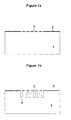
- Figure 1 a is a diagram of the openings made in a photoresist mask on the first substrate
- Figure 1b is a diagram of the substrate in Fig. 1a after DRIE etching of the pattern
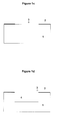
- Figure 1c is a diagram of the 2nd substrate with openings for the cavity mask
- Figure 1d is a diagram of the 2nd substrate after etching of the cavity
- Figure 1e is a diagram of the bonding of the two substrates shown in Fig. 1d and 1b;
- Figure If is a diagram of the two bonded substratew after back grinding
- Figure 2a is a diagram of the substrate with openings in a photoresist mask (the cavity mask);
- Figure 2b is a diagram of the substrate after etching of the cavity
- Figure 2c is a diagram of the substrate after stripping of the resist
- Figure 2d is a diagram of the substrate after spray coating photoresist
- Figure 2e is a diagram of the substrate after exposing and developing of the spray coated photoresist
- Figure 2f is a diagram of the substrate after DRIE etching of the pattern in Fig 2e;
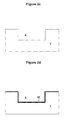
- Figure 3a is a diagram of the substrate shown in 2b after flip out-side-down and photolithography on the backside;
- Figure 3b is a diagram of the substrate shown in 3a after DRIE etching of the pattern in Fig.3a;
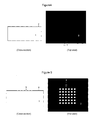
- Figure4 is a diagram of the substrate covered with the mask film (Cross section and Top view);
- Figure 5 is a diagram of the openings made in the mask. (Cross section and Top view);
- Figure 6a is a diagram of isotropic etch of the bulk substrate
- Figure 6b is a diagram of the cavity etched under the mask (Cross section and Top view);
- Figure 6c is a SEM image of a cavity etched under a photoresist mask
- Figure 6d is a SEM image of a cavity etched under a silicon oxide mask
- Figure 7a is a diagram of the etched structure created by DRIE in the bottom of the cavity
- Figure 7b is a SEM image of an etched pattern in the bottom of the cavity using photoresist mask
- Figure 7c is a SEM image of an etched pattern in the bottom of the cavity using silicon oxide mask
- Figure 7d is a SEM image of an etched pattern in the bottom of the cavity using silicon oxide mask
- Figure 8a is a diagram of the micro-machined structure after stripping of the mask layer
- Figure 8b is a SEM image of a micro-machined structure after stripping
- Fig. 9a is a diagram of the micro-machined structure with an etch stop layer.
- Fig. 9b is a SEM image of a micro-machined structure with an etch stop layer.
- Fig.4 shows a silicon substrate 1 covered with a photoresist mask 2.
- the photoresist is then exposed and developed with photolithography technique to produce a patterned mask 3 shown in Fig 5.
- the patterned mask presented here is photoresist but this material could be any patterned material that is chemically non reactive with the processing gases used to create the cavity.
- the mask needs to show enough strain to hold as a cantilever membrane above the intended cavity.
- commonly used masks are silicon oxide, silicon nitride, metal and spin on glass. They are usually patterned using photolithography and selective stripping. It then leaves the film as the patterned mask 3 in Fig 5.
- Another way to form a mask is to etch throughout the whole depth of a first substrate (not shown).
- Pattern mask that can hold in tension above the cavity, and which the intrinsic nature is etched at a slower rate than the substrate. Furthermore, the initial thickness needs to be larger than the thickness involuntary etched during the whole process.
- the substrate is then exposed to a spontaneously reacting enchants species that tend to etch isotropicaly. This is shown in Fig.6a.
- the cavities etched under each opening of the mask 3 will rapidly joint to form a large cavity 4, shown in Fig.6b.
- a dry etching technique it is preferable to use a dry etching technique.
- liquid etching techniques would require special handlings to prevent membrane breaking, membrane stiction or in order to prevent liquid to be trapped in the cavity 4.
- any possible residues need to be avoided in order to process the next step of the invention.
- the cavity was produced using fluorine - rich plasma. Fluorine ions easily react with silicon to form volatile species.
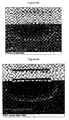
- Fig. 6c and Fig.6d show Scanning Electron Microscopy (SEM) images of cavities formed under a photoresist mask and a silicon oxide mask respectively.
- the thick photoresist mask with a square above the oxide in Fig. 6d is not necessary for the invention. It was used for other purposes.
- These cavities were produced using the ICP system ASE HRM from Surface Technology System (STS), with a radio-frequency power (RF power) on the coil only (at 3000W and 2000W for Fig. 6c and 6d respectively and, no power applied on the substrate holder), a flow of sulphur hexafluoride; SF6, (500sccm and 350sccm for Fig.
- SEM Scanning Electron Microscopy
- a DRIE technique is used to create etched structures 5 into the bottom of the cavity that respects the image of the suspended mask.
- the DRIE technique needs to be capable of high aspect ratios since the aspect ratios that need to be aimed are the total depth 6 over the mask opening dimension 3 rather than, only the depth of the pattern 5 over the mask opening 3.
- Many DRIE techniques can be used as shown in the literature ( U.S.Pat. 5,501,893 , and 6,127,273 ). This is generally done in an inductively coupled plasma (ICP) system.
- ICP inductively coupled plasma
- Fig. 7b, 7c and 7d show three SEM micrographs of patterns in the bottom of a cavity under a photoresist and 2 oxide masks.
- the cavity and the etched pattern were done sequentially in the ICP system ASE HRM STS.
- the anisotropic etch was performed using the technique described in U.S.Pat. 5,501,893 , and 6,127,273 known as the "Bosch" technique.
- Fig. 7b, 7c and 7d show three SEM micrographs of patterns in the bottom of a cavity under a photoresist and 2 oxide masks.
- the cavity and the etched pattern were done sequentially in the ICP system ASE HRM STS.
- the anisotropic etch was performed using the technique described in U.S.Pat. 5,501,893 , and 6,127,273 known as the "Bosch" technique.
- the mask can optionally be selectively stripped to show a final cavity with pattern in the bottom without membrane.
- Fig. 8b shows a SEM micrograph of a real device.
- FIG. 9a illustrates the usage of an etch stop 7.
- Fig. 9b shows a SEM image of a device made in Dalsa (Bromont, Canada) (silicon oxide is the etch stop in this case).
- This etch stop is deposited or grown on the other face of the substrate.
- This etch stop 7 is necessary since the back side of the substrate usually needs to be cooled with an inert gas (generally helium) that keep the temperature of the substrate stable during DRIE etching. Losing cooling when pinching through would cause loss of dimensions and erosion of the back face.
- an inert gas generally helium
- cavity etching and DRIE patterning can be done in situ within the same piece of equipment. However, it could be done in two pieces of equipments if desired. Using one mask and one etching equipment leads higher throughputs.
Landscapes
- Engineering & Computer Science (AREA)
- Chemical & Material Sciences (AREA)
- Manufacturing & Machinery (AREA)
- Dispersion Chemistry (AREA)
- Analytical Chemistry (AREA)
- Microelectronics & Electronic Packaging (AREA)
- Drying Of Semiconductors (AREA)
- Micromachines (AREA)
- Pressure Sensors (AREA)
- Internal Circuitry In Semiconductor Integrated Circuit Devices (AREA)
Applications Claiming Priority (1)
| Application Number | Priority Date | Filing Date | Title |
|---|---|---|---|
| US11/227,065 US7439093B2 (en) | 2005-09-16 | 2005-09-16 | Method of making a MEMS device containing a cavity with isotropic etch followed by anisotropic etch |
Publications (2)
| Publication Number | Publication Date |
|---|---|
| EP1764343A2 true EP1764343A2 (de) | 2007-03-21 |
| EP1764343A3 EP1764343A3 (de) | 2008-05-28 |
Family
ID=37561007
Family Applications (1)
| Application Number | Title | Priority Date | Filing Date |
|---|---|---|---|
| EP06120739A Withdrawn EP1764343A3 (de) | 2005-09-16 | 2006-09-15 | Verfahren zum Ätzen eines strukturierten Hohlraums mit einer einzigen Maske |
Country Status (2)
| Country | Link |
|---|---|
| US (1) | US7439093B2 (de) |
| EP (1) | EP1764343A3 (de) |
Cited By (4)
| Publication number | Priority date | Publication date | Assignee | Title |
|---|---|---|---|---|
| WO2010124909A1 (de) * | 2009-04-29 | 2010-11-04 | Epcos Ag | Mems mikrofon |
| CN103578965B (zh) * | 2012-07-31 | 2016-08-03 | 无锡华润上华半导体有限公司 | 两种腐蚀深度的一次成形方法 |
| WO2017075766A1 (en) * | 2015-11-03 | 2017-05-11 | Goertek. Inc | Mems microphone chip trimming method, apparatus, manufacturing method and microphone |
| CN110013999A (zh) * | 2019-05-17 | 2019-07-16 | 电子科技大学 | 一种基于惰性离子束刻蚀的氚污染光学膜无损去除方法 |
Families Citing this family (11)
| Publication number | Priority date | Publication date | Assignee | Title |
|---|---|---|---|---|
| NL1034489C2 (nl) | 2007-10-09 | 2009-04-14 | Micronit Microfluidics Bv | Werkwijzen voor het vervaardigen van een microstructuur. |
| DE102008040597A1 (de) * | 2008-07-22 | 2010-01-28 | Robert Bosch Gmbh | Mikromechanisches Bauelement mit Rückvolumen |
| US7951636B2 (en) * | 2008-09-22 | 2011-05-31 | Solid State System Co. Ltd. | Method for fabricating micro-electro-mechanical system (MEMS) device |
| US10570005B2 (en) | 2008-12-16 | 2020-02-25 | Massachusetts Institute Of Technology | Method and apparatus for release-assisted microcontact printing of MEMS |
| US8963262B2 (en) * | 2009-08-07 | 2015-02-24 | Massachusettes Institute Of Technology | Method and apparatus for forming MEMS device |
| US8739390B2 (en) * | 2008-12-16 | 2014-06-03 | Massachusetts Institute Of Technology | Method for microcontact printing of MEMS |
| US8603848B2 (en) * | 2009-08-25 | 2013-12-10 | Electronics And Telecommunications Research Institute | Three-dimensional MEMS structure and method of manufacturing the same |
| CN102530831B (zh) | 2010-12-27 | 2014-05-21 | 上海丽恒光微电子科技有限公司 | Mems器件的制作方法 |
| US8643140B2 (en) | 2011-07-11 | 2014-02-04 | United Microelectronics Corp. | Suspended beam for use in MEMS device |
| US10858241B2 (en) | 2015-04-09 | 2020-12-08 | Rensselaer Polytechnic Institute | Enhanced control of shuttle mass motion in MEMS devices |
| US10986435B2 (en) | 2017-04-18 | 2021-04-20 | Massachusetts Institute Of Technology | Electrostatic acoustic transducer utilized in a hearing aid or audio processing system |
Citations (7)
| Publication number | Priority date | Publication date | Assignee | Title |
|---|---|---|---|---|
| US6500348B2 (en) | 2001-02-14 | 2002-12-31 | Delphi Technologies, Inc. | Deep reactive ion etching process and microelectromechanical devices formed thereby |
| US20030210799A1 (en) | 2002-05-10 | 2003-11-13 | Gabriel Kaigham J. | Multiple membrane structure and method of manufacture |
| US6685844B2 (en) | 2001-02-14 | 2004-02-03 | Delphi Technologies, Inc. | Deep reactive ion etching process and microelectromechanical devices formed thereby |
| US6712983B2 (en) | 2001-04-12 | 2004-03-30 | Memsic, Inc. | Method of etching a deep trench in a substrate and method of fabricating on-chip devices and micro-machined structures using the same |
| US6767614B1 (en) * | 2000-12-19 | 2004-07-27 | Wolfgang M. J. Hofmann | Multiple-level actuators and clamping devices |
| EP1441561A2 (de) | 2003-01-23 | 2004-07-28 | Akustica Inc. | Verfahren zur Herstellung und akustischen Verbindung von Strukturen auf einem Substrat |
| EP1529753A2 (de) | 2003-11-05 | 2005-05-11 | Akustica Inc. | Herstellung von sehr dünnen MEMS Mikrophonen und Mikrolautsprechern |
Family Cites Families (4)
| Publication number | Priority date | Publication date | Assignee | Title |
|---|---|---|---|---|
| DE4241045C1 (de) * | 1992-12-05 | 1994-05-26 | Bosch Gmbh Robert | Verfahren zum anisotropen Ätzen von Silicium |
| DE19641288A1 (de) * | 1996-10-07 | 1998-04-09 | Bosch Gmbh Robert | Verfahren zum anisotropen Plasmaätzen verschiedener Substrate |
| DE60106577T8 (de) * | 2001-05-31 | 2006-04-27 | Alcatel | Abnehmbare Schirmvorrichtung für Plasmareaktoren |
| US7081370B2 (en) * | 2002-09-04 | 2006-07-25 | Mitsubishi Denki Kabushiki Kaisha | Silicon substrate apparatus and method of manufacturing the silicon substrate apparatus |
-
2005
- 2005-09-16 US US11/227,065 patent/US7439093B2/en not_active Expired - Fee Related
-
2006
- 2006-09-15 EP EP06120739A patent/EP1764343A3/de not_active Withdrawn
Patent Citations (7)
| Publication number | Priority date | Publication date | Assignee | Title |
|---|---|---|---|---|
| US6767614B1 (en) * | 2000-12-19 | 2004-07-27 | Wolfgang M. J. Hofmann | Multiple-level actuators and clamping devices |
| US6500348B2 (en) | 2001-02-14 | 2002-12-31 | Delphi Technologies, Inc. | Deep reactive ion etching process and microelectromechanical devices formed thereby |
| US6685844B2 (en) | 2001-02-14 | 2004-02-03 | Delphi Technologies, Inc. | Deep reactive ion etching process and microelectromechanical devices formed thereby |
| US6712983B2 (en) | 2001-04-12 | 2004-03-30 | Memsic, Inc. | Method of etching a deep trench in a substrate and method of fabricating on-chip devices and micro-machined structures using the same |
| US20030210799A1 (en) | 2002-05-10 | 2003-11-13 | Gabriel Kaigham J. | Multiple membrane structure and method of manufacture |
| EP1441561A2 (de) | 2003-01-23 | 2004-07-28 | Akustica Inc. | Verfahren zur Herstellung und akustischen Verbindung von Strukturen auf einem Substrat |
| EP1529753A2 (de) | 2003-11-05 | 2005-05-11 | Akustica Inc. | Herstellung von sehr dünnen MEMS Mikrophonen und Mikrolautsprechern |
Cited By (6)
| Publication number | Priority date | Publication date | Assignee | Title |
|---|---|---|---|---|
| WO2010124909A1 (de) * | 2009-04-29 | 2010-11-04 | Epcos Ag | Mems mikrofon |
| US8571239B2 (en) | 2009-04-29 | 2013-10-29 | Epcos Ag | MEMS microphone |
| CN103578965B (zh) * | 2012-07-31 | 2016-08-03 | 无锡华润上华半导体有限公司 | 两种腐蚀深度的一次成形方法 |
| WO2017075766A1 (en) * | 2015-11-03 | 2017-05-11 | Goertek. Inc | Mems microphone chip trimming method, apparatus, manufacturing method and microphone |
| CN110013999A (zh) * | 2019-05-17 | 2019-07-16 | 电子科技大学 | 一种基于惰性离子束刻蚀的氚污染光学膜无损去除方法 |
| CN110013999B (zh) * | 2019-05-17 | 2021-06-29 | 电子科技大学 | 一种基于惰性离子束刻蚀的氚污染光学膜无损去除方法 |
Also Published As
| Publication number | Publication date |
|---|---|
| US20070065967A1 (en) | 2007-03-22 |
| US7439093B2 (en) | 2008-10-21 |
| EP1764343A3 (de) | 2008-05-28 |
Similar Documents
| Publication | Publication Date | Title |
|---|---|---|
| US7439093B2 (en) | Method of making a MEMS device containing a cavity with isotropic etch followed by anisotropic etch | |
| Li et al. | Direct three-dimensional patterning using nanoimprint lithography | |
| EP0683921B1 (de) | Mikrostrukturen und einzelmask, einkristall-herstellungsverfahren | |
| US7049051B2 (en) | Process for forming and acoustically connecting structures on a substrate | |
| USRE36305E (en) | Method for fabrication of close-tolerance lines and sharp emission tips on a semiconductor wafer | |
| WO2009154173A1 (ja) | 多段型基板の製造方法 | |
| US7078337B2 (en) | Selective isotropic etch for titanium-based materials | |
| US11978658B2 (en) | Method for manufacturing a polysilicon SOI substrate including a cavity | |
| TW200806567A (en) | Method of deep etching | |
| US9070699B2 (en) | Micromachined structures | |
| Zhang et al. | Fabrication of submicron high-aspect-ratio GaAs actuators | |
| JP4264417B2 (ja) | マイクロマシニング型の装置、特にマイクロマシニング型の旋回ミラー装置を製作するための方法 | |
| US20090014296A1 (en) | Contact configurations for MEMS relays and MEMS switches and method for making same | |
| JP5341579B2 (ja) | 微細構造体の製造方法 | |
| US6472332B1 (en) | Surface micromachined structure fabrication methods for a fluid ejection device | |
| Kuehl et al. | Advanced silicon trench etching in MEMS applications | |
| JP4384844B2 (ja) | マイクロ素子のための膜構造,膜構造を含むマイクロ素子,及び膜構造を作るための方法 | |
| KR20090063131A (ko) | 반도체 장치의 제조 방법 | |
| TWI229377B (en) | Method for forming cavities having different aspect ratios | |
| JP2008264951A (ja) | 傾斜形状の加工方法 | |
| US6429034B1 (en) | Method of making high aspect ratio features during surface micromachining | |
| JP2006500232A (ja) | 形成方法及びマイクロメカニックスの構成要素 | |
| KR100712336B1 (ko) | 프리즘의 제조방법 | |
| KR100320190B1 (ko) | 고주파 스위치의 구조 및 그 제조방법 | |
| de Boer et al. | Self-Aligned Formation and Positioning of Nanogap Templates |
Legal Events
| Date | Code | Title | Description |
|---|---|---|---|
| PUAI | Public reference made under article 153(3) epc to a published international application that has entered the european phase |
Free format text: ORIGINAL CODE: 0009012 |
|
| AK | Designated contracting states |
Kind code of ref document: A2 Designated state(s): AT BE BG CH CY CZ DE DK EE ES FI FR GB GR HU IE IS IT LI LT LU LV MC NL PL PT RO SE SI SK TR |
|
| AX | Request for extension of the european patent |
Extension state: AL BA HR MK YU |
|
| PUAL | Search report despatched |
Free format text: ORIGINAL CODE: 0009013 |
|
| AK | Designated contracting states |
Kind code of ref document: A3 Designated state(s): AT BE BG CH CY CZ DE DK EE ES FI FR GB GR HU IE IS IT LI LT LU LV MC NL PL PT RO SE SI SK TR |
|
| AX | Request for extension of the european patent |
Extension state: AL BA HR MK RS |
|
| 17P | Request for examination filed |
Effective date: 20081002 |
|
| 17Q | First examination report despatched |
Effective date: 20081106 |
|
| AKX | Designation fees paid |
Designated state(s): DE FR GB |
|
| RAP1 | Party data changed (applicant data changed or rights of an application transferred) |
Owner name: TELEDYNE DALSA SEMICONDUCTOR INC. |
|
| STAA | Information on the status of an ep patent application or granted ep patent |
Free format text: STATUS: THE APPLICATION IS DEEMED TO BE WITHDRAWN |
|
| 18D | Application deemed to be withdrawn |
Effective date: 20121211 |