EP1764344B1 - Silice de précipitation présentant une distribution granulométrique particulière - Google Patents
Silice de précipitation présentant une distribution granulométrique particulière Download PDFInfo
- Publication number
- EP1764344B1 EP1764344B1 EP06115480A EP06115480A EP1764344B1 EP 1764344 B1 EP1764344 B1 EP 1764344B1 EP 06115480 A EP06115480 A EP 06115480A EP 06115480 A EP06115480 A EP 06115480A EP 1764344 B1 EP1764344 B1 EP 1764344B1
- Authority
- EP
- European Patent Office
- Prior art keywords
- process according
- precipitated silica
- metal silicate
- silica
- rubber
- Prior art date
- Legal status (The legal status is an assumption and is not a legal conclusion. Google has not performed a legal analysis and makes no representation as to the accuracy of the status listed.)
- Active
Links
Images

Classifications
-
- C—CHEMISTRY; METALLURGY
- C01—INORGANIC CHEMISTRY
- C01B—NON-METALLIC ELEMENTS; COMPOUNDS THEREOF; METALLOIDS OR COMPOUNDS THEREOF NOT COVERED BY SUBCLASS C01C
- C01B33/00—Silicon; Compounds thereof
- C01B33/113—Silicon oxides; Hydrates thereof
- C01B33/12—Silica; Hydrates thereof, e.g. lepidoic silicic acid
-
- C—CHEMISTRY; METALLURGY
- C01—INORGANIC CHEMISTRY
- C01B—NON-METALLIC ELEMENTS; COMPOUNDS THEREOF; METALLOIDS OR COMPOUNDS THEREOF NOT COVERED BY SUBCLASS C01C
- C01B33/00—Silicon; Compounds thereof
- C01B33/113—Silicon oxides; Hydrates thereof
- C01B33/12—Silica; Hydrates thereof, e.g. lepidoic silicic acid
- C01B33/18—Preparation of finely divided silica neither in sol nor in gel form; After-treatment thereof
- C01B33/187—Preparation of finely divided silica neither in sol nor in gel form; After-treatment thereof by acidic treatment of silicates
- C01B33/193—Preparation of finely divided silica neither in sol nor in gel form; After-treatment thereof by acidic treatment of silicates of aqueous solutions of silicates
-
- B—PERFORMING OPERATIONS; TRANSPORTING
- B60—VEHICLES IN GENERAL
- B60C—VEHICLE TYRES; TYRE INFLATION; TYRE CHANGING; CONNECTING VALVES TO INFLATABLE ELASTIC BODIES IN GENERAL; DEVICES OR ARRANGEMENTS RELATED TO TYRES
- B60C1/00—Tyres characterised by the chemical composition or the physical arrangement or mixture of the composition
-
- B—PERFORMING OPERATIONS; TRANSPORTING
- B60—VEHICLES IN GENERAL
- B60C—VEHICLE TYRES; TYRE INFLATION; TYRE CHANGING; CONNECTING VALVES TO INFLATABLE ELASTIC BODIES IN GENERAL; DEVICES OR ARRANGEMENTS RELATED TO TYRES
- B60C1/00—Tyres characterised by the chemical composition or the physical arrangement or mixture of the composition
- B60C1/0016—Compositions of the tread
-
- C—CHEMISTRY; METALLURGY
- C01—INORGANIC CHEMISTRY
- C01B—NON-METALLIC ELEMENTS; COMPOUNDS THEREOF; METALLOIDS OR COMPOUNDS THEREOF NOT COVERED BY SUBCLASS C01C
- C01B33/00—Silicon; Compounds thereof
- C01B33/113—Silicon oxides; Hydrates thereof
- C01B33/12—Silica; Hydrates thereof, e.g. lepidoic silicic acid
- C01B33/18—Preparation of finely divided silica neither in sol nor in gel form; After-treatment thereof
-
- C—CHEMISTRY; METALLURGY
- C08—ORGANIC MACROMOLECULAR COMPOUNDS; THEIR PREPARATION OR CHEMICAL WORKING-UP; COMPOSITIONS BASED THEREON
- C08K—Use of inorganic or non-macromolecular organic substances as compounding ingredients
- C08K3/00—Use of inorganic substances as compounding ingredients
- C08K3/34—Silicon-containing compounds
- C08K3/36—Silica
-
- C—CHEMISTRY; METALLURGY
- C01—INORGANIC CHEMISTRY
- C01P—INDEXING SCHEME RELATING TO STRUCTURAL AND PHYSICAL ASPECTS OF SOLID INORGANIC COMPOUNDS
- C01P2006/00—Physical properties of inorganic compounds
- C01P2006/12—Surface area
-
- C—CHEMISTRY; METALLURGY
- C01—INORGANIC CHEMISTRY
- C01P—INDEXING SCHEME RELATING TO STRUCTURAL AND PHYSICAL ASPECTS OF SOLID INORGANIC COMPOUNDS
- C01P2006/00—Physical properties of inorganic compounds
- C01P2006/16—Pore diameter
- C01P2006/17—Pore diameter distribution
-
- C—CHEMISTRY; METALLURGY
- C01—INORGANIC CHEMISTRY
- C01P—INDEXING SCHEME RELATING TO STRUCTURAL AND PHYSICAL ASPECTS OF SOLID INORGANIC COMPOUNDS
- C01P2006/00—Physical properties of inorganic compounds
- C01P2006/19—Oil-absorption capacity, e.g. DBP values
Definitions
- the present invention relates to precipitated silicas which have a particularly broad pore size distribution of the pores having a pore diameter smaller than the maximum of the derivative of the pore volume distribution function, at the same time low microporosity and high rubber activity, a process for their preparation and their use as a filler for rubber mixtures.
- silicas as reinforcing filler in rubber mixtures, as used, inter alia, for the production of air-filled tires and technical rubber articles, high demands are made. They are said to be easily and well incorporated and dispersible in rubber and, in conjunction with a coupling reagent, preferably a bifunctional organosilicon compound, to form a chemical compound with the rubber resulting in the desired high level of rubber compound enhancement.
- a coupling reagent preferably a bifunctional organosilicon compound
- the reinforcing property can be fixed to high static stress values and a low abrasion value.
- the particle size, surface morphology, surface activity and binding capacity of the coupling reagent are of particular importance for the reinforcing property of the silicic acids.
- the coupling reagent usually a bifunctional organosilicon compound
- S. Wolff “Chemical Aspects of Rubber Reinforcement by Fillers", Rubber Chem. Technol. 69, 325 (1996 )
- the rubber-effective surface should be as homogeneous as possible and modify quantitatively.
- the modification can be carried out by pre-loading the silica in bulk or in solution / suspension (ex-situ) ( U. Görl, R. Panenka, "Silanized Silicas - A New Product Class for Contemporary Mix Development", Kautsch. Rubber art st. 46, 538 (1993 )) and during the Compounds, paper No.
- a high DBP number is necessary to ensure optimum dispersion of the filler in the rubber.
- a moisture content of> 4% is necessary to ensure rapid and complete silanization of the silica surface with an organosilicon compound ( U. Görl, A. Hunsche, A. Müller, HG Koban, "Investigations into the Silica / Silane Reaction System", Rubber Chem. Technol. 70, 608 (1997 )).
- the humidity is typically between 4 and 8%.
- WO 2003016215 are described silica having a void ratio of V (d5-d50) / V (d5-d100)> 0.66.
- the EP 0942029 in turn discloses silicas for elastomer blends having two different types of aggregates.
- EP 1295850 A1 are precipitated silicas known with a BET / CTAB ratio greater than 1.3. Furthermore, are off EP 0983966 A1 Al 2 O 3 doped silicas are known
- the object of the present invention was to provide precipitated silicas and a process for their preparation which are particularly suitable as reinforcers in elastomer mixtures. Furthermore, a process for the preparation of the silicas according to the invention is to be made available.
- the present invention relates to precipitated silicas characterized by the following physico-chemical parameters: relative width ⁇ of the pore size distribution 4.0 to 10.0 (g nm) / ml, BET surface area 90 to 320 m 2 / g, CTAB surface 100 to 200 m 2 / g. Sears number V 2 25 to 40 ml / (5 g), Sears number V 2 / CTAB ratio 0.16 to 0.28 ml / (5 m 2 ), BET / CTAB quotient 0.90 to 1.30.
- the invention also provides precipitated silicas which, in addition to the parameters mentioned, independently of one another, have one or more of the following physico-chemical parameters: BET / CTAB ratio greater than 0.9 to 1.30, Zeta potential at pH 5 -12 to -30 mV, DBP number 200 to 330 g / (100 g), primary 10 - 40 nm, Al 2 O 3 content ⁇ 5% by weight, Sieve residue (Ro-Tap,> 300 ⁇ m) ⁇ 80% by weight, Sieve fraction (Ro-Tap, ⁇ 75 ⁇ m) ⁇ 10% by weight, Carbon content 0.1 to 20.0% by weight and in the form of powders or in the form of approximately spherical particles (microgranules) or as granules.
- Another object of the present invention is a process for the preparation of precipitated silicas according to the invention.
- Another object of the present invention is the use of the silicas according to the invention in elastomer mixtures, vulcanizable rubber mixtures and / or other vulcanizates, such as pneumatic tires, tire treads, Cable jackets, hoses, belts, conveyor belts, V-belts, roller coverings, tires, soles, gaskets and damping elements.
- elastomer mixtures such as pneumatic tires, tire treads, Cable jackets, hoses, belts, conveyor belts, V-belts, roller coverings, tires, soles, gaskets and damping elements.
- Another object of the invention are elastomer blends, vulcanizable rubber blends or other vulcanizates and tires containing the silicas of the invention.
- the precipitated silicas according to the invention have, inter alia, the advantage that they cause a low hysteresis after their incorporation into rubber, ie cause a low heat buildup in the case of mechanical-dynamic loading of the mixture and consequently produce, for example, B. generate a low rolling resistance of a tire. Further, a good dispersion coefficient and a high reinforcement are achieved to produce a low abrasion of the tire.
- silanol groups on the silica surface function in rubber or rubber mixtures as possible chemical reactants with a coupling reagent.
- a coupling reagent for example, a bifunctional silane such as bis (3-triethoxysilylpropyl) tetrasulfan or bis (3-triethoxysilylpropyl) disulfane, which allows the attachment of the silica to the rubber matrix.
- the low zeta potential at pH 5 also contributes to an advantageously high rubber activity and crosslinking density.
- silica and precipitated silica are used synonymously.
- the silicas according to the invention have a broad pore size distribution of the pores with a pore diameter smaller than that of the maximum of the derivative of the pore volume distribution function, which is determined by means of mercury porosimetry. Since silicas can be present in various dosage forms -. For example, in the form of powders, spherical particles or granules - must be made to obtain a non-dosage form of the measurement, previously carried out a mechanical pressure treatment of the silica.
- the determined by means of mercury porosimetry pore volume in the range of 3.5 nm to 5 microns is evaluated.
- an algorithm is applied to the data of the negative logarithmic derivative of the cumulative pore volume, which first determines the most common, characteristic pore diameter. This is more typical Way in the range of 10 to 100 nm. Starting from this value, the further evaluation takes place according to the information in the experimental part. This gives a relative width ⁇ of the pore size distribution, which takes into account asymmetrical pore size distributions.
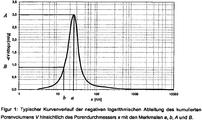
- the relative width ⁇ is a characteristic, independent of the dosage form and to be determined well reproducible feature, which only describes the pores, which have a smaller diameter than the most common pores (see. FIG. 1 ).
- This pore size range corresponds predominantly to the pore volume between the primary particles which have grown together to form silica aggregates and permits a statement about their aggregation.
- the relative width ⁇ of the pore size distribution causes after incorporation of the precipitated silicas in rubber, inter alia, a low hysteresis and thus ensures a low rolling resistance of a tire.
- the relative width ⁇ of the pore size distribution is in the range of 4.0 to 10.0 (g nm) / ml, preferably 4.3 to 8.5 (g nm) / ml, and more preferably 4.5 to 8.5 (g nm) / ml and from 4.5 to 7.5 (g nm) / ml.
- the precipitated silicas according to the invention also have a high absolute Sears number V 2 .
- the Sears number V 2 is a measure describing the silanol group number of the silica.
- the Sears number V 2 of the silicic acids according to the invention is preferably in the range from 26 to 40 ml / (5 g), more preferably from 26 to 36 ml / (5 g) and most preferably from 26 to 33 ml / (5 g) and 27 to 31 ml / (5 g).
- the indication of the absolute number of silanol groups alone is not always suitable for sufficiently characterizing a precipitated silica, since precipitated silicas having a high surface area generally have a higher absolute number of silanol groups than precipitated silicas having a low surface area.
- the Sears number V 2 must be related to the surface area of the silica.
- the CTAB surface is more important than the BET surface, since it represents a measure of the surface accessible from the outside and thus available for crosslinking with the rubber system. Therefore, the quotient Searsiere V 2 / CTAB is important .
- the amplification potential generated by the silanol groups per introduced outer surface and thereby the coupling partner accessible, specific surface is represented.
- the silicic acids according to the invention are distinguished by a greatly increased ratio of the Sears number V 2 to the CTAB surface of 0.16 to 0.28 ml / (5 m 2 ) compared to precipitated silicas of the prior art.
- the Precipitated silicas according to the invention have a very high number of silanol groups, especially with respect to the external surface.
- the ratio of Sears number V 2 to CTAB surface area is in the range of 0.16 to 0.26 ml / (5 m 2 ), and more preferably from 0.16 to 0.25 ml / (5 m 2 ), especially preferably from 0.17 to 0.24 ml / (5 m 2 ) and from 0.19 to 0.24 ml / (5 m 2 ).
- the specific CTAB surface is of crucial importance mainly for the reinforcing property of silica (cf. Janzen, Kraus, Rubber Chem. Technol. 44, 1287 (1971 )).
- the gain potential increases with increasing CTAB surface area.
- the precipitated silicas according to the invention are distinguished by a CTAB surface area of from 100 to 200 m 2 / g, preferably from 105 to 195 m 2 / g, particularly preferably from 110 to 190 m 2 / g and very particularly preferably from 110 to 180 m 2 / g and 110 to 175 m 2 / g.
- the CTAB surface area is in the range of 100 to 139 m 2 / g, and preferably in the range of 105 to 134 m 2 / g.
- the precipitated silicas according to the invention have a CTAB surface area of from 141 to 200 m 2 / g and preferably from 145 to 190 m 2 / g and from 145 to 175 m 2 / g.
- the BET specific surface area describes the influence of the silica on the incorporation behavior into the rubber, the raw mixture properties and the vulcanization kinetics (see S. Brunauer, PH Emmett, E. Teller, "Adsorption of Gases in Multimolecular Layers", J. Am Soc., 60, 309 (1938)).
- the silicic acids according to the invention are distinguished by a BET surface area of from 90 to 320 m 2 / g, preferably from 100 to 250 m 2 / g, more preferably from 105 to 220 m 2 / g and from 105 to 160 m 2 / g and 105 up to 135 m 2 / g.
- the silicas of the invention are distinguished by a BET surface area of from 125 to 250 m 2 / g, preferably from 141 to 240 m 2 / g and especially from 155 to 220 m 2 / g.
- the surface activity as well as the attachment capacity of the coupling reagent to the silica, as well as the polymer / silica interaction can be obtained by the determination of the zeta potential .
- the sound waves are detected, which emanate from an aqueous suspension of silica at a given pH in a high-frequency electric field. These arise due to the surface charges of the silica and thus represent a measure of the available for a reaction dissociated silanol groups for the coupling reaction.
- Die Silica according to the invention may advantageously have a zeta potential at pH 5 of -12 to -30 mV.
- the zeta potential is -12 to -25 mV, more preferably -13 to -21 mV.
- the silicas of the invention may have a DBP number of from 200 to 330 g / (100 g).
- the DBP number is preferably 250 to 330 g / (100 g) for powder and spherical particles (microgranulate) and 200 to 260 g / (100 g) for granules.
- the type of pores ie whether or not they are accessible to the rubber, is a further criterion of the silicas of the invention.
- the type of pores is described by the BETICTAB quotient .
- a high BET / CTAB quotient indicates a microporosity and thus a high proportion of "internal" - z.
- the BET / CTAB ratio of the silicas of the invention is in the range of 0.90 to less than or equal to 1.60, preferably in the range of 1.08 to 1.50, more preferably in the range of 1.10 to 1.40 , most preferably in the range of 1.10 to 1.30, and more preferably in the range of 1.12 to 1.25.
- the silicas according to the invention may have an aluminum oxide content of from 0.001 to 5% by weight, preferably from 0.001 to 0.5% by weight, particularly preferably from 0.01 to 0.3% by weight and very particularly from 0.01 to 0.15% by weight .-% exhibit.
- the precipitated silicas according to the invention can be present in various dosage forms.
- particle size d 50 from 1 to 80 microns.
- the powdery particles may have an irregular but also a regular outer shape, ie they may, for. B. also be substantially spherical.
- the precipitated silicas of the invention may also be present in the form of substantially spherical particles (microgranules) having a particle size d 50 of from 80 ⁇ m to 1000 ⁇ m determined by means of sieve residue determination (Alpine) .
- the Silica according to the invention preferably by means of nozzle tower drying, as in EP 0937755 described, and show a characteristic of this drying method outer shape (see figures in EP 0937755 ).
- the content of EP 0937755 is hereby explicitly included in the content of the present application.
- the precipitated silicas according to the invention are present in the form of granules (d 50 > 1000 ⁇ m (Alpine sieve residue)), they have a particle size distribution after granulation in such a way that at least 80% by weight of the particles are greater by means of screen residue determination (Ro-Tap) than 300 microns and at most 10 wt .-% are less than 75 microns.
- the said preferred ranges can be set independently of each other.
- the viscosity increase point corresponds to the time until the viscosity of the precipitation suspension increases steeply in the precipitation process, cf. to EP 0643015 ,
- the precipitation suspension is subjected to strong shearing by means of an additional shearing unit.
- the sulfuric acid is metered directly onto the shaving head of the additional shearing unit, so that an intensive mixing of the acid into the precipitation suspension and thus the most homogeneous and rapid distribution is ensured immediately.
- the original may be approximately 20, 30, 40, 50, 60, 70, 80 or 90% of the final volume of the precipitate.
- the basic compounds given for presentation are in particular selected from the group of alkali hydroxides, alkaline earth hydroxides, alkali metal carbonates, alkali hydrogen carbonates and alkali metal silicates.
- Sulfuric acid is preferably used as acidifier.
- other acidulants such as HCl, HNO 3 , H 3 PO 4 or CO 2 can also be used.
- the alkali metal or alkaline earth metal silicate used is preferably water glass (sodium silicate solution with a weight modulus of 2.0 to 3.5) and / or other silicates, such as potassium silicate or calcium silicate. Particularly preferably, water glass with a weight modulus of 3.2 to 3.5 and a density of 1.30 to 1.45 kg / l is used.
- the alkali number in the template (step a) and the alkali number during steps b) and / or d) is between 20 and 40, preferably between 20 and 35, particularly preferably between 25 and 35.
- step b) and / or d) is preferably carried out in such a way that the alkali number of the reaction solution is kept constant during the respective precipitation step.
- Constant is meant that the alkali number during the respective precipitation step by max. 2% may deviate from the nominal value.
- the components supplied in steps b) and d) may each have the same or different concentrations and / or inflow rates.
- the concentration of the components used in both steps is the same, but the inflow rate of the components in step d) is greater than in step b).
- the inflow rate of the components in step d) is 125-140% of the inflow rate in step b).
- step e) or the basic compound in step f) can be carried out at 40 to 98 ° C.
- the metered addition is carried out at 55 to 95 ° C and particularly preferably at the temperature which was also selected for the steps b) or d).
- an additional addition of organic or inorganic salts during steps a) to h) can take place.
- This can be carried out in solution or as a solid, in each case continuously over the addition time of the alkali and / or alkaline-earth silicate and the acidifier or as a batch addition. It is also possible to dissolve the salts in one or both components and then to add them simultaneously.
- step e) is carried out in two stages.
- the inflow rate of the acidifying agent is preferably 90 to 110% in the first partial step and preferably 40 to 60% of the inflow rate of step d) in the second partial step.
- Suitable organic salts are the salts of formic, acetic and propionic acids.
- said alkali or alkaline earth metal ions may be mentioned.
- the concentration of this Salts in the addition solution may be 0.01 to 5 mol / l.
- the inorganic salt used is Na 2 SO 4 .
- the filtration, liquefaction (eg according to DE 2447613 ) and long-term or short-term drying of the silicas according to the invention are familiar to the person skilled in the art and may, for. B. be read in the documents mentioned in the description.
- the filtration and washing of the silica is preferably carried out in such a way that the conductivity of the final product is ⁇ 2000 ⁇ S / cm and especially ⁇ 1300 ⁇ S / cm.
- the silica according to the invention is preferably dried in a current dryer, spray dryer, staged dryer, belt dryer, rotary tube dryer, flash dryer, spin-flash dryer or jet tower dryer. These drying variants include operation with an atomizer, a one- or two-fluid nozzle, or an integrated fluidized bed.
- the spray-drying can, for. B. according to US 4094771 be performed.
- the spray-dried particles may have average diameters of more than 15 ⁇ m, preferably 15 to 80 ⁇ m, measured by means of laser diffraction.
- the nozzle tower-dried particles preferably have average particle sizes, measured by sieve analysis (Alpine) of more than 80 ⁇ m, in particular more than 90 ⁇ m, preferably more than 200 ⁇ m.
- average particle sizes measured by sieve analysis (Alpine) of more than 80 ⁇ m, in particular more than 90 ⁇ m, preferably more than 200 ⁇ m.
- the granulation can be carried out, for example, using a roll press of the type WP 50N / 75 from Alexanderwerk AG, Remscheid.
- the powdery product is vented without further addition of binders or liquids via a horizontal feed system with single screw through a vacuum system and introduced evenly between the both sides mounted vertically arranged rollers.
- the powder is pressed into a scoop and brought by means of a crusher in the desired maximum granule size.
- the silicic acid according to the invention can be modified with linear, cyclic and / or branched silanes, silazanes, siloxane compounds and / or organosilicon compounds.
- the modification of the optionally granulated, ungranulated, ground and / or unmilled precipitated silica with one or more of said compounds can be carried out in mixtures of 0.5 to 50 parts, based on 100 parts of precipitated silica, in particular 1 to 15 parts and more particularly 1 to 10 parts , based on 100 parts of precipitated silica, wherein the reaction between precipitated silica and said compounds during the mixture preparation (in situ) or outside by spraying and then annealing the mixture, by mixing the modifying agent and the silica suspension, followed by drying and heat treatment (for example according to DE 3437473 and DE 19609619 ) or according to the method described in DE 19609619 or DE 4004781 can be carried out.
- the carbon content of the modified silica is 0.1 to 20 wt .-%, preferably 0.1 to 10 wt .-% and particularly preferably 0.5 to 5 wt .-%.
- Another object of the present invention is the use of silicas in elastomer blends, vulcanizable rubber blends and / or other vulcanizates, such as pneumatic tires, tire treads, cable sheaths, hoses, drive belts, conveyor belts, V-belts, roller coverings, tires, soles, seals and damping elements.
- silicas in elastomer blends, vulcanizable rubber blends and / or other vulcanizates, such as pneumatic tires, tire treads, cable sheaths, hoses, drive belts, conveyor belts, V-belts, roller coverings, tires, soles, seals and damping elements.
- the silica according to the invention can be used in elastomer mixtures, tires or vulcanizable rubber mixtures as reinforcing filler in amounts of from 5 to 200 Parts, based on 100 parts of rubber as a powder, spherical product or granules are mixed in both with and without organic aftertreatment.
- Rubber and elastomer mixtures are to be considered equivalent in the context of the present invention.
- the elastomer or rubber mixtures may additionally be filled with one or more more or less reinforcing fillers.
- the blend ratio also depends on the property profile of the finished rubber compound to be achieved. A ratio of 5 to 95% between the silicas of the invention and the other fillers mentioned above (also as a mixture) is conceivable and is also realized in this context.
- silica wholly or partly consisting of the silica according to the invention, optionally together with 0 to 100 parts by weight of carbon black, and 1 to 10 parts by weight of an organosilicon compound, in each case based on 100 parts by weight of rubber, are used for the preparation of the mixtures.
- the organosilanes and other fillers form another important constituent of the rubber mixture.
- these include elastomers, natural and synthetic, oil-extended or not, as a single polymer or blend with other rubbers, such as natural rubbers, polybutadiene (BR), polyisoprene (IR), styrene / butadiene copolymers having styrene contents of 1 to 60, preferably 2 to 50 wt .-% (SBR) in particular produced by the Engelspolymerisationsvons, butyl rubbers, isobutylene / isoprene copolymers (IIR), butadiene / acrylonitrile copolymers having acrylonitrile contents of 5 to 60, preferably 10 to 50 wt .-% (NBR), partially hydrogenated or fully hydrogenated NBR rubber (HNBR), ethylene / propylene / diene copolymers (
- rubber mixtures for the rubbers mentioned are the following additional rubbers: carboxyl rubbers, epoxide rubbers, trans-polypentenamer, halogenated butyl rubbers, rubbers of 2-chlorobutadiene, ethylene vinyl acetate copolymers, ethylene-propylene copolymers, if appropriate also chemical derivatives of natural rubber as well as modified natural rubbers.
- Preferred synthetic rubbers are for example at W. Hofmann, "Rubber Technology", Genter Verlag, Stuttgart 1980 , described.
- solution SBR anionically polymerized S-SBR rubbers having a glass transition temperature above -50 ° C and their mixtures with diene rubbers of interest.
- this silica and the preparation of the mixtures containing this silica is carried out in the usual manner in the rubber industry on an internal mixer or rolling mill at preferably 80 to 200 ° C.
- the dosage or use form of the silicas can be both as a powder, spherical product or granules.
- the rubber vulcanizates according to the invention may comprise further rubber auxiliaries in the customary dosages, such as reaction accelerators, anti-aging agents, heat stabilizers, light stabilizers, antiozonants, processing aids, Plasticizers, tackifiers, blowing agents, dyes, pigments, waxes, extenders, organic acids, retarders, metal oxides and activators, such as triethanolamine, polyethylene glycol and / or hexanetriol. These compounds are known in the rubber industry.
- the rubber auxiliaries can be used in known amounts, which depend inter alia on the intended use. Typical amounts are, for example, amounts of from 0.1 to 50% by weight, based on rubber. As crosslinkers sulfur or sulfur-donating substances can be used.
- the rubber mixtures according to the invention may additionally contain vulcanization accelerators. Examples of suitable main accelerators are mercaptobenzothiazoles, sulfenamides, thiurams, dithiocarbamates in amounts of from 0.5 to 3% by weight. Examples of co-accelerators are guanidines, thioureas and thiocarbonates in amounts of 0.5 to 5 wt .-%. Sulfur can usually be used in amounts of from 0.1 to 10% by weight, preferably from 1 to 3% by weight, based on rubber.
- the silicas of the invention can be used in rubbers which are crosslinkable with accelerators and / or sulfur, but also peroxide.
- the vulcanization of the rubber mixtures according to the invention can be carried out at temperatures of 100 to 200 ° C, preferably 130 to 180 ° C, optionally under pressure of 10 to 200 bar.
- the blending of the rubbers with the filler, optionally rubber auxiliaries and the organosilicon compound can be carried out in known mixing units, such as rollers, internal mixers and mixing extruders.
- the rubber mixtures of the invention are suitable for the production of moldings, for example for the production of pneumatic tires, tire treads for summer, winter and all-season tires, car tires, tires for commercial vehicles, motorcycle tires, tire sub-components, cable sheaths, hoses, drive belts, conveyor belts, roller coverings, Shoe soles, sealing rings and damping elements.
- the rubber mixtures of the invention are particularly suitable for the production of car and motorcycle tire treads but also tires for commercial vehicles with reduced rolling resistance with good abrasion resistance and good winter performance.
- the rubber mixtures according to the invention are suitable, without the addition of organosilicon compounds in the blend with a typical tread soot, also for improving the cut & chip behavior of construction, agricultural and pit tires (US Pat. For definition and further details see “New insights into the tear mechanism” and references herein, presented at the Tire Technology 2003 in Hamburg by Dr. med. W. Niedermeier ).
- reaction conditions and the physical / chemical data of the precipitated silicas according to the invention are determined by the following methods:
- the solids content of filter cake is determined by removing the volatiles at 105 ° C.
- the filter cake are weighed into a dry, tared porcelain dish (diameter 20 cm) (weight E). If necessary, the filter cake is comminuted with a spatula to obtain loose chunks of a maximum of 1 cm 3 .
- the sample is dried at 105 ⁇ 2 ° C in a drying oven to constant weight. The sample is then cooled to room temperature in a desiccator cabinet with silica gel as drying agent. The weight A is determined gravimetrically.
- the solids content of the precipitation suspension is determined gravimetrically after filtration of the sample.
- 100.0 ml of the homogenized precipitation suspension (V suspension ) are measured at room temperature using a measuring cylinder.
- the sample is sucked through a round filter (TYPE 572, from Schleicher & Schuell) in a porcelain chute, but not sucked dry to prevent cracking of the filter cake.
- the filter cake is washed with 100.0 ml of distilled water.
- the washed-out filter cake is transferred to a tared porcelain dish and dried at 105 ⁇ 2 ° C in a drying oven to constant weight. After cooling to room temperature, the weight of the dried silica (m sample ) is determined.
- the silicic acid feed is dried to constant weight in the IR drier.
- the drying loss consists predominantly of water moisture.
- the weight loss in% is displayed directly by the device when 0-100% mode is selected.
- the alkali number determination (AZ number) describes the consumption of hydrochloric acid in ml (at 50 ml sample volume, 50 ml of distilled water and a used hydrochloric acid of concentration 0.5 mol / l) in a direct potentiometric titration of alkaline solutions, or Suspensions up to a pH of 8.30.
- the free alkali content of the solution or suspension is hereby recorded.
- the pH device Kernick, type: 766 Calimatic pH meter with temperature sensor
- the pH electrode combination electrode from Schott, type N7680
- the combination electrode is immersed in the temperature-controlled at 40 ° C measurement solution or suspension consisting of 50.0 ml precipitation suspension and 50.0 ml of deionized water.
- hydrochloric acid solution of concentration 0.5 mol / l dropwise until a constant pH of 8.30 is established. Due to the slowly adjusting equilibrium between the silica and the free alkali content, a waiting time of 15 minutes is required for a final reading of the acid consumption.
- the read-out hydrochloric acid consumption in ml corresponds directly to the alkali number, which is given dimensionlessly.
- the determination of the pH of the silica is carried out as a 5% aqueous suspension at room temperature in accordance with DIN EN ISO 787-9. Compared to the requirements of this standard, the initial weights were changed (5.00 g of silica to 100 ml of deionized water).
- the determination of the electrical conductivity of silica is carried out as a 4% aqueous suspension at room temperature on the basis of DIN EN ISO 787-14. Compared with the requirements of this standard, the initial weight was changed (4.00 g of silica to 100 ml of deionized water).
- the moisture content of silica is determined according to ISO 787-2 after 2 hours of drying in a convection oven at 105 ° C. This drying loss consists predominantly of water moisture.
- the specific nitrogen surface area (hereinafter referred to as the BET surface area) of the powdery, spherical or granular silica is determined in accordance with ISO 5794-1 / Annex D using an AREA meter (Ströhlein, JUWE).
- the method is based on the adsorption of CTAB (N-hexadecyl-N, N, N-trimethylammonium bromide) on the "outer" surface of the silica based on ASTM 3765 or NFT 45-007 (Chapter 5.12.1.3).
- CTAB N-hexadecyl-N, N, N-trimethylammonium bromide
- CTAB adsorption of CTAB takes place in aqueous solution with stirring and ultrasound treatment.
- NDSS dioctyl sodium sulphosuccinate solution, "Aerosol OT” solution
- Titroprocessor a Titroprocessor
- the temperature during all operations is 23 - 25 ° C to prevent the crystallization of CTAB.
- the back titration is based on the following reaction equation:
- Titroprocessor METTLER Toledo Type DL 55 and Titroprocessor METTLER Toledo Type DL 70 each equipped with: pH electrode, manufactured by Mettler, type DG 111 and Phototrode, manufactured by Mettler, type DP 550 Titration cup 100 ml made of polypropylene Titration glass jar, 150 ml with lid Pressure filtration device, 100 ml content Cellulose nitrate membrane filter, pore size 0.1 ⁇ m, 47 mm ⁇ , z. B. Whatman (Order No. 7181-004)
- CTAB 0.015 mol / l in deionized water
- the consumption of NDSS solution for the titration of 5 ml of CTAB solution should be checked once a day before each series of measurements.
- the phototrode is set to 1000 ⁇ 20 mV before the beginning of the titration (corresponding to a transparency of 100%).
- Exactly 5.00 ml of CTAB solution are pipetted into a titration beaker and 50.0 ml of deionized water are added. While stirring, the titration with NDSS solution is carried out according to the well-known measurement method with the Titroprozessor DL 55 to the max. Turbidity of the solution. The consumption V A of NDSS solution in ml is determined. Each titration is to be carried out in triplicate.
- the titration vessel is closed with a lid and stirred with an Ultra Turrax T 25 stirrer (stirring shaft KV-18G, 18 mm diameter) at 18,000 rpm for a maximum of 1 minute until completely wetted.
- the titration vessel is screwed to the Titroprocessor DL 70 and the pH of the suspension is adjusted to 9 ⁇ 0.05 with KOH (0.1 mol / l).
- CTAB not humidity corrected V A - V B V A * C CTAB * M CTAB * T 1 * P e
- CTAB CTAB not humidity corrected in m 2 / G * 100 % 100 % - Humidity in %
- the moisture content of the silica is determined according to the described method "Determination of moisture".
- the DBP uptake is defined for anhydrous, dried silica. If moist precipitated silicas are used, the correction value K must be taken into account for calculating the DBP absorption. This value can be determined from the following correction table, eg. For example, a water content of the silica of 5.8% would mean a 33 g / (100 g) addition for DBP uptake.
- the moisture content of the silicic acid is determined according to the method "Determination of moisture or loss of drying".
- the modified Sears number (hereinafter called Sears number V 2 ) can be determined as a measure of the number of free silanol groups.
- the determination method is based on the following chemical reactions, where ⁇ SiOH is intended to symbolize a silanol group of the silica: ⁇ SiOH + NaCl ⁇ ⁇ SiONa + HCl HCl + KOH ⁇ KCl + H 2 O.
- the pH meter (Knick, type: 766 pH meter Calimatic with temperature sensor) and the pH electrode (combination electrode from Schott, type N7680) are added using buffer solutions (pH 7.00 and 9.00) Room temperature calibrated.
- the initial pH of the suspension is first measured at 25 ° C, then, depending on the result with potassium hydroxide solution (0.1 mol / l) or hydrochloric acid solution (0.1 mol / l) of the pH adjusted to 6.00.
- the consumption of KOH or HCI solution in ml up to pH 6.00 corresponds to V 1 '. Thereafter, 20.0 ml of sodium chloride solution (250.00 g of NaCl p.A., made up to 1 l with deionized water) are added. The titration is then carried out with 0.1 mol / l KOH up to a pH of 9.00. The consumption of KOH solution in ml up to pH 9.00 corresponds to V 2 '.
- V 1 'and V 2 ' are first normalized to the theoretical weight of 1 g and expanded with 5, resulting in V 1 and the Sears number V 2 in the units ml / (5 g).
- the relative width ⁇ of the pore size distribution of silica is determined by means of mercury porosimetry.
- the method is based on the Hg intrusion according to DIN 66133 (with a surface tension of 480 mN / m and a contact angle of 140 °), using an Autopore IV 9500 device from Micromeritics.
- the silica is subjected to a pressure treatment before the measurement.
- a Manual Hydraulic Press Order No. 15011 from Specac Ltd., River House, 97 Cray Avenue, Orpington, Kent BR5 4HE, U.K.
- a "pellet die” with 13 mm inner diameter of Fa. Specac Ltd.
- the sample is then relaxed and dried for 4 h at 105 ⁇ 2 ° C in a convection oven.
- the weight of the silica in the Penetrometer Type 10 is accurate to 0.001 g and is chosen for a good reproducibility of the measurement so that the "stem volume used", ie the percentage Hg volume used to fill the penetrometer 20% to 40%. Subsequently, the penetrometer is slowly evacuated to 50 .mu.m Hg and left for 5 min at this pressure.
- the operation of the Autopore device is carried out according to the operating instructions with the software version IV 1.05. Each measurement is corrected by one empty measurement of the penetrometer.
- the measuring range is 0.0025 - 420 MPa, whereby at least 136 equilibrium measurement points (device specific criterion of 10 s) are used (in the range 0.0025 - 0.25 MPa: 30 points, in the range 0.25 - 15 MPa: 53 points, 15 - 150 MPa: 40 points, in the range 150 - 420 MPa: 13 points). Possibly. If the incremental intrusion volume is> 0.04 ml / g, the software inserts additional measurement points. The smoothing of the intrusion curve takes place by means of the "smooth differentials" function of the device software.
- FIG. 1 A typical curve of the negative logarithmic derivative of the cumulative pore volume V according to equation 1 with respect to the pore diameter x with i measuring points and the features a , b, A and B is shown in FIG. 1 shown.
- the zeta potential of silica at pH 5 is determined by means of the electrokinetic sound amplitude (ESA).
- the sample is first dried at 105 ° C ⁇ 2 ° C for 5 h to constant weight and then 100 ml of a suspension with 1 vol .-% silica are prepared in distilled water.
- the required particle density is determined by means of He-pycnometry (DIN 66137-2).
- the dispersion is carried out for 5 minutes by means of an ultrasonic rod (Bandelin Sonopuls HD2200 with ultrasonic transducer UW2200, Power 100%, Cycle 8 (80% pulses, ie 0.8 s power and 0.2 s pause) with booster SH 213 G titanium plate TT 13, ⁇ 13 mm, immersion depth 1 cm) in a 150 ml beaker (height 9.5 cm, outer diameter 5 cm), which is cooled for the period of sonication in an ice bath.
- an ultrasonic rod Bandelin Sonopuls HD2200 with ultrasonic transducer UW2200, Power 100%, Cycle 8 (80% pulses, ie 0.8 s power and 0.2 s pause) with booster SH 213 G titanium plate TT 13, ⁇ 13 mm, immersion depth 1 cm
- a 150 ml beaker (height 9.5 cm, outer diameter 5 cm), which is cooled for the period of sonication in an ice bath.
- the suspension brought to room temperature is stirred with a magnetic stirrer and pumped via a peristaltic pump through the PPL-80 sensor of the ESA-8000 device from Matec.
- the automatic potentiometric titration is carried out at room temperature with 5 molar HNO 3 and a "delay time" of 30 s up to a pH of 5. If the initial pH of the suspension is ⁇ 5, the titration is carried out with 5 molar NaOH solution up to a pH of 5.
- the evaluation is carried out by means of the device software version pcava 5.94.
- the application of laser diffraction to determine particle sizes of powders is based on the phenomenon that particles scatter monochromatic light of different intensity patterns in all directions. This scattering is dependent on the particle size. The smaller the particles, the larger the scattering angles.
- the sample preparation and measurement Takes place in the case of hydrophilic precipitated silica with demineralized water, in the case of insufficient water-wettable precipitated silica with pure ethanol.
- the laser diffraction apparatus LS 230 (Coulter) and the liquid module (Small Volume Module Plus, 120 ml, Coulter) are allowed to warm up for 2 h, the module is rinsed three times with demineralized water, calibrated and rinsed in the case of hydrophobic Precipitated silicas three times with ethanol.
- the homogeneous suspension of 1 g of silica in 40 ml of deionised water with a 2 ml disposable pipette is added to the liquid module of the device in such a way that a constant concentration with a light absorption of 8 to 12% is achieved and the device is "OK". reports.
- the measurement takes place at room temperature.
- the software of the device LS 230 calculates the particle size distribution and the d50 value (median value) on the basis of the volume distribution, taking into account the Mie theory and the optical model parameters (.rfd file).
- This sieve residue determination is an air jet sieving based on DIN ISO 8130-1 using an air jet sieve S 200 from Alpine.
- Sieves are also used to determine the d 50 values of microgranules and granules used with a mesh size> 300 microns. To determine the d 50 value, the sieves must be chosen to give a particle size distribution from which the d 50 value is determined FIG. 2 can be determined.
- the graphical representation and evaluation are analogous to ISO 2591-1, chapter 8.2.
- the d 50 value is to be understood as meaning the particle diameter in the cumulative particle size distribution in which 50% of the particles have a particle diameter which is smaller than or the same size as the particles having the particle diameter of the d 50 value.
- the proportion of coarser particles (> 300 microns) and the proportion of finer particles ( ⁇ 75 microns) of granules is determined by sieving.
- a sieve pan There are a sieve pan, a test sieve with Metallallsiebgewebe (DIN ISO 565 T.2, nominal mesh size 75 microns), a test sieve with Metallsiebgewebe (DIN ISO 565 T.2, nominal mesh size 150 microns), and a test sieve with Metallabsiebgewebe (DIN ISO 565 T. 2, nominal mesh size 300 ⁇ m), each with a mesh diameter of 200 mm.
- the Siebturm is introduced in the order mentioned in a test sieve machine Ro-Tap B 8260 with timer Tyler and a homogeneous sample amount of 100.00 g of the silica granules is transferred to the top sieve.
- the sieve lid and the knocker are put on and the sieving is carried out with a circular and tapping movement for 5 min.
- silica is weighed into a ceramic crucible, provided with combustion additives and heated in an induction furnace under an oxygen stream.
- the existing carbon is oxidized to CO 2 . This amount of gas is quantified by infrared detectors.
- a calibration of the instrument with suitable reference material is carried out.
- suitable reference material eg tungsten carbide with 6.17% by weight of carbon
- 150 to 200 mg are weighed to the nearest 1 mg in a ceramic crucible.
- the sample material is covered with 1 g of Lecocel II (powder of tungsten-tin (10%) alloy) and 0.7 g of iron filings.
- the crucible is closed with a lid.
- the induction furnace is set to maximum power and purged with oxygen for 10 seconds.
- the automatic measurement and evaluation is started. Three determinations are made per sample. The result refers to the original substance and is given in% by weight.
- the alumina content is determined on the basis of DIN EN ISO 3262-18 by means of flame atomic absorption spectroscopy at a wavelength of 309.3 nm.
- Approximately 20 g of a silica are weighed to the nearest 0.01 g into a platinum crucible and moistened with distilled water. 1 ml conc. Hydrofluoric acid (40%, p.a.) is added and the mixture is heated in a sand bath until fuming. Gradually, nitric acid is added dropwise until the silica is completely dissolved. After evaporation to dryness, the residue in 3 ml of conc. Hydrochloric acid dissolved. The cooled solution is transferred quantitatively into a 100 ml measuring cup and made up there to 100 ml with distilled water.
- the solution thus prepared is analyzed in accordance with the instruction manual in a flame atomic absorption spectrometer (wavelength: 309.3 nm, Slit S: 0.7 nm, gas stream: acetylene / N 2 O).
- the coefficient of dispersion can be determined by a topographical method, described under: "Development of a method for characterizing the filler dispersion in rubber compounds by means of a surface topography" A. Wehmeier; Diploma thesis 1998 at the University of Applied Sciences Weg, Department Steinfurt in the Department of Chemical Engineering and "Filler Dispersion Analysis by Topography Measurements" Degussa AG, Applied Technology Advanced Fillers, Technical Report TR 820.
- the dispersion coefficient can also be determined by the DIAS method (photo-optical) at the German Institute of Rubber Technology in Hanover (see H. Geisler, DIK Radio, 1st edition (1997 ) and Medalia, Rubber Age, April 1965 ).
- the sulfuric acid is metered onto the shear turbine and is controlled so that in the reaction medium an AZ number of 30.0 +/- 0.3 prevails. Both raw material additions are stopped and the suspension is stirred vigorously for 60 min at the temperature reached of 78 ° C and sheared. Finally, will continue under Intensive stirring and shearing for 46 min 12,50 m 3 / h of the above water glass and about 930 l / h of the above sulfuric acid added simultaneously. The sulfuric acid dosage is again controlled so that in the reaction medium an AZ number of 30.0 +/- 0.3 prevails. After the addition, a temperature of 81 ° C is reached.
- the resulting suspension is filtered with a membrane filter press and the filter cake washed with water.
- the filter cake with 23 wt .-% solids content is then dried with a spin-flash dryer and roll granulated.
- the roll granulation takes place with a roll press of the type WP 50N / 75 of the company Alexanderwerk AG.
- the powdery product is vented through a horizontal feed system with single screw (speed 86 U / min) through a vacuum system (vacuum 0.3 bar) without further addition of binders or liquids and evenly introduced between the both sides mounted, vertically arranged rollers.
- the powder is pressed into a slug and crushed by means of a crusher (mesh size 8 mm).
- the fine fraction is sieved with a vibrating sieve (mesh size 1.2 mm) and returned to the powder feed.
- the sulfuric acid is metered onto the shear turbine and is controlled so that in the reaction medium an AZ number of 30.0 +/- 0.3 prevails. Both raw material additions are stopped and the resulting suspension is stirred vigorously at 65 ° C. for 60 minutes and sheared. Finally, 8.00 kg / min of the abovementioned waterglass and about 0.90 kg / min of the abovementioned sulfuric acid are metered in at the same time while maintaining intensive stirring and shearing at 65.degree. C. for 50 min. The sulfuric acid dosage is again controlled so that in the reaction medium an AZ number of 30.0 +/- 0.3 prevails.
- the resulting suspension is filtered with a membrane filter press and the filter cake washed with water.
- the filter cake with 23 wt .-% solids content is then liquefied with water and the above sulfuric acid and a dissolver.
- the silicic acid feed with 21 wt .-% solids content and a pH of 4.5 is then spray-dried with ammonia dosing so that the final product, a pH, measured as a 5% suspension, of 5.9 and analogous to Example 1 granulated at a speed of 13 U / min and a pressure of 20 bar.
- the sulfuric acid dosage takes place on the shear turbine and is regulated so that in the reaction medium an AZ number of 30.0 +/- 0.3 prevails. Both raw material additions are stopped and the resulting suspension is stirred vigorously at 60 ° C. for 60 minutes and sheared. Finally, 8.00 kg / min of the abovementioned waterglass and about 0.90 kg / min of the abovementioned sulfuric acid are metered in at the same time while stirring and shearing at 60 ° C. for 43 min. The sulfuric acid dosage is again controlled so that in the reaction medium an AZ number of 30.0 +/- 0.3 prevails.
- the resulting suspension is filtered with a membrane filter press and the filter cake washed with water.
- the filter cake with 21 wt .-% solids content is then liquefied with water and the above sulfuric acid and a dissolver.
- the silica feed with 18 wt .-% solids content and a pH of 4.1 is then spray-dried with ammonia dosing so that in the final product a pH, measured as 5% suspension, of 5.6 and analogous to Example 1 granulated at a speed of 12 U / min and a pressure of 18 bar.
- the physicochemical data of a representative sample of the resulting powdery (Example 3a) and granulated product (Example 3b) are listed in Table 1.
- the recipe used for the rubber compounds is given in Table 2 below.
- the unit “phr” means parts by weight based on 100 parts of the raw rubber used.
- Table 2 Standard GreenTire substance phr Article company 1st stage basic Rischen Buna VSL 50125- 96 S-SER; ⁇ lverstreckt (see text) Lanxess Europe GmbH & Co. KG; 51369 Leverkusen; Germany Buna CB 24 30 cis-1,4-BR (see text) Lanxess Europe GmbH & Co.
- the polymer VSL 5025-1 is a polymerized in solution SBR copolymer of Bayer AG (now Lanxess Europe GmbH & Co. KG) with a styrene content (by UV spectroscopy) of 25 +/- 2 wt .-% and a vinyl content (by IR spectroscopy) of about 50 +/- 4 wt .-%.
- the copolymer contains about 27% by weight of aromatic mineral oil (25.8-28.8% by weight) and has a Mooney Viscosity (ASTM D 1646) of about 50 +/- 5 MU.
- the polymer Buna CB 24 is a cis-1,4-polybutadiene (titanium type) from Bayer AG (today Lanxess Europe GmbH & Co. KG) with a cis-1,4 content (by means of IR spectroscopy) of at least 96% by weight and a Mooney viscosity (DIN 53523) of about 45 MU (39 MU - 49 MU).
- the vulcanization time for the test specimens at 165 ° C is 15 minutes for Example 1b and 2b and 20 minutes for Example 3b.
- the described rubber-technical behavior is due in particular to the width ⁇ of the pore size distribution.
- silica morphologies which are much more stable than the previously known and thus persist despite good dispersibility even after incorporation into the rubber matrix. This results in areas with high silica density and areas in which the polymer matrix predominates, with the latter areas in particular resulting in significantly lower hysteresis losses.
- the low polymer / silica interaction normally due to the different polarities can be markedly improved, as indicated by the increased reinforcing behavior and the increased Dmax-Dmin values.
Landscapes
- Chemical & Material Sciences (AREA)
- Organic Chemistry (AREA)
- Inorganic Chemistry (AREA)
- Engineering & Computer Science (AREA)
- Mechanical Engineering (AREA)
- Health & Medical Sciences (AREA)
- Chemical Kinetics & Catalysis (AREA)
- Medicinal Chemistry (AREA)
- Polymers & Plastics (AREA)
- Silicon Compounds (AREA)
- Compositions Of Macromolecular Compounds (AREA)
Claims (25)
- Procédé pour la préparation de silices précipitées, caractérisé en ce que, consécutivementa) on dispose au préalable une solution aqueuse d'un silicate de métal alcalin et/ou alcalino-terreux et/ou d'une base organique et/ou inorganique, la charge préalable présentant un indice alcalin de 20 à 40,b) on dose dans cette charge préalable, sous agitation, à 55 jusqu'à 85°C simultanément du silicate de métal alcalin et/ou alcalino-terreux et un agent d'acidification jusqu'à l'augmentation de viscosité,c) on arrête le dosage pendant 35 à 85 minutes, de préférence en maintenant la température atteinte à la fin de l'étape b),d) ensuite, on dose simultanément du silicate de métal alcalin et/ou alcalino-terreux et de l'agent d'acidification, à une température de 55 à 85°C, de préférence à la même température que celle à la fin de l'étape b) ou c), jusqu'à ce qu'une teneur en solides de 90 à 140 g/l soit atteinte,g) on post-agite la suspension obtenue pendant 1 à 120 minutes à 80 jusqu'à 98°C,h) on acidifie avec un agent d'acidification à un pH de 2,5 à 5,0 eti) on filtre et on sèche.
- Procédé selon la revendication 1, caractérisé en ce que la vitesse d'addition dans l'étape d) est supérieure à celle dans l'étape b).
- Procédé selon l'une quelconque des revendications 1 ou 2, caractérisé en ce que dans l'étape b), le silicate de métal alcalin et/ou alcalino-terreux et l'agent d'acidification sont dosés de manière telle que l'indice alcalin reste constant pendant cette étape.
- Procédé selon l'une quelconque des revendications 1 à 3, caractérisé en ce que dans l'étape d), le silicate de métal alcalin et/ou alcalino-terreux et l'agent d'acidification sont dosés de manière telle que l'indice alcalin reste constant pendant cette étape.
- Procédé selon l'une quelconque des revendications 1 à 4, caractérisé en ce que l'indice alcalin dans l'étape a) à d) se situe entre 20 et 35, de préférence entre 25 et 35.
- Procédé selon l'une quelconque des revendications 1 à 5, caractérisé en ce qu'après l'étape d), le pH dans l'étape e) est réglé par addition d'acide à 3 jusqu'à 11, de préférence à 7 jusqu'à 10.
- Procédé selon la revendication 6, caractérisé en ce qu'après l'étape e), le pH est augmenté dans une étape supplémentaire f) par addition d'un composé basique à 8 jusqu'à 14.
- Procédé selon la revendication 1 à 7, caractérisé en ce que dans au moins une des étapes a) à h), la suspension précipitée est cisaillée au moyen d'un appareil de cisaillement supplémentaire.
- Procédé selon l'une quelconque des revendications 1 à 8, caractérisé en ce que dans les étapes b) et d), l'acide sulfurique est dosé directement sur la tête de cisaillement de l'appareil de cisaillement supplémentaire, de manière telle qu'il se produit immédiatement un délayage intensif de l'acide dans la suspension précipitée et donc une répartition la plus homogène et rapide possible.
- Procédé selon l'une quelconque des revendications 1 à 9, caractérisé en ce qu'on utilise, comme base, un silicate de métal alcalin et/ou alcalino-terreux et/ou un hydroxyde de métal alcalin et/ou alcalino-terreux.
- Procédé selon l'une quelconque des revendications 1 à 10, caractérisé en ce que pendant les étapes a) à h), une addition d'un sel organique ou inorganique a lieu.
- Procédé selon l'une quelconque des revendications 1 à 11, caractérisé en ce que pour le séchage, on utilise un sécheur-convoyeur, un sécheur à pulvérisation, un sécheur à étages, un sécheur à bande, un sécheur à tube rotatif, un sécheur instantané ("flash"), un sécheur rotatif instantané ("spin-flash") ou un sécheur à tour de pulvérisation.
- Procédé selon l'une quelconque des revendications 1 à 12, caractérisé en ce qu'on réalise, après le séchage, une granulation avec un compacteur à cylindres.
- Procédé selon les revendications 1 à 13, caractérisé en ce que la silice précipitée est modifiée avec des silanes, des silazanes, des composés siloxane et/ou des composés organosiliciés linéaires, cycliques et/ou ramifiés.
- Procédé selon la revendication 14, caractérisé en ce qu'on utilise du bis(3-triéthoxysilylpropyl)tétrasulfane ou du bis(3-triéthoxysilylpropyl)disulfane pour la modification de la silice précipitée.
- Silice précipitée, caractérisée par les paramètres physico-chimiques suivantes :largeur relative γ de la
répartition des tailles des pores 4,0-10,0 (g nm)/ml, Surface BET 90-320 m2/g, Surface CTAB 100-200 m2/g, Indice de Sears V2 25-40 ml/(5 g), Rapport indice de Sears V2/CTAB 0,16-0,28 ml/(5 m2), Quotient BET/CTAB 0,90-1,30. - Silice précipitée selon la revendication 16, caractérisée en ce que le potentiel zêta à pH 5 vaut -12 à -30 mV.
- Silice précipitée selon l'une quelconque des revendications 16 ou 17, caractérisée en ce que la capacité d'adsorption d'huile, mesurée en tant qu'indice DBP, vaut 200 à 330 g/(100 g).
- Silice précipitée selon l'une quelconque des revendications 16 à 18, caractérisée en ce que la teneur en Al2O3 vaut 0,001 à 5% en poids.
- Silice précipitée selon l'une quelconque des revendications 16 à 19, caractérisée en ce qu'elle se trouve sous forme d'un granulat et en ce que le résidu de tamis (Ro-Tap) sur un tamis de 300 µm vaut au moins 80% en poids.
- Silice précipitée selon l'une quelconque des revendications 16 à 20, caractérisée en ce qu'elle se trouve sous forme d'un granulat et en ce que la fraction tamisée < 75 µm (Ro-Tap) vaut au maximum 10% en poids.
- Silice précipitée selon l'une quelconque des revendications 16 à 21, caractérisée en ce que la teneur en carbone est située entre 0,1 et 20,0% en poids.
- Utilisation de silices selon l'une quelconque des revendications 16 à 22 pour la préparation de mélanges d'élastomères, de mélanges de caoutchouc vulcanisables et/ou d'autres produits vulcanisés, tels que des chambres à air, des bandes de roulement de pneus, des gaines de câbles, des flexibles, des courroies de transmission, des bandes transporteuses, des courroies trapézoïdales, des revêtements de cylindres, des pneus, des semelles pour chaussures, des joints et des éléments amortisseurs.
- Mélanges de caoutchouc vulcanisables et produits vulcanisés, contenant au moins une silice précipitée selon l'une quelconque des revendications 16 à 22 comme charge.
- Pneus, contenant au moins une silice précipitée selon l'une quelconque des revendications 16 à 22.
Priority Applications (1)
| Application Number | Priority Date | Filing Date | Title |
|---|---|---|---|
| PL06115480T PL1764344T3 (pl) | 2005-09-09 | 2006-06-14 | Strącony kwas krzemowy o szczególnym rozkładzie wielkości porów |
Applications Claiming Priority (1)
| Application Number | Priority Date | Filing Date | Title |
|---|---|---|---|
| DE102005043202A DE102005043202A1 (de) | 2005-09-09 | 2005-09-09 | Fällungskieselsäuren mit besonderer Porengrößenverteilung |
Publications (3)
| Publication Number | Publication Date |
|---|---|
| EP1764344A2 EP1764344A2 (fr) | 2007-03-21 |
| EP1764344A3 EP1764344A3 (fr) | 2010-09-22 |
| EP1764344B1 true EP1764344B1 (fr) | 2012-08-08 |
Family
ID=37564234
Family Applications (1)
| Application Number | Title | Priority Date | Filing Date |
|---|---|---|---|
| EP06115480A Active EP1764344B1 (fr) | 2005-09-09 | 2006-06-14 | Silice de précipitation présentant une distribution granulométrique particulière |
Country Status (12)
| Country | Link |
|---|---|
| US (1) | US7608234B2 (fr) |
| EP (1) | EP1764344B1 (fr) |
| JP (1) | JP5388408B2 (fr) |
| KR (1) | KR101314071B1 (fr) |
| CN (1) | CN1927712B (fr) |
| BR (1) | BRPI0603907B1 (fr) |
| DE (1) | DE102005043202A1 (fr) |
| ES (1) | ES2391569T3 (fr) |
| PL (1) | PL1764344T3 (fr) |
| PT (1) | PT1764344E (fr) |
| TW (1) | TWI376352B (fr) |
| ZA (1) | ZA200607523B (fr) |
Cited By (1)
| Publication number | Priority date | Publication date | Assignee | Title |
|---|---|---|---|---|
| WO2023072666A1 (fr) | 2021-10-26 | 2023-05-04 | Evonik Operations Gmbh | Silice précipitée, son procédé de production et son utilisation |
Families Citing this family (39)
| Publication number | Priority date | Publication date | Assignee | Title |
|---|---|---|---|---|
| US8017098B2 (en) * | 2002-06-14 | 2011-09-13 | Evonik Degussa Gmbh | Aluminum-containing precipitated silicic acid having an adjustable BET/CTAB ratio |
| KR100960519B1 (ko) | 2003-01-22 | 2010-06-03 | 에보닉 데구사 게엠베하 | 고무에 사용하기 위한 고분산성 실리카 |
| PL210478B1 (pl) * | 2003-01-22 | 2012-01-31 | Degussa | Strącane kwasy krzemowe, sposób wytwarzania strącanych kwasów krzemowych, ich zastosowanie oraz wulkanizowane mieszanki gumowe albo kauczuki |
| EP1700824A1 (fr) * | 2005-03-09 | 2006-09-13 | Degussa AG | Granulés à base de silice pyrogenique, procédé pour leur obtention, utilisation de ceux-ci |
| DE102005043201A1 (de) * | 2005-09-09 | 2007-03-15 | Degussa Ag | Fällungskieselsäuren mit einer besonderen Porengrößenverteilung |
| DE102008017731A1 (de) * | 2008-04-07 | 2009-10-08 | Continental Aktiengesellschaft | Kautschukmischung |
| DE102008035867A1 (de) * | 2008-08-01 | 2010-02-04 | Evonik Degussa Gmbh | Neuartige Fällungskieselsäuren für Trägeranwendungen |
| CN102137813A (zh) * | 2008-09-01 | 2011-07-27 | 赢创德固赛有限责任公司 | 制备沉淀二氧化硅的方法、沉淀二氧化硅及其用途 |
| US8114935B2 (en) | 2009-05-04 | 2012-02-14 | Ppg Industries Ohio, Inc. | Microporous precipitated silica |
| WO2010140671A1 (fr) | 2009-06-05 | 2010-12-09 | 株式会社Sumco | Procédé de polissage de tranche de silicium et tranche de silicium |
| JP5256262B2 (ja) * | 2009-12-07 | 2013-08-07 | 住友ゴム工業株式会社 | タイヤ用ゴム組成物及び空気入りタイヤ |
| KR101452656B1 (ko) * | 2010-07-09 | 2014-10-22 | 가부시키가이샤 브리지스톤 | 고무 조성물 및 이를 이용한 공기 타이어 |
| FR2962996B1 (fr) * | 2010-07-23 | 2012-07-27 | Rhodia Operations | Nouveau procede de preparation de silices precipitees |
| BR112014004740A2 (pt) * | 2011-08-31 | 2017-03-28 | Bridgestone Corp | composição de borracha, composição de borracha reticulada e pneu |
| FR2988384B1 (fr) * | 2012-03-22 | 2015-09-11 | Rhodia Operations | Procede de preparation de silice precipitee comprenant une etape de fort compactage |
| EP2812091B1 (fr) | 2012-09-17 | 2021-03-10 | W.R. Grace & CO. - CONN. | Milieu de chromatographie et dispositifs associés |
| DE102013226162A1 (de) * | 2013-12-17 | 2015-06-18 | Evonik Degussa Gmbh | Silanmodifizierte Kieselsäure, Verfahren zu deren Herstellung und deren Verwendung |
| PL3137209T3 (pl) | 2014-05-02 | 2023-01-02 | W.R. Grace & Co. - Conn. | Funkcjonalizowany materiał nośnikowy i sposoby wytwarzania oraz stosowania funkcjonalizowanego materiału nośnikowego |
| DE102014113411A1 (de) | 2014-09-17 | 2016-03-17 | Fraunhofer-Gesellschaft zur Förderung der angewandten Forschung e.V. | Anorganische, Silica-basierte Feststoff-Schaumpartikel mit geschlossenen Innenporen, ihre Herstellung und ihre Verwendung als Füll- oder Speicherstoff |
| KR102566292B1 (ko) | 2015-06-05 | 2023-08-10 | 더블유.알. 그레이스 앤드 캄파니-콘. | 흡착성 바이오프로세싱 정화제와 이의 제조 및 사용 방법 |
| EP3309210B1 (fr) * | 2015-06-12 | 2020-01-08 | Bridgestone Corporation | Composition de caoutchouc et pneu |
| DE102015221449A1 (de) | 2015-11-03 | 2017-05-04 | Evonik Degussa Gmbh | Herstellung von silanmodifizierter Kieselsäure für Gummianwendungen |
| WO2017109743A1 (fr) * | 2015-12-23 | 2017-06-29 | Tata Chemicals Limited | Silice précipitée |
| WO2017109742A1 (fr) * | 2015-12-23 | 2017-06-29 | Tata Chemicals Limited | Silice précipitée |
| DE102016205302A1 (de) * | 2016-03-31 | 2017-10-05 | Continental Reifen Deutschland Gmbh | Kautschukmischung und Nutzfahrzeugreifen |
| ES2895507T3 (es) * | 2016-07-27 | 2022-02-21 | Wacker Chemie Ag | Procedimiento para la producción de un ácido silícico de precipitación modificado |
| FR3065960B1 (fr) * | 2017-05-05 | 2019-06-28 | Compagnie Generale Des Etablissements Michelin | Composition de caoutchouc comprenant au moins une silice en tant que charge renforcante inorganique |
| CN107603547A (zh) * | 2017-10-26 | 2018-01-19 | 鹤山市怡信化工厂有限公司 | 一种纳米材料改性亚胺环氧胶黏剂 |
| CN108383130A (zh) * | 2018-05-04 | 2018-08-10 | 福建远翔新材料股份有限公司 | 一种沉淀水合二氧化硅的合成方法 |
| KR102756383B1 (ko) * | 2018-07-13 | 2025-01-21 | 로디아 오퍼레이션스 | 가공처리 성질이 개선된 침전 실리카 |
| CN109231221B (zh) * | 2018-10-16 | 2019-06-28 | 肇庆金三江硅材料有限公司 | 一种低比表面积高分散性增稠型二氧化硅及其制备方法 |
| ES2960959T3 (es) | 2019-06-27 | 2024-03-07 | Rhodia Operations | Sílice precipitada y proceso para su fabricación |
| EP3954743A1 (fr) | 2020-08-12 | 2022-02-16 | Evonik Operations GmbH | Utilisation de dioxyde de silicium pour améliorer la conductivité des revêtements |
| EP3992147A1 (fr) * | 2020-10-28 | 2022-05-04 | Evonik Operations GmbH | Acides siliques précipités, leur procédé de fabrication et leur utilisation |
| FI4452848T3 (fi) * | 2021-12-20 | 2025-12-18 | Evonik Operations Gmbh | Saostettu piidioksidi ja siihen liittyvät menetelmät |
| US20260048992A1 (en) * | 2022-08-17 | 2026-02-19 | Tata Chemicals Limited | Precipitated silica |
| CN117865168B (zh) * | 2023-12-07 | 2024-09-03 | 金三江(肇庆)硅材料股份有限公司 | 一种无定形二氧化硅颗粒及其制备方法和应用 |
| CN117843004B (zh) * | 2023-12-20 | 2025-12-02 | 华中科技大学 | 一种通过可控降解废旧硅橡胶以制备纳米二氧化硅的方法 |
| CN120463208B (zh) * | 2025-05-19 | 2025-12-26 | 天津龙华诚信粉体技术有限公司 | 一种二氧化硅抗结剂及其制备方法 |
Family Cites Families (45)
| Publication number | Priority date | Publication date | Assignee | Title |
|---|---|---|---|---|
| US4001379A (en) | 1968-04-27 | 1977-01-04 | Deutsche Gold- Und Silber-Scheideanstalt Vormals Roessler | Process of making superfine amorphous high structural silicic acid |
| GB1477135A (en) | 1973-10-09 | 1977-06-22 | Lucas Electrical Ltd | Starter motors |
| US4094771A (en) | 1976-01-13 | 1978-06-13 | Deutsche Gold- Und Silber-Scheideanstalt Vormals Roessler | Process for preparation of a sprayable precipitated silicic acid suspension |
| FR2453880A1 (fr) | 1979-04-13 | 1980-11-07 | Rhone Poulenc Ind | Nouveau pigment a base de silice sous forme de bille, procede pour l'obtenir et application, notamment comme charge renforcante dans les elastomeres |
| DE3437473A1 (de) | 1984-10-12 | 1986-04-17 | Degussa Ag, 6000 Frankfurt | An der oberflaeche modifizierte synthetische, silikatische fuellstoffe, ein verfahren zur herstellung und deren verwendung |
| DE4004781A1 (de) | 1990-02-16 | 1991-08-22 | Degussa | Verfahren zur herstellung von mit organosiliciumverbindungen modifizierten fuellstoffen, die so hergestellten fuellstoffe und deren verwendung |
| FR2673187B1 (fr) | 1991-02-25 | 1994-07-01 | Michelin & Cie | Composition de caoutchouc et enveloppes de pneumatiques a base de ladite composition. |
| ES2092850T3 (es) | 1993-08-07 | 1996-12-01 | Degussa | Procedimiento para la preparacion de un acido silicico de precipitacion. |
| US6184201B1 (en) | 1995-04-14 | 2001-02-06 | Nps Allelix Corp. | Intestinotrophic glucagon-like peptide-2 analogs |
| DE19527278A1 (de) | 1995-07-26 | 1997-01-30 | Degussa | Fällungskieselsäure |
| DE19609619A1 (de) | 1996-03-12 | 1997-09-18 | Degussa | Staubarme, gut dispergierbare Granulate auf der Basis von mit Organosiliciumverbindungen modifizierten silikatischen Füllstoffen |
| ATE239737T1 (de) | 1997-08-21 | 2003-05-15 | Crompton Corp | Blockierte merkaptosilane als kupplungsmittel für gefüllte kautschukzusammensetzung |
| DE19740440A1 (de) | 1997-09-15 | 1999-03-18 | Degussa | Leicht dispergierbare Fällungskieselsäure |
| DE19807700A1 (de) | 1998-02-24 | 1999-08-26 | Degussa | Fällungskieselsäuregranulate |
| CA2261481A1 (fr) | 1998-03-09 | 1999-09-09 | Thierry Florent Edme Materne | Melange caoutchoute contenant de la silice ayant des premiers et des seconds aggregats chacun etant compose de particules de differentes tailles |
| US6602964B2 (en) | 1998-04-17 | 2003-08-05 | Crompton Corporation | Reactive diluent in moisture curable system |
| US6140445A (en) | 1998-04-17 | 2000-10-31 | Crompton Corporation | Silane functional oligomer |
| DE19840153A1 (de) * | 1998-09-03 | 2000-04-20 | Degussa | Fällungskieselsäure |
| US6207783B1 (en) | 1999-03-11 | 2001-03-27 | Crompton Corporation | Silicone oligomers with higher alkoxy groups |
| DE10019554A1 (de) * | 2000-04-18 | 2001-10-31 | Degussa | Abmischungen von mindestens einem Füllstoff und Organosiliciumverbindungen, Verfahren zu deren Herstellung und deren Verwendung |
| DE10112441A1 (de) * | 2001-03-15 | 2002-09-19 | Degussa | Kieselsäure durch Fällung mit konstanter Alkalizahl und deren Verwendung |
| DE10112651A1 (de) * | 2001-03-16 | 2002-09-19 | Degussa | Inhomogene Kieselsäuren als Trägermaterial |
| DE10112652A1 (de) * | 2001-03-16 | 2002-09-19 | Degussa | Inhomogene Kieselsäuren für Elastomerenmischungen |
| DE10112650A1 (de) * | 2001-03-16 | 2002-09-19 | Degussa | Inhomogene Kieselsäuren in Zahnpflegemittel |
| DE10122269A1 (de) * | 2001-05-08 | 2002-11-21 | Degussa | Silanmodifizierter biopolymerer, biooligomerer, oxidischer oder silikatischer Füllstoff, Verfahren zu seiner Herstellung und seine Verwendung |
| DE10124298A1 (de) | 2001-05-17 | 2002-11-21 | Degussa | Verfahren zur Herstellung von Kieselsäuren und Silikaten durch saure Fällung von Silikaten mit konstantem Kationenüberschuß |
| DE10132943A1 (de) * | 2001-07-06 | 2003-01-23 | Degussa | Silanmodifizierter oxidischer oder silikatischer Füllstoff, Verfahren zu dessen Herstellung und dessen Verwendung |
| DE10138492A1 (de) * | 2001-08-04 | 2003-02-13 | Degussa | Hydrophobe, nicht getemperte Fällungskieselsäure mit hohem Weißgrad |
| DE10138491A1 (de) * | 2001-08-04 | 2003-02-13 | Degussa | Verfahren zur Herstellung einer hydrophoben Fällungskieselsäure mit hohem Weißgrad und extrem niedriger Feuchtigkeitsaufnahme |
| DE10138490A1 (de) * | 2001-08-04 | 2003-02-13 | Degussa | Hydrophobe Fällungskieselsäure mit hohem Weißgrad und extrem niedriger Feuchtigkeitsaufnahme |
| ATE314381T1 (de) * | 2001-08-06 | 2006-01-15 | Degussa | Organosiliciumverbindungen |
| PT1419106T (pt) | 2001-08-13 | 2016-12-27 | Rhodia Chimie Sa | Processo de preparação de sílicas, sílicas com distribuição granulométrica e/ou repartição porosa específicas e suas utilizações, em particular no reforço de polímeros |
| DE10146325A1 (de) * | 2001-09-20 | 2003-04-10 | Degussa | Fällungskieselsäure mit hohem BET/CTAB-Verhältnis |
| EP1295906A1 (fr) * | 2001-09-20 | 2003-03-26 | Degussa AG | Formulations de caoutchouc silicone contenant de la silice hydrophobe |
| DE10163945C1 (de) | 2001-09-26 | 2003-05-08 | Degussa | Geblockte Mercaptosilane, ein Verfahren zu ihrer Herstellung sowie ihre Verwendung |
| EP1298163B1 (fr) | 2001-09-26 | 2005-07-06 | Degussa AG | Mercaptosilanes bloqués, leur préparation et compositions de caoutchouc les contentant |
| DE10223658A1 (de) | 2002-05-28 | 2003-12-18 | Degussa | Organosiliciumverbindungen, Verfahren zu ihrer Herstellung und ihre Verwendung |
| US8017098B2 (en) * | 2002-06-14 | 2011-09-13 | Evonik Degussa Gmbh | Aluminum-containing precipitated silicic acid having an adjustable BET/CTAB ratio |
| PL202602B1 (pl) * | 2002-08-03 | 2009-07-31 | Degussa | Strąceniowy kwas krzemowy, sposób jego wytwarzania oraz zastosowanie |
| DE10330221A1 (de) * | 2002-08-03 | 2004-02-12 | Degussa Ag | Hochdispersible Fällungskieselsäure |
| PL202604B1 (pl) * | 2002-08-03 | 2009-07-31 | Degussa | Strąceniowy kwas krzemowy, sposób jego wytwarzania oraz zastosowanie |
| PL210478B1 (pl) * | 2003-01-22 | 2012-01-31 | Degussa | Strącane kwasy krzemowe, sposób wytwarzania strącanych kwasów krzemowych, ich zastosowanie oraz wulkanizowane mieszanki gumowe albo kauczuki |
| KR100960519B1 (ko) * | 2003-01-22 | 2010-06-03 | 에보닉 데구사 게엠베하 | 고무에 사용하기 위한 고분산성 실리카 |
| ATE368004T1 (de) * | 2003-05-14 | 2007-08-15 | Degussa | Oberflächenmodifizierte fällungskieselsäuren |
| DE102005043201A1 (de) * | 2005-09-09 | 2007-03-15 | Degussa Ag | Fällungskieselsäuren mit einer besonderen Porengrößenverteilung |
-
2005
- 2005-09-09 DE DE102005043202A patent/DE102005043202A1/de not_active Ceased
-
2006
- 2006-06-14 PT PT06115480T patent/PT1764344E/pt unknown
- 2006-06-14 ES ES06115480T patent/ES2391569T3/es active Active
- 2006-06-14 EP EP06115480A patent/EP1764344B1/fr active Active
- 2006-06-14 PL PL06115480T patent/PL1764344T3/pl unknown
- 2006-09-05 JP JP2006240437A patent/JP5388408B2/ja active Active
- 2006-09-05 TW TW095132769A patent/TWI376352B/zh active
- 2006-09-06 BR BRPI0603907A patent/BRPI0603907B1/pt active IP Right Grant
- 2006-09-08 KR KR1020060086935A patent/KR101314071B1/ko active Active
- 2006-09-08 ZA ZA200607523A patent/ZA200607523B/xx unknown
- 2006-09-08 CN CN2006101513804A patent/CN1927712B/zh active Active
- 2006-09-08 US US11/517,395 patent/US7608234B2/en active Active
Cited By (1)
| Publication number | Priority date | Publication date | Assignee | Title |
|---|---|---|---|---|
| WO2023072666A1 (fr) | 2021-10-26 | 2023-05-04 | Evonik Operations Gmbh | Silice précipitée, son procédé de production et son utilisation |
Also Published As
| Publication number | Publication date |
|---|---|
| CN1927712B (zh) | 2011-06-15 |
| EP1764344A2 (fr) | 2007-03-21 |
| CN1927712A (zh) | 2007-03-14 |
| BRPI0603907A (pt) | 2007-04-27 |
| PT1764344E (pt) | 2012-10-17 |
| JP2007077011A (ja) | 2007-03-29 |
| JP5388408B2 (ja) | 2014-01-15 |
| DE102005043202A1 (de) | 2007-03-15 |
| TWI376352B (en) | 2012-11-11 |
| US7608234B2 (en) | 2009-10-27 |
| EP1764344A3 (fr) | 2010-09-22 |
| ZA200607523B (en) | 2008-06-25 |
| ES2391569T3 (es) | 2012-11-27 |
| BRPI0603907B1 (pt) | 2017-05-16 |
| KR20070029601A (ko) | 2007-03-14 |
| KR101314071B1 (ko) | 2013-10-14 |
| US20070100057A1 (en) | 2007-05-03 |
| TW200728201A (en) | 2007-08-01 |
| PL1764344T3 (pl) | 2012-12-31 |
Similar Documents
| Publication | Publication Date | Title |
|---|---|---|
| EP1764344B1 (fr) | Silice de précipitation présentant une distribution granulométrique particulière | |
| EP1762544B1 (fr) | Silice précipitée avec une distribution de tailles de pores spécifiée | |
| EP2262730B1 (fr) | Acides siliciques précipités en tant que charge renforçante pour mélanges élastomères | |
| EP1525159B1 (fr) | Acide silicique de precipitation a grande surface | |
| EP1525158B1 (fr) | Acide silicique precipite fortement dispersible presentant une surface elevee | |
| EP1525157B1 (fr) | Silice precipitee fortement dispersible | |
| EP1513768B1 (fr) | Acide silicique obtenu par precipitation contenant de l'aluminium presentant un rapport bet/ctab ajustable | |
| EP1590297B1 (fr) | Silices precipitees de fa on specifique pour des applications dans le domaine du caoutchouc | |
| EP2268726B1 (fr) | Mélange de caoutchouc contenant de l'acide silicique précipité | |
| DE10330222A1 (de) | Hochdispersible Fällungskieselsäure mit hoher Oberfläche | |
| EP4237374B1 (fr) | Acides siliques précipités, leur procédé de fabrication et leur utilisation | |
| EP1585704B1 (fr) | Silices hautement dispersibles destinees etre utilisees dans des caoutchoucs | |
| EP1813573A1 (fr) | Procédé pour la préparation d'une composition de caoutchouc | |
| DE10330118A1 (de) | Fällungskieselsäure mit hoher Oberfläche | |
| DE10358466A1 (de) | Speziell gefällte Kieselsäuren für Gummianwendungen |
Legal Events
| Date | Code | Title | Description |
|---|---|---|---|
| PUAI | Public reference made under article 153(3) epc to a published international application that has entered the european phase |
Free format text: ORIGINAL CODE: 0009012 |
|
| 17P | Request for examination filed |
Effective date: 20060614 |
|
| AK | Designated contracting states |
Kind code of ref document: A2 Designated state(s): AT BE BG CH CY CZ DE DK EE ES FI FR GB GR HU IE IS IT LI LT LU LV MC NL PL PT RO SE SI SK TR |
|
| AX | Request for extension of the european patent |
Extension state: AL BA HR MK YU |
|
| PUAL | Search report despatched |
Free format text: ORIGINAL CODE: 0009013 |
|
| AK | Designated contracting states |
Kind code of ref document: A3 Designated state(s): AT BE BG CH CY CZ DE DK EE ES FI FR GB GR HU IE IS IT LI LT LU LV MC NL PL PT RO SE SI SK TR |
|
| AX | Request for extension of the european patent |
Extension state: AL BA HR MK RS |
|
| AKX | Designation fees paid |
Designated state(s): AT BE BG CH CY CZ DE DK EE ES FI FR GB GR HU IE IS IT LI LT LU LV MC NL PL PT RO SE SI SK TR |
|
| 17Q | First examination report despatched |
Effective date: 20110818 |
|
| GRAP | Despatch of communication of intention to grant a patent |
Free format text: ORIGINAL CODE: EPIDOSNIGR1 |
|
| RAP1 | Party data changed (applicant data changed or rights of an application transferred) |
Owner name: EVONIK DEGUSSA GMBH |
|
| GRAS | Grant fee paid |
Free format text: ORIGINAL CODE: EPIDOSNIGR3 |
|
| GRAA | (expected) grant |
Free format text: ORIGINAL CODE: 0009210 |
|
| AK | Designated contracting states |
Kind code of ref document: B1 Designated state(s): AT BE BG CH CY CZ DE DK EE ES FI FR GB GR HU IE IS IT LI LT LU LV MC NL PL PT RO SE SI SK TR |
|
| REG | Reference to a national code |
Ref country code: GB Ref legal event code: FG4D Free format text: NOT ENGLISH |
|
| REG | Reference to a national code |
Ref country code: CH Ref legal event code: EP Ref country code: AT Ref legal event code: REF Ref document number: 569653 Country of ref document: AT Kind code of ref document: T Effective date: 20120815 |
|
| REG | Reference to a national code |
Ref country code: IE Ref legal event code: FG4D Free format text: LANGUAGE OF EP DOCUMENT: GERMAN |
|
| REG | Reference to a national code |
Ref country code: DE Ref legal event code: R096 Ref document number: 502006011815 Country of ref document: DE Effective date: 20121011 |
|
| REG | Reference to a national code |
Ref country code: RO Ref legal event code: EPE |
|
| REG | Reference to a national code |
Ref country code: PT Ref legal event code: SC4A Free format text: AVAILABILITY OF NATIONAL TRANSLATION Effective date: 20121010 |
|
| REG | Reference to a national code |
Ref country code: SE Ref legal event code: TRGR |
|
| REG | Reference to a national code |
Ref country code: NL Ref legal event code: T3 |
|
| REG | Reference to a national code |
Ref country code: ES Ref legal event code: FG2A Ref document number: 2391569 Country of ref document: ES Kind code of ref document: T3 Effective date: 20121127 |
|
| REG | Reference to a national code |
Ref country code: SK Ref legal event code: T3 Ref document number: E 12596 Country of ref document: SK |
|
| REG | Reference to a national code |
Ref country code: PL Ref legal event code: T3 |
|
| REG | Reference to a national code |
Ref country code: LT Ref legal event code: MG4D Effective date: 20120808 |
|
| PG25 | Lapsed in a contracting state [announced via postgrant information from national office to epo] |
Ref country code: CY Free format text: LAPSE BECAUSE OF FAILURE TO SUBMIT A TRANSLATION OF THE DESCRIPTION OR TO PAY THE FEE WITHIN THE PRESCRIBED TIME-LIMIT Effective date: 20120808 Ref country code: LT Free format text: LAPSE BECAUSE OF FAILURE TO SUBMIT A TRANSLATION OF THE DESCRIPTION OR TO PAY THE FEE WITHIN THE PRESCRIBED TIME-LIMIT Effective date: 20120808 Ref country code: IS Free format text: LAPSE BECAUSE OF FAILURE TO SUBMIT A TRANSLATION OF THE DESCRIPTION OR TO PAY THE FEE WITHIN THE PRESCRIBED TIME-LIMIT Effective date: 20121208 |
|
| PG25 | Lapsed in a contracting state [announced via postgrant information from national office to epo] |
Ref country code: LV Free format text: LAPSE BECAUSE OF FAILURE TO SUBMIT A TRANSLATION OF THE DESCRIPTION OR TO PAY THE FEE WITHIN THE PRESCRIBED TIME-LIMIT Effective date: 20120808 Ref country code: SI Free format text: LAPSE BECAUSE OF FAILURE TO SUBMIT A TRANSLATION OF THE DESCRIPTION OR TO PAY THE FEE WITHIN THE PRESCRIBED TIME-LIMIT Effective date: 20120808 Ref country code: GR Free format text: LAPSE BECAUSE OF FAILURE TO SUBMIT A TRANSLATION OF THE DESCRIPTION OR TO PAY THE FEE WITHIN THE PRESCRIBED TIME-LIMIT Effective date: 20121109 |
|
| PG25 | Lapsed in a contracting state [announced via postgrant information from national office to epo] |
Ref country code: DK Free format text: LAPSE BECAUSE OF FAILURE TO SUBMIT A TRANSLATION OF THE DESCRIPTION OR TO PAY THE FEE WITHIN THE PRESCRIBED TIME-LIMIT Effective date: 20120808 Ref country code: EE Free format text: LAPSE BECAUSE OF FAILURE TO SUBMIT A TRANSLATION OF THE DESCRIPTION OR TO PAY THE FEE WITHIN THE PRESCRIBED TIME-LIMIT Effective date: 20120808 |
|
| PLBE | No opposition filed within time limit |
Free format text: ORIGINAL CODE: 0009261 |
|
| STAA | Information on the status of an ep patent application or granted ep patent |
Free format text: STATUS: NO OPPOSITION FILED WITHIN TIME LIMIT |
|
| 26N | No opposition filed |
Effective date: 20130510 |
|
| PG25 | Lapsed in a contracting state [announced via postgrant information from national office to epo] |
Ref country code: BG Free format text: LAPSE BECAUSE OF FAILURE TO SUBMIT A TRANSLATION OF THE DESCRIPTION OR TO PAY THE FEE WITHIN THE PRESCRIBED TIME-LIMIT Effective date: 20121108 |
|
| PGFP | Annual fee paid to national office [announced via postgrant information from national office to epo] |
Ref country code: CH Payment date: 20130621 Year of fee payment: 8 |
|
| REG | Reference to a national code |
Ref country code: DE Ref legal event code: R097 Ref document number: 502006011815 Country of ref document: DE Effective date: 20130510 |
|
| REG | Reference to a national code |
Ref country code: HU Ref legal event code: AG4A Ref document number: E016630 Country of ref document: HU |
|
| PG25 | Lapsed in a contracting state [announced via postgrant information from national office to epo] |
Ref country code: MC Free format text: LAPSE BECAUSE OF FAILURE TO SUBMIT A TRANSLATION OF THE DESCRIPTION OR TO PAY THE FEE WITHIN THE PRESCRIBED TIME-LIMIT Effective date: 20120808 |
|
| REG | Reference to a national code |
Ref country code: IE Ref legal event code: MM4A |
|
| PG25 | Lapsed in a contracting state [announced via postgrant information from national office to epo] |
Ref country code: IE Free format text: LAPSE BECAUSE OF NON-PAYMENT OF DUE FEES Effective date: 20130614 |
|
| REG | Reference to a national code |
Ref country code: CH Ref legal event code: PL |
|
| PG25 | Lapsed in a contracting state [announced via postgrant information from national office to epo] |
Ref country code: CH Free format text: LAPSE BECAUSE OF NON-PAYMENT OF DUE FEES Effective date: 20140630 Ref country code: LI Free format text: LAPSE BECAUSE OF NON-PAYMENT OF DUE FEES Effective date: 20140630 |
|
| PG25 | Lapsed in a contracting state [announced via postgrant information from national office to epo] |
Ref country code: LU Free format text: LAPSE BECAUSE OF NON-PAYMENT OF DUE FEES Effective date: 20130614 |
|
| REG | Reference to a national code |
Ref country code: FR Ref legal event code: PLFP Year of fee payment: 11 |
|
| REG | Reference to a national code |
Ref country code: FR Ref legal event code: PLFP Year of fee payment: 12 |
|
| REG | Reference to a national code |
Ref country code: FR Ref legal event code: PLFP Year of fee payment: 13 |
|
| REG | Reference to a national code |
Ref country code: DE Ref legal event code: R081 Ref document number: 502006011815 Country of ref document: DE Owner name: EVONIK OPERATIONS GMBH, DE Free format text: FORMER OWNER: EVONIK DEGUSSA GMBH, 45128 ESSEN, DE |
|
| REG | Reference to a national code |
Ref country code: BE Ref legal event code: HC Owner name: EVONIK OPERATIONS GMBH; DE Free format text: DETAILS ASSIGNMENT: CHANGE OF OWNER(S), CHANGEMENT DE NOM DU PROPRIETAIRE; FORMER OWNER NAME: EVONIK DEGUSSA GMBH Effective date: 20191122 |
|
| REG | Reference to a national code |
Ref country code: SK Ref legal event code: TC4A Ref document number: E 12596 Country of ref document: SK Owner name: EVONIK OPERATIONS GMBH, ESSEN, DE Effective date: 20200525 |
|
| REG | Reference to a national code |
Ref country code: ES Ref legal event code: PC2A Owner name: EVONIK OPERATIONS GMBH Effective date: 20200622 |
|
| REG | Reference to a national code |
Ref country code: HU Ref legal event code: HC9C Owner name: EVONIK OPERATIONS GMBH, DE Free format text: FORMER OWNER(S): EVONIK DEGUSSA GMBH, DE |
|
| REG | Reference to a national code |
Ref country code: FI Ref legal event code: PCE Owner name: EVONIK OPERATIONS GMBH |
|
| REG | Reference to a national code |
Ref country code: NL Ref legal event code: HC Owner name: EVONIK OPERATIONS GMBH; DE Free format text: DETAILS ASSIGNMENT: CHANGE OF OWNER(S), CHANGE OF OWNER(S) NAME Effective date: 20200928 |
|
| REG | Reference to a national code |
Ref country code: AT Ref legal event code: HC Ref document number: 569653 Country of ref document: AT Kind code of ref document: T Owner name: EVONIK OPERATIONS GMBH, DE Effective date: 20210315 |
|
| P01 | Opt-out of the competence of the unified patent court (upc) registered |
Effective date: 20230526 |
|
| PGFP | Annual fee paid to national office [announced via postgrant information from national office to epo] |
Ref country code: FI Payment date: 20250627 Year of fee payment: 20 |
|
| PGFP | Annual fee paid to national office [announced via postgrant information from national office to epo] |
Ref country code: PL Payment date: 20250609 Year of fee payment: 20 Ref country code: DE Payment date: 20250618 Year of fee payment: 20 |
|
| PGFP | Annual fee paid to national office [announced via postgrant information from national office to epo] |
Ref country code: GB Payment date: 20250618 Year of fee payment: 20 |
|
| PGFP | Annual fee paid to national office [announced via postgrant information from national office to epo] |
Ref country code: NL Payment date: 20250618 Year of fee payment: 20 Ref country code: BE Payment date: 20250618 Year of fee payment: 20 |
|
| PGFP | Annual fee paid to national office [announced via postgrant information from national office to epo] |
Ref country code: PT Payment date: 20250605 Year of fee payment: 20 |
|
| PGFP | Annual fee paid to national office [announced via postgrant information from national office to epo] |
Ref country code: FR Payment date: 20250620 Year of fee payment: 20 Ref country code: HU Payment date: 20250620 Year of fee payment: 20 |
|
| PGFP | Annual fee paid to national office [announced via postgrant information from national office to epo] |
Ref country code: RO Payment date: 20250610 Year of fee payment: 20 Ref country code: AT Payment date: 20250620 Year of fee payment: 20 |
|
| PGFP | Annual fee paid to national office [announced via postgrant information from national office to epo] |
Ref country code: SK Payment date: 20250609 Year of fee payment: 20 Ref country code: TR Payment date: 20250610 Year of fee payment: 20 |
|
| PGFP | Annual fee paid to national office [announced via postgrant information from national office to epo] |
Ref country code: CZ Payment date: 20250610 Year of fee payment: 20 |
|
| PGFP | Annual fee paid to national office [announced via postgrant information from national office to epo] |
Ref country code: SE Payment date: 20250618 Year of fee payment: 20 |
|
| PGFP | Annual fee paid to national office [announced via postgrant information from national office to epo] |
Ref country code: ES Payment date: 20250728 Year of fee payment: 20 |
|
| PGFP | Annual fee paid to national office [announced via postgrant information from national office to epo] |
Ref country code: IT Payment date: 20250624 Year of fee payment: 20 |