EP1770524A2 - Feststellung von Sequenzfehlern in einer Programmausführung - Google Patents
Feststellung von Sequenzfehlern in einer Programmausführung Download PDFInfo
- Publication number
- EP1770524A2 EP1770524A2 EP06114270A EP06114270A EP1770524A2 EP 1770524 A2 EP1770524 A2 EP 1770524A2 EP 06114270 A EP06114270 A EP 06114270A EP 06114270 A EP06114270 A EP 06114270A EP 1770524 A2 EP1770524 A2 EP 1770524A2
- Authority
- EP
- European Patent Office
- Prior art keywords
- instruction
- execution
- counter
- program
- opi
- Prior art date
- Legal status (The legal status is an assumption and is not a legal conclusion. Google has not performed a legal analysis and makes no representation as to the accuracy of the status listed.)
- Withdrawn
Links
Images


Classifications
-
- G—PHYSICS
- G06—COMPUTING OR CALCULATING; COUNTING
- G06F—ELECTRIC DIGITAL DATA PROCESSING
- G06F11/00—Error detection; Error correction; Monitoring
- G06F11/28—Error detection; Error correction; Monitoring by checking the correct order of processing
Definitions
- the present invention relates, in general, the execution of programs (software codes) by a microprocessor.
- the invention relates more particularly to the control of the integrity of a program during its execution in order to verify that it is executed with a normal sequencing.
- a modification in this operation can be accidental or voluntary and come for example from a computer virus or an attempted hacking consisting, more particularly, of injections of faults in the execution of the program.
- a fault injection attack for example a so-called diversion, may consist in the introduction of a disturbance likely to cause an unexpected jump in the execution sequence of the program (for example, by means of a thermal, light disturbance , the power supply of the component, etc.).
- a fault injection attack applied during the execution of an authentication algorithm may be to skip the program counter to cause a jump in the execution sequence and then exit a block (for example, a loop). endless) caused by the algorithm following an authentication defect.
- An example of application of such an attack is the case of a processor having to decide whether a particular operation is authorized (for example, in the case of bank cards, the authorization of a bank transaction after authentication of the user ).
- a fault injection attack applied during the execution of an encryption or cryptographic algorithm can be used, combined with an analysis of the results (partial or complete) provided by the component (for example, by an analysis of its consumption) to discover secret quantities.
- a fraudster seeks to change the sequencing of a program during its execution to divert the application executed by the microprocessor (for example, contained in a smart card) to fraudulently extend a managed duration of use by the microprocessor (eg transport ticket or pay-TV).
- the microprocessor for example, contained in a smart card
- a managed duration of use by the microprocessor eg transport ticket or pay-TV.
- the program to be protected is contained in a read-only memory (ROM) registered in the manufacturing and not modifiable or in a rewritable non-volatile memory, for example, a flash memory.
- ROM read-only memory
- a periodic verification of this code from an authentication key stored in a memory or in a hardware manner in the integrated circuit, for example during the initial storage of the program or of his installation.
- a signature is computed (application of an encryption algorithm to at least a portion of the software code) during the installation or writing of the program.
- This signature is then stored in or out of the microcontroller.
- the operating system recalculates a signature on the basis of the same algorithm that was used to generate the initial signature.
- the current signature is then compared with the predetermined signature.
- a discrepancy between these two signatures means that the stored program has been modified and thus allows identification of a potential, unintentional or accidental attack.
- An example of such an integrity verification method is described in US Patent No. 5442645.
- a disadvantage of known signature solutions is that the integrity check is static, that is, at the beginning of the program, it is checked whether the signature is authorized. Therefore, such a protection system is in practice inefficient in case of fault injection during the execution of the program.
- Another known solution for controlling the execution of a program is to perform certain double operations, so as to have a redundancy on the data to check the consistency between the two executions.
- a disadvantage common to the known techniques described above is that they are greedy computing resources. Therefore, they are unsuitable for low power microcontrollers, such as those available in smart cards.
- the present invention aims at overcoming all or part of the disadvantages of known program execution control solutions and, more particularly, at enabling a dynamic verification, that is to say which detects errors in the sequencing of a program. a program during its execution.
- the invention also aims to prevent the result of a signature calculation from being known in advance by the microcontroller.
- the invention also aims not to require an update of authentication signature with each update of the software code to be protected.
- the invention also aims to be compatible with an execution on a microcontroller of limited power of the smart card type.
- the invention also aims, in a preferred aspect, to make the independent verification of the program itself by not requiring any programming intervention on the error detection method in case of modification of the program to monitor.
- said estimated value is obtained independently of the execution of the instruction.
- the weights assigned to different operations are chosen to be prime numbers between them.
- said counter is not initialized at the beginning of an instruction.
- the number of executions of the operation corresponds to the number of bytes to be processed by the operation to execute the instruction on a word of several bytes.
- the present invention also provides a microcontroller comprising at least one microprocessor.
- the present invention also provides a chip card comprising a microcontroller.
- FIG. 1 very schematically shows in the form of blocks a simplified embodiment of a microcontroller 1 of the smart card type to which the present invention more particularly applies.
- a microcontroller 1 comprises a central processing unit 2 (CPU) communicating via one or more buses 3 of addresses, data and commands, with different memories.
- the microcontroller comprises at least one memory 4 (for example, a read-only memory ROM or a flash memory) for storing programs to be executed, a random access memory (RAM) used during the execution of the programs and, optionally, a memory 6 that can not be used. rewritable volatile (NVM).
- the chip 1 also has inputs / outputs (not shown) to the outside, whether in the form of contacts and / or a communication antenna.
- a feature of an embodiment of the present invention is to assign to all or part of the operations performed by the microprocessor different respective weights.
- weight we mean a number that will serve as an increment or decrement to a counter.
- operation we mean either an operation of minimum granularity, that is to say an elementary operation executed, during an instruction, on a number of bits related to the capacity of the microcontroller (for example the same operation performed on bytes of a word of several bytes in the case of an 8-bit processor), or operations themselves consisting of several elementary operations. These operations can be arithmetic, logical or access (reading, writing a register).
- instruction is meant a command to execute at least one operation a given number of times.
- Another characteristic of an embodiment of the invention is to use a counter whose image is incremented or decremented, independently of the execution of an instruction but according to the weight assigned to the operations performed in the command. instruction and the number of executions provided, and iteratively increment or decrement the counter as the operations are performed in order to compare the final state of the counter obtained at the end of the instructions with respect to the expected value. calculated from the initial image.
- the expected value is calculated either at the beginning of the execution, during or after, but without being carried out on a piecemeal basis, contrary to the iterative increment as the execution progresses.
- the initial state of the counter does not matter. It is therefore a bounded counter that runs in a loop between maximum and minimum values. These values preferably correspond to the extreme values of the counter's possible counting range.
- the respective weights assigned to the operations are chosen to avoid collisions between obtained values, that is to say to avoid that the weight of an operation of a first type multiplied by its number of executions in an instruction is equal to the weight of an operation of a second type by another number of executions.
- the weights are chosen to be prime numbers between them of important values (greater than 200). There is then a probability of collision that we consider sufficiently weak.
- FIG. 2 illustrates, by a diagrammatic and block-shaped view, an embodiment of the method for controlling the execution of a program according to the present invention.
- This diagram is functional and does not necessarily represent the hardware elements implemented, they can at least partially correspond to the central unit 2 executing a software code.
- a GCOUNT value of a first counter is stored in a storage element 11. It can be either a RAM area (5, FIG. 1), non-volatile rewritable memory, or a dedicated register the microcontroller.
- the GCOUNT value evolves in a loop without needing to be reset at particular times. Of course, if this value is stored in RAM, it will be reset each time the power supply of the microcontroller 1 itself. In the case where it is stored in non-volatile rewritable memory 6, it will for example be initialized at the first start of the program or periodically but this has no impact on the operation of the invention as will be better understood later.
- a weight WEIGHTi (i, between 1 and m) of the operation OPi executed by this instruction is extracted from a table 13 stored in a non-volatile manner.
- the instruction also defines the number n (greater than or equal to 1) of executions of the operation OPi, for example, following a division into bytes of a word of several bytes.
- the table 13 can be stored in the ROM during manufacture but will preferably be stored in the rewritable memory 6 so as to allow updating.
- the m operations whose execution is monitored can be modified according to the application. It is sufficient that at each beginning of instruction, the program checks whether it is an operation to monitor (contained in the table 13) and then implement the counting steps that will be described below.
- the value GCOUNT contained in the register 11 is read by the central unit 2 and is stored (for example, in an intermediate register) to make an estimate of the expected final value (block 14, FINAL ESTIM.) From the weight WEIGHTi of the operation OPi and the number n of executions of this operation in the instruction. The calculation of this final estimate (increment or decrement of n * WEIGHTi) is done at any time relative to the execution of the instruction (before, during or after), however avoiding an iterative computation as and when the execution of the operations.
- the current value GCOUNT contained in the register 11 is incremented (or decremented) iteratively weight WEIGHTi at each execution (block 15 , ITER INCREM.).
- the two values obtained are compared (block 16, COMP). In case of identity between the two values, it is considered that the instruction was executed without disturbance (OK) in its sequence. Otherwise, it means an error in the execution of the program (FAIL).
- FAIL error in the execution of the program
- the storage register 11 of the global counter GCOUNT is updated at each iteration (block 15) of the instruction, which reduces to two the number of registers necessary to contain the two count values to be compared.
- an intermediate register additional to contain the updated value iteratively. This will be the case, for example, if the value of a counter used for other purposes is used (for example, the program counter, an access counter, etc.).
- the comparison between the results expected and obtained by the execution of the instruction is performed by the operating system of the microcontroller either at the end of each instruction or periodically, provided that this moment corresponds to the end of execution of an instruction.
- the operations preferably correspond to the elementary operations that can be executed by the microcontroller.
- controls can be nested at different levels in the execution of the same software code. For example, a check of the correct execution of several successive instructions can be combined with a check of the individual executions of these instructions.
- any n iteration loop can replace the initialized index k with the value n (for example, an initialization inverse to a zero or unit value, then an incrementation until reaching the value n-1 or n ).
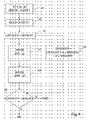
- FIG. 4 is a flowchart illustrating a second example of implementation of the invention in which a function FCT of several instructions (for example, two instructions INSTR and INSTR 'executing respectively operations OPi and n' operations OPi ') is monitored by the process control method.
- a function FCT of several instructions for example, two instructions INSTR and INSTR 'executing respectively operations OPi and n' operations OPi '
- an additional intermediate register is used for the value LCOUNT and detects a possible non-respect of the sequencing within each instruction.
- tests (28, FIG. 3) are not implemented in blocks 34 and 34 'and only a final test is performed (block 38).
- control method is implemented at a still higher level (for example commands of several functions, themselves of several instructions of several operations). If the controls of the different levels are nested ( Figure 4), this amounts to adding a control level. If only the top level controls are done, it is equivalent to considering an operation of a level higher than that of the elementary operations.
- An advantage of the present invention is that it makes it possible to dynamically detect a voluntary or accidental fault in the execution of a program.
- Another advantage of the invention is that its implementation requires only a few resources. Indeed, it is enough for a table of correspondence of the weights assigned to the various operations (this table can even be omitted if the increments / decrements are directly written in the program), and of to minus two storage spaces for the respective GCOUNT and LCOUNT counter values.
- Another advantage of the invention is that it is not necessary to know in advance the value to be reached by the meter. Only the increment or decrement (weight of each operation) needs to be known. This is a significant difference from a signature calculation in which the expected value of the signature needs to be known from the outset.
- Another advantage of the invention is that the counter does not need to be reset at specific times and can be looped.
- Another advantage that arises is that the verification program does not need to be modified in case of update of the program to be monitored provided that it calls the verification program at the beginning of the instructions to be monitored by providing the program. type of operation and number of executions. Therefore, the method of the invention is independent of the program to be monitored.
Landscapes
- Engineering & Computer Science (AREA)
- Theoretical Computer Science (AREA)
- Quality & Reliability (AREA)
- Physics & Mathematics (AREA)
- General Engineering & Computer Science (AREA)
- General Physics & Mathematics (AREA)
- Debugging And Monitoring (AREA)
- Microcomputers (AREA)
Applications Claiming Priority (1)
| Application Number | Priority Date | Filing Date | Title |
|---|---|---|---|
| FR0551307A FR2886027A1 (fr) | 2005-05-20 | 2005-05-20 | Detection d'erreur de sequencement dans l'execution d'un programme |
Publications (1)
| Publication Number | Publication Date |
|---|---|
| EP1770524A2 true EP1770524A2 (de) | 2007-04-04 |
Family
ID=36084417
Family Applications (1)
| Application Number | Title | Priority Date | Filing Date |
|---|---|---|---|
| EP06114270A Withdrawn EP1770524A2 (de) | 2005-05-20 | 2006-05-19 | Feststellung von Sequenzfehlern in einer Programmausführung |
Country Status (3)
| Country | Link |
|---|---|
| US (1) | US20060265578A1 (de) |
| EP (1) | EP1770524A2 (de) |
| FR (1) | FR2886027A1 (de) |
Families Citing this family (4)
| Publication number | Priority date | Publication date | Assignee | Title |
|---|---|---|---|---|
| US8296739B2 (en) * | 2008-03-31 | 2012-10-23 | International Business Machines Corporation | Testing soft error rate of an application program |
| US9965378B1 (en) * | 2016-03-29 | 2018-05-08 | Amazon Technologies, Inc. | Mediated fault invocation service |
| EP3738059A4 (de) * | 2018-01-08 | 2021-10-20 | Digital Immunity LLC | Systeme und verfahren zur detektion und abschwächung von codeinjektionsangriffen |
| US12189755B2 (en) * | 2023-04-24 | 2025-01-07 | Halcyon Tech, Inc. | Automated system for program identity-driven program access control |
Family Cites Families (10)
| Publication number | Priority date | Publication date | Assignee | Title |
|---|---|---|---|---|
| DE4036765A1 (de) * | 1990-11-17 | 1992-05-21 | Angewandte Digital Elektronik | Kodierte chipkartenaktivierung |
| NL9101796A (nl) * | 1991-10-25 | 1993-05-17 | Nederland Ptt | Werkwijze voor het authenticeren van communicatiedeelnemers, systeem voor toepassing van de werkwijze en eerste communicatiedeelnemer en tweede communicatiedeelnemer voor toepassing in het systeem. |
| US5442704A (en) * | 1994-01-14 | 1995-08-15 | Bull Nh Information Systems Inc. | Secure memory card with programmed controlled security access control |
| US5925127A (en) * | 1997-04-09 | 1999-07-20 | Microsoft Corporation | Method and system for monitoring the use of rented software |
| FR2787900B1 (fr) * | 1998-12-28 | 2001-02-09 | Bull Cp8 | Circuit integre intelligent |
| FR2790844B1 (fr) * | 1999-03-09 | 2001-05-25 | Gemplus Card Int | Procede et dispositif de surveillance du deroulement d'un programme, dispositif programme permettant la surveillance de son programme |
| US9219708B2 (en) * | 2001-03-22 | 2015-12-22 | DialwareInc. | Method and system for remotely authenticating identification devices |
| DE10156394A1 (de) * | 2001-11-16 | 2003-06-12 | Giesecke & Devrient Gmbh | Kontrollierte Programmausführung durch einen tragbaren Datenträger |
| FR2841015A1 (fr) * | 2002-06-18 | 2003-12-19 | St Microelectronics Sa | Controle d'execution d'un programme |
| EP1383047A1 (de) * | 2002-07-18 | 2004-01-21 | Cp8 | Verfahren zur Sicherung der Ausführung eines Programms gegen Strahlungsangriffe oder ähnliches |
-
2005
- 2005-05-20 FR FR0551307A patent/FR2886027A1/fr active Pending
-
2006
- 2006-05-19 EP EP06114270A patent/EP1770524A2/de not_active Withdrawn
- 2006-05-19 US US11/437,416 patent/US20060265578A1/en not_active Abandoned
Also Published As
| Publication number | Publication date |
|---|---|
| FR2886027A1 (fr) | 2006-11-24 |
| US20060265578A1 (en) | 2006-11-23 |
Similar Documents
| Publication | Publication Date | Title |
|---|---|---|
| US10419216B2 (en) | Keying infrastructure | |
| EP1161725B1 (de) | Verfahren zur überwachung des programmablaufs | |
| EP1374018A1 (de) | System und verfahren zur steuerung des zugangs zu in einer speichereinheit gespeicherten geschützten daten | |
| FR2612316A1 (fr) | Carte a circuits integres ayant une capacite de verification d'erreur interne | |
| EP1774484B1 (de) | Aufzeichnen eines schlüssels in eine integrierte schaltung | |
| EP1605333B1 (de) | Programmausführungssteuerung | |
| EP1724700A1 (de) | Kontrolle der Integrität eines externen Prozessorspeichers | |
| EP1983436B1 (de) | Kontrolle der Integrität eines prozessorexternen Speichers | |
| FR2841015A1 (fr) | Controle d'execution d'un programme | |
| FR2923923A1 (fr) | Verification de donnees lues en memoire | |
| EP1980968B1 (de) | Schutz der Ausführung eines Programms | |
| FR2788649A1 (fr) | Procede de chargement securise de donnees entre des modules de securite | |
| EP1494104B1 (de) | Programmintegritätsprüfung mittels Statistiken | |
| EP1715410B1 (de) | Schutz einer von einem integrierten Schaltkreis durchgeführten Berechnung | |
| EP1932121B1 (de) | Ereignis-zähler | |
| EP3284206B1 (de) | Verfahren zur sicherung der ausführung eines programms | |
| EP2252978B1 (de) | Chipkarte mit veränderbarem betriebsprogramm und entsprechendes änderungsverfahren | |
| EP3340098B1 (de) | Verfahren zur sicherung einer elektronischen operation mit einer chipkarte | |
| EP3295297B1 (de) | Verfahren zur sicherung eines vergleichs von daten während der ausführung eines programms | |
| US20060265578A1 (en) | Detection of a sequencing error in the execution of a program | |
| EP4307143A1 (de) | Verfahren und schaltungsanordnung zur überprüfung der integrität von software | |
| EP1742412B1 (de) | Prüfung einer in einer Speicherzone abgelegten digitalen Nachricht | |
| FR2807245A1 (fr) | Procede de protection d'une puce electronique contre la fraude | |
| FR2789774A1 (fr) | Procede de comparaison securise de deux registres memoire, et module de securite mettant en oeuvre ce procede | |
| FR3147397A1 (fr) | Système informatique configuré pour exécuter un programme d’ordinateur |
Legal Events
| Date | Code | Title | Description |
|---|---|---|---|
| PUAI | Public reference made under article 153(3) epc to a published international application that has entered the european phase |
Free format text: ORIGINAL CODE: 0009012 |
|
| AK | Designated contracting states |
Kind code of ref document: A2 Designated state(s): AT BE BG CH CY CZ DE DK EE ES FI FR GB GR HU IE IS IT LI LT LU LV MC NL PL PT RO SE SI SK TR |
|
| AX | Request for extension of the european patent |
Extension state: AL BA HR MK YU |
|
| STAA | Information on the status of an ep patent application or granted ep patent |
Free format text: STATUS: THE APPLICATION IS DEEMED TO BE WITHDRAWN |
|
| 18D | Application deemed to be withdrawn |
Effective date: 20091201 |