EP1770865A1 - Une table de consultation fracturable pour des éléments logiques utilisant la surface de façon efficace - Google Patents
Une table de consultation fracturable pour des éléments logiques utilisant la surface de façon efficace Download PDFInfo
- Publication number
- EP1770865A1 EP1770865A1 EP06019794A EP06019794A EP1770865A1 EP 1770865 A1 EP1770865 A1 EP 1770865A1 EP 06019794 A EP06019794 A EP 06019794A EP 06019794 A EP06019794 A EP 06019794A EP 1770865 A1 EP1770865 A1 EP 1770865A1
- Authority
- EP
- European Patent Office
- Prior art keywords
- inputs
- multiplexer
- luts
- output
- multiplexers
- Prior art date
- Legal status (The legal status is an assumption and is not a legal conclusion. Google has not performed a legal analysis and makes no representation as to the accuracy of the status listed.)
- Granted
Links
Images



Classifications
-
- H—ELECTRICITY
- H03—ELECTRONIC CIRCUITRY
- H03K—PULSE TECHNIQUE
- H03K19/00—Logic circuits, i.e. having at least two inputs acting on one output; Inverting circuits
- H03K19/02—Logic circuits, i.e. having at least two inputs acting on one output; Inverting circuits using specified components
- H03K19/173—Logic circuits, i.e. having at least two inputs acting on one output; Inverting circuits using specified components using elementary logic circuits as components
- H03K19/1733—Controllable logic circuits
- H03K19/1737—Controllable logic circuits using multiplexers
Definitions
- the present application relates to logic elements for use with programmable logic devices or other similar devices.
- PLDs Programmable logic devices
- CPLDs CPLDs
- PALs PLAs
- PLAs PLAs
- FPLAs FPLAs
- EPLDs EEPLDs
- LCAs LCAs
- FPGAs FPGAs
- PLDs Programmable logic devices
- Such devices are well known in the art and typically provide an "off the shelf” device having at least a portion that can be electrically programmed to meet a user's specific needs.
- ASICs Application specific integrated circuits
- ASICs have traditionally been fixed integrated circuits, however, it is possible to provide an ASIC that has a portion or portions that are programmable; thus, it is possible for an integrated circuit device to have qualities of both an ASIC and a PLD.
- PLD as used herein will be considered broad enough to include such devices.
- PLDs typically include blocks of logic elements, which are sometimes referred to as logic array blocks (“LABs”) or “configurable logic blocks” (“CLBs”).
- Logic elements which are also referred to by other names such as “logic circuits” or “logic cells”, may include a look-up table (“LUT”), product term, carryout chain, register, and other elements.
- Logic elements typically include configurable elements holding configuration data that determine the particular function or functions carried out by the logic element.
- a typical LUT circuit may include RAM bits that hold data (a "1" or “0").
- Other types of configurable elements may be used. Some examples may include static, magnetic, ferro-electric or dynamic random access memory, electrically erasable read-only memory, flash, fuse, and anti-fuse programmable connections.
- the programming of configuration elements could also be implemented through mask programming during fabrication of the device. While mask programming may have disadvantages relative to some of the field programmable options already listed, it may be useful in certain high volume applications.
- the generic term "memory element" will be used to refer to any programmable element that may be configured to determine functions implemented by a PLD.
- K-LUT K-input lookup table
- K-LUT typically includes 2 K programmable memory elements, and a 2K to 1 multiplexer tree, selecting one of the storage elements under the control of the K select inputs to the multiplexer.
- K inputs can be considered to be the inputs to a K-input logic function which can implement any particular required logic function by setting the contents of the memory elements to the appropriate values.
- the 6-LUT circuitry are offset by a reduction in the delay.
- the longest path through a logic circuit might be ten 4-LUTs versus eight 6-LUTs.
- the 6-LUT version of the circuit might be larger, but faster.
- the 6-LUT circuit would likely require less programmable routing in a PLD, offsetting some of its higher cost.
- the eight-hundred 6-LUTs might actually include three-hundred 6-input functions, three-hundred 5-input functions, one-hundred 4-input functions, and one-hundred 3-input functions.
- the LE based on 6-LUTs is only being used to its fullest extent in three-hundred out of eight-hundred instances.
- a fracturable logic element includes a first, second, third, and fourth two-input lookup tables (2-LUTs). Each 2-LUT includes four memory elements. Each memory element is configured to hold one data bit.
- the fracturable logic element also includes a set of six inputs and a control circuit configured to operate in a first mode and a second mode. When the control circuit operates in the first mode, a first combinatorial output is generated using four of the set of six inputs and the first, second, third, and fourth 2-LUTs. When the control circuit operates in the second mode, a second combinatorial output is generated using a first subset of three of the set of six inputs and the first and second 2-LUTS.
- a third combinatorial output is generated using a second subset of three of the set of six inputs and the third and fourth 2-LUTs, the first and second subsets being non-intersecting subsets of the set of six inputs.
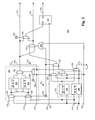
- Fig. 1 is a schematic of an exemplary two-input lookup table (2-LUT);
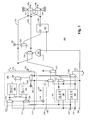
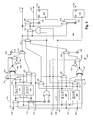
- Fig. 2 is a schematic of an exemplary fracturable logic element
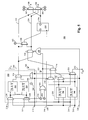
- Fig. 3 is a schematic of another exemplary fracturable logic element
- Fig. 4 is a schematic of another exemplary fracturable logic element
- Fig. 5 is a schematic of another exemplary fracturable logic element
- Fig. 6 is a schematic of another exemplary fracturable logic element
- Fig. 7 is a schematic of another exemplary fracturable logic element
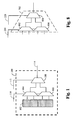
- Fig. 8 is a schematic of an exemplary 4:1 multiplexer implemented as a tree of 2:1 multiplexers
- Fig. 9 is a schematic of another exemplary fracturable logic element.
- Fig. 10 is a block diagram of an exemplary data processing system.
- 2-LUT 100 includes memory elements 102 connected to 2:1 multiplexers 104, 106.
- each memory element 102 can hold one data bit (i.e., 1 or 0), and each is coupled to provide that bit to an input of multiplexers 104, 106.
- the control inputs of multiplexers 104, 106 are connected to input 110.
- the outputs of multiplexers 104, 106 are connected to 2:1 multiplexer 108.
- the control input of multiplexer 108 is connected to input 112.
- inputs 110, 112 can be used to selected any one of memory element 102 as an output 114 of 2-LUT 100.
- Logic element 200 includes four 2-LUTs 202, 204, 206, and 208 and a set of six inputs 210, 212, 214, 216, 218, and 220.
- Each 2-LUT 202, 204, 206, and 208 includes four memory elements.
- logic element 200 includes a total of 16 memory elements, which are also referred to as its LUT mask.
- fractuable logic elements see U.S. Patent Application Serial No. 10/364,310 , titled FRACTURABLE LOOKUP TABLE AND LOGIC ELEMENT, filed on February 10, 2003, which is incorporated herein by reference in its entirety.
- Logic element 200 includes a control circuit 222 that operates in a first mode and a second mode.
- logic element 200 operates as a single 4-LUT, where four of the set of six inputs are used and two of the six inputs are not used.
- logic element 200 operates as two 3-LUTs (i.e., a first 3-LUT 201 and a second 3-LUT 203), where a first subset of the six inputs are used for first 3-LUT 201 and a second subset of the six inputs are used for second 3-LUT 203, and where the inputs in the first and second subsets are distinct.
- control circuit 222 includes a control bit 224 connected to the control inputs of multiplexers 226, 228.
- Inputs 210, 216 are connected to multiplexer 226.
- Inputs 212, 214 are connected to multiplexer 228.
- the outputs of multiplexers 226, 228 are connected to the inputs of 2-LUTs 202, 204.
- the outputs of 2-LUTs 202, 204 are connected to the inputs of multiplexer 230.
- Inputs 214, 216 are also connected to the inputs of 2-LUTs 206, 208.
- the outputs of 2-LUTs 206, 208 are connected to the inputs of multiplexer 242.
- Input 218 is connected to the control input of multiplexer 230 through multiplexer 246. Input 218 is also connected to the control input of multiplexer 242. The output of multiplexer 242 is connected to an input of multiplexer 238 through multiplexer 234. The output of multiplexer 230 is connected to the other input of multiplexer 238. Input 220 is connected to the control input of multiplexer 238 through logic gate 240.
- control bit 224 controls multiplexers 226, 228 to select inputs 214, 216 as the outputs of multiplexers 226, 228 rather than inputs 210, 212.
- inputs 214, 216 are used as inputs of 2-LUTs 202, 204 as well as 2-LUTs 206, 208.
- Input 218 controls multiplexers 230, 242 to select among the outputs of 2-LUTs 202, 204, 206, and 208.
- Control bit 224 also controls multiplexer 234 to select the output of multiplexer 242 as the output of multiplexer 234.
- Input 220 controls multiplexer 238 through logic gate 240 to select between the output of multiplexer 230 and multiplexer 234.
- output line 234 outputs the combinatorial output of the four inputs 214, 216, 218, and 220.
- control bit 224 controls multiplexers 226, 228 to select inputs 210, 212 as the outputs of multiplexers 226, 228 rather than inputs 214, 216.
- inputs 210, 212 are used as inputs of 2-LUTs 202, 204.
- Input 218 controls multiplexer 230 through multiplexer 246 to select between the outputs of 2-LUTs 202, 204.
- output line 232 outputs the combinatorial output of the three inputs 210, 212, and 218.
- control circuit 222 when control circuit 222 operates in the second mode, inputs 214, 216 are used as inputs to 2-LUTs 206, 208.
- Input 220 controls multiplexer 236 to select between the outputs of 2-LUTs 206, 208.
- Control bit 224 selects the output of multiplexer 236 as the output of multiplexer 234.
- Control bit 224 also controls multiplexer 238 through logic gate 240 to select the output of multiplexer 234 as the output of multiplexer 238.
- output line 234 outputs the combinatorial output of the three inputs 214, 216, and 220.
- logic element 200 includes an arithmetic circuit 243 to implement one-bit arithmetic.
- arithmetic circuit 243 includes a carry-chain input (C in ) 244, which is generated by a previous logic element, connected to an input of multiplexer 246.
- a control bit 248 controls multiplexer 246 to select between input 218 and carry-chain input 244.
- the output of multiplexer 246 controls multiplexer 230.
- multiplexer 230 can produce an arithmetic sum based on inputs to 2-LUTs 202, 204 and carry-chain input 244.
- carry-chain input 244 controls multiplexer 250 to generate a carry-chain output (C out ) 252, which feeds a subsequent logic element.
- logic element 200 includes a flip-flop 254 to produce a registered output on output line 256.
- flip-flop 254 receives a clock signal 258, and the data input of flip-flop 254 is connected to the output of multiplexer 260.
- a control bit 262 controls multiplexer 260 to select between the outputs of multiplexer 230, which outputs the combinatorial output of the three inputs 210, 212, 218, and multiplexer 238, which outputs the combinatory output of the four inputs 214, 216, 218, and 220.
- output line 256 outputs the registered output of either three inputs 210, 212, and 218 or four inputs 214, 216, 218, and 220.
- a second exemplary embodiment of logic element 200 is depicted.
- the second exemplary embodiment of logic element 200 includes the features of the first exemplary embodiment with the addition of 3:1 multiplexers 302, 304 to reduce the number of output lines from three to two, which reduces the number of drivers needed.
- multiplexers 302, 304 are each connected to output lines 232, 234, and 256.
- outputs on output lines 306, 308 from multiplexers 302, 304, respectively, can be selected among output lines 232, 234, and 256.
- logic gate 402 is an OR gate with inputs connected to control bits 224, 404 and an output connected to an input of logic gate 240 and the control input of multiplexer 234.
- control bit 224 controls multiplexers 226, 228 to select inputs 210, 212.
- Input 218 controls multiplexer 230 through multiplexer 246 to select between inputs 210, 212.
- Input 218 also controls multiplexer 242 to select between inputs 214, 216.
- Control bit 404 is set appropriately to control multiplexer 234 to select the output of multiplexer 242 as the output to multiplexer 234 and to force input 220 to control multiplexer 238 through logic gate 240.
- input 220 controls multiplexer 238 to select between the outputs of multiplexer 230 (inputs 210, 212) and multiplexer 234 (inputs 214, 216).
- the order of the multiplexors e.g., multiplexer 226) can be modified so that this controlling behavior is possible while maintaining the dual usage of the SRAM configuration bits.
- a fourth exemplary embodiment of logic element 200 is depicted.
- the fourth exemplary embodiment of logic element 200 includes the features of the third exemplary embodiment with the addition of multiplexers 302, 304 to reduce the number of output lines from three to two, which reduces the number of drivers needed.
- multiplexers 302, 304 are each connected to output lines 232, 234, and 256.
- outputs on output lines 306, 308 from multiplexers 302, 304, respectively, can be selected among output lines 232, 234, and 256.
- the fifth exemplary embodiment of logic element 200 includes the features of the third exemplary embodiment but with arithmetic circuit 243 comprised of adder circuits 600, 602 to implement two-bits of arithmetic.
- the fifth exemplary embodiment of logic element 200 also includes a second flip-flop 626 and a fourth output line 628.
- Adder circuit 600 includes an exclusive OR (XOR) 604 with inputs connected to inputs 210, 212.
- the inputs of multiplexer 606 receive the output of XOR 604 and an inverse of the output of XOR 604 through inverter 608.
- the control input of multiplexer 606 is connected to carry-chain input 244.
- multiplexer 606 can produce an arithmetic sum based on inputs 210, 212 and carry-chain input 244.
- the inputs of multiplexer 610 are connected to the outputs of multiplexer 606 and multiplexer 230.
- the control input of multiplexer 610 is connected to a control bit 612.
- control bit 612 controls multiplexer 610 to select between the sum produced by multiplexer 606 and the output of multiplexer 230.
- Adder circuit 602 includes an XOR 616 with inputs connected to inputs 214, 216.
- the inputs of multiplexer 618 receive the output of XOR 616 and an inverse of the output of XOR 616 through inverter 620.
- multiplexer 618 can produce an arithmetic sum based on inputs 214, 216.
- the inputs of multiplexer 622 are connected to the outputs of multiplexer 618 and multiplexer 236.
- the control input of multiplexer 622 is connected to a control bit 624.
- control bit 624 controls multiplexer 622 to select between the sum produced by multiplexer 618 and the output of multiplexer 236.
- logic element 200 includes second flip-flop 626 to produce a second registered output on output line 628.
- flip-flop 626 receives clock signal 258, and the data input of flip-flop 626 is connected to the output of multiplexer 630.
- a control bit 632 controls multiplexer 630 to select between the outputs of multiplexer 610 and multiplexer 238.
- logic element 200 can be configured to perform two four-input logic functions sharing the logic elements/LUT masks of 2-LUTs 202, 204, 206, and 208.
- a first 4:1 multiplexer 702 receives an input from each 2-LUT 202, 204, 206, and 208.
- a second 4:1 multiplexer 704 also receives an input from each 2-LUT 202, 204, 206, and 208.
- Control circuit 222 includes a control bit 706 connected to control inputs of multiplexers 708, 710. Inputs 210, 218 are connected to the inputs of multiplexer 708.
- the output of multiplexer 708 is connected to the inputs of 2-LUTs 202, 204.
- the outputs of 2-LUTs 202, 204 are connected to 4:1 multiplexers 702, 704.
- Input 218 is also connected to an input of multiplexer 710.
- the output of multiplexer 710 is connected to a control input of 4:1 multiplexer 702.
- Input 220 is connected to another control input of 4:1 multiplexer 702.
- Control circuit 222 also includes a control bit 712 connected to control inputs of multiplexers 714, 716. Inputs 212, 216 are connected to the inputs of multiplexer 714. The output of multiplexer 714 is connected to the inputs of 2-LUTs 206, 208. The outputs of 2-LUTs 206, 208 are connected to 4:1 multiplexers 702, 704. Input 216 is connected to a control input of 4:1 multiplexer 704. Input 214 is connected to another control input of 4:1 multiplexer 704.
- control bit 706 controls multiplexer 708 to select input 210 as the output of multiplexer 708 rather than input 218.
- Control bit 712 controls multiplexer 714 to select input 212 as the output of multiplexer 714.
- inputs 210, 212 are used as inputs of 2-LUTs 206, 208 as well as 2-LUTs 202, 204.
- Control bit 706 controls multiplexer 710 to select input 218 as the output of multiplexer 710.
- 4:1 multiplexer 702 is controlled by inputs 218, 220, and the output of 4:1 multiplexer 702 is the combinatorial output of the four inputs 210, 212, 218, and 220.
- control bit 712 controls multiplexer 716 to select input 216 as the output of multiplexer 716.
- 4:1 multiplexer 702 is controlled by inputs 214, 216, and the output of 4:1 multiplexer 704 is the combinatorial output of the four inputs 210, 212, 214, and 216.
- control bit 706 controls multiplexer 708 to select input 218 as the output of multiplexer 708 rather than input 210.
- inputs 212, 218 are used as inputs of 2-LUTs 202, 204.
- Input 220 controls 4:1 multiplexer 702.
- the output of 4:1 multiplexer 702 is the combinatorial output of the three inputs 212, 218, and 220.
- control bit 712 control multiplexer 714 to select input 216 as the output of multiplexer 714.
- inputs 210, 216 are used as inputs of 2-LUTs 206, 208.
- Input 214 controls 4:1 multiplexer 704.
- the output of 4:1 multiplexer 704 is the combinatorial output of the three inputs 210, 214, and 216.
- each 4:1 multiplexer 702, 704 can be implemented as a tree of multiple 2:1 multiplexers.
- 4:1 multiplexer 702 can be implemented as a tree of three 2:1 multiplexers 802, 804, 806.
- the inputs of multiplexer 802 are connected to the outputs of 2-LUT 202 (Fig. 7) and 2-LUT 206 (Fig. 7), respectively.
- the inputs of multiplexer 804 are connected to the outputs of 2-LUT 204 (Fig. 7) and 2-LUT 208 (Fig. 7), respectively.
- the control inputs of multiplexers 802, 804 are connected to input 218.
- the outputs of multiplexers 802, 804 are connected to the inputs of multiplexer 806.
- the control input of multiplexer 806 is connected to input 220.
- a seventh exemplary embodiment of logic element 200 is depicted.
- the seventh exemplary embodiment of logic element 200 includes the features of the sixth exemplary embodiment with the addition of multiplexer 902 to implement a 4:1 multiplexing mode.
- multiplexer 902 selects between inputs 210, 214 under the control of a control bit 904.
- control bit 706 controls multiplexer 708 to select input 210.
- Control bit 904 controls multiplexer 902 to select input 214.
- Control bit 712 controls multiplexer 714 to select input 216.
- inputs 210, 212, 214, and 216 are used as inputs to 4:1 multiplexer 702.
- Inputs 218, 220 control 4:1 multiplexer 702.
- Data processing system 1000 includes a PLD 1010 that may include embodiments of logic element 200 as discussed above.
- PLD 1010 includes a plurality of logic array blocks (LABs), such as the illustrated LAB 1012.
- LAB 1012 includes a plurality of logic elements such as the illustrated logic element 200.
- Data processing system 1000 may include one or more of the following components: a processor 1040; memory 1050; I/O circuitry 1020; and peripheral devices 1030. These components are coupled together by a system bus 1060 and are populated on a circuit board 1070 which is contained in an end-user system 1080.
- Data processing system 1000 can be used in a wide variety of applications, such as computer networking, data networking, instrumentation, video processing, digital signal processing, or any other application where the advantage of using programmable or reprogrammable logic is desirable.
- PLD 1010 can be used to perform a variety of different logic functions.
- PLD 1010 can be configured as a processor or controller that works in cooperation with processor 1040 (or, in alternative embodiments, a PLD might itself act as the sole system processor).
- PLD 1010 may also be used as an arbiter for arbitrating access to shared resources in system 1000.
- PLD 1010 can be configured as an interface between the processor 1040 and one of the other components in system 1000. It should be noted that system 1000 is only exemplary.
Landscapes
- Physics & Mathematics (AREA)
- Engineering & Computer Science (AREA)
- Computer Hardware Design (AREA)
- Computing Systems (AREA)
- General Engineering & Computer Science (AREA)
- Mathematical Physics (AREA)
- Logic Circuits (AREA)
- Electronic Switches (AREA)
Applications Claiming Priority (1)
| Application Number | Priority Date | Filing Date | Title |
|---|---|---|---|
| US11/234,538 US7330052B2 (en) | 2005-09-22 | 2005-09-22 | Area efficient fractureable logic elements |
Publications (2)
| Publication Number | Publication Date |
|---|---|
| EP1770865A1 true EP1770865A1 (fr) | 2007-04-04 |
| EP1770865B1 EP1770865B1 (fr) | 2010-08-25 |
Family
ID=37492422
Family Applications (1)
| Application Number | Title | Priority Date | Filing Date |
|---|---|---|---|
| EP06019794A Active EP1770865B1 (fr) | 2005-09-22 | 2006-09-21 | Une table de consultation fracturable pour des éléments logiques utilisant la surface de façon efficace |
Country Status (5)
| Country | Link |
|---|---|
| US (1) | US7330052B2 (fr) |
| EP (1) | EP1770865B1 (fr) |
| JP (1) | JP5026037B2 (fr) |
| CN (1) | CN1937409B (fr) |
| DE (1) | DE602006016388D1 (fr) |
Cited By (2)
| Publication number | Priority date | Publication date | Assignee | Title |
|---|---|---|---|---|
| EP3157171A1 (fr) * | 2015-10-15 | 2017-04-19 | Menta | Architecture de blocs logiques pour réseau de portes programmable par l'utilisateur |
| US10230368B2 (en) | 2013-02-13 | 2019-03-12 | Semiconductor Energy Laboratory Co., Ltd. | Programmable logic device and semiconductor device |
Families Citing this family (19)
| Publication number | Priority date | Publication date | Assignee | Title |
|---|---|---|---|---|
| US7902864B1 (en) * | 2005-12-01 | 2011-03-08 | Altera Corporation | Heterogeneous labs |
| US7812633B1 (en) * | 2006-04-03 | 2010-10-12 | Altera Corporation | Apparatus and method for the arithmetic over-ride of look up table outputs in a programmable logic device |
| US7812635B1 (en) | 2006-05-08 | 2010-10-12 | Altera Corporation | Programmable logic device architecture with the ability to combine adjacent logic elements for the purpose of performing high order logic functions |
| US7394287B1 (en) * | 2007-05-21 | 2008-07-01 | Altera Corporation | Programmable logic device having complex logic blocks with improved logic cell functionality |
| US7459932B1 (en) * | 2007-05-24 | 2008-12-02 | Altera Corporation | Programmable logic device having logic modules with improved register capabilities |
| JP5360194B2 (ja) * | 2009-03-18 | 2013-12-04 | 日本電気株式会社 | 再構成可能な論理回路 |
| JP5618275B2 (ja) * | 2011-06-12 | 2014-11-05 | 独立行政法人産業技術総合研究所 | Cmosインバータを用いたマルチプレクサ、デマルチプレクサ、ルックアップテーブルおよび集積回路 |
| US8519740B2 (en) | 2012-01-06 | 2013-08-27 | Altera Corporation | Integrated circuits with shared interconnect buses |
| CN103259528A (zh) * | 2012-02-17 | 2013-08-21 | 京微雅格(北京)科技有限公司 | 一种异构可编程逻辑结构的集成电路 |
| US8581624B2 (en) | 2012-03-29 | 2013-11-12 | Altera Corporation | Integrated circuits with multi-stage logic regions |
| US9571103B2 (en) * | 2012-05-25 | 2017-02-14 | Semiconductor Energy Laboratory Co., Ltd. | Lookup table and programmable logic device including lookup table |
| WO2015051105A1 (fr) * | 2013-10-02 | 2015-04-09 | The Penn State Research Foundation | Techniques et dispositifs d'opérations arithmétiques |
| CN103762974B (zh) * | 2014-01-26 | 2016-09-14 | 无锡中微亿芯有限公司 | 多功能可配置的六输入查找表结构 |
| US10312918B2 (en) * | 2017-02-13 | 2019-06-04 | High Performance Data Storage And Processing Corporation | Programmable logic design |
| US10530397B2 (en) * | 2017-07-17 | 2020-01-07 | Texas Instruments Incorporated | Butterfly network on load data return |
| US10790830B1 (en) * | 2019-05-20 | 2020-09-29 | Achronix Semiconductor Corporation | Fused memory and arithmetic circuit |
| US11256476B2 (en) | 2019-08-08 | 2022-02-22 | Achronix Semiconductor Corporation | Multiple mode arithmetic circuit |
| US12519474B2 (en) * | 2021-02-02 | 2026-01-06 | Efinix, Inc. | Adding LUT fracturabiliy to FPGA 4-LUTs using existing adder circuitry |
| US12249987B2 (en) | 2021-12-31 | 2025-03-11 | Lattice Semiconductor Corporation | Programmable look-up table systems and methods |
Citations (4)
| Publication number | Priority date | Publication date | Assignee | Title |
|---|---|---|---|---|
| US6747480B1 (en) * | 2002-07-12 | 2004-06-08 | Altera Corporation | Programmable logic devices with bidirect ional cascades |
| EP1445864A2 (fr) * | 2003-02-10 | 2004-08-11 | Altera Corporation | Elément logique et procédé associé |
| US20040155676A1 (en) | 2003-02-11 | 2004-08-12 | Sinan Kaptanoglu | Fracturable incomplete look up table for area efficient logic elements |
| US6798240B1 (en) * | 2003-01-24 | 2004-09-28 | Altera Corporation | Logic circuitry with shared lookup table |
Family Cites Families (4)
| Publication number | Priority date | Publication date | Assignee | Title |
|---|---|---|---|---|
| JP3580785B2 (ja) * | 2001-06-29 | 2004-10-27 | 株式会社半導体理工学研究センター | ルックアップテーブル、ルックアップテーブルを備えるプログラマブル論理回路装置、および、ルックアップテーブルの構成方法 |
| US7185035B1 (en) * | 2003-10-23 | 2007-02-27 | Altera Corporation | Arithmetic structures for programmable logic devices |
| US7176716B2 (en) * | 2003-12-24 | 2007-02-13 | Viciciv Technology | Look-up table structure with embedded carry logic |
| US7167022B1 (en) * | 2004-03-25 | 2007-01-23 | Altera Corporation | Omnibus logic element including look up table based logic elements |
-
2005
- 2005-09-22 US US11/234,538 patent/US7330052B2/en not_active Expired - Fee Related
-
2006
- 2006-09-21 DE DE602006016388T patent/DE602006016388D1/de active Active
- 2006-09-21 JP JP2006256398A patent/JP5026037B2/ja not_active Expired - Fee Related
- 2006-09-21 EP EP06019794A patent/EP1770865B1/fr active Active
- 2006-09-22 CN CN2006101598041A patent/CN1937409B/zh not_active Expired - Fee Related
Patent Citations (4)
| Publication number | Priority date | Publication date | Assignee | Title |
|---|---|---|---|---|
| US6747480B1 (en) * | 2002-07-12 | 2004-06-08 | Altera Corporation | Programmable logic devices with bidirect ional cascades |
| US6798240B1 (en) * | 2003-01-24 | 2004-09-28 | Altera Corporation | Logic circuitry with shared lookup table |
| EP1445864A2 (fr) * | 2003-02-10 | 2004-08-11 | Altera Corporation | Elément logique et procédé associé |
| US20040155676A1 (en) | 2003-02-11 | 2004-08-12 | Sinan Kaptanoglu | Fracturable incomplete look up table for area efficient logic elements |
Cited By (3)
| Publication number | Priority date | Publication date | Assignee | Title |
|---|---|---|---|---|
| US10230368B2 (en) | 2013-02-13 | 2019-03-12 | Semiconductor Energy Laboratory Co., Ltd. | Programmable logic device and semiconductor device |
| EP3157171A1 (fr) * | 2015-10-15 | 2017-04-19 | Menta | Architecture de blocs logiques pour réseau de portes programmable par l'utilisateur |
| WO2017063956A1 (fr) * | 2015-10-15 | 2017-04-20 | Menta | Architecture de bloc logique pour réseau prédiffusé programmable |
Also Published As
| Publication number | Publication date |
|---|---|
| US20070063732A1 (en) | 2007-03-22 |
| CN1937409B (zh) | 2012-01-25 |
| CN1937409A (zh) | 2007-03-28 |
| EP1770865B1 (fr) | 2010-08-25 |
| JP2007089180A (ja) | 2007-04-05 |
| DE602006016388D1 (de) | 2010-10-07 |
| US7330052B2 (en) | 2008-02-12 |
| JP5026037B2 (ja) | 2012-09-12 |
Similar Documents
| Publication | Publication Date | Title |
|---|---|---|
| US6943580B2 (en) | Fracturable lookup table and logic element | |
| EP1770865B1 (fr) | Une table de consultation fracturable pour des éléments logiques utilisant la surface de façon efficace | |
| US7030650B1 (en) | Fracturable incomplete look up table area efficient logic elements | |
| US7671625B1 (en) | Omnibus logic element | |
| US7317330B2 (en) | Logic circuitry with shared lookup table | |
| US8217678B1 (en) | Fracturable lookup table and logic element | |
| US7030652B1 (en) | LUT-based logic element with support for Shannon decomposition and associated method | |
| US7185035B1 (en) | Arithmetic structures for programmable logic devices | |
| CN101312347B (zh) | 具有复杂逻辑块的可编程逻辑器件 | |
| US20040070422A1 (en) | Programmable logic devices having enhanced cascade functions to provide increased flexibility | |
| US6084427A (en) | Programmable logic devices with enhanced multiplexing capabilities | |
| US7565388B1 (en) | Logic cell supporting addition of three binary words | |
| US6975154B1 (en) | Reduced power consumption clock network | |
| US6833730B1 (en) | PLD configurable logic block enabling the rapid calculation of sum-of-products functions | |
| US7119575B1 (en) | Logic cell with improved multiplexer, barrel shifter, and crossbarring efficiency | |
| US9235498B1 (en) | Circuits for and methods of enabling the modification of an input data stream | |
| US7010777B1 (en) | Shared lookup table enhancements for the efficient implementation of barrel shifters | |
| US9768784B2 (en) | Transformable logic and routing structures for datapath optimization | |
| US7368942B1 (en) | Dedicated resource interconnects | |
| US7098687B1 (en) | Flexible routing resources in a programmable logic device | |
| US7336099B1 (en) | Multiplexer including addition element |
Legal Events
| Date | Code | Title | Description |
|---|---|---|---|
| PUAI | Public reference made under article 153(3) epc to a published international application that has entered the european phase |
Free format text: ORIGINAL CODE: 0009012 |
|
| AK | Designated contracting states |
Kind code of ref document: A1 Designated state(s): AT BE BG CH CY CZ DE DK EE ES FI FR GB GR HU IE IS IT LI LT LU LV MC NL PL PT RO SE SI SK TR |
|
| AX | Request for extension of the european patent |
Extension state: AL BA HR MK YU |
|
| 17P | Request for examination filed |
Effective date: 20070927 |
|
| AKX | Designation fees paid |
Designated state(s): DE |
|
| GRAP | Despatch of communication of intention to grant a patent |
Free format text: ORIGINAL CODE: EPIDOSNIGR1 |
|
| GRAS | Grant fee paid |
Free format text: ORIGINAL CODE: EPIDOSNIGR3 |
|
| GRAA | (expected) grant |
Free format text: ORIGINAL CODE: 0009210 |
|
| AK | Designated contracting states |
Kind code of ref document: B1 Designated state(s): DE |
|
| REF | Corresponds to: |
Ref document number: 602006016388 Country of ref document: DE Date of ref document: 20101007 Kind code of ref document: P |
|
| REG | Reference to a national code |
Ref country code: DE Ref legal event code: R096 Ref document number: 602006016388 Country of ref document: DE Effective date: 20101007 |
|
| PLBE | No opposition filed within time limit |
Free format text: ORIGINAL CODE: 0009261 |
|
| STAA | Information on the status of an ep patent application or granted ep patent |
Free format text: STATUS: NO OPPOSITION FILED WITHIN TIME LIMIT |
|
| 26N | No opposition filed |
Effective date: 20110526 |
|
| REG | Reference to a national code |
Ref country code: DE Ref legal event code: R097 Ref document number: 602006016388 Country of ref document: DE Effective date: 20110526 |
|
| P01 | Opt-out of the competence of the unified patent court (upc) registered |
Effective date: 20230531 |
|
| PGFP | Annual fee paid to national office [announced via postgrant information from national office to epo] |
Ref country code: DE Payment date: 20250819 Year of fee payment: 20 |