EP1777312B1 - Matériau d'apport pour soudage, utilisation du matériau d'apport pour soudage et procédé de soudage - Google Patents
Matériau d'apport pour soudage, utilisation du matériau d'apport pour soudage et procédé de soudage Download PDFInfo
- Publication number
- EP1777312B1 EP1777312B1 EP05023192A EP05023192A EP1777312B1 EP 1777312 B1 EP1777312 B1 EP 1777312B1 EP 05023192 A EP05023192 A EP 05023192A EP 05023192 A EP05023192 A EP 05023192A EP 1777312 B1 EP1777312 B1 EP 1777312B1
- Authority
- EP
- European Patent Office
- Prior art keywords
- welding
- filler according
- weld filler
- nickel
- der
- Prior art date
- Legal status (The legal status is an assumption and is not a legal conclusion. Google has not performed a legal analysis and makes no representation as to the accuracy of the status listed.)
- Ceased
Links
Images



Classifications
-
- B—PERFORMING OPERATIONS; TRANSPORTING
- B23—MACHINE TOOLS; METAL-WORKING NOT OTHERWISE PROVIDED FOR
- B23K—SOLDERING OR UNSOLDERING; WELDING; CLADDING OR PLATING BY SOLDERING OR WELDING; CUTTING BY APPLYING HEAT LOCALLY, e.g. FLAME CUTTING; WORKING BY LASER BEAM
- B23K35/00—Rods, electrodes, materials, or media, for use in soldering, welding, or cutting
- B23K35/22—Rods, electrodes, materials, or media, for use in soldering, welding, or cutting characterised by the composition or nature of the material
- B23K35/24—Selection of soldering or welding materials proper
- B23K35/30—Selection of soldering or welding materials proper with the principal constituent melting at less than 1550°C
- B23K35/3033—Ni as the principal constituent
- B23K35/304—Ni as the principal constituent with Cr as the next major constituent
-
- B—PERFORMING OPERATIONS; TRANSPORTING
- B23—MACHINE TOOLS; METAL-WORKING NOT OTHERWISE PROVIDED FOR
- B23K—SOLDERING OR UNSOLDERING; WELDING; CLADDING OR PLATING BY SOLDERING OR WELDING; CUTTING BY APPLYING HEAT LOCALLY, e.g. FLAME CUTTING; WORKING BY LASER BEAM
- B23K10/00—Welding or cutting by means of a plasma
- B23K10/02—Plasma welding
-
- B—PERFORMING OPERATIONS; TRANSPORTING
- B23—MACHINE TOOLS; METAL-WORKING NOT OTHERWISE PROVIDED FOR
- B23K—SOLDERING OR UNSOLDERING; WELDING; CLADDING OR PLATING BY SOLDERING OR WELDING; CUTTING BY APPLYING HEAT LOCALLY, e.g. FLAME CUTTING; WORKING BY LASER BEAM
- B23K26/00—Working by laser beam, e.g. welding, cutting or boring
- B23K26/12—Working by laser beam, e.g. welding, cutting or boring in a special environment or atmosphere, e.g. in an enclosure
-
- B—PERFORMING OPERATIONS; TRANSPORTING
- B23—MACHINE TOOLS; METAL-WORKING NOT OTHERWISE PROVIDED FOR
- B23K—SOLDERING OR UNSOLDERING; WELDING; CLADDING OR PLATING BY SOLDERING OR WELDING; CUTTING BY APPLYING HEAT LOCALLY, e.g. FLAME CUTTING; WORKING BY LASER BEAM
- B23K26/00—Working by laser beam, e.g. welding, cutting or boring
- B23K26/20—Bonding
- B23K26/32—Bonding taking account of the properties of the material involved
-
- B—PERFORMING OPERATIONS; TRANSPORTING
- B23—MACHINE TOOLS; METAL-WORKING NOT OTHERWISE PROVIDED FOR
- B23K—SOLDERING OR UNSOLDERING; WELDING; CLADDING OR PLATING BY SOLDERING OR WELDING; CUTTING BY APPLYING HEAT LOCALLY, e.g. FLAME CUTTING; WORKING BY LASER BEAM
- B23K26/00—Working by laser beam, e.g. welding, cutting or boring
- B23K26/60—Preliminary treatment
-
- B—PERFORMING OPERATIONS; TRANSPORTING
- B23—MACHINE TOOLS; METAL-WORKING NOT OTHERWISE PROVIDED FOR
- B23K—SOLDERING OR UNSOLDERING; WELDING; CLADDING OR PLATING BY SOLDERING OR WELDING; CUTTING BY APPLYING HEAT LOCALLY, e.g. FLAME CUTTING; WORKING BY LASER BEAM
- B23K9/00—Arc welding or cutting
- B23K9/23—Arc welding or cutting taking account of the properties of the materials to be welded
-
- B—PERFORMING OPERATIONS; TRANSPORTING
- B23—MACHINE TOOLS; METAL-WORKING NOT OTHERWISE PROVIDED FOR
- B23K—SOLDERING OR UNSOLDERING; WELDING; CLADDING OR PLATING BY SOLDERING OR WELDING; CUTTING BY APPLYING HEAT LOCALLY, e.g. FLAME CUTTING; WORKING BY LASER BEAM
- B23K9/00—Arc welding or cutting
- B23K9/235—Preliminary treatment
-
- C—CHEMISTRY; METALLURGY
- C22—METALLURGY; FERROUS OR NON-FERROUS ALLOYS; TREATMENT OF ALLOYS OR NON-FERROUS METALS
- C22C—ALLOYS
- C22C19/00—Alloys based on nickel or cobalt
- C22C19/03—Alloys based on nickel or cobalt based on nickel
- C22C19/05—Alloys based on nickel or cobalt based on nickel with chromium
-
- C—CHEMISTRY; METALLURGY
- C22—METALLURGY; FERROUS OR NON-FERROUS ALLOYS; TREATMENT OF ALLOYS OR NON-FERROUS METALS
- C22C—ALLOYS
- C22C19/00—Alloys based on nickel or cobalt
- C22C19/03—Alloys based on nickel or cobalt based on nickel
- C22C19/05—Alloys based on nickel or cobalt based on nickel with chromium
- C22C19/051—Alloys based on nickel or cobalt based on nickel with chromium and Mo or W
- C22C19/056—Alloys based on nickel or cobalt based on nickel with chromium and Mo or W with the maximum Cr content being at least 10% but less than 20%
-
- C—CHEMISTRY; METALLURGY
- C22—METALLURGY; FERROUS OR NON-FERROUS ALLOYS; TREATMENT OF ALLOYS OR NON-FERROUS METALS
- C22F—CHANGING THE PHYSICAL STRUCTURE OF NON-FERROUS METALS AND NON-FERROUS ALLOYS
- C22F1/00—Changing the physical structure of non-ferrous metals or alloys by heat treatment or by hot or cold working
- C22F1/10—Changing the physical structure of non-ferrous metals or alloys by heat treatment or by hot or cold working of nickel or cobalt or alloys based thereon
-
- B—PERFORMING OPERATIONS; TRANSPORTING
- B23—MACHINE TOOLS; METAL-WORKING NOT OTHERWISE PROVIDED FOR
- B23K—SOLDERING OR UNSOLDERING; WELDING; CLADDING OR PLATING BY SOLDERING OR WELDING; CUTTING BY APPLYING HEAT LOCALLY, e.g. FLAME CUTTING; WORKING BY LASER BEAM
- B23K2101/00—Articles made by soldering, welding or cutting
- B23K2101/001—Turbines
-
- B—PERFORMING OPERATIONS; TRANSPORTING
- B23—MACHINE TOOLS; METAL-WORKING NOT OTHERWISE PROVIDED FOR
- B23K—SOLDERING OR UNSOLDERING; WELDING; CLADDING OR PLATING BY SOLDERING OR WELDING; CUTTING BY APPLYING HEAT LOCALLY, e.g. FLAME CUTTING; WORKING BY LASER BEAM
- B23K2103/00—Materials to be soldered, welded or cut
- B23K2103/18—Dissimilar materials
- B23K2103/26—Alloys of Nickel and Cobalt and Chromium
-
- B—PERFORMING OPERATIONS; TRANSPORTING
- B23—MACHINE TOOLS; METAL-WORKING NOT OTHERWISE PROVIDED FOR
- B23K—SOLDERING OR UNSOLDERING; WELDING; CLADDING OR PLATING BY SOLDERING OR WELDING; CUTTING BY APPLYING HEAT LOCALLY, e.g. FLAME CUTTING; WORKING BY LASER BEAM
- B23K2103/00—Materials to be soldered, welded or cut
- B23K2103/50—Inorganic materials other than metals or composite materials
Definitions
- the invention relates to a filler metal according to claim 1.
- Rene 41 components by Ramazan Kayacan et al., In Materials Research Bulletin 39, (2004) 2171-2186, describes the effects of pre- and post-weld treatment on the strainl-age crackingin welded Rene 41 components becomes the influence of heat treatments and described after welding in welded RENE41 components, using different filler metals for the base material RENE41.
- the object is achieved by a filler metal according to claim 1.
- a welding filler material is proposed which allows the repair welding of gas turbine blades and other nickel base superalloy hot gas components by manual or automated room temperature welding.
- the filler metal is also a y'-hardened nickel base superalloy, but differs in particular from the material of a substrate of a component to be repaired.
- Weld repair provides low cycle fatigue (LCF) that is approximately 50% and more of the properties of the base material (the weld holds 50% of the LCF cycles of the base material).
- This prior art filler has relatively good welding properties at room temperature.
- the proportions of Al and Ti in the alloy were chosen so that a very low sensitivity to strain-age cracking results.
- the Al content was chosen to be less than 4% and the Cr content to 17-20%, so that the alloy forms a corrosion-resistant Cr 2 O 3 cover layer and contains sufficient reservoir to regenerate this layer under operating conditions.
- Titanium The titanium content is preferably reduced to a maximum of 1.5wt%. This eliminates the risk of the formation of the embrittling, incoherent ⁇ -phase Ni 3 Ti.
- the ⁇ -phase forms at high titanium to aluminum contents, for example in the Ni-base superalloy IN939 with about 3.7wt% Ti and about 1.9wt% Al).
- Tantalum Preferably up to 2.5wt% tantalum is added to compensate for the loss of gamma-forming titanium.
- (Titanium + Tantalum) The proportion of (Ti + Ta) is preferably limited to ⁇ 3.5wt% in order to suppress the risk of strain-age cracking. In particular, the minimum content is 3wt%.
- Silicon Silicon is preferably limited to 0.1wt% maximum to minimize hot cracking.
- Zirconia Zirconium is preferably added in a proportion of 0.01 to 0.1 wt%. It binds sulfur and carbon, thereby reducing hot cracking in the added proportions.
- Lanthanum is preferably added in an amount of 0.05wt% to 0.1wt%, as it binds sulfur like zirconia and reduces hot cracking.
- Sulfur is preferably limited to a maximum of 0.0075wt% to suppress hot cracking.
- Hafnium is preferably added in a proportion of 0.25wt% to 0.5wt%. It binds sulfur, reduces hot cracking, and is incorporated into ⁇ ', thereby increasing its strength.
- oxides and in particular sulfides can form at the grain boundaries.
- these sulfur-containing and oxygen-containing, thin, intergranular eutectics embrittle the grain boundaries.
- they have a low melting temperature, resulting in a large grain boundary crack susceptibility due to local melting of the grain boundaries.
- a local change in the chemical composition of the grain boundaries by the addition of Hf which segregates at the grain boundary and thereby makes the grain boundary diffusion of oxygen difficult, and thus hinders the grain boundary embrittlement caused by the oxygen, helps against the oxygen embrittlement.
- hafnium built into the ⁇ '-phase and increases its strength.
- Zirconium, lanthanum and also hafnium bind sulfur and thus make it possible to significantly improve the resistance to hot cracking.
- Application example is the welding of the alloy Rene80, especially when it is operational, by means of manual TIG welding and plasma powder plating. Other welding processes and repair applications are not excluded.
- the weld repair sites have properties that allow "structural" repairs in the transition radius of the airfoil platform or in the airfoil of a turbine blade.
- nickel-based additives can be selected according to how large the proportion of the ⁇ 'phase is, namely preferably greater than or equal to 35% by volume with a preferably given maximum upper limit of 75% by volume.
- materials IN738, IN939, PWA1483SX or IN6203DS can be welded with the welding consumable material according to the invention.
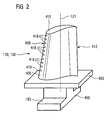
- FIG. 2 shows a perspective view of a blade 120 or guide vane 130 of a turbomachine, which extends along a longitudinal axis 121.
- the turbomachine may be a gas turbine of an aircraft or a power plant for power generation, a steam turbine or a compressor.
- the blade 120, 130 has along the longitudinal axis 121 consecutively a fastening region 400, a blade platform 403 adjoining thereto and an airfoil 406. As a guide blade 130, the blade 130 may have at its blade tip 415 another platform (not shown).
- a blade root 183 is formed, which serves for attachment of the blades 120, 130 to a shaft or a disc (not shown).
- the blade root 183 is designed, for example, as a hammer head. Other designs as Christmas tree or Schwalbenschwanzfuß are possible.
- the blade 120, 130 has a leading edge 409 and a trailing edge 412 for a medium flowing past the airfoil 406.
- Such superalloys are for example from EP 1 204 776 B1 .
- EP 1 306 454 .
- the blade 120, 130 can be made by a casting process, also by directional solidification, by a forging process, by a milling process or combinations thereof.
- directionally solidified microstructures which means both single crystals that have no grain boundaries or at most small angle grain boundaries, and stem crystal structures that have probably longitudinal grain boundaries but no transverse grain boundaries.
- second-mentioned crystalline structures are also known as directionally solidified structures.
- the blades 120, 130 may have coatings against corrosion or oxidation, e.g. M is at least one element of the group iron (Fe), cobalt (Co), nickel (Ni), X is an active element and stands for yttrium (Y) and / or silicon and / or at least one element of the rare ones Earth, or hafnium (Hf)).
- M is at least one element of the group iron (Fe), cobalt (Co), nickel (Ni)
- X is an active element and stands for yttrium (Y) and / or silicon and / or at least one element of the rare ones Earth, or hafnium (Hf)).
- Such alloys are known from the EP 0 486 489 B1 .
- EP 0 412 397 B1 or EP 1 306 454 A1 are known from the EP 0 486 489 B1 .
- a thermal barrier coating consists for example of ZrO 2 , Y 2 O 3 -ZrO 3 , that is, it is not, partially or completely stabilized by yttria and / or calcium oxide and / or magnesium oxide.
- Suitable coating processes such as electron beam evaporation (EB-PVD), produce stalk-shaped grains in the thermal barrier coating.
- Refurbishment means that components 120, 130 may need to be deprotected after use (e.g., by sandblasting). This is followed by removal of the corrosion and / or oxidation layers or products. Optionally, even cracks in the component 120, 130 are repaired, wherein the welding filler according to the invention can be used. This is followed by a re-coating of the component 120, 130 and a renewed use of the component 120, 130.
- the blade 120, 130 may be hollow or solid. If the blade 120, 130 is to be cooled, it is hollow and may still film cooling holes 418 (indicated by dashed lines) on.
- the FIG. 3 shows a combustion chamber 110 of a gas turbine 100 ( Fig. 4 ).
- the combustion chamber 110 is designed, for example, as a so-called annular combustion chamber, in which a plurality of burners 107 arranged around a rotation axis 102 in the circumferential direction open into a common combustion chamber space 154, which generate flames 156.
- the combustion chamber 110 is configured in its entirety as an annular structure, which is positioned around the axis of rotation 102 around.
- the combustion chamber 110 is designed for a comparatively high temperature of the working medium M of about 1000 ° C to 1600 ° C.
- the combustion chamber wall 153 is provided on its side facing the working medium M side with an inner lining formed from heat shield elements 155.
- Each heat shield element 155 made of an alloy is equipped on the working medium side with a particularly heat-resistant protective layer (MCrAlX layer and / or ceramic coating) or is made of high-temperature-resistant material (solid ceramic blocks).
- M is at least one element of the group iron (Fe), cobalt (Co), nickel (Ni), X is an active element and stands for yttrium (Y) and / or silicon and / or at least one element of the rare earths, or hafnium (Hf).
- MCrAlX means: M is at least one element of the group iron (Fe), cobalt (Co), nickel (Ni), X is an active element and stands for yttrium (Y) and / or silicon and / or at least one element of the rare earths, or hafnium (Hf).
- Such alloys are known from the EP 0 486 489 B1 .
- EP 0 412 397 B1 or EP 1 306 454 A1 are known from the EP 0 486 489 B1 .
- EP 0 412 397 B1 or EP 1 306 454 A1 is known from the EP 0 486 489 B1 .
- a ceramic thermal barrier coating may be present and consists for example of ZrO 2 , Y 2 O 3 -ZrO 2 , ie it is not, partially or completely stabilized by yttria and / or calcium oxide and / or magnesium oxide.
- Electron beam evaporation produces stalk-shaped grains in the thermal barrier coating.
- Refurbishment means that heat shield elements 155 may need to be deprotected (e.g., by sandblasting) after use. This is followed by removal of the corrosion and / or oxidation layers or products. Optionally, cracks in the heat shield element 155 are repaired with the welding filler according to the invention. This is followed by a recoating of the heat shield elements 155 and a renewed use of the heat shield elements 155.
- the heat shield elements 155 are then, for example, hollow and possibly still have film cooling holes (not shown) which open into the combustion chamber space 154.
- FIG. 4 shows by way of example a gas turbine 100 in a longitudinal partial section.
- the gas turbine 100 has inside a rotatably mounted about a rotation axis 102 rotor 103 with a shaft 101, which is also referred to as a turbine runner.
- a compressor 105 for example, a toroidal combustion chamber 110, in particular annular combustion chamber, with a plurality of coaxially arranged burners 107, a turbine 108 and the exhaust housing 109th
- the annular combustion chamber 110 communicates with an annular annular hot gas channel 111, for example.
- Each turbine stage 112 is formed, for example, from two blade rings.
- a row 125 formed of rotor blades 120 follows.
- the guide vanes 130 are fastened to an inner housing 138 of a stator 143, whereas the moving blades 120 of a row 125 are attached to the rotor 103 by means of a turbine disk 133, for example. Coupled to the rotor 103 is a generator or work machine (not shown).
- air 105 is sucked in and compressed by the compressor 105 through the intake housing 104.
- the compressed air provided at the turbine-side end of the compressor 105 is supplied to the burners 107 where it is mixed with a fuel.
- the mixture is then burned to form the working fluid 113 in the combustion chamber 110.
- the working medium 113 flows along the hot gas channel 111 past the guide vanes 130 and the rotor blades 120.
- the working medium 113 expands in a pulse-transmitting manner so that the rotor blades 120 drive the rotor 103 and drive the machine coupled to it.
- the components exposed to the hot working medium 113 are subject to thermal loads during operation of the gas turbine 100.
- the guide vanes 130 and rotor blades 120 of the first turbine stage 112, viewed in the flow direction of the working medium 113, are subjected to the greatest thermal stress in addition to the heat shield elements lining the annular combustion chamber 110. To withstand the prevailing temperatures, they can be cooled by means of a coolant.
- substrates of the components can have a directional structure, ie they are monocrystalline (SX structure) or have only longitudinal grains (DS structure).
- As a material for the components, in particular for the turbine blade 120, 130 and components of the combustion chamber 110 are For example, iron, nickel or cobalt-based superalloys used. Such superalloys are for example from EP 1 204 776 B1 . EP 1 306 454 . EP 1 319 729 A1 . WO 99/67435 or WO 00/44949 ,
- the vane 130 has a guide vane foot (not shown here) facing the inner housing 138 of the turbine 108 and a vane head opposite the vane foot.
- the vane head faces the rotor 103 and fixed to a mounting ring 140 of the stator 143.
Landscapes
- Engineering & Computer Science (AREA)
- Mechanical Engineering (AREA)
- Chemical & Material Sciences (AREA)
- Physics & Mathematics (AREA)
- Plasma & Fusion (AREA)
- Materials Engineering (AREA)
- Optics & Photonics (AREA)
- Metallurgy (AREA)
- Organic Chemistry (AREA)
- Thermal Sciences (AREA)
- Crystallography & Structural Chemistry (AREA)
- Arc Welding In General (AREA)
- Turbine Rotor Nozzle Sealing (AREA)
Claims (16)
- Matériau d'apport de soudure
contenant ( en pourcentage en poids ) de 17,5 % à 20,0 % de chrome ( Cr ), de 10,0 % à 12,0 % de cobalt ( Co ), de 9,0 % à 10,5 % de molybdène ( Mo ), de 0,1 % à 3,3 % de titane ( Ti ), de 1,4 % à 1,8 % d'aluminium ( Al ), de 0,04 % à 0,12 % de carbone, de 0,003 % à 0,01 % de bore ( B ), de 0,1 % en poids à 2,5 % en poids de tantale ( Ta ) éventuellement 5 % au maximum de fer ( Fe ), 0,1 % au maximum de manganèse ( Mn ), 0,5 % au maximum de silicium ( Si ), 0,015 % au maximum de soufre ( S ), 0,03 % au maximum de phosphore ( P ), de 0,01 % en poids à 0,1 % en poids de zirconium ( Zr ), de 0,25 % en poids à 0,5 % en poids d'hafnium ( Hf ), de 0,05 % en poids à 0,1 % en poids de lanthane ( La ) le reste étant du nickel, - Matériau d'apport de soudure suivant la revendication 1,
qui contient jusqu'à 1,5 % en poids de titane. - Matériau d'apport de soudure suivant la revendication 1 ou 2,
qui contient du titane et du tantale,
notamment ( Ti + Ta ) ≤ 3,5 % en poids,
et notamment ( Ti + Ta ) ≥ 3 % en poids. - Matériau d'apport de soudure suivant l'une ou plusieurs des revendications précédentes,
qui contient au maximum 0,0075 % en poids de soufre ( S ). - Matériau d'apport de soudure suivant l'une ou plusieurs des revendications 1 à 4,
qui contient au maximum 0,015 % en poids de phosphore ( P ). - Matériau d'apport de soudure suivant l'une ou plusieurs des revendications précédentes,
qui contient au maximum 0,35 % en poids de der ( Fe ). - Matériau d'apport de soudure suivant l'une ou plusieurs des revendications précédentes,
qui contient au maximum 0,05 % en poids de manganèse ( Mn ). - Matériau d'apport de soudure suivant l'une ou plusieurs des revendications précédentes,
qui contient au maximum 0,1 % en poids de silicium ( Si ). - Matériau d'apport de soudure suivant la revendication 1,
qui est constitué de
nickel, chrome, cobalt, molybdène, titane, aluminium, carbone, bore, tantale
et des constituants facultatifs
fer, manganèse, silicium, soufre, phosphore, lanthane, zirconium et/ou hafnium. - Matériau d'apport de soudure suivant la revendication 1,
qui comporte 19 % de Cr. - Matériau d'apport de soudure suivant la revendication 1,
qui comporte 11 % de Co. - Matériau d'apport de soudure suivant la revendication 1,
qui comporte 10 % de Mo. - Matériau d'apport de soudure suivant la revendication 1,
qui comporte de 3,0 % à 3,3 % de Ti. - Matériau d'apport de soudure suivant la revendication 1,
qui comporte 1,6 % d'Al. - Matériau d'apport de soudure suivant la revendication 1,
qui comporte 0,09 % de C. - Matériau d'apport de soudure suivant la revendication 1,
qui comporte 0,05 % de B.
Priority Applications (4)
| Application Number | Priority Date | Filing Date | Title |
|---|---|---|---|
| DE200520021294 DE202005021294U1 (de) | 2005-10-24 | 2005-10-24 | Geschweißtes Bauteil mit Schweißzusatzwerkstoff |
| DE502005005347T DE502005005347D1 (de) | 2005-10-24 | 2005-10-24 | Schweißzusatzwerkstoff, Verwendung des Schweißzusatzwerkstoffes und Verfahren zum Schweißen |
| EP05023192A EP1777312B1 (fr) | 2005-10-24 | 2005-10-24 | Matériau d'apport pour soudage, utilisation du matériau d'apport pour soudage et procédé de soudage |
| US11/584,879 US7915566B2 (en) | 2005-10-24 | 2006-10-23 | Weld filler, use of the weld filler and welding process |
Applications Claiming Priority (1)
| Application Number | Priority Date | Filing Date | Title |
|---|---|---|---|
| EP05023192A EP1777312B1 (fr) | 2005-10-24 | 2005-10-24 | Matériau d'apport pour soudage, utilisation du matériau d'apport pour soudage et procédé de soudage |
Publications (2)
| Publication Number | Publication Date |
|---|---|
| EP1777312A1 EP1777312A1 (fr) | 2007-04-25 |
| EP1777312B1 true EP1777312B1 (fr) | 2008-09-10 |
Family
ID=35478848
Family Applications (1)
| Application Number | Title | Priority Date | Filing Date |
|---|---|---|---|
| EP05023192A Ceased EP1777312B1 (fr) | 2005-10-24 | 2005-10-24 | Matériau d'apport pour soudage, utilisation du matériau d'apport pour soudage et procédé de soudage |
Country Status (3)
| Country | Link |
|---|---|
| US (1) | US7915566B2 (fr) |
| EP (1) | EP1777312B1 (fr) |
| DE (1) | DE502005005347D1 (fr) |
Cited By (2)
| Publication number | Priority date | Publication date | Assignee | Title |
|---|---|---|---|---|
| CN105945449A (zh) * | 2016-05-25 | 2016-09-21 | 厦门大学 | 镍锰基无硼钎料 |
| CN111015019A (zh) * | 2019-12-31 | 2020-04-17 | 江苏新华合金有限公司 | 00Cr20Mo16焊丝及其生产工艺 |
Families Citing this family (31)
| Publication number | Priority date | Publication date | Assignee | Title |
|---|---|---|---|---|
| GB2452274A (en) * | 2007-08-30 | 2009-03-04 | Welding Alloys Ltd | Manufacture of welded components |
| EP2182084A1 (fr) * | 2008-11-04 | 2010-05-05 | Siemens Aktiengesellschaft | Matériau d'apport de soudure, utilisation du matériau d'apport de soudure et composant |
| KR101127613B1 (ko) | 2010-05-13 | 2012-03-22 | 삼성에스디아이 주식회사 | 배터리 팩 |
| CN103635284B (zh) | 2011-03-23 | 2017-03-29 | 思高博塔公司 | 用于抗应力腐蚀裂开的细粒镍基合金及其设计方法 |
| US9346132B2 (en) | 2011-08-29 | 2016-05-24 | General Electric Company | Metal chemistry for improved weldability of super alloys |
| US20130048700A1 (en) * | 2011-08-29 | 2013-02-28 | General Electric Company | Filler metal chemistry for improved weldability of super alloys |
| CA2861581C (fr) | 2011-12-30 | 2021-05-04 | Scoperta, Inc. | Compositions de revetement |
| US9126287B2 (en) | 2012-03-12 | 2015-09-08 | Siemens Energy, Inc. | Advanced pass progression for build-up welding |
| US9174309B2 (en) * | 2012-07-24 | 2015-11-03 | General Electric Company | Turbine component and a process of fabricating a turbine component |
| US20150275341A1 (en) | 2012-10-11 | 2015-10-01 | Scoperta, Inc. | Non-magnetic metal alloy compositions and applications |
| EP2961555A4 (fr) | 2013-02-28 | 2016-10-12 | United Technologies Corp | Système et procédé de soudage à chaleur faible |
| US9358629B1 (en) | 2013-09-24 | 2016-06-07 | Siemens Energy, Inc. | Tungsten submerged arc welding using powdered flux |
| CN109830269B (zh) | 2013-10-10 | 2023-09-19 | 思高博塔公司 | 选择材料组合物和设计具有目标特性的材料的方法 |
| WO2015081209A1 (fr) | 2013-11-26 | 2015-06-04 | Scoperta, Inc. | Alliage à rechargement dur résistant à la corrosion |
| US11130205B2 (en) | 2014-06-09 | 2021-09-28 | Oerlikon Metco (Us) Inc. | Crack resistant hardfacing alloys |
| US9987700B2 (en) * | 2014-07-08 | 2018-06-05 | Siemens Energy, Inc. | Magnetically impelled arc butt welding method having magnet arrangement for welding components having complex curvatures |
| MY190226A (en) | 2014-07-24 | 2022-04-06 | Oerlikon Metco Us Inc | Hardfacing alloys resistant to hot tearing and cracking |
| CN106661700B (zh) | 2014-07-24 | 2019-05-03 | 思高博塔公司 | 耐冲击的耐磨堆焊和合金及其制备方法 |
| CA2971202C (fr) | 2014-12-16 | 2023-08-15 | Scoperta, Inc. | Alliages ferreux tenaces et resistants a l'usure contenant de multiples phases dures |
| MX2018002635A (es) | 2015-09-04 | 2019-02-07 | Scoperta Inc | Aleaciones resistentes al desgaste sin cromo y bajas en cromo. |
| EP3347501B8 (fr) | 2015-09-08 | 2021-05-12 | Oerlikon Metco (US) Inc. | Alliages non magnétiques de formation de carbures forts destinés à la fabrication de poudres |
| EP3374536A4 (fr) | 2015-11-10 | 2019-03-20 | Scoperta, Inc. | Matières de projection à l'arc à deux fils à oxydation contrôlée |
| CA3017642A1 (fr) | 2016-03-22 | 2017-09-28 | Scoperta, Inc. | Revetement issu de la projection thermique entierement lisible |
| CA3095046A1 (fr) | 2018-03-29 | 2019-10-03 | Oerlikon Metco (Us) Inc. | Alliages ferreux a teneur reduite en carbures |
| EP3870727A1 (fr) | 2018-10-26 | 2021-09-01 | Oerlikon Metco (US) Inc. | Alliages à base de nickel résistants à la corrosion et à l'usure |
| CN113631750A (zh) | 2019-03-28 | 2021-11-09 | 欧瑞康美科(美国)公司 | 用于涂布发动机气缸孔的热喷涂铁基合金 |
| CA3136967A1 (fr) | 2019-05-03 | 2020-11-12 | Oerlikon Metco (Us) Inc. | Charge d'alimentation pulverulente destinee au soudage en vrac resistant a l'usure, concue pour optimiser la facilite de production |
| JP7391533B2 (ja) * | 2019-05-13 | 2023-12-05 | 株式会社東芝 | 溶接用Ni基合金および溶加材 |
| KR102870036B1 (ko) | 2019-07-09 | 2025-10-13 | 오를리콘 메트코 (유에스) 아이엔씨. | 내마모성 및 내부식성을 위해 설계된 철 기반 합금 |
| JP7485936B2 (ja) * | 2020-07-08 | 2024-05-17 | 日本製鉄株式会社 | 低温用Ni鋼を用いた溶接継手の製造方法 |
| CN114983238B (zh) * | 2022-06-29 | 2023-03-24 | 九阳股份有限公司 | 一种抗高温蠕变金属涂层的烹饪容器及其制造方法 |
Family Cites Families (18)
| Publication number | Priority date | Publication date | Assignee | Title |
|---|---|---|---|---|
| US3741824A (en) * | 1970-10-29 | 1973-06-26 | United Aircraft Corp | Method to improve the weldability and formability of nickel-base superalloys |
| US4219592A (en) * | 1977-07-11 | 1980-08-26 | United Technologies Corporation | Two-way surfacing process by fusion welding |
| US4359352A (en) * | 1979-11-19 | 1982-11-16 | Marko Materials, Inc. | Nickel base superalloys which contain boron and have been processed by a rapid solidification process |
| DE3926479A1 (de) | 1989-08-10 | 1991-02-14 | Siemens Ag | Rheniumhaltige schutzbeschichtung, mit grosser korrosions- und/oder oxidationsbestaendigkeit |
| DE58908611D1 (de) | 1989-08-10 | 1994-12-08 | Siemens Ag | Hochtemperaturfeste korrosionsschutzbeschichtung, insbesondere für gasturbinenbauteile. |
| WO1996012049A1 (fr) | 1994-10-14 | 1996-04-25 | Siemens Aktiengesellschaft | Couche de protection de pieces contre la corrosion, l'oxydation et les contraintes thermiques excessives, et son procede de production |
| EP0861927A1 (fr) | 1997-02-24 | 1998-09-02 | Sulzer Innotec Ag | Procédé de fabrication de structures monocristallines |
| EP0892090B1 (fr) | 1997-02-24 | 2008-04-23 | Sulzer Innotec Ag | Procédé de fabrication de structure monocristallines |
| EP1306454B1 (fr) | 2001-10-24 | 2004-10-06 | Siemens Aktiengesellschaft | Revêtement protecteur contenant du rhénium pour la protection d'un élément contre l'oxydation et la corrosion aux températures élevées |
| WO1999067435A1 (fr) | 1998-06-23 | 1999-12-29 | Siemens Aktiengesellschaft | Alliage a solidification directionnelle a resistance transversale a la rupture amelioree |
| US6231692B1 (en) | 1999-01-28 | 2001-05-15 | Howmet Research Corporation | Nickel base superalloy with improved machinability and method of making thereof |
| DE50006694D1 (de) | 1999-07-29 | 2004-07-08 | Siemens Ag | Hochtemperaturbeständiges bauteil und verfahren zur herstellung des hochtemperaturbeständigen bauteils |
| AT408665B (de) * | 2000-09-14 | 2002-02-25 | Boehler Edelstahl Gmbh & Co Kg | Nickelbasislegierung für die hochtemperaturtechnik |
| WO2002040728A1 (fr) * | 2000-11-16 | 2002-05-23 | Sumitomo Metal Industries, Ltd. | Alliage refractaire a base de nickel (ni) et joint soude integrant celui-ci |
| DE50112339D1 (de) | 2001-12-13 | 2007-05-24 | Siemens Ag | Hochtemperaturbeständiges Bauteil aus einkristalliner oder polykristalliner Nickel-Basis-Superlegierung |
| US20040115086A1 (en) | 2002-09-26 | 2004-06-17 | Framatome Anp | Nickel-base alloy for the electro-welding of nickel alloys and steels, welding wire and use |
| EP1428897A1 (fr) * | 2002-12-10 | 2004-06-16 | Siemens Aktiengesellschaft | Méthode de fabrication d'un composant en alliage à soudabilité et/ou formabilité améliorée |
| US20060051234A1 (en) * | 2004-09-03 | 2006-03-09 | Pike Lee M Jr | Ni-Cr-Co alloy for advanced gas turbine engines |
-
2005
- 2005-10-24 EP EP05023192A patent/EP1777312B1/fr not_active Ceased
- 2005-10-24 DE DE502005005347T patent/DE502005005347D1/de not_active Expired - Lifetime
-
2006
- 2006-10-23 US US11/584,879 patent/US7915566B2/en not_active Expired - Fee Related
Cited By (4)
| Publication number | Priority date | Publication date | Assignee | Title |
|---|---|---|---|---|
| CN105945449A (zh) * | 2016-05-25 | 2016-09-21 | 厦门大学 | 镍锰基无硼钎料 |
| CN105945449B (zh) * | 2016-05-25 | 2019-04-26 | 厦门大学 | 镍锰基无硼钎料及其制备方法 |
| CN111015019A (zh) * | 2019-12-31 | 2020-04-17 | 江苏新华合金有限公司 | 00Cr20Mo16焊丝及其生产工艺 |
| CN111015019B (zh) * | 2019-12-31 | 2021-11-26 | 江苏新华合金有限公司 | 00Cr20Mo16焊丝及其生产工艺 |
Also Published As
| Publication number | Publication date |
|---|---|
| US7915566B2 (en) | 2011-03-29 |
| US20070090167A1 (en) | 2007-04-26 |
| EP1777312A1 (fr) | 2007-04-25 |
| DE502005005347D1 (de) | 2008-10-23 |
Similar Documents
| Publication | Publication Date | Title |
|---|---|---|
| EP2347022B1 (fr) | Matériau d'apport de soudure, utilisation du matériau d'apport de soudure et composant | |
| EP1777312A1 (fr) | Matériau d'apport pour soudage, utilisation du matériau d'apport pour soudage et procédé de soudage | |
| EP1835040A1 (fr) | Matériau d'apport, utilisation du matériau d'apport et procédé de soudage d'une composante structurelle | |
| EP1957685B1 (fr) | Procede de reparation de fissures dans des composants | |
| EP2311597B1 (fr) | Procédé de soudage laser de pièces en superalliages haute température avec contrôle de certains paramètres du soudage laser pour obtenir une vitesse de refroidissement particulière | |
| EP2701878A1 (fr) | Alliage à base de nickel, utilisation et procédé | |
| EP2322313A1 (fr) | Procédé de soudure de pièces usinées en superalliages résistant aux températures avec un débit particulier du matériau d'apport de soudage | |
| EP1967312A1 (fr) | Procédé de réparation par soudure d'un composant sous vide et sous une pression partielle d'oxygène choisie | |
| EP1716965A1 (fr) | Brasure comprenant de la poudre d'apport métallique sous forme élémentaire | |
| EP2117766A1 (fr) | Alliages de brasage et dispositif pour la réparation d'un élément de construction | |
| EP1595633B1 (fr) | utilisation d'un mélange gazeux en soudage. | |
| WO2008116478A1 (fr) | Mélange de gaz protecteurs et procédé de soudage | |
| EP1924395B1 (fr) | Alliage d'apport a base de nickel et procede pour reparer un composant | |
| EP1790743A1 (fr) | Alliage, couche de protection et composant | |
| EP1970156A1 (fr) | Alliage de brasage et procédé destiné à la réparation d'un composant | |
| DE202005021294U1 (de) | Geschweißtes Bauteil mit Schweißzusatzwerkstoff | |
| WO2012095221A1 (fr) | Alliages à base de cobalt et contenant de germanium, et procédé de brasage | |
| EP1790746B1 (fr) | Alliage, couche de protection et composant | |
| EP2597167B1 (fr) | Superalliage DS et composant | |
| EP1808572A1 (fr) | Procédé de soudage suivi d'un traitement de diffusion | |
| EP1930115A1 (fr) | Fil, son utilisation et procédé de soudage | |
| WO2009018839A1 (fr) | Alliage de brasage et procédé de réparation d'un composant | |
| EP1806419A1 (fr) | Alliage, couche protectrice pour proteger un élément structurel contre la corrosion et l'oxydation aux temperatures hautes, et élément structurel |
Legal Events
| Date | Code | Title | Description |
|---|---|---|---|
| PUAI | Public reference made under article 153(3) epc to a published international application that has entered the european phase |
Free format text: ORIGINAL CODE: 0009012 |
|
| 17P | Request for examination filed |
Effective date: 20061120 |
|
| AK | Designated contracting states |
Kind code of ref document: A1 Designated state(s): AT BE BG CH CY CZ DE DK EE ES FI FR GB GR HU IE IS IT LI LT LU LV MC NL PL PT RO SE SI SK TR |
|
| AX | Request for extension of the european patent |
Extension state: AL BA HR MK YU |
|
| 17Q | First examination report despatched |
Effective date: 20070201 |
|
| AKX | Designation fees paid |
Designated state(s): CH DE GB IT LI |
|
| GRAP | Despatch of communication of intention to grant a patent |
Free format text: ORIGINAL CODE: EPIDOSNIGR1 |
|
| GRAS | Grant fee paid |
Free format text: ORIGINAL CODE: EPIDOSNIGR3 |
|
| GRAA | (expected) grant |
Free format text: ORIGINAL CODE: 0009210 |
|
| AK | Designated contracting states |
Kind code of ref document: B1 Designated state(s): CH DE GB IT LI |
|
| REG | Reference to a national code |
Ref country code: GB Ref legal event code: FG4D Free format text: NOT ENGLISH |
|
| REG | Reference to a national code |
Ref country code: CH Ref legal event code: NV Representative=s name: SIEMENS SCHWEIZ AG Ref country code: CH Ref legal event code: EP |
|
| REF | Corresponds to: |
Ref document number: 502005005347 Country of ref document: DE Date of ref document: 20081023 Kind code of ref document: P |
|
| REG | Reference to a national code |
Ref country code: CH Ref legal event code: PCAR Free format text: SIEMENS SCHWEIZ AG;INTELLECTUAL PROPERTY FREILAGERSTRASSE 40;8047 ZUERICH (CH) |
|
| PLBE | No opposition filed within time limit |
Free format text: ORIGINAL CODE: 0009261 |
|
| STAA | Information on the status of an ep patent application or granted ep patent |
Free format text: STATUS: NO OPPOSITION FILED WITHIN TIME LIMIT |
|
| 26N | No opposition filed |
Effective date: 20090611 |
|
| PGFP | Annual fee paid to national office [announced via postgrant information from national office to epo] |
Ref country code: GB Payment date: 20161013 Year of fee payment: 12 |
|
| PGFP | Annual fee paid to national office [announced via postgrant information from national office to epo] |
Ref country code: IT Payment date: 20161027 Year of fee payment: 12 |
|
| PGFP | Annual fee paid to national office [announced via postgrant information from national office to epo] |
Ref country code: CH Payment date: 20170105 Year of fee payment: 12 Ref country code: DE Payment date: 20161220 Year of fee payment: 12 |
|
| REG | Reference to a national code |
Ref country code: CH Ref legal event code: PCOW Free format text: NEW ADDRESS: WERNER-VON-SIEMENS-STRASSE 1, 80333 MUENCHEN (DE) |
|
| REG | Reference to a national code |
Ref country code: DE Ref legal event code: R119 Ref document number: 502005005347 Country of ref document: DE |
|
| REG | Reference to a national code |
Ref country code: CH Ref legal event code: PL |
|
| GBPC | Gb: european patent ceased through non-payment of renewal fee |
Effective date: 20171024 |
|
| PG25 | Lapsed in a contracting state [announced via postgrant information from national office to epo] |
Ref country code: LI Free format text: LAPSE BECAUSE OF NON-PAYMENT OF DUE FEES Effective date: 20171031 Ref country code: GB Free format text: LAPSE BECAUSE OF NON-PAYMENT OF DUE FEES Effective date: 20171024 Ref country code: DE Free format text: LAPSE BECAUSE OF NON-PAYMENT OF DUE FEES Effective date: 20180501 Ref country code: CH Free format text: LAPSE BECAUSE OF NON-PAYMENT OF DUE FEES Effective date: 20171031 |
|
| PG25 | Lapsed in a contracting state [announced via postgrant information from national office to epo] |
Ref country code: IT Free format text: LAPSE BECAUSE OF NON-PAYMENT OF DUE FEES Effective date: 20171024 |