EP1785592A2 - Système de joint d'étanchéité pour turbine à gaz - Google Patents
Système de joint d'étanchéité pour turbine à gaz Download PDFInfo
- Publication number
- EP1785592A2 EP1785592A2 EP06255762A EP06255762A EP1785592A2 EP 1785592 A2 EP1785592 A2 EP 1785592A2 EP 06255762 A EP06255762 A EP 06255762A EP 06255762 A EP06255762 A EP 06255762A EP 1785592 A2 EP1785592 A2 EP 1785592A2
- Authority
- EP
- European Patent Office
- Prior art keywords
- tab
- seal
- spline seal
- turbine
- slot
- Prior art date
- Legal status (The legal status is an assumption and is not a legal conclusion. Google has not performed a legal analysis and makes no representation as to the accuracy of the status listed.)
- Granted
Links
Images

Classifications
-
- F—MECHANICAL ENGINEERING; LIGHTING; HEATING; WEAPONS; BLASTING
- F02—COMBUSTION ENGINES; HOT-GAS OR COMBUSTION-PRODUCT ENGINE PLANTS
- F02C—GAS-TURBINE PLANTS; AIR INTAKES FOR JET-PROPULSION PLANTS; CONTROLLING FUEL SUPPLY IN AIR-BREATHING JET-PROPULSION PLANTS
- F02C7/00—Features, components parts, details or accessories, not provided for in, or of interest apart form groups F02C1/00 - F02C6/00; Air intakes for jet-propulsion plants
- F02C7/28—Arrangement of seals
-
- F—MECHANICAL ENGINEERING; LIGHTING; HEATING; WEAPONS; BLASTING
- F01—MACHINES OR ENGINES IN GENERAL; ENGINE PLANTS IN GENERAL; STEAM ENGINES
- F01D—NON-POSITIVE DISPLACEMENT MACHINES OR ENGINES, e.g. STEAM TURBINES
- F01D11/00—Preventing or minimising internal leakage of working-fluid, e.g. between stages
- F01D11/005—Sealing means between non relatively rotating elements
-
- F—MECHANICAL ENGINEERING; LIGHTING; HEATING; WEAPONS; BLASTING
- F05—INDEXING SCHEMES RELATING TO ENGINES OR PUMPS IN VARIOUS SUBCLASSES OF CLASSES F01-F04
- F05D—INDEXING SCHEME FOR ASPECTS RELATING TO NON-POSITIVE-DISPLACEMENT MACHINES OR ENGINES, GAS-TURBINES OR JET-PROPULSION PLANTS
- F05D2240/00—Components
- F05D2240/10—Stators
- F05D2240/12—Fluid guiding means, e.g. vanes
-
- F—MECHANICAL ENGINEERING; LIGHTING; HEATING; WEAPONS; BLASTING
- F05—INDEXING SCHEMES RELATING TO ENGINES OR PUMPS IN VARIOUS SUBCLASSES OF CLASSES F01-F04
- F05D—INDEXING SCHEME FOR ASPECTS RELATING TO NON-POSITIVE-DISPLACEMENT MACHINES OR ENGINES, GAS-TURBINES OR JET-PROPULSION PLANTS
- F05D2260/00—Function
- F05D2260/30—Retaining components in desired mutual position
-
- Y—GENERAL TAGGING OF NEW TECHNOLOGICAL DEVELOPMENTS; GENERAL TAGGING OF CROSS-SECTIONAL TECHNOLOGIES SPANNING OVER SEVERAL SECTIONS OF THE IPC; TECHNICAL SUBJECTS COVERED BY FORMER USPC CROSS-REFERENCE ART COLLECTIONS [XRACs] AND DIGESTS
- Y10—TECHNICAL SUBJECTS COVERED BY FORMER USPC
- Y10T—TECHNICAL SUBJECTS COVERED BY FORMER US CLASSIFICATION
- Y10T29/00—Metal working
- Y10T29/49—Method of mechanical manufacture
- Y10T29/49229—Prime mover or fluid pump making
- Y10T29/49297—Seal or packing making
-
- Y—GENERAL TAGGING OF NEW TECHNOLOGICAL DEVELOPMENTS; GENERAL TAGGING OF CROSS-SECTIONAL TECHNOLOGIES SPANNING OVER SEVERAL SECTIONS OF THE IPC; TECHNICAL SUBJECTS COVERED BY FORMER USPC CROSS-REFERENCE ART COLLECTIONS [XRACs] AND DIGESTS
- Y10—TECHNICAL SUBJECTS COVERED BY FORMER USPC
- Y10T—TECHNICAL SUBJECTS COVERED BY FORMER US CLASSIFICATION
- Y10T29/00—Metal working
- Y10T29/49—Method of mechanical manufacture
- Y10T29/49316—Impeller making
- Y10T29/4932—Turbomachine making
-
- Y—GENERAL TAGGING OF NEW TECHNOLOGICAL DEVELOPMENTS; GENERAL TAGGING OF CROSS-SECTIONAL TECHNOLOGIES SPANNING OVER SEVERAL SECTIONS OF THE IPC; TECHNICAL SUBJECTS COVERED BY FORMER USPC CROSS-REFERENCE ART COLLECTIONS [XRACs] AND DIGESTS
- Y10—TECHNICAL SUBJECTS COVERED BY FORMER USPC
- Y10T—TECHNICAL SUBJECTS COVERED BY FORMER US CLASSIFICATION
- Y10T29/00—Metal working
- Y10T29/49—Method of mechanical manufacture
- Y10T29/49316—Impeller making
- Y10T29/4932—Turbomachine making
- Y10T29/49323—Assembling fluid flow directing devices, e.g., stators, diaphragms, nozzles
Definitions
- This invention relates generally to turbine engines and more particularly, to methods and apparatus for assembling gas turbine engines.
- Known gas turbine engines include combustors which ignite fuel-air mixtures which are then channeled through a turbine nozzle assembly towards a turbine.
- At least some known turbine nozzle assemblies include a plurality of arcuate nozzle segments arranged circumferentially.
- At least some known turbine nozzles include a plurality of circumferentially-spaced hollow airfoil vanes coupled by integrally-formed inner and outer band platforms. More specifically, the inner band forms a portion of the radially inner flowpath boundary and the outer band forms a portion of the radially outer flowpath boundary.
- known turbine nozzle assemblies the turbine nozzle segments are coupled circumferentially within the turbine engine. More specifically, because of temperature differentials that may develop and to accommodate thermal expansion, known turbine nozzles are positioned such that a gap or clearance is defined between pairs of circumferentially-adjacent nozzles. To facilitate preventing cooling air supplied to such nozzle segments from leaking through the clearance gaps, at least some known turbine nozzle assemblies include a plurality of spline seals.
- Known spline seals are substantially flat pieces of material that are inserted within slots defined in the turbine nozzles. More specifically, at least some known nozzle assemblies include a loading slot that facilitates the installation of the spline seals within the spline seal slots. However, depending on the operation of the turbine engine, at least some known spline seals may undesirably slip out of the spline seal slots through the loading slot. Such seals may be channeled downstream and cause damage to other engine components. Moreover, over time, continued operation with decreased cooling of the turbine nozzles adjacent such spline seal slots may limit a useful life of the turbine nozzle.
- a method for assembling a gas turbine engine comprises coupling a first turbine nozzle within the engine, coupling a second turbine nozzle circumferentially adjacent the first turbine nozzle such that a gap is defined between the first and second turbine nozzles and providing at least one spline seal including a substantially planar body.
- the method also comprises forming at least one retainer tab to extend outward from the body portion of the at least one spline seal, and inserting the at least one spline seal into a slot defined in at least one of the first and second turbine nozzles to facilitate reducing leakage through said gap, such that the at least one retainer tab facilitates retaining the retainer tab within the turbine nozzle slot.
- a seal assembly for use with a turbine engine turbine nozzle assembly.
- the seal assembly includes at least one spline seal sized for insertion within a slot formed within a turbine nozzle.
- the at least one spline seal is configured to facilitate reducing leakage through the turbine engine turbine nozzle assembly, and includes a substantially planar body and at least one tab extending outward from said body.
- the seal body is bounded by an outer periphery, and the at least one tab is adjacent to the body outer periphery.
- a turbine nozzle assembly for a gas turbine engine.
- the nozzle assembly includes a plurality of turbine nozzles and a seal assembly.
- Each turbine nozzle includes an outer band, an inner band, and at least one airfoil vane extending between the outer and inner bands.
- a portion of each of the plurality of turbine nozzles defines a slot therein.
- the seal assembly includes at least one spline seal sized for insertion within the turbine nozzle slot to facilitate reducing leakage between circumferentially adjacent pairs of the turbine nozzles.
- the at least one spline seal includes a substantially planar body and at least one retainer tab extending outward from the body. The body is bounded by an outer periphery, and the at least one retainer tab is adjacent to the body outer periphery.
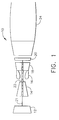
- Figure 1 is a schematic illustration of an exemplary gas turbine engine 10 including a low pressure compressor 12, a high pressure compressor 14, and a combustor 16.
- Engine 10 also includes a high pressure turbine 18 and a low pressure turbine 20.
- Compressor 12 and turbine 20 are coupled by a first shaft 21, and compressor 14 and turbine 18 are coupled by a second shaft 22.
- gas turbine engine 10 is an LM2500 engine commercially available from General Electric Aircraft Engines, Cincinnati, Ohio.
- gas turbine engine 10 is a CFM engine commercially available from General Electric Aircraft Engines, Cincinnati, Ohio.
- the highly compressed air is delivered to combustor 16.
- Airflow from combustor 16 is channeled through a turbine nozzle (not shown in Figure 1) to drive turbines 18 and 20, prior to exiting gas turbine engine 10 through an exhaust nozzle 24.
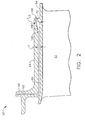
- FIG 2 is a side view of an exemplary turbine nozzle 50 that may be used with a gas turbine engine, such as turbine engine 10 (shown in Figure 1).
- nozzle 50 is one segment of a plurality of segments that are positioned circumferentially to form a nozzle assembly (not shown) within the gas turbine engine.
- Nozzle 50 includes at least one airfoil vane 52 extending between an arcuate radially outer band or platform 54, and an arcuate radially inner band or platform (not shown). More specifically, in the exemplary embodiment, outer band 54 and the inner band are each integrally-formed with airfoil vane 52.
- nozzle 50 also includes an axial spline seal slot 60 and a radial spline seal slot 62 that are each formed in a generally axially-extending face 64 of nozzle 50. More specifically, slot 60 extends generally axially through a portion of face 64 and slot 62 extends generally radially through a radial flange 66 portion of nozzle 50. In the exemplary embodiment, slot 60 is also formed integrally with a loading slot portion 68 that facilitates the installation of axial spline seals (not shown in Figure 2) into the segmented nozzle assembly.
- a thickness T of spline seal slot 60 is substantially constant through slot 60.
- loading slot portion 68 is frusto-conical such that a thickness T LS of slot portion 68 increases from slot 60 to a stop projection 72 adjacent a trailing end 76 of slot portion 68. Stop projection 72 facilitates maintaining the spline seal within slot 60.
- a plurality of nozzles 50 are positioned circumferentially adjacent to each other to form the nozzle assembly.
- nozzles 50 are positioned relative to each other such that a clearance gap is defined between each pair of circumferentially adjacent pairs of nozzles. More specifically, the clearance gap is defined between circumferentially adjacent and opposing nozzle end faces 64.
- spline seals (not shown in Figure 2) are inserted within a pair of circumferentially adjacent spline seal slots 60. More specifically, when positioned within slots 60, each spline seal circumferentially bridges the clearance gap to facilitate preventing leakage through the gap.
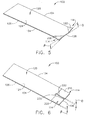
- FIG 3 is a perspective view of an exemplary spline seal 100 that may be used in turbine nozzle 50 (shown in Figure 2).
- spline seal 100 is substantially rectangular and is bordered by an outer perimeter 102 including a pair of circumferentially-spaced sides 104 that are connected by a leading edge side 106 and a trailing edge side 108.
- spline seal 100 may have any non-rectangular shape that enables seal 100 to function as described herein.
- at least one corner portion 114 is defined at the intersection of sides 104 and 106 or sides 104 and 108.
- Spline seal 100 includes a body portion 120 and a retainer tab 122.
- Body portion 120 is substantially planar and includes a radially outer surface 124 and an opposite radially inner surface 126.
- Body portion 120 is sized for insertion within spline seal slot 60 and has a thickness T B that is thinner than spline seal slot thickness T.
- spline seal 100 is fabricated from a substantially flat piece of sheet metal.
- Retainer tab 122 extends outward from body portion 120 and is not co-planar with body portion 120. Specifically, in the exemplary embodiment, retainer tab 122 extends outward from spline seal outer perimeter 102, and more specifically, is formed within a spline seal corner portion 114. Accordingly, in the exemplary embodiment, retainer tab 122 is substantially triangular shaped. Alternatively, retainer tab 122 may extend from any portion of body portion 120, or have any shape, that enables retainer tab 122 to function as described herein. Moreover, although only one retainer tab 122 is illustrated, spline seal 100 may include any number of retainer tabs 122.
- retainer tab 122 is oriented at an oblique angle ⁇ with respect to body radially outer surface 124.
- retainer tab 122 may be oriented at any angle ⁇ with respect to radially outer surface 124 that enables retainer tab 122 to function as described herein.
- retainer tab 122 may be oriented at any angle ⁇ with respect to body radially inner surface 126 such that retainer tab 122 extends radially inward from surface 126 rather than outward from surface 124.
- retainer tab 122 is formed integrally with body portion 120. More specifically, in the exemplary embodiment, retainer tab 122 is formed by bending a portion of spline seal 122 to a desired angle ⁇ . Alternatively, retainer tab 122 may be coupled to body portion 120.
- spline seal 100 is inserted through loading slot portion 68 and into spline seal slot 60 such that spline seal 100 circumferentially bridges the clearance gap between adjacent nozzles 50 (shown in Figure 2). More specifically, spline seal 100 is inserted into slot 60 such that seal leading edge side 106 is upstream from seal trailing edge side 108. As such, in the exemplary embodiment, when spline seal 100 is fully inserted into slot 60, retainer tab 122 extends outward from spline seal body portion 120 and contacts a radially upper surface 130 (shown in Figure 2) of slot portion 68, which limits the amount of radial movement of trailing edge side 108.
- retainer tab 122 facilitates maintaining spline seal 100 within spline seal slot 60, and thus facilitates preventing spline seal 100 from undesirably slipping or backing out from slot 60. As a result, retainer tab 122 facilitates minimizing leakage through the segmented turbine nozzle assembly clearance gaps and thus facilitates enhancing engine performance and component life expectancy.
- Figure 4 is a perspective view of an alternative embodiment of spline seal 100.
- the embodiment illustrated in Figure 4 is substantially similar to the embodiment illustrated in Figure 3 and components of spline seal 100 illustrated in Figure 4 that are identical to components of spline seal 100 illustrated in Figure 3, are identified in Figure 4 using the same reference numerals used in Figure 3.
- spline seal 100 includes a retainer tab 150 that extends outward from body portion 120 and as such, is not co-planar with body portion 120.
- retainer tab 122 has a width W that is identical to a width Ws of spline seal 100 measured between sides 104.
- retainer tab 122 is substantially rectangular-shaped.
- retainer tab 150 may extend from any portion of body portion 120, or have any shape, that enables retainer tab 150 to function as described herein.
- retainer tab 150 is oriented at an oblique angle ⁇ with respect to body radially inner surface 126.
- retainer tab 150 may be oriented at any angle ⁇ with respect to radially inner surface 126 that enables retainer tab 150 to function as described herein.
- retainer tab 150 is formed integrally with body portion 120. More specifically, in the exemplary embodiment, retainer tab 150 is formed by bending a portion of spline seal 100 to a desired angle ⁇ . Alternatively, retainer tab 150 may be coupled to body portion 120.
- retainer tab 150 facilitates limiting an amount of radial and axial movement of spline seal 100. More specifically, as spline seal 100 travels aftward towards loading slot portion 68, retainer tab 150 contacts stop projection 72. As such, during engine operation, retainer tab 150 facilitates maintaining spline seal 100 within spline seal slot 60, and thus facilitates preventing spline seal 100 from undesirably slipping or backing out from slot 60. As a result, retainer tab 150 facilitates minimizing leakage through the segmented turbine nozzle assembly clearance gaps and thus facilitates enhancing engine performance and component life expectancy.
- FIG. 5 is perspective view of a further alternative embodiment of spline seal 100.
- the embodiment illustrated in Figure 5 is substantially similar to the embodiment illustrated in Figure 3 and components of spline seal 100 illustrated in Figure 5 that are identical to components of spline seal 100 illustrated in Figure 3, are identified in Figure 5 using the same reference numerals used in Figure 3.
- spline seal 100 includes retainer tab 122 and body portion 120.
- Spline seal 100 also includes a second retainer tab 200 that extends outward from body portion 120 and is not co-planar with body portion 120.
- retainer tab 200 extends outward from spline seal outer perimeter 102, and more specifically, is formed within a spline seal corner portion 114.
- retainer tab 200 is substantially triangular shaped.
- retainer tab 200 may extend from any portion of body portion 120, or have any shape, that enables retainer tab 200 to function as described herein.
- retainer tab 200 is oriented at an oblique angle ⁇ with respect to body radially inner surface 126.
- retainer tab 200 may be oriented at any angle ⁇ with respect to radially inner surface 126 that enables retainer tab 200 to function as described herein.
- retainer tab 200 is formed integrally with body portion 120. More specifically, in the exemplary embodiment, retainer tab 200 is formed by bending a portion of spline seal 100 to a desired angle ⁇ . Alternatively, retainer tab 200 may be coupled to body portion 120.
- Figure 6 is a perspective view of another alternative embodiment of spline seal 100.
- the embodiment illustrated in Figure 6 is substantially similar to the embodiment illustrated in Figure 3 and components of spline seal 100 illustrated in Figure 6 that are identical to components of spline seal 100 illustrated in Figure 3, are identified in Figure 6 using the same reference numerals used in Figure 3.
- spline seal 100 includes body portion 120 and a first retainer tab 210 and a second retainer tab 220.
- each retainer tab 210 and 220 extends outward from spline seal outer perimeter 102, and each is formed partially within a spline seal corner portion 114.
- spline seal 100 includes a retainer division slot or cut 222 that extends a distance axially upstream from spline seal trailing edge side 108.
- slot 222 is substantially centered between spline seal sides 104, such that retainer tabs 210 and 220 are approximately the same size.
- slot 222 is non-centered with respect to spline seal 100 and retainer tabs 210 and 220 have different sizes.
- retainer tabs 210 and 220 are each substantially rectangular-shaped.
- Stop hole 230 facilitates reducing stresses that may be induced to spline seal 100 adjacent retainer tabs 210 and 220 and also facilitates preventing the initiation or propagation of cracks that may develop within spline seal 100 between retainer tabs 210 and 220.
- retainer tab 210 is oriented at an oblique angle ⁇ with respect to body radially outer surface 124
- retainer tab 220 is oriented at an oblique angle ⁇ with respect to body radially inner surface 126.
- retainer tabs 210 and 220 may be oriented at any angles ⁇ or ⁇ with respect to radially outer and inner surfaces 124 and 126, respectively, that enables retainer tabs 210 and 220 to function as described herein.
- retainer tabs 210 and 220 are each formed integrally with body portion 120. More specifically, in the exemplary embodiment, retainer tabs 210 and 220 are each formed by bending a portion of spline seal 100 that is adjacent to slot 222 to a respective desired angle ⁇ or ⁇ . Alternatively, either retainer tab 210 and/or retainer tab 220 may be coupled to body portion 120.
- the above-described spline seals include a retainer tab that facilitates preventing the spline seal from inadvertently backing out of the nozzle assembly spline seal slots. More specifically, in each embodiment, the retainer tab extends outward from the body portion of the spline seal to facilitate limiting radial and movement of the spline seal within the spline seal slot. As a result, during engine operation, the retainer tabs facilitate reducing leakage through the clearance gap defined between circumferentially adjacent turbine nozzles. Accordingly, engine performance and component useful life are each facilitated to be enhanced in a cost effective and reliable means. Moreover, the invention provides a means wherein existing spline seals can be modified to facilitate enhancing turbine engine performance.
- spline seals are not limited to use with the specific nozzle embodiments described herein, but rather, the spline seals can be utilized independently and separately from other turbine nozzle components described herein. Moreover, the invention is not limited to the embodiments of the spline seals described above in detail. Rather, other variations of spline embodiments may be utilized within the spirit and scope of the claims.
Landscapes
- Engineering & Computer Science (AREA)
- Chemical & Material Sciences (AREA)
- Combustion & Propulsion (AREA)
- Mechanical Engineering (AREA)
- General Engineering & Computer Science (AREA)
- Turbine Rotor Nozzle Sealing (AREA)
- Gasket Seals (AREA)
Applications Claiming Priority (1)
| Application Number | Priority Date | Filing Date | Title |
|---|---|---|---|
| US11/271,101 US7575415B2 (en) | 2005-11-10 | 2005-11-10 | Methods and apparatus for assembling turbine engines |
Publications (3)
| Publication Number | Publication Date |
|---|---|
| EP1785592A2 true EP1785592A2 (fr) | 2007-05-16 |
| EP1785592A3 EP1785592A3 (fr) | 2012-08-01 |
| EP1785592B1 EP1785592B1 (fr) | 2013-09-25 |
Family
ID=37575118
Family Applications (1)
| Application Number | Title | Priority Date | Filing Date |
|---|---|---|---|
| EP06255762.4A Not-in-force EP1785592B1 (fr) | 2005-11-10 | 2006-11-09 | Système de joint d'étanchéité pour turbine à gaz |
Country Status (4)
| Country | Link |
|---|---|
| US (1) | US7575415B2 (fr) |
| EP (1) | EP1785592B1 (fr) |
| JP (1) | JP4960065B2 (fr) |
| CA (1) | CA2565744C (fr) |
Cited By (4)
| Publication number | Priority date | Publication date | Assignee | Title |
|---|---|---|---|---|
| EP2213841A1 (fr) * | 2009-01-28 | 2010-08-04 | Alstom Technology Ltd | Languette d'étanchéité et son procédé de conception |
| EP2578910A1 (fr) * | 2011-10-05 | 2013-04-10 | Rolls-Royce plc | Joints de bande |
| EP2586993A3 (fr) * | 2011-10-28 | 2016-12-07 | United Technologies Corporation | Fente de joint à languette |
| FR3146928A1 (fr) * | 2023-03-20 | 2024-09-27 | Safran Aircraft Engines | Ensemble d’étanchéité amélioré pour turbine à gaz |
Families Citing this family (14)
| Publication number | Priority date | Publication date | Assignee | Title |
|---|---|---|---|---|
| US7918024B2 (en) * | 2006-01-20 | 2011-04-05 | General Electric Company | Methods and apparatus for manufacturing components |
| US8308428B2 (en) * | 2007-10-09 | 2012-11-13 | United Technologies Corporation | Seal assembly retention feature and assembly method |
| EP2762679A1 (fr) * | 2013-02-01 | 2014-08-06 | Siemens Aktiengesellschaft | Aube de rotor de turbine à gaz et turbine à gaz |
| US10072517B2 (en) * | 2013-03-08 | 2018-09-11 | United Technologies Corporation | Gas turbine engine component having variable width feather seal slot |
| EP2881544A1 (fr) | 2013-12-09 | 2015-06-10 | Siemens Aktiengesellschaft | Profilé d'aube de turbine à gaz et agencement associé |
| EP3118420A1 (fr) | 2015-07-15 | 2017-01-18 | Siemens Aktiengesellschaft | Élément de paroi pouvant être refroidi avec plaque de refroidissement par impact |
| US10494943B2 (en) | 2016-02-03 | 2019-12-03 | General Electric Company | Spline seal for a gas turbine engine |
| US10221712B2 (en) | 2016-05-16 | 2019-03-05 | General Electric Company | Seal for hardware segments |
| US10662794B2 (en) * | 2017-10-19 | 2020-05-26 | Rolls-Royce Corporation | Strip seal axial assembly groove |
| US10633994B2 (en) * | 2018-03-21 | 2020-04-28 | United Technologies Corporation | Feather seal assembly |
| US11840930B2 (en) * | 2019-05-17 | 2023-12-12 | Rtx Corporation | Component with feather seal slots for a gas turbine engine |
| US11566528B2 (en) * | 2019-12-20 | 2023-01-31 | General Electric Company | Rotor blade sealing structures |
| US11519286B2 (en) * | 2021-02-04 | 2022-12-06 | General Electric Company | Sealing assembly and sealing member therefor with spline seal retention |
| FR3158533A1 (fr) * | 2024-01-19 | 2025-07-25 | Safran Aircraft Engines | Ensemble d’étanchéité, turbine et procédé associés |
Family Cites Families (16)
| Publication number | Priority date | Publication date | Assignee | Title |
|---|---|---|---|---|
| GB1081458A (en) * | 1965-12-28 | 1967-08-31 | Rolls Royce | Blade assembly for a fluid flow machine such as a gas turbine engine |
| US3728041A (en) * | 1971-10-04 | 1973-04-17 | Gen Electric | Fluidic seal for segmented nozzle diaphragm |
| US3947145A (en) * | 1974-10-07 | 1976-03-30 | Westinghouse Electric Corporation | Gas turbine stationary shroud seals |
| JPS5991401A (ja) * | 1982-11-17 | 1984-05-26 | Furukawa Electric Co Ltd:The | パイプ被覆光フアイバ |
| US4557412A (en) * | 1983-12-05 | 1985-12-10 | United Technologies Corporation | Intersecting feather seals and construction thereof |
| US4524980A (en) * | 1983-12-05 | 1985-06-25 | United Technologies Corporation | Intersecting feather seals for interlocking gas turbine vanes |
| US5074748A (en) | 1990-07-30 | 1991-12-24 | General Electric Company | Seal assembly for segmented turbine engine structures |
| US5154577A (en) * | 1991-01-17 | 1992-10-13 | General Electric Company | Flexible three-piece seal assembly |
| US5249920A (en) * | 1992-07-09 | 1993-10-05 | General Electric Company | Turbine nozzle seal arrangement |
| US5655876A (en) | 1996-01-02 | 1997-08-12 | General Electric Company | Low leakage turbine nozzle |
| US5820338A (en) * | 1997-04-24 | 1998-10-13 | United Technologies Corporation | Fan blade interplatform seal |
| JPH1150805A (ja) * | 1997-08-06 | 1999-02-23 | Mitsubishi Heavy Ind Ltd | ガスタービン静翼シュラウドのシール構造 |
| US6254333B1 (en) * | 1999-08-02 | 2001-07-03 | United Technologies Corporation | Method for forming a cooling passage and for cooling a turbine section of a rotary machine |
| US20030039542A1 (en) * | 2001-08-21 | 2003-02-27 | Cromer Robert Harold | Transition piece side sealing element and turbine assembly containing such seal |
| ES2289256T3 (es) * | 2003-02-19 | 2008-02-01 | Alstom Technology Ltd | Sistema de estanqueidad, particularmente para los segmentos de alabes de turbinas de gas. |
| JP4495481B2 (ja) * | 2004-02-18 | 2010-07-07 | イーグル・エンジニアリング・エアロスペース株式会社 | シール装置 |
-
2005
- 2005-11-10 US US11/271,101 patent/US7575415B2/en not_active Expired - Fee Related
-
2006
- 2006-10-26 CA CA2565744A patent/CA2565744C/fr not_active Expired - Fee Related
- 2006-11-08 JP JP2006302559A patent/JP4960065B2/ja not_active Expired - Fee Related
- 2006-11-09 EP EP06255762.4A patent/EP1785592B1/fr not_active Not-in-force
Cited By (6)
| Publication number | Priority date | Publication date | Assignee | Title |
|---|---|---|---|---|
| EP2213841A1 (fr) * | 2009-01-28 | 2010-08-04 | Alstom Technology Ltd | Languette d'étanchéité et son procédé de conception |
| US8534675B2 (en) | 2009-01-28 | 2013-09-17 | Alstom Technology Ltd | Strip seal and method for designing a strip seal |
| EP2578910A1 (fr) * | 2011-10-05 | 2013-04-10 | Rolls-Royce plc | Joints de bande |
| US9163728B2 (en) | 2011-10-05 | 2015-10-20 | Rolls-Royce Plc | Strip seals |
| EP2586993A3 (fr) * | 2011-10-28 | 2016-12-07 | United Technologies Corporation | Fente de joint à languette |
| FR3146928A1 (fr) * | 2023-03-20 | 2024-09-27 | Safran Aircraft Engines | Ensemble d’étanchéité amélioré pour turbine à gaz |
Also Published As
| Publication number | Publication date |
|---|---|
| EP1785592A3 (fr) | 2012-08-01 |
| JP2007132351A (ja) | 2007-05-31 |
| US7575415B2 (en) | 2009-08-18 |
| CA2565744A1 (fr) | 2007-05-10 |
| EP1785592B1 (fr) | 2013-09-25 |
| JP4960065B2 (ja) | 2012-06-27 |
| US20070104571A1 (en) | 2007-05-10 |
| CA2565744C (fr) | 2015-06-02 |
Similar Documents
| Publication | Publication Date | Title |
|---|---|---|
| US7625174B2 (en) | Methods and apparatus for assembling gas turbine engine stator assemblies | |
| CA2565744C (fr) | Methodes et dispositif d'assemblage des moteurs a turbine | |
| US8684680B2 (en) | Sealing and cooling at the joint between shroud segments | |
| US20130011265A1 (en) | Chevron platform turbine vane | |
| US7976274B2 (en) | Methods and apparatus for assembling turbine engines | |
| US20090014964A1 (en) | Angled honeycomb seal between turbine rotors and turbine stators in a turbine engine | |
| EP3315731B1 (fr) | Ensemble d'étanchéité pour une turbine á gaz | |
| CA2555395C (fr) | Ensemble d'enveloppe de turbine et methode d'assemblage d'une turbine a gaz | |
| US20180283193A1 (en) | Sealing part for a gas turbine and method for manufacturing such a sealing part | |
| EP1795712A2 (fr) | Procédé et dispositif pour l'assemblage d'un moteur à turbine. | |
| EP2578910B1 (fr) | Joints de bande | |
| US20180128117A1 (en) | Self-sealing impingement cooling tube for a turbine vane | |
| EP3438410B1 (fr) | Système d'étanchéité pour machine rotative | |
| GB2627749A (en) | A ring segment for a gas turbine, a method to operate a gas turbine and computer-implemented method to design and/or manufacture said ring segments | |
| US8469656B1 (en) | Airfoil seal system for gas turbine engine | |
| EP3498980B1 (fr) | Agencement de joint à feuillure | |
| CA2596040A1 (fr) | Methodes et appareillage d'assemblage de moteurs a turbine | |
| WO2019177599A1 (fr) | Structure abradable en nid d'abeilles inclinée pour turbine à gaz |
Legal Events
| Date | Code | Title | Description |
|---|---|---|---|
| PUAI | Public reference made under article 153(3) epc to a published international application that has entered the european phase |
Free format text: ORIGINAL CODE: 0009012 |
|
| AK | Designated contracting states |
Kind code of ref document: A2 Designated state(s): AT BE BG CH CY CZ DE DK EE ES FI FR GB GR HU IE IS IT LI LT LU LV MC NL PL PT RO SE SI SK TR |
|
| AX | Request for extension of the european patent |
Extension state: AL BA HR MK YU |
|
| PUAL | Search report despatched |
Free format text: ORIGINAL CODE: 0009013 |
|
| AK | Designated contracting states |
Kind code of ref document: A3 Designated state(s): AT BE BG CH CY CZ DE DK EE ES FI FR GB GR HU IE IS IT LI LT LU LV MC NL PL PT RO SE SI SK TR |
|
| AX | Request for extension of the european patent |
Extension state: AL BA HR MK RS |
|
| RIC1 | Information provided on ipc code assigned before grant |
Ipc: F02C 7/28 20060101ALI20120625BHEP Ipc: F01D 11/00 20060101AFI20120625BHEP |
|
| 17P | Request for examination filed |
Effective date: 20130201 |
|
| AKX | Designation fees paid |
Designated state(s): DE FR GB |
|
| GRAP | Despatch of communication of intention to grant a patent |
Free format text: ORIGINAL CODE: EPIDOSNIGR1 |
|
| INTG | Intention to grant announced |
Effective date: 20130412 |
|
| GRAS | Grant fee paid |
Free format text: ORIGINAL CODE: EPIDOSNIGR3 |
|
| GRAA | (expected) grant |
Free format text: ORIGINAL CODE: 0009210 |
|
| AK | Designated contracting states |
Kind code of ref document: B1 Designated state(s): DE FR GB |
|
| REG | Reference to a national code |
Ref country code: GB Ref legal event code: FG4D |
|
| REG | Reference to a national code |
Ref country code: DE Ref legal event code: R096 Ref document number: 602006038555 Country of ref document: DE Effective date: 20131114 |
|
| REG | Reference to a national code |
Ref country code: DE Ref legal event code: R097 Ref document number: 602006038555 Country of ref document: DE |
|
| PLBE | No opposition filed within time limit |
Free format text: ORIGINAL CODE: 0009261 |
|
| STAA | Information on the status of an ep patent application or granted ep patent |
Free format text: STATUS: NO OPPOSITION FILED WITHIN TIME LIMIT |
|
| 26N | No opposition filed |
Effective date: 20140626 |
|
| REG | Reference to a national code |
Ref country code: DE Ref legal event code: R097 Ref document number: 602006038555 Country of ref document: DE Effective date: 20140626 |
|
| REG | Reference to a national code |
Ref country code: FR Ref legal event code: PLFP Year of fee payment: 10 |
|
| PGFP | Annual fee paid to national office [announced via postgrant information from national office to epo] |
Ref country code: DE Payment date: 20151127 Year of fee payment: 10 Ref country code: GB Payment date: 20151127 Year of fee payment: 10 |
|
| PGFP | Annual fee paid to national office [announced via postgrant information from national office to epo] |
Ref country code: FR Payment date: 20151117 Year of fee payment: 10 |
|
| REG | Reference to a national code |
Ref country code: DE Ref legal event code: R119 Ref document number: 602006038555 Country of ref document: DE |
|
| GBPC | Gb: european patent ceased through non-payment of renewal fee |
Effective date: 20161109 |
|
| REG | Reference to a national code |
Ref country code: FR Ref legal event code: ST Effective date: 20170731 |
|
| PG25 | Lapsed in a contracting state [announced via postgrant information from national office to epo] |
Ref country code: FR Free format text: LAPSE BECAUSE OF NON-PAYMENT OF DUE FEES Effective date: 20161130 |
|
| PG25 | Lapsed in a contracting state [announced via postgrant information from national office to epo] |
Ref country code: DE Free format text: LAPSE BECAUSE OF NON-PAYMENT OF DUE FEES Effective date: 20170601 Ref country code: GB Free format text: LAPSE BECAUSE OF NON-PAYMENT OF DUE FEES Effective date: 20161109 |