EP1786887B1 - Polymerisierbares flüssigkristallmaterial - Google Patents
Polymerisierbares flüssigkristallmaterial Download PDFInfo
- Publication number
- EP1786887B1 EP1786887B1 EP05777335A EP05777335A EP1786887B1 EP 1786887 B1 EP1786887 B1 EP 1786887B1 EP 05777335 A EP05777335 A EP 05777335A EP 05777335 A EP05777335 A EP 05777335A EP 1786887 B1 EP1786887 B1 EP 1786887B1
- Authority
- EP
- European Patent Office
- Prior art keywords
- polymerisable
- formula
- compounds
- oco
- atoms
- Prior art date
- Legal status (The legal status is an assumption and is not a legal conclusion. Google has not performed a legal analysis and makes no representation as to the accuracy of the status listed.)
- Expired - Lifetime
Links
- 0 CC(C)(C(c(cc1)ccc1-c(c(F)c1)ccc1-c1ccc(*)cc1)=O)N1CCOCC1 Chemical compound CC(C)(C(c(cc1)ccc1-c(c(F)c1)ccc1-c1ccc(*)cc1)=O)N1CCOCC1 0.000 description 3
- PEDJXJZUJMTWBB-UHFFFAOYSA-N CCCC(CC1)CCC1C1COc2ccc(cccc3)c3c2-c2c(cccc3)c3ccc2OC1 Chemical compound CCCC(CC1)CCC1C1COc2ccc(cccc3)c3c2-c2c(cccc3)c3ccc2OC1 PEDJXJZUJMTWBB-UHFFFAOYSA-N 0.000 description 1
- OVYCZXLSZRFECO-UHFFFAOYSA-N CNOc(cc1)ccc1OC1COc(ccc2ccccc22)c2-c(c2ccccc2cc2)c2OC1 Chemical compound CNOc(cc1)ccc1OC1COc(ccc2ccccc22)c2-c(c2ccccc2cc2)c2OC1 OVYCZXLSZRFECO-UHFFFAOYSA-N 0.000 description 1
- NPJJAROHPYGBEX-HKOYGPOVSA-N CNOc(cc1)ccc1OO/C1=C/Oc(ccc2ccccc22)c2-c(c(cccc2)c2cc2)c2OC1 Chemical compound CNOc(cc1)ccc1OO/C1=C/Oc(ccc2ccccc22)c2-c(c(cccc2)c2cc2)c2OC1 NPJJAROHPYGBEX-HKOYGPOVSA-N 0.000 description 1
Images




Classifications
-
- C—CHEMISTRY; METALLURGY
- C09—DYES; PAINTS; POLISHES; NATURAL RESINS; ADHESIVES; COMPOSITIONS NOT OTHERWISE PROVIDED FOR; APPLICATIONS OF MATERIALS NOT OTHERWISE PROVIDED FOR
- C09K—MATERIALS FOR MISCELLANEOUS APPLICATIONS, NOT PROVIDED FOR ELSEWHERE
- C09K19/00—Liquid crystal materials
- C09K19/04—Liquid crystal materials characterised by the chemical structure of the liquid crystal components, e.g. by a specific unit
- C09K19/06—Non-steroidal liquid crystal compounds
- C09K19/08—Non-steroidal liquid crystal compounds containing at least two non-condensed rings
- C09K19/10—Non-steroidal liquid crystal compounds containing at least two non-condensed rings containing at least two benzene rings
- C09K19/14—Non-steroidal liquid crystal compounds containing at least two non-condensed rings containing at least two benzene rings linked by a carbon chain
- C09K19/18—Non-steroidal liquid crystal compounds containing at least two non-condensed rings containing at least two benzene rings linked by a carbon chain the chain containing carbon-to-carbon triple bonds, e.g. tolans
-
- C—CHEMISTRY; METALLURGY
- C09—DYES; PAINTS; POLISHES; NATURAL RESINS; ADHESIVES; COMPOSITIONS NOT OTHERWISE PROVIDED FOR; APPLICATIONS OF MATERIALS NOT OTHERWISE PROVIDED FOR
- C09K—MATERIALS FOR MISCELLANEOUS APPLICATIONS, NOT PROVIDED FOR ELSEWHERE
- C09K19/00—Liquid crystal materials
- C09K19/04—Liquid crystal materials characterised by the chemical structure of the liquid crystal components, e.g. by a specific unit
- C09K2019/0444—Liquid crystal materials characterised by the chemical structure of the liquid crystal components, e.g. by a specific unit characterized by a linking chain between rings or ring systems, a bridging chain between extensive mesogenic moieties or an end chain group
- C09K2019/0448—Liquid crystal materials characterised by the chemical structure of the liquid crystal components, e.g. by a specific unit characterized by a linking chain between rings or ring systems, a bridging chain between extensive mesogenic moieties or an end chain group the end chain group being a polymerizable end group, e.g. -Sp-P or acrylate
-
- C—CHEMISTRY; METALLURGY
- C09—DYES; PAINTS; POLISHES; NATURAL RESINS; ADHESIVES; COMPOSITIONS NOT OTHERWISE PROVIDED FOR; APPLICATIONS OF MATERIALS NOT OTHERWISE PROVIDED FOR
- C09K—MATERIALS FOR MISCELLANEOUS APPLICATIONS, NOT PROVIDED FOR ELSEWHERE
- C09K19/00—Liquid crystal materials
- C09K19/04—Liquid crystal materials characterised by the chemical structure of the liquid crystal components, e.g. by a specific unit
- C09K2019/0488—Liquid crystal materials characterised by the chemical structure of the liquid crystal components, e.g. by a specific unit characterized by a special bonding
- C09K2019/0496—Liquid crystal materials characterised by the chemical structure of the liquid crystal components, e.g. by a specific unit characterized by a special bonding the special bonding being a specific pi-conjugated group
-
- C—CHEMISTRY; METALLURGY
- C09—DYES; PAINTS; POLISHES; NATURAL RESINS; ADHESIVES; COMPOSITIONS NOT OTHERWISE PROVIDED FOR; APPLICATIONS OF MATERIALS NOT OTHERWISE PROVIDED FOR
- C09K—MATERIALS FOR MISCELLANEOUS APPLICATIONS, NOT PROVIDED FOR ELSEWHERE
- C09K2323/00—Functional layers of liquid crystal optical display excluding electroactive liquid crystal layer characterised by chemical composition
Definitions
- the invention relates to a polymerisable liquid crystal (LC) material, to optically biaxial films prepared thereof, to novel polymerisable compounds used therein and to the use of the material and films in optical devices like compensators and LC displays (LCDs).
- LC liquid crystal
- Biaxial negative C-plate retarders are suitable for use as compensators in LCDs to improve the optical parameters such as contrast ratio and grey scale representation at large viewing angles.
- a biaxial negative C-plate retarder in its optical properties approximates to a combination of a planar A-plate and a negative C-plate, but shows better optical performance than such a combination.
- the in-plane anisotropy of the biaxial negative C-plate retarder ( ⁇ n xy ) approximates to the A-plate and the out-of-plane anisotropy ( ⁇ n xz and ⁇ n yz ) to the negative C-plate.
- WO 03/054111 discloses a biaxial negative C-plate comprising a cholesteric film having a deformed helix structure with an elliptical refractive index. It also discloses a method of preparing such a film from a polymerisable cholesteric LC material comprising a dichroic UV-photoinitiator. The cholesteric material is applied onto a substrate and irradiated with linear polarised UV light. The use of a dichroic UV-photoinitiator in combination linear polarised UV light induces a deformed helix structure in the LC material which is then fixed by in-situ polymerisation. As a consequence the resulting polymer film exhibits an elliptical refractive index and optical biaxiality.
- the films disclosed in prior art do only have a limited biaxiality. To increase the biaxiality of the films new materials and methods are required.
- 'film' includes rigid or flexible, self-supporting or freestanding films with mechanical stability, as well as coatings or layers on a supporting substrate or between two substrates.
- 'liquid crystal or mesogenic material' or 'liquid crystal or mesogenic compound' means materials or compounds comprising one or more rod-shaped, board-shaped or disk-shaped mesogenic groups, i.e. groups with the ability to induce liquid crystal (LC) phase behaviour.
- LC compounds with rod-shaped or board-shaped groups are also known in the art as 'calamitic' liquid crystals.
- LC compounds with a disk-shaped group are also known in the art as 'discotic' liquid crystals.
- the compounds or materials comprising mesogenic groups do not necessarily have to exhibit an LC phase themselves. It is also possible that they show LC phase behaviour only in mixtures with other compounds, or when the mesogenic compounds or materials, or the mixtures thereof, are polymerised.
- liquid crystal material' is used hereinafter for both mesogenic and LC materials.
- Polymerisable compounds with one polymerisable group are also referred to as 'monoreactive' compounds, compounds with two polymerisable groups as 'direactive' compounds, and compounds with more than two polymerisable groups as 'multireactive' compounds.
- Compounds without a polymerisable group are also referred to as 'non-reactive' compounds.
- RM 'reactive mesogen'
- the term 'director' is known in the art and means the preferred orientation direction of the long molecular axes (in case of calamitic compounds) or short molecular axis (in case of discotic compounds) of the mesogenic groups in an LC material.
- the invention relates to a polymerisable LC material comprising
- the invention further relates to an optically biaxial film obtainable from a polymerisable LC material as described above and below.
- the invention further relates to the use of a biaxial film as described above and below as retardation or compensation film in optical devices like for example LCDs.
- the invention further relates to a compensator comprising a biaxial film as described above and below.
- the invention further relates to an LCD comprising a compensator or biaxial film as described above and below.
- At least one compound of formula Ia is used wherein P and Sp are as defined in formula I, Z 0 is -COO-, -OCO- or a single bond, preferably -COO-, L 1a,1b,2a,2b are independently of each other F, Cl, CN, (O) a C b F c H 2b+1-c or COCH 3 , preferably Cl, CH 3 or OCH 3 , r1 a, r1 b, r2a, r2b are independently of each other 0 or 1, with at least one of r1 a, r1b, r2a, r2b being 1, R 1a is Cl or optionally mono- or polyfluorinated straight-chain or branched alkyl with 1 to 6 C-atoms wherein one or two non-adjacent CH 2 -groups are optionally replaced by -O-, -S-, -CO-, - COO-, -OCO-, -OCO
- the compounds of formula la are novel and are another aspect of the invention.
- a further aspect of the invention relates to the use of novel compounds of formula la in optical and electrooptical components or devices, in particular optical films, polarisers, compensators, beam splitters, reflective films, alignment layers, colour filters, holographic elements, hot stamping foils, coloured images, decorative or security markings, liquid crystal pigments, adhesives, synthetic resins with anisotropic mechanical properties, cosmetics, diagnostics, nonlinear optics, optical information storage or in LC media for LC display devices, preferably for use in polymerisable LC materials and for the preparation of optically biaxial films.
- novel compounds of formula la can be prepared in analogy to the methods described in US 6,514,578 or GB 2 388 599 A in particular according to or in analogy to schemes 1 and 2 below, wherein L has one of the meanings of L 1a given above, r is 0, 1 or 2, and R has one of the meanings of R 1a given above.
- Component B) preferably comprises one or more direactive compouds of formula II wherein P, Sp, L 1 , L 2 , r1 and r2 have independently of each other the meanings of formula I, Z 1 and Z 2 have one of the meanings given for Z in formula I, L 3 has one of the meanings of L 1 and r3 has one of the meanings of r1.
- Z 1 and Z 2 are -CH 2 CH 2 -, -COO-, -OCO- or a single bond, in particular wherein Z 1 is -COO- and Z 2 is -OCO-.
- r2 and r3 are 0, r1 is 0, 1 or 2 and L 1 is F, Cl, CH 3 , C 2 H 5 , OCH 3 or COCH 3 .
- the chiral compounds of component C) can be selected from, optionally polymerisable, chiral dopants which are known from prior art, like for example the commercially available R- or S-811, R- or S-1011, R- or S-2011, R- or S-3011, R- or S-4011, R- or S-5011, or CB 15 (from Merck KGaA, Darmstadt, Germany).
- chiral compounds having a high value of the helical twisting power (HTP), in particular with a HTP of at least 40 ⁇ m -1 , very preferably of at least 60 ⁇ m -1 , for example from 60 to 110 ⁇ m -1 .
- HTP helical twisting power
- chiral compounds with a high HTP as disclosed in WO 98/00428 (sorbitols), GB 2,328,207 (hydrobenzoins), WO 02/94805 (binaphthols), WO 02/34739 (binaphthols), WO 02/06265 (TADDOLs), WO 02/06196 or WO 02/06195 (compounds with CF 2 O-groups, in particular binaphthols).
- chiral binaphthols as disclosed in WO 02/34739 and WO 02/94805 .
- Very preferred are compounds of formula III wherein R 3 has one of the meanings of R 1 of formula I or is P-Sp, and P, Sp, Z, A, L 1 , L 2 , r1 and r2 have the meanings of formula I and m3 is 0, 1, 2 or 3.
- Component D) preferably comprises one or more compounds having a nematic phase, preferably an enantiotropic nematic phase, and a clearing point (nematic-isotropic phase transition temperature) of 85°C or higher, preferably 100°C or higher.
- a clearing point nematic-isotropic phase transition temperature
- Component E) preferably comprises a mesogenic or liquid crystal photoinitiator.
- dichroic photoinitiator for example the following compounds can be used
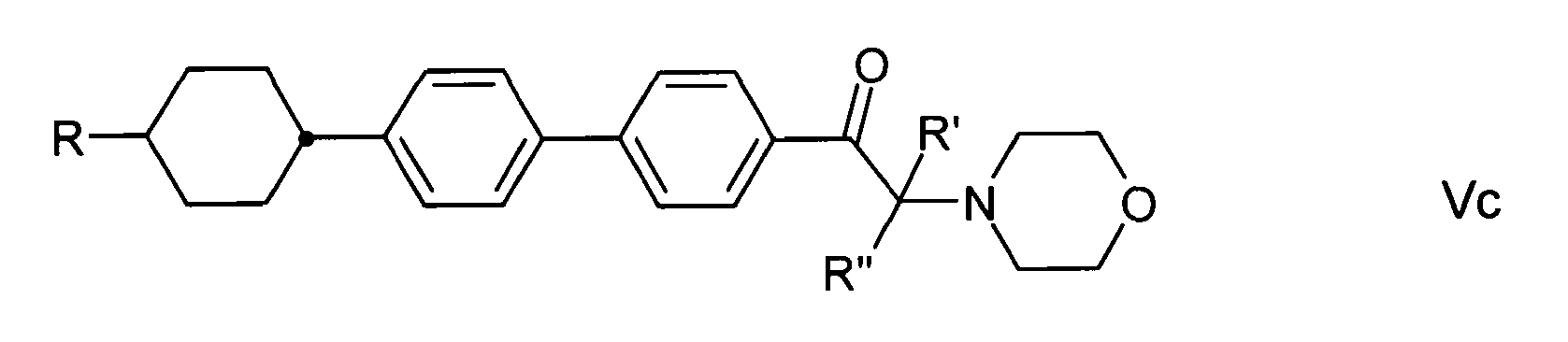
- dichroic photoinitiators comprising an ⁇ -amino group as disclosed in EP-A-1 388 538 , in particular those of formula V wherein A, Z, m3, L 1 and r1 are as defined above, and R, R' and R" have one of the meanings of R 1 in formula I.
- R' and R" are preferably selected from alkyl or alkoxy with 1 to 6 C-atoms.
- R is preferably an unpolar group as defined above.
- Very preferred compounds of formula V are the following wherein L" is H or F, R is alkyl or alkoxy with 1 to 12 C-atoms, R' and R" are selected from alkyl or alkoxy with 1 to 6 C-atoms, very preferably from methyl, ethyl or propyl.
- R, R 1 and R 2 can be a polar or an unpolar group.
- Polar groups are preferably selected from halogen, CN, NCS, SF 5 , OCH 3 , optionally mono- or polyfluorinated alkycarbonyl, alkoxycarbonyl, alkylcarbonyloxy or alkoxycarbonyloxy with 1 to 4 C-atoms, and mono-, oligo- or polyfluorinated alkyl or alkoxy with 1 to 4 C-atoms.
- Unpolar groups are preferably selected from optionally halogenated alkyl, alkoxy, alkycarbonyl, alkoxycarbonyl, alkylcarbonyloxy or alkoxycarbonyloxy with 1 or more, preferably 1 to 15 C-atoms which is not covered by the above definition of 'polar group'.
- Especially preferred polar groups are selected of F, Cl, CN, OCH 3 , COCH 3 , COC 2 H 5 , COOCH 3 , COOC 2 H 5 , CF 3 , CHF 2 , CH 2 F, OCF 3 , OCHF 2 , OCH 2 F, C 2 F 5 and OC 2 F 5 , in particular F, Cl, CN, CF 3 , OCHF 2 and OCF 3 .
- Especially preferred unpolar groups are selected from unsubstituted alkyl with 1 to 12 C-atoms or unsubstituted alkoxy with 2 to 12 C-atoms.
- R, R 1 or R 2 is an alkyl or alkoxy group, i.e. where the terminal CH 2 group is replaced by -O-, this may be straight-chain or branched. It is preferably straight-chain, has 1, 2, 3, 4, 5, 6, 7 or 8 carbon atoms and accordingly is preferably methyl, ethyl, propyl, butyl, pentyl, hexyl, heptyl, octyl, methoxy, ethoxy, propoxy, butoxy, pentoxy, hexoxy, heptoxy, or octoxy, furthermore nonyl, decyl, undecyl, dodecyl, tridecyl, tetradecyl, pentadecyl, nonoxy, decoxy, undecoxy, dodecoxy, tridecoxy or tetradecoxy, for example.
- R 1 or R 2 is alkylsulfanyl (thioether), i.e. alkyl where the CH 2 group that is linked to the adjacent group is replaced by -S-, it is preferably straight-chain, has 1, 2, 3, 4, 5, 6, 7 or 8 carbon atoms and accordingly is preferably methylsulfanyl, ethylsulfanyl, propylsulfanyl, butylsulfanyl, pentylsulfanyl, hexylsulfanyl, heptylsulfanyl, octylsulfanyl, furthermore nonylsulfanyl, decylsulfanyl, undecylsulfanyl or dodecylsulfanyl, for example.
- thioether i.e. alkyl where the CH 2 group that is linked to the adjacent group is replaced by -S-, it is preferably straight-chain, has 1, 2, 3, 4, 5, 6, 7 or 8 carbon
- R, R 1 or R 2 can be an achiral or a chiral group.
- A is preferably selected from 1,4-cyclohexylene, 1,4-phenylene, tetrahydropyrane-2,5-diyl, dioxane-2,5-diyl, furane-2,5-diyl, thiophene-2,5-diyl, pyrrol-2,5-diyl, pyridine-2,5-diyl, pyrimidine-2,5-diyl, naphthalene-2,6-diyl, 1,2,3,4-tetrahydronaphthalene-2,6-diyl, decaline-2,6-diyl, indane-2,5-diyl, these groups optionally being mono- or polysubstituted by L 1 as defined above.
- L 1-5 are preferably selected from F, Cl, CN, NO 2 CH 3 , C 2 H 5 , OCH 3 , OC 2 H 5 , COCH 3 , COC 2 H 5 , COOCH 3 , COOC 2 H 5 , CF 3 , OCF 3 , OCHF 2 or OC 2 F 5 , in particular F, Cl, CN, CH 3 , C 2 H 5 , OCH 3 , COCH 3 or OCF 3 , most preferably F, Cl, CH 3 , OCH 3 or COCH 3 .
- -(A-Z) m1 -, -(A-Z) m2 -, -(A-Z) m3 - and -(A-Z) m4 - are selected from the groups listed below and their mirror images.
- Phe is 1,4-phenylene
- PheL is 1,4-phenylene that is substituted by 1 to 4 groups L 1 as defined above
- Cyc is 1,4-cyclohexylene and Z has one of the meanings of Z 1 in formula I.
- PheL in these preferred formulae is preferably denoting with L having each independently one of the meanings given above.
- Halogen is preferably F or Cl.
- Y 1 and Y 2 are preferably H or F.
- the polymerisable group P is a group that is capable of participating in a polymerisation reaction, like radicalic or ionic chain polymerisation, polyaddition or polycondensation, or capable of being grafted, for example by condensation or addition, to a polymer backbone in a polymeranaloguous reaction.
- a polymerisation reaction like radicalic or ionic chain polymerisation, polyaddition or polycondensation, or capable of being grafted, for example by condensation or addition, to a polymer backbone in a polymeranaloguous reaction.
- polymerisable groups for chain polymerisation reactions like radicalic, cationic or anionic polymerisation.
- Very preferred are polymerisable groups comprising a C-C double or triple bond, and polymerisable groups capable of polymerisation by a ring-opening reaction, like oxetanes or epoxides.
- Oxetanes produce less shrinkage upon polymerisation (cross-linking), which results in less stress development within films, leading to higher retention of ordering and fewer defects.
- Oxetane cross-linking also requires a cationic initiator, which unlike free radical initiator is inert to oxygen.
- the spacer group Sp all groups can be used that are known for this purpose to the skilled in the art.
- the spacer group Sp is preferably of formula Sp'-X, such that P-Sp- is P-Sp'-X-, wherein
- Typical groups Sp' are, for example, -(CH 2 ) p -, -(CH 2 CH 2 O) q -CH 2 CH 2 -,-CH 2 CH 2 -S-CH 2 CH 2 - or -CH 2 CH 2 -NH-CH 2 CH 2 - or -(SiR 0 R 00 -O) p -, with p being an integer from 2 to 12, q being an integer from 1 to 3 and R 0 and R 00 having the meanings given above.
- Preferred groups Sp' are ethylene, propylene, butylene, pentylene, hexylene, heptylene, octylene, nonylene, decylene, undecylene, dodecylene, octadecylene, ethyleneoxyethylene, methyleneoxybutylene, ethylene-thioethylene, ethylene-N-methyliminoethylene, 1-methylalkylene, ethenylene, propenylene and butenylene for example.
- each of the two polymerisable groups P and the two spacer groups Sp can be identical or different.
- group Sp' is a chiral group of the following formula wherein
- the polymerisable LC material according to the present invention preferably has a chiral smectic or chiral nematic (cholesteric) LC phase or a blue phase. Especially preferred is a cholesteric LC (CLC) material.
- CLC cholesteric LC
- the polymerisable LC material preferably comprises one or more monofunctional chiral polymerisable mesogenic compounds and one or more di- or multifunctional achiral polymerisable mesogenic compounds.
- the polymerisable LC material may comprise one or more additional polymerisable mesogenic compounds.
- additional compounds are preferably selected of the following formulae wherein P and L 1 are as defined above, A is cyclohexylene or phenylene that is optionally substituted by 1 to 4 groups L 1 , x is an integer from 1 to 12, u and v are independently of each other 0 or 1, R 0 is a polar or unpolar group as defined above, and the phenyl rings are optionally substituted by 1, 2, 3 or 4 groups L 1 .
- Compounds of formula I are disclosed for example in US 6,514,578 .
- Compounds of formula IV are disclosed in US 6,491,990 .
- Compounds of formula III are disclosed in WO 02/94805 .
- Compounds of formula V are disclosed in EP-A-1 388 538 .
- Compounds of formula II and suitable additional polymerisable mesogenic compounds like those of formula R1-R10 are disclosed for example in WO 93/22397 , US 5,518,652 , DE 195 04 224 , US 5,750,051 , US 5,770,107 and US 6,514,578 .
- the polymerisable LC material preferably comprises one or more components selected from
- the polymerisable material comprises one or more surfactants F) to achieve planar alignment with a low tilt angle.
- Suitable surfactants are described for example in J. Cognard, Mol.Cryst.Liq.Cryst. 78, Supplement 1,1-77 (1981 ).
- Particularly preferred are non-ionic surfactants, e.g. non-ionic fluorocarbon surfactants, like the commercially available Fluorad® (from 3M), or Zonyl FSN® (from DuPont), or polymerizable fluorocarbon surfactants as disclosed in EP 1 256 617 A1 .
- Further preferred are multiblock surfactants as disclosed in GB 2 383 040 A .
- the polymerisable material comprises one or more non-mesogenic polymerisable compounds G), preferably in a concentration from 0 to 30%, preferably 0 to 20 %.
- Typical examples of monoreactive non-mesogenic compounds are alkylacrylates or alkylmethacrylates.
- Typical examples for direactive non-mesogenic compounds are alkyldiacrylates or alkyldimethacrylates with alkyl groups of 1 to 20 C atoms.
- Typical examples for multireactive non-mesogenic compounds are trimethylpropanetrimethacrylate or pentaerythritoltetraacrylate.
- the polymerisable material comprises one or more chain transfer agents H), in order to modify the physical properties of the polymer film.
- chain transfer agents H Especially preferred are thiol compounds, such as monofunctional thiol compounds like e.g. dodecane thiol or multifunctional thiol compounds like e.g. trimethylpropane tri(3-mercaptopropionate), very preferably mesogenic or LC thiol compounds as for example disclosed in WO 96/12209 , WO 96/25470 or US 6,420,001 .
- the polymerisable material comprises one or more dyes I) having an absorption maximum at the wavelength of the radiation used for polymerisation of the material.
- dyes I e.g. 4,4'-azoxy anisole or the commercially available Tinuvin (from Ciba AG, Basel, Switzerland).
- a preferred polymerisable LC mixture comprises
- the polymerisable LC material according to the present invention can be used for the preparation of biaxial films.
- another aspect of the invention relates to a biaxial film which is obtainable from the polymerisable material as described above and below.
- the biaxial film according to the present invention preferably has a cholesteric structure with a distorted helix, resulting in an elliptical, discotic refractive index ellipsoid.
- the pitch of the cholesteric helix has a value well below the visible wavelength range, preferably below 225 nm, so that only the average directional refractive indices are experienced.
- the Bragg reflection bands occur in the UV range of light, so the film is transparent to visible wavelengths of light and behaves purely as retarders between crossed polarisers for these visible wavelengths.
- the biaxial film has optical biaxial negative C symmetry with n x > n y > n z , wherein n x and n y are the principal refractive indices in orthogonal directions within the film plane and n z is the principal refractive index perpendicular to the film plane.
- the reflection wavelength of the biaxial film is preferably below 380 nm. Further preferred is a biaxial film that is substantially transparent for light with a wavelength of 400 nm or higher, preferably 380 nm or higher. Very preferably the biaxial film is substantially transparent for visible light with a wavelength from 380 to at least 780 nm.
- the thickness of the biaxial film is preferably from 0.5 to 5 ⁇ m, very preferably from 0.5 to 3 ⁇ m.
- the on-axis retardation (previously defined as R 0 ) of a biaxial film according to the present invention is preferably from 10 to 150 nm, very preferably from 20 to 100 nm, most preferably from 30 to 80 nm.
- QWF quarter wave retardation film
- Especially preferred for such uses are retardation values from 90 to 200 nm, preferably from 100 to 175 nm.
- Another preferred embodiment relates to a biaxial film with approximately half wave ( ⁇ /2) retardation for use as half wave retardation film (HWF).
- ⁇ /2 half wave retardation film
- Especially preferred for such uses are retardation values from 180 to 400 nm, preferably from 200 to 350 nm.
- Another aspect of the invention relates to a method of preparing a biaxial film.
- a process of preparing a biaxial film by providing a layer of a polymerisable LC material as described above and below on a substrate, aligning the material in its LC phase into planar orientation, photopolymerising the material by exposure to linear polarised light, and optionally removing the polymerised material from the substrate.
- the biaxial film is prepared in analogy to the method as described in WO 03/54111 .
- a polymerisable cholesteric LC material is coated as a thin film onto a substrate, where it adopts a planar orientation with the cholesteric helix being substantially perpendicular to the plane of the film.
- Planar alignment of the LC material can be aided by adding aligning agents such as surfactants, or by applying an alignment layer to the substrate and/or rubbing the substrate or the alignment layer.
- the material can also be annealed at high temperatures to improve alignment.
- the aligned cholesteric material is then exposed to linear polarised UV light.
- the dichroic photoinitiator (E) present in the material locally aligns with its UV-absorbing axis parallel to the LC director.
- E dichroic photoinitiator
- Inhomogeneous free-radical production results in local polymerisation, predominantly of the highly reactive components, like the di- or multifunctional polymerisable compounds. This results in concentration gradients between the high and low reactive components within a half turn of the helix.
- the highly reactive components become concentrated where the director lies parallel to the E-field (maximum concentration of free radicals) and the less reactive components, like the monofunctional polymerisable or non-polymerisable compounds, become concentrated where the director is perpendicular to the E-field.
- Localised variation of the chiral component results in distortion of the sinusoidal helix (which above and below is also referred to as 'distorted' or 'deformed' helix).
- the biaxial films according to the present invention preferably have a value of BI ⁇ 0.14, in particular ⁇ 0.20, very preferably ⁇ 0.25, most preferably ⁇ 0.30.
- the polymerisable LC chiral mixture is preferably designed such that its selective reflection wavelength is below the wavelength of light that is normally used for polymerisation (typically UV light of about 365nm) and enables local variation of the birefringence. This is achieved by using chiral compounds of formula III with high twist to push the Bragg reflection band into the UV, and by using improved dichroic photoinitiators, especially those of formula V.
- the polymerisable LC chiral mixture according to the present invention allows to make the film production process suitable for manufacture on a plastic substrate, with a cure time of less than 3 minutes, preferably less than 1 minute, which is especially suitable for mass production.
- the polymerisable LC mixture according to the present invention has a high clearing point and allows polymerisation at higher temperature within the LC phase. It was found that, by increasing the polymerisation temperature to a certain extent within the LC phase of the polymerisable material, it is possible to increase the biaxiality of the resulting polymer film. Therefore, polymerisable LC mixtures with high clearing points are especially suitable and preferred.
- the polymerisation temperature is selected, within the LC phase of the polymerisable material, in a range from 40°C to 100°C, in particular from 40°C to 90°C, preferably from 50°C to 80°C, very preferably from 55 to 65°C or from 60 to 80°C.
- the direction of the slow axis of the biaxial film can be controlled.
- the slow axis corresponds to the x-direction, i.e. the direction of the highest refractive index n x .
- irradiation with linear polarised UV light can be achieved by passing UV light through a linear polariser (e.g. a commercially available dye-doped absorption polarizer).
- the direction of the slow axis in the resulting biaxial film will then correspond to the direction of the transmission axis of the polariser.
- the direction of the slow axis can thus be controlled.
- the optically biaxial film comprises at least two areas with different retardation birefringence or a pattern of two or more areas having different retardation.
- Such a film can be prepared by the method as described above, wherein only selected areas of the polymerisable material are polymerised. This is achieved for example by photopolymerisation through a photomask so that only the uncovered areas are exposed to UV light. Different areas are then polymerised under different conditions, e.g. at different curing temperature, leading to a change in on-axis retardation.
- a biaxial film that comprises a pattern of one or more, preferably one, two or three different regions having different retardation values, each of said values being adjusted such that its efficiency of converting linearly polarised light into circularly polarised light is optimised for light of one of the primary colours red, green and blue (R, G, B).
- said values of retardation are as follows:
- the retardation is from 140 to 190 nm, preferably 145 to 180 nm, very preferably 145 to 160 nm, most preferably 150 nm.
- the retardation is from 122 to 152 nm, preferably 127 to 147 nm, very preferably 132 to 142 nm, most preferably 137 nm.
- the retardation is from 85 to 120 nm, preferably 90 to 115 nm, very preferably 100 to 115 nm, most preferably 112 nm.
- the polymerisable material is preferably coated or printed onto substrate, aligned into a uniform orientation and polymerised to permanently fix the orientation.
- a substrate for example a glass or quarz sheet or a plastic film or sheet can be used. It is also possible to put a second substrate on top of the coated mixture prior to and/or during and/or after polymerisation.
- the substrates can be removed after polymerisation or not.
- Isotropic or birefringent substrates can be used. In case the substrate is not removed from the polymerized film after polymerisation, preferably isotropic substrates are used.
- At least one substrate is a plastic substrate such as for example a film of polyester such as polyethyleneterephthalate (PET) or polyethylenenaphthalate (PEN), of polyvinylalcohol (PVA), polycarbonate (PC) or triacetylcellulose (TAC), especially preferably a PET film or a TAC film.
- PET polyethyleneterephthalate
- PEN polyethylenenaphthalate
- PVA polyvinylalcohol
- PC polycarbonate
- TAC triacetylcellulose
- PET films are commercially available from DuPont Teijin Films under the trade name Melinex ®.
- the polymerisable material can be applied onto the substate by conventional coating techniques like spin-coating or blade coating. It can also be applied to the substrate by conventional printing techniques which are known to the expert, like for example screen printing, offset printing, reel-to-reel printing, letter press printing, gravure printing, rotogravure printing, flexographic printing, intaglio printing, pad printing, heat-seal printing, ink-jet printing or printing by means of a stamp or printing plate.
- solvents for example standard organic solvents can be used the solvents can be selected for example from ketones like e.g. acetone, methyl ethyl ketone, methyl propyl ketone or cyclohexanone, acetates like e.g. methyl, ethyl or butyl acetate or methyl acetoacetate, alcohols like e.g.
- methanol e.g. ethanol, ethanol or isopropyl alcohol
- aromatic solvents like e.g. toluene or xylene
- halogenated hydrocarbons like e.g. di- or trichloromethane
- glycols or their esters like e.g. PGMEA (propyl glycol monomethyl ether acetate), ⁇ -butyrolactone, and the like.
- PGMEA propyl glycol monomethyl ether acetate
- ⁇ -butyrolactone and the like. It is also possible to use binary, ternary or higher mixtures of the above solvents.
- Polymerisation of the material is preferably achieved by exposing it to heat or actinic radiation.
- Actinic radiation means irradiation with light, like UV light, IR light or visible light, irradiation with X-rays or gamma rays or irradiation with high energy particles, such as ions or electrons.
- Preferably polymerisation is carried out by photoirradiation, in particular with UV light, very preferably with linear polarised UV light.
- a source for actinic radiation for example a single UV lamp or a set of UV lamps can be used. When using a high lamp power the curing time can be reduced.
- Another possible source for photoradiation is a laser, like e.g. a UV laser, an IR laser or a visible laser.
- the polymerisable material may also comprise one or more conventional photoinitators.
- photoinitiator for radical polymerisation for example the commercially available Irgacure® 651, Irgacure® 184, Darocure® 1173 or Darocure® 4205 (all from Ciba Geigy AG) can be used, whereas in case of cationic photopolymerisation the commercially available UVI 6974 (Union Carbide) can be used.
- the curing time is dependent, inter alia, on the reactivity of the polymerisable material, the thickness of the coated layer, the type of polymerisation initiator and the power of the UV lamp.
- the curing time according to the invention is preferably not longer than 10 minutes, particularly preferably not longer than 5 minutes and very particularly preferably shorter than 2 minutes. For mass production short curing times of 3 minutes or less, very preferably of 1 minute or less, in particular of 30 seconds or less, are preferred.
- the polymerisable material can additionally comprise one or more other suitable components such as, for example, catalysts, sensitizers, stabilizers, chain-transfer agents, inhibitors, accelerators, co-reacting monomers, surface-active compounds, lubricating agents, wetting agents, dispersing agents, hydrophobing agents, adhesive agents, flow improvers, defoaming agents, deaerators, diluents, reactive diluents, auxiliaries, colourants, dyes or pigments.
- suitable components such as, for example, catalysts, sensitizers, stabilizers, chain-transfer agents, inhibitors, accelerators, co-reacting monomers, surface-active compounds, lubricating agents, wetting agents, dispersing agents, hydrophobing agents, adhesive agents, flow improvers, defoaming agents, deaerators, diluents, reactive diluents, auxiliaries, colourants, dyes or pigments.
- uniform alignment of the material can be aided for example by shearing the material, e.g. by means of a doctor blade. It is also possible to apply an alignment layer, for example a layer of rubbed polyimide or sputtered SiO x , on top of at least one of the substrates. Alignment can also be achieved by rubbing the substrate without applying an additional alignment layer, e.g. by means of a rubbing cloth or a rubbing roller.
- the polymerisable LC material is annealed at a high temperature within the LC phase before polymerisation to improve the alignment, preferably at a temperature close to its clearing point, very preferably less than 5°C, most preferably less than 2°C below its clearing point.
- polymerisation is carried out under an atmosphere of inert gas like for example nitrogen or argon.
- the biaxial film according to the present invention can be used alone or in combination with other retardation films as compensator or retarder, in particular for viewing angle compensation in LCDs.
- another aspect of the invention relates to an LCD device comprising at least one biaxial film or compensator as described above and below.
- the LCD device comprises the following elements
- the above display elements can be separated, stacked, mounted on top of each other or connected by means of adhesive layers in any combination of these means of assembly.
- the biaxial film and compensator according to the present invention can be used for compensation of conventional displays, in particular those of the TN (twisted nematic), HTN (highly twisted nematic) or STN (super twisted nematic) mode, in AMD-TN (active matrix driven TN) displays, in displays of the IPS (in plane switching) mode, which are also known as 'super TFT' displays, in displays of the DAP (deformation of aligned phases) or VA (vertically aligned) mode, like e.g.
- ECB electrically controlled birefringence
- CSH colour super homeotropic
- VAN or VAC vertically aligned nematic or cholesteric
- MVA multi-domain vertically aligned
- OCB optically compensated bend cell or optically compensated birefringence
- R-OCB reflective OCB
- HAN hybrid aligned nematic or pi-cell ( ⁇ -cell) displays, or transflective displays.
- TN TN
- STN STN
- VA STN
- MVA MVA
- OCB OCB
- pi-cell displays Especially preferred are TN, STN, VA, MVA, OCB and pi-cell displays.
- the biaxial film is used as optical retardation film in an LCD not outside the switchable LC cell of the display, but between the substrates, usually glass substrates, forming the switchable LC cell and containing the switchable LC medium (incell application). This avoids parallax problems and allows to reduce the total thickness of the LCD device.
- a further preferred LCD comprises
- An especially preferred LCD comprises
- Another preferred embodiment relates to a biaxial film with a pattern of areas or pixels with three different retardations, the retardation values in these regions being adjusted such that the efficiency of converting linearly polarised light into circularly polarised light in each region or pixel is optimised for one of the colours R, G and B, and is preferably positioned on the colour filter such that each R-, G- or B-pixel of the colour filter is covered by a corresponding pixel of the biaxial film having a retardation optimised for this colour.
- a pixelated biaxial QWF can be constructed having three types of pixels with a retardation of approximately 112 nm, 137nm and 150 nm, which correspond to approximately a quarter of the wavelength of the blue (B) pixel at 450 nm, green (G) pixel at 550 nm and red (R) pixel at 600 nm of the colour filter, respectively.
- a pixelated HWF can be prepared analoguously.
- an unpixelated film will only provide an average uniform property for all areas of the display.
- the biaxial film can also have a pattern of areas having QWF (or HWF) retardation and areas having another retardation, e.g. zero retardation.
- a patterned film is especially suitable for as compensater in a patterned transflective display, e.g. a hole-in-mirror type transflective display as described e.g. in WO 03/019276 A2 or in van der Zande et al., SID Digest 14.2, 2003, page 194-197 , S. Roosendaal et al., SID Digest 8.1, 2003, page 78-81 and M. Kubo et al., Proccedings of the IDW 1999, page 183-186 .
- an unpatterned biaxial film according to the present invention for use in an LCD, e.g. of the VA or MVA type, as incell film.
- specific HTP values given above and below relate to a dopant concentration of 1 % in the LC host mixture MLC-6260 (commercially available from Merck KGaA, Darmstadt, Germany) at 20 °C.
- a polymerisable mixture is prepared as shown in example 2 of WO 03/054111 , comprising Compound (B1) 51.50 % Compound (B2) 12.00 % Compound (a) 8.00 % Compound (b) 21.00 % Compound (C1) 6.00 % Compound (e) 1.00 % FC171® 0.20 %
- FC171® is surfactant commercially available surfactant from 3M (St. Paul, Minnesota, USA).
- Chiral compound (C1) is disclosed in WO 02/94805 .
- a biaxial polymer film is prepared from this mixture as described in example 2 of WO 03/054111 .
- the retardation of the biaxial film is measured through a range of viewing angles and the biaxiality index BI calculated. The results are shown in table 1 below.
- Paliocolor LC756 ® is a reactive polymerisable chiral material commercially available from BASF AG (Ludwigshafen, Germany). Irganox 1076 ® is commercially available from Ciba AG (Basel, Switzerland). Chiral compound (C2) is disclosed in WO 98/00428 . Dichroic photoinitiator (E1) is disclosed in EP 1 388 538 .
- the mixture has a cholesteric phase and a clearing point of 59.6°C.
- the mixture is dissolved in PGMEA to give a 45% w/w solution.
- the solution is spin-coated onto a rubbed polyimide substrate using a spin speed of 2000rpm.
- the solvent is evaporated at ambient temperature and the coating is annealed for 1 minute at 57°C.
- the coating is then photopolymerised in an inert atmosphere through a UV linear polariser using UV light of 365nm for 1 minute at room temperature to give a polymer film.
- the retardation profile of the polymer film (retardation in nm on the x-axis versus viewing angle in degrees on the y-axis) is shown in Figure 1 .
- a polymer film is prepared from a polymerisable mixture as described in example 1, but wherein compound (E1) is replaced by compound (E2) (example 2, cp 65.3°C) and (E3) (example 3, cp 59.1°C), respectively, in the same amount (annealing temperature 63°C).
- the retardation at different viewing angles and the biaxiality index BI of the polymer films are shown in table 1.
- the retardation profiles of the films are shown in Figure 1 .
- Chiral compound (C3) is disclosed in WO 02/94805 .
- the mixture has a cholesteric phase and a clearing point of 55.1°C.
- a polymer film (Example 4) is prepared from this mixture as described in example 1 (annealing temperature 53°C, curing temperature is room temperature).
- Example 5 Another polymer film (Example 5) is prepared from a polymerisable mixture as described above, but wherein compound (E2) is replaced by compound (E3) in the same amount (clearing point of the mixture 48.2°C).
- the retardation at different viewing angles and the biaxiality index BI of the polymer films are shown in table 2.
- the retardation profiles of the films are shown in Figure 2 .
- Compound (D1) is disclosed in US 6,491,990 .
- the mixture has a cholesteric phase and a clearing point of 96.6°C.
- the mixture is dissolved in PGMEA to give a 45% w/w solution.
- the solution is spin-coated onto a rubbed polyimide substrate using a spin speed of 2000rpm.
- the solvent is evaporated at ambient temperature and the coating is annealed for 1 minute at 98°C.
- the coating is then photopolymerised through a UV linear polarizer using UV light of 365nm for 1 minute at 20°C to give a polymer film.
- Further polymer film samples are prepared using the same method but photopolymerising at 40°C, 60°C and 80°C, respectively.
- Polymer films are prepared from a polymerisable mixture as described in example 6, but wherein compound (D1) is replaced by compound (D2) in the same amount (clearing point of the mixture is 101.5°C).
- the retardation at different viewing angles and the biaxiality index BI of the polymer films are shown in table 4.
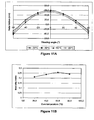
- the retardation profiles of the polymer films are shown in Figure 4A , the biaxiality index versus cure temperature in Figure 4B .
- Polymer films are prepared from a polymerisable mixture as described in example 6, but wherein compound (D1) is replaced by compound (D3) in the same amount (clearing point of the mixture is 90.0°C).
- the retardation at different viewing angles and the biaxiality index BI of the polymer films are shown in table 5.
- the retardation profiles of the polymer films are shown in Figure 5A , the biaxiality index versus cure temperature in Figure 5B .
- Polymer films are prepared from a polymerisable mixture as described in example 6, but wherein compound (D1) was replaced by compound (D4) in the same amount (clearing point of the mixture is 86.0°C).
- the retardation at different viewing angles and the biaxiality index BI of the polymer films are shown in table 6.
- the retardation profiles of the polymer films are shown in Figure 6A , the biaxiality index versus cure temperature in Figure 6B .
- Polymer films are prepared from a polymerisable mixture as described in example 6, but wherein compound (D1) was replaced by compound (D5) in the same amount (clearing point of the mixture is 80.0°C).
- the retardation at different viewing angles and the biaxiality index Bl of the polymer films are shown in table 7.
- the retardation profiles of the polymer films are shown in Figure 7A , the biaxiality index versus cure temperature in Figure 7B .
- Polymer films are prepared from a polymerisable mixture as described in example 6, but wherein compound (D1) is replaced by compound (D6) in the same amount (clearing point of the mixture is 84.0°C).
- the retardation at different viewing angles and the biaxiality index BI of the polymer films are shown in table 8.
- the retardation profiles of the polymer films are shown in Figure 8A , the biaxiality index versus cure temperature in Figure 8B .
- Polymer films are prepared from a polymerisable mixture as described in example 6, but wherein compound (D1) is replaced by compound (D7) in the same amount (clearing point of the mixture is 76.0°C).
- the retardation at different viewing angles and the biaxiality index BI of the polymer films are shown in table 9.
- the retardation profiles of the polymer films are shown in Figure 9A , the biaxiality index versus cure temperature in Figure 9B .
- Polymer films are prepared from a polymerisable mixture as described in example 6, but wherein compound (D1) is replaced by compound (D8) in the same amount (clearing point of the mixture is 73.0°C).
- the retardation at different viewing angles and the biaxiality index BI of the polymer films are shown in table 10.
- the retardation profiles of the polymer films are shown in Figure 10A , the biaxiality index versus cure temperature in Figure 10B .
- Polymer films are prepared from a polymerisable mixture as described in example 6, but wherein compound (E2) is replaced by compound (E3) in the same amount (clearing point of the mixture is 92.4°C).
- the retardation at different viewing angles and the biaxiality index Bl of the polymer films are shown in table 11.
- the retardation profiles of the polymer films are shown in Figure 11A , the biaxiality index versus cure temperature in Figure 11B .
- Polymer films are prepared from a polymerisable mixture as described in example 6, but wherein compound (D1) is replaced by compound (D2) and compound (E2) is replaced by compound (E3) in the same amount (clearing point of the mixture is 100.2°C).
- the retardation at different viewing angles and the biaxiality index BI of the polymer films are shown in table 12.
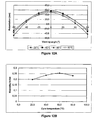
- the retardation profiles of the polymer films are shown in Figure 12A , the biaxiality index versus cure temperature in Figure 12B .
- the mixture has a cholesteric phase and a clearing point of 101.0°C.
- Polymer films are prepared from this polymerisable mixture as described in example 6.
- the retardation at different viewing angles and the biaxiality index BI of the polymer films are shown in table 15.
- the retardation profiles of the polymer films are shown in Figure 13A , the biaxiality index versus cure temperature in Figure 13B .
- Polymer films are prepared from a polymerisable mixture as described in example 16, but wherein compound (D1) is replaced by compound (D2) in the same amount (clearing point of the mixture is 105.0°C).
- the retardation at different viewing angles and the biaxiality index BI of the polymer films are shown in table 14.
- the retardation profiles of the polymer films are shown in Figure 14A , the biaxiality index versus cure temperature in Figure 14B .
- Polymer films are prepared from a polymerisable mixture as described in example 16, but wherein compound (C3) is replaced by compound (C4) in the same amount (clearing point of the mixture is 102.0°C).
- the retardation at different viewing angles and the biaxiality index BI of the polymer films are shown in table 15.
- the retardation profiles of the polymer films are shown in Figure 15A , the biaxiality index versus cure temperature in Figure 15B .
- a polymer film is prepared from this mixture as described in example 1 (annealing temperature 61 °C, cured at room temperature).
- Chiral compound (C5) is disclosed in US 6,511,719 .
- a polymer film is prepared from this mixture as described in example 1 (annealing temperature 43°C).
- a polymer film is prepared from this mixture as described in example 1 (annealing temperature 57°C).
- the following polymerisable cholesteric LC mixture is prepared Compound (A2) 19.60 % Compound (B1) 19.20 % Compound (a) 11.20 % Compound (b) 33.62 % Compound (C2) 2.00 % Paliocolor LC756 ® 9.80 % Compound (E1) 4.00 % FC171® 0.50 % Irganox 1076 ® 0.08 %
- a polymer film is prepared from this mixture as described in example 1 (annealing temperature 58°C).
- Polymer films are prepared from a polymerisable mixture as described in example 23, but wherein compound (A2) is replaced by compound (A3) (example 24), (A4) (example 25) and (A5) (example 26), respectively, in the same amount.
- Table 20 The retardation at different viewing angles and the biaxiality index BI of the polymer films are shown in table 20.
- a polymer film is prepared from this mixture as described in example 1 (annealing temperature 45°C).
- Table 21 The retardation at different viewing angles and the biaxiality index BI of the polymer film are shown in table 21.
- a polymer film is prepared from a polymerisable mixture as described in example 27, but wherein compound (A1) is replaced by compound (A5) in the same amount.
- Table 22 The retardation at different viewing angles and the biaxiality index BI of the polymer film is shown in table 22.
- the following polymerisable cholesteric LC mixture is prepared Compound (A1) 20.00 % Compound (B1) 52.00 % Compound (B2) 13.50 % Paliocolor LC756 ® 10.00 % Compound (E1) 4.00 % FC171® 0.50 %
- a polymer film is prepared from this mixture as described in example 1 (annealing temperature 100°C).
- Table 23 The retardation at different viewing angles and the biaxiality index BI of the polymer film are shown in table 23.
- Polymer films are prepared from a polymerisable mixture as described in example 29, but wherein compound (A1) is replaced by the following compounds in the same amount:
- Example 30 31 32 33 34 35
- Compound A3 A6 A4 A5 A7 A8 annealing temperature 100°C 85°C 70°C 100°C 100°C 100°C 100°C
- Table 24 The retardation at different viewing angles and the biaxiality index BI of the polymer films are shown in table 24.
- the following polymerisable cholesteric LC mixture is prepared Compound (A3) 19.60 % Compound (B1) 45.42 % Compound (a) 5.00 % Compound (b) 13.60 % Compound (C2) 13.50 % Paliocolor LC756 ® 10.00 % Compound (E1) 4.00 % FC171® 0.50 % Irganox 1076 0.08%
- a polymer film is prepared from this mixture as described in example 1 (annealing temperature 77°C).
- Table 25 The retardation at different viewing angles and the biaxiality index BI of the polymer film are shown in table 25.
Landscapes
- Chemical & Material Sciences (AREA)
- Crystallography & Structural Chemistry (AREA)
- Engineering & Computer Science (AREA)
- Materials Engineering (AREA)
- Organic Chemistry (AREA)
- Liquid Crystal Substances (AREA)
- Polarising Elements (AREA)
- Organic Low-Molecular-Weight Compounds And Preparation Thereof (AREA)
- Addition Polymer Or Copolymer, Post-Treatments, Or Chemical Modifications (AREA)
- Liquid Crystal (AREA)
Claims (23)
- Polymerisierbares LC-Material enthaltendA) mindestens eine Verbindung mit hoher Doppelbrechung ausgewählt aus der Formel I
 P eine polymerisierbare oder reaktive Gruppe bedeutet,Sp eine Spacergruppe oder eine Einfachbindung bedeutet,A bei mehrfachem Auftreten unabhängig voneinander einen aromatischen oder aliphatischen 5- oder 6-Ring, oder eine Gruppe mit zwei oder drei anellierten aromatischen oder aliphatischen 5- oder 6-Ringen bedeutet, wobei diese Ringe gegebenenfalls ein oder mehrere Heteroatome ausgewählt aus N, O und S enthalten und gegebenenfalls durch eine oder mehrere gleiche oder verschiedene Gruppen L1 substituiert sind,Z bei mehrfachem Auftreten unabhängig voneinander -O-, -S-, -CO-, -COO-, -OCO-, -S-CO-, -CO-S-, -O-CO-O-, -CO-NR0-, -NR0-CO-, -OCH2-, -CH2O-, -SCH2-, -CH2S-, -CF2O-, -OCF2-, -CF2S-, -SCF2-, -CH2CH2-, -CF2CH2-, -CH2CF2-, -CF2CF2-, -CH=CR0-, -CH=CH-, -CH=CF-, -CY1=CY1-, -C≡C-, -CH=CH-COO-, -OCO-CH=CH- oder eine Einfachbindung bedeutet,R0, R00 unabhängig voneinander H oder Alkyl mit 1 bis 12 C-Atomen bedeuten,Y1, Y2 unabhängig voneinander H, F, Cl oder CN bedeuten,m1, m2 unabhängig voneinander 0, 1 oder 2 bedeuten, wobei m1+m2 ≤ 3,L1, L2 unabhängig voneinander F, Cl, Br, I, CN, NO2, P-Sp- oder Alkyl, Alkoxy, Alkylcarbonyl, Alkoxycarbonyl, Alkylcarbonyloxy oder Alkoxycarbonyloxy mit 1 bis 12 C-Atomen bedeuten, worin ein oder mehrere H-Atome gegebenenfalls durch F oder Cl ersetzt sind,r1, r2 unabhängig voneinander 0, 1, 2, 3 oder 4 bedeuten,R1 H, Halogen, CN, NO2, NCS, SF5, P-Sp- oder geradkettiges oder verzweigtes Alkyl mit 1 bis 20 C-Atomen bedeutet, das gegebenenfalls ein- oder mehrfach durch F, Cl, Br, I oder CN substituiert ist und worin gegebenenfalls eine oder mehrere nicht benachbarte CH2-Gruppen jeweils unabhängig voneinander so durch -O-, -S-, -NR0-, -SiR0R00-, -CO-, -COO-, -OCO-, -OCO-O-, -NR°-CO-, -CO-NR0-, -NR0-CO-NR0-, -S-CO-, -CO-S-, -CY1=CY2- oder -C≡C- ersetzt sind, dass O- und/oder S-Atome nicht direkt miteinander verknüpft sind,B) mindestens eine polymerisierbare mesogene Verbindung mit zwei oder mehr polymerisierbaren Gruppen,C) mindestens eine chirale Verbindung mit hohem helikalen Verdrillungsvermögen (helical twisting power - HTP),D) gegebenenfalls mindestens eine monoreaktive polymerisierbare Verbindung mit einer enantiotropen nematischen Phase und einem Klärpunkt von 75°C oder höher,E) mindestens einen dichroitischen Photoinitiator,
dadurch gekennzeichnet, dass es mindestens eine Verbindung der Formel I ausgewählt aus der Formel Ia P eine polymerisierbare oder reaktive Gruppe bedeutet,Sp eine Spacergruppe oder eine Einfachbindung bedeutet,Z0 -COO-, -OCO- oder eine Einfachbindung bedeutet,L1a,1b,2a,2b unabhängig voneinander F, Cl, CN, (O)aCbFcH2b+1-c oder COCH3 bedeuten,r1 a, r1 b, r2a, r2b unabhängig voneinander 0 oder 1 bedeuten, wobei mindestens eines von r1 a, r1 b, r2a, r2b 1 bedeutet,R1a Cl oder gegebenenfalls ein- oder mehrfach fluoriertes geradkettiges oder verzweigtes Alkyl mit 1 bis 6 C-Atomen bedeutet, worin gegebenenfalls eine oder zwei nicht benachbarte CH2-Gruppen so durch -O-, -S-, -CO-, -COO-, -OCO-, -OCO-O-, -S-CO- oder -CO-S- ersetzt sind, dass O- und/oder S-Atome nicht direkt miteinander verknüpft sind,a 0 oder 1 bedeutet,b 1 oder 2 bedeutet,c 0, 1, 2, 3, 4 oder 5 bedeutet.
 - Polymerisierbares LC-Material nach dem vorhergehenden Anspruch, dadurch gekennzeichnet, dass die Komponente A) eine oder mehrere Verbindungen der Formel I enthält, worin m1 1 bedeutet, m2 0 bedeutet, A 1,4-Cyclohexylen oder 1,4-Phenylen, das gegebenenfalls mit 1 bis 4 Gruppen L1 substituiert ist, bedeutet und Z -COO-, -OCO- oder eine Einfachbindung bedeutet.
- Polymerisierbares LC-Material nach mindestens einem der vorhergehenden Ansprüche, dadurch gekennzeichnet, dass die Komponente B) eine oder mehrere Verbindungen der Formel II

- Polymerisierbares LC-Material nach mindestens einem der vorhergehenden Ansprüche, dadurch gekennzeichnet, dass die Komponente C) eine oder mehrere Verbindungen der Formel III

- Polymerisierbares LC-Material nach mindestens einem der vorhergehenden Ansprüche, dadurch gekennzeichnet, dass es Komponente D) enthaltend eine oder mehrere Verbindungen der Formel IV
 m4 0, 1 oder 2 bedeutet,Z3 -COO-, -OCO- oder eine Einfachbindung bedeutet,L4, L5 unabhängig voneinander eine der Bedeutungen von L1 in Formel I besitzen,r4, r5 unabhängig voneinander 0, 1, 2, 3 oder 4 bedeuten, wobei r4+r5 > 0,R2 H, Halogen, CN, NO2, NCS, SF5 oder geradkettiges oder verzweigtes Alkyl mit 1 bis 20 C-Atomen bedeutet, das gegebenenfalls ein- oder mehrfach durch F, Cl, Br, I oder CN substituiert ist und worin gegebenenfalls eine oder mehrere nicht benachbarte CH2-Gruppen jeweils unabhängig voneinander so durch -O-, -S-, -NR0-, -SiR0R00-, -CO-, -COO-, -OCO-, -OCO-O-, -NR0-CO-, -CO-NR0-, -NR0-CO-NR0-, -S-CO-, -CO-S-, -CY1=CY2- oder -C≡C ersetzt sind, dass O- und/oder S-Atome nicht direkt miteinander verknüpft sind.
 - Polymerisierbares LC-Material nach mindestens einem der vorhergehenden Ansprüche, dadurch gekennzeichnet, dass die Komponente E) eine oder mehrere Verbindungen der Formel V

- Polymerisierbares LC-Material nach mindestens einem der vorhergehenden Ansprüche, dadurch gekennzeichnet, dass es- eine oder mehrere Verbindungen der folgenden Formel
 Z0 -COO-, -OCO- oder eine Einfachbindung bedeutet,L1a,1b,2a,2b unabhängig voneinander F, Cl, CN, (O)aCbFcH2b+1-c oder COCH3 bedeuten,r1 a, r1 b, r2a, r2b unabhängig voneinander 0 oder 1 bedeuten,R1a Cl oder gegebenenfalls ein- oder mehrfach fluoriertes geradkettiges oder verzweigtes Alkyl mit 1 bis 6 C-Atomen bedeutet, worin gegebenenfalls eine oder zwei nicht benachbarte CH2-Gruppen so durch -O-, -S-, -CO-, -COO-, -OCO-, -OCO-O-, -S-CO- oder -CO-S- ersetzt sind, dass O- und/oder S-Atome nicht direkt miteinander verknüpft sind,a 0 oder 1 bedeutet,b 1 oder 2 bedeutet,c 0, 1, 2, 3, 4 oder 5 bedeutet,- eine oder mehrere Verbindungen der Formel II, worin Z1 und Z2 -COO- oder -OCO- bedeuten, r2 und r3 0 bedeuten, r1 0, 1 oder 2 bedeutet und L1 F, Cl, CH3, C2H5, OCH3 oder COCH3 bedeutet,- eine oder mehrere Verbindungen der folgenden Formelworin x eine ganze Zahl von 1 bis 12 bedeutet und P wie in Formel I definiert ist,
 - eine oder mehrere Verbindungen der folgenden Formelworin P und Sp wie in Formel I definiert sind,
 L4a,5a unabhängig voneinander F, Cl, CH3, C2H5, OCH3 oder COCH3 bedeuten,r4a, r5a 0 oder 1 bedeuten, wobei r4a + r5a > 0,R2a Cl oder gegebenenfalls ein- oder mehrfach fluoriertes geradkettiges oder verzweigtes Alkyl mit 1 bis 12 C-Atomen bedeutet, worin gegebenenfalls eine oder zwei nicht benachbarte CH2-Gruppen so durch -O-, -S-, -CO-, -COO-, -OCO-, -OCO-O-, -S-CO- oder -CO-S- ersetzt sind, dass O- und/oder S-Atome nicht direkt miteinander verknüpft sind,- eine oder mehrere Verbindungen der folgenden Formelenthält.



- Polymerisierbares LC-Material nach mindestens einem der vorhergehenden Ansprüche, dadurch gekennzeichnet, dass es weiterhin eine oder mehrere der folgenden Komponenten enthält:F) ein oder mehrere Tenside,G) eine oder mehrere nicht mesogene Verbindungen mit einer, zwei oder mehr polymerisierbaren Gruppen,H) einen oder mehrere Kettenregler,I) einen oder mehrere Farbstoffe mit einem Absorptionsmaximum bei einer Wellenlänge, die zur Initiierung der Photopolymerisation des Materials verwendet wird.
- Polymerisierbares LC-Material nach mindestens einem der vorhergehenden Ansprüche, dadurch gekennzeichnet, dass esA) 5 bis 60 % einer oder mehrerer Verbindungen der Formel I,B) 5 bis 80 % einer oder mehrerer mesogener Verbindungen mit zwei oder mehr polymerisierbaren Gruppen,C) 0,1 bis 20 % einer oder mehrerer chiraler Verbindungen,D) 0 bis 70 % einer oder mehrerer Verbindungen der Formel IV,E) 0,1 bis 15 % eines oder mehrerer dichroitischer Photoinitiatoren,F) 0 bis 10 % eines oder mehrerer Tenside,G) 0 bis 30 % einer oder mehrerer mono-, di- oder multifunktioneller polymerisierbarer, nicht mesogener Verbindungen,H) 0 bis 15 % eines oder mehrerer Kettenregler,I) 0 bis 10 % eines oder mehrerer Farbstoffe mit einem Absorptionsmaximum bei der Wellenlänge, die zur Polymerisation des Materials verwendet wird,
enthält. - Verbindungen der Formel Ia
 P eine polymerisierbare oder reaktive Gruppe bedeutet,Sp eine Spacergruppe oder eine Einfachbindung bedeutet,Z0 -COO-, -OCO- oder eine Einfachbindung bedeutet,L1a,1b,2a,2b unabhängig voneinander F, Cl, CN, (O)aCbFcH2b+1-c oder COCH3 bedeuten,r1 a, r1 b, r2a, r2b unabhängig voneinander 0 oder 1 bedeuten, wobei mindestens eines von r1 a, r1 b, r2a, r2b 1 bedeutet,R1a Cl oder gegebenenfalls ein- oder mehrfach fluoriertes geradkettiges oder verzweigtes Alkyl mit 1 bis 6 C-Atomen bedeutet, worin gegebenenfalls eine oder zwei nicht benachbarte CH2-Gruppen so durch -O-, -S-, -CO-, -COO-, -OCO-, -OCO-O-, -S-CO- oder -CO-S- ersetzt sind, dass O- und/oder S-Atome nicht direkt miteinander verknüpft sind,a 0 oder 1 bedeutet,b 1 oder 2 bedeutet,c 0, 1, 2, 3, 4 oder 5 bedeutet.
 - Verbindungen der Formel Ia nach dem vorhergehenden Anspruch, worin Z0 -COO- bedeutet, L1a,1b,2a,2b Cl, CH3 oder OCH3 bedeutet und R1a Cl, (O)CH3, (O)C2H5 oder SCH3 bedeutet.
- Verwendung von Verbindungen der Formel Ia nach den vorhergehenden Ansprüchen in optischen und elektrooptischen Komponenten oder Vorrichtungen, optischen Folien, biaxialen Folien, Polarisatoren, Kompensatoren, Strahlteilern, Reflexionsfolien, Orientierungsschichten, Farbfiltern, holographischen Elementen, Heißprägefolien, farbigen Abbildungen, dekorativen oder Sicherheitsmarkierungen, Flüssigkristallpigmenten, Klebstoffen, Kunstharzen mit anisotropen mechanischen Eigenschaften, Kosmetika, Diagnostika, in der nichtlinearen Optik, optischen Datenspeicherung, in LC-Medien für LC-Anzeigevorrichtungen und in polymerisierbaren LC-Materialien.
- Verfahren zur Herstellung einer optisch biaxialen Folie aus einem polymerisierbaren LC-Material nach mindestens einem der vorhergehenden Ansprüche, indem man eine Schicht des polymerisierbaren LC-Materials auf einem Substrat bereitstellt, das Material in seiner LC-Phase in planare Ausrichtung orientiert, das Material durch Einwirkung von linear polarisiertem Licht photopolymerisiert und gegebenenfalls das polymerisierte Material von dem Substrat entfernt.
- Verfahren nach dem vorhergehenden Anspruch, dadurch gekennzeichnet, dass die Photopolymerisation bei einer Temperatur von 40°C bis 80°C durchgeführt wird.
- Optisch biaxiale Folie erhältlich aus einem polymerisierbaren LC-Material oder nach einem Verfahren nach mindestens einem der vorhergehenden Ansprüche.
- Biaxiale Folie nach dem vorhergehenden Anspruch, dadurch gekennzeichnet, dass nx > ny > nz, worin nx und ny die Hauptbrechungsindices in orthogonalen Richtungen innerhalb der Folienebene sind und nz der Hauptbrechungsindex in einer Richtung senkrecht zur Folienebene ist.
- Biaxiale Folie nach mindestens einem der vorhergehenden Ansprüche, dadurch gekennzeichnet, dass R0/Rth ≥ 0,14, worin R0 = d'(nx-ny) und Rth = d[(nx+ny)/2 - nz], worin d die Foliendicke ist.
- Verwendung einer biaxialen Folie nach mindestens einem der vorhergehenden Ansprüche als Verzögerungs- oder Kompensationsfolie oder Orientierungsschicht in optischen Vorrichtungen wie Flüssigkristallanzeigen.
- Kompensator enthaltend mindestens eine Folie nach mindestens einem der vorhergehenden Ansprüche.
- Flüssigkristallanzeige enthaltend mindestens eine Folie oder einen Kompensator nach mindestens einem der vorhergehenden Ansprüche.
- Flüssigkristallanzeige enthaltend die folgenden Elemente- eine LC-Zelle, die gebildet wird durch zwei planparallele Substrate, von denen mindestens eines für einfallendes Licht transparent ist, eine auf der Innenseite mindestens eines der beiden transparenten Substrate bereitgestellte Elektrodenschicht, die gegebenenfalls mit einer Orientierungsschicht überlagert ist, und ein LC-Medium, das sich zwischen den beiden Substraten befindet und durch Anlegen eines elektrischen Feldes zwischen mindestens zwei unterschiedlichen Zuständen schaltbar ist,- einen ersten Linearpolarisator auf einer Seite der LC-Zelle,- gegebenenfalls einen zweiten Linearpolarisator auf der dem ersten Linearpolarisator gegenüberliegenden Seite der LC-Zelle,- mindestens eine biaxiale Folie oder einen Kompensator nach mindestens einem der vorhergehenden Ansprüche, die/der zwischen den beiden planparallelen Substraten der LC-Zelle positioniert ist.
- Flüssigkristallanzeige enthaltend- eine LC-Zelle enthaltend die folgenden Elemente- ein erstes und ein zweites Substrat planparallel zueinander, von denen mindestens eines für einfallendes Licht transparent ist,- eine Anordnung von nichtlinearen elektrischen Elementen auf einem der Substrate, die verwendet werden kann, um einzelne Bildpunkte der LC-Zelle individuell zu schalten, wobei es sich bei den Elementen vorzugsweise um aktive Elemente wie Transistoren, ganz bevorzugt TFTs handelt,- eine auf einem der Substrate bereitgestellte Farbfilteranordnung, vorzugsweise auf dem Substrat gegenüber demjenigen, das die Anordnung von nichtlinearen Elementen trägt, mit einem Muster aus verschiedenen Bildpunkten, welche einer der Primärfarben rot, grün und blau (R, G, B) aussenden, wobei der Farbfilter gegebenenfalls durch eine Planarisierungsschicht bedeckt ist,- eine auf der Innenseite des ersten Substrats bereitgestellte erste Elektrodenschicht,- gegebenenfalls eine auf der Innenseite des zweiten Substrats bereitgestellte zweite Elektrodenschicht,- gegebenenfalls auf den ersten und zweiten Elektroden bereitgestellte erste und zweite Orientierungsschichten,- ein LC-Medium, das durch Anlegen eines elektrischen Feldes zwischen mindestens zwei unterschiedlichen Ausrichtungen schaltbar ist,- einen ersten (oder "vorderen") Linearpolarisator auf der ersten Seite der LC-Zelle,- gegebenenfalls einen zweiten (oder "hinteren") Linearpolarisator auf der zweiten Seite der LC-Zelle und- mindestens eine biaxiale Folie oder einen Kompensator nach mindestens einem der vorhergehenden Ansprüche, der/die sich zwischen dem ersten und zweiten Substrat der LC-Zelle befindet.
- Flüssigkristallanzeige nach mindestens einem der vorhergehenden Ansprüche, dadurch gekennzeichnet, dass es sich um eine Anzeige mit TN- (twisted nematic), OCB- (optically compensated bend), Pi-Zellen-, VA- (vertically aligned) oder MVA- (multi-domain vertically aligned) Modus oder eine transflektive Anzeige handelt.
Priority Applications (1)
| Application Number | Priority Date | Filing Date | Title |
|---|---|---|---|
| EP05777335A EP1786887B1 (de) | 2004-09-06 | 2005-08-10 | Polymerisierbares flüssigkristallmaterial |
Applications Claiming Priority (3)
| Application Number | Priority Date | Filing Date | Title |
|---|---|---|---|
| EP04021104 | 2004-09-06 | ||
| EP05777335A EP1786887B1 (de) | 2004-09-06 | 2005-08-10 | Polymerisierbares flüssigkristallmaterial |
| PCT/EP2005/008676 WO2006027076A1 (en) | 2004-09-06 | 2005-08-10 | Polymerisable liquid crystal material |
Publications (2)
| Publication Number | Publication Date |
|---|---|
| EP1786887A1 EP1786887A1 (de) | 2007-05-23 |
| EP1786887B1 true EP1786887B1 (de) | 2008-07-02 |
Family
ID=35044561
Family Applications (1)
| Application Number | Title | Priority Date | Filing Date |
|---|---|---|---|
| EP05777335A Expired - Lifetime EP1786887B1 (de) | 2004-09-06 | 2005-08-10 | Polymerisierbares flüssigkristallmaterial |
Country Status (9)
| Country | Link |
|---|---|
| US (1) | US7597942B2 (de) |
| EP (1) | EP1786887B1 (de) |
| JP (1) | JP4846724B2 (de) |
| KR (1) | KR101176677B1 (de) |
| CN (1) | CN101010414B (de) |
| AT (1) | ATE399832T1 (de) |
| DE (1) | DE602005007917D1 (de) |
| TW (1) | TWI402331B (de) |
| WO (1) | WO2006027076A1 (de) |
Cited By (2)
| Publication number | Priority date | Publication date | Assignee | Title |
|---|---|---|---|---|
| US9120883B2 (en) | 2011-04-18 | 2015-09-01 | Dic Corporation | Polymerizable compound having lateral substituent in terminal ring structure |
| WO2018192896A1 (en) | 2017-04-20 | 2018-10-25 | Merck Patent Gmbh | Light modulation element |
Families Citing this family (37)
| Publication number | Priority date | Publication date | Assignee | Title |
|---|---|---|---|---|
| JP4917400B2 (ja) * | 2006-03-29 | 2012-04-18 | 富士フイルム株式会社 | ホログラフィック記録用組成物及び光記録媒体、並びに光記録方法 |
| JP5051417B2 (ja) * | 2006-03-29 | 2012-10-17 | Dic株式会社 | 光開始剤及び重合性組成物 |
| JP2007262288A (ja) * | 2006-03-29 | 2007-10-11 | Dainippon Ink & Chem Inc | 重合性液晶組成物 |
| JP5354238B2 (ja) * | 2006-05-31 | 2013-11-27 | Dic株式会社 | 重合性液晶組成物 |
| JP2008203382A (ja) * | 2007-02-19 | 2008-09-04 | Hitachi Displays Ltd | 液晶表示装置 |
| WO2009086911A1 (en) | 2008-01-11 | 2009-07-16 | Merck Patent Gmbh | Reactive mesogenic compounds and mixtures |
| EP2218764B1 (de) * | 2009-02-13 | 2012-01-18 | Merck Patent GmbH | Chirale reaktionsfähige Mesogenmischung |
| TWI659091B (zh) | 2009-02-20 | 2019-05-11 | 迪愛生股份有限公司 | 聚合性液晶組成物 |
| US8176924B2 (en) * | 2009-03-11 | 2012-05-15 | Kent Displays Incorporated | Color changing artificial fingernails |
| WO2010127052A1 (en) * | 2009-04-28 | 2010-11-04 | Abbott Diabetes Care Inc. | Dynamic analyte sensor calibration based on sensor stability profile |
| KR101644046B1 (ko) * | 2009-05-07 | 2016-08-01 | 삼성디스플레이 주식회사 | 액정 표시 장치 |
| CN102219876B (zh) * | 2010-04-14 | 2014-09-24 | 统炀企业有限公司 | 高分子液晶配向聚合物以及用其制造液晶显示装置的方法 |
| JP5743129B2 (ja) * | 2010-04-16 | 2015-07-01 | Dic株式会社 | 重合性化合物を含有する液晶組成物及びそれを使用した液晶表示素子 |
| KR101810718B1 (ko) * | 2010-06-25 | 2017-12-19 | 메르크 파텐트 게엠베하 | 중합가능한 화합물 및 이의 액정 디스플레이에서의 용도 |
| JP5718260B2 (ja) * | 2011-09-08 | 2015-05-13 | 富士フイルム株式会社 | 重合性液晶化合物、重合性組成物、高分子材料、及びフィルム |
| JP5797148B2 (ja) * | 2011-09-12 | 2015-10-21 | 富士フイルム株式会社 | コレステリック液晶性混合物、フィルム、選択反射板、積層体および合わせガラス |
| JP2012162742A (ja) * | 2012-05-21 | 2012-08-30 | Dic Corp | 重合性液晶組成物 |
| JP6285924B2 (ja) * | 2012-06-26 | 2018-02-28 | メルク パテント ゲゼルシャフト ミット ベシュレンクテル ハフツングMerck Patent Gesellschaft mit beschraenkter Haftung | 複屈折ポリマーフィルムの製造方法 |
| JP5816232B2 (ja) * | 2012-09-25 | 2015-11-18 | 富士フイルム株式会社 | 液晶組成物およびその製造方法ならびにフィルム |
| TW201510186A (zh) * | 2013-05-29 | 2015-03-16 | Dainippon Ink & Chemicals | 聚合性液晶組成物、相位差膜、相位差圖案化膜、及沿面配向液晶膜 |
| KR102243116B1 (ko) * | 2013-10-21 | 2021-04-22 | 메르크 파텐트 게엠베하 | 복굴절성 중합체 필름의 제조 방법 |
| CN104479691B (zh) * | 2014-12-05 | 2016-09-07 | 京东方科技集团股份有限公司 | 制造取向层的组合物、显示基板及其制造方法和显示面板 |
| CN105441089B (zh) * | 2015-01-26 | 2018-06-26 | 江苏和成新材料有限公司 | 聚合性液晶组合物及其应用 |
| US20180148648A1 (en) * | 2015-05-21 | 2018-05-31 | Merck Patent Gmbh | Reactive mesogens |
| KR102665013B1 (ko) * | 2015-10-06 | 2024-05-13 | 메르크 파텐트 게엠베하 | 키랄 화합물 |
| KR102421011B1 (ko) * | 2016-01-07 | 2022-07-13 | 삼성전자주식회사 | 모노머, 중합체, 보상 필름, 광학 필름 및 표시 장치 |
| CN105807359B (zh) * | 2016-05-30 | 2017-04-05 | 京东方科技集团股份有限公司 | 线偏光层、圆偏光层、柔性显示装置及其制备方法 |
| AU2018346597B2 (en) | 2017-10-06 | 2023-07-13 | Forma Therapeutics, Inc. | Inhibiting Ubiquitin Specific Peptidase 30 |
| JP7449242B2 (ja) | 2018-05-17 | 2024-03-13 | フォーマ セラピューティクス,インコーポレイテッド | ユビキチン特異的ペプチダーゼ30(usp30)阻害剤として有用な縮合二環化合物 |
| JP7530889B2 (ja) | 2018-10-05 | 2024-08-08 | フォーマ セラピューティクス,インコーポレイテッド | ユビキチン特異的プロテアーゼ30(usp30)阻害剤として作用する縮合ピロリン |
| JP7467851B2 (ja) * | 2019-09-17 | 2024-04-16 | 三菱ケミカル株式会社 | 異方性色素膜形成用組成物、異方性色素膜、および光学素子 |
| JP7467850B2 (ja) * | 2019-09-17 | 2024-04-16 | 三菱ケミカル株式会社 | 異方性色素膜形成用組成物、異方性色素膜、および光学素子 |
| US20230340329A1 (en) | 2020-09-24 | 2023-10-26 | Merck Patent Gmbh | Polymerizable liquid crystal material and polymerized liquid crystal film |
| EP4039776A3 (de) | 2020-11-20 | 2022-08-24 | Merck Patent GmbH | Polymerisierbares lc-material und polymerfilm |
| GB2603274B (en) | 2020-12-04 | 2024-12-11 | Merck Patent Gmbh | Polymerizable liquid crystal material and polymerized liquid crystal film |
| KR20240005069A (ko) | 2021-05-07 | 2024-01-11 | 메르크 파텐트 게엠베하 | 반응성 메소젠 |
| JP7852738B2 (ja) * | 2022-11-04 | 2026-04-28 | 株式会社村田製作所 | 芳香族アミン化合物、液晶組成物、液晶素子、表示装置および調光装置 |
Family Cites Families (17)
| Publication number | Priority date | Publication date | Assignee | Title |
|---|---|---|---|---|
| WO1993022397A1 (en) * | 1992-04-27 | 1993-11-11 | Merck Patent Gmbh | Electrooptical liquid crystal system |
| US5871556A (en) * | 1997-05-02 | 1999-02-16 | Hepa Corporation | Clean room air filter system with self-supporting filter units |
| JP4517416B2 (ja) * | 1999-03-30 | 2010-08-04 | Dic株式会社 | 重合性化合物、該化合物の合成中間体、該重合性化合物を含有する重合性液晶組成物、該組成物からなる光学異方体及び該光学異方体の製造方法 |
| US6514578B1 (en) * | 1999-06-30 | 2003-02-04 | Merck Patent Gesellschaft Mit Beschrankter Haftung | Polymerizable mesogenic tolanes |
| KR100955968B1 (ko) * | 1999-07-02 | 2010-05-13 | 메르크 파텐트 게엠베하 | 모노반응성 메소제닉 화합물 |
| TW513598B (en) * | 2000-03-29 | 2002-12-11 | Sharp Kk | Liquid crystal display device |
| JP4058480B2 (ja) * | 2001-03-12 | 2008-03-12 | 日東電工株式会社 | 液晶性(メタ)アクリレート化合物、該化合物を含有する液晶組成物およびこれらを用いた光学フィルム |
| JP4058481B2 (ja) * | 2001-04-12 | 2008-03-12 | 日東電工株式会社 | 重合性液晶化合物および光学フィルム |
| US7223450B2 (en) * | 2001-05-21 | 2007-05-29 | Merck Gmbh | Chiral compounds |
| KR100915480B1 (ko) * | 2001-12-12 | 2009-09-03 | 메르크 파텐트 게엠베하 | 이축 필름 |
| GB2388599B (en) * | 2002-04-18 | 2005-07-13 | Merck Patent Gmbh | Polymerisable tolanes |
| TWI284230B (en) * | 2002-05-17 | 2007-07-21 | Merck Patent Gmbh | Compensator comprising a positive and a negative birefringent retardation film and use thereof |
| EP1388538B1 (de) | 2002-07-09 | 2010-09-01 | Merck Patent GmbH | Polymerizationsinitiator |
| GB2395201B (en) * | 2002-09-24 | 2006-10-04 | Merck Patent Gmbh | Broadband reflective film |
| JP4008358B2 (ja) | 2003-01-10 | 2007-11-14 | 日東電工株式会社 | 広帯域コレステリック液晶フィルムの製造方法 |
| US7393570B2 (en) * | 2003-01-10 | 2008-07-01 | Nitto Denko Corporation | Broad-band-cholesteric liquid-crystal film, process for producing the same, circularly polarizing plate, linearly polarizing element, illiminator, and liquid-crystal display |
| WO2004063780A1 (ja) | 2003-01-10 | 2004-07-29 | Nitto Denko Corporation | 広帯域コレステリック液晶フィルムおよびその製造方法、円偏光板、直線偏光子、照明装置および液晶表示装置 |
-
2005
- 2005-08-10 KR KR1020077005357A patent/KR101176677B1/ko not_active Expired - Lifetime
- 2005-08-10 DE DE602005007917T patent/DE602005007917D1/de not_active Expired - Lifetime
- 2005-08-10 AT AT05777335T patent/ATE399832T1/de not_active IP Right Cessation
- 2005-08-10 JP JP2007529325A patent/JP4846724B2/ja not_active Expired - Lifetime
- 2005-08-10 WO PCT/EP2005/008676 patent/WO2006027076A1/en not_active Ceased
- 2005-08-10 EP EP05777335A patent/EP1786887B1/de not_active Expired - Lifetime
- 2005-08-10 US US11/661,832 patent/US7597942B2/en not_active Expired - Lifetime
- 2005-08-10 CN CN2005800298382A patent/CN101010414B/zh not_active Expired - Lifetime
- 2005-09-06 TW TW094130575A patent/TWI402331B/zh active
Cited By (3)
| Publication number | Priority date | Publication date | Assignee | Title |
|---|---|---|---|---|
| US9120883B2 (en) | 2011-04-18 | 2015-09-01 | Dic Corporation | Polymerizable compound having lateral substituent in terminal ring structure |
| US9688787B2 (en) | 2011-04-18 | 2017-06-27 | Dic Corporation | Polymerizable compound having lateral substituent in terminal ring structure |
| WO2018192896A1 (en) | 2017-04-20 | 2018-10-25 | Merck Patent Gmbh | Light modulation element |
Also Published As
| Publication number | Publication date |
|---|---|
| DE602005007917D1 (de) | 2008-08-14 |
| EP1786887A1 (de) | 2007-05-23 |
| JP2008512504A (ja) | 2008-04-24 |
| US20080143943A1 (en) | 2008-06-19 |
| TWI402331B (zh) | 2013-07-21 |
| JP4846724B2 (ja) | 2011-12-28 |
| KR101176677B1 (ko) | 2012-08-23 |
| TW200624538A (en) | 2006-07-16 |
| US7597942B2 (en) | 2009-10-06 |
| WO2006027076A1 (en) | 2006-03-16 |
| KR20070061534A (ko) | 2007-06-13 |
| CN101010414B (zh) | 2012-05-30 |
| CN101010414A (zh) | 2007-08-01 |
| ATE399832T1 (de) | 2008-07-15 |
Similar Documents
| Publication | Publication Date | Title |
|---|---|---|
| EP1786887B1 (de) | Polymerisierbares flüssigkristallmaterial | |
| EP2227513B1 (de) | Reaktive mesogene verbindungen und mischungen | |
| KR101779226B1 (ko) | 음성 광학 분산도를 갖는 중합성 lc 물질 및 중합체 필름 | |
| KR101489541B1 (ko) | 플루오렌 유도체 | |
| EP3177693B1 (de) | Polymerisierbares lc-medium und polymerfolie mit negativer optischer dispersion | |
| KR101506055B1 (ko) | 메소젠 이량체 | |
| KR101531722B1 (ko) | 음성 광학 분산도를 갖는 복굴절층 | |
| EP2129743B1 (de) | Doppelbrechungs-polymerfolie mit negativer optischer dispersion | |
| EP1340118B1 (de) | Homeotropische orientierungsschicht | |
| KR101489540B1 (ko) | 칼라미틱 메소젠성 화합물 | |
| CN101194000B (zh) | 具有垂面定向的lc材料 | |
| KR20080053949A (ko) | 키랄 화합물 |
Legal Events
| Date | Code | Title | Description |
|---|---|---|---|
| PUAI | Public reference made under article 153(3) epc to a published international application that has entered the european phase |
Free format text: ORIGINAL CODE: 0009012 |
|
| 17P | Request for examination filed |
Effective date: 20070115 |
|
| AK | Designated contracting states |
Kind code of ref document: A1 Designated state(s): AT BE BG CH CY CZ DE DK EE ES FI FR GB GR HU IE IS IT LI LT LU LV MC NL PL PT RO SE SI SK TR |
|
| 17Q | First examination report despatched |
Effective date: 20070621 |
|
| DAX | Request for extension of the european patent (deleted) | ||
| GRAP | Despatch of communication of intention to grant a patent |
Free format text: ORIGINAL CODE: EPIDOSNIGR1 |
|
| GRAS | Grant fee paid |
Free format text: ORIGINAL CODE: EPIDOSNIGR3 |
|
| GRAA | (expected) grant |
Free format text: ORIGINAL CODE: 0009210 |
|
| AK | Designated contracting states |
Kind code of ref document: B1 Designated state(s): AT BE BG CH CY CZ DE DK EE ES FI FR GB GR HU IE IS IT LI LT LU LV MC NL PL PT RO SE SI SK TR |
|
| REG | Reference to a national code |
Ref country code: GB Ref legal event code: FG4D |
|
| REG | Reference to a national code |
Ref country code: CH Ref legal event code: EP |
|
| REF | Corresponds to: |
Ref document number: 602005007917 Country of ref document: DE Date of ref document: 20080814 Kind code of ref document: P |
|
| REG | Reference to a national code |
Ref country code: IE Ref legal event code: FG4D |
|
| PG25 | Lapsed in a contracting state [announced via postgrant information from national office to epo] |
Ref country code: SI Free format text: LAPSE BECAUSE OF FAILURE TO SUBMIT A TRANSLATION OF THE DESCRIPTION OR TO PAY THE FEE WITHIN THE PRESCRIBED TIME-LIMIT Effective date: 20080702 |
|
| PG25 | Lapsed in a contracting state [announced via postgrant information from national office to epo] |
Ref country code: NL Free format text: LAPSE BECAUSE OF FAILURE TO SUBMIT A TRANSLATION OF THE DESCRIPTION OR TO PAY THE FEE WITHIN THE PRESCRIBED TIME-LIMIT Effective date: 20080702 |
|
| NLV1 | Nl: lapsed or annulled due to failure to fulfill the requirements of art. 29p and 29m of the patents act | ||
| PG25 | Lapsed in a contracting state [announced via postgrant information from national office to epo] |
Ref country code: LT Free format text: LAPSE BECAUSE OF FAILURE TO SUBMIT A TRANSLATION OF THE DESCRIPTION OR TO PAY THE FEE WITHIN THE PRESCRIBED TIME-LIMIT Effective date: 20080702 Ref country code: IS Free format text: LAPSE BECAUSE OF FAILURE TO SUBMIT A TRANSLATION OF THE DESCRIPTION OR TO PAY THE FEE WITHIN THE PRESCRIBED TIME-LIMIT Effective date: 20081102 |
|
| PG25 | Lapsed in a contracting state [announced via postgrant information from national office to epo] |
Ref country code: BG Free format text: LAPSE BECAUSE OF FAILURE TO SUBMIT A TRANSLATION OF THE DESCRIPTION OR TO PAY THE FEE WITHIN THE PRESCRIBED TIME-LIMIT Effective date: 20081002 Ref country code: FI Free format text: LAPSE BECAUSE OF FAILURE TO SUBMIT A TRANSLATION OF THE DESCRIPTION OR TO PAY THE FEE WITHIN THE PRESCRIBED TIME-LIMIT Effective date: 20080702 Ref country code: AT Free format text: LAPSE BECAUSE OF FAILURE TO SUBMIT A TRANSLATION OF THE DESCRIPTION OR TO PAY THE FEE WITHIN THE PRESCRIBED TIME-LIMIT Effective date: 20080702 Ref country code: PT Free format text: LAPSE BECAUSE OF FAILURE TO SUBMIT A TRANSLATION OF THE DESCRIPTION OR TO PAY THE FEE WITHIN THE PRESCRIBED TIME-LIMIT Effective date: 20081202 Ref country code: ES Free format text: LAPSE BECAUSE OF FAILURE TO SUBMIT A TRANSLATION OF THE DESCRIPTION OR TO PAY THE FEE WITHIN THE PRESCRIBED TIME-LIMIT Effective date: 20081013 Ref country code: LV Free format text: LAPSE BECAUSE OF FAILURE TO SUBMIT A TRANSLATION OF THE DESCRIPTION OR TO PAY THE FEE WITHIN THE PRESCRIBED TIME-LIMIT Effective date: 20080702 |
|
| PG25 | Lapsed in a contracting state [announced via postgrant information from national office to epo] |
Ref country code: MC Free format text: LAPSE BECAUSE OF NON-PAYMENT OF DUE FEES Effective date: 20080831 Ref country code: BE Free format text: LAPSE BECAUSE OF FAILURE TO SUBMIT A TRANSLATION OF THE DESCRIPTION OR TO PAY THE FEE WITHIN THE PRESCRIBED TIME-LIMIT Effective date: 20080702 |
|
| PG25 | Lapsed in a contracting state [announced via postgrant information from national office to epo] |
Ref country code: EE Free format text: LAPSE BECAUSE OF FAILURE TO SUBMIT A TRANSLATION OF THE DESCRIPTION OR TO PAY THE FEE WITHIN THE PRESCRIBED TIME-LIMIT Effective date: 20080702 Ref country code: DK Free format text: LAPSE BECAUSE OF FAILURE TO SUBMIT A TRANSLATION OF THE DESCRIPTION OR TO PAY THE FEE WITHIN THE PRESCRIBED TIME-LIMIT Effective date: 20080702 |
|
| PLBE | No opposition filed within time limit |
Free format text: ORIGINAL CODE: 0009261 |
|
| STAA | Information on the status of an ep patent application or granted ep patent |
Free format text: STATUS: NO OPPOSITION FILED WITHIN TIME LIMIT |
|
| REG | Reference to a national code |
Ref country code: IE Ref legal event code: MM4A |
|
| PG25 | Lapsed in a contracting state [announced via postgrant information from national office to epo] |
Ref country code: RO Free format text: LAPSE BECAUSE OF FAILURE TO SUBMIT A TRANSLATION OF THE DESCRIPTION OR TO PAY THE FEE WITHIN THE PRESCRIBED TIME-LIMIT Effective date: 20080702 Ref country code: CZ Free format text: LAPSE BECAUSE OF FAILURE TO SUBMIT A TRANSLATION OF THE DESCRIPTION OR TO PAY THE FEE WITHIN THE PRESCRIBED TIME-LIMIT Effective date: 20080702 Ref country code: SK Free format text: LAPSE BECAUSE OF FAILURE TO SUBMIT A TRANSLATION OF THE DESCRIPTION OR TO PAY THE FEE WITHIN THE PRESCRIBED TIME-LIMIT Effective date: 20080702 |
|
| 26N | No opposition filed |
Effective date: 20090403 |
|
| REG | Reference to a national code |
Ref country code: FR Ref legal event code: ST Effective date: 20090630 |
|
| PG25 | Lapsed in a contracting state [announced via postgrant information from national office to epo] |
Ref country code: IE Free format text: LAPSE BECAUSE OF NON-PAYMENT OF DUE FEES Effective date: 20080810 |
|
| PG25 | Lapsed in a contracting state [announced via postgrant information from national office to epo] |
Ref country code: IT Free format text: LAPSE BECAUSE OF FAILURE TO SUBMIT A TRANSLATION OF THE DESCRIPTION OR TO PAY THE FEE WITHIN THE PRESCRIBED TIME-LIMIT Effective date: 20080702 |
|
| PG25 | Lapsed in a contracting state [announced via postgrant information from national office to epo] |
Ref country code: FR Free format text: LAPSE BECAUSE OF NON-PAYMENT OF DUE FEES Effective date: 20080901 |
|
| PG25 | Lapsed in a contracting state [announced via postgrant information from national office to epo] |
Ref country code: SE Free format text: LAPSE BECAUSE OF FAILURE TO SUBMIT A TRANSLATION OF THE DESCRIPTION OR TO PAY THE FEE WITHIN THE PRESCRIBED TIME-LIMIT Effective date: 20081002 |
|
| REG | Reference to a national code |
Ref country code: CH Ref legal event code: PL |
|
| PG25 | Lapsed in a contracting state [announced via postgrant information from national office to epo] |
Ref country code: CH Free format text: LAPSE BECAUSE OF NON-PAYMENT OF DUE FEES Effective date: 20090831 Ref country code: LI Free format text: LAPSE BECAUSE OF NON-PAYMENT OF DUE FEES Effective date: 20090831 |
|
| PG25 | Lapsed in a contracting state [announced via postgrant information from national office to epo] |
Ref country code: PL Free format text: LAPSE BECAUSE OF FAILURE TO SUBMIT A TRANSLATION OF THE DESCRIPTION OR TO PAY THE FEE WITHIN THE PRESCRIBED TIME-LIMIT Effective date: 20080702 |
|
| PG25 | Lapsed in a contracting state [announced via postgrant information from national office to epo] |
Ref country code: LU Free format text: LAPSE BECAUSE OF NON-PAYMENT OF DUE FEES Effective date: 20080810 Ref country code: CY Free format text: LAPSE BECAUSE OF FAILURE TO SUBMIT A TRANSLATION OF THE DESCRIPTION OR TO PAY THE FEE WITHIN THE PRESCRIBED TIME-LIMIT Effective date: 20080702 Ref country code: HU Free format text: LAPSE BECAUSE OF FAILURE TO SUBMIT A TRANSLATION OF THE DESCRIPTION OR TO PAY THE FEE WITHIN THE PRESCRIBED TIME-LIMIT Effective date: 20090103 |
|
| PG25 | Lapsed in a contracting state [announced via postgrant information from national office to epo] |
Ref country code: TR Free format text: LAPSE BECAUSE OF FAILURE TO SUBMIT A TRANSLATION OF THE DESCRIPTION OR TO PAY THE FEE WITHIN THE PRESCRIBED TIME-LIMIT Effective date: 20080702 |
|
| PG25 | Lapsed in a contracting state [announced via postgrant information from national office to epo] |
Ref country code: GR Free format text: LAPSE BECAUSE OF FAILURE TO SUBMIT A TRANSLATION OF THE DESCRIPTION OR TO PAY THE FEE WITHIN THE PRESCRIBED TIME-LIMIT Effective date: 20081003 |
|
| PGFP | Annual fee paid to national office [announced via postgrant information from national office to epo] |
Ref country code: DE Payment date: 20130807 Year of fee payment: 9 |
|
| PGFP | Annual fee paid to national office [announced via postgrant information from national office to epo] |
Ref country code: GB Payment date: 20130807 Year of fee payment: 9 |
|
| REG | Reference to a national code |
Ref country code: DE Ref legal event code: R119 Ref document number: 602005007917 Country of ref document: DE |
|
| GBPC | Gb: european patent ceased through non-payment of renewal fee |
Effective date: 20140810 |
|
| REG | Reference to a national code |
Ref country code: DE Ref legal event code: R119 Ref document number: 602005007917 Country of ref document: DE Effective date: 20150303 |
|
| PG25 | Lapsed in a contracting state [announced via postgrant information from national office to epo] |
Ref country code: GB Free format text: LAPSE BECAUSE OF NON-PAYMENT OF DUE FEES Effective date: 20140810 Ref country code: DE Free format text: LAPSE BECAUSE OF NON-PAYMENT OF DUE FEES Effective date: 20150303 |