EP1788036A1 - Verfahren zur Herstellung von J-Aggregaten - Google Patents
Verfahren zur Herstellung von J-Aggregaten Download PDFInfo
- Publication number
- EP1788036A1 EP1788036A1 EP05111790A EP05111790A EP1788036A1 EP 1788036 A1 EP1788036 A1 EP 1788036A1 EP 05111790 A EP05111790 A EP 05111790A EP 05111790 A EP05111790 A EP 05111790A EP 1788036 A1 EP1788036 A1 EP 1788036A1
- Authority
- EP
- European Patent Office
- Prior art keywords
- aggregates
- molecules
- support
- solution
- pamam
- Prior art date
- Legal status (The legal status is an assumption and is not a legal conclusion. Google has not performed a legal analysis and makes no representation as to the accuracy of the status listed.)
- Granted
Links
Images




Classifications
-
- C—CHEMISTRY; METALLURGY
- C09—DYES; PAINTS; POLISHES; NATURAL RESINS; ADHESIVES; COMPOSITIONS NOT OTHERWISE PROVIDED FOR; APPLICATIONS OF MATERIALS NOT OTHERWISE PROVIDED FOR
- C09B—ORGANIC DYES OR CLOSELY-RELATED COMPOUNDS FOR PRODUCING DYES, e.g. PIGMENTS; MORDANTS; LAKES
- C09B67/00—Influencing the physical, e.g. the dyeing or printing properties of dyestuffs without chemical reactions, e.g. by treating with solvents grinding or grinding assistants, coating of pigments or dyes; Process features in the making of dyestuff preparations; Dyestuff preparations of a special physical nature, e.g. tablets, films
- C09B67/0097—Dye preparations of special physical nature; Tablets, films, extrusion, microcapsules, sheets, pads, bags with dyes
-
- C—CHEMISTRY; METALLURGY
- C08—ORGANIC MACROMOLECULAR COMPOUNDS; THEIR PREPARATION OR CHEMICAL WORKING-UP; COMPOSITIONS BASED THEREON
- C08G—MACROMOLECULAR COMPOUNDS OBTAINED OTHERWISE THAN BY REACTIONS ONLY INVOLVING UNSATURATED CARBON-TO-CARBON BONDS
- C08G83/00—Macromolecular compounds not provided for in groups C08G2/00 - C08G81/00
- C08G83/002—Dendritic macromolecules
- C08G83/003—Dendrimers
- C08G83/004—After treatment of dendrimers
-
- C—CHEMISTRY; METALLURGY
- C09—DYES; PAINTS; POLISHES; NATURAL RESINS; ADHESIVES; COMPOSITIONS NOT OTHERWISE PROVIDED FOR; APPLICATIONS OF MATERIALS NOT OTHERWISE PROVIDED FOR
- C09D—COATING COMPOSITIONS, e.g. PAINTS, VARNISHES OR LACQUERS; FILLING PASTES; CHEMICAL PAINT OR INK REMOVERS; INKS; CORRECTING FLUIDS; WOODSTAINS; PASTES OR SOLIDS FOR COLOURING OR PRINTING; USE OF MATERIALS THEREFOR
- C09D201/00—Coating compositions based on unspecified macromolecular compounds
- C09D201/005—Dendritic macromolecules
-
- G—PHYSICS
- G01—MEASURING; TESTING
- G01N—INVESTIGATING OR ANALYSING MATERIALS BY DETERMINING THEIR CHEMICAL OR PHYSICAL PROPERTIES
- G01N21/00—Investigating or analysing materials by the use of optical means, i.e. using sub-millimetre waves, infrared, visible or ultraviolet light
- G01N21/62—Systems in which the material investigated is excited whereby it emits light or causes a change in wavelength of the incident light
- G01N21/63—Systems in which the material investigated is excited whereby it emits light or causes a change in wavelength of the incident light optically excited
- G01N21/64—Fluorescence; Phosphorescence
- G01N21/645—Specially adapted constructive features of fluorimeters
- G01N21/648—Specially adapted constructive features of fluorimeters using evanescent coupling or surface plasmon coupling for the excitation of fluorescence
-
- G—PHYSICS
- G02—OPTICS
- G02B—OPTICAL ELEMENTS, SYSTEMS OR APPARATUS
- G02B6/00—Light guides; Structural details of arrangements comprising light guides and other optical elements, e.g. couplings
- G02B6/24—Coupling light guides
- G02B6/42—Coupling light guides with opto-electronic elements
Definitions
- the present invention relates to the field of nanotechnology, and relates, more particularly, to particular supramolecular assemblies of dyes, in particular of the cyanine family, called aggregates J.
- the invention relates to a process for the very simple realization of such aggregates J. It also relates to an assembly comprising a layer of aggregates J, and optical devices implementing aggregates J obtained according to the method of the invention.
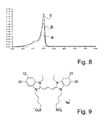
- cyanines will include both cyanines and mero-cyanines and their derivatives, as defined in DM Sturmer published in the book "Chemistry of heterocyclic compounds: special topics", Volume 30, pp. 441-601, edited by A. Weissberger and BW Rossiter, 1977 (Wiley Interscience, New York) ), and examples of which are given respectively in Figures 2a and 2b, 3, 9, 10 and 14.
- the aggregates J are self-arrangements of cyanine molecules that form very ordered assemblages and whose structural organizations are of crystalline type.
- a description of aggregates J and their properties can be found in the article by H Kuhn et al. in a book titled "J-aggregates" by T. Kobayashi, ISBN 981-02-2737-X. Due to the almost flawless organization of aggregates J, they have remarkable properties. Thus, it has been observed that the irradiation of a two-dimensional monolayer of aggregates J causes the formation of an exciton which is capable of spreading throughout this monolayer at a high speed, typically 2 km / s, consistently and with extremely little energy loss.
- the object of the present invention is to propose a simple, fast and efficient method which makes it possible to reproduce stably J aggregates of high quality, that is to say, whose physicochemical characteristics are comparable to the reference.
- the invention also relates to an assembly formed of a support, an organized layer of dendrimer molecules and, on the organized layer of these molecules, a monolayer of molecules of the cyanine family organized in J aggregates.
- the different spectra show absorption or emission, depending on the incident or transmitted wavelength.
- the method essentially consists in coating a previously prepared support with a model matrix and then depositing on this matrix the cyanine molecules to form the aggregate J.
- a borosilicate-type glass support forming a plate approximately 3 cm by 1 cm, is cleaned, for example, by immersion in a so-called Piranha solution composed of H 2 SO 4 and H 2 O 2 , in a proportion of 2 for 1 at 120 ° C for 10 minutes. Then, the support is rinsed with ultra pure water and dried under a stream of nitrogen. The support is then activated by treatment with an oxygen plasma for 3 minutes. This plasma is created between two capacitor plates, by inducing a radiofrequency current through the plates. The highly energetic particles of the plasma degrade any organic residues remaining on the support in volatile molecules that evacuate. The media is perfectly cleaned and ready for the next steps.
- a model matrix is made based on dendrimers, that is to say macromolecules each consisting of monomers that associate in a tree process around a central core multifunctional.
- the tree construction is carried out by repeating the same sequence of reactions until a new generation and an increasing number of identical branches are obtained at the end of each reaction cycle.
- An example of a dendrimer, fourth-generation polyamidoamide, called PAMAM G4, is shown in FIG.
- the dendrimers have the advantage of being monodisperse and of having a rigorously controlled structure, geometry and stoichiometry. Indeed, the reaction scheme of their preparation being clearly defined, each of the molecules of a given dendrimer is identical to another. For a dendrimer molecule, the number of functions, the charge density, the surface and the occupied volume are known. The table below gives some examples of dendrimers and their properties. Number of peripheral functions Diameter (nm) External surface (nm 2 ) Surface density of functional groups (per nm 2 ) PAMAM G1 8 2.2 3.8 2.11 PAMAM G4 64 4.5 15.9 4.02 PAMAM G6 256 6.7 35.2 7.26
- the support prepared in the previous step is dipped, for 18 hours, in an ethanolic solution of PAMAM G4 concentrated to 1.10 -4 M. Thanks to the interactions between the support and PAMAM, it is adsorbed on the surface of the support to form on the latter a homogeneous monolayer (see, in particular, the article of H. Tokuhisa et al. J. Am. Chem. Soc., 1998, 120, 4492 ).
- the reactions between PAMAM and the support are of acid-base type, between the amine functions of PAMAM and the silanol groups of the glass, but other types of interactions (electrostatic, Van der Waals bonds). , metal-ligand type, etc. .7) can also be involved, depending on the various media chosen, as will be explained below.
- deposition techniques can be used to obtain a homogeneous monolayer. These techniques include: “spin coating” or deposit on a rotating sample, printing, “spraying” or spraying, etc.
- the support is rinsed with pure ethanol in order to eliminate the PAMAM molecules not bound to the support. Finally, the support is dried under a stream of nitrogen.
- the cyanine used to form the aggregate J is [5,5'-diphenyldibenzoxazolo N, N'-propylsulfonate] -9 ethyl trimethine cyanine (called Myline1), illustrated in FIG. 3.
- Myline1 ethyl trimethine cyanine
- These cyanines being sensitive to light, it is It is essential to avoid exposing them to light, both during the preparation of the reagent and during the reaction.
- the cyanine is dissolved in acetone at a concentration of 7 ⁇ 10 -4 M. The mixture is stirred magnetically for 2 hours to ensure complete solubilization of the reagent.
- the proposed cyanine is negatively charged. Also, to allow it to interact with PAMAM deposited on the support, it is previously immersed in an acid solution, typically hydrochloric acid at pH 3.5 to protonate all the amines PAMAM. The support thus activated is then immersed in the cyanine solution above. The duration of the immersion is between a few seconds and a few minutes, and will be discussed below. Then, the support is rinsed with pure acetone and dried under a stream of nitrogen.
- an acid solution typically hydrochloric acid at pH 3.5
- the assembly obtained above, particularly the cyanine layer, is analyzed by means of a UV-visible spectrophotometer.
- the spectrum obtained with an immersion time of 12 minutes is presented in FIG. 4b, to be compared with that of the Myline 1 solution used as the reagent illustrated in FIG. 4a.
- FIG. 4a shows three peaks for the reagent, at 479 nm, 50 nm and 551 nm, described in the literature as respectively corresponding to the absorption peaks of the dimer, the monomer and the J aggregate of Myline. 1.
- the spectrum of the layer of Myline 1 deposited on the support shows that there is no more dimer (no peak at 479 nm) and almost no more monomer (low peak at 507 nm).
- the signal corresponding to the aggregate J is very intense, which means that the layer is almost exclusively composed of aggregates J.
- the quality of the organization and the homogeneity of the aggregates J formed is confirmed by the comparison of the wavelengths of fluorescence emission and absorption of the assembly obtained above.
- the spectrum is shown in FIG. 5.
- the absorption peak a appears at a wavelength of 549 nm, whereas the emission peak b appears at 554 nm. This small difference shows that the layer is homogeneous and perfectly organized at the molecular level.
- FIG. 6 shows the absorption variations for an assembly obtained according to the invention, with a glass support covered with PAMAM of different generations, respectively G1, G4 and G6 for the spectra 10, 11 and 12. Between the different measurements, the samples were kept in the dark. The spectra indexed a are obtained just after the reaction, while the spectra indexed b were made 14 weeks later. It is observed that, in the absence of light, the aggregates J obtained according to the method of the invention remain remarkably organized and even that the intensity of the peaks increases slightly. This effect is thought to be due to the removal of traces of solvent still present just after the reaction.
- a glass carrier has been coated with a polylysine layer.
- This polymer has a large number of amine functional groups and its ability to self-arrange the Myline 1 molecules into J aggregates can therefore be compared with that observed for PAMAM.
- the assembly formed by a glass support and a polylysine layer undergoes the treatment described in the previous paragraph relating to the formation of aggregates J.
- FIG. 7 shows that, with a polylysine layer, the absorption peak corresponding to the aggregate J is poorly defined (between 530 and 544 nm), less intense and much wider than with a PAMAM layer.
- the spectrum d illustrates that the cyanine molecules are not stable on the polylysine layer and that they reorganize on this surface.
- this comparison proves that dendrimer matrices, and in particular those functionalized with PAMAM, have an excellent ability to self-arrange cyanine molecules into stable and highly organized aggregates and, consequently, to very close optical properties. reference properties.
- a layer of PAMAM is deposited according to the method described above with regard to a glass support.
- PAMAM adheres to the gold surface essentially through the interactions between the PAMAM peripheral primary amines and the surface gold atoms.
- the large number of these primary amines makes it possible to obtain a very good adhesion of PAMAM on the gold support.
- an aqueous solvent the nature of the interactions between PAMAM and gold is very different and is essentially controlled by electrostatic attractions. Indeed, under these conditions, the peripheral amine groups tend to protonate, positively charging PAMAM.
- support such as silicon, mica, quartz or metal oxides, in particular, or even flexible supports of polymer or polycarbonate type.
- the essential thing is that sufficient interactions can be established between the support and the layer of dendrimers and that these interactions are such as to allow the creation of a monolayer of dendrimers on the support.
- Those skilled in the art will be able, by means of simple experiments, to establish other associations between supports and dendrimers, by varying the functional groups of the dendrimer or the experimental conditions of the deposition of the monolayer.
- an intermediate layer of attachment between the support and the monolayer of dendrimers An example of such an intermediate layer can be found in the article of M. Wells and RM Crooks, J. Am. Chem. Soc. 1996, 118, 3988-3989 .
- PAMAM poly(ethylene glycol)
- Other dendrimers such as PAMAM G3.5, G4.5,..., Gm.5,... With carboxylic peripheral functions (COOH) or carboxylate functions (COO-), also form matrices allowing The essential characteristic that the molecule forming the model matrix must exhibit is that its outer surface, that is to say the one forming the interface with the reaction medium when it is on the support, must be defined and regular. It must, in addition, have a high density of peripheral functional groups to interact effectively with the support to be adsorbed therein but also to react with dyes to allow them to self-organize freely.
- hyperbranch macromolecules including dendrimers, but also hyperbranch polymers, that is to say molecules having a polymer type part, weakly organized, and a dendrimer part, well-defined.
- hyperbranch polymers may be suitable insofar as the polymer part is used to bind this molecule to the support, the dendrimer part then being at the interface with the dye molecules.
- such hyperbranch polymers are deemed to be part of the family of dendrimers.
- the various dyes included in the definition of the cyanine family given above that is to say the cyanines, the mero-cyanines and their derivatives, are capable of self-arranging to form aggregates J on a model matrix as defined in the preceding paragraphs.
- the cyanine and the molecule forming the model matrix must be chosen in relation to each other so that the cyanine interacts with the functional groups present at the periphery of the model matrix; which implies, for example, a complementarity of the electric charges and a similarity of the densities of charges.
- the Myline 2 was used in anionic form, in solution in acetone at 7 ⁇ 10 -4 M.
- the PAMAM having been protonated, as described above, the model matrix is immersed for 3 minutes in the Myline 2 solution. Aggregate formation was observed, confirmed by the presence of an absorption peak at 586 nm.
- a cation-like cyanine can also self-arrange to form aggregates J on a negatively charged model template.
- An example of such a cyanine is shown in Figure 10 while a negatively charged dendrimer may, for example, be a generation PAMAM, Gm.5 with carboxylate peripheral functions.
- Solvents occur at two stages of the reaction process.
- the dendrimer is dissolved in a first solvent.
- this first solvent is preferably a low molecular weight alcohol, especially methanol or ethanol.
- the dye is dissolved in a second solvent.
- a second solvent In the example, the latter is acetone.
- the cyanine solution used during the formation of aggregates J gives a better conversion of the cyanine molecules into aggregates J if the concentration of cyanines is sufficient, that is to say close to the saturation, of to allow the formation of J aggregates in the solution, which will act as seeds in the subsequent growth process of the aggregate J.
- the value of the saturation threshold depends of course on the solvent used and the nature of the cyanine considered. With acetone as solvent and cyanine Myline 1, it is therefore desirable that the concentration be equal to or greater than 7.10 -5 M.
- the aggregation step J was conducted by carrying the cyanine solution at various temperatures, at room temperature (22 ° C), 40 ° C and 55 ° C. These different tests were reproduced with a model matrix made from PAMAM G4 and PAMAM G6. The absorption spectra obtained are shown in FIGS. 11a and 11b, respectively for PAMAM G4 and PAMAM G6. The curves a, b, c correspond to the temperatures 22, 40 and 55 ° C.
- aggregates J As mentioned above, one of the properties of aggregates J is to allow the extremely fast circulation and, almost without loss of energy, an exciton or an electron. Thus, if aggregates J of cyanines are excited, all the cyanine molecules will emit resonance fluorescence with a high intensity.
- the present application is based on the fact that, if an electron-accepting molecule is present in the environment of the aggregate J, the excitons delocalized in the aggregate J will be rapidly captured by the acceptor which will transform them into electron pairs. hole, which will result in the extinction of the emission fluorescence.
- paraquat 1,1'-dimethyl-4,4'-bipyridinium
- paraquat 1,1'-dimethyl-4,4'-bipyridinium
- Paraquat is also a potent toxin, particularly attacking the central nervous system. It is therefore particularly important to be able to detect any traces on crops that have been treated.
- an energy acceptor molecule directly inside the aggregate J.
- a luminescent energy acceptor whose absorption spectrum covers, at least partially, the emission spectrum of the aggregate
- this acceptor will harvest, with a certain yield, the excitation energy of the aggregate and re-emit at its own length. emission wave.
- such an acceptor which may be suitable for incorporation into an aggregate of Myline 1 molecules, may be as shown in FIG. the properties necessary for the desired energy transfer (absorption maximum around 550 nm, emission around 600 nm).
- the energy-accepting molecules are dissolved in the cyanine master solution used for the formation of aggregates J.
- This mode of use of aggregates J may especially find a particularly advantageous application in devices comprising waveguides or other optical compounds. Indeed, it may be desirable to integrate, in such a device, a light source capable of injecting a light wave into the waveguide of said device. Such integration is made possible by the method according to the invention.
- the device thus obtained is shown in FIG. 15.
- a waveguide 24, for example made of Ta 2 O 5 is conventionally produced in a glass substrate 23.
- These layers, thus deposited and forming a secondary light source 28 are covered by a transparent separating layer 26, for example glass.
- a primary light source 30 is formed on the transparent layer 26 opposite the secondary light source 28.
- the separating layer may be a transparent medium such as air.
- the energy accepting molecules are capable of harvesting the light received, at a first wavelength, from the primary source 30 and of reemitting at a second wavelength different from the first, in the Waveguide 24.
- the emission at the second wavelength may be either spontaneous or stimulated.
- laser effect occurs when the excitation at the first wavelength is sufficiently intense to cause a population inversion of the energy acceptors, which means that more than 50% of the energy acceptors are excited at all times.
- the emission wavelength of the energy acceptor is sufficiently far removed from that of the J aggregates absorption, to avoid that the light emitted by the acceptors is absorbed by the aggregate instead of be driven by the waveguide.
- the wavelengths are, for example, separated by at least 20 nm, particularly from about 50 to 70 nm.
- This secondary source 28 is intended to be energized by a primary light source 30 which can be positioned in a number of ways, as described in detail hereinafter.
- the assembly formed by the waveguide 24 and by the secondary light source 28 is integrated inside a device 23. More particularly, the secondary source 28 is covered with a transparent separator 26, for example made of glass, the primary source 30 being positioned directly on the separator 26.
- This primary source 30 may be an LED, an OLED or another known light source.
- the assembly formed by the waveguide 24 and by the secondary light source 28 constitutes the upper layer of a device 23.
- the primary light source 30 is situated at a distance from the device and can be positioned indifferently with respect to the secondary source, as shown by the various illustrated positions, as long as the light it emits reaches the secondary source, including through the substrate and the waveguide 24 of the device 23 .
- FIG. 17 proposes different variants of the position of the secondary light source 28 with respect to the waveguide 24.
- the profile of the transmission mode of the waveguide is shown at 32.
- Secondary source 28 may be placed anywhere within the mode profile. In other words, it must be located in the region where the electromagnetic field of the guided wave is increased by the waveguide. It is also possible to combine several secondary sources, located at different positions, these different sources being able to absorb and / or re-emit at different wavelengths, depending on the application and the materials chosen.
- the luminescent acceptor is located at a specific location of the aggregate J instead of being distributed homogeneously. In this case, when a location of the aggregate J is irradiated by a light source, the zone comprising the acceptor will absorb the energy moving in the aggregate and only this area will emit light.
- the invention relates to one of these applications to optical devices.
- the techniques described above open wide perspectives in terms of experimentation, to apply them to other hyperbranch macromolecules, other substrates or other types of dyes capable of forming aggregates J.
- the scope of the The invention is therefore not limited to the chemical species mentioned in the particular examples.
Landscapes
- Chemical & Material Sciences (AREA)
- Organic Chemistry (AREA)
- Physics & Mathematics (AREA)
- Health & Medical Sciences (AREA)
- General Physics & Mathematics (AREA)
- Chemical Kinetics & Catalysis (AREA)
- Life Sciences & Earth Sciences (AREA)
- Biochemistry (AREA)
- General Health & Medical Sciences (AREA)
- Polymers & Plastics (AREA)
- Nuclear Medicine, Radiotherapy & Molecular Imaging (AREA)
- Engineering & Computer Science (AREA)
- Analytical Chemistry (AREA)
- Wood Science & Technology (AREA)
- Medicinal Chemistry (AREA)
- Materials Engineering (AREA)
- Immunology (AREA)
- Pathology (AREA)
- Optics & Photonics (AREA)
- Investigating, Analyzing Materials By Fluorescence Or Luminescence (AREA)
- Optical Integrated Circuits (AREA)
- Application Of Or Painting With Fluid Materials (AREA)
- Indole Compounds (AREA)
Applications Claiming Priority (1)
| Application Number | Priority Date | Filing Date | Title |
|---|---|---|---|
| CH01838/05A CH703675B1 (fr) | 2005-11-16 | 2005-11-16 | Procédé de réalisation d'agrégats J. |
Publications (2)
| Publication Number | Publication Date |
|---|---|
| EP1788036A1 true EP1788036A1 (de) | 2007-05-23 |
| EP1788036B1 EP1788036B1 (de) | 2011-09-28 |
Family
ID=37946143
Family Applications (1)
| Application Number | Title | Priority Date | Filing Date |
|---|---|---|---|
| EP05111790A Expired - Lifetime EP1788036B1 (de) | 2005-11-16 | 2005-12-07 | Verfahren zur Herstellung von J-Aggregaten |
Country Status (5)
| Country | Link |
|---|---|
| US (1) | US8088929B2 (de) |
| EP (1) | EP1788036B1 (de) |
| AT (1) | ATE526368T1 (de) |
| CH (1) | CH703675B1 (de) |
| WO (1) | WO2007057356A2 (de) |
Cited By (2)
| Publication number | Priority date | Publication date | Assignee | Title |
|---|---|---|---|---|
| EP2028236A1 (de) * | 2007-08-23 | 2009-02-25 | CSEM Centre Suisse d'Electronique et de Microtechnique SA Recherche et Développement | Zusammensetzung, die J-Aggregate umfasst |
| EP2684839A1 (de) | 2012-07-13 | 2014-01-15 | CSEM Centre Suisse d'Electronique et de Microtechnique SA - Recherche et Développement | Mesoporöse Schicht mit J-Aggregaten |
Citations (2)
| Publication number | Priority date | Publication date | Assignee | Title |
|---|---|---|---|---|
| EP1081557A1 (de) * | 1999-09-03 | 2001-03-07 | Sharp Kabushiki Kaisha | Elektrophotographischer Photorezeptor, Beschichtungsflüssigkeit für photoempfindliche Schichten, Herstellungsverfahren und elektrophotographischer Apparat |
| EP1085315A1 (de) * | 1999-09-15 | 2001-03-21 | CSEM Centre Suisse d'Electronique et de Microtechnique SA | Integrierter optischer Sensor |
Family Cites Families (6)
| Publication number | Priority date | Publication date | Assignee | Title |
|---|---|---|---|---|
| DE19855180A1 (de) * | 1998-11-30 | 2000-05-31 | Metabion Gmbh Ges Fuer Angewan | in situ-Hybridisierungsverfahren |
| EP1978110B1 (de) * | 2000-09-06 | 2010-05-26 | Transnetyx, Inc. | Computer-basiertes Verfahren und System zum Screenen von genomischer DNS |
| US20040023248A1 (en) * | 2001-12-07 | 2004-02-05 | Whitehead Institiute For Biomedical Research | Methods and reagents for improving nucleic acid detection |
| US7261875B2 (en) * | 2001-12-21 | 2007-08-28 | Board Of Regents, The University Of Texas System | Dendritic poly (amino acid) carriers and methods of use |
| US7271265B2 (en) * | 2003-08-11 | 2007-09-18 | Invitrogen Corporation | Cyanine compounds and their application as quenching compounds |
| EP2028236B1 (de) * | 2007-08-23 | 2010-08-11 | CSEM Centre Suisse d'Electronique et de Microtechnique SA - Recherche et Développement | Zusammensetzung, die J-Aggregate umfasst |
-
2005
- 2005-11-16 CH CH01838/05A patent/CH703675B1/fr not_active IP Right Cessation
- 2005-12-07 AT AT05111790T patent/ATE526368T1/de not_active IP Right Cessation
- 2005-12-07 EP EP05111790A patent/EP1788036B1/de not_active Expired - Lifetime
-
2006
- 2006-11-10 WO PCT/EP2006/068340 patent/WO2007057356A2/fr not_active Ceased
- 2006-11-10 US US12/094,038 patent/US8088929B2/en active Active
Patent Citations (2)
| Publication number | Priority date | Publication date | Assignee | Title |
|---|---|---|---|---|
| EP1081557A1 (de) * | 1999-09-03 | 2001-03-07 | Sharp Kabushiki Kaisha | Elektrophotographischer Photorezeptor, Beschichtungsflüssigkeit für photoempfindliche Schichten, Herstellungsverfahren und elektrophotographischer Apparat |
| EP1085315A1 (de) * | 1999-09-15 | 2001-03-21 | CSEM Centre Suisse d'Electronique et de Microtechnique SA | Integrierter optischer Sensor |
Non-Patent Citations (3)
| Title |
|---|
| HIDEO TOKUHISA ET. AL.: "Preparation and Characterization of Dendrimer Monolayers and Dendrimer-Alkanethiol Mixed Monolayers Adsorbed to Gold", JOURNAL OF THE AMERICAN CHEMICAL SOCIETY, vol. 120, 1998, pages 4492 - 4501, XP002417618 * |
| M. LOSSON: "Self-organizing properties of dendrimers and potential applications; Thèse pur l'obtention du titre de Docteur ès Sciences", 24 October 2005, UNIVERSITÉ DE NEUCHATEL; FACULTE DES SCIENCES, NEUCHATEL, XP002417620 * |
| R. STEIGER; F. ZBINDEN: "Physical-Chemical Properties of Organized Sensitizer Molecules", JOURNAL OF IMAGING SCIENCE, vol. 32, 1988, pages 64 - 81, XP008074432 * |
Cited By (4)
| Publication number | Priority date | Publication date | Assignee | Title |
|---|---|---|---|---|
| EP2028236A1 (de) * | 2007-08-23 | 2009-02-25 | CSEM Centre Suisse d'Electronique et de Microtechnique SA Recherche et Développement | Zusammensetzung, die J-Aggregate umfasst |
| US7824617B2 (en) | 2007-08-23 | 2010-11-02 | CSEM Centre Suisse d'Electronique et de Microtechnique SA-Recherche et Development | Assembly comprising J aggregates |
| EP2684839A1 (de) | 2012-07-13 | 2014-01-15 | CSEM Centre Suisse d'Electronique et de Microtechnique SA - Recherche et Développement | Mesoporöse Schicht mit J-Aggregaten |
| EP2708492A1 (de) | 2012-07-13 | 2014-03-19 | CSEM Centre Suisse d'Electronique et de Microtechnique SA - Recherche et Développement | Mesoporöse Schicht mit J-Aggregaten |
Also Published As
| Publication number | Publication date |
|---|---|
| US8088929B2 (en) | 2012-01-03 |
| CH703675B1 (fr) | 2012-03-15 |
| WO2007057356A2 (fr) | 2007-05-24 |
| ATE526368T1 (de) | 2011-10-15 |
| US20080279500A1 (en) | 2008-11-13 |
| WO2007057356A3 (fr) | 2007-08-23 |
| EP1788036B1 (de) | 2011-09-28 |
Similar Documents
| Publication | Publication Date | Title |
|---|---|---|
| Abulikemu et al. | Solid-state, near-infrared to visible photon upconversion via triplet–triplet annihilation of a binary system fabricated by solution casting | |
| EP2652533B1 (de) | Optisches element mit einem rissfreien aerogel | |
| Huijser et al. | Photosensitization of TiO2 and SnO2 by artificial self-assembling mimics of the natural chlorosomal bacteriochlorophylls | |
| EP4082052B1 (de) | Fotovoltaikmodul | |
| EP0130117B1 (de) | Lumineszentes Material bestehend aus einer Matrize mit einer inwendig verteilten fluoreszenten Verbindung, dessen Herstellung und Verwendung in einem Photoelement | |
| EP2260085A1 (de) | In einer anorganischen hülle eingekapselte fluoreszierende nanokristalle | |
| EP2550679B1 (de) | PV-Module mit Antireflexionsschicht mit dispergierten Objekten mit Bereichen mit unterschiedlichem Brechungsindex | |
| EP1788036B1 (de) | Verfahren zur Herstellung von J-Aggregaten | |
| EP4178989A1 (de) | Initiatormolekül für eine nichtlineare absorptionsreaktion, durch biphotonische absorption aktivierbare photopolymerisierbare zusammensetzung und zugehöriges 3d-druckverfahren | |
| EP2125992A1 (de) | Fluoreszierende organische nanokristalle zur herstellung von biosensoren | |
| EP3815155A1 (de) | Fotovoltaikzelle und verfahren zur herstellung davon | |
| EP2028236B1 (de) | Zusammensetzung, die J-Aggregate umfasst | |
| EP1704607B1 (de) | P-n-hybridmaterial für einen anorganischen/organischen halbleiter, herstellungsverfahren dafür und fotovoltaikzelle damit | |
| CA2816251C (fr) | Conduction electrique par des assemblages supramoleculaires de triarylamines | |
| FR2912938A1 (fr) | Procede de preparation d'un materiau structure par traitement electromagnetique et/ou photonique | |
| EP3221042B1 (de) | Verfahren zur herstellung einer kolloidalen lösung aus nanopartikeln aus einem mischoxid von vanadium und europium oder mischoxid von vanadium, europium und yttrium. | |
| EP3364461A1 (de) | Dotierungsverfahren von graphen | |
| WO2010066812A1 (fr) | Composés actifs rédox organiques à stockage de charges réversible et substrats et dispositifs de mémoire moléculaire les comprenant. | |
| WO2013189811A1 (fr) | Un système laser organique et procédé de modification de la longueur d'onde d'émission du système laser | |
| EP3470368A1 (de) | Dotierverfahren von kohlenstoffnanoröhren | |
| EP4386064A1 (de) | Lumineszierendes verbundmaterial | |
| WO2013054024A1 (fr) | Procede de detection de l'interaction d'au moins une entite avec une couche dielectrique | |
| WO2020002832A1 (fr) | Composition de polymère conducteur et son procédé de fabrication | |
| FR2930937A1 (fr) | Traitement de surface de nanoparticules de silicium | |
| HK1223391A1 (en) | Ink compositions comprising nanoparticles |
Legal Events
| Date | Code | Title | Description |
|---|---|---|---|
| PUAI | Public reference made under article 153(3) epc to a published international application that has entered the european phase |
Free format text: ORIGINAL CODE: 0009012 |
|
| AK | Designated contracting states |
Kind code of ref document: A1 Designated state(s): AT BE BG CH CY CZ DE DK EE ES FI FR GB GR HU IE IS IT LI LT LU LV MC NL PL PT RO SE SI SK TR |
|
| AX | Request for extension of the european patent |
Extension state: AL BA HR MK YU |
|
| 17P | Request for examination filed |
Effective date: 20071109 |
|
| AKX | Designation fees paid |
Designated state(s): AT BE BG CH CY CZ DE DK EE ES FI FR GB GR HU IE IS IT LI LT LU LV MC NL PL PT RO SE SI SK TR |
|
| GRAP | Despatch of communication of intention to grant a patent |
Free format text: ORIGINAL CODE: EPIDOSNIGR1 |
|
| GRAS | Grant fee paid |
Free format text: ORIGINAL CODE: EPIDOSNIGR3 |
|
| GRAA | (expected) grant |
Free format text: ORIGINAL CODE: 0009210 |
|
| RAP1 | Party data changed (applicant data changed or rights of an application transferred) |
Owner name: CSEM CENTRE SUISSE D'ELECTRONIQUE ET DE MICROTECHN |
|
| AK | Designated contracting states |
Kind code of ref document: B1 Designated state(s): AT BE BG CH CY CZ DE DK EE ES FI FR GB GR HU IE IS IT LI LT LU LV MC NL PL PT RO SE SI SK TR |
|
| REG | Reference to a national code |
Ref country code: GB Ref legal event code: FG4D Free format text: NOT ENGLISH |
|
| REG | Reference to a national code |
Ref country code: CH Ref legal event code: EP |
|
| REG | Reference to a national code |
Ref country code: IE Ref legal event code: FG4D |
|
| REG | Reference to a national code |
Ref country code: CH Ref legal event code: NV Representative=s name: GLN S.A. |
|
| REG | Reference to a national code |
Ref country code: DE Ref legal event code: R096 Ref document number: 602005030202 Country of ref document: DE Effective date: 20111201 |
|
| REG | Reference to a national code |
Ref country code: NL Ref legal event code: VDEP Effective date: 20110928 |
|
| PG25 | Lapsed in a contracting state [announced via postgrant information from national office to epo] |
Ref country code: SE Free format text: LAPSE BECAUSE OF FAILURE TO SUBMIT A TRANSLATION OF THE DESCRIPTION OR TO PAY THE FEE WITHIN THE PRESCRIBED TIME-LIMIT Effective date: 20110928 Ref country code: FI Free format text: LAPSE BECAUSE OF FAILURE TO SUBMIT A TRANSLATION OF THE DESCRIPTION OR TO PAY THE FEE WITHIN THE PRESCRIBED TIME-LIMIT Effective date: 20110928 Ref country code: LT Free format text: LAPSE BECAUSE OF FAILURE TO SUBMIT A TRANSLATION OF THE DESCRIPTION OR TO PAY THE FEE WITHIN THE PRESCRIBED TIME-LIMIT Effective date: 20110928 |
|
| LTIE | Lt: invalidation of european patent or patent extension |
Effective date: 20110928 |
|
| PG25 | Lapsed in a contracting state [announced via postgrant information from national office to epo] |
Ref country code: LV Free format text: LAPSE BECAUSE OF FAILURE TO SUBMIT A TRANSLATION OF THE DESCRIPTION OR TO PAY THE FEE WITHIN THE PRESCRIBED TIME-LIMIT Effective date: 20110928 Ref country code: AT Free format text: LAPSE BECAUSE OF FAILURE TO SUBMIT A TRANSLATION OF THE DESCRIPTION OR TO PAY THE FEE WITHIN THE PRESCRIBED TIME-LIMIT Effective date: 20110928 Ref country code: SI Free format text: LAPSE BECAUSE OF FAILURE TO SUBMIT A TRANSLATION OF THE DESCRIPTION OR TO PAY THE FEE WITHIN THE PRESCRIBED TIME-LIMIT Effective date: 20110928 Ref country code: GR Free format text: LAPSE BECAUSE OF FAILURE TO SUBMIT A TRANSLATION OF THE DESCRIPTION OR TO PAY THE FEE WITHIN THE PRESCRIBED TIME-LIMIT Effective date: 20111229 Ref country code: CY Free format text: LAPSE BECAUSE OF FAILURE TO SUBMIT A TRANSLATION OF THE DESCRIPTION OR TO PAY THE FEE WITHIN THE PRESCRIBED TIME-LIMIT Effective date: 20110928 |
|
| REG | Reference to a national code |
Ref country code: AT Ref legal event code: MK05 Ref document number: 526368 Country of ref document: AT Kind code of ref document: T Effective date: 20110928 |
|
| REG | Reference to a national code |
Ref country code: IE Ref legal event code: FD4D |
|
| PG25 | Lapsed in a contracting state [announced via postgrant information from national office to epo] |
Ref country code: IS Free format text: LAPSE BECAUSE OF FAILURE TO SUBMIT A TRANSLATION OF THE DESCRIPTION OR TO PAY THE FEE WITHIN THE PRESCRIBED TIME-LIMIT Effective date: 20120128 Ref country code: CZ Free format text: LAPSE BECAUSE OF FAILURE TO SUBMIT A TRANSLATION OF THE DESCRIPTION OR TO PAY THE FEE WITHIN THE PRESCRIBED TIME-LIMIT Effective date: 20110928 Ref country code: SK Free format text: LAPSE BECAUSE OF FAILURE TO SUBMIT A TRANSLATION OF THE DESCRIPTION OR TO PAY THE FEE WITHIN THE PRESCRIBED TIME-LIMIT Effective date: 20110928 |
|
| PG25 | Lapsed in a contracting state [announced via postgrant information from national office to epo] |
Ref country code: EE Free format text: LAPSE BECAUSE OF FAILURE TO SUBMIT A TRANSLATION OF THE DESCRIPTION OR TO PAY THE FEE WITHIN THE PRESCRIBED TIME-LIMIT Effective date: 20110928 Ref country code: NL Free format text: LAPSE BECAUSE OF FAILURE TO SUBMIT A TRANSLATION OF THE DESCRIPTION OR TO PAY THE FEE WITHIN THE PRESCRIBED TIME-LIMIT Effective date: 20110928 Ref country code: PT Free format text: LAPSE BECAUSE OF FAILURE TO SUBMIT A TRANSLATION OF THE DESCRIPTION OR TO PAY THE FEE WITHIN THE PRESCRIBED TIME-LIMIT Effective date: 20120130 Ref country code: RO Free format text: LAPSE BECAUSE OF FAILURE TO SUBMIT A TRANSLATION OF THE DESCRIPTION OR TO PAY THE FEE WITHIN THE PRESCRIBED TIME-LIMIT Effective date: 20110928 Ref country code: IT Free format text: LAPSE BECAUSE OF FAILURE TO SUBMIT A TRANSLATION OF THE DESCRIPTION OR TO PAY THE FEE WITHIN THE PRESCRIBED TIME-LIMIT Effective date: 20110928 |
|
| BERE | Be: lapsed |
Owner name: CSEM CENTRE SUISSE D'ELECTRONIQUE ET DE MICROTECH Effective date: 20111231 |
|
| PG25 | Lapsed in a contracting state [announced via postgrant information from national office to epo] |
Ref country code: DK Free format text: LAPSE BECAUSE OF FAILURE TO SUBMIT A TRANSLATION OF THE DESCRIPTION OR TO PAY THE FEE WITHIN THE PRESCRIBED TIME-LIMIT Effective date: 20110928 Ref country code: MC Free format text: LAPSE BECAUSE OF NON-PAYMENT OF DUE FEES Effective date: 20111231 Ref country code: IE Free format text: LAPSE BECAUSE OF FAILURE TO SUBMIT A TRANSLATION OF THE DESCRIPTION OR TO PAY THE FEE WITHIN THE PRESCRIBED TIME-LIMIT Effective date: 20110928 |
|
| PLBE | No opposition filed within time limit |
Free format text: ORIGINAL CODE: 0009261 |
|
| STAA | Information on the status of an ep patent application or granted ep patent |
Free format text: STATUS: NO OPPOSITION FILED WITHIN TIME LIMIT |
|
| PG25 | Lapsed in a contracting state [announced via postgrant information from national office to epo] |
Ref country code: PL Free format text: LAPSE BECAUSE OF FAILURE TO SUBMIT A TRANSLATION OF THE DESCRIPTION OR TO PAY THE FEE WITHIN THE PRESCRIBED TIME-LIMIT Effective date: 20110928 |
|
| 26N | No opposition filed |
Effective date: 20120629 |
|
| REG | Reference to a national code |
Ref country code: DE Ref legal event code: R097 Ref document number: 602005030202 Country of ref document: DE Effective date: 20120629 |
|
| PG25 | Lapsed in a contracting state [announced via postgrant information from national office to epo] |
Ref country code: BE Free format text: LAPSE BECAUSE OF NON-PAYMENT OF DUE FEES Effective date: 20111231 |
|
| REG | Reference to a national code |
Ref country code: CH Ref legal event code: PCAR Free format text: NEW ADDRESS: AVENUE EDOUARD-DUBOIS 20, 2000 NEUCHATEL (CH) |
|
| PG25 | Lapsed in a contracting state [announced via postgrant information from national office to epo] |
Ref country code: ES Free format text: LAPSE BECAUSE OF FAILURE TO SUBMIT A TRANSLATION OF THE DESCRIPTION OR TO PAY THE FEE WITHIN THE PRESCRIBED TIME-LIMIT Effective date: 20120108 |
|
| PG25 | Lapsed in a contracting state [announced via postgrant information from national office to epo] |
Ref country code: LU Free format text: LAPSE BECAUSE OF NON-PAYMENT OF DUE FEES Effective date: 20111207 |
|
| PG25 | Lapsed in a contracting state [announced via postgrant information from national office to epo] |
Ref country code: BG Free format text: LAPSE BECAUSE OF FAILURE TO SUBMIT A TRANSLATION OF THE DESCRIPTION OR TO PAY THE FEE WITHIN THE PRESCRIBED TIME-LIMIT Effective date: 20111228 |
|
| PG25 | Lapsed in a contracting state [announced via postgrant information from national office to epo] |
Ref country code: TR Free format text: LAPSE BECAUSE OF FAILURE TO SUBMIT A TRANSLATION OF THE DESCRIPTION OR TO PAY THE FEE WITHIN THE PRESCRIBED TIME-LIMIT Effective date: 20110928 |
|
| PG25 | Lapsed in a contracting state [announced via postgrant information from national office to epo] |
Ref country code: HU Free format text: LAPSE BECAUSE OF FAILURE TO SUBMIT A TRANSLATION OF THE DESCRIPTION OR TO PAY THE FEE WITHIN THE PRESCRIBED TIME-LIMIT Effective date: 20110928 |
|
| REG | Reference to a national code |
Ref country code: FR Ref legal event code: PLFP Year of fee payment: 11 |
|
| REG | Reference to a national code |
Ref country code: CH Ref legal event code: PFA Owner name: CSEM CENTRE SUISSE D'ELECTRONIQUE ET DE MICROT, CH Free format text: FORMER OWNER: CSEM CENTRE SUISSE D'ELECTRONIQUE ET DE MICROTECHNIQUE SA - RECHERCHE ET DEVELOPPEMENT, CH |
|
| REG | Reference to a national code |
Ref country code: FR Ref legal event code: PLFP Year of fee payment: 12 |
|
| REG | Reference to a national code |
Ref country code: FR Ref legal event code: PLFP Year of fee payment: 13 |
|
| REG | Reference to a national code |
Ref country code: CH Ref legal event code: NV Representative=s name: BOVARD SA NEUCHATEL CONSEILS EN PROPRIETE INTE, CH |
|
| PGFP | Annual fee paid to national office [announced via postgrant information from national office to epo] |
Ref country code: DE Payment date: 20241216 Year of fee payment: 20 |
|
| PGFP | Annual fee paid to national office [announced via postgrant information from national office to epo] |
Ref country code: GB Payment date: 20241218 Year of fee payment: 20 |
|
| PGFP | Annual fee paid to national office [announced via postgrant information from national office to epo] |
Ref country code: FR Payment date: 20241217 Year of fee payment: 20 |
|
| PGFP | Annual fee paid to national office [announced via postgrant information from national office to epo] |
Ref country code: CH Payment date: 20250101 Year of fee payment: 20 |
|
| REG | Reference to a national code |
Ref country code: CH Ref legal event code: H14 Free format text: ST27 STATUS EVENT CODE: U-0-0-H10-H14 (AS PROVIDED BY THE NATIONAL OFFICE) Effective date: 20251207 Ref country code: DE Ref legal event code: R071 Ref document number: 602005030202 Country of ref document: DE |
|
| REG | Reference to a national code |
Ref country code: GB Ref legal event code: PE20 Expiry date: 20251206 |