EP1794106B1 - Phenols sulfones avec nitrophenols comme inhibiteurs de polymerisation - Google Patents
Phenols sulfones avec nitrophenols comme inhibiteurs de polymerisation Download PDFInfo
- Publication number
- EP1794106B1 EP1794106B1 EP05777468A EP05777468A EP1794106B1 EP 1794106 B1 EP1794106 B1 EP 1794106B1 EP 05777468 A EP05777468 A EP 05777468A EP 05777468 A EP05777468 A EP 05777468A EP 1794106 B1 EP1794106 B1 EP 1794106B1
- Authority
- EP
- European Patent Office
- Prior art keywords
- group
- alkyl
- hydrogen
- dinitro
- independently selected
- Prior art date
- Legal status (The legal status is an assumption and is not a legal conclusion. Google has not performed a legal analysis and makes no representation as to the accuracy of the status listed.)
- Expired - Lifetime
Links
- 0 *c(cc1*)cc(*)c1O Chemical compound *c(cc1*)cc(*)c1O 0.000 description 5
Classifications
-
- C—CHEMISTRY; METALLURGY
- C07—ORGANIC CHEMISTRY
- C07C—ACYCLIC OR CARBOCYCLIC COMPOUNDS
- C07C309/00—Sulfonic acids; Halides, esters, or anhydrides thereof
- C07C309/01—Sulfonic acids
- C07C309/28—Sulfonic acids having sulfo groups bound to carbon atoms of six-membered aromatic rings of a carbon skeleton
- C07C309/41—Sulfonic acids having sulfo groups bound to carbon atoms of six-membered aromatic rings of a carbon skeleton containing singly-bound oxygen atoms bound to the carbon skeleton
- C07C309/42—Sulfonic acids having sulfo groups bound to carbon atoms of six-membered aromatic rings of a carbon skeleton containing singly-bound oxygen atoms bound to the carbon skeleton having the sulfo groups bound to carbon atoms of non-condensed six-membered aromatic rings
-
- C—CHEMISTRY; METALLURGY
- C07—ORGANIC CHEMISTRY
- C07C—ACYCLIC OR CARBOCYCLIC COMPOUNDS
- C07C7/00—Purification; Separation; Use of additives
- C07C7/20—Use of additives, e.g. for stabilisation
-
- C—CHEMISTRY; METALLURGY
- C08—ORGANIC MACROMOLECULAR COMPOUNDS; THEIR PREPARATION OR CHEMICAL WORKING-UP; COMPOSITIONS BASED THEREON
- C08K—Use of inorganic or non-macromolecular organic substances as compounding ingredients
- C08K5/00—Use of organic ingredients
- C08K5/36—Sulfur-, selenium-, or tellurium-containing compounds
- C08K5/37—Thiols
- C08K5/375—Thiols containing six-membered aromatic rings
Definitions
- the present invention is directed to the inhibition of the polymerization of ethylenically unsaturated monomers by means of the addition thereto of the combination of a sulfonated phenol and a nitrophenol.
- Polymerization can also result in equipment fouling, especially in the case of production of acrylic monomers.
- Such polymerization causes loss in production efficiency owing to the deposition of polymer in or on the equipment being used. These deposits must be removed from time to time, leading to additional loss in production of the monomer.
- U.S. Patent No. 2,867,672 discloses that the polymerization of uninhibited styrene condensing in liquid form on the surfaces containing the vapor space above the liquid level of the main body of styrene in a tank may be minimized by spraying the surfaces enclosing the vapor space with a styrene polymerization inhibitor.
- U.S. Patent No. 4,086,147 discloses a process for the distillation of readily polymerizable vinyl aromatic compounds comprising subjecting a vinyl aromatic compound to elevated temperatures in a distillation system in the presence of a polymerization inhibitor comprising m-nitro-p-cresol.
- U.S. Patent No. 4,468,343 discloses a compound and a process for utilizing the compound to prevent the polymerization of vinyl aromatic compounds, such as styrene, during heating.
- the composition includes effective amounts of 2,6-dinitro-p-cresol and either a phenylenediamine or 4-tert-butylcatechol respectively, to act as a polymerization co-inhibitor system in the presence of oxygen.
- U.S. Patent No. 4,670,131 discloses controlling the fouling of equipment used for processing of organic feed streams containing olefinic compounds by inhibiting polymerization of the olefinic compounds by carrying out the processing in the presence of from about 20 ppb to less than 1000 ppb of a stable free radical, such as a nitroxide.
- U.S. Patent No. 5,254,760 discloses the inhibition of the polymerization of a vinyl aromatic compound, such as styrene, during distillation or purification by the presence of at least one stable nitroxyl compound together with at least one aromatic nitro compound.
- U.S. Patent No. 5,290,888 discloses a process for stabilizing an ethylenically unsaturated monomer or oligomer from premature polymerization whereby a stabilizing amount of an N-hydroxy substituted hindered amine is added to said polymerizable monomer or oligomer.
- the ethylenically unsaturated monomer or oligomer encompasses vinyl monomers or oligomers bearing at least one polymerizable moiety.
- the N-hydroxy substituted hindered amine is said to inhibit premature polymerization in the liquid and/or vapor phase.
- U.S. Patent No. 5,446,220 discloses methods for inhibiting the polymerization of vinyl aromatic monomers in oxygen-free processing systems. These methods comprise adding from 1 to about 10,000 parts per million parts monomer of a combination of a dinitrophenol compound, a hydroxylamine compound and a phenylenediamine compound. Preferably, 2-sec-butyl-4,6-dinitrophenol or 4,6-dinitro-o-cresol are used in combination with bis-(hydroxypropyl)hydroxylamine and N,N' -di-sec-butyl-p-phenylenediamine.
- U.S. Patent No. 5,545,786 discloses that nitroxyl inhibitors in combination with some oxygen reduce the premature polymerization of vinyl aromatic monomers during the manufacturing processes for such monomers. It is also disclosed that even small quantities of air used in combination with the nitroxyl inhibitors result in vastly prolonged inhibition times for said monomers.
- U.S. Patent No. 5,932,735 discloses that selected derivatives of 1-oxyl-2,2,6,6-tetramethyl-4-hydroxypiperidine are effective as inhibitors to prevent the premature polymerization of acrylic and methacrylic acids, their esters, their amides, vinyl acetate and acrylonitrile in the presence of water.
- U.S. Patent No. 6,143,205 discloses a mixture for inhibiting the premature polymerization of monomers that contains (A) vinyl-containing monomers, and (B) an effective amount of a mixture of (i) from 0.05 to 4.5% by weight, based on the total mixture (B), of at least one N-oxyl compound of a secondary amine which carries no hydrogen atoms on the ⁇ -carbon atoms and (ii) from 99.95 to 95.5% by weight, based on the total mixture (B), of at least one nitro compound.
- Russian patents 1,027,150 ; 1,139,722 ; and 1,558,888 disclose decreased polymer formation during normal operating conditions (true inhibitors), but do not protect the system in emergency feed shut off situations, i.e., there is no retarder effect.
- inhibiting systems comprising sulfonated phenols have been found to be excellent inhibitors and retarders to prevent polymerization of ethylenically unsaturated monomers, especially vinyl aromatic compounds, when used with nitrophenols, such as 2,4-dinitro-o-sec-butylphenol (DNBP).
- DNBP 2,4-dinitro-o-sec-butylphenol
- this inhibitor system can be used in combination with nitroxyl radical type compounds or nitrosoanilines and amines.
- DNBP is a preferred second component of the claimed inhibitor blend
- both components can be manufactured in the same process. Accordingly, manufacturing can be simplified by producing both components in the same process at the same location. This provides the economic advantage that the material can be produced in an already existing process at low cost without capital investment. From a customer point of view, an economic advantage is realized owing to the low manufacturing cost (low price) and the superior performance of the claimed inhibitor blend. The latter results in low inhibitor usage and low polymer make.
- the present invention is directed to a method for inhibiting the premature polymerization and the polymer growth of ethylenically unsaturated monomers comprising adding to said monomers an effective amount of a combination of
- the present invention is directed to a method for inhibiting the premature polymerization and the polymer growth of ethylenically unsaturated monomers comprising adding to said monomers an effective amount of a combination of
- the present invention is directed to a composition comprising a combination of
- the present invention is directed to inhibiting systems comprising a combination of
- the inhibiting system further comprises at least one amine and at least one additional inhibitor selected from the group consisting of nitroxyl compounds and nitrosoanilines.
- R 2 is hydrocarbyl, it is preferably a straight chain or branched chain alkyl or alkenyl group of from 1 to to 50 carbon atoms, more preferably of from 1 to 18 carbon atoms including, but not limited to, methyl, ethyl, propyl, butyl, pentyl, hexyl, heptyl, octyl, 2-ethyl hexyl, nonyl, decyl, undecyl, dodecyl, tridecyl, tetradecyl, pentadecyl, hexadecyl, heptadecyl, octadecyl, oleyl, nonadecyl, eicosyl, heneicosyl, docosyl, tricosyl, tetracosyl, pentacosyl, triacontyl, isomers of the foregoing (such as, for example, isopropy
- Nitrophenols that can be employed in the practice of the present invention include, but are not limited to, 2,6-dinitro-4-methylphenol, 2-nitro-4-methylphenol, 2,4-dinitro-1-naphthol, 2,4,6-trinitrophenol (picric acid), 2,4-dinitro-6-methylphenol, 2,4-dinitrophenol, 2,4-dinitro-6-sec-butylphenol, 4-cyano-2-nitrophenol, 3-iodo-4-cyano-5-nitrophenol, m- nitro- p -cresol, 2,6-dinitro -p -cresol, and the like. 2,4-Dinitro-6-sec-butylphenol is preferred.
- the nitroxyl compound is preferably a stable hindered nitroxyl compound having the structural formula: wherein R 4 and R 7 are independently selected from the group consisting of hydrogen, alkyl, and heteroatom-substituted alkyl and R 5 and R 6 are independently selected from the group consisting of alkyl and heteroatom-substituted alkyl; and X 1 and X 2 (1) are independently selected from the group consisting of halogen, cyano, COOR 7 , -S-COR 7 , -OCOR 7 , (wherein R 7 is alkyl or aryl), amido, -S-C 6 H 5 , carbonyl, alkenyl, or alkyl of 1 to 15 carbon atoms, or (2) taken together, form a ring structure with the nitrogen.
- the stable hindered nitroxyl compound has the structural formula: wherein R 4 and R 7 are independently selected from the group consisting of hydrogen, alkyl, and heteroatom-substituted alkyl and R 5 and R 6 are independently selected from the group consisting of alkyl and heteroatom-substituted alkyl, and the portion represents the atoms necessary to form a five-, six-, or seven-membered heterocyclic ring.
- R 8 and/or R 9 are alkyl, it is preferred that they be a lower alkyl (i.e., one having one to five carbon atoms, e.g., methyl, ethyl, propyl, butyl, pentyl, and isomers thereof).
- R 8 and/or R 9 are aryl, it is preferred that they be aryl of from 6 to 10 carbon atoms, e.g., phenyl or naphthyl, which, in addition, may be substituted with non-interfering substituents, e.g., lower alkyl groups, halogens, and the like.
- R 8 and/or R 9 are acyl, it is preferred that they be acyl of the structure where R 19 is alkyl, aryl, OR 20 , or NR 20 R 21 and where R 20 and R 21 are alkyl, aryl, or where R 22 is alkyl or aryl.
- R 19 , R 20 , R 21 , or R 22 are alkyl, they are preferably alkyl of from 1 to 15 carbon atoms, more preferably lower alkyl of from 1 to 5 carbon atoms, as described above.
- R 19 , R 20 , R 21 , or R 22 are aryl, they are preferably aryl of from 6 to 10 carbon atoms, as described above.
- two or more nitroxyl groups can be present in the same molecule, for example, by being linked through one or more of the Z-type moieties by a linking group E, as disclosed in U.S. Patent Number 5,254,760 .
- R 4 and R 7 are independently selected from the group consisting of hydrogen, alkyl, and heteroatom-substituted alkyl and R 5 and R 6 are independently selected from the group consisting of alkyl and heteroatom-substituted alkyl.
- the alkyl (or heteroatom-substituted alkyl) groups R 4 through R 7 can be the same or different and preferably contain 1 to 15 carbon atoms, e.g., methyl, ethyl, propyl, butyl, pentyl, hexyl, heptyl, octyl, nonyl, decyl, undecyl, dodecyl, tridecyl, tetradecyl, pentadecyl, and the like, and isomers thereof, e.g., t-butyl, 2-ethylhexyl, and the like.
- R 4 through R 7 be independently selected lower alkyl (or heteroatom-substituted lower alkyl) of one to five carbon atoms (e.g., methyl, ethyl, propyl, butyl, pentyl, and isomers thereof).
- heteroatom substituents can, for example, include halogen, oxygen, sulfur, nitrogen, and the like. It is most preferred that all of R 4 through R 7 be methyl.
- Suitable nitroxide free radical compounds that can be used in combination with the hydrogen donor or electron acceptor in the practice of the present invention, include, but are not limited to:
- TEMPO 2,2,6,6-tetramethyl-1-piperidinyloxy.
- 4-amino-TEMPO is 4-amino-2,2,6,6-tetramethyl-1-piperidinyloxy
- 4-hydroxy-TEMPO is 4-hydroxy-2,2,6,6-tetramethyl-1-piperidinyloxy (also known in the art as HTEMPO)
- 4-oxo-TEMPO is 4-oxo-2,2,6,6-tetramethyl-1-piperidinyloxy; and so on.
- one member of the combination employed in the practice of the present invention be 4-amino-TEMPO, 4-oxo-TEMPO, 4-hydroxy-TEMPO, or TEMPO.
- Blends of two or more of the foregoing, e.g., 4-amino-TEMPO and 4-oxo-TEMPO, can also be employed.
- Such stable nitroxide free radical compounds can be prepared by known methods. (See, for example, U.S. Patent Numbers 3,163,677 ; 3,334,103 ; 3,372,182 ; 3,422,144 ; 3,494,930 ; 3,502,692 ; 3,873,564 ; 3,966,711 ; and 4,665,185 .) They are suitable for use over a wide range of temperatures, but distillation temperatures employed with the ethylenically unsaturated monomers that are stabilized by the process of the present invention typically range from about 60°C to about 180°C, preferably from about 70°C to about 165°C, and, more preferably, from about 80°C to about 150°C. Such distillations are generally performed at an absolute pressure in the range of 1330 Pa to 16000 Pa (about 10 to about 1,200 mm of Hg).
- the inhibiting system of the present invention comprises an additional inhibitor that is a nitrosoaniline
- it can be an N-nitrosoaniline or a C-nitrosoaniline.
- the nitrosoaniline compound is a C-nitrosoaniline.
- C-nitrosoaniline compounds can be prepared by C-nitrosation of the corresponding anilines in any typical manner used for the C-nitrosation of aromatic amines.
- reaction of the amine with cold nitrous acid produces an N-nitroso compound that rearranges to a para-nitrosoaniline under the influence of an excess of hydrochloric acid.
- it is more convenient to effect the nitrosation and rearrangement in one step by conducting the reaction in methanol solution in the presence of an excess of hydrogen chloride under anhydrous conditions. This procedure is described in U.S. Patent Number 2,046,356 .
- nitrosoaniline derivatives are understood to tautomerize to quinone imine oxime derivatives, i.e., See, for example, Sidgwick, N.V., The Organic Chemistry of Nitrogen, Third Edition, Clarendon Press, Oxford, 1966. Thus, both forms can be present, especially in solution at elevated temperatures, and can be expected to contribute to the inhibiting activity of these compounds.
- nitrosoanilines that can be employed in the practice of the present invention are preferably of the structure: wherein R 21 and R 22 are independently selected from the group consisting of hydrogen, alkyl, aryl, acyl, hydroxyl, alkoxy, nitroso, and sulfonyl, or R 21 and R 22 can form a cyclic ring that is aryl, cycloalkyl, polyaryl, or heterocyclic; R 23 through R 27 are independently selected from the group consisting of hydrogen, alkyl, aryl, acyl, hydroxyl, alkoxy, acyloxy, NR 28 (R 29 ), nitro, nitroso, halogen, and sulfonyl, or any two adjacent R's can form a cyclic ring that is aryl, cycloalkyl, polyaryl, or heterocyclic, provided that at least one of R 23 through R 27 must be a nitroso group; and R 28 and R 29 are independently selected from the group
- the amine can be a primary, secondary, or tertiary amine, and can comprise alkyl groups, aryl groups, or combinations thereof.
- amines include, but are not limited to, ⁇ -naphthylamine, thiodiarylamines, p- phenylenediamine, o -phenylenediamine, 2,4-diamino diphenylamine, cyclohexyl naphthyl amine, polybutyl amines, methyl aniline, diphenyl- p- phenylene diamine, phenyl- ⁇ -naphthylamine, isopropoxydiphenylamine, aldol- ⁇ -naphthyl amine, symmetrical di- ⁇ -naphthyl- p- phenylenediamine, trimethyl dihydroquinoline, ditolylamines, phenyl-
- the ethylenically unsaturated monomer, the premature polymerization and polymer growth of which is an object of the present invention, can be any such monomer for which unintended polymerization and/or polymer growth during its manufacture, storage, and/or distribution is a problem.
- styrene ⁇ -methylstyrene, styrene sulfonic acid, vinyltoluene, divinylbenzenes, polyvinylbenzenes, alkylated styrene, 2-vinylpyridine, acrylonitrile, methacrylonitrile, methyl acrylate, ethyl acrylate, methyl methacrylate, ethyl methacrylate, acrylic acid, methacrylic acid, butadiene, chloroprene, isoprene, and the like.
- the ethylenically unsaturated monomers will not necessarily be stabilized indefinitely by the presence of the inhibitor(s), especially when the monomers are heated as in distillation, but they can be considered to be stabilized as long as A) there is a measurable increase in the time for which they can be heated before the onset of polymerization and/or polymer growth in a static system, B) the amount of polymer made at a constant temperature remains constant over time in a dynamic system, and/or C) the rate of polymer growth is significantly slower than when the growth inhibiting system is not present.
- free radical scavengers can also be included in the practice of the present invention.
- air or O 2 as disclosed in U.S. Patent Numbers 5,545,782 and 5,545,786 , can be added, as can the aromatic nitro compounds disclosed in U.S.
- the dihetero-substituted benzene compounds having at least one transferable hydrogen e.g., a quinone derivative such as the mono-methyl-ether of hydroquinone disclosed in European Patent Application 0 765 856 A1 , the iron compounds disclosed in WO 98/25872 , and other inhibitors, e.g., phenolics and certain inorganic salts, well-known to those skilled in the art.
- a quinone derivative such as the mono-methyl-ether of hydroquinone disclosed in European Patent Application 0 765 856 A1
- iron compounds disclosed in WO 98/25872 the iron compounds disclosed in WO 98/25872
- other inhibitors e.g., phenolics and certain inorganic salts, well-known to those skilled in the art.
- the polymerization inhibitors can be introduced into the monomer to be protected by any conventional method. They can, for example, be added as a concentrated solution in suitable solvents just upstream from the point of desired application by any suitable means.
- individual inhibiting components can be injected separately into the distillation train along with the incoming feed and/or through separate and multiple entry points, provided there is an efficient distribution of the inhibiting composition. Since the inhibitors are gradually depleted during the distillation operation, it is generally advantageous to maintain the appropriate amount of them in the distillation apparatus by adding them during the course of the distillation process. Adding inhibitors can be done either on a generally continuous basis or intermittently, in order to maintain the inhibitor concentration above the minimum required level.
- the total inhibitor concentration should be from about 1 to about 2000 ppm versus the monomer being inhibited; preferably from about 5 to about 1000 ppm, depending on the conditions of use.
- the ratio of the first component (A) to the second component (B), based on the total of both components is from about 1 to 100 wt % A : about 99 to 0 wt % B; preferably, about 25-75 wt % A : about 75-25 wt% B; more preferably about 50-75 wt % A : about 50-25 wt % B.
- the styrene inhibitor and retarder properties of this material were tested in a Continuous Dynamic Reboiler Test monitoring the polymer formation with UV spectrophotometry.
- the inhibitor is added to styrene monomer from which tert -butylcatechol (TBC) is previously removed by distillation.
- TBC tert -butylcatechol
- This styrene 180 grams is loaded into a flask, which is immersed into an oil bath. The temperature of styrene is usually 116°C.
- a fresh feed is charged into the flask at the rate of three grams/minute and, at the same time, the material from flask is discharged at the same rate.
- the steady stage is continued until equilibrium. For feed shut off stage, the charging and discharging are discontinued. Samples are taken every hour at the steady stage and every 5-10 minutes at feed shut off.
Landscapes
- Chemical & Material Sciences (AREA)
- Organic Chemistry (AREA)
- Engineering & Computer Science (AREA)
- Analytical Chemistry (AREA)
- Oil, Petroleum & Natural Gas (AREA)
- Water Supply & Treatment (AREA)
- Health & Medical Sciences (AREA)
- Chemical Kinetics & Catalysis (AREA)
- Medicinal Chemistry (AREA)
- Polymers & Plastics (AREA)
- Polymerisation Methods In General (AREA)
- Organic Low-Molecular-Weight Compounds And Preparation Thereof (AREA)
- Hydrogenated Pyridines (AREA)
Abstract
Claims (20)
- Procédé pour inhiber la polymérisation prématurée et la croissance de polymères de monomères à insaturation éthylénique, comprenant l'addition auxdits monomères d'une quantité efficace d'une combinaison de(A) au moins un inhibiteur qui est un phénol sulfoné de formule :
 (1) R2 est choisi dans le groupe constitué de l'hydrogène et d'un groupe hydrocarbyle ; et(2) R1 et R3 sont indépendamment choisis dans le groupe constitué de l'hydrogène et de SO3H, sous réserve qu'au moins l'un de R1 et de R3 soit SO3H ; et(B) au moins un inhibiteur qui est un nitrophénol.
 - Procédé selon la revendication 1, dans lequel R2 est un groupe alkyle à chaîne linéaire ou à chaîne ramifiée ou un groupe alcényle ayant de 1 à 50 atomes de carbone.
- Procédé selon la revendication 1, dans lequel R2 est choisi dans le groupe constitué des groupes méthyle, éthyle, propyle, butyle, pentyle, hexyle, heptyle, octyle, 2-éthylhexyle, nonyle, décyle, undécyle, dodécyle, tridécyle, tétradécyle, pentadécyle, hexadécyle, heptadécyle, octadécyle, oléyle, nonadécyle, éicosyle, hénéicosyle, docosyle, tricosyle, tétracosyle, pentacosyle, triacontyle, des isomères des précédents, cyclopentyle, cyclohexyle, cycloheptyle, cyclooctyle et cyclododécyle.
- Procédé selon la revendication 3, dans lequel R2 est sec-butyle.
- Procédé selon la revendication 1, dans lequel le nitrophénol est choisi dans le groupe constitué de 2,6-dinitro-4-méthylphénol, 2-nitro-4-méthylphénol, 2,4-dinitro-1-naphtol, 2,4,6-trinitrophénol (acide picrique), 2,4-dinitro-6-méthylphénol, 2,4-dinitrophénol, 2,4-dinitro-6-sec-butylphénol, 4-cyano-2-nitrophénol, 3-iodo-4-cyano-5-nitrophénol, m-nitro-p-crésol et 2,6-dinitro-p-crésol.
- Procédé selon la revendication 1 pour inhiber la polymérisation prématurée et la croissance de polymères de monomères à insaturation éthylénique, comprenant l'addition auxdits monomères d'une quantité efficace d'une combinaison de(A) au moins un inhibiteur qui est un phénol sulfoné de formule :
 (1) R2 est choisi dans le groupe constitué de l'hydrogène et d'un groupe hydrocarbyle ; et(2) R1 et R3 sont indépendamment choisis dans le groupe constitué de l'hydrogène et de SO3H, sous réserve qu'au moins l'un de R1 et de R3 soit SO3H ;(B) au moins un inhibiteur qui est un nitrophénol ;(C) au moins un inhibiteur choisi dans le groupe constitué de composés nitroxyle et de nitrosoanilines ; et(D) au moins une amine.
 - Procédé selon la revendication 6, dans lequel R2 est un groupe alkyle à chaîne linéaire ou à chaîne ramifiée ou un groupe alcényle ayant de 1 à 50 atomes de carbone.
- Procédé selon la revendication 6, dans lequel R2 est choisi dans le groupe constitué des groupes méthyle, éthyle, propyle, butyle, pentyle, hexyle, heptyle, octyle, 2-éthylhexyle, nonyle, décyle, undécyle, dodécyle, tridécyle, tétradécyle, pentadécyle, hexadécyle, heptadécyle, octadécyle, oléyle, nonadécyle, éicosyle, hénéicosyle, docosyle, tricosyle, tétracosyle, pentacosyle, triacontyle, des isomères des précédents, cyclopentyle, cyclohexyle, cycloheptyle, cyclooctyle et cyclododécyle.
- Procédé selon la revendication 8, dans lequel R2 est sec-butyle.
- Procédé selon la revendication 6, dans lequel le nitrophénol est choisi dans le groupe constitué de 2,6-dinitro-4-méthylphénol, 2-nitro-4-méthylphénol, 2,4-dinitro-1-naphtol, 2,4,6-trinitrophénol (acide picrique), 2,4-dinitro-6-méthylphénol, 2,4-dinitrophénol, 2,4-dinitro-6-sec-butylphénol, 4-cyano-2-nitrophénol, 3-iodo-4-cyano-5-nitrophénol, m-nitro-p-crésol et 2,6-dinitro-p-crésol.
- Procédé selon la revendication 6, dans lequel (C) est un composé nitroxyle stable stériquement encombré ayant la formule de structure :

- Procédé selon la revendication 6, dans lequel (C) est une nitrosoaniline de structure :
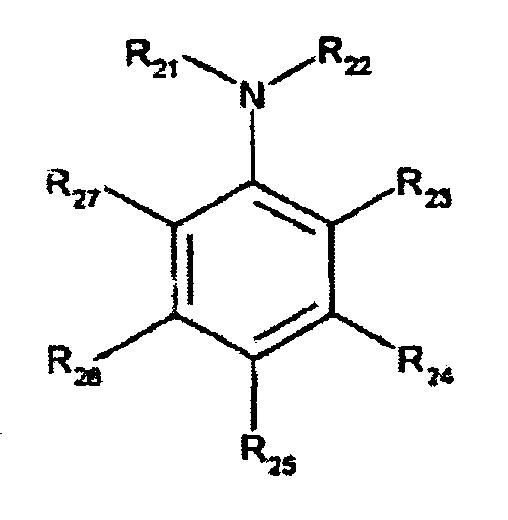
R21 et R22 sont indépendamment choisis dans le groupe constitué de l'hydrogène, des groupes alkyle, aryle, acyle, hydroxyle, alkoxy, nitroso et sulfonyle, ou R21 et R22 peuvent former un noyau cyclique qui est un groupe aryle, cycloalkyle, polyaryle, ou hétérocyclique ;
R23 à R27 sont indépendamment choisis dans le groupe constitué de l'hydrogène, des groupes alkyle, aryle, acyle, hydroxyle, alkoxy, acyloxy, NR28 (R29), nitro, nitroso, halogène et sulfonyle, ou l'un quelconque de deux R adjacents peut former un noyau cyclique qui est un groupe aryle, cycloalkyle, polyaryle, ou hétérocyclique, sous réserve qu' au moins l'un de R23 à R27 soit un groupe nitroso ; et
R28 et R29 sont indépendamment choisis dans le groupe constitué de l'hydrogène, des groupes alkyle, aryle, acyle et nitroso. - Procédé selon la revendication 6, dans lequel (D) est choisi dans le groupe constitué d'α-naphtylamine, thiodiarylamines, p-phénylènediamine, o-phénylènediamine, 2,4-diaminodiphénylamine, cyclohexyl-naphtylamine, polybutylamines, méthylaniline, diphényl-p-phénylènediamine, phényl-β-naphtylamine, isopropoxy-diphénylamine, aldol-α-naphtylamine, di-β-naphtyl-p-phénylènediamine symétrique, triméthyldihydroquinoléine, ditolylamines, phényl-α-naphtylamine, phényl-β-naphtylamine, diaminophénol, 4-cyclohexylaminophénol, p-aminophénol, o-aminophénol, et 5-amino-2-hydroxytoluène.
- Composition comprenant une combinaison de(A) au moins un inhibiteur qui est un phénol sulfoné de formule :
 (1) R2 est choisi dans le groupe constitué de l'hydrogène et d'un groupe hydrocarbyle ; et(2) R1 et R3 sont indépendamment choisis dans le groupe constitué de l'hydrogène et de SO3H, sous réserve qu'au moins l'un de R1 et de R3 soit SO3H ;(B) un inhibiteur qui est un nitrophénol ;(C) un inhibiteur choisi dans le groupe constitué de composés nitroxyle et de nitrosoanilines ; et(D) une amine.
 - Composition selon la revendication 14, dans laquelle R2 est un groupe à chaîne linéaire ou à chaîne ramifiée ou un groupe alcényle ayant de 1 à 50 atomes de carbone.
- Composition selon la revendication 14, dans laquelle R2 est choisi dans le groupe constitué des groupes méthyle, éthyle, propyle, butyle, pentyle, hexyle, heptyle, octyle, 2-éthylhexyle, nonyle, décyle, undécyle, dodécyle, tridécyle, tétradécyle, pentadécyle, hexadécyle, heptadécyle, octadécyle, oléyle, nonadécyle, éicosyle, hénéicosyle, docosyle, tricosyle, tétracosyle, pentacosyle, triacontyle, des isomères des précédents, cyclopentyle, cyclohexyle, cycloheptyle, cyclooctyle et cyclododécyle.
- Composition selon la revendication 14, dans laquelle le nitrophénol est choisi dans le groupe constitué de 2,6-dinitro-4-méthylphénol, 2-nitro-4-méthylphénol, 2,4-dinitro-1-naphtol, 2,4,6-trinitrophénol (acide picrique), 2,4-dinitro-6-méthylphénol, 2,4-dinitrophénol, 2,4-dinitro-6-sec-butylphénol, 4-cyano-2-nitrophénol, 3-iodo-4-cyano-5-nitrophénol, m-nitro-p-crésol et 2,6-dinitro-p-crésol.
- Composition selon la revendication 14, dans laquelle (C) est un composé nitroxyle stable stériquement encombré ayant la formule de structure :

- Composition selon la revendication 14, dans laquelle (C) est une nitrosoaniline de structure :

R21 et R22 sont indépendamment choisis dans le groupe constitué de l'hydrogène, des groupes alkyle, aryle, acyle, hydroxyle, alkoxy, nitroso et sulfonyle, ou R21 et R22 peuvent former un noyau cyclique qui est un groupe aryle, cycloalkyle, polyaryle, ou hétérocyclique ;
R23 à R27 sont indépendamment choisis dans le groupe constitué de l'hydrogène, des groupes alkyle, aryle, acyle, hydroxyle, alkoxy, acyloxy, NR28 (R29) , nitro, nitroso, halogène et sulfonyle, ou l'un quelconque de deux R adjacents peut former un noyau cyclique qui est un groupe aryle, cycloalkyle, polyaryle, ou hétérocyclique, sous réserve qu'au moins l'un de R23 à R27 soit un groupe nitroso ; et
R28 et R29 sont indépendamment choisis dans le groupe constitué de l'hydrogène, des groupes alkyle, aryle, acyle et nitroso. - Composition selon la revendication 14, dans laquelle (D) est choisi dans le groupe constitué d'α-naphtylamine, thiodiarylamines, p-phénylènediamine, o-phénylènediamine, 2,4-diaminodiphénylamine, cyclohexyl-naphtylamine, polybutylamines, méthylaniline, diphényl-p-phénylènediamine, phényl-β-naphtylamine, isopropoxy-diphénylamine, aldol-α-naphtylamine, di-β-naphtyl-p-phénylènediamine symétrique, triméthyldihydroquinoléine, ditolylamines, phényl-α-naphtylamine, phényl-β-naphtylamine, diaminophénol, 4-cyclohexylaminophénol, p-aminophénol, o-aminophénol, et 5-amino-2-hydroxytoluène.
Priority Applications (1)
| Application Number | Priority Date | Filing Date | Title |
|---|---|---|---|
| PL05777468T PL1794106T3 (pl) | 2004-09-28 | 2005-07-20 | Sufonowane fenole z nitrofenolami jako inhibitory polimeryzacji |
Applications Claiming Priority (4)
| Application Number | Priority Date | Filing Date | Title |
|---|---|---|---|
| US61437804P | 2004-09-28 | 2004-09-28 | |
| US63124104P | 2004-11-29 | 2004-11-29 | |
| US11/172,517 US20060069219A1 (en) | 2004-09-28 | 2005-06-29 | Sulfonated phenols with nitrophenols as polymerization inhibitors |
| PCT/US2005/026016 WO2006036274A1 (fr) | 2004-09-28 | 2005-07-20 | Phenols sulfones avec nitrophenols comme inhibiteurs de polymerisation |
Publications (2)
| Publication Number | Publication Date |
|---|---|
| EP1794106A1 EP1794106A1 (fr) | 2007-06-13 |
| EP1794106B1 true EP1794106B1 (fr) | 2010-04-07 |
Family
ID=35385340
Family Applications (1)
| Application Number | Title | Priority Date | Filing Date |
|---|---|---|---|
| EP05777468A Expired - Lifetime EP1794106B1 (fr) | 2004-09-28 | 2005-07-20 | Phenols sulfones avec nitrophenols comme inhibiteurs de polymerisation |
Country Status (16)
| Country | Link |
|---|---|
| US (1) | US20060069219A1 (fr) |
| EP (1) | EP1794106B1 (fr) |
| JP (1) | JP5175550B2 (fr) |
| KR (1) | KR101181599B1 (fr) |
| CN (1) | CN102766009A (fr) |
| AR (1) | AR050962A1 (fr) |
| AT (1) | ATE463473T1 (fr) |
| BR (1) | BRPI0515540A (fr) |
| CA (1) | CA2581526C (fr) |
| DE (1) | DE602005020473D1 (fr) |
| ES (1) | ES2343071T3 (fr) |
| MX (1) | MX2007003663A (fr) |
| MY (1) | MY146410A (fr) |
| PL (1) | PL1794106T3 (fr) |
| TW (1) | TWI374131B (fr) |
| WO (1) | WO2006036274A1 (fr) |
Families Citing this family (3)
| Publication number | Priority date | Publication date | Assignee | Title |
|---|---|---|---|---|
| CA2593400C (fr) | 2005-02-04 | 2013-03-12 | Chemtura Corporation | Moyens permettant de maitriser la reaction exothermique des monomeres styreniques avec les acides sulfoniques |
| US9206268B2 (en) * | 2011-09-16 | 2015-12-08 | General Electric Company | Methods and compositions for inhibiting polystyrene formation during styrene production |
| ES2547893T3 (es) * | 2011-12-26 | 2015-10-09 | Dorf Ketal Chemicals (India) Private Limited | Composición de aditivo mejorada a base de amina para el control y la inhibición de la polimerización de monómeros aromáticos de vinilo, y procedimiento para su uso |
Family Cites Families (33)
| Publication number | Priority date | Publication date | Assignee | Title |
|---|---|---|---|---|
| US396711A (en) * | 1889-01-22 | Necticut | ||
| US2046356A (en) * | 1933-12-27 | 1936-07-07 | Ici Ltd | Manufacture of diarylamine derivatives |
| US2867672A (en) * | 1955-08-29 | 1959-01-06 | Shell Dev | Method of minimizing styrene polymerization during storage |
| US3163677A (en) * | 1961-08-07 | 1964-12-29 | American Cyanamid Co | Process for preparing n, n, o-trisubstituted hydroxyl amines and n, n-disubstituted nitroxides and products |
| US3502692A (en) * | 1962-06-13 | 1970-03-24 | American Cyanamid Co | Cyclic nitroxides and process for preparing same |
| GB983134A (en) * | 1962-06-13 | 1965-02-10 | American Cyanamid Co | Cyclic nitroxides and process for preparing same |
| US3422144A (en) * | 1965-04-27 | 1969-01-14 | American Cyanamid Co | Stable free radical nitroxides |
| US3372182A (en) * | 1965-04-27 | 1968-03-05 | American Cyanamid Co | Process for preparation of stable, free radical nitroxides |
| FR1501769A (fr) * | 1966-07-04 | 1967-11-18 | Commissariat Energie Atomique | Radicaux libres du type nitroxyde |
| US3873564A (en) * | 1971-03-03 | 1975-03-25 | Synvar Ass | 2-Imidazolinyl-3-oxide-1-oxypropionic acid |
| GB1354420A (en) * | 1971-05-17 | 1974-06-05 | Volgogradsky Politekh Inst | Isoprene treatment |
| US4086147A (en) * | 1976-12-10 | 1978-04-25 | Cosden Technology, Inc. | Polymerization inhibitor for vinyl aromatic compounds |
| US4468343A (en) * | 1983-04-11 | 1984-08-28 | Cosden Technology, Inc. | Polymerization co-inhibitors for vinyl aromatic compounds |
| US4665185A (en) * | 1984-03-22 | 1987-05-12 | Ciba-Geigy Corporation | Process for preparing nitroxyls of sterically hindered amines |
| US4664845A (en) * | 1986-01-09 | 1987-05-12 | Uniroyal Chemical Company, Inc. | Phenylenediamine solubilizer for dinitrophenol in aromatic solvent |
| US4670131A (en) * | 1986-01-13 | 1987-06-02 | Exxon Chemical Patents Inc. | Method for controlling fouling of hydrocarbon compositions containing olefinic compounds |
| US5290888A (en) * | 1990-07-20 | 1994-03-01 | Ciba-Geigy Corporation | Process for stabilizing ethylenically unsaturated compounds and stabilized monomer compositions |
| US5212272A (en) * | 1990-10-31 | 1993-05-18 | Peach State Labs, Inc. | Polyacrylic acid compositions for textile processing |
| US5157175A (en) * | 1991-09-09 | 1992-10-20 | Nalco Chemical Company | Composition and method for inhibition of styrene polymerization |
| JP2914075B2 (ja) * | 1992-04-30 | 1999-06-28 | 大日本インキ化学工業株式会社 | (メタ)アクリル酸エステルの製造法 |
| US5254760A (en) * | 1992-07-29 | 1993-10-19 | Ciba-Geigy Corporation | Inhibiting polymerization of vinyl aromatic monomers |
| JPH06234700A (ja) * | 1993-02-12 | 1994-08-23 | Dainippon Ink & Chem Inc | (メタ)アクリル酸エステル類の製造方法 |
| US5446220A (en) * | 1994-08-24 | 1995-08-29 | Betz Laboratories, Inc. | Methods for inhibiting vinyl aromatic monomer polymerization |
| US5545786C1 (en) * | 1994-11-28 | 2001-10-16 | Ciba Geigy Corp | Method for inhibiting premature polymerization of vinyl aromatic monomers |
| JPH08217726A (ja) * | 1995-02-15 | 1996-08-27 | Dainippon Ink & Chem Inc | ペンタエリスリトール(メタ)アクリルエステルの製造方法 |
| WO1997046504A1 (fr) * | 1996-06-05 | 1997-12-11 | Basf Aktiengesellschaft | Melanges contenant des monomeres et des agents stabilisants |
| US5932735A (en) * | 1997-06-13 | 1999-08-03 | Ciba Specialty Chemicals Corporation | Derivatives of 1-oxyl-4-hydroxy-2,2,6,6-tetramethylpiperidine as polymerization inhibitors for (meth)acrylate monomers |
| US6200461B1 (en) * | 1998-11-05 | 2001-03-13 | Betzdearborn Inc. | Method for inhibiting polymerization of ethylenically unsaturated hydrocarbons |
| US6403850B1 (en) * | 2000-01-18 | 2002-06-11 | Uniroyal Chemical Company, Inc. | Inhibition of polymerization of unsaturated monomers |
| US7045647B2 (en) * | 2000-10-16 | 2006-05-16 | Uniroyal Chemical Company, Inc. | Blends of quinone alkide and nitroxyl compounds and polymerization inhibitors |
| JP3788950B2 (ja) * | 2001-04-25 | 2006-06-21 | 伯東株式会社 | 芳香族ビニル化合物の重合抑制方法 |
| CA2476357C (fr) * | 2002-02-15 | 2012-07-24 | Crompton Corporation | Nitrosophenols et c-nitrosoanilines utiles en tant qu'inhibiteurs de polymerisation |
| US7691952B2 (en) * | 2004-09-28 | 2010-04-06 | Chemtura Corporation | Sulfonated nitrophenols as polymerization inhibitors |
-
2005
- 2005-06-29 US US11/172,517 patent/US20060069219A1/en not_active Abandoned
- 2005-07-20 MX MX2007003663A patent/MX2007003663A/es active IP Right Grant
- 2005-07-20 AT AT05777468T patent/ATE463473T1/de not_active IP Right Cessation
- 2005-07-20 JP JP2007533463A patent/JP5175550B2/ja not_active Expired - Fee Related
- 2005-07-20 CN CN2012102665693A patent/CN102766009A/zh active Pending
- 2005-07-20 CA CA2581526A patent/CA2581526C/fr not_active Expired - Fee Related
- 2005-07-20 EP EP05777468A patent/EP1794106B1/fr not_active Expired - Lifetime
- 2005-07-20 BR BRPI0515540-1A patent/BRPI0515540A/pt not_active IP Right Cessation
- 2005-07-20 ES ES05777468T patent/ES2343071T3/es not_active Expired - Lifetime
- 2005-07-20 WO PCT/US2005/026016 patent/WO2006036274A1/fr not_active Ceased
- 2005-07-20 KR KR1020077006908A patent/KR101181599B1/ko not_active Expired - Fee Related
- 2005-07-20 PL PL05777468T patent/PL1794106T3/pl unknown
- 2005-07-20 DE DE602005020473T patent/DE602005020473D1/de not_active Expired - Lifetime
- 2005-09-16 TW TW094132209A patent/TWI374131B/zh not_active IP Right Cessation
- 2005-09-26 MY MYPI20054518A patent/MY146410A/en unknown
- 2005-09-28 AR ARP050104091A patent/AR050962A1/es not_active Application Discontinuation
Also Published As
| Publication number | Publication date |
|---|---|
| ES2343071T3 (es) | 2010-07-22 |
| TW200616938A (en) | 2006-06-01 |
| KR20070058528A (ko) | 2007-06-08 |
| EP1794106A1 (fr) | 2007-06-13 |
| WO2006036274A1 (fr) | 2006-04-06 |
| JP5175550B2 (ja) | 2013-04-03 |
| TWI374131B (en) | 2012-10-11 |
| ATE463473T1 (de) | 2010-04-15 |
| AR050962A1 (es) | 2006-12-06 |
| BRPI0515540A (pt) | 2008-07-29 |
| MY146410A (en) | 2012-08-15 |
| PL1794106T3 (pl) | 2010-09-30 |
| MX2007003663A (es) | 2007-06-13 |
| US20060069219A1 (en) | 2006-03-30 |
| CA2581526A1 (fr) | 2006-04-06 |
| KR101181599B1 (ko) | 2012-09-13 |
| CN102766009A (zh) | 2012-11-07 |
| CA2581526C (fr) | 2013-02-12 |
| JP2008514598A (ja) | 2008-05-08 |
| DE602005020473D1 (de) | 2010-05-20 |
Similar Documents
| Publication | Publication Date | Title |
|---|---|---|
| US7728083B1 (en) | Aromatic sulfonic acids, amines and nitrophenols in combination with nitroxyl radical-containing compounds or C-nitrosoanilines as polymerization inhibitors | |
| CA2392526C (fr) | Composition et procede destines a inhiber la polymerisation et la croissance des polymeres | |
| US6403850B1 (en) | Inhibition of polymerization of unsaturated monomers | |
| EP1843995B1 (fr) | Moyens permettant de maitriser la reaction exothermique des monomeres styreniques avec les acides sulfoniques | |
| EP1794106B1 (fr) | Phenols sulfones avec nitrophenols comme inhibiteurs de polymerisation | |
| EP1794107B1 (fr) | Nitrophénols sulfonés en tant qu'inhibiteurs de la polymérisation | |
| RU2378242C2 (ru) | Сульфированные нитрофенолы в качестве ингибиторов полимеризации | |
| CN101102984A (zh) | 作为聚合抑制剂的与含氮氧自由基的化合物或c-亚硝基苯胺结合的芳族磺酸、胺和硝基酚 | |
| RU2380347C2 (ru) | Сульфированные фенолы с нитрофенолами как ингибиторы полимеризации |
Legal Events
| Date | Code | Title | Description |
|---|---|---|---|
| PUAI | Public reference made under article 153(3) epc to a published international application that has entered the european phase |
Free format text: ORIGINAL CODE: 0009012 |
|
| 17P | Request for examination filed |
Effective date: 20070319 |
|
| AK | Designated contracting states |
Kind code of ref document: A1 Designated state(s): AT BE BG CH CY CZ DE DK EE ES FI FR GB GR HU IE IS IT LI LT LU LV MC NL PL PT RO SE SI SK TR |
|
| DAX | Request for extension of the european patent (deleted) | ||
| GRAP | Despatch of communication of intention to grant a patent |
Free format text: ORIGINAL CODE: EPIDOSNIGR1 |
|
| GRAS | Grant fee paid |
Free format text: ORIGINAL CODE: EPIDOSNIGR3 |
|
| GRAA | (expected) grant |
Free format text: ORIGINAL CODE: 0009210 |
|
| AK | Designated contracting states |
Kind code of ref document: B1 Designated state(s): AT BE BG CH CY CZ DE DK EE ES FI FR GB GR HU IE IS IT LI LT LU LV MC NL PL PT RO SE SI SK TR |
|
| REG | Reference to a national code |
Ref country code: GB Ref legal event code: FG4D |
|
| REG | Reference to a national code |
Ref country code: CH Ref legal event code: EP |
|
| REG | Reference to a national code |
Ref country code: IE Ref legal event code: FG4D |
|
| REF | Corresponds to: |
Ref document number: 602005020473 Country of ref document: DE Date of ref document: 20100520 Kind code of ref document: P |
|
| REG | Reference to a national code |
Ref country code: NL Ref legal event code: T3 |
|
| REG | Reference to a national code |
Ref country code: RO Ref legal event code: EPE |
|
| REG | Reference to a national code |
Ref country code: ES Ref legal event code: FG2A Ref document number: 2343071 Country of ref document: ES Kind code of ref document: T3 |
|
| PG25 | Lapsed in a contracting state [announced via postgrant information from national office to epo] |
Ref country code: SI Free format text: LAPSE BECAUSE OF FAILURE TO SUBMIT A TRANSLATION OF THE DESCRIPTION OR TO PAY THE FEE WITHIN THE PRESCRIBED TIME-LIMIT Effective date: 20100407 |
|
| LTIE | Lt: invalidation of european patent or patent extension |
Effective date: 20100407 |
|
| REG | Reference to a national code |
Ref country code: PL Ref legal event code: T3 |
|
| PG25 | Lapsed in a contracting state [announced via postgrant information from national office to epo] |
Ref country code: SE Free format text: LAPSE BECAUSE OF FAILURE TO SUBMIT A TRANSLATION OF THE DESCRIPTION OR TO PAY THE FEE WITHIN THE PRESCRIBED TIME-LIMIT Effective date: 20100407 Ref country code: LT Free format text: LAPSE BECAUSE OF FAILURE TO SUBMIT A TRANSLATION OF THE DESCRIPTION OR TO PAY THE FEE WITHIN THE PRESCRIBED TIME-LIMIT Effective date: 20100407 |
|
| PG25 | Lapsed in a contracting state [announced via postgrant information from national office to epo] |
Ref country code: IS Free format text: LAPSE BECAUSE OF FAILURE TO SUBMIT A TRANSLATION OF THE DESCRIPTION OR TO PAY THE FEE WITHIN THE PRESCRIBED TIME-LIMIT Effective date: 20100807 Ref country code: LV Free format text: LAPSE BECAUSE OF FAILURE TO SUBMIT A TRANSLATION OF THE DESCRIPTION OR TO PAY THE FEE WITHIN THE PRESCRIBED TIME-LIMIT Effective date: 20100407 Ref country code: AT Free format text: LAPSE BECAUSE OF FAILURE TO SUBMIT A TRANSLATION OF THE DESCRIPTION OR TO PAY THE FEE WITHIN THE PRESCRIBED TIME-LIMIT Effective date: 20100407 Ref country code: FI Free format text: LAPSE BECAUSE OF FAILURE TO SUBMIT A TRANSLATION OF THE DESCRIPTION OR TO PAY THE FEE WITHIN THE PRESCRIBED TIME-LIMIT Effective date: 20100407 |
|
| PG25 | Lapsed in a contracting state [announced via postgrant information from national office to epo] |
Ref country code: CY Free format text: LAPSE BECAUSE OF FAILURE TO SUBMIT A TRANSLATION OF THE DESCRIPTION OR TO PAY THE FEE WITHIN THE PRESCRIBED TIME-LIMIT Effective date: 20100512 Ref country code: GR Free format text: LAPSE BECAUSE OF FAILURE TO SUBMIT A TRANSLATION OF THE DESCRIPTION OR TO PAY THE FEE WITHIN THE PRESCRIBED TIME-LIMIT Effective date: 20100708 |
|
| PG25 | Lapsed in a contracting state [announced via postgrant information from national office to epo] |
Ref country code: PT Free format text: LAPSE BECAUSE OF FAILURE TO SUBMIT A TRANSLATION OF THE DESCRIPTION OR TO PAY THE FEE WITHIN THE PRESCRIBED TIME-LIMIT Effective date: 20100809 Ref country code: DK Free format text: LAPSE BECAUSE OF FAILURE TO SUBMIT A TRANSLATION OF THE DESCRIPTION OR TO PAY THE FEE WITHIN THE PRESCRIBED TIME-LIMIT Effective date: 20100407 Ref country code: EE Free format text: LAPSE BECAUSE OF FAILURE TO SUBMIT A TRANSLATION OF THE DESCRIPTION OR TO PAY THE FEE WITHIN THE PRESCRIBED TIME-LIMIT Effective date: 20100407 |
|
| PLBE | No opposition filed within time limit |
Free format text: ORIGINAL CODE: 0009261 |
|
| STAA | Information on the status of an ep patent application or granted ep patent |
Free format text: STATUS: NO OPPOSITION FILED WITHIN TIME LIMIT |
|
| PG25 | Lapsed in a contracting state [announced via postgrant information from national office to epo] |
Ref country code: SK Free format text: LAPSE BECAUSE OF FAILURE TO SUBMIT A TRANSLATION OF THE DESCRIPTION OR TO PAY THE FEE WITHIN THE PRESCRIBED TIME-LIMIT Effective date: 20100407 Ref country code: MC Free format text: LAPSE BECAUSE OF NON-PAYMENT OF DUE FEES Effective date: 20100731 |
|
| REG | Reference to a national code |
Ref country code: CH Ref legal event code: PL |
|
| 26N | No opposition filed |
Effective date: 20110110 |
|
| PG25 | Lapsed in a contracting state [announced via postgrant information from national office to epo] |
Ref country code: LI Free format text: LAPSE BECAUSE OF NON-PAYMENT OF DUE FEES Effective date: 20100731 Ref country code: CH Free format text: LAPSE BECAUSE OF NON-PAYMENT OF DUE FEES Effective date: 20100731 |
|
| PG25 | Lapsed in a contracting state [announced via postgrant information from national office to epo] |
Ref country code: IE Free format text: LAPSE BECAUSE OF NON-PAYMENT OF DUE FEES Effective date: 20100720 |
|
| PGFP | Annual fee paid to national office [announced via postgrant information from national office to epo] |
Ref country code: BG Payment date: 20120625 Year of fee payment: 8 Ref country code: CZ Payment date: 20120626 Year of fee payment: 8 |
|
| PGFP | Annual fee paid to national office [announced via postgrant information from national office to epo] |
Ref country code: RO Payment date: 20120628 Year of fee payment: 8 |
|
| PG25 | Lapsed in a contracting state [announced via postgrant information from national office to epo] |
Ref country code: LU Free format text: LAPSE BECAUSE OF NON-PAYMENT OF DUE FEES Effective date: 20100720 Ref country code: HU Free format text: LAPSE BECAUSE OF FAILURE TO SUBMIT A TRANSLATION OF THE DESCRIPTION OR TO PAY THE FEE WITHIN THE PRESCRIBED TIME-LIMIT Effective date: 20101008 |
|
| PG25 | Lapsed in a contracting state [announced via postgrant information from national office to epo] |
Ref country code: TR Free format text: LAPSE BECAUSE OF FAILURE TO SUBMIT A TRANSLATION OF THE DESCRIPTION OR TO PAY THE FEE WITHIN THE PRESCRIBED TIME-LIMIT Effective date: 20100407 |
|
| PGFP | Annual fee paid to national office [announced via postgrant information from national office to epo] |
Ref country code: PL Payment date: 20120705 Year of fee payment: 8 |
|
| PGFP | Annual fee paid to national office [announced via postgrant information from national office to epo] |
Ref country code: IT Payment date: 20120717 Year of fee payment: 8 Ref country code: FR Payment date: 20120712 Year of fee payment: 8 Ref country code: DE Payment date: 20120731 Year of fee payment: 8 Ref country code: ES Payment date: 20120719 Year of fee payment: 8 Ref country code: BE Payment date: 20120724 Year of fee payment: 8 |
|
| PGFP | Annual fee paid to national office [announced via postgrant information from national office to epo] |
Ref country code: NL Payment date: 20120713 Year of fee payment: 8 |
|
| REG | Reference to a national code |
Ref country code: GB Ref legal event code: 732E Free format text: REGISTERED BETWEEN 20130919 AND 20130925 |
|
| REG | Reference to a national code |
Ref country code: DE Ref legal event code: R082 Ref document number: 602005020473 Country of ref document: DE Representative=s name: DR. SCHOEN & PARTNER, DE |
|
| PGFP | Annual fee paid to national office [announced via postgrant information from national office to epo] |
Ref country code: GB Payment date: 20130925 Year of fee payment: 9 |
|
| REG | Reference to a national code |
Ref country code: DE Ref legal event code: R082 Ref document number: 602005020473 Country of ref document: DE Representative=s name: DR. SCHOEN & PARTNER, DE Effective date: 20131030 Ref country code: DE Ref legal event code: R081 Ref document number: 602005020473 Country of ref document: DE Owner name: ADDIVANT SWITZERLAND GMBH, CH Free format text: FORMER OWNER: CHEMTURA CORPORATION, MIDDLEBURY, US Effective date: 20131030 Ref country code: DE Ref legal event code: R082 Ref document number: 602005020473 Country of ref document: DE Representative=s name: DR. SCHOEN, NEYMEYR & PARTNER MBB, DE Effective date: 20131030 |
|
| BERE | Be: lapsed |
Owner name: CHEMTURA CORP. Effective date: 20130731 |
|
| REG | Reference to a national code |
Ref country code: NL Ref legal event code: V1 Effective date: 20140201 |
|
| REG | Reference to a national code |
Ref country code: DE Ref legal event code: R119 Ref document number: 602005020473 Country of ref document: DE Effective date: 20140201 |
|
| REG | Reference to a national code |
Ref country code: FR Ref legal event code: ST Effective date: 20140331 |
|
| PG25 | Lapsed in a contracting state [announced via postgrant information from national office to epo] |
Ref country code: BE Free format text: LAPSE BECAUSE OF NON-PAYMENT OF DUE FEES Effective date: 20130731 Ref country code: DE Free format text: LAPSE BECAUSE OF NON-PAYMENT OF DUE FEES Effective date: 20140201 Ref country code: RO Free format text: LAPSE BECAUSE OF NON-PAYMENT OF DUE FEES Effective date: 20130720 Ref country code: NL Free format text: LAPSE BECAUSE OF NON-PAYMENT OF DUE FEES Effective date: 20140201 Ref country code: CZ Free format text: LAPSE BECAUSE OF NON-PAYMENT OF DUE FEES Effective date: 20130720 |
|
| PG25 | Lapsed in a contracting state [announced via postgrant information from national office to epo] |
Ref country code: IT Free format text: LAPSE BECAUSE OF NON-PAYMENT OF DUE FEES Effective date: 20130720 Ref country code: FR Free format text: LAPSE BECAUSE OF NON-PAYMENT OF DUE FEES Effective date: 20130731 |
|
| PG25 | Lapsed in a contracting state [announced via postgrant information from national office to epo] |
Ref country code: BG Free format text: LAPSE BECAUSE OF NON-PAYMENT OF DUE FEES Effective date: 20140630 |
|
| PG25 | Lapsed in a contracting state [announced via postgrant information from national office to epo] |
Ref country code: BG Free format text: LAPSE BECAUSE OF NON-PAYMENT OF DUE FEES Effective date: 20130731 |
|
| PG25 | Lapsed in a contracting state [announced via postgrant information from national office to epo] |
Ref country code: BG Free format text: LAPSE BECAUSE OF NON-PAYMENT OF DUE FEES Effective date: 20140930 |
|
| REG | Reference to a national code |
Ref country code: PL Ref legal event code: LAPE |
|
| PG25 | Lapsed in a contracting state [announced via postgrant information from national office to epo] |
Ref country code: PL Free format text: LAPSE BECAUSE OF NON-PAYMENT OF DUE FEES Effective date: 20130720 Ref country code: ES Free format text: LAPSE BECAUSE OF NON-PAYMENT OF DUE FEES Effective date: 20130721 |
|
| GBPC | Gb: european patent ceased through non-payment of renewal fee |
Effective date: 20140720 |
|
| PG25 | Lapsed in a contracting state [announced via postgrant information from national office to epo] |
Ref country code: GB Free format text: LAPSE BECAUSE OF NON-PAYMENT OF DUE FEES Effective date: 20140720 |
|
| PG25 | Lapsed in a contracting state [announced via postgrant information from national office to epo] |
Ref country code: BG Free format text: LAPSE BECAUSE OF NON-PAYMENT OF DUE FEES Effective date: 20140131 |