EP1798263A2 - Zinkoxid-Ceroxid-Kompositpartikel - Google Patents
Zinkoxid-Ceroxid-Kompositpartikel Download PDFInfo
- Publication number
- EP1798263A2 EP1798263A2 EP06123304A EP06123304A EP1798263A2 EP 1798263 A2 EP1798263 A2 EP 1798263A2 EP 06123304 A EP06123304 A EP 06123304A EP 06123304 A EP06123304 A EP 06123304A EP 1798263 A2 EP1798263 A2 EP 1798263A2
- Authority
- EP
- European Patent Office
- Prior art keywords
- composite particles
- particles according
- solution
- cerium
- oxide
- Prior art date
- Legal status (The legal status is an assumption and is not a legal conclusion. Google has not performed a legal analysis and makes no representation as to the accuracy of the status listed.)
- Withdrawn
Links
- 239000011246 composite particle Substances 0.000 title claims abstract description 56
- CZEPEKPAPYAXPU-UHFFFAOYSA-N [O-2].[Ce+3].[O-2].[Zn+2] Chemical compound [O-2].[Ce+3].[O-2].[Zn+2] CZEPEKPAPYAXPU-UHFFFAOYSA-N 0.000 title 1
- XLOMVQKBTHCTTD-UHFFFAOYSA-N Zinc monoxide Chemical compound [Zn]=O XLOMVQKBTHCTTD-UHFFFAOYSA-N 0.000 claims abstract description 60
- 239000011787 zinc oxide Substances 0.000 claims abstract description 30
- 229910000420 cerium oxide Inorganic materials 0.000 claims abstract description 18
- BMMGVYCKOGBVEV-UHFFFAOYSA-N oxo(oxoceriooxy)cerium Chemical compound [Ce]=O.O=[Ce]=O BMMGVYCKOGBVEV-UHFFFAOYSA-N 0.000 claims abstract description 18
- 239000007789 gas Substances 0.000 claims abstract description 14
- 239000011159 matrix material Substances 0.000 claims abstract description 10
- 239000001301 oxygen Substances 0.000 claims abstract description 10
- 229910052760 oxygen Inorganic materials 0.000 claims abstract description 10
- QVGXLLKOCUKJST-UHFFFAOYSA-N atomic oxygen Chemical compound [O] QVGXLLKOCUKJST-UHFFFAOYSA-N 0.000 claims abstract description 9
- 150000001785 cerium compounds Chemical class 0.000 claims abstract description 6
- 239000012265 solid product Substances 0.000 claims abstract description 6
- 150000003752 zinc compounds Chemical class 0.000 claims abstract description 6
- 238000000354 decomposition reaction Methods 0.000 claims abstract description 3
- 239000006185 dispersion Substances 0.000 claims description 16
- 239000000203 mixture Substances 0.000 claims description 16
- 239000008199 coating composition Substances 0.000 claims description 12
- 230000000475 sunscreen effect Effects 0.000 claims description 10
- 239000000516 sunscreening agent Substances 0.000 claims description 10
- 239000004904 UV filter Substances 0.000 claims description 9
- 238000006243 chemical reaction Methods 0.000 claims description 9
- 238000009472 formulation Methods 0.000 claims description 9
- 239000001257 hydrogen Substances 0.000 claims description 8
- 229910052739 hydrogen Inorganic materials 0.000 claims description 8
- UFHFLCQGNIYNRP-UHFFFAOYSA-N Hydrogen Chemical compound [H][H] UFHFLCQGNIYNRP-UHFFFAOYSA-N 0.000 claims description 7
- 239000011230 binding agent Substances 0.000 claims description 6
- 238000000034 method Methods 0.000 claims description 5
- 239000002737 fuel gas Substances 0.000 claims description 4
- 238000004544 sputter deposition Methods 0.000 claims description 2
- 238000005496 tempering Methods 0.000 claims description 2
- HCHKCACWOHOZIP-UHFFFAOYSA-N Zinc Chemical compound [Zn] HCHKCACWOHOZIP-UHFFFAOYSA-N 0.000 abstract description 6
- 229910052725 zinc Inorganic materials 0.000 abstract description 5
- 239000011701 zinc Substances 0.000 abstract description 5
- 229910052684 Cerium Inorganic materials 0.000 abstract description 4
- GWXLDORMOJMVQZ-UHFFFAOYSA-N cerium Chemical compound [Ce] GWXLDORMOJMVQZ-UHFFFAOYSA-N 0.000 abstract description 4
- 238000001816 cooling Methods 0.000 abstract description 2
- 229960001296 zinc oxide Drugs 0.000 abstract 2
- 238000000889 atomisation Methods 0.000 abstract 1
- 230000015572 biosynthetic process Effects 0.000 abstract 1
- 238000004519 manufacturing process Methods 0.000 abstract 1
- 238000005507 spraying Methods 0.000 abstract 1
- 235000014692 zinc oxide Nutrition 0.000 description 24
- 239000000243 solution Substances 0.000 description 23
- 238000000576 coating method Methods 0.000 description 20
- 239000011248 coating agent Substances 0.000 description 19
- 230000001699 photocatalysis Effects 0.000 description 15
- 238000002360 preparation method Methods 0.000 description 15
- JXTHNDFMNIQAHM-UHFFFAOYSA-N dichloroacetic acid Chemical compound OC(=O)C(Cl)Cl JXTHNDFMNIQAHM-UHFFFAOYSA-N 0.000 description 14
- GWEVSGVZZGPLCZ-UHFFFAOYSA-N Titan oxide Chemical compound O=[Ti]=O GWEVSGVZZGPLCZ-UHFFFAOYSA-N 0.000 description 10
- 239000002245 particle Substances 0.000 description 10
- CSCPPACGZOOCGX-UHFFFAOYSA-N Acetone Chemical compound CC(C)=O CSCPPACGZOOCGX-UHFFFAOYSA-N 0.000 description 9
- HEMHJVSKTPXQMS-UHFFFAOYSA-M Sodium hydroxide Chemical compound [OH-].[Na+] HEMHJVSKTPXQMS-UHFFFAOYSA-M 0.000 description 9
- VYPSYNLAJGMNEJ-UHFFFAOYSA-N Silicium dioxide Chemical compound O=[Si]=O VYPSYNLAJGMNEJ-UHFFFAOYSA-N 0.000 description 8
- 238000010521 absorption reaction Methods 0.000 description 7
- 229960005215 dichloroacetic acid Drugs 0.000 description 7
- 239000012071 phase Substances 0.000 description 7
- 239000000126 substance Substances 0.000 description 7
- LFQSCWFLJHTTHZ-UHFFFAOYSA-N Ethanol Chemical compound CCO LFQSCWFLJHTTHZ-UHFFFAOYSA-N 0.000 description 6
- XEKOWRVHYACXOJ-UHFFFAOYSA-N Ethyl acetate Chemical compound CCOC(C)=O XEKOWRVHYACXOJ-UHFFFAOYSA-N 0.000 description 6
- 230000008033 biological extinction Effects 0.000 description 6
- 239000007791 liquid phase Substances 0.000 description 6
- XLYOFNOQVPJJNP-UHFFFAOYSA-N water Substances O XLYOFNOQVPJJNP-UHFFFAOYSA-N 0.000 description 6
- 230000015556 catabolic process Effects 0.000 description 5
- 229910000422 cerium(IV) oxide Inorganic materials 0.000 description 5
- 238000006731 degradation reaction Methods 0.000 description 5
- 239000003960 organic solvent Substances 0.000 description 5
- 229920002635 polyurethane Polymers 0.000 description 5
- 239000004814 polyurethane Substances 0.000 description 5
- 235000010215 titanium dioxide Nutrition 0.000 description 5
- LRHPLDYGYMQRHN-UHFFFAOYSA-N N-Butanol Chemical compound CCCCO LRHPLDYGYMQRHN-UHFFFAOYSA-N 0.000 description 4
- NIXOWILDQLNWCW-UHFFFAOYSA-N acrylic acid group Chemical group C(C=C)(=O)O NIXOWILDQLNWCW-UHFFFAOYSA-N 0.000 description 4
- CETPSERCERDGAM-UHFFFAOYSA-N ceric oxide Chemical compound O=[Ce]=O CETPSERCERDGAM-UHFFFAOYSA-N 0.000 description 4
- 239000000463 material Substances 0.000 description 4
- VNWKTOKETHGBQD-UHFFFAOYSA-N methane Chemical compound C VNWKTOKETHGBQD-UHFFFAOYSA-N 0.000 description 4
- 239000004408 titanium dioxide Substances 0.000 description 4
- OKKJLVBELUTLKV-UHFFFAOYSA-N Methanol Chemical compound OC OKKJLVBELUTLKV-UHFFFAOYSA-N 0.000 description 3
- 229920002125 Sokalan® Polymers 0.000 description 3
- KRKNYBCHXYNGOX-UHFFFAOYSA-N citric acid Chemical compound OC(=O)CC(O)(C(O)=O)CC(O)=O KRKNYBCHXYNGOX-UHFFFAOYSA-N 0.000 description 3
- 150000002148 esters Chemical class 0.000 description 3
- 239000011521 glass Substances 0.000 description 3
- 239000003921 oil Substances 0.000 description 3
- -1 polyalkydes Polymers 0.000 description 3
- 239000000377 silicon dioxide Substances 0.000 description 3
- 235000011121 sodium hydroxide Nutrition 0.000 description 3
- 239000002023 wood Substances 0.000 description 3
- CIWBSHSKHKDKBQ-JLAZNSOCSA-N Ascorbic acid Chemical compound OC[C@H](O)[C@H]1OC(=O)C(O)=C1O CIWBSHSKHKDKBQ-JLAZNSOCSA-N 0.000 description 2
- DKPFZGUDAPQIHT-UHFFFAOYSA-N Butyl acetate Natural products CCCCOC(C)=O DKPFZGUDAPQIHT-UHFFFAOYSA-N 0.000 description 2
- PEDCQBHIVMGVHV-UHFFFAOYSA-N Glycerine Chemical compound OCC(O)CO PEDCQBHIVMGVHV-UHFFFAOYSA-N 0.000 description 2
- XEEYBQQBJWHFJM-UHFFFAOYSA-N Iron Chemical compound [Fe] XEEYBQQBJWHFJM-UHFFFAOYSA-N 0.000 description 2
- CSNNHWWHGAXBCP-UHFFFAOYSA-L Magnesium sulfate Chemical compound [Mg+2].[O-][S+2]([O-])([O-])[O-] CSNNHWWHGAXBCP-UHFFFAOYSA-L 0.000 description 2
- ATUOYWHBWRKTHZ-UHFFFAOYSA-N Propane Chemical compound CCC ATUOYWHBWRKTHZ-UHFFFAOYSA-N 0.000 description 2
- WYURNTSHIVDZCO-UHFFFAOYSA-N Tetrahydrofuran Chemical compound C1CCOC1 WYURNTSHIVDZCO-UHFFFAOYSA-N 0.000 description 2
- 239000000654 additive Substances 0.000 description 2
- 239000000443 aerosol Substances 0.000 description 2
- 150000001335 aliphatic alkanes Chemical class 0.000 description 2
- 229910052782 aluminium Inorganic materials 0.000 description 2
- XAGFODPZIPBFFR-UHFFFAOYSA-N aluminium Chemical compound [Al] XAGFODPZIPBFFR-UHFFFAOYSA-N 0.000 description 2
- PNEYBMLMFCGWSK-UHFFFAOYSA-N aluminium oxide Inorganic materials [O-2].[O-2].[O-2].[Al+3].[Al+3] PNEYBMLMFCGWSK-UHFFFAOYSA-N 0.000 description 2
- TZCXTZWJZNENPQ-UHFFFAOYSA-L barium sulfate Chemical compound [Ba+2].[O-]S([O-])(=O)=O TZCXTZWJZNENPQ-UHFFFAOYSA-L 0.000 description 2
- 230000000052 comparative effect Effects 0.000 description 2
- 150000001875 compounds Chemical class 0.000 description 2
- 239000002537 cosmetic Substances 0.000 description 2
- 235000014113 dietary fatty acids Nutrition 0.000 description 2
- 239000003085 diluting agent Substances 0.000 description 2
- 239000003995 emulsifying agent Substances 0.000 description 2
- 239000000194 fatty acid Substances 0.000 description 2
- 229930195729 fatty acid Natural products 0.000 description 2
- 150000004665 fatty acids Chemical class 0.000 description 2
- FUZZWVXGSFPDMH-UHFFFAOYSA-N hexanoic acid Chemical compound CCCCCC(O)=O FUZZWVXGSFPDMH-UHFFFAOYSA-N 0.000 description 2
- XLYOFNOQVPJJNP-UHFFFAOYSA-M hydroxide Chemical compound [OH-] XLYOFNOQVPJJNP-UHFFFAOYSA-M 0.000 description 2
- 229910052751 metal Inorganic materials 0.000 description 2
- 239000002184 metal Substances 0.000 description 2
- 239000000049 pigment Substances 0.000 description 2
- 229920000058 polyacrylate Polymers 0.000 description 2
- 239000004584 polyacrylic acid Substances 0.000 description 2
- 229920001296 polysiloxane Polymers 0.000 description 2
- YGSDEFSMJLZEOE-UHFFFAOYSA-N salicylic acid Chemical compound OC(=O)C1=CC=CC=C1O YGSDEFSMJLZEOE-UHFFFAOYSA-N 0.000 description 2
- 159000000000 sodium salts Chemical class 0.000 description 2
- 239000002904 solvent Substances 0.000 description 2
- 239000003381 stabilizer Substances 0.000 description 2
- 150000005846 sugar alcohols Polymers 0.000 description 2
- 229910052721 tungsten Inorganic materials 0.000 description 2
- CHJMFFKHPHCQIJ-UHFFFAOYSA-L zinc;octanoate Chemical compound [Zn+2].CCCCCCCC([O-])=O.CCCCCCCC([O-])=O CHJMFFKHPHCQIJ-UHFFFAOYSA-L 0.000 description 2
- OBETXYAYXDNJHR-SSDOTTSWSA-M (2r)-2-ethylhexanoate Chemical compound CCCC[C@@H](CC)C([O-])=O OBETXYAYXDNJHR-SSDOTTSWSA-M 0.000 description 1
- OIQXFRANQVWXJF-QBFSEMIESA-N (2z)-2-benzylidene-4,7,7-trimethylbicyclo[2.2.1]heptan-3-one Chemical class CC1(C)C2CCC1(C)C(=O)\C2=C/C1=CC=CC=C1 OIQXFRANQVWXJF-QBFSEMIESA-N 0.000 description 1
- IBMCQJYLPXUOKM-UHFFFAOYSA-N 1,2,2,6,6-pentamethyl-3h-pyridine Chemical compound CN1C(C)(C)CC=CC1(C)C IBMCQJYLPXUOKM-UHFFFAOYSA-N 0.000 description 1
- ZNQOETZUGRUONW-UHFFFAOYSA-N 1-(2-butoxyethoxy)ethanol Chemical compound CCCCOCCOC(C)O ZNQOETZUGRUONW-UHFFFAOYSA-N 0.000 description 1
- ZDQNWDNMNKSMHI-UHFFFAOYSA-N 1-[2-(2-prop-2-enoyloxypropoxy)propoxy]propan-2-yl prop-2-enoate Chemical compound C=CC(=O)OC(C)COC(C)COCC(C)OC(=O)C=C ZDQNWDNMNKSMHI-UHFFFAOYSA-N 0.000 description 1
- VOBUAPTXJKMNCT-UHFFFAOYSA-N 1-prop-2-enoyloxyhexyl prop-2-enoate Chemical compound CCCCCC(OC(=O)C=C)OC(=O)C=C VOBUAPTXJKMNCT-UHFFFAOYSA-N 0.000 description 1
- BANXPJUEBPWEOT-UHFFFAOYSA-N 2-methyl-Pentadecane Chemical compound CCCCCCCCCCCCCC(C)C BANXPJUEBPWEOT-UHFFFAOYSA-N 0.000 description 1
- SLXKOJJOQWFEFD-UHFFFAOYSA-N 6-aminohexanoic acid Chemical compound NCCCCCC(O)=O SLXKOJJOQWFEFD-UHFFFAOYSA-N 0.000 description 1
- 241000195940 Bryophyta Species 0.000 description 1
- RYGMFSIKBFXOCR-UHFFFAOYSA-N Copper Chemical compound [Cu] RYGMFSIKBFXOCR-UHFFFAOYSA-N 0.000 description 1
- MYMOFIZGZYHOMD-UHFFFAOYSA-N Dioxygen Chemical compound O=O MYMOFIZGZYHOMD-UHFFFAOYSA-N 0.000 description 1
- OTMSDBZUPAUEDD-UHFFFAOYSA-N Ethane Chemical compound CC OTMSDBZUPAUEDD-UHFFFAOYSA-N 0.000 description 1
- AFCARXCZXQIEQB-UHFFFAOYSA-N N-[3-oxo-3-(2,4,6,7-tetrahydrotriazolo[4,5-c]pyridin-5-yl)propyl]-2-[[3-(trifluoromethoxy)phenyl]methylamino]pyrimidine-5-carboxamide Chemical compound O=C(CCNC(=O)C=1C=NC(=NC=1)NCC1=CC(=CC=C1)OC(F)(F)F)N1CC2=C(CC1)NN=N2 AFCARXCZXQIEQB-UHFFFAOYSA-N 0.000 description 1
- 241000376571 Paraceras Species 0.000 description 1
- 235000008331 Pinus X rigitaeda Nutrition 0.000 description 1
- 235000011613 Pinus brutia Nutrition 0.000 description 1
- 241000018646 Pinus brutia Species 0.000 description 1
- 229920000388 Polyphosphate Polymers 0.000 description 1
- 235000021355 Stearic acid Nutrition 0.000 description 1
- 229910000831 Steel Inorganic materials 0.000 description 1
- 238000003917 TEM image Methods 0.000 description 1
- 230000006750 UV protection Effects 0.000 description 1
- QCWXUUIWCKQGHC-UHFFFAOYSA-N Zirconium Chemical compound [Zr] QCWXUUIWCKQGHC-UHFFFAOYSA-N 0.000 description 1
- 229920005822 acrylic binder Polymers 0.000 description 1
- 230000000996 additive effect Effects 0.000 description 1
- 125000001931 aliphatic group Chemical group 0.000 description 1
- 150000001336 alkenes Chemical class 0.000 description 1
- OBETXYAYXDNJHR-UHFFFAOYSA-N alpha-ethylcaproic acid Natural products CCCCC(CC)C(O)=O OBETXYAYXDNJHR-UHFFFAOYSA-N 0.000 description 1
- 229960002684 aminocaproic acid Drugs 0.000 description 1
- 229910052787 antimony Inorganic materials 0.000 description 1
- WATWJIUSRGPENY-UHFFFAOYSA-N antimony atom Chemical compound [Sb] WATWJIUSRGPENY-UHFFFAOYSA-N 0.000 description 1
- 239000003963 antioxidant agent Substances 0.000 description 1
- 235000006708 antioxidants Nutrition 0.000 description 1
- 229910052785 arsenic Inorganic materials 0.000 description 1
- RQNWIZPPADIBDY-UHFFFAOYSA-N arsenic atom Chemical compound [As] RQNWIZPPADIBDY-UHFFFAOYSA-N 0.000 description 1
- 239000011668 ascorbic acid Substances 0.000 description 1
- 229960005070 ascorbic acid Drugs 0.000 description 1
- 235000010323 ascorbic acid Nutrition 0.000 description 1
- 150000001556 benzimidazoles Chemical class 0.000 description 1
- 239000012965 benzophenone Substances 0.000 description 1
- 150000008366 benzophenones Chemical class 0.000 description 1
- 239000001273 butane Substances 0.000 description 1
- 229910052793 cadmium Inorganic materials 0.000 description 1
- BDOSMKKIYDKNTQ-UHFFFAOYSA-N cadmium atom Chemical compound [Cd] BDOSMKKIYDKNTQ-UHFFFAOYSA-N 0.000 description 1
- 239000004359 castor oil Substances 0.000 description 1
- 235000019438 castor oil Nutrition 0.000 description 1
- 239000001913 cellulose Substances 0.000 description 1
- 229920002678 cellulose Polymers 0.000 description 1
- FXNONNRUNQPNLF-UHFFFAOYSA-N cerium;2-ethylhexanoic acid Chemical compound [Ce].CCCCC(CC)C(O)=O.CCCCC(CC)C(O)=O.CCCCC(CC)C(O)=O FXNONNRUNQPNLF-UHFFFAOYSA-N 0.000 description 1
- 239000003795 chemical substances by application Substances 0.000 description 1
- 150000001851 cinnamic acid derivatives Chemical class 0.000 description 1
- 229960004106 citric acid Drugs 0.000 description 1
- 235000015165 citric acid Nutrition 0.000 description 1
- 239000000470 constituent Substances 0.000 description 1
- 229910052802 copper Inorganic materials 0.000 description 1
- 239000010949 copper Substances 0.000 description 1
- 239000006071 cream Substances 0.000 description 1
- NZZIMKJIVMHWJC-UHFFFAOYSA-N dibenzoylmethane Chemical class C=1C=CC=CC=1C(=O)CC(=O)C1=CC=CC=C1 NZZIMKJIVMHWJC-UHFFFAOYSA-N 0.000 description 1
- 238000001035 drying Methods 0.000 description 1
- 239000000975 dye Substances 0.000 description 1
- 239000000839 emulsion Substances 0.000 description 1
- 230000002255 enzymatic effect Effects 0.000 description 1
- 150000002170 ethers Chemical class 0.000 description 1
- UHESRSKEBRADOO-UHFFFAOYSA-N ethyl carbamate;prop-2-enoic acid Chemical compound OC(=O)C=C.CCOC(N)=O UHESRSKEBRADOO-UHFFFAOYSA-N 0.000 description 1
- 238000002474 experimental method Methods 0.000 description 1
- 239000000945 filler Substances 0.000 description 1
- 239000012530 fluid Substances 0.000 description 1
- 229910021485 fumed silica Inorganic materials 0.000 description 1
- 235000011187 glycerol Nutrition 0.000 description 1
- ZEMPKEQAKRGZGQ-XOQCFJPHSA-N glycerol triricinoleate Natural products CCCCCC[C@@H](O)CC=CCCCCCCCC(=O)OC[C@@H](COC(=O)CCCCCCCC=CC[C@@H](O)CCCCCC)OC(=O)CCCCCCCC=CC[C@H](O)CCCCCC ZEMPKEQAKRGZGQ-XOQCFJPHSA-N 0.000 description 1
- 150000002431 hydrogen Chemical class 0.000 description 1
- 239000012535 impurity Substances 0.000 description 1
- 229910052742 iron Inorganic materials 0.000 description 1
- UQSXHKLRYXJYBZ-UHFFFAOYSA-N iron oxide Inorganic materials [Fe]=O UQSXHKLRYXJYBZ-UHFFFAOYSA-N 0.000 description 1
- 235000013980 iron oxide Nutrition 0.000 description 1
- VBMVTYDPPZVILR-UHFFFAOYSA-N iron(2+);oxygen(2-) Chemical class [O-2].[Fe+2] VBMVTYDPPZVILR-UHFFFAOYSA-N 0.000 description 1
- 239000004922 lacquer Substances 0.000 description 1
- 239000007788 liquid Substances 0.000 description 1
- 239000006210 lotion Substances 0.000 description 1
- 229910052943 magnesium sulfate Inorganic materials 0.000 description 1
- 235000019341 magnesium sulphate Nutrition 0.000 description 1
- 238000002844 melting Methods 0.000 description 1
- 230000008018 melting Effects 0.000 description 1
- QSHDDOUJBYECFT-UHFFFAOYSA-N mercury Chemical compound [Hg] QSHDDOUJBYECFT-UHFFFAOYSA-N 0.000 description 1
- 229910052753 mercury Inorganic materials 0.000 description 1
- 235000013336 milk Nutrition 0.000 description 1
- 239000008267 milk Substances 0.000 description 1
- 210000004080 milk Anatomy 0.000 description 1
- 235000011929 mousse Nutrition 0.000 description 1
- IJDNQMDRQITEOD-UHFFFAOYSA-N n-butane Chemical compound CCCC IJDNQMDRQITEOD-UHFFFAOYSA-N 0.000 description 1
- OFBQJSOFQDEBGM-UHFFFAOYSA-N n-pentane Natural products CCCCC OFBQJSOFQDEBGM-UHFFFAOYSA-N 0.000 description 1
- 239000003345 natural gas Substances 0.000 description 1
- QIQXTHQIDYTFRH-UHFFFAOYSA-N octadecanoic acid Chemical compound CCCCCCCCCCCCCCCCCC(O)=O QIQXTHQIDYTFRH-UHFFFAOYSA-N 0.000 description 1
- OQCDKBAXFALNLD-UHFFFAOYSA-N octadecanoic acid Natural products CCCCCCCC(C)CCCCCCCCC(O)=O OQCDKBAXFALNLD-UHFFFAOYSA-N 0.000 description 1
- SOQBVABWOPYFQZ-UHFFFAOYSA-N oxygen(2-);titanium(4+) Chemical class [O-2].[O-2].[Ti+4] SOQBVABWOPYFQZ-UHFFFAOYSA-N 0.000 description 1
- RVTZCBVAJQQJTK-UHFFFAOYSA-N oxygen(2-);zirconium(4+) Chemical class [O-2].[O-2].[Zr+4] RVTZCBVAJQQJTK-UHFFFAOYSA-N 0.000 description 1
- FJKROLUGYXJWQN-UHFFFAOYSA-N papa-hydroxy-benzoic acid Natural products OC(=O)C1=CC=C(O)C=C1 FJKROLUGYXJWQN-UHFFFAOYSA-N 0.000 description 1
- 239000002304 perfume Substances 0.000 description 1
- 239000004033 plastic Substances 0.000 description 1
- 229920003023 plastic Polymers 0.000 description 1
- 229920002239 polyacrylonitrile Polymers 0.000 description 1
- 229920000647 polyepoxide Polymers 0.000 description 1
- 229920000728 polyester Polymers 0.000 description 1
- 239000001205 polyphosphate Substances 0.000 description 1
- 235000011176 polyphosphates Nutrition 0.000 description 1
- 239000004800 polyvinyl chloride Substances 0.000 description 1
- 230000001376 precipitating effect Effects 0.000 description 1
- 239000002243 precursor Substances 0.000 description 1
- 239000003755 preservative agent Substances 0.000 description 1
- BDERNNFJNOPAEC-UHFFFAOYSA-N propan-1-ol Chemical compound CCCO BDERNNFJNOPAEC-UHFFFAOYSA-N 0.000 description 1
- 239000001294 propane Substances 0.000 description 1
- 239000011541 reaction mixture Substances 0.000 description 1
- 238000000518 rheometry Methods 0.000 description 1
- 229960004889 salicylic acid Drugs 0.000 description 1
- 150000003839 salts Chemical class 0.000 description 1
- 150000004760 silicates Chemical class 0.000 description 1
- 229910052710 silicon Inorganic materials 0.000 description 1
- 239000010703 silicon Substances 0.000 description 1
- 235000012239 silicon dioxide Nutrition 0.000 description 1
- 239000011734 sodium Substances 0.000 description 1
- 239000007787 solid Substances 0.000 description 1
- 239000007921 spray Substances 0.000 description 1
- 239000008117 stearic acid Substances 0.000 description 1
- 229960004274 stearic acid Drugs 0.000 description 1
- 239000010959 steel Substances 0.000 description 1
- 238000003756 stirring Methods 0.000 description 1
- 239000000758 substrate Substances 0.000 description 1
- 150000003458 sulfonic acid derivatives Chemical class 0.000 description 1
- 230000002195 synergetic effect Effects 0.000 description 1
- 239000011782 vitamin Substances 0.000 description 1
- 229940088594 vitamin Drugs 0.000 description 1
- 229930003231 vitamin Natural products 0.000 description 1
- 235000013343 vitamin Nutrition 0.000 description 1
- 239000001993 wax Substances 0.000 description 1
- 239000000230 xanthan gum Substances 0.000 description 1
- 229920001285 xanthan gum Polymers 0.000 description 1
- 229940082509 xanthan gum Drugs 0.000 description 1
- 235000010493 xanthan gum Nutrition 0.000 description 1
- 229910052724 xenon Inorganic materials 0.000 description 1
- FHNFHKCVQCLJFQ-UHFFFAOYSA-N xenon atom Chemical compound [Xe] FHNFHKCVQCLJFQ-UHFFFAOYSA-N 0.000 description 1
- 238000004383 yellowing Methods 0.000 description 1
- RNWHGQJWIACOKP-UHFFFAOYSA-N zinc;oxygen(2-) Chemical class [O-2].[Zn+2] RNWHGQJWIACOKP-UHFFFAOYSA-N 0.000 description 1
- 229910052726 zirconium Inorganic materials 0.000 description 1
- 229910001928 zirconium oxide Inorganic materials 0.000 description 1
Images

Classifications
-
- C—CHEMISTRY; METALLURGY
- C09—DYES; PAINTS; POLISHES; NATURAL RESINS; ADHESIVES; COMPOSITIONS NOT OTHERWISE PROVIDED FOR; APPLICATIONS OF MATERIALS NOT OTHERWISE PROVIDED FOR
- C09C—TREATMENT OF INORGANIC MATERIALS, OTHER THAN FIBROUS FILLERS, TO ENHANCE THEIR PIGMENTING OR FILLING PROPERTIES ; PREPARATION OF CARBON BLACK ; PREPARATION OF INORGANIC MATERIALS WHICH ARE NO SINGLE CHEMICAL COMPOUNDS AND WHICH ARE MAINLY USED AS PIGMENTS OR FILLERS
- C09C1/00—Treatment of specific inorganic materials other than fibrous fillers; Preparation of carbon black
- C09C1/0081—Composite particulate pigments or fillers, i.e. containing at least two solid phases, except those consisting of coated particles of one compound
-
- A—HUMAN NECESSITIES
- A61—MEDICAL OR VETERINARY SCIENCE; HYGIENE
- A61K—PREPARATIONS FOR MEDICAL, DENTAL OR TOILETRY PURPOSES
- A61K8/00—Cosmetics or similar toiletry preparations
- A61K8/02—Cosmetics or similar toiletry preparations characterised by special physical form
- A61K8/0241—Containing particulates characterized by their shape and/or structure
- A61K8/0283—Matrix particles
-
- A—HUMAN NECESSITIES
- A61—MEDICAL OR VETERINARY SCIENCE; HYGIENE
- A61K—PREPARATIONS FOR MEDICAL, DENTAL OR TOILETRY PURPOSES
- A61K8/00—Cosmetics or similar toiletry preparations
- A61K8/18—Cosmetics or similar toiletry preparations characterised by the composition
- A61K8/19—Cosmetics or similar toiletry preparations characterised by the composition containing inorganic ingredients
-
- A—HUMAN NECESSITIES
- A61—MEDICAL OR VETERINARY SCIENCE; HYGIENE
- A61K—PREPARATIONS FOR MEDICAL, DENTAL OR TOILETRY PURPOSES
- A61K8/00—Cosmetics or similar toiletry preparations
- A61K8/18—Cosmetics or similar toiletry preparations characterised by the composition
- A61K8/19—Cosmetics or similar toiletry preparations characterised by the composition containing inorganic ingredients
- A61K8/27—Zinc; Compounds thereof
-
- A—HUMAN NECESSITIES
- A61—MEDICAL OR VETERINARY SCIENCE; HYGIENE
- A61Q—SPECIFIC USE OF COSMETICS OR SIMILAR TOILETRY PREPARATIONS
- A61Q17/00—Barrier preparations; Preparations brought into direct contact with the skin for affording protection against external influences, e.g. sunlight, X-rays or other harmful rays, corrosive materials, bacteria or insect stings
- A61Q17/04—Topical preparations for affording protection against sunlight or other radiation; Topical sun tanning preparations
-
- C—CHEMISTRY; METALLURGY
- C01—INORGANIC CHEMISTRY
- C01F—COMPOUNDS OF THE METALS BERYLLIUM, MAGNESIUM, ALUMINIUM, CALCIUM, STRONTIUM, BARIUM, RADIUM, THORIUM, OR OF THE RARE-EARTH METALS
- C01F17/00—Compounds of rare earth metals
- C01F17/20—Compounds containing only rare earth metals as the metal element
- C01F17/206—Compounds containing only rare earth metals as the metal element oxide or hydroxide being the only anion
-
- C—CHEMISTRY; METALLURGY
- C01—INORGANIC CHEMISTRY
- C01F—COMPOUNDS OF THE METALS BERYLLIUM, MAGNESIUM, ALUMINIUM, CALCIUM, STRONTIUM, BARIUM, RADIUM, THORIUM, OR OF THE RARE-EARTH METALS
- C01F17/00—Compounds of rare earth metals
- C01F17/20—Compounds containing only rare earth metals as the metal element
- C01F17/206—Compounds containing only rare earth metals as the metal element oxide or hydroxide being the only anion
- C01F17/224—Oxides or hydroxides of lanthanides
- C01F17/235—Cerium oxides or hydroxides
-
- C—CHEMISTRY; METALLURGY
- C01—INORGANIC CHEMISTRY
- C01G—COMPOUNDS CONTAINING METALS NOT COVERED BY SUBCLASSES C01D OR C01F
- C01G9/00—Compounds of zinc
- C01G9/02—Oxides; Hydroxides
-
- C—CHEMISTRY; METALLURGY
- C09—DYES; PAINTS; POLISHES; NATURAL RESINS; ADHESIVES; COMPOSITIONS NOT OTHERWISE PROVIDED FOR; APPLICATIONS OF MATERIALS NOT OTHERWISE PROVIDED FOR
- C09C—TREATMENT OF INORGANIC MATERIALS, OTHER THAN FIBROUS FILLERS, TO ENHANCE THEIR PIGMENTING OR FILLING PROPERTIES ; PREPARATION OF CARBON BLACK ; PREPARATION OF INORGANIC MATERIALS WHICH ARE NO SINGLE CHEMICAL COMPOUNDS AND WHICH ARE MAINLY USED AS PIGMENTS OR FILLERS
- C09C1/00—Treatment of specific inorganic materials other than fibrous fillers; Preparation of carbon black
- C09C1/04—Compounds of zinc
-
- C—CHEMISTRY; METALLURGY
- C09—DYES; PAINTS; POLISHES; NATURAL RESINS; ADHESIVES; COMPOSITIONS NOT OTHERWISE PROVIDED FOR; APPLICATIONS OF MATERIALS NOT OTHERWISE PROVIDED FOR
- C09C—TREATMENT OF INORGANIC MATERIALS, OTHER THAN FIBROUS FILLERS, TO ENHANCE THEIR PIGMENTING OR FILLING PROPERTIES ; PREPARATION OF CARBON BLACK ; PREPARATION OF INORGANIC MATERIALS WHICH ARE NO SINGLE CHEMICAL COMPOUNDS AND WHICH ARE MAINLY USED AS PIGMENTS OR FILLERS
- C09C1/00—Treatment of specific inorganic materials other than fibrous fillers; Preparation of carbon black
- C09C1/04—Compounds of zinc
- C09C1/043—Zinc oxide
-
- C—CHEMISTRY; METALLURGY
- C09—DYES; PAINTS; POLISHES; NATURAL RESINS; ADHESIVES; COMPOSITIONS NOT OTHERWISE PROVIDED FOR; APPLICATIONS OF MATERIALS NOT OTHERWISE PROVIDED FOR
- C09D—COATING COMPOSITIONS, e.g. PAINTS, VARNISHES OR LACQUERS; FILLING PASTES; CHEMICAL PAINT OR INK REMOVERS; INKS; CORRECTING FLUIDS; WOODSTAINS; PASTES OR SOLIDS FOR COLOURING OR PRINTING; USE OF MATERIALS THEREFOR
- C09D7/00—Features of coating compositions, not provided for in group C09D5/00; Processes for incorporating ingredients in coating compositions
- C09D7/40—Additives
- C09D7/60—Additives non-macromolecular
- C09D7/63—Additives non-macromolecular organic
-
- A—HUMAN NECESSITIES
- A61—MEDICAL OR VETERINARY SCIENCE; HYGIENE
- A61K—PREPARATIONS FOR MEDICAL, DENTAL OR TOILETRY PURPOSES
- A61K2800/00—Properties of cosmetic compositions or active ingredients thereof or formulation aids used therein and process related aspects
- A61K2800/40—Chemical, physico-chemical or functional or structural properties of particular ingredients
- A61K2800/60—Particulates further characterized by their structure or composition
- A61K2800/65—Characterized by the composition of the particulate/core
- A61K2800/651—The particulate/core comprising inorganic material
-
- C—CHEMISTRY; METALLURGY
- C01—INORGANIC CHEMISTRY
- C01P—INDEXING SCHEME RELATING TO STRUCTURAL AND PHYSICAL ASPECTS OF SOLID INORGANIC COMPOUNDS
- C01P2004/00—Particle morphology
- C01P2004/01—Particle morphology depicted by an image
- C01P2004/04—Particle morphology depicted by an image obtained by TEM, STEM, STM or AFM
-
- C—CHEMISTRY; METALLURGY
- C01—INORGANIC CHEMISTRY
- C01P—INDEXING SCHEME RELATING TO STRUCTURAL AND PHYSICAL ASPECTS OF SOLID INORGANIC COMPOUNDS
- C01P2004/00—Particle morphology
- C01P2004/60—Particles characterised by their size
- C01P2004/61—Micrometer sized, i.e. from 1-100 micrometer
-
- C—CHEMISTRY; METALLURGY
- C01—INORGANIC CHEMISTRY
- C01P—INDEXING SCHEME RELATING TO STRUCTURAL AND PHYSICAL ASPECTS OF SOLID INORGANIC COMPOUNDS
- C01P2004/00—Particle morphology
- C01P2004/60—Particles characterised by their size
- C01P2004/64—Nanometer sized, i.e. from 1-100 nanometer
-
- C—CHEMISTRY; METALLURGY
- C01—INORGANIC CHEMISTRY
- C01P—INDEXING SCHEME RELATING TO STRUCTURAL AND PHYSICAL ASPECTS OF SOLID INORGANIC COMPOUNDS
- C01P2004/00—Particle morphology
- C01P2004/80—Particles consisting of a mixture of two or more inorganic phases
- C01P2004/82—Particles consisting of a mixture of two or more inorganic phases two phases having the same anion, e.g. both oxidic phases
-
- C—CHEMISTRY; METALLURGY
- C01—INORGANIC CHEMISTRY
- C01P—INDEXING SCHEME RELATING TO STRUCTURAL AND PHYSICAL ASPECTS OF SOLID INORGANIC COMPOUNDS
- C01P2006/00—Physical properties of inorganic compounds
- C01P2006/12—Surface area
-
- C—CHEMISTRY; METALLURGY
- C01—INORGANIC CHEMISTRY
- C01P—INDEXING SCHEME RELATING TO STRUCTURAL AND PHYSICAL ASPECTS OF SOLID INORGANIC COMPOUNDS
- C01P2006/00—Physical properties of inorganic compounds
- C01P2006/80—Compositional purity
Definitions
- the invention relates to zinc oxide-ceria composite particles, their preparation and use.
- UV-B titanium dioxide
- UV-A zinc oxide
- Zinc oxide particles are disclosed whose photocatalytic activity is reduced by coating with a silicone compound.
- US 6500415 discloses titanium dioxide or zinc oxide particles coated with silica or alumina to minimize their photocatalytic activity.
- titanium dioxide particles whose photocatalytic activity can be reduced by coating with an oxide, hydroxide or an oxide hydroxide of aluminum, cerium, zirconium and / or silicon are disclosed.
- a precursor of the encapsulating material is applied to titanium dioxide particles by means of an enzymatic precipitating agent system.
- the coated particles are not aggregated and have an average particle size of less than 50 nm. Essential for a significant reduction in photocatalytic activity is complete occupancy.
- the prior art discloses UV-B filters whose photocatalytic activity can be reduced by coating with a photocatalytically inactive component.
- the UV absorption of the coated substance is usually reduced, in the best Case she remains the same.
- the wavelength of the UV absorption is not or only slightly changed by the enveloping substances mentioned in the prior art.
- the shell thus has only the task to minimize the photocatalytic activity, without affecting the absorption of the UV filter in the UV-B range too much.
- the object underlying the present invention is to provide a UV filter with little or no photocatalytic activity which absorbs in the UV-B and UV-A range.
- the invention relates to composite particles having a BET surface area of 5 to 100 m 2 / g, containing a zinc oxide matrix and cerium oxide domains, wherein the domains are in and on the matrix and the proportion of zinc oxide 80 to 98 wt. -% and the proportion of cerium oxide 2 to 20 wt .-%, each based on the composite particles, is.
- the composite particles according to the invention can be present in aggregated form or as isolated individual particles. Aggregated composite particles have a high extinction in the UV-A and UV-B range and show a low photocatalytic activity. Therefore, the composite particles according to the invention are preferably present in aggregated form.
- the particles according to the invention have a zinc oxide content of 80 to 98% by weight and a cerium oxide content of 2 to 20% by weight. With a proportion of less than 2% by weight, no appreciable reduction of the photocatalytic activity is detectable in comparison to pure zinc oxide particles. At proportions of cerium oxide of more than 20 wt .-%, no further reduction of the photocatalytic activity is more detectable.
- the zinc oxide content is 85 to 95 wt .-% and the cerium oxide content 5 to 15 wt .-%.
- the sum of the proportions of zinc oxide and cerium oxide is preferably at least 99.9% by weight, based on the composite particles.
- composite particles may be particularly advantageous whose lead content is less than 20 ppm, arsenic less than 3 ppm, cadmium less than 15 ppm, mercury less than 1 ppm, iron less than 200 ppm and antimony less than 1 ppm , in each case based on the composite particles amount.
- the BET surface area of the composite particles is preferably 20 to 50 m 2 / g. In this range, the composite particles have high UV-A and UV-B absorption at low photoactivity.
- the matrix of the composite particles preferably has an average diameter of 20 to 100 nm. In this range, the composite particles have high UV-A and UV-B absorption at low photoactivity.
- the domains of the composite particles preferably have a mean diameter of 2 to 10 nm. In this range, the composite particles have high UV-A and UV-B absorption at low photoactivity.
- the temperature required in the high-temperature zone is generated with a flame obtained from the reaction of a hydrogen-containing fuel gas with oxygen and / or air.
- the temperature can be adjusted by the ratio of hydrogen-containing fuel gas and oxygen.
- Suitable hydrogen-containing fuel gases may be: hydrogen, methane, ethane, propane, butane and / or natural gas. Preference is given to using hydrogen.
- the content of composite particles may be 0.1 to 60 wt .-%, preferably from 10 to 40 wt .-%, based on the total amount of Dispersion, amount. It can either be aqueous or organic, or consist of a mixture comprising water and organic solvents as the liquid phase, with only a single liquid phase in all cases.
- aqueous is meant that the major part of the liquid phase consists of water.
- Under organic is to be understood that the liquid phase consists predominantly or exclusively of at least one organic solvent.
- Suitable organic solvents may be mono-, di-, tri-, poly-alcohols, ethers, esters, aromatics, alkanes and alkenes.
- the organic solvent may also be a reactive diluent such as hexanediol diacrylate or tripropylene glycol diacrylate.
- the dispersion of the invention may further contain additives.
- additives may be a dispersing aid, an emulsifier, a pH regulator and / or a stabilizer.
- This may preferably be Na polyphosphate, ascorbic acid, citric acid, 6-aminohexanoic acid, stearic acid and / or salts of polyacrylic acid, in particular the sodium salt.
- Disperbyk 163, Disperbyk 180, Disperbyk 190 and / or Byk 9077 can be used.
- the additive is preferably present in an amount of from 0.1 to 5% by weight, more preferably from 0.5 to 1.5% by weight, based on the liquid phase of the dispersion.
- a further subject of the invention is a coating preparation which contains the composite particles according to the invention or the dispersion according to the invention and at least one binder.
- Suitable binders may include polyacrylates, polyurethanes, polyalkydes, polyepoxides, polysiloxanes, Polyacrylonitrile and / or polyester.
- an aliphatic urethane acrylate for example Laromer® LR8987, BASF, may be particularly suitable as the binder.
- the coating preparation according to the invention can particularly preferably comprise polyacrylates and / or polyurethanes.
- the proportion of the binder in the coating preparation is preferably between 0.1 and 50 wt .-%. Particularly preferred is a range between 1 and 10 wt .-%.
- the proportion of composite particles in the coating preparation is preferably between 0.1 and 60 wt .-%. Particularly preferred is a range between 1 and 10 wt .-%.
- the coating composition may contain compounds for altering the rheology of the coating formulation.
- Silica-containing fillers are particularly advantageous, with fumed silica being particularly preferred.
- the amount may preferably be between 0.1 and 20% by weight, based on the total coating composition.
- the coating preparation may contain organic solvents such as ethanol, butyl acetate, ethyl acetate, acetone, butanol, THF, alkanes or mixtures of two or more of these substances in amounts of from 1% by weight to 98% by weight, based on the total coating preparation, contain.
- organic solvents such as ethanol, butyl acetate, ethyl acetate, acetone, butanol, THF, alkanes or mixtures of two or more of these substances in amounts of from 1% by weight to 98% by weight, based on the total coating preparation, contain.
- the coating composition according to the invention can be used for coating substrates made of wood, PVC, plastic, Steel, aluminum, zinc, copper, MDF, glass, concrete can be used.
- Another object of the invention is a sunscreen formulation containing the composite particles according to the invention.
- the proportion of composite particles may preferably be from 0.01 to 25% by weight, based on the sunscreen formulation.
- the sunscreen according to the invention can be used in mixtures with known inorganic UV-absorbing pigments and / or chemical UV filters. Titanium dioxides, zinc oxides, aluminum oxides, iron oxides, silicon dioxide, silicates, ceric oxides, zirconium oxides, barium sulfate or mixtures thereof may be considered as known UV-absorbing pigments.
- Suitable chemical UV filters are all water-soluble or oil-soluble UVA and UV-B filters known to those skilled in the art, of which, by way of example but not limitation, sulfonic acid derivatives of benzophenones and benzimidazoles, derivatives of dibenzoylmethane, benzylidene camphor and derivatives thereof, derivatives of Cinnamic acid and its esters, or esters of salicylic acid may be mentioned.
- the sunscreens according to the invention may also contain the solvents known to the person skilled in the art, such as water, monohydric or polyhydric alcohols, cosmetic oils, emulsifiers, stabilizers, consistency regulators such as carbomers, cellulose derivatives, xanthan gum, waxes, bentones, fumed silicas and other substances customary in cosmetics, such as vitamins , Antioxidants, Preservatives, Dyes and Perfumes.
- solvents known to the person skilled in the art, such as water, monohydric or polyhydric alcohols, cosmetic oils, emulsifiers, stabilizers, consistency regulators such as carbomers, cellulose derivatives, xanthan gum, waxes, bentones, fumed silicas and other substances customary in cosmetics, such as vitamins , Antioxidants, Preservatives, Dyes and Perfumes.
- the sunscreen of the invention may be in the form of an emulsion (O / W, W / O or multiple), aqueous or aqueous-alcoholic gel or oil gel, and in the form of lotions, creams, Milk sprays, mousses, be offered as a pen or in other common forms.
- the invention further provides for the use of the composite particles according to the invention, the dispersion according to the invention, the coating composition according to the invention or the sunscreen formulation according to the invention as a UV filter.
- Example 1 1463 g / h of solution A having a temperature of 20 ° C., which has a viscosity of 325 mPas at this temperature and 136 g / h of solution C having a temperature of 80 ° C., which at this temperature has a viscosity of 9 , 2 mPas are by means of a Three-fluid nozzle atomized into a reaction space to form an aerosol.
- the mean droplet diameter D 30 is less than 100 microns.
- a blast gas flame burns out of hydrogen (3 Nm 3 / h) and primary air (5 Nm 3 / h), in which the aerosol is brought to the reaction.
- reaction space 25 Nm 3 / h
- secondary air 25 Nm 3 / h
- the temperature 0.5 m below the flame is 925 ° C.
- the reaction mixture is cooled and the solid product is separated on a filter of gaseous substances.
- Examples 2 to 6 are carried out analogously. Feedstocks and amounts used are shown in Table 1. Composition and BET surface area of the obtained composite particles are also shown in Table 1.
- FIG. 1 shows a TEM image of the composite particles from Example 2. It can be clearly seen the darker cerium oxide domains in a zinc oxide matrix.
- the diameter of the zinc oxide matrix is generally from 20 to 100 nm, that of the ceria domains generally from 5 to 10 nm.
- the zinc oxide content is in hexagonal, the ceria content in cubic form.
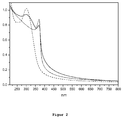
- FIG. 2 shows the extinction of ZnO hollow, CeO 2 (----) and the composite particles according to the invention from Example 2 (------) as a function of the wavelength in nm. It can be seen clearly in the composite particles according to the invention, which contain about 90% by weight of zinc oxide and about 10% by weight of cerium oxide, that the extinction, in spite of the small proportion of cerium oxide, is only slightly smaller than with pure cerium oxide.
- the extinction of zinc oxide contents in the composite particles almost matches the extinction of pure zinc oxide. So there is a synergistic effect in that the integral extinction of the composite particles is greater than would arithmetically result from the sum of the individual components (10% cerium oxide, 90% zinc oxide).
- the composite particles according to the invention are furthermore distinguished by the fact that their constituents have a high absorption in the UV-A and UV-B range and can thus be used as broadband filters.
- the photocatalytic activity of zinc oxide (comparative) and the composite particles of Example 2 is carried out by the degradation of dichloroacetic acid (DCA) using a thermostated at 20 ° C irradiation reactor with a quartz glass window of 4.9 cm 2 area and a volume of 250 ml. It is irradiated with a 450 W xenon lamp (Osram XBO) and an irradiance of 65 mW / cm 2 . The irradiation period is at least 4 hours.
- the material to be tested is present as a 0.1% dispersion in water. In order to keep the ionic strength constant throughout the experiment, an additional 10 mM KNO 3 is added to the dispersion.
- the initial concentration of dichloroacetic acid (DCA) was 1 mM.
- the pH of the continuously stirred dispersion was kept constant by addition of 0.1 M NaOH, with 0.1 M NaOH being added.
- Degradation of the DCA can be monitored directly on the basis of the consumption of caustic soda to keep the pH constant.
- the following stoichiometry applies: CHCl 2 COO - + O 2 -> H + + 2 Cl - + 2 CO 2
- the rate of degradation (nM / s) and therefrom the photon efficiency (%) related to the irradiated light intensity can be determined.
- the photocatalytic activity can be significantly reduced. It has furthermore been found that the photocatalytic activity can no longer appreciably be reduced by proportions of cerium oxide of more than 20% by weight.
- Example 2 To 50 g of water to which 0.1% by weight of polyacrylic acid in the form of the sodium salt are added, the composite particles from Example 2 are added in portions with stirring until a solids content of 10% by weight results. Then one minute each with an ultrasonic finger (diameter: 7 mm, device: ultrasonic processor UP 400s, power: 400 W, Dr. Hielscher) dispersed.
- an ultrasonic finger diameter: 7 mm, device: ultrasonic processor UP 400s, power: 400 W, Dr. Hielscher
- Example 8 The dispersion of Example 8 is added under dispersing conditions to a commercial acrylic / polyurethane binder formulation (Relius Aqua Seal Gloss), so that a coating formulation with a proportion of composite particles of 2 wt .-% results.
- a commercial acrylic / polyurethane binder formulation (Relius Aqua Seal Gloss)
- the coatings of Examples 9 and 10 in contrast to the coating without composite particles show a significantly lower yellowing, a significantly higher gloss and no embrittlement or cracks in the coating.
- the coating preparations of Examples 9 and 10, and a coating preparation without Kompositpizer on acrylic / polyurethane-based (Relius Aqua Seal Gloss) as a comparison, are applied in a layer thickness of 150 microns on glass plates.
- the hardness is determined after drying times of 1, 6, 13 and 34 days under normal laboratory conditions (20 ° C, 65% RH) (DIN ISO 1522).
- the hardness of the layers resulting from Examples 9 and 10 is up to 100% greater than that of the Comparative Example.
- the metal plates are pretreated with a white lacquer. Subsequently, the coating compositions 9 and 10 and a commercially available coating composition are treated with an organic UV filter and irradiated for 55 days according to DIN53231.
- Example 14 Preparation of a sunscreen formulation according to the invention
- phase component Wt .-% A Isolan GI 34 3.0 castor oil 1.2 Tegesoft OP 10.0 Tegesoft Liquid 5.0 Glycerin 86% 3.0 B Paracera W80 1.8 Isohexadecan 5.0 C Composite particles according to Example 2 4.0 D magnesium sulfate 0.5 VE water 66.5
- Phase A is heated to 70 ° C in a mixer. After melting on a MagnetCloudplatte at 80 ° C Phase B is added to Phase A. Phase C is stirred into the oil phase at about 300 rpm and under vacuum. Phase D is also heated to 70 ° C and added under vacuum to the mixture of A-C.
Landscapes
- Chemical & Material Sciences (AREA)
- Life Sciences & Earth Sciences (AREA)
- Health & Medical Sciences (AREA)
- Organic Chemistry (AREA)
- Inorganic Chemistry (AREA)
- Animal Behavior & Ethology (AREA)
- General Health & Medical Sciences (AREA)
- Public Health (AREA)
- Veterinary Medicine (AREA)
- Birds (AREA)
- Epidemiology (AREA)
- Mathematical Physics (AREA)
- Physics & Mathematics (AREA)
- Composite Materials (AREA)
- Dermatology (AREA)
- Geology (AREA)
- Engineering & Computer Science (AREA)
- Materials Engineering (AREA)
- Wood Science & Technology (AREA)
- Paints Or Removers (AREA)
- Catalysts (AREA)
- Cosmetics (AREA)
- Inorganic Compounds Of Heavy Metals (AREA)
- Oxygen, Ozone, And Oxides In General (AREA)
Abstract
Description
- Die Erfindung betrifft Zinkoxid-Ceroxid-Kompositpartikel, deren Herstellung und Verwendung.
- Es ist bekannt, die photokatalytische Aktivität von anorganischen UV-Filtern, wie Titandioxid (UV-B) und Zinkoxid (UV-A), durch Umhüllen mit einer photokatalytisch inaktiven Komponente zu reduzieren.
- In
US 6132743 werden Zinkoxidpartikel offenbart, deren photokatalytische Aktivität durch Beschichtung mit einer Silikonverbindung reduziert wird. -
US 6500415 offenbart Titandioxid- oder Zinkoxidpartikel, die mit Siliciumdioxid oder Aluminiumoxid umhüllt sind, um deren photokatalytische Aktivität zu minimieren. - In
WO 03/037994 WO 03/037994 - Zusammenfassend offenbart der Stand der Technik UV-B-Filter, deren photokatalytische Aktivität durch Umhüllung mit einer photokatalytisch inaktiven Komponente, reduziert werden kann. Mit der Umhüllung wird in der Regel die UV-Absorption der umhüllten Substanz verringert, im besten Fall bleibt sie gleich. Die Wellenlänge der UV-Absorption wird durch die im Stand der Technik genannten umhüllenden Stoffe nicht oder nur gering verändert. Der Hülle kommt also lediglich die Aufgabe zu, die photokatalytische Aktivität zu minimieren, ohne die Absorption des UV-Filters im UV-B-Bereich zu sehr zu beeinträchtigen.
- Die der vorliegenden Erfindung zugrunde liegende Aufgabe, besteht darin, einen UV-Filter mit nur geringer oder keiner photokatalytischen Aktivität bereitzustellen, der im UV-B- und UV-A-Bereich absorbiert.
- Gegenstand der Erfindung sind Kompositpartikel mit einer BET-Oberfläche von 5 bis 100 m2/g, enthaltend eine Zinkoxid-Matrix und Ceroxid-Domänen, wobei sich die Domänen in der und auf der Matrix befinden und der Anteil an Zinkoxid 80 bis 98 Gew.-% und der Anteil an Ceroxid 2 bis 20 Gew.-%, jeweils bezogen auf die Kompositpartikel, beträgt.
- Die erfindungsgemäßen Kompositpartikel können in aggregierter Form oder als isolierte Einzelpartikel vorliegen. Aggregierte Kompositpartikel weisen eine hohe Extinktion im UV-A und UV-B-Bereich auf und zeigen eine geringe photokatalytische Aktivität. Daher liegen die erfindungsgemäßen Kompositpartikel bevorzugt in aggregierter Form vor.
- Die erfindungsgemäßen Partikel weisen einen Zinkoxid-Anteil von 80 bis 98 Gew.-% und einen Ceroxid-Anteil von 2 bis 20 Gew.-% auf. Bei einem Anteil von weniger als 2 Gew.-% ist noch keine nennenswerte Reduktion der photokatalytischen Aktivität im Vergleich zu reinem Zinkoxidpartikeln feststellbar. Bei Anteilen von Ceroxid von mehr als 20 Gew.-% ist keine weitere Reduzierung der photokatalytischen Aktivität mehr feststellbar.
- Bevorzugterweise beträgt der Zinkoxid-Anteil 85 bis 95 Gew.-% und der Ceroxid-Anteil 5 bis 15 Gew.-%.
- In den erfindungsgemäßen Kompositpartikeln beträgt die Summe der Anteile von Zinkoxid und Ceroxid vorzugsweise mindestens 99,9 Gew.-%, bezogen auf die Kompositpartikel. Insbesondere kann es vorteilhaft sein den Anteil an metallischen Verunreinigungen zu reduzieren. So können Kompositpartikel besonders vorteilhaft sein, dessen Anteile an Blei weniger als 20 ppm, an Arsen weniger als 3 ppm, an Cadmium weniger als 15 ppm, an Quecksilber weniger als 1 ppm, an Eisen weniger als 200 ppm und an Antimon weniger als 1 ppm, jeweils bezogen auf die Kompositpartikel, betragen.
- Die BET-Oberfläche der Kompositpartikel beträgt vorzugsweise 20 bis 50 m2/g. In diesem Bereich weisen die Kompositpartikel hohe UV-A- und UV-B Absorption bei niedriger Photoaktivität auf.
- Die Matrix der Kompositpartikel weist vorzugsweise einen mittleren Durchmesser von 20 bis 100 nm auf. In diesem Bereich weisen die Kompositpartikel hohe UV-A- und UV-B Absorption bei niedriger Photoaktivität auf.
- Die Domänen der Kompositpartikel weisen vorzugsweise einen mittleren Durchmesser von 2 bis 10 nm auf. In diesem Bereich weisen die Kompositpartikel hohe UV-A- und UV-B Absorption bei niedriger Photoaktivität auf.
- Ein weiterer Gegenstand der Erfindung ist ein Verfahren, bei dem man
- eine Lösung 1, welche eine oxidierbare Zinkverbindung enthält und eine Lösung 2, welche eine oxidierbare Cerverbindung enthält, mit einem Zerstäubungsgas mittels einer Düse in einen Reaktionsraum unter Bildung von Tropfen mit einem mittleren Durchmesser von weniger als 100 µm zerstäubt, wobei
- die Lösungsmittel vorzugsweise organischer Natur sind,
- der Anteil der Lösung 1 80 bis 98 Gew.-%, berechnet als ZnO, und der Anteil der Lösung 2 2 bis 20 Gew.-%, berechnet als CeO2, beträgt,
- Lösung 1 eine Viskosität von 200 bis 5000 mPas und Lösung 2 eine Viskosität von 5 bis 150, vorzugsweise 10 bis 50 mPas, aufweist, und die Viskosität gegebenfalls durch Temperieren auf Temperaturen jeweils unterhalb der Zersetzungstemperatur der Zinkverbindung und der Cerverbindung geregelt wird,
- die zerstäubten Lösungen in eine Hochtemperaturzone eines Reaktors einbringt und dort bei Temperaturen von 800 bis 1200°C mit Sauerstoff oder einem sauerstoffhaltigen Gas zur Reaktion bringt,
- die heißen Gase und das feste Produkt kühlt und anschließend das feste Produkt von den Gasen abtrennt.
- Vorzugsweise wird die in der Hochtemperaturzone benötigte Temperatur mit einer Flamme erzeugt, die aus der Reaktion eines wasserstoffhaltigen Brenngases mit Sauerstoff und/oder Luft erhalten wird. Die Temperatur kann durch das Verhältnis von wasserstoffhaltigem Brenngas und Sauerstoff eingestellt werden. Geeignete wasserstoffhaltige Brenngase können sein: Wasserstoff, Methan, Ethan, Propan, Butan und/oder Erdgas. Bevorzugt wird Wasserstoff eingesetzt.
- Ein weiterer Gegenstand der Erfindung ist eine Dispersion, welche die erfindungsgemäßen Kompositpartikel enthält. Der Gehalt an Kompositpartikeln kann 0,1 bis 60 Gew.-%, bevorzugt von 10 bis 40 Gew.-%, bezogen auf die Gesamtmenge der Dispersion, betragen. Sie kann entweder wässerig oder organisch sein, oder aus einer Mischung bestehen, die Wasser und organische Lösungsmittel als flüssige Phase aufweist, wobei in allen Fällen nur eine einzige flüssige Phase vorliegt. Unter wässerig ist zu verstehen, dass der überwiegende Anteil der flüssigen Phase aus Wasser besteht. Unter organisch ist zu verstehen, dass die flüssige Phase überwiegend oder ausschließlich aus wenigstens einem organischen Lösungsmittel besteht. Geeignete organische Lösungsmittel können mono-, di-, tri-, poly-Alkohole, Ether, Ester, Aromaten, Alkane und Alkene sein. Insbesondere können Ethanol, Methanol, Propanol, Butanol, Aceton, Ethylacetat, Butylacetat eingesetzt werden. Das organische Lösungsmittel kann auch ein Reaktivverdünner, wie beispielsweise Hexandioldiacrylat oder Tripropylenglykoldiacrylat, sein.
- Die erfindungsgemäße Dispersion kann weiterhin Additive enthalten. Dies können ein Dispergierhilfsmittel, ein Emulgator, ein pH-Wert regulierender Stoff und/oder ein Stabilisator sein. Vorzugsweise kann dies Na-Polyphosphat, Ascorbinsäure, Zitronensäure, 6-Aminohexansäure, Stearinsäure und/oder Salze der Polyacrylsäure, insbesondere das Natrium-Salz, sein. Weiterhin können Disperbyk 163, Disperbyk 180, Disperbyk 190 und/oder Byk 9077 eingesetzt werden. Das Additiv liegt vorzugsweise in einer Menge von 0,1 bis 5 Gew.-%, besonders bevorzugt von 0,5 bis 1,5 Gew.-%, bezogen auf die flüssige Phase der Dispersion, vor.
- Ein weiterer Gegenstand der Erfindung ist eine Beschichtungszubereitung, welche die erfindungsgemäßen Kompositpartikel oder die erfindungsgemäße Dispersion und wenigstens ein Bindemittel enthält.
- Geeignete Bindemittel können Polyacrylate, Polyurethane, Polyalkyde, Polyepoxide, Polysiloxane, Polyacrylonitrile und/oder Polyester sein. Bei Dispersionen, die einen oder mehrere Reaktivverdünner als flüssige Phase aufweisen, kann als Bindemittel ein aliphatisches Urethanacrylat, beispielsweise Laromer® LR8987, BASF, besonders geeignet sein. Besonders bevorzugt kann die erfindungsgemäße Beschichtungszubereitung Polyacrylate und/oder Polyurethane enthalten.
- Der Anteil des Bindemittels in der Beschichtungszubereitung liegt bevorzugt zwischen 0,1 und 50 Gew.-%. Besonders bevorzugt ist ein Bereich zwischen 1 und 10 Gew.-%.
- Der Anteil an Kompositpartikeln in der Beschichtungszubereitung liegt bevorzugt zwischen 0,1 und 60 Gew.-%. Besonders bevorzugt ist ein Bereich zwischen 1 und 10 Gew.-%.
- Weiterhin kann die Beschichtungszubereitung während des Auftragens Verbindungen zur Veränderung der Rheologie der Beschichtungszubereitung enthalten. Besonders vorteilhaft sind Siliciumdioxid enthaltende Füllstoffe, wobei pyrogen hergestelltes Siliciumdioxid besonders bevorzugt ist. Die Menge kann bevorzugt zwischen 0,1 und 20 Gew.-%, bezogen auf die gesamte Beschichtungszubereitung, liegen.
- Weiterhin kann die Beschichtungszubereitung organische Lösungsmittel wie Ethanol, Butylacetat, Ethylacetat, Aceton, Butanol, THF, Alkane oder Mischungen aus zwei oder mehreren dieser genannten Stoffe in Mengen von 1 Gew.-% bis 98 Gew.-%, bezogen auf die gesamte Beschichtungszubereitung, enthalten.
- Die erfindungsgemäße Beschichtungszubereitung kann zur Beschichtung von Substraten aus Holz, PVC, Plastik, Stahl, Aluminium, Zink, Kupfer, MDF, Glas, Beton verwendet werden.
- Ein weiterer Gegenstand der Erfindung ist eine Sonnenschutzformulierung, welche die erfindungsgemäßen Kompositpartikel enthält.
- Der Anteil an Kompositpartikeln kann vorzugsweise 0,01 bis 25 Gew.-%, bezogen auf die Sonnenschutzformulierung, betragen. Daneben kann das erfindungsgemäße Sonnenschutzmittel in Mischungen mit bekannten anorganischen UV-absorbierenden Pigmenten und/oder chemischen UV-Filtern eingesetzt werden. Als bekannte UV-absorbierende Pigmente kommen in Betracht Titandioxide, Zinkoxide, Aluminiumoxide, Eisenoxide, Siliziumdioxid, Silicate, Ceroxide, Zirkoniumoxide, Bariumsulfat oder Gemische davon in Betracht. Als chemische UV-Filter kommen alle dem Fachmann bekannten wasser- oder öllöslichen UVA- als auch UV-B-Filter in Frage, von denen exemplarisch, jedoch nicht limitierend Sulfonsäurederivate von Benzophenonen und Benzimidazolen, Derivate des Dibenzoylmethans, Benzylidencampher und dessen Derivate, Derivate der Zimtsäure und deren Ester, oder Ester der Salizylsäure genannt seien. Die erfindungsgemäßen Sonnenschutzmittel können ferner die dem Fachmann bekannten Lösungsmittel wie Wasser, ein- oder mehrwertige Alkohole, kosmetische Öle, Emulgatoren, Stabilisatoren, Konsistenzregler wie Carbomere, Cellulosederivate, Xanthan-Gum, Wachse, Bentone, pyrogene Kieselsäuren und weitere in Kosmetika übliche Stoffe wie Vitamine, Antioxidantien, Konservierungsstoffe, Farbstoffe und Parfums enthalten.
- Typischerweise kann das erfindungsgemäße Sonnenschutzmittel als Emulsion (O/W, W/O oder multipel), wässeriges oder wässerig-alkoholisches Gel oder Ölgel vorliegen, und in Form von Lotionen, Cremes, Milchsprays, Mousse, als Stift oder in anderen gebräuchlichen Formen angeboten werden.
- Ein weiterer Gegenstand der Erfindung ist die Verwendung der erfindungsgemäßen Kompositpartikel, der erfindungsgemäßen Dispersion, der erfindungsgemäßen Beschichtungszusammensetzung oder der erfindungsgemäßen Sonnenschutzformulierung als UV-Filter.
-
- Lösung A: Octa-Soligen Zink 10 (Fa. Borchers):
- Viskosität (20°C): 325 mPas
- Zinkoctoat: 10 Gew.-%, berechnet als Zink
- Testbenzin: 42 Gew.-%
- C6-C19-Fettsäuren: 46 Gew.-%
- 2-(2-Butoxyethoxyethanol): 2 Gew.-%
- Lösung B: Borchi Kat 22, Fa. Borchers,
- Viskosität (20°C): 5017 mPas
- Zinkoctoat: 22 Gew.-%, berechnet als Zink
- C6-C19-Fettsäuren: 78 Gew.-%
- Lösung C: Octa-Soligen Cerium 12, Fa. Borchers, Viskosität (30°C): 61 mPas
- Ceriumoctoat 50 Gew.-%
- 2-Ethylhexansäure 50 Gew.-%.
- Lösung D: Cer(III)nitrat-hexahydrat gelöst in Aceton, Gehalt an Cer 8 Gew.-%, Viskosität (20°C): 52 mPas
- Beispiel 1: 1463 g/h Lösung A mit einer Temperatur von 20°C, die bei dieser Temperatur eine Viskosität von 325 mPas aufweist und 136 g/h Lösung C mit einer Temperatur von 80°C , die bei dieser Temperatur eine Viskosität von 9,2 mPas aufweist werden mittels einer Dreistoffdüse in einen Reaktionsraum unter Bildung eines Aerosoles zerstäubt. Der mittlere Tropfendurchmesser D30 beträgt weniger als 100 µm. Hier brennt eine Knallgasflamme aus Wasserstoff (3 Nm3/h) und Primärluft (5 Nm3/h), in der das Aerosol zur Reaktion gebracht wird. Zusätzlich wird Sekundärluft (25 Nm3/h) in den Reaktionsraum eingebracht. Die Temperatur 0,5 m unterhalb der Flamme beträgt 925°C. Nachfolgend wird das Reaktionsgemisch abgekühlt und das feste Produkt an einem Filter von gasförmigen Stoffen abgetrennt.
- Die Beispiele 2 bis 6 werden analog durchgeführt. Einsatzstoffe und Einsatzmengen sind in Tabelle 1 wiedergegeben. Zusammensetzung und BET-Oberfläche der erhaltenen Kompositpartikel sind ebenfalls in Tabelle 1 wiedergegeben.
- Figur 1 zeigt eine TEM-Aufnahme der Kompositpartikel aus Beispiel 2. Es sind deutlich die dunkleren Ceroxid-Domänen in einer Zinkoxidmatrix zu erkennen. Der Durchmesser der Zinkoxidmatrix beträgt im allgemeinen 20 bis 100 nm, der der Ceroxid-Domänen im Allgemeinen 5 bis 10 nm. Der Zinkoxid-Anteil liegt in hexagonaler, der Ceroxid-Anteil in kubischer Form vor.
- Figur 2 zeigt die Extinktion von ZnO (.........), CeO2 (----) und den erfindungsgemäßen Kompositpartikeln aus Beispiel 2(------) in Abhängigkeit von der Wellenlänge in nm. Deutlich ist bei dem erfindungsgemäßen Kompositpartikeln, welche ca. 90 Gew.-% Zinkoxid und ca. 10 Gew.-% Ceroxid enthalten, zu erkennen, dass die Extinktion trotz des geringen Anteiles an Ceroxid nur geringfügig kleiner ist als bei reinem Ceroxid.
Tabelle 1: Einsatzstoffe und Einsatzmengen; analytische Werte der erhaltenen Kompositpartikel Beispiel 1 2 3 4 5 6 Lösung A Konzentration g/h 1385 1463 - - 1461 1853 Temperatur °C 23 23 - - 23 23 Viskosität mPas 325 325 - - 325 325 Lösung B Konzentration g/h - - 1034 1057 - - Temperatur °C - - 23 23 - - Viskosität mPas - - 5000 5000 - - Lösung C Konzentration g/h 115 136 166 343 - - Temperatur °C 80 80 80 80 - - Viskosität mPas 9,2 9,2 9,2 9,2 - - Lösung D Konzentration g/h - - - - 139 47 Temperatur °C - - - - 40 40 Viskosität mPas - - - - 32 32 Wasserstoff Nm3/h 3 3 2 2 3 5 Verdüsungsluft Nm3/h 5 5 4 5 5 6 Primärluft Nm3/h 25 25 20 20 25 20 Sekundärluft Nm3/h 10 10 10 10 15 15 Temperatur °C 950 925 900 900 975 1050 ZnO Gew.% 91 90 92 85 93 98 CeO2 Gew.% 9 10 8 15 7 2 BET-Oberfläche m2/g 28 36 30 45 26 25 - Auf der anderen Seite reicht die Extinktion von Zinkoxidanteilen in den Kompositpartikeln nahezu an die Extinktion von reinem Zinkoxid heran. Es liegt also ein synergistischer Effekt dahingehend vor, dass die integrale Extinktion der Kompositpartikel größer ist als sich arithmetisch aus der Summe der einzelnen Komponenten (10% Ceroxid, 90 % Zinkoxid) ergeben würde. Die erfindungsgemäßen Kompositpartikel zeichnen sich weiterhin dadurch aus, dass deren Bestandteile im UV-A und UV-B-Bereich eine hohe Absorption aufweisen und somit als Breitbandfilter verwendet werden können.
- Die photokatalytische Aktivität von Zinkoxid (Vergleich) und den Kompositpartikeln aus Beispiel 2 wird anhand des Abbaus von Dichloressigsäure (DCA) unter Verwendung eines auf 20°C thermostatisierten Bestrahlungsreaktors mit einem Quarzglasfenster von 4,9 cm2 Fläche und einem Volumen von 250 ml durchgeführt. Bestrahlt wird mit einer 450 W Xenon-Lampe (Osram XBO) und einer Bestrahlungsstärke von 65 mW/cm2. Die Bestrahlungsdauer beträgt mindestens 4 Stunden. Das zu testende Material liegt als 0,1 %-ige Dispersion in Wasser vor. Um die Ionenstärke während des gesamten Versuches konstant zu halten, werden der Dispersion zusätzlich 10 mM KNO3 zugesetzt. Die Anfangskonzentration der Dichloressigsäure (DCA) betrug 1 mM. Der pH-Wert der kontinuierlich gerührten Dispersion wurde durch Zugabe von 0,1 M NaOH konstant gehalten, wobei 0,1 M NaOH zutitriert wurde.
- Der Abbau der DCA kann unmittelbar anhand des Verbrauchs an Natronlauge zur Konstanthaltung des pH-Wertes verfolgt werden. Es gilt folgende Stöchiometrie:
CHCl2COO- + O2 -> H+ + 2 Cl- + 2 CO2
- Aus den Anfangssteigungen der erhaltenen Protonenbildungskurven kann die Abbaurate (nM/s) und daraus die auf die eingestrahlte Lichtintensität bezogene Photoneneffizienz (%) bestimmt werden.
- Reines Zinkoxid ergibt hiermit eine DCA-Abbaurate von 21,5 nM/s und eine Photoneneffizienz von 0,58%. Die erfindungsgemäßen Kompositpartikel aus Beispiel 2 hingegen weisen eine DCA-Abbaurate von lediglich 4,23 nM/s und eine Photoneneffizienz von 0,11% auf.
- Selbst bei einem Anteil von Ceroxid von nur 10 Gew.-% und der Tatsache, dass der Großteil der Oberfläche der eingesetzten Kompositpartikel Zinkoxid ist, kann die photokatalytische Aktivität deutlich reduziert werden. Es wurde weiterhin gefunden, dass die photokatalytische Aktivität durch Anteile an Ceroxid von mehr als 20 Gew.-% nicht mehr nennenswert reduziert werden kann.
- Zu 50 g Wasser, dem 0,1 Gew.-% Polyacrylsäure in Form des Natriumsalzes zugesetzt sind, werden portionsweise unter Umrühren die Kompositpartikel aus Beispiel 2 gegeben, bis ein Festoffgehalt von 10 Gew.-% resultiert. Anschließend wird jeweils eine Minute mit einem Ultraschallfinger (Durchmesser: 7 mm, Gerät: Ultraschallprozessor UP 400s, Leistung: 400 W, Dr. Hielscher) dispergiert.
- Die Dispersion aus Beispiel 8 wird unter dispergierenden Bedingungen zu einer handelsüblichen Acryl-/Polyurethan-Bindemittelzubereitung gegeben (Relius Aqua Siegel Gloss), so dass eine Beschichtungszubereitung mit einem Anteil an Kompositpartikeln von 2 Gew.-% resultiert.
- Durchführung wie bei Beispiel 9, jedoch unter Verwendung einer handelsüblichen Acryl-Bindemittelzubereitung. (Macrynal SM 510 (Cytec), Desmodur N75 (Bayer).
- Mit den Beschichtungszubereitungen aus Beispiel 9 und 10 werden je 3 Kiefernholz-Proben, die mit einem Primer (Relius Aqua Holz Grund) vorbehandelt wurden, beschichtet (QUV-B 313; DIN EN 927-6, ISO 11507, ASTM D 4857). Als Vergleich dienen Kiefernholz-Proben, die mit einer Beschichtungszubereitung, die frei von Kompositpartikeln ist, auf Acryl-/Polyurethan-Basis (Relius Aqua Siegel Gloss) beschichtet.
- Nach einer Testzeit von 1000 Stunden zeigen die Beschichtungen aus den Beispielen 9 und 10 im Gegensatz zur Beschichtung ohne Kompositpartikel eine deutlich geringere Vergilbung, einen deutlichen höheren Glanz und keine Versprödung oder Risse in der Beschichtung.
- Die Beschichtungszubereitungen aus den Beispielen 9 und 10, sowie eine Beschichtungszubereitung ohne kompositpartikel auf Acryl-/Polyurethan-Basis (Relius Aqua Siegel Gloss) als Vergleich, werden in einer Schichtdicke von 150 µm auf Glasplatten aufgetragen. Die Härte wird nach Trocknungszeiten von 1, 6, 13 und 34 Tagen bei normalen Laborbedingungen (20°C, 65% RH) (DIN ISO 1522) bestimmt. Die Härte der Schichten hervorgegangen aus den Beispielen 9 und 10 ist bis zu 100% größer als die des Vergleichsbeispieles.
- Die Metallplatten werden mit einem weißen Lack vorbehandelt. Anschließend werden die Beschichtungszusammensetzungen 9 und 10 und eine handelsübliche Beschichtungszusammensetzung mit einem organischen UV-Filter behandelt und 55 Tage gemäß DIN53231 bestrahlt.
- Der Weißgrad nach Berger der Probe mit organischem UV-Filter ist nach dieser deutlich geringer als die Proben aus den Zusammensetzungen der Beispiele 9 und 10.
- Mit nachfolgender Rezeptur wurde ein Sonnenschutzmittel mit 4 Gew.-% der erfindungsgemäßen Partikel nach Beispiel 2 hergestellt.
Phase Bestandteil Gew.-% A Isolan GI 34 3,0 Rizinusöl 1,2 Tegesoft OP 10,0 Tegesoft Liquid 5,0 Glycerin 86% 3,0 B Paracera W80 1,8 Isohexadecan 5,0 C Kompositpartikel nach Beispiel 2 4,0 D Magnesiumsulfat 0,5 VE-Wasser 66,5 - Phase A wird in einem Mischer auf 70°C erwärmt. Nach dem Aufschmelzen auf einer Magnetheizplatte bei 80°C wird Phase B zu Phase A gegeben. Die Phase C wird mit ca. 300 U/min und unter Vakuum in die Ölphase eingerührt. Phase D wird ebenfalls auf 70°C erwärmt und unter Vakuum der Mischung aus A-C zugefügt.
Claims (13)
- Kompositpartikel mit einer BET-Oberfläche von 5 bis 100 m2/g enthaltend eine Zinkoxid-Matrix und Ceroxid-Domänen, wobei sich die Domänen in der und auf der Matrix befinden und der Anteil an Zinkoxid 80 bis 98 Gew.-% und der Anteil an Ceroxid 2 bis 20 Gew.-%, jeweils bezogen auf die Kompositpartikel, beträgt.
- Kompositpartikel nach Anspruch 1, dadurch gekennzeichnet, dass sie in aggregierter Form vorliegen.
- Kompositpartikel nach den Ansprüchen 1 oder 2, dadurch gekennzeichnet, dass der Zinkoxid-Anteil 85 bis 95 Gew.-% und der Ceroxid-Anteil 5 bis 15 Gew.-%, jeweils bezogen auf die Kompositpartikel, beträgt.
- Kompositpartikel nach den Ansprüchen 1 bis 3, dadurch gekennzeichnet, dass der Anteil von Zinkoxid und Ceroxid mindestens 99,9 Gew.-%, bezogen auf die Kompositpartikel, beträgt.
- Kompositpartikel nach den Ansprüchen 1 bis 4, dadurch gekennzeichnet, dass die BET-Oberfläche 20 bis 50 m2/g beträgt.
- Kompositpartikel nach den Ansprüchen 1 bis 5, dadurch gekennzeichnet, dass die Matrix einen mittleren Durchmesser von 20 bis 100 nm aufweist.
- Kompositpartikel nach den Ansprüchen 1 bis 6, dadurch gekennzeichnet, dass die Domänen einen mittleren Durchmesser von 2 bis 10 nm aufweisen.
- Verfahren zur Herstellung der Kompositpartikel gemäß den Ansprüchen 1 bis 7, dadurch gekennzeichnet, dass- man eine Lösung 1, welche eine oxidierbare Zinkverbindung enthält und eine Lösung 2, welche eine oxidierbare Cerverbindung enthält, mit einem Zerstäubungsgas mittels einer Düse in einen Reaktionsraum unter Bildung von Tropfen mit einem mittleren Durchmesser von weniger als 100 µm zerstäubt, wobei- der Anteil der Lösung 1 80 bis 98 Gew.-%, berechnet als ZnO, und der Anteil der Lösung 2 2 bis 20 Gew.-%, berechnet als CeO2, beträgt,- Lösung 1 eine Viskosität von 200 bis 5000 mPas und Lösung 2 eine Viskosität von 5 bis 150 mPas, aufweist, und die Viskosität gegebenfalls durch Temperieren auf Temperaturen jeweils unterhalb der Zersetzungstemperatur der Zinkverbindung und der Cerverbindung geregelt wird,- die zerstäubten Lösungen in eine Hochtemperaturzone eines Reaktors einbringt und dort bei Temperaturen von 800 bis 1200°C mit Sauerstoff oder einem sauerstoffhaltigen Gas zur Reaktion bringt,- die heißen Gase und das feste Produkt kühlt und anschließend das feste Produkt von den Gasen abtrennt.
- Verfahren nach Anspruch 9, dadurch gekennzeichnet, dass die Reaktionstemperatur durch eine Flamme erzeugt wird, die aus der Reaktion eines wasserstoffhaltigen Brenngases mit Sauerstoff und/oder Luft resultiert.
- Dispersion enthaltend die Kompositpartikel gemäß der Ansprüche 1 bis 7.
- Beschichtungszusammensetzung enthaltend die Kompositpartikel gemäß der Ansprüche 1 bis 7 oder die Dispersion gemäß des Anspruches 11 und wenigstens ein Bindemittel.
- Sonnenschutzformulierung enthaltend die Kompositpartikel gemäß der Ansprüche 1 bis 7 oder die Dispersion gemäß des Anspruches 11.
- Verwendung der aggregierten Kompositpartikel gemäß der Ansprüche 1 bis 7, der Dispersion gemäß des Anspruches 11, der Beschichtungszusammensetzung gemäß des Anspruches 12 oder der Sonnenschutzformulierung gemäß Anspruch 13 als UV-Filter.
Applications Claiming Priority (1)
| Application Number | Priority Date | Filing Date | Title |
|---|---|---|---|
| DE102005059405A DE102005059405A1 (de) | 2005-12-13 | 2005-12-13 | Zinkoxid-Ceroxid-Kompositpartikel |
Publications (2)
| Publication Number | Publication Date |
|---|---|
| EP1798263A2 true EP1798263A2 (de) | 2007-06-20 |
| EP1798263A3 EP1798263A3 (de) | 2010-07-28 |
Family
ID=37907503
Family Applications (1)
| Application Number | Title | Priority Date | Filing Date |
|---|---|---|---|
| EP06123304A Withdrawn EP1798263A3 (de) | 2005-12-13 | 2006-11-01 | Zinkoxid-Ceroxid-Kompositpartikel |
Country Status (6)
| Country | Link |
|---|---|
| US (1) | US20070149395A1 (de) |
| EP (1) | EP1798263A3 (de) |
| JP (1) | JP2007161578A (de) |
| KR (1) | KR100797745B1 (de) |
| CN (1) | CN100567409C (de) |
| DE (1) | DE102005059405A1 (de) |
Cited By (1)
| Publication number | Priority date | Publication date | Assignee | Title |
|---|---|---|---|---|
| EP3088364A4 (de) * | 2013-12-24 | 2017-08-09 | Sakai Chemical Industry Co., Ltd. | Ceroxidbeschichtete zinkoxidpartikel, verfahren zur herstellung davon, ultraviolettstrahlungsabschirmungsmittel und kosmetikum |
Families Citing this family (22)
| Publication number | Priority date | Publication date | Assignee | Title |
|---|---|---|---|---|
| KR100628841B1 (ko) * | 2001-11-13 | 2006-09-29 | 데구사 아게 | 분해가능한 경화성 결합조립체 |
| DE10353995A1 (de) * | 2003-11-19 | 2005-06-09 | Degussa Ag | Nanoskaliges, kristallines Siliciumpulver |
| DE10353996A1 (de) * | 2003-11-19 | 2005-06-09 | Degussa Ag | Nanoskaliges, kristallines Siliciumpulver |
| DE102004012682A1 (de) * | 2004-03-16 | 2005-10-06 | Degussa Ag | Verfahren zur Herstellung von dreidimensionalen Objekten mittels Lasertechnik und Auftragen eines Absorbers per Inkjet-Verfahren |
| DE102004041747A1 (de) * | 2004-08-28 | 2006-03-02 | Degussa Ag | Indium-Zinn-Mischoxidpulver |
| DE102004041746A1 (de) * | 2004-08-28 | 2006-03-02 | Degussa Ag | Kautschukmischung, enthaltend nanoskalige, magnetische Füllstoffe |
| DE102005049136A1 (de) * | 2004-12-01 | 2006-06-08 | Degussa Ag | Zubereitung, enthaltend ein polymerisierbares Monomer und/oder ein Polymer und darin dispergiert ein superparamagnetisches Pulver |
| BRPI0609111A2 (pt) * | 2005-04-18 | 2010-02-23 | Roehm Gmbh | processo para a preparação de um material de moldagem ou um molde, material de moldagem ou molde e seu uso |
| DE102005040157A1 (de) * | 2005-08-25 | 2007-03-01 | Degussa Ag | Paste aus nanoskaligem Pulver und Dispergiermittel |
| DE102005049718A1 (de) * | 2005-10-14 | 2007-04-19 | Degussa Gmbh | Durch Schweißen im elektromagnetischen Wechselfeld erhältliche Kunststoffverbundformkörper |
| DE102005056286A1 (de) * | 2005-11-24 | 2007-05-31 | Degussa Gmbh | Schweißverfahren mittels elektromagnetischer Strahlung |
| DE102005060121A1 (de) * | 2005-12-16 | 2007-06-21 | Degussa Gmbh | Verfahren zur Herstellung von Zinkoxidpulver |
| DE102006007564A1 (de) * | 2006-02-16 | 2007-08-30 | Röhm Gmbh | Nanoskalige superparamagnetische Poly(meth)acrylatpolymere |
| KR102206346B1 (ko) | 2014-02-07 | 2021-01-22 | 사까이가가꾸고오교가부시끼가이샤 | 육각 판상 산화아연 입자, 그 제조 방법, 화장료, 필러, 수지 조성물, 적외선 반사재 및 도료 조성물 |
| CA2981073A1 (en) * | 2015-03-30 | 2016-10-06 | The Shepherd Color Company | Uv-absorbing nanocrystal containing composite |
| KR101594734B1 (ko) * | 2015-08-10 | 2016-02-16 | 고려대학교 산학협력단 | 산화인듐 중공구조 및 산화세륨 나노입자를 포함하는 가스 검출용 복합체, 그 제조방법 및 이를 포함하는 가스센서 |
| US12605314B2 (en) | 2018-03-23 | 2026-04-21 | LCS Advanced Solutions, LLC | Broad-spectrum, mineral, photoprotective compositions |
| CN111672524B (zh) * | 2019-06-13 | 2023-03-10 | 河南理工大学 | 一种二氧化铈-氧化锌-卤氧化铋-铁酸钴磁性可见光催化剂制备方法 |
| US12083199B2 (en) | 2019-09-10 | 2024-09-10 | LCS Advanced Solutions, LLC | Mineral, anhydrous, broad-spectrum sunscreen |
| FR3105789B1 (fr) * | 2019-12-27 | 2024-01-12 | Oreal | Particules d’oxyde de metal enrobees d’oxyde de terre rare et son procede de preparation par pyrolyse par projection de flamme |
| CN111883788A (zh) * | 2020-06-24 | 2020-11-03 | 华南理工大学 | 一种氧化铈基中低温固体氧化物燃料电池关键材料的制备方法 |
| EP4353328A3 (de) | 2022-10-15 | 2024-05-22 | LCS Advanced Solutions, LLC | Strukturell diverse, stabile und strahlenschützende partikelmatrix-sonnenschutz- und kosmetische zusammensetzungen und zugehörige verfahren |
Family Cites Families (22)
| Publication number | Priority date | Publication date | Assignee | Title |
|---|---|---|---|---|
| JPS62275025A (ja) * | 1986-02-12 | 1987-11-30 | Sumitomo Chem Co Ltd | 複合酸化物の製造方法 |
| EP0721484B1 (de) * | 1993-10-01 | 1998-06-17 | Kao Corporation | Gegen ultraviolettstrahlung schützende feine kompositteilchen, verfahren zur herstellung derselben und kosmetika |
| WO1998017730A1 (en) * | 1996-10-23 | 1998-04-30 | Kanebo, Ltd. | Zinc oxide powder with suppressed activity and cosmetic preparation |
| US6187824B1 (en) | 1999-08-25 | 2001-02-13 | Nyacol Nano Technologies, Inc. | Zinc oxide sol and method of making |
| US6500415B2 (en) * | 2000-06-05 | 2002-12-31 | Showa Denko K.K. | Cosmetic composition |
| DE10140089A1 (de) * | 2001-08-16 | 2003-02-27 | Degussa | Superparamagnetische oxidische Partikel, Verfahren zu deren Herstellung und ihre Verwendung |
| DE10153547A1 (de) * | 2001-10-30 | 2003-05-22 | Degussa | Dispersion, enthaltend pyrogen hergestellte Abrasivpartikel mit superparamagnetischen Domänen |
| KR100628841B1 (ko) * | 2001-11-13 | 2006-09-29 | 데구사 아게 | 분해가능한 경화성 결합조립체 |
| DE10235758A1 (de) * | 2002-08-05 | 2004-02-26 | Degussa Ag | Dotiertes Zinkoxidpulver, Verfahren zu seiner Herstellung und Verwendung |
| JP2004217499A (ja) * | 2002-11-21 | 2004-08-05 | Idemitsu Kosan Co Ltd | 複合酸化物、n型熱電変換材料及びそれを用いた熱電変換素子 |
| DE10317067A1 (de) * | 2003-04-14 | 2004-11-11 | Degussa Ag | Domänen in einer Metalloxid-Matrix |
| KR20040100136A (ko) * | 2003-05-21 | 2004-12-02 | 한화석유화학 주식회사 | 금속 산화물의 도핑 방법 |
| DE10343728A1 (de) * | 2003-09-22 | 2005-04-21 | Degussa | Zinkoxidpulver |
| DE10353995A1 (de) * | 2003-11-19 | 2005-06-09 | Degussa Ag | Nanoskaliges, kristallines Siliciumpulver |
| DE10353996A1 (de) * | 2003-11-19 | 2005-06-09 | Degussa Ag | Nanoskaliges, kristallines Siliciumpulver |
| EP1722984B1 (de) * | 2004-03-04 | 2008-06-04 | Evonik Degussa GmbH | Durch farbmittel transparent, transluzent oder gedeckt eingefärbte laserschweissbare kunststoffmaterialien |
| DE102004010504B4 (de) * | 2004-03-04 | 2006-05-04 | Degussa Ag | Hochtransparente lasermarkierbare und laserschweißbare Kunststoffmaterialien, deren Verwendung und Herstellung sowie Verwendung von Metallmischoxiden und Verfahren zur Kennzeichnung von Produktionsgütern |
| DE102004041746A1 (de) * | 2004-08-28 | 2006-03-02 | Degussa Ag | Kautschukmischung, enthaltend nanoskalige, magnetische Füllstoffe |
| US7704586B2 (en) * | 2005-03-09 | 2010-04-27 | Degussa Ag | Plastic molded bodies having two-dimensional and three-dimensional image structures produced through laser subsurface engraving |
| BRPI0609111A2 (pt) * | 2005-04-18 | 2010-02-23 | Roehm Gmbh | processo para a preparação de um material de moldagem ou um molde, material de moldagem ou molde e seu uso |
| US7815423B2 (en) * | 2005-07-29 | 2010-10-19 | Emerson Climate Technologies, Inc. | Compressor with fluid injection system |
| DE102005040157A1 (de) * | 2005-08-25 | 2007-03-01 | Degussa Ag | Paste aus nanoskaligem Pulver und Dispergiermittel |
-
2005
- 2005-12-13 DE DE102005059405A patent/DE102005059405A1/de not_active Withdrawn
-
2006
- 2006-11-01 EP EP06123304A patent/EP1798263A3/de not_active Withdrawn
- 2006-12-12 KR KR1020060126061A patent/KR100797745B1/ko not_active Expired - Fee Related
- 2006-12-13 US US11/610,031 patent/US20070149395A1/en not_active Abandoned
- 2006-12-13 JP JP2006336394A patent/JP2007161578A/ja active Pending
- 2006-12-13 CN CNB2006101669437A patent/CN100567409C/zh not_active Expired - Fee Related
Non-Patent Citations (1)
| Title |
|---|
| None |
Cited By (1)
| Publication number | Priority date | Publication date | Assignee | Title |
|---|---|---|---|---|
| EP3088364A4 (de) * | 2013-12-24 | 2017-08-09 | Sakai Chemical Industry Co., Ltd. | Ceroxidbeschichtete zinkoxidpartikel, verfahren zur herstellung davon, ultraviolettstrahlungsabschirmungsmittel und kosmetikum |
Also Published As
| Publication number | Publication date |
|---|---|
| CN1982377A (zh) | 2007-06-20 |
| JP2007161578A (ja) | 2007-06-28 |
| KR20070062921A (ko) | 2007-06-18 |
| EP1798263A3 (de) | 2010-07-28 |
| KR100797745B1 (ko) | 2008-01-24 |
| DE102005059405A1 (de) | 2007-06-14 |
| CN100567409C (zh) | 2009-12-09 |
| US20070149395A1 (en) | 2007-06-28 |
Similar Documents
| Publication | Publication Date | Title |
|---|---|---|
| EP1798263A2 (de) | Zinkoxid-Ceroxid-Kompositpartikel | |
| EP1078957B1 (de) | Oberflächenmodifiziertes Titandioxid | |
| DE69738654T2 (de) | Zinkoxidpulver mit unterdückter wirkung und kosmetikzusammensetzung | |
| EP0609533B1 (de) | Eisenoxidhaltiges Titandioxidpulver | |
| DE69723347T2 (de) | Beschichtete SiO2-Teilchen | |
| DE3817909B4 (de) | Teilchenförmiges Material und Verfahren zur Herstellung | |
| DE69400456T2 (de) | Zusammensetzungen auf Basis von Sulfiden von seltenen Erden, Syntheseverfahren und Anwendungen | |
| DE60029870T2 (de) | Ceriumoxiddotiertes Metalloxid, Verfahren zu dessen Herstellung und diese Oxide enthaltende Kunststoff- und kosmetische Zusammensetzungen | |
| EP0417567B1 (de) | Verfahren zur Herstellung von plättchenförmigen Hematitpigmenten | |
| DE69333612T2 (de) | Ultrafeine eisenhaltige Teilchen von Titandioxid des Rutiltyps und Verfahren zur Herstellung derselben | |
| EP0603627A1 (de) | Feinteiliges, hochreines, neutrales Zinkoxidpulver, Verfahren zu dessen Herstellung und seine Verwendung | |
| DE10259860A1 (de) | Pulvergemisch bestehend aus Titandioxid, Zinkoxid und Zink-Titan-Mischoxid | |
| EP1706449A1 (de) | Dispersion und beschichtungszubereitung enthaltend nanoskaliges zinkoxid | |
| DE102004004147A1 (de) | Oberflächenmodifizierte, mit Siliziumdioxid umhüllte Metalloid/Metalloxide | |
| EP1321432A2 (de) | Flammenhydrolytisch hergestelltes Silicium-Titan-Mischoxidpulver mit an der Oberfläche angereichertem Siliciumdioxid, dessen Herstellung und Verwendung | |
| EP1284277A1 (de) | Mit Siliziumdioxid umhüllte Metalloxidpartikel | |
| EP0722992A1 (de) | Oberflächenmodifizierte pyrogen hergestellte Mischoxide, Verfahren zu ihrer Herstellung und Verwendung | |
| DE102006038518A1 (de) | Umhüllte Zinkoxidpartikel | |
| DE102004046093A1 (de) | Oberflächenmodifizierte Zink-Titan-Mischoxide | |
| DE102005046263A1 (de) | Verfahren zur Herstellung oberflächenmodifizierter nanopartikulärer Metalloxide, Metallhydroxide, und/oder Metalloxidhydroxide | |
| EP3738577A1 (de) | Oberflächenmodifizierte effektpigmente | |
| EP0293746B1 (de) | Plättchenförmiges Zweiphasenpigment | |
| EP1373412B1 (de) | Titandioxid-pigmentzusammensetzung | |
| EP2875077B1 (de) | Verfahren zur oberflächenbehandlung von anorganischen partikeln | |
| EP1820778A2 (de) | Verfahren zur Herstellung von Zinkoxidpulver |
Legal Events
| Date | Code | Title | Description |
|---|---|---|---|
| PUAI | Public reference made under article 153(3) epc to a published international application that has entered the european phase |
Free format text: ORIGINAL CODE: 0009012 |
|
| 17P | Request for examination filed |
Effective date: 20061101 |
|
| AK | Designated contracting states |
Kind code of ref document: A2 Designated state(s): AT BE BG CH CY CZ DE DK EE ES FI FR GB GR HU IE IS IT LI LT LU LV MC NL PL PT RO SE SI SK TR |
|
| AX | Request for extension of the european patent |
Extension state: AL BA HR MK YU |
|
| RAP1 | Party data changed (applicant data changed or rights of an application transferred) |
Owner name: EVONIK DEGUSSA GMBH |
|
| RAP1 | Party data changed (applicant data changed or rights of an application transferred) |
Owner name: EVONIK DEGUSSA GMBH |
|
| PUAL | Search report despatched |
Free format text: ORIGINAL CODE: 0009013 |
|
| AK | Designated contracting states |
Kind code of ref document: A3 Designated state(s): AT BE BG CH CY CZ DE DK EE ES FI FR GB GR HU IE IS IT LI LT LU LV MC NL PL PT RO SE SI SK TR |
|
| AX | Request for extension of the european patent |
Extension state: AL BA HR MK RS |
|
| RIC1 | Information provided on ipc code assigned before grant |
Ipc: C01F 17/00 20060101ALI20100624BHEP Ipc: C01G 9/02 20060101ALI20100624BHEP Ipc: C09C 1/04 20060101ALI20100624BHEP Ipc: C09C 1/00 20060101AFI20070416BHEP |
|
| AKX | Designation fees paid |
Designated state(s): AT BE BG CH CY CZ DE DK EE ES FI FR GB GR HU IE IS IT LI LT LU LV MC NL PL PT RO SE SI SK TR |
|
| RIC1 | Information provided on ipc code assigned before grant |
Ipc: C09C 1/04 20060101ALI20120913BHEP Ipc: C01F 17/00 20060101ALI20120913BHEP Ipc: C01G 9/02 20060101ALI20120913BHEP Ipc: C09C 1/00 20060101AFI20120913BHEP |
|
| GRAP | Despatch of communication of intention to grant a patent |
Free format text: ORIGINAL CODE: EPIDOSNIGR1 |
|
| STAA | Information on the status of an ep patent application or granted ep patent |
Free format text: STATUS: THE APPLICATION IS DEEMED TO BE WITHDRAWN |
|
| 18D | Application deemed to be withdrawn |
Effective date: 20130306 |