EP1800892A2 - Protection contre la contrefaçon avec les marques de sécurité miniatures - Google Patents
Protection contre la contrefaçon avec les marques de sécurité miniatures Download PDFInfo
- Publication number
- EP1800892A2 EP1800892A2 EP06126491A EP06126491A EP1800892A2 EP 1800892 A2 EP1800892 A2 EP 1800892A2 EP 06126491 A EP06126491 A EP 06126491A EP 06126491 A EP06126491 A EP 06126491A EP 1800892 A2 EP1800892 A2 EP 1800892A2
- Authority
- EP
- European Patent Office
- Prior art keywords
- msm
- data
- security mark
- mark
- marks
- Prior art date
- Legal status (The legal status is an assumption and is not a legal conclusion. Google has not performed a legal analysis and makes no representation as to the accuracy of the status listed.)
- Withdrawn
Links
Images



Classifications
-
- B—PERFORMING OPERATIONS; TRANSPORTING
- B42—BOOKBINDING; ALBUMS; FILES; SPECIAL PRINTED MATTER
- B42D—BOOKS; BOOK COVERS; LOOSE LEAVES; PRINTED MATTER CHARACTERISED BY IDENTIFICATION OR SECURITY FEATURES; PRINTED MATTER OF SPECIAL FORMAT OR STYLE NOT OTHERWISE PROVIDED FOR; DEVICES FOR USE THEREWITH AND NOT OTHERWISE PROVIDED FOR; MOVABLE-STRIP WRITING OR READING APPARATUS
- B42D15/00—Printed matter of special format or style not otherwise provided for
-
- H—ELECTRICITY
- H04—ELECTRIC COMMUNICATION TECHNIQUE
- H04N—PICTORIAL COMMUNICATION, e.g. TELEVISION
- H04N1/00—Scanning, transmission or reproduction of documents or the like, e.g. facsimile transmission; Details thereof
- H04N1/32—Circuits or arrangements for control or supervision between transmitter and receiver or between image input and image output device, e.g. between a still-image camera and its memory or between a still-image camera and a printer device
- H04N1/32101—Display, printing, storage or transmission of additional information, e.g. ID code, date and time or title
- H04N1/32144—Display, printing, storage or transmission of additional information, e.g. ID code, date and time or title embedded in the image data, i.e. enclosed or integrated in the image, e.g. watermark, super-imposed logo or stamp
-
- B—PERFORMING OPERATIONS; TRANSPORTING
- B41—PRINTING; LINING MACHINES; TYPEWRITERS; STAMPS
- B41M—PRINTING, DUPLICATING, MARKING, OR COPYING PROCESSES; COLOUR PRINTING
- B41M3/00—Printing processes to produce particular kinds of printed work, e.g. patterns
- B41M3/14—Security printing
-
- H—ELECTRICITY
- H04—ELECTRIC COMMUNICATION TECHNIQUE
- H04N—PICTORIAL COMMUNICATION, e.g. TELEVISION
- H04N2201/00—Indexing scheme relating to scanning, transmission or reproduction of documents or the like, and to details thereof
- H04N2201/32—Circuits or arrangements for control or supervision between transmitter and receiver or between image input and image output device, e.g. between a still-image camera and its memory or between a still-image camera and a printer device
- H04N2201/3201—Display, printing, storage or transmission of additional information, e.g. ID code, date and time or title
- H04N2201/3271—Printing or stamping
Definitions
- the following relates to counterfeit prevention. It finds particular application in utilizing miniature security marks to distinguish authentic documents and/or images from counterfeit documents and/or images.
- Digital watermarking is a technique which allows a user to add information (e.g., copyright notices, security codes, identification data, etc.) to digital image signals and documents.
- information e.g., copyright notices, security codes, identification data, etc.
- Such data can be in a group of bits describing information pertaining to the signal or to the author of the signal (e.g., name, place, etc.).
- the simplest method involves flipping the lowest-order bit of chosen pixels in a gray scale or color image. This will work well only if the image will not be subject to any human or noisy modification.
- a more robust watermark can be embedded in an image in the same way that a watermark is added to paper. Such techniques may superimpose a watermark symbol over an area of the picture and then add some fixed intensity value for the watermark to the varied pixel values of the image. The resulting watermark may be visible or invisible depending upon the value (large or small, respectively) of the watermark intensity.
- Spatial watermarking can also be applied using color separation. In this way, the watermark appears in only one of the color bands. This renders the watermark visibly subtle such that it is difficult to detect under regular viewing. However, the watermark appears immediately when the colors are separated for printing or xerography. This renders the document useless to the printer unless the watermark can be removed from the color band. This approach is used commercially for journalists to inspect digital pictures from a photo-stockhouse before buying un-watermarked versions.
- a system applies a security mark to a recipient.
- a data reception component receives information from one or more sources.
- a security mark generation component generates at least one miniature security mark (MSM) configuration based at least in part upon the information from the data reception component.
- An application component applies the at least one MSM configuration to one or more recipients.
- the recipient is one of paper, velum, acetate, and glass.
- the recipient is one of a document, a title, a license, a deed, a visa, a passport, a bill of currency, and a check.
- the at least one MSM configuration utilizes a plurality of data marks which are identical to each other.
- the at least one MSM configuration is comprised of a plurality of geometric shapes with a diameter between about 1 micrometer and about several hundred micrometers.
- a system interprets data extracted from a security mark.
- a detection component detects one or more security marks applied to at least one recipient, wherein the security mark is a MSM configuration that includes at least one data mark and at least two anchor marks.
- An extraction component extracts information from the one or more MSM configurations detected by the detection component.
- An interpretation component determines the meaning of the information extracted from the one or more MSM configurations by the extraction component.
- the system further includes:
- a method is employed to interpret information represented by a security mark.
- a MSM security mark is generated that includes at least one data mark and at least two anchor marks that are from about 1 micron to several hundred microns in diameter, the at least one data mark is different from the at least two anchor marks.
- the MSM security mark is applied to at least one recipient and the at least one recipient that contains the MSM security mark is analyzed.
- the location of the MSM security mark applied to the at least one recipient is detected. Information from the detected MSM security mark is extracted and the information extracted from the MSM security mark is interpreted.
- FIGURE 1 illustrates a system that applies a security mark that is based at least in part on information received from one or more sources;
- FIGURE 2 illustrates a system that detects, extracts and interprets data contained within a security mark
- FIGURE 3 illustrates an exemplary embodiment of a security mark that is a MSM configuration on a recipient
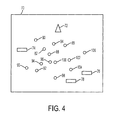
- FIGURE 4 illustrates an exemplary MSM configuration
- FIGURE 5 illustrates another exemplary MSM configuration
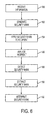
- FIGURE 6 illustrates a methodology to interpret data generated via a security mark.
- a security mark as used herein can be any mark (e.g., depression, impression, raised, overlay, etc.) that is applied to a recipient such as an image, a graphic, a picture, a document, a body of text, etc.
- the security mark can contain information that can be detected, extracted and/or interpreted. Such information can be employed to prevent counterfeiting by verifying that the information contained within the security mark is accurate thereby verifying the authenticity of the recipient upon which the security mark is applied.
- This system includes a data reception component 10, a security mark generation component 12, a memory component 14, and an application component 16.
- the data reception component 10 receives information from one or more sources (not shown).
- sources can be one or more databases, processing components, etc. that contain information related to one or more products (e.g., currency, passports, visas, banking documents, identification documents, etc.).
- verification of authenticity of the one or more products is of interest to a user.
- one or more security marks can be placed on the product. Such security marks can be detected and extracted at a later time for verification purposes.
- Data can be representative of substantially any desired quantity such as origin of manufacture, date, time, serial number or simply an arbitrary alphanumeric string.
- the data is proprietary such that only a limited number of users can interpret the data.
- the data can contain an alphanumeric string of characters that represent particular data. For instance, a letter "D" can be representative of the location of manufacture for a particular currency.
- a four digit numeric code can represent a sequence number (e.g., year of issuance, location of issuance, etc.) for a passport. Such information can be utilized to verify the authenticity of the recipient upon which the security mark is applied.
- the security mark generation component 12 can convert received data into at least one miniature security mark (MSM) which is placed in a particular configuration.
- MSMs are small in size (e.g., a size between about 1 micrometer and several hundred micrometers) such that they are virtually invisible to the naked eye.
- Information from the data reception component 10 can be employed to generate one or more security marks.
- the marks that comprise a MSM configuration can be composed via one or more algorithms that convert the received data to a configuration of marks that are representative of the received data.
- the algorithm can utilize one or more equations, methodologies, work flows, etc. to determine the locations, sizes and/or shapes of the one or more marks. Such a determination can be made based at least in part upon one or more aspects of one or more disparate marks.
- a security mark has a MSM configuration that includes at least one data mark and at least two anchor marks.
- the MSMs may have different colors and shapes.
- the anchor marks within a MSM configuration have at least one attribute (e.g., size, shape, color, etc.) that is different than the at least one data marks. In this manner, no anchor mark can have all the same attributes of any data mark.
- the location, size and/or shape of the one or more data marks can determine the information contained therein.
- a MSM configuration can contain nineteen data marks and two anchor marks.
- the size, shape and color of both the anchor marks and data marks can be known such that the anchor marks can be distinguished from each other.
- the location of the anchor marks in each MSM configuration can be known to each other and known relative to the one or more data marks.
- information can be stored and extracted from a MSM configuration utilizing one or more algorithms associated therewith.
- the one or more algorithms can utilize at least one of mark location, size, shape and color to store and/or extract data from a MSM configuration.
- Anchor marks can be employed to limit the amount of computational overhead employed in the detection and extraction of a MSM configuration. For example, greater detection requirements can be necessary since the rotation, shift and/or scaling of an image (and MSM configuration applied therein) is unknown. As a result, the computational complexity may grow exponentially as the number of marks increases. Generally, anchor marks can allow rapid determination of the location of a MSM configuration. In particular, the location of the at least one data mark relative to the anchor marks within the MSM configuration can be quickly determined. In this manner, excessive computation overhead can be mitigated. Moreover, MSM configurations can create smaller footprints than the digital watermarks, which can lower buffering storage requirements This is particularly beneficial when a greater number of data and/or anchor marks are employed. In one aspect, a detector can first identify the anchor marks, and then use them to determine location, orientation and scaling parameters. These parameters can be applied to locate the data marks at a linear computational complexity.
- Algorithms can employ substantially any method to determine the location, size, shape, etc. of the data marks and/or anchor marks within a MSM configuration. For example, key dependency, mathematical morphology, etc. can be employed. Algorithms utilizing mathematical morphology can process an image utilizing a structuring element, erosion and/or dilation, for example. Informed embedding can be employed utilizing blind extraction. In one example, various techniques are employed to create compact non-authentic regions and to remove noise due to high quality compression from a false detection map. Utilizing mathematical morphology, the tampered regions can be located and noise (e.g., from lossy compression, etc.) is reduced. In another example, an algorithm that creates a geometrically invariant feature based security mark is created. Such a mark remains constant under rotation, scale, translation, etc.
- the memory component 14 can contain one or more algorithms, look up tables, etc. in order to provide a method of generating a particular MSM configuration. New algorithms employed by the security mark generation component 12 can be transmitted to the memory component 14. In this manner, algorithms can be stored, viewed, edited, organized and retrieved for subsequent use. Selection of an algorithm can be based on a plurality of factors such as data source, user preference, time constraints, footprint constraints, data constraints, surface type, etc.
- an artificial intelligence (AI) component (not shown) can be employed.
- the Al component can employ information received from one or more sources (e.g., databases, processors, machine control systems, etc.) to determine an appropriate algorithm.
- one or more parameters can be detected and employed to determine an appropriate algorithm.
- the appropriate algorithm can be determined by machine learning wherein one or more training sets of data with examples of desired results and/or undesired results for data format and/or processing techniques can be utilized to train the system.
- initial conditions based on one or more features that indicate desired results, can be utilized. Such initial conditions can be adjusted over time and associated with returned results in order to improve discrimination.
- the application component 16 can apply one or more security marks received from the security mark generation component 12 to one or more recipients.
- the application component 16 is a printing platform that can place a MSM configuration on a recipient (e.g., paper, velum, acetate, etc.) based at least in part upon commands received from the security mark generation component 12. In this manner, a print head, an applicator or the like can move to one or more locations relative to the recipient and distribute ink in specified locations to create a particular MSM configuration.
- the application component is a laser marking system that removes and/or discolors a surface of the recipient in order to create a particular MSM configuration. It is to be appreciated that the application component 16 can be substantially any device that can create one or more marks on a recipient.
- FIGURE 2 illustrates a system that interprets a security mark (e.g., a MSM configuration) that includes a detection component 18, an extraction component 20, an algorithm store 22, and an interpretation component 24.
- This system can detect one or more security marks that are applied to a recipient, extract the one or more security marks and interpret the data contained within the one or more security marks.
- the algorithm store 22 can provide one or more algorithms utilized to extract the one or more security marks applied to the recipient.
- the detection component 18 can be employed to detect one or more security marks located on a recipient.
- the detection component 18 can be preprogrammed such that it searches for particular configurations, specific locations, after a predetermined condition is met, etc. In this manner, the detection component 18 can be customized based on one or more user requirements.
- the detection component 18 can be substantially any device that can scan a recipient surface and locate one or more MSM configurations.
- the detection component 18 is a vision system that can scan a particular field utilizing a charge coupled device (CCD) array.
- CCD charge coupled device
- One or more predetermined thresholds can be established related to one or more pixels within an array. Such array can be scrutinized such that pixels which meet the one or more predetermined thresholds (e.g., particular gray level, brightness, size, etc.) can be identified.
- the detection component 18 can process the identified pixels and determine if a MSM configuration is present. For instance, the vision system can zoom in on the surface of a bill of currency and detect the location of one or more security marks and the data contained therein.
- the extraction component 20 can employ one or more algorithms to extract information contained within one or more security marks. Algorithms can contain one or more formulae, equations, methods, etc. to interpret data represented by a particular security mark.
- the security mark is a MSM configuration wherein data is represented by two or more anchor marks and one or more data marks.
- the extraction component 20 can analyze the location of the data marks relative to each other and relative to the two or more anchor marks. In addition, the extraction component can analyze the location of the anchor marks relative to each other to insure that a MSM configuration exists in a particular location. The size, shape, color, orientation, etc. of the marks can also be analyzed to extract information contained within the one or more MSM configurations.
- the algorithm store 22 can be employed to store, organize, edit, view, and retrieve one or more algorithms for subsequent use.
- the extraction component 20 can retrieve one or more algorithms from the algorithm store 22 to determine the information contained within a MSM configuration.
- the extraction component 20 can determine the appropriate algorithm, methodology, etc. to extract information from one or more security marks and transmit such information to the algorithm store 22 for subsequent use.
- the interpretation component 24 can determine the meaning related to data extracted from one or more security marks by the extraction component 20. Such a determination can be made based on one or more conditions such as the location of the security mark, the recipient upon which the security mark is applied, the location of the system, one or more predetermined conditions, etc. In addition, a look up table, a database, etc. can be employed by the interpretation component 24 to determine the meaning of data extracted from a security mark.
- the security mark is related to the recipient upon which the security mark is applied. For instance, a data string "5jrwm38f6ho" may have a different meaning when applied to a one hundred dollar bill versus a one hundred euro bill.
- FIGURE 3 illustrates a security mark 30 applied to a recipient 32.
- the recipient 32 can be substantially any media or surface to which a security mark can be applied.
- the recipient 32 can be paper, velum, acetate, etc.
- the recipient 32 can be employed within a particular product such as a document, a title, a license, a visa, a passport, a bill of currency, a check, etc.
- a single security mark is illustrated, a plurality of security marks can be applied in substantially any location on the recipient 32.
- the security mark 30 is a MSM configuration that includes anchor marks 34 and 36 and data marks 38, 40, 42, 44, 46, 48, 50, 52, 54, 56, and 58.
- the anchor marks 34 and 36 are employed to provide two reference points for the MSM configuration. Such reference points allow data to be extracted regardless of the scale, orientation, truncation, image degradation, etc. of the security mark 30.
- systems employed to extract data from the security mark 30 are not dependent on a perfect, properly oriented security mark 30 in order to extract data contained therein. As a result, recipient handling does not have to be constrained.
- the anchor mark 34 is a triangle
- the anchor mark 36 is a rectangle
- the data marks 38-58 are miniature circles.
- the anchor marks 34 and 36 and/or the data marks 38-58 can be substantially any shape, size, orientation, color, etc.
- the anchor marks 34 and 36 cannot be identical to any of the data marks 38-58.
- the anchor marks 34 and 36 can be located in substantially any location relative to each other and/or the data marks 38-58.
- the data marks 38-58 can be located in substantially any location relative to each other.
- FIGURE 4 illustrates a security mark 70 that has a MSM configuration.
- the security mark 70 includes anchor marks 72, 74, 76, and 78 and data marks 80, 82, 84, 86, 88, 90, 92, 94, 96, 98, 100, 102, 104, and 106.
- the anchor mark 72 is a triangle and the anchor marks 74, 76, and 78 are rectangles.
- the data marks 80-104 are miniature circles.
- the data marks 80-104 and/or anchor marks 72-78 can be comprised of substantially any color outline and/orfill.
- the data marks 80-104 are comprised of a white outline with no fill.
- the anchor marks 72-78 are comprised of a black outline with a red fill.
- FIGURE 5 illustrates a security mark 110 that has a MSM configuration.
- the security mark 110 includes anchor marks 112, 114, and 116 and data marks 118, 120, 122, 124, 126, 128, 130, 132, 134, 136, 138, 140, 142, 144, 146, 148, 150, 152, 154, 156, 158, 160, and 162.
- the anchor mark 112 is a circle and the anchor marks 114 and 116 are triangles.
- the data marks 118-162 are miniature squares.
- FIGURE 6 While, for purposes of simplicity of explanation, the methodologies of FIGURE 6 is shown and described as executing serially, it is to be understood and appreciated that the exemplary embodiment is not limited by the illustrated order, as some aspects could, in accordance with the exemplary embodiment, occur in different orders and/or concurrently with other aspects from that shown and described herein. Moreover, not all illustrated features may be required to implement a methodology in accordance with an aspect of the exemplary embodiment.
- information is received from one or more sources. Such information can contain data pertaining to source, date, time, serial number, sequential code, etc. In one example, the information is a proprietary alphanumeric sequence that is known only to a limited number of parties.
- a security mark is generated based at least in part upon the information received at 180.
- the security mark can be a MSM configuration that utilizes at least two anchor points and at least one data point.
- the security mark can be generated utilizing one or more algorithms that can determine the size, shape, color, orientation and location of the two or more anchor points and the one or more data points.
- the security mark is applied to a recipient.
- Application of the security mark can be accomplished utilizing substantially any device such as a printing platform, a laser marker, a pin stamp marker, etc.
- substantially any methodology such as xerography, printing, image transfer, etc. can be employed to apply the security mark to a recipient.
- the recipient can be any material such as paper, velum, acetate, glass, etc. upon which a security mark can be placed and subsequently detected and extracted.
- the recipient is analyzed. This analysis can determine the context wherein a security mark may be employed. For example, the type of recipient, the location of the analysis, the material that comprises the recipient, text and/or images placed on the recipient, etc. can be determined. In one example, the same security mark may have different meanings related to the recipient upon which it is placed.
- the security mark is detected. Detection can be performed by a number of means such as video, vision systems, human, etc. In this manner, the location, size, orientation, etc. of the security mark can be determined.
- the security mark is extracted to determine the data contained therein. Extraction of the security mark can be accomplished by one or more algorithms, formulae, equations, methods, etc. to interpret data represented by a particular security mark.
- the security mark is a MSM configuration wherein data is represented by two or more anchor marks and one or more data marks. Analysis can be performed to determine the location of the data marks relative to each other and relative to the two or more anchor marks. The size, shape, color, orientation, etc. of the marks can also be analyzed to extract information contained within the one or more MSM configurations.
- the security mark is interpreted. Once data has been extracted from the security mark, it is interpreted to determine its meaning. Such interpretation can be contextual, as the same data extracted from various disparate contexts can have different meanings. In one example, the same alphanumeric string extracted from a security mark on a passport can have a different meaning than on a bill of currency. Once data is interpreted, it can be output for further processing.
Landscapes
- Engineering & Computer Science (AREA)
- Multimedia (AREA)
- Signal Processing (AREA)
- Editing Of Facsimile Originals (AREA)
- Accessory Devices And Overall Control Thereof (AREA)
- Image Processing (AREA)
- Record Information Processing For Printing (AREA)
- Cleaning In Electrography (AREA)
- Radar Systems Or Details Thereof (AREA)
Applications Claiming Priority (1)
| Application Number | Priority Date | Filing Date | Title |
|---|---|---|---|
| US11/317,768 US9033371B2 (en) | 2005-12-23 | 2005-12-23 | Counterfeit prevention using miniature security marks |
Publications (2)
| Publication Number | Publication Date |
|---|---|
| EP1800892A2 true EP1800892A2 (fr) | 2007-06-27 |
| EP1800892A3 EP1800892A3 (fr) | 2008-02-27 |
Family
ID=37899265
Family Applications (1)
| Application Number | Title | Priority Date | Filing Date |
|---|---|---|---|
| EP06126491A Withdrawn EP1800892A3 (fr) | 2005-12-23 | 2006-12-19 | Protection contre la contrefaçon avec les marques de sécurité miniatures |
Country Status (3)
| Country | Link |
|---|---|
| US (1) | US9033371B2 (fr) |
| EP (1) | EP1800892A3 (fr) |
| JP (2) | JP2007168435A (fr) |
Families Citing this family (10)
| Publication number | Priority date | Publication date | Assignee | Title |
|---|---|---|---|---|
| US7715057B2 (en) * | 2006-06-22 | 2010-05-11 | Xerox Corporation | Hierarchical miniature security marks |
| US8056821B2 (en) | 2006-10-18 | 2011-11-15 | Xerox Corporation | Security marks simulating natural defects for embedding information in documents |
| US8770625B1 (en) * | 2006-12-22 | 2014-07-08 | Hewlett-Packard Development Company, L.P. | Anti-counterfeiting articles |
| US9138636B2 (en) | 2007-05-16 | 2015-09-22 | Eyecue Vision Technologies Ltd. | System and method for calculating values in tile games |
| EP2462537A1 (fr) | 2009-08-04 | 2012-06-13 | Eyecue Vision Technologies Ltd. | Système et procédé d'extraction d'objet |
| US9595108B2 (en) | 2009-08-04 | 2017-03-14 | Eyecue Vision Technologies Ltd. | System and method for object extraction |
| US9336452B2 (en) | 2011-01-16 | 2016-05-10 | Eyecue Vision Technologies Ltd. | System and method for identification of printed matter in an image |
| US9044960B2 (en) * | 2012-11-19 | 2015-06-02 | Xerox Corporation | Sparse test patterns in printed documents for identification of inkjet and printhead performance in a printer |
| EP3221690B1 (fr) | 2014-11-21 | 2023-07-19 | Le Hénaff, Guy | Système et procédé de détection d'authenticité de produits |
| JP7563123B2 (ja) * | 2020-11-12 | 2024-10-08 | 大日本印刷株式会社 | カード記録装置 |
Citations (1)
| Publication number | Priority date | Publication date | Assignee | Title |
|---|---|---|---|---|
| EP1059800A2 (fr) | 1999-06-09 | 2000-12-13 | Xerox Corporation | Procédé numérique d'imagerie et appareil pour la détection de marques de sécurité d'un document |
Family Cites Families (8)
| Publication number | Priority date | Publication date | Assignee | Title |
|---|---|---|---|---|
| JP2893080B2 (ja) * | 1994-02-25 | 1999-05-17 | オムロン株式会社 | 画像処理方法及び装置並びにそれを用いた複写機,スキャナー,プリンター |
| JP3246222B2 (ja) * | 1994-09-20 | 2002-01-15 | ミノルタ株式会社 | 画像形成装置 |
| US6820807B1 (en) * | 1996-03-01 | 2004-11-23 | Cobblestone Software, Inc. | Variable formatting of digital data into a pattern |
| US6516305B1 (en) * | 2000-01-14 | 2003-02-04 | Microsoft Corporation | Automatic inference of models for statistical code compression |
| JP2002019221A (ja) | 2000-07-03 | 2002-01-23 | Canon Inc | 画像形成装置及びその方法 |
| JP2002290705A (ja) * | 2001-03-26 | 2002-10-04 | Minolta Co Ltd | 画像形成装置、画像形成方法、画像形成プログラム、および、そのような画像形成プログラムを記録した記録媒体 |
| US7889275B2 (en) * | 2003-01-28 | 2011-02-15 | Microsoft Corp. | System and method for continuous flash |
| JP4285300B2 (ja) * | 2004-03-31 | 2009-06-24 | 株式会社日立製作所 | 情報埋め込み装置を実現するプログラム,および,情報読み取り装置を実現するプログラム |
-
2005
- 2005-12-23 US US11/317,768 patent/US9033371B2/en active Active
-
2006
- 2006-12-19 EP EP06126491A patent/EP1800892A3/fr not_active Withdrawn
- 2006-12-20 JP JP2006342682A patent/JP2007168435A/ja active Pending
-
2012
- 2012-03-13 JP JP2012056037A patent/JP5536815B2/ja not_active Expired - Fee Related
Patent Citations (1)
| Publication number | Priority date | Publication date | Assignee | Title |
|---|---|---|---|---|
| EP1059800A2 (fr) | 1999-06-09 | 2000-12-13 | Xerox Corporation | Procédé numérique d'imagerie et appareil pour la détection de marques de sécurité d'un document |
Also Published As
| Publication number | Publication date |
|---|---|
| JP2012124957A (ja) | 2012-06-28 |
| JP2007168435A (ja) | 2007-07-05 |
| US20070158434A1 (en) | 2007-07-12 |
| EP1800892A3 (fr) | 2008-02-27 |
| JP5536815B2 (ja) | 2014-07-02 |
| US9033371B2 (en) | 2015-05-19 |
Similar Documents
| Publication | Publication Date | Title |
|---|---|---|
| JP5536815B2 (ja) | 微小セキュリティマークを利用した偽造防止装置及び方法 | |
| US8888010B2 (en) | Detection of security marks simulating natural defects for embedding information in documents | |
| US7949175B2 (en) | Counterfeit deterrence using dispersed miniature security marks | |
| US7974495B2 (en) | Identification and protection of video | |
| US7239734B2 (en) | Authentication of identification documents and banknotes | |
| US7864979B2 (en) | System and method for embedding dispersed miniature security marks | |
| EP1432234A1 (fr) | Systèmes et procédés pour la production des documents securisés imprimés et pour la validation de ceux-ci | |
| US7840028B2 (en) | Authentication system and method | |
| EP1887532B1 (fr) | Système et procédé pour la détection de marques de sécurité miniatures | |
| EP1901226A2 (fr) | Marques de sécurité miniatures hiérarchiques | |
| WO2002027720A1 (fr) | Procede de fabrication et d'authentification d'une carte sur laquelle sont imprimees des informations numeriques par une technique de filigranage numerique et appareil utilise | |
| EP1887779A2 (fr) | Système et procédé pour intégrer des marques de sécurité miniatures | |
| Gavaldà García | Robust watermarking techniques for authentication of printed copies through digital camera capture |
Legal Events
| Date | Code | Title | Description |
|---|---|---|---|
| PUAI | Public reference made under article 153(3) epc to a published international application that has entered the european phase |
Free format text: ORIGINAL CODE: 0009012 |
|
| AK | Designated contracting states |
Kind code of ref document: A2 Designated state(s): AT BE BG CH CY CZ DE DK EE ES FI FR GB GR HU IE IS IT LI LT LU LV MC NL PL PT RO SE SI SK TR |
|
| AX | Request for extension of the european patent |
Extension state: AL BA HR MK YU |
|
| PUAL | Search report despatched |
Free format text: ORIGINAL CODE: 0009013 |
|
| AK | Designated contracting states |
Kind code of ref document: A3 Designated state(s): AT BE BG CH CY CZ DE DK EE ES FI FR GB GR HU IE IS IT LI LT LU LV MC NL PL PT RO SE SI SK TR |
|
| AX | Request for extension of the european patent |
Extension state: AL BA HR MK YU |
|
| 17P | Request for examination filed |
Effective date: 20080827 |
|
| AKX | Designation fees paid |
Designated state(s): DE FR GB |
|
| 17Q | First examination report despatched |
Effective date: 20081013 |
|
| STAA | Information on the status of an ep patent application or granted ep patent |
Free format text: STATUS: THE APPLICATION IS DEEMED TO BE WITHDRAWN |
|
| 18D | Application deemed to be withdrawn |
Effective date: 20150701 |