EP1802187A2 - Leiterplatte und Verfahren zu deren Herstellung - Google Patents
Leiterplatte und Verfahren zu deren Herstellung Download PDFInfo
- Publication number
- EP1802187A2 EP1802187A2 EP06123432A EP06123432A EP1802187A2 EP 1802187 A2 EP1802187 A2 EP 1802187A2 EP 06123432 A EP06123432 A EP 06123432A EP 06123432 A EP06123432 A EP 06123432A EP 1802187 A2 EP1802187 A2 EP 1802187A2
- Authority
- EP
- European Patent Office
- Prior art keywords
- center
- additional
- conductive layer
- layer
- insulation layer
- Prior art date
- Legal status (The legal status is an assumption and is not a legal conclusion. Google has not performed a legal analysis and makes no representation as to the accuracy of the status listed.)
- Ceased
Links
Images

Classifications
-
- H—ELECTRICITY
- H05—ELECTRIC TECHNIQUES NOT OTHERWISE PROVIDED FOR
- H05K—PRINTED CIRCUITS; CASINGS OR CONSTRUCTIONAL DETAILS OF ELECTRIC APPARATUS; MANUFACTURE OF ASSEMBLAGES OF ELECTRICAL COMPONENTS
- H05K3/00—Apparatus or processes for manufacturing printed circuits
- H05K3/46—Manufacturing multilayer circuits
- H05K3/4611—Manufacturing multilayer circuits by laminating two or more circuit boards
- H05K3/4614—Manufacturing multilayer circuits by laminating two or more circuit boards the electrical connections between the circuit boards being made during lamination
- H05K3/4617—Manufacturing multilayer circuits by laminating two or more circuit boards the electrical connections between the circuit boards being made during lamination characterized by laminating only or mainly similar single-sided circuit boards
-
- H—ELECTRICITY
- H05—ELECTRIC TECHNIQUES NOT OTHERWISE PROVIDED FOR
- H05K—PRINTED CIRCUITS; CASINGS OR CONSTRUCTIONAL DETAILS OF ELECTRIC APPARATUS; MANUFACTURE OF ASSEMBLAGES OF ELECTRICAL COMPONENTS
- H05K1/00—Printed circuits
- H05K1/02—Details
- H05K1/11—Printed elements for providing electric connections to or between printed circuits
- H05K1/115—Via connections; Lands around holes or via connections
-
- H—ELECTRICITY
- H05—ELECTRIC TECHNIQUES NOT OTHERWISE PROVIDED FOR
- H05K—PRINTED CIRCUITS; CASINGS OR CONSTRUCTIONAL DETAILS OF ELECTRIC APPARATUS; MANUFACTURE OF ASSEMBLAGES OF ELECTRICAL COMPONENTS
- H05K2201/00—Indexing scheme relating to printed circuits covered by H05K1/00
- H05K2201/09—Shape and layout
- H05K2201/09209—Shape and layout details of conductors
- H05K2201/095—Conductive through-holes or vias
- H05K2201/09627—Special connections between adjacent vias, not for grounding vias
-
- H—ELECTRICITY
- H05—ELECTRIC TECHNIQUES NOT OTHERWISE PROVIDED FOR
- H05K—PRINTED CIRCUITS; CASINGS OR CONSTRUCTIONAL DETAILS OF ELECTRIC APPARATUS; MANUFACTURE OF ASSEMBLAGES OF ELECTRICAL COMPONENTS
- H05K2201/00—Indexing scheme relating to printed circuits covered by H05K1/00
- H05K2201/09—Shape and layout
- H05K2201/09209—Shape and layout details of conductors
- H05K2201/09654—Shape and layout details of conductors covering at least two types of conductors provided for in H05K2201/09218 - H05K2201/095
- H05K2201/0969—Apertured conductors
-
- H—ELECTRICITY
- H05—ELECTRIC TECHNIQUES NOT OTHERWISE PROVIDED FOR
- H05K—PRINTED CIRCUITS; CASINGS OR CONSTRUCTIONAL DETAILS OF ELECTRIC APPARATUS; MANUFACTURE OF ASSEMBLAGES OF ELECTRICAL COMPONENTS
- H05K2203/00—Indexing scheme relating to apparatus or processes for manufacturing printed circuits covered by H05K3/00
- H05K2203/05—Patterning and lithography; Masks; Details of resist
- H05K2203/0548—Masks
- H05K2203/0554—Metal used as mask for etching vias, e.g. by laser ablation
-
- H—ELECTRICITY
- H05—ELECTRIC TECHNIQUES NOT OTHERWISE PROVIDED FOR
- H05K—PRINTED CIRCUITS; CASINGS OR CONSTRUCTIONAL DETAILS OF ELECTRIC APPARATUS; MANUFACTURE OF ASSEMBLAGES OF ELECTRICAL COMPONENTS
- H05K2203/00—Indexing scheme relating to apparatus or processes for manufacturing printed circuits covered by H05K3/00
- H05K2203/07—Treatments involving liquids, e.g. plating, rinsing
- H05K2203/0703—Plating
- H05K2203/0733—Method for plating stud vias, i.e. massive vias formed by plating the bottom of a hole without plating on the walls
-
- H—ELECTRICITY
- H05—ELECTRIC TECHNIQUES NOT OTHERWISE PROVIDED FOR
- H05K—PRINTED CIRCUITS; CASINGS OR CONSTRUCTIONAL DETAILS OF ELECTRIC APPARATUS; MANUFACTURE OF ASSEMBLAGES OF ELECTRICAL COMPONENTS
- H05K3/00—Apparatus or processes for manufacturing printed circuits
- H05K3/40—Forming printed elements for providing electric connections to or between printed circuits
- H05K3/42—Plated through-holes or plated via connections
- H05K3/423—Plated through-holes or plated via connections characterised by electroplating method
-
- H—ELECTRICITY
- H05—ELECTRIC TECHNIQUES NOT OTHERWISE PROVIDED FOR
- H05K—PRINTED CIRCUITS; CASINGS OR CONSTRUCTIONAL DETAILS OF ELECTRIC APPARATUS; MANUFACTURE OF ASSEMBLAGES OF ELECTRICAL COMPONENTS
- H05K3/00—Apparatus or processes for manufacturing printed circuits
- H05K3/46—Manufacturing multilayer circuits
- H05K3/4602—Manufacturing multilayer circuits characterized by a special circuit board as base or central core whereon additional circuit layers are built or additional circuit boards are laminated
-
- H—ELECTRICITY
- H05—ELECTRIC TECHNIQUES NOT OTHERWISE PROVIDED FOR
- H05K—PRINTED CIRCUITS; CASINGS OR CONSTRUCTIONAL DETAILS OF ELECTRIC APPARATUS; MANUFACTURE OF ASSEMBLAGES OF ELECTRICAL COMPONENTS
- H05K3/00—Apparatus or processes for manufacturing printed circuits
- H05K3/46—Manufacturing multilayer circuits
- H05K3/4644—Manufacturing multilayer circuits by building the multilayer layer by layer, i.e. build-up multilayer circuits
- H05K3/4652—Adding a circuit layer by laminating a metal foil or a preformed metal foil pattern
Definitions
- the invention relates to a printed circuit board (PCB) and the manufacturing method thereof.
- PCB printed circuit board
- the manufacturing method thereof relates to a multi-layer PCB with shared conductive pads and the method of manufacturing the same.
- the PCB is a circuit board that supports electronic devices with a circuit design on an insulator, through the steps of patterning the circuit layout and specific machining and processing.
- the present invention is to let the onboard electronic devices function normally.
- FIG. 1A shows the cross-sectional view of a multi-layer PCB that is drilled through using a traditional drilling head.
- the connections between the layers are achieved by stacking several boards, followed by drilling holes through the stack at predetermined positions to form the vias 102, which are also called the plated through hole (PTH).
- PTH plated through hole
- plating is used to form a conductive film 104 on the wall of the via.
- the different layers are connected using pads 106 and conductive copper films 104. That is, the conventional multi-layer PCB is manufactured by a single pressing, followed by drilling, plating, and circuit etching.
- another conventional method of adding layers is to first form base vias 126 using conventional mechanical drilling for the base layers 120.
- the vias 124 of the outermost, i.e. the upper and lower, additional layers 122 are formed by laser drilling, before pressing them to the base layers 120.
- This forms a multi-layer structure with non-through holes.
- it is impossible to prevent unnecessary through holes from being produced on the base layers.
- Both the above-mentioned two production methods in the prior art use mechanical drilling.
- the diameter of the drilled holes are larger.
- the needed pad size also inevitably occupies a larger area on each layer.
- One aspect of the invention is to provide a PCB and the manufacturing method thereof for obtaining a smaller pad size than conventional mechanical drilling methods.
- Another aspect of the invention is to provide a PCB and the manufacturing method thereof for preventing unnecessary drilling and increasing the layout area.
- a further aspect of the invention is to provide a PCB and the manufacturing method thereof for achieving the pad design data sharing and effectively saving the layout time.
- the disclosed PCB manufacturing method includes: providing a conductive layer deposited on an insulation layer; patterning the conductive layer and forming at least one conductive layer opening; drilling at the conductive layer opening through the insulation layer and forming a via; introducing a conductive material in the via; and repeating the above-mentioned steps for forming a plurality of layers, and bonding the layers together.
- At least one conductive layer opening is located at a position normal to the board that is not perpendicular to its adjacent conductive layer opening.
- the copper clad laminate (CCL) is used as the material for each layer.
- the center substrate contains an insulation layer and two copper foils on the upper and lower sides thereof.
- a circuit is patterned on the center substrate and the copper foil layer of an additional substrate.
- a copper foil opening is formed at a predetermined via.
- a carbon dioxide laser drills a hole on the insulation layer at the copper foil opening, forming a via.
- the center substrate and the additional substrate are bonded together. The rest of the additional substrates are further bonded thereon as needed.
- Another embodiment of the invention is a PCB with a center substrate and at least one additional substrate.
- the center substrate has a center insulation layer connected to a center conductive layer.
- the center insulation layer has a center via.
- the additional substrate has an additional insulation layer and an additional conductive layer.
- the additional insulation layer is sandwiched between the center conductive layer and the additional conductive layer and has an additional via.
- the center via and the additional via are loaded with a conductive material.
- An axis of the center via and an axis of the additional via are separated by a predetermined distance and are electrically coupled via the additional conductive layer and the conductive material.
- a further embodiment of the invention is a portable electronic device comprising a display unit, a control unit, and an input unit.
- the control unit includes an arbitrary via circuit board structure of the invention.
- the disclosed circuit board is applied to a portable electronic device, such as a mobile phone.
- the via at an arbitrary position in the multi-layer structure can be formed using existing processes and equipment without any special arrangement. Therefore, this not only reduces the formation of unnecessary through holes, but increases the available layout area.
- the circuit design personnel does not need to produce a different file data for different processes based on the prior art.
- a design with file data sharing is used instead. That is, different PCB processes can share the PCB circuit layout file data and the layout file data format in order to avoid complications and satisfying many more electronic circuit design requirements.
- the invention discloses a PCB and the manufacturing method thereof. Its sharing pad design is suitable for different multi-layer circuit board processes. By drilling and bonding layer by layer, the invention achieves the goals of forming a through hole at an arbitrary position in the multi-layer structure and reducing unnecessary wasted space caused by the through hole.
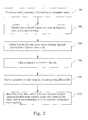
- the disclosed PCB manufacturing method includes the following steps. First, a conductive layer deposited on an insulation layer is provided. The conductive layer is patterned and formed with at least one conductive layer opening. The conductive layer opening is drilled through the insulation layer, forming a via. The via is loaded with a conductive material. A plurality of substrates are formed using the above steps and bonded according to the design. At least one conductive layer opening is formed at a position along the normal to the board that is not perpendicular to its adjacent conductive layer opening.
- each layer uses a conventional CCL. That is, one or both surfaces of each insulation layer are covered with copper foils.
- the copper foil is the conductive layer to be patterned.
- the insulation layer contains phenolic or epoxy, called the resin substrate.
- a center insulation layer and a center copper foil layer are provided first.
- the center copper foil layer is a conductive layer that is bonded with the central insulation layer in advance.
- a desired circuit pattern is defined on the center copper foil layer. That is, the center copper foil layer is patterned according the circuit blueprint, forming a necessary circuit structure. The patterning includes forming at least one center copper foil opening. The center copper foil opening is used for forming the center via in the subsequent drilling step.
- the center copper foil opening is drilled through the center insulation layer, forming at least one center via.
- the drilling method can be conventional mechanical drilling or laser drilling, which can render an opening with a smaller diameter.
- the laser drilling may be done with a carbon dioxide laser.
- chemical plating fills the center via with a conductive material, preferably copper, thereby connecting layers.
- step 208 the center via is loaded with a conductive material to provide an electrical connection.
- a center substrate is obtained by electroplating or other deposition methods.
- step 210 a first additional substrate is prepared following the above-mentioned steps 202 to 208.
- step 212 the first additional substrate is bonded with the center substrate.
- the conducting circuit between the additional layer and the center layer follows a predetermined design.
- a circuit is patterned on the layer copper foil in the center. Additional substrates are prepared according to the design (step 210). The center substrate is then bonded with additional substrates to render a multi-layer PCB (step 212).
- the above describes an example of bonding the substrates layer by layer. However, one may also first prepare all the substrates and then bond them together all at once.
- the center substrate may already be one with multi-layer substrates. It can be mechanically drilled to form vias and electroplated and then bonded with additional substrates using the disclosed method.
- the invention is not restricted to the case where each layer of substrate has to be laser drilled to form individual vias, followed by electroplating and bonding. Such variations can be readily performed by a person skilled in the art.
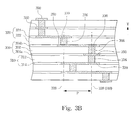
- another embodiment of the invention is a PCB structure that contains a center substrate 300 and at least one additional substrate 310.
- the center substrate 300 contains a center insulation layer 302 connected to a center conductive layer 304b.
- the center insulation layer 302 has a center via 306.
- the additional substrate 320 contains an additional insulation layer 322 and an additional conductive layer 324.
- the additional insulation layer 322 is disposed between the center conductive layer 304b and the additional conductive layer 324.
- the additional insulation layer 322 has an additional via 326.
- the center via 306 and the additional via 326 are loaded with a conductive material 330.
- the axis 308 of the center via 308 and the axis 328 of the additional via are separated by a predetermined distance P. They are electrically coupled through the center conductive layer 304b and the conductive material 330.
- the circuit board is a PCB with eight layers of circuits. It includes a center substrate and six additional substrates.
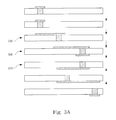
- FIG. 3A or 3B clearly shows that the center substrate 300 includes a center insulation layer and two center conductive layers disposed and pre-bonded above and below the center insulation layer before further bonding.
- Each additional substrate 310 or 320 includes an additional insulation layer and an additional conductive layer.
- the conductive layer uses the copper foil in this embodiment.
- the center substrate 300 includes a center insulation layer 302, a first center conductive layer 304a and a second center conductive layer 304b.
- the first center conductive layer 304a is bonded to the lower surface of the center insulation layer 302.
- the second center conductive layer 304b is bonded to the upper surface of the center insulation layer 302.
- the center insulation layer 302 is formed with a center via 306.
- the two conductive layers are formed with predetermined circuits.
- each via is formed by laser drilling, the size of the pad 350 thereon may be as small as or smaller than approximately 10mm.
- Each via is formed with copper 330 by electroplating to achieve electrical conduction.
- the conductive material 330 inside the via can be formed using some other deposition method.
- a first additional layer 310 is bonded to the lower surface of the first center conductive layer 304a.
- the first additional layer 310 includes a first additional insulation layer 312 and a first additional conductive layer 314.
- the first additional insulation layer is disposed between the first center conductive layer 304a and the first additional conductive layer 314 and formed with a first additional via 316.
- the first additional via 316 and the center via 306 are at roughly at the same position along the normal to the board T. That is, the axis 318 of the first additional via 318 and the axis 308 of the center via are roughly the same. Therefore, if the via diameter requirement is not strict in this embodiment, the center substrate 300 and the first additional substrate 310 can be bonded first, followed by traditional mechanical drilling. There is no need to perform laser drilling individually before bonding them together.
- the second additional substrate 320 is bonded on the upper surface of the second center conductive layer 304b.
- the second additional substrate 320 includes a second additional insulation layer 322 and a second additional conductive layer 324.
- the second additional insulation layer 322 is disposed between the second center conductive layer 304b and the second additional conductive layer 324 and formed with a second additional via 326.
- the second additional via 326 and the center via 306 are at different positions along the normal to the board T. That is, the axis 328 of the second additional via and the axis 308 of the center via are separated by a predetermined distance P.
- each of the above-mentioned conductive layers is patterned first.
- the drawings have been simplified from the actual circuit board structure.
- Each insulation layer has only one via in them.
- each conductive layer only displays the pad and the related connection, emphasizing that the disclosed connection design does not need to be the same as in the prior art of drilling holes at the corresponding position on each substrate.
- the holes are formed only at specific, necessary layers. Therefore, the layout area on each layer is increased.
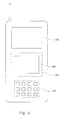
- FIG. 4 is a schematic view of the disclosed PCB in a portable electronic device, such as a mobile phone.
- the electronic device includes a display unit 430, a control unit 420, and an input unit.
- the control unit 420 includes the circuit board structure 400 with an arbitrary via according to the invention, e.g. the circuit board structure in FIG. 3B.
- the input unit 410 can be, for example, a key set for entering an input signal.
- the input signal is transmitted via the circuit board structure and processed by a device on the control unit 420, such as a chip (not shown).
- the display unit 430 can be, for example, a liquid crystal display (LCD) panel. An image responds to the input signal.
- LCD liquid crystal display
- the invention has the following advantages.
- the PCB is patterned according to a circuit layout. Before drilling holes in each layer of substrate, copper foil openings are patterned for subsequent hole drilling. Therefore, vias can be formed in the insulation layer by direct laser drilling, rendering small holes. This further reduces the size and cost of pads.
- the position of the via in each layer can be arbitrarily selected. It is not restricted to one drilling through all the substrates. The available layout area is also increased. Therefore, the invention provides a breakthrough in the technical development of device integration and miniaturization.
- the sizes of pads are different in various kinds of multi-layer manufacturing processes in the prior art.
- the circuit designer has to produce different data files for different processes using, for example, the commonly seen layout file format.
- the invention can be implemented using existing processes without employing any other special process. It can be applied to soft, hard, and combined PCB's. With the shared data file, the pads on the circuit board can be shared by different processes, satisfying the requirements of different PCB manufacturing processes. It effectively saves the circuit layout time. As the manpower and materials are efficiently used in the invention, the total cost is largely reduced.
Landscapes
- Engineering & Computer Science (AREA)
- Microelectronics & Electronic Packaging (AREA)
- Manufacturing & Machinery (AREA)
- Production Of Multi-Layered Print Wiring Board (AREA)
- Printing Elements For Providing Electric Connections Between Printed Circuits (AREA)
Applications Claiming Priority (1)
| Application Number | Priority Date | Filing Date | Title |
|---|---|---|---|
| CNA2005100035942A CN1993018A (zh) | 2005-12-26 | 2005-12-26 | 印刷电路板及其制造方法 |
Publications (2)
| Publication Number | Publication Date |
|---|---|
| EP1802187A2 true EP1802187A2 (de) | 2007-06-27 |
| EP1802187A3 EP1802187A3 (de) | 2008-01-23 |
Family
ID=38001766
Family Applications (1)
| Application Number | Title | Priority Date | Filing Date |
|---|---|---|---|
| EP06123432A Ceased EP1802187A3 (de) | 2005-12-26 | 2006-11-03 | Leiterplatte und Verfahren zu deren Herstellung |
Country Status (2)
| Country | Link |
|---|---|
| EP (1) | EP1802187A3 (de) |
| CN (1) | CN1993018A (de) |
Cited By (4)
| Publication number | Priority date | Publication date | Assignee | Title |
|---|---|---|---|---|
| FR2969897A1 (fr) * | 2010-12-23 | 2012-06-29 | Thales Sa | Circuit imprime multicouches et procede d'etablissement d'interconnexions dans ledit circuit |
| WO2017156678A1 (zh) * | 2016-03-14 | 2017-09-21 | 深圳崇达多层线路板有限公司 | 线路板的叠孔制作方法 |
| EP2718939B1 (de) * | 2011-06-08 | 2017-10-18 | Siemens Energy, Inc. | Isoliermaterialien mit darin geformten öffnungen |
| CN111836464A (zh) * | 2020-08-11 | 2020-10-27 | 日月光半导体(上海)有限公司 | 集成电路基板与集成电路基板制造方法 |
Families Citing this family (3)
| Publication number | Priority date | Publication date | Assignee | Title |
|---|---|---|---|---|
| CN102595799B (zh) * | 2011-12-30 | 2015-03-25 | 柏承科技(昆山)股份有限公司 | 高密度互联印刷电路板的制造方法 |
| CN105934085A (zh) * | 2016-06-28 | 2016-09-07 | 广东欧珀移动通信有限公司 | Pcb板及具有其的移动终端 |
| CN106793524A (zh) * | 2017-02-10 | 2017-05-31 | 昆山元茂电子科技有限公司 | 印刷电路板的制造方法 |
Family Cites Families (8)
| Publication number | Priority date | Publication date | Assignee | Title |
|---|---|---|---|---|
| JP3311899B2 (ja) * | 1995-01-20 | 2002-08-05 | 松下電器産業株式会社 | 回路基板及びその製造方法 |
| JPH09116273A (ja) * | 1995-08-11 | 1997-05-02 | Shinko Electric Ind Co Ltd | 多層回路基板及びその製造方法 |
| US6207259B1 (en) * | 1998-11-02 | 2001-03-27 | Kyocera Corporation | Wiring board |
| JP3760771B2 (ja) * | 2001-01-16 | 2006-03-29 | 松下電器産業株式会社 | 回路形成基板および回路形成基板の製造方法 |
| US6831236B2 (en) * | 2001-03-23 | 2004-12-14 | Fujikura Ltd. | Multilayer wiring board assembly, multilayer wiring board assembly component and method of manufacture thereof |
| JP3826731B2 (ja) * | 2001-05-07 | 2006-09-27 | ソニー株式会社 | 多層プリント配線基板及び多層プリント配線基板の製造方法 |
| WO2004064467A1 (ja) * | 2003-01-16 | 2004-07-29 | Fujitsu Limited | 多層配線基板、その製造方法、および、ファイバ強化樹脂基板の製造方法 |
| US7211289B2 (en) * | 2003-12-18 | 2007-05-01 | Endicott Interconnect Technologies, Inc. | Method of making multilayered printed circuit board with filled conductive holes |
-
2005
- 2005-12-26 CN CNA2005100035942A patent/CN1993018A/zh active Pending
-
2006
- 2006-11-03 EP EP06123432A patent/EP1802187A3/de not_active Ceased
Cited By (4)
| Publication number | Priority date | Publication date | Assignee | Title |
|---|---|---|---|---|
| FR2969897A1 (fr) * | 2010-12-23 | 2012-06-29 | Thales Sa | Circuit imprime multicouches et procede d'etablissement d'interconnexions dans ledit circuit |
| EP2718939B1 (de) * | 2011-06-08 | 2017-10-18 | Siemens Energy, Inc. | Isoliermaterialien mit darin geformten öffnungen |
| WO2017156678A1 (zh) * | 2016-03-14 | 2017-09-21 | 深圳崇达多层线路板有限公司 | 线路板的叠孔制作方法 |
| CN111836464A (zh) * | 2020-08-11 | 2020-10-27 | 日月光半导体(上海)有限公司 | 集成电路基板与集成电路基板制造方法 |
Also Published As
| Publication number | Publication date |
|---|---|
| CN1993018A (zh) | 2007-07-04 |
| EP1802187A3 (de) | 2008-01-23 |
Similar Documents
| Publication | Publication Date | Title |
|---|---|---|
| JP4538486B2 (ja) | 多層基板およびその製造方法 | |
| CN104883807B (zh) | 嵌入式板及其制造方法 | |
| US7457129B2 (en) | Multilayer printed wiring board | |
| US10064292B2 (en) | Recessed cavity in printed circuit board protected by LPI | |
| KR20030057284A (ko) | 비아 홀을 갖는 다층 프린트 배선판, 다층 프린트배선판에 탑재된 회로 부품을 구비하는 회로 모듈 및 다층프린트 배선판의 제조 방법 | |
| CN102387672A (zh) | 多层电路板的制作方法 | |
| US20110005071A1 (en) | Printed Circuit Board and Manufacturing Method Thereof | |
| US10219374B2 (en) | Printed wiring board | |
| US10772220B2 (en) | Dummy core restrict resin process and structure | |
| EP1802187A2 (de) | Leiterplatte und Verfahren zu deren Herstellung | |
| US20170271734A1 (en) | Embedded cavity in printed circuit board by solder mask dam | |
| CN111182733A (zh) | 具有侧壁线路的线路板制造工艺以及线路板制造工艺 | |
| JPH10261854A (ja) | プリント配線板及びその製造方法 | |
| TWI706702B (zh) | 電路板中的導通孔結構及其製造方法 | |
| JP4485975B2 (ja) | 多層フレキシブル回路配線基板の製造方法 | |
| JP4347143B2 (ja) | 回路基板およびその製造方法 | |
| CN101351091A (zh) | 线路连接工艺及其结构 | |
| US20040182603A1 (en) | [inner layer structure of a circuit board] | |
| KR20030071391A (ko) | 범프의 형성방법 및 이로부터 형성된 범프를 이용한인쇄회로기판의 제조방법 | |
| KR20070056188A (ko) | 캐비티 형의 인쇄회로기판의 제조방법 | |
| JP4397793B2 (ja) | 回路基板およびその製造方法 | |
| JPH06350256A (ja) | 非貫通スルーホールを有するプリント配線板およびその製造方法 | |
| JPH08111584A (ja) | シート積層多層配線基板の製造方法 | |
| KR20030078449A (ko) | 범프의 형성방법 및 이로부터 형성된 범프를 이용한인쇄회로기판의 제조방법 | |
| JPH11298148A (ja) | Ivh基板及びその製造方法 |
Legal Events
| Date | Code | Title | Description |
|---|---|---|---|
| PUAI | Public reference made under article 153(3) epc to a published international application that has entered the european phase |
Free format text: ORIGINAL CODE: 0009012 |
|
| AK | Designated contracting states |
Kind code of ref document: A2 Designated state(s): AT BE BG CH CY CZ DE DK EE ES FI FR GB GR HU IE IS IT LI LT LU LV MC NL PL PT RO SE SI SK TR |
|
| AX | Request for extension of the european patent |
Extension state: AL BA HR MK YU |
|
| PUAL | Search report despatched |
Free format text: ORIGINAL CODE: 0009013 |
|
| AK | Designated contracting states |
Kind code of ref document: A3 Designated state(s): AT BE BG CH CY CZ DE DK EE ES FI FR GB GR HU IE IS IT LI LT LU LV MC NL PL PT RO SE SI SK TR |
|
| AX | Request for extension of the european patent |
Extension state: AL BA HR MK YU |
|
| 17P | Request for examination filed |
Effective date: 20080520 |
|
| 17Q | First examination report despatched |
Effective date: 20080708 |
|
| AKX | Designation fees paid |
Designated state(s): DE FR GB |
|
| RAP1 | Party data changed (applicant data changed or rights of an application transferred) |
Owner name: HTC CORPORATION |
|
| STAA | Information on the status of an ep patent application or granted ep patent |
Free format text: STATUS: THE APPLICATION HAS BEEN REFUSED |
|
| 18R | Application refused |
Effective date: 20110423 |