EP1805155B1 - Verbindungen modulierende thrombopoietinaktivität und verfahren - Google Patents
Verbindungen modulierende thrombopoietinaktivität und verfahren Download PDFInfo
- Publication number
- EP1805155B1 EP1805155B1 EP05813834A EP05813834A EP1805155B1 EP 1805155 B1 EP1805155 B1 EP 1805155B1 EP 05813834 A EP05813834 A EP 05813834A EP 05813834 A EP05813834 A EP 05813834A EP 1805155 B1 EP1805155 B1 EP 1805155B1
- Authority
- EP
- European Patent Office
- Prior art keywords
- oxo
- hydrazino
- ylidene
- dihydro
- carboxylic acid
- Prior art date
- Legal status (The legal status is an assumption and is not a legal conclusion. Google has not performed a legal analysis and makes no representation as to the accuracy of the status listed.)
- Expired - Lifetime
Links
- 0 *=*C(CCCC1)C1NS Chemical compound *=*C(CCCC1)C1NS 0.000 description 3
- ZIIIBCNRBREWEU-QYVLQNAGSA-N C=C(C1)C(C(F)(F)F)=CC(N(C2=O)c(cc3)cc4c3OCO4)=C1/C2=N/Nc(cccc1-c(cc2C(O)=O)ccc2F)c1O Chemical compound C=C(C1)C(C(F)(F)F)=CC(N(C2=O)c(cc3)cc4c3OCO4)=C1/C2=N/Nc(cccc1-c(cc2C(O)=O)ccc2F)c1O ZIIIBCNRBREWEU-QYVLQNAGSA-N 0.000 description 1
- UYJQLPIXFGHJCY-ZXPTYKNPSA-N CCc(cc1)ccc1N(c1ccccc1/C1=N/Nc(cccc2-c(cc3)ccc3C(O)=O)c2O)C1=O Chemical compound CCc(cc1)ccc1N(c1ccccc1/C1=N/Nc(cccc2-c(cc3)ccc3C(O)=O)c2O)C1=O UYJQLPIXFGHJCY-ZXPTYKNPSA-N 0.000 description 1
- ZUSROJXZZVBNDT-MDVFONAFSA-N CCc(cc1N(C2=O)c3cc(C)c(C)cc3)ccc1/C2=N/Nc(cccc1-c2cc(C(O)=O)ccc2)c1O Chemical compound CCc(cc1N(C2=O)c3cc(C)c(C)cc3)ccc1/C2=N/Nc(cccc1-c2cc(C(O)=O)ccc2)c1O ZUSROJXZZVBNDT-MDVFONAFSA-N 0.000 description 1
- YAAUKHYIDYDKEE-MXNGAVTRSA-N Cc(c(C)c1)ccc1N(c(cc(cc1)S(C)(=O)=O)c1/C1=N/Nc(cccc2-c3cc(C(O)=O)ccc3)c2O)C1=O Chemical compound Cc(c(C)c1)ccc1N(c(cc(cc1)S(C)(=O)=O)c1/C1=N/Nc(cccc2-c3cc(C(O)=O)ccc3)c2O)C1=O YAAUKHYIDYDKEE-MXNGAVTRSA-N 0.000 description 1
- MBHDVMOGJZVJMD-JYUHDHNASA-N Cc(c(C)c1)ccc1N(c(ccc(C(F)(F)F)c1)c1/C1=N/Nc(cccc2-c3cccc(C(O)=O)c3)c2O)C1=O Chemical compound Cc(c(C)c1)ccc1N(c(ccc(C(F)(F)F)c1)c1/C1=N/Nc(cccc2-c3cccc(C(O)=O)c3)c2O)C1=O MBHDVMOGJZVJMD-JYUHDHNASA-N 0.000 description 1
- YJSCFWBURSMTCQ-FSRJSHLRSA-N Cc(cc1)c(C)cc1N(C(C(CCC=C1)=C1/C1=N/Nc(cccc2-c3cc(C(O)=O)ccc3)c2O)=O)C1=O Chemical compound Cc(cc1)c(C)cc1N(C(C(CCC=C1)=C1/C1=N/Nc(cccc2-c3cc(C(O)=O)ccc3)c2O)=O)C1=O YJSCFWBURSMTCQ-FSRJSHLRSA-N 0.000 description 1
- MGAJDGFFWQNWGL-JYUHDHNASA-N Cc(cc1)c(C)cc1N(c(cc(C(F)(F)F)cc1)c1/C1=N/Nc(cccc2-c3cc(C(O)=O)ccc3)c2O)C1=O Chemical compound Cc(cc1)c(C)cc1N(c(cc(C(F)(F)F)cc1)c1/C1=N/Nc(cccc2-c3cc(C(O)=O)ccc3)c2O)C1=O MGAJDGFFWQNWGL-JYUHDHNASA-N 0.000 description 1
- YZWPQNDZXQAUNH-QYVLQNAGSA-N Cc(cc1)c(C)cc1N(c1c(/C2=N/Nc(cccc3-c4cccc(C(O)=O)c4)c3O)c(F)cc(C(F)(F)F)c1)C2=O Chemical compound Cc(cc1)c(C)cc1N(c1c(/C2=N/Nc(cccc3-c4cccc(C(O)=O)c4)c3O)c(F)cc(C(F)(F)F)c1)C2=O YZWPQNDZXQAUNH-QYVLQNAGSA-N 0.000 description 1
- XOHRMLLISAXPSX-GDWJVWIDSA-N Cc(cc1F)ccc1N(c(cccc1)c1/C1=N/Nc(cccc2-c3cccc(C(O)=O)c3)c2O)C1=O Chemical compound Cc(cc1F)ccc1N(c(cccc1)c1/C1=N/Nc(cccc2-c3cccc(C(O)=O)c3)c2O)C1=O XOHRMLLISAXPSX-GDWJVWIDSA-N 0.000 description 1
- VGSQSSICPYHMBG-UOZKZNBHSA-N Cc1cc(C)cc(N(C(C2/C3=N/Nc(cccc4-c(cc5)cc(C(O)=O)c5F)c4O)C=C(C(F)(F)F)C=C2F)C3=O)c1 Chemical compound Cc1cc(C)cc(N(C(C2/C3=N/Nc(cccc4-c(cc5)cc(C(O)=O)c5F)c4O)C=C(C(F)(F)F)C=C2F)C3=O)c1 VGSQSSICPYHMBG-UOZKZNBHSA-N 0.000 description 1
- MGLCKFNAZHYKHQ-QYVLQNAGSA-N Cc1cc(C)cc(N(c2c(/C3=N/Nc(cccc4-c5cccc(C(O)=O)c5)c4O)c(F)cc(C(F)(F)F)c2)C3=O)c1 Chemical compound Cc1cc(C)cc(N(c2c(/C3=N/Nc(cccc4-c5cccc(C(O)=O)c5)c4O)c(F)cc(C(F)(F)F)c2)C3=O)c1 MGLCKFNAZHYKHQ-QYVLQNAGSA-N 0.000 description 1
- SVIHZRADJDCSLS-UHFFFAOYSA-O Cc1cc(C)cc(N(c2cc(C(F)(F)F)ccc2C2=[NH2+])C2=O)c1 Chemical compound Cc1cc(C)cc(N(c2cc(C(F)(F)F)ccc2C2=[NH2+])C2=O)c1 SVIHZRADJDCSLS-UHFFFAOYSA-O 0.000 description 1
- ZVOIKDJZTUMKHB-UOZKZNBHSA-N Cc1cc(N(c2cc(C(F)(F)F)ccc2/C2=N/Nc(cc(cc3-c4cc(C(O)=O)ccc4)F)c3O)C2=O)cc(C)c1F Chemical compound Cc1cc(N(c2cc(C(F)(F)F)ccc2/C2=N/Nc(cc(cc3-c4cc(C(O)=O)ccc4)F)c3O)C2=O)cc(C)c1F ZVOIKDJZTUMKHB-UOZKZNBHSA-N 0.000 description 1
- DBEHLUMVCNVWDJ-UHFFFAOYSA-N Nc(ccc(CCCC(O)=O)c1)c1O Chemical compound Nc(ccc(CCCC(O)=O)c1)c1O DBEHLUMVCNVWDJ-UHFFFAOYSA-N 0.000 description 1
- IGKFXDDHDZUXFN-GIBOGKFOSA-N OC(c1cc(-c2cccc(N/N=C(/c(cccc3)c3N3c(cc4)ccc4OC(F)(F)F)\C3=O)c2O)ccc1)=O Chemical compound OC(c1cc(-c2cccc(N/N=C(/c(cccc3)c3N3c(cc4)ccc4OC(F)(F)F)\C3=O)c2O)ccc1)=O IGKFXDDHDZUXFN-GIBOGKFOSA-N 0.000 description 1
- TZVYPEWKJMFLQY-NQUVTRGKSA-N OC(c1cc(-c2cccc(N/N=C(/c(cccc3)c3N3c4ccc(CC(F)(F)F)cc4)\C3=O)c2O)ccc1)=O Chemical compound OC(c1cc(-c2cccc(N/N=C(/c(cccc3)c3N3c4ccc(CC(F)(F)F)cc4)\C3=O)c2O)ccc1)=O TZVYPEWKJMFLQY-NQUVTRGKSA-N 0.000 description 1
- YUXCAZBLPOCLKN-UHFFFAOYSA-N [CH]1C(C2=CN=CO[CH]2)=NOC=C1 Chemical compound [CH]1C(C2=CN=CO[CH]2)=NOC=C1 YUXCAZBLPOCLKN-UHFFFAOYSA-N 0.000 description 1
- VMMBDNVWMJQTIQ-UHFFFAOYSA-N [CH]1OC=CN=C1 Chemical compound [CH]1OC=CN=C1 VMMBDNVWMJQTIQ-UHFFFAOYSA-N 0.000 description 1
Classifications
-
- C—CHEMISTRY; METALLURGY
- C07—ORGANIC CHEMISTRY
- C07D—HETEROCYCLIC COMPOUNDS
- C07D471/00—Heterocyclic compounds containing nitrogen atoms as the only ring hetero atoms in the condensed system, at least one ring being a six-membered ring with one nitrogen atom, not provided for by groups C07D451/00 - C07D463/00
- C07D471/02—Heterocyclic compounds containing nitrogen atoms as the only ring hetero atoms in the condensed system, at least one ring being a six-membered ring with one nitrogen atom, not provided for by groups C07D451/00 - C07D463/00 in which the condensed system contains two hetero rings
- C07D471/04—Ortho-condensed systems
-
- A—HUMAN NECESSITIES
- A61—MEDICAL OR VETERINARY SCIENCE; HYGIENE
- A61K—PREPARATIONS FOR MEDICAL, DENTAL OR TOILETRY PURPOSES
- A61K31/00—Medicinal preparations containing organic active ingredients
- A61K31/33—Heterocyclic compounds
- A61K31/395—Heterocyclic compounds having nitrogen as a ring hetero atom, e.g. guanethidine or rifamycins
- A61K31/40—Heterocyclic compounds having nitrogen as a ring hetero atom, e.g. guanethidine or rifamycins having five-membered rings with one nitrogen as the only ring hetero atom, e.g. sulpiride, succinimide, tolmetin, buflomedil
- A61K31/4015—Heterocyclic compounds having nitrogen as a ring hetero atom, e.g. guanethidine or rifamycins having five-membered rings with one nitrogen as the only ring hetero atom, e.g. sulpiride, succinimide, tolmetin, buflomedil having oxo groups directly attached to the heterocyclic ring, e.g. piracetam, ethosuximide
-
- A—HUMAN NECESSITIES
- A61—MEDICAL OR VETERINARY SCIENCE; HYGIENE
- A61K—PREPARATIONS FOR MEDICAL, DENTAL OR TOILETRY PURPOSES
- A61K31/00—Medicinal preparations containing organic active ingredients
- A61K31/33—Heterocyclic compounds
- A61K31/395—Heterocyclic compounds having nitrogen as a ring hetero atom, e.g. guanethidine or rifamycins
- A61K31/40—Heterocyclic compounds having nitrogen as a ring hetero atom, e.g. guanethidine or rifamycins having five-membered rings with one nitrogen as the only ring hetero atom, e.g. sulpiride, succinimide, tolmetin, buflomedil
- A61K31/403—Heterocyclic compounds having nitrogen as a ring hetero atom, e.g. guanethidine or rifamycins having five-membered rings with one nitrogen as the only ring hetero atom, e.g. sulpiride, succinimide, tolmetin, buflomedil condensed with carbocyclic rings, e.g. carbazole
- A61K31/404—Indoles, e.g. pindolol
-
- A—HUMAN NECESSITIES
- A61—MEDICAL OR VETERINARY SCIENCE; HYGIENE
- A61P—SPECIFIC THERAPEUTIC ACTIVITY OF CHEMICAL COMPOUNDS OR MEDICINAL PREPARATIONS
- A61P21/00—Drugs for disorders of the muscular or neuromuscular system
- A61P21/04—Drugs for disorders of the muscular or neuromuscular system for myasthenia gravis
-
- A—HUMAN NECESSITIES
- A61—MEDICAL OR VETERINARY SCIENCE; HYGIENE
- A61P—SPECIFIC THERAPEUTIC ACTIVITY OF CHEMICAL COMPOUNDS OR MEDICINAL PREPARATIONS
- A61P25/00—Drugs for disorders of the nervous system
-
- A—HUMAN NECESSITIES
- A61—MEDICAL OR VETERINARY SCIENCE; HYGIENE
- A61P—SPECIFIC THERAPEUTIC ACTIVITY OF CHEMICAL COMPOUNDS OR MEDICINAL PREPARATIONS
- A61P43/00—Drugs for specific purposes, not provided for in groups A61P1/00-A61P41/00
-
- A—HUMAN NECESSITIES
- A61—MEDICAL OR VETERINARY SCIENCE; HYGIENE
- A61P—SPECIFIC THERAPEUTIC ACTIVITY OF CHEMICAL COMPOUNDS OR MEDICINAL PREPARATIONS
- A61P7/00—Drugs for disorders of the blood or the extracellular fluid
-
- A—HUMAN NECESSITIES
- A61—MEDICAL OR VETERINARY SCIENCE; HYGIENE
- A61P—SPECIFIC THERAPEUTIC ACTIVITY OF CHEMICAL COMPOUNDS OR MEDICINAL PREPARATIONS
- A61P7/00—Drugs for disorders of the blood or the extracellular fluid
- A61P7/04—Antihaemorrhagics; Procoagulants; Haemostatic agents; Antifibrinolytic agents
-
- C—CHEMISTRY; METALLURGY
- C07—ORGANIC CHEMISTRY
- C07D—HETEROCYCLIC COMPOUNDS
- C07D209/00—Heterocyclic compounds containing five-membered rings, condensed with other rings, with one nitrogen atom as the only ring hetero atom
- C07D209/02—Heterocyclic compounds containing five-membered rings, condensed with other rings, with one nitrogen atom as the only ring hetero atom condensed with one carbocyclic ring
- C07D209/04—Indoles; Hydrogenated indoles
- C07D209/30—Indoles; Hydrogenated indoles with hetero atoms or with carbon atoms having three bonds to hetero atoms with at the most one bond to halogen, directly attached to carbon atoms of the hetero ring
- C07D209/40—Nitrogen atoms, not forming part of a nitro radical, e.g. isatin semicarbazone
-
- C—CHEMISTRY; METALLURGY
- C07—ORGANIC CHEMISTRY
- C07D—HETEROCYCLIC COMPOUNDS
- C07D209/00—Heterocyclic compounds containing five-membered rings, condensed with other rings, with one nitrogen atom as the only ring hetero atom
- C07D209/02—Heterocyclic compounds containing five-membered rings, condensed with other rings, with one nitrogen atom as the only ring hetero atom condensed with one carbocyclic ring
- C07D209/04—Indoles; Hydrogenated indoles
- C07D209/30—Indoles; Hydrogenated indoles with hetero atoms or with carbon atoms having three bonds to hetero atoms with at the most one bond to halogen, directly attached to carbon atoms of the hetero ring
- C07D209/42—Carbon atoms having three bonds to hetero atoms with at the most one bond to halogen, e.g. ester or nitrile radicals
-
- C—CHEMISTRY; METALLURGY
- C07—ORGANIC CHEMISTRY
- C07D—HETEROCYCLIC COMPOUNDS
- C07D217/00—Heterocyclic compounds containing isoquinoline or hydrogenated isoquinoline ring systems
- C07D217/22—Heterocyclic compounds containing isoquinoline or hydrogenated isoquinoline ring systems with hetero atoms or with carbon atoms having three bonds to hetero atoms with at the most one bond to halogen, e.g. ester or nitrile radicals, directly attached to carbon atoms of the nitrogen-containing ring
- C07D217/24—Oxygen atoms
-
- C—CHEMISTRY; METALLURGY
- C07—ORGANIC CHEMISTRY
- C07D—HETEROCYCLIC COMPOUNDS
- C07D239/00—Heterocyclic compounds containing 1,3-diazine or hydrogenated 1,3-diazine rings
- C07D239/02—Heterocyclic compounds containing 1,3-diazine or hydrogenated 1,3-diazine rings not condensed with other rings
- C07D239/04—Heterocyclic compounds containing 1,3-diazine or hydrogenated 1,3-diazine rings not condensed with other rings having no double bonds between ring members or between ring members and non-ring members
-
- C—CHEMISTRY; METALLURGY
- C07—ORGANIC CHEMISTRY
- C07D—HETEROCYCLIC COMPOUNDS
- C07D239/00—Heterocyclic compounds containing 1,3-diazine or hydrogenated 1,3-diazine rings
- C07D239/02—Heterocyclic compounds containing 1,3-diazine or hydrogenated 1,3-diazine rings not condensed with other rings
- C07D239/24—Heterocyclic compounds containing 1,3-diazine or hydrogenated 1,3-diazine rings not condensed with other rings having three or more double bonds between ring members or between ring members and non-ring members
- C07D239/28—Heterocyclic compounds containing 1,3-diazine or hydrogenated 1,3-diazine rings not condensed with other rings having three or more double bonds between ring members or between ring members and non-ring members with hetero atoms or with carbon atoms having three bonds to hetero atoms with at the most one bond to halogen, directly attached to ring carbon atoms
- C07D239/46—Two or more oxygen, sulphur or nitrogen atoms
- C07D239/60—Three or more oxygen or sulfur atoms
-
- C—CHEMISTRY; METALLURGY
- C07—ORGANIC CHEMISTRY
- C07D—HETEROCYCLIC COMPOUNDS
- C07D277/00—Heterocyclic compounds containing 1,3-thiazole or hydrogenated 1,3-thiazole rings
- C07D277/02—Heterocyclic compounds containing 1,3-thiazole or hydrogenated 1,3-thiazole rings not condensed with other rings
- C07D277/04—Heterocyclic compounds containing 1,3-thiazole or hydrogenated 1,3-thiazole rings not condensed with other rings having no double bonds between ring members or between ring members and non-ring members
-
- C—CHEMISTRY; METALLURGY
- C07—ORGANIC CHEMISTRY
- C07D—HETEROCYCLIC COMPOUNDS
- C07D277/00—Heterocyclic compounds containing 1,3-thiazole or hydrogenated 1,3-thiazole rings
- C07D277/02—Heterocyclic compounds containing 1,3-thiazole or hydrogenated 1,3-thiazole rings not condensed with other rings
- C07D277/20—Heterocyclic compounds containing 1,3-thiazole or hydrogenated 1,3-thiazole rings not condensed with other rings having two or three double bonds between ring members or between ring members and non-ring members
- C07D277/32—Heterocyclic compounds containing 1,3-thiazole or hydrogenated 1,3-thiazole rings not condensed with other rings having two or three double bonds between ring members or between ring members and non-ring members with hetero atoms or with carbon atoms having three bonds to hetero atoms with at the most one bond to halogen, e.g. ester or nitrile radicals, directly attached to ring carbon atoms
- C07D277/54—Nitrogen and either oxygen or sulfur atoms
-
- C—CHEMISTRY; METALLURGY
- C07—ORGANIC CHEMISTRY
- C07D—HETEROCYCLIC COMPOUNDS
- C07D401/00—Heterocyclic compounds containing two or more hetero rings, having nitrogen atoms as the only ring hetero atoms, at least one ring being a six-membered ring with only one nitrogen atom
- C07D401/02—Heterocyclic compounds containing two or more hetero rings, having nitrogen atoms as the only ring hetero atoms, at least one ring being a six-membered ring with only one nitrogen atom containing two hetero rings
- C07D401/04—Heterocyclic compounds containing two or more hetero rings, having nitrogen atoms as the only ring hetero atoms, at least one ring being a six-membered ring with only one nitrogen atom containing two hetero rings directly linked by a ring-member-to-ring-member bond
-
- C—CHEMISTRY; METALLURGY
- C07—ORGANIC CHEMISTRY
- C07D—HETEROCYCLIC COMPOUNDS
- C07D403/00—Heterocyclic compounds containing two or more hetero rings, having nitrogen atoms as the only ring hetero atoms, not provided for by group C07D401/00
- C07D403/02—Heterocyclic compounds containing two or more hetero rings, having nitrogen atoms as the only ring hetero atoms, not provided for by group C07D401/00 containing two hetero rings
- C07D403/12—Heterocyclic compounds containing two or more hetero rings, having nitrogen atoms as the only ring hetero atoms, not provided for by group C07D401/00 containing two hetero rings linked by a chain containing hetero atoms as chain links
-
- C—CHEMISTRY; METALLURGY
- C07—ORGANIC CHEMISTRY
- C07D—HETEROCYCLIC COMPOUNDS
- C07D405/00—Heterocyclic compounds containing both one or more hetero rings having oxygen atoms as the only ring hetero atoms, and one or more rings having nitrogen as the only ring hetero atom
- C07D405/02—Heterocyclic compounds containing both one or more hetero rings having oxygen atoms as the only ring hetero atoms, and one or more rings having nitrogen as the only ring hetero atom containing two hetero rings
- C07D405/04—Heterocyclic compounds containing both one or more hetero rings having oxygen atoms as the only ring hetero atoms, and one or more rings having nitrogen as the only ring hetero atom containing two hetero rings directly linked by a ring-member-to-ring-member bond
-
- C—CHEMISTRY; METALLURGY
- C07—ORGANIC CHEMISTRY
- C07D—HETEROCYCLIC COMPOUNDS
- C07D409/00—Heterocyclic compounds containing two or more hetero rings, at least one ring having sulfur atoms as the only ring hetero atoms
- C07D409/02—Heterocyclic compounds containing two or more hetero rings, at least one ring having sulfur atoms as the only ring hetero atoms containing two hetero rings
- C07D409/04—Heterocyclic compounds containing two or more hetero rings, at least one ring having sulfur atoms as the only ring hetero atoms containing two hetero rings directly linked by a ring-member-to-ring-member bond
-
- C—CHEMISTRY; METALLURGY
- C07—ORGANIC CHEMISTRY
- C07D—HETEROCYCLIC COMPOUNDS
- C07D417/00—Heterocyclic compounds containing two or more hetero rings, at least one ring having nitrogen and sulfur atoms as the only ring hetero atoms, not provided for by group C07D415/00
- C07D417/02—Heterocyclic compounds containing two or more hetero rings, at least one ring having nitrogen and sulfur atoms as the only ring hetero atoms, not provided for by group C07D415/00 containing two hetero rings
- C07D417/12—Heterocyclic compounds containing two or more hetero rings, at least one ring having nitrogen and sulfur atoms as the only ring hetero atoms, not provided for by group C07D415/00 containing two hetero rings linked by a chain containing hetero atoms as chain links
Definitions
- This invention relates to compounds that modulate one or more thrombopoietin activity and/or bind to thrombopoietin receptors: and to methods for making and using such compounds.
- Thrombopoietin also referred to as c-Mpl ligand, mpl ligand, megapoietin, and megakaryocyte growth and development factor
- TPO Thrombopoietin
- c-Mpl ligand also referred to as c-Mpl ligand, mpl ligand, megapoietin, and megakaryocyte growth and development factor
- TPO activity results from binding of TPO to the TPO receptor (also called MPL).
- TPO receptor also called MPL.
- the TPO receptor has been cloned and its amino acid sequence has been described. See e.g ., Vigon et al., Proc. Natl. Acad. Sci., 89:5640-5644 (1992 ).
- TPO modulators may be useful in treating a variety of hematopoietic conditions, including, but not limited to, thrombocytopenia. See e.g ., Baser et al. Blood 89:3118-3128 (1997 ); Fanucchi et al. New Engl. J. Med. 336:404-409 (1997 ).
- patients undergoing certain chemotherapies including but not limited to chemotherapy and/or radiation therapy for the treatment of cancer, may have reduced platelet levels.
- treating such patients with a selective TPO modulator increases platelet levels.
- selective TPO modulators stimulate production of glial cells, which may result in repair of damaged nerve cells.
- TPO mimics have been described previously. See e.g ., WO 01/89457 or WO 03/103686 . In both documents specific hydroxy-1-azo-benzene derivatives have been described for this purpose. Both documents do not describe compounds having an indolone moiety.
- the present invention provides a compound of Formula III: or a pharmaceutically acceptable salt, ester, or amide, thereof, wherein:
- the invention provides a compound of Formula III or a pharmaceutically acceptable salt, ester, or amide, wherein:
- a compound of Formula III is a selective TPO modulator. In certain such embodiments, a compound of Formula III is a TPO mimic.
- the invention provides a selective TPO modulator. In certain embodiments, the invention provides a selective TPO receptor agonist. In certain embodiments, the invention provides a selective TPO receptor antagonist. In certain embodiments, the invention provides a selective TPO partial agonist. In certain embodiments, the invention provides a selective TPO receptor binding compound. In certain embodiments, the invention provides a TPO mimic. In certain embodiments, the invention provides a tissue-selective selective TPO modulator.
- the invention provides methods for modulating a TPO activity. Certain such methods comprise contacting a cell with one or more compounds of the present invention. Such methods include, but are not limited to, contacting TPO and/or a TPO receptor with one or more compounds of the present invention.
- the invention provides an in vitro method for identifying a compound that is capable of modulating TPO activity comprising contacting a cell capable of a TPO activity with a compound of the present invention and monitoring an effect on the cell.
- the cell expresses a TPO receptor.
- the invention provides an inventive compound for treating a patient suffering from thrombocytopenia.
- one or more compounds of the present invention are administered to a patient before, during or after chemotherapy, bone marrow transplantation, and/or radiation therapy.
- one or more compounds of the invention are administered to a patient suffering from aplastic anemia, bone marrow failure, and/or idiopathic thrombocytopenia.
- Compound described herein may be administered to a patient suffering from a disease of the nervous system.
- Compounds described herein may be administered to patient suffering from amyotrophic lateral sclerosis, multiple sclerosis, or multiple dystrophy.
- Compounds described herein may be administered to a patient with a nerve injury, including, but not limited to, a spinal cord injury.
- the invention provides pharmaceutical compositions comprising one or more compounds of the present invention and a physiologically acceptable carrier, diluent, or excipient.
- Standard chemical symbols are used interchangeably with the full names represented by such symbols. Thus, for example, the terms "hydrogen” and “H” are understood to have identical meaning.
- Standard techniques may be used for chemical syntheses, chemical analyses, pharmaceutical preparation, formulation, and delivery, and treatment of patients. Standard techniques may be used for recombinant DNA, oligonucleotide synthesis, and tissue culture and transformation ( e.g ., electroporation, lipofection).
- Reactions and purification techniques may be performed e.g ., using kits according to manufacturer's specifications or as commonly accomplished in the art or as described herein.
- the foregoing techniques and procedures may be generally performed according to conventional methods well known in the art and as described in various general and more specific references that are cited and discussed throughout the present specification. See e.g., Sambrook et al. Molecular Cloning: A Laboratory Manual (2d ed., Cold Spring Harbor Laboratory Press, Cold Spring Harbor, N.Y. (1989 )).
- selective binding compound refers to a compound that selectively binds to any portion of one or more target.
- selective TPO receptor binding compound refers to a compound that selectively binds to any portion of a TPO receptor.
- selective binding refers to the ability of a selective binding compound to bind to a target receptor with greater affinity than it binds to a non-target receptor.
- specific binding refers to binding to a target with an affinity that is at least 10, 50, 100, 250, 500, or 1000 times greater than the affinity for a non-target.
- target receptor refers to a receptor or a portion of a receptor capable of being bound by a selective binding compound.
- a target receptor is a TPO receptor.
- modulator refers to a compound that alters or elicits an activity.
- the presence of a modulator may result in an increase or decrease in the magnitude of a certain activity compared to the magnitude of the activity in the absence of the modulator.
- a modulator is an inhibitor, which decreases the magnitude of one or more activities.
- an inhibitor completely prevents one or more biological activities.
- a modulator is an activator, which increases the magnitude of at least one activity.
- the presence of a modulator results in a activity that does not occur in the absence of the modulator.
- selective modulator refers to a compound that selectively modulates a target activity.
- selective TPO modulator refers to a compound that selectively modulates at least one TPO activity.
- selective TPO modulator includes, but is not limited to "TPO mimic” which refers to a compound, the presence of which results in at least one TPO activity.
- selective modulates refers to the ability of a selective modulator to modulate a target activity to a greater extent than it modulates a non-target activity.
- target activity refers to a biological activity capable of being modulated by a selective modulator.
- Certain exemplary target activities include, but are not limited to, binding affinity; signal transduction; enzymatic activity; transcription of one or more gen es; the proliferation and/or differentiation of cells, including, but not limited to progenitor cells; generation of platelets; and alleviation of symptoms of a disease or condition.
- TPO activity refers to a biological activity that results, either directly or indirectly from the presence of TPO.
- Exemplary TPO activities include, but are not limited to, proliferation and or differentiation of progenitor cells to produce platelets; hematopoiesis; growth and/or development of glial cells; repair of nerve cells; and alleviation of thrombocytopenia.
- thrombocytopenia refers to a condition wherein the concentration of platelets in the blood of a patient is below what is considered normal for a healthy patient.
- thrombocytopenia is a platelet count less than 450,000, 400,000, 350,000, 300,000, 250,000, 200,000, 150,000, 140,000, 130,000, 120,000, 110,000, 100,000, 75,000, or 50,000 platelets per microliter of blood.
- receptor mediated activity refers any biological activity that results, either directly or indirectly, from binding of a ligand to a receptor.
- agonist refers to a compound, the presence of which results in a biological activity of a receptor that is the same as the biological activity resulting from the presence of a naturally occurring ligand for the receptor.
- partial agonist refers to a compound, the presence of which results in a biological activity of a receptor that is of the same type as that resulting from the presence of a naturally occurring ligand for the receptor, but of a lower magnitude.
- antagonist refers to a compound, the presence of which results in a decrease in the magnitude of a biological activity of a receptor. In certain embodiments, the presence of an antagonist results in complete inhibition of a biological activity of a receptor.
- aliphatic refers to a straight or branched chain comprising at least one carbon atom.
- Aliphatics include alkyls, alkenyls, and alkynyls. In certain embodiments, aliphatics are optionally substituted. Aliphatics include, but are not limited to, methyl, ethyl, propyl, isopropyl, butyl, isobutyl, tertiary butyl, pentyl, hexyl, ethenyl, propenyl, butenyl, ethynyl, butynyl, propynyl, and the like, each of which may be optionally substituted. As used herein, aliphatic is not intended to include cyclic groups.
- alkyl refers to a fully saturated aliphatic. In certain embodiments, alkyls are optionally substituted. In certain embodiments, an alkyl comprises 1 to 20 carbon atoms (whenever it appears herein, a numerical range, such as “1 to 20" or “C 1 -C 20 ", refers to each integer in the given range; e.g ., "C 1 -C 20 alkyl” means that an alkyl group comprising only 1 carbon atom, 2 carbon atoms, 3 carbon atoms, etc ., up to and including 20 carbon atoms).
- alkyls include, but are not limited to, methyl, ethyl, n-propyl, isopropyl, n-butyl, isobutyl, sec-butyl, tert-butyl, tert-amyl, pentyl, hexyl, heptyl, octyl and the like.
- alkenyl refers to an aliphatic having one or more carbon-carbon double-bonds. In certain embodiments, alkenyls are optionally substituted. Examples of alkenyls include, but are not limited to, ethenyl, propenyl, 1,4-butadienyl, and the like.
- alkynyl refers to an aliphatic having one or more carbon-carbon triple-bonds. In certain embodiments, alkynyls are optionally substituted. Examples of alkynyls include, but are not limited to, ethynyl, propynyl, butynyl, and the like.
- haloaliphatic refers to an aliphatic in which at least one hydrogen atom is replaced with a halogen atom. In certain embodiments in which two or more hydrogen atom are replaced with halogen atoms, the halogen atoms are all the same as one another. In certain such embodiments, the halogen atoms are not all the same as one another.
- Haloaliphatics include haloalkyls, haloalkenyls, and haloalkynyls. In certain embodiments, haloaliphatics are optionally substituted, in addition to the hydrogen/halogen substitution.
- haloaliphatic also includes perhaloaliphatic, in which all of the hydrogen atoms of the aliphatic are replaced by halogen atoms.
- perhaloaliphatic include trichloromethyl, pentacholorethyl, etc.
- heteroaliphatic refers to a group comprising an aliphatic and one or more heteroatoms.
- Certain heteroaliphatics are acylaliphatics, in which the one or more heteroatoms is not within an aliphatic chain.
- Heteroaliphatics include heteroalkyls, including, but not limited to acylalkys; heteroalkenyls, including, but not limited to, acylalkenyls; and heteroalkynyls, including, but not limited acylalkynyls.
- heteroaliphatics are optionally substituted.
- heterohaloaliphatic refers to a heteroaliphatic in which at least one hydrogen atom is replaced with a halogen atom.
- Heterohaloaliphatics include heterohaloalkyls, heterohaloalkenyls, and heterohaloalkynyls. In certain embodiments, heterohaloaliphatics are optionally substituted.
- R''' and R'''' represent hydrogen.
- Olefins may be optional substituted, in which case R''' and R'''' above are independently selected from hydrogen and an optional substituent.
- Carbocycle refers to a group comprising a covalently closed ring, wherein each of the atoms forming the ring is a carbon atom.
- Carbocylic rings may be formed by three, four, five, six, seven, eight, nine, or more than nine carbon atoms.
- Carbocycles may be optionally substituted.
- heterocycle refers to a group comprising a covalently closed ring wherein at least one atom forming the ring is a carbon atom and at least one atom forming the ring is a heteroatom.
- Heterocyclic rings may be formed by three, four, five, six, seven, eight, nine, or more than nine atoms. Any number of those atoms may be heteroatoms ( i.e ., a heterocyclic ring may comprise one, two, three, four, five, six, seven, eight, nine, or more than nine heteroatoms).
- heterocycle e.g ., C 1 -C 6 heterocycle
- the heterocylic ring will have additional heteroatoms in the ring.
- heterocycles comprising two or more heteroatoms, those two or more heteroatoms may be the same or different from one another.
- Heterocycles may be optionally substituted. Binding to a heterocycle can be at a heteroatom or via a carbon atom. Examples of heterocycles include, but are not limited to the following: wherein D, E, F, and G independently represent a heteroatom. Each of D, E, F, and G may be the same or different from one another.
- heteroatom refers to an atom other than carbon or hydrogen. Heteroatoms are typically independently selected from oxygen, sulfur, nitrogen, and phosphorus, but are not limited to those atoms. In embodiments in which two or more heteroatoms are present, the two or more heteroatoms may all be the same as one another, or some or all of the two or more heteroatoms may each be different from the others.
- aromatic refers to a group comprising a covalently closed planar ring having a delocalized ⁇ -electron system comprising 4n+2 ⁇ electrons, where n is an integer.
- Aromatic rings may be formed by five, six, seven, eight, nine, or more than nine atoms.
- Aromatics may be optionally substituted. Examples of aromatic groups include, but are not limited to phenyl, naphthalenyl, phenanthrenyl, anthracenyl, tetralinyl, fluorenyl, indenyl, and indanyl.
- aromatic includes, for example, benzenoid groups, connected via one of the ring-forming carbon atoms, and optionally carrying one or more substituents selected from an aryl, a heteroaryl, a cycloalkyl, a non-aromatic heterocycle, a halo, a hydroxy, an amino, a cyano, a nitro, an alkylamido, an acyl, a C 1-6 alkoxy, a C 1-6 alkyl, a C 1-6 hydroxyalkyl, a C 1-6 aminoalkyl, a C 1-6 alkylamino, an alkylsulfenyl, an alkylsulfinyl, an alkylsulfonyl, an sulfamoyl, or a trifluoromethyl-In certain embodiments, an aromatic group is substituted at one or more of the para, meta, and/or ortho positions.
- aromatic groups comprising substitutions include, but are not limited to, phenyl, 3-halophenyl, 4-halophenyl, 3-hydroxyphenyl, 4-hydroxyphenyl, 3-aminophenyl, 4-aminophenyl, 3-methylphenyl, 4-methylphenyl, 3-methoxyphenyl, 4-methoxyphenyl, 4-trifluoromethoxyphenyl, 3-cyanophenyl, 4-cyanophenyl, dimethylphenyl, naphthyl, hydroxynaphthyl, hydroxymethylphenyl, (trifluoromethyl)phenyl, alkoxyphenyl, 4-morpholin-4-ylphenyl, 4-pyrrolidin-1-ylphenyl, 4-pyrazolylphenyl, 4-triazolylphenyl, and 4-(2-oxopyrolidin-1-yl)phenyl.
- aryl refers to an aromatic ring wherein each of the atoms forming the ring is a carbon atom.
- Aryl rings may be formed by five, six, seven, eight, nine, or more than nine carbon atoms.
- Aryl groups may be optionally substituted.
- heteroaryl refers to an aromatic heterocycle. Heteroaryl rings may be formed by three, four, five, six, seven, eight, nine, or more than nine atoms. Heteroaryls may be optionally substituted. Examples of heteroaryl groups include, but are not limited to, aromatic C 3-8 heterocyclic groups comprising one oxygen or sulfur atom or up to four nitrogen atoms, or a combination of one oxygen or sulfur atom and up to two nitrogen atoms, and their substituted as well as benzo- and pyrido-fused derivatives, for example, connected via one of the ring-forming carbon atoms.
- heteroaryl groups are optionally substituted with one or more substituents, independently selected from halo, hydroxy, amino, cyano, nitro, alkylamido, acyl, C 1-6 -alkoxy, C 1-6 -alkyl, C 1-6 -hydroxyalkyl, C 1-6 -aminoalkyl, C 1-6 -alkylamino, alkylsulfenyl, alkylsulfinyl, alkylsulfonyl, sulfamoyl, or trifluoromethyl.
- substituents independently selected from halo, hydroxy, amino, cyano, nitro, alkylamido, acyl, C 1-6 -alkoxy, C 1-6 -alkyl, C 1-6 -hydroxyalkyl, C 1-6 -aminoalkyl, C 1-6 -alkylamino, alkylsulfenyl, alkylsulfinyl, alkylsulf
- heteroaryl groups include, but are not limited to, unsubstituted and mono- or di-substituted derivatives of furan, benzofuran, thiophene, benzothiophene, pyrrole, pyridine, indole, oxazole, benzoxazole, isoxazole, benzisoxazole, thiazole, benzothiazole, isothiazole, imidazole, benzimidazole, pyrazole, indazole, tetrazole, quinoline, isoquinoline, pyridazine, pyrimidine, purine and pyrazine, furazan, 1,2,3-oxadiazole, 1,2,3-thiadiazole, 1,2,4-thiadiazole, triazole, benzotriazole, pteridine, phenoxazole, oxadiazole, benzopyrazole, quinolizine, cinnoline, phthalazin
- non-aromatic ring refers to a group comprising a covalently closed ring that is not aromatic.
- alicyclic refers to a group comprising a non-aromatic ring wherein each of the atoms forming the ring is a carbon atom. Alicyclic rings may be formed by three, four, five, six, seven, eight, nine, or more than nine carbon atoms. In certain embodiments, alicyclics are optionally substituted. In certain embodiments, an alicyclic comprises one or more unsaturated bonds. Alicyclics include cycloalkyls, cycloalkenyls, and cycloalkynyls.
- alicyclics include, but are not limited to, cyclopropane, cyclobutane, cyclopentane, cyclopentene, cyclopentadiene, cyclohexane, cyclohexene, 1,3-cyclohexadiene, 1,4-cyclohexadiene, cycloheptane, and cycloheptene.
- alicylcic rings are optionally substituted.
- non-aromatic heterocycle refers to a group comprising a non-aromatic ring wherein one or more atoms forming the ring is a heteroatom.
- Non-aromatic heterocyclic rings may be formed by three, four, five, six, seven, eight, nine, or more than nine atoms.
- Non-aromatic heterocycles may be optionally substituted.
- non-aromatic heterocycles comprise one or more carbonyl or thiocarbonyl groups such as, for example, oxo- and thio-containing groups.
- non-aromatic heterocycles include, but are not limited to, lactams, lactones, cyclic imides, cyclic thioimides, cyclic carbamates, tetrahydrothiopyran, 4 H- pyran, tetrahydropyran, piperidine, 1,3-dioxin, 1,3-dioxane, 1,4-dioxin, 1,4-dioxane, piperazine, 1,3-oxathiane, 1,4-oxathiin, 1,4-oxathiane, tetrahydro-1,4-thiazine, 2 H- 1,2-oxazine, maleimide, succinimide, barbituric acid, thiobarbituric acid, dioxopiperazine, hydantoin, dihydrouracil, morpholine, trioxane, hexahydro-1,3,5-triazine, tetrahydrothiophene,
- arylalkyl refers to a group comprising an aryl group bound to an alkyl group.
- Ring refers to any covalently closed structure. Rings include, for example, carbocycles (e.g ., aryls and alicyclics), heterocycles (e.g ., heteroaryls and non-aromatic heterocycles), aromatics ( e.g ., aryls and heteroaryls), and non-aromatics ( e.g ., alicyclics and non-aromatic heterocycles). Rings may be optionally substituted. Rings may form part of a ring system.
- ring system refers to two or more rings, wherein two or more of the rings are fused.
- fused refers to structures in which two or more rings share one or more bonds.
- null refers to a group being absent from a structure. For example, in the structure where in certain instances X is N, if X is N, one of R' or R" is null, meaning that only three groups are bound to the N.
- carboxylic acid bioisostere refers to a group that is biologically equivalent to a carboxylic acid.
- carboxylic acid bioisosteres include, but are not limited to, tetrazole, NHSO 2 R 15 , OC(S)NR 10 R 11 , SC(O)NR 10 R 11 , thiazolidinedione, oxazolidinedione, and 1-oxa-2,4-diazolidine-3,5-dione.
- a carboxylic acid bioisoster comprises the following structure: wherein A, B, and C are each independently selected from O, S, and N.
- spacer refers to an atom or group of atoms that separate two or more groups from one another by a desired number of atoms. For example, in certain embodiments, it may be desirable to separate two or more groups by one, two, three, four, five, six, or more than six atoms. In such embodiments, any atom or group of atoms may be used to separate those groups by the desired number of atoms. In certain embodiments, spacers are optionally substituted. In certain embodiments, a spacer comprises an aliphatic. In certain embodiments, a spacer comprises atoms that are part of a ring.
- spacers are provided.
- Examples of 1-atom spacers include, but are not limited to, the following: where A and B represent groups which are separated by the desired number of atoms.
- Examples of 2-atom spacers include, but are not limited to, the following: where A and B represent groups which are separated by the desired number of atoms.
- Examples of 3-atom spacers include, but are not limited to, the following: where A and B represent groups that are separated by the desired number of atoms.
- a spacer separates atoms in a ring.
- the resulting ring is a three-membered ring comprising A, B, and Q, where Q may be optionally substituted.
- a spacer in a ring comprises a ring, such that the ring formed by the spacer and the ring comprised by the spacer are fused.
- Q is a 3-atom spacer comprising a fused ring
- Q is a 3-atom spacer comprising a fused ring
- structures such as: where the fused ring can be fused at any bond of the spacer.
- Such a fused ring may be optionally substituted and may be heterocyclic or carbocyclic.
- the atoms of a spacer that create the desired separation may themselves be part of a group. That group may be, for example, an aliphatic, heteroaliphatic, haloaliphatic, heterohaloaliphatic, alicyclic, aryl, arylalkyl, heteroaryl, non-aromatic heterocycle, or substituted alkyl all of which are optionally substituted.
- the term "1-5 atom spacer" refers to a spacer that separates two groups by 1, 2, 3, 4, or 5 atoms and does not indicate the total size of the group that constitutes the spacer.
- the term "linked to form a ring” refers to the circumstance where two atoms that are bound either to a single atom or to atoms that are themselves ultimately bound, are each bound to a linking group, such that the resulting structure forms a ring. That resulting ring comprises the two atoms, the atom (or atoms) that previously linked those atoms, and the linker. For example, if A and B below are "linked to form a ring" the resulting ring includes A, B, the carbon atom to which both A and B are bound, and a linking group. Unless otherwise indicated, that linking group may be of any length and may be optionally substituted. Referring to the above example, resulting structures include, but are not limited to: and the like.
- the two atoms that are linked to form a ring are not bound to the same atom.
- the resulting ring comprises A, B, the 3 carbon atoms that already link A and B, and a linking group.
- Examples of resulting structures include, but are not limited to: and the like.
- R refers to a substituent selected from alkyl, cycloalkyl, aryl, heteroaryl (bonded through a ring carbon) and non-aromatic heterocycle (bonded through a ring carbon).
- cyano refers to a group of formula -CN.
- isocyanato refers to a group of formula -NCO.
- thiocyanato refers to a group of formula -CNS.
- isothiocyanato refers to a group of formula -NCS.
- esters refers to a chemical moiety with formula -(R) n -COOR', where R and R' are independently selected from alkyl, cycloalkyl, aryl, heteroaryl (bonded through a ring carbon) and non-aromatic heterocycle (bonded through a ring carbon), where n is 0 or 1.
- amide refers to a chemical moiety with formula -(R) n -C(O)NHR' or -(R) n -NHC(O)R', where R and R' are independently selected from alkyl, cycloalkyl, aryl, heteroaryl (bonded through a ring carbon) and heteroalicyclic (bonded through a ring carbon), where n is 0 or 1.
- R and R' are independently selected from alkyl, cycloalkyl, aryl, heteroaryl (bonded through a ring carbon) and heteroalicyclic (bonded through a ring carbon), where n is 0 or 1.
- an amide may be an amino acid or a peptide.
- amine include such groups that have been esterified or amidified. Procedures and specific groups used to achieve esterification and amidification are known to those of skill in the art and can readily be found in reference sources such as Greene and Wuts, Protective Groups in Organic Synthesis, 3rd Ed., John Wiley & Sons, New York, NY, 1999 , which is incorporated herein in its entirety.
- the term "optionally substituted,” refers to a group in which none, one, or more than one of the hydrogen atoms has been replaced with one or more group(s) are independently selected from: alkyl, heteroalkyl, haloalkyl, heteroholoalkyl, cycloalkyl, aryl, arylalkyl, heteroaryl, non-aromatic heterocycle, hydroxy, alkoxy, aryloxy, mercapto, alkylthio, arylthio, cyano, halo, carbonyl, thiocarbonyl, O-carbamyl, N-carbamyl, O-thiocarbamyl, N-thiocarbamyl, C-amido, N-amido, S-sulfonamido, N-sulfonamido, C-carboxy, O-carboxy, isocyanato, thiocyanato, isothiocyanato, nitro, silyl
- protective derivatives and protecting groups that may form such protective derivatives
- the substituent groups may be linked to form a ring.
- carrier refers to a compound that facilitates the incorporation of another compound into cells or tissues.
- DMSO dimethyl sulfoxide
- carrier for improving incorporation of certain organic compounds into cells or tissues.
- a pharmaceutical agent refers to a chemical compound or composition capable of inducing a desired therapeutic effect in a patient.
- a pharmaceutical agent comprises an active agent, which is the agent that induces the desired therapeutic effect.
- a pharmaceutical agent comprises a prodrug.
- a pharmaceutical agent comprises inactive ingredients such as carriers, excipients, and the like.
- composition refers to a pharmaceutical agent together with one or more inactive ingredient for pharmaceutical administration, such as a carrier, excipient, or the like.
- terapéuticaally effective amount refers to an amount of a pharmaceutical agent or composition sufficient to achieve a desired therapeutic effect.
- pharmaceutically acceptable refers to a formulation of a compound that does not significantly abrogate the biological activity, a pharmacological activity and/or other properties of the compound when the formulated compound is administered to a patient. In certain embodiments, a pharmaceutically acceptable formulation does not cause significant irritation to a patient.
- co-administer refers to administering more than one pharmaceutical agent to a patient.
- co-administered pharmaceutical agents are administered together in a single dosage unit.
- co-administered pharmaceutical agents are administered separately.
- co-administered pharmaceutical agents are administered at the same time.
- co-administered pharmaceutical agents are administered at different times.
- patient includes human and animal subjects.
- substantially pure means an object species (e.g ., compound) is the predominant species present ( i.e ., on a molar basis it is more abundant than any other individual species in the composition).
- a substantially purified fraction is a composition wherein the object species comprises at least about 50 percent (on a molar basis) of all species present.
- a substantially pure composition will comprise more than about 80%, 85%, 90%, 95%, or 99% of all species present in the composition.
- the object species is purified to essential homogeneity (contaminant species cannot be detected in the composition by conventional detection methods) wherein the composition consists essentially of a single species.
- tissue-selective refers to the ability of a compound to modulate a biological activity in one tissue to a greater or lesser degree than it modulates a biological activity in another tissue.
- the biological activities in the different tissues may be the same or they may be different.
- the biological activities in the different tissues may be mediated by the same type of target receptor.
- a tissue-selective compound may modulate receptor mediated biological activity in one tissue and fail to modulate, or modulate to a lesser degree, receptor mediated biological activity in another tissue type.
- monitoring refers to observing an effect or absence of any effect.
- effects include, but are not limited to, changes in cell phenotype, cell proliferation, receptor activity, or the interaction between a receptor and a compound known to bind to the receptor.
- cell phenotype refers to physical or biological characteristics of a cell. Examples of characteristics that constitute phenotype included, but are not limited to, cell size, cell proliferation, cell differentiation, cell survival, apoptosis (cell death), or the utilization of a metabolic nutrient (e.g ., glucose uptake). Certain changes or the absence of changes in cell phenotype are readily monitored using techniques known in the art.
- cell proliferation refers to the rate at which cells divide.
- cells are in situ in an organism.
- cell are grown in vitro in a vessel.
- the number of cells growing in a vessel can be quantified by a person skilled in the art (e.g ., by counting cells in a defined area using a microscope or by using laboratory apparatus that measure the density of cells in an appropriate medium).
- One skilled in that art can calculate cell proliferation by determining the number of cells at two or more times.
- contacting refers to bringing two or more materials into close enough proximity that they may interact. In certain embodiments, contacting can be accomplished in a vessel such as a test tube, a petri dish, or the like. In certain embodiments, contacting may be performed in the presence of additional materials. In certain embodiments, contacting may be performed in the presence of cells. In certain of such embodiments, one or more of the materials that are being contacted may be inside a cell. Cells may be alive or may dead. Cells may or may not be intact.
- Certain compounds that modulate one or more TPO activity and/or bind to TPO receptors play a role in health.
- compounds of the present invention are useful for treating any of a variety of diseases or conditions.
- the present invention provides selective TPO modulators. In certain embodiments, the invention provides selective TPO receptor binding agents. In certain embodiments, the invention provides methods of making and methods of using selective TPO modulators and/or selective TPO receptor binding agents. In certain embodiments, selective TPO modulators are agonists, partial agonists, and/or antagonists for the TPO receptor.
- the present invention relates to compounds of Formula III: or a pharmaceutically acceptable salt, ester, or amide, thereof.
- R 1 is selected from CO 2 R 10 , CONR 10 R 11 , SO 3 R 10 , and a carboxylic acid bioisostere.
- R 1 is selected from tetrazole, NHSO 2 R 15 , OC(S)NR 10 R 11 , SC(O)NR 10 R 11 , thiazolidinedione, oxazolidinedione, and 1-oxa-2,4-diazolidine-3,5-dione.
- R 2 and R 3 are each independently selected from hydrogen, OR 12 , NR 12 R 13 , an optionally substituted C 1 -C 4 aliphatic, an optionally substituted C 1 -C 4 haloaliphatic, an optionally substituted C 1 -C 4 heteroaliphatic, (CH 2 ) m R 14 , an optionally substituted ring, and null.
- R 2 and R 3 are each independently selected from an optionally substituted C 1 -C 4 alkyl, an optionally substituted C 1 -C 4 haloalkyl, an optionally substituted C 1 -C 4 heteroalkyl.
- R 2 and R 3 taken together form an optionally substituted olefin.
- R 2 and R 3 are linked to form an optionally substituted C 3 -C 8 ring. In certain such embodiments, R 2 and R 3 are linked to form an optionally substituted carbocycle, an optionally substituted heterocycle, an optionally substituted aromatic, or an optionally substituted non-aromatic ring. In certain such embodiments, R 2 and R 3 are linked to form an optionally substituted aryl, an optionally substituted heteroaryl, an optionally substituted alicyclic, or an optionally substituted non-aromatic heterocyclic. In certain embodiments, R 2 and R 3 are linked to form an optionally substituted aryl or an optionally substituted heteroaryl. In certain embodiments, R 2 and R 3 are linked to form an optionally substituted aryl. In certain embodiments, R 2 and R 3 are linked to form an aryl.
- R 4 is selected from hydrogen, F, Cl, Br, optionally substituted C 1 -C 4 aliphatic, optionally substituted C 1 -C 4 haloaliphatic, optionally substituted C 1 -C 4 heteroaliphatic, and an optionally substituted ring.
- R 4 is selected from optionally substituted C 1 -C 4 alkyl, optionally substituted C 1 -C 4 haloalkyl, and optionally substituted C 1 -C 4 heteroalkyl.
- R 5 is selected from hydrogen, OR 10 , SR 10 , NHR", and CO 2 H.
- R 6 is selected from hydrogen, OR 12 , NR 12 R 13 , F, Cl, Br, optionally substituted C 1 -C 4 aliphatic, optionally substituted C 1 -C 4 haloaliphatic, optionally substituted C 1 -C 4 heteroaliphatic, and an optionally substituted ring.
- R 6 is selected from optionally substituted C 1 -C 4 alkyl, optionally substituted C 1 -C 4 haloalkyl, and optionally substituted C 1 -C 4 heteroalkyl.
- R 6 is selected from an optionally substituted carbocycle, an optionally substituted heterocycle, and optionally substituted aromatic, and an optionally substituted non-aromatic ring.
- R 6 is selected from an optionally substituted aryl, an optionally substituted heteroaryl, an optionally substituted alicyclic, and an optionally substituted non-aromatic heterocyclic In certain embodiments, R 6 is selected from an optionally substituted aryl and an optionally substituted heteroaryl. In certain embodiments, R 6 is selected from an optionally substituted aryl. In certain embodiments, R 6 is an aryl.
- R 7 is selected from hydrogen, an optionally substituted C 1 -C 8 aliphatic, an optionally substituted C 1 -C 8 haloaliphatic, an optionally substituted C 1 -C 8 heteroaliphatic, an optionally substituted C 1 -C 8 heterohaloaliphatic, an optionally substituted ring, and (CH 2 ) m R 14 .
- R 7 is selected from an optionally substituted C 1 -C 8 alkyl, an optionally substituted C 1 -C 8 haloalkyl, an optionally substituted C 1 -C 8 heteroalkyl, and an optionally substituted C 1 -C 8 heterohaloalkyl.
- R 7 is selected from an optionally substituted carbocycle, an optionally substituted heterocycle, and optionally substituted aromatic, and an optionally substituted non-aromatic ring. In certain such embodiments, R 7 is selected from an optionally substituted aryl, an optionally substituted heteroaryl, an optionally substituted alicyclic, and an optionally substituted non-aromatic heterocyclic. In certain embodiments, R 7 is selected from an optionally substituted aryl and an optionally substituted heteroaryl. In certain embodiments, R 7 is selected from an optionally substituted aryl. In certain such embodiments, R 7 is selected from an aryl ring optionally fused to one or more additional rings. In certain embodiments, R 7 is an aryl. In certain embodiments, R 7 is an optionally substituted phenyl ring.
- R 8 and R 9 are each independently selected from hydrogen, F, Cl, Br, optionally substituted C 1 -C 4 aliphatic, optionally substituted C 1 -C 4 haloaliphatic, optionally substituted C 1 -C 4 heteroaliphatic, optionally substituted C 1 -C 4 heterohaloaliphatic, and an optionally substituted ring.
- R 8 and/or R 9 is independently selected from optionally substituted C 1 -C 4 alkyl, optionally substituted C 1 -C 4 haloalkyl, optionally substituted C 1 -C 4 heteroalkyl, and optionally substituted C 1 -C 4 heterohaloalkyl.
- R 8 and/or R 9 is selected from an optionally substituted carbocycle, an optionally substituted heterocycle, and optionally substituted aromatic, and an optionally substituted non-aromatic ring. In certain such embodiments, R 8 and/or R 9 is selected from an optionally substituted aryl, an optionally substituted heteroaryl, an optionally substituted alicyclic, and an optionally substituted non-aromatic heterocyclic. In certain embodiments, R 8 and/or R 9 is selected from an optionally substituted aryl and an optionally substituted heteroaryl. In certain embodiments, R 8 and/or R 9 is selected from an optionally substituted aryl. In certain embodiments, R 8 and/or R 9 is an aryl. In certain embodiments, R 8 and/or R 9 is an aryl.
- R 10 is selected from hydrogen, optionally substituted C 1 -C 4 aliphatic, optionally substituted C 1 -C 4 haloaliphatic, optionally substituted C 1 -C 4 heteroaliphatic, optionally substituted C 1 -C 4 heterohaloaliphatic, an optionally substituted ring.
- R 10 is selected from optionally substituted C 1 -C 4 alkyl, optionally substituted C 1 -C 4 haloalkyl, optionally substituted C 1 -C 4 heteroalkyl, and optionally substituted C 1 -C 4 heterohaloalkyl.
- R 10 is selected from an optionally substituted ring.
- R 10 is selected from an optionally substituted carbocycle, an optionally substituted heterocycle, and optionally substituted aromatic, and an optionally substituted non-aromatic ring. In certain such embodiments, R 10 is selected from an optionally substituted aryl, an optionally substituted heteroaryl, an optionally substituted alicyclic, and an optionally substituted non-aromatic heterocyclic. In certain embodiments, R 10 is selected from an optionally substituted aryl and an optionally substituted heteroaryl. In certain embodiments, R 10 is selected from an optionally substituted aryl. In certain embodiments, R 10 is an aryl.
- R 11 is selected from hydrogen, SO 2 R 15 , optionally substituted C 1 -C 4 aliphatic, optionally substituted C 1 -C 4 haloaliphatic, optionally substituted C 1 -C 4 heteroaliphatic, optionally substituted C 1 -C 4 heterohaloaliphatic, and an optionally substituted ring.
- R 11 is selected from optionally substituted C 1 -C 4 alkyl, optionally substituted C 1 -C 4 haloalkyl, optionally substituted C 1 -C 4 heteroalkyl, and optionally substituted C 1 -C 4 heterohaloalkyl.
- R 11 is selected from an optionally substituted ring.
- R 11 is selected from an optionally substituted carbocycle, an optionally substituted heterocycle, and optionally substituted aromatic, and an optionally substituted non-aromatic ring. In certain such embodiments, R 11 is selected from an optionally substituted aryl, an optionally substituted heteroaryl, an optionally substituted alicyclic, and an optionally substituted non-aromatic heterocyclic. In certain embodiments, R 11 is selected from an optionally substituted aryl and an optionally substituted heteroaryl. In certain embodiments, R 11 is selected from an optionally substituted aryl. In certain embodiments, R 11 is an aryl.
- R 12 and R 13 are each independently selected from hydrogen, optionally substituted C 1 -C 4 aliphatic, optionally substituted C 1 -C 4 haloaliphatic, optionally substituted C 1 -C 4 heteroaliphatic, optionally substituted C 1 -C 4 heterohaloaliphatic, an optionally substituted ring, and (CH 2 ) m R 14 .
- R 12 and/or R 13 is independently selected from optionally substituted C 1 -C 4 alkyl, optionally substituted C 1 -C 4 haloalkyl, optionally substituted C 1 -C 4 heteroalkyl, and optionally substituted C 1 -C 4 heterohaloalkyl.
- R 12 and/or R 13 is selected from an optionally substituted carbocycle, an optionally substituted heterocycle, and optionally substituted aromatic, and an optionally substituted non-aromatic ring. In certain such embodiments, R 12 and/or R 13 is selected from an optionally substituted aryl, an optionally substituted heteroaryl, an optionally substituted alicyclic, and an optionally substituted non-aromatic heterocyclic. In certain embodiments, R 12 and/or R 13 is selected from an optionally substituted aryl and an optionally substituted heteroaryl. In certain embodiments, R 12 and/or R 13 is selected from an optionally substituted aryl. In certain embodiments, R 12 and/or R 13 is an aryl. In certain embodiments, one of R 12 or R 13 is a ring and the other of R 12 and R 13 is hydrogen.
- R 12 and R 13 are linked to form an optionally substituted C 2 -C 8 heterocycle. In certain embodiments, R 12 and R 13 are linked to form an optionally substituted C 2 -C 8 heteroaryl. In certain embodiments, R 12 and R 13 are linked to form an optionally substituted C 2 -C 8 non-aromatic heterocycle.
- R 14 is selected from an optionally substituted ring. In certain such embodiments, R 14 is selected from an optionally substituted carbocycle, an optionally substituted heterocycle, and optionally substituted aromatic, and an optionally substituted non-aromatic ring. In certain such embodiments, R 14 is selected from an optionally substituted aryl, an optionally substituted heteroaryl, an optionally substituted alicyclic, and an optionally substituted non-aromatic heterocyclic. In certain embodiments, R 14 is selected from an optionally substituted aryl and an optionally substituted heteroaryl. In certain embodiments, R 14 is selected from an optionally substituted aryl. In certain embodiments, R 14 is an aryl.
- R 15 is selected from hydrogen, optionally substituted C 1 -C 3 aliphatic, optionally substituted C 1 -C 3 haloaliphatic, and optionally substituted ring. In certain such embodiments, R 15 is selected from optionally substituted C 1 -C 3 alkyl, and optionally substituted C 1 -C 3 haloalkyl. In certain embodiments, R 15 is an optionally substituted aryl. In certain embodiments, R 15 is selected from an alkyl, a haloalkyl, an alicyclic, and an aryl. In certain embodiments, R 15 is selected from an optionally substituted ring.
- R 15 is selected from an optionally substituted carbocycle, an optionally substituted heterocycle, and optionally substituted aromatic, and an optionally substituted non-aromatic ring. In certain such embodiments, R 15 is selected from an optionally substituted aryl, an optionally substituted heteroaryl, an optionally substituted alicyclic, and an optionally substituted non-aromatic heterocyclic. In certain embodiments, R 15 is selected from an optionally substituted aryl and an optionally substituted heteroaryl. In certain embodiments, R 15 is selected from an optionally substituted aryl. In certain embodiments, R 15 is an aryl.
- Y may be a 1, 2, 3, 4, 5, 7, or 8 atom spacer.
- Y may be a 1-4 atom spacer selected from optionally substituted C 1 -C 6 aliphatic and optionally substituted C 1 -C 6 heteroaliphatic.
- Y may be a 1-4 atom spacer selected from optionally substituted C 1 -C 6 alkyl, optionally substituted C 1 -C 6 heteroalkyl, optionally substituted C 2 -C 6 alkenyl, and optionally substituted C 2 -C 6 a heteroalkenyl.
- Y may be a 1-4 atom spacer comprising a ring.
- Y may be selected from optionally substituted phenyl, optionally substituted monocyclic heteroaryl, optionally substituted C 3 -C 5 heterocycle, and optionally substituted alicyclic, including, but not limited to, optionally substituted cycloalkyl and optionally substituted cycloalkenyl.
- Y may be a 2-6 atom spacer comprising both (1) a ring selected from optionally substituted phenyl, optionally substituted monocyclic heteroaryl, optionally substituted C 3 -C 5 heterocycle, and optionally substituted alicyclic and (2) 1-4 atoms selected from optionally substituted C 1 -C 6 aliphatic, and optionally substituted C 1 -C 6 heteroaliphatic.
- the ring that includes Y cannot be:
- Y is selected from:
- Q may be selected from O and S.
- X may be selected from O, S, NR 10 , and CR 10 R 10 ;
- Z may be a 1 to 5 atom spacer.
- Z may be a 2-5 atom spacer selected from an optionally substituted C 6 -C 10 aryl and an optionally substituted C 1 -C 8 heteroaryl.
- Z may be a 1-5 atom spacer selected from an optionally substituted C 1 -C 6 alkyl, an optionally substituted C 1 -C 6 heteroalkyl, an optionally substituted C 1 -C 6 haloalkyl, an optionally substituted C 2 -C 6 alkenyl, an optionally substituted C 2 -C 6 heteroalkenyl, an optionally substituted C 2 -C 6 haloalkenyl, an optionally substituted C 2 -C 6 alkynyl, and an optionally substituted C 2 -C 6 heteroalkyl.
- n 0, 1, or 2.
- n is 0 or 1.
- R 1 binds directly to Z and R 1 and/or R 3 are null, as appropriate. For example, if Z is a phenyl ring and n is 0, then R 1 binds directly to the phenyl ring and both R 2 and R 3 are null.
- the identities of those two or more particular groups are selected independently and, thus, may be the same or different from one another.
- certain compounds of the invention comprise two or more R 14 groups.
- the identities of those two or more R 14 groups are each selected independently.
- those R 14 groups are all the same as one another; in certain embodiments, those R 14 groups are all different from one another; and in certain embodiments, some of those R 14 groups are the same as one another and some are different from one another. This independent selection applies to any group that is present in a compound more than once.
- R 1 is selected from hydrogen, CO 2 R 10 , CONR 10 R 11 , SO 3 R 10 , and a carboxylic acid bioisostere
- R 1 may be selected from CO 2 R 10 , CONR 10 R 11 , and SO 3 R 10 , because each of those possible identities is included on the longer list of possible identities.
- broader terms include combinations of narrower terms, which may be substituted and selected.
- R 2 is selected from an optionally substituted C 1 -C 4 aliphatic. Because aliphatics include, but are not limited to, alkyls and alkenes, in certain embodiments, R 2 may be selected from an optionally substituted C 1 -C 4 alkyl and an optionally substituted C 1 -C 4 alkenyl. Similarly, in certain embodiments, R 2 is selected from an optionally substituted C 2 -C 3 alkyl and an optionally substituted C 2 -C 4 alkenyl, because those alkyls and alkenyls are included in the definition of C 1 -C 4 aliphatics.
- R 1 is selected from hydrogen, CO 2 R 10 , CONR 10 R 11 , SO 3 R 10 , and a carboxylic acid bioisostere
- R 2 is selected from hydrogen, OR 12 , NR 12 R 13 , an optionally substituted C 1 -C 4 aliphatic, an optionally substituted C 1 -C 4 haloaliphatic, an optionally substituted C 1 -C 4 heteroaliphatic, (CH 2 ) m R 14 , an optionally substituted ring, and null.
- R 1 may be selected from hydrogen, and CO 2 R 10 ; and at the same time R 2 may be selected from hydrogen, OR 12 , NR 12 R 13 , and an optionally substituted C 1 -C 4 aliphatic, because those lists of possible identities are included within the previous lists of possible identities. Such selection of combinations are included for all groups herein.
- a compound of Formula III is a selective TPO modulator. In certain embodiments, a compound of Formula III is a selective TPO receptor agonist. In certain embodiments, a compound of Formula III is a selective TPO receptor antagonist. In certain embodiments, a compound of Formula III is a selective TPO receptor partial agonist In certain embodiments, a compound of Formula III is a tissue-specific selective TPO modulator. In certain embodiments, a compound of Formula III is a selective TPO receptor binding compound. In certain embodiments, a compound of Formula III is a TPO mimic.
- the invention provides compounds including, but not limited to:
- the invention provides compounds including, but not limited to:
- the invention provides compounds including, but not limited to:
- Certain compounds of the present inventions may exist as stereoisomers including optical isomers.
- the present disclosure is intended to include all stereoisomers and both the racemic mixtures of such stereoisomers as well as the individual enantiomers that may be separated according to methods that are known in the art or that may be excluded by synthesis schemes known in the art designed to yield predominantly one enantomer relative to another.
- Scheme I is a multi-step synthetic sequence that commences with the palladium catalyzed cross-coupling of a phenylboronic acid such as structure 2 and an aryl bromide such as structure 1 to form the biaryl structure 3. Deprotection of the methyl ether is followed by nitration and hydrogenation to give the biphenyl amino acid such as structure 4. The amino group is then diazotized under standard conditions and is treated with the appropriate coupling partner to give the final product of structure 6.
- the process of Scheme II is a multi-step synthetic sequence that commences with the copper catalyzed cross-coupling of an oxindole such as structure 7 and an aryl or alkyl bromide to provide an N- substituted oxindole of structure 8. This is then followed by coupling the N- substituted oxindole with the diazonium salt of the biphenyl amino acid such as structure 4 to give the final product of structure 9.
- the process of Scheme III is a multi-step synthetic sequence that commences with the reductive amination of an aniline such as structure 10 with a benzaldehyde and conversion into the chloroacetanilide of structure 11 with chloroacetyl chloride. Palladium catalyzed ring closure gives the N -benzyl oxindole such as structure 12, which is then coupled to the diazonium salt of the biphenyl amino acid of structure 4 to give the final product of structure 9.
- Scheme IV is a multi-step synthetic sequence that commences with the conversion of an amine of structure 13 into an N -aryl rhodanine of structure 14 with bis(carboxymethyl) trithiocarbonate. The rhodanine is then coupled to the diazonium salt of the biphenyl amino acid such as structure 4 to give the final product of structure 15.
- a hyrdoxynitrobenzaldehyde such as structure 16 is converted into either a cinnamate such as structure 17 or thiazolidinedione derivative of structure 19.
- the requisite nitro-group is reduced and then converted into a diazonium salt and coupled to the corresponding N-aryl oxindole of structure 8 to give the final compound of structure 20.
- the invention provides a salt corresponding to a selective TPO modulator. In certain embodiments, the invention provides a salt corresponding to a selective TPO receptor binding agent. In certain embodiments, a salt is obtained by reacting a compound with an acid, such as hydrochloric acid, hydrobromic acid, sulfuric acid, nitric acid, phosphoric acid, methanesulfonic acid, ethanesulfonic acid, p-toluenesulfonic acid, salicylic acid, and the like.
- an acid such as hydrochloric acid, hydrobromic acid, sulfuric acid, nitric acid, phosphoric acid, methanesulfonic acid, ethanesulfonic acid, p-toluenesulfonic acid, salicylic acid, and the like.
- a salt is obtained by reacting a compound with a base to form a salt such as an ammonium salt, an alkali metal salt, such as a sodium or a potassium salt, an alkaline earth metal salt, such as a calcium or a magnesium salt, a salt of organic bases such as choline, dicyclohexylamine, N-methyl-D-glucamine, tris(hydroxymethyl)methylamine, 4-(2-hydroxyethyl)-morpholine, 1-(2-hydroxyethyl)-pyrrolidine, ethanolamine and salts with amino acids such as arginine, lysine, and the like.
- a salt is obtained by reacting a free acid form of a selective TPO modulator or selective TPO binding agent with multiple molar equivalents of a base, such as bis-sodium, bis-ethanolamine, and the like.
- a salt corresponding to a compound of the present invention is selected from acetate, ammonium, benzenesulfonate, benzoate, bicarbonate, bisulfate, bitartrate, borate, bromide, calcium edetate, camsylate, carbonate, chloride, cholinate, clavulanate, citrate, dihydrochloride, diphosphate, edetate, edisylate, estolate, esylate, fumarate, gluceptate, gluconate, glutamate, glycollylarsanilate, hexylresorcinate, hydrabanine, hydrobromide, hydrochloride, hydroxynaphthoate, iodide, isethionate, lactate, lactobionate, laurate, magnesium, malate, maleate, mandelate, mucate, napsylate, nitrate, N-methylglucamine, oxalate, pamoate
- one or more carbon atoms of a compound of the present invention are replaced with silicon. See e.g . , WO 03/037905A1 ; Tacke and Zilch, Endeavour, New Series, 10, 191-197 (1986 ); and Bains and Tacke, Curr. Opin. Drug Discov Devel. Jul:6(4):526-43(2003 ).
- compounds of the present invention comprising one or more silicon atoms possess certain desired properties, including, but not limited to, greater stability and/or longer half-life in a patient, when compared to the same compound in which none of the carbon atoms have been replaced with a silicon atom.
- compounds of the present invention may be used in a any of a variety of assays.
- compounds of the present invention may be tested for potency as selective TPO modulators in a luciferase assay, such as those described in Lamb, et al., Nucleic Acids Research, 23: 3283-3289(1995 ) and/or Seidel et al., Proc. Nat. Acad. Sci. USA; 92: 3041-3045 (1995 ).
- Certain compounds of the present invention may be used in in vitro proliferation and/or differentiation assays, such as those described by Bartley et al., Cell, 77: 1117-1124 (1994 ) and/or Cwirla, et al., Science, 276: 1696-1699 (1997 ).
- At least one selective TPO modulator, or pharmaceutically acceptable salt, ester and/or, amide, thereof, combined with one or more pharmaceutically acceptable carriers, forms a pharmaceutical composition.
- Techniques for formulation and administration of compounds of the present invention may be found for example, in " Remington's Pharmaceutical Sciences,” Mack Publishing Co., Easton, PA, 18th edition, 1990 .
- a pharmaceutical composition comprising one or more compounds of the present invention is prepared using known techniques, including, but not limited to mixing, dissolving, granulating, dragee-making, levigating, emulsifying, encapsulating, entrapping or tabletting processes.
- a pharmaceutical composition comprising one or more compounds of the present invention is a liquid (e.g. , a suspension, elixir and/or solution).
- a liquid pharmaceutical composition comprising one or more compounds of the present invention is prepared using ingredients known in the art, including, but not limited to, water, glycols, oils, alcohols, flavoring agents, preservatives, and coloring agents.
- a pharmaceutical composition comprising one or more compounds of the present invention is a solid (e.g ., a powder, tablet, and/or capsule).
- a solid pharmaceutical composition comprising one or more compounds of the present invention is prepared using ingredients known in the art, including, but not limited to, starches, sugars, diluents, granulating agents, lubricants, binders, and disintegrating agents.
- a pharmaceutical composition comprising one or more compounds of the present invention is formulated as a depot preparation.
- Certain such depot preparations are typically longer acting than non-depot preparations.
- such preparations are administered by implantation (for example subcutaneously or intramuscularly) or by intramuscular injection.
- depot preparations are prepared using suitable polymeric or hydrophobic materials (for example an emulsion in an acceptable oil) or ion exchange resins, or as sparingly soluble derivatives, for example, as a sparingly soluble salt.
- delivery systems include, but are not limited to, liposomes and emulsions. Certain delivery systems are useful for preparing certain pharmaceutical compositions including those comprising hydrophobic compounds. In certain embodiments, certain organic solvents such as dimethylsulfoxide are used.
- pharmaceutical compositions include liposomes coated with a tissue-specific antibody.
- co-solvent systems comprise, for example, benzyl alcohol, a nonpolar surfactant, a water-miscible organic polymer, and an aqueous phase.
- co-solvent systems are used for hydrophobic compounds.
- VPD co-solvent system is a solution of absolute ethanol comprising 3% w/v benzyl alcohol, 8% w/v of the nonpolar surfactant Polysorbate 80TM, and 65% w/v polyethylene glycol 300.
- co-solvent systems may be varied considerably without significantly altering their solubility and toxicity characteristics.
- identity of co-solvent components may be varied: for example, other surfactants may be used instead of Polysorbate 80TM; the fraction size of polyethylene glycol may be varied; other biocompatible polymers may replace polyethylene glycol, e.g ., polyvinyl pyrrolidone; and other sugars or polysaccharides may substitute for dextrose.
- a sustained-release system is a semi-permeable matrix of solid hydrophobic polymers.
- sustained-release systems may, depending on their chemical nature, release compounds over a period of hours, days, weeks or months.
- a pharmaceutical composition comprising a compound of the present invention is prepared for oral administration.
- a pharmaceutical composition is formulated by combining one or more compounds of the present invention with one or more pharmaceutically acceptable carriers.
- pharmaceutically acceptable carriers enable compounds of the invention to be formulated as tablets, pills, dragees, capsules, liquids, gels, syrups, slurries, suspensions and the like, for oral ingestion by a patient.
- pharmaceutical compositions for oral use are obtained by mixing one or more compounds of the present invention and one or more solid excipient.
- Suitable excipients include, but are not limited to, fillers, such as sugars, including lactose, sucrose, mannitol, or sorbitol; cellulose preparations such as, for example, maize starch, wheat starch, rice starch, potato starch, gelatin, gum tragacanth, methyl cellulose, hydroxypropylmethyl-cellulose, sodium carboxymethylcellulose, and/or polyvinylpyrrolidone (PVP).
- PVP polyvinylpyrrolidone
- such a mixture is optionally ground and auxiliaries are optionally added.
- pharmaceutical compositions are formed to obtain tablets or dragee cores.
- disintegrating agents e.g ., cross-linked polyvinyl pyrrolidone, agar, or alginic acid or a salt thereof, such as sodium alginate
- disintegrating agents e.g ., cross-linked polyvinyl pyrrolidone, agar, or alginic acid or a salt
- dragee cores are provided with coatings.
- concentrated sugar solutions may be used, which may optionally contain gum arabic, talc, polyvinyl pyrrolidone, carbopol gel, polyethylene glycol, and/or titanium dioxide, lacquer solutions, and suitable organic solvents or solvent mixtures.
- Dyestuffs or pigments may be added to tablets or dragee coatings.
- compositions for oral administration are push-fit capsules made of gelatin.
- Certain of such push-fit capsules comprise one or more compounds of the present invention in admixture with one or more filler such as lactose, binders such as starches, and/or lubricants such as talc or magnesium stearate and, optionally, stabilizers.
- pharmaceutical compositions for oral administration are soft, sealed capsules made of gelatin and a plasticizer, such as glycerol or sorbitol.
- one or more compounds of the present invention are be dissolved or suspended in suitable liquids, such as fatty oils, liquid paraffin, or liquid polyethylene glycols.
- stabilizers may be added.
- compositions are prepared for buccal administration. Certain of such pharmaceutical compositions are tablets or lozenges formulated in conventional manner.
- a pharmaceutical composition is prepared for administration by injection (e.g ., intravenous, subcutaneous, intramuscular, etc.).
- a pharmaceutical composition comprises a carrier and is formulated in aqueous solution, such as water or physiologically compatible buffers such as Hanks's solution, Ringer's solution, or physiological saline buffer.
- other ingredients are included (e.g ., ingredients that aid in solubility or serve as preservatives).
- injectable suspensions are prepared using appropriate liquid carriers, suspending agents and the like.
- compositions for injection are suspensions, solutions or emulsions in oily or aqueous vehicles, and may contain formulatory agents such as suspending, stabilizing and/or dispersing agents.
- Certain solvents suitable for use in pharmaceutical compositions for injection include, but are not limited to, lipophilic solvents and fatty oils, such as sesame oil, synthetic fatty acid esters, such as ethyl oleate or triglycerides, and liposomes.
- Aqueous injection suspensions may contain substances that increase the viscosity of the suspension, such as sodium carboxymethyl cellulose, sorbitol, or dextran.
- such suspensions may also contain suitable stabilizers or agents that increase the solubility of the compounds to allow for the preparation of highly concentrated solutions.
- a pharmaceutical composition is prepared for transmucosal administration.
- penetrants appropriate to the barrier to be permeated are used in the formulation. Such penetrants are generally known in the art.
- a pharmaceutical composition is prepared for administration by inhalation.
- Certain of such pharmaceutical compositions for inhalation are prepared in the form of an aerosol spray in a pressurized pack or a nebulizer.
- Certain of such pharmaceutical compositions comprise a propellant, e.g ., dichlorodifluoromethane, trichlorofluoromethane, dichlorotetrafluoroethane, carbon dioxide or other suitable gas.
- the dosage unit may be determined with a valve that delivers a metered amount.
- capsules and cartridges for use in an inhaler or insufflator may be formulated.
- Certain of such formulations comprise a powder mixture of a compound of the invention and a suitable powder base such as lactose or starch.
- a pharmaceutical composition is prepared for rectal administration, such as a suppositories or retention enema.
- Certain of such pharmaceutical compositions comprise known ingredients, such as coco a butter and/or other glycerides.
- a pharmaceutical composition is prepared for topical administration.
- Certain of such pharmaceutical compositions comprise bland moisturizing bases, such as ointments or creams.
- suitable ointment bases include, but are not limited to, petrolatum, petrolatum plus volatile silicones, lanolin and water in oil emulsions such as EucerinTM, available from Beiersdorf (Cincinnati, Ohio).
- Exemplary suitable cream bases include, but are not limited to, NiveaTM Cream, available from Beiersdorf (Cincinnati, Ohio), cold cream (USP), Purpose CreamTM, available from Johnson & Johnson (New Brunswick, New Jersey), hydrophilic ointment (USP) and LubridermTM, available from Pfizer (Morris Plains, New Jersey).
- a pharmaceutical composition comprising one or more compounds of the present invention comprises an active ingredient in a therapeutically effective amount.
- the therapeutically effective amount is sufficient to prevent, alleviate or ameliorate symptoms of a disease or to prolong the survival of the subject being treated. Determination of a therapeutically effective amount is well within the capability of those skilled in the art.
- a pharmaceutical composition comprising one or more compounds of the present invention is useful for treating a conditions or disorders in a mammalian, and particularly in a human, patient.
- Suitable administration routes include, but are not limited to, oral, rectal, transmucosal, intestinal, enteral, topical, suppository, through inhalation, intrathecal, intraventricular, intraperitoneal, intranasal, intraocular and parenteral (e.g ., intravenous, intramuscular, intramedullary, and subcutaneous).
- pharmaceutical intrathecals are administered to achieve local rather than systemic exposures.
- pharmaceutical compositions may be injected directly in the area of desired effect (e.g ., in the renal or cardiac area).
- a pharmaceutical composition comprising one or more compounds of the present invention is administered in the form of a dosage unit (e.g ., tablet, capsule, bolus, etc.).
- dosage units comprise a selective TPO modulator in a dose from about 1 ⁇ g/kg of body weight to about 50 mg/kg of body weight.
- dosage units comprise a selective TPO modulator in a dose from about 2 ⁇ g/kg of body weight to about 25 mg/kg of body weight.
- such dosage units comprise a selective TPO modulator in a dose from about 10 ⁇ g/kg of body weight to about 5 mg/kg of body weight.
- compositions are administered as needed, once per day, twice per day, three times per day, or four or more times per day. It is recognized by those skilled in the art that the particular dose, frequency, and duration of administration depends on a number of factors, including, without limitation, the biological activity desired, the condition of the patient, and tolerance for the pharmaceutical composition.
- the formulation, route of administration and dosage for a pharmaceutical composition of the present invention can be chosen in view of a particular patient's condition. ( See e.g., Fingl et al. 1975, in "The Pharmacological Basis of Therapeutics", Ch. 1 p. 1 ).
- a pharmaceutical composition is administered as a single dose.
- a pharmaceutical composition is administered as a series of two or more doses administered over one or more days.
- a pharmaceutical composition of the present invention is administered to a patient between about 0.1% and 500%, more preferably between about 25 % and 75% of an established human dosage.
- a suitable human dosage may be inferred from ED 50 or ID 50 values, or other appropriate values derived from in vitro or in vivo studies.
- a daily dosage regimen for a patient comprises an oral dose of between 0.1 mg and 2000 mg of a compound of the present invention. In certain embodiments, a daily dosage regimen is administered as a single daily dose. In certain embodiments, a daily dosage regimen is administered as two, three, four, or more than four doses.
- a pharmaceutical composition of the present invention is administered by continuous intravenous infusion. In certain of such embodiments, from 0.1 mg to 500 mg of a composition of the present invention is administered per day.
- a pharmaceutical composition of the invention is administered for a period of continuous therapy.
- a pharmaceutical composition of the present invention may be administered over a period of days, weeks, months, or years.
- Dosage amount, interval between doses, and duration of treatment may be adjusted to achieve a desired effect.
- dosage amount and interval between doses are adjusted to maintain a desired concentration on compound in a patient.
- dosage amount and interval between doses are adjusted to provide plasma concentration of a compound of the present invention at an amount sufficient to achieve a desired effect.
- the plasma concentration is maintained above the minimal effective concentration (MEC).
- pharmaceutical compositions of the present invention are administered with a dosage regimen designed to maintain a concentration above the MEC for 10-90% of the time, between 30-90% of the time, or between 50-90% of the time.
- the dosage regimen is adjusted to achieve a desired local concentration of a compound of the present invention.
- a pharmaceutical composition may be presented in a pack or dispenser device which may contain one or more unit dosage forms containing the active ingredient.
- the pack may for example comprise metal or plastic foil, such as a blister pack.
- the pack or dispenser device may be accompanied by instructions for administration.
- the pack or dispenser may also be accompanied with a notice associated with the container in form prescribed by a governmental agency regulating the manufacture, use, or sale of pharmaceuticals, which notice is reflective of approval by the agency of the form of the drug for human or veterinary administration. Such notice, for example, may be the labeling approved by the U.S. Food and Drug Administration for prescription drugs, or the approved product insert.
- Compositions comprising a compound of the invention formulated in a compatible pharmaceutical carrier may also be prepared, placed in an appropriate container, and labeled for treatment of an indicated condition.
- a pharmaceutical composition is in powder form for constitution with a suitable vehicle, e.g ., sterile pyrogen-free water, before use.
- a suitable vehicle e.g ., sterile pyrogen-free water
- one or more pharmaceutical compositions of the present invention are co-administered with one or more other pharmaceutical agents.
- such one or more other pharmaceutical agents are designed to treat the same disease or condition as the one or more pharmaceutical compositions of the present invention.
- such one or more other pharmaceutical agents are designed to treat a different disease or condition as the one or more pharmaceutical compositions of the present invention.
- such one or more other pharmaceutical agents are designed to treat an undesired effect of one or more pharmaceutical compositions of the present invention.
- one or more pharmaceutical compositions of the present invention are co-administered with another pharmaceutical agent to treat an undesired effect of that other pharmaceutical agent.
- one or more pharmaceutical compositions of the present invention and one or more other pharmaceutical agents are administered at the same time. In certain embodiments, one or more pharmaceutical compositions of the present invention and one or more other pharmaceutical agents are administered at the different times. In certain embodiments, one or more pharmaceutical compositions of the present invention and one or more other pharmaceutical agents are prepared together in a single formulation. In certain embodiments, one or more pharmaceutical compositions of the present invention and one or more other pharmaceutical agents are prepared separately.
- Examples of pharmaceutical agents that may be co-administered with a pharmaceutical composition of the present invention include, but are not limited to, anti-cancer treatments, including, but not limited to, chemotherapy and radiation treatment; corticosteroids, including but not limited to prednisone; immunoglobulins, including, but not limited to intravenous immunoglobulin (IVIg); analgesics (e.g ., acetaminophen); anti-inflammatory agents, including, but not limited to non-steroidal anti-inflammatory drugs (e.g ., ibuprofen, COX-1 inhibitors, and COX-2, inhibitors); salicylates; antibiotics; antivirals; antifungal agents; antidiabetic agents (e.g ., biguanides, glucosidase inhibitors, insulins, sulfonylureas, and thiazolidenediones); adrenergic modifiers; diuretics; hormones (e.g ., anabolic), cortic
- the invention provides compounds for use in treating a patient comprising administering one or more compounds of the present invention.
- thrombocytopenia results from chemotherapy and/or radiation treatment.
- thrombocytopenia results bone marrow failure resulting from bone marrow transplantation and/or aplastic anemia.
- thrombocytopenia is idiopathic.
- one or more compounds of the present invention are administered to a patient to in conjunction with harvesting peripheral blood progenitor cells and/or in conjunction with platelet apheresis. Such administration may be done before, during, and/or after such harvesting.
- Damage to the nervous system include, but are not limited to spinal cord injury or peripheral nerve damage, including, but not limited to, injury resulting from trauma or from stroke.
- Compounds described herein may be used to treat psychological disorders, including, but not limited to, cognitive disorders. Compounds described herein may be administered to enhance athletic performance.
- Example 17 3'- ⁇ N'-[1-(3-Fluoro-4-trifluoromethyl-phenyl)-2-oxo-1,2-dihydro-indol-3-ylidene]-hydrazino ⁇ -2'-hydroxy-biphenyl-3-carboxylic acid (Compound 117)
- Example 35 3'- ⁇ N'-[1-(4-Fluoro-3-trifluoromethyl-phenyl)-5-fluoro-2-oxo-1,2-dihydro-indol-3-ylidene]-hydrazino ⁇ -2'-hydroxy-biphenyl-3-carboxylic acid Compound 135)
- Example 36 3'- ⁇ N'-[1-(3,5-Dichloro-phenyl)-5-fluoro-2-oxo-1,2-dihydro-indol-3-ylidene]-hydrazino ⁇ -2'-hydroxy-biphenyl-3-carboxylic acid (Compound 136)
- Example 64 2'-Hydroxy-3'- ⁇ N'-[2-oxo-1-(4-propyl-phenyl)-5-trifluoromethyl-1,2-dihydro-indol-3-ylidene]-hydrazino ⁇ -biphenyl-3-carboxylic acid (Compound 164)
- Example 65 3'- ⁇ N'-[4,5-Difluoro-1-(4-isopropyl phenyl)-2-oxo-1,2-dihydro-indol-3-ylidene]-hydrazino ⁇ -2'-hydroxy-biphenyl-3-carboxylic acid (Compound 165)
- Example 70 3'- ⁇ N'-[1-(3,4-Dimethyl-phenyl)-6-methyl-2-oxo-1,2-dihydro-indol-3-ylidene]-hydrazino ⁇ -2'-hydroxy-biphenyl-3-carboxylic acid (compound 170)
- Example 75 3'- ⁇ N'-[1-(3,4-Dimethyl-phenyl)-2-oxo-6-trifluoromethyl-1,2-dihydro-indol-3-ylidene]-hydrazino ⁇ -4-fluoro-2'-hydroxy-biphenyl-3-carboxylic acid (Compound 175)
- Example 77 3'- ⁇ N'-[1-(3,4-Dimethyl-phenyl)-2-oxo-6-trifluoromethyl-1,2-dihydro-indol-3-ylidene]-hydrazino ⁇ -6-fluoro-2'-hydroxy-biphenyl-3-carboxylic acid (Compound 177 )
- Example 80 3'- ⁇ N'-[1-(3,4-Dimethyl-phenyl)-2-oxo-6-trifluoromethyl-2,3-dihydro-1H-indol-3-yl]-hydrazino ⁇ -2-fluoro-2'-hydroxy-biphenyl-4-carboxylic acid (Compound 180)
- Example 81 3'- ⁇ N'-[1-(3,4-Dimethyl-phenyl)-4-fluoro-2-oxo-6-trifluoromethyl-2,3-dihydro-1H-indol-3-yl]-hydrazino ⁇ -4-fluoro-2'-hydroxy-biphenyl-3-carboxylic acid (Compound 181)
- Example 82 5'-Chloro-3'- ⁇ N'-[1-(3,4-dimethylphenyl)-4-fluoro-2-oxo-6-trifluoromethyl-1,2-dihydro-indol-3-ylidene]-hydrazino ⁇ -4-fluoro-2'-hydroxy-biphenyl-3-carboxylic acid (Compound 182)
- Example 84 3-[(3'-Carboxy-4'-fluoro-2-hydroxy-biphenyl-3_yl)-hydrazono]-1-(3,5-dimethyl-phenyl)-2-oxo-2,3-dihydro-1H-indole-6-carboxylic acid methyl ester (Compound 184)
- Example 90 3'- ⁇ N'-[1-(4-Chloro-3-trifluoromethyl-phenyl)-6-cyano-2-oxo-1,2-dihydro-indol-3-ylidene]-hydrazino ⁇ -2'-hydroxy-biphenyl-3-carboxylic acid (Compound 190)
- Example 104 2'-Hydroxy-3'- ⁇ N'-[2-oxo-1-(4-propyl-phenyl)-6-trifluoromethyl-1,2-dihydro-indol-3-ylidene]-hydrazino ⁇ -biphenyl-3-carboxylic acid (Compound 204)
- Example 105 3'- ⁇ N'-[1-(4-Ethyl-phenyl)-5,7-difluoro-2-oxo-1,2-dihydro-indol-3-ylidene]-hydrazino ⁇ -2'-hydroxy-biphenyl-3-carboxylic acid (Compound 205)
- Example 106 3'- ⁇ N'-[1-(3,4-Dimethyl-phenyl)-5,7-difluoro-2-oxo-1,2-dihydro-indol-3-ylidene]-hydrazino ⁇ -2'-hydroxy-biphenyl-3-carboxylic acid (Compound 206)
- Example 110 3'- ⁇ N'-[1-(3,4-Dimethyl-phenyl)-6-ethyl-2-oxo-1,2-dihydro-indol-3-ylidene]-hydrazino ⁇ -2'-hydroxy-biphenyl-3-carboxylic acid Compound 210)
- Example 111 3'- ⁇ N'-[1-(3,4-Dimethyl-phenyl)-6-methoxy-2-oxo-1,2-dihydro-indol-3-ylidene]-hydrazino ⁇ -2'-hydroxy-biphenyl-3-carboxylic acid (Compound 211)
- Example 112 3'- ⁇ N'-[5-Chloro-1-(3,4-dimethyl-phenyl)-2-oxo-6-trifluoromethyl-1,2-dihydro-indol-3-ylidene]-hydrazino ⁇ -2'-hydroxy-biphenyl-3-carboxylic acid (Compound 212)
- Example 114 2-(3'- ⁇ N'-[1-(3,4-Dimethyl-phenyl)-2-oxo-6-trifluoromethyl-1,2-dihydro-indol-3 - ylidene]-hydrazino ⁇ -2'-hydroxy-biphenyl-4-yl)-2-methyl-propionic acid (Compound 214)
- Example 115 (-)-2-(3' ⁇ N'-[1-(3,4-Dimethyl-phenyl)-2-oxo-6-trifluoromethyl-1,2-dihydro-indol-3-ylidene]-hydrazino ⁇ -2'-hydroxy-biphenyl-4-yl)-propionic acid (Compound 215) and (+)-2-(3'- ⁇ N'-[ 1-(3,4-Dimethyl-phenyl)-2-oxo-6-trifluoromethyl-1,2-dihydro-indol-3-ylidene]-hydrazino ⁇ -2'-hydroxy-biphenyl-4-yl)-propionic acid (Compound 215a)
- Example 116 ( ⁇ )-(3'- ⁇ N'-[1-(3,4-Dimethyl-phenyl)-2-oxo-6-trifluoromethyl-1,2-dihydro-indol-3-ylidene]-hydrazino ⁇ -2'-hydroxy-5'-methyl-biphenyl-4-yl)-propionic acid (Compound 216)
- Example 125 3'- ⁇ N'-[1-(3,4-Dimethyl-phenyl)-2-oxo-6-trifluoromethyl-1,2-dihydro-indol-3-ylidene]-hydrazino ⁇ -2'-hydroxy-5'-methyl-biphenyl-3-carboxylic acid (Compound 225)
- Example 126 2'-Hydroxy-3'- ⁇ N'-[2-oxo-6-trifluoromethyl-1-(4-trifluoromethyl-phenyl)-1,2-dihydro-indol-3-ylidene]-hydrazino ⁇ -biphenyl-3-carboxylic acid (Compound 226)
- Example 127 3'- ⁇ N'-[1-(4-Ethyl-3-methyl-phenyl)-2-oxo-6-trifluoromethyl-1,2-dihydro-indol-3-ylidene]-hydrazino ⁇ -2'-hydroxy-biphenyl-3-carboxylic acid (Compound 227)
- Example 128 3'- ⁇ N'-[1-(4-Chloro-3-trifluoromethyl-phenyl)-2-oxo-6-trifluoromethyl-1,2-dihydro-indol-3-ylidene]-hydrazino ⁇ -2'-hydroxy-biphenyl-3-carboxylic acid (Compound 228)
- Example 129 3'- ⁇ N'-[1-(3,5-Dimethyl-phenyl)-2-oxo-6-trifluoromethyl-1,2-dihydro-indol-3-ylidene]-hydrazino ⁇ -5'-fluoro-2'-hydroxy-biphenyl-3-carboxylic acid (Compound 229)
- Example 130 3'- ⁇ N'-[1-(3,4-Dimethyl-phenyl)-2-oxo-6-trifluoromethyl-1,2-dihydro-indol-3-ylidene]-hydrazino ⁇ -4,5'-difluoro-2'-hydroxy-biphenyl-3-carboxylic acid (Compound 230)
- Example 132 4,5'-Difluoro-2'-hydroxy-3'- ⁇ N'-[2-oxo-6-trifluoromethyl-1-(4-trifluoromethylphenyl)-1,2-dihydro-indol-3-ylidene]-hydrazino ⁇ -biphenyl-3-carboxylic acid (Compound 232)
- Example 133 3'- ⁇ N'-[1-(4-Fluoro-3 5-dimethyl-phenyl)-2-oxo-6-trifluoromethyl-1,2-dihydro-indol-3-ylidene]-hydrazino ⁇ -2'-hydroxy-biphenyl-3-carboxylic acid (Compound 233)
- Example 135 3'- ⁇ N'-[1-(4-Fluoro-phenyl)-2-oxo-6-trifluoromethyl-1,2-dihydro-indol-3-ylidene]-hydrazino ⁇ -2'-hydroxy-biphenyl-3-carboxylic acid (Compound 235)
- Example 138 3'- ⁇ N'-[1-(3,5-Difluoro-phenyl)-2-oxo-6-trifluoromethyl-1,2-dihydro-indol-3-ylidene]--hydrazino ⁇ -2'-hydroxy-biphenyl-3-carboxylic acid (Compound 238)
- Example 140 4,5'-Difluoro-3'- ⁇ N'-[1-(4-fluoro-3,5-dimethyl-phenyl)-2-oxo-6-trifluoromethyl-1,2-dihydro-indol-3-ylidene]-hydrazino ⁇ -2'-hydroxy-biphenyl-3-carboxylic acid (Compound 240)
- Example 141 2'-Hydroxy-3'- ⁇ N'-[1-(4-methoxy-3,5-dimethyl-phenyl)-2-oxo-6-trifluoromethyl-1,2-dihydro-indol-3-ylidene]-hydrazino ⁇ -biphenyl-3-carboxylic acid (Compound 241)
- Example 142 2'-Hydroxy-3'- ⁇ N'-[1-(4-hydroxy-3,5-dimethyl-phenyl)-2-oxo-6-trifluoromethyl-1,2-dihydro-indol-3-ylidene]-hydrazino ⁇ -biphenyl-3-carboxylic acid Compound 242)
- Example 146 3'- ⁇ N'-[1-(4-Ethyl-phenyl)-2-oxo-6-trifluoromethyl-1,2-dihydro-indol-3-ylidene]-hydrazino ⁇ -2'-hydroxy-biphenyl-3-carboxylic acid (Compound 246)
- Example 151 2'-Hydroxy-3'-(N'- ⁇ 2-oxo-1-[4-(4,4,4-trifluoro-butyl)-phenyl]-1,2-dihydro-indol-3-ylidene ⁇ -hydrazino)-biphenyl-3-carboxylic acid (Compound 251)
- Example 152 3'- ⁇ N'-[1-(3,5-Dimethyl-phenyl)-4-fluoro-2-oxo-6-trifluoromethyl-1,2-dihydro-indol-3-ylidene]-hydrazino ⁇ -2'-hydroxy-biphenyl-3-carboxylic acid (Compound 252)
- Example 154 3'- ⁇ N'-[1-(3,4-Dimethyl-phenyl)-2-oxo-6-trifluoromethyl-1,2-dihydro-indol-3-ylidene]-hydrazino ⁇ -2'-hydroxy-biphenyl-4-carboxylic acid (Compound 254)
- Example 156 3'- ⁇ N'-[1-(3,4-Dimethyl-phenyl)-2-oxo-6-trifluoromethyl-1,2-dihydro-indol-3-ylidene]-hydrazino ⁇ -3-fluoro-2'-hydroxy-biphenyl-4-carboxylic acid (Compound 256)
- Example 158 3'- ⁇ N'-[1-(3,4-Dichloro-phenyl)-2-oxo-6-trifluoromethyl-1,2-dihydro-indol-3-ylidene]-hydrazino ⁇ -2'-hydroxy-biphenyl-3-carboxylic acid (Compound 258)
- Example 163 3'- ⁇ N'-[1-(3,4-Dimethyl-phenyl)-2-oxo-6-trifluoromethoxy-1,2-dihydro-indol-3-ylidene]-hydrazino ⁇ -2'-hydroxy-biphenyl-3-carboxylic acid (Compound 263)
- Example 164 3'- ⁇ N'-[1-(3,4-Dimethyl-phenyl)-2-oxo-6-(1,1,2,2-tetrafluoro-ethoxy)-1,2-dihydro-indol-3-ylidene]-hydrazino ⁇ -2'-hydroxy-biphenyl-3-carboxylic acid (Compound 264)
- Example 165 3'- ⁇ N'-[1-(3,4-Dimethyl-phenyl)-5-methyl-2-oxo-1,2-dihydro-indol-3-ylidene]-hydrazino ⁇ -2'-hydroxy-biphenyl-3-carboxylic acid (Compound 265)
- Example 166 3'- ⁇ N'-[1-(4-Isopropyl-phenyl)-5-methyl-2-oxo-1,2-dihydro-indol-3-ylidene]-hydrazino ⁇ -2'-hydroxy-biphenyl-3-carboxylic acid (Compound 266)
- Example 168 3'- ⁇ N'-[1-(3-Trifluoromethyl-phenyl)-6-trifluoromethyl-2-oxo-1,2-dihydro-indol-3-ylidene]-hydrazino ⁇ -2'-hydroxy-biphenyl-3-carboxylic acid (Compound 268)
- Example 170 3'- ⁇ N'-[1-(3,5-Dimethyl-phenyl)-6-trifluoromethyl-2-oxo-1,2-dihydro-indol-3-ylidene]-hydrazino ⁇ -2'-hydroxy-biphenyl-3-carboxylic acid (Compound 270)
- Example 171 3'- ⁇ N'-[1-(3-Trifluoromethyl-phenyl)-4,6-dimethyl-2-oxo-1,2-dihydro-indol-3-ylidene]-hydrazino ⁇ -2'-hydroxy-biphenyl-3-carboxylic acid (Compound 271)
- Example 172 3'- ⁇ N'-[1-(3-Trifluoromethyl-phenyl)-5,6-dimethyl-2-oxo-1,2-dihydro-indol-3-ylidene]-hydrazino ⁇ -2'-hydroxy-biphenyl-3-carboxylic acid (Compound 272)
- Example 173 3'- ⁇ N'-[1-(3,5-Dimethyl-phenyl)-6-trifluoromethyl-2-oxo-1,2-dihydro-indol-3-ylidene]-hydrazino ⁇ -2'-hydroxy-5'-chloro-4-fluoro-biphenyl-3-carboxylic acid Compound 273)
- Example 175 3- ⁇ N' -[6-Chloro-1-(3,4-dimethyl-phenyl)-2-oxo-1,2-dihydro-indol-3-ylidene]-hydrazino ⁇ -2'-hydroxy-biphenyl-3-carboxylic acid (Compound 275)
- Example 176 3'- ⁇ N' -[5-Fluoro-2-oxo-1-(4-propyl-phenyl)-1,2-dihydro-indol-3-ylidene]-hydrazino ⁇ -2'-hydroxy-biphenyl-3-carboxylic acid (Compound 276)
- Example 177 3'- ⁇ N' -[5-Cyano-1-(3,4-dimethyl-phenyl)-2-oxo-1,2-dihydro-indol-3-ylidene]-hydrazino ⁇ -2'-hydroxy-biphenyl-3-carboxylic acid (Compound 277)
- Example 179 4-Fluoro-3'- ⁇ N' -[1-(3-fluoro-4-methyl-phenyl)-2-oxo-6-trifluoromethyl-1,2-dihydro-indol-3-ylidene]-hydrazino ⁇ -2'-hydroxy-biphenyl-3-carboxylic acid (Compound 279)
- Example 180 3'- ⁇ N '-[1-(4-Chloro-3,5-dimethylphenyl)-2-oxo-6-trifluoromethyl-1,2-dihydroindol-3-ylidene]hydrazino ⁇ -2'-hydroxy-biphenyl-3-carboxylic acid (Compound 280)
- Example 181 3'- ⁇ N' -[1-(3,5-Dimethylphenyl)-4-fluoro-2-oxo-6-trifluoromethyl-1,2-dihydroindol-3-ylidene]hydrazino ⁇ -2'-hydroxybiphenyl-4-fluoro-3-carboxylic acid (Compound 281)
- Example 190 3'- ⁇ N-[1-N-(4-Trifluoromethylbenzyl)-2,8-dioxo-1,2,7,8-tetrahydroisoquinolin-7-ylidene]hydrazino ⁇ -2'-hydroxybiphenyl-3-carboxylic acid (Compound 290)
- Example 196 3'- ⁇ N' -[1-N-Phenyl-2,8-dioxo-1,2,7,8-tetrahydroisoduinolin-7-ylidene]hydrazino ⁇ -2'-hydroxybiphenyl-3-carboxylic acid (Compound 296)
- Example 200 3-(3- ⁇ N' -[1-N-(3 4-Dimethylphenyl)-2-oxo-4-fluoro-6-trifluoromethyl-1,2-dihydroindol-3-ylidene]hydrazino ⁇ -2-hydroxyphenyl)-2(Z)-propenoic acid (Compound 300)
- Example 201 5-(3- ⁇ N' -[1-(3,4-Dimethylphenyl)-2-oxo-4-fluoro-6-trifluoromethyl-1,2-dihydroindol-3-ylidene]hydrazino ⁇ -2-hydroxybenzylidene)thiazolidine-2 4-dione (Compound 301)
- Example 202 2-Chloro-3-(4- ⁇ N' -[1-(3,4-dimethylphenyl)-2-oxo-6-trifluoromethyl-1,2-dihydroindol-3-ylidene]hydrazino ⁇ -3-hydroxyphenyl)-2-propenoic acid (Compound 302)
- Example 203 2-Ethyl-3-(4- ⁇ N' -(3,4-dimethylphenyl)-2-oxo-6-trifluoromethyl-1,2-dihydroindol-3-ylidene]hydrazino ⁇ -3-hydroxyphenyl)-2-propenoic acid (Compound 303)
- Example 204 1-N-Methyl-5-(4- ⁇ N' -[1-(3,5-dimethylphenyl)-2-oxo-6-trifluoromethyl-1,2-dihydroindol-3-ylidene]hydrazino ⁇ -3-hydroxybenzylidene)-1,3-diazolidine-2,4-dione (Compound 304)
- Example 205 5-(4- ⁇ N' -[1-(3,5-Dimethylphenyl)-2-oxo-6-trifluoromethyl-1,2-dihydroindol-3-ylidene]hydrazino ⁇ -3-hydroxybenzylidene)-1,3-diazolidine-2,4-dione (Compound 305)
- Example 206 2-Fluoro-3-(4- ⁇ N' -[1-(3,4-dimethylphenyl)-2-oxo-6-trifluoromethyl-1,2-dihydroindol-3-ylidene]hydrazino ⁇ -3-hydroxyphenyl)-2-propenoic acid (Compound 306)
- Example 208 4-(3- ⁇ N' -[1-(3,4-dimethylphenyl)-2-oxo-6-trifluoromethyl-1,2-dihydroindol-3-ylidene]hydrazino ⁇ -2-hydroxyphenyl)butanoic acid (Compound 308)
- Example 210 4-(4- ⁇ N' -[1-(3,4-dimethylphenyl)-2-oxo-6-trifluoromethyl-1,2-dihydroindol-3-ylidene]hydrazino ⁇ -3-hydroxypheny)butanoic acid (Compound 310)
Landscapes
- Chemical & Material Sciences (AREA)
- Organic Chemistry (AREA)
- Health & Medical Sciences (AREA)
- Veterinary Medicine (AREA)
- Public Health (AREA)
- General Health & Medical Sciences (AREA)
- Animal Behavior & Ethology (AREA)
- Life Sciences & Earth Sciences (AREA)
- Medicinal Chemistry (AREA)
- Pharmacology & Pharmacy (AREA)
- Chemical Kinetics & Catalysis (AREA)
- Nuclear Medicine, Radiotherapy & Molecular Imaging (AREA)
- General Chemical & Material Sciences (AREA)
- Bioinformatics & Cheminformatics (AREA)
- Engineering & Computer Science (AREA)
- Hematology (AREA)
- Diabetes (AREA)
- Epidemiology (AREA)
- Neurology (AREA)
- Neurosurgery (AREA)
- Orthopedic Medicine & Surgery (AREA)
- Physical Education & Sports Medicine (AREA)
- Biomedical Technology (AREA)
- Pharmaceuticals Containing Other Organic And Inorganic Compounds (AREA)
- Indole Compounds (AREA)
- Plural Heterocyclic Compounds (AREA)
- Other In-Based Heterocyclic Compounds (AREA)
Claims (35)
- Eine Verbindung nach Formel III:
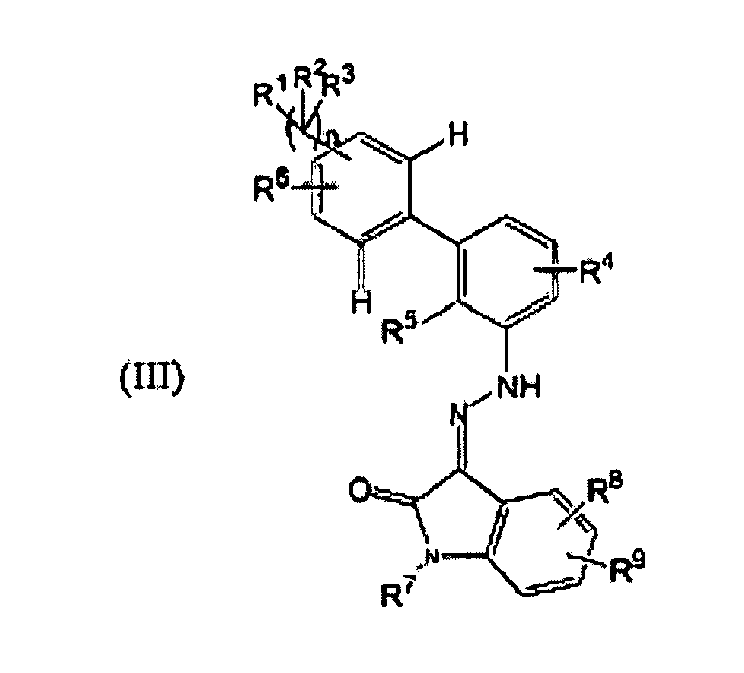 R1 aus CO2R10, CONR10R11, SO3R10 und einem Carbonsäure-Bioisoster, das aus Tetrazol, NHSO2R15, OC(S)NR10R11 und
 R2 und R3 jeweils unabhängig aus Null, Wasserstoff, OR12, NR12R13, einem optional substituierten C1-C4 Aliphat, einem optional substituierten C1-C4 Haloaliphat, einem optional substituierten C1-C4 Heteroaliphat, einem optional substituierten Ring und (CH2)mR14 ausgewählt werden; oder R2 und R3 zusammen ein optional substituiertes Olefin bilden; oder R2 und R3 verbunden werden, um einen optional substituierten C3-C8 Ring zu bilden;R4 aus Wasserstoff, F, Cl, Br, C1-C4 Aliphat, C1-C4 Haloaliphat, C1-C4 Heteroaliphat und einem Ring ausgewählt wird;R5 aus Wasserstoff, OR10 SR10 NHR11 und CO2H ausgewählt wird;R6 aus Wasserstoff, OR12, NR12R13, F, Cl, Br, C1-C4 Alkyl, C1-C4 Haloalkyl und C1-C4 Heteroalkyl ausgewählt wird;R7 aus Wasserstoff, einem optional substituierten C1-C8 Aliphat, einem optional substituierten C1-C8 Haloaliphat, einem optional substituierten C1-C8 Heteroaliphat, einem optional substituierten C1-C8 Heterohaloaliphat, einem optional substituierten Ring und (CH2) mR14 ausgewählt wird;R8 und R9 jeweils unabhängig aus Wasserstoff, F, Cl, Br, CO2R10, NO2 CN, SO2R10 , (CH2) mR14, C1-C4 Aliphat, C1-C4 Haloaliphat, C1-C4 Heteroaliphat und C1-C4 Heterohaloaliphat ausgewählt werden;R10 aus Wasserstoff, einem optional substituierten C1-C4 Aliphat, C1-C4 Haloaliphat, C1-C4 Heteroaliphat und einem Ring ausgewählt wird;R11 aus Wasserstoff, SO2R15, C1-C4 Aliphat, C1-C4 Haloaliphat, C1-C4 Heteroaliphat und einem Ring ausgewählt wird;R12 und R13 jeweils unabhängig aus Wasserstoff, einem optional substituierten C1-C4 Aliphat, einem optional substituierten C1-C4 Haloaliphat, einem optional substituierten C1-C4 Heteroaliphat, einem optional substituierten Ring und (CH2)mR14 ausgewählt werden; oder eines von R12 und R13 ein optional substituierter C2-C6 Aliphat oder ein optional substituierter Ring ist und das andere von R12 und R13 Null ist; oder R12 und R13 verbunden sind, um einen optional substituierten C3-C8 Ring zu bilden;R14 aus einem optional substituierten Aryl und einem optional substituierten Heteroaryl ausgewählt wird;R15 aus Wasserstoff, C1-C3 Aliphat, C1-C3 Haloaliphat und einem Ring ausgewählt wird;m 0, 1 oder 2 ist; undn 0 oder 1 ist.
 - Eine Verbindung nach Anspruch 1, wobei:R2 und R3 jeweils unabhängig aus Wasserstoff, OR12, NR12 R13, einem optional substituierten C1-C4 Alkyl, einem optional substituierten C1-C4 Haloalkyl, einem optional substituierten C1-C4 Heteroalkyl, einem optional substituierten Ring und (CH2)mR14 ausgewählt werden; oder R2 und R3 zusammen ein optional substituiertes Olefin bilden; oder R2 und R3 verbunden sind, um einen optional substituierten C3-C8 Ring zu bilden;R4 aus Wasserstoff, F, Cl, Br, C1-C4 Alkyl, C1-C4 Haloalkyl, C1-C4 Heteroalkyl und einem nicht-aromatischen Ring ausgewählt wird;R7aus Wasserstoff, einem optional substituierten C1-C8 Alkyl, einem optional substituierten C1-C8 Haloalkyl, einem optional substituierten C1-C8 Heteroalkyl, einem optional substituierten C1-C8 Heterohaloalkyl, einem optional substituierten aromatischen Ring und (CH2)mR14 ausgewählt wird;R8und R9 jeweils unabhängig aus Wasserstoff, F, Cl, Br, CO2R10, NO2 , CN, SO2R10, (CH2)mR14, C1-C4 Alkyl, C1-C4 Haloalkyl, C1-C4 Heteroalkyl und C1-C4 Heterohaloalkyl ausgewählt werden;R10 aus Wasserstoff, einem optional substituierten C1-C4 Alkyl, C1-C4 Haloalkyl, C1-C4 Heteroalkyl und einem nicht-aromatischen Ring ausgewählt wird;R11 aus Wasserstoff, SO2R15, C1-C4 Alkyl, C1-C4 Haloalkyl und C1-C4 Heteroalkyl und einem nicht-aromatischen Ring ausgewählt wird;R12 und R13 jeweils unabhängig aus Wasserstoff, einem optional substituierten C1-C4 Alkyl, einem optional substituierten C1-C4 Haloalkyl, einem optional substituierten C1-C4 Heteroalkyl, einem nicht-aromatischen Ring und (CH2)mR14 ausgewählt werden; oder eines von R12 und R13 ein optional substituiertes C2-C6 Alkyl oder ein nicht-aromatischer Ring ist, und das andere von R12 und R13 Null ist; oder R12 und R13 verbunden sind, um einen optional substituierten C3-C8 Ring zu bilden; undR15 aus Wasserstoff, C1-C3 Alkyl, C1-C3 Haloalkyl und Aryl ausgewählt wird.
- Die Verbindung nach Anspruch 1, die ausgewählt wird aus:3'-{N'-[1-(3,4-Dimethyl-phenyl)-2-oxo-1,2-dihydro-indol-3-yliden]-hydrazino}-2'-hydroxy-biphenyl-3-carbonsäure;2'-Hydroxy-3'-{N'-[2-oxo-1-(4-propyl-phenyl)-1,2-dihydro-indol-3-yliden]-hydrazino}-biphenyl-3-carbonsäure;2'-Hydroxy-3'-{N'-[2-oxo-1-(4-ethyl-phenyl)-1,2-dihydro-indol-3-yliden]-hydrazino}-biphenyl-3-carbonsäure;2'-Hydroxy-3'-{N'-[2-oxo-1-(4-trifluoromethoxy-phenyl)-1,2-dihydro-indol-3-yliden]-hydrazino}-biphenyl-3-carbonsäure;3'-{N'-[1-(3-Fluoro-4-methoxy-phenyl)-2-oxo-1,2-dihydro-indol-3-yliden]-hydrazino}-2'-hydroxy-biphenyl-3-carbonsäure;3'-{N'-[1-(3,4-Dimethyl-phenyl)-2-oxo-1,2-dihydro-indol-3-yliden]-hydrazino}-2'-hydroxy-biphenyl-4-carbonsäure;2'-Hydroxy-3'-{N'-[2-oxo-1-(4-propyl-phenyl)-1,2-dihydro-indol-3-yliden]-hydrazino}-biphenyl-4-carbonsäure;2'-Hydroxy-3'-{N'-[2-oxo-1-(4-ethyl-phenyl)-1,2-dihydro-indol-3-yliden]-hydrazino}-biphenyl-4-carbonsäure;3'-{N'-[1-(4-tert-Butyl-phenyl)-2-oxo-1,2-dihydro-indol-3-yliden]-hydrazino}-2'-hydroxy-biphenyl-3-carbonsäure;2'-Hydroxy-3'-{N'-[2-oxo-1-(4-trifluoromethyl-phenyl)-1,2-dihydro-indol-3-yliden]-hydrazino}-biphenyl-3-carbonsäure;3'-[N'-(1-Benzyl-5-chloro-2-oxo-1,2-dihydro-indol-3-yliden)-hydrazino]-2'-hydroxy-biphenyl-3-carbonsäure;3'[N'-(1-Benzyl-5-methyl-2-oxo-1,2-dihydro-indol-3-yliden)-hydrazino]-2'-hydroxy-biphenyl-3-carbonsäure;3'-[N'-(1-Benzyl-2-oxo-1,2-dihydro-indol-3-yliden)-hydrazino]-2'-hydroxy-biphenyl-3-carbonsäure;2'-Hydroxy-3'-{N'-[2-oxo-1-(4-trifluoromethyl-phenyl)-1,2-dihydro-indol-3-yliden]-hydrazino)}-biphenyl-4-carbonsäure;3'-{N'-[1-(3,4-Dichloro-phenyl)-2-oxo-1,2-dihydro-indol-3-yliden]-hydrazino}-2'-hydroxy-biphenyl-3-carbonsäure;2'-Hydroxy-3'-{N'-[1-(4-methyl-3-trifluoromethyl-phenyl)-2-oxo-1,2-dihydro-indol-3-yliden]-hydrazino}-biphenyl-3-carbonsäure;3'-{N'-[1-(3-Fluoro-4-trifluoromethyl-phenyl)-2-oxo-1,2-dihydro-indol-3-yliden]-hydrazino}-2'-hydroxybiphenyl-3-carbonsäure;3'-{N'-[1-(3,5-Bis-trifluoromethyl-phenyl)-2-oxo-1,2-dihydro-indol-3-yliden]-hydrazino}-2'-hydroxy-biphenyl-3-carbonsäure;2'-Hydroxy-3'-{N'-[1-(4-isopropyl-phenyl)-2-oxo-1,2-dihydro-indol-3-yliden]-hydrazino}-biphenyl-3-carbonsäure;3'-{N'-[1-(2-Fluoro-4-trifluoromethyl-phenyl)-2-oxo-1,2-dihydro-indol-3-yliden]-hydrazino}-2'-hydroxybiphenyl-3-carbonsäure;3'-{N'-[1-(2-Fluoro-4-methyl-phenyl)-2-oxo-1,2-dihydro-indol-3-yliden]-hydrazino}-2'-hydroxy-biphenyl-3-carbonsäure;3'-{N'-[1-(4-Chloro-3-trifluoromethyl-phenyl)-2-oxo-1,2-dihydro-indol-3-yliden]-hydrazino}-2'-hydroxybiphenyl-3-carbonsäure;3'-{N'-[1-(4-Butyl-phenyl)-2-oxo-1,2-dihydro-indol-3-yliden]-hydrazino}-2'-hydroxy-biphenyl-3-carbonsäure;3'-{N'-[1-(3-Fluoro-phenyl)-2-oxo-1,2-dihydro-indol-3-yliden]-hydrazino}-2'-hydroxy-biphenyl-3-carbonsäure;2'-Hydroxy-3'-[N'-(2-oxo-1-m-tolyl-1,2-dihydro-indol-3-yliden)-hydrazino]-biphenyl-3-carbonsäure;3'-{N'-[1-(4-Fluoro-phenyl)-2-oxo-1,2-dihydro-indol-3-yliden]-hydrazino}-2'-hydroxy-biphenyl-3-carbonsäure;3'-[N'-(1-Benzyl-5-methoxy-2-oxo-1,2-dihydro-indol-3-yliden)-hydrazino]-2'-hydroxy-biphenyl-3-carbonsäure;2'-Hydroxy-3'-{N'-[2-oxo-1-(3-trifluoromethyl-phenyl)-1,2-dihydro-indol-3-yliden]-hydrazino}-biphenyl-3-carbonsäure;3'-{N'-[5-Chloro-1-(4-isopropyl-phenyl)-2-oxo-1,2-dihydro-indol-3-yliden]-hydrazino}-2'-hydroxy-biphenyl-3-carbonsäure;3'-{N'-[6-Chloro-1-(4-isopropyl-phenyl)-2-oxo-1,2-dihydro-indol-3-yliden]-hydrazino}-2'-hydroxy-biphenyl-3-carbonsäure;3'-{N'-[5-Fluoro-1-(4-isopropyl-phenyl)-2-oxo-1,2-dihydro-indol-3-yliden]-hydrazino}-2'-hydroxy-biphenyl-3-carbonsäure;3'-{N'-[5-Methoxy-1-(4-isopropyl-phenyl)-2-oxo-1,2-dihydro-indol-3-yliden]-hydrazino}-2'-hydroxy-biphenyl-3-carbonsäure;3'-{N'-[1-(3,4-Dimethyl-phenyl)-5-fluoro-2-oxo-1,2-dihydro-indol-3-yliden]-hydrazino}-2'-hydroxy-biphenyl-3-carbonsäure;3'-{N'-[1-(4-Fluoro-3-trifluoromethyl-phenyl)-5-fluoro-2-oxo-1,2-dihydro-indol-3-yliden]-hydrazino}-2'-hydroxy-biphenyl-3-carbonsäure;3'-{N'-[1-(3,5-Dichloro-phenyl)-5-fluoro-2-oxo-1,2-dihydro-indol-3-yliden]-hydrazino}-2'-hydroxy-biphenyl-3-carbonsäure;3'-{N'-[1-(4-Propyl-phenyl)-6-chloro-2-oxo-1,2-dihydro-indol-3-yliden]-hydrazino}-2'-hydroxy-biphenyl-3-carbonsäure; undein pharmazeutisch geeignetes Salz, Ester und Amid davon.
- Die Verbindung nach Anspruch 1, die ausgewählt wird aus:(±)-2'-Hydroxy-3'-(N'-{2-oxo-1-[4-(2,2,2-trifluoro-1-hydroxy-ethyl)-phenyl]-1,2-dihydro-indol-3-yliden}-hydrazino)-biphenyl-3-carbonsäure;(±)-2'-Hydroxy-3'-(N'-{2-oxo-1-[4-(2,2,2-trifluoro-1-methoxy-ethyl)-phenyl]-1,2-dihydro-indol-3-yliden}-hydrazino)-biphenyl-3-carbonsäure;2'-Hydroxy-3'-(N'-{2-oxo-1-[4-(2,2,2-trifluoro-ethyl)-phenyl]-1,2-dihydro-indol-3-yliden}-hydrazino)-biphenyl-3-carbonsäure;3'-{N'-[1-(3,4-Dimethyl-phenyl)-4,5-dimethyl-2-oxo-1,2-dihydro-indol-3-yliden]-hydrazino}-2'-hydroxybiphenyl-3-carbonsäure;3'-{N'-[1-(3,4-Dimethyl-phenyl)-5-fluoro-4-methyl-2-oxo-1,2-dihydro-indol-3-yliden]-hydrazino}-2'-hydroxybiphenyl-3-carbonsäure;3'-{N'-[1-(3,4-Dimethyl-phenyl)-5-fluoro-6-methyl-2-oxo-1,2-dihydro-indol-3-yliden]-hydrazino}-2'-hydroxybiphenyl-3-carbonsäure;3'-{N'-[1-(3,4-Dimethyl-phenyl)-4-fluoro-2-oxo-6-trifluoromethyl-1,2-dihydro-indol-3-yliden]-hydrazino}-2'-hydroxy-biphenyl-3-carbonsäure;3'-{N'-[4-Chloro-1-(3,4-dimethyl-phenyl)-2-oxo-6-trifluoromethyl-1,2-dihydro-indol-3-yliden]-hydrazino}-2'-hydroxy-biphenyl-3-carbonsäure;3'-{N'-[5-Chloro-2-oxo-1-(4-propyl-phenyl)-1,2-dihydro-indol-3-yliden]-hydrazino}-2'-hydroxy-biphenyl-3-carbonsäure;2'-Hydroxy-3'-{N'-[1-(4-methylsulfanyl-phenyl)-2-oxo-1,2-dihydro-indol-3-yliden]-hydrazino}-biphenyl-3-carbonsäure;2'-Hydroxy-3'-{N'-[1-(4-methoxymethyl-phenyl)-2-oxo-1,2-dihydro-indol-3-yliden]-hydrazino}-biphenyl-3-carbonsäure;(±)-2'-Hydroxy-3'-(N'-{2-oxo-1-[4-(2,2,2-trifluoro-1-hydroxy-1-methyl-ethyl)-phenyl]-1,2-dihydro-indol-3-yliden}-hydrazino)-biphenyl-3-carbonsäure;3'-{N'-[5-Fluoro-1-(4-methyl-3-trifluoromethyl-phenyl)-2-oxo-1,2-dihydro-indol-3-yliden]-hydrazino}-2'-hydroxy-biphenyl-3-carbonsäure;2'-Hydroxy-3'-(N'-{2-oxo-1-[4-(2,2,2-trifluoro-1-methoxy-1-methyl-ethyl)-phenyl]-1,2-dihydro-indol-3-yliden}-hydrazino)-biphenyl-3-carbonsäure;3'-{N'-[1-(3,4-Dimethyl-phenyl)-6-fluoro-2-oxo-1,2-dihydro-indol-3-yliden]-hydrazino}-2'-hydroxy-biphenyl-3-carbonsäure;3'-{N'-[6-Fluoro-1-(4-isopropyl-phenyl)-2-oxo-1,2-dihydro-indol-3-yliden]-hydrazino}-2'-hydroxy-biphenyl-3-carbonsäure;3'-{N'-[1-(3,4-Dimethyl-phenyl)-2-oxo-5-trifluoromethyl-1,2-dihydro-indol-3-yliden]-hydrazino}-2'-hydroxy-biphenyl-3-carbonsäure;3'-{N'-[6-Fluoro-2-oxo-1-(4-propyl-phenyl)-1,2-dihydro-indol-3-yliden]-hydrazino}-2'-hydroxy-biphenyl-3-carbonsäure;2'-Hydroxy-3'-{N'-[2-oxo-1-(4-propyl-phenyl)-5-trifluoromethyl-1,2-dihydro-indol-3-yliden]-hydrazino}-biphenyl-3-carbonsäure;3'-{N'-[4,5-Difluoro-1-(4-isopropyl-phenyl)-2-oxo-1,2-dihydro-indol-3-yliden]-hydrazino}-2'-hydroxybiphenyl-3-carbonsäure;2'-Hydroxy-3'-[N'-(2-oxo-1-piperidin-4-yl-1,2-dihydro-indol-3-yliden)-hydrazino]-biphenyl-3-carbonsäure;3'-{N'-[5-Fluoro-1-(2-fluoro-4-methyl-phenyl)-2-oxo-1,2-dihydro-indol-3-yliden]-hydrazino}-2'-hydroxybiphenyl-3-carbonsäure;2'-Hydroxy-3'-[N'-(1-methyl-2-oxo-1,2-dihydro-indol-3-yliden)-hydrazino]-biphenyl-3-carbonsäure;3'-[N'-(1-Cyclopentyl-2-oxo-1,2-dihydro-indol-3-yliden)-hydrazino]-2'-hydroxy-biphenyl-3-carbonsäure;3'-{N'-[1-(3,4-Dimethyl-phenyl)-6-methyl-2-oxo-1,2-dihydro-indol-3-yliden]-hydrazino}-2'-hydroxy-biphenyl-3-carbonsäure;2'-Hydroxy-3'-[N'-(2-oxo-1-phenyl-1,2-dihydro-indol-3-yliden)-hydrazino]-biphenyl-3-carbonsäure;3'-[N'-(6-Fluoro-2-oxo-1-phenyl-2,3-dihydro-1H-indol-3-yl)-hydrazino]-2'-hydroxy-biphenyl-3-carbonsäure;3'-{N'-[1-(3,4-Dimethyl-phenyl)-6-isopropyl-2-oxo-1,2-dihydro-indol-3-yliden]-hydrazino}-2'-hydroxybiphenyl-3-carbonsäure;3'-{N'-[1-(3,4-Dimethyl-phenyl)-4-isopropyl-2-oxo-1,2-dihydro-indol-3-yliden]-hydrazino}-2'-hydroxybiphenyl-3-carbonsäure;3'-{N'-[1-(3,4-Dimethyl-phenyl)-2-oxo-6-trifluoromethyl-1,2-dihydro-indol-3-yliden]-hydrazino}-4-fluoro-2'-hydroxy-biphenyl-3-carbonsäure;5'-Chloro-3'-{N'-[1-(3,4-dimethyl-phenyl)-2-oxo-6-trifluoromethyl-1,2-dihydro-indol-3-yliden]-hydrazino}-4-fluoro-2'-hydroxy-biphenyl-3-carbonsäure;3'-{N'-[1-(3,4-Dimethyl-phenyl)-2-oxo-6-trifluoromethyl-1,2-dihydro-indol-3-yliden]-hydrazino}-6-fluoro-2'-hydroxy-biphenyl-3-carbonsäure;3'-{N'-[1-(3,4-Dimethyl-phenyl)-4,5-difluoro-2-oxo-1,2-dihydro-indol-3-yliden]-hydrazino}-2'-hydroxybiphenyl-3-carbonsäure;3'-{N'-[1-(3,4-Dimethyl-phenyl)-2-oxo-6-trifluoromethyl-1,2-dihydro-indol-3-yliden]-hydrazino}-2'-hydroxy-3-methyl-biphenyl-4-carbonsäure;3'-{N'-[1-(3,4-Dimethyl-phenyl)-2-oxo-6-trifluoromethyl-2,3-dihydro-1H-indol-3-yl]-hydrazino}-2-fluoro-2'-hydroxy-biphenyl-4-carbonsäure;3'-{N'-[1-(3,4-Dimethyl-phenyl)-4-fluoro-2-oxo-6-trifluoromethyl-2,3-dihydro-1H-indol-3-yl]-hydrazino}-4-fluoro-2'-hydroxy-biphenyl-3-carbonsäure;5'-Chloro-3'-{N'-[1-(3,4-dimethyl-phenyl)-4-fluoro-2-oxo-6-trifluoromethyl-1,2-dihydro-indol-3-yliden]-hydrazino}-4-fluoro-2'-hydroxy-biphenyl-3-carbonsäure;3-[(3'-Carboxy-2-hydroxy-biphenyl-3-yl)-hydrazono]-1-(3,5-dimethyl-phenyl)-2-oxo-2,3-dihydro-1H-indol-6-carbonsäuremethylester;3-[(3'-Carboxy-4'-fluoro-2-hydroxy-biphenyl-3-yl)-hydrazono]-1-(3,5-dimethyl-phenyl)-2-oxo-2,3-dihydro-1H-indol-6-carbonsäuremethylester;3-[(3'-Carboxy-4'-fluoro-2-hydroxy-biphenyl-3-yl)-hydrazono]-1-(3,4-dimethyl-phenyl)-2-oxo-2,3-dihydro-1H-indol-6-carbonsäuremethylester;3-[(3'-Carboxy-5-chloro-4'-fluoro-2-hydroxy-biphenyl-3-yl)-hydrazono]-1-(3,5-dimethyl-phenyl)-2-oxo-2,3-dihydro-1H-indol-6-carbonsäuremethylester;3'-{N'-[1-(2-Cyano-thiophen-3-yl)-2-oxo-1,2-dihydro-indol-3-yliden]-hydrazino}-2'-hydroxy-biphenyl-3-carbonsäure;2'-Hydroxy-3'-[N'-(2-oxo-1-thiophen-3-yl-1,2-dihydro-indol-3-yliden)-hydrazino]-biphenyl-3-carbonsäure;3-[(3'-Carboxy-2-hydroxy-biphenyl-3-yl)-hydrazono]-1-(3,4-dimethyl-phenyl)-2-oxo-2,3-dihydro-1H-indol-6-carbonsäuremethylester;3'-{N'-[1-(4-Chloro-3-trifluoromethyl-phenyl)-6-cyano-2-oxo-1,2-dihydro-indol-3-yliden]-hydrazino}-2'-hydroxy-biphenyl-3-carbonsäure;5'-Chloro-3'-{N'-[6-cyano-1-(4-isopropyl-phenyl)-2-oxo-1,2-dihydro-indol-3-yliden]-hydrazino}-4-fluoro-2'-hydroxy-biphenyl-3-carbonsäure;3'-{N'-[6-Cyano-1-(4-isopropyl-phenyl)-2-oxo-1,2-dihydro-indol-3-yliden]-hydrazino}-4-fluoro-2'-hydroxybiphenyl-3-carbonsäure;(±)-1-(3,4-Dimethyl-phenyl)-3-{[2-hydroxy-3'-(2,2,2-trifluoro-1-hydroxy-ethyl)-biphenyl-3-yl]-hydrazono}-6-methansulfonyl-1,3-dihydro-indol-2-on;3'-{N'-[6-Cyano-1-(4-isopropyl-phenyl)-2-oxo-1,2-dihydro-indol-3-yliden]-hydrazino}-2'-hydroxy-biphenyl-3-carbonsäure;3'-{N'-[1-(3,4-Dimethyl-phenyl)-5-nitro-2-oxo-1,2-dihydro-indol-3-yliden]-hydrazino}-2'-hydroxy-biphenyl-3-carbonsäure;3'-{N'-[1-(3,4-Dimethyl-phenyl)-6-methansulfonyl-2-oxo-1,2-dihydro-indol-3-yliden]-hydrazino}-2'-hydroxybiphenyl-3-carbonsäure;3'-{N'-[6-Cyano-1-(3,4-dimethyl-phenyl)-2-oxo-1,2-dihydro-indol-3-yliden]-hydrazino}-2'-hydroxy-biphenyl-3-carbonsäure;3'-{N'-[1-(5-Cyano-pyridin-3-yl)-2-oxo-1,2-dihydro-indol-3-yliden]-hydrazino}-2'-hydroxy-biphenyl-3-carbonsäure;3'-[N'-(1-Furan-3-yl-2-oxo-1,2-dihydro-indol-3-yliden)-hydrazino]-2'-hydroxy-biphenyl-3-carbonsäure;3'-[N'-(1-Benzo[1,3]dioxol-5-yl-2-oxo-1,2-dihydro-indol-3-yliden)-hydrazino]-2'-hydroxy-biphenyl-3-carbonsäure;2'-Hydroxy-3'-{N'-[1-(3-methyl-thiophen-2-yl)-2-oxo-1,2-dihydro-indol-3-yliden]-hydrazino}-biphenyl-3-carbonsäure;2'-Hydroxy-3'-[N'-(2-oxo-1-thiophen-2-yl-1,2-dihydro-indol-3-yliden)-hydrazino]-biphenyl-3-carbonsäure;2'-Hydroxy-3'-{N'-[1-(4-isopropyl-phenyl)-2-oxo-6-trifluoromethyl-1,2-dihydro-indol-3-yliden]-hydrazino}-biphenyl-3-carbonsäure;2'-Hydroxy-3'-{N'-[2-oxo-1-(4-propyl-phenyl)-6-trifluoromethyl-1,2-dihydro-indol-3-yliden]-hydrazino}-biphenyl-3-carbonsäure;3'-{N'-[1-(4-Ethyl-phenyl)-5,7-difluoro-2-oxo-1,2-dihydro-indol-3-yliden]-hydrazino}-2'-hydroxy-biphenyl-3-carbonsäure;3'-{N'-[1-(3,4-Dimethyl-phenyl)-5,7-difluoro-2-oxo-1,2-dihydro-indol-3-yliden]-hydrazino}-2'-hydroxybiphenyl-3-carbonsäure;3'-{N'-[5,7-Difluoro-2-oxo-1-(4-propyl-phenyl)-1,2-dihydro-indol-3-yliden]-hydrazino}-2'-hydroxy-biphenyl-3-carbonsäure;3'-{N'-[5,7-Difluoro-1-(4-isopropyl-phenyl)-2-oxo-1,2-dihydro-indol-3-yliden]-hydrazino}-2'-hydroxybiphenyl-3-carbonsäure;3'-{N'-[1-(3,4-Dimethyl-phenyl)-2-oxo-6-trifluoromethyl-1,2-dihydro-indol-3-yliden]-hydrazino}-2'-hydroxy-biphenyl-3-carbonsäure;3'-{N'-[1-(3,4-Dimethyl-phenyl)-6-ethyl-2-oxo-1,2-dihydro-indol-3-yliden]-hydrazino}-2'-hydroxy-biphenyl-3-carbonsäure;3'-{N'-[1-(3,4-Dimethyl-phenyl)-6-methoxy-2-oxo-1,2-dihydro-indol-3-yliden]-hydrazino}-2'-hydroxy-biphenyl-3-carbonsäure;3'-{N'-[5-Chloro-1-(3,4-dimethyl-phenyl)-2-oxo-6-trifluoromethyl-1,2-dihydro-indol-3-yliden]-hydrazino}-2'-hydroxy-biphenyl-3-carbonsäure;3'-{N'-[1-(3,4-Dimethyl-phenyl)-6,7-dimethyl-2-oxo-1,2-dihydro-indol-3-yliden]-hydrazino}-2'-hydroxybiphenyl-3-carbonsäure;2-(3'-{N'-[1-(3,4-Dimethyl-phenyl)-2-oxo-6-trifluoromethyl-1,2-dihydro-indol-3-yliden]-hydrazino}-2'-hydroxy-biphenyl-4-yl)-2-methyl-propionsäure;(-)-2-(3'-{N'-[1-(3,4-Dimethyl-phenyl)-2-oxo-6-trifluoromethyl-1,2-dihydro-indol-3-yliden]-hydrazino}-2'-hydroxy-biphenyl-4-yl)-propionsäure;(+)-2-(3'-{N'-[1-(3,4-Dimethyl-phenyl)-2-oxo-6-trifluoromethyl-1,2-dihydro-indol-3-yliden]-hydrazino}-2'-hydroxy-biphenyl-4-yl)-propionsäure;(±)-(3'-{N'-[1-(3,4-Dimethyl-phenyl)-2-oxo-6-trifluoromethyl-1,2-dihydro-indol-3-yliden]-hydrazino}-2'-hydroxy-5'-methyl-biphenyl-4-yl)-propionsäure;(±)-2-(3'-{N'-[1-(3,4-Dimethyl-phenyl)-2-oxo-6-trifluoromethyl-1,2-dihydro-indol-3-yliden]-hydrazino}-5'-fluoro-2'-hydroxy-biphenyl-4-yl)-propionsäure;3'-{N'-[1-(3,4-Dimethyl-phenyl)-2-oxo-6-trifluoromethyl-1,2-dihydro-indol-3-yliden]-hydrazino}-5'-fluoro-2'-hydroxy-biphenyl-3-carbonsäure;5'-Chloro-3'-{N'-[1-(3,4-dimethyl-phenyl)-2-oxo-6-tnfluoromethyl-1,2-dihydro-indol-3-yliden]-hydrazino}-2'-hydroxy-biphenyl-3-carbonsäure;3'-{N'-[1-(3,4-Dimethyl-phenyl)-2-oxo-6-trifluoromethyl-1,2-dihydro-indol-3-yliden]-hydrazino}-2'-hydroxy-5'-methyl-biphenyl-3-carbonsäure;2'-Hydroxy-3'-{N'-[2-oxo-6-trifluoromethyl-1-(4-trifluoromethyl-phenyl)-1,2-dihydro-indol-3-yliden]-hydrazino}-biphenyl-3-carbonsäure;3'-{N'-[1-(4-Ethyl-3-methyl-phenyl)-2-oxo-6-trifluoromethyl-1,2-dihydro-indol-3-yliden]-hydrazino}-2'-hydroxy-biphenyl-3-carbonsäure;3'-{N'-[1-(4-Chloro-3-trifluoromethyl-phenyl)-2-oxo-6-trifluoromethyl-1,2-dihydro-indol-3-yliden]-hydrazino}-2'-hydroxy-biphenyl-3-carbonsäure;3'-{N'-[1-(3,5-Dimethyl-phenyl)-2-oxo-6-trifluoromethyl-1,2-dihydro-indol-3-yliden]-hydrazino}-5'-fluoro-2'-hydroxy-biphenyl-3-carbonsäure;3'-{N'-[1-(3,4-Dimethyl-phenyl)-2-oxo-6-trifluoromethyl-1,2-dihydro-indol-3-yliden]-hydrazino}-4,5'-difluoro-2'-hydroxy-biphenyl-3-carbonsäure;3'-{N'-[1-(3,5-Dimethyl-phenyl)-2-oxo-6-trifluoromethyl-1,2-dihydro-indol-3-yliden]-hydrazino}-4,5'-difluoro-2'-hydroxy-biphenyl-3-carbonsäure;4,5'-Difluoro-2'-hydroxy-3'-{N'-[2-oxo-6-trifluoromethyl-1-(4-trifluoromethyl-phenyl)-1,2-dihydro-indol-3-yliden]-hydrazino}-biphenyl-3-carbonsäure;3'-{N'-[1-(4-Fluoro-3,5-dimethyl-phenyl)-2-oxo-6-trifluoromethyl-1,2-dihydro-indol-3-yliden]-hydrazino}-2'-hydroxy-biphenyl-3-carbonsäure;2'-Hydroxy-3'-{N'-[1-(4-methoxy-phenyl)-2-oxo-6-trifluoromethyl-1,2-dihydro-indol-3-yliden]-hydrazino}-biphenyl-3-carbonsäure;3'-{N'-[1-(4-Fluoro-phenyl)-2-oxo-6-trifluoromethyl-1,2-dihydro-indol-3-yliden]-hydrazino}-2'-hydroxybiphenyl-3-carbonsäure;3'-{N'-[1-(3,5-Dimethoxy-phenyl)-2-oxo-6-trifluoromethyl-1,2-dihydro-indol-3-yliden]-hydrazino}-2'-hydroxy-biphenyl-3-carbonsäure;3'-{N'-[1-(3,4-Dimethoxy-phenyl)-2-oxo-6-trifluoromethyl-1,2-dihydro-indol-3-yliden]-hydrazino}-2'-hydroxy-biphenyl-3-carbonsäure;3'-{N'-[1-(3,5-Difluoro-phenyl)-2-oxo-6-trifluoromethyl-1,2-dihydro-indol-3-yliden]-hydrazino}-2'-hydroxy-biphenyl-3-carbonsäure;5'-Fluoro-3'-{N'-[1-(4-fluoro-3,5-dimethyl-phenyl)-2-oxo-6-trifluoromethyl-1,2-dihydro-indol-3-yliden]-hydrazino}-2'-hydroxy-biphenyl-3-carbonsäure;4,5'-Difluoro-3'-{N'-[1-(4-fluoro-3,5-dimethyl-phenyl)-2-oxo-6-trifluoromethyl-1,2-dihydro-indol-3-yliden]-hydrazino}-2'-hydroxy-biphenyl-3-carbonsäure;2'-Hydroxy-3'-{N'-[1-(4-methoxy-3,5-dimethyl-phenyl)-2-oxo-6-trifluoromethyl-1,2-dihydro-indol-3-yliden]-hydrazino}-biphenyl-3-carbonsäure;2'-Hydroxy-3'-{N'-[1-(4-hydroxy-3,5-dimethyl-phenyl)-2-oxo-6-trifluoromethyl-1,2-dihydro-indol-3-yliden]-hydrazino}-biphenyl-3-carbonsäure;3'-{N'-[1-(4-Cyclohexyl-phenyl)-2-oxo-1,2-dihydro-indol-3-yliden]-hydrazino}-2'-hydroxy-biphenyl-3-carbonsäure;2'-Hydroxy-3'-[N'-(2-oxo-l-pyridin-2-yl-1,2-dihydro-indol-3-yliden)-hydrazino]-biphenyl-3-carbonsäure;2'-Hydroxy-3'-[N'-(2-oxo-1-pyridin-3-yl-1,2-dihydro-indol-3-yliden)-hydrazino]-biphenyl-3-carbonsäure;3'-{N'-[1-(4-Ethyl-phenyl)-2-oxo-6-trifluoromethyl-1,2-dihydro-indol-3-yliden]-hydrazino}-2'-hydroxybiphenyl-3-carbonsäure;3'-{N'-[1-(4-Ethyl-phenyl)-4-fluoro-2-oxo-6-trifluoromethyl-1,2-dihydro-indol-3-yliden]-hydrazino}-2'-hydroxy-biphenyl-3-carbonsäure;3-[(3'-Carboxy-2-hydroxy-biphenyl-3-yl)-hydrazono]-1-(3,5-dimethyl-phenyl)-2-oxo-2,3-dihydro-1-H-indol-5-carbonsäuremethylester;3'-{N'-[1-(3-Chloro-4-methyl-phenyl-2-oxo-6-trifluoromethyl-1,2-dihydro-indol-3-yliden]-hydrazino}-2'-hydroxy-biphenyl-3-carbonsäure;2'-Hydroxy-3'-(N'-{2-oxo-1-[4-(4,4,4-trifluoro-butyl)-phenyl]-1,2-dihydro-indol-3-yliden}-hydrazino)-biphenyl-3-carbonsäure;3'-{N'-[1-(3,5-Dimethyl-phenyl)-4-fluoro-2-oxo-6-trifluoromethyl-1,2-dihydro-indol-3-yliden]-hydrazino}-2'-hydroxy-biphenyl-3-carbonsäure;3'-{N'-[1-(4-tert-Butyl-phenyl)-2-oxo-6-trifluoromethyl-1,2-dihydro-indol-3-yliden]-hydrazino}-2'-hydroxy-biphenyl-3-carbonsäure;3'-{N'-[1-(3,4-Dimethyl-phenyl)-2-oxo-6-trifluoromethyl-1,2-dihydro-indol-3-yliden]-hydrazino}-2'-hydroxy-biphenyl-4-carbonsäure;3'-{N'-[1-(3,4-Dimethyl-phenyl)-2-oxo-6-bromo-1,2-dihydro-indol-3-yliden]-hydrazino}-2'-hydroxy-biphenyl-3-carbonsäure;3'-{N'-[1-(3,4-Dimethyl-phenyl)-2-oxo-6-trifluoromethyl-1,2-dihydro-indol-3-yliden]-hydrazino}-3-fluoro-2'-hydroxy-biphenyl-4-carbonsäure;3'-{N'-[1-(3,5-Bis-trifluoromethyl-phenyl)-2-oxo-6-frifluoromethyl-1,2-dihydro-indol-3-yliden]-hydrazino}-2'-hydroxy-biphenyl-3-carbonsäure;3'-{N'-[1-(3,4-Dichloro-phenyl)-2-oxo-6-trifluoromethyl-1,2-dihydro-indol-3-yliden]-hydrazino}-2'-hydroxy-biphenyl-3-carbonsäure;3'-{N'-[1-(3,5-Dichloro-phenyl)-2-oxo-6-trifluoromethyl-1,2-dihydro-indol-3-yliden]-hydrazino}-2'-hydroxy-biphenyl-3-carbonsäure;2'-Hydroxy-3'-[N'-(2-oxo-7-phenyl-1,2-dihydro-indol-3-yliden)-hydrazino]-biphenyl-3-carbonsäure;3'-{N'-[1-(3,4-Dimethyl-phenyl)-2-oxo-6-trifluoromethoxy-1,2-dihydro-indol-3-yliden]-hydrazino}-2'-hydroxy-biphenyl-3-carbonsäure;
3'-{N'-[1-(3,4-Dimethyl-phenyl)-2-oxo-6-(1,1,2,2-tetrafluoro-ethoxy)-1,2-dihydro-indol-3-yliden]-hydrazino)-2'-hydroxy-biphenyl-3-carbonsäure;
3'-{N'-[1-(3,4-Dimethyl-phenyl)-5-methyl-2-oxo-1,2-dihydro-indol-3-yliden]-hydrazino}-2'-hydroxy-biphenyl-3-carbonsäure;
3'-{N'-[1-(4-Isopropyl-phenyl)-5-methyl-2-oxo-1,2-dihydro-indol-3-yliden]-hydrazino}-2'-hydroxy-biphenyl-3-carbonsäure;
3'-{N'-[1-(3,4-Dimethyl-phenyl)-6-phenyl-2-oxo-1,2-dihydro-indol-3-yliden]-hydrazino)-2'-hydroxy-biphenyl-3-carbonsäure;
3'-{N'-[1-(3-Trifluoromethyl-phenyl)-6-trifluoromethyl-2-oxo-1,2-dihydro-indol-3-yliden]-hydrazino}-2'-hydroxy-biphenyl-3-carbonsäure;
3'-{N'-[1-(4-Trifluoromethoxy-phenyl)-5-trifluoromethoxy-2-oxo-1,2-dihydro-indol-3-yliden]-hydrazino}-2'-hydroxy-biphenyl-3-carbonsäure;
3'-{N'-[1-(3,5-Dimethyl-phenyl)-6-trifluoromethyl-2-oxo-1,2-dihydro-indol-3-yliden]-hydrazino}-2'-hydroxybiphenyl-3-carbonsäure;
3'-{N'-[1-(3-Trifluoromethyl-phenyl)-4,6-dimethyl-2-oxo-1,2-dihydro-indol-3-yliden]-hydrazino}-2'-hydroxybiphenyl-3-carbonsäure;
3'-{N'-[1-(3-Trifluoromethyl-phenyl)-5,6-dimethyl-2-oxo-1,2-dihydro-indol-3-yliden]-hydrazino}-2'-hydroxybiphenyl-3-carbonsäure;
3'-{N'-[1-(3,5-Dimethyl-phenyl)-6-trifluoromethyl-2-oxo-1,2-dihydro-indol-3-yliden]-hydrazino}-2'-hydroxy-5'-chloro-4-fluoro-biphenyl-3-carbonsäure;
3'-{N'-[1-(3,5-Dimethyl-phenyl)-6-trifluoromethyl-2-oxo-1,2-dihydro-indol-3-yliden]-hydrazino}-2'-hydroxy-4-fluoro-biphenyl-3-carbonsäure;3'-{N'-[6-Chloro-1-(3,4-dimethyl-phenyl)-2-oxo-1,2-dihydro-indol-3-yliden]-hydrazino}-2'-hydroxy-biphenyl-3-carbonsäure;3'-{N'-[5-Fluoro-2-oxo-1-(4-propyl-phenyl)-1,2-dihydro-indol-3-yliden]-hydrazino}-2'-hydroxy-biphenyl-3-carbonsäure;3'-{N'-[5-Cyano-1-(3,4-dimethyl-phenyl)-2-oxo-1,2-dihydro-indol-3-yliden]-hydrazino}-2'-hydroxy-biphenyl-3-carbonsäure;3'-{N'-[6-Chloro-1-(3,5-dimethyl-phenyl)-2-oxo-1,2-dihydro-indol-3-yliden]-hydrazino}-2'-hydroxy-biphenyl-3-carbonsäure;4-Fluoro-3'-{N-[1-(3-fluoro-4-methyl-phenyl)-2-oxo-6-trifluoromethyl-1,2-dihydro-indol-3-yliden]-hydrazino}-2'-hydroxy-biphenyl-3-carbonsäure; undein pharmazeutisch geeignetes Salz, Ester oder Amid davon. - Die Verbindung nach Anspruch 1, die ausgewählt wird aus:3'-{N'-[1-(4-Chloro-3,5-dimethylphenyl)-2-oxo-6-trifluoromethyl-1,2-dihydroindol-3-yliden]hydrazino}-2'-hydroxy-biphenyl-3-carbonsäure;3'-{N'-[1-(3,5-Dimethylphenyl)-4-fluoro-2-oxo-6-trifluoromethyl-1,2-dihydroindol-3-yliden]hydrazino}-2'-hydroxybiphenyl-4-fluoro-3-carbonsäure;3'-{N'-[1-Benzo[1,3]dioxo-5-yl-2-oxo-6-trifluoromethyl-1,2-dihydroindol-3-yliden]hydrazino}-2'-hydroxybiphenyl-3-carbonsäure;3'-{N'-[1-Benzo[1,3]dioxo-5-yl-2-oxo-6-trifluoromethyl-1,2-dihydroindol-3-yliden]hydrazino}-2'-hydroxybiphenyl-2-fluoro-3-carbonsäure;3'-{N'-[1-(3,5-Dimethylphenyl)-2-oxo-6-trifluoromethyl-1,2-dihydroindol-3-yliden]hydrazino}-2'-hydroxybiphenyl-2-hydroxy-3-carbonsäure;3'-{N'-[1-(3-Methoxycarbonylphenyl)-2-oxo-6-trifluoromethyl-1,2-dihydroindol-3-yliden]hydrazino}-2'-hydroxybiphenyl-3-carbonsäure;3'-{N'-[1-(3-Methoxycarbonylphenyl)-2-oxo-1,2-dihydroindol-3-yliden]hydrazino}-2'-hydroxy-biphenyl-3-carbonsäure;3'-{N'-[1-(3,5-Dimethylphenyl)-2-oxo-1,2-dihydroindol-6-trifluoromethyl-3-yliden]hydrazino}-2'-hydroxybiphenyl-3-(2-methyl-2-propionsäure; undein pharmazeutisch geeignetes Salz, Ester und Amid davon.
- Die Verbindung nach Anspruch 1, die aus 3'-{N'-[6-Chloro-1-(4-isopropyl-phenyl)-2-oxo-1,2-dihydro-indol-3-yliden]-hydrazino)-2'-hydroxy-biphenyl-3-carbonsäure und einem pharmazeutisch geeigneten Salz davon ausgewählt wird.
- Die Verbindung nach Anspruch 1, die aus 3'-{N'-[1-(4-Propyl-phenyl)-6-chloro-2-oxo-1,2-dihydro-indol-3-yliden]-hydrazino}-2'-hydroxy-biphenyl-3-carbonsäure und einem pharmazeutisch geeigneten Salz davon ausgewählt wird.
- Die Verbindung nach Anspruch 1, die aus 3'-{N'-[1-(3,4-Dimethyl-phenyl)-4-fluoro-2-oxo-6-trifluoromethyl-1,2-dihydro-indol-3-yliden]-hydrazino)-2'-hydroxy-biphenyl-3-carbonsäure und einem pharmazeutisch geeigneten Salz davon ausgewählt wird.
- Die Verbindung nach Anspruch 1, die aus 3'-{N'-[1-(3,4-Dimethyl-phenyl)-6-fluoro-2-oxo-1,2-dihydro-indol-3-yliden]-hydrazino)-2'-hydroxy-biphenyl-3-carbonsäure und einem pharmazeutisch geeigneten Salz davon ausgewählt wird.
- Die Verbindung nach Anspruch 1, die aus 3'-{N'-[6-Fluoro-1-(4-isopropyl-phenyl)-2-oxo-1,2-dihydro-indol-3-yliden]-hydrazino)-2'-hydroxy-biphenyl-3-carbonsäure und einem pharmazeutisch geeigneten Salz davon ausgewählt wird.
- Die Verbindung nach Anspruch 1, die aus 3'-{N'-[6-Fluoro-2-oxo-1-(4-propyl-phenyl)-1,2-dihydro-indol-3-yliden]-hydrazino)-2'-hydroxy-biphenyl-3-carbonsäure und einem pharmazeutisch geeigneten Salz davon ausgewählt wird.
- Die Verbindung nach Anspruch 1, die aus 2'-Hydroxy-3'-{N'-[1-(4-isopropyl-phenyl)-2-oxo-6-trifluoromethyl-1,2-dihydro-indol-3-yliden]-hydrazino}-biphenyl-3-carbonsäure und einem pharmazeutisch geeigneten Salz davon ausgewählt wird.
- Die Verbindung nach Anspruch 1, die aus 2'-Hydroxy-3'-{N'-[2-oxo-1-(4-propyl-phenyl)-6-trifluoromethyl-1,2-dihydro-indol-3-yliden]-hydrazino}-biphenyl-3-carbonsäure und einem pharmazeutisch geeigneten Salz davon ausgewählt wird.
- Die Verbindung nach Anspruch 1, die aus 3'-{N'-[1-(3,4-Dimethyl-phenyl)-2-oxo-6-trifluoromethyl-1,2-dihydro-indol-3-yliden]-hydrazino)-2'-hydroxy-biphenyl-3-carbonsäure und einem pharmazeutisch geeigneten Salz davon ausgewählt wird.
- Die Verbindung nach Anspruch 1, die aus 3'-{N'-[1-(4-Ethyl-phenyl)-2-oxo-6-trifluoromethyl-1,2-dihydro-indol-3-yliden]-hydrazino}-2'-hydroxy-biphenyl-3-carbonsäure und einem pharmazeutisch geeigneten Salz davon ausgewählt wird.
- Die Verbindung nach Anspruch 1, die aus 3'-{N'-[1-(4-Ethyl-phenyl)-4-fluoro-2-oxo-6-trifluoromethyl-1,2-dihydro-indol-3-yliden]-hydrazino}-2'-hydroxy-biphenyl-3-carbonsäure und einem pharmazeutisch geeigneten Salz davon ausgewählt wird.
- Die Verbindung nach Anspruch 1, die aus 3'-{N'-[1-(3,5-Dimethyl-phenyl)-4-fluoro-2-oxo-6-trifluoromethyl-1,2-dihydro-indol-3-yliden]-hydrazino}-2'-hydroxy-biphenyl-3-carbonsäure und einem pharmazeutisch geeigneten Salz davon ausgewählt wird.
- Die Verbindung nach Anspruch 1, die aus 3'-{N'-[1-(3,5-Dimethyl-phenyl)-6-trifluoromethyl-2-oxo-1,2-dihydro-indol-3-yliden]-hydrazino}-2'-hydroxy-biphenyl-3-carbonsäure und einem pharmazeutisch geeigneten Salz davon ausgewählt wird.
- Die Verbindung nach Anspruch 1, die aus 3'-{N'-[6-Chloro-1-(3,4-dimethyl-phenyl)-2-oxo-1,2-dihydro-indol-3-yliden]-hydrazino}-2'-hydroxy-biphenyl-3-carbonsäure und einem pharmazeutisch geeigneten Salz davon ausgewählt wird.
- Die Verbindung nach Anspruch 1, die aus 3'-{N'-[6-Chloro-1-(3,5-dimethyl-phenyl)-2-oxo-1,2-dihydro-indol-3-yliden]-hydrazino}-2'-hydroxy-biphenyl-3-carbonsäure und einem pharmazeutisch geeigneten Salz davon ausgewählt wird.
- Die Verbindung nach Anspruch 1, wobei:R2 und R3 jeweils unabhängig aus Wasserstoff, OR12, NR12R13, einem optional substituierten C1-C4 Alkyl, einem optional substituierten C1-C4 Haloalkyl, einem optional substituierten C1-C4 Heteroalkyl und (CH2)mR14 ausgewählt werden;R4 aus Wasserstoff, F, Cl, Br, C1-C4 Alkyl, C1-C4 Haloalkyl und C1-C4 Heteroalkyl ausgewählt wird;R5 aus OR10, SR10, NHR11 und CO2H ausgewählt wird;R7 aus Wasserstoff, einem optional substituierten C1-C8 Alkyl, einem optional substituierten C1-C8 Haloalkyl, einem optional substituierten C1-C8 Heteroalkyl, einem optional substituierten C1-C8 Heterohaloalkyl, einem optional substituierten aromatischen Ring und (CH2)mR14 ausgewählt wird;R8 und R9 jeweils unabhängig aus Wasserstoff, F, Cl, Br, CO2R10, NO2, CN, SO2R10, (CH2)mR14, C1-C4 Alkyl, C1-C4 Haloalkyl, C1-C4 Heteroalkyl und C1-C4 Heterohaloalkyl ausgewählt werden;R10 aus Wasserstoff, einem optional substituierten C1-C4 Alkyl, C1-C4 Haloalkyl und C1-C4 Heteroalkyl ausgewählt wird;R11 aus Wasserstoff, SO2R15, C1-C4 Alkyl, C1-C4 Haloalkyl und C1-C4 Heteroalkyl ausgewählt wird;R12 und R13 jeweils unabhängig aus Wasserstoff, einem optional substituierten C1-C4 Alkyl, einem optional substituierten C1-C4 Haloalkyl, einem optional substituierten C1-C4 Heteroalkyl und (CH2)mR14 ausgewählt werden; undR15 aus Wasserstoff, C1-C3 Alkyl, C1-C3 Haloalkyl und Aryl ausgewählt wird.
- Eine Verbindung nach einem der Ansprüche 1-21, die ein selektiver TPO Modulator ist.
- Eine Verbindung nach Anspruch 22, die ein TPO Mimetikum ist.
- Eine Verbindung nach Anspruch 22, die ein selektiver TPO Rezeptor-Agonist ist.
- Eine Verbindung nach Anspruch 22, die ein selektiver TPO Rezeptor-Teilagonist ist.
- Eine Verbindung nach Anspruch 22, die ein selektiver TPO Rezeptor-Antagonist ist.
- Eine Verbindung nach einem der Ansprüche 1-21, die eine selektive TPO Rezeptor-Bindungsverbindung ist.
- Eine Verbindung nach einem der Ansprüche 1-21 für die Modulation einer TPO Aktivität in einer Zelle.
- Ein in vitro Verfahren zur Identifizierung einer Verbindung, die eine TPO Aktivität moduliert, das das In-Kontakt-bringen einer Zelle, die einen TPO Rezeptor exprimiert, mit einer Verbindung nach einem der Ansprüche 1-21 und das Beobachten einer Wirkung der Verbindung auf die Zelle umfasst.
- Eine Verbindung nach einem der Ansprüche 1-21 zur Behandlung von Thrombozytopenie.
- Die Verbindung nach Anspruch 30, wobei die Thrombozytopenie aus Bestrahlung oder Chemotherapie resultiert.
- Die Verbindung nach Anspruch 30, wobei die Zellen von einem Patienten geerntet werden.
- Die Verbindung nach Anspruch 30, wobei die Behandlung prophylaktisch ist.
- Eine pharmazeutische Zusammensetzung, die einen physiologisch geeigneten Träger, Verdünnungsmittel oder Austauschstoff und eine Verbindung nach einem der Ansprüche 1-21 umfasst.
- Die pharmazeutische Zusammensetzung nach Anspruch 34 für die Verwendung in der Behandlung von Thrombozytopenie.
Applications Claiming Priority (3)
| Application Number | Priority Date | Filing Date | Title |
|---|---|---|---|
| US62187904P | 2004-10-25 | 2004-10-25 | |
| US67500105P | 2005-04-25 | 2005-04-25 | |
| PCT/US2005/038055 WO2006047344A1 (en) | 2004-10-25 | 2005-10-21 | Thrombopoietin activity modulating compounds and methods |
Publications (2)
| Publication Number | Publication Date |
|---|---|
| EP1805155A1 EP1805155A1 (de) | 2007-07-11 |
| EP1805155B1 true EP1805155B1 (de) | 2010-11-03 |
Family
ID=35610075
Family Applications (1)
| Application Number | Title | Priority Date | Filing Date |
|---|---|---|---|
| EP05813834A Expired - Lifetime EP1805155B1 (de) | 2004-10-25 | 2005-10-21 | Verbindungen modulierende thrombopoietinaktivität und verfahren |
Country Status (15)
| Country | Link |
|---|---|
| US (3) | US7314887B2 (de) |
| EP (1) | EP1805155B1 (de) |
| JP (1) | JP4728340B2 (de) |
| KR (1) | KR100958337B1 (de) |
| AR (1) | AR051940A1 (de) |
| AT (1) | ATE486859T1 (de) |
| AU (1) | AU2005299720B2 (de) |
| BR (1) | BRPI0516883A (de) |
| CA (1) | CA2583764C (de) |
| DE (1) | DE602005024599D1 (de) |
| IL (2) | IL182763A (de) |
| MX (1) | MX2007004765A (de) |
| NO (1) | NO20072199L (de) |
| NZ (1) | NZ554662A (de) |
| WO (1) | WO2006047344A1 (de) |
Families Citing this family (20)
| Publication number | Priority date | Publication date | Assignee | Title |
|---|---|---|---|---|
| CY2010012I2 (el) * | 2000-05-25 | 2020-05-29 | Novartis Ag | Μιμητικα θρομβοποιητινης |
| WO2005118551A2 (en) * | 2004-05-28 | 2005-12-15 | Ligand Pharmaceuticals Inc. | Thrombopoietin activity modulating compounds and methods |
| MX2007004765A (es) * | 2004-10-25 | 2007-07-09 | Ligand Pharm Inc | Compuestos y metodos que modulan la actividad de la trombopoyetina. |
| WO2007062078A2 (en) * | 2005-11-23 | 2007-05-31 | Ligand Pharmaceuticals Inc. | Thrombopoietin activity modulating compounds and methods |
| WO2008070583A2 (en) * | 2006-12-01 | 2008-06-12 | Stategics, Inc. | Thrombopoietin mimetics |
| US20090304634A1 (en) * | 2006-12-12 | 2009-12-10 | Smithkline Beecham Corporation | Novel Combinations |
| WO2008074078A1 (en) * | 2006-12-19 | 2008-06-26 | University Of Wollongong | Selectively deliverable isatin-based cytotoxic agents |
| UY30915A1 (es) * | 2007-02-16 | 2008-09-02 | Smithkline Beecham Corp | Método de tratamiento de canceres |
| US20110129550A1 (en) * | 2007-02-16 | 2011-06-02 | Connie Erickson-Miller | Cancer treatment method |
| US20110160130A1 (en) * | 2007-02-16 | 2011-06-30 | Connie Erickson-Miller | Cancer treatment method |
| CN101888841B (zh) * | 2007-10-09 | 2012-09-26 | 宾夕法尼亚大学理事会 | 血小板生成素受体激动剂(TpoRA)杀死急性人骨髓样白血病细胞 |
| WO2009140464A1 (en) * | 2008-05-16 | 2009-11-19 | Ligand Pharmaceuticals, Inc. | Methods of administration of thrombopoietin mimetic compounds |
| US8476249B2 (en) | 2009-05-07 | 2013-07-02 | Glaxosmithkline Llc | Method of treating thrombocytopenia |
| US8680150B2 (en) * | 2009-05-28 | 2014-03-25 | Ligand Pharmaceuticals, Inc. | Small molecule hematopoietic growth factor mimetic compounds that activate hematopoietic growth factor receptors |
| US9492430B2 (en) | 2011-11-14 | 2016-11-15 | Ligand Pharmaceuticals, Incorporated | Methods and compositions associated with the granulocyte colony-stimulating factor receptor |
| US9962370B2 (en) | 2013-03-15 | 2018-05-08 | Ligand Pharmaceuticals Incorporated | Methods of treatment associated with the granulocyte colony-stimulating factor receptor |
| CN105744935B (zh) | 2013-11-27 | 2022-09-30 | 雷德伍德生物科技股份有限公司 | 肼基-吡咯并化合物及用于生成缀合物的方法 |
| ES2908470T3 (es) | 2015-11-09 | 2022-04-29 | Scherer Technologies Llc R P | Conjugados de anticuerpo anti-CD22-maitansina y métodos de uso de los mismos |
| CN106632407A (zh) * | 2016-09-30 | 2017-05-10 | 陕西科技大学 | 一种具抗肿瘤活性的不对称双7‑n杂靛红席夫碱类化合物的合成方法 |
| US20220194939A1 (en) * | 2019-04-17 | 2022-06-23 | Colorado Research Partners, Llc | Novel compounds and methods of use treating fructose-related disorders or diseases |
Family Cites Families (79)
| Publication number | Priority date | Publication date | Assignee | Title |
|---|---|---|---|---|
| US3148192A (en) * | 1961-06-27 | 1964-09-08 | Roussel Uclaf | Halogenated 20alpha-yohimbane compounds |
| DE193633C (de) | ||||
| BE653800A (de) | ||||
| DE450819C (de) | 1924-12-24 | 1927-10-20 | Chemische Ind Ges | Verfahren zur Herstellung von chromhaltigen Azofarbstoffen |
| GB252957A (en) * | 1926-02-19 | 1926-06-10 | Chem Fab Vormals Sandoz | Manufacture of diazotizable azo-dyestuffs and intermediate products therefor |
| GB898706A (en) * | 1957-09-20 | 1962-06-14 | Polaroid Corp | Azo dyes derived from dihydroxyphenyl ketones and their use in photography |
| BE594503A (de) * | 1959-08-29 | |||
| GB1080864A (en) | 1963-02-26 | 1967-08-23 | Ici Ltd | Five membered heterocyclic systems and their use as fungicides |
| GB1269781A (en) * | 1968-11-12 | 1972-04-06 | Ici Ltd | Alkanolamine derivatives |
| US3966900A (en) * | 1969-03-12 | 1976-06-29 | Airwick Industries, Inc. | Evaporator system comprising a stabilized pesticidal phosphoric acid ester and method for stabilizing such ester enclosed in an evaporator |
| US3754857A (en) * | 1969-08-27 | 1973-08-28 | American Cyanamid Co | Polyethylene terephthalate,nylon and organic esters of cellulose dyedwith 5-(2-nitro-pranisylazo) barbituric acid |
| DE3164935D1 (en) * | 1980-02-18 | 1984-08-30 | Basf Ag | Dyestuffs containing imidazolylethylene groups and their use |
| US4322533A (en) * | 1980-03-17 | 1982-03-30 | Lesher George Y | 1H-Indole-2,3-dione derivatives |
| DE3329340A1 (de) | 1983-08-13 | 1985-03-07 | Basf Ag, 6700 Ludwigshafen | Verlackungsmittel enthaltende farbstoffzubereitungen basischer farbstoffe |
| DE3434379A1 (de) * | 1984-09-19 | 1986-03-20 | Basf Farben + Fasern Ag, 2000 Hamburg | Pigmentzubereitungen |
| GB8431426D0 (en) * | 1984-12-13 | 1985-01-23 | Glaxo Group Ltd | Chemical compounds |
| DE3743235A1 (de) * | 1987-12-19 | 1989-06-29 | Bayer Ag | Basische farbstoffe |
| DE3810958A1 (de) | 1988-03-31 | 1989-10-12 | Basf Ag | Tinten fuer ink-jet-aufzeichnungsverfahren |
| GB8816944D0 (en) * | 1988-07-15 | 1988-08-17 | Sobio Lab | Compounds |
| JP2683097B2 (ja) | 1989-04-28 | 1997-11-26 | キヤノン株式会社 | 電子写真感光体 |
| US5164404A (en) * | 1991-03-15 | 1992-11-17 | Neurosearch A/S | Hydrazone derivatives and their use |
| JP2709750B2 (ja) * | 1991-03-27 | 1998-02-04 | 富士写真フイルム株式会社 | ハロゲン化銀写真感光材料 |
| US5298658A (en) * | 1991-12-20 | 1994-03-29 | E. I. Du Pont De Nemours And Company | Photographic elements with reduced print-through |
| DE4335623A1 (de) | 1993-10-19 | 1995-04-20 | Henkel Kgaa | Indolinon-Derivate zum Färben keratinhaltiger Fasern |
| US5482546A (en) * | 1994-03-30 | 1996-01-09 | Canon Kabushiki Kaisha | Dye, ink containing the same, and ink-jet recording method and instrument using the ink |
| DE69503849T2 (de) | 1994-03-31 | 1999-04-01 | Amgen Inc., Thousand Oaks, Calif. | Zusammensetzungen und Verfahren zur Anregung des Wachstums und der Differenzierung von Megakaryozyten |
| US6184363B1 (en) * | 1997-06-13 | 2001-02-06 | Northwestern University | Inhibitors of β-lactamases and uses therefor |
| US6075044A (en) * | 1997-07-21 | 2000-06-13 | The Regents Of The University Of California | Heterocyclic derivatives as inhibitors of purine salvage phosphoribosyltransferases |
| GB9718913D0 (en) * | 1997-09-05 | 1997-11-12 | Glaxo Group Ltd | Substituted oxindole derivatives |
| US6649631B1 (en) * | 1997-10-23 | 2003-11-18 | The Board Of Regents Of The University Of Texas System | Compositions and methods for treating bone deficit conditions |
| GC0000177A (en) * | 1998-12-17 | 2006-03-29 | Smithkline Beecham | Thrombopoietin mimetics |
| JP2000206645A (ja) | 1999-01-18 | 2000-07-28 | Fuji Photo Film Co Ltd | 画像形成材料および画像形成方法 |
| GB9904933D0 (en) * | 1999-03-04 | 1999-04-28 | Glaxo Group Ltd | Compounds |
| CA2380206A1 (en) * | 1999-07-26 | 2001-02-01 | Shionogi & Co., Ltd. | Pharmaceutical compositions exhibiting thrombopoietin receptor agonism |
| WO2001017349A1 (en) | 1999-09-10 | 2001-03-15 | Smithkline Beckman Corporation | Thrombopoietin mimetics |
| JP2003509462A (ja) * | 1999-09-24 | 2003-03-11 | スミスクライン・ビーチャム・コーポレイション | トロンボポイエチン模倣物 |
| US6720345B1 (en) * | 1999-11-05 | 2004-04-13 | Smithkline Beecham Corporation | Semicarbazone derivatives and their use as thrombopoietin mimetics |
| JP2001152055A (ja) | 1999-11-26 | 2001-06-05 | Fuji Photo Film Co Ltd | インクジェット記録用インクおよびそれを用いた画像記録方法 |
| CY2010012I2 (el) * | 2000-05-25 | 2020-05-29 | Novartis Ag | Μιμητικα θρομβοποιητινης |
| JP4359382B2 (ja) | 2000-07-11 | 2009-11-04 | 富士フイルム株式会社 | 新規なヒドラゾン色素 |
| AU2001288374A1 (en) * | 2000-09-01 | 2002-03-22 | Glaxo Group Limited | Substituted oxindole derivatives as tyrosine kinase inhibitors |
| US6964977B2 (en) * | 2000-09-01 | 2005-11-15 | Smithkline Beecham Corporation | Oxindole derivatives |
| US6642265B1 (en) * | 2000-09-08 | 2003-11-04 | Smithkline Beecham Corporation | Thrombopoietin mimetics |
| JP2002129073A (ja) | 2000-10-20 | 2002-05-09 | Fuji Photo Film Co Ltd | 油性インク組成物 |
| JP2002129072A (ja) | 2000-10-20 | 2002-05-09 | Fuji Photo Film Co Ltd | インクジェット記録用インク及びそれを用いた画像記録方法 |
| EP1349613A4 (de) * | 2000-12-19 | 2005-09-21 | Smithkline Beecham Corp | Thrombopoietinmimetika |
| JP2004532614A (ja) * | 2000-12-21 | 2004-10-28 | スミスクライン・ビーチャム・コーポレイション | 金属キレート化アゴニストによる細胞膜受容体の活性化の調節 |
| US7169931B2 (en) * | 2001-01-26 | 2007-01-30 | Shionogi & Co., Ltd. | Cyclic compounds exhibiting thrombopoietin receptor agonism |
| JP2004527541A (ja) * | 2001-03-01 | 2004-09-09 | スミスクライン・ビーチャム・コーポレイション | トロンボポエチン模倣物 |
| US20030165873A1 (en) * | 2001-03-02 | 2003-09-04 | Come Jon H. | Three hybrid assay system |
| GB0106343D0 (en) * | 2001-03-14 | 2001-05-02 | Avecia Ltd | Compounds compositions and processes |
| EP1416799A4 (de) * | 2001-07-23 | 2004-11-10 | Univ Ramot | Verfahren und zusammensetzungen zur behandlung von pilzinfektionen |
| US6916798B2 (en) * | 2001-08-03 | 2005-07-12 | Vertex Pharmaceuticals Incorporated | Inhibitors of GSK-3 and uses thereof |
| JP2003128946A (ja) | 2001-10-26 | 2003-05-08 | Fuji Photo Film Co Ltd | 新規なアゾ色素、及び該アゾ色素の互変異性体 |
| GB0126036D0 (en) | 2001-10-30 | 2001-12-19 | Amedis Pharm Ltd | Silicon compounds |
| US7638536B2 (en) * | 2002-01-18 | 2009-12-29 | Astellas Pharma Inc. | 2-Acylaminothiazole derivative or salt thereof |
| WO2003074497A1 (en) * | 2002-03-01 | 2003-09-12 | Pintex Pharmaceutical, Inc. | Pin1-modulating compounds and methods of use thereof |
| CN1652770A (zh) | 2002-03-29 | 2005-08-10 | 利兰·斯坦福青年大学托管委员会 | 使用抑制素和其它免疫调节剂治疗自身免疫病 |
| US20030229453A1 (en) * | 2002-04-09 | 2003-12-11 | Antonysamy Stephen Suresh | Crystals and structures of PAK4KD kinase PAK4KD |
| JP2003313450A (ja) | 2002-04-22 | 2003-11-06 | Fuji Photo Film Co Ltd | アゾ色素及びその互変異性体 |
| JP2003335972A (ja) | 2002-05-21 | 2003-11-28 | Fuji Photo Film Co Ltd | アゾ化合物及びその製造方法 |
| AR040083A1 (es) * | 2002-05-22 | 2005-03-16 | Smithkline Beecham Corp | Compuesto bis-(monoetanolamina) del acido 3'-[(2z)-[1-(3,4-dimetilfenil) -1,5-dihidro-3-metil-5-oxo-4h-pirazol-4-iliden] hidrazino] -2'-hidroxi-[1,1'-bifenil]-3-carboxilico, procedimiento para prepararlo, composicion farmaceutica que lo comprende, procedimiento para preparar dicha composicion farmac |
| WO2003103686A1 (en) * | 2002-06-06 | 2003-12-18 | Smithkline Beecham Corporation | Thrombopoietin mimetics |
| TWI324593B (en) * | 2002-10-09 | 2010-05-11 | Nissan Chemical Ind Ltd | Pyrazolone compounds and thrombopoietin receptor activator |
| JP2004143118A (ja) | 2002-10-28 | 2004-05-20 | Fuji Photo Film Co Ltd | アゾ化合物及びその互変異性体、並びに、その製造方法 |
| US20060084682A1 (en) * | 2002-12-13 | 2006-04-20 | Heerding Dirk A | Thrombopoietin mimetics |
| US20040253178A1 (en) * | 2002-12-20 | 2004-12-16 | Shane Atwell | Crystals and structures of spleen tyrosine kinase SYKKD |
| EP2387998A1 (de) * | 2003-04-29 | 2011-11-23 | Glaxosmithkline LLC | Verfahren zur Behandlung von degenerativen Erkrankungen/Verletzungen |
| EP1638487A2 (de) * | 2003-05-28 | 2006-03-29 | Medcool, Inc. | Verfahren und geräte für die wärmeaktivierung einer konsole eines wärmeabgabesystems |
| UA82695C2 (uk) * | 2003-06-06 | 2008-05-12 | Нисан Кемикал Индастриз, Лтд. | Гетероароматичні сполуки як активатори рецептора тромбопоетину |
| EP1755574A4 (de) | 2004-04-06 | 2009-05-13 | Semafore Pharmaceuticals Inc | Pten-inhibitoren |
| CN100569076C (zh) | 2004-05-12 | 2009-12-16 | 拜尔作物科学有限公司 | 植物生长调节作用 |
| WO2005118551A2 (en) | 2004-05-28 | 2005-12-15 | Ligand Pharmaceuticals Inc. | Thrombopoietin activity modulating compounds and methods |
| SE0401790D0 (sv) | 2004-07-07 | 2004-07-07 | Forskarpatent I Syd Ab | Tamoxifen response in pre- and postmenopausal breast cancer patients |
| MX2007004765A (es) | 2004-10-25 | 2007-07-09 | Ligand Pharm Inc | Compuestos y metodos que modulan la actividad de la trombopoyetina. |
| GT200500321A (es) | 2004-11-09 | 2006-09-04 | Compuestos y composiciones como inhibidores de proteina kinase. | |
| US7563781B2 (en) | 2005-01-14 | 2009-07-21 | Janssen Pharmaceutica Nv | Triazolopyrimidine derivatives |
| WO2007062078A2 (en) | 2005-11-23 | 2007-05-31 | Ligand Pharmaceuticals Inc. | Thrombopoietin activity modulating compounds and methods |
| US20070162308A1 (en) | 2006-01-11 | 2007-07-12 | Peters James D | System and methods for performing distributed transactions |
-
2005
- 2005-10-21 MX MX2007004765A patent/MX2007004765A/es active IP Right Grant
- 2005-10-21 AT AT05813834T patent/ATE486859T1/de not_active IP Right Cessation
- 2005-10-21 KR KR1020077011701A patent/KR100958337B1/ko not_active Expired - Fee Related
- 2005-10-21 JP JP2007538100A patent/JP4728340B2/ja not_active Expired - Lifetime
- 2005-10-21 BR BRPI0516883-0A patent/BRPI0516883A/pt not_active Application Discontinuation
- 2005-10-21 US US11/256,572 patent/US7314887B2/en not_active Expired - Lifetime
- 2005-10-21 EP EP05813834A patent/EP1805155B1/de not_active Expired - Lifetime
- 2005-10-21 WO PCT/US2005/038055 patent/WO2006047344A1/en not_active Ceased
- 2005-10-21 AU AU2005299720A patent/AU2005299720B2/en not_active Ceased
- 2005-10-21 DE DE602005024599T patent/DE602005024599D1/de not_active Expired - Lifetime
- 2005-10-21 CA CA002583764A patent/CA2583764C/en not_active Expired - Fee Related
- 2005-10-21 NZ NZ554662A patent/NZ554662A/en not_active IP Right Cessation
- 2005-10-25 AR ARP050104466A patent/AR051940A1/es not_active Application Discontinuation
-
2007
- 2007-04-23 IL IL182763A patent/IL182763A/en not_active IP Right Cessation
- 2007-04-27 NO NO20072199A patent/NO20072199L/no not_active Application Discontinuation
- 2007-11-08 US US11/937,392 patent/US7691895B2/en not_active Expired - Fee Related
- 2007-12-21 US US11/963,115 patent/US20080103190A1/en not_active Abandoned
-
2008
- 2008-05-19 IL IL191542A patent/IL191542A/en not_active IP Right Cessation
Also Published As
| Publication number | Publication date |
|---|---|
| IL182763A0 (en) | 2007-07-24 |
| CA2583764A1 (en) | 2006-05-04 |
| WO2006047344A1 (en) | 2006-05-04 |
| US20080146594A1 (en) | 2008-06-19 |
| NO20072199L (no) | 2007-06-05 |
| NZ554662A (en) | 2008-11-28 |
| KR100958337B1 (ko) | 2010-05-17 |
| BRPI0516883A (pt) | 2008-09-23 |
| IL182763A (en) | 2010-12-30 |
| JP2008517932A (ja) | 2008-05-29 |
| IL191542A0 (en) | 2008-11-03 |
| CA2583764C (en) | 2009-06-09 |
| AU2005299720B2 (en) | 2010-02-04 |
| US7314887B2 (en) | 2008-01-01 |
| AR051940A1 (es) | 2007-02-21 |
| JP4728340B2 (ja) | 2011-07-20 |
| DE602005024599D1 (de) | 2010-12-16 |
| US20060116417A1 (en) | 2006-06-01 |
| IL191542A (en) | 2013-08-29 |
| EP1805155A1 (de) | 2007-07-11 |
| MX2007004765A (es) | 2007-07-09 |
| US7691895B2 (en) | 2010-04-06 |
| US20080103190A1 (en) | 2008-05-01 |
| KR20070084506A (ko) | 2007-08-24 |
| ATE486859T1 (de) | 2010-11-15 |
| AU2005299720A1 (en) | 2006-05-04 |
Similar Documents
| Publication | Publication Date | Title |
|---|---|---|
| US7691895B2 (en) | Thrombopoietin activity modulating compounds and methods | |
| EP2488486B1 (de) | Kleinmolekülige mimetische verbindung mit blutbildenden wachstumsfaktoren und ihre verwendungen | |
| EP1951667A2 (de) | Thrombopoietinaktivitätsmodulierende verbindungen und verfahren | |
| US7662804B2 (en) | Thrombopoietin activity modulating compounds and methods | |
| US20100063301A1 (en) | Synthesis of thrombopoietin activity modulating compounds | |
| US11413274B2 (en) | Methods and compositions associated with the granulocyte colony-stimulating factor receptor | |
| US8680150B2 (en) | Small molecule hematopoietic growth factor mimetic compounds that activate hematopoietic growth factor receptors | |
| ES2353805T3 (es) | Compuestos y procedimientos para modular la actividad de la trombopoyetina. | |
| MX2008006653A (en) | Thrombopoietin activity modulating compounds and methods | |
| JP2023506321A (ja) | 心臓病の治療のための心筋細胞増殖活性を有する複素環式誘導体の使用 |
Legal Events
| Date | Code | Title | Description |
|---|---|---|---|
| PUAI | Public reference made under article 153(3) epc to a published international application that has entered the european phase |
Free format text: ORIGINAL CODE: 0009012 |
|
| 17P | Request for examination filed |
Effective date: 20070516 |
|
| AK | Designated contracting states |
Kind code of ref document: A1 Designated state(s): AT BE BG CH CY CZ DE DK EE ES FI FR GB GR HU IE IS IT LI LT LU LV MC NL PL PT RO SE SI SK TR |
|
| AX | Request for extension of the european patent |
Extension state: AL BA HR MK YU |
|
| RIN1 | Information on inventor provided before grant (corrected) |
Inventor name: MCNEILL, MATTHEW H. Inventor name: NGUYEN, BAO N. Inventor name: DALGARD, JACKLINE E. Inventor name: MILLER, TODD A. Inventor name: PHILLIPS, DEAN P. Inventor name: PENULAIR, RICHARD J. Inventor name: ZHI, LIN Inventor name: LAU, THOMAS Inventor name: RUPPAR, DANIEL A. Inventor name: CHEN, JYUN-HUNG Inventor name: KALLEL, ADAM E. |
|
| 17Q | First examination report despatched |
Effective date: 20080505 |
|
| GRAP | Despatch of communication of intention to grant a patent |
Free format text: ORIGINAL CODE: EPIDOSNIGR1 |
|
| GRAS | Grant fee paid |
Free format text: ORIGINAL CODE: EPIDOSNIGR3 |
|
| GRAA | (expected) grant |
Free format text: ORIGINAL CODE: 0009210 |
|
| AK | Designated contracting states |
Kind code of ref document: B1 Designated state(s): AT BE BG CH CY CZ DE DK EE ES FI FR GB GR HU IE IS IT LI LT LU LV MC NL PL PT RO SE SI SK TR |
|
| AX | Request for extension of the european patent |
Extension state: AL BA HR MK YU |
|
| REG | Reference to a national code |
Ref country code: GB Ref legal event code: FG4D |
|
| REG | Reference to a national code |
Ref country code: CH Ref legal event code: EP |
|
| REG | Reference to a national code |
Ref country code: IE Ref legal event code: FG4D |
|
| REF | Corresponds to: |
Ref document number: 602005024599 Country of ref document: DE Date of ref document: 20101216 Kind code of ref document: P |
|
| REG | Reference to a national code |
Ref country code: ES Ref legal event code: FG2A Effective date: 20110223 |
|
| REG | Reference to a national code |
Ref country code: NL Ref legal event code: VDEP Effective date: 20101103 |
|
| LTIE | Lt: invalidation of european patent or patent extension |
Effective date: 20101103 |
|
| PG25 | Lapsed in a contracting state [announced via postgrant information from national office to epo] |
Ref country code: LT Free format text: LAPSE BECAUSE OF FAILURE TO SUBMIT A TRANSLATION OF THE DESCRIPTION OR TO PAY THE FEE WITHIN THE PRESCRIBED TIME-LIMIT Effective date: 20101103 |
|
| PG25 | Lapsed in a contracting state [announced via postgrant information from national office to epo] |
Ref country code: SE Free format text: LAPSE BECAUSE OF FAILURE TO SUBMIT A TRANSLATION OF THE DESCRIPTION OR TO PAY THE FEE WITHIN THE PRESCRIBED TIME-LIMIT Effective date: 20101103 Ref country code: IS Free format text: LAPSE BECAUSE OF FAILURE TO SUBMIT A TRANSLATION OF THE DESCRIPTION OR TO PAY THE FEE WITHIN THE PRESCRIBED TIME-LIMIT Effective date: 20110303 Ref country code: FI Free format text: LAPSE BECAUSE OF FAILURE TO SUBMIT A TRANSLATION OF THE DESCRIPTION OR TO PAY THE FEE WITHIN THE PRESCRIBED TIME-LIMIT Effective date: 20101103 Ref country code: LV Free format text: LAPSE BECAUSE OF FAILURE TO SUBMIT A TRANSLATION OF THE DESCRIPTION OR TO PAY THE FEE WITHIN THE PRESCRIBED TIME-LIMIT Effective date: 20101103 Ref country code: SI Free format text: LAPSE BECAUSE OF FAILURE TO SUBMIT A TRANSLATION OF THE DESCRIPTION OR TO PAY THE FEE WITHIN THE PRESCRIBED TIME-LIMIT Effective date: 20101103 Ref country code: NL Free format text: LAPSE BECAUSE OF FAILURE TO SUBMIT A TRANSLATION OF THE DESCRIPTION OR TO PAY THE FEE WITHIN THE PRESCRIBED TIME-LIMIT Effective date: 20101103 Ref country code: BG Free format text: LAPSE BECAUSE OF FAILURE TO SUBMIT A TRANSLATION OF THE DESCRIPTION OR TO PAY THE FEE WITHIN THE PRESCRIBED TIME-LIMIT Effective date: 20110203 Ref country code: PT Free format text: LAPSE BECAUSE OF FAILURE TO SUBMIT A TRANSLATION OF THE DESCRIPTION OR TO PAY THE FEE WITHIN THE PRESCRIBED TIME-LIMIT Effective date: 20110303 Ref country code: AT Free format text: LAPSE BECAUSE OF FAILURE TO SUBMIT A TRANSLATION OF THE DESCRIPTION OR TO PAY THE FEE WITHIN THE PRESCRIBED TIME-LIMIT Effective date: 20101103 |
|
| PG25 | Lapsed in a contracting state [announced via postgrant information from national office to epo] |
Ref country code: GR Free format text: LAPSE BECAUSE OF FAILURE TO SUBMIT A TRANSLATION OF THE DESCRIPTION OR TO PAY THE FEE WITHIN THE PRESCRIBED TIME-LIMIT Effective date: 20110204 |
|
| PG25 | Lapsed in a contracting state [announced via postgrant information from national office to epo] |
Ref country code: CZ Free format text: LAPSE BECAUSE OF FAILURE TO SUBMIT A TRANSLATION OF THE DESCRIPTION OR TO PAY THE FEE WITHIN THE PRESCRIBED TIME-LIMIT Effective date: 20101103 Ref country code: EE Free format text: LAPSE BECAUSE OF FAILURE TO SUBMIT A TRANSLATION OF THE DESCRIPTION OR TO PAY THE FEE WITHIN THE PRESCRIBED TIME-LIMIT Effective date: 20101103 |
|
| PG25 | Lapsed in a contracting state [announced via postgrant information from national office to epo] |
Ref country code: SK Free format text: LAPSE BECAUSE OF FAILURE TO SUBMIT A TRANSLATION OF THE DESCRIPTION OR TO PAY THE FEE WITHIN THE PRESCRIBED TIME-LIMIT Effective date: 20101103 Ref country code: DK Free format text: LAPSE BECAUSE OF FAILURE TO SUBMIT A TRANSLATION OF THE DESCRIPTION OR TO PAY THE FEE WITHIN THE PRESCRIBED TIME-LIMIT Effective date: 20101103 Ref country code: PL Free format text: LAPSE BECAUSE OF FAILURE TO SUBMIT A TRANSLATION OF THE DESCRIPTION OR TO PAY THE FEE WITHIN THE PRESCRIBED TIME-LIMIT Effective date: 20101103 Ref country code: RO Free format text: LAPSE BECAUSE OF FAILURE TO SUBMIT A TRANSLATION OF THE DESCRIPTION OR TO PAY THE FEE WITHIN THE PRESCRIBED TIME-LIMIT Effective date: 20101103 |
|
| PLBE | No opposition filed within time limit |
Free format text: ORIGINAL CODE: 0009261 |
|
| STAA | Information on the status of an ep patent application or granted ep patent |
Free format text: STATUS: NO OPPOSITION FILED WITHIN TIME LIMIT |
|
| 26N | No opposition filed |
Effective date: 20110804 |
|
| REG | Reference to a national code |
Ref country code: DE Ref legal event code: R097 Ref document number: 602005024599 Country of ref document: DE Effective date: 20110804 |
|
| PG25 | Lapsed in a contracting state [announced via postgrant information from national office to epo] |
Ref country code: MC Free format text: LAPSE BECAUSE OF NON-PAYMENT OF DUE FEES Effective date: 20111031 |
|
| REG | Reference to a national code |
Ref country code: CH Ref legal event code: PL |
|
| PG25 | Lapsed in a contracting state [announced via postgrant information from national office to epo] |
Ref country code: LI Free format text: LAPSE BECAUSE OF NON-PAYMENT OF DUE FEES Effective date: 20111031 Ref country code: CH Free format text: LAPSE BECAUSE OF NON-PAYMENT OF DUE FEES Effective date: 20111031 |
|
| REG | Reference to a national code |
Ref country code: IE Ref legal event code: MM4A |
|
| PG25 | Lapsed in a contracting state [announced via postgrant information from national office to epo] |
Ref country code: IE Free format text: LAPSE BECAUSE OF NON-PAYMENT OF DUE FEES Effective date: 20111021 |
|
| PG25 | Lapsed in a contracting state [announced via postgrant information from national office to epo] |
Ref country code: LU Free format text: LAPSE BECAUSE OF NON-PAYMENT OF DUE FEES Effective date: 20111021 Ref country code: CY Free format text: LAPSE BECAUSE OF EXPIRATION OF PROTECTION Effective date: 20101103 |
|
| PG25 | Lapsed in a contracting state [announced via postgrant information from national office to epo] |
Ref country code: TR Free format text: LAPSE BECAUSE OF FAILURE TO SUBMIT A TRANSLATION OF THE DESCRIPTION OR TO PAY THE FEE WITHIN THE PRESCRIBED TIME-LIMIT Effective date: 20101103 |
|
| PG25 | Lapsed in a contracting state [announced via postgrant information from national office to epo] |
Ref country code: HU Free format text: LAPSE BECAUSE OF FAILURE TO SUBMIT A TRANSLATION OF THE DESCRIPTION OR TO PAY THE FEE WITHIN THE PRESCRIBED TIME-LIMIT Effective date: 20101103 |
|
| REG | Reference to a national code |
Ref country code: FR Ref legal event code: PLFP Year of fee payment: 12 |
|
| REG | Reference to a national code |
Ref country code: FR Ref legal event code: PLFP Year of fee payment: 13 |
|
| REG | Reference to a national code |
Ref country code: FR Ref legal event code: PLFP Year of fee payment: 14 |
|
| PGFP | Annual fee paid to national office [announced via postgrant information from national office to epo] |
Ref country code: FR Payment date: 20180928 Year of fee payment: 14 |
|
| PGFP | Annual fee paid to national office [announced via postgrant information from national office to epo] |
Ref country code: BE Payment date: 20180924 Year of fee payment: 14 |
|
| PGFP | Annual fee paid to national office [announced via postgrant information from national office to epo] |
Ref country code: DE Payment date: 20181009 Year of fee payment: 14 |
|
| PGFP | Annual fee paid to national office [announced via postgrant information from national office to epo] |
Ref country code: GB Payment date: 20181017 Year of fee payment: 14 Ref country code: ES Payment date: 20181102 Year of fee payment: 14 Ref country code: IT Payment date: 20181018 Year of fee payment: 14 |
|
| REG | Reference to a national code |
Ref country code: DE Ref legal event code: R119 Ref document number: 602005024599 Country of ref document: DE |
|
| PG25 | Lapsed in a contracting state [announced via postgrant information from national office to epo] |
Ref country code: DE Free format text: LAPSE BECAUSE OF NON-PAYMENT OF DUE FEES Effective date: 20200501 |
|
| REG | Reference to a national code |
Ref country code: BE Ref legal event code: MM Effective date: 20191031 |
|
| PG25 | Lapsed in a contracting state [announced via postgrant information from national office to epo] |
Ref country code: BE Free format text: LAPSE BECAUSE OF NON-PAYMENT OF DUE FEES Effective date: 20191031 |
|
| GBPC | Gb: european patent ceased through non-payment of renewal fee |
Effective date: 20191021 |
|
| PG25 | Lapsed in a contracting state [announced via postgrant information from national office to epo] |
Ref country code: FR Free format text: LAPSE BECAUSE OF NON-PAYMENT OF DUE FEES Effective date: 20191031 Ref country code: IT Free format text: LAPSE BECAUSE OF NON-PAYMENT OF DUE FEES Effective date: 20191021 Ref country code: GB Free format text: LAPSE BECAUSE OF NON-PAYMENT OF DUE FEES Effective date: 20191021 |
|
| REG | Reference to a national code |
Ref country code: ES Ref legal event code: FD2A Effective date: 20210303 |
|
| PG25 | Lapsed in a contracting state [announced via postgrant information from national office to epo] |
Ref country code: ES Free format text: LAPSE BECAUSE OF NON-PAYMENT OF DUE FEES Effective date: 20191022 |