EP1810099B1 - Systeme de commande de vol faisant appel a trois boucles de commande - Google Patents
Systeme de commande de vol faisant appel a trois boucles de commande Download PDFInfo
- Publication number
- EP1810099B1 EP1810099B1 EP05858477.2A EP05858477A EP1810099B1 EP 1810099 B1 EP1810099 B1 EP 1810099B1 EP 05858477 A EP05858477 A EP 05858477A EP 1810099 B1 EP1810099 B1 EP 1810099B1
- Authority
- EP
- European Patent Office
- Prior art keywords
- trim
- steady state
- flight
- loop
- control
- Prior art date
- Legal status (The legal status is an assumption and is not a legal conclusion. Google has not performed a legal analysis and makes no representation as to the accuracy of the status listed.)
- Expired - Lifetime
Links
Images





Classifications
-
- G—PHYSICS
- G05—CONTROLLING; REGULATING
- G05D—SYSTEMS FOR CONTROLLING OR REGULATING NON-ELECTRIC VARIABLES
- G05D1/00—Control of position, course, altitude or attitude of land, water, air or space vehicles, e.g. using automatic pilots
- G05D1/10—Simultaneous control of position or course in three dimensions
- G05D1/101—Simultaneous control of position or course in three dimensions specially adapted for aircraft
Definitions
- the present invention includes significant benefits and advantages, including: (1) increasing handling qualities and performance for piloted aircrafts; (2) increasing robustness for unmanned aircrafts; (3) reducing flight test time; (4) reducing flight control law development time; (5) providing for easily applied intelligent portion for unmanned control; (6) providing for the system to be easily understood and implemented by engineers; and (7) using all advantages from classic feedback and modern control methods and eliminating their disadvantages.
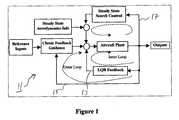
- Outer loop 15 is inherited from the classic feedback control laws. This portion is improved through a summary gain design, wherein instead of adjusting individual gains, the summary gain design is employed to shorten gain selection.
- the main purpose of this outer loop is to guide the helicopter to desired yaw angle, roll angle, airspeed, and altitude.
- Adjustment of individual control gain is dependent on its relative aerodynamic coefficients and associated control gains.
- the rules of adjusting these gains are not fixed. In order to correctly adjust these gains, several rules are needed so that the same mistakes are not repeated each time in the classic feedback guidance design.
- classic feedback control laws are mainly for guidance purpose. Of course, if the classic feedback laws will increase the stability of the system while performing very good guidance function, this kind of classic feedback control laws will be considered first. However, it has been observed that in high-speed flight conditions there are very few control gains that will make the system stable without employing LQR gains.
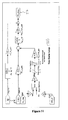
- Yaw_Actr_Cmnd 55 gets its value from Psi_plus_r 57, the value of which value is determined by YawOuter [(23) in Table I].
- the diagram of YawOuter (23) is shown in Figure 11 . All gains on the YawOuter (23) diagram need to be pointed to the correct direction so that Yaw in the low speed region will be guided.
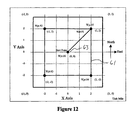
- FIG. 12 shows a square flight path 61 used in the simulation. This type of flight path might be used for a rescue searching function or similar mission.
- the aircraft flies from waypoint #1 at origin 63 [located at (0,0)], then sequentially flies to waypoints #2, #3, #4, and #5 on the perimeter of flight path 61 before returning to waypoint #6, which is also at origin 63.
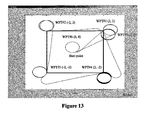
- the aircraft when the aircraft flies to each waypoint, it will transform its flight on the waypoint to a circle mode until the ground station ensures that no victim is located near that waypoint.
- the circle function is very well performed on each waypoint. Note that when flying circle mode, the aircraft altitude is also moving up and down to allow version system to explore any angle around the search region. Even with control surface changes in the vertical portion, the UAV still shows very positive flight. All guidance gains employed to accomplish the above flight are not gain scheduling, which means they are not changed. Therefore, it can be observed that gain-scheduling function is avoided on the guidance loop.
Landscapes
- Engineering & Computer Science (AREA)
- Aviation & Aerospace Engineering (AREA)
- Radar, Positioning & Navigation (AREA)
- Remote Sensing (AREA)
- Physics & Mathematics (AREA)
- General Physics & Mathematics (AREA)
- Automation & Control Theory (AREA)
- Feedback Control In General (AREA)
- Control Of Position, Course, Altitude, Or Attitude Of Moving Bodies (AREA)
- Traffic Control Systems (AREA)
Claims (15)
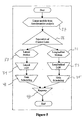
- Système de commande de vol (11) servant à commander le vol d'un aéronef, le système (11) comprenant :une boucle intérieure (13) configurée pour stabiliser le système de commande de vol, la boucle intérieure (13) possédant :une loi de commande ;la loi de commande étant séparée en trajectoires de flux correspondant à une composante longitudinale et à une composante latérale ; etcaractérisée en ce que la composante longitudinale comprend une entrée de mouvement longitudinal qui est transmise à un régulateur quadratique linéaire longitudinal et à un premier bloc de planification de gain, et en ce que la composante latérale comprend une entrée de mouvement latéral qui est transmise à un régulateur quadratique linéaire latéral et à un deuxième bloc de planification de gain ; etdans laquelle loi une sortie du premier bloc de planification de gain et une sortie du deuxième bloc de planification de gain sont regroupées ;une boucle extérieure (15) utilisant une conception de gain résumée pour raccourcir une sélection de gain ; etune boucle d'équilibrage de régime établi (17) configurée pour attraper automatiquement le vol équilibré de l'aéronef.
- Système de commande de vol selon la revendication 1, dans lequel la boucle intérieure (13) réalise une stabilisation grâce à l'utilisation d'une marge de phase et d'une marge de gain optimales.
- Système de commande de vol selon la revendication 1, dans lequel la boucle intérieure (13) réalise une stabilisation grâce à l'utilisation d'une marge de phase et d'une marge de gain optimales et dans lequel la boucle intérieure (13) utilise un algorithme basé sur une valeur propre, un vecteur propre et un taux d'amortissement issus du domaine temporel pour déterminer la marge de phase et la marge de gain optimales.
- Système de commande de vol selon la revendication 1, dans lequel la boucle d'équilibrage de régime établi (17) recherche automatiquement une condition d'équilibre optimale pour n'importe quelle condition de vol.
- Système de commande de vol selon la revendication 1, dans lequel la boucle d'équilibrage de régime établi (17) recherche une condition d'équilibre optimale d'après la vitesse verticale.
- Système de commande de vol selon la revendication 1, dans lequel la boucle d'équilibrage de régime établi (17) recherche une condition d'équilibre optimale d'après la vitesse de roulis.
- Système de commande de vol selon la revendication 1, dans lequel la boucle d'équilibrage de régime établi (17) recherche une condition d'équilibre optimale d'après la vitesse de lacet.
- Système de commande de vol selon la revendication 1, dans lequel la boucle d'équilibrage de régime établi (17) utilise une méthode de régulation quadratique linéaire avec un générateur de commande pour déterminer une condition d'équilibre optimale, le générateur de commande comprenant une valeur d'équilibrage de régime établi avec une condition d'équilibre initiale.
- Système de commande de vol selon la revendication 1, dans lequel la boucle d'équilibrage de régime établi (17) utilise une méthode de régulation quadratique linéaire avec un générateur de commande pour déterminer une condition d'équilibre optimale, le générateur de commande comprenant une valeur d'équilibrage de régime établi avec une condition d'équilibre initiale ; et
dans lequel une différence entre un état de vol actuel, la valeur d'équilibrage de régime établi, et la condition d'équilibre initiale est définie comme erreur de poursuite. - Système de commande de vol selon la revendication 1, dans lequel un cap latéral est engagé automatiquement lorsqu'une approche d'atterrissage est manquée.
- Système de commande de vol selon la revendication 1, dans lequel les boucles de rétroaction intérieure, extérieure et d'équilibrage de régime établi (13, 15, 17) sont préprogrammées.
- Système de commande de vol selon la revendication 1, dans lequel la boucle d'équilibrage de régime établi (17) utilise un générateur de commande de rétroaction configuré pour fournir un effort de commande pour passer d'un équilibrage initial à un équilibrage de régime établi.
- Système de commande de vol selon la revendication 1, dans lequel la boucle d'équilibrage de régime établi (17) maintient automatiquement un guidage de trajectoire latérale dans un mode de sélection de cap.
- Système de commande de vol selon la revendication 1, dans lequel la boucle d'équilibrage de régime établi (17) utilise une méthode de régulation quadratique linéaire avec un générateur de commande pour déterminer une condition d'équilibre optimale.
- Procédé de commande du vol d'un aéronef, le procédé comprenant l'étape consistant à :séparer (29) une loi de commande de vol en trajectoires de flux correspondant à une composante de loi de commande longitudinale et à une composante de loi de commande latérale ; et caractérisé par les étapes consistant à :transmettre une entrée de mouvement longitudinal (31) de la composante de loi de commande longitudinale à un régulateur quadratique linéaire longitudinal (33) et à un premier bloc de planification de gain (35) ;transmettre une entrée de mouvement latéral (37) de la composante de loi de commande latérale à un régulateur quadratique linéaire latéral (39) et à un deuxième bloc de planification de gain (41) ;regrouper (43) une sortie du premier bloc de planification de gain (35) avec celle d'une sortie du deuxième bloc de planification de gain (41) ;raccourcir une sélection de gain avec une boucle extérieure (15) utilisant une conception de gain résumée ; etobtenir un vol équilibré de l'aéronef avec une boucle d'équilibrage de régime établi (17).
Applications Claiming Priority (2)
| Application Number | Priority Date | Filing Date | Title |
|---|---|---|---|
| US62584804P | 2004-11-08 | 2004-11-08 | |
| PCT/US2005/040394 WO2007018572A2 (fr) | 2004-11-08 | 2005-11-08 | Systeme de commande de vol faisant appel a trois boucles de commande |
Publications (3)
| Publication Number | Publication Date |
|---|---|
| EP1810099A2 EP1810099A2 (fr) | 2007-07-25 |
| EP1810099A4 EP1810099A4 (fr) | 2008-03-12 |
| EP1810099B1 true EP1810099B1 (fr) | 2016-09-07 |
Family
ID=37727758
Family Applications (1)
| Application Number | Title | Priority Date | Filing Date |
|---|---|---|---|
| EP05858477.2A Expired - Lifetime EP1810099B1 (fr) | 2004-11-08 | 2005-11-08 | Systeme de commande de vol faisant appel a trois boucles de commande |
Country Status (7)
| Country | Link |
|---|---|
| US (1) | US8473124B2 (fr) |
| EP (1) | EP1810099B1 (fr) |
| CN (1) | CN100591900C (fr) |
| BR (1) | BRPI0517266A (fr) |
| CA (1) | CA2585105C (fr) |
| DE (1) | DE05858477T1 (fr) |
| WO (1) | WO2007018572A2 (fr) |
Families Citing this family (71)
| Publication number | Priority date | Publication date | Assignee | Title |
|---|---|---|---|---|
| US7930074B2 (en) * | 2007-03-19 | 2011-04-19 | Sikorsky Aircraft Corporation | Vertical speed and flight path command module for displacement collective utilizing tactile cueing and tactile feedback |
| US8694182B2 (en) * | 2007-04-03 | 2014-04-08 | Sikorsky Aircraft Corporation | Altitude and acceleration command altitude hold algorithm for rotorcraft with large center of gravity range |
| FR2924505B1 (fr) * | 2007-12-04 | 2015-12-11 | Thales Sa | Methode de decouplage du mode de suivi automatique du profil lateral et du mode de suivi automatique du profil vertical |
| FR2935495B1 (fr) * | 2008-08-29 | 2010-09-10 | Thales Sa | Systeme et procede de calcul des predictions de vol par sections verticales |
| US8523102B2 (en) * | 2008-10-03 | 2013-09-03 | Textron Innovations Inc. | Method and apparatus for aircraft sensor and actuator failure protection using reconfigurable flight control laws |
| US8529189B2 (en) * | 2009-01-30 | 2013-09-10 | Honeywell International Inc. | Linear quadratic regulator control for bleed air system fan air valve |
| DE202009001355U1 (de) | 2009-02-04 | 2009-05-20 | RÖHR, Ulrich | Modellflugkörpersteuer- und Empfangseinrichtung |
| US8718839B2 (en) * | 2009-12-06 | 2014-05-06 | Evolved Aircraft Systems, L.L.C. | Method and apparatus for automatically controlling aircraft flight control trim systems |
| CA2784615C (fr) * | 2009-12-18 | 2017-03-28 | National Research Council Of Canada | Mode de reponse pour systeme de commande d'embarcation pilotee |
| KR101184625B1 (ko) | 2010-04-15 | 2012-09-21 | 국방과학연구소 | 비행체의 수직면 직선추종 비행 제어기 설계방법 |
| US8965538B2 (en) * | 2010-05-19 | 2015-02-24 | The Boeing Company | Methods and apparatus for state limiting in a control system |
| CN102023640B (zh) * | 2010-11-23 | 2012-07-04 | 北京航空航天大学 | 飞行包线内标称设计点的选择方法 |
| ITRM20110651A1 (it) * | 2010-12-20 | 2012-06-21 | Selex Sistemi Integrati Spa | Metodo di previsione rapida del profilo verticale della traiettoria per la gestione del traffico aereo, e relativo sistema atm. |
| CN103314336B (zh) * | 2011-01-14 | 2016-08-10 | 贝尔直升机泰克斯特龙公司 | 用于控制竖直飞行航迹的飞行控制系统和方法 |
| EP2673681B1 (fr) | 2011-03-30 | 2016-09-07 | Bell Helicopter Textron Inc. | Lois de commande de vol pour virages à plat à vecteur constant |
| DE102012003910A1 (de) | 2011-04-15 | 2012-10-18 | Ulrich Röhr | System zur drahtlosen Steuerung eines RC-Modells, Sendeeinrichtung, Empfangseinrichtung sowie Verfahren |
| EP3101505B1 (fr) * | 2011-07-15 | 2018-07-11 | Bell Helicopter Textron Inc. | Lois de commandes de vol pour un helicoptere |
| TW201307155A (zh) * | 2011-08-01 | 2013-02-16 | Hon Hai Prec Ind Co Ltd | 無人飛行載具模擬飛行系統及方法 |
| CN102566427A (zh) * | 2012-01-09 | 2012-07-11 | 南京航空航天大学 | 一种飞行器鲁棒控制方法 |
| US9150308B2 (en) * | 2012-02-10 | 2015-10-06 | Merlin Technology, Inc. | Rotorcraft autopilot system, components and methods |
| US9097529B2 (en) * | 2012-07-12 | 2015-08-04 | Honeywell International Inc. | Aircraft system and method for improving navigation performance |
| CN104335006B (zh) * | 2012-07-18 | 2017-05-24 | 形创有限公司 | 3d扫描以及定位界面 |
| CN102929150B (zh) * | 2012-11-13 | 2015-02-11 | 湖南航天机电设备与特种材料研究所 | 一种基于离散控制模型的扰流片自适应控制方法 |
| US10421531B2 (en) * | 2012-11-27 | 2019-09-24 | Bell Helicopter Textron Inc. | Laptop based rapid control laws development |
| KR101426289B1 (ko) * | 2013-01-09 | 2014-08-05 | 국방과학연구소 | 기동 헬기 측면 항법 운용 장치 |
| KR101434310B1 (ko) | 2013-05-22 | 2014-08-26 | 현대로템 주식회사 | 이동장비에 장착된 구동장치의 안정화성능 향상 기법 및 시스템과 그 이동장비 |
| US9856017B2 (en) * | 2013-06-11 | 2018-01-02 | Bell Helicopter Textron Inc. | Torque based method of limiting vertical axis augmentation |
| JP5698802B2 (ja) * | 2013-06-28 | 2015-04-08 | ヤマハ発動機株式会社 | 遠隔操縦装置 |
| CN103823380B (zh) * | 2014-03-14 | 2017-01-18 | 北京航空航天大学 | 一种考虑飞行品质的直升机总体设计方法 |
| US9429952B2 (en) * | 2014-04-04 | 2016-08-30 | Sikorsky Aircraft Corporation | Rotorcraft control laws for sea-based operations |
| CN104298109B (zh) * | 2014-09-23 | 2017-04-19 | 南京航空航天大学 | 基于多控制器融合的无尾飞行器协调转弯控制方法 |
| US20170267338A1 (en) | 2014-10-01 | 2017-09-21 | Sikorsky Aircraft Corporation | Acoustic signature variation of aircraft utilizing a clutch |
| EP3201077B1 (fr) | 2014-10-01 | 2020-05-20 | Sikorsky Aircraft Corporation | Aéronef à voilure tournante et à deux rotors |
| WO2016178738A1 (fr) * | 2015-05-05 | 2016-11-10 | Sikorsky Aircraft Corporation | Commande de priorité de maintien de position |
| EP3386856B8 (fr) | 2015-12-07 | 2020-08-19 | Textron Systems Corporation | Aéronef sans pilote doté d'assemblages de plaques d'aile qui assurent une capacité à décollage et d'atterrissage verticaux efficaces |
| CN105867399B (zh) * | 2016-04-18 | 2017-05-03 | 北京航天自动控制研究所 | 一种确定多状态跟踪制导参数的方法 |
| CN109689156B (zh) | 2016-08-08 | 2023-08-01 | 深部脑刺激技术有限公司 | 用于监测神经活动的系统和方法 |
| CN106546204B (zh) * | 2016-09-22 | 2018-12-18 | 北京空间飞行器总体设计部 | 一种舱间分离相对位置与姿态测量方法 |
| CN108008630B (zh) * | 2016-11-01 | 2022-04-19 | 贵州火星探索科技有限公司 | 一种无人机位置环的补偿器设计方法及装置 |
| US10654561B2 (en) * | 2017-02-02 | 2020-05-19 | Textron Innovations Inc. | Rotorcraft fly-by-wire go-around mode |
| US10287026B2 (en) | 2017-02-04 | 2019-05-14 | Bell Helicopter Textron Inc. | Power demand anticipation systems for rotorcraft |
| US10647414B2 (en) * | 2017-02-27 | 2020-05-12 | Textron Innovations Inc. | Rotorcraft fly-by-wire standard rate turn |
| US10093415B1 (en) * | 2017-03-20 | 2018-10-09 | Bell Helicopter Textron Inc. | System and method for rotorcraft heading control |
| JP7144450B2 (ja) | 2017-05-22 | 2022-09-29 | ディープ・ブレイン・スティムレーション・テクノロジーズ・ピーティーワイ・リミテッド | 神経活動をモニタするためのシステム及び方法 |
| CA2972498C (fr) * | 2017-06-28 | 2024-01-23 | Bombardier Inc. | Systeme et methode d'orientation d'inclinaison au decollage |
| JP2019113992A (ja) * | 2017-12-22 | 2019-07-11 | カシオ計算機株式会社 | 飛行装置、飛行装置の制御方法及びプログラム |
| CN109032171B (zh) * | 2018-06-26 | 2019-07-16 | 中国空气动力研究与发展中心低速空气动力研究所 | 一种基于非线性控制律的飞行器风洞自由飞的控制方法 |
| CN109765530B (zh) * | 2018-12-30 | 2021-02-19 | 成都汇蓉国科微系统技术有限公司 | 一种运动平台雷达波束解耦方法 |
| US11059577B2 (en) * | 2019-03-25 | 2021-07-13 | Textron Innovations Inc. | System and method for monitoring aircraft pilot control position and providing a retrim prompt |
| CN110187715B (zh) * | 2019-04-24 | 2021-01-15 | 南京航空航天大学 | 一种基于动态耦合分析的高超声速飞行器协调控制方法 |
| CN110221624B (zh) * | 2019-05-20 | 2021-08-17 | 南京航空航天大学 | 一种基于组合系统的无人机环绕地面目标制导方法 |
| CN110568758B (zh) * | 2019-09-12 | 2022-07-01 | 中汽研(天津)汽车工程研究院有限公司 | 一种自动驾驶汽车的参数自适应横向运动lqr控制方法 |
| EP3832424B1 (fr) * | 2019-12-02 | 2022-07-13 | Volocopter GmbH | Procédé de fonctionnement d'un système d'actionneur, système d'actionneur et aéronef comprenant lesdits procédé et système |
| US11288972B2 (en) | 2019-12-19 | 2022-03-29 | Textron Innovations Inc. | Fleet controller |
| CN111026160B (zh) * | 2019-12-26 | 2020-12-08 | 华中科技大学 | 一种四旋翼无人机轨迹跟踪控制方法 |
| CN111290420A (zh) * | 2020-03-11 | 2020-06-16 | 山东超越数控电子股份有限公司 | 飞行器飞行姿态控制系统和方法 |
| CN112286053B (zh) * | 2020-10-16 | 2021-08-27 | 北京航空航天大学 | 一种高机动微型无人机的制导控制一体化方法 |
| CN112379685B (zh) * | 2020-11-30 | 2022-02-11 | 中国科学院沈阳自动化研究所 | 一种基于风速风向传感器的旋翼无人机控制系统及方法 |
| US11592837B1 (en) | 2021-10-30 | 2023-02-28 | Beta Air, Llc | Systems and methods to control gain for an electric aircraft |
| WO2023046303A1 (fr) * | 2021-09-27 | 2023-03-30 | Abb Schweiz Ag | Procédé et appareil de planification de trajectoire de robot |
| CN115123577B (zh) * | 2022-04-11 | 2025-04-15 | 北京航空航天大学 | 基于飞行品质的倾转旋翼机过渡段纵向增稳系统的设计方法 |
| CN114995140B (zh) * | 2022-06-07 | 2023-01-24 | 哈尔滨工业大学 | 一种基于直/气复合的高超声速飞行器时变系统的控制方法 |
| CN115328185B (zh) * | 2022-08-30 | 2023-05-30 | 北京京航计算通讯研究所 | 一种飞行器非线性非定常气动载荷修正系统 |
| US12673766B2 (en) * | 2024-01-29 | 2026-07-07 | Textron Innovations Inc. | Rotorcraft system for command mode transitions |
| CN118502235B (zh) * | 2024-03-11 | 2024-11-01 | 华中科技大学 | 欠驱动水下航行器双环lqr鲁棒深度跟踪控制方法及系统 |
| US20260084808A1 (en) * | 2024-09-26 | 2026-03-26 | Textron Eaviation Inc. | Tiltrotor Aircraft Control System |
| CN119416344B (zh) * | 2024-10-15 | 2025-10-24 | 中国直升机设计研究所 | 一种基于可变气动面的飞行器稳定性增强方法 |
| CN119336058B (zh) * | 2024-10-16 | 2025-10-28 | 中北大学 | 一种飞行器控制参数的设计方法、装置、设备及存储介质 |
| CN119847179B (zh) * | 2025-01-07 | 2025-11-21 | 西北工业大学 | 三方博弈交战场景下基于粒子优化算法和微分对策的制导控制方法 |
| CN120066046B (zh) * | 2025-02-27 | 2025-07-25 | 交通运输部水运科学研究所 | 基于强化性能的自主航行船预设精度轨迹跟踪控制方法 |
| CN120143856A (zh) * | 2025-05-16 | 2025-06-13 | 中国航空工业集团公司沈阳飞机设计研究所 | 一种飞机自动降落pid纵向引导律回路设计方法 |
Family Cites Families (8)
| Publication number | Priority date | Publication date | Assignee | Title |
|---|---|---|---|---|
| US4466526A (en) * | 1982-04-16 | 1984-08-21 | Chandler Evans Inc. | Helicopter engine control with rotor speed decay anticipator |
| US5189620A (en) * | 1989-10-06 | 1993-02-23 | United Technologies Corporation | Control system for gas turbine helicopter engines and the like |
| US6539290B1 (en) * | 1995-06-07 | 2003-03-25 | Dabulamanzi Holdings, Llc | Method, apparatus and design procedure for controlling multi-input, multi-output (MIMO) parameter dependent systems using feedback LTI'zation |
| US5796922A (en) * | 1996-03-29 | 1998-08-18 | Weber State University | Trainable, state-sampled, network controller |
| AU6532698A (en) * | 1996-12-05 | 1998-06-29 | Shabbir Ahmed Parvez | Autonomous on-board orbit control/maintenance system for satellites |
| US6729139B2 (en) * | 2001-09-26 | 2004-05-04 | Goodrich Pump & Engine Control Systems, Inc. | Engine control system |
| GB2423376B (en) * | 2002-12-09 | 2007-03-21 | Georgia Tech Res Inst | Adaptive output feedback apparatuses and methods capable of controlling a non-mimimum phase system |
| US7343232B2 (en) * | 2003-06-20 | 2008-03-11 | Geneva Aerospace | Vehicle control system including related methods and components |
-
2005
- 2005-11-08 CN CN200580037797A patent/CN100591900C/zh not_active Expired - Fee Related
- 2005-11-08 BR BRPI0517266-7A patent/BRPI0517266A/pt not_active IP Right Cessation
- 2005-11-08 WO PCT/US2005/040394 patent/WO2007018572A2/fr not_active Ceased
- 2005-11-08 CA CA2585105A patent/CA2585105C/fr not_active Expired - Lifetime
- 2005-11-08 DE DE05858477T patent/DE05858477T1/de active Pending
- 2005-11-08 US US11/665,138 patent/US8473124B2/en active Active
- 2005-11-08 EP EP05858477.2A patent/EP1810099B1/fr not_active Expired - Lifetime
Non-Patent Citations (1)
| Title |
|---|
| None * |
Also Published As
| Publication number | Publication date |
|---|---|
| WO2007018572A3 (fr) | 2007-11-29 |
| WO2007018572A9 (fr) | 2008-04-03 |
| DE05858477T1 (de) | 2008-01-31 |
| CN101175909A (zh) | 2008-05-07 |
| US20080097658A1 (en) | 2008-04-24 |
| CA2585105A1 (fr) | 2007-02-15 |
| CN100591900C (zh) | 2010-02-24 |
| EP1810099A2 (fr) | 2007-07-25 |
| US8473124B2 (en) | 2013-06-25 |
| WO2007018572A2 (fr) | 2007-02-15 |
| CA2585105C (fr) | 2015-04-21 |
| EP1810099A4 (fr) | 2008-03-12 |
| BRPI0517266A (pt) | 2008-10-07 |
Similar Documents
| Publication | Publication Date | Title |
|---|---|---|
| US8473124B2 (en) | Flight control system having a three control loop design | |
| Stastny et al. | Nonlinear model predictive guidance for fixed-wing UAVs using identified control augmented dynamics | |
| Ambroziak et al. | Two stage switching control for autonomous formation flight of unmanned aerial vehicles | |
| Menon et al. | Robust landing guidance law for impaired aircraft | |
| Sedlmair et al. | Flight testing automatic landing control for unmanned aircraft including curved approaches | |
| Boyle et al. | Autonomous maneuver tracking for self-piloted vehicles | |
| No et al. | Control and simulation of arbitrary flight trajectory-tracking | |
| Manjarrez et al. | Low level control architecture for automatic takeoff and landing of fixed wing UAV | |
| Theis et al. | Robust autopilot design for crosswind landing | |
| Kurnaz et al. | Autonomous navigation and landing tasks for fixed wing small unmanned aerial vehicles | |
| Takahashi et al. | Comparison of autonomous flight control performance between partial-and full-authority helicopters | |
| Rogalski et al. | Control system for aircraft take-off and landing based on modified PID controllers | |
| Kim et al. | Design and evaluation of nonlinear inversion based automated landing control for an airliner in a high crosswind scenario | |
| Matt et al. | Evaluation and analysis of ardupilot automatic tuning algorithm for the roll tracking controller of a small uas | |
| Nowak et al. | The selected innovative solutions in UAV control systems technologies | |
| Ju et al. | Longitudinal auto‐landing controller design via adaptive backstepping | |
| Carlson et al. | Nonlinear Guidance and Optimal Control Design of Gemini V2 Small UAS with Robustness Analysis | |
| Halbe et al. | Rotorcraft Guidance Laws and Flight Control Design for Automatic Tracking of Constrained Trajectories. | |
| Totoki et al. | Flight testing of a gain-scheduled stability and control augmentation system for a Quad-Tilt-Wing UAV | |
| Yomchinda et al. | Autonomous control and path planning for autorotation of unmanned helicopters | |
| Riboldi et al. | Dynamic simulation, flight control and guidance synthesis for fixed-wing uav swarms | |
| Saetti et al. | Dynamic inversion-based flare control law for autonomous helicopter autorotation | |
| Ishioka et al. | Landing system using extended dynamic window approach for fixed-wing UAV | |
| Vlk et al. | Light sport aircraft auto-land system | |
| Steinleitner et al. | Using Forward Slipping for Maximum Descend Authority in an Incremental Control Approach |
Legal Events
| Date | Code | Title | Description |
|---|---|---|---|
| PUAI | Public reference made under article 153(3) epc to a published international application that has entered the european phase |
Free format text: ORIGINAL CODE: 0009012 |
|
| 17P | Request for examination filed |
Effective date: 20070508 |
|
| AK | Designated contracting states |
Kind code of ref document: A2 Designated state(s): AT BE BG CH CY CZ DE DK EE ES FI FR GB GR HU IE IS IT LI LT LU LV MC NL PL PT RO SE SI SK TR |
|
| AX | Request for extension of the european patent |
Extension state: AL BA HR MK YU |
|
| R17D | Deferred search report published (corrected) |
Effective date: 20071129 |
|
| EL | Fr: translation of claims filed | ||
| RIC1 | Information provided on ipc code assigned before grant |
Ipc: F02C 3/10 20060101AFI20071214BHEP Ipc: F02C 9/28 20060101ALI20071214BHEP |
|
| DET | De: translation of patent claims | ||
| DAX | Request for extension of the european patent (deleted) | ||
| RBV | Designated contracting states (corrected) |
Designated state(s): DE FR GB IT |
|
| A4 | Supplementary search report drawn up and despatched |
Effective date: 20080213 |
|
| R17D | Deferred search report published (corrected) |
Effective date: 20080403 |
|
| 17Q | First examination report despatched |
Effective date: 20090212 |
|
| GRAP | Despatch of communication of intention to grant a patent |
Free format text: ORIGINAL CODE: EPIDOSNIGR1 |
|
| GRAS | Grant fee paid |
Free format text: ORIGINAL CODE: EPIDOSNIGR3 |
|
| INTG | Intention to grant announced |
Effective date: 20160708 |
|
| GRAA | (expected) grant |
Free format text: ORIGINAL CODE: 0009210 |
|
| AK | Designated contracting states |
Kind code of ref document: B1 Designated state(s): DE FR GB IT |
|
| REG | Reference to a national code |
Ref country code: GB Ref legal event code: FG4D |
|
| REG | Reference to a national code |
Ref country code: DE Ref legal event code: R096 Ref document number: 602005050210 Country of ref document: DE |
|
| REG | Reference to a national code |
Ref country code: FR Ref legal event code: PLFP Year of fee payment: 12 |
|
| REG | Reference to a national code |
Ref country code: DE Ref legal event code: R097 Ref document number: 602005050210 Country of ref document: DE |
|
| PLBE | No opposition filed within time limit |
Free format text: ORIGINAL CODE: 0009261 |
|
| STAA | Information on the status of an ep patent application or granted ep patent |
Free format text: STATUS: NO OPPOSITION FILED WITHIN TIME LIMIT |
|
| 26N | No opposition filed |
Effective date: 20170608 |
|
| REG | Reference to a national code |
Ref country code: FR Ref legal event code: PLFP Year of fee payment: 13 |
|
| PGFP | Annual fee paid to national office [announced via postgrant information from national office to epo] |
Ref country code: DE Payment date: 20241127 Year of fee payment: 20 |
|
| PGFP | Annual fee paid to national office [announced via postgrant information from national office to epo] |
Ref country code: GB Payment date: 20241127 Year of fee payment: 20 |
|
| PGFP | Annual fee paid to national office [announced via postgrant information from national office to epo] |
Ref country code: FR Payment date: 20241128 Year of fee payment: 20 |
|
| PGFP | Annual fee paid to national office [announced via postgrant information from national office to epo] |
Ref country code: IT Payment date: 20241122 Year of fee payment: 20 |
|
| REG | Reference to a national code |
Ref country code: DE Ref legal event code: R071 Ref document number: 602005050210 Country of ref document: DE |
|
| REG | Reference to a national code |
Ref country code: GB Ref legal event code: PE20 Expiry date: 20251107 |