EP1811026B1 - Methode d'immunisation d'un animal, preparation pour immunisation, methode de production d'un anticorps, methode de production d'un hybridome et methode de production d'un anticorps monoclonal - Google Patents
Methode d'immunisation d'un animal, preparation pour immunisation, methode de production d'un anticorps, methode de production d'un hybridome et methode de production d'un anticorps monoclonal Download PDFInfo
- Publication number
- EP1811026B1 EP1811026B1 EP05793077.8A EP05793077A EP1811026B1 EP 1811026 B1 EP1811026 B1 EP 1811026B1 EP 05793077 A EP05793077 A EP 05793077A EP 1811026 B1 EP1811026 B1 EP 1811026B1
- Authority
- EP
- European Patent Office
- Prior art keywords
- gene
- antigen protein
- antibody
- antigen
- human animal
- Prior art date
- Legal status (The legal status is an assumption and is not a legal conclusion. Google has not performed a legal analysis and makes no representation as to the accuracy of the status listed.)
- Expired - Lifetime
Links
Images

Classifications
-
- C—CHEMISTRY; METALLURGY
- C07—ORGANIC CHEMISTRY
- C07K—PEPTIDES
- C07K16/00—Immunoglobulins [IG], e.g. monoclonal or polyclonal antibodies
-
- A—HUMAN NECESSITIES
- A61—MEDICAL OR VETERINARY SCIENCE; HYGIENE
- A61K—PREPARATIONS FOR MEDICAL, DENTAL OR TOILETRY PURPOSES
- A61K39/00—Medicinal preparations containing antigens or antibodies
-
- A—HUMAN NECESSITIES
- A61—MEDICAL OR VETERINARY SCIENCE; HYGIENE
- A61K—PREPARATIONS FOR MEDICAL, DENTAL OR TOILETRY PURPOSES
- A61K39/00—Medicinal preparations containing antigens or antibodies
- A61K39/0005—Vertebrate antigens
-
- A—HUMAN NECESSITIES
- A61—MEDICAL OR VETERINARY SCIENCE; HYGIENE
- A61K—PREPARATIONS FOR MEDICAL, DENTAL OR TOILETRY PURPOSES
- A61K39/00—Medicinal preparations containing antigens or antibodies
- A61K39/385—Haptens or antigens, bound to carriers
-
- A—HUMAN NECESSITIES
- A61—MEDICAL OR VETERINARY SCIENCE; HYGIENE
- A61P—SPECIFIC THERAPEUTIC ACTIVITY OF CHEMICAL COMPOUNDS OR MEDICINAL PREPARATIONS
- A61P31/00—Antiinfectives, i.e. antibiotics, antiseptics, chemotherapeutics
-
- A—HUMAN NECESSITIES
- A61—MEDICAL OR VETERINARY SCIENCE; HYGIENE
- A61P—SPECIFIC THERAPEUTIC ACTIVITY OF CHEMICAL COMPOUNDS OR MEDICINAL PREPARATIONS
- A61P31/00—Antiinfectives, i.e. antibiotics, antiseptics, chemotherapeutics
- A61P31/04—Antibacterial agents
-
- A—HUMAN NECESSITIES
- A61—MEDICAL OR VETERINARY SCIENCE; HYGIENE
- A61P—SPECIFIC THERAPEUTIC ACTIVITY OF CHEMICAL COMPOUNDS OR MEDICINAL PREPARATIONS
- A61P31/00—Antiinfectives, i.e. antibiotics, antiseptics, chemotherapeutics
- A61P31/12—Antivirals
-
- A—HUMAN NECESSITIES
- A61—MEDICAL OR VETERINARY SCIENCE; HYGIENE
- A61P—SPECIFIC THERAPEUTIC ACTIVITY OF CHEMICAL COMPOUNDS OR MEDICINAL PREPARATIONS
- A61P35/00—Antineoplastic agents
-
- A—HUMAN NECESSITIES
- A61—MEDICAL OR VETERINARY SCIENCE; HYGIENE
- A61P—SPECIFIC THERAPEUTIC ACTIVITY OF CHEMICAL COMPOUNDS OR MEDICINAL PREPARATIONS
- A61P37/00—Drugs for immunological or allergic disorders
- A61P37/02—Immunomodulators
-
- A—HUMAN NECESSITIES
- A61—MEDICAL OR VETERINARY SCIENCE; HYGIENE
- A61P—SPECIFIC THERAPEUTIC ACTIVITY OF CHEMICAL COMPOUNDS OR MEDICINAL PREPARATIONS
- A61P43/00—Drugs for specific purposes, not provided for in groups A61P1/00-A61P41/00
-
- C—CHEMISTRY; METALLURGY
- C07—ORGANIC CHEMISTRY
- C07K—PEPTIDES
- C07K16/00—Immunoglobulins [IG], e.g. monoclonal or polyclonal antibodies
- C07K16/18—Immunoglobulins [IG], e.g. monoclonal or polyclonal antibodies against material from animals or humans
- C07K16/28—Immunoglobulins [IG], e.g. monoclonal or polyclonal antibodies against material from animals or humans against receptors, cell surface antigens or cell surface determinants
- C07K16/2869—Immunoglobulins [IG], e.g. monoclonal or polyclonal antibodies against material from animals or humans against receptors, cell surface antigens or cell surface determinants against hormone receptors
-
- A—HUMAN NECESSITIES
- A61—MEDICAL OR VETERINARY SCIENCE; HYGIENE
- A61K—PREPARATIONS FOR MEDICAL, DENTAL OR TOILETRY PURPOSES
- A61K39/00—Medicinal preparations containing antigens or antibodies
- A61K2039/51—Medicinal preparations containing antigens or antibodies comprising whole cells, viruses or DNA/RNA
- A61K2039/53—DNA (RNA) vaccination
-
- A—HUMAN NECESSITIES
- A61—MEDICAL OR VETERINARY SCIENCE; HYGIENE
- A61K—PREPARATIONS FOR MEDICAL, DENTAL OR TOILETRY PURPOSES
- A61K39/00—Medicinal preparations containing antigens or antibodies
- A61K2039/60—Medicinal preparations containing antigens or antibodies characteristics by the carrier linked to the antigen
- A61K2039/6031—Proteins
- A61K2039/6068—Other bacterial proteins, e.g. OMP
-
- C—CHEMISTRY; METALLURGY
- C07—ORGANIC CHEMISTRY
- C07K—PEPTIDES
- C07K2319/00—Fusion polypeptide
- C07K2319/35—Fusion polypeptide containing a fusion for enhanced stability/folding during expression, e.g. fusions with chaperones or thioredoxin
Definitions
- the present invention relates to a non-therapeutic method for immunizing a non-human animal, a composition for immunization, a medicament for immunizing an animal, a method for producing an antibody, a method for producing a hybridoma, and a method for producing a monoclonal antibody.
- a non-therapeutic method for immunizinga non-human animal inducing a humoral immune response by administering a fusion gene composed of a gene encoding the full-length or a part of an antigen protein and a gene encoding one selected from a chaperonin subunit and a chaperonin subunit linkage linked thereto, a composition for immunization for use in the method for immunization, a method for producing an antibody using the method for immunizing, a method for producing a hybridoma using an immune cell of an animal immunized by the method for immunizing, and a method for producing a monoclonal antibody using the hybridoma.
- an antibody is a principal player in humoral immunity and takes an important role in biological defense as well as a sensitized lymphocyte. Meanwhile, an antibody is frequently used for various kinds of techniques that take advantage of a specific affinity with its antigen, such as affinity chromatography or immunoassays, being indispensable tools in the biotechnology field. Consequently, an antibody is prepared by administering an antigen protein to an animal as an immunogen to induce a humoral immune response. At this time, the antigen protein isolated and purified from a sample such as a biological sample is used as an immunogen, for example.
- gene immunization in which a gene encoding an antigen protein is expressed in the animal to induce an immune response in stead of inoculating the antigen protein.
- a gene encoding an antigen protein is integrated in an appropriate expression vector, for example, so as to inoculate the expression vector to the animal, whereupon the gene integrated in the expression vector is expressed in the animal to synthesize an antigen protein.
- the antigen protein synthesized in the animal induces an immune response.
- gene immunization as long as a gene encoding an antigen protein is isolated, immunization is carried out, dispensing with isolation and purification of the antigen protein.
- gene immunization has the additional advantage of being able to induce an immune response even if the amount of an antigen protein synthesized by expression of a gene in the animal is far small than that required for direct administration of the antigen protein. It has further the additional advantage that there is no need to chemically synthesize a peptide antigen separately as in the conventional ways even if an antigen protein is difficult to be prepared by recombinant DNA techniques and that it is only necessary to introduce the full length of a gene into the animal.
- a humoral immune response may not be induced depending on the kind of the antigen protein, resulting in possibly failing to produce an antibody.
- a humoral immune response may not be induced as well as in the conventional method for immunizing.
- the antigen protein has extremely high homology to a protein contained endogenously in an immunized animal, the antigen protein is not recognized as a foreign body even though being synthesized in the animal, resulting in possibly failing to induce a humoral immune response.
- an antigen protein is labile in the animal, the antigen protein in the animal becomes less in amount, resulting in possibly failing to induce a humoral immune response.
- gene immunization has a specific disadvantage of possibly failing to induce humoral immune response due to less amount of an antigen protein resulting from the case that a transduction efficiency of a gene encoding the antigen protein into the animal is low or that expression level of a gene encoding the antigen protein in the animal is low.
- a fusion gene (chimeric nucleic acid) composed of a gene encoding a heat-shock protein HSP70 and a gene encoding an antigen protein is used as a DNA vaccine.
- a gene encoding HSP70 derived from Mycobacterium tuberculosis is used.
- this technique induces antigen-specific cellular immunity (killer T-cell), but does not induce humoral immunity, or antibody production.
- gene immunization still has the large state of the unknown and is still in the process of trial and error.
- Preparation of an antibody by gene immunization requires such a technique as being capable of induce a humoral immune response reproducibly and certainly regardless of the kinds of antigen proteins. It is therefore an object of the present invention to provide various techniques capable of inducing a humoral immune response with higher efficiency in preparation of an antibody against an antigen protein by means of gene immunization.
- the inventors have found that even an antigen protein that is not able to induce a humoral immune response by inoculation of its gene to an animal induces a humoral immune response to the antigen protein by inoculation of a fusion gene composed of a gene encoding the antigen protein and a gene encoding a chaperonin to the animal, and have achieved the present invention.
- the following description is a summary of the present invention.
- the first aspect of the present invention is a non-therapeutic method for immunizing a non-human animal, including the step of administering a fusion gene to a non-human animal, the fusion gene being composed of a gene encoding the full-length or a part of an antigen protein and a gene encoding one selected from a chaperonin subunit and a chaperonin subunit linkage linked thereto, so as to express the fusion gene in the non-human animal to induce a humoral immune response to the antigen protein.
- the second aspect of the present invention is a medicament for immunizing an animal, the medicament comprising a fusion gene, the fusion gene being composed of a gene encoding the full-length or a part of an antigen protein and a gene encoding one selected from a chaperonin subunit and a chaperonin subunit linkage linked thereto, so as to express the fusion gene in the animal to include a humoral immune response to the antigen protein.
- the non-therapeutic method for immunizing a non-human animal of this aspect belongs to gene immunization and is performed by administering a fusion gene to a non-human animal, the fusion gene being composed of a gene encoding the full-length or a part of an antigen protein and a gene encoding a chaperonin subunit or a chaperonin subunit linkage linked thereto.
- the fusion gene is expressed in the non-human animal, so that a fusion protein composed of the full-length or a part of the antigen protein and the chaperonin subunit or the chaperonin subunit linkage is synthesized.
- a humoral immune response to the antigen protein is induced.
- a humoral immune response is induced by a chaperonin even if the antigen protein is not able to induce a humoral immune response by administering a gene encoding the antigen protein alone. Consequently, an antibody against such an antigen protein is produced in an animal.
- Chaperonins are a kind of molecular chaperones and are complex proteins composed of subunits (chaperonin subunits) each with a molecular weight of about 60,000. Chaperonins accommodate and fold correctly other proteins therewithin.
- a "chaperonin subunit linkage" is defined as an artificial protein composed of more than one chaperonin subunit serially linked via a peptide bond.
- a chaperonin subunit linkage is an artificial protein composed of more than one tandemly-linked chaperonin subunit.
- a gene encoding a chaperonin subunit and a gene encoding a chaperonin subunit linkage are sometimes collectively referred to as a "gene encoding a chaperonin.”
- one selected from the chaperonin subunit and the chaperonin subunit linkage is derived from Escherichia coli.
- a chaperonin derived from E. coli is referred to as GroEL, whose biochemical and physiochemical attribute is well studied, and thus its gene is easily available.
- the chaperonin subunit or the chaperonin subunit linkage is derived from E. coli. This constitution readily produces a fusion gene to be administered to an animal.
- the fusion gene is integrated into an expression vector and expressed under control of a promoter on the expression vector.
- the fusion gene is integrated into an expression vector and expressed under control of a promoter on the expression vector. According to this constitution, a fusion gene is expressed in the animal more certainly. Consequently, a humoral immune response is induced more certainly.
- the promoter is one selected from the group consisting of a CMV promoter, an AML promoter, an SV40 promoter, an SR ⁇ promoter, and an EF-1 ⁇ promoter.
- the promoter on the expression vector is a promoter such as a CMV promoter which has high inductivity and whose attribute is well known. According to this constitution, a fusion gene is highly efficiently expressed. Consequently, a humoral immune response is induced more certainly.
- the expression vector contains a CpG motif.
- a CpG motif is a sequence contained in DNA of microorganism and known to enhance an immunostimulating system of mammals.
- the expression vector contains a CpG motif. This constitution induces a higher humoral immune response to an animal. Consequently, an antibody against an antigen protein is highly efficiently produced.
- the non-human animal is one selected from a mammal and a bird.
- a non-human animal to be immunized is a mammal or a bird, which is easy to use. According to this constitution, immunization is carried out more readily.
- the mammal is one selected from the group consisting of a mouse, a rat, a rabbit, a bovine, a horse, a dog, a cat, a goat, a sheep, and a pig.
- the bird is one selected from the group consisting of a chicken, a duck, and a turkey.
- the antigen protein is preferably one selected from the group consisting of a G protein-coupled receptor, an ion channel-linked receptor, a tyrosine kinase-type receptor, a CD antigen, a cell adhesion molecule, a cancer antigen, a cytokine, a growth factor, a trophic factor, a viral antigen, a bacterial antigen, and a toxic antigen.
- the antigen protein is a protein useful for drug development such as a G protein-coupled receptor. According to this constitution, an antibody against the useful protein is obtained and applied for construction of an assay system or the like.
- the third aspect of the present invention is a composition for immunization for use as a medicament or in the method for immunizing a non-human animal of the present invention, including a fusion gene composed of a gene encoding the full-length or a part of an antigen protein and a gene encoding one selected from a chaperonin subunit and a chaperonin subunit linkage linked thereto as a main ingredient.
- a composition is prepared by dissolving a fusion gene in an appropriate solvent, for example, so as to be administered to a non-human animal.
- the composition for immunization of this aspect is used for the non-therapeutic method for immunizing a non-human animal or as medicament of the present invention and includes a fusion gene composed of a gene encoding the full-length or a part of an antigen protein and a gene encoding a chaperonin subunit or a chaperonin subunit linkage linked thereto as a main ingredient.
- a fusion gene is administered to a non-human animal by means such as injection. Further, applied dose of the fusion gene is precisely adjusted by control of concentration of the fusion gene in the composition.
- the fourth aspect of the present invention is a method for producing an antibody, including the steps of immunizing a non-human animal by means of the non-therapeutic method for immunizing a non-human animal of the present invention to induce a humoral immune response to an antigen protein, so that an antibody against the antigen protein is produced in the non-human animal, and obtaining the antibody from the non-human animal.
- the above-mentioned non-therapeutic method for immunizing a non-human animal of the present invention induces a humoral immune response, with the consequence that an antibody is produced in the non-human animal.
- the method for producing an antibody of this aspect is carried out in such a manner that a humoral immune response is induced by the non-therapeutic method for immunizing a non-human animal of the present invention to produce an antibody against an antigen protein in the non-human animal, from which the antibody is obtained.
- an antibody is produced in a non-human animal even if an antigen protein, whose purification method is unestablished, whose purification is difficult, or that is unknown with only its gene being known, does not produce an antibody by administration of its gene alone.
- the antibody is obtained as a polyclonal antibody from a serum of the non-human animal.
- the fifth aspect of the present invention is a method for producing a hybridoma, including the steps of immunizing a non-human animal by the method for immunizing a non-human animal of the present invention to induce a humoral immune response to an antigen protein, obtaining an immunocyte from the non-human animal, and fusing the immunocyte and a myeloma, so as to prepare a hybridoma producing an antibody against the antigen protein.
- a hybridoma producing a monoclonal antibody against an antigen protein is prepared by cell fusion of an immunocyte of a non-human animal, in which a humoral immune response is induced by the method for immunizing an animal of the present invention, and a myeloma. According to this constitution, even if an antigen protein does not produce an antibody by administration of the antigen protein itself or its gene alone, a hybridoma producing a monoclonal antibody against the antigen protein is obtained.
- the sixth aspect of the present invention is a method for producing a monoclonal antibody, including the steps of culturing the hybridoma produced by the method of the present invention and obtaining a monoclonal antibody against the antigen protein from the culture of the hybridoma.
- a hybridoma produced by the method for producing a hybridoma of the present invention is cultured, whereupon a monoclonal antibody is obtained from the culture. According to this constitution, even if an antigen protein does not produce an antibody by administration of the antigen protein itself or its gene alone, a hybridoma producing a monoclonal antibody against the antigen protein is obtained.
- the seventh aspect of the present invention is a method for producing a monoclonal antibody, including the steps of immunizing a non-human animal by the method for immunizing a non-human animal of the present invention to induce a humoral immune response to an antigen protein, preparing mRNA from the non-human animal, preparing cDNA from the mRNA used as a template, and preparing a monoclonal antibody against the antigen protein by a phage display method using the cDNA.
- the method for producing a monoclonal antibody of this aspect uses a phage display method, mRNA is prepared from a non-human animal, in which a humoral immune response is induced by the method for immunizing a non-human animal of the present invention, whereupon cDNA is prepared from the mRNA used as a template, and a monoclonal antibody against the antigen protein is prepared by a phage display method using the cDNA. According to this constitution, even if an antigen protein does not produce an antibody by administration of the antigen protein or its gene alone, a monoclonal antibody against the antigen protein is obtained.
- a humoral immune response is induced in gene immunization even if an antigen protein does not induce a humoral immune response by injection of its gene alone to a non-human animal.
- an antibody against an antigen protein is produced in gene immunization even if the antigen protein does not induce a humoral immune response by injection of its gene alone to a non-human animal.
- a hybridoma producing a monoclonal antibody against an antigen protein is produced in gene immunization even if the antigen protein does not induce a humoral immune response by injection of its gene alone to a non-human animal.
- a monoclonal antibody against an antigen protein is produced in gene immunization even if the antigen protein does not induce a humoral immune response by injection of its gene alone to a non-human animal.
- the non-therapeutic method for immunizing a non-human animal of the present invention belongs to gene immunization and is carried out by administering to a non-human animal a fusion gene composed of a gene encoding the full-length or a part of an antigen protein and a gene encoding one selected from a chaperonin subunit and a chaperonin subunit linkage linked thereto.
- a fusion gene composed of a gene encoding the full-length or a part of an antigen protein and a gene encoding one selected from a chaperonin subunit and a chaperonin subunit linkage linked thereto.
- a gene encoding the full-length of an antigen protein is suitable for producing, for example, an antibody against each of a plurality of epitopes contained in the antigen protein or an antibody recognizing a stereostructure of the antigen protein.
- a gene encoding a part of an antigen protein is suitable for producing, for example, an antibody against a specific epitope.
- Chaperonins are a kind of molecular chaperones and are found in every living thing such as bacteria, archaea, and eukaryotes. Especially, they are found in large quantity in bacterial cytoplasm, eukaryotic cellular mitochondria, and chloroplasts. Chaperonins have an activity assisting protein folding or an activity preventing protein denaturation. Chaperonins are huge cylindrical complex proteins formed by two rings stacked on top of one another, each ring consisting of seven to nine chaperonin subunits (also referred to as Hsp60) each with a molecular weight of about 60,000, having a total molecular weight of about 800,000 to 1,000,000.
- Hsp60 chaperonin subunits
- Chaperonins each have a cavity within the rings, in which cavity folded intermediates of proteins or denatured proteins are transiently accommodated, so as to form a complex (hereinafter referred to as a "chaperonin-protein complex"). Then, it is known that the accommodated proteins are correctly folded in the cavity, whereupon the correctly folded proteins are released from the cavity.
- Chaperonins are roughly divided into two types, group 1-type and group 2-type. Chaperonins found in bacteria and organelles in eukaryotic cells are classified in the group 1-type, requiring a circular complex of proteins with a molecular weight of about 10 kDa referred to as a co-chaperone as a cofactor. On the other hand, chaperonins found in eukaryotic cytoplasm and archaea are classified in the group 2-type, whose structure or function has a lot of unclear points, and which have not found a protein corresponding to a co-chaperone in the group 1-type ( Gupta, Mol. Microbiol., 15, 1-, 1995 ).
- a gene of any type of chaperonin can be used.
- a chaperonin in the group 1-type includes Escherichia coli GroEL
- a chaperonin in the group 2-type includes TCP derived from archaea. More specifically, a gene encoding GroEL subunit or GroEL subunit linkage and a gene encoding TCP subunit or TCP subunit linkage can be used.
- a fusion gene composed of a gene encoding the full-length or a part of an antigen protein and a chaperonin subunit is administered to an animal. That sufficiently induces a humoral immune response to the antigen protein even when a humoral immune response is not induced by a gene encoding the antigen protein alone. It is not well known about a form of an expression product of the fusion gene in the animal, but likely explanation is that chaperonins stabilize the antigen protein in cells of the immunized animal.
- chaperonins are bound to Toll-like receptor 2 and Toll-like receptor 4, which are antigen receptors in antigen-presenting cells ( Gobert, A. P, et al., 2004, J. Biol. Chem. 279, 245 ). This shows that a chaperonin may function as a suitable adjuvant in fusion gene products composed of the chaperonin and a target antigen.
- a fusion gene composed of a gene encoding the full-length or a part of an antigen protein and a gene encoding a chaperonin subunit linkage is administered to a non-human animal.
- a "chaperonin subunit linkage” is defined as an artificial protein composed of more than one chaperonin subunit serially linked via a peptide bond.
- a chaperonin subunit linkage is an artificial protein composed of more than one tandemly-linked chaperonin subunit.
- a gene encoding a chaperonin subunit linkage is an artificial gene composed of more than one chaperonin subunit gene serially linked. In other words, it is an artificial gene composed of more than one tandemly-linked chaperonin subunit gene.
- a fusion gene composed of this artificial gene and a gene encoding an antigen protein is administered. Chaperonin subunit linkages are associated with one another to have the same complex structure as native chaperonins. Consequently, of this aspect, likely explanation is that an expression product of a fusion gene forms a complex as well as a native chaperonin-protein complex and that chaperonins stabilize the antigen protein in cells of the immunized animal.
- an antigen protein is accommodated in a chaperonin and occurs as a normal protein correctly folded.
- GroEL A chaperonin derived from E. coli is referred to as GroEL.
- GroEL is formed by two rings stacked on top of one another, each ring consisting of seven subunits (GroEL subunits), having a total of 14 subunits.
- a gene encoding a GroEL subunit is known and available, being suitable for carrying out the method of the present invention more simply.
- the known GroEL subunit gene has a nucleotide sequence shown in SEQ ID No. 10.
- a primer is designed based on the nucleotide sequence to carry out PCR using the genomic DNA of E. coli as a template, thereby obtaining a GroEL subunit gene.
- Single-ring chaperonins formed by only one ring are also known.
- a gene encoding a single-ring chaperonin is also available.
- Examples of a single-ring chaperonin include a modified GroEL subunit, which is given by substitution of a part of amino acid residues of a GroEL subunit.
- An example of a modified GroEL subunit gene is shown in SEQ ID No. 24. This modified GroEL subunit gene encodes a modified GroEL subunit (SRI), which is given by substitution of the amino acid residue 452 of the GroEL to a glutamic acid and of the amino acid residues 461, 463, and 464 to alanines.
- SRI modified GroEL subunit
- a "gene encoding a chaperonin subunit" in the method or medicament of the present invention includes not only a gene encoding the full-length of a native chaperonin subunit but also a gene encoding a protein having the same activity derived from a native chaperonin subunit.
- Examples of such a gene include a gene encoding a mutant chaperonin subunit, which is given by modification of a native chaperonin subunit by means such as amino acid substitution.
- the examples further include a gene encoding a protein composed of a part of a domain of a native or the above-mentioned mutant chaperonin subunit.
- the examples still further include a gene encoding a protein, which is given by deletion of a part of a domain of a native or the above-mentioned mutant chaperonin subunit.
- a gene which is given by deletion of a domain having high immunogeneity and being capable of becoming an antigenic determinant in a chaperonin subunit, performs operations such as prioritized induction of an immune response to an antigen protein.
- the method or medicament of the present invention has such a preferred embodiment that a fusion gene is integrated into an expression vector and expressed under control of a promoter on the expression vector.
- An expression vector would be any expression vector replicable in animal cells and includes pCI, pSI, pAdVantage, pTriEX, pKA1, pCDM8, pSVK3, pMSG, pSVL, pBK-CMV, pBK-RSV, and EBV.
- a promoter on the expression vector would be any promoter functioning in animal cells and includes a CMV promoter in Cytomegarovirus (CMV), an AML promoter in Adenovirus Major Late (AML), an SV40 promoter in Simian Virus 40 (SV40), an SR ⁇ promoter (a fusion promoter composed of SV40 and HTLV-1 LTR), and an EF-1 ⁇ promoter in Elongation Factor (EF).
- CMV Cytomegarovirus
- AML Adenovirus Major Late
- SV40 Simian Virus 40
- SR ⁇ promoter a fusion promoter composed of SV40 and HTLV-1 LTR
- EF-1 ⁇ promoter in Elongation Factor
- the expression vector may contain a CpG motif.
- a CpG motif is a sequence rich in unmethylated cytosines (C) and guanines (G).
- C cytosines
- G guanines
- a CpG motif is recognized by Toll like receptor 9 (TLR 9) occurring on the cell surface of a non-human immunized animal, and activates an immune response by gene expression of cytokine via an intercellular signal transduction system and promotes expression of antigen information to enhance a specific immune response by antigen presentation and activation of helper T-cells.
- TLR 9 Toll like receptor 9
- An expression vector containing a CpG motif gives a higher immune response by an effect enhancing an immunostimulatory system of the CpG motif.
- the CpG motif may be contained in any position in an expression vector and may be contained in one place or a plurality of places.
- a method of administering a fusion gene in the method of the present invention is not particularly limited and includes a subcutaneous injection, an intramuscular injection, and an intravenous injection. Administration by a particle gun may be applicable. Fusion gene dosage in the method of the present invention may be appropriately determined depending on a condition such as the kind of a used expression vector or a used promoter, but approximately 1 to 3 mg/kg WT per dose. In the case of a mouse, it is 25 to 100 ⁇ g/dose. The number of doses may be one time, but multiple doses at predetermined intervals induce a higher humoral immune response.
- An antigen protein suitable for the method of the present invention includes a G protein-coupled receptor, an ion channel-linked receptor, a tyrosine kinase-type receptor, a CD antigen, a cell adhesion molecule, a cancer antigen, a cytokine, a growth factor, a trophic factor, a viral antigen, a bacterial antigen, and a toxic antigen.
- the method of the present invention is carried out as long as any gene of these proteins is obtained, and it is not necessary to purify these proteins themselves.
- a non-human animal for use in the method or medicament of the present invention is preferably a mammal or a bird, which is easy to deal with.
- the mammal includes a mouse, a rat, a rabbit, a bovine, a horse, a dog, a cat, a goat, a sheep, and a pig.
- the bird includes a chicken, a duck, and a turkey.
- a monoclonal antibody a mouse, a rat, a rabbit, or a chicken would be preferable due to its easiness of cell fusion.
- a monoclonal antibody is obtained as long as tumor cells of B-cells are obtained regardless of animal species.
- a composition for immunization of the present invention has a fusion gene composed of a gene encoding the full-length or a part of an antigen protein and a gene encoding one selected from a chaperonin subunit and a chaperonin subunit linkage linked thereto as a main ingredient.
- a typical example of the composition of the present invention is given by dissolution of the fusion gene in an isotonic solution.
- the isotonic solution includes a physiological saline and a phosphate buffered saline (PBS).
- PBS phosphate buffered saline
- various kinds of buffer may be also used as a solvent. Addition of a metal ion such as Mg 2+ to an isotonic solution is effective in enhancing an ability to produce an antibody.
- an immunosuppressant specifically suppressing cellular immunity induces higher humoral immunity, thereby enhancing an ability to produce an antibody.
- a cytokine such as GM-CSF, TNF ⁇ , or IL-4, which induces differentiation of T H 2 helper T-cells capable of inducing humoral immunity to an isotonic solution, or addition of a gene encoding any of these cytokines is also effective in enhancing an ability to produce an antibody.
- addition of IL-10, one of cytokines, or a gene encoding IL-10 to an isotonic solution so as to suppress cellular immunity also induces humoral immunity, thereby enhancing an ability to produce an antibody.
- a cytokine such as IL-1, IL-2, IL-4, IL-5, IL-6, or IL-10, which induces activation of B-cells (a principal player in producing an antibody), division thereof, or differentiation thereof to antibody-producing cells, or addition of a gene encoding any of these cytokines to an isotonic solution enhances an ability to produce an antibody.
- a fusion gene in the composition of the present invention may be at a concentration of about 10 to 500 ⁇ g/mL.
- composition for immunization of the present invention may contain an oligonucleotide composed of a CpG motif.
- the oligonucleotide functions as an adjuvant, so as to induce a higher immune response.
- the composition of the present invention can also be used as a vaccine for inducing humoral immunity. When being used as a vaccine, the composition can be administered to humans.
- an antibody is obtained from a non-human animal immunized by the method for immunizing a non-human animal in the above-mentioned invention. Specifically, partial blood sampling from an immunized non-human animal is carried out periodically to evaluate its antibody titer, whereby the status of antibody production is monitored. At the point when the antibody titer reaches the maximum level, whole blood sampling is carried out to prepare serum. Then, an antibody is obtained from the obtained serum. The antibody obtained in this time is a polyclonal antibody. Isolation and purification of an antibody from serum may be performed by a method generally used for purification of an antibody, and for example, by affinity chromatography using protein A.
- an immunocyte is obtained from a non-human animal immunized by the method for immunizing a non-human animal in the above-mentioned invention, whereupon the immunocyte and a myeloma are fused, so as to prepare a hybridoma.
- Cell fusion and selection and cloning of a hybridoma can be performed by the known method.
- Cell fusion can be performed by the method of Köhler-Milstein, for example.
- Selection of a hybridoma can be performed by culturing using a HAT selection medium.
- Cloning of a hybridoma can be performed by a limiting dilution method.
- Culturing of a hybridoma cloned in this way produces a monoclonal antibody against an antigen protein.
- Culturing of a hybridoma can be performed within an abdominal cavity of a non-human animal such as a mouse or using a dish or the like in vitro.
- ascites is obtained, and a monoclonal antibody is isolated and purified from the ascites.
- a monoclonal antibody is isolated and purified from the culture.
- a monoclonal antibody is purified by the above-mentioned affinity chromatography using protein A, for example, in the case of a monoclonal antibody with IgG subclass.
- a method for producing a monoclonal antibody of the present invention includes a method using a phage display method.
- mRNA is prepared from a non-human animal immunized by the method for immunizing a non-human animal in the above-mentioned invention, whereupon cDNA is prepared using the mRNA as a template, so that a single-chain antibody (scFv) gene encoding only an antibody variable region is prepared.
- the gene is cloned to a phagemid vector.
- E. coli, into which the phagemid vector is transduced, is infected with phage, so as to express the scFV antibody on the phage capsid.
- a scFV gene subcloning of a scFV gene to a phagemid vector containing two elements consisting of a gene fragment encoding a leader sequence (signal sequence) and a phage capsid protein III and a replication origin of M13 and using of M13 phage as a phage are able to express a scFV antibody on the M13 phage.
- a phage obtained by screening is infected to a specific bacterium and cultured, so that a monoclonal antibody specific to an antigen protein is also collected in large quantities from the culture.
- the method for producing a monoclonal antibody of the present invention not only an scFV antibody but also an antibody fragment having no constant region such as an Fab antibody fragment are also prepared.
- Gene immunization was carried out in the following procedures using human endothelin A receptor (hETAR) as a model antigen protein.
- hETAR human endothelin A receptor
- PCR using a human lung cDNA library (Takara Bio) as a template and oligonucleotides as shown in SEQ ID No. 1 and No. 2 as a primer set was carried out, whereby a DNA fragment containing human endothelin A receptor (hETAR) gene as shown in SEQ ID No. 3 was amplified.
- an NheI site and an SalI site both derived from the primers were introduced into the amplified DNA fragment respectively at its 5'-terminus and its 3'-terminus.
- a DNA fragment containing an hETAR gene as shown in SEQ ID No. 3 was amplified.
- an NheI site, and an SalI site and a sequence encoding two termination codons (TAATAG) derived from the primers were introduced into the amplified DNA fragment respectively at its 5'-terminus and its 3'-terminus.
- PCR using oligonucleotides as shown in SEQ ID No. 5 and No. 6 as a primer set was carried out, whereby a DNA fragment containing an hETAR gene as shown in SEQ ID No. 3 was amplified.
- an SalI site and a sequence encoding a FLAG-tag (SEQ ID No. 7), a sequence encoding two termination codons (TAATAG), and an HindIII site derived from the primers were introduced into the amplified DNA fragment respectively at its 5'-terminus and its 3'-terminus.
- Genomic DNA was extracted and purified from Escherichia coli strain HMS174 (DE3) (Novagen). Then, PCR using the purified genomic DNA as a template and oligonucleotides as shown in SEQ ID No. 8 and No. 9 as a primer set was carried out, whereby a DNA fragment containing a GroEL subunit gene as shown in SEQ ID No. 10 was amplified.
- an SalI site, and an NotI site and a sequence encoding two termination codons (TAATAG) derived from the primers were introduced into the amplified DNA fragment respectively at its 5'-terminus and its 3'-terminus.
- An expression vector pCI Mammalian Expression Vector (Promega) was digested with restriction enzymes NheI and SalI and its termini were dephosphorylated by bacterial alkaline phosphatase (BAP), whereupon the amplified DNA fragment containing an hETAR gene in the above-mentioned step (1), into which an NheI site and an SalI site were introduced respectively at its 5'-terminus and its 3'-terminus, was introduced into the vector.
- BAP bacterial alkaline phosphatase
- this expression vector was digested with SalI and NotI and its termini were dephosphorylated by BAP, whereupon the amplified DNA fragment containing the GroEL subunit gene in the above-mentioned step (2) was introduced, thereby constructing a vector pCI-hETAR-GroEL.
- the vector pCI-hETAR-GroEL had a fusion gene composed of a gene encoding hETAR and a gene encoding a GroEL subunit.
- an expression vector pCI Mammalian Expression Vector was digested with restriction enzymes NheI and SalI and its termini were dephosphorylated by BAP, whereupon the amplified DNA fragment containing an hETAR gene in the above-mentioned step (1), into which an NheI site, and termination codons and an SalI site were introduced respectively at its 5'-terminus and its 3'-terminus, was introduced into the vector, thereby constructing a vector pCI-hETAR.
- the vector pCI-hETAR had only an hETAR gene.
- An expression vector pMAL (New England Biolabs) for E. coli was digested with restriction enzymes SalI and HindIII and its termini were dephosphorylated by BAP, whereupon the amplified DNA fragment containing an hETAR gene in the above-mentioned step (1), into which an SalI site, and a sequence encoding FLAG-tag, termination codons, and an HindIII site were introduced respectively at its 5'-terminus and its 3'-terminus, was introduced into the vector, thereby constructing an expression vector pMAL-hETAR.
- the expression vector pMAL-hETAR was capable of expressing a fusion protein composed of a maltose binding protein (MBP) and hETAR (hereinafter referred to as a "MBP-hETAR fusion protein) in E. coli.
- MBP maltose binding protein
- hETAR fusion protein a maltose binding protein
- Human endothelin A receptor (antigen protein) for antibody detection was prepared in the following procedures.
- the expression vector pMAL-hETAR constructed in the above-mentioned step (4) was introduced into E. coli strain BL21 (Novagen) to give a transformant.
- the transformant was cultured at 25°C and 110 rpm in 2xY.T. medium (16 g/L Bacto-trypton, 10 g/L Yeast extract, and 5 g/L NaCI) for 18 hours. After having cultured, cells were recovered by centrifugation (30,000g, for 30 minutes, 4°C). The recovered cells were rinsed with PBS, suspended in PBS, and then disrupted by sonication.
- Insoluble precipitate was recovered by centrifugation (100,000g, for an hour, 4°C) from the disrupted cell suspension. The insoluble precipitate was dissolved in 4% Triton X-100, and then, subjected to SDS-PAGE analysis. Further, Western blot analysis using an anti-FLAG antibody (ANTI-FLAG M2 Monoclonal Antibody, Sigma) as a primary antibody was carried out. PVDF membrane (Immobilon-P Millipore) was used for blotting and a biotin-labeled universal secondary antibody kit (Universal Quick Kit, Vector Laboratories) was used as a secondary antibody. Konica Immunostain HRP-100 (Seikagaku) was used for detection.
- a vector pCI-hETAR-GroEL was dissolved in saline so as to be at a concentration of 250 ⁇ g/mL, and whereby a composition for immunization was prepared.
- the composition for immunization was injected to femoral muscles of both legs of a BALB/c mouse aged 8 weeks (female), 0.12 mL to each, so as to immunize the mouse (day 0).
- 30 ⁇ g of pCI-hETAR-GroEL was administered to each of the both legs, that is, 60 ⁇ g for one mouse per dose.
- immunization was repeatedly performed in a similar fashion on the 7 th day, the 21 st day, and the 28 1h day.
- Blood sampling was carried out on 0, the 7 th , the 14 th , the 21 st , the 28 th , the 35 th , and the 42 nd days, so as to give sera.
- a mouse was immunized using a vector pCI-hETAR capable of expressing hETAR alone.
- a vector pCI-hETAR-GroEL was dissolved in saline so as to be at a concentration of 250 ⁇ g/mL, and whereby a composition for immunization was prepared.
- the composition for immunization was injected to femoral muscles of both legs of a BALB/c mouse aged 8 weeks (female), 0.12 mL to each, so as to immunize the mouse (day 0). Thereby, 30 ⁇ g of pCI-hETAR-GroEL was administered to each of the both legs, that is, 60 ⁇ g for one mouse per dose.
- Oligonucleotides as shown in SEQ ID No. 11 and No. 12 were annealed, so as to give a double-stranded DNA.
- the double-stranded DNA was introduced into NcoI-HindIII sites of pTrc99A (Amersham Bioscience), so as to construct pTrc99AII.
- An SpeI site, an XbaI site, and a gene encoding FLAG-tag derived from the double-stranded DNA were introduced into pTrc99AII. Meanwhile, a DNA fragment containing a GroEL subunit gene (SEQ ID No.
- Oligonucleotides as shown in SEQ ID No. 15 and No. 16 were annealed, so as to give a double-stranded DNA.
- the double-stranded DNA was introduced into DraIII-BamHI sites of pTrcGroEL, so as to construct pTrcSR1. That induced a mutation to a GroEL subunit gene on pTrcGroEL.
- the nucleotide sequence of the mutation-induced GroEL subunit gene (SR1 gene) is shown SEQ ID No. 24.
- pTrcSR1 was capable of expressing a modified GroEL subunit (SR1), which was given by substitution of the amino acid residues 452 of the GroEL subunit to a glutamic acid and of the amino acid residues 461, 463, and 464 to alanines.
- SR1 modified GroEL subunit
- a DNA fragment containing a SR1 gene was isolated by treatment of pTrcSR1 with SpeI and XbaI. The isolated DNA fragment was introduced into pTrcSR1 treated in advance with XbaI and BAP, so as to construct pTrcSR2, which contained a gene (SR2 gene) composed of two SR1 genes linked to each other in one direction. Similarly, a DNA fragment containing a SR1 gene was introduced into pTrcSR2 treated in advance with XbaI and BAP, so as to construct pTrcSR3, which contained a gene (SR3 gene) composed of three SR1 genes linked to one another in one direction.
- pTrcSR7 which contained a gene (SR7 gene) composed of seven SR1 genes linked to one another in one direction.
- SR7 gene a gene composed of seven SR1 genes linked to one another in one direction.
- pTrcSR7 was capable of expressing a modified GroEL subunit 7-time linkage (SR7).
- an NheI site and an XhoI site derived from the primers were introduced into the amplified DNA fragment respectively at its 5'-terminus and its 3'-terminus.
- This amplified DNA fragment was introduced into pTrcSR7 treated in advance with NheI, XhoI, and BAP, so as to construct pTrcSR7-hETAR.
- pTrcSR7-hETAR was capable of expressing a fusion protein composed of SR7 and hETAR (hereinafter referred to as a "SR7-hETAR fusion protein"). Further, FLAG-tag was added to the C-terminus of the SR7-hETAR fusion protein.
- pTrcSR7-hETAR was introduced into E. coli strain BL21(DE3) to give a transformant.
- the transformant was rotary cultured at 23°C and 110 rpm in 2xY.T. medium containing carbenicillin (100 ⁇ g/mL) for 24 hours. After having cultured, cultured cells were recovered by centrifugation. The recovered cells were disrupted by sonication. The supernatant of the cell disruption was recovered by centrifugation. The supernatant was subjected to an immune precipitation reaction using anti-FLAG antibody-immobilized beads (Sigma). The obtained precipitated fraction was subjected to SDS-PAGE/CBB.
- the obtained supernatant was subjected to affinity chromatography using ANTI-FLAG Monoclonal antibody Agarose Affinity Gel (Sigma-Aldrich) and to hydrophobic chromatography using Butyl Sepharose FF (Amersham Bioscience), so that the SR7-hETAR fusion protein was purified.
- SR7-hETAR fusion protein Fifty ⁇ g of the purified SR7-hETAR fusion protein was subcutaneously injected to a BALB/c mouse aged 8 weeks (female), so as to immunize the mouse (day 0). Thereafter, as well as the gene immunization in the step (1) in the present Example 1, immunization was repeatedly performed on the 7 th , the 21 st , the 28 th , and the 35 th days. Blood sampling was carried out on 0, the 7 th , the 14 th , the 21 st , the 28 th , the 35 th , and the 42 nd days, so as to give sera.
- the cell disruption of E. coli containing MAL-hETAR (84 kDa) obtained in the step (5) in the Example 1 was subjected to Amylose Resin Column (New England Biolabs), whereby MAL-hETAR was bound to the resin. After having washed the resin, MAL-hETAR was eluted by maltose and recovered. The recovered MAL-hETAR was absorbed to a 96-well microtiter plate. ELISA was carried out using the 96-well microtiter plate, thereby evaluating anti-hETAR titer of each of the sera obtained by the gene immunization in the step (1) and the protein immunization in the step (2).
- peroxidase-labeled anti-mouse IgG was used as a secondary antibody and TMB was used as a coloring substrate. Evaluation results by ELISA are shown in Table 1. In the Table 1, each numerical value is ELISA titer shown at dilution ratio of the serum. It showed that the higher its titer, the more an antibody was produced, that is, it revealed that humoral immunity was highly induced. The immunized mouse by protein immunization showed higher titer than the immunized mouse by gene immunization for a short period of time after the start of immunization until the 21 st day.
- binding ability to active-type hETAR on the cell surface was evaluated on an anti-hETAR antibody in each serum obtained in the step (1) in the Example 2.
- PCR using pCI-hETAR-GroEL constructed in the step (3) in the Example 1 as a template and oligonucleotides as shown in SEQ ID No. 19 and No. 20 as a primer set was carried out to give a DNA fragment containing an hETAR gene.
- the obtained DNA fragment was introduced into NheI-XhoI sites of pCIneo (Promega), so as to construct pCIneo-hETAR.
- hETBR human endothelin B receptor
- each of the COS7 cells were cultured for one day and night with a 96-well microtiter plate at an initial cell concentration of 2x10 4 /100 ⁇ L.
- stimulation of each cell by ET-1 (Peptide Institute) in a range of concentration from 10 -6 to 10 -12 M resulted in transiently higher Ca concentration in the cells.
- the Ca concentration was evaluated using Ca signal analyzer (FLIPR; MD) and intracellular Ca stain kit (Ca3kit; MD) The result revealed that both of active-type hETAR and active-type hETBR were normally expressed on the cell membrane of COS7 cells.
- the COS7 cells into which pCIneo-hETAR was introduced (hereinafter referred to as "hETAR gene-introduced cells"), the COS7 cells into which pCIneo-hETBR was introduced (hereinafter referred to as “hETBR gene-introduced cells”), and the COS7 cells into which pCIneo1 was introduced (control cells) were rinsed with PBS.
- the serum on the 35 th day after immunization, which was prepared in the Example 2 was diluted by 500 times and incubated with each of the cells.
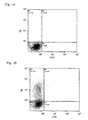
- Figs. 1A and 1B show analysis results of the interaction between hETAR gene-introduced cells and an anti-hETAR antibody in the serum, Fig. 1A being a two-dimensional dot plot in the case of use of the serum before gene immunization (day 0), Fig. 1B being a two-dimensional dot plot in the case of use of the serum on the 35 th day after gene immunization.
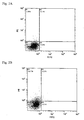
- Figs. 2A and 2B show analysis results of the interaction between hETBR gene-introduced cells and an anti-hETAR antibody in the serum, Fig. 2A being a two-dimensional dot plot in the case of use of the serum before gene immunization (day 0), Fig.
- FIG. 1B being a two-dimensional dot plot in the case of use of the serum on the 35 th day after gene immunization.
- FIGs. 3A and 3B show analysis results of the interaction between the control cells and an anti-hETAR antibody in the serum, Fig. 3A being a two-dimensional dot plot in the case of use of the serum before gene immunization (day 0), Fig. 1B being a two-dimensional dot plot in the case of use of the serum on the 35 th day after gene immunization.
- Figs. 3A being a two-dimensional dot plot in the case of use of the serum before gene immunization (day 0)
- Fig. 1B being a two-dimensional dot plot in the case of use of the serum on the 35 th day after gene immunization.
- Figs. 3A being a two-dimensional dot plot in the case of use of the serum before gene immunization (day 0)
- Fig. 1B being a two
- a vertical scale denotes fluorescence intensity derived from phycoerythrin (PE) and a horizontal scale denotes fluorescence intensity derived from fluorescein isothiocyanate (FITC).
- PE phycoerythrin
- FITC fluorescein isothiocyanate
Landscapes
- Health & Medical Sciences (AREA)
- Life Sciences & Earth Sciences (AREA)
- Chemical & Material Sciences (AREA)
- Immunology (AREA)
- Medicinal Chemistry (AREA)
- General Health & Medical Sciences (AREA)
- Animal Behavior & Ethology (AREA)
- Veterinary Medicine (AREA)
- Public Health (AREA)
- Pharmacology & Pharmacy (AREA)
- Organic Chemistry (AREA)
- Microbiology (AREA)
- Epidemiology (AREA)
- Mycology (AREA)
- Nuclear Medicine, Radiotherapy & Molecular Imaging (AREA)
- General Chemical & Material Sciences (AREA)
- Chemical Kinetics & Catalysis (AREA)
- Engineering & Computer Science (AREA)
- Molecular Biology (AREA)
- Proteomics, Peptides & Aminoacids (AREA)
- Biochemistry (AREA)
- Biophysics (AREA)
- Genetics & Genomics (AREA)
- Oncology (AREA)
- Communicable Diseases (AREA)
- Endocrinology (AREA)
- Neurology (AREA)
- Biomedical Technology (AREA)
- Bioinformatics & Cheminformatics (AREA)
- Virology (AREA)
- Preparation Of Compounds By Using Micro-Organisms (AREA)
- Peptides Or Proteins (AREA)
- Micro-Organisms Or Cultivation Processes Thereof (AREA)
- Medicines That Contain Protein Lipid Enzymes And Other Medicines (AREA)
- Medicines Containing Antibodies Or Antigens For Use As Internal Diagnostic Agents (AREA)
- Pharmaceuticals Containing Other Organic And Inorganic Compounds (AREA)
- Medicines Containing Material From Animals Or Micro-Organisms (AREA)
Claims (15)
- Médicament destiné à l'immunisation d'un animal, le médicament comprenant un gène de fusion, le gène de fusion se composant d'un gène codant pour une protéine antigène pleine longueur ou une partie d'une protéine antigène et d'un gène codant pour un élément sélectionné parmi une sous-unité de chapéronine et une liaison de sous-unités de chapéronine liée à celui-ci, de sorte à exprimer le gène de fusion dans l'animal afin d'induire une réponse immunitaire humorale vis-à-vis de la protéine antigène.
- Procédé non thérapeutique pour l'immunisation d'un animal qui n'est pas un être humain, comprenant l'étape d'administration d'un gène de fusion à un animal qui n'est pas un être humain, le gène de fusion se composant d'un gène codant pour une protéine antigène pleine longueur ou une partie d'une protéine antigène et d'un gène codant pour un élément sélectionné parmi une sous-unité de chapéronine et une liaison de sous-unités de chapéronine liée à celui-ci, de sorte à exprimer le gène de fusion dans l'animal qui n'est pas un être humain afin d'induire une réponse immunitaire humorale vis-à-vis de la protéine antigène.
- Procédé ou médicament tel que défini selon la revendication 1 ou 2, dans lequel l'élément sélectionné parmi la sous-unité de chapéronine et la liaison de sous-unités de chapéronine est dérivé d'Escherichia coli.
- Procédé ou médicament tel que défini selon la revendication 1, 2 ou 3, dans lequel le gène de fusion est intégré dans un vecteur d'expression et exprimé sous le contrôle d'un promoteur sur le vecteur d'expression.
- Procédé ou médicament tel que défini selon la revendication 4, dans lequel le promoteur est un élément sélectionné dans le groupe constitué par un promoteur CMV, un promoteur AML, un promoteur SV40, un promoteur SR et un promoteur EF-1a.
- Procédé ou médicament tel que défini selon la revendication 4 ou 5, dans lequel le vecteur d'expression contient un motif CpG.
- Procédé ou médicament tel que défini selon l'une quelconque des revendications 1 à 6, dans lequel l'animal est sélectionné parmi un mammifère et un oiseau.
- Procédé ou médicament tel que défini selon la revendication 7, dans lequel le mammifère est sélectionné dans le groupe constitué par une souris, un rat, un lapin, un bovin, un cheval, un chien, un chat, une chèvre, un mouton et un cochon.
- Procédé ou médicament tel que défini selon la revendication 7, dans lequel l'oiseau est sélectionné dans le groupe constitué par une poule, un canard et une dinde.
- Procédé ou médicament tel que défini selon l'une quelconque des revendications 1 à 9, dans lequel la protéine antigène est sélectionnée dans le groupe constitué par un récepteur couplé aux protéines G, un récepteur lié aux canaux ioniques, un récepteur de type tyrosine kinase, un antigène CD, une molécule d'adhésion cellulaire, un antigène cancéreux, une cytokine, un facteur de croissance, un facteur trophique, un antigène viral, un antigène bactérien et un antigène toxique.
- Composition destinée à l'immunisation pour une utilisation en tant que médicament ou dans un procédé tel que défini selon l'une quelconque des revendications 1 à 10, comprenant un gène de fusion se composant d'un gène codant pour une protéine antigène pleine longueur ou une partie d'une protéine antigène et d'un gène codant pour un élément sélectionné parmi une sous-unité de chapéronine et une liaison de sous-unités de chapéronine liée à celui-ci en tant qu'ingrédient principal.
- Procédé de production d'un anticorps, comprenant les étapes de :immunisation d'un animal qui n'est pas un être humain par le biais du procédé tel que défini selon l'une quelconque des revendications 2 à 10 afin d'induire une réponse immunitaire humorale vis-à-vis d'une protéine antigène,de sorte qu'un anticorps contre la protéine antigène soit produit dans l'animal qui n'est pas un être humain ;et obtention de l'anticorps à partir de l'animal qui n'est pas un être humain.
- Procédé de production d'un hybridome, comprenant les étapes de :immunisation d'un animal qui n'est pas un être humain par le biais du procédé tel que défini selon l'une quelconque des revendications 2 à 10 afin d'induire une réponse immunitaire humorale vis-à-vis d'une protéine antigène ;obtention d'un immunocyte à partir l'animal qui n'est pas un être humain ; etfusion de l'immunocyte et d'un myélome,de sorte à préparer un hybridome produisant un anticorps contre la protéine antigène.
- Procédé de production d'un anticorps monoclonal, comprenant les étapes de :culture de l'hybridome produit par le procédé tel que défini selon la revendication 13 ; etobtention d'un anticorps monoclonal contre la protéine antigène à partir de la culture de l'hybridome.
- Procédé de production d'un anticorps monoclonal, comprenant les étapes de :immunisation d'un animal qui n'est pas un être humain par le biais du procédé tel que défini selon l'une quelconque des revendications 2 à 10 afin d'induire une réponse immunitaire humorale vis-à-vis d'une protéine antigène ;préparation d'ARNm à partir de l'animal qui n'est pas un être humain ;préparation d'ADNc à partir de l'ARNm utilisé comme matrice ; etpréparation d'un anticorps monoclonal contre la protéine antigène par un procédé d'affichage de phages en utilisant l'ADNc.
Applications Claiming Priority (2)
| Application Number | Priority Date | Filing Date | Title |
|---|---|---|---|
| JP2004301887 | 2004-10-15 | ||
| PCT/JP2005/018953 WO2006041157A1 (fr) | 2004-10-15 | 2005-10-14 | Méthode d’immunisation d’un animal, préparation pour immunisation, méthode de production d'un anticorps, méthode de production d'un hybridome et méthode de production d'un anticorps monoclonal |
Publications (3)
| Publication Number | Publication Date |
|---|---|
| EP1811026A1 EP1811026A1 (fr) | 2007-07-25 |
| EP1811026A4 EP1811026A4 (fr) | 2007-11-14 |
| EP1811026B1 true EP1811026B1 (fr) | 2015-01-28 |
Family
ID=36148443
Family Applications (1)
| Application Number | Title | Priority Date | Filing Date |
|---|---|---|---|
| EP05793077.8A Expired - Lifetime EP1811026B1 (fr) | 2004-10-15 | 2005-10-14 | Methode d'immunisation d'un animal, preparation pour immunisation, methode de production d'un anticorps, methode de production d'un hybridome et methode de production d'un anticorps monoclonal |
Country Status (7)
| Country | Link |
|---|---|
| US (2) | US8349807B2 (fr) |
| EP (1) | EP1811026B1 (fr) |
| JP (2) | JP4644680B2 (fr) |
| KR (1) | KR101215780B1 (fr) |
| AU (1) | AU2005292852B2 (fr) |
| CA (1) | CA2583361C (fr) |
| WO (1) | WO2006041157A1 (fr) |
Families Citing this family (6)
| Publication number | Priority date | Publication date | Assignee | Title |
|---|---|---|---|---|
| JP2010138165A (ja) * | 2008-11-14 | 2010-06-24 | Sekisui Chem Co Ltd | 抗ヒトエンドセリン受容体タイプaモノクローナル抗体、並びに、ハイブリドーマ |
| JP2011111422A (ja) * | 2009-11-27 | 2011-06-09 | Sekisui Chem Co Ltd | モノクローナル抗体 |
| EP2623592B1 (fr) | 2010-09-28 | 2019-05-15 | NB Health Laboratory Co. Ltd. | Anticorps anti-ccr7 humain, hybridome, composition thérapeutique et vecteur à anticorps immobilisé |
| JP2012111706A (ja) * | 2010-11-24 | 2012-06-14 | Sekisui Chem Co Ltd | モノクローナル抗体、並びに、ハイブリドーマ |
| JP2012120507A (ja) * | 2010-12-10 | 2012-06-28 | Sekisui Chem Co Ltd | 組換え真核細胞、並びに、細胞内シグナル伝達抑制方法 |
| CN118978590B (zh) * | 2024-10-12 | 2025-01-21 | 北京溯本源和生物科技有限公司 | 一种利用重组流感病毒免疫小鼠制备杂交瘤单抗的方法及应用 |
Family Cites Families (20)
| Publication number | Priority date | Publication date | Assignee | Title |
|---|---|---|---|---|
| ES2171454T3 (es) * | 1993-06-04 | 2002-09-16 | Whitehead Biomedical Inst | Proteinas de estres y sus usos. |
| BR9610580A (pt) * | 1995-09-14 | 2000-10-24 | Univ California | Anticorpos especìficos para prpse nativos |
| EP1003531B1 (fr) * | 1997-05-20 | 2007-08-22 | Ottawa Health Research Institute | Procedes de preparation de constructions d'acides nucleiques |
| JP2001033449A (ja) | 1998-12-28 | 2001-02-09 | Sekisui Chem Co Ltd | ウイルス抗原の調製法 |
| FI109361B (fi) | 1999-05-04 | 2002-07-15 | Korpela Timo | Mikrobinen proteiinin ilmentämisjärjestelmä |
| GB9913437D0 (en) | 1999-06-09 | 1999-08-11 | Medical Res Council | Fusion proteins |
| EP1222289B1 (fr) | 1999-10-20 | 2008-04-16 | The Johns Hopkins University School Of Medicine | Compositions chimeriques immunogenes et acides nucleiques codant pour de telles compositions |
| US7250507B2 (en) * | 2000-04-28 | 2007-07-31 | Immunex Corporation | Inhibitory Pellino nucleic acids |
| JP5087201B2 (ja) | 2000-08-03 | 2012-12-05 | ジョンズ・ホプキンス・ユニバーシティ | 抗原に小胞体シャペロンポリペプチドを連結した分子ワクチン |
| JP4007477B2 (ja) | 2000-10-13 | 2007-11-14 | 独立行政法人科学技術振興機構 | エピトープの免疫原性が増強された人工タンパク質 |
| US7276355B2 (en) | 2000-12-26 | 2007-10-02 | Sekisui Chemical Co., Ltd. | Process for production of a recombinant protein and a fusion protein |
| AUPR852301A0 (en) * | 2001-10-26 | 2001-11-29 | Medvet Science Pty. Ltd. | Groel chimeric protein and vaccine |
| JP4108000B2 (ja) | 2002-05-17 | 2008-06-25 | 積水化学工業株式会社 | 蛋白質の製造方法 |
| JP2004024095A (ja) | 2002-06-25 | 2004-01-29 | Sekisui Chem Co Ltd | タンパク質の生産方法、融合タンパク質及びタンパク質 |
| JP2004081199A (ja) | 2002-06-25 | 2004-03-18 | Sekisui Chem Co Ltd | 組換え抗体の製造方法 |
| GB0223696D0 (en) * | 2002-10-14 | 2002-11-20 | Ml Lab Plc | Improved immunotherapy |
| AU2004230803A1 (en) | 2003-04-18 | 2004-10-28 | Chiba, Joe | Immunogen, composition for immunological use and process for producing antibody using the same |
| WO2004096859A1 (fr) | 2003-04-28 | 2004-11-11 | Sekisui Chemical Co., Ltd. | Complexe de chaperonine/proteine cible, son procede de production, procede de stabilisation de proteine cible, procede d'immobilisation de proteine cible, procede d'analyse de la structure de proteine cible, preparation a liberation prolongee et procede de production d'anticorps contre une proteine cible |
| US20070092937A1 (en) | 2003-04-28 | 2007-04-26 | Sekisui Chemical Company Limited | Method of producing target protein, fusion protein and gene thereof, protein consisting of partial sequence of intein and gene thereof, expression vector, and transformant |
| US20050260710A1 (en) | 2004-03-31 | 2005-11-24 | Sekisui Chemical Co. Ltd. | Methods for producing recombinant polyclonal immunoglobulins |
-
2005
- 2005-10-14 CA CA2583361A patent/CA2583361C/fr not_active Expired - Lifetime
- 2005-10-14 JP JP2006540983A patent/JP4644680B2/ja not_active Expired - Lifetime
- 2005-10-14 KR KR1020077010943A patent/KR101215780B1/ko not_active Expired - Fee Related
- 2005-10-14 WO PCT/JP2005/018953 patent/WO2006041157A1/fr not_active Ceased
- 2005-10-14 EP EP05793077.8A patent/EP1811026B1/fr not_active Expired - Lifetime
- 2005-10-14 US US11/665,270 patent/US8349807B2/en not_active Expired - Fee Related
- 2005-10-14 AU AU2005292852A patent/AU2005292852B2/en not_active Ceased
-
2010
- 2010-09-16 JP JP2010207530A patent/JP2011032276A/ja active Pending
-
2012
- 2012-11-20 US US13/681,700 patent/US8901099B2/en not_active Expired - Lifetime
Non-Patent Citations (1)
| Title |
|---|
| Technical Bulletin; pCI and pSI Mammalian Expression Vectors, Instructions for Use of Products E1721 and E1731 * |
Also Published As
| Publication number | Publication date |
|---|---|
| US8901099B2 (en) | 2014-12-02 |
| US8349807B2 (en) | 2013-01-08 |
| KR101215780B1 (ko) | 2012-12-26 |
| EP1811026A4 (fr) | 2007-11-14 |
| WO2006041157A1 (fr) | 2006-04-20 |
| JPWO2006041157A1 (ja) | 2008-05-22 |
| US20130109057A1 (en) | 2013-05-02 |
| JP4644680B2 (ja) | 2011-03-02 |
| CA2583361A1 (fr) | 2006-04-20 |
| AU2005292852A8 (en) | 2011-09-08 |
| EP1811026A1 (fr) | 2007-07-25 |
| CA2583361C (fr) | 2015-08-04 |
| JP2011032276A (ja) | 2011-02-17 |
| AU2005292852A1 (en) | 2006-04-20 |
| US20090041761A1 (en) | 2009-02-12 |
| KR20070073908A (ko) | 2007-07-10 |
| AU2005292852B2 (en) | 2011-02-03 |
Similar Documents
| Publication | Publication Date | Title |
|---|---|---|
| US12516116B2 (en) | Homodimeric protein constructs | |
| US8901099B2 (en) | Method for immunizing animal, composition for immunization, method for producing antibody, method for producing hybridoma, and method for producing monoclonal antibody | |
| CN112480239B (zh) | 人乳头瘤病毒特异性t细胞受体及其抗肿瘤用途 | |
| EP2910634A1 (fr) | Vaccin pour prévenir la maladie de l' dème chez le porc | |
| CN1871025B (zh) | 基于印记位点调节物兄弟(boris)的预防性癌症疫苗 | |
| EP3004173B1 (fr) | Présentation des anticorps à domaine unique | |
| US20250339509A1 (en) | Immunogenic constructs and vaccines for use in the prophylactic and therapeutic treatment of infectious diseases | |
| CN114853880B (zh) | Wt1抗原特异性t细胞受体及其抗肿瘤用途 | |
| Swencki-Underwood et al. | Engineering human IL-18 with increased bioactivity and bioavailability | |
| EP3540057A1 (fr) | Vaccin antipaludique | |
| CN110603053A (zh) | 重组衣原体活化的b细胞平台及其使用方法 | |
| KR102779372B1 (ko) | p40-EBI3의 복합체 및 이의 용도 | |
| EP4608436A1 (fr) | Constructions et leur utilisation | |
| CN118742321A (zh) | 用于预防性和治疗性治疗由SARS-CoV-2引起的疾病的免疫原性构建体和疫苗 | |
| CN105985444A (zh) | 一种嵌合抗原受体、以及快速构建嵌合抗原受体的方法及应用 | |
| JP2011063573A (ja) | 動物の免疫方法、免疫用組成物、抗体の製造方法、ハイブリドーマの製造方法、及びモノクローナル抗体の製造方法 |
Legal Events
| Date | Code | Title | Description |
|---|---|---|---|
| PUAI | Public reference made under article 153(3) epc to a published international application that has entered the european phase |
Free format text: ORIGINAL CODE: 0009012 |
|
| 17P | Request for examination filed |
Effective date: 20070427 |
|
| AK | Designated contracting states |
Kind code of ref document: A1 Designated state(s): AT BE BG CH CY CZ DE DK EE ES FI FR GB GR HU IE IS IT LI LT LU LV MC NL PL PT RO SE SI SK TR |
|
| RAP1 | Party data changed (applicant data changed or rights of an application transferred) |
Owner name: CHIBA, JOE Owner name: SEKISUI CHEMICAL CO., LTD. |
|
| A4 | Supplementary search report drawn up and despatched |
Effective date: 20071017 |
|
| RIC1 | Information provided on ipc code assigned before grant |
Ipc: A61K 48/00 20060101ALI20071009BHEP Ipc: C12P 21/08 20060101ALI20071009BHEP Ipc: C12N 15/62 20060101ALI20071009BHEP Ipc: C07K 14/705 20060101ALI20071009BHEP Ipc: C12N 5/12 20060101ALI20071009BHEP Ipc: C12N 15/09 20060101AFI20060831BHEP |
|
| DAX | Request for extension of the european patent (deleted) | ||
| 17Q | First examination report despatched |
Effective date: 20080103 |
|
| GRAP | Despatch of communication of intention to grant a patent |
Free format text: ORIGINAL CODE: EPIDOSNIGR1 |
|
| INTG | Intention to grant announced |
Effective date: 20140429 |
|
| GRAS | Grant fee paid |
Free format text: ORIGINAL CODE: EPIDOSNIGR3 |
|
| GRAP | Despatch of communication of intention to grant a patent |
Free format text: ORIGINAL CODE: EPIDOSNIGR1 |
|
| INTG | Intention to grant announced |
Effective date: 20141110 |
|
| GRAA | (expected) grant |
Free format text: ORIGINAL CODE: 0009210 |
|
| AK | Designated contracting states |
Kind code of ref document: B1 Designated state(s): AT BE BG CH CY CZ DE DK EE ES FI FR GB GR HU IE IS IT LI LT LU LV MC NL PL PT RO SE SI SK TR |
|
| REG | Reference to a national code |
Ref country code: GB Ref legal event code: FG4D |
|
| REG | Reference to a national code |
Ref country code: CH Ref legal event code: EP Ref country code: CH Ref legal event code: NV Representative=s name: BOHEST AG, CH |
|
| REG | Reference to a national code |
Ref country code: IE Ref legal event code: FG4D |
|
| REG | Reference to a national code |
Ref country code: DE Ref legal event code: R096 Ref document number: 602005045784 Country of ref document: DE Effective date: 20150312 |
|
| REG | Reference to a national code |
Ref country code: AT Ref legal event code: REF Ref document number: 708248 Country of ref document: AT Kind code of ref document: T Effective date: 20150315 |
|
| REG | Reference to a national code |
Ref country code: AT Ref legal event code: MK05 Ref document number: 708248 Country of ref document: AT Kind code of ref document: T Effective date: 20150128 |
|
| REG | Reference to a national code |
Ref country code: NL Ref legal event code: VDEP Effective date: 20150128 |
|
| REG | Reference to a national code |
Ref country code: LT Ref legal event code: MG4D |
|
| PG25 | Lapsed in a contracting state [announced via postgrant information from national office to epo] |
Ref country code: FI Free format text: LAPSE BECAUSE OF FAILURE TO SUBMIT A TRANSLATION OF THE DESCRIPTION OR TO PAY THE FEE WITHIN THE PRESCRIBED TIME-LIMIT Effective date: 20150128 Ref country code: LT Free format text: LAPSE BECAUSE OF FAILURE TO SUBMIT A TRANSLATION OF THE DESCRIPTION OR TO PAY THE FEE WITHIN THE PRESCRIBED TIME-LIMIT Effective date: 20150128 Ref country code: ES Free format text: LAPSE BECAUSE OF FAILURE TO SUBMIT A TRANSLATION OF THE DESCRIPTION OR TO PAY THE FEE WITHIN THE PRESCRIBED TIME-LIMIT Effective date: 20150128 Ref country code: SE Free format text: LAPSE BECAUSE OF FAILURE TO SUBMIT A TRANSLATION OF THE DESCRIPTION OR TO PAY THE FEE WITHIN THE PRESCRIBED TIME-LIMIT Effective date: 20150128 Ref country code: BG Free format text: LAPSE BECAUSE OF FAILURE TO SUBMIT A TRANSLATION OF THE DESCRIPTION OR TO PAY THE FEE WITHIN THE PRESCRIBED TIME-LIMIT Effective date: 20150428 |
|
| PG25 | Lapsed in a contracting state [announced via postgrant information from national office to epo] |
Ref country code: GR Free format text: LAPSE BECAUSE OF FAILURE TO SUBMIT A TRANSLATION OF THE DESCRIPTION OR TO PAY THE FEE WITHIN THE PRESCRIBED TIME-LIMIT Effective date: 20150429 Ref country code: PL Free format text: LAPSE BECAUSE OF FAILURE TO SUBMIT A TRANSLATION OF THE DESCRIPTION OR TO PAY THE FEE WITHIN THE PRESCRIBED TIME-LIMIT Effective date: 20150128 Ref country code: NL Free format text: LAPSE BECAUSE OF FAILURE TO SUBMIT A TRANSLATION OF THE DESCRIPTION OR TO PAY THE FEE WITHIN THE PRESCRIBED TIME-LIMIT Effective date: 20150128 Ref country code: IS Free format text: LAPSE BECAUSE OF FAILURE TO SUBMIT A TRANSLATION OF THE DESCRIPTION OR TO PAY THE FEE WITHIN THE PRESCRIBED TIME-LIMIT Effective date: 20150528 Ref country code: AT Free format text: LAPSE BECAUSE OF FAILURE TO SUBMIT A TRANSLATION OF THE DESCRIPTION OR TO PAY THE FEE WITHIN THE PRESCRIBED TIME-LIMIT Effective date: 20150128 Ref country code: LV Free format text: LAPSE BECAUSE OF FAILURE TO SUBMIT A TRANSLATION OF THE DESCRIPTION OR TO PAY THE FEE WITHIN THE PRESCRIBED TIME-LIMIT Effective date: 20150128 |
|
| REG | Reference to a national code |
Ref country code: FR Ref legal event code: PLFP Year of fee payment: 11 |
|
| REG | Reference to a national code |
Ref country code: DE Ref legal event code: R097 Ref document number: 602005045784 Country of ref document: DE |
|
| PG25 | Lapsed in a contracting state [announced via postgrant information from national office to epo] |
Ref country code: DK Free format text: LAPSE BECAUSE OF FAILURE TO SUBMIT A TRANSLATION OF THE DESCRIPTION OR TO PAY THE FEE WITHIN THE PRESCRIBED TIME-LIMIT Effective date: 20150128 Ref country code: SK Free format text: LAPSE BECAUSE OF FAILURE TO SUBMIT A TRANSLATION OF THE DESCRIPTION OR TO PAY THE FEE WITHIN THE PRESCRIBED TIME-LIMIT Effective date: 20150128 Ref country code: CZ Free format text: LAPSE BECAUSE OF FAILURE TO SUBMIT A TRANSLATION OF THE DESCRIPTION OR TO PAY THE FEE WITHIN THE PRESCRIBED TIME-LIMIT Effective date: 20150128 Ref country code: RO Free format text: LAPSE BECAUSE OF FAILURE TO SUBMIT A TRANSLATION OF THE DESCRIPTION OR TO PAY THE FEE WITHIN THE PRESCRIBED TIME-LIMIT Effective date: 20150128 Ref country code: EE Free format text: LAPSE BECAUSE OF FAILURE TO SUBMIT A TRANSLATION OF THE DESCRIPTION OR TO PAY THE FEE WITHIN THE PRESCRIBED TIME-LIMIT Effective date: 20150128 |
|
| PLBE | No opposition filed within time limit |
Free format text: ORIGINAL CODE: 0009261 |
|
| STAA | Information on the status of an ep patent application or granted ep patent |
Free format text: STATUS: NO OPPOSITION FILED WITHIN TIME LIMIT |
|
| PG25 | Lapsed in a contracting state [announced via postgrant information from national office to epo] |
Ref country code: IT Free format text: LAPSE BECAUSE OF FAILURE TO SUBMIT A TRANSLATION OF THE DESCRIPTION OR TO PAY THE FEE WITHIN THE PRESCRIBED TIME-LIMIT Effective date: 20150128 |
|
| 26N | No opposition filed |
Effective date: 20151029 |
|
| PG25 | Lapsed in a contracting state [announced via postgrant information from national office to epo] |
Ref country code: SI Free format text: LAPSE BECAUSE OF FAILURE TO SUBMIT A TRANSLATION OF THE DESCRIPTION OR TO PAY THE FEE WITHIN THE PRESCRIBED TIME-LIMIT Effective date: 20150128 |
|
| PG25 | Lapsed in a contracting state [announced via postgrant information from national office to epo] |
Ref country code: LU Free format text: LAPSE BECAUSE OF FAILURE TO SUBMIT A TRANSLATION OF THE DESCRIPTION OR TO PAY THE FEE WITHIN THE PRESCRIBED TIME-LIMIT Effective date: 20151014 Ref country code: BE Free format text: LAPSE BECAUSE OF FAILURE TO SUBMIT A TRANSLATION OF THE DESCRIPTION OR TO PAY THE FEE WITHIN THE PRESCRIBED TIME-LIMIT Effective date: 20150128 |
|
| PG25 | Lapsed in a contracting state [announced via postgrant information from national office to epo] |
Ref country code: MC Free format text: LAPSE BECAUSE OF FAILURE TO SUBMIT A TRANSLATION OF THE DESCRIPTION OR TO PAY THE FEE WITHIN THE PRESCRIBED TIME-LIMIT Effective date: 20150128 |
|
| REG | Reference to a national code |
Ref country code: IE Ref legal event code: MM4A |
|
| REG | Reference to a national code |
Ref country code: FR Ref legal event code: PLFP Year of fee payment: 12 |
|
| PG25 | Lapsed in a contracting state [announced via postgrant information from national office to epo] |
Ref country code: IE Free format text: LAPSE BECAUSE OF NON-PAYMENT OF DUE FEES Effective date: 20151014 |
|
| PG25 | Lapsed in a contracting state [announced via postgrant information from national office to epo] |
Ref country code: HU Free format text: LAPSE BECAUSE OF FAILURE TO SUBMIT A TRANSLATION OF THE DESCRIPTION OR TO PAY THE FEE WITHIN THE PRESCRIBED TIME-LIMIT; INVALID AB INITIO Effective date: 20051014 |
|
| PG25 | Lapsed in a contracting state [announced via postgrant information from national office to epo] |
Ref country code: CY Free format text: LAPSE BECAUSE OF FAILURE TO SUBMIT A TRANSLATION OF THE DESCRIPTION OR TO PAY THE FEE WITHIN THE PRESCRIBED TIME-LIMIT Effective date: 20150128 |
|
| PG25 | Lapsed in a contracting state [announced via postgrant information from national office to epo] |
Ref country code: TR Free format text: LAPSE BECAUSE OF FAILURE TO SUBMIT A TRANSLATION OF THE DESCRIPTION OR TO PAY THE FEE WITHIN THE PRESCRIBED TIME-LIMIT Effective date: 20150128 |
|
| REG | Reference to a national code |
Ref country code: FR Ref legal event code: PLFP Year of fee payment: 13 |
|
| PG25 | Lapsed in a contracting state [announced via postgrant information from national office to epo] |
Ref country code: PT Free format text: LAPSE BECAUSE OF FAILURE TO SUBMIT A TRANSLATION OF THE DESCRIPTION OR TO PAY THE FEE WITHIN THE PRESCRIBED TIME-LIMIT Effective date: 20150128 |
|
| REG | Reference to a national code |
Ref country code: FR Ref legal event code: PLFP Year of fee payment: 14 |
|
| P01 | Opt-out of the competence of the unified patent court (upc) registered |
Effective date: 20230522 |
|
| PGFP | Annual fee paid to national office [announced via postgrant information from national office to epo] |
Ref country code: GB Payment date: 20231025 Year of fee payment: 19 |
|
| PGFP | Annual fee paid to national office [announced via postgrant information from national office to epo] |
Ref country code: FR Payment date: 20231023 Year of fee payment: 19 Ref country code: DE Payment date: 20231027 Year of fee payment: 19 Ref country code: CH Payment date: 20231102 Year of fee payment: 19 |
|
| REG | Reference to a national code |
Ref country code: DE Ref legal event code: R119 Ref document number: 602005045784 Country of ref document: DE |
|
| REG | Reference to a national code |
Ref country code: CH Ref legal event code: PL |
|
| GBPC | Gb: european patent ceased through non-payment of renewal fee |
Effective date: 20241014 |
|
| PG25 | Lapsed in a contracting state [announced via postgrant information from national office to epo] |
Ref country code: DE Free format text: LAPSE BECAUSE OF NON-PAYMENT OF DUE FEES Effective date: 20250501 |
|
| PG25 | Lapsed in a contracting state [announced via postgrant information from national office to epo] |
Ref country code: GB Free format text: LAPSE BECAUSE OF NON-PAYMENT OF DUE FEES Effective date: 20241014 |
|
| PG25 | Lapsed in a contracting state [announced via postgrant information from national office to epo] |
Ref country code: FR Free format text: LAPSE BECAUSE OF NON-PAYMENT OF DUE FEES Effective date: 20241031 |
|
| PG25 | Lapsed in a contracting state [announced via postgrant information from national office to epo] |
Ref country code: CH Free format text: LAPSE BECAUSE OF NON-PAYMENT OF DUE FEES Effective date: 20241031 |