EP1811302B1 - Diagnostischer Nanosensor und seine Verwendung - Google Patents
Diagnostischer Nanosensor und seine Verwendung Download PDFInfo
- Publication number
- EP1811302B1 EP1811302B1 EP06090012A EP06090012A EP1811302B1 EP 1811302 B1 EP1811302 B1 EP 1811302B1 EP 06090012 A EP06090012 A EP 06090012A EP 06090012 A EP06090012 A EP 06090012A EP 1811302 B1 EP1811302 B1 EP 1811302B1
- Authority
- EP
- European Patent Office
- Prior art keywords
- diagnostic
- nanosensor
- metallic
- organic
- nanoislands
- Prior art date
- Legal status (The legal status is an assumption and is not a legal conclusion. Google has not performed a legal analysis and makes no representation as to the accuracy of the status listed.)
- Expired - Lifetime
Links
Images








Classifications
-
- G—PHYSICS
- G01—MEASURING; TESTING
- G01N—INVESTIGATING OR ANALYSING MATERIALS BY DETERMINING THEIR CHEMICAL OR PHYSICAL PROPERTIES
- G01N21/00—Investigating or analysing materials by the use of optical means, i.e. using sub-millimetre waves, infrared, visible or ultraviolet light
- G01N21/17—Systems in which incident light is modified in accordance with the properties of the material investigated
- G01N21/55—Specular reflectivity
- G01N21/552—Attenuated total reflection
- G01N21/553—Attenuated total reflection and using surface plasmons
- G01N21/554—Attenuated total reflection and using surface plasmons detecting the surface plasmon resonance of nanostructured metals, e.g. localised surface plasmon resonance
-
- G—PHYSICS
- G01—MEASURING; TESTING
- G01N—INVESTIGATING OR ANALYSING MATERIALS BY DETERMINING THEIR CHEMICAL OR PHYSICAL PROPERTIES
- G01N33/00—Investigating or analysing materials by specific methods not covered by groups G01N1/00 - G01N31/00
- G01N33/48—Biological material, e.g. blood, urine; Haemocytometers
- G01N33/50—Chemical analysis of biological material, e.g. blood, urine; Testing involving biospecific ligand binding methods; Immunological testing
- G01N33/53—Immunoassay; Biospecific binding assay; Materials therefor
- G01N33/543—Immunoassay; Biospecific binding assay; Materials therefor with an insoluble carrier for immobilising immunochemicals
- G01N33/54366—Apparatus specially adapted for solid-phase testing
- G01N33/54373—Apparatus specially adapted for solid-phase testing involving physiochemical end-point determination, e.g. wave-guides, FETS, gratings
Definitions
- This invention relates generally to biosensor technology, and pertains more particularly to novel multifunctional biosensors based on ordered arrays of metallic, semiconductors and magnetic nano-islands for medical, biological, biochemical, chemical and environmental applications.
- the present invention relates to a Diagnostic Nanosensor according to claim 1.
- FR 2 860 872 A discloses a Nanodetector comprising an array of spots made from an electrically conductive material on a substrate and capable of immobilizing chemical or biological targets, the spots having dimensions of less than 1 ⁇ m.
- the spots have circular or elliptical shapes.
- biosensors have important applications in medicine, in biological and biochemical research, as well as for environmental monitoring and protection and in food industry.
- WO2004/086044 discloses the production of nanosensors based on silver nanoparticles. The use of nanosphere lithography is mentioned.
- nanoparticles can be functionalized with bio-organic interactive material that due to their specificity interact selectively with other molecules.
- they can be "programmed” to recognize and selectively bind molecules, other nanoparticles (semiconductors) or a suitably patterned substrate surface like the cellular outer membrane.
- nano-transducers based on noble metal nanoislands through resonant excitations of the collective oscillations of the conduction electrons on the nanoislands, the so-called surface plasmon resonances.
- This phenomenon can be coupled to the binding event between receptors and their targets.
- Highly improved electrical conductivity of these nano-transducers translate into unprecedented sensitivity and enable the design of novel sensing devices for the detection of pathogens and toxins of concern, to homeland security, food safety, environmental quality, and public health.
- the use of noble metallic nanoislands results in increased signal transduction of the binding event between bio-organic interactive material and their target substances and lead to an increase in sensitivity of the nano-biosensor in terms of lower limit and dynamic range of detection.
- the present invention provides the Diagnostic Nanosensor according to claim 1.
- a highly periodic array of metallic nanoislands acting as nanotranducers forms a new integral structure called a "Diagnostic-Nanosensor".
- This "Diagnostic-Nanosensor” is deposited on a device that could have a form like a needle or wire or tube or chip and made out of transparent (glass, sapphire) or non-transparent material (silicon substrates, stainless steel, biocompatible polymers).
- the "Diagnostic-Nanosensor” is made by using nanosphere lithography (NSL) to create metallic nanoislands. This technique allows the total control of size and shape of the functional part of the nanosensor.
- NSL nanosphere lithography
- the surface plasmon band is due to collective electron oscillation around the surface mode of the particles.
- Ag nanoparticles have a strong absorption around 390 nm while Au nanoparticles have the plasmon band around 520 nm.
- the peak position and bandwidth of the surface plasmon absorption are related to the size and shape.
- gold nanorods however the absorption spectrum changes dramatically and a bimodal spectrum can be detected with peak position dependent on the aspect ratio of the nanorods.
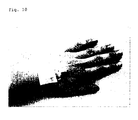
- the subsequent modification of nanostructured surfaces of a catheter or spring wire or stent with bio-organic interactive material is presented as an example in Figure 9 .
- This step and especially the binding of DNA, other molecules or cells on the particles surfaces leads to a change in the dielectric constant of this system and can easily be detected by the optical method.
- the Diagnostic Nanosensor achieves nanometer scale spatial resolution and therefore provides accurate real-time information regarding not only the concentration of a specific analyte of organic or inorganic nature but also its spatial distribution.
- the operation of sensors made with nanowires, nanotubes, or nano-contacts is based mostly on the reversible change in the optical and electronic properties
- the sensitivity and specification of the Diagnostic-Nanosensor according to the invention is based on quantum size effect and can be occur with the decreasing the size of our nanoparticles.
- the "Diagnostic-Nanosensor” of this invention may be used to detect biological materials, such as proteins, carbohydrates, or nucleic acids or cells as well as non-biological materials, such as synthetic polymers or non organic nanoparticles.
- the "Diagnostic-Nanosensor” could be used under in vivo as well as in vitro conditions.
- nanoscale materials are insatiable for producing new detection and diagnostic devices. On the nanometer length scale, materials exhibit new properties such quantum size confinement. Their surface properties become increasingly important. Nanoparticles made of metals (gold, silver, etc), semiconductors (CdS, CdTe, CdSe, Si, etc) or (superpara-) magnetic particles form an ideal platform for functionalized nanoscale materials.
- the particles size can be varied from some of nanometer to 100 nm. The small particle size implies high sensitivity and selectivity if they could further functionalized by the precise deposition of bio-organic interactive material for the binding of a given analyte.
- the "Diagnostic-Nanosensor” according to the invention is made by using nanosphere lithography (NSL) to create metallic nanoislands. This technique allows the total control of size and shape of the functional part of the nanosensor down to sizes below 10 nm. Subsequent depositions of bio-organic interactive material on the nanostructures give a sandwich device for interacting with organic or inorganic targets. Because the sensitivity and specification of any biosensor depends on the size of a given sensor unit, the invention descript here allows sensitivities far below the pmol range.
- the Diagnostic-Nanosensor according to the invention is based on quantum size effect and can be tuned with decreasing the size of utilized nanoparticles that are deposited on various support materials and are subsequently functionalized with bio-organic interactive material to give a sandwich device for interacting with organic or inorganic targets.
- the “Diagnostic Nanosensor” according to the invention is for the direct detection and isolation of rare molecules or cells out of the peripheral blood or the body.
- the "Diagnostic Nanosensor” allows detection of a resultant interaction between the bio-organic interactive material and the target substance by measuring the collective oscillations of the conduction electrons on the nanoislands, the so called surface plasmon resonance, or detection of optical properties from semiconductors particles (luminescence), or the super-paramagnetic properties by magnetic particles.
- detection methods enable the use of the "Diagnostic Nanosensor” according to the invention on scene, i.e. without the infrastructure of a laboratory.
- the "Diagnostic Nanosensor” could be used at the bedside, in the operating theatre, in the ambulance, and on battle field.
- the methods for producing the diagnostic-nanosensor comprise two separate but interrelated procedures:
- NSL nanoparticles or nanospheres lithography
- the two and three-dimensional (2-D, 3-D) ordered particles will be used as a mask for the following deposition of various amounts of different metals (Au, Ag, Pt) or semiconductors (CdS, CdTe, CdSe). After the evaporation process the liftoff of the mask will be performed.
- the metallic 2-D ( Figure 1b ) or 3-D varying particle arrays permit the control of the distance between the nanoparticles as well as their cubic, hexagonal or more complicated ordering. The amount of the deposited materials through the mask can determine directly their optical and electronic properties.
- the production of periodic arrays of nanostructures involves the following steps:
- Ad (2) Functionalizing nanostructured arrays
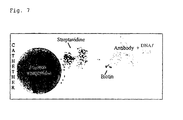
- bio-organic interactive material is bound to array surfaces using various strategies. These strategies include standard streptavidin-biotin interaction as shown in Figure 7 . It also includes the direct binding of (monoclonal) antibodies like IgG or fragments there of to the array surface via adhesion or electrostatic interaction. In addition, covalent linkage of target-specific molecular structures like antibodies or fragments there of, oligomers made of nucleic acids, or peptide or glycopeptides could be performed using linker technology as described in the detailed example below. The latter technique allows the precise binding of target specific molecules to nanoislands giving nanometer scale spatial resolution and therefore provides accurate real-time information regarding not only the concentration of a specific analyte but also its spatial distribution.
- the “Diagnostic-Nanosensor” is for medical application, for biological and biochemical research, as well as for environmental monitoring and protection and food safety. Concerning medical application, the “Diagnostic-Nanosensor” is assembled as a device for in vivo use.
- the "Diagnostic Nanosensor” is assembled on spring wire or stents giving a molecular or cell select catheter to obtain rare molecular or cellular components directly out of the circulation or the body in general ( Figure 9 ).
- the "Diagnostic-Nanosensor" assembled on e.g. spring wires or stents gives a cell or molecular select catheter which is useful for prenatal diagnosis of chromosomal aberrations, cancer diagnosis and the monitoring of chronic diseases like cancer, metabolic, infectious, allergic and inflammatory diseases.
- This device is applied as descript below.
- the "Diagnostic Nanosensor" is for the isolation of rare cells out of the peripheral blood, e.g. trophoblasts.
- Trophoblasts are foetal cells that appear in maternal blood around the 7 th gestational week at a concentration of about 1-2 per ml.
- the cell select catheter equipped with a monoclonal antibody that is directed against cellular but not soluble HLA-G binds specifically circulating trophoblasts in maternal blood.
- the number of bound cells to the cell select catheter depends on the retention period in the maternal circulation and the actual cell concentration. Appropriate numbers of trophoblasts for prenatal diagnoses of chromosomal aberration and other genetic defects could be collected after a retention period of 30 ⁇ 15 minutes in vivo. After replacing of the catheter the tip of the catheter with the attached cells is placed into a collector tube for transport to specialized laboratories.
- nanosized metallic particles show different optical absorption spectra depending on size.
- the surface plasmon band is due to collective electron oscillation around the surface of the particles.
- Ag (Silver) nanoparticles have plasmon band around 390 nm while Au nanoparticles have the plasmon band around 520 nm.
- the pick position, intensity and bandwidth of the surface plasmon absorption are directly related to size, morphology (shape), and surface functionality of the particles (see Figure 11 &12).
- the two-dimensional ordering of latex particles as a basis for nanosphere lithography (NSL) has been used by us and others in the past 1 , 2 , 3 , 4 , 5 , 6 , 7 , 8 .
- NSL nanosphere lithography
- the evaporation or sputtering of different materials through a latex particle mask enabled the production of lattices of triangular islands on various substrates, the shape of the islands being determined by the shape of the aperture between the spheres in the mask.
- the size of the aperture between the spheres depends on the size of the beads in the monolayer. To overcome this limitation, we annealed the monolayer to downsize the apertures in the mask from an initial 200 nm to 30 nm.
- Wiesendanger Appl. Phys. A 1996, 63, 617 . 6 R. Micheletto, H. Fukuda, M. Ohtsu, Langmuir 1995, 11, 3333 . 7 F. Burmeister, W. Badowsky, T. Braun, S. Wieprich, J. Boneberg, P. Griprich, Appl. Surf. Sci. 1999, 461, 144 . 8 N. D. Denkov, O. D. Velev, P. A. Kralchevsky, I. B. Ivanov, H. Yoshimura, K. Nagayama, Langmuir 1992, 8, 3183 .
- a piece of silicon, stainless steal, glass or sapphire substrate (1 cm 2 ) could be used for the deposition of polystyrene (PS) latex particles.
- PS polystyrene
- the amount of solution that could be distributed to cover the whole water surface with a hexagonal close packed (hcp) monolayer is limited by the size of the Petri dish and the diameter of the spheres. About 70% of this amount of solution is applied to the surface of the water, which left some places for stress relaxation and avoided the formation of cracks in the lattice during the next steps of the preparation.
- the monolayer has the biggest crystals of about 2 cm 2 , with very irregular shapes.
- gentle waves are applied to the liquid medium by slow and careful vessel tilting. After this treatment, crystals of about 25 cm 2 are created that show clear diffraction colors.
- the monolayer is deposited on a substrate by slow water evaporation.
- annealing of masks is performed.
- the monolayer of 540-nm PS latex nanospheres on a conductive Si substrate is immersed in a mixture (25 mL) of water/ethanol/acetone (3:1:1).
- Microwave heating is used up to the boiling temperature of the mixture, then additional microwave pulses are applied with duration of 3 s and period of 28 s.
- the increasing number of pulses causes gradual mask annealing and a decrease of the size of the apertures.
- the dependence of aperture morphology on number of pulses is presented in Figure 2 .
- the liquid environment of the sample ensured very homogeneous annealing-the feature sizes become uniform over the whole area of the sample.
- the control of the aperture size was very good and reproducible.
- Metal deposition is carried out by evaporation using an e-beam evaporator.
- the evaporation system is modified to ensure control over the evaporation angle (è) and the sample rotation at the same time ( Figure 4 ).
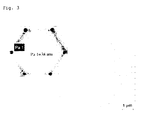
- FIG. 3 An annealed mask with 30-nm apertures ( Figure 3 ) is used for the fabrication of Co magnetic nanoparticles or Au nanoparticles in a honeycomb lattice.
- a layer of Co or Au is evaporated (10 nm at 0.01 nms -1 ) with the sample placed perpendicular to the evaporation beam.
- the result for Co particles is presented in Figure 5 .
- succinimidyl 6-[3'-(2-pyridyldithio)-propionamido] hexanoate, (a SPDP reagent) 12 in DMSO (dimethylsulfoxide) or ethanol was incubated with our periodic arrays of nanostructures in the presence of 150 mM DTT (dithiothreitol) for 30 minutes. This procedure allows covalent linkage of thiol to Au nanoislands.
- buffer PBS-EDTA
- the SPDP reagents produce disulfide-containing linkages that may be cleaved later with reducing agents such as dithiothreitol (DTT).
- DTT dithiothreitol
- the amine-reactive portion of SPDP reagents is the N- hydroxysuccinimide (NHS) ester. Reactions are most commonly performed in phosphate, carbonate/bicarbonate, or borate buffers at pH 7-8. Other buffers may be used provided they do not contain primary amines (or thiols or disulfide reducing reagent).
- the rate of reaction and degradation by hydrolysis increases with increasing pH; for example, the half-life of the NHS ester is several hours at pH 7 and less than 10 minutes at pH 9.
- NHS-ester reagents like SPDP and LC-SPDP have limited aqueous solubility and must be dissolved in organic solvent before adding them to a reaction mixture.
- Sulfo-NHS-ester reagents like Sulfo-LCSPDP are water-soluble and may be added directly to aqueous reaction mixtures.
- the sulfhydryl reactive portion of SPDP reagents is the 2-pyridyldithio group, which reacts optimally with sulfhydryls between pH 7 and 8.
- reaction buffers must be free of thiols and disulfide reducing agents until quenching or reduction of the 2-pyridyl disulfide is desired.
- Two basic strategies may be used to form cleavable cross-links between proteins with SPDP reagents, depending whether one or neither protein already possesses sulfhydryl groups (-SH) in addition to primary amines. Both conjugation methods result in cross-links that contain a disulfide bond in the spacer arm, which may be cleaved by reduction with dithiothreitol (DTT) or other reducing agent.
- DTT dithiothreitol
- cross-links created using SPDP reagents can be cleaved with 25 mM DTT at pH 4.5 without reducing native protein disulfide bonds. However, when preservation of native disulfide bonds is not a concern, cleavage with DTT may be performed most efficiently at pH 7-9.
- Cross-linking experiments with SPDP reagents are not limited to those involving proteins. Any of a variety of molecules with primary amines (-NH2) and sulfhydryl groups may be modified or crosslinked using an SPDP reagent.
Landscapes
- Health & Medical Sciences (AREA)
- Life Sciences & Earth Sciences (AREA)
- Immunology (AREA)
- Engineering & Computer Science (AREA)
- Chemical & Material Sciences (AREA)
- Biomedical Technology (AREA)
- Urology & Nephrology (AREA)
- Biochemistry (AREA)
- General Health & Medical Sciences (AREA)
- General Physics & Mathematics (AREA)
- Physics & Mathematics (AREA)
- Pathology (AREA)
- Analytical Chemistry (AREA)
- Molecular Biology (AREA)
- Hematology (AREA)
- Cell Biology (AREA)
- Microbiology (AREA)
- Biotechnology (AREA)
- Nanotechnology (AREA)
- Food Science & Technology (AREA)
- Medicinal Chemistry (AREA)
- Investigating Or Analyzing Materials By The Use Of Magnetic Means (AREA)
- Soft Magnetic Materials (AREA)
- Investigating Or Analysing Materials By Optical Means (AREA)
- Apparatus Associated With Microorganisms And Enzymes (AREA)
Claims (11)
- Diagnostischer Nanosensor, der auf einem Federdraht oder Katheter oder Stent zusammengesetzt ist und der unter In-vivo-Bedingungen verwendet werden kann, umfassend:(a) eine Aufbringung von nanogemusterten Inseln aus Metall auf planaren oder nichtplanaren, transparenten oder nichttransparenten Oberflächen, wobei die nanogemusterten Inseln eine nanostrukturierte periodische Feldanordnung von metallischen Nanoinseln umfassen, die sich aus einer verschiedenartigen Morphologie zusammensetzen und aus Edelmetallen bestehen, wobei die metallischen Nanoinseln durch Nanosphärenlithografie erzeugt werden,(b) anschließende Aufbringung eines bioorganischen interaktiven Materials auf der unter (a) beschriebenen Aufbringung, um eine schichtartige Vorrichtung für eine Wechselwirkung mit organischen oder anorganischen Zielen bzw. Targets zu erhalten.
- Diagnostischer Nanosensor nach Anspruch 1, wobei sich die nanostrukturierte periodische Feldanordnung von metallischen Nanoinseln aus Nanonadeln, Drähten, Rohren, Ringen oder Kugeln bzw. Sphären zusammensetzt.
- Diagnostischer Nanosensor nach Anspruch 1 oder 2, wobei die metallischen Inseln aus den Edelmetallen Gold, Platin und Silber bestehen.
- Diagnostischer Nanosensor nach einem der vorhergehenden Ansprüche, wobei das planare oder nichtplanare Substrat aus rostfreiem Stahl, Glas, Silizium oder bioverträglichen Polymeren besteht und im Allgemeinen transparent, nichttransparent, leitfähig oder nichtleitfähig sein kann.
- Diagnostischer Nanosensor nach einem der vorhergehenden Ansprüche, wobei das bioorganische interaktive Material Antikörper oder ein Teil von Antikörpern, Peptide, aus Nukleinsäuren bestehende Oligomere oder im Allgemeinen rezeptorstrukturierte organische oder anorganische Verbindungen sein kann, die spezifisch mit Zielen bzw. Targets wechselwirken.
- Diagnostischer Nanosensor nach einem der vorhergehenden Ansprüche, wobei die Nanosphärenlithografie die Erzeugung von monodispersen, oberflächenbeschränkten metallischen Nanodreiecken ermöglicht.
- Diagnostischer Nanosensor nach einem der vorhergehenden Ansprüche, wobei das bioorganische interaktive Material mit den nanogemusterten Strukturen durch Adhäsion, elektrostatische Wechselwirkung, chemische Verkettung bzw. Bindung oder kovalente oder nichtkovalente Bindung verbunden ist.
- Diagnostischer Nanosensor nach einem der vorhergehenden Ansprüche, wobei die Bindung einer Zielsubstanz an die biokonjugierte metallische Oberfläche eine kollektive Wechselwirkung mit dem Oberflächenelektron (Plasmonenresonanz) induziert.
- Diagnostischer Nanosensor nach einem der vorhergehenden Ansprüche, wobei die Bindung einer Zielsubstanz an die biokonjugierte Halbleiteroberfläche eine Exitonenwechselwirkung erzeugt, die durch Messen der Lumineszenz oder Fluoreszenz erfasst werden kann.
- Diagnostischer Nanosensor nach einem der vorhergehenden Ansprüche, wobei die Bindung einer Zielsubstanz an die biokonjugierte magnetische Oberfläche durch die Wechselwirkung zwischen ferro- und/oder superparamagnetischen Materialien gemessen werden kann.
- Diagnostischer Nanosensor nach einem der vorhergehenden Ansprüche, wobei jede bzw. alle metallischen oder nichtmetallischen Nanoinseln als individuelle Sensoren wirken.
Priority Applications (11)
| Application Number | Priority Date | Filing Date | Title |
|---|---|---|---|
| AT06090012T ATE520030T1 (de) | 2006-01-19 | 2006-01-19 | Diagnostischer nanosensor und seine verwendung |
| EP06090012A EP1811302B1 (de) | 2006-01-19 | 2006-01-19 | Diagnostischer Nanosensor und seine Verwendung |
| CA002609573A CA2609573A1 (en) | 2005-06-10 | 2006-06-09 | Diagnostic-nanosensor and its use in medicine |
| US11/917,032 US8846580B2 (en) | 2005-06-10 | 2006-06-09 | Diagnostic nanosensor and its use in medicine |
| AT06743163T ATE519110T1 (de) | 2005-06-10 | 2006-06-09 | Diagnostischer nanosensor und dessen verwendung in der medizin |
| BRPI0611821-6A BRPI0611821A2 (pt) | 2005-06-10 | 2006-06-09 | nanossensor para diagnóstico, método para produzir o mesmo, uso do mesmo, método de detecção |
| CN2006800204055A CN101305280B (zh) | 2005-06-10 | 2006-06-09 | 诊断纳米传感器及其在医学中的用途 |
| AU2006256859A AU2006256859B2 (en) | 2005-06-10 | 2006-06-09 | Diagnostic-nanosensor and its use in medicine |
| PCT/EP2006/005760 WO2006131400A1 (en) | 2005-06-10 | 2006-06-09 | Diagnostic-nanosensor and its use in medicine |
| EP06743163A EP1907848B1 (de) | 2005-06-10 | 2006-06-09 | Diagnostischer nanosensor und dessen verwendung in der medizin |
| US11/733,834 US8197756B2 (en) | 2005-06-10 | 2007-04-11 | Diagnostic-nanosensor and its use in medicine |
Applications Claiming Priority (1)
| Application Number | Priority Date | Filing Date | Title |
|---|---|---|---|
| EP06090012A EP1811302B1 (de) | 2006-01-19 | 2006-01-19 | Diagnostischer Nanosensor und seine Verwendung |
Publications (2)
| Publication Number | Publication Date |
|---|---|
| EP1811302A1 EP1811302A1 (de) | 2007-07-25 |
| EP1811302B1 true EP1811302B1 (de) | 2011-08-10 |
Family
ID=36337354
Family Applications (1)
| Application Number | Title | Priority Date | Filing Date |
|---|---|---|---|
| EP06090012A Expired - Lifetime EP1811302B1 (de) | 2005-06-10 | 2006-01-19 | Diagnostischer Nanosensor und seine Verwendung |
Country Status (2)
| Country | Link |
|---|---|
| EP (1) | EP1811302B1 (de) |
| AT (1) | ATE520030T1 (de) |
Cited By (1)
| Publication number | Priority date | Publication date | Assignee | Title |
|---|---|---|---|---|
| EP2842578A1 (de) | 2013-08-27 | 2015-03-04 | GILUPI GmbH | Diagnosevorrichtung für den Nachweis von erkrankungsverwandten Targetstrukturen |
Families Citing this family (4)
| Publication number | Priority date | Publication date | Assignee | Title |
|---|---|---|---|---|
| DE102008027095A1 (de) | 2008-06-06 | 2009-12-17 | Siemens Aktiengesellschaft | Interventionsvorrichtung zur Sammlung von biologischem Material und Verfahren zu ihrer Herstellung |
| DE102008039798A1 (de) * | 2008-08-15 | 2010-02-25 | NMI Naturwissenschaftliches und Medizinisches Institut an der Universität Tübingen | Verfahren zur Übertragung von Nanostrukturen in ein Substrat |
| EP2430425A4 (de) * | 2009-05-12 | 2015-02-25 | Jean-François Masson | Hochempfindliche plasmonenstrukturen zur verwendung in oberflächenplasmonen-resonanzsensoren und herstellungsverfahren dafür |
| US12290844B2 (en) | 2021-04-07 | 2025-05-06 | Identinano Ab | Method for sorting of items and an assembly for categorizing an item |
Family Cites Families (7)
| Publication number | Priority date | Publication date | Assignee | Title |
|---|---|---|---|---|
| US20020111551A1 (en) * | 2000-11-30 | 2002-08-15 | Erlach Julian Van | Method for detecting body condition using nano and microdevices |
| EP1608975B1 (de) * | 2003-03-28 | 2013-06-19 | The Provost, Fellows, Foundation Scholars, & the other members of Board, of the College of the Holy & Undiv. Trinity of Queen Elizabeth near Dublin | Sensor zum nachweis eines analyten mittels silbernanopartikeln |
| EP1623203A4 (de) * | 2003-05-14 | 2010-11-24 | Nantero Inc | Sensorplattform mit einem nicht horizontal ausgerichteten nanoröhrchenelement |
| EP1680353A4 (de) * | 2003-09-18 | 2012-04-11 | Nanomix Inc | Nanostrukturen mit elektrolytisch abgeschiedenen nanoteilchen |
| FR2860872A1 (fr) | 2003-10-09 | 2005-04-15 | Commissariat Energie Atomique | Micro-capteurs et nano-capteurs d'especes chimiques et biologiques a plasmons de surface |
| KR100578747B1 (ko) * | 2003-12-26 | 2006-05-12 | 한국전자통신연구원 | 혼합 리간드에 의해 캡슐화된 금속 나노입자 화학 센서 및센서 어레이 |
| WO2005093831A1 (en) * | 2004-02-13 | 2005-10-06 | President And Fellows Of Harvard College | Nanostructures containing metal-semiconductor compounds |
-
2006
- 2006-01-19 AT AT06090012T patent/ATE520030T1/de not_active IP Right Cessation
- 2006-01-19 EP EP06090012A patent/EP1811302B1/de not_active Expired - Lifetime
Cited By (1)
| Publication number | Priority date | Publication date | Assignee | Title |
|---|---|---|---|---|
| EP2842578A1 (de) | 2013-08-27 | 2015-03-04 | GILUPI GmbH | Diagnosevorrichtung für den Nachweis von erkrankungsverwandten Targetstrukturen |
Also Published As
| Publication number | Publication date |
|---|---|
| EP1811302A1 (de) | 2007-07-25 |
| ATE520030T1 (de) | 2011-08-15 |
Similar Documents
| Publication | Publication Date | Title |
|---|---|---|
| EP1907848B1 (de) | Diagnostischer nanosensor und dessen verwendung in der medizin | |
| Liang et al. | Carbon-based SERS biosensor: From substrate design to sensing and bioapplication | |
| Fateixa et al. | Hybrid nanostructures for SERS: materials development and chemical detection | |
| Pierrat et al. | Self-assembly of small gold colloids with functionalized gold nanorods | |
| Zeng et al. | A review on functionalized gold nanoparticles for biosensing applications | |
| Alex et al. | Functionalized gold nanoparticles: synthesis, properties and applications—a review | |
| Riboh et al. | A nanoscale optical biosensor: real-time immunoassay in physiological buffer enabled by improved nanoparticle adhesion | |
| Yang et al. | Fabrication of a flexible gold nanorod polymer metafilm via a phase transfer method as a SERS substrate for detecting food contaminants | |
| Smith et al. | Quantitative analysis of thiolated ligand exchange on gold nanoparticles monitored by 1H NMR spectroscopy | |
| Mayer et al. | A label-free immunoassay based upon localized surface plasmon resonance of gold nanorods | |
| Haes et al. | Solution-phase, triangular Ag nanotriangles fabricated by nanosphere lithography | |
| Frasconi et al. | Multifunctional Au nanoparticle dendrimer-based surface plasmon resonance biosensor and its application for improved insulin detection | |
| Huo | A perspective on bioconjugated nanoparticles and quantum dots | |
| Zhang et al. | Synthesis, properties, and optical applications of noble metal nanoparticle-biomolecule conjugates | |
| Zhang et al. | Enhancing sensitivity of surface plasmon resonance biosensor by Ag nanocubes/chitosan composite for the detection of mouse IgG | |
| KR102365091B1 (ko) | 표면 증강 라만 산란용 라만 활성 나노입자 및 이의 제조방법 | |
| Mannelli et al. | Recent advances in analytical and bioanalysis applications of noble metal nanorods | |
| Liu et al. | Gold nanotubes: synthesis, properties and biomedical applications | |
| Ceja-Fdez et al. | Glucose detection using SERS with multi-branched gold nanostructures in aqueous medium | |
| Yeom et al. | Nanostructures in biosensor-a review | |
| de la Chapelle et al. | Nanoantenna | |
| Rajaeian et al. | Improved albumin detection in bovine serum albumin concentration by Au/Ag nanocrystallites | |
| EP1811302A1 (de) | Diagnostisches Nanosensor und die Verwendung davon | |
| Chen et al. | Synthesis of gold nanoparticles and functionalization with DNA for bioanalytical applications | |
| Khlebtsov et al. | Plasmonic Nanoparticles: Fabrication, Optical Properties, and Biomedical Applica-tions |
Legal Events
| Date | Code | Title | Description |
|---|---|---|---|
| PUAI | Public reference made under article 153(3) epc to a published international application that has entered the european phase |
Free format text: ORIGINAL CODE: 0009012 |
|
| AK | Designated contracting states |
Kind code of ref document: A1 Designated state(s): AT BE BG CH CY CZ DE DK EE ES FI FR GB GR HU IE IS IT LI LT LU LV MC NL PL PT RO SE SI SK TR |
|
| AX | Request for extension of the european patent |
Extension state: AL BA HR MK YU |
|
| RAP1 | Party data changed (applicant data changed or rights of an application transferred) |
Owner name: GILUPI GMBH |
|
| 17P | Request for examination filed |
Effective date: 20080128 |
|
| AKX | Designation fees paid |
Designated state(s): AT BE BG CH CY CZ DE DK EE ES FI FR GB GR HU IE IS IT LI LT LU LV MC NL PL PT RO SE SI SK TR |
|
| 17Q | First examination report despatched |
Effective date: 20080328 |
|
| GRAP | Despatch of communication of intention to grant a patent |
Free format text: ORIGINAL CODE: EPIDOSNIGR1 |
|
| GRAS | Grant fee paid |
Free format text: ORIGINAL CODE: EPIDOSNIGR3 |
|
| GRAA | (expected) grant |
Free format text: ORIGINAL CODE: 0009210 |
|
| AK | Designated contracting states |
Kind code of ref document: B1 Designated state(s): AT BE BG CH CY CZ DE DK EE ES FI FR GB GR HU IE IS IT LI LT LU LV MC NL PL PT RO SE SI SK TR |
|
| REG | Reference to a national code |
Ref country code: GB Ref legal event code: FG4D |
|
| REG | Reference to a national code |
Ref country code: CH Ref legal event code: EP |
|
| REG | Reference to a national code |
Ref country code: DE Ref legal event code: R081 Ref document number: 602006023617 Country of ref document: DE Owner name: GILUPI GMBH, DE Free format text: FORMER OWNER: TOPASS GMBH, 10707 BERLIN, DE |
|
| REG | Reference to a national code |
Ref country code: IE Ref legal event code: FG4D |
|
| REG | Reference to a national code |
Ref country code: DE Ref legal event code: R096 Ref document number: 602006023617 Country of ref document: DE Effective date: 20111013 |
|
| REG | Reference to a national code |
Ref country code: NL Ref legal event code: VDEP Effective date: 20110810 |
|
| LTIE | Lt: invalidation of european patent or patent extension |
Effective date: 20110810 |
|
| PG25 | Lapsed in a contracting state [announced via postgrant information from national office to epo] |
Ref country code: IS Free format text: LAPSE BECAUSE OF FAILURE TO SUBMIT A TRANSLATION OF THE DESCRIPTION OR TO PAY THE FEE WITHIN THE PRESCRIBED TIME-LIMIT Effective date: 20111210 Ref country code: SE Free format text: LAPSE BECAUSE OF FAILURE TO SUBMIT A TRANSLATION OF THE DESCRIPTION OR TO PAY THE FEE WITHIN THE PRESCRIBED TIME-LIMIT Effective date: 20110810 Ref country code: FI Free format text: LAPSE BECAUSE OF FAILURE TO SUBMIT A TRANSLATION OF THE DESCRIPTION OR TO PAY THE FEE WITHIN THE PRESCRIBED TIME-LIMIT Effective date: 20110810 Ref country code: NL Free format text: LAPSE BECAUSE OF FAILURE TO SUBMIT A TRANSLATION OF THE DESCRIPTION OR TO PAY THE FEE WITHIN THE PRESCRIBED TIME-LIMIT Effective date: 20110810 Ref country code: LT Free format text: LAPSE BECAUSE OF FAILURE TO SUBMIT A TRANSLATION OF THE DESCRIPTION OR TO PAY THE FEE WITHIN THE PRESCRIBED TIME-LIMIT Effective date: 20110810 |
|
| REG | Reference to a national code |
Ref country code: AT Ref legal event code: MK05 Ref document number: 520030 Country of ref document: AT Kind code of ref document: T Effective date: 20110810 |
|
| PG25 | Lapsed in a contracting state [announced via postgrant information from national office to epo] |
Ref country code: SI Free format text: LAPSE BECAUSE OF FAILURE TO SUBMIT A TRANSLATION OF THE DESCRIPTION OR TO PAY THE FEE WITHIN THE PRESCRIBED TIME-LIMIT Effective date: 20110810 Ref country code: AT Free format text: LAPSE BECAUSE OF FAILURE TO SUBMIT A TRANSLATION OF THE DESCRIPTION OR TO PAY THE FEE WITHIN THE PRESCRIBED TIME-LIMIT Effective date: 20110810 Ref country code: LV Free format text: LAPSE BECAUSE OF FAILURE TO SUBMIT A TRANSLATION OF THE DESCRIPTION OR TO PAY THE FEE WITHIN THE PRESCRIBED TIME-LIMIT Effective date: 20110810 Ref country code: GR Free format text: LAPSE BECAUSE OF FAILURE TO SUBMIT A TRANSLATION OF THE DESCRIPTION OR TO PAY THE FEE WITHIN THE PRESCRIBED TIME-LIMIT Effective date: 20111111 Ref country code: PL Free format text: LAPSE BECAUSE OF FAILURE TO SUBMIT A TRANSLATION OF THE DESCRIPTION OR TO PAY THE FEE WITHIN THE PRESCRIBED TIME-LIMIT Effective date: 20110810 Ref country code: CY Free format text: LAPSE BECAUSE OF FAILURE TO SUBMIT A TRANSLATION OF THE DESCRIPTION OR TO PAY THE FEE WITHIN THE PRESCRIBED TIME-LIMIT Effective date: 20110810 |
|
| PG25 | Lapsed in a contracting state [announced via postgrant information from national office to epo] |
Ref country code: BE Free format text: LAPSE BECAUSE OF FAILURE TO SUBMIT A TRANSLATION OF THE DESCRIPTION OR TO PAY THE FEE WITHIN THE PRESCRIBED TIME-LIMIT Effective date: 20110810 |
|
| PG25 | Lapsed in a contracting state [announced via postgrant information from national office to epo] |
Ref country code: SK Free format text: LAPSE BECAUSE OF FAILURE TO SUBMIT A TRANSLATION OF THE DESCRIPTION OR TO PAY THE FEE WITHIN THE PRESCRIBED TIME-LIMIT Effective date: 20110810 Ref country code: CZ Free format text: LAPSE BECAUSE OF FAILURE TO SUBMIT A TRANSLATION OF THE DESCRIPTION OR TO PAY THE FEE WITHIN THE PRESCRIBED TIME-LIMIT Effective date: 20110810 |
|
| PG25 | Lapsed in a contracting state [announced via postgrant information from national office to epo] |
Ref country code: RO Free format text: LAPSE BECAUSE OF FAILURE TO SUBMIT A TRANSLATION OF THE DESCRIPTION OR TO PAY THE FEE WITHIN THE PRESCRIBED TIME-LIMIT Effective date: 20110810 Ref country code: IT Free format text: LAPSE BECAUSE OF FAILURE TO SUBMIT A TRANSLATION OF THE DESCRIPTION OR TO PAY THE FEE WITHIN THE PRESCRIBED TIME-LIMIT Effective date: 20110810 Ref country code: EE Free format text: LAPSE BECAUSE OF FAILURE TO SUBMIT A TRANSLATION OF THE DESCRIPTION OR TO PAY THE FEE WITHIN THE PRESCRIBED TIME-LIMIT Effective date: 20110810 |
|
| PLBE | No opposition filed within time limit |
Free format text: ORIGINAL CODE: 0009261 |
|
| STAA | Information on the status of an ep patent application or granted ep patent |
Free format text: STATUS: NO OPPOSITION FILED WITHIN TIME LIMIT |
|
| PG25 | Lapsed in a contracting state [announced via postgrant information from national office to epo] |
Ref country code: DK Free format text: LAPSE BECAUSE OF FAILURE TO SUBMIT A TRANSLATION OF THE DESCRIPTION OR TO PAY THE FEE WITHIN THE PRESCRIBED TIME-LIMIT Effective date: 20110810 |
|
| 26N | No opposition filed |
Effective date: 20120511 |
|
| PG25 | Lapsed in a contracting state [announced via postgrant information from national office to epo] |
Ref country code: MC Free format text: LAPSE BECAUSE OF NON-PAYMENT OF DUE FEES Effective date: 20120131 |
|
| REG | Reference to a national code |
Ref country code: CH Ref legal event code: PL |
|
| REG | Reference to a national code |
Ref country code: DE Ref legal event code: R097 Ref document number: 602006023617 Country of ref document: DE Effective date: 20120511 |
|
| REG | Reference to a national code |
Ref country code: IE Ref legal event code: MM4A |
|
| PG25 | Lapsed in a contracting state [announced via postgrant information from national office to epo] |
Ref country code: CH Free format text: LAPSE BECAUSE OF NON-PAYMENT OF DUE FEES Effective date: 20120131 Ref country code: LI Free format text: LAPSE BECAUSE OF NON-PAYMENT OF DUE FEES Effective date: 20120131 |
|
| PG25 | Lapsed in a contracting state [announced via postgrant information from national office to epo] |
Ref country code: IE Free format text: LAPSE BECAUSE OF NON-PAYMENT OF DUE FEES Effective date: 20120119 |
|
| PG25 | Lapsed in a contracting state [announced via postgrant information from national office to epo] |
Ref country code: ES Free format text: LAPSE BECAUSE OF FAILURE TO SUBMIT A TRANSLATION OF THE DESCRIPTION OR TO PAY THE FEE WITHIN THE PRESCRIBED TIME-LIMIT Effective date: 20111121 |
|
| PG25 | Lapsed in a contracting state [announced via postgrant information from national office to epo] |
Ref country code: BG Free format text: LAPSE BECAUSE OF FAILURE TO SUBMIT A TRANSLATION OF THE DESCRIPTION OR TO PAY THE FEE WITHIN THE PRESCRIBED TIME-LIMIT Effective date: 20111110 |
|
| PG25 | Lapsed in a contracting state [announced via postgrant information from national office to epo] |
Ref country code: TR Free format text: LAPSE BECAUSE OF FAILURE TO SUBMIT A TRANSLATION OF THE DESCRIPTION OR TO PAY THE FEE WITHIN THE PRESCRIBED TIME-LIMIT Effective date: 20110810 |
|
| PG25 | Lapsed in a contracting state [announced via postgrant information from national office to epo] |
Ref country code: LU Free format text: LAPSE BECAUSE OF NON-PAYMENT OF DUE FEES Effective date: 20120119 |
|
| PG25 | Lapsed in a contracting state [announced via postgrant information from national office to epo] |
Ref country code: HU Free format text: LAPSE BECAUSE OF FAILURE TO SUBMIT A TRANSLATION OF THE DESCRIPTION OR TO PAY THE FEE WITHIN THE PRESCRIBED TIME-LIMIT Effective date: 20060119 Ref country code: PT Free format text: LAPSE BECAUSE OF FAILURE TO SUBMIT A TRANSLATION OF THE DESCRIPTION OR TO PAY THE FEE WITHIN THE PRESCRIBED TIME-LIMIT Effective date: 20110810 |
|
| REG | Reference to a national code |
Ref country code: FR Ref legal event code: PLFP Year of fee payment: 11 |
|
| REG | Reference to a national code |
Ref country code: DE Ref legal event code: R082 Ref document number: 602006023617 Country of ref document: DE Representative=s name: GRUENECKER PATENT- UND RECHTSANWAELTE PARTG MB, DE Ref country code: DE Ref legal event code: R081 Ref document number: 602006023617 Country of ref document: DE Owner name: GILUPI GMBH, DE Free format text: FORMER OWNER: GILUPI GMBH, 12487 BERLIN, DE |
|
| REG | Reference to a national code |
Ref country code: FR Ref legal event code: PLFP Year of fee payment: 12 |
|
| REG | Reference to a national code |
Ref country code: FR Ref legal event code: PLFP Year of fee payment: 13 |
|
| PGFP | Annual fee paid to national office [announced via postgrant information from national office to epo] |
Ref country code: GB Payment date: 20240123 Year of fee payment: 19 |
|
| PGFP | Annual fee paid to national office [announced via postgrant information from national office to epo] |
Ref country code: FR Payment date: 20240124 Year of fee payment: 19 |
|
| PGFP | Annual fee paid to national office [announced via postgrant information from national office to epo] |
Ref country code: DE Payment date: 20250131 Year of fee payment: 20 |
|
| GBPC | Gb: european patent ceased through non-payment of renewal fee |
Effective date: 20250119 |
|
| PG25 | Lapsed in a contracting state [announced via postgrant information from national office to epo] |
Ref country code: GB Free format text: LAPSE BECAUSE OF NON-PAYMENT OF DUE FEES Effective date: 20250119 |
|
| PG25 | Lapsed in a contracting state [announced via postgrant information from national office to epo] |
Ref country code: FR Free format text: LAPSE BECAUSE OF NON-PAYMENT OF DUE FEES Effective date: 20250131 |
|
| REG | Reference to a national code |
Ref country code: DE Ref legal event code: R071 Ref document number: 602006023617 Country of ref document: DE |