EP1812382B1 - Verfahren zur herstellung von polyisocyanaten - Google Patents
Verfahren zur herstellung von polyisocyanaten Download PDFInfo
- Publication number
- EP1812382B1 EP1812382B1 EP05803068A EP05803068A EP1812382B1 EP 1812382 B1 EP1812382 B1 EP 1812382B1 EP 05803068 A EP05803068 A EP 05803068A EP 05803068 A EP05803068 A EP 05803068A EP 1812382 B1 EP1812382 B1 EP 1812382B1
- Authority
- EP
- European Patent Office
- Prior art keywords
- butyl
- methylimidazolium
- dimethylimidazolium
- ethyl
- chloride
- Prior art date
- Legal status (The legal status is an assumption and is not a legal conclusion. Google has not performed a legal analysis and makes no representation as to the accuracy of the status listed.)
- Expired - Lifetime
Links
Classifications
-
- C—CHEMISTRY; METALLURGY
- C07—ORGANIC CHEMISTRY
- C07C—ACYCLIC OR CARBOCYCLIC COMPOUNDS
- C07C263/00—Preparation of derivatives of isocyanic acid
- C07C263/10—Preparation of derivatives of isocyanic acid by reaction of amines with carbonyl halides, e.g. with phosgene
-
- C—CHEMISTRY; METALLURGY
- C07—ORGANIC CHEMISTRY
- C07C—ACYCLIC OR CARBOCYCLIC COMPOUNDS
- C07C263/00—Preparation of derivatives of isocyanic acid
- C07C263/18—Separation; Purification; Stabilisation; Use of additives
-
- Y—GENERAL TAGGING OF NEW TECHNOLOGICAL DEVELOPMENTS; GENERAL TAGGING OF CROSS-SECTIONAL TECHNOLOGIES SPANNING OVER SEVERAL SECTIONS OF THE IPC; TECHNICAL SUBJECTS COVERED BY FORMER USPC CROSS-REFERENCE ART COLLECTIONS [XRACs] AND DIGESTS
- Y02—TECHNOLOGIES OR APPLICATIONS FOR MITIGATION OR ADAPTATION AGAINST CLIMATE CHANGE
- Y02P—CLIMATE CHANGE MITIGATION TECHNOLOGIES IN THE PRODUCTION OR PROCESSING OF GOODS
- Y02P20/00—Technologies relating to chemical industry
- Y02P20/50—Improvements relating to the production of bulk chemicals
- Y02P20/54—Improvements relating to the production of bulk chemicals using solvents, e.g. supercritical solvents or ionic liquids
Definitions
- the invention relates to a process for the preparation of polyisocyanates by reacting the corresponding amines with phosgene.
- Polyisocyanates are produced in large quantities and serve mainly as starting materials for the production of polyurethanes. They are usually prepared by reacting the corresponding amines with phosgene.
- aromatic isocyanates TDI toluene diisocyanate
- MDI methylene diphenyl diisocyanate
- PMDI polymethylene polyphenylene polyisocyanate
- aliphatic isocyanates HDI hexamethylene diphenyl diisocyanate
- IPDI isophorone diisocyanate
- the continuous embodiment of this method is two-stage.
- the first stage of phosgenation the amine is reacted with phosgene to carbamoyl chloride and hydrogen chloride and in a parallel reaction to amine hydrochloride
- the reaction between amine and phosgene is very fast, highly exothermic and proceeds even at very low temperatures.
- amine and phosgene optionally mixed with organic solvent, must be mixed rapidly. Therefore, the first Phosgeniercut usually takes place in a mixing element, preferably a nozzle.
- the second stage of phosgenation involves both the decomposition of the carbamoyl chloride, which is usually present as a solid, to the desired isocyanate and hydrogen chloride, and also the phosgenation of the amine hydrochloride to the carbamoyl chloride.
- the temperature of the second phosgenation stage is usually higher than that of the first.
- a variety of reactors have been developed.
- the hydrogen chloride formed in the reaction is usually removed from the reaction mixture very rapidly in order to reduce the pressure in the reaction system and to shift the equilibrium of the reaction in the direction of the isocyanates.
- the rate of reaction of phosgene with amine or of hydrogen chloride with amine depends above all on the type of isocyanate to be prepared and the reaction temperature selected.
- amine hydrochlorides are intermediately formed, which react in a slow solid-liquid reaction.
- Modern nozzle methods such as in WO 02/02217 and WO 01/91898 described work exclusively on the principle of hot phosgenation, intermediate amine hydrochloride nanoparticles occur which have a large surface area. These particles react with phosgene in a subsequent reaction to produce the desired product. The reaction of the solids with the phosgene proceeds very slowly. In addition, there is a risk that the solids lead to blockages in the system.
- the preparation of the isocyanates is usually in solution.
- the starting materials are dissolved in the solvents, which are inert to the starting and end products, the solutions are reacted with each other and then separated the solvent.
- the preferred solvents are chlorinated aromatic hydrocarbons such as dichlorobenzene, chlorobenzene, trichlorobenzene or aromatic or aliphatic hydrocarbons such as toluene, xylene, benzene, pentane, hexane, heptane, octane, cyclohexane, biphenyl, ketones such as 2-butanone, methyl isobutyl ketone, esters such as diethyl isophthalates, ethyl acetate , Butyl acetate, nitriles such as acetonitrile, or sulfolane and others used.
- aromatic hydrocarbons such as dichlorobenzene, chlorobenzene, trichlorobenzene or aromatic or aliphatic hydrocarbons
- aromatic or aliphatic hydrocarbons such as toluene, xylene, benzene, pentane, hexane,
- a constant requirement in the production of isocyanates by reacting the corresponding amines with phosgene is the reduction of the amount of phosgene present in the reaction system, also referred to as phosgene hold-up. Furthermore, a constant requirement in the production of polyisocyanates is to reduce the side reactions and thus to obtain a higher yield and to products having an improved quality.
- the object of the invention was to develop a process for the preparation of polyisocyanates by reacting amines with phosgene, in which the formation of Solids is minimized without causing side reactions.
- the reaction should continue to be possible at low pressures and / or temperatures. This results in a lower phosgene hold-up, higher space-time yields and better selectivities.
- the problem could be solved by using as the solvent certain ionic liquids which have at least one cation and at least one anion, the cation of the ionic liquid being organic.
- the invention accordingly provides a process for the preparation of polyisocyanates by reacting primary amines with phosgene in the presence of a solvent, characterized in that the solvents used are ionic liquids which have at least one cation and at least one anion, where the cation of the ionic liquid is organic and is selected from the group comprising quaternary ammonium cations, phosphonium cations, imidazolium cations, H-pyrazolium cations, pyridazinium ions, pyrimidinium ions, pyrazinium-ionic pyrolidinium cations, guadinium cations, five to at least six-membered cations containing at least one phosphorus or sulfur atom and the 1,8-diazabicyclo [5.4.0] undec-7-enium cation and the 1,8-diazabicyclo [4.3.0] non-5-enium cation as well as oligo- and polymers containing these
- ionic liquids are understood as meaning compounds which have at least one cationic center and at least one anionic center, in particular having at least one cation and at least one anion, one of the ions, in particular the cation, being organic.
- Ionic liquids are defined as Wasserscheid and Keim in: Angewandte Chemie 2000, 112, 3926-3945 at relatively low temperatures melting salts of non-molecular, ionic character. They are already liquid at relatively low temperatures and relatively low viscous. They have very good solubilities for a large number of organic, inorganic and polymeric substances. In addition, they are generally non-flammable, non-corrosive and have no measurable vapor pressure.
- Ionic liquids are compounds that are formed from positive and negative ions, but are charge-neutral overall.
- the positive as well as the negative ions are predominantly monovalent, but multivalent anions and / or cations are also possible, for example with one to five, preferably one to four, more preferably one to three, and most preferably one to two electrical charges per ion.
- the charges can be located at different localized or delocalized regions within a molecule, so betainartig, or even as a separate anion and cation be distributed. Preference is given to those ionic liquids which are composed of at least one cation and at least one anion.
- ionic liquids are in particular as solvents for chemical reactions, as auxiliaries for the separation of acids from chemical reaction mixtures, as in DE 10202838 as auxiliary substances for the extractive rectification for the separation of narrow or azeotropic mixtures, as in WO 02/074718 described or as a heat transfer medium in solar thermal systems, accordingly the description in Proceeding of Solar Forum, 2001, April 21 to 25, Washington, DC ,
- the ionic liquids used according to the invention can also be used as mixtures of different ionic liquids.
- ionic liquids having the lowest possible melting point in particular below 150 ° C., more preferably below 100 ° C., particularly preferably below 80 ° C.
- the ionic liquid acting as the reaction medium is preferably selected so that it is substantially inert to the substances participating in the reaction, is present as a liquid under the reaction conditions, has sufficient solubility for the reaction for the products formed in the reaction and intermediates, in particular one having good solubility for the intermediate resulting amine hydrochloride and carbamoyl chloride, the corresponding acid of the anion of the ionic liquid is less volatile than that of the hydrogen chloride formed in the reaction, and the product separation preferably by forming a second phase with the reaction product or by extraction with a additional solvent in which the ionic liquid is largely insoluble, can take place.
- aryl, alkyl, aryloxy, alkyloxy, halogen, heteroatoms and / or heterocycles substituted C 1 -C 18 alkyl for example Methyl, ethyl, propyl, isopropyl, n-butyl, sec-butyl, tert-butyl, pentyl, hexyl, heptyl, octyl, 2-ethylhexyl, 2,4,4-trimethylpentyl, decyl, dodecyl, tetradecyl, hexadecyl, octadecyl , 1,1-dimethylpropyl, 1,1-dimethylbutyl, 1,1,3,3-tetramethylbutyl, benzyl, 1-phenylethyl, 2-phenylethyl, ⁇ , ⁇ -dimethylbenzyl, benzhydryl
- radicals may together be 1,3-propylene, 1,4-butylene, 2-oxa-1,3-propylene, 1-oxa-1,3-propylene, 2-oxa-1, 3-propylene, 1-oxa-1,3-propenylene, 1-aza-1,3-propenylene, 1-C 1 -C 4 -alkyl-1-aza-1,3-propenylene, 1,4-butadiene 1,3-dienylene, 1-aza-1,4-buta-1,3-dienylene or 2-aza-1,4-buta-1,3-dienylene.
- the number of oxygen and / or sulfur atoms and / or imino groups is not limited. As a rule, it is not more than 5 in the radical, preferably not more than 4, and very particularly preferably not more than 3.
- At least one carbon atom preferably at least two carbon atoms, are usually present between two heteroatoms.
- Substituted and unsubstituted imino groups may be, for example, imino, methylimino, iso- propylimino, n-butylimino or tert- butylimino.
- functional groups are carboxy, carboxamide, hydroxy, di- (C 1 -C 4 -alkyl) -amino, C 1 -C 4 -alkyloxycarbonyl, cyano or C 1 -C 4 -alkyloxy, optionally substituted by functional groups, aryl, alkyl, aryloxy, alkyloxy, halogen, heteroatoms and / or heterocycles substituted C 6 -C 12 aryl for example phenyl, tolyl, xylyl, ⁇ -naphthyl, ⁇ -naphthyl, 4-diphenylyl, chlorophenyl, dichlorophenyl , Trichlorophenyl, difluorophenyl, methylphenyl, dimethylphenyl, trimethylphenyl, ethylphenyl, diethylphenyl, iso- propylphenyl, tert-butylphenyl, dodec
- C 1 to C 4 alkyl for example, methyl, ethyl, propyl, isopropyl, n-butyl, sec-butyl or tert-butyl.
- R, R 1 , R 2 , R 3 , R 4 , R 5 , R 6 , R 7 , R 8 and R 9 are each independently of one another hydrogen, methyl, ethyl, n-butyl, 2-hydroxyethyl, 2-cyanoethyl, 2- (methoxycarbonyl) -ethyl, 2- (ethoxycarbonyl) -ethyl, 2- (n-butoxycarbonyl) -ethyl, benzyl, acetyl, dimethylamino, diethylamino and chloro.
- C 1 -C 18 -alkyl which is optionally substituted by functional groups, aryl, alkyl, aryloxy, alkyloxy, halogen, heteroatoms and / or heterocycles, mean, for example, methyl, ethyl, propyl, isopropyl, n-butyl, sec-butyl, tert.
- radicals may together be 1,3-propylene, 1,4-butylene, 2-oxa-1,3-propylene, 1-oxa-1,3-propylene, 2-oxa-1, 3-propylene, 1-oxa-1,3-propenylene, 1-aza-1,3-propenylene, 1-C 1 -C 4 -alkyl-1-aza-1,3-propenylene, 1,4-butadiene 1,3-dienylene, 1-aza-1,4-buta-1,3-dienylene or 2-aza-1,4-buta-1,3-dienylene.
- the number of oxygen and / or sulfur atoms and / or imino groups is not limited. As a rule, it is not more than 5 in the radical, preferably not more than 4, and very particularly preferably not more than 3.
- At least one carbon atom preferably at least two, is usually present between two heteroatoms.
- Substituted and unsubstituted imino groups may be, for example, imino, methylimino, iso- propylimino, n-butylimino or tert- butylimino.
- functional groups are carboxy, carboxamide, hydroxy, di- (C 1 -C 4 -alkyl) -amino, C 1 -C 4 -alkyloxycarbonyl, cyano or C 1 -C 4 -alkyloxy, C 6 -C 12 aryl optionally substituted by functional groups, aryl, alkyl, aryloxy, alkyloxy, halogen, heteroatoms and / or heterocycles, for example phenyl, tolyl, xylyl, ⁇ -naphthyl, ⁇ -naphthyl, 4-diphenylyl, chlorophenyl, dichlorophenyl , Trichlorophenyl, difluorophenyl, methylphenyl, dimethylphenyl, trimethylphenyl, ethylphenyl, diethylphenyl, iso- propylphenyl, tert-butylphenyl, dodecy
- C 1 to C 4 alkyl for example, methyl, ethyl, propyl, isopropyl, n-butyl, sec-butyl or tert-butyl.
- R 1 , R 2 , R 3 , R 4 and R 5 are independently hydrogen, methyl, ethyl, n-butyl, 2-hydroxyethyl, 2-cyanoethyl, 2- (methoxycarbonyl) -ethyl, 2- (ethoxycarbonyl) - ethyl, 2- (n-butoxycarbonyl) -ethyl, dimethylamino, diethylamino and chloro.
- the cations for the process according to the invention are preferably selected from the group comprising 1,2,3-trimethylimidazolium, 1,3,4,5-tetramethylimidazolium, 1,3,4-dimethylimidazolium, 1,3,4-trimethylimidazolium, 1, 3-Dibuty!
- Particularly preferred cations are selected from the group comprising 1,2,3-trimethylimidazolium, 1,2-dimethylimidazolium, 1-butyl-2-methylimidazolium, 1-butyl-4-methylimidazolium, 1,3-diethylimidazolium, 1-benzyl 3-methylimidazolium, 1-butyl-2,3-dimethylimidazolium, 1-butyl-2-methylimidazolium, 1-butyl-3-ethylimidazolium, 1-butyl-3-methylimidazolium, 1-butylimidazolium, 1-ethyl-2,3- dimethylimidazolium, 1-ethyl-3-methylimidazolium, 1-hexyl-3-methylimidazolium, 1-methyl-2-ethylimidazolium, 1-methyl-3-octylimidazolium, 1-methylimidazolium, 1-decyl-3-methylimidazolium, 1-d
- the cations are selected from the group comprising 1,2,3-trimethylimidazolium, 1,2-dimethylimidazolium, 1-butyl-2,3-dimethylimidazolium, 1-butyl-3-methylimidazolium, 1-ethyl-2,3- dimethylimidazolium, 1-ethyl-3-methylimidazolium, 1-butylimidazolium, 1-methylimidazolium, 1-butyl-4-methylpyridinium, 1-butylpyridinium, methyltrioctylammonium, octyltrimethylammonium.
- the anions are preferably selected from the group comprising acetate, bis (2,4,4-trimethylpentyl) phosphinate, bis (malonato) borate, bis (oxalato) borate, bis (pentafluoroethyl) phosphinate, bis (phtalato) for the process according to the invention.
- borate bis (salicylato) borate, bis (trifluoromethanesulfonyl) imidate, bis (trifluoromethanesulfonyl) methane, bis (trifluoromethyl) imidate, borate, bromide, bromoaluminates, carbonate, chloride, chloroaluminates, decylbenzenesulfonate, dichlorocuprate, dicyanamide, didecylbenzenesulfonate, didodecylbenzenesulfonate, diethylphosphate, Dihydrogenphosphate, dodecylbenzenesulphonate, ethylsulfate, ethylsulfonate, fluoride, hexafluorophosphate, hydrogencarbonate, hydrogenphosphate, hydrogensulfate, hydrogensulfite, iodide, methylsulfate, methylsulfonate, nitrate, nitrite, phosphate
- the anions are particularly preferably selected from the group comprising bis (2,4,4-trimethylpentyl) phosphinate, bis (malonato) borate, bis (oxalato) borate, bis (phthalato) borate, bis (trifluoromethanesulfonyl) imidate, borate, chloride , Chloroaluminates, decylbenzenesulfonate, didecylbenzenesulfonate, didodecylbenzenesulfonate, dihydrogenphosphate, dodecylbenzenesulfonate, ethylsulfate, ethylsulfonate, hydrogensulfate, methylsulfate, methylsulfonate, phosphate, sulfate, tetrakis (methylsulfonato) borate, tosylate, trichlorozincate.
- the anions are selected from the group containing chloride, chloroaluminates, ethylsulfate, methylsulfate, methyl sulfonate, sulfate, tosylate.
- Preferred ionic liquids for the process according to the invention are selected from the group comprising
- 1,2,3-trimethylimidazolium chloride 1,2-dimethylimidazolium chloride, 1-butyl-2,3-dimethylimidazolium chloride, 1-butyl-3-methylimidazolium chloride, 1-butylimidazolium chloride, 1-methylimidazolium chloride, 1-ethyl-2,3-dimethylimidazolium chloride, 1-Ethyl-3-methylimidazolium chloride, 1-butyl-4-methylpyridinium chloride, 1-butylpyridinium chloride, methyltrioctylammonium chloride, octyltrimethylammonium chloride, 1,2,3-trimethylimidazolium tetrachloroaluminate, 1,2-dimethylimidazolium tetrachloroaluminate, 1-butyl-2,3-dimethylimidazolium tetrachloroaluminate, 1- Butyl-3-methylimida
- Particularly preferred ionic liquids are selected from the group comprising 1-butyl-2,3-dimethylimidazolium chloride, 1-butyl-3-methylimidazolium chloride, 1-butylimidazolium chloride, 1-methylimidazolium chloride, 1-ethyl-2,3-dimethylimidazolium chloride, 1-ethyl 3-methylimidazolium chloride, 1-butyl-4-methylpyridinium chloride, 1-methylpyridinium chloride, methyltrioctylammonium chloride, 1-butyl-2,3-dimethylimidazolium tetrachloroaluminate, 1-butyl-3-methylimidazolium tetrachloroaluminate, 1-ethyl-2,3-dimethylimidazolium tetrachloroaluminate, 1-ethyl 3-methylimidazolium tetrachloroaluminate, 1-butyl-4-
- the ionic liquids are selected from the group containing 1-butyl-2,3-dimethylimidazolium chloride, 1-butyl-3-methylimidazolium chloride, 1-butylimidazolium chloride, 1-methylimidazolium chloride, 1-ethyl-3-methylimidazolium chloride, 1-butyl-4 -methylpyridinium chloride, methyltrioctylammonium chloride, 1-butyl-2,3-dimethylimidazolium tetrachloroaluminate, 1-butyl-3-methylimidazolium tetrachloroaluminate, 1-ethyl-3-methylimidazolium tetrachloroaluminate, 1-butyl-4-methylpyridinium tetrachloroaluminate, methyltrioctylammonium tetrachloroaluminate, 1-butyl-2,3-dimethylimidazolium chlor
- the solvent used is an ionic liquid mixed with hydrogen chloride.
- the ratio of Hydrogen chloride to ionic liquid in this embodiment is greater than 0 to 400 mol%, preferably 5 to 300 mol%, most preferably 10 to 150 mol% based on the ionic liquid.
- the ionic liquids used according to the invention as solvents have a high dissolving power, in particular for the amine hydrochlorides and carbamoyl chlorides; that they induce an acceleration of the reaction, in particular the phosgenation of amine hydrochlorides; and that they can be separated from the final products by simple distillation or extraction.
- the process according to the invention can be used to prepare the usual industrially produced polyisocyanates.
- polyisocyanates for example, the aromatic isocyanates TDI (toluene diisocyanate) and MDI (methylene diphenyl diisocyanate), PMDI (polymethylene polyphenylene polyisocyanate) and mixtures of MDI and PMDI (crude MDI) and the aliphatic isocyanates HDI (hexamethylene diphenyl diisocyanate) and isophorone diisocyanate (IPDI).
- TDI toluene diisocyanate
- MDI methylene diphenyl diisocyanate
- PMDI polymethylene polyphenylene polyisocyanate
- mixtures of MDI and PMDI crude MDI
- aliphatic isocyanates HDI hexamethylene diphenyl diisocyanate
- IPDI isophorone diisocyanate
- the temperature range which is advantageous for the process according to the invention depends inter alia on the nature and amount of the solvent and the isocyanate to be prepared.
- a temperature in the mixing unit between -20 ° C and 300 ° C, preferably between 10 ° C and 200 ° C and more preferably between 80 ° C and 150 ° C before.
- the temperature in the reactor is generally between 10 ° C and 360 ° C and preferably between 40 ° C and 210 ° C and more preferably at 80 ° C and 150 ° C.
- the absolute pressure is generally between 0.2 bar and 50 bar, preferably between 0.8 bar and 25 bar, more preferably between 1 and 17 bar.
- the residence time of the liquid in the mixing device and in the reactor is in the sum between 12 s and 20 min, preferably in the range of 36 s to 16 min, and particularly preferably between 60 s and 12 min.
- the molar ratio of phosgene used to amino groups is 1: 1 to 12: 1, preferably 1.1: 1 to 6: 1.
- the starting materials amine or amine hydrochloride and phosgene are dissolved in the ionic liquid used as solvent, alternatively, only the amine or the amine hydrochloride can be dissolved in the ionic liquid.
- the stream of amine or amine hydrochloride dissolved in the ionic liquid is combined with the phosgene, which may either be dissolved in the ionic liquid or pure present, preferably in a mixing nozzle.
- the mixing nozzle device is an axially symmetrical mixing tube device with an axial amine supply and a phosgene feed, which takes place via two non-axially arranged annular gaps used.
- the amine can also be dissolved as amine hydrochloride in the ionic liquid and mixed with the phosgene (pure or in solution).
- the mixing does not necessarily have to be carried out very rapidly, in contrast to the classical processes, since the further reaction of the isocyanate with the amine to form urea by the intermediate of the hydrochloride proceeds much more slowly.
- the reaction can be carried out here preferably at low pressure.
- reactors for example, gassed stirred tanks or bubble column reactors can be used.
- the hydrogen chloride formed in the reaction can be continuously discharged from the process.
- phosgene is used to prepare the solution containing phosgene, which is recycled from the reaction and still contains hydrogen chloride.
- the amount of the ionic liquid used as solvent for the process according to the invention is generally from 10 to 1000 wt .-%, preferably 50 to 500 wt .-%, more preferably 100 to 400 wt .-%, based on the amount of amine used ,
- the mixture of substances preferably by simple phase separation, optionally by adding a further solvent, is separated into isocyanate, solvent and gas phase (from phosgene and hydrogen chloride).
- isocyanate is separated into isocyanate, solvent and gas phase (from phosgene and hydrogen chloride).
- Small amounts of isocyanate remaining in the ionic liquid may, if necessary, be separated from the ionic liquid by means of additional extraction or crystallization.
- the isocyanate can be freed from by-products by the common purification methods.
- Phosgene and hydrogen chloride can be separated, for example, by distillation.
- the separated ionic liquid can then be recycled again as a solvent.
- the formation of solids can be prevented and thus the expenditure on equipment for the control of Save solids.
- the amine hydrochlorides formed react faster with the phosgene.
- the reaction is possible at low pressures and / or temperatures. This results in a lower phosgene hold-up, higher RZA and better selectivities.
- MIA-HCl methylimidazolium chloride
- BMIM-CI 1-butyl-3-methylimidazolium chloride
- BMIM-CI butyl-methylimidazolium chloride
- MIA-HCl Methylimidazoliumchlorid
- EMIM-CI 1-ethyl-3-methylimidazolium chloride
Landscapes
- Chemical & Material Sciences (AREA)
- Organic Chemistry (AREA)
- Chemical Kinetics & Catalysis (AREA)
- Organic Low-Molecular-Weight Compounds And Preparation Thereof (AREA)
- Pyridine Compounds (AREA)
- Catalysts (AREA)
Description
- Gegenstand der Erfindung ist ein Verfahren zur Herstellung von Polyisocyanaten durch Umsetzung der entsprechenden Amine mit Phosgen.
- Polyisocyanate werden in großen Mengen hergestellt und dienen hauptsächlich als Ausgangsstoffe zur Herstellung von Polyurethanen. Ihre Herstellung erfolgt zumeist durch Umsetzung der entsprechenden Amine mit Phosgen.
- Die kontinuierliche Herstellung der organischen Polyisocyanate durch Reaktion von primären organischen Aminen mit Phosgen ist vielfach beschrieben und wird im großtechnischen Maßstab durchgeführt (s. z.B. Ullmanns Enzyklopädie der Technischen Chemie, and 7 (Polyurethane), 3. neubearbeitete Auflage, Carl Hanser Verlag, München-Wien, S. 76ff (1993)). Insbesondere die aromatischen Isocyanate TDI (Toluylendiisocyanat) und MDI (Methylendiphenyldiisocyanat) bzw. PMDI (Polymethylenpolyphenylenpolyisocyanat) sowie die aliphatischen Isoyanate HDI (Hexamethylendiphenyldiisocyanat) und lsophorondilsocyanat (IPDI) werden großtechnisch hergestellt.
- In der Regel ist die kontinuierliche Ausführungsform dieses Verfahrens zweistufig. In der ersten Stufe der Phosgenierung wird das Amin mit Phosgen zu Carbamoylchlorid und Chlorwasserstoff und in einer parallelen Reaktion zu Aminhydrochlorid umgesetzt Die Reaktion zwischen Amin und Phosgen ist sehr schnell, stark exotherm und läuft schon bei sehr niedrigen Temperaturen ab. Um Nebenprodukte- und Feststoffbildung zu minimieren, müssen daher Amin und Phosgen, gegebenenfalls in Mischung mit organischem Lösungsmittel, schnell vermischt werden. Daher erfolgt die erste Phosgenierstufe in der Regel in einem Mischorgan, vorzugsweise einer Düse. Die zweite Stufe der Phosgenierung umfasst sowohl die Zersetzung des üblicherweise als Feststoff vorliegenden Carbamoylchlorids zum gewünschten Isocyanat und Chlorwasserstoff als auch die Phosgenierung des Aminhydrochlorids zum Carbamoylchlorid. Die Temperatur der zweiten Phosgenierstufe ist in der Regel höher als die der ersten. Für die zweite Stufe sind eine Vielzahl von Reaktoren entwickelt worden.
- Der bei der Umsetzung gebildete Chlorwasserstoff wird zumeist sehr schnell aus der Reaktionsmischung entfernt, um den Druck im Reaktionssystem zu verringern und das Gleichgewicht der Reaktion in Richtung der Isocyanate zu verschieben.
- Die Geschwindigkeit der Umsetzung von Phosgen mit Amin bzw. von Chlorwasserstoff mit Amin hängt vor allem von der Art des herzustellenden Isocyanats und der gewählten Reaktionstemperatur ab.
- In der Kalt-Heiß Phosgenierung werden intermediär Aminhydrochloride gebildet, die in langsamer Fest-Flüssig Reaktion abreagieren. Moderne Düsenverfahren, wie beispielsweise in
WO 02/02217 WO 01/91898 - Die Herstellung der Isocyanate erfolgt zumeist in Lösung. Dabei werden die Ausgangsstoffe in den Lösungsmitteln gelöst, die gegenüber den Einsatz- und Endprodukten inert sind, die Lösungen miteinander zur Umsetzung gebracht und anschließend das Lösungsmittel abgetrennt.
- Als Lösungsmittel werden vorzugsweise chlorierte aromatische Kohlenwasserstoffe wie Dichlorbenzol, Chlorbenzol, Trichlorbenzol oder aromatische oder aliphatische Kohlenwasserstoffe wie Toluol, Xylol, Benzol, Pentan, Hexan, Heptan, Octan, Cyclohexan, Biphenyl, Ketone wie 2-Butanon, Methylisobutylketon, Ester wie Diethylisophtalate, Ethylacetat, Butylacetat, Nitrile wie Acetonitril, oder Sulfolan u.a. verwendet. Hierbei ist jedoch die Löslichkeit der intermediär gebildeten Aminhydrochloride und Carbamoylchloride häufig unzureichend.
- Aus
DE 11 92 641 undDE 100 27 779 ist bekannt, auch die Isocyanate selbst als Lösungsmittel einzusetzen. Isocyanat als Lösungsmittel hat den Vorteil einer höheren Polarität als die üblicherweise eingesetzten inerten Lösungsmittel. Damit werden intermediär gebildete salzartige Feststoffe besser angelöst. Der Nachteil hierbei ist jedoch die Bildung von Harnstoffen durch die Reaktion der als Lösungsmittel eingesetzten Isocyanate mit den Aminen. - Eine Möglichkeit zur Verbesserung der Löslichkeit der Feststoffe wäre der Einsatz von stark polaren Lösungsmitteln, wie Alkoholen. Dies würde allerdings zu so starken Nebenreaktionen führen, dass es technisch nicht in Frage kommt.
- Eine ständige Forderung bei der Herstellung von Isocyanaten durch Umsetzung der entsprechenden Amine mit Phosgen ist die Verringerung der im Reaktionssystem vorhandenen Menge an Phosgen, auch als Phosgen hold-up bezeichnet. Weiterhin ist eine ständige Forderung bei der Herstellung von Polyisocyanaten, die Nebenreaktionen zu verringern und so zu einer höheren Ausbeute und zu Produkten mit einer verbesserten Qualität zu gelangen.
- Aufgabe der Erfindung war es, ein Verfahren zur Herstellung von Polyisocyanaten durch Umsetzung von Aminen mit Phosgen zu entwickeln, bei dem die Bildung von Feststoffen minimiert wird, ohne dass es zu Nebenreaktionen kommt. Die Reaktion sollte weiterhin bei niedrigen Drücken und/oder Temperaturen möglich sein. Hieraus resultieren ein geringerer Phosgen hold-up, höhere Raum-Zeit-Ausbeuten und bessere Selektivitäten.
- Die Aufgabe konnte überraschenderweise gelöst werden, indem als Lösungsmittel bestimmte ionische Flüssigkeiten eingesetzt werden, die mindestens ein Kation und mindestens ein Anion aufweisen, wobei das Kation der ionischen Flüssigkeit organisch ist.
- Gegenstand der Erfindung ist demzufolge ein Verfahren zur Herstellung von Polyisocyanaten durch Umsetzung von primären Aminen mit Phosgen in Anwesenheit eines Lösungsmittels, dadurch gekennzeichnet, dass als Lösungsmittel ionische Flüssigkeiten eingesetzt werden, die mindestens ein Kation und mindestens ein Anion aufweisen, wobei das Kation der ionischen Flüssigkeit organisch ist und ausgewählt ist aus der Gruppe enthaltend quaternäre Ammonium-Kationen, Phosphonium-Kationen, Imidazolium-Kationen, H-Pyrazolium-Kationen, Pyridazinium-lonen, Pyrimidinium-lonen, Pyrazinium-lonen Pyrolidinium-Kationen, Guadinium-Kationen, fünf bis mindestens sechsgliedrige Kationen, die mindestens ein Phosphor- oder Schwefelatom enthalten, und dem 1,8-Diazabicyclo[5.4.0]undec-7-enium-Kation sowie dem 1,8-Diazabicyclo[4.3.0]non-5-enium-Kation sowie Oligo- und Polymere, die diese Kationen enthalten.
- Unter ionischen Flüssigkeiten im Sinne der vorliegenden Erfindung werden Verbindungen verstanden, die mindestens ein kationisches Zentrum und mindestens ein anionisches Zentrum aufweisen, insbesondere die mindestens ein Kation und mindestens ein Anion aufweisen, wobei eines der Ionen, insbesondere das Kation, organisch ist.
- Ionische Flüssigkeiten sind nach der Definition von Wasserscheid und Keim in: Angewandte Chemie 2000, 112, 3926 - 3945 bei relativ niedrigen Temperaturen schmelzende Salze mit nicht molekularem, ionischem Charakter. Sie sind bereits bei relativ niedrigen Temperaturen flüssig und dabei relativ niedrig viskos. Sie besitzen sehr gute Löslichkeiten für eine große Anzahl organischer, anorganischer und polymerer Substanzen. Darüber hinaus sind sie in der Regel nicht brennbar, nicht korrosiv und haben keinen messbaren Dampfdruck.
- Ionische Flüssigkeiten sind Verbindungen, die aus positiven und negativen Ionen gebildet, jedoch insgesamt ladungsneutral sind. Die positiven wie auch die negativen Ionen sind überwiegend einwertig, möglich sind jedoch auch multivalente Anionen und/oder Kationen, beispielsweise mit einer bis fünf, bevorzugt mit einer bis vier, weiter bevorzugt mit einer bis drei und ganz besonders bevorzugt mit einer bis zwei elektrischen Ladungen pro Ion. Die Ladungen können sich an verschiedenen lokalisierten oder delokalisierten Bereichen innerhalb eines Moleküls befinden, also betainartig, oder auch wie ein getrenntes Anion und Kation verteilt sein. Bevorzugt sind solche ionischen Flüssigkeiten, die aus mindestens einem Kation und mindestens einem Anion aufgebaut sind.
- Bekannte Einsatzgebiete für ionische Flüssigkeiten sind insbesondere als Lösungsmittel für chemische Reaktionen, als Hilfsmittel zur Abtrennung von Säuren aus chemischen Reaktionsgemischen, wie in
DE 10202838 beschrieben, als Hilfsstoffe für die Extraktivrektifikation zur Trennung engsiedender oder azeotroper Gemische, wie inWO 02/074718 - Die erfindungsgemäß eingesetzten ionischen Flüssigkeiten können auch als Gemische verschiedener ionischer Flüssigkeiten verwendet werden.
- Bevorzugt sind ionische Flüssigkeiten mit möglichst niedrigem Schmelzpunkt, insbesondere unterhalb von 150°C, weiter bevorzugt unterhalb von 100°C, besonders bevorzugt unterhalb von 80°C.
- Die als Reaktionsmedium fungierende ionische Flüssigkeit wird bevorzugt so ausgewählt, dass sie weitgehend inert gegenüber den an der Reaktion teilnehmenden Stoffen ist, bei den Reaktionsbedingungen als Flüssigkeit vorliegt, eine für die Reaktion ausreichende Löslichkeit für die bei der Reaktion entstehenden Produkte und Zwischenprodukte hat, insbesondere eine gute Löslichkeit für das intermediär entstehende Aminhydrochlorid und Carbamoylchlorid aufweist, die korrespondierende Säure des Anions der ionischen Flüssigkeit geringer flüchtig ist als die des bei der Reaktion entstehenden Chlorwasserstoffs, und die Produktabtrennung bevorzugt durch die Ausbildung einer zweiten Phase mit dem Reaktionsprodukt oder durch die Extraktion mit einem weiteren Lösungsmittel, in dem die ionische Flüssigkeit weitgehend unlöslich ist, erfolgen kann.
- Bevorzugt werden ionische Flüssigkeiten der allgemeinen Formel
[A]n + [Y]n-
wobei n = 1,2, 3 oder 4 ist und
das Kation [A] ausgewählt ist aus - quart. Ammonium-Kationen der allgemeinen Formel,
[NR1R2R3R]+
- Phosphonium-Kationen der allgemeinen Formel,
[PR1R2R3R]+
- Imidazolium-Kationen der allgemeinen Formel,

H-Pyrazolium-Kationen der allgemeinen Formel,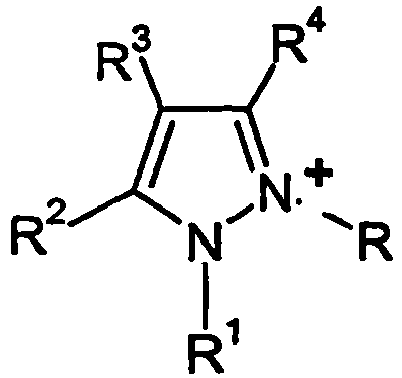
- Pyridinium-Kationen der allgemeinen Formel,

- Pyrrolidinium-Kationen der allgemeinen Formel,
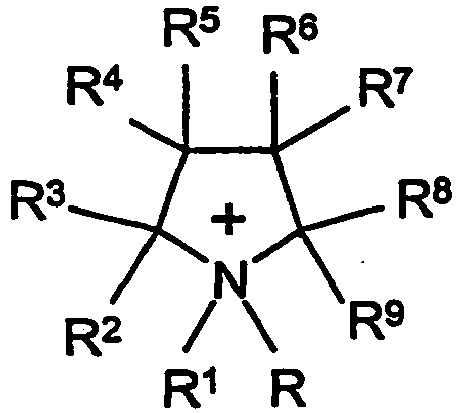

- fünf- bis mindestens sechsgliedrige heterocyclische Kationen, die mindestens ein Phosphor- oder Stickstoffatom sowie gegebenenfalls ein Sauerstoff- oder Schwefelatom aufweisen, wie beispielsweise Thiazolium-, Oxazolium, 1,2,4-Triazolium - oder 1,2,3-Triazolium, besonders bevorzugt solche Verbindungen, die mindestens einen fünf- bis sechsgliedrigen Heterocyclus enthalten, der ein, zwei oder drei Stickstoffatome und ein Schwefel- oder ein Sauerstoffatom aufweist, ganz besonders bevorzugt solche mit ein oder zwei Stickstoffatomen,
- dem 1,8-Diazabicyclo[5.4.0]undec-7-enium-Kation sowie dem 1,8-Diazabicyclo-[4.3.0]non-5-enium-Kation:

- Darin bedeuten gegebenenfalls durch funktionelle Gruppen, Aryl, Alkyl, Aryloxy, Alkyloxy, Halogen, Heteroatome und/oder Heterocyclen substituiertes C1-C18-Alkyl beispielsweise Methyl, Ethyl, Propyl, Isopropyl, n-Butyl, sec-Butyl, tert.-Butyl, Pentyl, Hexyl, Heptyl, Octyl, 2-Ethylhexyl, 2,4,4-Trimethylpentyl, Decyl, Dodecyl, Tetradecyl, Hexadecyl, Octadecyl, 1,1-Dimethylpropyl, 1,1-Dimethylbutyl, 1,1,3,3-Tetramethylbutyl, Benzyl, 1-Phenylethyl, 2-Phenylethyl, α,α-Dimethylbenzyl, Benzhydryl, p-Tolylmethyl, 1-(p-Butylphenyl)-ethyl, p-Chlorbenzyl, 2,4-Dichlorbenzyl, p-Methoxybenzyl, m-Ethoxybenzyl, 2-Cyanoethyl, 2-Cyanopropyl, 2-Methoxycarbonethyl, 2-Ethoxycarbonylethyl, 2-Butoxycarbonylpropyl, 1,2-Di-(methoxycarbonyl)-ethyl, 2-Methoxyethyl, 2-Ethoxyethyl, 2-Butoxyethyl, Diethoxymethyl, Diethoxyethyl, 1,3-Dioxolan-2-yl, 1,3-Di-oxan-2-yl, 2-Methyl-1,3-dioxolan-2-yl, 4-Methyl-1,3-dioxolan-2-yl, 2-lsopropoxyethyl, 2-Butoxypropyl, 2-Octyloxyethyl, Chlormethyl, 2-Chlorethyl, Trichlormethyl, Trifluormethyl, 1,1-Dimethyl-2-chlorethyl, 2-Methoxyisopropyl, 2-Ethoxyethyl, Butylthiomethyl, 2-Dodecylthioethyl, 2-Phenylthioethyl, 2,2,2-Trifluorethyl, 2-Hydroxy-ethyl, 2-Hydroxypropyl, 3-Hydroxypropyl, 4-Hydroxybutyl, 6-Hydroxyhexyl, 2-Amino-ethyl, 2-Aminopropyl, 3-Aminopropyl, 4-Aminobutyl, 6-Aminohexyl, 2-Methylamino-ethyl, 2-Methylaminopropyl, 3-Methylaminopropyl, 4-Methylaminobutyl, 6-Methylamino-hexyl, 2-Dimethylaminoethyl, 2-Dimethylaminopropyl, 3-Dimethylaminopropyl, 4-Di-methylaminobutyl, 6-Dimethylaminohexyl, 2-Hydroxy-2,2-dimethylethyl, 2-Phenoxyethyl, 2-Phenoxypropyl, 3-Phenoxypropyl, 4-Phenoxybutyl, 6-Phenoxyhexyl, 2-Methoxyethyl, 2-Methoxypropyl, 3-Methoxypropyl, 4-Methoxybutyl, 6-Methoxyhexyl, 2-Ethoxyethyl, 2-Ethoxypropyl, 3-Ethoxypropyl, 4-Ethoxybutyl oder 6-Ethoxyhexyl und,
gegebenenfalls durch ein oder mehrere Sauerstoff- und/oder Schwefelatome und/oder ein oder mehrere substituierte oder unsubstituierte Iminogruppen unterbrochenes C2-C18-Alkyl beispielsweise 5-Hydroxy-3-oxa-pentyl, 8-Hydroxy-3,6-dioxa-octyl, 11-Hydroxy-3,6,9-trioxa-undecyl, 7-Hydroxy-4-oxa-heptyl, 11-Hydroxy-4,8-dioxa-undecyl, 15-Hydroxy-4,8,12-trioxa-pentadecyl, 9-Hydroxy-5-oxa-nonyl, 14-Hydroxy-5,10-oxa-tetradecyl, 5-Methoxy-3-oxa-pentyl, 8-Methoxy-3,6-dioxa-octyl, 11-Methoxy-3,6,9-trioxa-undecyl, 7-Methoxy-4-oxa-heptyl, 11-Methoxy-4,8-dioxa-undecyl, 15-Methoxy-4,8,12-trioxa-pentadecyl, 9-Methoxy-5-oxa-nonyl, 14-Methoxy-5,10-oxa-tetradecyl, 5-Ethoxy-3-oxa-pentyl, 8-Ethoxy-3,6-dioxa-octyl, 11-Ethoxy-3,6,9-trioxa-undecyl, 7-Ethoxy-4-oxa-heptyl, 11-Ethoxy-4,8-dioxa-undecyl, 15-Ethoxy-4,8,12-trioxa-pentadecyl, 9-Ethoxy-5-oxa-nonyl oder 14-Ethoxy-5,10-oxa-tetradecyl. - Bilden zwei Reste einen Ring, so können diese Reste gemeinsam bedeuten 1,3-Propylen, 1,4-Butylen, 2-Oxa-1,3-propylen, 1-Oxa-1,3-propylen, 2-Oxa-1,3-propylen, 1-Oxa-1,3-propenylen, 1-Aza-1,3-propenylen, 1-C1-C4-Alkyl-1-aza-1,3-propenylen, 1,4-Buta-1,3-dienylen, 1-Aza-1,4-buta-1,3-dienylen oder 2-Aza-1,4-buta-1,3-dienylen.
- Die Anzahl der Sauerstoff- und/oder Schwefelatome und/oder Iminogruppen ist nicht beschränkt. In der Regel beträgt sie nicht mehr als 5 in dem Rest, bevorzugt nicht mehr als 4 und ganz besonders bevorzugt nicht mehr als 3.
- Weiterhin befinden sich zwischen zwei Heteroatomen in der Regel mindestens ein Kohlenstoffatom, bevorzugt mindestens zwei Kohlenstoffatome.
- Substituierte und unsubstituierte Iminogruppen können beispielsweise lmino-, Methylimino-, iso-Propylimino, n-Butylimino oder tert-Butylimino sein.
- Weiterhin bedeuten funktionelle Gruppen Carboxy, Carboxamid, Hydroxy, Di-(C1-C4-Alkyl)-amino, C1-C4-Alkyloxycarbonyl, Cyano oder C1-C4-Alkyloxy,
gegebenenfalls durch funktionelle Gruppen, Aryl, Alkyl, Aryloxy, Alkyloxy, Halogen, Heteroatome und/oder Heterocyclen substituiertes C6-C12-Aryl beispielsweise Phenyl, Tolyl, Xylyl, α-Naphthyl, α-Naphthyl, 4-Diphenylyl, Chlorphenyl, Dichlorphenyl, Trichlorphenyl, Difluorphenyl, Methylphenyl, Dimethylphenyl, Trimethylphenyl, Ethylphenyl, Diethylphenyl, iso-Propylphenyl, tert.-Butylphenyl, Dodecylphenyl, Methoxyphenyl, Dimethoxyphenyl, Ethoxyphenyl, Hexyloxyphenyl, Methylnaphthyl, Isopropylnaphthyl, Chlornaphthyl, Ethoxynaphthyl, 2,6-Dimethylphenyl, 2,4,6-Trimethylphenyl, 2,6-Dimethoxyphenyl, 2,6-Dichlorphenyl, 4-Bromphenyl, 2- oder 4-Nitrophenyl, 2,4- oder 2,6-Dinitrophenyl, 4-Dimethylaminophenyl, 4-Acetylphenyl, Methoxyethylphenyl oder Ethoxymethylphenyl,
gegebenenfalls durch funktionelle Gruppen, Aryl, Alkyl, Aryloxy, Alkyloxy, Halogen, Heteroatome und/oder Heterocyclen substituiertes C5- C12-Cycloalkyl beispielsweise Cyclopentyl, Cyclohexyl, Cyclooctyl, Cyclododecyl, Methylcyclopentyl, Dimethylcyclopentyl, Methylcyclohexyl, Dimethylcyclohexyl, Diethylcyclohexyl, Butylcyclohexyl, Methoxycyclohexyl, Dimethoxycyclohexyl, Diethoxycyclohexyl, Butylthiocyclohexyl, Chlorcyclohexyl, Dichlorcyclohexyl, Dichlorcyclopentyl sowie ein gesättigtes oder ungesättigtes bicyclisches System wie z.B. Norbomyl oder Norbomenyl,
ein fünf- bis sechsgliedriger, Sauerstoff-, Stickstoff- und/oder Schwefelatome aufweisender Heterocyclus beispielsweise Furyl, Thiophenyl, Pyrryl, Pyridyl, Indolyl, Benzoxazolyl, Dioxolyl, Dioxyl, Benzimidazolyl, Benzthiazolyl, Dimethylpyridyl, Methylchinolyl, Dimethylpyrryl, Methoxyfuryl, Dimethoxypyridyl, Difluorpyridyl, Methylthiophenyl, Isopropylthiophenyl oder tert-Butylthiophenyl und - C1 bis C4-Alkyl beispielsweise Methyl, Ethyl, Propyl, Isopropyl, n-Butyl, sec-Butyl oder tert.-Butyl.
- Bevorzugt sind R, R1, R2, R3, R4, R5, R6, R7, R8 und R9 unabhängig voneinander Wasserstoff, Methyl, Ethyl, n-Butyl, 2-Hydroxyethyl, 2-Cyanoethyl, 2-(Methoxycarbonyl)-ethyl, 2-(Ethoxycarbonyl)-ethyl, 2-(n-Butoxycarbonyl)-ethyl, Benzyl, Acetyl, Dimethylamino, Diethylamino und Chlor.
- Zusätzlich Verwendung können gemischte Spezies finden, wie
[A1]+[A2]+ [Y]2-, [A1]+[A2]+[A3]+ [Y]3- oder [A1]+[A2]+[A3]+[A4]+ [Y]4-
wobei A1, A2, A3 und A4 unabhängig voneinander aus den für [A] genannten Gruppen ausgewählt sind. - Daneben können Verwendung finden gemischte Spezies mit Metallkationen
[A1]+[A2]+[A3]+[M1]+ [Y]4-, [A1]+[A2]+[M1]+[M2]+ [Y]4-,
[A1]+[M1]+[M2]+M3]+ [Y]4-, [A1]+[A2]+[M1]+ [Y]3-, [A1]+[M1]+[M2]+ [Y]3-,
[A1]+[M1]+ [Y]2-, [A1]+[A2]+[M4]2+ [Y]4-, [A1]+[M1]+[M4]2+ [Y]4-,
[A1]+[M5]3+ [Y]4-, [A1]+[M4]2+ [Y]3-
wobei M1, M2, M3 einwertige Metallkationen, M4 zweiwertige Metallkationen und M5 dreiwertige Metallkationen darstellen. - Als Anionen sind prinzipiell alle Anionen einsetzbar.
- Das Anion [Y] ist bevorzugt ausgewählt aus
der Gruppe der Halogenide bzw. halogenhaltigen Verbindungen der Formel: - Cl-, Br-, BF4 -, PF6 -, AlCl4 -, Al2Cl7 -, FeCl4 -, BCl4 -, SbF6 -, AsF6 -, ZnCl3 -, SnCl3-, CF3SO3 -, (CF3SO3)2N-, CF3CO2-, CCl3CO2 -, CN-, SCN-, OCN-
- der Gruppe der Sulfate, Sulfite oder der Sulfonate der allgemeinen Formel:
SO4 2-, HSO4-, SO3 2-, HSO3 -, RaOSO3 -, RaSO3 -
- der Gruppe der Phosphate der allgemeinen Formel
PO4 3-, HPO4 2-, H2PO4-, RaPO4 2-, HRaPO4-, RaRbPO4 -
- der Gruppe der Phosphonate oder der Phosphinate der allgemeinen Formel:
RaHPO3 -,RaRbPO2 -, RaRbPO3 -
- der Gruppe der Phosphite der allgemeinen Formel:
PO3 3-, HPO3 2-, H2PO3 -, RaPO3 2-, RaHPO3 - , RaRbPO3 -
- der Gruppe der Phosphonite oder der Phosphinite der allgemeinen Formel:
RaRbPO2 -, RaHPO2 -, RaRbPO-, RaHPO-
- der Gruppe der Carbonsäuren der allgemeinen Formel:
RaCOO-
- der Gruppe der Borate der allgemeinen Formel:
BO3 3-, HBO3 2- , H2BO3 -, RaRbBO3 -, RaHBO3-, RaBO3 2-
- der Gruppe der Boronate der allgemeinen Formel:
RaBO2 2-, RaRbBO-
- der Gruppe der Carbonate oder der Kohlensäureester der allgemeinen Formel:
HCO3-, CO3 -, RaCO3 -
- der Gruppe der Silikate oder der Kieselsäuresäureester der allgemeinen Formel:
- SiO4 4-, HSiO4 3-, H2SiO4 2-, H3SiO4 -, RaSiO4 3-, RaRbSiO4 2- , RaRbRcSiO4 -, HRaSiO4 2-, H2RaSiO4 -, HRaRbSiO4 -
- der Gruppe der Alkyl- bzw. Arylsilan-Salze der allgemeinen Formel:
- RaSiO3 3-, RaRbSiO2 2-, RaRbRcSiO-, RaR bRcSiO3 -, RaRbRcSiO2 -, RaRbSiO3 2-
- der Gruppe der Carbonsäureimide, Bis(sulfonyl)imide oder der Sulfonylimide der allgemeinen Formel:

- der Gruppe der Alkoxide oder der Aryloxide der allgemeinen Formel:
- der Gruppe der komplexen Metallionen wie Fe(CN)6 3-, Fe(CN)6 4-, MnO4 -, Fe(CO)4
- und die Reste Ra, Rb, Rc unabhängig voneinander jeweils C1 - C18-Alkyl, gegebenenfalls durch ein oder mehrere Sauerstoff- und/oder Schwefelatome und/oder ein oder mehrere substituierte oder unsubstituierte Iminogruppen unterbrochenes C2 - C18-Alkyl, C6 - C12-Aryl, C5 - C12-Cycloalkyl oder einen fünf- bis sechsgliedrigen, Sauerstoff-, Stickstoff- und/oder Schwefelatome aufweisenden Heterocyclus bedeuten oder zwei von ihnen gemeinsam einen ungesättigten, gesättigten oder aromatischen und gegebenenfalls durch ein oder mehrere Sauerstoff- und/oder Schwefelatome und/oder ein oder mehrere substituierte oder unsubstituierte Iminogruppen unterbrochenen Ring bilden, wobei die genannten Reste jeweils durch funktionelle Gruppen, Aryl, Alkyl, Aryloxy, Alkyloxy, Halogen, Heteroatome und/oder Heterocyclen substituiert sein können.
- Darin bedeuten gegebenenfalls durch funktionelle Gruppen, Aryl, Alkyl, Aryloxy, Alkyloxy, Halogen, Heteroatome und/oder Heterocyclen substituiertes C1- C18-Alkyl beispielsweise Methyl, Ethyl, Propyl, Isopropyl, n-Butyl, sec-Butyl, tert.-Butyl, Pentyl, Hexyl, Heptyl, Octyl, 2-Ethylhexyl, 2,4,4-Trimethylpentyl, Decyl, Dodecyl, Tetradecyl, Hexadecyl, Octadecyl, 1,1-Dimethylpropyl, 1,1-Dimethylbutyl, 1,1,3,3-Tetramethylbutyl, Benzyl, 1-Phenylethyl, 2-Phenylethyl, α,α-Dimethylbenzyl, Benzhydryl, p-Tolylmethyl, 1-(p-Butylphenyl)-ethyl, p-Chlorbenzyl, 2,4-Dichlorbenzyl, p-Methoxybenzyl, m-Ethoxybenzyl, 2-Cyanoethyl, 2-Cyanopropyl, 2-Methoxycarbonethyl, 2-Ethoxycarbonylethyl, 2-Butoxycarbonylpropyl, 1,2-Di-(methoxycarbonyl)-ethyl, 2-Methoxyethyl, 2-Ethoxyethyl, 2-Butoxyethyl, Diethoxymethyl, Diethoxyethyl, 1,3-Dioxolan-2-yl, 1,3-Dioxan-2-yl, 2-Methyl-1,3-dioxolan-2-yl, 4-Methyl-1,3-dioxolan-2-yl, 2-Isopropoxyethyl, 2-Butoxypropyl, 2-Octyloxyethyl, Chlormethyl, 2-Chlorethyl, Trichlormethyl, Trifluormethyl, 1,1-Dimethyl-2-chlorethyl, 2-Methoxyisopropyl, 2-Ethoxyethyl, Butylthiomethyl, 2-Dodecylthioethyl, 2-Phenylthioethyl, 2,2,2-Trifluorethyl, 2-Hydroxyethyl, 2-Hydroxypropyl, 3-Hydroxypropyl, 4-Hydroxybutyl, 6-Hydroxyhexyl, 2-Aminoethyl, 2-Aminopropyl, 3-Aminopropyl, 4-Aminobutyl, 6-Aminohexyl, 2-Methylaminoethyl, 2-Methylaminopropyl, 3-Methylaminopropyl, 4-Methylaminobutyl, 6-Methylaminohexyl, 2-Dimethylaminoethyl, 2-Dimethylaminopropyl, 3-Dimethyl-aminopropyl, 4-Dimethylaminobutyl, 6-Dimethylaminohexyl, 2-Hydroxy-2,2-dimethylethyl, 2-Phenoxyethyl, 2-Phenoxypropyl, 3-Phenoxypropyl, 4-Phenoxybutyl, 6-Phenoxyhexyl, 2-Methoxyethyl, 2-Methoxypropyl, 3-Methoxypropyl, 4-Methoxybutyl, 6-Methoxyhexyl, 2-Ethoxyethyl, 2-Ethoxypropyl, 3-Ethoxypropyl, 4-Ethoxybutyl oder 6-Ethoxyhexyl und,
gegebenenfalls durch ein oder mehrere Sauerstoff- und/oder Schwefelatome und/oder ein oder mehrere substituierte oder unsubstituierte Iminogruppen unterbrochenes C2-C18-Alkyl beispielsweise 5-Hydroxy-3-oxa-pentyl, 8-Hydroxy-3,6-dioxa-octyl, 11-Hydroxy-3,6,9-trioxa-undecyl, 7-Hydroxy-4-oxa-heptyl, 11-Hydroxy-4;8-dioxa-undecyl, 15-Hydroxy-4,8,12-trioxa-pentadecyl, 9-Hydroxy-5-oxa-nonyl, 14-Hydroxy-5,10-oxa-tetradecyl, 5-Methoxy-3-oxa-pentyl, 8-Methoxy-3,6-dioxa-octyl, 11-Methoxy-3,6,9-trioxa-undecyl, 7-Methoxy-4-oxa-heptyl, 11-Methoxy-4,8-dioxa-undecyl, 15-Methoxy-4,8,12-trioxa-pentadecyl, 9-Methoxy-5-oxa-nonyl, 14-Methoxy-5,10-oxatetradecyl, 5-Ethoxy-3-oxa-pentyl, 8-Ethoxy-3,6-dioxa-octyl, 11-Ethoxy-3,6,9-trioxaundecyl, 7-Ethoxy-4-oxa-heptyl, 11-Ethoxy-4,8-dioxa-undecyl, 15-Ethoxy-4,8,12-trioxapentadecyl, 9-Ethoxy-5-oxa-nonyl oder 14-Ethoxy-5,10-oxa-tetradecyl. - Bilden zwei Reste einen Ring, so können diese Reste gemeinsam bedeuten 1,3-Propylen, 1,4-Butylen, 2-Oxa-1,3-propylen, 1-Oxa-1,3-propylen, 2-Oxa-1,3-propylen, 1-Oxa-1,3-propenylen, 1-Aza-1,3-propenylen, 1-C1-C4-Alkyl-1-aza-1,3-propenylen, 1,4-Buta-1,3-dienylen, 1-Aza-1,4-buta-1,3-dienylen oder 2-Aza-1,4-buta-1,3-dienylen.
- Die Anzahl der Sauerstoff- und/oder Schwefelatome und/oder Iminogruppen ist nicht beschränkt. In der Regel beträgt sie nicht mehr als 5 in dem Rest, bevorzugt nicht mehr als 4 und ganz besonders bevorzugt nicht mehr als 3.
- Weiterhin befinden sich zwischen zwei Heteroatomen in der Regel mindestens ein Kohlenstoffatom, bevorzugt mindestens zwei.
- Substituierte und unsubstituierte Iminogruppen können beispielsweise Imino-, Methylimino-, iso-Propylimino, n-Butylimino oder tert-Butylimino sein.
- Weiterhin bedeuten funktionelle Gruppen Carboxy, Carboxamid, Hydroxy, Di-(C1-C4-Alkyl)-amino, C1-C4-Alkyloxycarbonyl, Cyano oder C1-C4-Alkyloxy,
gegebenenfalls durch funktionelle Gruppen, Aryl, Alkyl, Aryloxy, Alkyloxy, Halogen, Heteroatome und/oder Heterocyclen substituiertes C6 - C12-Aryl beispielsweise Phenyl, Tolyl, Xylyl, α-Naphthyl, α-Naphthyl, 4-Diphenylyl, Chlorphenyl, Dichlorphenyl, Trichlorphenyl, Difluorphenyl, Methylphenyl, Dimethylphenyl, Trimethylphenyl, Ethylphenyl, Diethylphenyl, iso-Propylphenyl, tert.-Butylphenyl, Dodecylphenyl, Methoxyphenyl, Dimethoxyphenyl, Ethoxyphenyl, Hexyloxyphenyl, Methylnaphthyl, Isopropylnaphthyl, Chlornaphthyl, Ethoxynaphthyl, 2,6-Dimethylphenyl, 2,4,6-Trimethylphenyl, 2,6-Dimethoxyphenyl, 2,6-Dichlorphenyl, 4-Bromphenyl, 2- oder 4-Nitrophenyl, 2,4- oder 2,6-Dinitrophenyl, 4-Dimethylaminophenyl, 4-Acetylphenyl, Methoxyethylphenyl oder Ethoxymethylphenyl,
gegebenenfalls durch funktionelle Gruppen, Aryl, Alkyl, Aryloxy, Alkyloxy, Halogen, Heteroatome und/oder Heterocyclen substituiertes C5 - C12-Cycloalkyl beispielsweise Cyclopentyl, Cyclohexyl, Cyclooctyl, Cyclododecyl, Methylcyclopentyl, Dimethylcyclopentyl, Methylcyclohexyl, Dimethylcyclohexyl, Diethylcyclohexyl, Butytcyclohexyl, Methoxycyclohexyl, Dimethoxycyclohexyl, Diethoxycyclohexyl, Butylthiocyclohexyl, Chlorcyclohexyl, Dichlorcydohexyl, Dichlorcyclopentyl sowie ein gesättigtes oder ungesättigtes bicyclisches System wie z.B. Norbornyl oder Norbrnenyl,
ein fünf- bis sechsgliedriger, Sauerstoff-, Stickstoff- und/oder Schwefelatome aufweisender Heterocyclus beispielsweise Furyl, Thiophenyl, Pyrryl, Pyridyl, Indolyl, Benzoxazolyl, Dioxolyl, Dioxyl, Benzimidazolyl, Benzthiazolyl, Dimethylpyridyl, Methylchinolyl, Dimethylpyrryl, Methoxyfuryl, Dimethoxypyridyl, Difluorpyridyl, Methylthiophenyl, Isopropylthiophenyl oder tert.-Butylthiophenyl und - C1 bis C4-Alkyl beispielsweise Methyl, Ethyl, Propyl, Isopropyl, n-Butyl, sec-Butyl oder tert.-Butyl.
- Bevorzugt sind R1, R2, R3, R4 und R5 unabhängig voneinander Wasserstoff, Methyl, Ethyl, n-Butyl, 2-Hydroxyethyl, 2-Cyanoethyl, 2-(Methoxycarbonyl)-ethyl, 2-(Ethoxycarbonyl)-ethyl, 2-(n-Butoxycarbonyl)-ethyl, Dimethylamino, Diethylamino und Chlor.
- Die Kationen werden für das erfindungsgemäße Verfahren vorzugsweise ausgewählt aus der Gruppe, enthaltend 1,2,3-Trimethylimidazolium, 1,3,4,5-Tetramethylimidazolium, 1,3,4-Dimethylimidazolium, 1,3,4-Trimethylimidazolium, 1,3-Dibuty!-2-methylimidazolium, 1,3-Dibutylimidazolium, 1,2-Dimethylimidazolium, 1,3-Dimethylimidazolium, 1-Benzyl-3-methylimidazolium, 1-Butyl-2,3-dimethylimidazolium, 1-Butyl-2-ethyl-5-methylimidazolium, 1-Butyl-2-ethylimidazolium, 1-Butyl-2-methylimidazolium, 1-Butyl-3,4,5-trimethylimidazolium, 1-Butyl-3,4-dimethylimidazolium, 1-Butyl-3-ethylimidazolium, 1-Butyl-3-methylimidazolium, 1-Butyl-4-methylimidazolium, 1-Butylimidazolium, 1-Decyl-3-methylimidazolium, 1-Dodecyl-3-methylimidazolium, 1-Ethyl-2,3-dimethylimidazolium, 1-Ethyl-3-methylimidazolium, 1-Hexadecyl-2,3-dimethylimidazolium, 1-Hexadecyl-3-methylimidazolium, 1-Hexyl-2,3-dimethylimidazolium, 1-Hexyl-3-methylimidazolium, 1-Methyl-2-ethylimidazolium, 1-Methyl-3-octylimidazolium, 1-Methylimidazolium, 1-Pentyl-3-methylimidazolium, 1-Phenylpropyl-3-methylimidazolium, 1-Propyl-2,3-dimethylimidazolium, 1-Tetradecyl-3-methylimidazolium, 2,3-Dimethylimidazolium, 2-Ethyl-3,4-dimethylimidazolium, 3,4-Dimethylimidazolium, 1,2-Dimethylpyridinium, 1-Butyl-2-ethyl-6-methylpyridinium, 1-Butyl-2-ethylpyridinium, 1-Butyl-2-methylpyridinium, 1-Butyl-3,4-dimethylpyridinium, 1-Butyl-3,5-dimethylpyridinium, 1-Butyl-3-ethylpyridinium, 1-Butyl-3-methylpyridinium, 1-Butyl-4-methylpyridinium, 1-Butylpyridinium, 1-Ethylpyridinium, 1-Hexyl-3-methylpyridinium, 1-Hexyl-4-methylpyridinium, 1-Hexylpyridinium, 1-Methylpyridinium, 1-Octylpyridinium, 2-Ethyl-1,6-dimethylpyridinium, 2-Ethyl-1-methylpyridinium, 4-Methyl-1-octylpyridinium, 1,1-Dimethylpyrrolidinium, 1-Butyl-1-ethylpyrrolidinium, 1-Butyl-1-methylpyrrolidinium, 1-Ethyl-1-methylpyrrolidinium, 1-Ethyl-3-methylpyrrolidinium, 1-Hexyl-1-methylpyrrolidinium, 1-0ctyl-1-methylpyrrolidinium, Guanidinium, Hexamethylguanidinium, N,N,N',N'-Tetramethyl-N"-ethylguanidinium, N-Pentamethyl-N-isopropylguanidinium, N-Pentamethyl-N-propylguanidinium, Benzyltriphenylphosphonium, Tetrabutylphosphonium, Trihexyl(tetradecyl)phosphonium, Tri-iso-butyl(methyl)phosphonium, Butyltrimethylammonium, Methyltrioctylammonium, Octyltrimethylammonium, Tetrabutylammonium, Tetraethylammonium, Tetramethylammonium, Tributylmethylammonium
- Besonders bevorzugte Kationen werden ausgewählt aus der Gruppe, enthaltend 1,2,3-Trimethylimidazolium, 1,2-Dimethylimidazolium, 1-Butyl-2-methylimidazolium, 1-Butyl-4-methylimidazolium, 1,3-Diethylimidazolium, 1-Benzyl-3-methylimidazolium, 1-Butyl-2,3-dimethylimidazolium, 1-Butyl-2-methylimidazolium, 1-Butyl-3-ethylimidazolium, 1-Butyl-3-methylimidazolium, 1-Butylimidazolium, 1-Ethyl-2,3-dimethylimidazolium, 1-Ethyl-3-methylimidazolium, 1-Hexyl-3-methylimidazolium, 1-Methyl-2-ethylimidazolium, 1-Methyl-3-octylimidazolium, 1-Methylimidazolium, 1-Decyl-3-methylimidazolium, 1-Dodecyl-3-methylimidazolium, 1-Butyl-4-methylpyridinium, 1-Butylpyridinium, 1-Ethylpyridinium, 1-Hexylpyridinium, 1-Butyl-1-ethylpyrrolidinium, 1-Butyl-1-methylpyrrolidinium, 1-Ethyl-1-methylpyrrolidinium, 1-Hexyl-1-methylpyrrolidinium, Guanidinium, N,N,N',N'-Tetramethyl-N"-ethylguanidinium, Benzyltriphenylphosphonium, Tetrabutylphosphonium, Butyltrimethylammonium, Methyltrioctylammonium, Tetrabutylammonium, Tributylmethylammonium.
- Insbesondere sind die Kationen ausgewählt aus der Gruppe, enthaltend 1,2,3-Trimethylimidazolium, 1,2-Dimethylimidazolium, 1-Butyl-2,3-dimethylimidazolium, 1-Butyl-3-methylimidazolium, 1-Ethyl-2,3-dimethylimidazolium, 1-Ethyl-3-methylimidazolium, 1-Butylimidazolium, 1-Methylimidazolium, 1-Butyl-4-methylpyridinium, 1-Butylpyridinium, Methyltrioctylammonium, Octyltrimethylammonium.
- Die Anionen werden für das erfindungsgemäße Verfahren vorzugsweise ausgewählt aus der Gruppe, enthaltend Acetat, Bis(2,4,4-trimethylpentyl)phosphinat, Bis(malonato)borat, Bis(oxalato)borat, Bis(pentafluoroethyl)phosphinat, Bis(phtalato)borat, Bis(salicylato)borat, Bis(trifluoromethansulfonyl)imidat, Bis(trifluoromethansulfonyl)methan, Bis(trifluoromethyl)imidat, Borat, Bromid, Bromoaluminate, Carbonat, Chlorid, Chloroaluminate, Decylbenzolsulfonat, Dichlorocuprat, Dicyanamid, Didecylbenzolsulfonat, Didodecylbenzolsulfonat, Diethylphosphat, Dihydrogenphosphat, Dodecylbenzolsulfonat, Ethylsulfat, Ethylsulfonat, Fluorid, Hexafluorophosphat, Hydrogencarbonat, Hydrogenphosphat, Hydrogensulfat, Hydrogensulfrt, lodid, Methylsulfat, Methylsulfonat, Nitrat, Nitrit, Phosphat, Sulfat, Sulfit, Tetracyanoborat, Tetrafluoroborat, Tetrakis(hydrogensulfato)borat, Tetrakis(methylsulfonato)borat, Thiocyanat, Tosylat, Trichlorozinkat, Trifluoroacetat, Trifluoromethylsulfonat, Tris(heptafluoropropyl)trifluorophosphat, Tris(nonafluorobutyl)trifluorophosphat, Tris(pentafluoroethyl)trifluorophosphat, Tris(pentafluoroethylsulfonyl)trifluorophosphat. Besonders bevorzugt sind die Anionen ausgewählt aus der Gruppe, enthaltend Bis(2,4,4-trimethylpentyl)phosphinat, Bis(malonato)borat, Bis(oxalato)borat, Bis(phtalato)borat, Bis(trifluoromethansulfonyl)imidat, Borat, Chlorid, Chloroaluminate, Decylbenzolsulfonat, Didecylbenzolsulfonat, Didodecylbenzolsulfonat, Dihydrogenphosphat, Dodecylbenzolsulfonat, Ethylsulfat, Ethylsulfonat, Hydrogensulfat, Methylsulfat, Methylsulfonat, Phosphat, Sulfat, Tetrakis(methylsulfonato)borat, Tosylat, Trichlorozinkat.
- Insbesondere werden die Anionen ausgewählt aus der Gruppe, enthaltend Chlorid, Chloroaluminate, Ethylsulfat, Methylsulfat, Methylsulfonat, Sulfat, Tosylat.
- Bevorzugte ionische Flüssigkeiten für das erfindungsgemäße Verfahren sind ausgewählt aus der Gruppe, enthaltend
- 1,2,3-Trimethylimidazoliumchlorid, 1,2-Dimethylimidazoliumchlorid, 1-Butyl-2,3-dimethylimidazoliumchlorid, 1-Butyl-3-methylimidazoliumchlorid, 1-Butylimidazoliumchlorid, 1-Methylimidazoliumchlorid ,1-Ethyl-2,3-dimethylimidazoliumchlorid, 1-Ethyl-3-methylimidazoliumchlorid, 1-Butyl-4-methylpyridiniumchlorid, 1-Butylpyridiniumchlorid, Methyltrioctylammoniumchlorid, Octyltrimethylammoniumchlorid, 1,2,3-Trimethylimidazoliumtetrachloroaluminat, 1,2-Dimethylimidazoliumtetrachloroaluminat, 1-Butyl-2,3-dimethylimidazoliumtetrachloroaluminat, 1-Butyl-3-methylimidazolium-tetrachloroaluminat, 1-Ethyl-2,3-dimethylimidazoliumtetrachloroaluminat, 1-Ethyl-3-methylimidazoliumtetrachloroaluminat, 1-Butyl-4-methylpyridiniumtetrachloroaluminat, 1-Butylpyridiniumtetrachloroaluminat, Methyltrioctylammoniumtetrachloroaluminat, Octyltrimethylammoniumtetrachloroaluminat, 1,2,3-Trimethylimidazoliumethylsulfat, 1,2-Dimethylimidazoliumethylsulfat, 1-Butyl-2,3-dimethylimidazoliumethylsulfat, 1-Butyl-3-methylimidazoliumethylsulfat, 1-Ethyl-2,3-dimethylimidazoliumethylsulfat, 1-Ethyl-3-methylimidazoliumethylsulfat, 1-Butyl-4-methylpyridiniumethylsulfat, 1-Butylpyridiniumethylsulfat, Methyltrioctylammoniumethylsulfat, Octyltrimethylammoniumethylsulfat, 1,2,3-Trimethylimidazoliummethylsulfat, 1,2-Dimethylimidazoliummethylsulfat, 1-Butyl-2,3-dimethylimidazoliummethylsulfat, 1-Butyl-3-methylimidazoliummethylsulfat, 1-Ethyl-2,3-dimethylimidazoliummethylsulfat, 1-Ethyl-3-methylimidazoliummethylsulfat, 1-Butyl-4-methylpyridiniummethylsulfat, 1-Butylpyridiniummethylsulfat, Methyltrioctylammoniummethylsulfat, Octyltrimethylammoniummethylsulfat, 1,2,3-Trimethylimidazoliummethylsulfonat, 1,2-Dimethylimidazoliummethylsulfonat, 1-Butyl-2,3-dimethylimidazoliummethylsulfonat, 1-Butyl-3-methylimidazoliummethylsulfonat, 1-Ethyl-2,3-dimethylimidazoliummethylsulfonat, 1-Ethyl-3-methylimidazoliummethylsulfonat, 1-Butyl-4-methylpyridiniummethylsulfonat, 1-Butylpyridiniummethylsulfonat, Methyltrioctylammoniummethylsulfonat, Octyltrimethylammoniummethylsulfonat, 1,2,3-Trimethylimidazoliumsulfat, 1,2-Dimethylimidazoliumsulfat, 1-Butyl-2,3-dimethylimidazoliumsulfat, 1-Butyl-3-methylimidazoliumsulfat, 1-Ethyl-2,3-dimethylimidazoliumsulfat, 1-Ethyl-3-methylimidazoliumsulfat, 1-Butyl-4-methylpyridiniumsulfat, 1-Butylpyridiniumsulfat, Methyltrioctylammoniumsulfat, Octyltrimethylammoniumsulfat, 1,2,3-Trimethylimidazoliumtosylat, 1,2-Dimethylimidazoliumtosylat, 1-Butyl-2,3-dimethylimidazoliumtosylat, 1-Butyl-3-methylimidazoliumtosylat, 1-Ethyl-2,3-dimethylimidazoliumtosylat, 1-Ethyl-3-methylimidazoliumtosylat, 1-Butyl-4-methylpyridiniumtosylat, 1-Butylpyridiniumtosylat, Methyltrioctylammoniumtosylat, Octyltrimethylammoniumtosylat.
- Besonders bevorzugte ionischen Flüssigkeiten sind ausgewählt aus der Gruppe, enthaltend 1-Butyl-2,3-dimethylimidazoliumchlorid, 1-Butyl-3-methylimidazoliumchlorid, 1-Butylimidazoliumchlorid , 1-Methylimidazoliumchlorid, 1-Ethyl-2,3-dimethylimidazoliumchlorid, 1-Ethyl-3-methylimidazoliumchlorid, 1-Butyl-4-methylpyridiniumchlorid, 1-Methylpyridiniumchlorid, Methyltrioctylammoniumchlorid, 1-Butyl-2,3-dimethylimidazoliumtetrachloroaluminat, 1-Butyl-3-methylimidazoliumtetrachloroaluminat, 1-Ethyl-2,3-dimethylimidazoliumtetrachloroaluminat, 1-Ethyl-3-methylimidazolium-tetrachloroaluminat, 1-Butyl-4-methylpyridiniumtetrachloroaluminat, 1-Methylpyridiniumtetrachloroaluminat, Methyltrioctylammoniumtetrachloroaluminat, 1-Butyl-2,3-dimethylimidazoliumethylsulfat, 1-Butyl-3-methylimidazoliumethylsulfat, 1-Ethyl-2,3-dimethylimidazoliumethylsulfat, 1-Ethyl-3-methylimidazoliumethylsulfat, 1-Butyl-4-methylpyridiniumethylsulfat, 1-Methylpyridiniumethylsulfat, Methyltrioctylammoniumethylsulfat, 1-Butyl-2,3-dimethylimidazoliummethylsulfat, 1-Butyl-3-methylimidazoliummethylsulfat, 1-Ethyl-2,3-dimethylimidazoliummethylsulfat, 1-Ethyl-3-methylimidazoliummethylsulfat, 1-Butyl-4-methylpyridiniummethylsulfat, 1-Methylpyridiniummethylsulfat, Methyltrioctylammoniummethylsulfat, 1-Butyl-2,3-dimethylimidazoliummethylsulfonat, 1-B utyl-3-methylimidazoliummethylsulfonat, 1-Ethyl-2,3-dimethylimidazoliummethylsulfonat, 1-Ethyl-3-methylimidazoliummethylsulfonat, 1-Butyl-4-methylpyridiniummethylsulfonat, 1-Methylpyridiniummethylsulfonat, Methyltrioctylammoniummethylsulfonat.
- Insbesondere sind die ionischen Flüssigkeiten ausgewählt aus der Gruppe, enthaltend 1-Butyl-2,3-dimethylimidazoliumchlorid, 1-Butyl-3-methylimidazoliumchlorid, 1-Butylimidazoliumchlorid , 1-Methylimidazoliumchlorid, 1-Ethyl-3-methylimidazoliumchlorid, 1-Butyl-4-methylpyridiniumchlorid, Methyltrioctylammoniumchlorid, 1-Butyt-2,3-dimethylimidazoliumtetrachloroaluminat, 1-Butyl-3-methylimidazoliumtetrachloroaluminat, 1-Ethyl-3-methylimidazoliumtetrachloroaluminat, 1-Butyl-4-methylpyridiniumtetrachloroaluminat, Methyltrioctylammoniumtetrachloroaluminat, 1-Butyl-2,3-dimethylimidazoliummethylsulfat, 1-Butyl-3-methylimidazoliummethylsulfat, 1-Ethyl-3-methyllmidazoliummethylsulfat, 1-Butyl-4-methylpyridiniummethylsulfat, Methyltrioctylammoniummethylsulfat, 1-Butyl-2,3-dimethylimidazoliummethylsulfonat, 1-Butyl-3-methylimidazoliummethylsulfonat, 1-Ethyl-3-methylimidazoliummethylsulfonat, 1-Butyl-4-methylpyridiniummethylsulfonat, Methyltrioctylammoniummethylsulfonat.
- In einer besonderen Ausführungsform der Erfindung wird als Lösungsmittel eine ionische Flüssigkeit in Mischung mit Chlorwasserstoff eingesetzt Das Verhältnis von Chlorwasserstoff zu ionischer Flüssigkeit beträgt in dieser Ausführungsform größer-0 bis 400 Mol-%, bevorzugt 5 bis 300 Mol-%, ganz besonders bevorzugt 10 bis 150 Mol-% bezogen auf die ionische Flüssigkeit.
- Überraschenderweise hat sich gezeigt, dass die erfindungsgemäß als Lösungsmittel eingesetzten ionischen Flüssigkeiten ein hohes Lösungsvermögen insbesondere für die Aminhydrochloride und Carbamoylchloride aufweisen; dass sie eine Beschleunigung der Umsetzung, insbesondere der Phosgenierung von Aminhydrochloriden, induzieren; und dass sie durch einfache Destillation oder Extraktion von den Endprodukten abgetrennt werden können.
- Nach dem erfindungsgemäßen Verfahren können die üblichen großtechnisch hergestellten Polyisocyanate hergestellt werden. Dies sind beispielsweise die aromatischen Isocyanate TDI (Toluylendiisocyanat) und MDI (Methylendiphenyldiisocyanat), PMDI (Polymethylenpolyphenylenpolyisocyanat) und Mischungen aus MDI und PMDI (Roh-MDI) sowie die aliphatischen Isoyanate HDI (Hexamethylendiphenyldiisocyanat) und Isophorondiisocyanat (IPDI).
- Der für das erfindungsgemäße Verfahren vorteilhafte Temperaturbereich hängt unter anderem von der Art und der Menge des Lösemittels und von dem herzustellenden Isocyanat ab. Im allgemeinen liegt in der Mischeinheit eine Temperatur zwischen -20°C und 300°C, bevorzugt zwischen 10°C und 200°C und besonders bevorzugt zwischen 80°C und 150°C vor. Die Temperatur im Reaktor liegt im allgemeinen zwischen 10°C und 360°C und bevorzugt zwischen 40°C und 210°C und besonders bevorzugt bei 80°C und 150°C. Ferner liegt im allgemeinen der Absolutdruck zwischen 0,2 bar und 50 bar, bevorzugt zwischen 0,8 bar und 25 bar, besonders bevorzugt zwischen 1 und 17 bar vor.
- Die Verweilzeit der Flüssigkeit in der Mischvorrichtung und im Reaktor liegt in der Summe zwischen 12 s und 20 min, bevorzugt im Bereich von 36 s bis 16 min, und besonders bevorzugt zwischen 60 s und 12 min.
- Das molare Verhältnis von eingesetztem Phosgen zu Aminogruppen beträgt 1:1 bis 12:1, bevorzugt 1,1:1 bis 6:1.
- Zur Durchführung des erfindungsgemäßen Verfahrens werden die Ausgangsstoffe Amin oder Aminhydrochlorid und Phosgen in der als Lösungsmittel verwendeten ionischen Flüssigkeit gelöst, alternativ hierzu kann auch nur das Amin oder das Aminhydrochlorid in der ionischen Flüssigkeit gelöst werden. Der Strom mit Amin bzw. Aminhydrochlorid gelöst in der ionischen Flüssigkeit wird mit dem Phosgen, welches entweder in der ionischen Flüssigkeit gelöst sein kann oder rein vorliegt vorzugsweise in einer Mischdüse vereinigt. In einer bevorzugten Ausführungsform wird als Mischdüseneinrichtung eine axialsymmetrische Mischrohreinrichtung mit einer axialen Aminzufuhr und einer Phosgenzufuhr, die über zwei nicht axial angeordnete Ringspalte erfolgt, verwendet.
- In einer weiteren Ausführungsform der Erfindung kann das Amin auch als Aminhydrochlorid in der ionischen Flüssigkeit gelöst werden und mit dem Phosgen (rein oder in Lösung) vermischt werden. Die Vermischung muss im Gegensatz zu den klassischen Verfahren nicht zwangsläufig sehr schnell durchgeführt werden, da die Weiterreaktion des Isocyanats mit dem Amin zum Harnstoff durch die Zwischenstufe des Hydrochlorides sehr viel langsamer vonstatten geht. Die Reaktion kann hier vorzugsweise bei geringem Druck durchgeführt werden. Als Reaktoren können beispielsweise begaste Rührkessel oder Blasensäulenreaktoren verwendet werden. Der bei der Reaktion entstehende Chlorwasserstoff kann hierbei kontinuierlich aus dem Prozess ausgetragen werden.
- In einer weiteren Ausführungsform des erfindungsgemäßen Verfahrens wird zur Herstellung der Phosgen enthaltenden Lösung Phosgen verwendet, das aus der Reaktion zurückgeführt wird und noch Chlorwasserstoff enthält. Bei dieser Ausführungsform kann auf den dem Stand der Technik entsprechenden Verfahrensschritt der Trennung von Phosgen und Chlorwasserstoff nach der Herstellung der Isocyanate verzichtet werden.
- Die für das erfindungsgemäße Verfahren eingesetzte Menge der als Lösungsmittel verwendeten ionischen Flüssigkeit beträgt im allgemeinen 10 bis 1000 Gew.-%, bevorzugt 50 bis 500 Gew.-%, mehr bevorzugt 100 bis 400 Gew.-%, bezogen auf die eingesetzte Menge an Amin.
- Nach der Reaktion wird das Stoffgemisch, bevorzugt mittels einfacher Phasentrennung, gegebenenfalls durch Zugabe eines weiteren Lösungsmittels, in Isocyanat, Lösungsmittel und Gasphase (aus Phosgen und Chlorwasserstoff) aufgetrennt. Geringe Mengen von Isocyanat, die in der ionischen Flüssigkeit verbleiben, können, wenn notwendig, mittels zusätzlicher Extraktion oder auch Kristallisation von der ionischen Flüssigkeit getrennt werden. Das Isocyanat kann von Nebenprodukten durch die gängigen Reinigungsverfahren befreit werden. Phosgen und Chlorwasserstoff können beispielsweise destillativ voneinander getrennt werden.
- Die abgetrennte ionische Flüssigkeit kann anschließend wieder als Lösungsmittel zurückgeführt werden.
- Durch die erfindungsgemäße Verwendung ionischer Flüssigkeiten lässt sich die Bildung von Feststoffen verhindern und so der apparative Aufwand zur Beherrschung von Feststoffen einsparen. Zudem reagieren die gebildeten Aminhydrochloride schneller mit dem Phosgen. Des weiteren ist die Reaktionsführung bei niedrigen Drücken und / oder Temperaturen möglich. Hieraus resultieren ein geringerer Phosgen hold-up, höhere RZA und bessere Selektivitäten.
- Die Erfindung soll an den nachfolgenden Beispielen näher beschrieben werden.
- In einem 500 ml Vierhalskolben mit Rührer, Innenthermometer, getauchtem Einleitungsrohr für Phosgen und beheizter Zulaufleitung wurden 75 g MCB vorgelegt. Es wurde bei 120°C mit Phosgen gesättigt. Binnen 1 h wurde unter weiterem Einleiten von Phosgen eine Lösung von MDA in MCB (50 g MDA in 90 g MCB) zudosiert. Nach erfolgter Umsetzung wurde mit Stickstoff phosgenfrei gestrippt.
- Im feststoffhaltigen Rohaustrag (ca. 60 Gew.-%, laut Elementaranalyse Aminhydrochlorid) war ein Umsatz von 44 % zu erkennen.
- In einem 500 ml Vierhalskolben mit Rührer, Innenthermometer, getauchtem Einleitungsrohr für Phosgen und beheizter Zulaufleitung wurden 75 g Methylimidazoliumchlorid (MIA-HCl) vorgelegt. Es wurde bei 130°C mit Phosgen gesättigt. Binnen 1 h wurde unter weiterem Einleiten von Phosgen eine Lösung von MDA in MIA-HCl (50 g MDA in 88 g MIA-HCl) zudosiert. Nach erfolgter Umsetzung wurde mit Stickstoff phosgenfrei gestrippt.
- Im Gaschromatogramm des homogenen Rohaustrages war vollständiger Umsatz zu erkennen.
- In einem 500 ml Vierhalskolben mit Rührer, Innenthermometer, getauchtem Einleitungsrohr für Phosgen und beheizter Zulaufleitung wurden 200 g 1-Butyl-3-methylimidazoliumchlorid (BMIM-CI) vorgelegt. Es wurde bei 120°C mit Phosgen gesättigt Binnen 4 h wurde unter weiterem Einleiten von Phosgen eine Lösung von MDA in BMIM-CI (50 g MDA in 100 g BMIM-CI) zudosiert. Nach erfolgter Umsetzung wurde mit Stickstoff phosgenfrei gestrippt.
- Im Gaschromatogramm des homogenen Rohaustrages war vollständiger Umsatz zu erkennen.
- In einem 500 ml Vierhalskolben mit Rührer, Innenthermometer, getauchtem Einleitungsrohr für Phosgen und beheizter Zulaufleitung wurden 200 g Butyl-methylimidazolium-chlorid (BMIM-CI) vorgelegt. Es wurde bei 120°C mit Phosgen gesättigt Binnen 3 h wurde unter weiterem Einleiten von Phosgen eine Lösung von HDA in BMIM-CI (65 g HDA in 100 g BMIM-CI) zudosiert. Nach erfolgter Umsetzung wurde mit Stickstoff phosgenfrei gestrippt.
- Im Gaschromatogramm des homogenen Rohaustrages war vollständiger Umsatz zu erkennen.
- In einem 500 ml Vierhalskolben mit Rührer, Innenthermometer, getauchtem Einleitungsrohr für Phosgen und beheizter Zulaufleitung wurden 75 g Methylimidazoliumchlorid (MIA-HCI) vorgelegt. Es wurde bei 120°C mit Chlorwasserstoff-Gas gesättigt. Anschließend wurde bei 120°C mit Phosgen gesättigt. Binnen 1 h wurde unter weiterem Einleiten von Phosgen eine Lösung von MDA in MIA-HCI, welches bei Raumtemperatur mit HCI-Gas gesättigt worden war, (50 g MDA in 88 g MIA x 1.8 HCI) zudosiert. Nach erfolgter Umsetzung wurde mit Stickstoff phosgenfrei gestrippt.
- Im Gaschromatogramm des homogenen Rohaustrages war vollständiger Umsatz zu erkennen.
- In einem 500 ml Vierhalskolben mit Rührer, Innenthermometer, getauchtem Einleitungsrohr für Phosgen und beheizter Zulaufleitung wurden 75 g 1-Ethyl-3-methylimidazoliumchlorid (EMIM-CI) vorgelegt. Es wurde bei 120°C mit Chlorwasserstoff-Gas gesättigt. Anschließend wurde bei 120°C mit Phosgen gesättigt Binnen 1 h wurde unter weiterem Einleiten von Phosgen eine Lösung von MDA in EMIM-CI, welches bei Raumtemperatur mit HCI-Gas gesättigt worden war, (50 g MDA in 93 g EMIM-Cl x 1.3 HCI) zudosiert. Nach erfolgter Umsetzung wurde mit Stickstoff phosgenfrei gestrippt. Im Gaschromatogramm des homogenen Rohaustrages war vollständiger Umsatz zu erkennen.
- In einem 400 ml Druckautoklaven wurden 2,0 g MDAxHCl in 100,5 g EMIM CI (Ethylmethylimidazoliumchlorid) vorgelegt. Zu dieser Lösung werden 7,2 g Phosgen bei 120°C zudosiert. Die Phosgenierung findet unter dem Eigendruck des Reaktionssystems bei der Reaktionstemperatur statt.
Zeit s Beispiel 7 Ausbeute % Beispiel 8 Ausbeute % 39 34 28 58 57 34 86 84 38 - In einem 400 ml Druckautoklaven wurden 2,0 g MDAxHCl in 100 g Monochlorbenzol vorgelegt. Zu dieser Lösung werden 7,5 g Phosgen bei 120°C zudosiert. Die Phosgenierung findet unter dem Eigendruck des Reaktionssystems bei der Reaktionstemperatur statt.
Claims (17)
- Verfahren zur Herstellung von Polyisocyanaten durch Umsetzung von primären Aminen mit Phosgen in Anwesenheit eines Lösungsmittels, dadurch gekennzeichnet, dass als Lösungsmittel ionische Flüssigkeiten die mindestens ein Kation und mindestens ein Anion aufweisen, und das Kation der ionischen Flüssigkeit organisch ist, eingesetzt werden, wobei das Kation der ionischen Flüssigkeit ausgewählt ist aus der Gruppe enthaltend quaternäre Ammonium-Kationen, Phosphonium-Kationen, Imidazolium-Kationen, H-Pyrazolium-Kationen, Pyridazinium-lonen, Pyrimidinium-lonen, Pyrazinium-lonen Pyrolidinium-Kationen, Guadinium-Kationen, fünf- bis mindestens sechsgliedrige Kationen, die mindestens ein Phosphor- oder Schwefelatom enthalten, und dem 1,8-Diazabicyclo[5.4.0]undec-7-enium-Kation sowie dem 1,8-Diazabicyclo[4.3.0]non-5-enium-Kation sowie Oligo- und Polymere, die diese Kationen enthalten.
- Verfahren nach Anspruch 1, dadurch gekennzeichnet, dass das Kation ausgewählt ist aus der Gruppe, enthaltend 1,2,3-Trimethylimidazolium, 1,3,4,5-Tetramethylimidazolium, 1,3,4-Dimethylimidazolium, 1,3,4-Trimethylimidazolium, 1,3-Dibutyl-2-methylimidazolium, 1,3-Dibutylimidazolium, 1,2-Dimethylimidazolium, 1,3-Dimethylimidazolium, 1-Benzyl-3-methylimidazolium, 1-Butyl-2,3-dimethylimidazolium, 1-Butyl-2-ethyl-5-methylimidazolium, 1-Butyl-2-ethylimidazolium, 1-Butyl-2-methylimidazolium, 1-Butyl-3,4,5-trimathylimidazolium, 1-Butyl-3,4-dimethylimidazolium, 1-Butyl-3-ethylimidazolium, 1-Butyl-3-methylimidazolium, 1-Butyl-4-methylimidazolium, 1-Butylimidazolium, 1-Decyl-3-methylimidazolium, 1-Dodecyl-3-methylimidazolium, 1-Ethyl-2,3-dimethylimidazolium, 1-Ethyl-3-methylimidazolium, 1-Hexadecyl-2,3-dimethylimidazolium, 1-Hexadecyl-3-methylimidazolium, 1-Hexyl-2,3-dimethylimidazolium, 1-Hexyl-3-methylimidazolium, 1-Methyl-2-ethylimidazolium, 1-Methyl-3-octylimidazolium, 1-Methylimidazolium, 1-Pentyl-3-methylimidazolium, 1-Phenylpropyl-3-methylimidazolium, 1-Propyl-2,3-dimethylimidazolium, 1-Tetradecyl-3-methylimidazolium, 2,3-Dimethylimidazolium, 2-Ethyl-3,4-dimethylimidazolium, 3,4-Dimethylimidazolium, 1,2-Dimethylpyridinium, 1-Butyl-2-ethyl-6-methylpyridinium, 1-Butyl-2-ethylpyridinium, 1-Butyl-2-methylpyridinium, 1-Butyl-3,4-dimethylpyridinium, 1-Butyl-3,5-dimethylpyridinium, 1-Butyl-3-ethylpyridinium, 1-Butyl-3-methylpyridinium, 1-Butyl-4-methylpyridinium, 1-Butylpyridinium, 1-Ethylpyridinium, 1-Hexyl-3-methylpyridinium, 1-Hexyl-4-methylpyridinium, 1-Hexylpytidinium, 1-Methylpyridinium, 1-Octylpyridinium, 2-Ethyl-1,6-dimethylpyridinium, 2-Ethyl-1-methylpyridinium, 4-Methyl-1-octylpyridinium, 1,1-Dimethylpyrrolidinium, 1-Butyl-1-ethylpyrrolidinium, 1-Butyl-1-methylpyrrolidinium, 1-Ethyl-1-methylpyrrolidinium, 1-Ethyl-3-methylpyrrolidinium, 1-Hexyl-1-methylpyrrolidinium, 1-Octyl-1-methytpyrrolidinium, Guanidinium, Hexamethylguanidinium, N,N,N',N'-Tetramethyl-N"-ethylguanidinium, N-Pentamethyl-N-isopropylguanidinium, N-Pentamethyl-N-propylguanidinium, Benzyltriphenylphosphonium, Tetrabutylphosphonium, Trihexyl(tetradecyl)-phosphonium, Tri-iso-butyl(methyl)phosphonium, Butyltrimethylammonium, Methyltrioctylammonium, Octyltrimethylammonium, Tetrabutylammonium, Tetraethylammonium, Tetramethylammonium, Tributylmethylammonium.
- Verfahren nach Anspruch 1, dadurch gekennzeichnet, dass das Kation ausgewählt ist aus der Gruppe, enthaltend 1,2,3-Trimethylimidazolium, 1,2-Dimethylimidazolium, 1-Butyl-2-methylimidazolium, 1-Butyl-4-methylimidazolium, 1,3-Diethylimidazolium, 1-Benzyl-3-methylimidazolium, 1-Butyl-2,3-dimethylimidazolium, 1-Butyl-2-methylimidazolium, 1-Butyl-3-ethylimidazolium, 1-Butyl-3-methylimidazolium, 1-Butylimidazolium, 1-Ethyl-2,3-dimethylimidazolium, 1-Ethyl-3-methylimidazolium, 1-Hexyl-3-methylimidazolium, 1-Methyl-2-ethylimidazolium, 1-Methyl-3-octylimidazolium, 1-Methylimidazolium, 1-Decyl-3-methylimidazolium, 1-Dodecyl-3-methylimidazolium, 1-Butyl-4-methylpyridinium, 1-Butylpyridinium, 1-Ethylpyridinium, 1-Hexylpyridinium, 1-Butyl-1-ethylpyrrolidinium, 1-Butyl-1-methylpyrrolidinium, 1-Ethyl-1-methylpyrrolidinium, 1-Hexyl-1-methylpyrrolidinium, Guanidinium, N,N,N',N'-Tetramethyl-N"-ethylguanidinium, Benzyltriphenylphosphonium, Tetrabutylphosphonium, Butyltrimethylammonium, Methyltrioctylammonium, Tetrabutylammonium, Tributylmethylammonium.
- Verfahren nach Anspruch 1, dadurch gekennzeichnet, dass das Kation ausgewählt ist aus der Gruppe, enthaltend 1,2,3-Trimethylimidazolium, 1,2-Dimethylimidazolium, 1-Butyl-2,3-dimethylimidazolium, 1-Butyl-3-methylimidazolium, 1-Butylimidazolium, 1-Methylimidazolium, 1-Ethyl-2,3-dimethylimidazolium, 1-Ethyl-3-methylimidazolium, 1-Butyl-4-methylpyridinium, 1-Butylpyridinium, Methyltrioctylammonium, Octyltrimethylammonium.
- Verfahren nach Anspruch 1, dadurch gekennzeichnet, dass das Anion ausgewählt ist aus der Gruppe, enthaltend Halogenide bzw. halogenhaltigen Verbindungen, Sulfate, Sulfite und Sulfonate, Phosphate, Phosphite, Phosphonite und Phosphinite, Carbonsäuren, Borate, Boronate, Carbonate und Kohlensäureester, Silikate und Kieselsäuresäureester, Alkyl- bzw. Arylsilan-Salze, Carbonsäureimide, Bis(sulfonyl)imide und Sulfonylimide, Alkoxide und Aryloxide sowie komplexe Metallionen.
- Verfahren nach Anspruch 1, dadurch gekennzeichnet, dass das Anion ausgewählt ist aus der Gruppe, enthaltend Acetat, Bis(2,4,4-trimethylpentyl)phosphinat, Bis(malonato)borat, Bis(oxalato)borat, Bis(pentafluoroethyl)phosphinat, Bis(phtalato)borat, Bis(salicylato)borat, Bis(trifluoromethansulfanyl)imidat, Bis(trifluoromethansulfonyl)methan, Bis(trifluoromethyl)imidat, Borat, Bromid, Bromoaluminate, Carbonat, Chlorid, Chloroaluminate, Decylbenzolsulfonat, Dichlorocuprat, Dicyanamid, Didecylbenzolsulfonat, Didodecylbenzolsulfonat, Diethylphosphat, Dihydrogenphosphat, Dodecylbenzolsulfonat, Ethylsulfat, Ethylsulfonat, Fluorid, Hexafluorophosphat, Hydrogencarbonat, Hydrogenphosphat, Hydrogensulfat, Hydrogensulfit, Iodid, Methylsulfat, Methylsulfonat, Nitrat, Nitrit, Phosphat, Sulfat, Sulfit, Tetracyanoborat, Tetrafluoroborat, Tetrakis(hydrogensulfato)borat, Tetrakis(methylsulfonato)borat, Thiocyanat, Tosylat, Trichlorozinkat, Trifluoroacetat, Trifluoromethylsulfonat, Tris(heptafluoropropyl)trifluorophosphat, Tris(nonafluorobutyl)trifluorophosphat, Tris(pentafluoroethyl)trifluorophosphat, Tris(pentafluoroethylsulfonyl)trifluorophosphat.
- Verfahren nach Anspruch 1, dadurch gekennzeichnet, dass das Anion ausgewählt ist aus der Gruppe, enthaltend Bis(2,4,4-trimethylpentyl)phosphinat, Bis(malonato)borat, Bis(oxalato)borat, Bis(phtalato)borat, Bis(trifluoromethansulfonyl)imidat, Borat, Chlorid, Chloroaluminate, Decylbenzolsulfonat, Didecylbenzolsulfonat, Didodecylbenzolsulfonat, Dihydrogenphosphat, Dodecylbenzolsulfonat, Ethylsulfat, Ethylsulfonat, Hydrogensulfat, Methylsulfat, Methylsulfonat, Phosphat, Sulfat, Tetrakis(methylsulfonato)borat, Tosylat, Trichlorozinkat.
- Verfahren nach Anspruch 1, dadurch gekennzeichnet, dass das Anion ausgewählt ist aus der Gruppe, enthaltend Chlorid, Chloroaluminate, Ethylsulfat, Methylsulfat, Methylsulfonat, Sulfat, Tosylat.
- Verfahren nach Anspruch 1, dadurch gekennzeichnet, dass die ionische Flüssigkeit ausgewählt ist aus der Gruppe, enthaltend 1,2,3-Trimethylimidazoliumchlorid, 1,2-Dimethylimidazoliumchlorid, 1-Butyl-2,3-dimethylimidazoliumchlorid, 1-Butyl-3-methylimidazoliumchlorid, 1-Butylimidazoliumchlorid, 1-Methylimidazoliumchlorid, 1-Ethyl-2,3-dimethylimidazoliumchlorid, 1-Ethyl-3-methylimidazoliumchlorid, 1-Butyl-4-methylpyridiniumchlorid, 1-Butylpyridiniumchlorid, Methyltrioctylammoniumchlorid, Octyltrimethylammoniumchlorid, 1,2,3-Trimethylimidazoliumtetrachloroaluminat, 1,2-Dimethylimidazoliumtetrachloroaluminat, 1-Butyl-2,3-dimethylimidazoliumtetrachloroaluminat, 1-Butyl-3-methylimidazoliumtetrachloroaluminat, 1-Ethyl-2,3-dimethylimidazoliumtetrachloroaluminat, 1-Ethyl-3-methylimidazoliumtetrachloroaluminat, 1-Butyl-4-methylpyridiniumtetrachloroaluminat, 1-Butylpyridiniumtetrachloroaluminat, Methyltrioctylammoniumtetrachloroaluminat, Octyltrimethylammoniumtetrachloroaluminat, 1,2,3-Trimethylimidazoliumethylsulfat, 1,2-Dimethylimidazoliumethylsulfat, 1-Butyl-2,3-dimethylimidazoliumethylsulfat, 1-Butyl-3-methylimidazoliumethylsulfat, 1-Ethyl-2,3-dimethylimidazoliumethylsulfat, 1-Ethyl-3-methylimidazoliumethylsulfat, 1-Butyl-4-methylpyridiniumethylsulfat, 1-Butylpyridiniumethylsulfat, Methyltrioctylammoniumethylsulfat, Octyltrimethylammoniumethylsulfat, 1,2,3-Trimethylimidaaoliummethylsulfat, 1,2-Dimethylimidazoliummethylsulfat, 1-Butyl-2,3-dimethylimidazoliummethylsulfat, 1-Butyl-3-methyl-imidazoliummethylsulfat, 1-Ethyl-2,3-dimethylimidazoliummethylsulfat, 1-Ethyl-3-methylimidazoliummethylsulfat, 1-Butyl-4-methylpyridiniummethylsulfat, 1-Butylpyridiniummethylsulfat, Methyltrioctylammoniummethylsulfat, Octyltrimethylammoniummethylsulfat, 1,2,3-Trimethylimidazaliummethylsulfonat, 1,2-Dimethylimidazoliummethylsulfonat, 1-Butyl-2,3-dimethylimidazoliummethylsulfonat, 1-Butyl-3-methylimidazoliummethylsulfonat, 1-Ethyl-2,3-dimethylimidazoliummethylsulfonat, 1-Ethyl-3-methylimidazoliummethylsulfonat, 1-Butyl-4-methylpyridiniummethylsulfonat, 1-Butylpyridiniummethylsulfonat, Methyltrioctylammoniummethylsulfonat, Octyltrimethylammoniummethylsulfonat, 1,2,3-Trimethylimidazoliumsulfat, 1,2-Dimethylimidazoliumsulfat, 1-Butyl-2,3-dimethylimidazoliumsulfat, 1-Butyl-3-methylimidazoliumsulfat, 1-Ethyl-2,3-dimethylimidazoliumsulfat, 1-Ethyl-3-methylimidazoliumsulfat, 1-Butyl-4-methylpyridiniumsulfat, 1-Butylpyridiniumsulfat, Methyltrioctylammoniumsulfat, Octyltrimethylammoniumsulfat, 1,2,3-Trimethylimidazoliumtosylat, 1,2-Dimethylimidazoliumtosylat, 1-Butyl-2,3-dimethylimidazoliumtosylat, 1-Butyl-3-methylimidazoliumtosylat, 1-Ethyl-2,3-dimethylimidazoliumtosylat, 1-Ethyl-3-methylimidazoliumtosylat, 1-Butyl-4-methylpyridiniumtosylat, 1-Butylpyridiniumtosylat, Methyltrioctylammoniumtosylat, Octyltrimethylammoniumtosylat.
- Verfahren nach Anspruch 1, dadurch gekennzeichnet, dass die ionische Flüssigkeit ausgewählt ist aus der Gruppe, enthaltend 1-Butyl-2,3-dimethylimidazoliumchlorid, 1-Butyl-3-methylimidazoliumchlorid, 1-Butylimidazoliumchlorid, 1-Methylimidazoliumchlorid, 1-Ethyl-2,3-dimethylimidazoliumchlorid, 1-Ethyl-3-methylimidazoliumchlorid, 1-Butyl-4-methylpyridiniumchlorid, 1-Methylpyridiniumchlorid, Methyltrioctylammoniumchlorid, 1-Butyl-2,3-dimethylimidazoliumtetrachloroaluminat, 1-Butyl-3-methylimidazoliumtetrachloroaluminat, 1-Ethyl-2,3-dimethylimidazoliumtetrachloroaluminat, 1-Ethyl-3-methylimidazoliumtetrachloroaluminat, 1-Butyl-4-methylpyridiniumtetrachloroaluminat, 1-Methylpyridiniumtetrachloroaluminat, Methyltrioctylammoniumtetrachloroaluminat, 1-Butyl-2,3-dimethylimidazoliumethylsulfat, 1-Butyl-3-methylimidazoliumethylsulfat, 1-Ethyl-2,3-dimethylimidazoliumethylsulfat, 1-Ethyl-3-methylimidazoliumethylsulfat, 1-Butyl-4-methylpyridiniumethylsulfat, 1-Methylpyridiniumethylsulfat, Methyltrioctylammoniumethylsulfat, 1-Butyl-2,3-dimethylimidazoliummethylsulfat, 1-Butyl-3-methylimidazoliummethylsulfat, 1-Ethyl-2,3-dimethylimidazoliummethylsulfat, 1-Ethyl-3-methylimidazoliummethylsulfat, 1-Butyl-4-methylpyridiniummethylsulfat, 1-Methylpyridiniummethylsulfat, Methyltrioctylammoniummethylsulfat, 1-Butyl-2,3-dimethylimidazoliummethylsulfonat, 1-Butyl-3-methylimidazoliummethylsulfonat, 1-Ethyl-2,3-dimethylimidazoliummethylsulfonat, 1-Ethyl-3-methylimidazoliummethylsulfonat, 1-Butyl-4-methylpyridiniummethylsulfonat, 1-Methylpyridiniummethylsulfonat, Methyltrioctylammoniummethylsulfonat.
- Verfahren nach Anspruch 1, dadurch gekennzeichnet, dass die ionischen Flüssigkeit ausgewählt ist aus der Gruppe, enthaltend 1-Butyl-2,3-dimethylimidazoliumchlorid, 1-Butyl-3-methylimidazoliumchlorid, 1-Butylimidazoliumchlorid, 1-Methylimidazoliumchlorid, 1-Ethyl-3-methylimidazoliumchlorid, 1-Butyl-4-methylpyridiniumchlorid, Methyltrioctylammoniumchlorid, 1-Butyl-2,3-dimethylimidazoliumtetrachloroaluminat, 1-Butyl-3-methylimidazoliumtetrachloroaluminat, 1-Ethyl-3-methylimidazoliumtetrachloroaluminat, 1-Butyl-4-methylpyridiniumtetrachloroaluminat, Methyltrioctylammoniumtetrachloroaluminat, 1-Butyl-2,3-dimethylimidazoliummethylsulfat, 1-Butyl-3-methylimidazolium-methylsulfat, 1-Ethyl-3-methylimidazoliummethylsulfat, 1-Butyl-4-methylpyridiniummethylsulfat, Methyltrioctylammoniummethylsulfat, 1-Butyl-2,3-dimethylimidazoliummethylsulfonat, 1-Butyl-3-methylimidazoliummethylsulfonat, 1-Ethyl-3-methylimidazoliummethylsulfonat, 1-Butyl-4-methylpyridiniummethylsulfonat, Methyltrioctylammoniummethylsulfonat.
- Verfahren nach Anspruch 1, dadurch gekennzeichnet, dass die ionische Flüssigkeit ausgewählt ist aus der Gruppe, enthaltend 1-Butyl-3-methylimidazoliumchlorid, 1-Ethyl-3-methylimidazoliumchlorid, 1-Butyl-4-methylpyridiniumchlorid, 1-Butylimidazoliumchlorid, 1-Methylimidazoliumchlorid.
- Verfahren nach Anspruch 1, dadurch gekennzeichnet, dass das Amin als Aminhydrochlorid in der ionischen Flüssigkeit gelöst vorliegt.
- Verfahren nach Anspruch 1, dadurch gekennzeichnet, dass die ionische Flüssigkeit in Mischung mit Chlorwasserstoff eingesetzt wird.
- Verfahren nach Anspruch 14, dadurch gekennzeichnet, dass das Verhältnis von Chlorwasserstoff zu ionischer Flüssigkeit größer 0 bis 400 Mol-% beträgt.
- Verfahren nach Anspruch 14, dadurch gekennzeichnet, dass das Verhältnis von Chlorwasserstoff zu ionischer Flüssigkeit 5 bis 300 Mol-% beträgt.
- Verfahren nach Anspruch 14, dadurch gekennzeichnet, dass das Verhältnis von Chlorwasserstoff zu ionischer Flüssigkeit 10 bis 150 Mol-% beträgt.
Applications Claiming Priority (2)
| Application Number | Priority Date | Filing Date | Title |
|---|---|---|---|
| DE102004053662A DE102004053662A1 (de) | 2004-11-03 | 2004-11-03 | Verfahren zur Herstellung von Polyisocyanaten |
| PCT/EP2005/011490 WO2006048171A1 (de) | 2004-11-03 | 2005-10-27 | Verfahren zur herstellung von polyisocyanaten |
Publications (2)
| Publication Number | Publication Date |
|---|---|
| EP1812382A1 EP1812382A1 (de) | 2007-08-01 |
| EP1812382B1 true EP1812382B1 (de) | 2013-01-23 |
Family
ID=35615576
Family Applications (1)
| Application Number | Title | Priority Date | Filing Date |
|---|---|---|---|
| EP05803068A Expired - Lifetime EP1812382B1 (de) | 2004-11-03 | 2005-10-27 | Verfahren zur herstellung von polyisocyanaten |
Country Status (10)
| Country | Link |
|---|---|
| US (1) | US7897806B2 (de) |
| EP (1) | EP1812382B1 (de) |
| JP (1) | JP4828545B2 (de) |
| KR (1) | KR20070085447A (de) |
| CN (1) | CN100577638C (de) |
| DE (1) | DE102004053662A1 (de) |
| ES (1) | ES2400721T3 (de) |
| MX (1) | MX2007004951A (de) |
| PT (1) | PT1812382E (de) |
| WO (1) | WO2006048171A1 (de) |
Families Citing this family (17)
| Publication number | Priority date | Publication date | Assignee | Title |
|---|---|---|---|---|
| ES2476248T3 (es) | 2006-10-26 | 2014-07-14 | Basf Se | Procedimiento para la preparación de isocianatos |
| KR101540123B1 (ko) * | 2006-12-22 | 2015-07-28 | 바스프 에스이 | 코팅된 텍스타일, 특히 합성 피혁의 제조 방법 |
| JP5283863B2 (ja) * | 2007-06-22 | 2013-09-04 | 広栄化学工業株式会社 | 第4級アンモニウム塩 |
| BRPI0908350A2 (pt) * | 2008-02-11 | 2015-10-27 | Basf Se | processos para preparar poliamidas, para funcionalizar poliamidas por transmidação e para produzir fibras, folhas, filmes ou revestimentos a partir de poliamidas |
| JP2010018534A (ja) * | 2008-07-09 | 2010-01-28 | Nippon Polyurethane Ind Co Ltd | ポリイソシアネートの製造方法 |
| DE102008059702A1 (de) * | 2008-12-01 | 2010-06-02 | Byk-Chemie Gmbh | Verfahren zur Herstellung rheologisch wirksamer Harnstoffurethane in organischen Salzen |
| BRPI1011942A2 (pt) * | 2009-06-24 | 2016-04-26 | Basf Se | método para medir a entrada de água em instalações para preparar isocianatos por reação de fosgênio com uma ou mais amina (s) primária (s) em um solvente, e, dispositivo para realizar um método. |
| CN101962348A (zh) * | 2009-07-23 | 2011-02-02 | 中国科学院兰州化学物理研究所 | 一种液相热裂解制备异氰酸酯的方法 |
| EP2468812A1 (de) | 2010-12-21 | 2012-06-27 | Basf Se | Thermoplastische Formmasse |
| EP2468811A1 (de) | 2010-12-21 | 2012-06-27 | Basf Se | Thermoplastische Formmasse |
| SE535675C2 (sv) * | 2011-03-22 | 2012-11-06 | Högprestandasmörjmedel och tillsatser till smörjmedel för järnhaltiga och icke järnhaltiga material | |
| EP2714650A1 (de) | 2011-05-24 | 2014-04-09 | Basf Se | Verfahren zur herstellung von polyisocyanaten aus biomasse |
| US8933262B2 (en) | 2011-05-24 | 2015-01-13 | Basf Se | Process for preparing polyisocyanates from biomass |
| KR101458184B1 (ko) * | 2013-04-02 | 2014-11-05 | 리켐주식회사 | 리튬 프탈라토보레이트 화합물을 함유하는 전해액 및 이를 이용한 이차 전지 |
| US9266824B2 (en) | 2014-01-13 | 2016-02-23 | Warsaw Orthopedic, Inc. | Methods and compositions for making an amino acid triisocyanate |
| CN111151297B (zh) * | 2020-01-19 | 2021-03-16 | 山东新和成精化科技有限公司 | 一种用于光气化反应的催化剂以及光气化反应方法 |
| EP4011829A1 (de) * | 2020-12-14 | 2022-06-15 | Covestro Deutschland AG | Verfahren zur herstellung von phosgen durch umsetzung von polychlor-anionen und kohlenstoffmonoxid |
Family Cites Families (13)
| Publication number | Priority date | Publication date | Assignee | Title |
|---|---|---|---|---|
| DE1192641B (de) | 1963-10-09 | 1965-05-13 | Basf Ag | Verfahren zur Herstellung von Isocyanaten |
| JPH06234723A (ja) * | 1993-02-10 | 1994-08-23 | Kyowa Hakko Kogyo Co Ltd | 2,6,2’−トリイソシアネートエチルヘキサノエートの製造方法 |
| JP4045611B2 (ja) * | 1996-02-29 | 2008-02-13 | 日本曹達株式会社 | イソシアナート類の製造方法 |
| DE10026142A1 (de) | 2000-05-26 | 2001-12-13 | Basf Ag | Verfahren und Vorrichtung zur kontinuierlichen Herstellung von organischen Mono- oder Polyisocyanaten |
| DE10027779A1 (de) | 2000-06-07 | 2001-12-13 | Basf Ag | Verfahren zur Herstellung von Isocyanaten |
| DE10032269A1 (de) | 2000-07-03 | 2002-01-31 | Basf Ag | Verfahren und Vorrichtung zur Verringerung von Nebenprodukten bei der Vermischung von Eduktströmen |
| AU2002304855A1 (en) | 2001-03-20 | 2002-10-03 | Basf Aktiengesellschaft | Ionic liquids as selective additives for the separation of close-boiling or azeotropic mixtures |
| MXPA03010352A (es) * | 2001-05-17 | 2004-03-16 | Rhodia Chimie Sa | Uso de una composicion de naturaleza ionica como reactivo de sustitucion, composicion que constituye un reactivo de fluoracion y metodo que la utiliza. |
| AR038161A1 (es) | 2002-01-24 | 2004-12-29 | Basf Ag | Procedimiento para separar acidos de mezclas de reaccion quimicas con la ayuda de liquidos ionicos |
| DE10202838A1 (de) | 2002-01-24 | 2003-08-07 | Basf Ag | Verfahren zur Abtrennung von Säuren aus chemischen Reaktionsgemischen mit Hilfe von ionischen Flüssigkeiten |
| ATE302061T1 (de) * | 2002-03-22 | 2005-09-15 | Haldor Topsoe As | Verfahren zur paraffinisomerisierung und dafür geeignete katalytische zusammensetzung, enthaltend eine ionische flüssigkeit und ein metallsalz-additiv |
| DE10235476A1 (de) * | 2002-08-02 | 2004-02-12 | Basf Ag | Integriertes Verfahren zur Herstellung von Isocyanaten |
| DE10261187A1 (de) * | 2002-12-20 | 2004-07-08 | Basf Ag | Verfahren zur Herstellung von Isocyanaten |
-
2004
- 2004-11-03 DE DE102004053662A patent/DE102004053662A1/de not_active Withdrawn
-
2005
- 2005-10-27 CN CN200580038097A patent/CN100577638C/zh not_active Expired - Fee Related
- 2005-10-27 KR KR1020077011815A patent/KR20070085447A/ko not_active Ceased
- 2005-10-27 US US11/718,518 patent/US7897806B2/en not_active Expired - Fee Related
- 2005-10-27 WO PCT/EP2005/011490 patent/WO2006048171A1/de not_active Ceased
- 2005-10-27 MX MX2007004951A patent/MX2007004951A/es unknown
- 2005-10-27 PT PT58030685T patent/PT1812382E/pt unknown
- 2005-10-27 JP JP2007539507A patent/JP4828545B2/ja not_active Expired - Fee Related
- 2005-10-27 EP EP05803068A patent/EP1812382B1/de not_active Expired - Lifetime
- 2005-10-27 ES ES05803068T patent/ES2400721T3/es not_active Expired - Lifetime
Also Published As
| Publication number | Publication date |
|---|---|
| DE102004053662A1 (de) | 2006-05-04 |
| PT1812382E (pt) | 2013-03-14 |
| CN100577638C (zh) | 2010-01-06 |
| US20090112017A1 (en) | 2009-04-30 |
| ES2400721T3 (es) | 2013-04-11 |
| MX2007004951A (es) | 2007-06-14 |
| JP4828545B2 (ja) | 2011-11-30 |
| WO2006048171A1 (de) | 2006-05-11 |
| EP1812382A1 (de) | 2007-08-01 |
| KR20070085447A (ko) | 2007-08-27 |
| JP2008518990A (ja) | 2008-06-05 |
| US7897806B2 (en) | 2011-03-01 |
| CN101056848A (zh) | 2007-10-17 |
Similar Documents
| Publication | Publication Date | Title |
|---|---|---|
| EP1812382B1 (de) | Verfahren zur herstellung von polyisocyanaten | |
| EP1866045B1 (de) | Verfahren zur destillativen reinigung von ionischen flüssigkeiten und/oder polymeren | |
| US20080287684A1 (en) | Method for Producing Ionic Liquids | |
| WO2005070896A1 (de) | Herstellungsmethode für ionische flüssigkeiten | |
| EP1735265B1 (de) | Nitrilhydrierung in gegenwart ionischer flüssigkeiten an heterogenen katalysatoren | |
| EP1663921B9 (de) | Verfahren zur herstellung von halogenalkanen aus alkoholen | |
| EP0638580A1 (de) | Verfahren zur Herstellung von Triphenylphosphin | |
| EP1708976A1 (de) | Destillation von ionischen flüssigkeiten | |
| DE69631154T2 (de) | Verfahren zur herstellung von 1,1,1,3,3-pentafluorpropan | |
| EP1937624A1 (de) | Verfahren zur herstellung von ethylenaminen | |
| DE10327128B4 (de) | Verfahren zur Herstellung von Chlor aus HCI | |
| EP1817090B1 (de) | Verfahren zur chemischen umsetzung und auftrennung eines gemisches in einer kolonne | |
| EP3512905B1 (de) | Verfahren zur herstellung eines polybenzazolpolymers (p) | |
| WO2022128950A1 (de) | Phosgensynthese durch umsetzung eines chlor und kohlenstoffmonoxid enthaltenden gasgemisches an organischem, chloranion-haltigen katalysator | |
| DE102007003139A1 (de) | Verfahren zur Herstellung von Salzverbindungen | |
| WO2018069237A1 (de) | Betain (b) und verfahren zu dessen herstellung | |
| DE102005006550A1 (de) | Verfahren zur Herstellung von Polyisocyanaten und ihre Verwendung | |
| WO2007088152A1 (de) | Verfahren zur herstellung von isocyanaten | |
| DE2935396C2 (de) | Verfahren zur Herstellung von Methylisocyanat | |
| DE10315412A1 (de) | Verfahren zur Herstellung von 2,2,6,6-Tetramethylpiperidin-4-on |
Legal Events
| Date | Code | Title | Description |
|---|---|---|---|
| PUAI | Public reference made under article 153(3) epc to a published international application that has entered the european phase |
Free format text: ORIGINAL CODE: 0009012 |
|
| 17P | Request for examination filed |
Effective date: 20070604 |
|
| AK | Designated contracting states |
Kind code of ref document: A1 Designated state(s): AT BE BG CH CY CZ DE DK EE ES FI FR GB GR HU IE IS IT LI LT LU LV MC NL PL PT RO SE SI SK TR |
|
| 17Q | First examination report despatched |
Effective date: 20071112 |
|
| DAX | Request for extension of the european patent (deleted) | ||
| RAP1 | Party data changed (applicant data changed or rights of an application transferred) |
Owner name: BASF SE |
|
| GRAP | Despatch of communication of intention to grant a patent |
Free format text: ORIGINAL CODE: EPIDOSNIGR1 |
|
| GRAS | Grant fee paid |
Free format text: ORIGINAL CODE: EPIDOSNIGR3 |
|
| GRAA | (expected) grant |
Free format text: ORIGINAL CODE: 0009210 |
|
| AK | Designated contracting states |
Kind code of ref document: B1 Designated state(s): AT BE BG CH CY CZ DE DK EE ES FI FR GB GR HU IE IS IT LI LT LU LV MC NL PL PT RO SE SI SK TR |
|
| REG | Reference to a national code |
Ref country code: GB Ref legal event code: FG4D Free format text: NOT ENGLISH |
|
| REG | Reference to a national code |
Ref country code: CH Ref legal event code: EP |
|
| REG | Reference to a national code |
Ref country code: CH Ref legal event code: EP Ref country code: AT Ref legal event code: REF Ref document number: 594885 Country of ref document: AT Kind code of ref document: T Effective date: 20130215 |
|
| REG | Reference to a national code |
Ref country code: IE Ref legal event code: FG4D Free format text: LANGUAGE OF EP DOCUMENT: GERMAN |
|
| REG | Reference to a national code |
Ref country code: PT Ref legal event code: SC4A Free format text: AVAILABILITY OF NATIONAL TRANSLATION Effective date: 20130304 |
|
| REG | Reference to a national code |
Ref country code: DE Ref legal event code: R096 Ref document number: 502005013438 Country of ref document: DE Effective date: 20130321 |
|
| REG | Reference to a national code |
Ref country code: ES Ref legal event code: FG2A Ref document number: 2400721 Country of ref document: ES Kind code of ref document: T3 Effective date: 20130411 |
|
| REG | Reference to a national code |
Ref country code: NL Ref legal event code: T3 |
|
| REG | Reference to a national code |
Ref country code: LT Ref legal event code: MG4D |
|
| PG25 | Lapsed in a contracting state [announced via postgrant information from national office to epo] |
Ref country code: LT Free format text: LAPSE BECAUSE OF FAILURE TO SUBMIT A TRANSLATION OF THE DESCRIPTION OR TO PAY THE FEE WITHIN THE PRESCRIBED TIME-LIMIT Effective date: 20130123 Ref country code: BG Free format text: LAPSE BECAUSE OF FAILURE TO SUBMIT A TRANSLATION OF THE DESCRIPTION OR TO PAY THE FEE WITHIN THE PRESCRIBED TIME-LIMIT Effective date: 20130423 Ref country code: SE Free format text: LAPSE BECAUSE OF FAILURE TO SUBMIT A TRANSLATION OF THE DESCRIPTION OR TO PAY THE FEE WITHIN THE PRESCRIBED TIME-LIMIT Effective date: 20130123 Ref country code: IS Free format text: LAPSE BECAUSE OF FAILURE TO SUBMIT A TRANSLATION OF THE DESCRIPTION OR TO PAY THE FEE WITHIN THE PRESCRIBED TIME-LIMIT Effective date: 20130523 |
|
| PG25 | Lapsed in a contracting state [announced via postgrant information from national office to epo] |
Ref country code: GR Free format text: LAPSE BECAUSE OF FAILURE TO SUBMIT A TRANSLATION OF THE DESCRIPTION OR TO PAY THE FEE WITHIN THE PRESCRIBED TIME-LIMIT Effective date: 20130424 Ref country code: LV Free format text: LAPSE BECAUSE OF FAILURE TO SUBMIT A TRANSLATION OF THE DESCRIPTION OR TO PAY THE FEE WITHIN THE PRESCRIBED TIME-LIMIT Effective date: 20130123 Ref country code: SI Free format text: LAPSE BECAUSE OF FAILURE TO SUBMIT A TRANSLATION OF THE DESCRIPTION OR TO PAY THE FEE WITHIN THE PRESCRIBED TIME-LIMIT Effective date: 20130123 Ref country code: FI Free format text: LAPSE BECAUSE OF FAILURE TO SUBMIT A TRANSLATION OF THE DESCRIPTION OR TO PAY THE FEE WITHIN THE PRESCRIBED TIME-LIMIT Effective date: 20130123 Ref country code: PL Free format text: LAPSE BECAUSE OF FAILURE TO SUBMIT A TRANSLATION OF THE DESCRIPTION OR TO PAY THE FEE WITHIN THE PRESCRIBED TIME-LIMIT Effective date: 20130123 |
|
| PG25 | Lapsed in a contracting state [announced via postgrant information from national office to epo] |
Ref country code: RO Free format text: LAPSE BECAUSE OF FAILURE TO SUBMIT A TRANSLATION OF THE DESCRIPTION OR TO PAY THE FEE WITHIN THE PRESCRIBED TIME-LIMIT Effective date: 20130123 Ref country code: DK Free format text: LAPSE BECAUSE OF FAILURE TO SUBMIT A TRANSLATION OF THE DESCRIPTION OR TO PAY THE FEE WITHIN THE PRESCRIBED TIME-LIMIT Effective date: 20130123 Ref country code: SK Free format text: LAPSE BECAUSE OF FAILURE TO SUBMIT A TRANSLATION OF THE DESCRIPTION OR TO PAY THE FEE WITHIN THE PRESCRIBED TIME-LIMIT Effective date: 20130123 Ref country code: CZ Free format text: LAPSE BECAUSE OF FAILURE TO SUBMIT A TRANSLATION OF THE DESCRIPTION OR TO PAY THE FEE WITHIN THE PRESCRIBED TIME-LIMIT Effective date: 20130123 Ref country code: EE Free format text: LAPSE BECAUSE OF FAILURE TO SUBMIT A TRANSLATION OF THE DESCRIPTION OR TO PAY THE FEE WITHIN THE PRESCRIBED TIME-LIMIT Effective date: 20130123 |
|
| PG25 | Lapsed in a contracting state [announced via postgrant information from national office to epo] |
Ref country code: CY Free format text: LAPSE BECAUSE OF FAILURE TO SUBMIT A TRANSLATION OF THE DESCRIPTION OR TO PAY THE FEE WITHIN THE PRESCRIBED TIME-LIMIT Effective date: 20130123 |
|
| PLBE | No opposition filed within time limit |
Free format text: ORIGINAL CODE: 0009261 |
|
| STAA | Information on the status of an ep patent application or granted ep patent |
Free format text: STATUS: NO OPPOSITION FILED WITHIN TIME LIMIT |
|
| REG | Reference to a national code |
Ref country code: HU Ref legal event code: AG4A Ref document number: E017705 Country of ref document: HU |
|
| PG25 | Lapsed in a contracting state [announced via postgrant information from national office to epo] |
Ref country code: IT Free format text: LAPSE BECAUSE OF FAILURE TO SUBMIT A TRANSLATION OF THE DESCRIPTION OR TO PAY THE FEE WITHIN THE PRESCRIBED TIME-LIMIT Effective date: 20130123 |
|
| 26N | No opposition filed |
Effective date: 20131024 |
|
| REG | Reference to a national code |
Ref country code: DE Ref legal event code: R097 Ref document number: 502005013438 Country of ref document: DE Effective date: 20131024 |
|
| REG | Reference to a national code |
Ref country code: NL Ref legal event code: V1 Effective date: 20140501 |
|
| PG25 | Lapsed in a contracting state [announced via postgrant information from national office to epo] |
Ref country code: MC Free format text: LAPSE BECAUSE OF FAILURE TO SUBMIT A TRANSLATION OF THE DESCRIPTION OR TO PAY THE FEE WITHIN THE PRESCRIBED TIME-LIMIT Effective date: 20130123 |
|
| REG | Reference to a national code |
Ref country code: CH Ref legal event code: PL |
|
| GBPC | Gb: european patent ceased through non-payment of renewal fee |
Effective date: 20131027 |
|
| REG | Reference to a national code |
Ref country code: IE Ref legal event code: MM4A |
|
| PG25 | Lapsed in a contracting state [announced via postgrant information from national office to epo] |
Ref country code: LI Free format text: LAPSE BECAUSE OF NON-PAYMENT OF DUE FEES Effective date: 20131031 Ref country code: CH Free format text: LAPSE BECAUSE OF NON-PAYMENT OF DUE FEES Effective date: 20131031 Ref country code: GB Free format text: LAPSE BECAUSE OF NON-PAYMENT OF DUE FEES Effective date: 20131027 |
|
| REG | Reference to a national code |
Ref country code: PT Ref legal event code: MM4A Free format text: LAPSE DUE TO NON-PAYMENT OF FEES Effective date: 20140728 |
|
| PG25 | Lapsed in a contracting state [announced via postgrant information from national office to epo] |
Ref country code: NL Free format text: LAPSE BECAUSE OF NON-PAYMENT OF DUE FEES Effective date: 20140501 |
|
| PG25 | Lapsed in a contracting state [announced via postgrant information from national office to epo] |
Ref country code: IE Free format text: LAPSE BECAUSE OF NON-PAYMENT OF DUE FEES Effective date: 20131027 |
|
| REG | Reference to a national code |
Ref country code: AT Ref legal event code: MM01 Ref document number: 594885 Country of ref document: AT Kind code of ref document: T Effective date: 20131027 |
|
| PG25 | Lapsed in a contracting state [announced via postgrant information from national office to epo] |
Ref country code: PT Free format text: LAPSE BECAUSE OF NON-PAYMENT OF DUE FEES Effective date: 20140728 |
|
| PG25 | Lapsed in a contracting state [announced via postgrant information from national office to epo] |
Ref country code: AT Free format text: LAPSE BECAUSE OF NON-PAYMENT OF DUE FEES Effective date: 20131027 |
|
| PG25 | Lapsed in a contracting state [announced via postgrant information from national office to epo] |
Ref country code: TR Free format text: LAPSE BECAUSE OF FAILURE TO SUBMIT A TRANSLATION OF THE DESCRIPTION OR TO PAY THE FEE WITHIN THE PRESCRIBED TIME-LIMIT Effective date: 20130123 |
|
| PG25 | Lapsed in a contracting state [announced via postgrant information from national office to epo] |
Ref country code: LU Free format text: LAPSE BECAUSE OF NON-PAYMENT OF DUE FEES Effective date: 20131027 |
|
| REG | Reference to a national code |
Ref country code: FR Ref legal event code: PLFP Year of fee payment: 11 |
|
| PGFP | Annual fee paid to national office [announced via postgrant information from national office to epo] |
Ref country code: HU Payment date: 20151002 Year of fee payment: 11 Ref country code: FR Payment date: 20151029 Year of fee payment: 11 Ref country code: ES Payment date: 20151126 Year of fee payment: 11 Ref country code: BE Payment date: 20151028 Year of fee payment: 11 |
|
| PGFP | Annual fee paid to national office [announced via postgrant information from national office to epo] |
Ref country code: DE Payment date: 20151230 Year of fee payment: 11 |
|
| PG25 | Lapsed in a contracting state [announced via postgrant information from national office to epo] |
Ref country code: BE Free format text: LAPSE BECAUSE OF NON-PAYMENT OF DUE FEES Effective date: 20161031 |
|
| REG | Reference to a national code |
Ref country code: DE Ref legal event code: R119 Ref document number: 502005013438 Country of ref document: DE |
|
| REG | Reference to a national code |
Ref country code: FR Ref legal event code: ST Effective date: 20170630 |
|
| PG25 | Lapsed in a contracting state [announced via postgrant information from national office to epo] |
Ref country code: DE Free format text: LAPSE BECAUSE OF NON-PAYMENT OF DUE FEES Effective date: 20170503 Ref country code: FR Free format text: LAPSE BECAUSE OF NON-PAYMENT OF DUE FEES Effective date: 20161102 |
|
| PG25 | Lapsed in a contracting state [announced via postgrant information from national office to epo] |
Ref country code: HU Free format text: LAPSE BECAUSE OF NON-PAYMENT OF DUE FEES Effective date: 20161028 |
|
| REG | Reference to a national code |
Ref country code: BE Ref legal event code: MM Effective date: 20161031 |
|
| PG25 | Lapsed in a contracting state [announced via postgrant information from national office to epo] |
Ref country code: ES Free format text: LAPSE BECAUSE OF NON-PAYMENT OF DUE FEES Effective date: 20161028 |
|
| REG | Reference to a national code |
Ref country code: ES Ref legal event code: FD2A Effective date: 20181123 |