EP1735265B1 - Nitrilhydrierung in gegenwart ionischer flüssigkeiten an heterogenen katalysatoren - Google Patents
Nitrilhydrierung in gegenwart ionischer flüssigkeiten an heterogenen katalysatoren Download PDFInfo
- Publication number
- EP1735265B1 EP1735265B1 EP04804094A EP04804094A EP1735265B1 EP 1735265 B1 EP1735265 B1 EP 1735265B1 EP 04804094 A EP04804094 A EP 04804094A EP 04804094 A EP04804094 A EP 04804094A EP 1735265 B1 EP1735265 B1 EP 1735265B1
- Authority
- EP
- European Patent Office
- Prior art keywords
- ionic liquid
- catalyst
- methyl
- process according
- ethyl
- Prior art date
- Legal status (The legal status is an assumption and is not a legal conclusion. Google has not performed a legal analysis and makes no representation as to the accuracy of the status listed.)
- Expired - Lifetime
Links
- 239000002608 ionic liquid Substances 0.000 title claims abstract description 84
- 150000002825 nitriles Chemical class 0.000 title claims abstract description 45
- 238000005984 hydrogenation reaction Methods 0.000 title claims abstract description 44
- 239000002638 heterogeneous catalyst Substances 0.000 title claims abstract description 32
- 238000000034 method Methods 0.000 claims abstract description 69
- 230000008569 process Effects 0.000 claims abstract description 57
- 150000002894 organic compounds Chemical class 0.000 claims abstract description 11
- -1 phosphonium ions Chemical class 0.000 claims description 207
- 239000003054 catalyst Substances 0.000 claims description 43
- QGZKDVFQNNGYKY-UHFFFAOYSA-N Ammonia Chemical compound N QGZKDVFQNNGYKY-UHFFFAOYSA-N 0.000 claims description 34
- 229910021529 ammonia Inorganic materials 0.000 claims description 17
- 125000003118 aryl group Chemical group 0.000 claims description 12
- 125000000217 alkyl group Chemical group 0.000 claims description 11
- 229910019142 PO4 Inorganic materials 0.000 claims description 10
- 150000001450 anions Chemical class 0.000 claims description 9
- 239000000460 chlorine Substances 0.000 claims description 8
- 229910052757 nitrogen Inorganic materials 0.000 claims description 7
- 229910052707 ruthenium Inorganic materials 0.000 claims description 7
- XEEYBQQBJWHFJM-UHFFFAOYSA-N Iron Chemical compound [Fe] XEEYBQQBJWHFJM-UHFFFAOYSA-N 0.000 claims description 6
- PXHVJJICTQNCMI-UHFFFAOYSA-N Nickel Chemical compound [Ni] PXHVJJICTQNCMI-UHFFFAOYSA-N 0.000 claims description 6
- KDLHZDBZIXYQEI-UHFFFAOYSA-N Palladium Chemical compound [Pd] KDLHZDBZIXYQEI-UHFFFAOYSA-N 0.000 claims description 6
- 235000021317 phosphate Nutrition 0.000 claims description 6
- BASFCYQUMIYNBI-UHFFFAOYSA-N platinum Chemical compound [Pt] BASFCYQUMIYNBI-UHFFFAOYSA-N 0.000 claims description 6
- 229910052717 sulfur Inorganic materials 0.000 claims description 6
- 239000000725 suspension Substances 0.000 claims description 6
- 125000004070 6 membered heterocyclic group Chemical group 0.000 claims description 5
- BVKZGUZCCUSVTD-UHFFFAOYSA-M Bicarbonate Chemical compound OC([O-])=O BVKZGUZCCUSVTD-UHFFFAOYSA-M 0.000 claims description 5
- 229910002651 NO3 Inorganic materials 0.000 claims description 5
- NHNBFGGVMKEFGY-UHFFFAOYSA-N Nitrate Chemical compound [O-][N+]([O-])=O NHNBFGGVMKEFGY-UHFFFAOYSA-N 0.000 claims description 5
- NINIDFKCEFEMDL-UHFFFAOYSA-N Sulfur Chemical compound [S] NINIDFKCEFEMDL-UHFFFAOYSA-N 0.000 claims description 5
- 238000002844 melting Methods 0.000 claims description 5
- 230000008018 melting Effects 0.000 claims description 5
- 125000004433 nitrogen atom Chemical group N* 0.000 claims description 5
- 125000004430 oxygen atom Chemical group O* 0.000 claims description 5
- 239000007858 starting material Substances 0.000 claims description 5
- 239000011593 sulfur Substances 0.000 claims description 5
- OAICVXFJPJFONN-UHFFFAOYSA-N Phosphorus Chemical compound [P] OAICVXFJPJFONN-UHFFFAOYSA-N 0.000 claims description 4
- 125000003342 alkenyl group Chemical group 0.000 claims description 4
- 125000004183 alkoxy alkyl group Chemical group 0.000 claims description 4
- 125000000304 alkynyl group Chemical group 0.000 claims description 4
- 125000004103 aminoalkyl group Chemical group 0.000 claims description 4
- 229910017052 cobalt Inorganic materials 0.000 claims description 4
- 239000010941 cobalt Substances 0.000 claims description 4
- GUTLYIVDDKVIGB-UHFFFAOYSA-N cobalt atom Chemical compound [Co] GUTLYIVDDKVIGB-UHFFFAOYSA-N 0.000 claims description 4
- 125000000753 cycloalkyl group Chemical group 0.000 claims description 4
- 150000004820 halides Chemical class 0.000 claims description 4
- QAOWNCQODCNURD-UHFFFAOYSA-M hydrogensulfate Chemical compound OS([O-])(=O)=O QAOWNCQODCNURD-UHFFFAOYSA-M 0.000 claims description 4
- 229910052698 phosphorus Inorganic materials 0.000 claims description 4
- 239000011574 phosphorus Substances 0.000 claims description 4
- ZXMGHDIOOHOAAE-UHFFFAOYSA-N 1,1,1-trifluoro-n-(trifluoromethylsulfonyl)methanesulfonamide Chemical compound FC(F)(F)S(=O)(=O)NS(=O)(=O)C(F)(F)F ZXMGHDIOOHOAAE-UHFFFAOYSA-N 0.000 claims description 3
- QTBSBXVTEAMEQO-UHFFFAOYSA-M Acetate Chemical compound CC([O-])=O QTBSBXVTEAMEQO-UHFFFAOYSA-M 0.000 claims description 3
- BVKZGUZCCUSVTD-UHFFFAOYSA-L Carbonate Chemical compound [O-]C([O-])=O BVKZGUZCCUSVTD-UHFFFAOYSA-L 0.000 claims description 3
- RYGMFSIKBFXOCR-UHFFFAOYSA-N Copper Chemical compound [Cu] RYGMFSIKBFXOCR-UHFFFAOYSA-N 0.000 claims description 3
- KIWBPDUYBMNFTB-UHFFFAOYSA-N Ethyl hydrogen sulfate Chemical compound CCOS(O)(=O)=O KIWBPDUYBMNFTB-UHFFFAOYSA-N 0.000 claims description 3
- IOVCWXUNBOPUCH-UHFFFAOYSA-M Nitrite anion Chemical compound [O-]N=O IOVCWXUNBOPUCH-UHFFFAOYSA-M 0.000 claims description 3
- NBIIXXVUZAFLBC-UHFFFAOYSA-L Phosphate ion(2-) Chemical compound OP([O-])([O-])=O NBIIXXVUZAFLBC-UHFFFAOYSA-L 0.000 claims description 3
- KJTLSVCANCCWHF-UHFFFAOYSA-N Ruthenium Chemical compound [Ru] KJTLSVCANCCWHF-UHFFFAOYSA-N 0.000 claims description 3
- QAOWNCQODCNURD-UHFFFAOYSA-L Sulfate Chemical compound [O-]S([O-])(=O)=O QAOWNCQODCNURD-UHFFFAOYSA-L 0.000 claims description 3
- LSNNMFCWUKXFEE-UHFFFAOYSA-N Sulfurous acid Chemical compound OS(O)=O LSNNMFCWUKXFEE-UHFFFAOYSA-N 0.000 claims description 3
- DTQVDTLACAAQTR-UHFFFAOYSA-M Trifluoroacetate Chemical compound [O-]C(=O)C(F)(F)F DTQVDTLACAAQTR-UHFFFAOYSA-M 0.000 claims description 3
- 229910052802 copper Inorganic materials 0.000 claims description 3
- 239000010949 copper Substances 0.000 claims description 3
- ORTQZVOHEJQUHG-UHFFFAOYSA-L copper(II) chloride Chemical compound Cl[Cu]Cl ORTQZVOHEJQUHG-UHFFFAOYSA-L 0.000 claims description 3
- NBIIXXVUZAFLBC-UHFFFAOYSA-M dihydrogenphosphate Chemical compound OP(O)([O-])=O NBIIXXVUZAFLBC-UHFFFAOYSA-M 0.000 claims description 3
- 229910052742 iron Inorganic materials 0.000 claims description 3
- 230000002427 irreversible effect Effects 0.000 claims description 3
- JZMJDSHXVKJFKW-UHFFFAOYSA-M methyl sulfate(1-) Chemical compound COS([O-])(=O)=O JZMJDSHXVKJFKW-UHFFFAOYSA-M 0.000 claims description 3
- 229910052759 nickel Inorganic materials 0.000 claims description 3
- 229910052763 palladium Inorganic materials 0.000 claims description 3
- NBIIXXVUZAFLBC-UHFFFAOYSA-K phosphate Chemical compound [O-]P([O-])([O-])=O NBIIXXVUZAFLBC-UHFFFAOYSA-K 0.000 claims description 3
- 239000010452 phosphate Substances 0.000 claims description 3
- 150000003013 phosphoric acid derivatives Chemical class 0.000 claims description 3
- 229910052697 platinum Inorganic materials 0.000 claims description 3
- BDHFUVZGWQCTTF-UHFFFAOYSA-M sulfonate Chemical compound [O-]S(=O)=O BDHFUVZGWQCTTF-UHFFFAOYSA-M 0.000 claims description 3
- JOXIMZWYDAKGHI-UHFFFAOYSA-N toluene-4-sulfonic acid Chemical compound CC1=CC=C(S(O)(=O)=O)C=C1 JOXIMZWYDAKGHI-UHFFFAOYSA-N 0.000 claims description 3
- ITMCEJHCFYSIIV-UHFFFAOYSA-M triflate Chemical compound [O-]S(=O)(=O)C(F)(F)F ITMCEJHCFYSIIV-UHFFFAOYSA-M 0.000 claims description 3
- 125000004122 cyclic group Chemical group 0.000 claims description 2
- 125000002768 hydroxyalkyl group Chemical group 0.000 claims description 2
- 229910052741 iridium Inorganic materials 0.000 claims description 2
- GKOZUEZYRPOHIO-UHFFFAOYSA-N iridium atom Chemical compound [Ir] GKOZUEZYRPOHIO-UHFFFAOYSA-N 0.000 claims description 2
- 229910052703 rhodium Inorganic materials 0.000 claims description 2
- 239000010948 rhodium Substances 0.000 claims description 2
- MHOVAHRLVXNVSD-UHFFFAOYSA-N rhodium atom Chemical compound [Rh] MHOVAHRLVXNVSD-UHFFFAOYSA-N 0.000 claims description 2
- LSNNMFCWUKXFEE-UHFFFAOYSA-M Bisulfite Chemical compound OS([O-])=O LSNNMFCWUKXFEE-UHFFFAOYSA-M 0.000 claims 4
- 229910021592 Copper(II) chloride Inorganic materials 0.000 claims 2
- 229940079826 hydrogen sulfite Drugs 0.000 claims 2
- LSNNMFCWUKXFEE-UHFFFAOYSA-L sulfite Chemical compound [O-]S([O-])=O LSNNMFCWUKXFEE-UHFFFAOYSA-L 0.000 claims 2
- 125000002496 methyl group Chemical group [H]C([H])([H])* 0.000 description 62
- 229910052739 hydrogen Inorganic materials 0.000 description 50
- 239000001257 hydrogen Substances 0.000 description 50
- 125000001495 ethyl group Chemical group [H]C([H])([H])C([H])([H])* 0.000 description 47
- UFHFLCQGNIYNRP-UHFFFAOYSA-N Hydrogen Chemical compound [H][H] UFHFLCQGNIYNRP-UHFFFAOYSA-N 0.000 description 31
- 125000004108 n-butyl group Chemical group [H]C([H])([H])C([H])([H])C([H])([H])C([H])([H])* 0.000 description 31
- 125000002777 acetyl group Chemical group [H]C([H])([H])C(*)=O 0.000 description 28
- 150000002431 hydrogen Chemical class 0.000 description 19
- 239000002904 solvent Substances 0.000 description 19
- YXFVVABEGXRONW-UHFFFAOYSA-N Toluene Chemical compound CC1=CC=CC=C1 YXFVVABEGXRONW-UHFFFAOYSA-N 0.000 description 18
- 238000006243 chemical reaction Methods 0.000 description 18
- NAQMVNRVTILPCV-UHFFFAOYSA-N hexane-1,6-diamine Chemical compound NCCCCCCN NAQMVNRVTILPCV-UHFFFAOYSA-N 0.000 description 18
- 239000000047 product Substances 0.000 description 16
- 150000003254 radicals Chemical class 0.000 description 16
- 150000001412 amines Chemical class 0.000 description 11
- 150000001768 cations Chemical class 0.000 description 11
- FHKPTEOFUHYQFY-UHFFFAOYSA-N 2-aminohexanenitrile Chemical compound CCCCC(N)C#N FHKPTEOFUHYQFY-UHFFFAOYSA-N 0.000 description 10
- BTGRAWJCKBQKAO-UHFFFAOYSA-N adiponitrile Chemical compound N#CCCCCC#N BTGRAWJCKBQKAO-UHFFFAOYSA-N 0.000 description 9
- IJGRMHOSHXDMSA-UHFFFAOYSA-N Atomic nitrogen Chemical compound N#N IJGRMHOSHXDMSA-UHFFFAOYSA-N 0.000 description 8
- 125000001997 phenyl group Chemical group [H]C1=C([H])C([H])=C(*)C([H])=C1[H] 0.000 description 8
- OKTJSMMVPCPJKN-UHFFFAOYSA-N Carbon Chemical compound [C] OKTJSMMVPCPJKN-UHFFFAOYSA-N 0.000 description 7
- 239000000654 additive Substances 0.000 description 7
- 125000005842 heteroatom Chemical group 0.000 description 7
- 125000000623 heterocyclic group Chemical group 0.000 description 7
- 229910052760 oxygen Inorganic materials 0.000 description 7
- 239000001301 oxygen Substances 0.000 description 7
- XLYOFNOQVPJJNP-UHFFFAOYSA-N water Substances O XLYOFNOQVPJJNP-UHFFFAOYSA-N 0.000 description 7
- ZMXDDKWLCZADIW-UHFFFAOYSA-N N,N-Dimethylformamide Chemical compound CN(C)C=O ZMXDDKWLCZADIW-UHFFFAOYSA-N 0.000 description 6
- 125000003545 alkoxy group Chemical group 0.000 description 6
- 125000004104 aryloxy group Chemical group 0.000 description 6
- 229910052799 carbon Inorganic materials 0.000 description 6
- 125000000524 functional group Chemical group 0.000 description 6
- 229910052736 halogen Inorganic materials 0.000 description 6
- 150000002367 halogens Chemical group 0.000 description 6
- 150000002500 ions Chemical class 0.000 description 6
- 229910052751 metal Inorganic materials 0.000 description 6
- 239000002184 metal Substances 0.000 description 6
- 239000000203 mixture Substances 0.000 description 6
- 239000000376 reactant Substances 0.000 description 6
- 238000004064 recycling Methods 0.000 description 5
- 150000003839 salts Chemical class 0.000 description 5
- 239000007787 solid Substances 0.000 description 5
- 125000004434 sulfur atom Chemical group 0.000 description 5
- 238000010626 work up procedure Methods 0.000 description 5
- 125000001731 2-cyanoethyl group Chemical group [H]C([H])(*)C([H])([H])C#N 0.000 description 4
- 125000000954 2-hydroxyethyl group Chemical group [H]C([*])([H])C([H])([H])O[H] 0.000 description 4
- 125000005219 aminonitrile group Chemical group 0.000 description 4
- QVGXLLKOCUKJST-UHFFFAOYSA-N atomic oxygen Chemical compound [O] QVGXLLKOCUKJST-UHFFFAOYSA-N 0.000 description 4
- 150000001875 compounds Chemical class 0.000 description 4
- 238000001816 cooling Methods 0.000 description 4
- 238000004821 distillation Methods 0.000 description 4
- 238000001914 filtration Methods 0.000 description 4
- 239000007789 gas Substances 0.000 description 4
- 125000001841 imino group Chemical group [H]N=* 0.000 description 4
- 239000007788 liquid Substances 0.000 description 4
- 150000002739 metals Chemical class 0.000 description 4
- 239000011541 reaction mixture Substances 0.000 description 4
- 238000000926 separation method Methods 0.000 description 4
- 239000000126 substance Substances 0.000 description 4
- IQQRAVYLUAZUGX-UHFFFAOYSA-N 1-butyl-3-methylimidazolium Chemical compound CCCCN1C=C[N+](C)=C1 IQQRAVYLUAZUGX-UHFFFAOYSA-N 0.000 description 3
- QTBSBXVTEAMEQO-UHFFFAOYSA-N Acetic acid Chemical compound CC(O)=O QTBSBXVTEAMEQO-UHFFFAOYSA-N 0.000 description 3
- WFDIJRYMOXRFFG-UHFFFAOYSA-N Acetic anhydride Chemical compound CC(=O)OC(C)=O WFDIJRYMOXRFFG-UHFFFAOYSA-N 0.000 description 3
- CSCPPACGZOOCGX-UHFFFAOYSA-N Acetone Chemical compound CC(C)=O CSCPPACGZOOCGX-UHFFFAOYSA-N 0.000 description 3
- WEVYAHXRMPXWCK-UHFFFAOYSA-N Acetonitrile Chemical compound CC#N WEVYAHXRMPXWCK-UHFFFAOYSA-N 0.000 description 3
- UHOVQNZJYSORNB-UHFFFAOYSA-N Benzene Chemical compound C1=CC=CC=C1 UHOVQNZJYSORNB-UHFFFAOYSA-N 0.000 description 3
- YMWUJEATGCHHMB-UHFFFAOYSA-N Dichloromethane Chemical compound ClCCl YMWUJEATGCHHMB-UHFFFAOYSA-N 0.000 description 3
- RTZKZFJDLAIYFH-UHFFFAOYSA-N Diethyl ether Chemical compound CCOCC RTZKZFJDLAIYFH-UHFFFAOYSA-N 0.000 description 3
- RPNUMPOLZDHAAY-UHFFFAOYSA-N Diethylenetriamine Chemical compound NCCNCCN RPNUMPOLZDHAAY-UHFFFAOYSA-N 0.000 description 3
- LFQSCWFLJHTTHZ-UHFFFAOYSA-N Ethanol Chemical compound CCO LFQSCWFLJHTTHZ-UHFFFAOYSA-N 0.000 description 3
- XEKOWRVHYACXOJ-UHFFFAOYSA-N Ethyl acetate Chemical compound CCOC(C)=O XEKOWRVHYACXOJ-UHFFFAOYSA-N 0.000 description 3
- OKKJLVBELUTLKV-UHFFFAOYSA-N Methanol Chemical compound OC OKKJLVBELUTLKV-UHFFFAOYSA-N 0.000 description 3
- 239000002253 acid Substances 0.000 description 3
- 125000005129 aryl carbonyl group Chemical group 0.000 description 3
- 230000015572 biosynthetic process Effects 0.000 description 3
- 239000006227 byproduct Substances 0.000 description 3
- 230000003197 catalytic effect Effects 0.000 description 3
- 150000004985 diamines Chemical class 0.000 description 3
- 239000012530 fluid Substances 0.000 description 3
- 239000000463 material Substances 0.000 description 3
- 239000000843 powder Substances 0.000 description 3
- 239000002699 waste material Substances 0.000 description 3
- XUAXVBUVQVRIIQ-UHFFFAOYSA-N 1-butyl-2,3-dimethylimidazol-3-ium Chemical compound CCCCN1C=C[N+](C)=C1C XUAXVBUVQVRIIQ-UHFFFAOYSA-N 0.000 description 2
- JYARJXBHOOZQQD-UHFFFAOYSA-N 1-butyl-3-ethylimidazol-1-ium Chemical compound CCCC[N+]=1C=CN(CC)C=1 JYARJXBHOOZQQD-UHFFFAOYSA-N 0.000 description 2
- NNLHWTTWXYBJBQ-UHFFFAOYSA-N 1-butyl-4-methylpyridin-1-ium Chemical compound CCCC[N+]1=CC=C(C)C=C1 NNLHWTTWXYBJBQ-UHFFFAOYSA-N 0.000 description 2
- HZAXFHJVJLSVMW-UHFFFAOYSA-N 2-Aminoethan-1-ol Chemical compound NCCO HZAXFHJVJLSVMW-UHFFFAOYSA-N 0.000 description 2
- 125000004200 2-methoxyethyl group Chemical group [H]C([H])([H])OC([H])([H])C([H])([H])* 0.000 description 2
- MTPJEFOSTIKRSS-UHFFFAOYSA-N 3-(dimethylamino)propanenitrile Chemical compound CN(C)CCC#N MTPJEFOSTIKRSS-UHFFFAOYSA-N 0.000 description 2
- ABDVJABGTGHCPI-UHFFFAOYSA-N 3-ethyl-1h-imidazol-3-ium;chloride Chemical compound Cl.CCN1C=CN=C1 ABDVJABGTGHCPI-UHFFFAOYSA-N 0.000 description 2
- HEDRZPFGACZZDS-UHFFFAOYSA-N Chloroform Chemical compound ClC(Cl)Cl HEDRZPFGACZZDS-UHFFFAOYSA-N 0.000 description 2
- IAZDPXIOMUYVGZ-UHFFFAOYSA-N Dimethylsulphoxide Chemical compound CS(C)=O IAZDPXIOMUYVGZ-UHFFFAOYSA-N 0.000 description 2
- SECXISVLQFMRJM-UHFFFAOYSA-N N-Methylpyrrolidone Chemical compound CN1CCCC1=O SECXISVLQFMRJM-UHFFFAOYSA-N 0.000 description 2
- JUJWROOIHBZHMG-UHFFFAOYSA-N Pyridine Chemical compound C1=CC=NC=C1 JUJWROOIHBZHMG-UHFFFAOYSA-N 0.000 description 2
- SMWDFEZZVXVKRB-UHFFFAOYSA-N Quinoline Chemical compound N1=CC=CC2=CC=CC=C21 SMWDFEZZVXVKRB-UHFFFAOYSA-N 0.000 description 2
- WYURNTSHIVDZCO-UHFFFAOYSA-N Tetrahydrofuran Chemical compound C1CCOC1 WYURNTSHIVDZCO-UHFFFAOYSA-N 0.000 description 2
- 150000007513 acids Chemical class 0.000 description 2
- WNLRTRBMVRJNCN-UHFFFAOYSA-N adipic acid Chemical compound OC(=O)CCCCC(O)=O WNLRTRBMVRJNCN-UHFFFAOYSA-N 0.000 description 2
- 125000004448 alkyl carbonyl group Chemical group 0.000 description 2
- DFNYGALUNNFWKJ-UHFFFAOYSA-N aminoacetonitrile Chemical compound NCC#N DFNYGALUNNFWKJ-UHFFFAOYSA-N 0.000 description 2
- 239000002585 base Substances 0.000 description 2
- 230000008901 benefit Effects 0.000 description 2
- 239000006229 carbon black Substances 0.000 description 2
- 235000019241 carbon black Nutrition 0.000 description 2
- 239000012876 carrier material Substances 0.000 description 2
- 239000007795 chemical reaction product Substances 0.000 description 2
- 239000003795 chemical substances by application Substances 0.000 description 2
- 238000005229 chemical vapour deposition Methods 0.000 description 2
- 238000000975 co-precipitation Methods 0.000 description 2
- 239000011248 coating agent Substances 0.000 description 2
- 238000000576 coating method Methods 0.000 description 2
- 230000000052 comparative effect Effects 0.000 description 2
- 235000014113 dietary fatty acids Nutrition 0.000 description 2
- 238000009792 diffusion process Methods 0.000 description 2
- XBDQKXXYIPTUBI-UHFFFAOYSA-N dimethylselenoniopropionate Natural products CCC(O)=O XBDQKXXYIPTUBI-UHFFFAOYSA-N 0.000 description 2
- 239000006185 dispersion Substances 0.000 description 2
- 230000000694 effects Effects 0.000 description 2
- 239000000839 emulsion Substances 0.000 description 2
- 150000002170 ethers Chemical class 0.000 description 2
- 238000000605 extraction Methods 0.000 description 2
- 229930195729 fatty acid Natural products 0.000 description 2
- 239000000194 fatty acid Substances 0.000 description 2
- 238000010438 heat treatment Methods 0.000 description 2
- 238000009904 heterogeneous catalytic hydrogenation reaction Methods 0.000 description 2
- 239000000543 intermediate Substances 0.000 description 2
- 238000005342 ion exchange Methods 0.000 description 2
- 125000001449 isopropyl group Chemical group [H]C([H])([H])C([H])(*)C([H])([H])[H] 0.000 description 2
- 239000003960 organic solvent Substances 0.000 description 2
- 125000000636 p-nitrophenyl group Chemical group [H]C1=C([H])C(=C([H])C([H])=C1*)[N+]([O-])=O 0.000 description 2
- 238000012856 packing Methods 0.000 description 2
- 239000002245 particle Substances 0.000 description 2
- 238000005191 phase separation Methods 0.000 description 2
- 229920000642 polymer Polymers 0.000 description 2
- 238000002360 preparation method Methods 0.000 description 2
- 150000003141 primary amines Chemical class 0.000 description 2
- 125000001501 propionyl group Chemical group O=C([*])C([H])([H])C([H])([H])[H] 0.000 description 2
- 125000001436 propyl group Chemical group [H]C([*])([H])C([H])([H])C([H])([H])[H] 0.000 description 2
- 238000010926 purge Methods 0.000 description 2
- 229920006395 saturated elastomer Polymers 0.000 description 2
- 125000002914 sec-butyl group Chemical group [H]C([H])([H])C([H])([H])C([H])(*)C([H])([H])[H] 0.000 description 2
- 238000003786 synthesis reaction Methods 0.000 description 2
- 125000000999 tert-butyl group Chemical group [H]C([H])([H])C(*)(C([H])([H])[H])C([H])([H])[H] 0.000 description 2
- 125000003944 tolyl group Chemical group 0.000 description 2
- KCUGPPHNMASOTE-UHFFFAOYSA-N 1,2,3-trimethylimidazol-1-ium Chemical compound CC=1N(C)C=C[N+]=1C KCUGPPHNMASOTE-UHFFFAOYSA-N 0.000 description 1
- GIWQSPITLQVMSG-UHFFFAOYSA-N 1,2-dimethylimidazole Chemical compound CC1=NC=CN1C GIWQSPITLQVMSG-UHFFFAOYSA-N 0.000 description 1
- UMZDENILBZKMFY-UHFFFAOYSA-N 1,2-dimethylpyridin-1-ium Chemical compound CC1=CC=CC=[N+]1C UMZDENILBZKMFY-UHFFFAOYSA-N 0.000 description 1
- NOBVKAMFUBMCCA-UHFFFAOYSA-N 1,3,4,5-tetramethylimidazol-1-ium Chemical compound CC1=C(C)[N+](C)=CN1C NOBVKAMFUBMCCA-UHFFFAOYSA-N 0.000 description 1
- CDIWYWUGTVLWJM-UHFFFAOYSA-N 1,3,4-trimethylimidazol-1-ium Chemical compound CC1=C[N+](C)=CN1C CDIWYWUGTVLWJM-UHFFFAOYSA-N 0.000 description 1
- CLHRGZGPVVFEAO-UHFFFAOYSA-N 1,3-dibutyl-2-methylimidazol-1-ium Chemical compound CCCCN1C=C[N+](CCCC)=C1C CLHRGZGPVVFEAO-UHFFFAOYSA-N 0.000 description 1
- HVVRUQBMAZRKPJ-UHFFFAOYSA-N 1,3-dimethylimidazolium Chemical compound CN1C=C[N+](C)=C1 HVVRUQBMAZRKPJ-UHFFFAOYSA-N 0.000 description 1
- 150000000185 1,3-diols Chemical class 0.000 description 1
- RYHBNJHYFVUHQT-UHFFFAOYSA-N 1,4-Dioxane Chemical compound C1COCCO1 RYHBNJHYFVUHQT-UHFFFAOYSA-N 0.000 description 1
- HQNBJNDMPLEUDS-UHFFFAOYSA-N 1,5-dimethylimidazole Chemical compound CC1=CN=CN1C HQNBJNDMPLEUDS-UHFFFAOYSA-N 0.000 description 1
- PWGJDPKCLMLPJW-UHFFFAOYSA-N 1,8-diaminooctane Chemical compound NCCCCCCCCN PWGJDPKCLMLPJW-UHFFFAOYSA-N 0.000 description 1
- YCUPSJOUHYCMHF-UHFFFAOYSA-N 1-amino-5-ethoxynonan-4-one Chemical compound CCCCC(OCC)C(=O)CCCN YCUPSJOUHYCMHF-UHFFFAOYSA-N 0.000 description 1
- BXKLAIZZZVWDLP-UHFFFAOYSA-N 1-butyl-2-ethyl-5-methylimidazole Chemical compound CCCCN1C(C)=CN=C1CC BXKLAIZZZVWDLP-UHFFFAOYSA-N 0.000 description 1
- DRRUKZGOEVGCED-UHFFFAOYSA-N 1-butyl-2-ethyl-6-methylpyridin-1-ium Chemical compound CCCC[N+]1=C(C)C=CC=C1CC DRRUKZGOEVGCED-UHFFFAOYSA-N 0.000 description 1
- FWEIDDZCICNFFR-UHFFFAOYSA-N 1-butyl-2-ethylimidazole Chemical compound CCCCN1C=CN=C1CC FWEIDDZCICNFFR-UHFFFAOYSA-N 0.000 description 1
- GYZXRPOUUZKBAT-UHFFFAOYSA-N 1-butyl-2-ethylpyridin-1-ium Chemical compound CCCC[N+]1=CC=CC=C1CC GYZXRPOUUZKBAT-UHFFFAOYSA-N 0.000 description 1
- WHLZPGRDRYCVRQ-UHFFFAOYSA-N 1-butyl-2-methylimidazole Chemical compound CCCCN1C=CN=C1C WHLZPGRDRYCVRQ-UHFFFAOYSA-N 0.000 description 1
- BHIGPVGNEXDQBL-UHFFFAOYSA-N 1-butyl-2-methylpyridin-1-ium Chemical compound CCCC[N+]1=CC=CC=C1C BHIGPVGNEXDQBL-UHFFFAOYSA-N 0.000 description 1
- RIDWYWYHKGNNOF-UHFFFAOYSA-N 1-butyl-3,4,5-trimethylimidazol-3-ium Chemical compound CCCCN1C=[N+](C)C(C)=C1C RIDWYWYHKGNNOF-UHFFFAOYSA-N 0.000 description 1
- QVHIOPQEIQXVPH-UHFFFAOYSA-N 1-butyl-5-methylimidazole Chemical compound CCCCN1C=NC=C1C QVHIOPQEIQXVPH-UHFFFAOYSA-N 0.000 description 1
- LDVVBLGHGCHZBJ-UHFFFAOYSA-N 1-decyl-3-methylimidazolium Chemical compound CCCCCCCCCCN1C=C[N+](C)=C1 LDVVBLGHGCHZBJ-UHFFFAOYSA-N 0.000 description 1
- OOFAEFCMEHZNGP-UHFFFAOYSA-N 1-n',1-n'-dimethylpropane-1,1-diamine Chemical compound CCC(N)N(C)C OOFAEFCMEHZNGP-UHFFFAOYSA-N 0.000 description 1
- 125000004343 1-phenylethyl group Chemical group [H]C1=C([H])C([H])=C(C([H])=C1[H])C([H])(*)C([H])([H])[H] 0.000 description 1
- UTQNKKSJPHTPBS-UHFFFAOYSA-N 2,2,2-trichloroethanone Chemical group ClC(Cl)(Cl)[C]=O UTQNKKSJPHTPBS-UHFFFAOYSA-N 0.000 description 1
- 125000004206 2,2,2-trifluoroethyl group Chemical group [H]C([H])(*)C(F)(F)F 0.000 description 1
- 125000003456 2,6-dinitrophenyl group Chemical group [H]C1=C([H])C(=C(*)C(=C1[H])[N+]([O-])=O)[N+]([O-])=O 0.000 description 1
- LJAIDEYQVIJERM-UHFFFAOYSA-N 2-[bis(cyanomethyl)amino]acetonitrile Chemical compound N#CCN(CC#N)CC#N LJAIDEYQVIJERM-UHFFFAOYSA-N 0.000 description 1
- 125000000022 2-aminoethyl group Chemical group [H]C([*])([H])C([H])([H])N([H])[H] 0.000 description 1
- 125000001340 2-chloroethyl group Chemical group [H]C([H])(Cl)C([H])([H])* 0.000 description 1
- 125000003006 2-dimethylaminoethyl group Chemical group [H]C([H])([H])N(C([H])([H])[H])C([H])([H])C([H])([H])* 0.000 description 1
- KACBWSJPLBIMGN-UHFFFAOYSA-N 2-ethyl-1,5-dimethylimidazole Chemical compound CCC1=NC=C(C)N1C KACBWSJPLBIMGN-UHFFFAOYSA-N 0.000 description 1
- YQCACEPSJCNFNB-UHFFFAOYSA-N 2-ethyl-1,6-dimethylpyridin-1-ium Chemical compound CCC1=CC=CC(C)=[N+]1C YQCACEPSJCNFNB-UHFFFAOYSA-N 0.000 description 1
- UINDRJHZBAGQFD-UHFFFAOYSA-N 2-ethyl-1-methylimidazole Chemical compound CCC1=NC=CN1C UINDRJHZBAGQFD-UHFFFAOYSA-N 0.000 description 1
- BJMBCVIFMXOIIH-UHFFFAOYSA-N 2-ethyl-1-methylpyridin-1-ium Chemical compound CCC1=CC=CC=[N+]1C BJMBCVIFMXOIIH-UHFFFAOYSA-N 0.000 description 1
- SFPQDYSOPQHZAQ-UHFFFAOYSA-N 2-methoxypropanenitrile Chemical compound COC(C)C#N SFPQDYSOPQHZAQ-UHFFFAOYSA-N 0.000 description 1
- 125000000094 2-phenylethyl group Chemical group [H]C1=C([H])C([H])=C(C([H])=C1[H])C([H])([H])C([H])([H])* 0.000 description 1
- RNLHGQLZWXBQNY-UHFFFAOYSA-N 3-(aminomethyl)-3,5,5-trimethylcyclohexan-1-amine Chemical compound CC1(C)CC(N)CC(C)(CN)C1 RNLHGQLZWXBQNY-UHFFFAOYSA-N 0.000 description 1
- QDFXRVAOBHEBGJ-UHFFFAOYSA-N 3-(cyclononen-1-yl)-4,5,6,7,8,9-hexahydro-1h-diazonine Chemical compound C1CCCCCCC=C1C1=NNCCCCCC1 QDFXRVAOBHEBGJ-UHFFFAOYSA-N 0.000 description 1
- WADSJYLPJPTMLN-UHFFFAOYSA-N 3-(cycloundecen-1-yl)-1,2-diazacycloundec-2-ene Chemical compound C1CCCCCCCCC=C1C1=NNCCCCCCCC1 WADSJYLPJPTMLN-UHFFFAOYSA-N 0.000 description 1
- SVTMPVRFMNPZTP-UHFFFAOYSA-N 3-butyl-1,4-dimethylimidazol-1-ium Chemical compound CCCCN1C=[N+](C)C=C1C SVTMPVRFMNPZTP-UHFFFAOYSA-N 0.000 description 1
- MCMFEZDRQOJKMN-UHFFFAOYSA-O 3-butyl-1h-imidazol-3-ium Chemical compound CCCCN1C=C[NH+]=C1 MCMFEZDRQOJKMN-UHFFFAOYSA-O 0.000 description 1
- QOXOZONBQWIKDA-UHFFFAOYSA-N 3-hydroxypropyl Chemical group [CH2]CCO QOXOZONBQWIKDA-UHFFFAOYSA-N 0.000 description 1
- FAXDZWQIWUSWJH-UHFFFAOYSA-N 3-methoxypropan-1-amine Chemical compound COCCCN FAXDZWQIWUSWJH-UHFFFAOYSA-N 0.000 description 1
- WXMVWUBWIHZLMQ-UHFFFAOYSA-N 3-methyl-1-octylimidazolium Chemical compound CCCCCCCCN1C=C[N+](C)=C1 WXMVWUBWIHZLMQ-UHFFFAOYSA-N 0.000 description 1
- 125000004042 4-aminobutyl group Chemical group [H]C([*])([H])C([H])([H])C([H])([H])C([H])([H])N([H])[H] 0.000 description 1
- 125000004800 4-bromophenyl group Chemical group [H]C1=C([H])C(*)=C([H])C([H])=C1Br 0.000 description 1
- 125000006283 4-chlorobenzyl group Chemical group [H]C1=C([H])C(=C([H])C([H])=C1Cl)C([H])([H])* 0.000 description 1
- SXIFAEWFOJETOA-UHFFFAOYSA-N 4-hydroxy-butyl Chemical group [CH2]CCCO SXIFAEWFOJETOA-UHFFFAOYSA-N 0.000 description 1
- 229910018072 Al 2 O 3 Inorganic materials 0.000 description 1
- 229910016467 AlCl 4 Inorganic materials 0.000 description 1
- QGZKDVFQNNGYKY-UHFFFAOYSA-O Ammonium Chemical compound [NH4+] QGZKDVFQNNGYKY-UHFFFAOYSA-O 0.000 description 1
- ZAMOUSCENKQFHK-UHFFFAOYSA-N Chlorine atom Chemical compound [Cl] ZAMOUSCENKQFHK-UHFFFAOYSA-N 0.000 description 1
- 229910021591 Copper(I) chloride Inorganic materials 0.000 description 1
- XDTMQSROBMDMFD-UHFFFAOYSA-N Cyclohexane Chemical compound C1CCCCC1 XDTMQSROBMDMFD-UHFFFAOYSA-N 0.000 description 1
- MYMOFIZGZYHOMD-UHFFFAOYSA-N Dioxygen Chemical compound O=O MYMOFIZGZYHOMD-UHFFFAOYSA-N 0.000 description 1
- 241000790917 Dioxys <bee> Species 0.000 description 1
- SNRUBQQJIBEYMU-UHFFFAOYSA-N Dodecane Natural products CCCCCCCCCCCC SNRUBQQJIBEYMU-UHFFFAOYSA-N 0.000 description 1
- LYCAIKOWRPUZTN-UHFFFAOYSA-N Ethylene glycol Chemical compound OCCO LYCAIKOWRPUZTN-UHFFFAOYSA-N 0.000 description 1
- PIICEJLVQHRZGT-UHFFFAOYSA-N Ethylenediamine Chemical compound NCCN PIICEJLVQHRZGT-UHFFFAOYSA-N 0.000 description 1
- 238000005671 Kolbe nitrile synthesis reaction Methods 0.000 description 1
- WHNWPMSKXPGLAX-UHFFFAOYSA-N N-Vinyl-2-pyrrolidone Chemical compound C=CN1CCCC1=O WHNWPMSKXPGLAX-UHFFFAOYSA-N 0.000 description 1
- PQBAWAQIRZIWIV-UHFFFAOYSA-N N-methylpyridinium Chemical compound C[N+]1=CC=CC=C1 PQBAWAQIRZIWIV-UHFFFAOYSA-N 0.000 description 1
- CTQNGGLPUBDAKN-UHFFFAOYSA-N O-Xylene Chemical compound CC1=CC=CC=C1C CTQNGGLPUBDAKN-UHFFFAOYSA-N 0.000 description 1
- 229910004298 SiO 2 Inorganic materials 0.000 description 1
- 238000007059 Strecker synthesis reaction Methods 0.000 description 1
- 229910010413 TiO 2 Inorganic materials 0.000 description 1
- GEIAQOFPUVMAGM-UHFFFAOYSA-N ZrO Inorganic materials [Zr]=O GEIAQOFPUVMAGM-UHFFFAOYSA-N 0.000 description 1
- 238000009825 accumulation Methods 0.000 description 1
- 235000011054 acetic acid Nutrition 0.000 description 1
- 239000006230 acetylene black Substances 0.000 description 1
- 238000010669 acid-base reaction Methods 0.000 description 1
- 239000011831 acidic ionic liquid Substances 0.000 description 1
- 239000013543 active substance Substances 0.000 description 1
- 230000000996 additive effect Effects 0.000 description 1
- 239000001361 adipic acid Substances 0.000 description 1
- 235000011037 adipic acid Nutrition 0.000 description 1
- 239000003905 agrochemical Substances 0.000 description 1
- 150000001298 alcohols Chemical class 0.000 description 1
- 229910052783 alkali metal Inorganic materials 0.000 description 1
- 150000008044 alkali metal hydroxides Chemical class 0.000 description 1
- 150000001340 alkali metals Chemical class 0.000 description 1
- 229910052784 alkaline earth metal Inorganic materials 0.000 description 1
- 150000001342 alkaline earth metals Chemical class 0.000 description 1
- PQLAYKMGZDUDLQ-UHFFFAOYSA-K aluminium bromide Chemical compound Br[Al](Br)Br PQLAYKMGZDUDLQ-UHFFFAOYSA-K 0.000 description 1
- VSCWAEJMTAWNJL-UHFFFAOYSA-K aluminium trichloride Chemical class Cl[Al](Cl)Cl VSCWAEJMTAWNJL-UHFFFAOYSA-K 0.000 description 1
- 150000001408 amides Chemical class 0.000 description 1
- 150000003863 ammonium salts Chemical class 0.000 description 1
- 150000001540 azides Chemical class 0.000 description 1
- 125000003785 benzimidazolyl group Chemical group N1=C(NC2=C1C=CC=C2)* 0.000 description 1
- 125000001164 benzothiazolyl group Chemical group S1C(=NC2=C1C=CC=C2)* 0.000 description 1
- 125000004541 benzoxazolyl group Chemical group O1C(=NC2=C1C=CC=C2)* 0.000 description 1
- 125000003236 benzoyl group Chemical group [H]C1=C([H])C([H])=C(C([H])=C1[H])C(*)=O 0.000 description 1
- 125000001797 benzyl group Chemical group [H]C1=C([H])C([H])=C(C([H])=C1[H])C([H])([H])* 0.000 description 1
- 125000001584 benzyloxycarbonyl group Chemical group C(=O)(OCC1=CC=CC=C1)* 0.000 description 1
- 125000002619 bicyclic group Chemical group 0.000 description 1
- XHIHMDHAPXMAQK-UHFFFAOYSA-N bis(trifluoromethylsulfonyl)azanide;1-butylpyridin-1-ium Chemical compound CCCC[N+]1=CC=CC=C1.FC(F)(F)S(=O)(=O)[N-]S(=O)(=O)C(F)(F)F XHIHMDHAPXMAQK-UHFFFAOYSA-N 0.000 description 1
- 125000000484 butyl group Chemical group [H]C([*])([H])C([H])([H])C([H])([H])C([H])([H])[H] 0.000 description 1
- 150000001721 carbon Chemical group 0.000 description 1
- 150000003857 carboxamides Chemical class 0.000 description 1
- 125000003178 carboxy group Chemical group [H]OC(*)=O 0.000 description 1
- 230000008859 change Effects 0.000 description 1
- 239000002738 chelating agent Substances 0.000 description 1
- 229910052801 chlorine Inorganic materials 0.000 description 1
- 125000001309 chloro group Chemical group Cl* 0.000 description 1
- 125000002668 chloroacetyl group Chemical group ClCC(=O)* 0.000 description 1
- 125000004218 chloromethyl group Chemical group [H]C([H])(Cl)* 0.000 description 1
- 125000000068 chlorophenyl group Chemical group 0.000 description 1
- 238000003776 cleavage reaction Methods 0.000 description 1
- 238000002485 combustion reaction Methods 0.000 description 1
- 230000000295 complement effect Effects 0.000 description 1
- 238000010924 continuous production Methods 0.000 description 1
- OXBLHERUFWYNTN-UHFFFAOYSA-M copper(I) chloride Chemical compound [Cu]Cl OXBLHERUFWYNTN-UHFFFAOYSA-M 0.000 description 1
- 238000009295 crossflow filtration Methods 0.000 description 1
- 150000001913 cyanates Chemical class 0.000 description 1
- 125000004093 cyano group Chemical group *C#N 0.000 description 1
- 125000006639 cyclohexyl carbonyl group Chemical group 0.000 description 1
- 125000000113 cyclohexyl group Chemical group [H]C1([H])C([H])([H])C([H])([H])C([H])(*)C([H])([H])C1([H])[H] 0.000 description 1
- 125000000640 cyclooctyl group Chemical group [H]C1([H])C([H])([H])C([H])([H])C([H])([H])C([H])(*)C([H])([H])C([H])([H])C1([H])[H] 0.000 description 1
- 125000006638 cyclopentyl carbonyl group Chemical group 0.000 description 1
- 125000001511 cyclopentyl group Chemical group [H]C1([H])C([H])([H])C([H])([H])C([H])(*)C1([H])[H] 0.000 description 1
- 125000003074 decanoyl group Chemical group [H]C([H])([H])C([H])([H])C([H])([H])C([H])([H])C([H])([H])C([H])([H])C([H])([H])C([H])([H])C([H])([H])C(*)=O 0.000 description 1
- 238000000354 decomposition reaction Methods 0.000 description 1
- 230000003247 decreasing effect Effects 0.000 description 1
- 125000002704 decyl group Chemical group [H]C([H])([H])C([H])([H])C([H])([H])C([H])([H])C([H])([H])C([H])([H])C([H])([H])C([H])([H])C([H])([H])C([H])([H])* 0.000 description 1
- 230000001419 dependent effect Effects 0.000 description 1
- 238000011118 depth filtration Methods 0.000 description 1
- 125000004188 dichlorophenyl group Chemical group 0.000 description 1
- 125000004212 difluorophenyl group Chemical group 0.000 description 1
- 125000005805 dimethoxy phenyl group Chemical group 0.000 description 1
- 125000002147 dimethylamino group Chemical group [H]C([H])([H])N(*)C([H])([H])[H] 0.000 description 1
- IUNMPGNGSSIWFP-UHFFFAOYSA-N dimethylaminopropylamine Chemical compound CN(C)CCCN IUNMPGNGSSIWFP-UHFFFAOYSA-N 0.000 description 1
- ZZVUWRFHKOJYTH-UHFFFAOYSA-N diphenhydramine Chemical group C=1C=CC=CC=1C(OCCN(C)C)C1=CC=CC=C1 ZZVUWRFHKOJYTH-UHFFFAOYSA-N 0.000 description 1
- 238000006073 displacement reaction Methods 0.000 description 1
- 125000003438 dodecyl group Chemical group [H]C([H])([H])C([H])([H])C([H])([H])C([H])([H])C([H])([H])C([H])([H])C([H])([H])C([H])([H])C([H])([H])C([H])([H])C([H])([H])C([H])([H])* 0.000 description 1
- 230000008030 elimination Effects 0.000 description 1
- 238000003379 elimination reaction Methods 0.000 description 1
- 150000002148 esters Chemical class 0.000 description 1
- 125000003754 ethoxycarbonyl group Chemical group C(=O)(OCC)* 0.000 description 1
- 125000005448 ethoxyethyl group Chemical group [H]C([H])([H])C([H])([H])OC([H])([H])C([H])([H])* 0.000 description 1
- 150000002222 fluorine compounds Chemical class 0.000 description 1
- 125000002541 furyl group Chemical group 0.000 description 1
- LTYRAPJYLUPLCI-UHFFFAOYSA-N glycolonitrile Chemical compound OCC#N LTYRAPJYLUPLCI-UHFFFAOYSA-N 0.000 description 1
- 229910002804 graphite Inorganic materials 0.000 description 1
- 239000010439 graphite Substances 0.000 description 1
- 125000003187 heptyl group Chemical group [H]C([*])([H])C([H])([H])C([H])([H])C([H])([H])C([H])([H])C([H])([H])C([H])([H])[H] 0.000 description 1
- 125000004051 hexyl group Chemical group [H]C([H])([H])C([H])([H])C([H])([H])C([H])([H])C([H])([H])C([H])([H])* 0.000 description 1
- 125000005935 hexyloxycarbonyl group Chemical group 0.000 description 1
- 239000002815 homogeneous catalyst Substances 0.000 description 1
- 229930195733 hydrocarbon Natural products 0.000 description 1
- 150000002430 hydrocarbons Chemical class 0.000 description 1
- 150000004679 hydroxides Chemical class 0.000 description 1
- 125000004356 hydroxy functional group Chemical group O* 0.000 description 1
- BSRDNMMLQYNQQD-UHFFFAOYSA-N iminodiacetonitrile Chemical compound N#CCNCC#N BSRDNMMLQYNQQD-UHFFFAOYSA-N 0.000 description 1
- 238000005470 impregnation Methods 0.000 description 1
- 239000012535 impurity Substances 0.000 description 1
- 125000001041 indolyl group Chemical group 0.000 description 1
- 239000011261 inert gas Substances 0.000 description 1
- LAQPNDIUHRHNCV-UHFFFAOYSA-N isophthalonitrile Chemical compound N#CC1=CC=CC(C#N)=C1 LAQPNDIUHRHNCV-UHFFFAOYSA-N 0.000 description 1
- 125000005928 isopropyloxycarbonyl group Chemical group [H]C([H])([H])C([H])(OC(*)=O)C([H])([H])[H] 0.000 description 1
- 150000002576 ketones Chemical class 0.000 description 1
- 125000000400 lauroyl group Chemical group O=C([*])C([H])([H])C([H])([H])C([H])([H])C([H])([H])C([H])([H])C([H])([H])C([H])([H])C([H])([H])C([H])([H])C([H])([H])C([H])([H])[H] 0.000 description 1
- 238000000622 liquid--liquid extraction Methods 0.000 description 1
- 238000004519 manufacturing process Methods 0.000 description 1
- 125000002960 margaryl group Chemical group [H]C([*])([H])C([H])([H])C([H])([H])C([H])([H])C([H])([H])C([H])([H])C([H])([H])C([H])([H])C([H])([H])C([H])([H])C([H])([H])C([H])([H])C([H])([H])C([H])([H])C([H])([H])C([H])([H])C([H])([H])[H] 0.000 description 1
- 239000012528 membrane Substances 0.000 description 1
- AUHZEENZYGFFBQ-UHFFFAOYSA-N mesitylene Substances CC1=CC(C)=CC(C)=C1 AUHZEENZYGFFBQ-UHFFFAOYSA-N 0.000 description 1
- 125000001827 mesitylenyl group Chemical group [H]C1=C(C(*)=C(C([H])=C1C([H])([H])[H])C([H])([H])[H])C([H])([H])[H] 0.000 description 1
- 229910001507 metal halide Inorganic materials 0.000 description 1
- 150000005309 metal halides Chemical class 0.000 description 1
- 125000001160 methoxycarbonyl group Chemical group [H]C([H])([H])OC(*)=O 0.000 description 1
- 238000012986 modification Methods 0.000 description 1
- 230000004048 modification Effects 0.000 description 1
- 125000001421 myristyl group Chemical group [H]C([*])([H])C([H])([H])C([H])([H])C([H])([H])C([H])([H])C([H])([H])C([H])([H])C([H])([H])C([H])([H])C([H])([H])C([H])([H])C([H])([H])C([H])([H])C([H])([H])[H] 0.000 description 1
- 125000006606 n-butoxy group Chemical group 0.000 description 1
- 125000006257 n-butyloxycarbonyl group Chemical group [H]C([H])([H])C([H])([H])C([H])([H])C([H])([H])OC(*)=O 0.000 description 1
- 125000000740 n-pentyl group Chemical group [H]C([H])([H])C([H])([H])C([H])([H])C([H])([H])C([H])([H])* 0.000 description 1
- 125000004123 n-propyl group Chemical group [H]C([H])([H])C([H])([H])C([H])([H])* 0.000 description 1
- 239000012454 non-polar solvent Substances 0.000 description 1
- 125000003518 norbornenyl group Chemical group C12(C=CC(CC1)C2)* 0.000 description 1
- 125000002868 norbornyl group Chemical group C12(CCC(CC1)C2)* 0.000 description 1
- BTNXBLUGMAMSSH-UHFFFAOYSA-N octanedinitrile Chemical compound N#CCCCCCCC#N BTNXBLUGMAMSSH-UHFFFAOYSA-N 0.000 description 1
- 125000002347 octyl group Chemical group [H]C([*])([H])C([H])([H])C([H])([H])C([H])([H])C([H])([H])C([H])([H])C([H])([H])C([H])([H])[H] 0.000 description 1
- SOWBFZRMHSNYGE-UHFFFAOYSA-N oxamic acid Chemical compound NC(=O)C(O)=O SOWBFZRMHSNYGE-UHFFFAOYSA-N 0.000 description 1
- ISBHMJZRKAFTGE-UHFFFAOYSA-N pent-2-enenitrile Chemical class CCC=CC#N ISBHMJZRKAFTGE-UHFFFAOYSA-N 0.000 description 1
- 125000001147 pentyl group Chemical group C(CCCC)* 0.000 description 1
- 230000000737 periodic effect Effects 0.000 description 1
- UYWQUFXKFGHYNT-UHFFFAOYSA-N phenylmethyl ester of formic acid Natural products O=COCC1=CC=CC=C1 UYWQUFXKFGHYNT-UHFFFAOYSA-N 0.000 description 1
- XYFCBTPGUUZFHI-UHFFFAOYSA-O phosphonium Chemical compound [PH4+] XYFCBTPGUUZFHI-UHFFFAOYSA-O 0.000 description 1
- 239000002798 polar solvent Substances 0.000 description 1
- 229920005862 polyol Polymers 0.000 description 1
- 150000003077 polyols Chemical class 0.000 description 1
- 230000008092 positive effect Effects 0.000 description 1
- 238000001556 precipitation Methods 0.000 description 1
- 239000002243 precursor Substances 0.000 description 1
- 230000002028 premature Effects 0.000 description 1
- 125000002924 primary amino group Chemical group [H]N([H])* 0.000 description 1
- 235000019260 propionic acid Nutrition 0.000 description 1
- FVSKHRXBFJPNKK-UHFFFAOYSA-N propionitrile Chemical compound CCC#N FVSKHRXBFJPNKK-UHFFFAOYSA-N 0.000 description 1
- WGYKZJWCGVVSQN-UHFFFAOYSA-N propylamine Chemical group CCCN WGYKZJWCGVVSQN-UHFFFAOYSA-N 0.000 description 1
- 125000004742 propyloxycarbonyl group Chemical group 0.000 description 1
- UMJSCPRVCHMLSP-UHFFFAOYSA-N pyridine Natural products COC1=CC=CN=C1 UMJSCPRVCHMLSP-UHFFFAOYSA-N 0.000 description 1
- JUJWROOIHBZHMG-UHFFFAOYSA-O pyridinium Chemical compound C1=CC=[NH+]C=C1 JUJWROOIHBZHMG-UHFFFAOYSA-O 0.000 description 1
- 125000004076 pyridyl group Chemical group 0.000 description 1
- IUVKMZGDUIUOCP-BTNSXGMBSA-N quinbolone Chemical compound O([C@H]1CC[C@H]2[C@H]3[C@@H]([C@]4(C=CC(=O)C=C4CC3)C)CC[C@@]21C)C1=CCCC1 IUVKMZGDUIUOCP-BTNSXGMBSA-N 0.000 description 1
- 230000035484 reaction time Effects 0.000 description 1
- 238000001953 recrystallisation Methods 0.000 description 1
- 238000002407 reforming Methods 0.000 description 1
- 229910052702 rhenium Inorganic materials 0.000 description 1
- WUAPFZMCVAUBPE-UHFFFAOYSA-N rhenium atom Chemical compound [Re] WUAPFZMCVAUBPE-UHFFFAOYSA-N 0.000 description 1
- 230000007017 scission Effects 0.000 description 1
- 125000005930 sec-butyloxycarbonyl group Chemical group [H]C([H])([H])C([H])([H])C([H])(OC(*)=O)C([H])([H])[H] 0.000 description 1
- 150000003335 secondary amines Chemical class 0.000 description 1
- 238000007086 side reaction Methods 0.000 description 1
- 238000000638 solvent extraction Methods 0.000 description 1
- 125000005402 stannate group Chemical group 0.000 description 1
- 125000004079 stearyl group Chemical group [H]C([*])([H])C([H])([H])C([H])([H])C([H])([H])C([H])([H])C([H])([H])C([H])([H])C([H])([H])C([H])([H])C([H])([H])C([H])([H])C([H])([H])C([H])([H])C([H])([H])C([H])([H])C([H])([H])C([H])([H])C([H])([H])[H] 0.000 description 1
- 239000000758 substrate Substances 0.000 description 1
- 150000003467 sulfuric acid derivatives Chemical class 0.000 description 1
- 125000005931 tert-butyloxycarbonyl group Chemical group [H]C([H])([H])C(OC(*)=O)(C([H])([H])[H])C([H])([H])[H] 0.000 description 1
- 125000001973 tert-pentyl group Chemical group [H]C([H])([H])C([H])([H])C(*)(C([H])([H])[H])C([H])([H])[H] 0.000 description 1
- 150000003512 tertiary amines Chemical class 0.000 description 1
- 125000005207 tetraalkylammonium group Chemical group 0.000 description 1
- 125000005497 tetraalkylphosphonium group Chemical group 0.000 description 1
- YLQBMQCUIZJEEH-UHFFFAOYSA-N tetrahydrofuran Natural products C=1C=COC=1 YLQBMQCUIZJEEH-UHFFFAOYSA-N 0.000 description 1
- 125000001544 thienyl group Chemical group 0.000 description 1
- 125000005425 toluyl group Chemical group 0.000 description 1
- 230000001988 toxicity Effects 0.000 description 1
- 231100000419 toxicity Toxicity 0.000 description 1
- 125000005270 trialkylamine group Chemical group 0.000 description 1
- 125000003866 trichloromethyl group Chemical group ClC(Cl)(Cl)* 0.000 description 1
- 125000004044 trifluoroacetyl group Chemical group FC(C(=O)*)(F)F 0.000 description 1
- 125000002023 trifluoromethyl group Chemical group FC(F)(F)* 0.000 description 1
- 230000007306 turnover Effects 0.000 description 1
- 238000009736 wetting Methods 0.000 description 1
- 239000008096 xylene Substances 0.000 description 1
- 125000005023 xylyl group Chemical group 0.000 description 1
- 239000010457 zeolite Substances 0.000 description 1
Classifications
-
- C—CHEMISTRY; METALLURGY
- C07—ORGANIC CHEMISTRY
- C07C—ACYCLIC OR CARBOCYCLIC COMPOUNDS
- C07C209/00—Preparation of compounds containing amino groups bound to a carbon skeleton
- C07C209/44—Preparation of compounds containing amino groups bound to a carbon skeleton by reduction of carboxylic acids or esters thereof in presence of ammonia or amines, or by reduction of nitriles, carboxylic acid amides, imines or imino-ethers
- C07C209/48—Preparation of compounds containing amino groups bound to a carbon skeleton by reduction of carboxylic acids or esters thereof in presence of ammonia or amines, or by reduction of nitriles, carboxylic acid amides, imines or imino-ethers by reduction of nitriles
-
- C—CHEMISTRY; METALLURGY
- C07—ORGANIC CHEMISTRY
- C07C—ACYCLIC OR CARBOCYCLIC COMPOUNDS
- C07C211/00—Compounds containing amino groups bound to a carbon skeleton
- C07C211/01—Compounds containing amino groups bound to a carbon skeleton having amino groups bound to acyclic carbon atoms
- C07C211/02—Compounds containing amino groups bound to a carbon skeleton having amino groups bound to acyclic carbon atoms of an acyclic saturated carbon skeleton
- C07C211/09—Diamines
- C07C211/12—1,6-Diaminohexanes
-
- C—CHEMISTRY; METALLURGY
- C07—ORGANIC CHEMISTRY
- C07C—ACYCLIC OR CARBOCYCLIC COMPOUNDS
- C07C253/00—Preparation of carboxylic acid nitriles
- C07C253/30—Preparation of carboxylic acid nitriles by reactions not involving the formation of cyano groups
-
- C—CHEMISTRY; METALLURGY
- C07—ORGANIC CHEMISTRY
- C07C—ACYCLIC OR CARBOCYCLIC COMPOUNDS
- C07C255/00—Carboxylic acid nitriles
- C07C255/01—Carboxylic acid nitriles having cyano groups bound to acyclic carbon atoms
- C07C255/24—Carboxylic acid nitriles having cyano groups bound to acyclic carbon atoms containing cyano groups and singly-bound nitrogen atoms, not being further bound to other hetero atoms, bound to the same saturated acyclic carbon skeleton
Definitions
- the present invention relates to a process for the hydrogenation of nitrile functions contained in organic compounds on at least one heterogeneous catalyst.
- Nitriles, dinitriles or trinitriles are widely used starting materials in the chemical, pharmaceutical and agrochemical industries. Hydrogenation of nitriles or dinitriles can be used to obtain amines, aminonitriles or diamines which are used as precursors or additives for polymers, as surface-active substances, chelating agents or generally as intermediates in chemical synthesis.
- WO-A-02/096862 discloses, for example, the hydrogenation of adiponitrile to hexamethylenediamine.
- homogeneous and heterogeneous processes are suitable for the hydrogenation of nitrile functions.
- Heterogeneous processes are industrially advantageous, since the use of heterogeneous catalysts and the recycling of these catalysts is generally much easier and cheaper than with homogeneous catalysts.
- catalysts which contain, for example, one or more of the metals nickel, cobalt, copper, palladium, platinum, rhenium, ruthenium and iron. These catalysts for the hydrogenation of nitriles or dinitriles generally have an insufficient service life. In addition, the selectivity in hydrogenations of nitriles to primary, secondary or tertiary amines is insufficient: Thus, for example, when the production of primary amines is desired, the undesired, more highly substituted amines are often also formed. Moreover, in the hydrogenation of dinitriles, it is often not possible to obtain the intermediate aminonitrile at high dinitrile conversions and high selectivities.
- a solvent which consists either of one of the reactants (eg nitrile or amine) or common solvents (eg organic solvents or water).
- ammonia or conventional solvents are used in the known processes for the hydrogenation of nitriles in order to avoid the aforementioned disadvantages, in addition to an increased pressure during the reaction, a complex work-up for recycling the ammonia or the conventional solvent is generally required.
- additives besides alkali metal hydroxides or the like with or without water, there are used, for example, tetraalkylammonium or tetraalkylphosphonium salts which have hydroxides, azides, fluorides, thiocyanides or cyanates as counterions.
- tetraalkylammonium or tetraalkylphosphonium salts which have hydroxides, azides, fluorides, thiocyanides or cyanates as counterions.
- the salts which are obtained under the given reaction conditions of the heterogeneous hydrogenation of nitriles as a solid or in solution are generally not recycled in the known processes, but must be disposed of in an environmentally sound manner and thus make the process more expensive.
- US 3,919,271 describes the hydrogenation of nitriles in the presence of dispersions of a metal halide in ammonium or phosphonium stannates or germanates.
- the dispersions used only in catalytic amounts are not recovered.
- these salts which have a melting point above 100 ° C, however, the possibilities of temperature control and control of the polarities of the mixture to be hydrogenated are restricted.
- stannates or germanates are undesirable on an industrial scale because of their toxicity and problematic waste disposal.
- a further object of the present invention is to provide a process for the hydrogenation of nitrile functions on at least one heterogeneous catalyst, in which the total pressure necessary for a sufficient selectivity and service life is preferably reduced in comparison with the known processes. In this case, the aforementioned tasks should be carried out with minimal waste and a simple and therefore economic processing of the various products or returns.
- the object is achieved by a process for the hydrogenation of nitrile functions contained in organic compounds on at least one heterogeneous catalyst.
- the process according to the invention is then characterized in that the hydrogenation is carried out in the presence of an ionic liquid.
- the ionic liquid can act as a solvent.
- the ionic liquid as the exclusive solvent, i. in a large excess to reactant and product, to use.
- ionic liquid in combination with another, conventional solvent.
- Any ratio between ionic liquid and solvent is suitable for this.
- particular preference is given to ratios of 1 to 99% by volume, in particular 1 to 50% by volume, especially 1 to 25% by volume, of ionic liquid in the conventional solvent, in each case based on the total reaction mixture.
- the conventional solvent may have the same, a similar or a complementary polarity to the ionic liquid.
- the conventional solvent may be miscible or immiscible with the ionic liquid, or form stable or unstable emulsions with the ionic liquid.
- the educt ie the nitrile to be hydrogenated, and / or the product, ie the amine or aminonitrile to be prepared, can also be used as conventional solvent without or with additional conventional solvent.
- Suitable as conventional solvents are polar solvents selected from the group consisting of methanol, ethanol, higher alcohols, polyols, pyridine, quinoline, dichloromethane, chloroform, alkylnitriles such as acetonitrile, pentenenitrile isomers, adiponitrile, dimethylformamide, dimethyl sulfoxide, water, Acetone, higher ketones, tetrahydrofuran, 1,4-dioxane, vinylpyrrolidone, N-methylpyrrolidone, esters, for example ethyl acetate, acids, for example acetic acid, propionic acid or adipic acid, amines or diamines, for example hexamethylenediamine, aminocapronitrile, trialkylamines and short-chain ethers, for example diethyl ether , Suitable non-polar solvents are preferably selected from the group consisting of hydrocarbons, aromatics, for example toluene
- the ionic liquid is used as an additive in the process according to the invention for the hydrogenation of nitriles.
- the content of ionic liquid is preferably 0.0001 to 10 vol.%, Particularly preferably 0.001 to 5 vol.%, Each based on the total reaction mixture.
- the ionic liquid is in the liquid state during the hydrogenation. This eliminates an expensive and expensive solids handling.
- the proportions of hydrogenated nitrile or dinitrile and ionic liquid and thus the exact composition of the reaction mixture is dependent on the nitrile or the resulting amine and the reaction conditions selected.
- the proportions are preferably adjusted so that both the highest possible yield and the highest possible selectivity are achieved.
- the amount of hydrogen introduced must be sufficient to hydrogenate at least part of the nitrile.
- the exact pressure and temperature conditions depend on the reactants used or the selected reaction conditions.
- Ionic liquids are by definition by Wasserscheid and Keim in "Angewandte Chemie” 2000, 112, pages 3926-3945 at relatively low temperatures melting salts of non-molecular, but ionic character. They are already liquid at relatively low temperatures and relatively low viscous. They have very good solubilities for a large number of organic, inorganic and polymeric substances. Moreover, they are generally nonflammable and have no measurable vapor pressure.
- Ionic liquids are formed from positive and negative ions, but are charge-neutral overall.
- the positive as well as the negative ions are predominantly monovalent, but multivalent anions and / or cations are also possible, for example with one to five, preferably one to four, particularly preferably one to three, in particular one to two, electric charges per Ion.
- the charges may be located at different localized or delocalized regions within a molecule, that is to say betainike, or else distributed like a separate anion and cation. Preference is given to those ionic liquids which are composed of at least one cation and at least one anion.
- the present invention is not limited to specific ionic liquids; all suitable ionic liquids can be used, including mixtures of different ionic liquids, for example mixtures of conventional solid, gaseous or liquid entraining agents for enrichment of a component of a mixture, such as n-methylpyrrolidone, dimethylformamide, ethanediol, benzene, cyclohexane, water etc., with ionic liquids.
- ionic liquids having the lowest possible melting point Preference is given to ionic liquids having the lowest possible melting point, more preferably below 200 ° C., in particular below 100 ° C., especially below 76 ° C.
- the ionic liquids have a molecular weight of preferably at most 1,000 g / mol, more preferably at most 500 g / mol.
- Preferred as cation are phosphonium ions or those cations which contain at least one five- or six-membered heterocycle which has at least one phosphorus or nitrogen atom and optionally an oxygen or sulfur atom.
- Particularly preferred are cations containing at least one five- or six-membered heterocycle having one, two or three nitrogen atoms and one sulfur or one oxygen atom.
- Very particular preference is given to cations which contain at least one five- or six-membered heterocycle which has one or two nitrogen atoms.
- R 7 can furthermore be C 1 -C 18 -alkyloxy (alkylcarbonyl), C 1 -C 18 -alkyloxycarbonyl, C 5 -C 12 -cycloalkylcarbonyl or C 6 -C 12 -aryloyl (arylcarbonyl), where the radicals mentioned are each represented by functional groups, aryl, alkyl, aryloxy, alkyloxy, halogen, heteroatoms and / or heterocycles may be substituted, wherein the information C 1 -C 18 refers to alkyl.
- C 1 -C 18 -alkyl substituted by functional groups, aryl, alkyl, aryloxy, alkyloxy, halogen, heteroatoms and / or heterocycles, for example methyl, ethyl, propyl, isopropyl, n-butyl, sec-butyl, tert-butyl, Pentyl, hexyl, heptyl, octyl, 2-ethylhexyl, 2,4,4-trimethylpentyl, decyl, dodecyl, tetradecyl, heptadecyl, octadecyl, 1,1-dimethylpropyl, 1,1-dimethylbutyl, 1,1,3,3- Tetramethylbutyl, benzyl, 1-phenylethyl, 2-phenylethyl, ⁇ , ⁇ -dimethylbenzyl, benzhydryl, p-
- radicals may together be 1,3-propylene, 1,4-butylene, 2-oxa-1,3-propylene, 1-oxa-1,3-propylene, 2-oxa-1, 3-propylene, 1-oxa-1,3-propenylene, 1-aza-1,3-propenylene, 1-C 1 -C 4 -alkyl-1-aza-1,3-propenylene, 1,4-butadiene 1,3-dienylene, 1-aza-1,4-buta-1,3-dienylene or 2-aza-1,4-buta-1,3-dienylene.
- the number of oxygen and / or sulfur atoms and / or imino groups in the ionic liquid is not limited. In general, it is not more than 5 in the balance, preferably not more than 4, especially not more than 3.
- At least one carbon atom is located between two heteroatoms, more preferably at least two.
- Substituted and unsubstituted imino groups may be, for example, imino, methylimino, iso-propylimino, n-butylimino or tert-butylimino.
- C 1 to C 4 alkyl for example, methyl, ethyl, propyl, isopropyl, n-butyl, sec-butyl or tert-butyl.
- C 1 -C 18 -alkyloyl may be, for example, acetyl, propionyl, n-butyloyl, sec-butyloyl, tert-butyloyl, 2-ethylhexylcarbonyl, decanoyl, dodecanoyl, chloroacetyl, trichloroacetyl or trifluoroacetyl.
- C 1 -C 18 -alkyloxycarbonyl may be, for example, methyloxycarbonyl, ethyloxycarbonyl, propyloxycarbonyl, isopropyloxycarbonyl, n-butyloxycarbonyl, sec-butyloxycarbonyl, tert-butyloxycarbonyl, hexyloxycarbonyl, 2-ethylhexyloxycarbonyl or benzyloxycarbonyl.
- C 5 -C 12 -cycloalkylcarbonyl may be, for example, cyclopentylcarbonyl, cyclohexylcarbonyl or cyclododecylcarbonyl.
- C 6 -C 12 -Aryloyl may be, for example, benzoyl, toluyl, xyloyl, ⁇ -naphthoyl, ⁇ -naphthoyl, chlorobenzoyl, dichlorobenzoyl, trichlorobenzoyl or trimethylbenzoyl.
- R 1 , R 2 , R 3 , R 4 , R 5 and R 6 are each, independently of one another, hydrogen, methyl, ethyl, n-butyl, 2-hydroxyethyl, 2-cyanoethyl, 2- (methoxycarbonyl) -ethyl, 2- (ethoxycarbonyl) -ethyl, 2- (n-butoxycarbonyl) -ethyl, dimethylamino, diethylamino and chloro.
- R 7 is methyl, ethyl, n-butyl, 2-hydroxyethyl, 2-cyanoethyl, 2- (methoxycarbonyl) -ethyl, 2- (ethoxycarbonyl) -ethyl, 2- (n-butoxycarbonyl) -ethyl, acetyl, propionyl, t-butyryl, methoxycarbonyl, ethoxycarbonyl or n-butoxycarbonyl.
- Particularly preferred pyridinium ions (Ia) are those in which one of the radicals R 1 to R 5 is methyl, ethyl or chlorine, R 7 is acetyl, methyl, ethyl or n-butyl and all other radicals are hydrogen, or R 3 is dimethylamino, R 7 acetyl, methyl, ethyl or n-butyl and all other radicals are hydrogen or R 7 is acetyl, methyl, ethyl or n-butyl and all other radicals are hydrogen or R 2 is carboxy or carboxamide, R 7 is acetyl, methyl, ethyl or n Butyl and all other radicals are hydrogen or R 1 and R 2 or R 2 and R 3 are 1,4-buta-1,3-dienylene, R 7 is acetyl, methyl, ethyl or n-butyl and all other radicals are hydrogen.
- Particularly preferred pyridazinium ions (Ib) are those in which one of the radicals R 1 to R 4 is methyl or ethyl, R 7 is acetyl, methyl, ethyl or n-butyl and all other radicals Hydrogen or R 7 is acetyl, methyl, ethyl or n-butyl, and all other radicals are hydrogen.
- Particularly preferred pyrimidinium ions are those in which R 2 to R 4 are hydrogen or methyl, R 7 is acetyl, methyl, ethyl or n-butyl and R 1 is hydrogen, methyl or ethyl, or R 2 and R 4 are methyl, R 3 is hydrogen and R 1 is hydrogen, methyl or ethyl and R 7 is acetyl, methyl, ethyl or n-butyl.
- Particularly preferred pyrazinium ions (Id) are those in which R 1 to R 4 are all methyl and R 7 is acetyl, methyl, ethyl or n-butyl or R 7 is acetyl, methyl, ethyl or n-butyl and all other radicals are hydrogen.
- Particularly preferred imidazolium ions are those in which independently of one another R 1 is selected from the group consisting of methyl, ethyl, n-propyl, n-butyl, n-pentyl, n-octyl, n-decyl, n-dodecyl, 2-hydroxyethyl and 2-cyanoethyl, R 7 is acetyl, methyl, ethyl or n-butyl and R 2 to R 4 independently of one another denote hydrogen, methyl or ethyl.
- Particularly preferred 1H-pyrazolium ions are those in which independently of one another R 1 is hydrogen, methyl or ethyl, R 2 , R 3 and R 4 are hydrogen or methyl and R 7 are selected from acetyl, methyl, ethyl or n-butyl.
- Particularly preferred 3H-pyrazolium ions are those in which independently of one another R 1 is hydrogen, methyl or ethyl, R 2 , R 3 and R 4 are hydrogen or methyl and R 7 are selected from acetyl, methyl, ethyl or n-butyl.
- Particularly preferred 4H-pyrazolium ions (Ih) are those in which independently of one another R 1 to R 4 are hydrogen or methyl and R 7 are selected from acetyl, methyl, ethyl or n-butyl.
- Particularly preferred 1-pyrazolinium ions (Ii) are those in which independently of one another
- R 1 to R 6 are hydrogen or methyl and R 7 are selected from acetyl, methyl, ethyl or n-butyl.
- Particularly preferred 2-pyrazolinium ions (Ij) are those in which independently of one another R 1 is hydrogen, methyl, ethyl or phenyl, R 7 is acetyl, methyl, ethyl or n-butyl and R 2 to R 6 are selected from hydrogen or methyl.
- Particularly preferred 3-pyrazolinium ions (Ik) are those in which independently of one another R 1 or R 2 is hydrogen, methyl, ethyl or phenyl, R 7 is acetyl, methyl, ethyl or n-butyl and R 3 to R 6 are selected from hydrogen or methyl.
- Particularly preferred imidazolinium ions (II) are those in which independently of one another R 1 or R 2 is hydrogen, methyl, ethyl, n-butyl or phenyl, R 7 is acetyl, methyl, ethyl or n-butyl and R 3 or R 4 is hydrogen, methyl or ethyl and R 5 or R 6 are selected from hydrogen or methyl.
- Particularly preferred imidazolinium ions are those in which independently of one another R 1 or R 2 is hydrogen, methyl or ethyl, R 7 is acetyl, methyl, ethyl or n-butyl and R 3 to R 6 are selected from hydrogen or methyl.
- Particularly preferred imidazolinium ions (In) are those in which independently of one another R 1 , R 2 or R 3 is hydrogen, methyl or ethyl, R 7 is acetyl, methyl, ethyl or n-butyl and R 4 to R 6 are selected from hydrogen or methyl.
- Particularly preferred thiazolium ions (Io) or oxazolium ions (Ip) are those in which independently of one another R 1 is hydrogen, methyl, ethyl or phenyl, R 7 is acetyl, methyl, ethyl or n-butyl and R 2 or R 3 are selected from hydrogen or methyl.
- Particularly preferred 1,2,4-triazolium ions (Iq) and (Ir) are those in which independently of one another R 1 or R 2 is hydrogen, methyl, ethyl or phenyl, R 7 is acetyl, methyl, ethyl or n-butyl and R 3 are selected from hydrogen, methyl or phenyl.
- Particularly preferred 1,2,3-triazolium ions (Is) and (It) are those in which independently of one another R 1 is hydrogen, methyl or ethyl, R 7 is acetyl, methyl, ethyl or n-butyl and R 2 or R 3 are selected from hydrogen or methyl or R 2 and R 3 are 1,4-buta-1,3-dienylene and all others are hydrogen.
- Particularly preferred pyrrolidinium ions (Iu) are those in which independently of one another R 1 and R 7 are selected from acetyl, methyl, ethyl or n-butyl, and R 2 , R 3 , R 4 and R 5 are hydrogen.
- Particularly preferred phosphonium ions (Iw) are those in which independently of one another R 7 is acetyl, methyl, ethyl or n-butyl and R 1 , R 2 , and R 3 are selected from phenyl, phenoxy, ethoxy and n-butoxy.
- R 7 is acetyl, methyl, ethyl or n-butyl
- R 1 , R 2 , and R 3 are selected from phenyl, phenoxy, ethoxy and n-butoxy.
- phosphonium, pyridinium and imidazolium ions are preferred.
- Very particularly preferred cations are 1,2-dimethylpyridinium, 1-methyl-2-ethylpyridinium, 1-methyl-2-ethyl-6-methylpyridinium, N-methylpyridinium, 1-butyl-2-methylpyridinium, 1-butyl-2- ethylpyridinium, 1-butyl-2-ethyl-6-methylpyridinium, N-butylpyridinium, 1-butyl-4-methylpyridinium, 1,3-dimethylimidazolium, 1,2,3-trimethylimidazolium, 1-n-butyl-3-methylimidazolium, 1,3,4,5-tetramethylimidazolium, 1,3,4-trimethylimidazolium, 2,3-dimethylimidazolium, 1-butyl-2,3-dimethylimidazolium, 3,4-dimethylimidazolium, 2-ethyl-3,4-dimethylimidazolium, 3-methyl-2-ethylim
- Preferred as anions are halides F - , Cl - , Br - , I - , acetate CH 3 COOO - , trifluoroacetate CF 3 COO - , triflate CF 3 SO 3 - , sulfate SO 4 2- , hydrogen sulfate HSO 4 - , methylsulfate CH 3 OSO 3 - , ethylsulfate C 2 H 5 OSO 3 - , sulfite SO 3 2- , hydrogensulfate HSO 3 - , aluminum chlorides AlCl 4 - , Al 2 Cl 7 - , Al 3 Cl 10 - , aluminum tribromide AlBr 4 - , nitrite NO 2 - , Nitrate NO 3 - , copper chloride CuCl 2 - , phosphates, phosphate PO 4 3- , hydrogen phosphate HPO 4 2 -, dihydrogen phosphate H 2 PO 4 -
- the heterogeneous catalyst used in the process of the invention may contain a carrier material or be used as a full contact.
- the heterogeneous catalyst may be present as a powder (suspension procedure) or as a shaped body (fixed bed).
- Typical shaped bodies are spheres, strands, hollow strands, star strands, tablets, chippings, etc. with characteristic diameters of 0.5 to 5 mm or else monoliths and similar structured packings (cf. Ullmann's Encyclopedia, Sixth Edition, 2000 Electronic Release, Chapter Fixed-Bed Reactors, Par. 2: Catalyst Forms for Fixed-Bed Reactors ).
- the present invention is not limited to specific heterogeneous catalysts; all suitable heterogeneous catalysts can be used.
- suitable Catalysts include, for example, metals selected from the group consisting of nickel, cobalt, copper, iron, ruthenium, rhodium, iridium, palladium and platinum. If appropriate, the abovementioned metal catalysts may also be in the form of skeletal catalysts.
- the heterogeneous catalysts may be doped or undoped. Suitable doping metals can be selected from the elements of groups 3 to 12 of the Periodic Table of the Elements according to IUPAC nomenclature ( Handbook of Chemistry and Physics, 80th Edition, 1999-2000 ).
- combinations of the aforementioned materials may also be used as the heterogeneous catalyst.
- the present process is not limited to specific support materials.
- support materials For example, it is possible to use carbon blacks, acetylene black, carbon, graphite, SiO 2 , Al 2 O 3 , ZrO 2 , ZnO 2 , TiO 2 , MgO, zeolites, hydrotalcites or other carrier materials known to the person skilled in the art in the various possible modifications.
- the support materials may additionally be doped, for example, with alkali metals or alkaline earth metals or else with phosphorus, halide and / or sulfate salts.
- the acid-base properties are modified by such doping, which can have a positive effect on the catalytic properties.
- the aforesaid hydrogenation-active metals may be supported on the carrier by any suitable method, for example by impregnation, ion exchange, coprecipitation, eg co-precipitation with the carrier, precipitation onto a supported carrier, ion exchange, chemical vapor deposition (CVD), etc.
- the catalytically active metal is present in an amount of preferably 0.1 to 60% by weight, more preferably 1 to 50% by weight, in particular 2 to 50% by weight. %, in each case based on the total catalyst.
- the heterogeneous catalyst is produced as a shaped body, for example for a fixed-bed process, it can be used in any desired form.
- Typical shaped bodies are spheres, strands, hollow strands, star strands, tablets, chippings, etc. with characteristic diameters of 0.5 to 5 mm, or else monoliths and similar structured packings (cf. Ullmann's Encyclopedia, Sixth Edition, 2000 Electronic Release, Chapter Fixed-Bed Reactors, Par. 2: Catalyst Forms for Fixed-Bed Reactors ).
- the catalyst In the suspension mode, the catalyst is used in powder form.
- Typical particle sizes in such powders are 1-100 ⁇ m, but it can also be used particles much smaller than 1 micron, such as the use of carbon black as a catalyst support.
- the filtration can be carried out batchwise, for example by depth filtration, in suspension processes. In continuous processes, for example, cross-flow filtration is suitable.
- the molar ratio of catalyst to nitrile or dinitrile can generally be arbitrary as long as hydrogenation of the nitrile or dinitrile takes place.
- the weight ratio of catalyst to nitrile or dinitrile is preferably 0.0001: 1 to 1: 1, more preferably 0.001: 1 to 0.25: 1.
- the heterogeneous catalyst is used in combination with an ionic liquid. It is preferred that the polarity of the heterogeneous catalyst and the polarity of the ionic liquid are matched to one another. To define polarities of ionic liquids, the following applies: P. Wasserscheid, T. Welton (ed.), Ionic Liquids in Synthesis, Wiley VCH, Weinheim 2003, page 94 et seq , directed.
- a non-polar ionic liquid is preferred, and in a heterogeneous catalyst having a non-polar surface, a polar ionic liquid is preferred. It is also preferred that the ionic liquid and catalyst are chosen so that reactant or product reside in another phase. It is further preferred that an irreversible coating of the catalyst is prevented by the ionic liquid.
- a heterogeneous catalyst having a nonpolar surface and a polar ionic liquid are used.
- the catalyst is substantially not wetted by the ionic liquid.
- the surface of the heterogeneous catalyst is polar and is not wetted by the comparatively nonpolar ionic liquid.
- the method according to the invention has a high selectivity by the above-described choice of suitable ionic liquids and suitable heterogeneous catalysts, which is achieved, for example, by virtue of the fact that one of the components involved, for example, the hydrogenated amine is removed from the reactive hydrogenation conditions into another phase (also present, for example, in the form of minute droplets in an emulsion). This prevents further catalytic conversion of the product produced.
- the selectivity is thus increased by the spatial separation of the components involved.
- the surface of the catalyst can be polar and wetted by the polar ionic liquid, so that a non-polar educt or product forms a second phase and can thus be separated from the active catalyst, which may be the formation of by-products decreased.
- a heterogeneous catalyst with nonpolar surface and a comparatively non-polar ionic liquid can be used.
- the polar educt or product can form a second phase and thus be separated from the active catalyst.
- irreversible coating of the surface of the catalyst by secondary components can be prevented by a reversibly coordinating ionic liquid.
- an even only weakly coordinating ionic liquid can prevent an occupancy of the catalyst surface by secondary components due to the generation of a polar, ionic environment (rinsing effect).
- the ionic liquid coordinates more strongly than the amine end product on the catalyst surface and thus displaces it, thereby preventing side reactions.
- the coordination is similar or weaker than that of the educt, so that an exchange of the ionic liquid is possible by the educt, which is then reacted on the catalyst surface.
- the ionic liquid exerts co-ordination effects, it is advantageous, but not a mandatory prerequisite, for sufficient accessibility of the catalyst surface to be ensured for the molecules of the ionic liquid.
- the hydrogenation of the process according to the invention can be carried out with recycling or without recycling (straight passage).
- the hydrogenation can also be carried out in continuous or batch mode. Full turnover or, for example, premature termination of partial sales can be generated. Backmixing is possible in the process according to the invention, but not absolutely necessary.
- the process according to the invention can be carried out in any suitable apparatus known to the person skilled in the art. For example, tube reactors, bubble columns, autoclaves, pressure-resistant stirred vessels or reactor cascades are suitable.
- the hydrogenation can be carried out in a single device or in several devices connected in series, for example in trickle bed or sump mode.
- the pressure at which the process according to the invention is carried out is preferably 1 to 300 bar, more preferably 1 to 200, in particular 1 to 150.
- the hydrogenation is preferably carried out at a temperature of at least 20 ° C., in particular 50 ° C.
- the hydrogenation is preferably carried out at a temperature of at most 250.degree. C., more preferably at most 200.degree. C., especially at most 150.degree.
- the inventive method is suitable in a particularly preferred embodiment for the hydrogenation of nitrile functions in such an organic compound having at least two nitrile functions.
- nitrile functions in such an organic compound having at least two nitrile functions.
- An example of this is the hydrogenation of adiponitrile to aminocapronitrile, in which hexamethylenediamine is formed only in excess and the proportion of the diamine can be controlled depending on the choice of reactants and reaction conditions.
- it is suitable for the hydrogenation of nitrile functions in labile organic compounds Compounds which decompose under normal reaction conditions, for example in the presence of the hydrogenation product.
- An example of this is the hydrogenation of iminodiacetonitrile to diethylenetriamine, in which diethylenetriamine can be produced with high selectivity.
- any hydrogen-containing fluid can be used as long as the content of hydrogen or the post-diffusion of the hydrogen in the fluid is sufficient to hydrogenate nitrile functions.
- the reaction time of the hydrogenation depends on the substrate to be hydrogenated, the catalyst used and the hydrogenation conditions. It can be, for example, a few minutes to a few hours.
- the gas used for the hydrogenation preferably contains 1 to 100% by volume, more preferably 50 to 100% by volume, in particular 90 to 100% by volume, of hydrogen. In a particularly preferred embodiment, pure hydrogen is used.
- the molar ratio of hydrogen, optionally in the fluid, to the nitrile or dinitrile is not critical, as long as there is sufficient hydrogen to hydrogenate the nitrile function. In general, hydrogen is used in excess.
- the work-up of the reaction product from the process according to the invention, ie the catalyst (in the case of a suspension procedure), the ionic liquid and the starting materials or products, can be carried out separately or together for each individual component, for example by a particularly preferred and simple process Distillation of the starting materials, desired products and impurities or by-products.
- Another preferred work-up option is the extraction of the reactants for the separation of the ionic liquid.
- filtration may also be possible.
- Educts and / or products can also be separated from the ionic liquid and / or the catalyst by simple phase separation.
- a conventional solvent used in addition to the ionic liquid, it may be separated from the ionic liquid by, for example, distillation. If the ionic liquid and the conventional solvent are not miscible with each other, also a simple phase separation of the ionic liquid from the conventional solvent is possible.
- catalyst and ionic liquid may be recycled separately or together.
- the ionic liquid can be recycled to the process.
- the ionic liquid is preferably to be circulated. In order to remove foreign substances that accumulate in the ionic liquid, while a portion of the ionic liquid is preferably discharged as a purge stream from the system and replaced by a fresh ionic liquid.
- the amount of purge stream is preferably 0 to 15 wt .-%, more preferably less than 10 wt .-%, in particular less 5 wt .-%.
- a workup of the ionic liquid is not necessary because the reaction components or the reaction conditions are coordinated so that no accumulation of reaction components or by-products occurs, which makes a workup necessary.
- nitrile functions which are contained in organic compounds are hydrogenated.
- the organic compounds preferably contain one, two or three nitrile functions.
- X is linear, branched or cyclic groups selected from the group consisting of alkyl, cycloalkyl, alkenyl, alkynyl, aryl, hydroxyalkyl, alkoxyalkyl, aminoalkyl and arylC 1-4
- Y and Z are selected from the group consisting of alkyl, cycloalkyl, alkenyl, alkynyl, aryl, alkoxyalkyl and aminoalkyl.
- hydrogenating compounds which are selected from the group consisting of dimethylaminopropionitrile, aminoacetonitrile, formaldehyde cyanohydrin, 3- (2) ethylhexoyl (proprionitrile), 3-dimethylaminoproprionitrile, methoxypropionitrile and fatty acid nitriles.
- adiponitrile, iminodiacetanenitrile, isophoronenitrilimine, suberonitrile, nitrilotriacetonitrile and isophthalonitrile are particularly preferred.
- the compounds prepared by the process according to the invention are known per se. Particular mention may be made here of aminocapronitrile, hexamethylenediamine, diethylenetriamine, ethylenediamine, ethanolamine, aminoacetonitrile, trisaminoethylamine, dimethylaminopropanamine, methoxypropylamine, 3- (2-ethoxyhexoyl) propylamine, isophoronediamine, 8-aminooctanitrile, diaminooctane and fatty acid amines.
- the preparation of the nitriles used as starting materials in the process according to the invention can be carried out by any method known to the person skilled in the art. Examples include the Kolbe nitrile synthesis, the Strecker synthesis, the heating of acid amides with dehydrating agents, the addition of unsaturated nitriles and the heating of aldoximes with acetic anhydride with elimination of water.
- Another object of the present invention is the use of the above-described ionic liquids in hydrogenations of nitrile functions contained in organic compounds on at least one heterogeneous catalyst.
- the inventive method also has not yet discussed advantages.
- the present process provides the ability to separate products via an acid-base reaction with the acidic ionic liquids.
- the desired product is separated by distillation with displacement of the acid-base equilibria and decomposition of the addition compound ionic liquid - product. This eliminates an expensive and expensive solids handling by salt formation or - release.
- the process described leads, as already stated, to an increase in the selectivity or to influence the product ratio between monohydrolysis and dihydrogenation in the case of dinitriles.
- the yield of product of value are improved and the life of the catalyst is increased.
- the ionic liquids can be tailored to the requirements by varying the cations or anions used over a wide range in polarity, solubility, wetting behavior, melting point, physical and chemical properties.
- a further significant advantage of the invention is that it proceeds under comparatively low pressure and at low temperatures without addition of ammonia or addition of other additives.
- Adiponitrile, toluene, ethylimidazolium chloride (ratio% by weight 1: 1: 1) and catalyst consisting of Ru / carbon (4.1% by weight) are mixed in an autoclave and at 100 ° C. and a pressure of 100 bar without the addition of ammonia implemented. After 12 h, the reaction is stopped by cooling, the phases are separated, the catalyst, which accumulates mainly at the phase boundary, filtered off and analyzed the two phases. Sales: 60% Selectivity: 66% with respect to aminocapronitrile, 7% with respect to hexamethylenediamine, ratio of aminocapronitrile to hexamethylenediamine: 5: 1
- Dimethylaminopropionitrile, toluene, ethylimidazolium chloride in a ratio of 1: 1: 1 and cobalt catalyst (4.1% by weight) are mixed in an autoclave and reacted at 100 ° C. and a hydrogen pressure of 100 bar without the addition of ammonia. After 12 h, the reaction is stopped by cooling, the phases are separated, the catalyst is filtered off and the two phases are analyzed. Sales: 100% Selectivity: 90% with respect to dimethylaminopropylamine
Landscapes
- Chemical & Material Sciences (AREA)
- Organic Chemistry (AREA)
- Chemical Kinetics & Catalysis (AREA)
- Organic Low-Molecular-Weight Compounds And Preparation Thereof (AREA)
- Low-Molecular Organic Synthesis Reactions Using Catalysts (AREA)
- Catalysts (AREA)
Description
- Die vorliegende Erfindung betrifft ein Verfahren zur Hydrierung von in organischen Verbindungen enthaltenen Nitrilfunktionen an mindestens einem heterogenen Katalysator.
- Nitrile, Dinitrile oder Trinitrile sind weit verbreitete Edukte in der chemischen, pharmazeutischen und agrochemischen Industrie. Durch Hydrierung von Nitrilen bzw. Dinitrilen können Amine, Aminonitrile bzw. Diamine erhalten werden, die als Grundstoffe oder Additive für Polymere, als oberflächenaktive Substanz, Chelatbildner oder allgemein als Intermediate in der chemischen Synthese verwendet werden.
WO-A-02/096862 - Zur Hydrierung von Nitrilfunktionen eignen sich homogene und heterogene Verfahren. Industriell von Vorteil sind dabei heterogene Verfahren, da die Verwendung von heterogenen Katalysatoren und die Rückführung dieser Katalysatoren in der Regel wesentlich einfacher und billiger ist als bei homogenen Katalysatoren.
- Zur heterogenen Hydrierung von Nitrilen bzw. Dinitrilen werden Katalysatoren verwendet, die beispielsweise eines oder mehrere der Metalle Nickel, Kobalt, Kupfer, Palladium, Platin, Rhenium, Ruthenium und Eisen enthalten. Diese Katalysatoren zur Hydrierung von Nitrilen bzw. Dinitrilen weisen im Allgemeinen eine unzureichende Standzeit auf. Darüber hinaus ist die Selektivität bei Hydrierungen won Nitrilen zu primären, sekundären oder tertiären Aminen unzureichend: So werden beispielsweise, wenn die Herstellung von primären Aminen gewünscht ist, häufig auch die nicht erwünschten, höher substituierten Amine gebildet. Bei der Hydrierung von Dinitrilen ist es darüber hinaus häufig nicht möglich, das intermediäre Aminonitril bei hohen Umsätzen des Dinitrils und gleichzeitig hohen Selektivitäten zu erhalten.
- Höhere Standzeiten und verbesserte Selektivitäten bei der Hydrierung von Nitrilen können dadurch erreicht werden, dass die Hydrierung bei hohem Druck und hoher Temperatur in Gegenwart von überschüssigem Ammoniak durchgeführt wird. Darüber hinaus "wird häufig ein Lösemittel verwendet, das entweder aus einem der Reaktionspartner (z.B. Nitril oder Amin) oder aus gängigen Lösemitteln (z.B. organische Lösemittel oder Wasser) besteht.
- Werden Ammoniak oder konventionelle Lösemittel in den bekannten Verfahren zur Hydrierung von Nitrilen verwendet, um die zuvor erwähnten Nachteile zu vermeiden, ist im Allgemeinen neben einem erhöhten Druck während der Reaktion eine aufwendige Aufarbeitung zur Rückführung des Ammoniaks oder des konventionellen Lösemittels erforderlich.
- Eine weitere Möglichkeit, die Selektivität in Verfahren zur Hydrierung von Nitrilen zu verbessern, ist die Verwendung von Additiven. Als Additive werden neben Alkalimetallhydroxiden oder ähnlichem mit oder ohne Wasser beispielsweise Tetraalkylammonium- bzw. Tetraalkylphosphoniumsalze, die Hydroxide, Azide, Fluoride, Thiocyanide oder Cyanate als Gegenionen besitzen, verwendet. Die Salze, die unter den gegebenen Reaktionsbedingungen der heterogenen Hydrierung von Nitrilen als Feststoff oder in Lösung anfallen, werden in den bekannten Verfahren im Allgemeinen nicht recycliert, sondern müssen umweltgerecht entsorgt werden und verteuern somit die Verfahrensweise.
-
US 3,919,271 beschreibt die Hydrierung von Nitrilen in Gegenwart von Dispersionen eines Metallhalogenids in Ammonium- oder Phosphoniumstannaten oder -germanaten. Die nur in katalytischen Mengen eingesetzten Dispersionen werden dabei nicht zurückgewonnen. Durch die Verwendung dieser Salze, die einen Schmelzpunkt oberhalb von 100°C aufweisen, werden allerdings die Möglichkeiten der Temperaturführung und Steuerung der Polaritäten der zu hydrierenden Mischung eingeschränkt. Zudem sind Stannate bzw. Germanate aufgrund ihrer Toxizität und problematischen Abfallbeseitigung im industriellen Maßstab unerwünscht. - Eine Selektivitätserhöhung in der Nitrilhydrierung kann auch durch Säurezugabe erzielt werden. Hierdurch kann, neben einer eventuellen positiven Veränderung aktiver Zentren des Katalysators, eine Abtrennung des gebildeten Amins über das Ammoniumsalz erzielt werden. Problematisch ist aber, dass ein Salz anfällt, aus dem das Amin mit Laugen freigesetzt werden muss, so dass durch die notwendige Feststoffhandhabung diese Verfahrensweise verteuert wird.
- Aufgabe der vorliegenden Erfindung ist es somit, ein Verfahren zur Hydrierung von Nitrilfunktionen an mindestens einem heterogenen Katalysator bereitzustellen, welches die zuvor beschriebenen Nachteile im Wesentlichen vermeidet. Dabei soll vorzugsweise zum Erreichen gleicher oder verbesserter Selektivität und Standzeit ein geringeres Molverhältnis von Ammoniak zu Nitril als in den bekannten Verfahren erforderlich sein.
- Besonders bevorzugt soll das Verfahren ermöglichen, auf die Verwendung von Ammoniak vollständig zu verzichten. Eine weitere Aufgabe der vorliegenden Erfindung besteht darin, ein Verfahren zur Hydrierung von Nitrilfunktionen an mindestens einem heterogenen Katalysator bereitzustellen, bei dem der für eine ausreichende Selektivität und Standzeit notwendige Gesamtdruck im Vergleich zu den bekannten Verfahren vorzugsweise reduziert ist. Dabei sollen die zuvor genannten Aufgaben unter möglichst geringem Anfall von Abfall und einer einfachen und daher wirtschaftlichen Aufarbeitung der verschiedenen Produkte bzw. Rückführungen erfolgen.
- Die Lösung der Aufgabe geht aus von einem Verfahren zur Hydrierung von in organischen Verbindungen enthaltenen Nitrilfunktionen an mindestens einem heterogenen Katalysator. Das erfindungsgemäße Verfahren ist dann dadurch gekennzeichnet, dass die Hydrierung in Gegenwart einer ionischen Flüssigkeit durchgeführt wird.
- Die ionische Flüssigkeit kann dabei als Lösemittel fungieren.
- So ist es beispielsweise möglich, in dem erfindungsgemäßen Verfahren die ionische Flüssigkeit als ausschließliches Lösemittel, d.h. in einem großen Überschuss zu Edukt und Produkt, zu verwenden.
- Alternativ ist es aber auch möglich, die ionische Flüssigkeit in Kombination mit einem anderen, konventionellen Lösemittel zu verwenden. Dafür bietet sich jedes Verhältnis zwischen ionischer Flüssigkeit und Lösemittel an. Besonders bevorzugt sind allerdings Verhältnisse mit 1 bis 99 Vol.%, insbesondere 1 bis 50 Vol.%, speziell 1 bis 25 Vol.%, ionischer Flüssigkeit in dem konventionellen Lösemittel, jeweils bezogen auf die Gesamtreaktionsmischung.
- Das konventionelle Lösemittel kann dabei dieselbe, eine ähnliche oder eine komplementäre Polarität zur ionischen Flüssigkeit aufweisen. Darüber hinaus kann das konventionelle Lösemittel mit der ionischen Flüssigkeit mischbar oder nicht-mischbar sein bzw. mit der ionischen Flüssigkeit stabile oder nicht-stabile Emulsionen bilden.
- Als konventionelles Lösemittel kann auch das Edukt, d.h. das zu hydrierende Nitril, und/oder das Produkt, d.h. das herzustellende Amin bzw. Aminonitril, ohne oder mit zusätzlichem konventionellem Lösemittel verwendet werden.
- Als konventionelle Lösemittel geeignet sind polare Lösemittel, die ausgewählt sind aus der Gruppe, bestehend aus Methanol, Ethanol, höhere Alkohole, Polyole, Pyridin, Chinolin, Dichlormethan, Chloroform, Alkylnitrile wie Acetonitril, Pentennitril-Isomeren, Adipodinitril, Dimethylformamid, Dimethylsulfoxid, Wasser, Aceton, höhere Ketone, Tetrahydrofuran, 1,4-Dioxan, Vinylpyrrolidon, N-Methylpyrrolidon, Estern, beispielsweise Essigester, Säuren, beispielsweise Essigsäure, Propionsäure oder Adipinsäure, Aminen bzw. Diamine, beispielsweise Hexamethylendiamin, Aminocapronitril, Trialkylamine und kurzkettige Ether, beispielsweise Diethylether. Geeignete unpolare Lösemittel werden vorzugsweise ausgewählt aus der Gruppe, bestehend aus Kohlenwasserstoffen, Aromaten, beispielsweise Toluol, Xylol, Mesitylen und oligo- bzw. polymeren Ethern.
- Darüber hinaus ist es auch denkbar, dass die ionische Flüssigkeit als Additiv in dem erfindungsgemäßen Verfahren zur Hydrierung von Nitrilen verwendet wird. Dabei beträgt der Gehalt an ionischer Flüssigkeit vorzugsweise 0,0001 bis 10 Vol.%, besonders bevorzugt 0,001 bis 5 Vol.%, jeweils bezogen auf die Gesamtreaktionsmischung.
- In dem erfindungsgemäßen Verfahren ist es bevorzugt, dass die ionische Flüssigkeit bei der Hydrierung im flüssigen Zustand vorliegt. Damit entfällt eine teure und aufwendige Feststoffhandhabung.
- Die Mengenverhältnisse von zu hydrierendem Nitril bzw. Dinitril und ionischer Flüssigkeit und somit die genaue Zusammensetzung des Reaktionsgemisches ist abhängig vom Nitril bzw. entstehenden Amin und den gewählten Reaktionsbedingungen. Die Mengenverhältnisse werden vorzugsweise so eingestellt, dass sowohl eine möglichst hohe Ausbeute als auch eine möglichst hohe Selektivität erzielt werden. Dafür muss die Menge des eingebrachten Wasserstoffs ausreichend sein, um zumindest einen Teil des Nitrils zu hydrieren. Die genauen Druck- und Temperaturverhältnisse richten sich dabei nach den verwendeten Reaktionspartnern bzw. den gewählten Reaktionsbedingungen.
- Ionische Flüssigkeiten sind nach der Definition von Wasserscheid und Keim in "Angewandte Chemie" 2000, 112, Seiten 3926-3945 bei relativ niedrigen Temperaturen schmelzende Salze mit nicht-molekularem, sondern ionischem Charakter. Sie sind bereits bei relativ niedrigen Temperaturen flüssig und dabei relativ niedrig viskos. Sie besitzen sehr gute Löslichkeiten für eine große Anzahl organischer, anorganischer und polymerer Substanzen. Darüber hinaus sind sie im Allgemeinen nicht brennbar, und haben keinen messbaren Dampfdruck.
- Ionische Flüssigkeiten werden aus positiven und negativen Ionen gebildet, sind jedoch insgesamt ladungsneutral. Die positiven wie auch die negativen Ionen sind überwiegend einwertig, möglich sind jedoch auch multivalente Anionen und/oder Kationen, beispielsweise mit einer bis fünf, vorzugsweise mit einer bis vier, besonders bevorzugt mit einer bis drei, insbesondere mit einer bis zwei, elektrischen Ladungen pro Ion. Die Ladungen können sich an verschiedenen lokalisierten oder delokalisierten Bereichen innerhalb eines Moleküls befinden, also betainartig vorliegen, oder auch wie ein getrenntes Anion und Kation verteilt sein. Bevorzugt sind solche ionischen Flüssigkeiten, die aus mindestens einem Kation und mindestens einem Anion aufgebaut sind.
- Die vorliegende Erfindung ist nicht auf spezielle ionische Flüssigkeiten beschränkt; es können alle geeigneten ionischen Flüssigkeiten verwendet werden, worunter auch Gemische verschiedener ionischer Flüssigkeiten verstanden werden, beispielsweise auch Mischungen aus herkömmlichen festen, gasförmigen oder flüssigen Schleppmitteln zur Anreicherung einer Komponente eines Gemisches, wie n-Methylpyrrolidon, Dimethylformamid, Ethandiol, Benzol, Cyclohexan, Wasser etc., mit ionischen Flüssigkeiten.
- Bevorzugt sind ionische Flüssigkeiten mit möglichst niedrigem Schmelzpunkt, besonders bevorzugt unterhalb von 200°C, insbesondere unterhalb von 100°C, speziell unterhalb von 76°C.
- Die ionischen Flüssigkeiten weisen eine Molmasse von vorzugsweise höchstens 1.000 g/mol, besonders bevorzugt höchstens 500 g/mol, auf.
- Bevorzugt als Kation sind Phosphoniumionen oder solche Kationen, die mindestens einen fünf- oder sechsgliedrigen Heterocyclus enthalten, der mindestens ein Phosphor- oder Stickstoffatom sowie gegebenenfalls ein Sauerstoff- oder Schwefelatom aufweist. Besonders bevorzugt sind Kationen, die mindestens einen fünf- oder sechsgliedrigen Heterocyclus enthalten, der ein, zwei oder drei Stickstoffatome und ein Schwefel- oder ein Sauerstoffatom aufweist. Ganz besonders bevorzugt sind Kationen, die mindestens einen fünf- oder sechsgliedrigen Heterocyclus enthalten, der ein oder zwei Stickstoffatome aufweist.
- Weiterhin sind solche Kationen bevorzugt, die ausgewählt sind aus den Verbindungen der Formeln (Ia) bis (Iw),


worin
die Reste R1, R2, R3, R4, R5, R6 und R7, jeweils unabhängig voneinander Wasserstoff, gegebenenfalls durch funktionelle Gruppen, Aryl, Alkyl, Aryloxy, Alkyloxy, Halogen, Heteroatome und/oder Heterocyclen substituiertes C1-C18-Alkyl, gegebenenfalls durch ein oder mehrere nicht benachbarte Sauerstoff- und/oder Schwefelatome und/ oder ein oder mehrere substituierte oder unsubstituierte Iminogruppen unterbrochenes C2-C18-Alkyl, C6-C12-Aryl, C5-C12-Cycloalkyl oder einen fünf- bis sechsgliedrigen, Sauerstoff , Stickstoff- und/oder Schwefelatome aufweisenden Heterocyclus bedeuten oder zwei von den Resten gemeinsam einen ungesättigten, gesättigten oder aromatischen und gegebenenfalls durch ein oder mehrere Sauerstoff- und/oder Schwefelatome und/oder ein oder mehrere substituierte oder unsubstituierte Iminogruppen unterbrochenen Ring bilden, wobei die Reste jeweils durch funktionelle Gruppen, Aryl, Alkyl, Aryloxy, Alkyloxy, Halogen, Heteroatome und/oder Heterocyclen substituiert sein können. - R7 kann darüber hinaus C1-C18-Alkyloyl (Alkylcarbonyl), C1-C18- Alkyloxycarbonyl, C5-C12-Cycloalkylcarbonyl oder C6-C12-Aryloyl (Arylcarbonyl) bedeuten, wobei die genannten Reste jeweils durch funktionelle Gruppen, Aryl, Alkyl, Aryloxy, Alkyloxy, Halogen, Heteroatome und/oder Heterocyclen substituiert sein können, wobei sich die Angaben C1-C18 auf Alkyl bezieht.
- Darin bedeuten
gegebenenfalls durch funktionelle Gruppen, Aryl, Alkyl, Aryloxy, Alkyloxy, Halogen, Heteroatome und/oder Heterocyclen substituiertes C1-C18-Alkyl beispielsweise Methyl, Ethyl, Propyl, Isopropyl, n-Butyl, sec-Butyl, tert.-Butyl, Pentyl, Hexyl, Heptyl, Octyl, 2-Etylhexyl, 2,4,4-Trimethylpentyl, Decyl, Dodecyl, Tetradecyl, Hetadecyl, Octadecyl, 1,1-Dimethylpropyl, 1,1-Dimethylbutyl, 1,1,3,3-Tetramethylbutyl, Benzyl, 1-Phenylethyl, 2-Phenylethyl, α,α-Dimethylbenzyl, Benzhydryl, p-Tolylmethyl,1-(p-Buty phenyl)-ethyl, p-Chlorbenzyl, 2,4-Dichlorbenzyl, p-Methoxybenzyl, m-Ethoxybenzyl, 2-Cyanoethyl, 2-Cyanopropyl, 2-Methoxycarbonethyl, 2-Ethoxycarbonylethyl, 2-Butoxycarbonylpropyl, 1,2-Di-(methoxycarbonyl)-ethyl, 2-Methoxyethyl, 2-Ethoxyethyl, 2-Butoxyethyl, Diethoxymethyl, Diethoxyethyl, 1,3-Dioxolan-2-yl, 1,3-Dioxan-2-yl, 2-Methyl-1,3-dioxolan-2-yl, 4-Methyl-1,3-dioxolan-2-yl, 2-Isopropoxyethyl, 2-Butoxypropyl, 2-Octyloxyethyl, Chlormethyl, 2-Chlorethyl, Trichlormethyl, Trifluormethyl, 1,1-Dimethyl-2-chlorethyl, 2-Methoxyisopropyl, 2-Ethoxyethyl, Butylthiomethyl, 2-Dodecylthioethyl, 2-Phenylthioethyl, 2,2,2-Trifluorethyl, 2-Hydroxyethyl, 2-Hydroxypropyl, 3-Hydroxypropyl, 4-Hydroxybutyl, 6-Hydroxyhexyl, 2-Aminoethyl, 2-Aminopropyl, 3-Aminopropyl, 4-Aminobutyl, 6-Aminohexyl, 2-Methylaminoethyl, 2-Methylaminopropyl, 3-Methylaminopropyl, 4-Methylaminobutyl, 6-Methylaminohexyl, 2-Dimethylaminoethyl, 2-Dimethylaminopropyl, 3-Dimethylaminopropyl, 4-Dimethylaminobutyl, 6-Dimethylaminohexyl, 2-Hydroxy-2,2-dimethylethyl, 2-Phenoxyethyl, 2-Phenoxypropyl, 3-Phenoxypropyl, 4-Phenoxybutyl, 6-Phenoxyhexyl, 2-Methoxyethyl, 2-Methoxypropyl, 3-Methoxypropyl, 4-Methoxybutyl, 6-Methoxyhexyl, 2-Ethoxyethyl, 2-Ethoxypropyl, 3-Ethoxypropyl, 4-Ethoxybutyl oder 6-Ethoxyhexyl und, gegebenenfalls durch ein oder mehrere nicht benachbarte Sauerstoff- und/oder Schwefelatome und/oder ein oder mehrere substituierte oder unsubstituierte Iminogruppen unterbrochenes C2-C18-Alkyl beispielsweise 5-Hydroxy-3-oxa-pentyl, 8-Hydroxy-3,6-dioxa-octyl, 11-Hydroxy-3,6,9-trioxa-undecyl, 7-Hydroxy-4-oxa-heptyl, 11-Hydroxy-4,8-dioxa-undecyl, 15-Hydroxy-4,8,12-trioxa-pentadecyl, 9-Hydroxy-5-oxa-nonyl, 14-Hydroxy-5,10-oxa-tetradecyl, 5-Methoxy-3-oxa-pentyl, 8-Methoxy-3,6-dioxa-octyl, 11-Methoxy-3,6,9-trioxa-undecyl, 7-Methoxy-4-oxa-heptyl, 11-Methoxy-4,8-dioxa-undecyl, 15-Methoxy-4,8,12-trioxa-pentadecyl, 9-Methoxy-5-oxa-nonyl, 14-Methoxy-5,10-oxa-tetradecyl, 5-Ethoxy-3-oxa-pentyl, 8-Ethoxy-3,6-dioxa-octyl, 11-Ethoxy-3,6,9-trioxa-undecyl, 7-Ethoxy-4-oxa-heptyl, 11-Ethoxy-4,8-dioxa-undecyl, 15-Ethoxy-4,8,12-trioxa-pentadecyl, 9-Ethoxy-5-oxa-nonyl oder 14-Ethoxy-5,10-oxa-tetradecyl. - Bilden zwei Reste einen Ring, so können diese Reste gemeinsam bedeuten 1,3-Propylen, 1,4-Butylen, 2-Oxa-1,3-propylen, 1-Oxa-1,3-propylen, 2-Oxa-1,3-propylen, 1-Oxa-1,3-propenylen, 1-Aza-1,3-propenylen, 1-C1-C4-Alkyl-1-aza-1,3-propenylen, 1,4-Buta-1,3-dienylen, 1-Aza-1,4-buta-1,3-dienylen oder 2-Aza-1,4-buta-1,3-dienylen.
- Die Anzahl der Sauerstoff- und/oder Schwefelatome und/oder Iminogruppen in der ionischen Flüssigkeit ist nicht beschränkt. Im Allgemeinen beträgt sie nicht mehr als 5 in dem Rest, vorzugsweise nicht mehr als 4, insbesondere nicht mehr als 3.
- Weiterhin befindet sich zwischen zwei Heteroatomen mindestens ein Kohlenstoffatom, besonders bevorzugt mindestens zwei.
- Substituierte und unsubstituierte Iminogruppen können beispielsweise Imino-, Methylimino-, iso-Propylimino, n-Butylimino oder tert-Butylimino sein.
- Weiterhin bedeuten
funktionelle Gruppen Carboxy, Carboxamid, Hydroxy, Di-(C1-C4-Alkyl)-amino, C1-C4-Alkyloxycarbonyl, Cyano oder C1-C4-Alkyloxy,
gegebenenfalls durch funktionelle Gruppen, Aryl, Alkyl, Aryloxy, Alkyloxy, Halogen, Heteroatome und/oder Heterocyclen substituiertes C6-C12-Aryl beispielsweise Phenyl, Tolyl, Xylyl, α-Naphthyl, β-naphthyl, 4-Diphenylyl, Chlorphenyl, Dichlorphenyl, Trichlorphenyl, Difluorphenyl, Methylphenyl, Dimethylphenyl, Trimethylphenyl, Ethylphenyl, Diethylphenyl, iso-Propylphenyl, tert.-Butylphenyl, Dodecylphenyl, Methoxyphenyl, Dimethoxyphenyl, Ethoxyphenyl, Hexyloxyphenyl, Methylnaphthyl, I-sopropylnaphthyl, Chlornaphthyl, Ethoxynaphthyl, 2,6-Dimethylphenyl, 2,4,6-Trimethylphenyl, 2,6-Diethoxyphenyl, 2,6-Dichlorphenyl, 4-Bromphenyl, 2- oder 4-Nitrophenyl, 2,4- oder 2,6-Dinitrophenyl, 4-Dimethylaminophenyl, 4-Acetylphenyl, Methoxyethylphenyl oder Ethoxyethylphenyl,
gegebenenfalls durch funktionelle Gruppen, Aryl, Alkyl, Aryloxy, Alkyloxy, Halogen, Heteroatome und/oder Heterocyclen substituiertes C5-C12-Cycloalkyl beispielsweise Cyclopentyl, Cyclohexyl, Cyclooctyl, Cyclododecyl, Methylcyclopentyl, Dimethylcyclopentyl, Methylcyclohexyl, Dimethylcyclohexyl, Diethylcyclohexyl, Butylcyclohexyl, Methoxycyclohexyl, Dimethoxycyclohexyl, Diethoxycyclohexyl, Butylthiocyclohexyl, Chlorcyclohexyl, Dichlorcyclohexyl, Dichlorcyclopentyl sowie ein gesättigtes oder ungesättigtes bicyclisches System wie z.B. Norbornyl oder Norbornenyl, ein fünf- bis sechsgliedriger, Sauerstoff-, Stickstoff- und/oder Schwefelatome aufweisender Heterocyclus beispielsweise Furyl, Thiophenyl, Pyrryl, Pyridyl, Indolyl, Benzoxazolyl, Dioxolyl, Dioxyl, Benzimidazolyl, Benzthiazolyl, Dimethylpyridyl, Methylchinolyl, Dimethylpyrryl, Methoxyfuryl, Dimethoxypyridyl, Difluorpyridyl, Methylthiophenyl, Isopropylthiophenyl oder tert.-Butylthiophenyl und - C1 bis C4-Alkyl beispielsweise Methyl, Ethyl, Propyl, Isopropyl, n-Butyl, sec-Butyl oder tert.-Butyl.
- C1-C18-Alkyloyl (Alkylcarbonyl) kann beispielsweise sein Acetyl, Propionyl, n-Butyloyl, sec-Butyloyl, tert.-Butyloyl, 2-Etylhexylcarbonyl, Decanoyl, Dodecanoyl, Chloracetyl, Trichloracetyl oder Trifluoracetyl.
- C1-C18- Alkyloxycarbonyl kann beispielsweise sein Methyloxycarbonyl, Ethyloxycarbonyl, Propyloxycarbonyl, Isopropyloxycarbonyl, n-Butyloxycarbonyl, sec-Butyloxycarbonyl, tert.-Butyloxycarbonyl, Hexyloxycarbonyl, 2-Etylhexyloxycarbonyl oder Benzyloxycarbonyl.
- C5-C12-Cycloalkylcarbonyl kann beispielsweise sein Cyclopentylcarbonyl, Cyclohexylcarbonyl oder Cyclododecylcarbonyl.
- C6-C12-Aryloyl (Arylcarbonyl) kann beispielsweise sein Benzoyl, Toluyl, Xyloyl, α-Naphthoyl, β-Naphthoyl, Chlorbenzoyl, Dichlorbenzoyl, Trichlorbenzoyl oder Trimethylbenzoyl.
- Bevorzugt sind R1, R2, R3, R4, R5 und R6, jeweils unabhängig voneinander, Wasserstoff, Methyl, Ethyl, n-Butyl, 2-Hydroxyethyl, 2-Cyanoethyl, 2-(Methoxycarbonyl)-ethyl, 2-(Ethoxycarbonyl)-ethyl, 2-(n-Butoxycarbonyl)-ethyl, Dimethylamino, Diethylamino und Chlor.
- Bevorzugt ist R7 Methyl, Ethyl, n-Butyl, 2-Hydroxyethyl, 2-Cyanoethyl, 2-(Methoxycarbonyl)-ethyl, 2-(Ethoxycarbonyl)-ethyl, 2-(n-Butoxycarbonyl)-ethyl, Acetyl, Propionyl, t-Butyryl, Methoxycarbonyl, Ethoxycarbonyl oder n-Butoxycarbonyl.
- Besonders bevorzugte Pyridiniumionen (Ia) sind solche, bei denen einer der Reste R1 bis R5 Methyl, Ethyl oder Chlor ist, R7 Acetyl, Methyl, Ethyl oder n-Butyl und alle anderen Reste Wasserstoff sind, oder R3 Dimethylamino, R7 Acetyl, Methyl, Ethyl oder n-Butyl und alle anderen Reste Wasserstoff sind oder R7 Acetyl, Methyl, Ethyl oder n-Butyl und alle anderen Reste Wasserstoff sind oder R2 Carboxy oder Carboxamid, R7 Acetyl, Methyl, Ethyl oder n-Butyl und alle anderen Reste Wasserstoff sind oder R1 und R2 oder R2 und R3 1,4-Buta-1,3-dienylen, R7 Acetyl, Methyl, Ethyl oder n-Butyl und alle anderen Reste Wasserstoff sind.
- Besonders bevorzugte Pyridaziniumionen (Ib) sind solche, bei denen einer der Reste R1 bis R4 Methyl oder Ethyl, R7 Acetyl, Methyl, Ethyl oder n-Butyl und alle anderen Reste Wasserstoff oder R7 Acetyl, Methyl, Ethyl oder n-Butyl, und alle anderen Reste Wasserstoff sind.
- Besonders bevorzugte Pyrimidiniumionen (Ic) sind solche, bei denen R2 bis R4 Wasserstoff oder Methyl, R7 Acetyl, Methyl, Ethyl oder n-Butyl und R1 Wasserstoff, Methyl oder Ethyl ist, oder R2 und R4 Methyl, R3 Wasserstoff und R1 Wasserstoff, Methyl oder Ethyl und R7 Acetyl, Methyl, Ethyl oder n-Butyl ist.
- Besonders bevorzugte Pyraziniumionen (Id) sind solche, bei denen
R1 bis R4 alle Methyl und
R7 Acetyl, Methyl, Ethyl oder n-Butyl oder R7 Acetyl, Methyl, Ethyl oder n-Butyl und alle anderen Reste Wasserstoff sind. - Besonders bevorzugte Imidazoliumionen (Ie) sind solche, bei denen unabhängig voneinander
R1 ausgewählt ist aus der Gruppe bestehend aus Methyl, Ethyl, n-Propyl, n-Butyl, n-Pentyl, n-Octyl, n-Decyl, n-Dodecyl, 2-Hydroxyethyl und 2-Cyanoethyl,
R7 Acetyl, Methyl, Ethyl oder n-Butyl und
R2 bis R4 unabhängig voneinander Wasserstoff, Methyl oder Ethyl bedeuten. - Besonders bevorzugte 1H-Pyrazoliumionen (If) sind solche, bei denen unabhängig voneinander
R1 unter Wasserstoff, Methyl oder Ethyl,
R2, R3 und R4 unter Wasserstoff oder Methyl und
R7 unter Acetyl, Methyl, Ethyl oder n-Butyl ausgewählt sind.
Besonders bevorzugte 3H-Pyrazoliumionen (Ig) sind solche, bei denen unabhängig voneinander
R1 unter Wasserstoff, Methyl oder Ethyl,
R2, R3 und R4 unter Wasserstoff oder Methyl und
R7 unter Acetyl, Methyl, Ethyl oder n-Butyl ausgewählt sind. - Besonders bevorzugte 4H-Pyrazoliumionen (Ih) sind solche, bei denen unabhängig voneinander
R1 bis R4 unter Wasserstoff oder Methyl und
R7 unter Acetyl, Methyl, Ethyl oder n-Butyl ausgewählt sind.
Besonders bevorzugte 1-Pyrazoliniumionen (Ii) sind solche, bei denen unabhängig voneinander - R1 bis R6 unter Wasserstoff oder Methyl und
R7 unter Acetyl, Methyl, Ethyl oder n-Butyl ausgewählt sind. - Besonders bevorzugte 2-Pyrazoliniumionen (Ij) sind solche, bei denen unabhängig voneinander
R1 unter Wasserstoff, Methyl, Ethyl oder Phenyl,
R7 unter Acetyl, Methyl, Ethyl oder n-Butyl und
R2 bis R6 unter Wasserstoff oder Methyl ausgewählt sind. - Besonders bevorzugte 3-Pyrazoliniumionen (Ik) sind solche, bei denen unabhängig voneinander
R1 oder R2 unter Wasserstoff, Methyl, Ethyl oder Phenyl,
R7 unter Acetyl, Methyl, Ethyl oder n-Butyl und
R3 bis R6 unter Wasserstoff oder Methyl ausgewählt sind. - Besonders bevorzugte Imidazoliniumionen (II) sind solche, bei denen unabhängig voneinander
R1 oder R2 unter Wasserstoff, Methyl, Ethyl, n-Butyl oder Phenyl,
R7 unter Acetyl, Methyl, Ethyl oder n-Butyl und
R3 oder R4 unter Wasserstoff, Methyl oder Ethyl und
R5 oder R6 unter Wasserstoff oder Methyl ausgewählt sind. - Besonders bevorzugte Imidazoliniumionen (Im) sind solche, bei denen unabhängig voneinander
R1 oder R2 unter Wasserstoff, Methyl oder Ethyl,
R7 unter Acetyl, Methyl, Ethyl oder n-Butyl und
R3 bis R6 unter Wasserstoff oder Methyl ausgewählt sind.
Besonders bevorzugte Imidazoliniumionen (In) sind solche, bei denen unabhängig voneinander
R1, R2 oder R3 unter Wasserstoff, Methyl oder Ethyl,
R7 Acetyl, Methyl, Ethyl oder n-Butyl und
R4 bis R6 unter Wasserstoff oder Methyl ausgewählt sind. - Besonders bevorzugte Thiazoliumionen (Io) oder Oxazoliumionen (Ip) sind solche, bei denen unabhängig voneinander
R1 unter Wasserstoff, Methyl, Ethyl oder Phenyl,
R7 unter Acetyl, Methyl, Ethyl oder n-Butyl und
R2 oder R3 unter Wasserstoff oder Methyl ausgewählt sind. - Besonders bevorzugte 1,2,4-Triazoliumionen (Iq) und (Ir) sind solche, bei denen unabhängig voneinander
R1 oder R2 unter Wasserstoff, Methyl, Ethyl oder Phenyl,
R7 unter Acetyl, Methyl, Ethyl oder n-Butyl und
R3 unter Wasserstoff, Methyl oder Phenyl ausgewählt sind. - Besonders bevorzugte 1,2,3-Triazoliumionen (Is) und (It) sind solche, bei denen unabhängig voneinander
R1 unter Wasserstoff, Methyl oder Ethyl,
R7 unter Acetyl, Methyl, Ethyl oder n-Butyl und
R2 oder R3 unter Wasserstoff oder Methyl ausgewählt sind oder
R2 und R3 1,4-Buta-1,3-dienylen und alle anderen Wasserstoff sind. - Besonders bevorzugte Pyrrolidiniumionen (Iu) sind solche, bei denen unabhängig voneinander
R1 und R7 unter Acetyl, Methyl, Ethyl oder n-Butyl ausgewählt sind und
R2, R3, R4 und R5 Wasserstoff bedeuten. - Besonders bevorzugte Phosphoniumionen (Iw) sind solche, bei denen unabhängig voneinander
R7 unter Acetyl, Methyl, Ethyl oder n-Butyl und
R1, R2, und R3 unter Phenyl, Phenoxy, Ethoxy und n-Butoxy ausgewählt sind.
Unter den zuvor erwähnten Ionen sind, Phosphonium-, Pyridinium- und Imidazoliumionen bevorzugt. - Ganz besonders bevorzugt sind als Kationen 1,2-Dimethylpyridinium, 1-Methyl-2-ethylpyridinium, 1-Methyl-2-ethyl-6-methylpyridinium, N-Methylpyridinium, 1-Butyl-2-methylpyridinium, 1-Butyl-2-ethylpyridinium, 1-Butyl-2-ethyl-6-methylpyridinium, N-Butylpyridinium, 1-Butyl-4-methylpyridinium, 1,3-Dimethylimidazolium, 1,2,3-Trimethylimidazolium, 1-n-Butyl-3-methylimidazolium, 1,3,4,5-Tetramethylimidazolium, 1,3,4-Trimethylimidazolium, 2,3-Dimethylimidazolium, 1-Butyl-2,3-dimethylimidazolium, 3,4-Dimethylimidazolium, 2-Ethyl-3,4-dimethylimidazolium, 3-Methyl-2-ethylimidazol, 3-Butyl-1-methylimidazolium, 3-Butyl-1-ethylimidazolium, 3-Butyl-1,2-dimethylimidazolium, 1,3-Di-n-Butylimidazolium, 3-Butyl-1,4,5-Trimethylimidazolium, 3-Butyl-1,4-Dimethylimidazolium, 3-Butyl-2-methylimidazolium, 1,3-Dibutyl-2-methylimidazolium, 3-Butyl-4-methylimidazolium, 3-Butyl-2-ethyl-4-methylimidazolium und 3-Butyl-2-ethylimidazolium, 1-Methyl-3-Octylimidazolium, 1-Decyl-3-Methylimidazolium.
- Insbesondere bevorzugt sind 1-Butyl-4-methylpyridinium, 1-n-Butyl-3-methylimidazolium und 1-n-Butyl-3-ethylimidazolium.
- Auch möglich sind Kationen, die von Diazabicyclononen oder Diazabicycloundecen abgeleitet werden, sowie deren Mischungen oder Derivate.
- Als Anionen sind prinzipiell alle Anionen denkbar.
- Bevorzugt als Anionen sind Halogenide F-, Cl-, Br-, I-, Acetat CH3COOO-, Trifluoracetat CF3COO-, Triflat CF3SO3 -, Sulfat SO4 2-, Hydrogensulfat HSO4 -, Methylsulfat CH3OSO3 -, Ethylsulfat C2H5OSO3 -, Sulfit SO3 2-, Hydrogensulfat HSO3 -, Aluminiumchloride AlCl4 -, Al2Cl7 -, Al3Cl10 -, Aluminiumtribromid AlBr4 -, Nitrit NO2 -, Nitrat NO3 -, Kupferchlorid CuCl2 - , Phosphate, Phosphat PO4 3-, Hydrogenphosphat HPO4 2-, Dihydrogenphosphat H2PO4 -, Carbonat CO3 2-, Hydrogencarbonat HCO3 -, Sulfonat -SO3 -, Tosylat p-CH3C6H4SO3 - bzw. Bis(trifluormethylsulfonyl)imid (CF3SO2)2N-.
- Der in dem erfindungsgemäßen Verfahren verwendete heterogene Katalysator kann ein Trägermaterial enthalten oder als Vollkontakt verwendet werden. Darüber hinaus kann der heterogene Katalysator als Pulver (Suspensionsfahrweise) oder als Formkörper (Festbett) vorliegen. Typische Formkörper sind Kugeln, Stränge, Hohlstränge, Sternstränge, Tabletten, Splitt, etc. mit charakteristischen Durchmessern von 0,5 bis 5 mm oder auch Monolithe und ähnliche strukturierte Packungen (vgl. Ullmann's Encyclopedia, Sixth Edition, 2000 Electronic Release, Chapter Fixed-Bed Reactors, Par. 2: Catalyst Forms for Fixed-Bed Reactors).
Die vorliegende Erfindung ist nicht eingeschränkt auf spezielle heterogene Katalysatoren; es können alle geeigneten heterogenen Katalysatoren verwendet werden. Geeignete Katalysatoren enthalten beispielsweise Metalle, die ausgewählt sind aus der Gruppe, bestehend aus Nickel, Kobalt, Kupfer, Eisen, Ruthenium, Rhodium, Iridium, Palladium und Platin. Die zuvor genannten Metall-Katalysatoren können gegebenenfalls auch als Skelett-Katalysatoren ausgeführt sein . Die heterogenen Katalysatoren können dotiert oder undotiert sein. Geeignete Dotiermetalle können ausgewählt werden aus den Elementen der Gruppen 3 bis 12 des Periodensystems der Elemente gemäß IUPAC-Nomenklatur (Handbook of Chemistry and Physics, 80. Ausgabe, 1999-2000). - Darüber hinaus können auch Kombinationen der zuvor erwähnten Materialien als heterogener Katalysator verwendet werden.
- Wenn in dem erfindungsgemäßen Verfahren ein geträgerter heterogener Katalysator verwendet wird, so ist man im vorliegenden Verfahren nicht auf spezielle Trägermaterialien beschränkt. Beispielsweise können Ruße, Acetylenschwarz, Kohle, Graphit, SiO2, Al2O3, ZrO2, ZnO2, TiO2, MgO, Zeolithe, Hydrotalcite oder weitere, dem Fachmann an sich bekannte Trägermaterialien in den verschiedenen möglichen Modifikationen verwendet werden. Die Trägermaterialien können zusätzlich, etwa mit Alkali- oder Erdalkalimetallen oder auch mit Phosphor-, Halogenid- und/oder Sulfatsalzen dotiert sein. Im Allgemeinen werden die Säure-Baseeigenschaften durch solche Dotierungen modifiziert, was sich positiv auf die katalytischen Eigenschaften auswirken kann. Die zuvor genannten hydrieraktiven Metalle können durch jedes geeignete Verfahren auf dem Träger aufgebracht werden, beispielsweise durch Imprägnieren, Ionenaustausch, Coprezipitation, z.B. gemeinsame Fällung mit dem Träger, Fällung auf einen vorgelegten Träger, Ionenaustausch, Chemical Vapour Deposition (CVD) etc.
- Wenn in dem erfindungsgemäßen Verfahren ein geträgerter heterogener Katalysator verwendet wird, so ist das katalytisch wirkende Metall in einer Menge von vorzugsweise 0,1 bis 60 Gew.-%, besonders bevorzugt 1 bis 50 Gew.-%, insbesonders 2 bis 50 Gew.-%, jeweils bezogen auf den gesamten Katalysator, vorhanden.
- Wird der heterogene Katalysator als Formkörper, etwa für ein Festbettverfahren, hergestellt, kann er in jeder beliebigen Form verwendet werden. Typische Formkörper sind Kugeln, Stränge, Hohlstränge, Sternstränge, Tabletten, Splitt, etc. mit charakteristischen Durchmessern von 0,5 bis 5 mm, oder auch Monolithe und ähnliche strukturierte Packungen (vgl. Ullmann's Encyclopedia, Sixth Edition, 2000 Electronic Release, Chapter Fixed-Bed Reactors, Par. 2: Catalyst Forms for Fixed-Bed Reactors). Bei der Suspensionsfahrweise wird der Katalysator in Pulverform eingesetzt. Typische Partikelgrößen in solchen Pulvern liegen bei 1-100µm, es können aber auch Partikel deutlich kleiner als 1µm verwendet werden, etwa beim Einsatz von Ruß als Katalysatorträger. Die Filtration kann in Suspensionsverfahren diskontinuierlich, etwa durch Tiefenfiltration durchgeführt werden. In kontinuierlichen Verfahren bietet sich etwa die Querstromfiltration an.
- Das molare Verhältnis von Katalysator zu Nitril bzw. Dinitril kann im Allgemeinen beliebig sein, solange eine Hydrierung des Nitrils bzw. Dinitrils erfolgt. Das Gewichtsverhältnis von Katalysator zu Nitril bzw. Dinitril ist vorzugsweise 0.0001:1 bis 1:1, besonders bevorzugt 0.001:1 bis 0,25:1.
- In dem erfindungsgemäßen Verfahren der Hydrierung von Nitrilen wird der heterogene Katalysator in Kombination mit einer ionischen Flüssigkeit verwendet. Dabei ist es bevorzugt, dass die Polarität des heterogenen Katalysators und die Polarität der ionischen Flüssigkeit aufeinander abgestimmt sind. Zur Definition von Polaritäten ionischer Flüssigkeiten wird dabei auf: P. Wasserscheid, T. Welton (Hrsg.), Ionic Liquids in Synthesis, Wiley VCH, Weinheim 2003, Seite 94 ff. verwiesen.
- So ist bei einem heterogenen Katalysator mit polarer Oberfläche eine unpolare ionische Flüssigkeit und bei einem heterogenen Katalysator mit einer unpolaren Oberfläche eine polare ionische Flüssigkeit bevorzugt. Bevorzugt ist auch, dass die ionische Flüssigkeit und Katalysator so gewählt werden, dass sich Edukt oder Produkt in einer anderen Phase aufhalten. Bevorzugt ist ferner, dass durch die ionische Flüssigkeit eine irreversible Belegung des Katalysators verhindert wird. -
- Demnach werden in einer ersten Ausführungsform der vorliegenden Erfindung ein heterogener Katalysator mit einer unpolaren Oberfläche und eine polare ionische Flüssigkeit verwendet. In dieser Ausführungsform wird der Katalysator von der ionischen Flüssigkeit im Wesentlichen nicht benetzt.
- In einer zweiten Ausführungsform des erfindungsgemäßen Verfahrens ist die Oberfläche des heterogenen Katalysators polar und wird nicht von der vergleichsweise unpolaren ionischen Flüssigkeit benetzt.
- Das erfindungsgemäße Verfahren weist durch die zuvor beschriebene Wahl geeigneter ionischer Flüssigkeiten und geeigneter heterogener Katalysatoren eine hohe Selektivität auf, die beispielsweise dadurch erreicht wird, dass eine der beteiligten Komponenten, beispielsweise das hydrierte Amin aus den reaktiven Bedingungen der Hydrierung hinein in eine andere Phase (auch zum Beispiel in Form von kleinsten Tröpfchen in einer Emulsion vorliegend) entfernt wird. Damit wird eine weitere katalytische Umsetzung des hergestellten Produkts unterbunden. Die Selektivität wird somit durch die räumliche Trennung der beteiligten Komponenten erhöht.
- In einer dritten Ausführungsform des erfindungsgemäßen Verfahrens kann die Oberfläche des Katalysators polar sein und von der polaren ionischen Flüssigkeit benetzt werden, so dass ein unpolareres Edukt bzw. Produkt eine zweite Phase bildet und so vom aktiven Katalysator getrennt werden kann, was die Bildung von Nebenprodukten gegebenenfalls erniedrigt.
- In einer vierten Ausführungsform des erfindungsgemäßen Verfahrens können ein heterogener Katalysator mit unpolarer Oberfläche und eine vergleichsweise unpolare ionische Flüssigkeit verwendet werden. In diesem Fall können polareres Edukt bzw. Produkt eine zweite Phase bilden und so vom aktiven Katalysator getrennt werden.
- In einer fünften Ausführungsform des erfindungsgemäßen Verfahrens kann eine irreversible Belegung der Oberfläche des Katalysators durch Nebenkomponenten durch eine reversibel koordinierend wirkende ionische Flüssigkeit verhindert werden.
- In einer sechsten Ausführungsform des erfindungsgemäßen Verfahrens kann eine selbst nur schwach koordinierende ionische Flüssigkeit durch die Erzeugung einer polaren, ionischen Umgebung eine Belegung der Katalysatoroberfläche lurch Nebenkomponenten verhindern (Spüleffekt).
- Im Idealfall koordiniert beispielsweise die ionische Flüssigkeit stärker als das Aminendprodukt an der Katalysatoroberfläche und verdrängt dieses somit, wodurch Nebenreaktionen verhindert werden. Die Koordination ist jedoch ähnlich bzw. schwächer als die des Eduktes, so dass ein Austausch der ionischen Flüssigkeit durch das Edukt möglich ist, das daraufhin an der Katalysatoroberfläche umgesetzt wird.
- Sofern die ionische Flüssigkeit Koordinationseffekte ausübt, ist es vorteilhaft, aber keine zwingende Voraussetzung, dass eine ausreichende Zugänglichkeit der Katalysatoroberfläche für die Moleküle der ionischen Flüssigkeit gewährleistet wird.
- Zur Durchführung des erfindungsgemäßen Verfahrens ist es vorteilhaft, wenn neben der Polarität die Löslichkeit der verschiedenen Komponenten in den beteiligten Lösemitteln bzw. ionischen Flüssigkeiten, die Viskositäten und Dichten und die Gasflüssigkeiten bzw. Diffusionsgeschwindigkeiten der beteiligten Gase in den verschiedenen Phasen berücksichtigt werden.
- Die Hydrierung des erfindungsgemäßen Verfahrens kann mit Rückführung oder ohne Rückführung (gerader Durchgang) erfolgen. Die Hydrierung kann darüber hinaus in kontinuierlicher oder diskontinuierlicher Betriebsweise durchgeführt werden. Dabei kann Vollumsatz oder zum Beispiel durch vorzeitiges Abbrechen Teilumsatz erzeugt werden. Eine Rückvermischung ist in dem erfindungsgemäßen Verfahren möglich, aber nicht zwingend erforderlich. Das erfindungsgemäße Verfahren kann in jeder geeigneten, dem Fachmann bekannten Vorrichtung durchgeführt werden. Geeignet sind beispielsweise Rohrreaktoren, Blasensäulen, Autoklaven, druckfeste Rührbehälter oder Reaktorkaskaden. Die Hydrierung kann dabei in einer einzigen Vorrichtung oder in mehreren hintereinander geschalteten Vorrichtungen, beispielsweise in Rieselbett- oder Sumpffahrweise durchgeführt werden.
- Der Druck, bei dem das erfindungsgemäße Verfahren durchgeführt wird, beträgt vorzugsweise 1 bis 300 bar, besonders bevorzugt 1 bis 200, insbesondere 1 bis 150. Die Hydrierung wird vorzugsweise bei einer Temperatur von mindestens 20°C, insbesondere 50°C durchgeführt. Die Hydrierung wird vorzugsweise bei einer Temperatur von höchstens 250°C, besonders bevorzugt höchstens 200°C, insbesondere höchstens 150°C, durchgeführt.
- Das erfindungsgemäße Verfahren eignet sich in einer besonders bevorzugten Ausführungsform zur Hydrierung von Nitrilfunktionen in einer solchen organischen Verbindung, die mindestens zwei Nitrilfunktionen aufweist. Diesbezüglich ist insbesondere die Herstellung von Aminonitrilen ausgehend von Dinitrilen zu erwähnen. Beispiel hierfür ist die Hydrierung von Adipodinitril zu Aminocapronitril, bei der Hexamethylendiamin nur im Unterschuss gebildet wird und der Anteil des Diamins sich je nach Wahl der Reaktionspartner und Reaktionsbedingungen steuern läßt Ebenso eignet es sich in einer weiteren besonders bevorzugten Ausführungsform zur Hydrierung von Nitrilfunktionen in labilen organischen Verbindungen, die sich unter normalen Reaktionsbedingungen, z.B. in Gegenwart des Hydrierproduktes zersetzten.
- Beispiel hierfür ist die Hydrierung von Iminodiacetonitril zu Diethylentriamin, bei der Diethylentriamin mit hoher Selektivität erzeugt werden kann.
- Es ist möglich, das erfindungsgemäße Verfahren in Gegenwart von Ammoniak durchzuführen, beispielsweise bei einem Stoffmengenverhältnis von Ammoniak zu Nitril von 10 bis 1, insbesondere 2 bis 1. In einer besonders bevorzugten Ausführungsform des erfindungsgemäßen Verfahrens findet die Hydrierung jedoch in Abwesenheit von Ammoniak statt.
- Zur Hydrierung kann jedes Wasserstoff enthaltende Fluid verwendet werden, soweit der Gehalt an Wasserstoff bzw. die Nachdiffusion des Wasserstoffs in dem Fluid ausreichend ist, um Nitrilfunktionen zu hydrieren. Die Reaktionszeit der Hydrierung ist abhängig von dem zu hydrierenden Substrat, dem verwendeten Katalysator und den Hydrierbedingungen. Sie kann beispielsweise einige Minuten bis einige Stunden betragen. Das zur Hydrierung verwendete Gas enthält vorzugsweise 1 bis 100 Vol.%, besonders bevorzugt 50 bis 100 Vol.%, insbesondere 90 bis 100 Vol.%, Wasserstoff. In einer besonders bevorzugten Ausführungsform wird reiner Wasserstoff verwendet.
- Das molare Verhältnis von Wasserstoff, gegebenenfalls in dem Fluid, zum Nitril bzw. Dinitril ist nicht kritisch, solange ausreichend Wasserstoff vorhanden ist, die Nitrilfunktion zu hydrieren. Im Allgemeinen wird Wasserstoff im Überschuss verwendet.
- Die Aufarbeitung des aus dem erfindungsgemäßen Verfahren stammenden Reaktionsaustrags, d.h. des Katalysators (im Falle einer Suspensionsfahrweise), der ionischen Flüssigkeit und der Edukte bzw. Produkte, kann je nach Prozessanforderungen für jede einzelne Komponente getrennt oder zusammen erfolgen, z.B. durch eine besonders bevorzugte und einfache Destillation der Edukte, Wertprodukte und Verunreinigungen bzw. Nebenprodukte. Eine weitere bevorzugte Aufarbeitungsmöglichkeit besteht in der Extraktion der Reaktionspartner zur Trennung von der ionischen Flüssigkeit. Zur Abtrennung des Katalysators von der ionischen Flüssigkeit und dem Reaktionsgemisch ist gegebenenfalls auch eine Filtration möglich. Edukte und/oder Produkte können von der ionischen Flüssigkeit und/oder dem Katalysator auch durch einfache Phasentrennung separiert werden. Falls ein konventionelles Lösemittel zusätzlich zu der ionischen Flüssigkeit verwendet wird, so kann dessen Trennung von der ionischen Flüssigkeit beispielsweise durch Destillation erfolgen. Falls die ionische Flüssigkeit und das konventionelle Lösemittel nicht miteinander mischbar sind, ist auch eine einfache Phasentrennung der ionischen Flüssigkeit von dem konventionellen Lösemittel möglich.
- Im Falle einer Suspensionsfahrweise können Katalysator und ionische Flüssigkeit getrennt oder zusammen zurückgeführt werden. In einer Festbettfahrweise kann die ionische Flüssigkeit in das Verfahren zurückgeführt werden.
- Die ionische Flüssigkeit ist vorzugsweise im Kreis zu führen. Um Fremdstoffe, die sich in der ionischen Flüssigkeit anreichern, zu entfernen, kann dabei ein Teil der ionischen Flüssigkeit vorzugsweise als Purge-Strom aus dem System ausgeschleust und durch eine frische ionische Flüssigkeit ersetzt werden. Die Menge an Purge-Strom beträgt vorzugsweise 0 bis 15 Gew.-%, besonders bevorzugt weniger als 10 Gew.-%, insbesondere weniger 5 Gew.-%.
- Weitere Varianten zur Aufarbeitung der ionischen Flüssigkeit an Stelle des Ausschleusens sind beispielsweise:
- Flüssig-flüssig-Extraktion mit nicht mischbaren Lösemitteln, beispielsweise Wasser, organischen Lösemitteln und Säuren (in Abhängigkeit davon, ob die ionische Flüssigkeit wasserlöslich oder -unlöslich ist),
- Umkristallisation,
- Membranpermeation bzw. Filtration und
- Strippen mit einem inerten Gas beispielsweise Stickstoff.
- Reaktion unter Spaltung der ionischen Flüssigkeit, Destillation oder Extraktion der Komponenten und Reformierung der ionischen Flüssigkeit.
- Im Idealfall ist eine Aufarbeitung der ionischen Flüssigkeit nicht nötig, da die Reaktionskomponenten bzw. die Reaktionsbedingungen so aufeinander abgestimmt werden, daß keine Anreicherung von Reaktionskomponenten bzw. Nebenprodukten auftritt, die eine Aufarbeitung nötig macht.
- Im erfindungsgemäßen Verfahren werden Nitrilfunktionen, die in organischen Verbindungen enthalten sind, hydriert. Die organischen Verbindungen enthalten dabei vorzugsweise eine, zwei oder drei Nitrilfunktionen.
- Besonders bevorzugt werden organische Verbindungen mit den folgenden Struktureinheiten hydriert
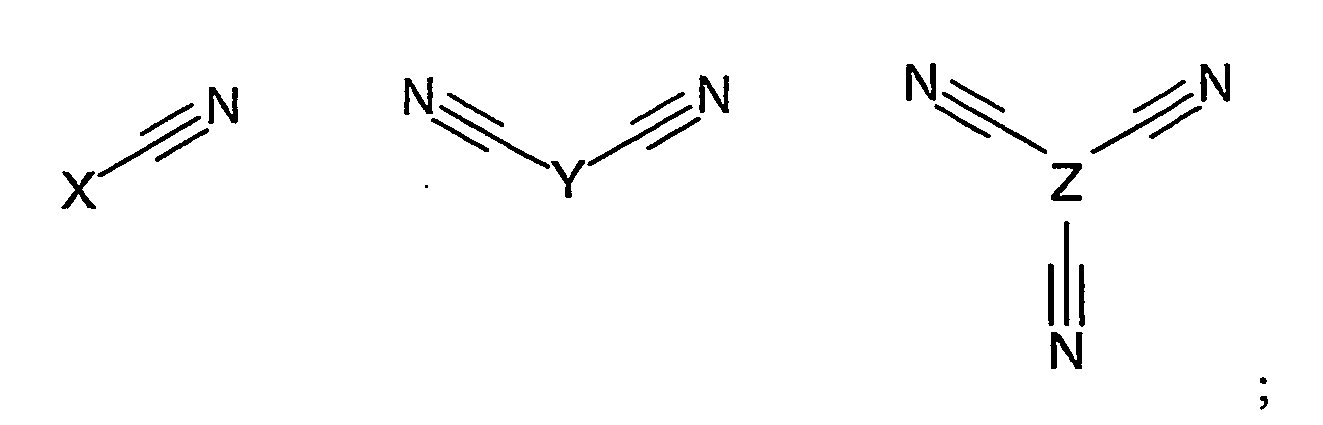
X für lineare, verzweigte oder cyclische Gruppen steht, die ausgewählt sind aus der Gruppe, bestehend aus Alkyl, Cycloalkyl, Alkenyl, Alkinyl, Aryl, Hydroxyalkyl, Alkoxyalkyl, Aminoalkyl und Aryl-C1-4,
Y und Z ausgewählt sind aus der Gruppe, bestehend aus Alkyl, Cycloalkyl, Alkenyl, Alkinyl, Aryl, Alkoxyalkyl und Aminoalkyl. - Besonders bevorzugt werden in dem erfindungsgemäßen Verfahren Verbindungen hydriert, die ausgewählt sind aus der Gruppe, bestehend aus Dimethylaminopropionitril, Aminoacetonitril, Formaldehydcyanhydrin, 3-(2-)Ethylhexoyl(proprionitril), 3-Dimethylaminoproprionitril, Methoxyproprionitril und Fettsäurenitrile. Besonders bevorzugt sind darüber hinaus Adipodinitril, Iminodiacetonnitril, Isophoronnitrilimin, Korksäuredinitril, Nitrilotriacetonitril und Isophthalsäuredinitril.
- Die durch das erfindungsgemäße Verfahren erhaltenen Amine besitzen entsprechend die allgemeinen Strukturformeln

- Die durch das erfindungsgemäße Verfahren hergestellten Verbindungen sind an sich bekannt. Insbesondere sind hierbei zu nennen Aminocapronitril, Hexamethylendiamin, Diethylentriamin, Ethylendiamin, Ethanolamin, Aminoacetonitril, Trisaminoethylamin, Dimethylaminopropanamin, Methoxypropylamin, 3-(2-Ethoxyhexoyl)propylamin, Isophorondiamin, 8-Aminooctanitril, Diaminooctan und Fettsäureamine.
- Die Herstellung der in dem erfindungsgemäßen Verfahren als Edukte verwendeten Nitrile kann durch jede dem Fachmann bekannte Verfahrensweise erfolgen. Beispiele hierfür sind die Kolbe-Nitril-Synthese, die Strecker-Synthese, das Erhitzen von Säureamiden mit wasserabspaltenden Mitteln, die Addition an ungesättigte Nitrile und das Erhitzen von Aldoximen mit Acetanhydrid unter Wasserabspaltung.
- Weiterer Gegenstand der vorliegenden Erfindung ist die Verwendung der zuvor beschriebenen ionischen Flüssigkeiten in Hydrierungen von in organischen Verbindungen enthaltenen Nitrilfunktionen an mindestens einem heterogenen Katalysator.
- Bezüglich der organischen Verbindungen, die Nitrilfunktionen enthalten, den ionischen Flüssigkeiten und den heterogenen Katalysatoren wird auf obige Ausführungen verwiesen.
- Das erfindungsgemäße Verfahren weist darüber hinaus noch nicht diskutierte Vorteile auf.
- Das vorliegende Verfahren bietet beispielsweise die Möglichkeit, Produkte über eine Säure-Base-Reaktion mit den sauren ionischen Flüssigkeiten abzutrennen. Hierbei wird das Wertprodukt durch Destillation unter Verschiebung der Säure-Base-Gleichgewichte und Zersetzung der Anlagerungsverbindung ionische Flüssigkeit - Produkt abgetrennt. Damit entfällt eine teure und aufwendige Feststoffhandhabung durch Salzbildung bzw. - freisetzung.
- Das beschriebene Verfahren führt, wie bereits ausgeführt, zu einer Erhöhung der Selektivität bzw. zu Beeinflussung des Produktverhältnisses zwischen Mono- und Dihydrierung bei Dinitrilen. Darüber hinaus sind die Ausbeute an Wertprodukt verbessert und die Lebensdauer des Katalysators erhöht. Die ionischen Flüssigkeiten lassen sich dabei durch Variation der verwendeten Kationen bzw. Anionen über einen weiten Bereich in Polarität, Löslichkeit, Benetzungsverhalten, Schmelzpunkt, physikalischen und chemischen Eigenschaften auf die Anforderungen maßschneidern.
- Neben der erhöhten Selektivität ist ein weiterer bedeutender Vorteil der Erfindung, dass sie unter vergleichsweise niedrigem Druck und bei niedrigen Temperaturen ohne Ammoniak-Zusatz oder Zusatz anderer Additive vonstatten geht.
- Daher sind aufwendige und teure Abfallbeseitigungen, z.B. durch Verbrennung von Additiven, hinfällig, ebenso wie entsprechende druckfest ausgelegte Apparate bzw. Verdichter zur Rückführung des in den bekannten Verfahren verwendeten Ammoniaks. Die verwendeten ionischen Flüssigkeiten sind im Gegensatz zu den meisten sonst verwendeten Additiven einschließlich Ammoniak durch den niedrigen Dampfdruck einfach und wirtschaftlich rückführbar.
- Das erfindungsgemäße Verfahren wird anhand der folgenden Ausführungsbeispiele näher erläutert.
- In einem Autoklaven werden Adipodinitril, Toluol, Ethylimidazoliumchlorid (Verhältnis Gew% 1:1:1) und Katalysator, bestehend aus Ru/Kohle (4,1 Gew%) gemischt und bei 100°C und einem Druck von 100 bar ohne Zusatz von Ammoniak umgesetzt. Nach 12 h wird die Reaktion durch Abkühlen abgebrochen, die Phasen getrennt, der Katalysator, der sich vor allem an der Phasengrenze ansammelt, abfiltriert und die beiden Phasen analysiert.
Umsatz: 60 %
Selektivität: 66 % bzgl. Aminocapronitril, 7 % bzgl. Hexamethylendiamin, Verhältnis Aminocapronitril zu Hexamethylendiamin: 5:1 - In einem Autoklaven werden Adipodinitril, Toluol, Methylimidazoliumhydrogensulfat (Verhältnis Gew% 1:1:1) und Katalysator, bestehend aus Ru/Kohle (3 Gew%) gemischt und bei 100°C und 100 bar ohne Zusatz von Ammoniak umgesetzt. Nach 18 h wird die Reaktion durch Abkühlen abgebrochen, die Phasen getrennt, der Katalysator abfiltriert und die beiden Phasen analysiert.
Umsatz: 68 %
Selektivität: 53 % bzgl. Aminocapronitril, Verhältnis Aminocapronitril zu Hexamethylendiamin: 8:1 - In einem Autoklaven werden Dimethylaminopropionitril, Toluol, Ethylimidazoliumchlorid im Verhältnis 1:1:1 und Kobaltkatalysator (4,1 Gew%) gemischt und bei 100°C und einem Wasserstoffdruck von 100 bar ohne Zusatz von Ammoniak umgesetzt. Nach 12 h wird die Reaktion durch Abkühlen abgebrochen, die Phasen getrennt, der Katalysator abfiltriert und die beiden Phasen analysiert.
Umsatz: 100 %
Selektivität: 90 % bzgl. Dimethylaminopropylamin - In einem Autoklaven werden Adipodinitril, Toluol (1:1 Gew%) und Katalysator, bestehend aus Ru/Kohle (5,6 Gew%), gemischt und bei 100°C und 100 bar ohne Zusatz von Ammoniak umgesetzt. Nach 12 h wird die Reaktion durch Abkühlen abgebrochen und der Reaktionsaustrag analysiert.
Umsatz: 100 %
Selektivität: 40 % bzgl. Hexamethylendiamin: Aminocapronitril und Adipodinitril sind nicht nachweisbar - In einem Autoklaven werden Adipodinitril, Toluol (1:1 Gew%) und Katalysator, bestehend aus Ru/Kohle (5,6 Gew%), gemischt und bei 100°C und 100 bar ohne Zusatz von Ammoniak umgesetzt. Nach 6 h wird eine Probe entnommen und der Reaktionsaustrag analysiert.
Umsatz: 69 %
Selektivität: 37 % bzgl. Aminocapronitril; Verhältnis Aminocapronitril zu Hexamethylendiamin: 3,2:1
Claims (9)
- Verfahren zur Hydrierung von in organischen Verbindungen enthaltenen Nitrilfunktionen an mindestens einem heterogenen Katalysator, dadurch gekennzeichnet, dass die Hydrierung in Gegenwart einer ionischen Flüssigkeit durchgeführt wird und das Anion der ionischen Flüssigkeit ausgewählt ist aus der Gruppe, bestehend aus Halogenide F-, Cl-, Br-, I-, Acetat CH3COO-, Trifluoracetat CF3COO-, Triflat CF3SO3 -, Sulfat SO4 2-, Hydrogensulfat HSO4 -, Methylsulfat CH3OSO3 -, Ethylsulfat C2H5OSO3 -, Sulfit SO3 2-, Hydrogensulfit HSO3 -, Aluminiumchloride AlCl4 -, Al2Cl7 -, Al3Cl10 -, Aluminiumtetrabromid AlBr4 -, Nitrit NO2 -, Nitrat NO3 -, Kupferchlorid CuCl2 -, Phosphate, Phosphat PO4 3-, Hydrogenphosphat HPO4 2-, Dihydrogenphosphat H2PO4 -, Carbonat CO3 2-, Hydrogencarbonat HCO3 -, Sulfonat - SO3 -, Tosylat p-CH3C6H4SO3 - und Bis(trifluormethylsulfonyl)imid (CF3SO2)2N- und die ionische Flüssigkeit Phosphoniumionen enthält und/oder mindestens einen fünf- oder sechsgliedrigen Heterocyclus enthält, der mindestens ein Phosphor- oder Stickstoffatom sowie gegebenenfalls ein Schwefel- und/oder Sauerstoffatom ausweist.
- Verfahren nach Anspruch 1, dadurch gekennzeichnet, dass bei einem heterogenen Katalysator mit polarer Oberfläche eine unpolare ionische Flüssigkeit und bei einem heterogenen Katalysator mit einer unpolaren Oberfläche eine polare ionische Flüssigkeit verwendet werden und/oder ionische Flüssigkeit und Katalysator so gewählt werden, dass sich Edukt oder Produkt in einer anderen Phase aufhalten und/oder durch die ionische Flüssigkeit eine irreversible Belegung des Katalysators verhindert wird.
- Verfahren nach Anspruch 1 oder 2, dadurch gekennzeichnet, dass die ionische Flüssigkeit einen Schmelzpunkt unterhalb 200°C aufweist
- Verfahren nach einem der Ansprüche 1 bis 3, dadurch gekennzeichnet, dass das Verfahren in Abwesenheit vom Ammoniak durchgeführt wird.
- Verfahren nach einem der Ansprüche 1 bis 4, dadurch gekennzeichnet, dass in Suspensionsfahrweise der Katalysator und/oder die ionische Flüssigkeit getrennt oder zusammen in das Verfahren zurückgeführt werden oder in einer Festbettfahrweise als ionische Flüssigkeit in das Verfahren zurückgeführt wird.
- Verfahren nach einem der Ansprüche 1 bis 5, dadurch gekennzeichnet, dass ein heterogener Katalysator auf Basis von Nickel, Kobalt, Kupfer, Eisen, Ruthenium, Rhodium, Iridium, Palladium und/oder Platin, gegebenenfalls als Skelett-Katalysators, verwendet wird.
- Verfahren nach einem der Ansprüche 1 bis 6, dadurch gekennzeichnet, dass die Hydrierung bei einer Temperatur von 20 bis 250°C und/oder einem Druck von 1 bis 300 bar durchgeführt wird.
- Verfahren nach einem der Ansprüche 1 bis 7, dadurch gekennzeichnet, dass die zu hydrierenden Nitrile mindestens eine der folgenden Struktureinheiten aufweisen

- Verwendung von ionischen Flüssigkeiten in Hydrierungen von Nitrilfunktionen, die in organischen Verbindungen enthalten sind, an mindestens einem heterogenen Katalysator, wobei die Anionen der ionischen Flüssigkeit ausgewählt sind aus der Gruppe, bestehend aus Halogeniden F-, Cl-, Br-, I-, Acetat CH3COO-, Trifluoracetat CF3COO-, Triflat CF3SO3 -, Sulfat SO4 2-, Hydrogensulfat HSO4 -, Methylsulfat CH3OSO3 -, Ethylsulfat C2H5OSO3 -, Sulfit SO3 -, Hydrogensulfit HSO3 -, Aluminiumchloriden AlC4 -, Al2Cl7 -, Al3Cl10 - ; Aluminiumtetrabromid AlBr4 -, Nitrit NO2 -, Nitrat NO3 -, Kupferchlorid CuCl2 -, Phosphaten, Phosphat PO4 3-, Hydrogenphosphat HPO4 2-, Dihydrogenphosphat H2PO4 -, Carbonat CO3 2-, Hydrogencarbonat HCO3 -, Sulfonat -SO3 -, Tosylat p-CH3C6H4SO3 - und Bis(trifluormethylsulfonyl)imid (CF3SO2)2N- und die ionische Flüssigkeit Phosphoniumionen enthält und/oder mindestens einen fünf- oder sechsgliedrigen Heterocyclus enthält, der mindestens ein Phosphor- oder Stickstoffatom sowie gegebenenfalls ein Schwefel- und/oder Sauerstoffatom aufweist.
Applications Claiming Priority (2)
| Application Number | Priority Date | Filing Date | Title |
|---|---|---|---|
| DE10361071A DE10361071A1 (de) | 2003-12-22 | 2003-12-22 | Nitrilhydrierung in Gegenwart Ionischer Flüssigkeiten |
| PCT/EP2004/014495 WO2005061429A1 (de) | 2003-12-22 | 2004-12-20 | Nitrilhydrierung in gegenwart ionischer flüssigkeiten an heterogenen katalysatoren |
Publications (2)
| Publication Number | Publication Date |
|---|---|
| EP1735265A1 EP1735265A1 (de) | 2006-12-27 |
| EP1735265B1 true EP1735265B1 (de) | 2009-03-18 |
Family
ID=34673060
Family Applications (1)
| Application Number | Title | Priority Date | Filing Date |
|---|---|---|---|
| EP04804094A Expired - Lifetime EP1735265B1 (de) | 2003-12-22 | 2004-12-20 | Nitrilhydrierung in gegenwart ionischer flüssigkeiten an heterogenen katalysatoren |
Country Status (9)
| Country | Link |
|---|---|
| US (1) | US7381845B2 (de) |
| EP (1) | EP1735265B1 (de) |
| JP (1) | JP2007515445A (de) |
| KR (1) | KR20060109954A (de) |
| CN (1) | CN100509752C (de) |
| AT (1) | ATE425957T1 (de) |
| DE (2) | DE10361071A1 (de) |
| ES (1) | ES2322064T3 (de) |
| WO (1) | WO2005061429A1 (de) |
Families Citing this family (20)
| Publication number | Priority date | Publication date | Assignee | Title |
|---|---|---|---|---|
| FR2850966B1 (fr) * | 2003-02-10 | 2005-03-18 | Rhodia Polyamide Intermediates | Procede de fabrication de composes dinitriles |
| FR2854891B1 (fr) | 2003-05-12 | 2006-07-07 | Rhodia Polyamide Intermediates | Procede de preparation de dinitriles |
| ES2532982T3 (es) * | 2005-10-18 | 2015-04-06 | Invista Technologies S.À.R.L. | Proceso de preparación de 3-aminopentanonitrilo |
| WO2007109005A2 (en) | 2006-03-17 | 2007-09-27 | Invista Technologies S.A R.L. | Method for the purification of triorganophosphites by treatment with a basic additive |
| DE102006019460A1 (de) * | 2006-04-26 | 2007-10-31 | Süd-Chemie AG | Mit einer ionischen Flüssigkeit beschichteter poröser heterogener Katalysator |
| US7919646B2 (en) | 2006-07-14 | 2011-04-05 | Invista North America S.A R.L. | Hydrocyanation of 2-pentenenitrile |
| US7880028B2 (en) * | 2006-07-14 | 2011-02-01 | Invista North America S.A R.L. | Process for making 3-pentenenitrile by hydrocyanation of butadiene |
| EP2146930A2 (de) | 2007-05-14 | 2010-01-27 | INVISTA Technologies S.à.r.l. | Hocheffizienter reaktor und entsprechendes verfahren |
| WO2008157218A1 (en) | 2007-06-13 | 2008-12-24 | Invista Technologies S.A.R.L. | Process for improving adiponitrile quality |
| CN101918356B (zh) | 2008-01-15 | 2013-09-25 | 因温斯特技术公司 | 戊烯腈的氢氰化 |
| WO2009091771A2 (en) * | 2008-01-15 | 2009-07-23 | Invista Technologies S.A R.L | Process for making and refining 3-pentenenitrile, and for refining 2-methyl-3-butenenitrile |
| US20090240068A1 (en) * | 2008-03-19 | 2009-09-24 | Invista North America S.A.R.L. | Methods of making cyclododecatriene and methods of making laurolactone |
| US8247621B2 (en) * | 2008-10-14 | 2012-08-21 | Invista North America S.A.R.L. | Process for making 2-secondary-alkyl-4,5-di-(normal-alkyl)phenols |
| CN102471218B (zh) * | 2009-08-07 | 2014-11-05 | 因温斯特技术公司 | 用于形成二酯的氢化并酯化 |
| DE102009051462B4 (de) | 2009-10-30 | 2015-02-05 | Clariant International Ag | Verfahren zur Herstellung eines Kompositmaterials, Kompositmaterial und dessen Verwendung |
| EP2583751B1 (de) * | 2011-10-19 | 2014-12-03 | Clariant Produkte (Deutschland) GmbH | Katalysatorzusammensetzung zur selektiven Hydrierung mit verbesserten Merkmalen |
| US20130102819A1 (en) | 2011-10-19 | 2013-04-25 | Normen Szesni | Catalyst composition for selective hydrogenation with improved characteristics |
| DE102015215662A1 (de) * | 2015-08-18 | 2017-02-23 | Friedrich-Alexander-Universität Erlangen-Nürnberg | Verfahren zur Umsetzung von gleichgewichtslimitierten Reaktionen |
| CN108610262A (zh) * | 2016-12-09 | 2018-10-02 | 中国科学院大连化学物理研究所 | 一种新溶剂体系间苯二甲腈加氢制备间苯二甲胺的方法 |
| CN114380699B (zh) * | 2022-01-26 | 2023-07-04 | 山东新和成维生素有限公司 | 一种合成异佛尔酮二胺的方法、催化剂及其制备方法 |
Family Cites Families (3)
| Publication number | Priority date | Publication date | Assignee | Title |
|---|---|---|---|---|
| US3919271A (en) | 1968-05-08 | 1975-11-11 | Du Pont | Catalysis by dispersions of metal halides in molten trihalostannate (II) and trihalogermanate (II) salts |
| US3657368A (en) * | 1970-11-24 | 1972-04-18 | Du Pont | Catalysis by dispersions of metal halides in molten trihalostannate(ii) and trihalogermanate(ii) salts |
| US6376714B1 (en) * | 2001-05-31 | 2002-04-23 | E. I. Du Pont De Nemours And Company | Environmentally friendly process for the hydrogenation of dinitriles |
-
2003
- 2003-12-22 DE DE10361071A patent/DE10361071A1/de not_active Withdrawn
-
2004
- 2004-12-20 EP EP04804094A patent/EP1735265B1/de not_active Expired - Lifetime
- 2004-12-20 KR KR1020067012290A patent/KR20060109954A/ko not_active Withdrawn
- 2004-12-20 DE DE502004009191T patent/DE502004009191D1/de not_active Expired - Fee Related
- 2004-12-20 ES ES04804094T patent/ES2322064T3/es not_active Expired - Lifetime
- 2004-12-20 JP JP2006546025A patent/JP2007515445A/ja not_active Withdrawn
- 2004-12-20 AT AT04804094T patent/ATE425957T1/de not_active IP Right Cessation
- 2004-12-20 US US10/583,726 patent/US7381845B2/en not_active Expired - Fee Related
- 2004-12-20 CN CNB2004800407722A patent/CN100509752C/zh not_active Expired - Fee Related
- 2004-12-20 WO PCT/EP2004/014495 patent/WO2005061429A1/de not_active Ceased
Also Published As
| Publication number | Publication date |
|---|---|
| DE10361071A1 (de) | 2005-07-14 |
| WO2005061429A1 (de) | 2005-07-07 |
| CN100509752C (zh) | 2009-07-08 |
| KR20060109954A (ko) | 2006-10-23 |
| US20070142673A1 (en) | 2007-06-21 |
| DE502004009191D1 (de) | 2009-04-30 |
| US7381845B2 (en) | 2008-06-03 |
| EP1735265A1 (de) | 2006-12-27 |
| JP2007515445A (ja) | 2007-06-14 |
| ATE425957T1 (de) | 2009-04-15 |
| CN1906150A (zh) | 2007-01-31 |
| ES2322064T3 (es) | 2009-06-16 |
Similar Documents
| Publication | Publication Date | Title |
|---|---|---|
| EP1735265B1 (de) | Nitrilhydrierung in gegenwart ionischer flüssigkeiten an heterogenen katalysatoren | |
| EP2024088B2 (de) | Mit einer ionischen flüssigkeit beschichteter poröser heterogener katalysator | |
| DE69910557T2 (de) | Verfahren zur reinigung von aminonitrilen | |
| DE69837162T2 (de) | Regenerierungsverfahren eines Hydrierungskatalysators und Verfahren zur Hydrierung von nitrilfunktionellen Verbindungen | |
| DE69523620T2 (de) | Verfahren zur selktiven hydrierung von dinitrilen zu aminonitrilen | |
| EP1812382B1 (de) | Verfahren zur herstellung von polyisocyanaten | |
| EP1663921B2 (de) | Verfahren zur herstellung von halogenalkanen aus alkoholen | |
| DE69222061T2 (de) | Verfahren zur herstellung von aminonitrilen durch partielle hydrierung von nitrilen mit zwei oder mehr nitrilgruppen | |
| DE2812151A1 (de) | Verfahren zur herstellung von organischen nitrilen | |
| DE19704612A1 (de) | Verfahren zur Gewinnung von Hexamethylendiamin aus Hexamethylendiamin enthaltenden Mischungen | |
| DE1518345B2 (de) | Verfahren zur Herstellung von Trimethylhexamethylendiaminen | |
| DE69821971T2 (de) | Verfahren zur hydrierung von dinitrilen | |
| DE102005048552A1 (de) | Verfahren zur Herstellung von Ethylenaminen | |
| DE3003730C2 (de) | ||
| EP1446377B1 (de) | Verfahren zur herstellung von aminen durch olefinaminierung in gegenwart ungesättigter stickstoffverbindungen | |
| DE1168430B (de) | Verfahren zur Umalkylierung von Bleitetraalkylen | |
| DE102007003139A1 (de) | Verfahren zur Herstellung von Salzverbindungen | |
| DE1959577C (de) | Verfahren zur Herstellung von Aminophenylalkylathern | |
| DE60100746T2 (de) | Vefahren zur herstellung von epsilon-caprolactam | |
| DE10233239B4 (de) | Katalysator für Crack-Prozesse der schweren und hochviskosen Erdöl-Fraktionen | |
| DE1092917B (de) | Verfahren zur Herstellung von ª-Cyanaethylmethyldichlorsilan | |
| DE2461074B2 (de) | Verfahren zur Herstellung primärer Amine aus Paraffinen |
Legal Events
| Date | Code | Title | Description |
|---|---|---|---|
| PUAI | Public reference made under article 153(3) epc to a published international application that has entered the european phase |
Free format text: ORIGINAL CODE: 0009012 |
|
| 17P | Request for examination filed |
Effective date: 20060724 |
|
| AK | Designated contracting states |
Kind code of ref document: A1 Designated state(s): AT BE BG CH CY CZ DE DK EE ES FI FR GB GR HU IE IS IT LI LT LU MC NL PL PT RO SE SI SK TR |
|
| DAX | Request for extension of the european patent (deleted) | ||
| RAP1 | Party data changed (applicant data changed or rights of an application transferred) |
Owner name: BASF SE |
|
| GRAP | Despatch of communication of intention to grant a patent |
Free format text: ORIGINAL CODE: EPIDOSNIGR1 |
|
| GRAS | Grant fee paid |
Free format text: ORIGINAL CODE: EPIDOSNIGR3 |
|
| GRAA | (expected) grant |
Free format text: ORIGINAL CODE: 0009210 |
|
| AK | Designated contracting states |
Kind code of ref document: B1 Designated state(s): AT BE BG CH CY CZ DE DK EE ES FI FR GB GR HU IE IS IT LI LT LU MC NL PL PT RO SE SI SK TR |
|
| REG | Reference to a national code |
Ref country code: GB Ref legal event code: FG4D Free format text: NOT ENGLISH |
|
| REG | Reference to a national code |
Ref country code: CH Ref legal event code: EP |
|
| REG | Reference to a national code |
Ref country code: IE Ref legal event code: FG4D Free format text: LANGUAGE OF EP DOCUMENT: GERMAN |
|
| REF | Corresponds to: |
Ref document number: 502004009191 Country of ref document: DE Date of ref document: 20090430 Kind code of ref document: P |
|
| REG | Reference to a national code |
Ref country code: ES Ref legal event code: FG2A Ref document number: 2322064 Country of ref document: ES Kind code of ref document: T3 |
|
| REG | Reference to a national code |
Ref country code: SE Ref legal event code: TRGR |
|
| REG | Reference to a national code |
Ref country code: HU Ref legal event code: AG4A Ref document number: E005271 Country of ref document: HU |
|
| PG25 | Lapsed in a contracting state [announced via postgrant information from national office to epo] |
Ref country code: SI Free format text: LAPSE BECAUSE OF FAILURE TO SUBMIT A TRANSLATION OF THE DESCRIPTION OR TO PAY THE FEE WITHIN THE PRESCRIBED TIME-LIMIT Effective date: 20090318 Ref country code: LT Free format text: LAPSE BECAUSE OF FAILURE TO SUBMIT A TRANSLATION OF THE DESCRIPTION OR TO PAY THE FEE WITHIN THE PRESCRIBED TIME-LIMIT Effective date: 20090318 |
|
| PG25 | Lapsed in a contracting state [announced via postgrant information from national office to epo] |
Ref country code: PL Free format text: LAPSE BECAUSE OF FAILURE TO SUBMIT A TRANSLATION OF THE DESCRIPTION OR TO PAY THE FEE WITHIN THE PRESCRIBED TIME-LIMIT Effective date: 20090318 |
|
| REG | Reference to a national code |
Ref country code: IE Ref legal event code: FD4D |
|
| PG25 | Lapsed in a contracting state [announced via postgrant information from national office to epo] |
Ref country code: EE Free format text: LAPSE BECAUSE OF FAILURE TO SUBMIT A TRANSLATION OF THE DESCRIPTION OR TO PAY THE FEE WITHIN THE PRESCRIBED TIME-LIMIT Effective date: 20090318 Ref country code: IE Free format text: LAPSE BECAUSE OF FAILURE TO SUBMIT A TRANSLATION OF THE DESCRIPTION OR TO PAY THE FEE WITHIN THE PRESCRIBED TIME-LIMIT Effective date: 20090318 Ref country code: PT Free format text: LAPSE BECAUSE OF FAILURE TO SUBMIT A TRANSLATION OF THE DESCRIPTION OR TO PAY THE FEE WITHIN THE PRESCRIBED TIME-LIMIT Effective date: 20090826 |
|
| PG25 | Lapsed in a contracting state [announced via postgrant information from national office to epo] |
Ref country code: IS Free format text: LAPSE BECAUSE OF FAILURE TO SUBMIT A TRANSLATION OF THE DESCRIPTION OR TO PAY THE FEE WITHIN THE PRESCRIBED TIME-LIMIT Effective date: 20090718 Ref country code: SK Free format text: LAPSE BECAUSE OF FAILURE TO SUBMIT A TRANSLATION OF THE DESCRIPTION OR TO PAY THE FEE WITHIN THE PRESCRIBED TIME-LIMIT Effective date: 20090318 Ref country code: RO Free format text: LAPSE BECAUSE OF FAILURE TO SUBMIT A TRANSLATION OF THE DESCRIPTION OR TO PAY THE FEE WITHIN THE PRESCRIBED TIME-LIMIT Effective date: 20090318 |
|
| PLBE | No opposition filed within time limit |
Free format text: ORIGINAL CODE: 0009261 |
|
| STAA | Information on the status of an ep patent application or granted ep patent |
Free format text: STATUS: NO OPPOSITION FILED WITHIN TIME LIMIT |
|
| PG25 | Lapsed in a contracting state [announced via postgrant information from national office to epo] |
Ref country code: DK Free format text: LAPSE BECAUSE OF FAILURE TO SUBMIT A TRANSLATION OF THE DESCRIPTION OR TO PAY THE FEE WITHIN THE PRESCRIBED TIME-LIMIT Effective date: 20090318 Ref country code: BG Free format text: LAPSE BECAUSE OF FAILURE TO SUBMIT A TRANSLATION OF THE DESCRIPTION OR TO PAY THE FEE WITHIN THE PRESCRIBED TIME-LIMIT Effective date: 20090618 |
|
| 26N | No opposition filed |
Effective date: 20091221 |
|
| BERE | Be: lapsed |
Owner name: BASF SE Effective date: 20091231 |
|
| REG | Reference to a national code |
Ref country code: NL Ref legal event code: V1 Effective date: 20100701 |
|
| EUG | Se: european patent has lapsed | ||
| PG25 | Lapsed in a contracting state [announced via postgrant information from national office to epo] |
Ref country code: MC Free format text: LAPSE BECAUSE OF NON-PAYMENT OF DUE FEES Effective date: 20100701 |
|
| REG | Reference to a national code |
Ref country code: CH Ref legal event code: PL |
|
| GBPC | Gb: european patent ceased through non-payment of renewal fee |
Effective date: 20091220 |
|
| PG25 | Lapsed in a contracting state [announced via postgrant information from national office to epo] |
Ref country code: CZ Free format text: LAPSE BECAUSE OF NON-PAYMENT OF DUE FEES Effective date: 20091220 Ref country code: FI Free format text: LAPSE BECAUSE OF NON-PAYMENT OF DUE FEES Effective date: 20091220 |
|
| REG | Reference to a national code |
Ref country code: FR Ref legal event code: ST Effective date: 20100831 |
|
| PG25 | Lapsed in a contracting state [announced via postgrant information from national office to epo] |
Ref country code: NL Free format text: LAPSE BECAUSE OF NON-PAYMENT OF DUE FEES Effective date: 20100701 Ref country code: GR Free format text: LAPSE BECAUSE OF FAILURE TO SUBMIT A TRANSLATION OF THE DESCRIPTION OR TO PAY THE FEE WITHIN THE PRESCRIBED TIME-LIMIT Effective date: 20090619 Ref country code: FR Free format text: LAPSE BECAUSE OF NON-PAYMENT OF DUE FEES Effective date: 20091231 Ref country code: CH Free format text: LAPSE BECAUSE OF NON-PAYMENT OF DUE FEES Effective date: 20091231 Ref country code: BE Free format text: LAPSE BECAUSE OF NON-PAYMENT OF DUE FEES Effective date: 20091231 Ref country code: LI Free format text: LAPSE BECAUSE OF NON-PAYMENT OF DUE FEES Effective date: 20091231 Ref country code: HU Free format text: LAPSE BECAUSE OF NON-PAYMENT OF DUE FEES Effective date: 20091221 |
|
| PG25 | Lapsed in a contracting state [announced via postgrant information from national office to epo] |
Ref country code: DE Free format text: LAPSE BECAUSE OF NON-PAYMENT OF DUE FEES Effective date: 20100701 |
|
| PG25 | Lapsed in a contracting state [announced via postgrant information from national office to epo] |
Ref country code: GB Free format text: LAPSE BECAUSE OF NON-PAYMENT OF DUE FEES Effective date: 20091220 |
|
| REG | Reference to a national code |
Ref country code: ES Ref legal event code: FD2A Effective date: 20110307 |
|
| PG25 | Lapsed in a contracting state [announced via postgrant information from national office to epo] |
Ref country code: IT Free format text: LAPSE BECAUSE OF NON-PAYMENT OF DUE FEES Effective date: 20091220 |
|
| PG25 | Lapsed in a contracting state [announced via postgrant information from national office to epo] |
Ref country code: LU Free format text: LAPSE BECAUSE OF NON-PAYMENT OF DUE FEES Effective date: 20091220 |
|
| PG25 | Lapsed in a contracting state [announced via postgrant information from national office to epo] |
Ref country code: SE Free format text: LAPSE BECAUSE OF NON-PAYMENT OF DUE FEES Effective date: 20091221 Ref country code: AT Free format text: LAPSE BECAUSE OF NON-PAYMENT OF DUE FEES Effective date: 20091220 |
|
| PG25 | Lapsed in a contracting state [announced via postgrant information from national office to epo] |
Ref country code: ES Free format text: LAPSE BECAUSE OF NON-PAYMENT OF DUE FEES Effective date: 20110304 |
|
| PG25 | Lapsed in a contracting state [announced via postgrant information from national office to epo] |
Ref country code: TR Free format text: LAPSE BECAUSE OF FAILURE TO SUBMIT A TRANSLATION OF THE DESCRIPTION OR TO PAY THE FEE WITHIN THE PRESCRIBED TIME-LIMIT Effective date: 20090318 |
|
| PG25 | Lapsed in a contracting state [announced via postgrant information from national office to epo] |
Ref country code: CY Free format text: LAPSE BECAUSE OF FAILURE TO SUBMIT A TRANSLATION OF THE DESCRIPTION OR TO PAY THE FEE WITHIN THE PRESCRIBED TIME-LIMIT Effective date: 20090318 Ref country code: ES Free format text: LAPSE BECAUSE OF NON-PAYMENT OF DUE FEES Effective date: 20091221 |