EP1814077A2 - Header-basierte Verarbeitung komprimierter Bilder unter Verwendung von Multi-Skalen Tranformationen - Google Patents
Header-basierte Verarbeitung komprimierter Bilder unter Verwendung von Multi-Skalen Tranformationen Download PDFInfo
- Publication number
- EP1814077A2 EP1814077A2 EP07106420A EP07106420A EP1814077A2 EP 1814077 A2 EP1814077 A2 EP 1814077A2 EP 07106420 A EP07106420 A EP 07106420A EP 07106420 A EP07106420 A EP 07106420A EP 1814077 A2 EP1814077 A2 EP 1814077A2
- Authority
- EP
- European Patent Office
- Prior art keywords
- image
- scale
- header
- block
- coded data
- Prior art date
- Legal status (The legal status is an assumption and is not a legal conclusion. Google has not performed a legal analysis and makes no representation as to the accuracy of the status listed.)
- Granted
Links
Images






Classifications
-
- G—PHYSICS
- G06—COMPUTING OR CALCULATING; COUNTING
- G06T—IMAGE DATA PROCESSING OR GENERATION, IN GENERAL
- G06T3/00—Geometric image transformations in the plane of the image
- G06T3/40—Scaling of whole images or parts thereof, e.g. expanding or contracting
-
- G—PHYSICS
- G06—COMPUTING OR CALCULATING; COUNTING
- G06T—IMAGE DATA PROCESSING OR GENERATION, IN GENERAL
- G06T7/00—Image analysis
- G06T7/10—Segmentation; Edge detection
- G06T7/11—Region-based segmentation
-
- H—ELECTRICITY
- H04—ELECTRIC COMMUNICATION TECHNIQUE
- H04N—PICTORIAL COMMUNICATION, e.g. TELEVISION
- H04N19/00—Methods or arrangements for coding, decoding, compressing or decompressing digital video signals
- H04N19/10—Methods or arrangements for coding, decoding, compressing or decompressing digital video signals using adaptive coding
- H04N19/134—Methods or arrangements for coding, decoding, compressing or decompressing digital video signals using adaptive coding characterised by the element, parameter or criterion affecting or controlling the adaptive coding
- H04N19/136—Incoming video signal characteristics or properties
- H04N19/14—Coding unit complexity, e.g. amount of activity or edge presence estimation
-
- H—ELECTRICITY
- H04—ELECTRIC COMMUNICATION TECHNIQUE
- H04N—PICTORIAL COMMUNICATION, e.g. TELEVISION
- H04N19/00—Methods or arrangements for coding, decoding, compressing or decompressing digital video signals
- H04N19/10—Methods or arrangements for coding, decoding, compressing or decompressing digital video signals using adaptive coding
- H04N19/169—Methods or arrangements for coding, decoding, compressing or decompressing digital video signals using adaptive coding characterised by the coding unit, i.e. the structural portion or semantic portion of the video signal being the object or the subject of the adaptive coding
- H04N19/17—Methods or arrangements for coding, decoding, compressing or decompressing digital video signals using adaptive coding characterised by the coding unit, i.e. the structural portion or semantic portion of the video signal being the object or the subject of the adaptive coding the unit being an image region, e.g. an object
-
- H—ELECTRICITY
- H04—ELECTRIC COMMUNICATION TECHNIQUE
- H04N—PICTORIAL COMMUNICATION, e.g. TELEVISION
- H04N19/00—Methods or arrangements for coding, decoding, compressing or decompressing digital video signals
- H04N19/10—Methods or arrangements for coding, decoding, compressing or decompressing digital video signals using adaptive coding
- H04N19/169—Methods or arrangements for coding, decoding, compressing or decompressing digital video signals using adaptive coding characterised by the coding unit, i.e. the structural portion or semantic portion of the video signal being the object or the subject of the adaptive coding
- H04N19/17—Methods or arrangements for coding, decoding, compressing or decompressing digital video signals using adaptive coding characterised by the coding unit, i.e. the structural portion or semantic portion of the video signal being the object or the subject of the adaptive coding the unit being an image region, e.g. an object
- H04N19/176—Methods or arrangements for coding, decoding, compressing or decompressing digital video signals using adaptive coding characterised by the coding unit, i.e. the structural portion or semantic portion of the video signal being the object or the subject of the adaptive coding the unit being an image region, e.g. an object the region being a block, e.g. a macroblock
-
- H—ELECTRICITY
- H04—ELECTRIC COMMUNICATION TECHNIQUE
- H04N—PICTORIAL COMMUNICATION, e.g. TELEVISION
- H04N19/00—Methods or arrangements for coding, decoding, compressing or decompressing digital video signals
- H04N19/44—Decoders specially adapted therefor, e.g. video decoders which are asymmetric with respect to the encoder
-
- H—ELECTRICITY
- H04—ELECTRIC COMMUNICATION TECHNIQUE
- H04N—PICTORIAL COMMUNICATION, e.g. TELEVISION
- H04N19/00—Methods or arrangements for coding, decoding, compressing or decompressing digital video signals
- H04N19/48—Methods or arrangements for coding, decoding, compressing or decompressing digital video signals using compressed domain processing techniques other than decoding, e.g. modification of transform coefficients, variable length coding [VLC] data or run-length data
-
- H—ELECTRICITY
- H04—ELECTRIC COMMUNICATION TECHNIQUE
- H04N—PICTORIAL COMMUNICATION, e.g. TELEVISION
- H04N19/00—Methods or arrangements for coding, decoding, compressing or decompressing digital video signals
- H04N19/60—Methods or arrangements for coding, decoding, compressing or decompressing digital video signals using transform coding
- H04N19/63—Methods or arrangements for coding, decoding, compressing or decompressing digital video signals using transform coding using sub-band based transform, e.g. wavelets
-
- G—PHYSICS
- G06—COMPUTING OR CALCULATING; COUNTING
- G06T—IMAGE DATA PROCESSING OR GENERATION, IN GENERAL
- G06T2207/00—Indexing scheme for image analysis or image enhancement
- G06T2207/10—Image acquisition modality
- G06T2207/10016—Video; Image sequence
-
- G—PHYSICS
- G06—COMPUTING OR CALCULATING; COUNTING
- G06T—IMAGE DATA PROCESSING OR GENERATION, IN GENERAL
- G06T2207/00—Indexing scheme for image analysis or image enhancement
- G06T2207/20—Special algorithmic details
- G06T2207/20021—Dividing image into blocks, subimages or windows
-
- G—PHYSICS
- G06—COMPUTING OR CALCULATING; COUNTING
- G06T—IMAGE DATA PROCESSING OR GENERATION, IN GENERAL
- G06T2207/00—Indexing scheme for image analysis or image enhancement
- G06T2207/20—Special algorithmic details
- G06T2207/20048—Transform domain processing
- G06T2207/20064—Wavelet transform [DWT]
-
- G—PHYSICS
- G06—COMPUTING OR CALCULATING; COUNTING
- G06T—IMAGE DATA PROCESSING OR GENERATION, IN GENERAL
- G06T2207/00—Indexing scheme for image analysis or image enhancement
- G06T2207/20—Special algorithmic details
- G06T2207/20112—Image segmentation details
- G06T2207/20132—Image cropping
-
- H—ELECTRICITY
- H04—ELECTRIC COMMUNICATION TECHNIQUE
- H04N—PICTORIAL COMMUNICATION, e.g. TELEVISION
- H04N19/00—Methods or arrangements for coding, decoding, compressing or decompressing digital video signals
- H04N19/10—Methods or arrangements for coding, decoding, compressing or decompressing digital video signals using adaptive coding
Definitions
- the invention relates generally to the field of image processing. More specifically, the invention relates to processing images using multi-scale transforms.
- Digital images can be represented and stored in a variety of formats.
- a common feature in digital image representation formats is that the bits constituting an image file are divided into image description bits and header bits.
- Image description bits describe the actual underlying image. Often the image description bits are divided into smaller units for convenience.
- Header bits provide organizational information about the image, such as image size in pixels, file size, length in bits for the various smaller image description units, etc.
- Compressed image files contain a wide variety of organizational information in the header primarily to facilitate convenient file management and interpretation.
- JPEG 2000 ITU-T Rec. T.800I image headers also provide information about the number of bits contained in smaller units, such as groups of wavelet coefficients (termed codeblocks), that constitute compressed data for image and the wavelet-domain locations of these small units of coefficients.
- Other image file formats can contain similar information.
- Image analysis involves describing, interpreting, and understanding an image. Image analysis extracts measurements, data or information from an image. Image analysis techniques involve feature extraction, segmentation and classification. Image analysis may be referred to as computer vision, image data extraction, scene analysis, image description, automatic photointerpretation, region selection or image understanding. See W. Pratt, Digital Image Processing, (2nd Edition), John Wiley & Sons, Inc., New York, NY, 1995 , and A. Jain, Fundamentals of Digital Image Processing, Prentice Hall, Englewood Cliffs, NJ, 1995 .
- Image processing produces a modified output image from an input image.
- Image processing techniques include cropping, scaling, point operations, filtering, noise removal, restoration, enhancement. (Jain chapters 7 and 8; Pratt Part 4.)
- the program "pnmcrop” http://www.acme.com/software/pbmplus/) first analyzes an image to find stripes of a background color (a single color value, for example white or black) on all four sides. Then it performs an image processing operation, cropping, on the image to remove the stripes.
- a background color a single color value, for example white or black
- a method and apparatus for performing operations such as image segmentation, adaptive scale selection, and automatic region selection and scaling on the underlying image using only the image file header information.
- the image files use a multi-scale image compression technique.
- a multi-scale bit allocation, which is used for processing, is estimated from the file header.
- the processing algorithms use the number of bits allocated by the image coder (or, in another embodiment, estimated to be allocated) as a quantitative measure for the visual importance of the underlying features.
- the file header information may be part of a bit stream that includes compressed data corresponding to the underlying digital image.
- the processing described herein uses the information in the header and process it in a specific way to determine what portions of the compressed data to decode. In essence, the information in the header enables identification of a region or regions upon which further processing is to occur.
- the compressed data comprises an image representation format resulting from multi-scale transform-based compression.
- Compressed data consists of header and image description bits. That is, multi-scale transformed based compression is applied to image data as part of the process of generating the image description bits.
- the image coder's entropy distribution, or bit allocation, in the multi-scale domain may be estimated and used as a quantitative measure for visual importance of the underlying image features. For example, from the header of a JPEG 2000 file information such as, the length of codeblocks, the number of zero bit planes, the number of coding passes, may be used to determine the entropy distribution.
- bit distribution in a multi-scale transform based representation is used to perform one or more operations, including, but are not limited to, image segmentation, adaptive scale/resolution selection for images, and automatic scaling and detection and selection, scaling and cropping of important image regions.
- information in the header is used to generate an entropy distribution map that indicates which portions of the compressed image data contain desirable data for subsequent processing.
- An example of such a map is given in Figure 1.
- Other maps are possible and may indicate the number of layers, which are described below with the description of JPEG 2000, to obtain a desired bit rate (particularly for cases when layer assignment is related to distortion) or the entropy distribution for each of a number of bit rates. In the latter case, each rectangular area on the map has a vector associated with it. The vector might indicate values for multiple layers.
- Image representation formats that utilize multi-scale transforms to compress the image description bits typically incorporate many organizational details in the header, so that pixel-wise description about the digital image can be decoded correctly and conveniently.
- JPEG 2000 is an example of an image compression standard that provides multi-scale bit distributions in the file header.
- the image description bits are divided among smaller units, and the number of bits allocated by the encoder to these units is stored in the image header to facilitate features such as partial image access, adaptation to networked environments, etc. Using information theoretic conventions, the allocated number of bits is referred to as the entropy of each small unit.
- Entropy distributions used by image coders provide an excellent quantitative measure for visual importance in the compressed images.
- an image coder For lossless compression, an image coder uses more bits to describe the high activity (lot of detail) regions, and less bits to convey the regions with little detail information. For lossy compression, the image coder typically strives to convey the best possible description of the image within the allocated bits. Hence, the coder is designed to judiciously spends the available few bits describing visually important features in the image.
- a multi-scale image coder does not code image pixels, but coefficients of the transformed image where the transform performs a separation of image information into various frequency bands.
- Multi-scale image coders e.g., a JPEG 2000 coder
- the ability to process an image simply based on its header is desirable, because not only is the header information easily accessed using a small number of computations, but also the condensed nature of the available image information enables more efficient subsequent processing.
- the header information which is easy to access, indicates information about the image without decoding coefficients. Therefore, processing decisions can be made without having to expend a large amount of time decoding coefficients.
- the techniques described herein have applications in areas such as, but not limited to, display-adaptive image representations, digital video surveillance, image database management, image classification, image retrieval, and preprocessing for pattern analysis, image filtering and sizing.
- the present invention also relates to apparatus for performing the operations herein.
- This apparatus may be specially constructed for the required purposes, or it may comprise a general purpose computer selectively activated or reconfigured by a computer program stored in the computer.
- a computer program may be stored in a computer readable storage medium, such as, but is not limited to, any type of disk including floppy disks, optical disks, CD-ROMs, and magnetic-optical disks, read-only memories (ROMs), random access memories (RAMs), EPROMs, EEPROMs, magnetic or optical cards, or any type of media suitable for storing electronic instructions, and each coupled to a computer system bus.
- a machine-readable medium includes any mechanism for storing or transmitting information in a form readable by a machine (e.g., a computer).
- a machine-readable medium includes read only memory ("ROM”); random access memory (“RAM”); magnetic disk storage media; optical storage media; flash memory devices; electrical, optical, acoustical or other form of propagated signals (e.g., carrier waves, infrared signals, digital signals, etc.); etc.
- Figure 1 illustrates one multi-scale entropy distribution for an image.
- the image undergoes JPEG 2000 encoding initially.
- the underlying patterns are the wavelet coefficients of the image.
- the thin lines denote the JPEG 2000 division of the wavelet domain coefficients into code blocks, and the thick lines separate the different wavelet sub-bands.
- the coder performing the encoding process allocates and divides the wavelet domain coefficients into small units called code blocks.
- the numbers shown in each square are the bits or entropies allocated to the respective code blocks by the JPEG 2000 coder operating at 0.5 bits per pixel using three levels of decomposition. These numbers represent the multiscale entropy distribution.
- the entropy allocations which are accessed using only the JPEG 2000 file header, provide a good measure for the visual importance of the different features at various scales and help distinguish between the different types of important image features characterized by different multiscale properties. For example, to describe the feather region in the image, a multi-scale image coder spends many bits coding the fine scale coefficients and less on coarse scale coefficients than, e.g., fine scale coefficients corresponding to the feather region. On the other hand, to code the face region, a multi-scale image coder spends more bits coding the intermediate scale coefficients corresponding to the face region. The smooth background receives few bits. Thus, the multi-scale entropy distribution provides significant information about the underlying image features. Assuming knowledge of the multi-scale entropy distribution is obtained from headers, one or more operations may be performed. These operations may be, for example, image segmentation, automatic active region identification and scaling, and/or adaptive image scaling.
- JPEG 2000 is a standard to represent digital images in a coherent code-stream and file format (See, e.g., ITU-T Rec. T.800
- JPEG 2000 efficiently represents digital image by efficiently coding the wavelet coefficients of the image using the following steps.
- a typical image consists of one or more components (e.g., red, green, blue). Components are rectangular arrays of samples. These arrays are optionally divided further into rectangular tiles. On a tile-by-tile basis, the components are optionally decorrelated with a color space transformation. Each tile-component is compressed independently. Wavelet coefficients of each color component in the tile are obtained.
- the wavelet coefficients are separated into local groups in the wavelet domain. These are called code blocks.
- the code blocks are optionally ordered using precincts. Arithmetic coding is used to code these different wavelet-coefficient groups independently.
- the coded coefficients are optionally organized into layers to facilitate progression. Coded data from one layer of one resolution of one precinct of one component of one tile is stored in a unit called a packet. In addition to coded data, each packet has a packet header.
- a tile-component is optionally divided into tile-parts, otherwise the tile-component consists of a single tile-part.
- a tile-part is the minimum unit in the code-stream that corresponds to the syntax.
- a JPEG 2000 codestream consists of syntax (main and tile-part headers, plus EOC) and one or more bitstreams.
- a bitstream consists of packets (coded data for codeblocks, plus any instream markers including instream packet headers). The organizational information to parse the coded data, the packet headers, may be stored in the main header, tile headers, or instream.
- JPEG 2000 has main headers and tile headers which contain marker segments. JPEG 2000 also has packet headers which may be contained in marker segments or be in-stream in the bit stream. Headers are read and used as inputs to processing which obtains a multiscale entropy distribution. Table 1 summarizes the information contained in various JPEG 2000 headers that is relevant to header-based processing. Table 1: Uses of JPEG 2000 file header information Header Entries Type of Information Role to Entropy Estimation Main Tile Instream Packet header (PPM, PPT, instream) Length of coded data; number of zero bit planes and coding passes Provides entropy of each code block of each sub-band of each component of tile. Facilitates estimation of entropy allocation at lower bit rates.
- PPM Packet header
- ⁇ ⁇ ⁇ Packet length (PLM, PLT) Lengths of packets Facilitates faster estimation of code block entropies for some JPEG 2000 files
- ⁇ ⁇ Tile-length part (TLM, SOT) Lengths of tiles Provides entropy of each tile.
- TLM, SOT Tile-length part
- ⁇ ⁇ SIZ Size of image Helps determine location of code blocks ⁇ COD, COC, QCC, QCD Coding style Number of transform levels, code block size, maximum size of coefficients, precinct information ⁇ ⁇ RGN Region information Estimate size and importance of region of interest.
- the packet header (PPM, PPT, in-stream)
- it may be in either the main header, tile header or in-stream, but not a combination of any two or more of these at the same time.
- the packet length and tile-length part may be in the main header or the tile headers, or in both at the same time.
- the multi-scale entropy distribution at lower bit rates provides a robust measure for visual importance. At higher bit rates the existence of image noise, which is present in digital images from any sensor or capture device, corrupts the overall entropy distribution.
- images are encoded losslessly or lossy.
- the layering scheme in the JPEG 2000 standard could be used to order the codestream of a lossless or high bit rate encoded image into layers of visual or Mean-Squared-Error (MSE)-based importance.
- MSE Mean-Squared-Error
- a low bit rate version of the image could be obtained by extraction of information from only the packets in some layers and ignoring the packets in the other layers. If such layering is not employed by the encoder, the packet length information from the header can yield the multi-scale entropy distribution only at the bit rate chosen by the encoder, e.g. lossless, high bit rate or low bit rate.
- the estimation successively subtracts bits from the total number of bits per codeblock until a given bit rate for the image is reached.
- the order of subtraction is the reverse of a bit allocation algorithm.
- the allocation algorithm may be the same as the one used by the encoder, but it is not required to be.
- an order of subbands and bitplanes can be derived that reflects the importance of a bit plane in a given subband. Based on, e.g., MSE importance, the ordering of importance of bit planes in a subband of a 5-level decomposition is given by the one displayed in Table 2. Table 2 - Order of importance of bitplanes and subbands based on MSE weighting.
- bitplane HH level 1 1st bitplans LH/HL level 1 3 1st bitplane HH level 2 4 2nd bitplane HH level 1 5 1st bitplane LH/HL level 2 6 1st bitplane HH level 3 7 2nd bitplane LH/HL level 1 8 2nd bitplane HH level 2 9 1st bitplane LH/HL level 3 10 1st bitplane HH level 4 11 3rd bitplane HH level 1 12 2nd bitplane LH/HL level 2 13 2nd bitplane HH level 3 14 1st bitplane LH/HL level 4 15 1st bitplane HH level 5 16 3rd bitplane LH/HL level 1 17 3rd bitplane HH level 2 18 2nd bitplane LH/HL level 3 19 2nd bitplane HH
- a specific number of bits is subtracted from the codeblock bits.
- the specific number of bits is computed as the average number of bits per coding pass in the specific subband, or the specific resolution.
- order number (i+1) the derived number of bits is subtracted in a similar way from the codeblocks for bitplane b(i+1) of subband s(i+1) at level l(i+1).
- an exemplary estimation algorithm for the example target rate of 0.5bits/pixel is expressed as follows.
- New_B and new_CP are arrays of size of the number of codeblocks.
- the new estimated bit values "new_B" are used in the entropy processing algorithms.
- the parameter ⁇ could be estimated from the header data of a coding unit, then the pdf of the coefficients in that coding unit could be estimated and the entropy for any given quantizer Q be determined.
- Equations (6) and (4) an estimate for the entropy given a specific quantization is obtained.
- the value H yields bits per pixel. Since the codeblock length is measured in bytes, the estimated value H has to be multiplied by 8*(#coefficients per codeblock).
- a final algorithm may use the same order as the previously described method to reduce the number of bits in different subbands at different resolution levels successively. The reduction of bits is given by setting the quantizer to the bitplane parameter b(i) from Table 2.
- techniques may be used to perform image analysis or computer vision and similar operations such as, for example, but not limited to, segmentation, automatic scaling, resolution selection, and automatic region selection and cropping on the underlying image.
- image analysis or computer vision and similar operations such as, for example, but not limited to, segmentation, automatic scaling, resolution selection, and automatic region selection and cropping on the underlying image.
- Common prior art techniques are described in W. Pratt, Digital Image Processing, (2nd Edition), John Wiley & Sons, Inc., New York, NY, 1995 , and A. Jain, Fundamentals of Digital Image Processing, Prentice Hall, Englewood Cliffs, NJ, 1995 .
- a granular entropy distribution is available.
- the granular entropy distribution is used to process the underlying image.
- the use of multi-scale information from an image available in JPEG 2000 headers is demonstrated in the framework of several image analysis algorithms (or computer vision).
- the header parameters that are used are PPM, PPT, SIZ, COD, COC, QCC and QCD. From these parameters, the location of codeblocks in the wavelet domain and the number of bits used by the encoder to encode the corresponding coefficients can be extracted. These numbers can be used to derive a bit distribution of the multi-scale representation of the image.
- the scale and spatial localization of codeblocks, and the multi-scale bit distribution inferred from headers lead to different image processing applications such a multiscale segmentation, automatic scaling, automatic scaling and cropping, and production of multiscale collage.
- a classification technique assigns a class label to each small area in an image.
- Such-an area can be an individual pixel or a group of pixels, e.g. pixels contained in a square block.
- Various image analysis techniques use the class assignments in different ways, for example, the segmentation techniques separate an image into regions with homogeneous properties, e.g. same class labels.
- a scale is assigned as the class label to each image region, so that even if the coefficients from the finer scales is ignored, the visual relevant information about the underlying region is retained at the assigned scale.
- Such labeling identifies the frequency bandwidth of the underlying image features. Segmentation is posed as an optimization problem, and a statistical approach is invoked to solve the problem.
- the location of codeblocks in the wavelet domain is given by the two-dimensional (2D) spatial location (i,k) and scale j.
- 2D two-dimensional spatial location
- i,k the two-dimensional spatial location
- the number of bits B j (i,k) per codeblock location (i,k) at level j for the three different bands LH, HL and HH at level j are added to yield the number of bits necessary to code the total coefficients at wavelet domain location (i,k).
- a linear or non-linear combination of the different entropies can also be used to help distinguish between vertical and horizontal features.
- the prior art Maximum A Posteriori (“MAP") approach is adopted from statistics to solve the segmentation problem, because such an approach can be tuned to suit the final application.
- the basic ingredients used by MAP to set the cost function ⁇ are the likelihood P ( B
- the MAP segmentation solution corresponds to optimizing equation (8), using equation (9).
- the coefficients contained in a codeblock at level 1 contain information about a block of approximately twice the size in the pixel domain, If the pixel domain is divided into blocks of a specific size there are four times as many blocks in the pixel domain than codeblocks at level 1 of the wavelet decomposition, 16 times as many blocks in the pixel domain than codeblocks at level 2 of the wavelet decomposition, etc. Therefore, bits of a codeblock B j ( i,k ) of size n x n contribute information to a block in the pixel domain of size 2 j n x 2 j n at location ( i2 j n,k2 j n ).
- Other interpolation algorithms such as, for example, polynomial interpolation or other nonlinear interpolation, can be used as well to calculate the level j bits.
- the parameters w i and the weights ⁇ j, l may be changed depending on the application.
- the set of values B ⁇ j pixel is called the cumulative weighted entropy of the image at resolution j.
- the likelihood for the entropy B ⁇ j pixel (x,y) of a pixel domain block at location (x,y) is set to be the value of B ⁇ j pixel (x,y) relative to the total weighted bits for all levels associated with the pixel domain location (x,y), namely P B ⁇ pixel x , y )
- the total likelihood is given by P B
- S x ⁇ y j .
- B ⁇ pixel provides a multiscale entropy distribution for the original image.
- a prior is set on each location (x, y) based on its immediate neighborhood N(x, y), which consists of nine blocks (using reflection at the boundaries).
- the individual prior is P S x ⁇ y
- N x ⁇ y ⁇ x , y ( # ( N x ⁇ y S x ⁇ y ⁇ ) ⁇ .
- ⁇ 0.02 to 0.08.
- the desired segmentation map can now be obtained by optimizing the cost function ⁇ (S, B).
- a number of prior art iterative techniques may be used to search for the local maxima.
- the segmentation map maximizing the resulting cost function is obtained because the vector optimization decouples into a scalar optimization problem.
- S x ⁇ y j for all x ⁇ y
- N(x, y) is obtained from S m -1 .
- the iterative algorithm always converges, because the cost function ⁇ ( B , S m ) is a non-decreasing function with iterations m, and the cost function is bounded.
- the S m obtained after convergence is the segmentation estimate.
- FIG. 2 is a flow diagram of one embodiment of a process for segmenting an image.
- process block 201 a file that contains a header that contains multi-scale entropy distribution information on blocks of an image is received.
- the file represents an image in JPEG 2000 format.
- a scale from a set of scales is assigned to the block that maximizes a cost function.
- the cost function is a product of a total likelihood and a prior.
- the total likelihood is a product of likelihoods of the blocks.
- each likelihood of a block is proportional to a summation, for each scale in the set of scales, of a product of a weight of the scale and a number of bits spent to code the block at the scale.
- the number of bits spent to code the block at the scale is a numerator divided by a denominator.
- the numerator is an entropy distribution of a multi-scale coefficient of the block at the scale.
- the denominator is four raised to the power of the scale.
- the image is segmented by grouping together blocks that have been assigned equivalent scales.
- Figure 3 illustrates a segmentation map superimposed on an exemplary image of a woman.
- the segmentation process (set forth above) labels the face regions of the image 301 with finer scales, and labels the background regions with coarser scales to reflect the underlying features in the image. The different shades show that the regions with different types of features are identified differently.
- the segmentation process assigns a scale to the different regions on the basis of the underlying features.
- the color-bar 302 on the right shows the scales assigned to the different regions. Regions such as the face which contain many edges are labeled with a fine scale 303. In contrast, the background regions are assigned coarser scales 304.
- Figure 4 illustrates a segmentation map superimposed on an exemplary image of Japanese text. Since the segmentation map 402 is uniform, the superimposition does not change the appearance of the original image 401.
- the segmentation process attempts to assign a scale to the different regions on the basis of the underlying features.
- the color-bar 403 on the right shows the scales assigned to the different regions. Since the image 401 has uniform features, the algorithm has uniformly assigned the scale 3 to all regions in the image 401.
- the image coders in these examples used JPEG 2000 Part I reversible wavelet filters, five levels of decomposition, code-block size 32x32, and a bit rate of 0.2 bits per pixel on gray scale images.
- the results can be extended to color images.
- a linear or non-linear combination of the multi-scale entropy allocations among the different color components can be used for segmentation. Segmentation can be performed on only one component such as luminance or green.
- a segmentation algorithm can be run on each component separately, and then combined using voting or by a MAP method.
- the resolution of the final results are limited by the granularity (coarseness) of the multi-scale entropy distribution; typically, the resolution of the final results with respect to the underlying image is limited to multiples of the code-block size. In one embodiment, when precincts are employed, better resolution can be obtained if the precinct boundaries cause the code blocks to be split.
- the best scale it is often desirable to know the best scale such that even if all finer scale coefficients are thrown away, the retained coefficients contain sufficient information to identify the image. This may be used, for example, with digital cameras. Since entropy is a good measure for visual information, this may be used as a measure for the amount of visual information that is lost when an image is represented at scale j. Furthermore, the multi-scale representation helps to identify the approximate areas in the image that lose their visual information during image scaling. The best scale is estimated as follows. For each scale j , the importance of a given group of multi-scale coefficients S i,j to reconstruct the respective part of the image is analyzed.
- the relative importance of the coefficient is inferred by comparing their entropy to a scaled factor of the mean entropy from the immediate coarser level j +1 or combination of all coarse levels j+1....J.
- S l,j is significant if B ⁇ ⁇ j+1 and insignificant if B ⁇ ⁇ j+1 , where ⁇ j+1 is the mean of the number of bits per block at the coarser scale j +1, and ⁇ is a threshold parameter that dictates significance. In one embodiment, ⁇ is 0.3 .
- P ( j ) measures the percentage of the image area that the significant coefficients at level j cover.
- P ( j ) measures the area that would lose a significant amount of information, if the significant coefficients at level j are thrown away (when the image X is scaled down by a factor 2 j , then all coefficients at levels 1...j are lost in the scaled down image).
- the coarsest possible scale J opt is chosen so that at least P* percent of the area is still significant, i.e., P J opt > P * , where P* is a threshold parameter that sets the minimum percentage of area that needs to be recognizable. In one embodiment, P* equals 35%.
- the best scale that retains sufficient information about the image is J opt .
- the image would still contain sufficient information in the remaining coefficient to facilitate recognition of the image. It is possible to also set the significance threshold based on all the coarser scale coefficients, or based on only some of the coarser scale coefficients.
- FIG. 5 is a flow diagram of one embodiment of a process for adaptively scaling an image.
- a file is received that contains a header that contains multi-scale entropy distribution information on blocks of an image.
- the file represents an image in JPEG 2000 format.
- process block 502 for each block, it is determined that the block retains significance at a scale upon a determination that an entropy of a multi-scale coefficient of a block at the scale is greater than a mean entropy of multi-scale coefficients of blocks in at least one coarser scale.
- the mean entropy is a mean bit distribution multiplied by a threshold parameter.
- the image is scaled to a coarsest scale at which a threshold percentage of the blocks retain significance at the scale.
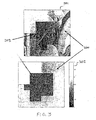
- Figure 6 illustrates adaptive scaling of an exemplary image of a woman.
- the size of the original image 601 is 512 by 512 pixels.
- the size of the scaled image 602 is 64 by 64 pixels.
- the black boxes 603, 604, and 605 display the different possible choices for the scaled image size.
- the scaling is determined using a recognizable area of 35% and a significance threshold factor of 0.3.
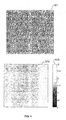
- Figure 7 illustrates adaptive scaling of an exemplary image of Japanese text.
- the size of the original image 701 is 512 by 512 pixels.
- the size of the scaled image 702 is 128 by 128 pixels.
- the black boxes 703 and 704 display the different possible choices for the scaled image size.
- the scaling is determined using a recognizable area of 35% and a significance threshold factor of 0.3.
- the scale selection algorithm set forth above may choose different scales for different images.
- the image 601 of the woman is, according to one embodiment, down-sampled by a factor of 2 3 times, while the image 701 of Japanese text is, according to one embodiment, down-sampled by a factor of 2 2 .
- the differences in the scales arises because the Japanese text image 701 has important components (reflected as higher entropy) in the higher frequency bands relative to the image 601of the woman.
- the labeling of a codeblock as significant or insignificant can be also performed by modeling the entropy of all the codeblocks in one resolution level as a mixture of two probability distributions, e.g., two Gaussian distribution with different mean ⁇ 1 and ⁇ 2 , and different standard deviations, ⁇ 1 and ⁇ 2 . From the entropy values smaller than the significance threshold, the parameters ⁇ 1 , and ⁇ 1 are estimated. Given those two pdfs f 1 and f 2 , the probability of an entropy value x belonging to f l is estimated.
- This method is a standard procedure as explained, e.g., Duda, Hart, Stork, Pattern Classification (2nd ed.), Wiley, New York, NY 2000 .
- the probability distribution of the codeblocks at each resolution is then fed into a multiscale segmentation algorithm as described above.
- an image is constrained to be represented within a fixed size in pixels. Under such constraints, it is desirable to choose the "best" representation of the image that satisfies the given size constraints. Since entropy is a good measure for visual information, an image representation is obtained that encompasses the maximum entropy, while still satisfying the size constraints.
- the weighted cumulative entropy B ⁇ j pixel from equation (6) is used as an input to a maximization algorithm for determination of the best scale (or resolution level) of an image convolved with a local indicator function.
- ⁇ j (a,b) The size of ⁇ j (a,b) is the same at all scale. (In order to deal with images that are centered, as well as to incorporate the natural human tendency, a heuristic that is not incorporated into most image coders, the ⁇ ( a,b ) are typically chosen such that the central portions of the image are weighed more than the entropies at the edges of the image.) For 512 x 512 images with 32x32 codeblock size, an example is given.
- Multiplying the cumulated weighted entropy at resolution j with mask 1 means weighting the entropy values linearly decreasing from 1 to 0.77 from the center towards the edges of the image at resolution j.
- the best representation of the image is then obtained by theoretically computing the image at resolution j* and cropping out of that low-resolution image a rectangle of size m x n located with the lower left corner at position (a*/2 j* ,b*/2 j* ).
- This procedure is practically done by decoding only the codeblocks of the JPEG 2000 codestream that contribute to that cropped part of the j* -reduced resolution image and performing an inverse transform on those data to create actually cropped image.
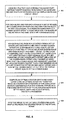
- Figure 8 is a flow diagram of one embodiment of a process for automatically scaling and cropping an image.
- the process is performed by processing logic that may comprise hardware (e.g., circuitry, dedicated logic, etc.), software (such as is run on a general purpose computer system or a dedicated machine), or a combination of both.
- processing logic may comprise hardware (e.g., circuitry, dedicated logic, etc.), software (such as is run on a general purpose computer system or a dedicated machine), or a combination of both.
- a file that contains a header that contains multi-scale entropy distribution information on blocks of an image is received, along with a shape constraint, such as display width and display height.
- the file represents an image in JPEG 2000 format.
- a cumulative entropy distribution for the block at that scale is set equal to a weighted summation of a number of bits spent to code the block for scales at and between the first scale and a maximum scale.
- an indicator function of the block at the chosen scale and chosen width and height offset is set to one upon determining that a width location of the block is not greater than a first minimum value of a set consisting of the chosen width offset and a sum of the chosen width offset with the display width scaled by the chosen scale, and the height location of the block is not greater than a first minimum value of a set consisting of the chosen height offset and a sum of the chosen height offset with the display height scaled by the chosen scale. Otherwise, the indicator function is set to zero otherwise.
- the first minimum value is a minimum value of a set consisting of a width of the image and a sum of the width of the block plus one plus a desired height scaled by the first scale.
- the second minimum value is a minimum value of a set consisting of a height of the image and a sum of the height of the block plus one plus a desired width scaled by the first scale.
- an optimal location (width and height offset) and an optimal scale are computed that together maximize a summation consisting of the cumulative entropy distribution for the block, multiplied by the indicator function of the block (characterized by the scale, width and height offset) and with a parameter.
- the image is cropped to the optimal location and the resulting cropped image is down-sampled to the optimal scale.
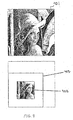
- Figure 9 illustrates automatic scaling and cropping of an exemplary image of a woman according to one embodiment.
- the size of the original image 901 is 512 by 512 pixels.
- the maximum size of the representation 902 is constrained to be 192 by 192 pixels.
- the process selects the important face region of the woman, and then scales it down by a factor of two.
- the fixed size representation 902 does not contain the unimportant background regions.
- the black box 903 displays the region with respect to the original image that is being considered in the representation.
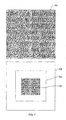
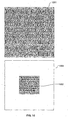
- Figure 10 illustrates automatic scaling and cropping of an exemplary image of japanese text.
- the size of the original image 1001 is 512 by 512 pixels.
- the maximum size of the representation 1002 is constrained to be 192 by 192 pixels.
- the algorithm's best 192 by 192 pixel representation 1002 for the japanese text image 1001 is simply the whole image 1001 scaled down appropriately.
- the black box 1003 displays the region with respect to the original image that is being considered in the representation.
- the whole Japanese text image 1001 is scaled down to obtain the representation 1002.
- Display space is often a constraint on any device. Under such circumstances, it is desirable to obtain a device dependent, meaningful, condensed representation of images.
- a variety of meaningful and condensed image representations can be provided.
- the display device characteristics set an upper and lower bound on the size of the image to be represented. Since the automatic scaling process set forth above suggests a scale which ensures that most of the image information is still retained in the scaled down image, a scale can be chosen between the bounds dictated by the display device that is closest to the suggested scale.
- the size (e.g., in pixels) available to represent an image is fixed. In such a case, it is desirable to find the best representation of the image that can be accommodated with in the available pixels.
- the automatic region selection and scaling technique set forth above can provide the best fixed-size representation of the image, by exploiting the multi-scale entropy distribution.
- the parameters in the process can be chosen to tune the representation to specific display devices.
- One approach to compressing digital video sequences is to compress each video frame independently using a mttlti-resolution image coder.
- the Motion JPEG 2000 standard uses multi-scale transform-based compression on each video frame independently. Since our proposed algorithms can effectively process these frames, the aforementioned processing can be applied to Motion JPEG 2000 as well. For example, by setting the segmentation process parameters such as ⁇ and ⁇ j,k appropriately, "active" regions, such as people from the background in a single video frame, can be identified. This can be utilized to allocate more bits to the active regions in the next frame, so that the people can be better identified if required. Significant changes in the entropy allocation with time across frames can also be exploited to detect motion in the video. This may have special applications in surveillance cameras.
- An aim of image classification is to automatically sort through an image database, and group images of similar types such as natural images, portraits, documents, uniform textures, etc. Segmentation maps obtained by processing the multi-scale entropy distributions can be an exploited as a feature to perform broad classifications. The classification can be fine-tuned later using more intensive and specialized processing.
- An aim of image retrieval is to identify images that are similar to some template image. Since good image retrieval algorithms are intensive and require the actual image to perform, their analysis, header-based segmentation maps can be exploited to reduce the number of images that need to be decoded and fed to the specialized image-retrieval algorithms.
- the segmentation process set forth above can be used to provide an approximate segmentation that splits the image into regions containing coarse scale features and regions containing fine scale features.
- the segmentation algorithm can approximately distinguish the text regions from the images.
- the approximate segmentation can be input to a more intensive pattern analysis algorithm such as optical character recognition ("OCR”) for further analysis.
- OCR optical character recognition
- GUI graphical user interface
- a multi-scale probability distribution such as the MAP cost function ⁇ (B ⁇ pixel ,S m ) from Equation (6) or the result of a monotonic transformation such as log ⁇ (B ⁇ pixel , S m ) is used as an input to a technique for fitting rectangles.
- the goal is to find at each level j the rectangle whose probabilities are most similar to the probability at a larger level j*. That means the content inside the rectangle has most likely meaningful content at all scales m, j ⁇ m ⁇ j*. Its corresponding image part is therefore likely to be well represented at resolution j.
- Once the rectangle is found the locations of entries covered by the rectangle are marked as already counted' while the corresponding probability values are penalized by adding a large value (e.g., 10).
- the rectangle and level is chosen that yields the minimal difference in probabilities to the rectangle at level j*.
- the position and size of the rectangle as well as the associated level is saved in a list.
- the procedure is applied again to the penalized probabilistic distribution function (pdf) unit all codeblock locations of the image labeled as "already counted".
- the information in the final list represents a rectangular multiscale partition of the image.
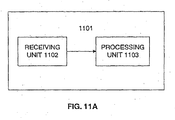
- Figure 11A is a schematic diagram of an apparatus to segment an image, to adaptively scale an image, or to automatically scale and crop an image.
- the apparatus 1101 comprises a receiving unit 1102 to receive a file that contains a header that contains multi-scale entropy distribution information on blocks of an image.
- the file represents an image in JPEG 2000 format.
- the apparatus 1101 further comprises a processing unit 1103 coupled with the receiving unit 1102.
- the processing unit 1103 is to, for each block, assign to the block a scale from a set of scales that maximizes a cost function.
- the cost function is a product of a total likelihood and a prior.
- the total likelihood is a product of likelihoods of the blocks.
- each likelihood of a block is proportional to a summation, for each scale in the set of scales, of a product of a weight of the scale and a number of bits spent to code the block at the scale.
- the number of bits spent to code the block at the scale is a numerator divided by a denominator.
- the numerator is an entropy distribution of a multi-scale coefficient of the block at the scale.
- the denominator is four raised to the power of the scale.
- processing 1103 groups together blocks that have been assigned equivalent scales to segment the image.
- processing unit 1103, for each block determines that the block retains significance at a scale upon determining that an entropy of a multi-scale coefficient of a block at the scale is greater than a mean entropy of multi-scale coefficients of blocks in at least one coarser scale.
- the mean entropy is a mean bit distribution multiplied by a threshold parameter.
- processing unit 1103 further scales the image to a coarsest scale at which a threshold percentage (e.g., 35% as described above as the threshold parameter P* of the blocks retain significance at the scale.
- a threshold percentage e.g., 35% as described above as the threshold parameter P* of the blocks retain significance at the scale.
- Processing unit 1103 may, for each block and for each first scale of a set of scales, set a cumulative entropy distribution for the block at the first scale equal to a summation of a number of bits spent to code the block for scales at and between the first scale and a maximum scale.
- Processing unit 1103 may, for each block and for each first scale of a set of scales, set an indicator function of the block and the first scale to one upon determining that a width of the block is not greater than a first minimum value and a height of the block is not greater than a second minimum value and to zero otherwise.
- the first minimum value and second minimum values are the same as described in Figure 8.
- processing unit 1103 further computes an optimal location and an optimal scale that together maximize a summation, for each block in the optimal location at the optimal scale, of the cumulative entropy distribution for the block at the optimal scale, multiplied by the indicator function of the block and the optimal scale, multiplied by a parameter (e.g., ⁇ described above).
- a parameter e.g., ⁇ described above.
- processing unit 1103 crops the image to the optimal location and down-sample a resulting cropped image to the optimal scale.
- Figure 11B is block diagram of one embodiment of a codestream processor for use in an image processing system.
- codestream 1121 is received by header extractor 1122 that extracts header information.
- Segmentation unit 1123 performs segmentation on the codestream using the extracted header information from header extractor 1122.
- segmentation unit 1123 determines which codeblocks of codestream 1121 to decode and signals decoder 1124.
- Decoder 1124 decodes codeblocks necessary for the segmented image portion (e.g., a region at a specified resolution.)
- header-based processing is demonstrated in the example of creating a good 128x128 thumbnail representation of 1024x1024 image.
- An image analysis process described herein is the one for automatic cropping and scaling as described above.
- the complexity of processed data compared to traditional image processing of a JPEG 2000 image and a raster image is listed in Table 3.
- the advantage over an image in JPEG 2000 form is that only 1/1000 of the data must be used by the segmentation algorithm and less than 1/2 of data must be decoded.
- Table 3-Quantitative example of header-based processing Multiscale forward wavelet transform Amount of data processed by segmentation algorithm Amount of decoding Raster image 1024 x 102.4. 1024 x 1024 - JPEG 2000 - 1024 x 1024 1024 x 1024 JPEG 2000 (header processing) - 32 x 32 (0.001% of above) -33% of above
- FIG. 12 is a block diagram of an exemplary computer system that may perform one or more of the operations described herein.
- computer system 1200 may comprise an exemplary client 1250 or server 1200 computer system.
- Computer system 1200 comprises a communication mechanism or bus 1211 for communicating information, and a processor 1212 coupled with bus 1211 for processing information.
- Processor 1212 includes a microprocessor, but is not limited to a microprocessor, such as, for example, Pentium TM , PowerPC TM , etc.
- System 1200 further comprises a random access memory (RAM), or other dynamic storage device 1204 (referred to as main memory) coupled to bus 1211 for storing information and instructions to be executed by processor 1212.
- main memory 1204 also may be used for storing temporary variables or other intermediate information during execution of instructions by processor 1212.
- Computer system 1200 also comprises a read only memory (ROM) and/or other static storage device 1206 coupled to bus 1211 for storing static information and instructions for processor 1212, and a data storage device 1207, such as a magnetic disk or optical disk and its corresponding disk drive.
- ROM read only memory
- Data storage device 1207 is coupled to bus 1211 for storing information and instructions.
- Computer system 1200 may further be coupled to a display device 1221, such as a cathode ray tube (CR1) or liquid crystal display (LCD), coupled to bus 1211 for displaying information to a computer user.
- a display device 1221 such as a cathode ray tube (CR1) or liquid crystal display (LCD)
- An alphanumeric input device 1222 may also be coupled to bus 1211 for communicating information and command selections to processor 1212.
- cursor control 1223 such as a mouse, trackball, trackpad, stylus, or cursor direction keys, coupled to bus 1211 for communicating direction information and command selections to processor 1212, and for controlling cursor movement on display 1221.
- bus 1211 Another device that may be coupled to bus 1211 is hard copy device 1224, which may be used for printing instructions, data, or other information on a medium such as paper, film, or similar types of media. Furthermore, a sound recording and playback device, such as a speaker and/or microphone may optionally be coupled to bus 1211 for audio interfacing with computer system 1200. Another device that may be coupled to bus 1211 is a wired/wireless communication capability 1225 to communication to a phone or handheld palm device.
Landscapes
- Engineering & Computer Science (AREA)
- Multimedia (AREA)
- Signal Processing (AREA)
- Physics & Mathematics (AREA)
- General Physics & Mathematics (AREA)
- Theoretical Computer Science (AREA)
- Computer Vision & Pattern Recognition (AREA)
- Compression Of Band Width Or Redundancy In Fax (AREA)
- Compression Or Coding Systems Of Tv Signals (AREA)
- Image Processing (AREA)
Applications Claiming Priority (2)
| Application Number | Priority Date | Filing Date | Title |
|---|---|---|---|
| US10/044,420 US7428338B2 (en) | 2002-01-10 | 2002-01-10 | Header-based processing of images compressed using multi-scale transforms |
| EP03000510A EP1329847B1 (de) | 2002-01-10 | 2003-01-09 | Header-basierte Verarbeitung von mittels Multiskalentransformation komprimierter Bilder |
Related Parent Applications (1)
| Application Number | Title | Priority Date | Filing Date |
|---|---|---|---|
| EP03000510A Division EP1329847B1 (de) | 2002-01-10 | 2003-01-09 | Header-basierte Verarbeitung von mittels Multiskalentransformation komprimierter Bilder |
Publications (3)
| Publication Number | Publication Date |
|---|---|
| EP1814077A2 true EP1814077A2 (de) | 2007-08-01 |
| EP1814077A3 EP1814077A3 (de) | 2007-08-08 |
| EP1814077B1 EP1814077B1 (de) | 2009-12-02 |
Family
ID=21932291
Family Applications (2)
| Application Number | Title | Priority Date | Filing Date |
|---|---|---|---|
| EP03000510A Expired - Lifetime EP1329847B1 (de) | 2002-01-10 | 2003-01-09 | Header-basierte Verarbeitung von mittels Multiskalentransformation komprimierter Bilder |
| EP07106420A Expired - Lifetime EP1814077B1 (de) | 2002-01-10 | 2003-01-09 | Header-basierte Verarbeitung komprimierter Bilder unter Verwendung von Multi-Skalen Tranformationen |
Family Applications Before (1)
| Application Number | Title | Priority Date | Filing Date |
|---|---|---|---|
| EP03000510A Expired - Lifetime EP1329847B1 (de) | 2002-01-10 | 2003-01-09 | Header-basierte Verarbeitung von mittels Multiskalentransformation komprimierter Bilder |
Country Status (4)
| Country | Link |
|---|---|
| US (4) | US7428338B2 (de) |
| EP (2) | EP1329847B1 (de) |
| JP (2) | JP3989362B2 (de) |
| DE (2) | DE60330409D1 (de) |
Cited By (2)
| Publication number | Priority date | Publication date | Assignee | Title |
|---|---|---|---|---|
| GB2505169A (en) * | 2012-08-13 | 2014-02-26 | Gurulogic Microsystems Oy | Decoding data based on header information |
| US10412414B2 (en) | 2012-08-13 | 2019-09-10 | Gurulogic Microsystems Oy | Decoder and method for decoding encoded input data containing a plurality of blocks or packets |
Families Citing this family (43)
| Publication number | Priority date | Publication date | Assignee | Title |
|---|---|---|---|---|
| US20030233619A1 (en) * | 2002-05-30 | 2003-12-18 | Fast Bruce Brian | Process for locating data fields on electronic images of complex-structured forms or documents |
| KR100453517B1 (ko) * | 2002-05-31 | 2004-10-20 | 주식회사 이노티브 | 인터넷을 통한 대용량 고품질 디지털 이미지의 실시간서비스 방법 |
| FR2848765B1 (fr) * | 2002-12-11 | 2005-04-29 | Canon Kk | Procede et dispositif de determination d'une configuration de donnees d'un signal numerique d'image |
| JP2005123856A (ja) * | 2003-10-16 | 2005-05-12 | Ricoh Co Ltd | 画像処理システム、画像処理方法、プログラム及び情報記録媒体 |
| US7912291B2 (en) * | 2003-11-10 | 2011-03-22 | Ricoh Co., Ltd | Features for retrieval and similarity matching of documents from the JPEG 2000-compressed domain |
| CN1305008C (zh) * | 2003-12-22 | 2007-03-14 | 中国科学院自动化研究所 | 弥散张量核磁成像脑缺血病灶区的自动分割方法 |
| US20090142039A1 (en) * | 2003-12-26 | 2009-06-04 | Humax Co., Ltd. | Method and apparatus for recording video data |
| JP4111926B2 (ja) | 2004-03-09 | 2008-07-02 | 株式会社リコー | 画像処理装置、プログラム、記憶媒体及び画像送信方法 |
| JP4594688B2 (ja) * | 2004-06-29 | 2010-12-08 | オリンパス株式会社 | 画像符号化処理方法、画像復号化処理方法、動画圧縮処理方法、動画伸張処理方法、画像符号化処理プログラム、画像符号化装置、画像復号化装置、画像符号化/復号化システム、拡張画像圧縮伸張処理システム |
| FI117845B (fi) | 2004-08-12 | 2007-03-15 | Gurulogic Microsystems Oy | Videokuvan prosessointi |
| US9232228B2 (en) | 2004-08-12 | 2016-01-05 | Gurulogic Microsystems Oy | Processing of image |
| US9509991B2 (en) | 2004-08-12 | 2016-11-29 | Gurulogic Microsystems Oy | Processing and reproduction of frames |
| KR20070056059A (ko) * | 2004-08-31 | 2007-05-31 | 마쯔시다덴기산교 가부시키가이샤 | 동화상 부호화 방법 및 장치 |
| US7650031B2 (en) * | 2004-11-23 | 2010-01-19 | Microsoft Corporation | Method and system for detecting black frames in a sequence of frames |
| JP4301193B2 (ja) * | 2005-03-31 | 2009-07-22 | ソニー株式会社 | 画像比較装置及び方法、画像検索装置及び方法、並びにプログラム及び記録媒体 |
| US8169547B2 (en) * | 2005-08-09 | 2012-05-01 | Gurulogic Microsystems Oy | Processing of video image |
| US8665284B2 (en) * | 2005-11-17 | 2014-03-04 | Xerox Corporation | Fragmenting image files systems and methods |
| WO2007077520A2 (en) * | 2006-01-03 | 2007-07-12 | Ati Technologies, Inc. | Image analyser and adaptive image scaling circuit and methods |
| US7761789B2 (en) | 2006-01-13 | 2010-07-20 | Ricoh Company, Ltd. | Methods for computing a navigation path |
| US7912468B2 (en) * | 2006-02-24 | 2011-03-22 | Broadcom Corporation | Multi-communication pathway addressing in a mobile communication device |
| US8081827B2 (en) * | 2006-02-28 | 2011-12-20 | Ricoh Co., Ltd. | Compressed data image object feature extraction, ordering, and delivery |
| US8018472B2 (en) * | 2006-06-08 | 2011-09-13 | Qualcomm Incorporated | Blending multiple display layers |
| US8812969B2 (en) * | 2007-03-21 | 2014-08-19 | Ricoh Co., Ltd. | Methods for authoring and interacting with multimedia representations of documents |
| US8584042B2 (en) | 2007-03-21 | 2013-11-12 | Ricoh Co., Ltd. | Methods for scanning, printing, and copying multimedia thumbnails |
| US8583637B2 (en) * | 2007-03-21 | 2013-11-12 | Ricoh Co., Ltd. | Coarse-to-fine navigation through paginated documents retrieved by a text search engine |
| JP4441558B2 (ja) * | 2007-09-19 | 2010-03-31 | キヤノン株式会社 | 画像処理装置及び画像処理方法ならびにプログラム |
| US20100128181A1 (en) * | 2008-11-25 | 2010-05-27 | Advanced Micro Devices, Inc. | Seam Based Scaling of Video Content |
| US9705888B2 (en) | 2009-03-31 | 2017-07-11 | Amazon Technologies, Inc. | Managing security groups for data instances |
| DE102009017436B4 (de) * | 2009-04-15 | 2011-12-29 | Fraunhofer-Gesellschaft zur Förderung der angewandten Forschung e.V. | Erkennung einer Änderung zwischen Bildern oder in einer Sequenz von Bildern |
| JP5686611B2 (ja) * | 2011-01-14 | 2015-03-18 | 株式会社ソニー・コンピュータエンタテインメント | 情報処理装置 |
| JP5927829B2 (ja) * | 2011-02-15 | 2016-06-01 | 株式会社リコー | 印刷用データ作成装置、印刷用データ作成方法、プログラム及び記録媒体 |
| PH12013501696A1 (en) * | 2011-08-11 | 2013-10-07 | Sun Patent Trust | Image coding method, image decoding method, image coding apparatus, image decoding apparatus, and image coding and decoding apparatus |
| EP2680219A1 (de) * | 2012-06-29 | 2014-01-01 | Thomson Licensing | Verfahren zum Reframing von Bildern einer Videosequenz sowie Vorrichtung zum Reframing von Bildern einer Videosequenz |
| CN103279957B (zh) * | 2013-05-31 | 2015-11-25 | 北京师范大学 | 一种基于多尺度特征融合的遥感图像感兴趣区域提取方法 |
| CN106233725B (zh) * | 2014-03-31 | 2019-08-02 | 英迪股份有限公司 | 用于对图像进行解码的装置及其方法 |
| CN105427307B (zh) * | 2015-11-20 | 2018-10-30 | 信阳师范学院 | 一种立方体粒计算的图像分割方法 |
| US9930354B2 (en) | 2015-12-11 | 2018-03-27 | Google Llc | Skip scanlines on JPEG image decodes |
| US11829703B2 (en) * | 2018-01-09 | 2023-11-28 | Adobe Inc. | Parallel object analysis for efficiently generating layouts in digital design documents |
| JP6943343B2 (ja) * | 2018-09-04 | 2021-09-29 | 日本電気株式会社 | 流体漏洩診断装置、流体漏洩診断システム、流体漏洩診断方法、及び、流体漏洩診断プログラム |
| CN109670576B (zh) * | 2018-11-29 | 2022-09-13 | 中山大学 | 一种多尺度视觉关注图像描述方法 |
| US20210303763A1 (en) * | 2020-03-26 | 2021-09-30 | Mappedin Inc. | Systems and methods for geometry simplification and filtering |
| CN111597981B (zh) * | 2020-05-14 | 2022-05-27 | 中南大学 | 基于改进多尺度散布熵的大地电磁信号去噪方法及系统 |
| CN117036832B (zh) * | 2023-10-09 | 2024-01-05 | 之江实验室 | 一种基于随机多尺度分块的图像分类方法、装置及介质 |
Citations (1)
| Publication number | Priority date | Publication date | Assignee | Title |
|---|---|---|---|---|
| EP0833519A2 (de) | 1996-09-26 | 1998-04-01 | Xerox Corporation | Segmentierung und Hintergrundunterdrückung in JPEG-komprimierten Bildern mit Anwendung von Kodierungskostendaten |
Family Cites Families (12)
| Publication number | Priority date | Publication date | Assignee | Title |
|---|---|---|---|---|
| US5563960A (en) * | 1993-01-22 | 1996-10-08 | David Sarnoff Research Center, Inc. | Apparatus and method for emphasizing a selected region in the compressed representation of an image |
| JP3732867B2 (ja) | 1995-03-09 | 2006-01-11 | 株式会社ルネサステクノロジ | 画像伸張装置 |
| US5999639A (en) * | 1997-09-04 | 1999-12-07 | Qualia Computing, Inc. | Method and system for automated detection of clustered microcalcifications from digital mammograms |
| SE521021C2 (sv) | 1998-06-18 | 2003-09-23 | Ericsson Telefon Ab L M | Förfarande och anordning vid överförande av bilder |
| HK1039823B (zh) | 1998-08-10 | 2006-08-18 | Etiip控股有限公司 | 数字静止图象编码方法、设备和压缩比特流解码方法 |
| US6775325B1 (en) * | 1998-10-07 | 2004-08-10 | Sarnoff Corporation | Method and apparatus for converting the bitrate of an encoded bitstream without full re-encoding |
| US6813384B1 (en) * | 1999-11-10 | 2004-11-02 | Intel Corporation | Indexing wavelet compressed video for efficient data handling |
| US6795577B2 (en) * | 1999-12-03 | 2004-09-21 | Canon Research Centre France S.A. | Digital signal analysis, with hierarchical segmentation |
| US6553150B1 (en) * | 2000-04-25 | 2003-04-22 | Hewlett-Packard Development Co., Lp | Image sequence compression featuring independently coded regions |
| JP2002064709A (ja) | 2000-06-06 | 2002-02-28 | Canon Inc | 画像処理装置及びその方法とそのコンピュータプログラム及び記憶媒体 |
| JP2002044663A (ja) * | 2000-07-24 | 2002-02-08 | Canon Inc | 画像符号化装置及び方法、画像表示装置及び方法、画像処理システム並びに撮像装置 |
| US6925126B2 (en) * | 2001-04-18 | 2005-08-02 | Koninklijke Philips Electronics N.V. | Dynamic complexity prediction and regulation of MPEG2 decoding in a media processor |
-
2002
- 2002-01-10 US US10/044,420 patent/US7428338B2/en not_active Expired - Fee Related
- 2002-11-20 JP JP2002336772A patent/JP3989362B2/ja not_active Expired - Fee Related
-
2003
- 2003-01-09 EP EP03000510A patent/EP1329847B1/de not_active Expired - Lifetime
- 2003-01-09 EP EP07106420A patent/EP1814077B1/de not_active Expired - Lifetime
- 2003-01-09 DE DE60330409T patent/DE60330409D1/de not_active Expired - Lifetime
- 2003-01-09 DE DE60314305T patent/DE60314305T2/de not_active Expired - Lifetime
-
2007
- 2007-02-13 JP JP2007032742A patent/JP4317230B2/ja not_active Expired - Fee Related
- 2007-04-17 US US11/787,993 patent/US7548654B2/en not_active Expired - Fee Related
- 2007-04-17 US US11/787,836 patent/US7536056B2/en not_active Expired - Fee Related
- 2007-04-17 US US11/787,835 patent/US8184918B2/en not_active Expired - Fee Related
Patent Citations (1)
| Publication number | Priority date | Publication date | Assignee | Title |
|---|---|---|---|---|
| EP0833519A2 (de) | 1996-09-26 | 1998-04-01 | Xerox Corporation | Segmentierung und Hintergrundunterdrückung in JPEG-komprimierten Bildern mit Anwendung von Kodierungskostendaten |
Non-Patent Citations (1)
| Title |
|---|
| A. JAIN: "Fundamentals of Digital Image Processing", 1995, PRENTICE HALL |
Cited By (4)
| Publication number | Priority date | Publication date | Assignee | Title |
|---|---|---|---|---|
| GB2505169A (en) * | 2012-08-13 | 2014-02-26 | Gurulogic Microsystems Oy | Decoding data based on header information |
| GB2505169B (en) * | 2012-08-13 | 2016-03-16 | Gurulogic Microsystems Oy | decoder and method |
| US9538239B2 (en) | 2012-08-13 | 2017-01-03 | Gurulogic Microsystems Oy | Decoder and method for decoding encoded input data containing a plurality of blocks or packets |
| US10412414B2 (en) | 2012-08-13 | 2019-09-10 | Gurulogic Microsystems Oy | Decoder and method for decoding encoded input data containing a plurality of blocks or packets |
Also Published As
| Publication number | Publication date |
|---|---|
| JP4317230B2 (ja) | 2009-08-19 |
| DE60330409D1 (de) | 2010-01-14 |
| US20080095452A1 (en) | 2008-04-24 |
| EP1329847B1 (de) | 2007-06-13 |
| DE60314305D1 (de) | 2007-07-26 |
| EP1814077B1 (de) | 2009-12-02 |
| JP3989362B2 (ja) | 2007-10-10 |
| EP1329847A1 (de) | 2003-07-23 |
| US7428338B2 (en) | 2008-09-23 |
| JP2003230012A (ja) | 2003-08-15 |
| US7548654B2 (en) | 2009-06-16 |
| US7536056B2 (en) | 2009-05-19 |
| US20090103818A1 (en) | 2009-04-23 |
| US20030165273A1 (en) | 2003-09-04 |
| DE60314305T2 (de) | 2008-02-21 |
| EP1814077A3 (de) | 2007-08-08 |
| JP2007181232A (ja) | 2007-07-12 |
| US8184918B2 (en) | 2012-05-22 |
| US20080044091A1 (en) | 2008-02-21 |
Similar Documents
| Publication | Publication Date | Title |
|---|---|---|
| EP1814077B1 (de) | Header-basierte Verarbeitung komprimierter Bilder unter Verwendung von Multi-Skalen Tranformationen | |
| EP1548616B1 (de) | Merkmale zum Abrufen und zur Ähnlichkeitsanpassung von komprimierten Dokumenten | |
| US6476805B1 (en) | Techniques for spatial displacement estimation and multi-resolution operations on light fields | |
| Skodras et al. | The JPEG 2000 still image compression standard | |
| EP1591963B1 (de) | Adaptive Quantisierung einer Tiefenkarte | |
| US6985632B2 (en) | Image processing system, image processing apparatus, and image processing method | |
| US7162095B2 (en) | Method of automatically determining the region of interest from an image | |
| EP2270718B1 (de) | Verfahren und Vorrichtung zur Verarbeitung von Bilddaten relevanter Bereiche | |
| US6895121B2 (en) | Method for utilizing subject content analysis for producing a compressed bit stream from a digital image | |
| EP1466483A1 (de) | Filterung von bild-schicht-daten bei der verarbeitung zusammengesetzter dokumente | |
| EP1821545A2 (de) | Videokodierungs- und -dekodierungsvorrichtung | |
| Penna et al. | A new low complexity KLT for lossy hyperspectral data compression | |
| EP0974932A2 (de) | Adaptive Videokomprimierung | |
| Tabesh et al. | JPEG2000 and motion JPEG2000 content analysis using codestream length information | |
| EP3151565B1 (de) | Verfahren zur auswertung der perzeptuellen visuellen qualität mit niedriger komplexität für komprimierte jpeg2000-ströme | |
| Villegas et al. | Feature preserving image compression: A survey | |
| Kountchev et al. | Compression of multispectral and multi-view images with inverse pyramid decomposition | |
| SATTAR | The medical image compression with embedded zerotree wavelet | |
| Zhang et al. | A combined-transform coding (CTC) scheme for image data compression | |
| Vij et al. | Entropy-coded pyramid vector quantisation for interband wavelet image coding | |
| Wickramanayake et al. | A wavelet based image quilting approach to fast, multiresolution texture synthesis |
Legal Events
| Date | Code | Title | Description |
|---|---|---|---|
| PUAI | Public reference made under article 153(3) epc to a published international application that has entered the european phase |
Free format text: ORIGINAL CODE: 0009012 |
|
| PUAL | Search report despatched |
Free format text: ORIGINAL CODE: 0009013 |
|
| 17P | Request for examination filed |
Effective date: 20070418 |
|
| AC | Divisional application: reference to earlier application |
Ref document number: 1329847 Country of ref document: EP Kind code of ref document: P |
|
| AK | Designated contracting states |
Kind code of ref document: A2 Designated state(s): DE FR GB NL |
|
| AK | Designated contracting states |
Kind code of ref document: A3 Designated state(s): DE FR GB NL |
|
| 17Q | First examination report despatched |
Effective date: 20080307 |
|
| AKX | Designation fees paid |
Designated state(s): DE FR GB NL |
|
| GRAP | Despatch of communication of intention to grant a patent |
Free format text: ORIGINAL CODE: EPIDOSNIGR1 |
|
| GRAS | Grant fee paid |
Free format text: ORIGINAL CODE: EPIDOSNIGR3 |
|
| GRAA | (expected) grant |
Free format text: ORIGINAL CODE: 0009210 |
|
| AC | Divisional application: reference to earlier application |
Ref document number: 1329847 Country of ref document: EP Kind code of ref document: P |
|
| AK | Designated contracting states |
Kind code of ref document: B1 Designated state(s): DE FR GB NL |
|
| REG | Reference to a national code |
Ref country code: GB Ref legal event code: FG4D |
|
| REF | Corresponds to: |
Ref document number: 60330409 Country of ref document: DE Date of ref document: 20100114 Kind code of ref document: P |
|
| REG | Reference to a national code |
Ref country code: NL Ref legal event code: VDEP Effective date: 20091202 |
|
| PG25 | Lapsed in a contracting state [announced via postgrant information from national office to epo] |
Ref country code: NL Free format text: LAPSE BECAUSE OF FAILURE TO SUBMIT A TRANSLATION OF THE DESCRIPTION OR TO PAY THE FEE WITHIN THE PRESCRIBED TIME-LIMIT Effective date: 20091202 |
|
| PLBE | No opposition filed within time limit |
Free format text: ORIGINAL CODE: 0009261 |
|
| STAA | Information on the status of an ep patent application or granted ep patent |
Free format text: STATUS: NO OPPOSITION FILED WITHIN TIME LIMIT |
|
| 26N | No opposition filed |
Effective date: 20100903 |
|
| PGFP | Annual fee paid to national office [announced via postgrant information from national office to epo] |
Ref country code: DE Payment date: 20140122 Year of fee payment: 12 |
|
| PGFP | Annual fee paid to national office [announced via postgrant information from national office to epo] |
Ref country code: FR Payment date: 20140123 Year of fee payment: 12 |
|
| PGFP | Annual fee paid to national office [announced via postgrant information from national office to epo] |
Ref country code: GB Payment date: 20140121 Year of fee payment: 12 |
|
| REG | Reference to a national code |
Ref country code: DE Ref legal event code: R119 Ref document number: 60330409 Country of ref document: DE |
|
| GBPC | Gb: european patent ceased through non-payment of renewal fee |
Effective date: 20150109 |
|
| PG25 | Lapsed in a contracting state [announced via postgrant information from national office to epo] |
Ref country code: GB Free format text: LAPSE BECAUSE OF NON-PAYMENT OF DUE FEES Effective date: 20150109 Ref country code: DE Free format text: LAPSE BECAUSE OF NON-PAYMENT OF DUE FEES Effective date: 20150801 |
|
| REG | Reference to a national code |
Ref country code: FR Ref legal event code: ST Effective date: 20150930 |
|
| PG25 | Lapsed in a contracting state [announced via postgrant information from national office to epo] |
Ref country code: FR Free format text: LAPSE BECAUSE OF NON-PAYMENT OF DUE FEES Effective date: 20150202 |