EP1814084A2 - Système et procédé pour établir automatiquement la zone de préférence pour filigrane d'image - Google Patents
Système et procédé pour établir automatiquement la zone de préférence pour filigrane d'image Download PDFInfo
- Publication number
- EP1814084A2 EP1814084A2 EP07101495A EP07101495A EP1814084A2 EP 1814084 A2 EP1814084 A2 EP 1814084A2 EP 07101495 A EP07101495 A EP 07101495A EP 07101495 A EP07101495 A EP 07101495A EP 1814084 A2 EP1814084 A2 EP 1814084A2
- Authority
- EP
- European Patent Office
- Prior art keywords
- image
- watermark
- areas
- target image
- determining
- Prior art date
- Legal status (The legal status is an assumption and is not a legal conclusion. Google has not performed a legal analysis and makes no representation as to the accuracy of the status listed.)
- Ceased
Links
Images



Classifications
-
- H—ELECTRICITY
- H04—ELECTRIC COMMUNICATION TECHNIQUE
- H04N—PICTORIAL COMMUNICATION, e.g. TELEVISION
- H04N1/00—Scanning, transmission or reproduction of documents or the like, e.g. facsimile transmission; Details thereof
- H04N1/32—Circuits or arrangements for control or supervision between transmitter and receiver or between image input and image output device, e.g. between a still-image camera and its memory or between a still-image camera and a printer device
- H04N1/32101—Display, printing, storage or transmission of additional information, e.g. ID code, date and time or title
- H04N1/32144—Display, printing, storage or transmission of additional information, e.g. ID code, date and time or title embedded in the image data, i.e. enclosed or integrated in the image, e.g. watermark, super-imposed logo or stamp
- H04N1/32149—Methods relating to embedding, encoding, decoding, detection or retrieval operations
- H04N1/32331—Fragile embedding or watermarking
-
- G—PHYSICS
- G06—COMPUTING OR CALCULATING; COUNTING
- G06T—IMAGE DATA PROCESSING OR GENERATION, IN GENERAL
- G06T1/00—General purpose image data processing
- G06T1/0021—Image watermarking
- G06T1/0028—Adaptive watermarking, e.g. Human Visual System [HVS]-based watermarking
-
- G—PHYSICS
- G06—COMPUTING OR CALCULATING; COUNTING
- G06T—IMAGE DATA PROCESSING OR GENERATION, IN GENERAL
- G06T7/00—Image analysis
- G06T7/70—Determining position or orientation of objects or cameras
- G06T7/73—Determining position or orientation of objects or cameras using feature-based methods
-
- H—ELECTRICITY
- H04—ELECTRIC COMMUNICATION TECHNIQUE
- H04N—PICTORIAL COMMUNICATION, e.g. TELEVISION
- H04N1/00—Scanning, transmission or reproduction of documents or the like, e.g. facsimile transmission; Details thereof
- H04N1/32—Circuits or arrangements for control or supervision between transmitter and receiver or between image input and image output device, e.g. between a still-image camera and its memory or between a still-image camera and a printer device
- H04N1/32101—Display, printing, storage or transmission of additional information, e.g. ID code, date and time or title
- H04N1/32144—Display, printing, storage or transmission of additional information, e.g. ID code, date and time or title embedded in the image data, i.e. enclosed or integrated in the image, e.g. watermark, super-imposed logo or stamp
- H04N1/32149—Methods relating to embedding, encoding, decoding, detection or retrieval operations
- H04N1/32154—Transform domain methods
- H04N1/32187—Transform domain methods with selective or adaptive application of the additional information, e.g. in selected frequency coefficients
-
- H—ELECTRICITY
- H04—ELECTRIC COMMUNICATION TECHNIQUE
- H04N—PICTORIAL COMMUNICATION, e.g. TELEVISION
- H04N1/00—Scanning, transmission or reproduction of documents or the like, e.g. facsimile transmission; Details thereof
- H04N1/32—Circuits or arrangements for control or supervision between transmitter and receiver or between image input and image output device, e.g. between a still-image camera and its memory or between a still-image camera and a printer device
- H04N1/32101—Display, printing, storage or transmission of additional information, e.g. ID code, date and time or title
- H04N1/32144—Display, printing, storage or transmission of additional information, e.g. ID code, date and time or title embedded in the image data, i.e. enclosed or integrated in the image, e.g. watermark, super-imposed logo or stamp
- H04N1/32149—Methods relating to embedding, encoding, decoding, detection or retrieval operations
- H04N1/3232—Robust embedding or watermarking
- H04N1/32325—Robust embedding or watermarking the embedded data being visible
-
- G—PHYSICS
- G06—COMPUTING OR CALCULATING; COUNTING
- G06T—IMAGE DATA PROCESSING OR GENERATION, IN GENERAL
- G06T2201/00—General purpose image data processing
- G06T2201/005—Image watermarking
- G06T2201/0051—Embedding of the watermark in the spatial domain
-
- G—PHYSICS
- G06—COMPUTING OR CALCULATING; COUNTING
- G06T—IMAGE DATA PROCESSING OR GENERATION, IN GENERAL
- G06T2201/00—General purpose image data processing
- G06T2201/005—Image watermarking
- G06T2201/0061—Embedding of the watermark in each block of the image, e.g. segmented watermarking
Definitions
- Disclosed is a system and method for determining preferred image locations for placing watermark information for both hidden and obvious marks, and more particularly the use of at least one of three criteria (image similarity, contrast, and image value range) to determine the best area of hiding or showing the watermark, depending upon the user's intent for the mark.
- three criteria image similarity, contrast, and image value range
- the digital watermarks can be created either in a spatial domain or in a transform domain.
- transform domain digital watermarking the digital string is embedded using a transformation space, such as Fourier transform or the like, to obtain a spread spectrum characteristic of noise insensitivity.
- the digital watermark is not an image and can not be simply reconstructed or verified optically, though the actually encoded digital watermark data can be arbitrary, thus also an image in some other transform domain.
- An example of spatial domain digital watermarking is found in U.S. Patent 6,252,971 to S. Wang, for "DIGITAL WATERMARKING USING PHASE-SHIFTED STOCLUSTIC SCREENS,” issued June 26, 2001, where the watermark can be reconstructed as image directly in the space domain.
- Classical watermarks are image-wise watermarks, meaning that they can be viewed by a user, normally to verify authenticity, but often only to establish a perception of value or beauty.
- Image-wise digital watermarks exist in the form of glossmarks, correlation marks and embedded image watermarks as described, for example in U.S. Patent Application No. 11/034,131 (above), as well as U.S. Patent Application No. 10/876,001 ( U.S. Publ. 20050128524 A1 ).
- variable watermarks are more closely resemble classical watermarks, albeit with the added capability of variable content.
- This variable content also directly interacts with the background image and a truly automated use of variable watermarks requires the correct positioning (or identification of the watermark location) based on the watermark content and the image content.
- the "best" or preferred position at which such a mark should be reproduced in the image is strongly dependent upon the nature of the mark as well as the image - where simply repositioning the mark within an image may significantly alter the detectability (desired/undesired) of a mark.
- U.S. Patent 6,956,958 describes a method of enhancing color fidelity in multi-reproduction that includes an encoding part, which usually resides in a printer (or the printing part of a copier, but may also be resident in software stored in a computer) and a decoding part which usually resides in a scanner (or the scanning part of a copier, but may also be resident in software stored in a computer) so as to add color fidelity information directly to the output print.
- Each part can be divided into layers where the top layers are responsible for management of color information while the bottom layers are responsible for embedding/detection of digital watermarks containing the color information.
- the present disclosure is directed to a system and a method for determining preferred image locations for placing watermark information for both hidden and obvious marks.
- Preferred locations provide either a high degree of hiding or visibility depending on the goal.
- At least three metrics may be employed in making a determination of a preferred position of a watermark, including (i) image value, (ii) image/watermark value similarity, and (iii) image/watermark contrast similarity.
- Disclosed in embodiments herein is a method for determining a location for an image-wise watermark in relation to a target image, comprising: analyzing the target image by dividing the target image into a plurality of smaller areas and determining a characteristic metric for the areas thereof; and determining, based upon the characteristic metric, at least one location for the watermark image to be overlaid onto the target image.
- a print production system for determining a location for an image-wise watermark in relation to a target image, comprising: a processor for analyzing the target image by dividing the target image into a plurality of smaller areas and determining a characteristic metric for the areas thereof; memory for recording the characteristic metric data for each of the areas analyzed by the processor; said processor further determining, based upon the characteristic metric, at least one location for a watermark image to be overlaid onto the target image, and overlaying said watermark image on the target image in the at least one location; and a printing engine for receiving the target image with the overlaid watermark image and rendering the image on a substrate.
- the target image is a variable data image and where determining a location for an image-wise watermark occurs on a document-by-document basis.
- a method for printing variable data with a watermark comprising: receiving a target image into which an image-wise watermark is to be embedded; receiving a watermark image; analyzing the target image by dividing the target image into a plurality of smaller areas and determining a characteristic metric for the areas thereof; analyzing the watermark image by dividing the watermark image into a plurality of smaller areas and determining a characteristic metric for the areas thereof; and determining, based upon at least one of the characteristic metrics, at least one location for the watermark image to be overlaid onto the target image.
- the characteristic metric is image similarity between the target image and the watermark image.
- the method further comprises determining image similarity as a function of a variance between average gray levels for the areas of the target image and the watermark image.
- the characteristic metric is image contrast.
- the method further comprises determining image contrast as a function of a difference between contrast levels for the areas of the target image and the watermark image.
- the characteristic metric is image value range.
- the method further comprises determining image value range as a function of the range of image data within areas of the target image.
- the method further comprises receiving variable data for the watermark image and generating a watermark image incorporating the variable data.
- the method further comprises receiving variable data for the target image and generating a target image incorporating the variable data.
- the method further comprises determining the at least one location for the watermark image as a function of a plurality of characteristic metrics.
- FIG. 1 is a schematic illustration of a system and method for carrying out an embodiment of the invention
- FIG. 2 is an illustrative example of a target image in accordance with an aspect of the disclosed embodiments
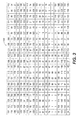
- FIG. 3 is an illustrative example of the data derived from an analysis of areas of FIG. 2;
- FIG. 4 is an illustrative example of a watermark image in accordance with an aspect of the disclosed embodiments
- FIG. 5 is an illustrative example of the data derived from an analysis of areas of FIG. 4;
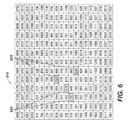
- FIG. 6 is an illustrative example of the data array calculated from a characteristic metric relating to the data of FIGS. 3 and 5 in accordance with one embodiment
- FIG. 7 is an illustrative example of another target image in accordance with an aspect of the disclosed embodiments.
- FIG. 8 is an illustrative example of the data derived from an analysis of areas of FIG. 7;
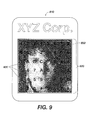
- FIG. 9 is an exemplary output illustrating an aspect of the disclosed embodiments.
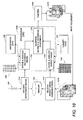
- FIG. 10 is an alternative schematic illustration a variable data system and method for carrying out an embodiment of the invention.
- the watermark In the case of image-wise watermarking, two possible applications / intentions can be considered as the extreme cases, and all intermediate cases can be derived from two end points established by the extreme cases.
- the watermark In the first case, the watermark is intended to be as unobtrusive as possible, and in the second case, the watermark is intended to be clearly visible.
- An example of the first scenario is where the image-wise watermark is intended to be completely hidden.
- An example of the second scenario is a variable data glossmark storing, for example a serial number, on a photo.
- the "best" area for embedding a watermark can generally be found following a combination of one or more of three criteria: (i) image/watermark value similarity; (ii) image/watermark contrast similarity; and (iii) image value range.
- the use of the criteria may be independent of one another, or two or more criteria may be combined using a weighted average or similar approach so as to optimize the placement of the watermark in order to achieve a desired objective of the watermark (e.g., maximize or minimize visibility).
- the image/watermark value similarity criteria if the target image and the watermark image information are similar, the watermark will be more subtle or less detectable. On the other hand, if they are dissimilar, the watermark will be more obvious or apparent. As for the image/watermark contrast similarity, if the contrast of the target image is high, watermark contrast will be lost, and vice versa. Lastly, for the image value range criteria, since all watermarks are created by modulating the input image, sufficient image data must be present locally to serve as an information carrier (to carry the overlaid watermark image).
- the image value similarity criteria computes a gray-level based variance (if the absolute brightness of the watermark is not fixed, the calculation can be done bias independent).
- the input or target image 110 is first received or retrieved from a storage medium or memory 114 as indicated by operation 120.
- An example of a target image is shown in FIG. 2
- the target image is divided into or reduced to a small set of image areas 124, for example about 20 x 20 areas, as represented by operation 128.
- the average gray level of the target image areas is computed and stored as target data 132.
- the watermark image 140 having been received and/or stored in memory, operation 144, is also reduced in size to a substantially smaller number of areas, say 4 x 4, as depicted at 154.
- the divided watermark image is characterized as indicated by reference numeral 150, and the associated characteristic metric data indicated as 158.
- An example of a watermark image is depicted in FIG. 4
- FIG. 2 shows an example target image and FIG. 3 the corresponding area entries indicating the average intensity values for each of the 20 x 20 image areas.
- the array 132 of average intensity data depicted in FIG. 5 is an example of the data that is described above as being derived from the target image. It should be noted that the number of areas (e.g., 20 x 20) is chosen somewhat arbitrarily and that equivalent calculations can also be performed on various array sizes. It is also the case that equivalent calculations can be performed for color images and color image data by, for example, looking at the luminance for scalar data or by looking at the color for vector computations.
- the method of determining an optimal location of the watermark is completed by the comparison described above relative to the examples, where the resultant array of FIG. 6 (divided image areas 620 ) are identified at operation 170, and the watermark is then overlaid or embedded into the target image at those locations, producing the watermarked digital image 174.
- a similar processing can be performed for the contrast criteria at operations 128 and 170 if FIG. 1.
- a second embodiment of the method is to use an automatic image enhancement (AIE) based contrast calculation.
- AIE automatic image enhancement
- Such a characteristic metric may be established by following the method outlined in U.S. Patent 5,450,502 for a "IMAGE DEPENDENT LUMINANCE ENHANCEMENT,” by R. Eschbach et al. issued September 12, 1995, and hereby incorporated by reference in its entirety.
- the watermark it can be assumed that the watermark is best located in image regions of low contrast. This can be done by separating the image into a number of regions. For simplicity, assume non-overlapping regions, though overlapping and multi-scale regions are understood variations of the described approach.
- FIG. 7 shows a target image and the array 810 in FIG. 8 gives the corresponding overlay areas for 10 x 10 areas of the target image, assuming a fixed threshold in the contrast variance metric.
- the "best" overlay areas are those with the least image contrast (indicated by an "X" in array 810 ), since the image contrast will act as localized noise with respect to the watermark. It will, however, be appreciated that this applies in the case where it is desirable to view the watermark - for example a visible watermark overlay using a glossmark. In the opposite case, where desirable to hide the watermark, it may be preferable to place the watermark in areas having greater image contrast.
- an optimal watermark location involves the image value range characteristic as noted above.
- area selection is based on the input image value range.
- the basis for this characteristic is the assumption that any coding or modulation of the image data to embed a watermark in the target image data requires that the target image act as an information carrier.
- the data of the target image must provide sufficient image data in a local area to serve as the information carrier for the watermark.
- the image value range is simply defined based on the watermark criteria, and in general will limit the useful area to exclude the extreme ends of the image. In other words, areas of the target image that would be most suitable for coding a watermark are mid-tone areas, whereas the totally white areas or fully saturated color areas would be the least suitable.
- the following example illustrates the importance of the system and methods disclosed herein to automatically identify preferred or "best" watermark locations in a target digital image.
- a unique ID number is to be placed visibly over an image.
- the reader is referred to FIG. 9, where there is depicted an identification card 810 having a person's photograph in region 820 overlaid with a repeating ID number 830.
- ID number was simply placed over the image, in actual applications the watermark (ID number) would typically be much less visible.
- the ID number 830 is repeated over the image 820.
- the three criteria described in detail above may be employed, alone or in combination with one another (or other criteria) to determine a preferred location within an image to apply a watermark.
- Use of the system and method described above also requires that an instruction or requirement be established to indicate whether the process is to optimize visibility or "invisibility" of the watermark (i.e. overlaying in dissimilar or similar image areas).
- a determination must be made as to which of the criteria will be employed to make the location determination. If more than one criterion is employed, the weighting of each criterion should also be established in relation to the particular intent of the watermark.
- Such weighting or other parameters are then employed during the processing of the target image and/or the watermark image. Both, as indicated in FIG. 1 are processed to produce a "low resolution map" of the image, such as the 20 x 20 and 4 x 4 arrays for the target (132) and watermark (158) images respectively. Subsequently, the analysis of the images proceeds in accordance with the selected criteria ((i) image/watermark value similarity, (ii) image/watermark contrast similarity; and (iii) image value range), and the result is likely an array 610 as depicted in FIG.
- the processed data is retained as a "map.”
- the areas of the map can then be sorted (based upon the predefined preferences (e.g., ascending or descending order), and the first N areas will then be identified as the preferred locations into which the watermark is embedded.
- the image value range criteria is of particular import because areas with too much or too little toner are undesirable for the embedding of glossmarks.
- the image value range criteria would be used to rule out certain areas of the target image.
- the contrast similarity criteria would be applied, but in this case to the target image only; assuming that even low contrast portions of the glossmark should be visible results in a "constant" contrast map for the glossmark image. The result of the contrast similarity criteria would then be employed to select areas with minimal variance as preferred locations for embedding the mark.
- the areas identified for embedding the mark may be further employed to control the size of the watermark to be applied. For example, if a plurality of adjacent areas are suitable (e.g., above a contrast variance threshold), then it may also be possible to agglomerate the areas so as to provide a larger region (consisting of adjacent analysis areas) in which the watermark may be embedded. In other words, the size (magnification) of the watermark may be increased to cover more than a single area.
- variable print output variable input target images 1010
- the target image may vary with each printed document.
- the previously described process may be applied on a document-by-document basis in order to assure that the resulting output documents 1074 each have a watermark displayed in a preferred location of the output document - regardless of the fact that the content of the document may change from one document to the next.
- system and methods described above emulate, to some level, what experienced graphic designers might do in selecting the location(s) for watermarks - thereby adding "intelligence" as opposed to simply applying a watermark redundantly over entire image.
- variable data printing system identifies several components and nodes of know production printing environments.
- the various operations described herein may, therefore, be performed on a digital front end (DFE) device 1080 or other prepress processors that are suitable for receiving image data, including watermark images and variable input data, storing the data I a memory and then processing the data to produce a stream of information that may be employed to drive a printing system (printer 1090 ) such as a digital xerographic printer - whether black/white, highlight color or full color.
- a printing system printer 1090
- the output of such printers may, therefore, incorporate variable print information as well as optimally placed image-wise watermarks, without the requirement of user intervention.
Landscapes
- Engineering & Computer Science (AREA)
- Multimedia (AREA)
- Signal Processing (AREA)
- Physics & Mathematics (AREA)
- General Physics & Mathematics (AREA)
- Theoretical Computer Science (AREA)
- Computer Vision & Pattern Recognition (AREA)
- Editing Of Facsimile Originals (AREA)
- Image Processing (AREA)
Applications Claiming Priority (1)
| Application Number | Priority Date | Filing Date | Title |
|---|---|---|---|
| US11/343,668 US8090141B2 (en) | 2006-01-31 | 2006-01-31 | System and method to automatically establish preferred area for image-wise watermark |
Publications (2)
| Publication Number | Publication Date |
|---|---|
| EP1814084A2 true EP1814084A2 (fr) | 2007-08-01 |
| EP1814084A3 EP1814084A3 (fr) | 2010-12-29 |
Family
ID=38045581
Family Applications (1)
| Application Number | Title | Priority Date | Filing Date |
|---|---|---|---|
| EP07101495A Ceased EP1814084A3 (fr) | 2006-01-31 | 2007-01-31 | Système et procédé pour établir automatiquement la zone de préférence pour filigrane d'image |
Country Status (3)
| Country | Link |
|---|---|
| US (1) | US8090141B2 (fr) |
| EP (1) | EP1814084A3 (fr) |
| JP (1) | JP5237563B2 (fr) |
Cited By (2)
| Publication number | Priority date | Publication date | Assignee | Title |
|---|---|---|---|---|
| US20100238513A1 (en) * | 2009-03-20 | 2010-09-23 | Xerox Corporation | Glossmark-enabled photo product composition station |
| EP4057272A3 (fr) * | 2007-11-12 | 2022-12-07 | Bundesdruckerei GmbH | Document doté d'un dispositif d'affichage intégré |
Families Citing this family (19)
| Publication number | Priority date | Publication date | Assignee | Title |
|---|---|---|---|---|
| US20030103246A1 (en) * | 2001-11-30 | 2003-06-05 | Eastman Kodak Company | System and method for providing unobtrusive human visible information on a print |
| US8933889B2 (en) * | 2005-07-29 | 2015-01-13 | Nokia Corporation | Method and device for augmented reality message hiding and revealing |
| ATE556390T1 (de) * | 2007-06-29 | 2012-05-15 | Thomson Licensing | Volumenmarkierung mit niederfrequenz |
| US7894103B2 (en) * | 2008-02-20 | 2011-02-22 | Xerox Corporation | Variable data digital pantographs |
| US8233197B2 (en) * | 2008-11-20 | 2012-07-31 | Xerox Corporation | Pantograph methods, apparatus and systems based on UCR/GCR |
| US8345314B2 (en) * | 2008-11-24 | 2013-01-01 | Xerox Corporation | Methods and systems to embed glossmark digital watermarks into continuous-tone images |
| US7869090B2 (en) * | 2008-12-17 | 2011-01-11 | Xerox Corporation | Variable data digital pantographs |
| US8355167B2 (en) * | 2009-02-25 | 2013-01-15 | Xerox Corporation | Method and apparatus for using pattern color space in print job processing |
| JP2011097538A (ja) * | 2009-11-02 | 2011-05-12 | Sharp Corp | 画像処理装置、プログラム、記録媒体 |
| JP5021061B2 (ja) * | 2009-12-08 | 2012-09-05 | 株式会社 資生堂 | 非可視化情報埋込装置、非可視化情報認識装置、非可視化情報埋込方法、非可視化情報認識方法、非可視化情報埋込プログラム、及び非可視化情報認識プログラム |
| WO2012054036A1 (fr) * | 2010-10-21 | 2012-04-26 | Hewlett-Packard Development Company, L.P. | Procédé et système pour générer un document ayant un pantographe void en couches |
| US8941899B2 (en) | 2011-02-22 | 2015-01-27 | Xerox Corporation | Simulated paper texture using glossmark on texture-less stock |
| US8619331B2 (en) | 2011-07-19 | 2013-12-31 | Xerox Corporation | Simulated paper texture using clear toner and glossmark on texture-less stock |
| JP6218186B2 (ja) * | 2012-08-07 | 2017-10-25 | 国立大学法人静岡大学 | 固体撮像装置 |
| JP6705596B2 (ja) * | 2014-08-12 | 2020-06-03 | ディジマーク コーポレイション | 製品包装中のスポットカラーのためのデータ隠蔽 |
| US10902541B2 (en) * | 2018-10-23 | 2021-01-26 | International Business Machines Corporation | Watermarking a digital image |
| JP7055889B2 (ja) * | 2019-08-20 | 2022-04-18 | シトリックス・システムズ・インコーポレイテッド | マスク化透かし並びに関連するシステムおよび技術 |
| CN111402109A (zh) * | 2020-03-07 | 2020-07-10 | 北京北信源软件股份有限公司 | 一种即时通信用户界面数字水印设置方法及装置 |
| CN115293949B (zh) * | 2022-07-14 | 2024-01-02 | 中技安全科技有限公司 | 一种图像加密方法 |
Citations (1)
| Publication number | Priority date | Publication date | Assignee | Title |
|---|---|---|---|---|
| US6201879B1 (en) * | 1996-02-09 | 2001-03-13 | Massachusetts Institute Of Technology | Method and apparatus for logo hiding in images |
Family Cites Families (88)
| Publication number | Priority date | Publication date | Assignee | Title |
|---|---|---|---|---|
| US3675948A (en) | 1969-09-10 | 1972-07-11 | American Bank Note Co | Printing method and article for hiding halftone images |
| US4310180A (en) | 1977-05-18 | 1982-01-12 | Burroughs Corporation | Protected document and method of making same |
| US4210346A (en) | 1977-06-23 | 1980-07-01 | Burroughs Corporation | Protected document bearing watermark and method of making |
| US4149194A (en) | 1977-07-07 | 1979-04-10 | Xerox Corporation | Variable angle electronic halftone screening |
| CH672687A5 (fr) | 1987-11-20 | 1989-12-15 | Lipatec Ets | |
| FI80405C (fi) | 1988-03-24 | 1990-06-11 | Suomen Pankin Setelipaino | Tryckalster saekerstaellt med varningsfigur och foerfarande foer dess utarbetning. |
| US5583660A (en) | 1990-09-14 | 1996-12-10 | Minnesota Mining And Manufacturing Company | Non-perpendicular, equal frequency non-conventional screen patterns for electronic halftone generation |
| US5181254A (en) | 1990-12-14 | 1993-01-19 | Westinghouse Electric Corp. | Method for automatically identifying targets in sonar images |
| US5234783A (en) | 1991-12-16 | 1993-08-10 | Eastman Kodak Company | Method of selectively glossing toner images |
| US5487567A (en) | 1992-04-24 | 1996-01-30 | Francois-Charles Oberthur Group | Printing method and copy-evident secure document |
| US5284364A (en) | 1992-06-10 | 1994-02-08 | Anvik Corporation | Increased-security identification card system |
| US5344192A (en) | 1993-04-01 | 1994-09-06 | Phillips George K | Visual validation mark for bank checks and other security documents |
| JP3241157B2 (ja) | 1993-04-19 | 2001-12-25 | 富士写真フイルム株式会社 | 網点画像データ補正方法および補正機能を有する画像処理装置 |
| US5450502A (en) | 1993-10-07 | 1995-09-12 | Xerox Corporation | Image-dependent luminance enhancement |
| US5488649A (en) | 1994-05-06 | 1996-01-30 | Motorola, Inc. | Method for validating a communication link |
| US5710636A (en) | 1995-06-05 | 1998-01-20 | Xerox Corporation | Method and apparatus for generating halftone images having human readable patterns formed therein |
| US6788800B1 (en) | 2000-07-25 | 2004-09-07 | Digimarc Corporation | Authenticating objects using embedded data |
| US5995638A (en) | 1995-08-28 | 1999-11-30 | Ecole Polytechnique Federale De Lausanne | Methods and apparatus for authentication of documents by using the intensity profile of moire patterns |
| DE19541064A1 (de) | 1995-11-03 | 1997-05-07 | Giesecke & Devrient Gmbh | Datenträger mit einem optisch variablen Element |
| US5905819A (en) | 1996-02-05 | 1999-05-18 | Eastman Kodak Company | Method and apparatus for hiding one image or pattern within another |
| US5853197A (en) | 1996-03-05 | 1998-12-29 | The Standard Register Company | Security document |
| US5751432A (en) | 1996-05-31 | 1998-05-12 | Xerox Corporation | Highlight gloss for xerographic engine |
| US5788285A (en) | 1996-06-13 | 1998-08-04 | Wicker; Thomas M. | Document protection methods and products |
| US5678133A (en) | 1996-07-01 | 1997-10-14 | Xerox Corporation | Auto-gloss selection feature for color image output terminals (IOTs) |
| US6061793A (en) | 1996-08-30 | 2000-05-09 | Regents Of The University Of Minnesota | Method and apparatus for embedding data, including watermarks, in human perceptible sounds |
| US6031914A (en) | 1996-08-30 | 2000-02-29 | Regents Of The University Of Minnesota | Method and apparatus for embedding data, including watermarks, in human perceptible images |
| US5734752A (en) | 1996-09-24 | 1998-03-31 | Xerox Corporation | Digital watermarking using stochastic screen patterns |
| US5901224A (en) * | 1996-10-21 | 1999-05-04 | Xerox Corporation | Quasi-reprographics with variable embedded data with applications to copyright management, and distribution control |
| US5825892A (en) | 1996-10-28 | 1998-10-20 | International Business Machines Corporation | Protecting images with an image watermark |
| US5790703A (en) | 1997-01-21 | 1998-08-04 | Xerox Corporation | Digital watermarking using conjugate halftone screens |
| KR19980086811A (ko) | 1997-05-08 | 1998-12-05 | 니시무로 타이조 | 부가정보 매입과 재생을 위한 장치와 방법 및 그 기록 매체 |
| JPH118753A (ja) | 1997-06-18 | 1999-01-12 | Nec Corp | 電子透かし挿入装置 |
| US5949055A (en) | 1997-10-23 | 1999-09-07 | Xerox Corporation | Automatic geometric image transformations using embedded signals |
| US6037984A (en) | 1997-12-24 | 2000-03-14 | Sarnoff Corporation | Method and apparatus for embedding a watermark into a digital image or image sequence |
| US5946103A (en) | 1998-01-29 | 1999-08-31 | Xerox Corporation | Halftone patterns for trusted printing |
| US6608911B2 (en) * | 2000-12-21 | 2003-08-19 | Digimarc Corporation | Digitally watermaking holograms for use with smart cards |
| US6252971B1 (en) | 1998-04-29 | 2001-06-26 | Xerox Corporation | Digital watermarking using phase-shifted stoclustic screens |
| AU7683398A (en) | 1998-06-01 | 1999-12-20 | Datamark Technologies Pte Ltd | Methods for embedding image, audio and video watermarks in digital data |
| US6332194B1 (en) | 1998-06-05 | 2001-12-18 | Signafy, Inc. | Method for data preparation and watermark insertion |
| US6731775B1 (en) | 1998-08-18 | 2004-05-04 | Seiko Epson Corporation | Data embedding and extraction techniques for documents |
| US5946414A (en) | 1998-08-28 | 1999-08-31 | Xerox Corporation | Encoding data in color images using patterned color modulated image regions |
| US6456745B1 (en) | 1998-09-16 | 2002-09-24 | Push Entertaiment Inc. | Method and apparatus for re-sizing and zooming images by operating directly on their digital transforms |
| US6693647B1 (en) | 1998-10-19 | 2004-02-17 | Lightsurf Technologies, Inc. | Method and apparatus for displaying notification that a color corrected image is being viewed |
| US6304345B1 (en) | 1998-12-14 | 2001-10-16 | Eastman Kodak Company | Auto resoration of a print |
| US7013021B2 (en) * | 1999-03-19 | 2006-03-14 | Digimarc Corporation | Watermark detection utilizing regions with higher probability of success |
| US6606168B1 (en) | 1999-03-31 | 2003-08-12 | 3M Innovative Properties Company | Narrow band, anisotropic stochastic halftone patterns and methods of creating and using the same |
| US6714320B1 (en) | 1999-06-14 | 2004-03-30 | Toshiba Tec Kabushiki Kaisha | Image processor and color image processor |
| US6906825B1 (en) | 1999-06-14 | 2005-06-14 | Toshiba Tec Kabushiki Kaisha | Image processor and color image processor |
| US6439465B1 (en) | 1999-09-24 | 2002-08-27 | Xerox Corporation | Encoding small amounts of embedded digital data at arbitrary locations within an image |
| JP2001148776A (ja) | 1999-11-18 | 2001-05-29 | Canon Inc | 画像処理装置及び方法及び記憶媒体 |
| US6108512A (en) | 1999-11-29 | 2000-08-22 | Xerox Corporation | Copy prevention method |
| JP2001275115A (ja) | 2000-03-23 | 2001-10-05 | Nec Corp | 電子すかしデータ挿入装置および検出装置 |
| US6741758B2 (en) | 2000-04-07 | 2004-05-25 | Canon Kabushiki Kaisha | Image processor and image processing method |
| JP2001320569A (ja) | 2000-05-02 | 2001-11-16 | Canon Inc | 画像記録装置および方法及び記憶媒体 |
| US6572025B1 (en) | 2000-05-10 | 2003-06-03 | Japan Gain The Summit Co., Ltd. | Information code product, manufacturing device and method for manufacturing the same, information code reading device, authentication system, authentication terminal, authentication server, and authentication method |
| US6763121B1 (en) | 2000-06-14 | 2004-07-13 | Hewlett-Packard Development Company, L.P. | Halftone watermarking method and system |
| US7660429B2 (en) | 2000-06-14 | 2010-02-09 | Hewlett-Packard Development Company, L.P. | Error diffusion halftone watermarking |
| US6813710B1 (en) | 2000-08-10 | 2004-11-02 | Chung Shan Institute Of Science And Technology | Invisible electronic signature |
| US7346776B2 (en) * | 2000-09-11 | 2008-03-18 | Digimarc Corporation | Authenticating media signals by adjusting frequency characteristics to reference values |
| US6694041B1 (en) | 2000-10-11 | 2004-02-17 | Digimarc Corporation | Halftone watermarking and related applications |
| US6707928B2 (en) | 2000-11-29 | 2004-03-16 | Intel Corporation | Method for block-based digital image watermarking |
| US20020178362A1 (en) | 2001-05-10 | 2002-11-28 | Kwon Oh-Jin | Method fo embedding hidden digital watermark into subband-decomposed image for identification of copyrighter |
| JP2002341619A (ja) | 2001-05-11 | 2002-11-29 | Fuji Xerox Co Ltd | 光沢付与装置及びこれを用いたカラー画像形成装置 |
| KR100878518B1 (ko) * | 2001-12-03 | 2009-01-13 | 삼성전자주식회사 | 워터마크 삽입방법, 전송방법, 복원방법 및 그 장치 |
| JP4107851B2 (ja) | 2002-02-13 | 2008-06-25 | 三洋電機株式会社 | 電子透かし埋め込み方法およびその方法を利用可能な符号化装置と復号装置 |
| US6956958B2 (en) | 2002-02-21 | 2005-10-18 | Xerox Corporation | Method of embedding color information in printed documents using watermarking |
| JP4541632B2 (ja) * | 2002-05-13 | 2010-09-08 | パナソニック株式会社 | 電子透かし埋め込み装置、その方法及び記録媒体 |
| US7180635B2 (en) | 2002-05-30 | 2007-02-20 | Xerox Corporation | Halftone image gloss control for glossmarks |
| US7092128B2 (en) | 2002-05-30 | 2006-08-15 | Xerox Corporation | Application of glossmarks for graphics enhancement |
| US7085399B2 (en) * | 2002-06-18 | 2006-08-01 | Oki Electric Industry Co., Ltd. | Watermark information embedding device and watermark information detection device |
| US7126721B2 (en) | 2002-06-27 | 2006-10-24 | Xerox Corporation | Protecting printed items intended for public exchange with glossmarks |
| US7148999B2 (en) | 2002-06-27 | 2006-12-12 | Xerox Corporation | Variable glossmark |
| US7139101B2 (en) | 2002-10-31 | 2006-11-21 | Xerox Corporation | Anisotropic stochastic screen |
| US7193751B2 (en) | 2002-12-12 | 2007-03-20 | Xerox Corporation | Tag control for runtime glossmarks |
| JP4193665B2 (ja) | 2003-03-05 | 2008-12-10 | 株式会社日立製作所 | 二値画像用電子透かし方法 |
| US7352493B2 (en) | 2003-12-12 | 2008-04-01 | Xerox Corporation | Enhancement of glossmark images at low and high densities |
| US7382495B2 (en) | 2003-12-12 | 2008-06-03 | Xerox Corporation | Reduction of differential gloss |
| US7877053B2 (en) | 2003-12-23 | 2011-01-25 | Eastman Kodak Company | Adjustable gloss control method with different substrates and 3-D image effect with adjustable gloss |
| US7139521B2 (en) | 2003-12-23 | 2006-11-21 | Eastman Kodak Company | Gloss and differential gloss control methodology |
| US7324662B2 (en) | 2004-05-21 | 2008-01-29 | Nanyang Technological University | Method, software, and device for hiding data in binary image, while preserving image quality |
| WO2005122080A1 (fr) | 2004-06-08 | 2005-12-22 | Koninklijke Philips Electronics N.V. | Variation fondee sur la variance de la profondeur du tatouage numerique dans un signal media |
| US7301675B2 (en) | 2004-06-29 | 2007-11-27 | Xerox Corporation | Glossmark images with clear toner |
| US7304770B2 (en) | 2004-08-30 | 2007-12-04 | Xerox Corporation | Reduction of differential gloss with halftoned clear toner |
| US7391537B2 (en) | 2004-09-28 | 2008-06-24 | Xerox Corporation | User interface for differential gloss images |
| US7324241B2 (en) | 2004-09-29 | 2008-01-29 | Xerox Corporation | Variable data differential gloss images |
| EP1705531A1 (fr) | 2005-03-22 | 2006-09-27 | Eastman Kodak Company | Méthode et dispositif pour contrôler le lustre différentiel de zones de haute densité et l'article imprimé ainsi obtenu |
| EP1705529A1 (fr) | 2005-03-22 | 2006-09-27 | Eastman Kodak Company | Méthode et dispositif pour contrôler le lustre différentiel et l'article imprimé ainsi obtenu |
| US7580155B2 (en) | 2005-12-19 | 2009-08-25 | Xerox Corporation | Tools to embed information into digital visual works |
-
2006
- 2006-01-31 US US11/343,668 patent/US8090141B2/en not_active Expired - Fee Related
-
2007
- 2007-01-26 JP JP2007015729A patent/JP5237563B2/ja not_active Expired - Fee Related
- 2007-01-31 EP EP07101495A patent/EP1814084A3/fr not_active Ceased
Patent Citations (1)
| Publication number | Priority date | Publication date | Assignee | Title |
|---|---|---|---|---|
| US6201879B1 (en) * | 1996-02-09 | 2001-03-13 | Massachusetts Institute Of Technology | Method and apparatus for logo hiding in images |
Non-Patent Citations (1)
| Title |
|---|
| SARAJU MOHANTY ET AL: "A dual watermarking technique for images", PROCEEDINGS OF THE SEVENTH ACM INTERNATIONAL CONFERENCE ON MULTIMEDIA (PART 2) , MULTIMEDIA '99, 1 October 1999 (1999-10-01), New York, New York, USA, pages 49 - 51, XP055148722, ISBN: 978-1-58-113239-7, DOI: 10.1145/319878.319891 * |
Cited By (4)
| Publication number | Priority date | Publication date | Assignee | Title |
|---|---|---|---|---|
| EP4057272A3 (fr) * | 2007-11-12 | 2022-12-07 | Bundesdruckerei GmbH | Document doté d'un dispositif d'affichage intégré |
| US20100238513A1 (en) * | 2009-03-20 | 2010-09-23 | Xerox Corporation | Glossmark-enabled photo product composition station |
| EP2230828A3 (fr) * | 2009-03-20 | 2010-11-24 | Xerox Corporation | Marquage des images avec marques de brillance ou marques de correlation en fonction de la compatibilité entre les marques et les images à marquer |
| US8259361B2 (en) | 2009-03-20 | 2012-09-04 | Xerox Corporation | Glossmark-enabled photo product composition station |
Also Published As
| Publication number | Publication date |
|---|---|
| JP5237563B2 (ja) | 2013-07-17 |
| US20070177759A1 (en) | 2007-08-02 |
| JP2007208980A (ja) | 2007-08-16 |
| EP1814084A3 (fr) | 2010-12-29 |
| US8090141B2 (en) | 2012-01-03 |
Similar Documents
| Publication | Publication Date | Title |
|---|---|---|
| EP1814084A2 (fr) | Système et procédé pour établir automatiquement la zone de préférence pour filigrane d'image | |
| US6049627A (en) | Covert digital identifying indicia for digital image | |
| US6760464B2 (en) | Halftone watermarking and related applications | |
| US7020349B2 (en) | Halftone watermarking and related applications | |
| JP5085349B2 (ja) | 分散型微小セキュリティ・マークを埋め込むためのシステム及び方法 | |
| JP4199540B2 (ja) | ハーフトーンウォーターマーキングおよび関連アプリケーション | |
| US7499565B2 (en) | Method of watermarking for binary images | |
| JP2021515442A (ja) | 視覚的品質及び信頼性に適合させるように、可変密度を有する光学コードを生成すること、及び読み取ること | |
| US20080080738A1 (en) | Electronic Watermark Embedment Apparatus And Electronic Watermark Detection Apparatus | |
| EP0901274B1 (fr) | Procédé et système pour l'insertion d'information dans des données | |
| JP2006314125A (ja) | デジタル像符牒の処理方法及びシステム | |
| JP4296126B2 (ja) | スクリーン作成装置 | |
| JP2002142094A (ja) | 電子透かし埋込装置、電子透かし検出装置、電子透かし埋込方法、電子透かし検出方法及び記録媒体 | |
| US20080056529A1 (en) | Systems and Methods for Image Watermarking | |
| JP4298588B2 (ja) | 情報検出装置および情報検出方法 | |
| JP3570236B2 (ja) | 画像処理方法およびそのプログラムが記憶された記憶媒体 | |
| EP1887779A2 (fr) | Système et procédé pour intégrer des marques de sécurité miniatures | |
| TW200406717A (en) | Watermarking | |
| JP2001061055A (ja) | 情報埋込み方法及び装置 | |
| Yamada et al. | Maintaining image quality when watermarking grayscale comic images for electronic books | |
| JP2007142619A (ja) | 画像処理装置、画像調整方法、埋め込み強度調整方法、及びプログラム |
Legal Events
| Date | Code | Title | Description |
|---|---|---|---|
| PUAI | Public reference made under article 153(3) epc to a published international application that has entered the european phase |
Free format text: ORIGINAL CODE: 0009012 |
|
| AK | Designated contracting states |
Kind code of ref document: A2 Designated state(s): AT BE BG CH CY CZ DE DK EE ES FI FR GB GR HU IE IS IT LI LT LU LV MC NL PL PT RO SE SI SK TR |
|
| AX | Request for extension of the european patent |
Extension state: AL BA HR MK YU |
|
| PUAL | Search report despatched |
Free format text: ORIGINAL CODE: 0009013 |
|
| AK | Designated contracting states |
Kind code of ref document: A3 Designated state(s): AT BE BG CH CY CZ DE DK EE ES FI FR GB GR HU IE IS IT LI LT LU LV MC NL PL PT RO SE SI SK TR |
|
| AX | Request for extension of the european patent |
Extension state: AL BA HR MK RS |
|
| 17P | Request for examination filed |
Effective date: 20110629 |
|
| AKX | Designation fees paid |
Designated state(s): DE FR GB |
|
| 17Q | First examination report despatched |
Effective date: 20120420 |
|
| STAA | Information on the status of an ep patent application or granted ep patent |
Free format text: STATUS: THE APPLICATION HAS BEEN REFUSED |
|
| 18R | Application refused |
Effective date: 20150309 |