EP1815444B1 - Dispositif et procede pour la representation visuelle de valeurs mesurees - Google Patents
Dispositif et procede pour la representation visuelle de valeurs mesurees Download PDFInfo
- Publication number
- EP1815444B1 EP1815444B1 EP05798830.5A EP05798830A EP1815444B1 EP 1815444 B1 EP1815444 B1 EP 1815444B1 EP 05798830 A EP05798830 A EP 05798830A EP 1815444 B1 EP1815444 B1 EP 1815444B1
- Authority
- EP
- European Patent Office
- Prior art keywords
- measured values
- different
- data
- spectral
- measured
- Prior art date
- Legal status (The legal status is an assumption and is not a legal conclusion. Google has not performed a legal analysis and makes no representation as to the accuracy of the status listed.)
- Expired - Lifetime
Links
Images

Classifications
-
- G—PHYSICS
- G07—CHECKING-DEVICES
- G07D—HANDLING OF COINS OR VALUABLE PAPERS, e.g. TESTING, SORTING BY DENOMINATIONS, COUNTING, DISPENSING, CHANGING OR DEPOSITING
- G07D7/00—Testing specially adapted to determine the identity or genuineness of valuable papers or for segregating those which are unacceptable, e.g. banknotes that are alien to a currency
- G07D7/06—Testing specially adapted to determine the identity or genuineness of valuable papers or for segregating those which are unacceptable, e.g. banknotes that are alien to a currency using wave or particle radiation
- G07D7/12—Visible light, infrared or ultraviolet radiation
- G07D7/1205—Testing spectral properties
Definitions
- the invention relates to a device and a method for the visual display of measured values.
- the invention also specifically relates to apparatus and methods for checking value documents, such as e.g. Systems for checking the authenticity and / or denomination of value documents, in which measured values of the value documents are recorded and test results are visually displayed.
- value documents may e.g. Banknotes, checks, chip cards, ID cards, passports or the like.
- luminescence such as phosphorescence or fluorescence
- usually systems are used, as described in the DE 23 66 274 C2 are described by way of example.
- a banknote to be tested is irradiated with light and the remitted luminescent radiation is detected spectrally resolved in order to determine whether a luminescent feature substance is actually contained in the banknote to be tested.
- a luminescent feature substance is understood as meaning a substance composed of a single component or of a mixture of a plurality of components which exhibit a luminescence behavior.
- These feature substances which may be present for example in the form of pigments, are contained in the value document itself and / or applied to it.
- the feature substances may, for example, also be applied in spatially coded form in order to be able to differentiate between different denominations of a monetary system.
- the luminescence sensor mounted with its evaluation electronics in a secured against access closed housing.
- the evaluation electronics serves to evaluate the recorded measured values.
- the result of the evaluation of the respective banknote can be e.g. in a classification of the banknote into one of the categories "genuine”, “false”, “suspected counterfeit” or "unrecognized” banknote.
- the housing has an interface for the transmission of data to an external unit, such as, for example, to a control unit of an ATM or a banknote sorting device, in which or which the luminescence sensor is integrated.
- the control unit is usually connected to a display at which the operator of the ATM or the banknote sorting device information about the result of the test are displayed, ie displayed visually.
- an external unit such as a downstream data evaluation unit or the display of a quality control device that is used for quality control of the bill during or after its production.
- a check of predetermined tolerances can take place, which evaluates more than merely, for example, the intensity of the luminescent substance.
- luminescence sensors for bank notes which are equipped with an analog interface for forwarding measured values of the measured luminescence radiation to an external unit have recently been available.
- graphic representations of the spectral curves themselves are then displayed on a screen of the external unit.
- persons using the luminescence sensors may, through the visual representation, provide information about the measurements themselves or quantities derived therefrom, e.g. obtained via the measured spectral curves of the luminescent feature substances. This makes it possible to draw conclusions about the luminescent feature substances which, in principle, can also be used abusively to simulate the feature substances.
- the present invention is thus based on the idea of obscuring the visual representation of authenticity data or other measured values by visually displaying not the measured values themselves, but camouflage data which are formed by measured values changed with the aid of a mathematical algorithm.
- camouflage concept is particularly evident in the preferred application of the examination of value documents, in particular in the examination of the luminescence radiation of security paper or banknotes.
- measured values are transmitted to an external monitoring station by means of an analog interface, at which point, for example, the measured spectral curves of the luminescent feature substances are displayed.
- camouflage data are displayed, which are caused by a change in the measured values and vary with the actual measured values. If the actually measured spectral curves are displayed in the prior art, modified spectral curves with altered intensity ratios are displayed according to the present invention, for example.
- the inventive concept of disguising the measured values thus significantly better secures the secrecy of the luminescent feature substances than the known sensor concept with analog interface, although the user of the sensor simultaneously also receives a certain amount of information about the measurements, which he can use, for example, for quality assurance ,
- the camouflage can be done differently. That if it is e.g. In the quality test preferred to a check of the spectral amplitudes, they are to be displayed so that the necessary conclusions for the quality assessment on the amplitudes are still possible. However, the shape of the individual spectral curves, the order of the spectral amplitudes or their distance from one another, etc. can be alienated as desired.
- different Tarndarougnaen can be selected to test the same substances for different applications.
- a person who has access to different applications can not benefit from it.
- the mathematical algorithms will vary so that, for different measurements, the cover data for the same test object will vary, even with identical measured values.
- the luminescent feature substances can e.g. be inserted and / or printed in the banknote paper itself. Sensors for measuring such feature substances may e.g. in papermaking, banknote printing, banknote counting, banknotes, bill dispensers, vending machines, or other banknote processing devices.
- FIG. 1 shows in a merely exemplary manner a schematic view of an example of such a processing device 1, in which freshly printed banknotes BN are checked for their print quality.
- the processing apparatus 1 in this case has a printing station 2, in which the banknote paper is printed with security ink.
- the ink contains luminescent Feature substances.
- the banknotes BN which are still present in the sheet form or have already been cut into individual nips, are then transported past in the transport direction T to a checking device 3 which checks the print quality.
- the test device 3 serves in particular for the luminescence test of luminescent feature substances contained in the printing ink and includes an illumination unit 4 to illuminate the banknotes BN to be tested, a spectrometer as a sensor unit 5 for spectrally resolved detection of the illuminated banknote BN outgoing luminescence and a with the illumination unit 4 and the sensor unit 5 connected computer-assisted evaluation unit 6 to evaluate the detected by the sensor unit 5 signals.
- the evaluation unit 6 is preferably attached to the sensor unit 5 in a common housing 7. However, the evaluation unit 6 may also be a separate component that is connected via a data line with the illumination unit 4 and the sensor unit 5.
- the housing 7 is secured against unauthorized access and has an interface 9 to transmit data from the tester 3 to a control computer 8, the processing device 1 depending u.a. the evaluation results of the test device 3 controls and e.g. Banknotes BN marked or rejected with poor print quality.
- the control computer 8 is connected to a screen 10 on the transmitted from the tester 3 data for each measurement are displayed (curve 11).
- the displayed data may be used by an operator to control the device 1 by means of an input unit 12.
- this regulation can also be automatic.
- the regulation can be, for example, that the dosage of the luminescent feature substances in the printing ink is changed in the printing station 2.
- Excellent is the device 1 by the type of data which are transmitted via the interface 9 of the test device 3 and the evaluation unit 6 for display on the screen 10. Via the interface 9, no measured values, but camouflage data are transmitted.
- the cover data are formed by the fact that the actual measured values are changed in the evaluation unit 6 with the aid of a mathematical algorithm.
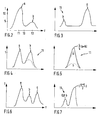
- FIG. 2 shows in a simplified manner a section of a spectral curve of a luminescent banknote BN actually measured with the test device 3, ie the dependence of the intensity I on the frequency f of the luminescence radiation.
- This spectral curve is formed by a larger number of measured values, not shown, and is characterized by two different sized maxima at frequencies f1 and f2.
- the maximum at the frequency f1 is caused by a first substance "a” and the second maximum at the frequency f2 is caused by a second substance "b", both in Mixture form the luminescent feature substance contained in the paper.
- FIG. 2 While in the prior art such a measurement curve would be displayed on the screen 10, the associated measurement values according to the invention are not forwarded for display on the screen 10. It is thus deliberately excluded that an actual trace accordingly FIG. 2 can be displayed in order to prevent the secrecy on the exact composition of the measured feature substances is compromised. Instead, measured values altered by a mathematical algorithm are forwarded as disguised cover data via the interface 9 and displayed on the screen 10 as a fogged spectral curve 11.
- FIG. 3 shows a very simple example that camouflage data are formed by changing the assignment of the measurement intensities to the frequencies.
- the camouflage data are of the same physical size as the measured values, ie also the camouflage data are like the actual measured values data to frequency-dependent intensity values.
- a concealment of the assignment of the intensity values to the frequencies ensues for concealment.
- the position of the maxima of the substances a and b in the considered frequency spectrum is reversed and the distance of the maxima is increased.
- the measurement intensities and the frequencies could also be mixed much more complex.
- the intensities at 50 measured frequencies f1, f2, f3, f4, ... f50 are assigned to the frequencies f13, f19, f7, f2, etc., in particular at a large number of measured frequencies (in example 50) suitable permutations, e.g. obtained at least partial aspects of the functional relationships, the frequencies of a complete mixing are preferable.
- FIG. 4 shows a second example of a measurement according to FIG. 2 associated Tarnkurve 11, which is formed by camouflage data, which are forwarded by the test device 3.
- the formation of the displayed camouflage data takes place by a different scaling of different measured values.
- the relative maxima of the substance "b" are normalized to the value of the absolute maximum of the spectral curve caused by the substance "a". This concept makes it possible to check the principle presence of the substances a and b despite the display of the caravan.
- FIG. 5 shows a third example of a measurement according to FIG. 2 This case is distinguished by the fact that the camouflage data are formed by superimposing the spectral curves in the regions around the relative maxima of the substances a and b at the frequencies f1 and f2.
- the course of the camouflage curve is exemplarily formed by the sum of the measured values scaled by the factor 4/5.
- FIG. 6 shows another example of a spectral curve measured by the test device 3.
- the measured values of this spectral curve are again not transmitted from the test device 3 to the display on the screen 10.
- the spectral curve has three maxima for the substances a, b, c contained in the feature substance.
- FIG. 7 shows an example of a measurement FIG. 6
- This camouflage curve 11 is a combination of the previous examples and characterized both by a mixing, overlaying and different scaling of the measured values to form the illustrated camouflage curve.
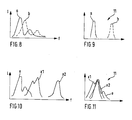
- FIG. 8 shows two actually measured by the tester 3 spectral curves.
- the solid line corresponds eg to a first coding a and the dashed line to a second coding b of a currency system.
- the different codes can for example consist in the use of different combinations of substances as feature substances and be used for example to denominate differentiation.
- the individual spectral curves However, a, b may also be different substances contained in combination in the audited banknote.
- FIG. 9 two associated Tarnkurven 11 are shown as an example, as they can be displayed on the screen 10.
- the individual spectral curves a, b are depicted as a single peak, wherein the distance of the individual peaks of the Tarndar ein is preferably constant.
- in the Tarndar ein also includes an indication of the measured amplitudes of the individual codes or substances a, b.
- a change in the total intensity of the individual actually measured spectral curves a, b of the FIG. 9 eg due to contamination in banknotes already in circulation, then resulting eg in a change in the size of the individual peaks of the camouflage curves 11.
- the checking device 3 will be designed to check the authenticity of the banknotes.
- the evaluation unit 6 will perform a genuineness classification of the bill. This can consist, for example, in that at least a distinction is made between genuine and false banknotes or between genuine, false, counterfeit, unrecognized banknotes.
- this classification can be a preliminary classification obtained only on the basis of the measured values of the test device 3, and e.g. only indicates whether the measured luminescence behavior corresponds to a genuine banknote.
- this classification may also be a final classification which also takes into account the measurements of other measurements made in the device 1, such as other optical, acoustic, magnetic and / or electrical measurements.
- the evaluation is carried out on the basis of the actually recorded measured values and not the camouflage data determined for display.
- the display of the stealth data may serve to provide certain information about real and false banknote measurements without compromising the secrecy of the actual spectral curves of genuine banknotes.
- FIGS. 10 and 11 show a further comparison of actual measuring curves (in Fig. 10 ) and associated camouflage curves 11 (in Fig. 11 ).
- the spectral curve e in FIG. 10 corresponds to the actual measurement curve of a genuine banknote, while the spectral curves x1, x2 correspond to actual measurement curves of two different counterfeits.
- the mathematical algorithm varies for different measured values and consists for example of several different partial algorithms and measured values are varied differently with different partial algorithms depending on whether the measured values fulfill at least one predetermined criterion.
- the measured values for forming the cover data will be changed by a locally continuous mathematical function.
- This local continuity means that small deviations in the measured values only lead to small deviations in the associated stealth data.
- This range can also be set to be e.g. also realistically covers the variations in the dosage of feature substances customary in paper and banknote production.
- the measured values are preferably changed more than within the range typical for real banknotes and e.g. be changed by a locally discontinuous mathematical function.
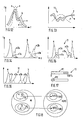
- FIG. 12 again shows actually measured spectral curves.
- the shaded area illustrates the tolerance range for the measured values of a banknote with two feature substances a and b, which is identified by the reference symbol "e” and which is classified as “genuine” by evaluating, inter alia, these measured values.
- With "x” the spectral curve of a forgery is shown, which contains only the feature substance a.
- the mathematical function for forming the camouflage data is designed only for measured values which lie within a predetermined tolerance range such that no two measured values are mapped to the same camouflage value. Outside the tolerance range, this requirement can even be purposefully violated, i. that in particular different measured values are mapped to the same camouflage value.
- forwarding and / or presentation of the cover data takes place only when the associated measured values fulfill at least one predetermined criterion.
- the cover data is displayed only if the checked banknote BN belongs to a certain class, specifically classified as "genuine".
- the cover data are then not forwarded or displayed by the checking device 3 for banknotes which have not been genuinely classified, such as the camouflage curve associated with the forgery x.
- a luminescent feature substance to be tested contains a plurality of different substances and / or individual peaks
- different types of deviations of the spectral measured values from the spectral nominal values, the substances or individual peaks are defined during the formation of the camouflage data and be taken into account.
- different changes of the measured values to form camouflage data are then preferably carried out.
- FIGS. 14 and 15 This concept is in the FIGS. 14 and 15 illustrated.
- a and b are in FIG. 14 illustrates the desired curves of the spectral curves of two different luminescent substances to be measured, which may be contained in combination in a banknote to be tested or separately eg in different codings.
- x1a, x2a, x1b, x2b the actually measured spectral curves of two other substances are shown, such as those contained in counterfeits.
- the spectral curves x1a and x2a or x1b and x2b differ by the measured intensity I of the luminescence radiation.
- camouflage curves 11 are shown, with corresponding camouflage curves are identified by the same reference numerals.
- FIG. 16 shows another example of camouflage curves 11 for FIG. 14 and illustrates the concept that a change in a measured quantity (intensity) results in a change in another size (frequency) of the cover data depending on the magnitude of this change.
- the other way of altering the measured data to form the cloaking data is that when there are deviations from the predetermined tolerance ranges, such as the tolerance ranges for real banknotes, changes in measured intensities of counterfeits classified as non-genuine x1a, x2a, x1b, x2b, moves the position of the associated camouflage curves.
- FIG. 17 shows two bar - shaped advertisements to camouflage data, as they also eg in the case of FIGS. 15 or 16 can be displayed on the screen 10.
- This display can be used, for example, to control the introduction of a luminescent feature substance from a plurality of substances into the paper or the printing ink of the banknote in the printing station 2.
- the scale line M1 in the upper bar indicates whether the mixing ratio of two substances of the sample corresponds to the ideal value (100%) or deviates therefrom.
- the scale line M2 in the lower bar indicates how large the contamination of the sample is by additional substances.
- the position of the scale marks M1, M2 is determined by evaluation of the measured spectral curves, eg FIG. 14 , won. Permitted tolerance ranges during production are indicated schematically by the hatched areas of the bars.
- Such a message after FIG. 17 is with a representation of spectral Tarnkurven such as after the FIGS. 15 or 16 coupled. It can, for example, then, if the contamination is outside the allowable tolerance range, the forwarding of the associated camouflage data or a graphical representation of the associated Tarnkurven also omitted.
- At least two different sets of camouflage data which are intended for different target groups, are formed for a measurement.
- the one cover data for example, is forwarded to an administrator of a set of checking devices 3 and the other cover data to the respective users of the individual checking devices 3.
- the data transfer and / or the display of the different cover data for different target groups preferably takes place only after a corresponding authentication of the respective target group.
- the nature of the formation of the cover data will differ in both cases, for example by using different tamper concepts previously explained with reference to the figures.
- an administrator has the in FIG. 13 displayed camouflage curves for all classified as genuine banknotes, while the usual user of the test equipment 3 only camouflage curves are displayed for a smaller tolerance range of all genuine banknotes.
- the information "real banknote” and only for a part of the genuinely classified banknotes the associated camouflage curves are displayed to this user.
- the cover data which are still classified as genuine, whose measured values have larger deviations from the ideal target values, are not displayed.
- the information displayed is e.g. also indicates in the form of a bar with what percentage the checked banknote was classified as "genuine". The percentage will then be e.g. indicate the extent to which the measured values, within the tolerance range permissible for genuinely classified banknotes, deviate from the ideal values of a genuine banknote.
- a 95% genuine bill is then sent e.g. still classified in the category "real", however, shows deviations from a reference measurement fixed reference measurement of a genuine banknote.
- the checking device 3 together with the camouflage data, forwards an individual checksum or any other code which may be e.g. is formed on the basis of the mathematical algorithm forming parameters and / or the associated measured values and due to the camouflage data can be recalculated to the associated measured values.
- the algorithm for reproducing the measured values with the aid of the camouflage data and the code will preferably be known only to the manufacturer of the test equipment 3, and may be known therefrom by e.g. can be used to check customer complaints due to possible incorrect evaluations or advertisements.
- camouflage can also be used for other measurements, such as time-varying measured values.
- time-resolved measured values for determining the decay times of the luminescence radiation can be camouflaged in the same way.
- the checking device 3 evaluates only a part of all recorded measured values for classifying the bank notes.
- test device 3 comprises e.g. a luminescence sensor for testing the luminescence radiation in the visible or infrared spectral range
- the evaluation of the presence of the luminescent feature substance and the representation of the associated camouflage curves will be based only on the measured values in the visible or infrared spectral range.
- the tolerance range for the Tarnaries reduced or renounced entirely on a visual representation of the cover data If, for example, the color impression or another authenticity criterion is not met or the tested forgery already does not fulfill further criteria.
- this criterion can be used e.g. also include an examination of whether the Lumineszenzmeßock for predetermined substances have characteristic properties.
- These predetermined substances are preferably per se substances not contained in the tested banknotes, but such as are e.g. Usually used for counterfeiting.
- the mentioned characteristic properties can e.g. concern the spectral course or the decay times of these known counterfeiting materials.
- the stealth data is then formed in other, more concealing manner and / or the Tambredarwolf is prevented when these characteristic properties are measured.
- the measured values represented as measuring vector are present as data points in an n-dimensional space M, for example the IR n , and are transformed into an m-dimensional space for camouflage, where m can be greater, smaller or equal to n.
- Different algorithms for camouflage can be used in this space for different classes, for example, depending on which target class i, which is defined for example by a target vector x i and an associated class area K i , is assigned the measurement vector. It is possible that there are areas where the measurement vector is not assigned to any destination class at all, ie the space IR n need not be completely divided into destination classes. In particular, there may additionally be a tolerance range Ti for each target class i, which lies within the class area Ki.
- the function (s) fi which are e.g. can also be defined only locally in M or the class areas Ki.
- a function f may be used that shows different behavior in different subranges of M.
- the function f (or functions fi) meet certain conditions. For example, it is possible that only the target vector xi is mapped to the camouflage value f (i) (xi).
- the function (s) is (are) such that no points outside a tolerance range Ti are mapped into the associated camouflage area f (Ti).
- the function (s) be chosen so that in a sequence of measured measurements yi converging to a setpoint xi, the camouflage values f (yi) also converge to the camouflaged setpoint f (xi), or / and conversely, a sequence of camouflage values f (yi) converging to f (xi) also corresponds to a sequence of measured values yi converging to xi.
- the functions f i may be chosen such that these restrictions outside the tolerance ranges Ti do not apply, and e.g. Measured values in the space M that are not within a tolerance range, are displayed in an area of the camouflage space that consciously dispenses with an unambiguous assignment.
Landscapes
- Physics & Mathematics (AREA)
- Health & Medical Sciences (AREA)
- General Health & Medical Sciences (AREA)
- Toxicology (AREA)
- Spectroscopy & Molecular Physics (AREA)
- General Physics & Mathematics (AREA)
- Inspection Of Paper Currency And Valuable Securities (AREA)
Claims (22)
- Procédé de camouflage d'une représentation visuelle de valeurs mesurées d'un objet à mesurer (BN) sous forme d'un billet de banque qui comporte des substances caractéristiques luminescentes, comprenant les étapes suivantes:- enregistrement de valeurs mesurées lors d'une mesure d'une dépendance temporelle ou/et spectrale de la luminescence du document de valeur au moyen d'une unité de capteur (5), les données mesurées présentant une dépendance temporelle ou/et spectrale, constitution de données de camouflage (11) à partir des valeurs mesurées enregistrées, à l'aide d'un algorithme mathématique pour la modification des données mesurées, au moyen d'une unité d'évaluation (6), les données de camouflage présentant en comparaison avec les valeurs mesurées correspondantes une dépendance temporelle ou/et spectrale modifiée, et représentation visuelle des données de camouflage (11),de telle sorte que, par une analyse de la représentation visuelle des données de camouflage, un contrôle de qualité est certes facilité, mais aucune interférence directe permettant de déduire les substances caractéristiques luminescentes du billet de banque n'est possible,
le procédé étant conçu pour la vérification de documents de valeur luminescents ou/et pour le contrôle de qualité lors de la fabrication de documents de valeur, et les valeurs mesurées étant utilisées pour la vérification de l'authenticité de l'objet (BN) vérifié. - Procédé selon la revendication 1, caractérisé par une classification des valeurs mesurées relativement à un nombre de classes.
- Procédé selon au moins une des revendications précédentes, caractérisé en ce que, par l'algorithme mathématique, un groupe de valeurs mesurées est placé dans un ordre modifié.
- Procédé selon une des revendications précédentes, caractérisé en ce que les valeurs mesurées sont des valeurs spectrales mesurées et en ce que, par l'algorithme mathématique, un groupe de valeurs mesurées est placé dans un ordre modifié, ce qui a lieu en ce que l'affectation spectrale des valeurs mesurées relativement aux fréquences est modifiée.
- Procédé selon au moins une des revendications précédentes, caractérisé en ce que, par l'algorithme mathématique, de différentes valeurs mesurées ou différents groupes de valeurs mesurées sont modifiés avec de différentes fonctions mathématiques.
- Procédé selon au moins une des revendications précédentes, caractérisé en ce que, par l'algorithme mathématique, de différentes valeurs mesurées ou différents groupes de valeurs mesurées sont modifiés par de différentes fonctions mathématiques, ce qui a lieu en ce qu'elles sont mises à échelle avec de différents facteurs.
- Procédé selon au moins une des revendications précédentes, caractérisé en ce que, pour la vérification d'un document de valeur, les valeurs mesurées sont elles-mêmes évaluées, les données de camouflage n'étant en l'occurrence pas prises en compte.
- Procédé selon au moins une des revendications précédentes, caractérisé en ce qu'un résultat de l'évaluation est transféré en plus des données de camouflage par l'intermédiaire d'une ligne de données à une unité externe (8).
- Procédé selon au moins une des revendications précédentes, caractérisé en ce que la représentation des données de camouflage comprend une représentation de chiffres et/ou de graphiques (11) qui dépendent des données de camouflage.
- Procédé selon au moins une des revendications précédentes, caractérisé en ce que la représentation des données de camouflage a lieu par une représentation graphique de courbes spectrales (11) modifiées du document (BN) vérifié, les courbes spectrales (11) modifiées se différenciant des courbes spectrales réellement mesurées du document (BN) vérifié.
- Procédé selon au moins une des revendications précédentes, caractérisé en ce qu'un transfert et/ou une représentation des données de camouflage n'a lieu que quand les valeurs mesurées correspondantes remplissent au moins un critère prédéterminé.
- Procédé selon au moins une des revendications précédentes, caractérisé en ce que l'algorithme mathématique varie pour différentes valeurs mesurées.
- Procédé selon au moins une des revendications précédentes, caractérisé en ce que l'algorithme mathématique se constitue de plusieurs différents algorithmes partiels et en ce que des valeurs mesurées, en fonction de si les valeurs mesurées remplissent au moins un critère prédéterminé, sont modifiées différemment avec différents des algorithmes partiels.
- Procédé selon au moins une des revendications précédentes, caractérisé en ce que le critère entraînant la modification différente des valeurs mesurées avec différents algorithmes partiels et/ou le critère entraînant le transfert et/ou la représentation des données de camouflage indique si, par évaluation des valeurs mesurées, l'objet à mesurer (BN) correspondant est affecté au moins à une de plusieurs catégories de classification prédéterminées.
- Procédé selon au moins une des revendications précédentes, caractérisé en ce que le critère entraînant la modification différente des valeurs mesurées avec différents algorithmes partiels et/ou le critère entraînant le transfert et/ou la représentation des données de camouflage indique si les valeurs mesurées présentent, pour des substances prédéterminées, des propriétés caractéristiques.
- Procédé selon au moins une des revendications précédentes, caractérisé en ce que la divergence des valeurs mesurées respectives par rapport aux données de camouflage respectives est plus grande quand les valeurs mesurées remplissent au moins un critère prédéterminé que quand les valeurs mesurées ne remplissent pas le au moins un critère prédéterminé.
- Procédé selon au moins une des revendications précédentes, caractérisé en ce que les valeurs mesurées sont subdivisées en au moins deux catégories et, en fonction de si les valeurs mesurées peuvent être affectées à une des deux catégories, des fonctions mathématiques continues sont utilisées pour la constitution des données de camouflage.
- Procédé selon au moins une des revendications précédentes, caractérisé en ce que ce n'est que pour des valeurs mesurées se situant dans une plage de tolérance prédéterminée que l'algorithme mathématique servant à la constitution des données de camouflage est configuré de telle manière que, pour une même valeur de camouflage, il n'y a pas deux valeurs mesurées qui sont imagées.
- Procédé selon au moins une des revendications précédentes, caractérisé en ce que, lors de la constitution des données de camouflage, différentes sortes des divergences de valeurs spectrales mesurées par rapport à des valeurs spectrales prescrites sont prises en compte.
- Procédé selon au moins une des revendications précédentes, caractérisé en ce que, pour une mesure, au moins deux quantités différentes de données de camouflage sont constituées, qui sont destinées de préférence à de différents groupes cibles.
- Procédé selon au moins une des revendications précédentes, caractérisé en ce que, conjointement avec les données de camouflage, une somme individuelle de vérification ou un autre code est constitué, qui, avec les données de camouflage, ramène aux valeurs mesurées correspondantes.
- Procédé selon au moins une des revendications précédentes, caractérisé en ce que des valeurs mesurées prédéterminées et/ou des données de camouflage correspondantes à ces valeurs mesurées prédéterminées ne sont pas représentées.
Applications Claiming Priority (2)
| Application Number | Priority Date | Filing Date | Title |
|---|---|---|---|
| DE102004049998A DE102004049998A1 (de) | 2004-10-14 | 2004-10-14 | Vorrichtung und Verfahren zur visuellen Darstellung von Meßwerten |
| PCT/EP2005/010935 WO2006042668A1 (fr) | 2004-10-14 | 2005-10-11 | Dispositif et procede pour la representation visuelle de valeurs mesurees |
Publications (2)
| Publication Number | Publication Date |
|---|---|
| EP1815444A1 EP1815444A1 (fr) | 2007-08-08 |
| EP1815444B1 true EP1815444B1 (fr) | 2014-01-01 |
Family
ID=35501608
Family Applications (1)
| Application Number | Title | Priority Date | Filing Date |
|---|---|---|---|
| EP05798830.5A Expired - Lifetime EP1815444B1 (fr) | 2004-10-14 | 2005-10-11 | Dispositif et procede pour la representation visuelle de valeurs mesurees |
Country Status (4)
| Country | Link |
|---|---|
| US (1) | US8542866B2 (fr) |
| EP (1) | EP1815444B1 (fr) |
| DE (1) | DE102004049998A1 (fr) |
| WO (1) | WO2006042668A1 (fr) |
Families Citing this family (9)
| Publication number | Priority date | Publication date | Assignee | Title |
|---|---|---|---|---|
| DE10346636A1 (de) * | 2003-10-08 | 2005-05-12 | Giesecke & Devrient Gmbh | Vorrichtung und Verfahren zur Prüfung von Wertdokumenten |
| DE102009036706C5 (de) | 2009-08-08 | 2017-04-13 | Friedrich Kisters | Sicherheitselement mit einer elektronischen Anzeigevorrichtung zur Darstellung von sicherheitsrelevanten Informationen oder Mustern, seine Verwendung als Bestandteil einer elektronischen Telekommunikationseinrichtung sowie ein Verfahren zur Kennzeichnung, Identifikation oder Authentifikation von Gegenständen oder Lebewesen |
| US8328102B2 (en) | 2009-12-21 | 2012-12-11 | Honeywell International Inc. | Method and authentication apparatus for authenticating value documents |
| DE102010055974A1 (de) * | 2010-12-23 | 2012-06-28 | Giesecke & Devrient Gmbh | Verfahren und Vorrichtung zur Bestimmung eines Klassenreferenzdatensatzes für die Klassifizierung von Wertdokumenten |
| DE102011016509A1 (de) * | 2011-04-08 | 2012-10-11 | Giesecke & Devrient Gmbh | Verfahren zur Prüfung von Wertdokumenten |
| DE102011114410A1 (de) * | 2011-09-26 | 2013-03-28 | Giesecke & Devrient Gmbh | Verfahren zum Prüfen der Herstellungsqualität eines optischen Sicherheitsmerkmals eines Wertdokuments |
| EP2824641B1 (fr) | 2013-07-08 | 2016-11-30 | Friedrich Kisters | Systèmes et procédés permettant l'authentification, l'identification ou le marquage d'objets ou d'individus au moyen de caractéristiques de sécurité dynamiques |
| EP3185221B1 (fr) | 2015-12-23 | 2023-06-07 | Friedrich Kisters | Dispositif d'authentification et procede de reconnaissance optique ou acoustique |
| DE102023101915A1 (de) * | 2023-01-26 | 2024-08-01 | Giesecke+Devrient Currency Technology Gmbh | Datenträger mit maschinenlesbarem Sicherheitsmerkmal, Herstellungsverfahren und Sicherheitssubstratbogen |
Family Cites Families (27)
| Publication number | Priority date | Publication date | Assignee | Title |
|---|---|---|---|---|
| CH484479A (de) * | 1969-06-12 | 1970-01-15 | Landis & Gyr Ag | Vorrichtung zur optischen Echtheitsprüfung von Banknoten und anderen Wertzeichen |
| AT330574B (de) * | 1972-05-03 | 1976-07-12 | Int Security Systems Sa | Falschungsgesichertes wertpapier |
| DE2308887C3 (de) * | 1973-02-23 | 1985-08-08 | Atmos Fritzsching & Co Gmbh, Zweigniederlassung Lenzkirch Im Schwarzwald, 7825 Lenzkirch | Temperaturmeßverfahren und -einrichtung mit Speicherung der Meßwerte in einem temperaturisolierten Gefäß |
| DE3048734A1 (de) * | 1980-12-23 | 1982-07-15 | GAO Gesellschaft für Automation und Organisation mbH, 8000 München | Sicherheitspapier mit die echtheitsmerkmale schuetzenden tarnstoffe |
| US5652802A (en) * | 1990-02-05 | 1997-07-29 | Cummins-Allison Corp. | Method and apparatus for document identification |
| NL9001368A (nl) * | 1990-06-15 | 1992-01-02 | Tel Developments B V | Beveiliging van voorwerpen of dokumenten. |
| CH684856A5 (de) * | 1992-11-30 | 1995-01-13 | Mars Inc | Verfahren zur Klassifizierung eines Musters - insbesondere eines Musters einer Banknote oder einer Münze - und Einrichtung zur Durchführung des Verfahrens. |
| DE4438854C2 (de) * | 1994-11-02 | 1996-12-12 | Siemens Ag | Überwachungssystem für eine technische Anlage |
| DE19543363C2 (de) * | 1995-11-21 | 1999-12-23 | Ritz Messwandler Kg | Meßwandleranordnung |
| GB2309778B (en) * | 1996-02-05 | 2000-05-24 | Mars Inc | Security document validation |
| DE19637651A1 (de) * | 1996-09-16 | 1998-03-19 | Abb Patent Gmbh | Verfahren zur Prozeßvisualisierung |
| US5991408A (en) * | 1997-05-16 | 1999-11-23 | Veridicom, Inc. | Identification and security using biometric measurements |
| US6185316B1 (en) * | 1997-11-12 | 2001-02-06 | Unisys Corporation | Self-authentication apparatus and method |
| AU6269699A (en) * | 1998-09-29 | 2000-04-17 | Angstrom Technologies, Inc. | First-order authentication system |
| JP4180715B2 (ja) * | 1998-12-14 | 2008-11-12 | 株式会社東芝 | 印刷物の汚損度判別装置 |
| US20020124176A1 (en) * | 1998-12-14 | 2002-09-05 | Michael Epstein | Biometric identification mechanism that preserves the integrity of the biometric information |
| DE19940341A1 (de) * | 1999-08-25 | 2001-03-01 | Kolja Vogel | Verfahren zum Schutz von Daten |
| GB0007360D0 (en) * | 2000-03-28 | 2000-05-17 | Ncr Int Inc | Electronic wallet |
| US7002710B1 (en) * | 2000-04-10 | 2006-02-21 | Hewlett-Packard Development Company, L.P. | High reliability forensic color marking system |
| DE10029051A1 (de) * | 2000-06-13 | 2001-12-20 | Giesecke & Devrient Gmbh | Verfahren zur Echtheitsprüfung von Dokumenten |
| MY134895A (en) * | 2000-06-29 | 2007-12-31 | Multimedia Glory Sdn Bhd | Biometric verification for electronic transactions over the web |
| DE10113268B4 (de) * | 2001-03-16 | 2021-06-24 | Bundesdruckerei Gmbh | Sensor für die Echtheitserkennung von Sicherheitsmerkmalen auf Wert und/oder Sicherheitsdokumenten |
| EP1520369B1 (fr) * | 2002-05-31 | 2006-10-18 | Scientific Generics Limited | Systeme d'authentification biometrique |
| CZ2005209A3 (cs) * | 2002-09-10 | 2005-12-14 | Ivi Smart Technologies, Inc. | Bezpečné biometrické ověření identity |
| US7256874B2 (en) * | 2002-10-18 | 2007-08-14 | Cummins-Allison Corp. | Multi-wavelength currency authentication system and method |
| DE10346635A1 (de) * | 2003-10-08 | 2005-05-12 | Giesecke & Devrient Gmbh | System zur Prüfung von Sicherheitsmerkmalen von Wertdokumenten |
| DE10346636A1 (de) * | 2003-10-08 | 2005-05-12 | Giesecke & Devrient Gmbh | Vorrichtung und Verfahren zur Prüfung von Wertdokumenten |
-
2004
- 2004-10-14 DE DE102004049998A patent/DE102004049998A1/de not_active Withdrawn
-
2005
- 2005-10-11 US US11/664,795 patent/US8542866B2/en not_active Expired - Fee Related
- 2005-10-11 WO PCT/EP2005/010935 patent/WO2006042668A1/fr not_active Ceased
- 2005-10-11 EP EP05798830.5A patent/EP1815444B1/fr not_active Expired - Lifetime
Also Published As
| Publication number | Publication date |
|---|---|
| WO2006042668A1 (fr) | 2006-04-27 |
| US20090074229A1 (en) | 2009-03-19 |
| US8542866B2 (en) | 2013-09-24 |
| DE102004049998A1 (de) | 2006-04-20 |
| EP1815444A1 (fr) | 2007-08-08 |
Similar Documents
| Publication | Publication Date | Title |
|---|---|---|
| EP1459266B1 (fr) | Procédé pour protéger l'authenticité de documents | |
| EP3746992B1 (fr) | Procédé pour le contrôle de l'authenticité et/ou de l'intégrité d'un document de sécurité comprenant une caractéristique de sécurité imprimée, caractéristique de sécurité et dispositif pour la vérification | |
| EP2617016B1 (fr) | Procédé de traitement de billets de banque | |
| EP2625673B1 (fr) | Procédé pour contrôler un signe de sécurité optique d'un document de valeur | |
| EP1815443A2 (fr) | Documents de valeur, production et verification de documents de valeur | |
| EP1910089B1 (fr) | Document de valeur, realisation et controle de documents de valeur | |
| EP2132719A1 (fr) | Procédé et dispositif pour vérifier des papiers-valeurs | |
| EP1815444B1 (fr) | Dispositif et procede pour la representation visuelle de valeurs mesurees | |
| EP0854451A1 (fr) | Document de valeur | |
| EP2313872B1 (fr) | Procédé pour vérifier l'authenticité d'un document, produit programme informatique, appareil de contrôle et système de traitement de données | |
| EP2394250B1 (fr) | Procédé et dispositif pour vérifier des documents par utilisation d'une transformation en ondelettes | |
| DE102004055761A1 (de) | Wertdokumente, Herstellung und Prüfung von Wertdokumenten | |
| EP1872338A1 (fr) | Dispositif et procede pour controler des documents de valeur | |
| DE102011084820B4 (de) | Verfahren zur Verifikation eines Sicherheitsdokuments unter Verwendung einer Anzeigevorrichtung | |
| DE102022107442B4 (de) | Verfahren zur Überprüfung der Echtheit eines Wertdokuments | |
| DE19634169A1 (de) | Automat für das Herstellen von Wertdokumenten | |
| DE102005032704A1 (de) | Wertdokumente, Herrstellung und Prüfung von Wertdokumenten | |
| WO2017108428A1 (fr) | Dispositif d'authentification et procédé de reconnaissance optique ou acoustique de caractères | |
| DE102023115512A1 (de) | Sicherheitsdokument-verifizierungsvorrichtung und verfahren zum prüfen eines sicherheitsdokuments | |
| EP4576031A1 (fr) | Procédé et dispositif de vérification d'un élément de sécurité pour un document de sécurité | |
| DE102020002587A1 (de) | Verfahren und Vorrichtung zum Prüfen eines Substrats mit einem Lumineszenzstoff | |
| DE102014204302A1 (de) | Vorrichtung und Verfahren zur Prüfung mindestens eines Sicherheitselements eines Sicherheitsdokuments | |
| DE102020130444A1 (de) | Vorrichtung zum Erzeugen einer digitalen Kennung von einem mindestens ein Druckbild aufweisenden Exemplar eines Druckerzeugnisses |
Legal Events
| Date | Code | Title | Description |
|---|---|---|---|
| PUAI | Public reference made under article 153(3) epc to a published international application that has entered the european phase |
Free format text: ORIGINAL CODE: 0009012 |
|
| 17P | Request for examination filed |
Effective date: 20070514 |
|
| AK | Designated contracting states |
Kind code of ref document: A1 Designated state(s): AT BE BG CH CY CZ DE DK EE ES FI FR GB GR HU IE IS IT LI LT LU LV MC NL PL PT RO SE SI SK TR |
|
| DAX | Request for extension of the european patent (deleted) | ||
| 17Q | First examination report despatched |
Effective date: 20090512 |
|
| GRAP | Despatch of communication of intention to grant a patent |
Free format text: ORIGINAL CODE: EPIDOSNIGR1 |
|
| INTG | Intention to grant announced |
Effective date: 20130718 |
|
| GRAS | Grant fee paid |
Free format text: ORIGINAL CODE: EPIDOSNIGR3 |
|
| GRAA | (expected) grant |
Free format text: ORIGINAL CODE: 0009210 |
|
| AK | Designated contracting states |
Kind code of ref document: B1 Designated state(s): AT BE BG CH CY CZ DE DK EE ES FI FR GB GR HU IE IS IT LI LT LU LV MC NL PL PT RO SE SI SK TR |
|
| REG | Reference to a national code |
Ref country code: GB Ref legal event code: FG4D Free format text: NOT ENGLISH |
|
| REG | Reference to a national code |
Ref country code: DE Ref legal event code: R081 Ref document number: 502005014155 Country of ref document: DE Owner name: GIESECKE+DEVRIENT CURRENCY TECHNOLOGY GMBH, DE Free format text: FORMER OWNER: GIESECKE & DEVRIENT GMBH, 81677 MUENCHEN, DE |
|
| REG | Reference to a national code |
Ref country code: CH Ref legal event code: EP |
|
| REG | Reference to a national code |
Ref country code: IE Ref legal event code: FG4D Free format text: LANGUAGE OF EP DOCUMENT: GERMAN |
|
| REG | Reference to a national code |
Ref country code: DE Ref legal event code: R096 Ref document number: 502005014155 Country of ref document: DE Effective date: 20140213 |
|
| REG | Reference to a national code |
Ref country code: AT Ref legal event code: REF Ref document number: 647882 Country of ref document: AT Kind code of ref document: T Effective date: 20140215 |
|
| REG | Reference to a national code |
Ref country code: CH Ref legal event code: NV Representative=s name: PATENTANWAELTE SCHAAD, BALASS, MENZL AND PARTN, CH |
|
| REG | Reference to a national code |
Ref country code: NL Ref legal event code: VDEP Effective date: 20140101 |
|
| REG | Reference to a national code |
Ref country code: LT Ref legal event code: MG4D |
|
| PG25 | Lapsed in a contracting state [announced via postgrant information from national office to epo] |
Ref country code: LT Free format text: LAPSE BECAUSE OF FAILURE TO SUBMIT A TRANSLATION OF THE DESCRIPTION OR TO PAY THE FEE WITHIN THE PRESCRIBED TIME-LIMIT Effective date: 20140101 Ref country code: IS Free format text: LAPSE BECAUSE OF FAILURE TO SUBMIT A TRANSLATION OF THE DESCRIPTION OR TO PAY THE FEE WITHIN THE PRESCRIBED TIME-LIMIT Effective date: 20140501 |
|
| PG25 | Lapsed in a contracting state [announced via postgrant information from national office to epo] |
Ref country code: ES Free format text: LAPSE BECAUSE OF FAILURE TO SUBMIT A TRANSLATION OF THE DESCRIPTION OR TO PAY THE FEE WITHIN THE PRESCRIBED TIME-LIMIT Effective date: 20140101 Ref country code: FI Free format text: LAPSE BECAUSE OF FAILURE TO SUBMIT A TRANSLATION OF THE DESCRIPTION OR TO PAY THE FEE WITHIN THE PRESCRIBED TIME-LIMIT Effective date: 20140101 Ref country code: CY Free format text: LAPSE BECAUSE OF FAILURE TO SUBMIT A TRANSLATION OF THE DESCRIPTION OR TO PAY THE FEE WITHIN THE PRESCRIBED TIME-LIMIT Effective date: 20140101 Ref country code: PT Free format text: LAPSE BECAUSE OF FAILURE TO SUBMIT A TRANSLATION OF THE DESCRIPTION OR TO PAY THE FEE WITHIN THE PRESCRIBED TIME-LIMIT Effective date: 20140502 Ref country code: SE Free format text: LAPSE BECAUSE OF FAILURE TO SUBMIT A TRANSLATION OF THE DESCRIPTION OR TO PAY THE FEE WITHIN THE PRESCRIBED TIME-LIMIT Effective date: 20140101 Ref country code: NL Free format text: LAPSE BECAUSE OF FAILURE TO SUBMIT A TRANSLATION OF THE DESCRIPTION OR TO PAY THE FEE WITHIN THE PRESCRIBED TIME-LIMIT Effective date: 20140101 |
|
| PG25 | Lapsed in a contracting state [announced via postgrant information from national office to epo] |
Ref country code: LV Free format text: LAPSE BECAUSE OF FAILURE TO SUBMIT A TRANSLATION OF THE DESCRIPTION OR TO PAY THE FEE WITHIN THE PRESCRIBED TIME-LIMIT Effective date: 20140101 |
|
| REG | Reference to a national code |
Ref country code: DE Ref legal event code: R097 Ref document number: 502005014155 Country of ref document: DE |
|
| PG25 | Lapsed in a contracting state [announced via postgrant information from national office to epo] |
Ref country code: CZ Free format text: LAPSE BECAUSE OF FAILURE TO SUBMIT A TRANSLATION OF THE DESCRIPTION OR TO PAY THE FEE WITHIN THE PRESCRIBED TIME-LIMIT Effective date: 20140101 Ref country code: EE Free format text: LAPSE BECAUSE OF FAILURE TO SUBMIT A TRANSLATION OF THE DESCRIPTION OR TO PAY THE FEE WITHIN THE PRESCRIBED TIME-LIMIT Effective date: 20140101 Ref country code: DK Free format text: LAPSE BECAUSE OF FAILURE TO SUBMIT A TRANSLATION OF THE DESCRIPTION OR TO PAY THE FEE WITHIN THE PRESCRIBED TIME-LIMIT Effective date: 20140101 Ref country code: RO Free format text: LAPSE BECAUSE OF FAILURE TO SUBMIT A TRANSLATION OF THE DESCRIPTION OR TO PAY THE FEE WITHIN THE PRESCRIBED TIME-LIMIT Effective date: 20140101 |
|
| PLBE | No opposition filed within time limit |
Free format text: ORIGINAL CODE: 0009261 |
|
| STAA | Information on the status of an ep patent application or granted ep patent |
Free format text: STATUS: NO OPPOSITION FILED WITHIN TIME LIMIT |
|
| PG25 | Lapsed in a contracting state [announced via postgrant information from national office to epo] |
Ref country code: SK Free format text: LAPSE BECAUSE OF FAILURE TO SUBMIT A TRANSLATION OF THE DESCRIPTION OR TO PAY THE FEE WITHIN THE PRESCRIBED TIME-LIMIT Effective date: 20140101 Ref country code: PL Free format text: LAPSE BECAUSE OF FAILURE TO SUBMIT A TRANSLATION OF THE DESCRIPTION OR TO PAY THE FEE WITHIN THE PRESCRIBED TIME-LIMIT Effective date: 20140101 |
|
| 26N | No opposition filed |
Effective date: 20141002 |
|
| REG | Reference to a national code |
Ref country code: DE Ref legal event code: R097 Ref document number: 502005014155 Country of ref document: DE Effective date: 20141002 |
|
| PG25 | Lapsed in a contracting state [announced via postgrant information from national office to epo] |
Ref country code: SI Free format text: LAPSE BECAUSE OF FAILURE TO SUBMIT A TRANSLATION OF THE DESCRIPTION OR TO PAY THE FEE WITHIN THE PRESCRIBED TIME-LIMIT Effective date: 20140101 Ref country code: MC Free format text: LAPSE BECAUSE OF FAILURE TO SUBMIT A TRANSLATION OF THE DESCRIPTION OR TO PAY THE FEE WITHIN THE PRESCRIBED TIME-LIMIT Effective date: 20140101 Ref country code: LU Free format text: LAPSE BECAUSE OF FAILURE TO SUBMIT A TRANSLATION OF THE DESCRIPTION OR TO PAY THE FEE WITHIN THE PRESCRIBED TIME-LIMIT Effective date: 20141011 |
|
| PG25 | Lapsed in a contracting state [announced via postgrant information from national office to epo] |
Ref country code: BE Free format text: LAPSE BECAUSE OF NON-PAYMENT OF DUE FEES Effective date: 20141031 |
|
| REG | Reference to a national code |
Ref country code: IE Ref legal event code: MM4A |
|
| REG | Reference to a national code |
Ref country code: FR Ref legal event code: PLFP Year of fee payment: 11 |
|
| PG25 | Lapsed in a contracting state [announced via postgrant information from national office to epo] |
Ref country code: IE Free format text: LAPSE BECAUSE OF NON-PAYMENT OF DUE FEES Effective date: 20141011 |
|
| PG25 | Lapsed in a contracting state [announced via postgrant information from national office to epo] |
Ref country code: BG Free format text: LAPSE BECAUSE OF FAILURE TO SUBMIT A TRANSLATION OF THE DESCRIPTION OR TO PAY THE FEE WITHIN THE PRESCRIBED TIME-LIMIT Effective date: 20140101 |
|
| PG25 | Lapsed in a contracting state [announced via postgrant information from national office to epo] |
Ref country code: GR Free format text: LAPSE BECAUSE OF FAILURE TO SUBMIT A TRANSLATION OF THE DESCRIPTION OR TO PAY THE FEE WITHIN THE PRESCRIBED TIME-LIMIT Effective date: 20140402 Ref country code: IT Free format text: LAPSE BECAUSE OF FAILURE TO SUBMIT A TRANSLATION OF THE DESCRIPTION OR TO PAY THE FEE WITHIN THE PRESCRIBED TIME-LIMIT Effective date: 20140101 |
|
| PG25 | Lapsed in a contracting state [announced via postgrant information from national office to epo] |
Ref country code: TR Free format text: LAPSE BECAUSE OF FAILURE TO SUBMIT A TRANSLATION OF THE DESCRIPTION OR TO PAY THE FEE WITHIN THE PRESCRIBED TIME-LIMIT Effective date: 20140101 Ref country code: HU Free format text: LAPSE BECAUSE OF FAILURE TO SUBMIT A TRANSLATION OF THE DESCRIPTION OR TO PAY THE FEE WITHIN THE PRESCRIBED TIME-LIMIT; INVALID AB INITIO Effective date: 20051011 |
|
| REG | Reference to a national code |
Ref country code: FR Ref legal event code: PLFP Year of fee payment: 12 |
|
| REG | Reference to a national code |
Ref country code: DE Ref legal event code: R081 Ref document number: 502005014155 Country of ref document: DE Owner name: GIESECKE+DEVRIENT CURRENCY TECHNOLOGY GMBH, DE Free format text: FORMER OWNER: GIESECKE & DEVRIENT GMBH, 81677 MUENCHEN, DE |
|
| REG | Reference to a national code |
Ref country code: FR Ref legal event code: PLFP Year of fee payment: 13 |
|
| REG | Reference to a national code |
Ref country code: CH Ref legal event code: PUE Owner name: GIESECKE+DEVRIENT CURRENCY TECHNOLOGY GMBH, DE Free format text: FORMER OWNER: GIESECKE AND DEVRIENT GMBH, DE |
|
| REG | Reference to a national code |
Ref country code: GB Ref legal event code: 732E Free format text: REGISTERED BETWEEN 20180118 AND 20180124 |
|
| REG | Reference to a national code |
Ref country code: AT Ref legal event code: PC Ref document number: 647882 Country of ref document: AT Kind code of ref document: T Owner name: GIESECKE+DEVRIENT CURRENCY TECHNOLOGY GMBH, DE Effective date: 20180425 |
|
| REG | Reference to a national code |
Ref country code: FR Ref legal event code: TP Owner name: GIESECKE+DEVRIENT CURRENCY TECHNOLOGY GMBH, DE Effective date: 20180530 |
|
| REG | Reference to a national code |
Ref country code: FR Ref legal event code: PLFP Year of fee payment: 14 |
|
| PGFP | Annual fee paid to national office [announced via postgrant information from national office to epo] |
Ref country code: FR Payment date: 20201020 Year of fee payment: 16 Ref country code: GB Payment date: 20201022 Year of fee payment: 16 Ref country code: DE Payment date: 20201031 Year of fee payment: 16 |
|
| REG | Reference to a national code |
Ref country code: DE Ref legal event code: R119 Ref document number: 502005014155 Country of ref document: DE |
|
| GBPC | Gb: european patent ceased through non-payment of renewal fee |
Effective date: 20211011 |
|
| PG25 | Lapsed in a contracting state [announced via postgrant information from national office to epo] |
Ref country code: GB Free format text: LAPSE BECAUSE OF NON-PAYMENT OF DUE FEES Effective date: 20211011 Ref country code: DE Free format text: LAPSE BECAUSE OF NON-PAYMENT OF DUE FEES Effective date: 20220503 |
|
| PG25 | Lapsed in a contracting state [announced via postgrant information from national office to epo] |
Ref country code: FR Free format text: LAPSE BECAUSE OF NON-PAYMENT OF DUE FEES Effective date: 20211031 |
|
| PGFP | Annual fee paid to national office [announced via postgrant information from national office to epo] |
Ref country code: AT Payment date: 20221018 Year of fee payment: 18 |
|
| PGFP | Annual fee paid to national office [announced via postgrant information from national office to epo] |
Ref country code: CH Payment date: 20221027 Year of fee payment: 18 |
|
| P01 | Opt-out of the competence of the unified patent court (upc) registered |
Effective date: 20230520 |
|
| REG | Reference to a national code |
Ref country code: CH Ref legal event code: PL |
|
| REG | Reference to a national code |
Ref country code: AT Ref legal event code: MM01 Ref document number: 647882 Country of ref document: AT Kind code of ref document: T Effective date: 20231011 |
|
| PG25 | Lapsed in a contracting state [announced via postgrant information from national office to epo] |
Ref country code: CH Free format text: LAPSE BECAUSE OF NON-PAYMENT OF DUE FEES Effective date: 20231031 |
|
| PG25 | Lapsed in a contracting state [announced via postgrant information from national office to epo] |
Ref country code: AT Free format text: LAPSE BECAUSE OF NON-PAYMENT OF DUE FEES Effective date: 20231011 |
|
| PG25 | Lapsed in a contracting state [announced via postgrant information from national office to epo] |
Ref country code: CH Free format text: LAPSE BECAUSE OF NON-PAYMENT OF DUE FEES Effective date: 20231031 Ref country code: AT Free format text: LAPSE BECAUSE OF NON-PAYMENT OF DUE FEES Effective date: 20231011 |