EP1817137B1 - Affuteuse de lame de rasoir - Google Patents
Affuteuse de lame de rasoir Download PDFInfo
- Publication number
- EP1817137B1 EP1817137B1 EP05825498A EP05825498A EP1817137B1 EP 1817137 B1 EP1817137 B1 EP 1817137B1 EP 05825498 A EP05825498 A EP 05825498A EP 05825498 A EP05825498 A EP 05825498A EP 1817137 B1 EP1817137 B1 EP 1817137B1
- Authority
- EP
- European Patent Office
- Prior art keywords
- razor blade
- blade
- razor
- sharpening
- blades
- Prior art date
- Legal status (The legal status is an assumption and is not a legal conclusion. Google has not performed a legal analysis and makes no representation as to the accuracy of the status listed.)
- Expired - Lifetime
Links
Images
Classifications
-
- B—PERFORMING OPERATIONS; TRANSPORTING
- B24—GRINDING; POLISHING
- B24B—MACHINES, DEVICES, OR PROCESSES FOR GRINDING OR POLISHING; DRESSING OR CONDITIONING OF ABRADING SURFACES; FEEDING OF GRINDING, POLISHING, OR LAPPING AGENTS
- B24B3/00—Sharpening cutting edges, e.g. of tools; Accessories therefor, e.g. for holding the tools
- B24B3/36—Sharpening cutting edges, e.g. of tools; Accessories therefor, e.g. for holding the tools of cutting blades
- B24B3/48—Sharpening cutting edges, e.g. of tools; Accessories therefor, e.g. for holding the tools of cutting blades of razor blades or razors
-
- B—PERFORMING OPERATIONS; TRANSPORTING
- B24—GRINDING; POLISHING
- B24B—MACHINES, DEVICES, OR PROCESSES FOR GRINDING OR POLISHING; DRESSING OR CONDITIONING OF ABRADING SURFACES; FEEDING OF GRINDING, POLISHING, OR LAPPING AGENTS
- B24B21/00—Machines or devices using grinding or polishing belts; Accessories therefor
- B24B21/002—Machines or devices using grinding or polishing belts; Accessories therefor for grinding edges or bevels
Definitions
- the present invention relates to a razor blade sharpener, more particularly to a disposable razor blade sharpener that sharpens multiple blades in a cartridge at the same time
- the disposable razor blades with multiple cutting edges are generally sharpened from only one side, unlike double-edged razor blades wherein the cutting edge is formed by sharpening upper and lower surfaces and the cutting edge is the intersection of these two sharpened surfaces.
- US Patent 1,540,078 to Long discloses a sharpener.
- a single edged Gillette safety razor blade is sharpened.
- the safety razor blade is secured to a metal handle and stropped over a pair of corrugated inclined metallic strips attached to a wooden block. Sliding motion sharpens the safety razor blade edge. Stropping or honing of the razor blade edge over corrugated metal manually destroys the edge rather than sharpening it since the single edge safety razor blade is hard.
- the device does not sharpen a blade edge automatically and has no means to sharpen multiple edge disposable razor blade cartridges.
- US Patent 1,588,322 to McAdoo discloses a razor blade sharpener without the use of a strop or hone.
- a magnetized holder is used to act on the extremely fine sensitive cutting edge of a razor blade and return it to its normal position. The blade edge is not sharpened, but rather the magnetic forces are used to bring the edge back to its normal position.
- This device can only act on blades which are magnetizable, like the Gillette single edge blue blades.
- the disclosed a razor blade sharpener cannot accommodate multiple edge blades.
- US Patent 2,289,062 to Muros discloses a safety razor receptacle.
- a frictionally retained double-edged blade is pivotally mounted to a blade holder.
- Two stropping rollers sharpen the edge of the blade as they are manually rotated by turning a crank handle.
- This blade-sharpening device is only capable of sharpening double sided blades and not multiple edge blades, and especially not blades which are mounted in a cartridge. Furthermore, the operation of the device is manual, not automatic.
- US Patent 2,458,257 to Donovan discloses a safety razor blade sharpener.
- a double-sided safety razor blade is slid against a substantially flat abrading surface ensuring intimate contact of the entire cutting edge.
- Such a device is operable for sharpening a double-sided blade, not a multiple edge blade; it is not capable of handling blade cartridges. Moreover, the sharpening operation is manual, not automatic.
- US Patent 3,854,251 to Paule discloses a sharpening device for cutting implements such as razor blades.
- the sharpening device employs a vibrating unit to reciprocate the blade to be sharpened between a series of honing elements, which are spring load biased.
- the honing cylinders may be removed and rotated to expose fresh honing surface to the blade edge that is being sharpened.
- This is an automatic honing apparatus for a double-sided blade using cylindrical honing stones and vibratory movement.
- US Patent 3,875,702 to Yacos discloses a blade sharpening mechanism.
- Two sharpening stones are mounted on a flexible frame which is subjected to reciprocating or vibratory movement by a motor driven cam.
- a motor driven cam When the shaft is rotated in one direction, one edge of the blade is engaged against the stone, while rotating the shaft in the opposite direction engages the opposite edge of the blade against the stone.
- It is capable of sharpening a double-sided safety razor blade by pressing one edge against a vibrating or reciprocating stone.
- the opposite side of the same edge is polished when a shaft is rotated to contact the opposite side of the edge against another vibrating or reciprocating stone.
- This device is incapable of sharpening multiple edge blades, especially blades which are mounted in a cartridge and requires sharpening from one side only.
- US Patent 5,036,731 to Fletcher discloses a razor-sharpening device.
- This razor blade sharpening device includes a sharpening member, a housing for securing the sharpening member therein and mechanism for manually guiding a razor blade in back-and forth sharpening movement within the housing.
- the housing has a transverse slot for inserting a head of a razor blade holder, and a longitudinal slot in a top plate thereof for linear movement therein of the handle, which carries the blade holder.
- the sharpening or honing member is made of a plate of glass secured to the bottom wall of the housing. There are no moving parts within the sharpening device and all sharpening movement is provided by the user moving the handle securing the razor blade.
- the device requires manual operation whereby the user must slide a razor blade over the hard surface anchored to the bottom of the device. There is no indication that this device can be used for multiple edge cartridge blades.
- US Patent 5,224,302 to Grossi discloses a device for re-conditioning cutting elements of disposable double-blade shavers.
- the device for re-conditioning the cutting elements of disposable double-blade shavers includes a supporting structure having guides for directing manual sharpening of the blades.
- the device also includes abrasive elastic material portions fixed to the structure. Re-conditioning of the blades is obtained by providing friction between the blades and the sharpening surfaces.
- the device is for re-conditioning cutting elements of disposable double-blade shavers.
- the double edge blade is manually sharpened by the two abrasive elements attached to the T shaped device. This device does not automatically sharpen multiple edged safety razor blades.
- US Patent 6,062,970 to Back discloses a stropping device of a blade for safety razors.
- the stropping device consists of a main body and an adhesive sheet attached on the black surface of the main body.
- a guide groove part is longitudinally formed on a front portion of the main body, while a protrusion is integrally and horizontally formed on a top portion of the main body.
- a stropping plate member produced from a leather material such as a natural or synthetic leather or suede, is attached on the bottom surface of the guide groove part by an adhesive means.
- the multiple edge razor is moved manually by the user against a stopping leather in order to sharpen a razor blade. No disclosure is contained by the '970 patent concerning an automatic razor blade sharpening device.
- US Patent No. 6,488,834 to Francis discloses a blade re-sharpener and method.
- the razor blade sharpener utilizes the principles of an electrochemical cell.
- the blade forms an anode (-) and a cathodic plate provided in close proximity to the razor edge to be sharpened.
- the blade tip edge is sharpened electrochemically to provide a fresh, or "as new" razor blade.
- the blade sharpener has additional uses for sharpening, for example, kitchen knifes and surgical blades.
- the current source is an external source of current, such as a solar cell, battery or D.C. power supply.
- the cathodic plate is stainless steel or a conductive plastic, or nickel-plated copper or solid nickel.
- the electrolyte is a weak solution of sulphuric acid, which will also function as a descaler.
- the sterilizing substance could be sodium hypochloride.
- most ionic solutions will work as the electrolyte equally as well as sulphuric acid.
- a saturated saline solution for the ionic conductor, a safer cell is provided.
- Two cathodic plates could be provided to sharpen a blade, such as a kitchen knife on two sides thereof.
- the current source would be controlled to switch from one plate to the other.
- the electrolytic cell has ionic conducting solutions such as weak sulfuric acid, saturated saline solution, etc., and the blade being sharpened is made as an anode.
- US Patent No. 6,506,106 to Fletcher discloses an automated razor-sharpening device.
- This apparatus for sharpening a razor blade comprises a motor actuated sharpening member mounted in a housing with a slot for receiving the razor head and a cradle assembly for engaging the distal end of the razor handle to hold the razor head in the slot.
- a carriage assembly holds the sharpening member opposite to the slot with its sharpening surface engaging the cutting edge of a razor blade secured in the razor head.
- a drive assembly driven by a motor operated by a timing circuit, causes a repetitive movement of the sharpening surface for a predetermined period of time.
- the electric drive system of the sharpener comprises a small electric motor and a reduction gear assembly.
- the reduction gear assembly drives a cam assembly arranged to slidingly oscillate back and forth a carriage on which is mounted a rectangular strip or slide of mildly abrasive material.
- This mildly abrasive material may be a hard vitreous material such as, for example, glass, porcelain, or a ceramic.
- Testing of the motorized sharpening device indicates that the useful life of typical hand-held razors, such as a GILLETTE, SCHICK and BIC, may be extended to about 150 shaves, or about 1500%.
- the dual edged blade is made to engage with an abrasive slide, which is rigid and oscillated by a cam and motor drive.
- the principle of operation of the device is essentially similar to that which will enable the constant dripping of water to wear away a stone.
- the blades are always drawn across the skin in a uniform direction and this tends to cause the very keen edge of the blades to be slowly bent back until the cutting angle of the blades has been so altered that the blade now feels blunt.
- the very keen edge is gently bent back to the correct angle.
- This patented device cleans accumulated debris between blades by use of high-pressure water.
- RazorMate makes your blade last significantly longer saving you money and cutting down on waste so it is also eco-friendly.
- the device uses ceramic permanent magnets, which has a low 'energy product' and therefore precludes application of strong magnetic fields. It is therefore unlikely that any razor edge is straightened by the device.
- the present invention provides an automatic razor blade sharpening device, more particularly a sharpening device suited to sharpen razor blade cartridges with multiple blades with the cutting edges disposed parallel to each other as defined in claim 1. During manufacture these blades are sharpened from one side only, unlike the double-edged razor blades which are sharpened from both sides and the cutting edge of the double-sided razor blade thus produced is at the intersection of the polished surfaces.
- the cartridge type razor blades used in this invention are sharpened from one side only and the cutting edge is at the intersection of the polished surface and the flat under surface of the blade.
- the automatic razor blade sharpening device comprises a chamber, which encloses the razor blade mechanism for safety reasons and comprises an aperture for receiving a razor blade cartridge and is held against the razor blade sharpening mechanism with a gentle pressure.
- the razor blade sharpening mechanism comprises a compliant belt manufactured from rubber or polymeric material, which is embedded with 5 to 25 micron hard particles. Since these hard particles are embedded in the belt, they do not separate easily from the belt
- the belt is stretched between two rollers and is moved by a motor drive.
- the motor may be activated by turning on a switch. Alternatively, the switch may be connected to the spring mechanism that holds the razor blade cartridge, so that the motor is turned on when the cartridge is inserted into the razor blade sharpening device.
- Both the polishing belt and the holding springs are compliant, thereby, the razor blade cartridge is very gently placed against the moving belt having hard particles embedded therein. If this contact were to be rigid, the blade will not polished uniformly, especially when multiple razor blades are present, and as a result the blade cutting edge will be completely ruined.
- the hard particles in the moving rubber or polymeric belt are chosen from diamond, silicon carbide or alumina, and with particle diameters ranging from 5 to 25 microns. These small sized particles gently hone or polish the cutting surface of the blades in the cartridge, providing a keen cutting edge. Since the particles are firmly embedded in the belt, they are not readily removed during the polishing operation.
- the razor blade sharpener has two springs attached to a cradle, which has an aperture.
- the handle of a multiple blade disposable razor cartridge is placed in this aperture and the spring tension pulls the multiple razor blade cutting surfaces against the compliant belt.
- the motor driving the belt may be switched on by a switch or alternatively, the spring tension may be used to activate the motor.
- the motor may be shut off after a preset period of time and illuminating a green 'ready' light indicating to the user that the polishing operation is complete.
- a liquid is squirted on the rubber or polymeric belt impregnated with hard particles when the belt is moving, forming a thin liquid film coating on the belt surface.
- This thin liquid layer functions as a lubricant during the honing or sharpening operation, thereby reducing friction.
- the liquid may be water or other suitable lubricating oil composition and may contain suspension of fine abrasive particles.
- a light source is used to direct light transverse to the belt movement direction at a shallow angle to the belt surface. The reflected light from the liquid film is captured by a sensor that is also mounted opposite to the light source transverse to the belt movement direction to receive this reflected light. A baseline measurement is taken before the razor blade edge contacts the thin liquid film.
- the thin liquid film remains on the belt as a lubricant. If the liquid film evaporates or is spilled off, the light reflection from the thin liquid film is lost and the blade sharpening process is terminated by the blade-sharpening device. The red LED light is then lit to indicate to the user that the liquid film has been lost. Under normal conditions, the blade sharpening process is terminated by the preset timer before the reflection from the thin liquid film is lost
- the present invention provides an automatic razor blade sharpening device, more particularly a sharpening device suited to sharpen razor blade cartridges with multiple blades with the cutting edges disposed parallel to each other.
- the cartridge type razor blades used in this invention are sharpened from one side only by the razor blades coming in gentle contact with a compliant moving belt having hard particles embedded therein. These hard particles are typically 5 to 25 microns in diameter.
- the gentle contact of the razor blade with the compliant moving belt is assured by a spring loading mechanism that pushes the razor blade against the compliant moving belt.
- a hard contact of the cutting edge results in nonuniform sharpening of the cutting edge, especially when multiple razor blades are present, resulting in damaged cutting edges.
- the invention comprises a razor blade sharpening system conveniently designed to allow the re-sharpening of razor blades as they become dull, thereby promoting a longer service life and more comfortable shave.
- This system is suited for sharpening razor blades which have more than one cutting edge, all of which are disposed parallel to each other. Because of the longer service lives of the razor blades, the user saves money from the less frequent purchases of replacement razor blade cartridges.
- the Razor Blade Sharpener comprises a central unit operable for attachment onto the wall of a bathroom.
- the central unit includes an internal razor blade sharpening mechanism powered either by a battery or through an electrical connection to a standard wall socket, and is capable of sharpening razor blades by the rapid movement of a soft leather or polymeric belt impregnated with 5 to 25 micron size hard abrasive particles.
- the central unit includes an aperture within which the blade sharpening mechanism is contained.
- the razor blade cartridge is positioned compliantly within the aperture to allow compliant contact with the moving belt, thereby contacting the entire cutting edges of the multiple blades of a cartridge.
- the aperture and blade sharpener are capable of receiving various sized razor blade cartridge heads with razor blades, including those from leading manufacturers such as Gillette, Schick, and the like.
- the aperture and blade sharpener combination is specifically designed with dimensions that are operable for use only with a specific brand and type of razor, such as the GILLETTE MACH 3® razor.
- special razor blades may be used, which may be less expensive and more suitable for re-sharpening than blades currently on the market.
- the unit further includes an internal sensor which measures the contact between the cutting edge of the razor blade and the moving belt impregnated with 5 to 25 micron particles.
- Water or another type of suitable lubricating liquid, optionally containing a fine abrasive particle suspension, may be dripped on the moving belt to form a thin uniform liquid layer.
- a light and light-receiving sensor are transversely mounted to obtain a baseline value of the reflection prior to insertion of the blade within the device. When a multiple edge safety blade is inserted, the liquid layer on the belt is disturbed. If the cutting edge is reasonably free from damage, the output from the light-receiving sensor is comparable to the baseline value.
- the blade edge is nicked or has deep grooves, a series of lines are generated in the thin liquid film and the light receiving sensor receives reduced light intensity, thereby indicating that the blade edge is worn and is unfit for processing in the razor blade sharpening apparatus.
- the belt movement may be turned off when the reflection from the thin film disappears, indicating that the thin liquid film has either evaporated or spilled over, based on a fixed honing time period.
- the light receiving sensor triggers one of two different colored LED indicator bulbs, depending on the status of the razor blades. If the sensor determines that the blade is too worn and cannot be re-sharpened, as indicated by reduced reflected light intensity, a red LED light is lit thereby informing the user that the blade has reached the end of its service life and should therefore be discarded and the belt movement is turned off. If the sensor determines that the blade can be sharpened, as indicated by reflection intensity comparable to the baseline, the sharpening operation proceeds. At this stage, the belt is completely parallel to the razor blade edge with no undulations on the edge being sharpened. At the completion of the preset time sharpening period, the belt movement is turned off and a green LED indicator light is illuminated to inform the user that the razor is ready for use.
- the central unit preferably has a durable and attractive outer shell, made from a suitable polymeric material.
- the unit further comprises means for rotating the razor blades from their standard angled orientation to a straight position, in order to allow the sharpening process to be more efficient.
- the invention is suitable for home use and safely sharpens razor blades of different construction, having two cutting blades, three cutting blades or four cutting blades. This sharpening process provides for a more comfortable shave and reduces the cost of buying new cartridges.
- the Razor Blade Sharpener first determines if a blade can be affectively sharpened, thereby preventing the premature disposal of razor blade cartridges which are still capable of being adequately sharpened.
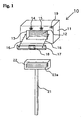
- the razor blade sharpener shown generally at 10, comprises a central unit 11 operable for attachment onto the wall of a bathroom.
- the unit 11 includes an internal razor blade sharpening mechanism 12, detailed in Fig. 3 , below, which is powered either by a battery or through an electrical connection to a standard wall socket (not shown).
- the unit includes an aperture 13 for inserting a razor blade cartridge head 22, typically located on the upper end of a razor handle 21.
- the razor blade sharpening mechanism 12 is positioned completely within the aperture 13 to prevent accidental injury to the user or a child.
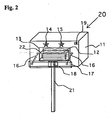
- the central unit 11 has two springs 16 attached to the main body carrying a cradle 17 for receiving the handle 21 of the disposable razor cartridge.
- the handle 21 of the disposable razor cartridge is inserted in an aperture 18 in the cradle 17.
- the motor drive for the razor blade sharpener is activated by switch 19 or optionally by the springs 16 by activating a switch when a razor blade is inserted for sharpening.
- the aperture 13 and blade sharpener 12 are capable of receiving various sized razor blade cartridge heads 22 with razor blades 23a, including those from leading manufacturers such as Gillette, Schick, and the like.
- the aperture 13 and blade sharpener 12 combination is specifically designed with dimensions that are operable for use only with a specific brand and type of razor, such as the GILLETTE MACH 3® razor.
- special razor blades may be used, which may be less expensive and more suitable for re-sharpening than blades currently on the market.
- the unit 11 further includes an internal sensor, as shown in Fig.3 , below, which informs the user as to the status of the razor blade 23a that is being serviced.
- the sensor triggers one of two different colored LED indicator bulbs 14 and 15, respectively, depending on the status of the razor blades 23a. If the sensor determines that the blade 23a can be sharpened, it will activate the internal blade sharpener 12; when the blade 23a has been completely re-sharpened, a green LED indicator 14 will illuminate, thereby informing the user that the razor 23a is ready for use.
- the sensor triggers a red LED indicator 15, thereby informing the user that the blade 23a has reached the end of its service life and should therefore be discarded.
- the unit 11 preferably has a durable and attractive outer shell, made from a suitable polymeric material.
- the unit further comprises means for rotating the razor blades 23a from their standard angled orientation 23a to a straight position, in order to allow the sharpening process to be more efficient.
- FIG. 2 there is shown at 20 a razor blade handle 21 placed in the aperture 18 of the cradle 17 with the springs 16 gently placing the cartridge 22 with multiple razor blade edges against the sharpening mechanism 12.
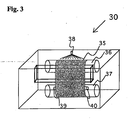
- a belt 35 is made from rubber or polymeric material impregnated with 5 to 25 micron particles.
- the belt is stretched between two rollers 36 and 37 and is driven by a motor (not shown).
- the belt is springy and makes gentle contact with the edge of the razor blade, even when multiple blades are present.
- the belt surface may be lubricated by dripping water or another lubricating liquid through a liquid dropper at 38.
- a transversely mounted light 39 and a light-receiving sensor 40 determine the integrity of the liquid film on the belt.
- Reflection of light from the thin liquid film decreases when a razor blade with a substantially deteriorated cutting edge contacts the moving belt, thereby indicating that the cutting edge of the razor blade is worn and unsuitable for sharpening.
- the sharpening operation may be terminated based on either a pre-selected time or on an absence of reflection from the thin liquid film, indicating that the thin liquid film has evaporated or has spilled away from the belt
- the key features of the razor blade sharpener include, in combination, the features set forth below:
Landscapes
- Engineering & Computer Science (AREA)
- Mechanical Engineering (AREA)
- Finish Polishing, Edge Sharpening, And Grinding By Specific Grinding Devices (AREA)
- Dry Shavers And Clippers (AREA)
Claims (11)
- Dispositif d'affûtage automatique de lames de rasoir (10) destiné à affûter une cartouche de lames de rasoir jetable (22) ayant un support en mesure d'être attaché et plusieurs lames de rasoir (23a) logées dans la cartouche (22), chaque lame de rasoir (23a) ayant une arête tranchante, ledit dispositif d'affûtage comportant :a. une chambre renfermant un mécanisme d'affûtage de lames de rasoir (12) ;b. ladite chambre étant mise en oeuvre avec une ouverture (13) adaptée pour recevoir ladite cartouche ; etc. un mécanisme à ressort (16) en mesure d'être adapté pour appliquer une tension de ressort appliquée pour tenir délicatement la dite cartouche (22) à l'intérieur de ladite ouverture (13) de telle manière que lesdites arêtes tranchantes desdites lames de rasoir (23a) entrent en contact avec ledit mécanisme d'affûtage de lames de rasoir ;
caractérisé en ce qued. ledit mécanisme d'affûtage de lames de rasoir (12) comporte une courroie mobile élastique entraînée par moteur (35), ladite courroie mobile (35) étant composée d'un matériau de type caoutchouc ou polymère et imprégnée de particules dures ayant une granulométrie allant de 5 à 25 microns et convenant à des fins de mise en contact délicate avec une lame de rasoir et de rodage ou d'affûtage de celle-ci, ce par quoi, lesdites arêtes tranchantes desdites lames de rasoir (23a) situées dans ladite cartouche (22) sont polies automatiquement par un contact délicat entre ladite courroie mobile (35) et lesdites arêtes tranchantes desdites lames de rasoir (23a) logées dans ladite cartouche (22), ladite cartouche (22) étant maintenue en place par ladite tension de ressort appliquée. - Dispositif d'affûtage automatique de lames de rasoir (10) selon la revendication 1, dans lequel le contact par le mécanisme à ressort (16) desdites arêtes tranchantes desdites lames de rasoir (23a) sur ledit mécanisme d'affûtage de lames de rasoir (12) est de commencer le processus d'affûtage, et ladite courroie mobile (35) a une surface ;
et le dispositif comporte par ailleurs :e. un système d'écoulement de liquide qui enduit la surface de ladite courroie mobile d'un liquide formant une fine pellicule liquide sur la surface de ladite courroie mobile ;f. une source de lumière montée dans le sens transversal sur ladite courroie mobile (35) destinée à éclairer la fine pellicule liquide sur la surface de ladite courroie mobile et à faire réfléchir la lumière en provenance de celle-ci ;h. un capteur monté dans le sens transversal sur ladite courroie mobile (35) adapté pour recevoir ladite lumière réfléchie en provenance de ladite fine pellicule liquide sur la surface de ladite courroie mobile (35) ;g. ledit capteur étant adapté pour déterminer la qualité de ladite arête tranchante en mesurant ladite lumière réfléchie par rapport à une valeur de référence qui est établie avant que lesdites arêtes tranchantes desdites lames de rasoir (23a) entrent en contact avec ladite courroie mobile (35) ;h. ledit mécanisme d'affûtage de lames de rasoir étant adapté pour déterminer l'état inadéquat de ladite cartouche (22) pour le processus d'affûtage en se basant sur un manque de contact total desdites arêtes tranchantes par rapport à ladite fine pellicule liquide donnant lieu à une dite lumière réfléchie médiocre ; eti. ledit mécanisme d'affûtage de lames de rasoir (12) étant adapté pour déterminer la fin du processus d'affûtage en se basant sur une perte de ladite lumière réfléchie en provenance de ladite fine pellicule liquide, ceci indiquant que ladite fine pellicule liquide s'est évaporée ou renversée. - Dispositif d'affûtage automatique de lames de rasoir (10) selon la revendication 1 ou la revendication 2, dans lequel lesdites particules dures sont des abrasifs à base de diamant.
- Dispositif d'affûtage automatique de lames de rasoir (10) selon la revendication 1 ou la revendication 2, dans lequel lesdites particules dures sont des abrasifs à base de carbure de silicium.
- Dispositif d'affûtage automatique de lames de rasoir (10) selon la revendication 1 ou la revendication 2, dans lequel lesdites particules dures sont des abrasifs à base d'alumine.
- Dispositif d'affûtage automatique de lames de rasoir (10) selon la revendication 1 ou la revendication 2, dans lequel ledit moteur est actionné par un commutateur (19) connecté audit mécanisme à ressort (16) quand lesdites arêtes tranchantes desdites lames de rasoir (23a) entrent en contact avec ledit mécanisme d'affûtage de lames de rasoir (12).
- Dispositif d'affûtage automatique de lames de rasoir (10) selon la revendication 1, dans lequel ledit moteur est coupé par un circuit de temporisation.
- Dispositif d'affûtage automatique de lames de rasoir (10) selon la revendication 2, dans lequel ledit liquide est de l'eau.
- Dispositif d'affûtage automatique de lames de rasoir (10) selon la revendication 2, dans lequel ledit liquide est de l'huile de graissage.
- Dispositif d'affûtage automatique de lames de rasoir (10) selon la revendication 2, dans lequel ledit liquide comporte des particules abrasives finement dispersées.
- Dispositif d'affûtage automatique de lames de rasoir (10) selon la revendication 2, dans lequel ledit moteur est coupé par un circuit de temporisation avant la perte du signal de réflexion du capteur.
Applications Claiming Priority (2)
| Application Number | Priority Date | Filing Date | Title |
|---|---|---|---|
| US10/985,440 US6969299B1 (en) | 2004-11-10 | 2004-11-10 | Razor blade sharpener |
| PCT/US2005/040880 WO2006053189A1 (fr) | 2004-11-10 | 2005-11-10 | Affuteuse de lame de rasoir |
Publications (3)
| Publication Number | Publication Date |
|---|---|
| EP1817137A1 EP1817137A1 (fr) | 2007-08-15 |
| EP1817137A4 EP1817137A4 (fr) | 2008-01-16 |
| EP1817137B1 true EP1817137B1 (fr) | 2009-06-17 |
Family
ID=35405082
Family Applications (1)
| Application Number | Title | Priority Date | Filing Date |
|---|---|---|---|
| EP05825498A Expired - Lifetime EP1817137B1 (fr) | 2004-11-10 | 2005-11-10 | Affuteuse de lame de rasoir |
Country Status (7)
| Country | Link |
|---|---|
| US (1) | US6969299B1 (fr) |
| EP (1) | EP1817137B1 (fr) |
| AT (1) | ATE433824T1 (fr) |
| AU (1) | AU2005304355A1 (fr) |
| CA (1) | CA2587365A1 (fr) |
| DE (1) | DE602005015019D1 (fr) |
| WO (1) | WO2006053189A1 (fr) |
Families Citing this family (13)
| Publication number | Priority date | Publication date | Assignee | Title |
|---|---|---|---|---|
| US7104874B1 (en) * | 2005-05-16 | 2006-09-12 | Milton Gussack | Razor sharpening apparatus |
| WO2007079756A1 (fr) * | 2006-01-13 | 2007-07-19 | Bo Lander Rasmussen | Dispositif de nettoyage et d'aiguisage de lame de rasoir |
| US7473232B2 (en) * | 2006-02-24 | 2009-01-06 | Boston Scientific Scimed, Inc. | Obtaining a tissue sample |
| US7134935B1 (en) * | 2006-03-15 | 2006-11-14 | Julia Grace Papetti | Lubricated razor blade edge sanitizer and sharpener |
| US7740522B2 (en) * | 2007-07-09 | 2010-06-22 | National Presto Industries, Inc. | Knife sharpener |
| IL190127A0 (en) * | 2008-03-12 | 2008-12-29 | Sahar Zaydi | Razor blade sharpeneer and method of sharpening |
| BRPI0915776A2 (pt) | 2008-07-14 | 2015-11-03 | Celso E Martell | dispositivo e método para tratar uma lâmina de um barbeador manual, e, método para fabricar um barbeador manual |
| US20110047805A1 (en) * | 2009-08-28 | 2011-03-03 | James Michael Deininger | Razor blade extender |
| USD632153S1 (en) | 2010-02-15 | 2011-02-08 | National Presto Industries, Inc. | Adjustable knife sharpener |
| US8491356B2 (en) | 2010-02-15 | 2013-07-23 | National Presto Industries, Inc. | Adjustable knife sharpener |
| US20120003906A1 (en) * | 2010-07-02 | 2012-01-05 | Messing Jan G C | Device for the cleaning and care of shaving devices |
| US8915766B1 (en) | 2014-05-22 | 2014-12-23 | Dmitriy Kolchin | Automatic knife sharpener and a method for its use |
| US11794364B1 (en) | 2022-10-11 | 2023-10-24 | Planet Earth Razors Ab | Razor blade re-coating |
Family Cites Families (18)
| Publication number | Priority date | Publication date | Assignee | Title |
|---|---|---|---|---|
| US1588322A (en) | 1924-04-04 | 1926-06-08 | Mcadoo Thomas | Razor-blade sharpener |
| US1540078A (en) | 1924-05-23 | 1925-06-02 | William R Long | Sharpener |
| GB332130A (en) * | 1929-09-18 | 1930-07-17 | Frank Oscar Seyd | Improved razor-stropping machine |
| US1832539A (en) * | 1929-12-30 | 1931-11-17 | John M Ezzell | Razor sharpener |
| US2289062A (en) | 1941-01-18 | 1942-07-07 | Gillette Safety Razor Co | Safety razor receptacle |
| US2458257A (en) | 1946-06-25 | 1949-01-04 | Albert E Donovan | Safety razor and blade sharpener |
| US2788400A (en) * | 1955-01-13 | 1957-04-09 | Chicago Musical Instr Company | Organ key switch |
| US2789400A (en) * | 1955-09-19 | 1957-04-23 | Sergerie Fernand | Straight razor sharpener |
| US2852895A (en) * | 1958-02-18 | 1958-09-23 | Pittsburgh Erie Saw Corp | Cutlery sharpener |
| US3854251A (en) | 1972-10-12 | 1974-12-17 | M Paule | Sharpening device for cutting implements such as razor blades |
| US3875702A (en) | 1973-01-11 | 1975-04-08 | George Yacos | Blade sharpening mechanism |
| DE3019598A1 (de) * | 1980-05-22 | 1981-11-26 | Dietrich 8130 Starnberg Hasse | Schleifvorrichtung |
| SU1558388A1 (ru) * | 1984-11-30 | 1990-04-23 | 2-й Московский государственный медицинский институт им.Н.И.Пирогова | Устройство дл обработки внутриклеточных стекл нных микроэлектродов |
| US5036731A (en) | 1990-10-12 | 1991-08-06 | Fletcher Charles J | Razor sharpening device |
| AR244122A1 (es) | 1991-04-19 | 1993-10-29 | Grossi Alfredo | Dispositivo de reacondicionar los elementos cortantes de rasudoras descartables de doble hoja |
| KR200216407Y1 (ko) | 1998-03-12 | 2002-06-24 | 백승호 | 면도기용날연마구 |
| GB2352993B (en) | 1999-08-10 | 2003-12-24 | Clive Alan Francis | Blade sharpener |
| US6506106B2 (en) * | 2000-09-06 | 2003-01-14 | Charles J. Fletcher | Automated razor sharpening device |
-
2004
- 2004-11-10 US US10/985,440 patent/US6969299B1/en not_active Expired - Fee Related
-
2005
- 2005-11-10 DE DE602005015019T patent/DE602005015019D1/de not_active Expired - Fee Related
- 2005-11-10 AU AU2005304355A patent/AU2005304355A1/en not_active Abandoned
- 2005-11-10 WO PCT/US2005/040880 patent/WO2006053189A1/fr not_active Ceased
- 2005-11-10 EP EP05825498A patent/EP1817137B1/fr not_active Expired - Lifetime
- 2005-11-10 AT AT05825498T patent/ATE433824T1/de not_active IP Right Cessation
- 2005-11-10 CA CA002587365A patent/CA2587365A1/fr not_active Abandoned
Also Published As
| Publication number | Publication date |
|---|---|
| EP1817137A4 (fr) | 2008-01-16 |
| AU2005304355A1 (en) | 2006-05-18 |
| CA2587365A1 (fr) | 2006-05-18 |
| ATE433824T1 (de) | 2009-07-15 |
| EP1817137A1 (fr) | 2007-08-15 |
| WO2006053189A1 (fr) | 2006-05-18 |
| DE602005015019D1 (de) | 2009-07-30 |
| US6969299B1 (en) | 2005-11-29 |
Similar Documents
| Publication | Publication Date | Title |
|---|---|---|
| WO2007109053A2 (fr) | Dispositif de nettoyage et d'affutage lubrifie d'un bord de lame de rasoir | |
| US6969299B1 (en) | Razor blade sharpener | |
| US8033894B2 (en) | Razor blade sharpener and method of sharpening | |
| US8721399B1 (en) | Manually operated sharpener | |
| US5036731A (en) | Razor sharpening device | |
| JPH0741527B2 (ja) | 刃物研摩方法及び装置 | |
| US8406598B2 (en) | Apparatus for shaping the end of an optical fiber | |
| US7104874B1 (en) | Razor sharpening apparatus | |
| CN114401819A (zh) | 具有手动珩磨台的刃磨器 | |
| US20050101231A1 (en) | Razor sharpening apparatus | |
| US7547244B2 (en) | Sonic razor blade sharpener | |
| KR101909542B1 (ko) | 면도날 연마기능을 구비하는 면도기 거치대 | |
| WO1987000108A1 (fr) | Renovateur de balai d'essuie glaces | |
| US4850149A (en) | Sharpening device | |
| US20060211346A1 (en) | Multi-bladed razor cartridge sharpener with aloe vera gel lubricant | |
| KR20070078353A (ko) | 연마 장치가 부착된 접이식 수납 커터 | |
| CN216371375U (zh) | 一种自动磨刀器 | |
| CN216030246U (zh) | 磨刀器 | |
| Hunt et al. | Optical petrology in the field | |
| JPH02243255A (ja) | 刃物研ぎ器 | |
| US2032739A (en) | Self sharpening razor | |
| GB909027A (en) | Honing unit for rotary shavers | |
| US20160243665A1 (en) | Razor Blade Sharpening Device and Method | |
| JPS5943082Y2 (ja) | 包丁研ぎ器 | |
| CN119871110A (zh) | 磨刀装置 |
Legal Events
| Date | Code | Title | Description |
|---|---|---|---|
| PUAI | Public reference made under article 153(3) epc to a published international application that has entered the european phase |
Free format text: ORIGINAL CODE: 0009012 |
|
| 17P | Request for examination filed |
Effective date: 20070524 |
|
| AK | Designated contracting states |
Kind code of ref document: A1 Designated state(s): AT BE BG CH CY CZ DE DK EE ES FI FR GB GR HU IE IS IT LI LT LU LV MC NL PL PT RO SE SI SK TR |
|
| A4 | Supplementary search report drawn up and despatched |
Effective date: 20071219 |
|
| DAX | Request for extension of the european patent (deleted) | ||
| 17Q | First examination report despatched |
Effective date: 20080331 |
|
| GRAP | Despatch of communication of intention to grant a patent |
Free format text: ORIGINAL CODE: EPIDOSNIGR1 |
|
| GRAS | Grant fee paid |
Free format text: ORIGINAL CODE: EPIDOSNIGR3 |
|
| GRAA | (expected) grant |
Free format text: ORIGINAL CODE: 0009210 |
|
| AK | Designated contracting states |
Kind code of ref document: B1 Designated state(s): AT BE BG CH CY CZ DE DK EE ES FI FR GB GR HU IE IS IT LI LT LU LV MC NL PL PT RO SE SI SK TR |
|
| REG | Reference to a national code |
Ref country code: GB Ref legal event code: FG4D |
|
| REG | Reference to a national code |
Ref country code: CH Ref legal event code: EP |
|
| REG | Reference to a national code |
Ref country code: IE Ref legal event code: FG4D |
|
| REF | Corresponds to: |
Ref document number: 602005015019 Country of ref document: DE Date of ref document: 20090730 Kind code of ref document: P |
|
| PG25 | Lapsed in a contracting state [announced via postgrant information from national office to epo] |
Ref country code: FI Free format text: LAPSE BECAUSE OF FAILURE TO SUBMIT A TRANSLATION OF THE DESCRIPTION OR TO PAY THE FEE WITHIN THE PRESCRIBED TIME-LIMIT Effective date: 20090617 Ref country code: LT Free format text: LAPSE BECAUSE OF FAILURE TO SUBMIT A TRANSLATION OF THE DESCRIPTION OR TO PAY THE FEE WITHIN THE PRESCRIBED TIME-LIMIT Effective date: 20090617 Ref country code: AT Free format text: LAPSE BECAUSE OF FAILURE TO SUBMIT A TRANSLATION OF THE DESCRIPTION OR TO PAY THE FEE WITHIN THE PRESCRIBED TIME-LIMIT Effective date: 20090617 |
|
| PG25 | Lapsed in a contracting state [announced via postgrant information from national office to epo] |
Ref country code: SI Free format text: LAPSE BECAUSE OF FAILURE TO SUBMIT A TRANSLATION OF THE DESCRIPTION OR TO PAY THE FEE WITHIN THE PRESCRIBED TIME-LIMIT Effective date: 20090617 Ref country code: SE Free format text: LAPSE BECAUSE OF FAILURE TO SUBMIT A TRANSLATION OF THE DESCRIPTION OR TO PAY THE FEE WITHIN THE PRESCRIBED TIME-LIMIT Effective date: 20090917 Ref country code: PL Free format text: LAPSE BECAUSE OF FAILURE TO SUBMIT A TRANSLATION OF THE DESCRIPTION OR TO PAY THE FEE WITHIN THE PRESCRIBED TIME-LIMIT Effective date: 20090617 Ref country code: LV Free format text: LAPSE BECAUSE OF FAILURE TO SUBMIT A TRANSLATION OF THE DESCRIPTION OR TO PAY THE FEE WITHIN THE PRESCRIBED TIME-LIMIT Effective date: 20090617 |
|
| NLV1 | Nl: lapsed or annulled due to failure to fulfill the requirements of art. 29p and 29m of the patents act | ||
| PG25 | Lapsed in a contracting state [announced via postgrant information from national office to epo] |
Ref country code: IS Free format text: LAPSE BECAUSE OF FAILURE TO SUBMIT A TRANSLATION OF THE DESCRIPTION OR TO PAY THE FEE WITHIN THE PRESCRIBED TIME-LIMIT Effective date: 20091017 Ref country code: CZ Free format text: LAPSE BECAUSE OF FAILURE TO SUBMIT A TRANSLATION OF THE DESCRIPTION OR TO PAY THE FEE WITHIN THE PRESCRIBED TIME-LIMIT Effective date: 20090617 Ref country code: EE Free format text: LAPSE BECAUSE OF FAILURE TO SUBMIT A TRANSLATION OF THE DESCRIPTION OR TO PAY THE FEE WITHIN THE PRESCRIBED TIME-LIMIT Effective date: 20090617 Ref country code: ES Free format text: LAPSE BECAUSE OF FAILURE TO SUBMIT A TRANSLATION OF THE DESCRIPTION OR TO PAY THE FEE WITHIN THE PRESCRIBED TIME-LIMIT Effective date: 20090928 Ref country code: RO Free format text: LAPSE BECAUSE OF FAILURE TO SUBMIT A TRANSLATION OF THE DESCRIPTION OR TO PAY THE FEE WITHIN THE PRESCRIBED TIME-LIMIT Effective date: 20090617 |
|
| PG25 | Lapsed in a contracting state [announced via postgrant information from national office to epo] |
Ref country code: SK Free format text: LAPSE BECAUSE OF FAILURE TO SUBMIT A TRANSLATION OF THE DESCRIPTION OR TO PAY THE FEE WITHIN THE PRESCRIBED TIME-LIMIT Effective date: 20090617 Ref country code: NL Free format text: LAPSE BECAUSE OF FAILURE TO SUBMIT A TRANSLATION OF THE DESCRIPTION OR TO PAY THE FEE WITHIN THE PRESCRIBED TIME-LIMIT Effective date: 20090617 Ref country code: BE Free format text: LAPSE BECAUSE OF FAILURE TO SUBMIT A TRANSLATION OF THE DESCRIPTION OR TO PAY THE FEE WITHIN THE PRESCRIBED TIME-LIMIT Effective date: 20090617 |
|
| PG25 | Lapsed in a contracting state [announced via postgrant information from national office to epo] |
Ref country code: PT Free format text: LAPSE BECAUSE OF FAILURE TO SUBMIT A TRANSLATION OF THE DESCRIPTION OR TO PAY THE FEE WITHIN THE PRESCRIBED TIME-LIMIT Effective date: 20091017 Ref country code: BG Free format text: LAPSE BECAUSE OF FAILURE TO SUBMIT A TRANSLATION OF THE DESCRIPTION OR TO PAY THE FEE WITHIN THE PRESCRIBED TIME-LIMIT Effective date: 20090917 |
|
| PLBE | No opposition filed within time limit |
Free format text: ORIGINAL CODE: 0009261 |
|
| STAA | Information on the status of an ep patent application or granted ep patent |
Free format text: STATUS: NO OPPOSITION FILED WITHIN TIME LIMIT |
|
| PG25 | Lapsed in a contracting state [announced via postgrant information from national office to epo] |
Ref country code: DK Free format text: LAPSE BECAUSE OF FAILURE TO SUBMIT A TRANSLATION OF THE DESCRIPTION OR TO PAY THE FEE WITHIN THE PRESCRIBED TIME-LIMIT Effective date: 20090617 |
|
| 26N | No opposition filed |
Effective date: 20100318 |
|
| PG25 | Lapsed in a contracting state [announced via postgrant information from national office to epo] |
Ref country code: MC Free format text: LAPSE BECAUSE OF NON-PAYMENT OF DUE FEES Effective date: 20091130 |
|
| REG | Reference to a national code |
Ref country code: CH Ref legal event code: PL |
|
| GBPC | Gb: european patent ceased through non-payment of renewal fee |
Effective date: 20091110 |
|
| REG | Reference to a national code |
Ref country code: FR Ref legal event code: ST Effective date: 20100730 |
|
| PG25 | Lapsed in a contracting state [announced via postgrant information from national office to epo] |
Ref country code: LI Free format text: LAPSE BECAUSE OF NON-PAYMENT OF DUE FEES Effective date: 20091130 Ref country code: IE Free format text: LAPSE BECAUSE OF NON-PAYMENT OF DUE FEES Effective date: 20091110 Ref country code: GR Free format text: LAPSE BECAUSE OF FAILURE TO SUBMIT A TRANSLATION OF THE DESCRIPTION OR TO PAY THE FEE WITHIN THE PRESCRIBED TIME-LIMIT Effective date: 20090918 Ref country code: FR Free format text: LAPSE BECAUSE OF NON-PAYMENT OF DUE FEES Effective date: 20091130 Ref country code: CH Free format text: LAPSE BECAUSE OF NON-PAYMENT OF DUE FEES Effective date: 20091130 |
|
| PG25 | Lapsed in a contracting state [announced via postgrant information from national office to epo] |
Ref country code: DE Free format text: LAPSE BECAUSE OF NON-PAYMENT OF DUE FEES Effective date: 20100601 |
|
| PG25 | Lapsed in a contracting state [announced via postgrant information from national office to epo] |
Ref country code: GB Free format text: LAPSE BECAUSE OF NON-PAYMENT OF DUE FEES Effective date: 20091110 |
|
| PG25 | Lapsed in a contracting state [announced via postgrant information from national office to epo] |
Ref country code: LU Free format text: LAPSE BECAUSE OF NON-PAYMENT OF DUE FEES Effective date: 20091110 |
|
| PG25 | Lapsed in a contracting state [announced via postgrant information from national office to epo] |
Ref country code: HU Free format text: LAPSE BECAUSE OF FAILURE TO SUBMIT A TRANSLATION OF THE DESCRIPTION OR TO PAY THE FEE WITHIN THE PRESCRIBED TIME-LIMIT Effective date: 20091218 |
|
| PG25 | Lapsed in a contracting state [announced via postgrant information from national office to epo] |
Ref country code: TR Free format text: LAPSE BECAUSE OF FAILURE TO SUBMIT A TRANSLATION OF THE DESCRIPTION OR TO PAY THE FEE WITHIN THE PRESCRIBED TIME-LIMIT Effective date: 20090617 |
|
| PG25 | Lapsed in a contracting state [announced via postgrant information from national office to epo] |
Ref country code: CY Free format text: LAPSE BECAUSE OF FAILURE TO SUBMIT A TRANSLATION OF THE DESCRIPTION OR TO PAY THE FEE WITHIN THE PRESCRIBED TIME-LIMIT Effective date: 20090617 |
|
| PGFP | Annual fee paid to national office [announced via postgrant information from national office to epo] |
Ref country code: IT Payment date: 20130329 Year of fee payment: 8 |
|
| PG25 | Lapsed in a contracting state [announced via postgrant information from national office to epo] |
Ref country code: IT Free format text: LAPSE BECAUSE OF NON-PAYMENT OF DUE FEES Effective date: 20131110 |