EP1831099B1 - Verfahren zur verpackung eines ein viskoses produkt enthaltenden flexiblen behälters - Google Patents
Verfahren zur verpackung eines ein viskoses produkt enthaltenden flexiblen behälters Download PDFInfo
- Publication number
- EP1831099B1 EP1831099B1 EP05823827A EP05823827A EP1831099B1 EP 1831099 B1 EP1831099 B1 EP 1831099B1 EP 05823827 A EP05823827 A EP 05823827A EP 05823827 A EP05823827 A EP 05823827A EP 1831099 B1 EP1831099 B1 EP 1831099B1
- Authority
- EP
- European Patent Office
- Prior art keywords
- viscous product
- mobile
- flexible
- tank
- container
- Prior art date
- Legal status (The legal status is an assumption and is not a legal conclusion. Google has not performed a legal analysis and makes no representation as to the accuracy of the status listed.)
- Expired - Lifetime
Links
Images
Classifications
-
- B—PERFORMING OPERATIONS; TRANSPORTING
- B67—OPENING, CLOSING OR CLEANING BOTTLES, JARS OR SIMILAR CONTAINERS; LIQUID HANDLING
- B67D—DISPENSING, DELIVERING OR TRANSFERRING LIQUIDS, NOT OTHERWISE PROVIDED FOR
- B67D7/00—Apparatus or devices for transferring liquids from bulk storage containers or reservoirs into vehicles or into portable containers, e.g. for retail sale purposes
- B67D7/02—Apparatus or devices for transferring liquids from bulk storage containers or reservoirs into vehicles or into portable containers, e.g. for retail sale purposes for transferring liquids other than fuel or lubricants
-
- B—PERFORMING OPERATIONS; TRANSPORTING
- B65—CONVEYING; PACKING; STORING; HANDLING THIN OR FILAMENTARY MATERIAL
- B65B—MACHINES, APPARATUS OR DEVICES FOR, OR METHODS OF, PACKAGING ARTICLES OR MATERIALS; UNPACKING
- B65B69/00—Unpacking of articles or materials, not otherwise provided for
- B65B69/0075—Emptying systems for flexible intermediate bulk containers [FIBC]
-
- B—PERFORMING OPERATIONS; TRANSPORTING
- B65—CONVEYING; PACKING; STORING; HANDLING THIN OR FILAMENTARY MATERIAL
- B65B—MACHINES, APPARATUS OR DEVICES FOR, OR METHODS OF, PACKAGING ARTICLES OR MATERIALS; UNPACKING
- B65B3/00—Packaging plastic material, semiliquids, liquids or mixed solids and liquids, in individual containers or receptacles, e.g. bags, sacks, boxes, cartons, cans, or jars
- B65B3/04—Methods of, or means for, filling the material into the containers or receptacles
- B65B3/16—Methods of, or means for, filling the material into the containers or receptacles for filling collapsible tubes
Definitions
- the present invention relates to a continuous or batch process for packaging a viscous product contained in storage containers of capacity> 50 l, preferably ⁇ 100 l, in volume units adapted to the use and with a capacity of ⁇ 50 l, preferably ⁇ 10 l.
- the containers for storing the viscous product are advantageously flexible containers, in particular of the "big bag” type, and the volume conditioning units are, for example, cylindrical cartridges, boxes of all shapes made of metal, glass, plastic, paper or cardboard, aluminized or not.
- the invention also relates to a draining kit, including a mobile and autonomous machine for expelling the viscous product out of the flexible containers.
- Such viscous products can be stored in bulk in flexible containers of the "big bag” type, before being packaged in other smaller volume packages.
- the patent application DE-A-34 29 167 discloses a method and a device for emptying flexible containers for bulk particulate products.
- the flexible container of "big bag” type is, on the one hand, suspended via the handles of which it is equipped, and on the other hand housed in a hopper, on which shaking is carried out by means of a rotating eccentric foot and two other spring-mounted feet.
- This vibration-emptying device does not seem suitable for viscous products contained in flexible bags.
- techniques are known for emptying rigid drums of viscous products using a drum press comprising a pressure plate intended to penetrate and move in a drum to pressurize the viscous product contained in a bag under pressure. fine plastic, for example polyethylene.
- the remote technological background also includes container emptying systems consisting of a rigid cardboard box containing a thin polyethylene bag loaded with viscous products.
- the emptying of this type of container is effected by means of a pressure plate capable of expelling the viscous product out of the polyethylene bag, said viscous product then being taken up by pumps provided for this purpose, to be conveyed to downstream elements.
- the patent application PCT WO-A-2004/074164 discloses a method of emptying flexible containers for viscous products, easy to implement and economical. This application also describes a necessary emptying kit in the implementation of the method.
- the viscous products are chosen from the group of viscosity products of between 10 Pa.s and 200,000 Pa.s, ie eg silicone oils or gums.
- This emptying process essentially consists of: implementing a flexible container; possibly move the container to empty from its storage site to a drain site; ensuring that at least one outlet opening, preferably disposed in the lower part of the container, allows the flow of the viscous product out of the container; exerting pressure on at least one defined area of the flexible container by means of pressurizing means, preferably constituted by at least one pressing member and / or a pressurizing fluid, so as, on the one hand, keep the container inflated or partially inflated and, on the other hand, hasten the flow; depressurize at the end of emptying.
- the emptying device comprises, on the one hand, a pressing member comprising at least one piston and, on the other hand, at least one emptying tank intended to receive the flexible container.
- the pressure member is a static hydraulic press very expensive, very bulky and very heavy (4 to 5 tons).
- a hydraulic press is permanently assigned to a single packer of the viscous product in packages of smaller volumes than the "big bags", for example the silicone sealant cartridges. So at least one hydraulic press is required.
- the size of a hydraulic press is an industrial handicap, as space is limited.
- the heavy weight of hydraulic presses requires expensive civil engineering works, able to withstand them.
- These hydraulic presses also pose other problems. Indeed, such presses are long-term financial assets to be depreciated, and all the more because it is penalizing in terms of productivity to have a single static emptying press by packaging machine.
- one of the essential objectives of the present invention is to improve and / or propose an alternative to the invention described in the application.
- PCT WO-A-2004/074164 providing an easy to implement and economical method of packaging a viscous product contained in storage containers of capacity ⁇ 501, preferably ⁇ 1001, in volume units suitable for use and of capacity ⁇ 501, preferably ⁇ 101.
- one of the essential objectives of the present invention is to provide a method of packaging a bulk viscous product in volume units adapted to the use and of low volume ( ⁇ 101), this process being carried out to be flexible and to allow the change in masked time of big bags "feeding a line of conditioning.
- Another essential objective of the present invention is to provide a method of packaging a bulk viscous product in volume units suitable for use and of low volume ( ⁇ 10 1), this process being carried out lead to low material losses, for example less than or equal to 1.5% or even 0.8%, and which requires very little or no cleaning of the equipment used.
- Another essential objective of the present invention is to provide a packaging kit for a viscous bulk product ("big bag"), in volume units adapted to the use and of low volume ( ⁇ 10 1). which is lightweight, compact, simple, economical and inexpensive, that allows to empty flexible bags with capacity greater than or equal to 250 liters which is easy to use, which generates very little loss of materials (lower or 1.5%) and requires little or no cleaning.
- Another essential objective of the invention is to provide a packaging kit for a bulk viscous product ("big bag"), in volume units adapted to the use and of low volume ( ⁇ 10 1). , responding optimally to the industrial requirements of transport and logistics.
- One of the essential characteristics of the invention is therefore the implementation of a mobile and autonomous expulsion machine, which can be easily moved from one packaging machine to another and which is autonomous with regard to the emptying by expelling the viscous product out of the flexible container. To do this, it is equipped with expulsion means that are also mobile, lightweight, inexpensive and compact.
- the process according to the invention offers a wide range of emptying rates that can be varied depending on the viscosity of the product in question, the outlet diameter or the pressure value exerted.
- the mobile machine for expelling the viscous product out of the flexible containers comprises a tank intended to receive a flexible container.
- step e) consists in implementing at least one mobile and autonomous expulsion machine comprising at least one pressing member comprising at least one piston intended to exert a thrust on the flexible container.
- At least one mobile and autonomous expulsion machine comprising a vessel designed so as to be closed the piston of said machine being able to move under the action of a pressure-fluid , so as to expel the viscous product out of the tank.
- a pressure fluid contained in an inflatable cylinder is used, this jack being housed between the piston and a reversible closure lid of the tank or the bottom of the tank. tank and connected to pressurizing fluid supply means equipping the mobile and autonomous expulsion machine, said fluid-pressure supply means for inflation and consequently displacement of the piston, to allow the expulsion of the product viscous out of the tank.
- the pressure fluid used may be a gas or a liquid. It can be a liquid having a viscosity less than or equal to 50 Pa.s. Water could be perfectly suitable for this purpose.
- the mobile and autonomous machine that is preferably selected comprises a viscous product extraction pump and a follower plate intended to rest on the flexible container out of operation of said machine and throughout the emptying of the flexible container. .
- the viscous product expelled from the flexible container feeds storage means and / or mechanical means for setting the viscous product in motion to increase its flow rate, said mechanical means preferably being selected from the group consisting of: pumps, (double) -vis.
- the viscous product expelled from the flexible container feeds at least one packaging unit of said product in a suitable packaging, at a suitable flow rate greater than or equal to the consumption of the packaging machine.
- the flow is advantageously the highest possible, (for example greater than 50 liters per minute for a viscous product of 1000 Pa.s) so as to provide maximum productivity, in the food case of a packaging machine, it is desirable to have high instantaneous flow rates (for example, may be greater than 1 liter per minute).
- the flow rate naturally depends on all the parameters of the Poiseuille law (viscosity, pressure difference, geometry of the outlet duct) and elements hindering the output of the viscous product: valves, filters, roughness.
- the packaging machine could in particular be a device for putting in a cartridge of viscous products, in particular silicone sealants ("encartoucheuse”), according to a flow rate adapted at least equal to the consumption of the set of packs
- the viscous product expelled from the flexible container feeds mechanical means for setting the viscous product in motion interposed between the mobile and autonomous expulsion machine and making it possible to increase its flow rate, said mechanical means preferably being selected from the group consisting of: pumps, (double) -vis.
- the method according to the invention is not limited as to the number of mobile and autonomous expulsion machines, fixed expulsion machines, packaging machines, and any storage or mechanical recovery means arranged downstream.
- the pressure exerted is, for example, between 1 and 6 bars in the case of direct discharge by expulsion, while it is adjusted so that the output flow rate of the viscous product is greater than or equal to the consumption of the conditioner disposed downstream of the the mobile and autonomous machine of expulsion.
- the present invention relates to a kit for carrying out the above-defined method, as defined in claim 11.
- the flexible container is, for example, of the "big bag” type.
- it is a container whose wall to be flexible does not remain less mechanically resistant and has moreover and preferably sealing properties vis-à-vis the viscous product considered.
- This container formed by such a flexible envelope is a sufficient packaging in terms of protection of the viscous product. It is an autonomous packaging that can be transported easily, for example by simply being placed on a pallet and attached, or even included in other containers that are not involved in the emptying process, unlike bags polyethylene, which, in known manner, are housed in rigid containers for both transport and emptying.
- the flexible envelope container used in the process according to the invention can be for example a cloth bag (eg polypropylene) lined with a thin bag, for example multilayer (polyethylene / aluminum / polyethylene terephthalate) glued and / or stitched to the canvas, said container being optionally and advantageously provided with handles for suspending and handling with a hoist or forklift.
- These flexible containers or "big bag” can have large capacities, for example between 500 and 2000 liters.
- the flexible envelope container can be disposable, which is a source of economy, particularly in terms of transport and storage. This avoids complicated "supply chain” rotations of metal containers
- the flexible container has a mechanically resistant and watertight wall made from fabric (s) whose uncoated weight is in the range of 100 to 300 g / m 2 and the bag-liner has a thickness in the range of 5 to 500 microns.
- it may be polypropylene fabric with a density of 150-300 g / m 2 for a 1000 liter container.
- the bag-lining is for example glued or sewn inside or outside the mechanically resistant wall.
- This bag-lining end can have a thickness of between 10 and 250 microns. It should be noted that the fabric thicknesses of the wall and the liner-bag are a function of the desired mechanical strength and physicochemical protection.
- the flexible container is provided with one or more discharge chutes, identical or different structure to that of the flexible container.
- each chute possibly provided on the flexible container may be used for emptying or filling said container and may also play the role shutter of an opening for example by means of a plug or a knotted link. This plug could consist of a weld and / or a glue joint.
- Each possible chute may furthermore constitute a connection element of the flexible container to a downstream mechanical recovery or conditioning storage means.
- the flexible container comprises at least one large opening or so-called “total" opening facilitating the filling.
- This large opening may be closed by welding and / or by a knot and / or by an adhesive joint. It is preferable that such a large opening is used only for filling, unlike the openings and / or drain channels as described above.
- the mobile and autonomous expulsion machine comprises at least one pressure fluid reservoir and a pipe connecting the fluid-pressure reservoir to the inflatable cylinder.
- the fluid-pressure is for example chosen from the group of incompressible fluids, preferably from the subgroup of liquids, eg with a viscosity of less than 50 Pa.s, including water or oil, or in the group of compressible fluids, with air being preferred.
- the drain tank is designed as an autoclave provided with at least one opening which can be open or closed and serving to introduce and / or evacuate the pressure fluid.
- this autoclave drain tank also includes at least one drain opening for the viscous product.
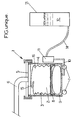
- the single figure shows a machine 1 mobile and autonomous expulsion of a viscous product 2 included in a flexible container 3.
- the latter is disposed inside a tank 4, open at its upper end and generally cylindrical flat bottom.
- the open upper end of this tank 4, is hermetically closed by a lid 5, reversibly.
- This lid 5 comprises an orifice connected to an outlet duct 6 for conveying the viscous product 2 to a packaging machine included in the packaging kit according to the invention but not shown in the drawing.
- the tank 4 (for example with a capacity of 1000 liters and for example stainless steel) is equipped with wheels 7 allowing its easy movement, for example the place of storage of the flexible containers 3 to a packaging machine and vice versa.
- the wheels 7 could be replaced by other means able to confer mobility to the machine 1. It could for example be a pallet for transporting the machine 1 with the help of lifting and handling equipment.
- the flexible container 3 or "big bag” of viscous product 2 rests inside the tank 4 on a pressing member constituted by a movable piston 8.
- This pressing piston 8 has a maximum outside diameter slightly smaller than the inside diameter. of the tank 4 (for example 0.1 to 2.5% lower) so as to be able to slide easily.
- a flexible inflating cylinder 9 is housed in the tank 4 between the pressing piston 8 and the bottom of the tank 4.
- This flexible inflation cylinder 9 can be for example of the type marketed by the company PRONAL.
- the pressure fluid supply of the inflatable flexible cylinder 9 is effected via a pipe 10 passing through the bottom of the tank 4 and connected at its outer end to means 11 for conveying (pump) of the pressing fluid 12 contained in a tank 13.
- the connection tank 13 - pump 11 is provided by a pipe 14.
- the pressure fluid 12 may be an incompressible fluid, for example a liquid such as water or oil, or even a compressible fluid such as air.
- the flexible container 3 housed inside the tank 4, has an outlet passage 15 of the viscous product 2.
- This passage 15 is provided in the upper part of the flexible container 3 during storage of the flexible container viscous product of this passage output 15 is closed.
- the closure of the outlet passage 15 is achieved by any appropriate means known to those skilled in the art, for example: bonding, thermo welding, sewing, gluing, stapling, etc.
- This outlet passage 15 is disposed in the vicinity of the orifice of the cover 5 connected to the outlet duct 6 to the conditioner.
- the opening of this outlet passage 15 is made just before the expulsion of the viscous product, that is to say just before the pressurization of the flexible container 3 by the pressure piston 8 actuated by the inflatable cylinder 9.
- the seal between the head of the pressing piston 8 and the inner face of the tank 4 can be provided by an O-ring not shown in the drawing, which forms a barrier to the migration of the viscous product 2 in the volume compartment variable of the tank 4 containing the inflatable cylinder 9.
- This embodiment with a flexible inflating cylinder 9 is simple to implement and economical. It is also a lightweight, non-bulky pressing member that participates in the advantages of the mobile and autonomous machine 1. The latter has another advantage of being quickly mountable and removable.
- the lid 5 of the tank 4 may be equipped with a safety valve allowing the evacuation of air overpressures.
- the operation of the mobile and autonomous machine 1 is simply to inflate the flexible cylinder 9 with the aid of the pressure fluid, so as to compress the flexible container 3 and thus expel the viscous product 2 contained in this flexible container 3 to the outside the tank 4 through the outlet duct 6 towards the conditioner not shown in the drawing.
Landscapes
- Engineering & Computer Science (AREA)
- Mechanical Engineering (AREA)
- Basic Packing Technique (AREA)
- Packages (AREA)
- Containers And Packaging Bodies Having A Special Means To Remove Contents (AREA)
- Bag Frames (AREA)
- Supply Of Fluid Materials To The Packaging Location (AREA)
- Supplying Of Containers To The Packaging Station (AREA)
- Packging For Living Organisms, Food Or Medicinal Products That Are Sensitive To Environmental Conditiond (AREA)
Claims (16)
- Verfahren zur Verpackung eines in Lagerbehältern mit einer Kapazität von ≥ 50 1, vorzugsweise ≥ 100 l, enthaltenen viskosen Produkts in Volumeneinheiten, die für die Verwendung geeignet sind und eine Kapazität von ≤ 50 l, vorzugsweise ≤ 10 1 haben,
wobei das viskose Produkt vorzugsweise aus der Gruppe der Produkte ausgewählt wird, deren Viskosität mindestens 10 Pa.s beträgt und vorzugsweise zwischen 10 Pa.s und 200 000 Pa.s liegt, bei dem:a) als Lagerbehälter mit einer Kapazität von ≥ 50 1 weiche Behälter (3) eingesetzt werden, wobei die weichen Behälter je mindestens Austrittsdurchgang (15) aufweisen, der ggf. verschlossenen ist,b) ggf. jeder weiche Behälter in einer zerlegbaren eindrahtigen Schachtel, vorzugsweise aus Faltkarton, zwischengelagert wird,c) ggf. die weichen Behälter aus ihren Zwischenlagerungsschachteln entnommen werden,d) die weichen Behälter von ihrem Lagerort zu einem Verpackungsort transportiert werden,
dadurch gekennzeichnet, dass:e) mindestens zwei Maschinen zur Verpackung des viskosen Produkts (2) in den Einheiten, die für die Verwendung geeignet sind und eine Kapazität von ≤ 50 l haben, eingesetzt werden, die mindestens zwei beweglichen und autonomen Maschinen für den Ausstoß des viskosen Produkts (2) aus den weichen Behältern (3) zugeordnet sind und den Betrieb in Überlappungszeit erlauben, wobei der Ausführungsmodus aus der folgenden Gruppe ausgewählt wird:• der Modus, in dem es zwei bewegliche Maschinen zum Entleeren von weichen Behältern und eine ortsfeste Maschine zum Entleeren von eindrahtigen Behältern pro Paar von Verpackungsmaschinen gibt; und• der Modus, in dem es drei bewegliche Maschinen zum Entleeren von weichen Behältern pro Paar von Verpackungsmaschinen gibt;f) der Austrittsdurchgang (15) geöffnet wird, wenn dieser verschlossen ist, und so der Ausstoß des viskosen Produkts (2) aus dem Behälter (3) erlaubt wird,g) das viskose Produkt (2) mit Hilfe der beweglichen und autonomen Ausstoßmaschine ausgestoßen wird,h) das ausgestoßene viskose Produkt (2) zur Verpackungsmaschine geleitet wird, undi) dafür gesorgt wird, dass die Verpackungsmaschine Einheiten, die für die Verwendung geeignet sind und eine Kapazität von ≤ 50 l haben, mit der gewünschten Dosis füllt. - Verfahren nach Anspruch 1, dadurch gekennzeichnet, dass für den Ausstoß gemäß dem Schritt g):g1) mit Hilfe von Mittel zum Unterdrucksetzen, die zu der beweglichen Maschine gehören und vorzugsweise aus mindestens einem Druckorgan (8) und/oder aus einem Druckfluid bestehen, ein Druck auf mindestens eine begrenzte Zone des weichen Behälters (3) ausgeübt wird, um einerseits den Behälter (3) im aufgeblasenen oder teilweise aufgeblasenen Zustand zu halten, und andererseits den Ausstoß des viskosen Produkts (2) zu ermöglichen; und/oderg2) das viskose Produkt gepumpt wird; undg3) falls nötig, am Ende des Ausstoßes Druck abgelassen wird.
- Verfahren nach Anspruch 1, dadurch gekennzeichnet, dass jede bewegliche Maschine zum Ausstoß des viskosen Produkts (2) aus den weichen Behältern (3) ein Gefäß (4) aufweist, das dazu bestimmt ist, einen weichen Behälter (3) aufzunehmen.
- Verfahren nach den Ansprüchen 1 und 2, dadurch gekennzeichnet, dass im Schritt e) mindestens zwei bewegliche und autonome Ausstoßmaschinen eingesetzt werden, die mindestens ein Druckorgan (8) enthalten, das mindestens einen Kolben (8) aufweist, der dazu bestimmt ist, einen Druck auf den weichen Behälter (3) auszuüben.
- Verfahren nach Anspruch 3 oder 4, dadurch gekennzeichnet, dass mindestens zwei bewegliche und autonome Ausstoßmaschinen eingesetzt werden, die ein Gefäß (4) enthalten, das konzipiert ist, um verschlossen werden zu können, und dass der Kolben (8) der Maschinen fähig ist, sich unter der Wirkung eines Druckfluids zu bewegen, um das viskose Produkt (2) aus dem Gefäß (4) auszustoßen.
- Verfahren nach Anspruch 5, dadurch gekennzeichnet, dass ein in einem aufblasbaren Zylinder enthaltenes Druckfluid verwendet wird, wobei dieser Zylinder zwischen dem Kolben (8) und einem Deckel zum umkehrbaren Verschließen des Gefäßes (4) oder dem Boden des Gefäßes (4) angeordnet und mit Druckfluid-Speisemittel verbunden ist, die zur beweglichen und autonomen Ausstoßmaschine gehören, wobei die Druckfluid-Speisemittel das Aufblasen und anschließende Verschieben des Kolbens (8) erlauben, um den Ausstoß des viskosen Produkts (2) aus dem Gefäß (4) zu ermöglichen.
- Verfahren nach einem der vorhergehenden Ansprüche, dadurch gekennzeichnet, dass jede bewegliche und autonome Maschine eine Pumpe zur Entnahme des viskosen Produkts (2) und eine Folgeplatte aufweist, die dazu bestimmt ist, wenn die Maschine außer Betrieb ist und während der ganzen Leerung des weichen Behälters, auf dem weichen Behälter zu ruhen.
- Verfahren nach einem der vorhergehenden Ansprüche, dadurch gekennzeichnet, dass das viskose Produkt (2) aus der Gruppe ausgewählt wird, die enthält:o die Silicone, vorzugsweise Siliconöle, Silicongummis, Polyorganosiloxan-Zusammensetzungen (ggf. in Form von wässrigen Emulsionen), zu Elastomeren vernetzbar durch Polyadditions-, Polykondensations- oder Dehydrogeno(poly)kondensationsreaktionen;o die organischen Polymere, die reaktive siliciumorganische Gruppen (MS-Polymere genannt) enthalten;o die Füllstoffe enthaltenden Zusammensetzungen, in Lösungsmedium oder in wässrigem Medium, die ein Acrylpolymer enthalten und durch Trocknen zu Elastomeren vernetzbar sind;o die Nahrungsmittel;o die Agrarnahrungsmittel;o die Anstrichfarben; undo die Druckfarben.
- Verfahren nach einem der vorhergehenden Ansprüche, dadurch gekennzeichnet, dass die Öffnung (oder die Öffnungen) des Austrittsdurchgangs (oder der Ausgangsdurchgänge) (15) des Behälters (3) erhalten wird (werden) durch:- Ausschneiden in der Wand des Behälters (3); und/oder- Entfernen eines Deckels (von Deckeln) oder von Verschlussorganen; und/oder- Entfernen von einem (von) eine Öffnung (Öffnungen), die bereits auf dem Behälter (3) vorgesehen ist (sind), verschließenden Band (Bändern).
- Verfahren nach einem der vorhergehenden Ansprüche, dadurch gekennzeichnet, dass das aus dem weichen Behälter ausgestoßene viskose Produkt (2) mechanische Mittel zum Inbewegungversetzen des viskosen Produkts speist, die zwischen der beweglichen und autonomen Ausstoßmaschine eingefügt sind und es ermöglichen, ihren Durchsatz zu erhöhen, wobei die mechanischen Mittel vorzugsweise aus der Gruppe ausgewählt werden, die enthält: die Pumpen und die (Doppel)-Schnecken.
- Anordnung zur Durchführung des Verfahrens nach einem der Ansprüche 1 bis 10, die enthält:- ein viskoses Produkt (2), das aus der Gruppe der Produkte ausgewählt wird, deren Viskosität höher als oder gleich 50 Pa.s ist, vorzugsweise zwischen 100 Pa.s und 10.000 Pa.s liegt,- weiche Lagerbehälter (3) mit einer Kapazität von ≥ 50 1, wobei die weichen Behälter je mindestens einen Austrittsdurchgang (15) aufweisen, der ggf. verschlossen ist,dadurch gekennzeichnet, dass sie enthält:- mindestens zwei Maschinen zur Verpackung des viskosen Produkts (2) in den Einheiten, die für die Verwendung geeignet sind und eine Kapazität von ≤ 50 l haben, die mindestens zwei beweglichen und autonomen Maschinen zum Ausstoß des viskosen Produkts (2) aus den weichen Behältern (3) zugeordnet sind, und die Anordnung zwei bewegliche Maschinen zum Leeren weicher Behälter und eine ortsfeste Maschine zum Leeren nicht weicher Behälter oder drei bewegliche Maschinen zum Leeren weicher Behälter pro Paar von Verpackungsmaschinen enthält,- ggf. mechanische Mittel zum Inbewegungsversetzen des viskosen Produkts, die es ermöglichen, seinen Durchsatz zu erhöhen, wobei die mechanischen Mittel vorzugsweise aus der Gruppe ausgewählt werden, die enthält: die Pumpen und die (Doppel)-Schnecken.
- Anordnung nach Anspruch 11, dadurch gekennzeichnet, dass der weiche Behälter (3) eine Wand hat, die besteht aus:• mindestens einem Element, das die mechanische Festigkeit gewährleistet und eine oder mehrere Schichten von gleichen oder unterschiedlichen Materialien, vorzugsweise aus Tuch, enthält; und/oder• mindestens einem Dichtungselement, das von (i) mindestens einem Polymerfilm, vorzugsweise in Form eines Belags, und/oder (2i) von mindestens einem dichten Innenbeutel gebildet wird, der aus einer oder mehreren Schichten von Werkstoffen besteht, die aus der Gruppe ausgewählt werden, die enthält: die synthetischen Polymerfilme (insbesondere die Polyolefine - und noch bevorzugter die Polyethylene, die Polypropylene - die Polyester oder die Polyamide), oder die Metalle (insbesondere Aluminium); wobei der (die) Innenbeutel, falls verwendet, fest mit dem Wandelement verbunden ist (sind), das die mechanische Festigkeit gewährleistet, wobei dieser (oder diese) Beutel vorzugsweise zumindest zum Teil auf das Element geklebt und/oder genäht ist (sind).
- Anordnung nach Anspruch 12, dadurch gekennzeichnet, dass der weiche Behälter (3) eine mechanisch feste und dichte Wand besitzt, die auf der Basis von Tüchern hergestellt ist, deren Gewicht im nicht beschichteten Zustand in dem Bereich von 100 bis 300 g/m2 liegt, und dass der Innenbeutel eine Dicke hat, die in dem Bereich von 5 bis 500 Mikron liegt.
- Anordnung nach Anspruch 13, dadurch gekennzeichnet, dass jede bewegliche und autonome Ausstoßmaschine enthält:• mindestens ein Druckorgan, das mindestens einen Kolben (8) aufweist, der dazu bestimmt ist, einen Druck auf den weichen Behälter (3) auszuüben, und der fähig ist, sich unter der Wirkung eines Druckfluids zu bewegen, um das viskose Produkt (2) aus dem Gefäß (4) auszustoßen;• ein Gefäß (4):o das mindestens eine Austrittsöffnung des viskosen Produkts (2) enthält,o das mit einem Deckel für den umkehrbaren Verschluss ausgestattet ist,o das mit Verschiebeeinrichtungen (vorzugsweise Rollen (7)) ausgestattet ist, undo das vorzugsweise aus einem Hohlzylinder besteht, der dazu bestimmt ist, den weichen Behälter (3) aufzunehmen, und in dem der Kopf des Kolbens (8) gleiten kann, wobei dieser Kopf vorzugsweise kreisförmig ist und einen Durchmesser ausreichend nahe dem Innendurchmesser des Gefäßes (4) hat, damit die Dichtheit gegenüber dem viskosen Produkt (2) gewährleistet werden kann, vorteilhafterweise mit Hilfe einer Umfangsringdichtung, die auf dem vorzugsweise abgeschrägten Rand des Kopfes des Kolbens (8) und auf der Innenwand des Gefäßes (4) aufliegt,• mindestens einen aufblasbaren Zylinder (9), der dazu bestimmt ist, das Druckfluid aufzunehmen, der zwischen dem Kolben (8) und einem Verschlussdeckel des Gefäßes (4) oder dem Boden des Gefäßes (4) angeordnet ist;• Mittel zur Speisung des aufblasbaren Zylinders mit Druckfluid, wobei die Druckfluid-Speisemittel das Aufblasen und anschließend die Verschiebung des Kolbens (8) erlauben, um den Ausstoß des viskosen Produkts (2) aus dem Gefäß (4) zu ermöglichen; und• ggf. mindestens eine Pumpe zur Entnahme des viskosen Produkts (2) und mindestens eine Folgeplatte, die dazu bestimmt ist, wenn die Maschine außer Betrieb ist und während der ganzen Entleerung des weichen Behälters auf dem weichen Behälter zu ruhen.
- Anordnung nach einem der Ansprüche 10 bis 14, dadurch gekennzeichnet, dass die bewegliche und autonome Ausstoßmaschine mindestens einen Druckfluidtank (12) und eine Rohrleitung (10, 14) enthält, die den Druckfluidtank (12) mit dem aufblasbaren Zylinder (9) verbindet.
- Anordnung nach Anspruch 15, dadurch gekennzeichnet, dass das Druckfluid aus der Gruppe der nicht komprimierbaren Fluide, vorzugsweise aus der Untergruppe, die Wasser oder Öl enthält, oder aus der Gruppe der komprimierbaren Fluide ausgewählt wird, wobei Luft bevorzugt wird.
Priority Applications (1)
| Application Number | Priority Date | Filing Date | Title |
|---|---|---|---|
| PL05823827T PL1831099T3 (pl) | 2004-12-31 | 2005-12-28 | Sposób pakowania lepkiego produktu zawartego w elastycznym kontenerze |
Applications Claiming Priority (2)
| Application Number | Priority Date | Filing Date | Title |
|---|---|---|---|
| FR0453281A FR2880339A1 (fr) | 2004-12-31 | 2004-12-31 | Procede de conditionnement d'un conteneur souple renfermant un produit visqueux |
| PCT/EP2005/057204 WO2006070010A1 (fr) | 2004-12-31 | 2005-12-28 | Procede de conditionnement d'un conteneur souple renfermant un produit visqueux |
Publications (2)
| Publication Number | Publication Date |
|---|---|
| EP1831099A1 EP1831099A1 (de) | 2007-09-12 |
| EP1831099B1 true EP1831099B1 (de) | 2009-03-18 |
Family
ID=34953428
Family Applications (1)
| Application Number | Title | Priority Date | Filing Date |
|---|---|---|---|
| EP05823827A Expired - Lifetime EP1831099B1 (de) | 2004-12-31 | 2005-12-28 | Verfahren zur verpackung eines ein viskoses produkt enthaltenden flexiblen behälters |
Country Status (11)
| Country | Link |
|---|---|
| US (1) | US20080257447A1 (de) |
| EP (1) | EP1831099B1 (de) |
| JP (1) | JP2008526625A (de) |
| KR (1) | KR101274262B1 (de) |
| CN (1) | CN101111451A (de) |
| AT (1) | ATE425937T1 (de) |
| DE (1) | DE602005013427D1 (de) |
| ES (1) | ES2324622T3 (de) |
| FR (1) | FR2880339A1 (de) |
| PL (1) | PL1831099T3 (de) |
| WO (1) | WO2006070010A1 (de) |
Families Citing this family (16)
| Publication number | Priority date | Publication date | Assignee | Title |
|---|---|---|---|---|
| EP2152118B1 (de) * | 2007-01-18 | 2011-04-06 | Eveready Battery Company, Inc. | Rasiersystem mit gaserzeugungszelle |
| EP2198949A1 (de) * | 2008-12-18 | 2010-06-23 | Sika Technology AG | Dispensierwerkzeug für mehrkomponentige Substanzen |
| DE102009003044A1 (de) * | 2009-05-12 | 2010-11-18 | Wacker Chemie Ag | Verfahren zur Dosierung von Massen auf der Basis von Organopolysiloxanen |
| FR2946032B1 (fr) | 2009-05-27 | 2015-02-20 | Sartorius Stedim Biotech Sa | Conteneur rigide pour poche souple 3d destinee a contenir un fluide biopharmaceutique ; poche 3d destinee a un tel conteneur ; procede de mise en oeuvre. |
| PL216323B1 (pl) | 2010-03-26 | 2014-03-31 | Zentis Polska Społka Z Ograniczoną Odpowiedzialnością | Sposób i urządzenie do opróżniania worka bag-in-box o dużej pojemności |
| WO2012012630A1 (en) * | 2010-07-22 | 2012-01-26 | Sun Chemical Corporation | Collapsible container for transport of viscous liquids |
| CN104097853B (zh) * | 2014-06-20 | 2017-09-26 | 上海鸿研物流技术有限公司 | 用于中型散装容器的内衬袋 |
| SE1530083A1 (sv) * | 2015-06-10 | 2016-12-11 | Delafe Design Ab | Kassett för trycksättning av påse i förpackning |
| CN106184982B (zh) * | 2015-07-17 | 2017-11-10 | 骆雪娥 | 一种应用于建筑立柱的弧形分体涂料桶 |
| US10472168B2 (en) * | 2015-10-05 | 2019-11-12 | Ilc Dover Ip, Inc. | Flexible container liner wringing device |
| GB201701576D0 (en) * | 2017-01-31 | 2017-03-15 | Ge Healthcare Bio Sciences Ab | Method and system for transferring separation resin |
| KR101992025B1 (ko) * | 2017-03-08 | 2019-06-21 | 조성암 | 도료 분출장치 |
| KR101848596B1 (ko) * | 2018-01-24 | 2018-04-12 | 조성암 | 유체이송장치 |
| CN109110723B (zh) * | 2018-08-21 | 2023-11-14 | 深圳安吉尔饮水产业集团有限公司 | 真空活塞式储水装置 |
| FI128616B (sv) | 2018-11-06 | 2020-08-31 | Fluid Bag Ltd | Förfarande och anordning för tömning av en flexibel behållare |
| EP4250959A1 (de) * | 2020-11-30 | 2023-10-04 | DSM IP Assets B.V. | Neue formulierungen mit reduziertem antioxidantgehalt, ihre herstellung und verwendung |
Family Cites Families (18)
| Publication number | Priority date | Publication date | Assignee | Title |
|---|---|---|---|---|
| GB1028269A (en) * | 1963-03-05 | 1966-05-04 | Edward Reginald Carter | Improvements in or relating to barrels, casks or the like |
| US3720240A (en) * | 1969-08-01 | 1973-03-13 | N Gardner | Method of preparing intravenous feeding containers |
| US4577783A (en) * | 1973-03-15 | 1986-03-25 | Marson Corporation | Dispenser |
| US4279363A (en) * | 1979-01-05 | 1981-07-21 | Raza Alikhan | Non-inverting fluid dispenser |
| GB2159583A (en) * | 1984-05-30 | 1985-12-04 | Kelvin Dawes | Liquid dispensing apparatus |
| DE3683025D1 (de) * | 1985-12-10 | 1992-01-30 | Peter Thomsen | Abgabebeutel und verfahren zu seiner herstellung. |
| US4796788A (en) * | 1987-08-26 | 1989-01-10 | Liqui-Box Corporation | Bag-in-box packaging and dispensing of substances which will not readily flow by gravity |
| US5060826A (en) * | 1988-08-25 | 1991-10-29 | Fabricated Metals, Inc. | Container with inflatable vessel for controlling flow of liquid or viscous material |
| US5344048A (en) * | 1991-05-24 | 1994-09-06 | Bonerb Timothy C | Flexible bulk container apparatus and discharge method |
| DE4117663A1 (de) * | 1991-05-29 | 1992-12-03 | Focke & Co | Faltbehaelter |
| DE4226644A1 (de) * | 1992-08-12 | 1994-02-17 | Teroson Gmbh | Verpackung für Kleb- und/oder Dichtstoffe |
| US6067906A (en) * | 1997-06-10 | 2000-05-30 | Walter Stobb Assoicates, Inc. | Method and apparatus for dispensing ink to a printing press |
| FR2780708B1 (fr) * | 1998-07-02 | 2001-01-12 | Stedim Sa | Conteneurs rigides de transport pour poches de produits fluides bio-pharmaceutiques |
| US6196420B1 (en) * | 1999-09-09 | 2001-03-06 | Nestec S.A. | Pumpless dispenser for viscous food products |
| US6158628A (en) * | 1999-09-13 | 2000-12-12 | Englram; Paul B. | Viscous fluid delivery system and method and valve therefor |
| AUPQ345999A0 (en) * | 1999-10-15 | 1999-11-11 | Hickinbotham, Andrew James | Materials handling apparatus and method |
| FR2851242B1 (fr) * | 2003-02-13 | 2005-10-21 | Rhodia Chimie Sa | Procede de vidange d'un conteneur souple renfermant un produit visqueux |
| FR2851241B1 (fr) * | 2003-02-13 | 2005-11-11 | Rhodia Chimie Sa | Procede de vidange d'un conteneur souple renfermant un produit visqueux |
-
2004
- 2004-12-31 FR FR0453281A patent/FR2880339A1/fr not_active Withdrawn
-
2005
- 2005-12-28 KR KR1020077017748A patent/KR101274262B1/ko not_active Expired - Fee Related
- 2005-12-28 US US11/813,169 patent/US20080257447A1/en not_active Abandoned
- 2005-12-28 EP EP05823827A patent/EP1831099B1/de not_active Expired - Lifetime
- 2005-12-28 PL PL05823827T patent/PL1831099T3/pl unknown
- 2005-12-28 WO PCT/EP2005/057204 patent/WO2006070010A1/fr not_active Ceased
- 2005-12-28 CN CNA2005800455222A patent/CN101111451A/zh active Pending
- 2005-12-28 DE DE602005013427T patent/DE602005013427D1/de not_active Expired - Lifetime
- 2005-12-28 AT AT05823827T patent/ATE425937T1/de active
- 2005-12-28 ES ES05823827T patent/ES2324622T3/es not_active Expired - Lifetime
- 2005-12-28 JP JP2007548826A patent/JP2008526625A/ja active Pending
Also Published As
| Publication number | Publication date |
|---|---|
| ATE425937T1 (de) | 2009-04-15 |
| US20080257447A1 (en) | 2008-10-23 |
| EP1831099A1 (de) | 2007-09-12 |
| ES2324622T3 (es) | 2009-08-11 |
| KR101274262B1 (ko) | 2013-06-17 |
| WO2006070010A1 (fr) | 2006-07-06 |
| FR2880339A1 (fr) | 2006-07-07 |
| DE602005013427D1 (de) | 2009-04-30 |
| PL1831099T3 (pl) | 2009-08-31 |
| JP2008526625A (ja) | 2008-07-24 |
| KR20070117545A (ko) | 2007-12-12 |
| CN101111451A (zh) | 2008-01-23 |
Similar Documents
| Publication | Publication Date | Title |
|---|---|---|
| EP1625093B2 (de) | Vorrichtung zum entfernen von einem viskosen produkt aus einem flexiblen behälter | |
| EP1831099B1 (de) | Verfahren zur verpackung eines ein viskoses produkt enthaltenden flexiblen behälters | |
| EP3268291B1 (de) | Vorrichtung zum fördern eines beutels mit einem biopharmazeutischen fluid und systeme und verfahren mit verwendung davon | |
| FR2851241A1 (fr) | Procede de vidange d'un conteneur souple renfermant un produit visqueux | |
| FR3003245A1 (fr) | Reception, vidage et transfert sous pression d'une grande quantite de fluide biopharmaceutique en vue d'un traitement ulterieur. | |
| WO2005077546A1 (fr) | Poche souple deformable et dispositif pour le conditionnement et la distribution de produits fluides. | |
| EP3106408B1 (de) | Starrer behälter für einen flexiblen beutel für die aufnahme einer biopharmazeutischen flüssigkeit und verfahren zum einsatz eines solchen behälters | |
| FR2557544A1 (fr) | Procede et dispositif pour la protection de substances perissables contenues dans des recipients contre l'influence de gaz nocifs, par exemple l'air de l'atmosphere | |
| FR3107040A1 (fr) | Cuve de stockage de produits à vidange horizontale, et véhicule, en particulier hydrocureur, pourvu d’une telle cuve. | |
| EP1412263B1 (de) | Flexible patrone für flüssigkeiten | |
| WO2015150660A1 (fr) | Contenant pour liquide comportant une poche | |
| FR3048036B1 (fr) | Compacteur a verin hydraulique et procede de reduction du volume des dechets | |
| EP4699952A1 (de) | Zylindrische, recycelbare kartonverpackung für flüssigkeiten und manueller, scheibenförmiger aufsatzverschluss mit seilgriff und verwendung davon | |
| EP2909104A1 (de) | Behälter für eine flüssigkeit mit einem beutel |
Legal Events
| Date | Code | Title | Description |
|---|---|---|---|
| PUAI | Public reference made under article 153(3) epc to a published international application that has entered the european phase |
Free format text: ORIGINAL CODE: 0009012 |
|
| 17P | Request for examination filed |
Effective date: 20070618 |
|
| AK | Designated contracting states |
Kind code of ref document: A1 Designated state(s): AT BE BG CH CY CZ DE DK EE ES FI FR GB GR HU IE IS IT LI LT LU LV MC NL PL PT RO SE SI SK TR |
|
| 17Q | First examination report despatched |
Effective date: 20080124 |
|
| DAX | Request for extension of the european patent (deleted) | ||
| GRAP | Despatch of communication of intention to grant a patent |
Free format text: ORIGINAL CODE: EPIDOSNIGR1 |
|
| GRAS | Grant fee paid |
Free format text: ORIGINAL CODE: EPIDOSNIGR3 |
|
| GRAA | (expected) grant |
Free format text: ORIGINAL CODE: 0009210 |
|
| RAP1 | Party data changed (applicant data changed or rights of an application transferred) |
Owner name: BLUESTAR SILICONES FRANCE SAS |
|
| AK | Designated contracting states |
Kind code of ref document: B1 Designated state(s): AT BE BG CH CY CZ DE DK EE ES FI FR GB GR HU IE IS IT LI LT LU LV MC NL PL PT RO SE SI SK TR |
|
| REG | Reference to a national code |
Ref country code: GB Ref legal event code: FG4D Free format text: NOT ENGLISH |
|
| REG | Reference to a national code |
Ref country code: CH Ref legal event code: EP |
|
| REG | Reference to a national code |
Ref country code: IE Ref legal event code: FG4D Free format text: LANGUAGE OF EP DOCUMENT: FRENCH |
|
| REF | Corresponds to: |
Ref document number: 602005013427 Country of ref document: DE Date of ref document: 20090430 Kind code of ref document: P |
|
| PG25 | Lapsed in a contracting state [announced via postgrant information from national office to epo] |
Ref country code: SI Free format text: LAPSE BECAUSE OF FAILURE TO SUBMIT A TRANSLATION OF THE DESCRIPTION OR TO PAY THE FEE WITHIN THE PRESCRIBED TIME-LIMIT Effective date: 20090318 Ref country code: LT Free format text: LAPSE BECAUSE OF FAILURE TO SUBMIT A TRANSLATION OF THE DESCRIPTION OR TO PAY THE FEE WITHIN THE PRESCRIBED TIME-LIMIT Effective date: 20090318 |
|
| REG | Reference to a national code |
Ref country code: ES Ref legal event code: FG2A Ref document number: 2324622 Country of ref document: ES Kind code of ref document: T3 |
|
| PG25 | Lapsed in a contracting state [announced via postgrant information from national office to epo] |
Ref country code: LV Free format text: LAPSE BECAUSE OF FAILURE TO SUBMIT A TRANSLATION OF THE DESCRIPTION OR TO PAY THE FEE WITHIN THE PRESCRIBED TIME-LIMIT Effective date: 20090318 Ref country code: SE Free format text: LAPSE BECAUSE OF FAILURE TO SUBMIT A TRANSLATION OF THE DESCRIPTION OR TO PAY THE FEE WITHIN THE PRESCRIBED TIME-LIMIT Effective date: 20090618 |
|
| REG | Reference to a national code |
Ref country code: PL Ref legal event code: T3 |
|
| REG | Reference to a national code |
Ref country code: IE Ref legal event code: FD4D |
|
| PG25 | Lapsed in a contracting state [announced via postgrant information from national office to epo] |
Ref country code: CZ Free format text: LAPSE BECAUSE OF FAILURE TO SUBMIT A TRANSLATION OF THE DESCRIPTION OR TO PAY THE FEE WITHIN THE PRESCRIBED TIME-LIMIT Effective date: 20090318 Ref country code: PT Free format text: LAPSE BECAUSE OF FAILURE TO SUBMIT A TRANSLATION OF THE DESCRIPTION OR TO PAY THE FEE WITHIN THE PRESCRIBED TIME-LIMIT Effective date: 20090827 Ref country code: EE Free format text: LAPSE BECAUSE OF FAILURE TO SUBMIT A TRANSLATION OF THE DESCRIPTION OR TO PAY THE FEE WITHIN THE PRESCRIBED TIME-LIMIT Effective date: 20090318 Ref country code: IE Free format text: LAPSE BECAUSE OF FAILURE TO SUBMIT A TRANSLATION OF THE DESCRIPTION OR TO PAY THE FEE WITHIN THE PRESCRIBED TIME-LIMIT Effective date: 20090318 |
|
| PG25 | Lapsed in a contracting state [announced via postgrant information from national office to epo] |
Ref country code: IS Free format text: LAPSE BECAUSE OF FAILURE TO SUBMIT A TRANSLATION OF THE DESCRIPTION OR TO PAY THE FEE WITHIN THE PRESCRIBED TIME-LIMIT Effective date: 20090718 Ref country code: RO Free format text: LAPSE BECAUSE OF FAILURE TO SUBMIT A TRANSLATION OF THE DESCRIPTION OR TO PAY THE FEE WITHIN THE PRESCRIBED TIME-LIMIT Effective date: 20090318 |
|
| PLBE | No opposition filed within time limit |
Free format text: ORIGINAL CODE: 0009261 |
|
| STAA | Information on the status of an ep patent application or granted ep patent |
Free format text: STATUS: NO OPPOSITION FILED WITHIN TIME LIMIT |
|
| PG25 | Lapsed in a contracting state [announced via postgrant information from national office to epo] |
Ref country code: BG Free format text: LAPSE BECAUSE OF FAILURE TO SUBMIT A TRANSLATION OF THE DESCRIPTION OR TO PAY THE FEE WITHIN THE PRESCRIBED TIME-LIMIT Effective date: 20090618 Ref country code: DK Free format text: LAPSE BECAUSE OF FAILURE TO SUBMIT A TRANSLATION OF THE DESCRIPTION OR TO PAY THE FEE WITHIN THE PRESCRIBED TIME-LIMIT Effective date: 20090318 |
|
| 26N | No opposition filed |
Effective date: 20091221 |
|
| PG25 | Lapsed in a contracting state [announced via postgrant information from national office to epo] |
Ref country code: MC Free format text: LAPSE BECAUSE OF NON-PAYMENT OF DUE FEES Effective date: 20100701 |
|
| REG | Reference to a national code |
Ref country code: CH Ref legal event code: PL |
|
| PG25 | Lapsed in a contracting state [announced via postgrant information from national office to epo] |
Ref country code: GR Free format text: LAPSE BECAUSE OF FAILURE TO SUBMIT A TRANSLATION OF THE DESCRIPTION OR TO PAY THE FEE WITHIN THE PRESCRIBED TIME-LIMIT Effective date: 20090619 Ref country code: LI Free format text: LAPSE BECAUSE OF NON-PAYMENT OF DUE FEES Effective date: 20091231 Ref country code: CH Free format text: LAPSE BECAUSE OF NON-PAYMENT OF DUE FEES Effective date: 20091231 |
|
| PG25 | Lapsed in a contracting state [announced via postgrant information from national office to epo] |
Ref country code: IT Free format text: LAPSE BECAUSE OF FAILURE TO SUBMIT A TRANSLATION OF THE DESCRIPTION OR TO PAY THE FEE WITHIN THE PRESCRIBED TIME-LIMIT Effective date: 20090318 |
|
| PG25 | Lapsed in a contracting state [announced via postgrant information from national office to epo] |
Ref country code: LU Free format text: LAPSE BECAUSE OF NON-PAYMENT OF DUE FEES Effective date: 20091228 |
|
| PG25 | Lapsed in a contracting state [announced via postgrant information from national office to epo] |
Ref country code: HU Free format text: LAPSE BECAUSE OF FAILURE TO SUBMIT A TRANSLATION OF THE DESCRIPTION OR TO PAY THE FEE WITHIN THE PRESCRIBED TIME-LIMIT Effective date: 20090919 |
|
| PG25 | Lapsed in a contracting state [announced via postgrant information from national office to epo] |
Ref country code: CY Free format text: LAPSE BECAUSE OF FAILURE TO SUBMIT A TRANSLATION OF THE DESCRIPTION OR TO PAY THE FEE WITHIN THE PRESCRIBED TIME-LIMIT Effective date: 20090318 |
|
| REG | Reference to a national code |
Ref country code: FR Ref legal event code: PLFP Year of fee payment: 11 |
|
| REG | Reference to a national code |
Ref country code: FR Ref legal event code: PLFP Year of fee payment: 12 |
|
| PGFP | Annual fee paid to national office [announced via postgrant information from national office to epo] |
Ref country code: GB Payment date: 20161228 Year of fee payment: 12 |
|
| PGFP | Annual fee paid to national office [announced via postgrant information from national office to epo] |
Ref country code: ES Payment date: 20161111 Year of fee payment: 12 |
|
| PGFP | Annual fee paid to national office [announced via postgrant information from national office to epo] |
Ref country code: TR Payment date: 20161201 Year of fee payment: 12 |
|
| REG | Reference to a national code |
Ref country code: FR Ref legal event code: PLFP Year of fee payment: 13 |
|
| PGFP | Annual fee paid to national office [announced via postgrant information from national office to epo] |
Ref country code: FI Payment date: 20171211 Year of fee payment: 13 Ref country code: SK Payment date: 20171116 Year of fee payment: 13 Ref country code: NL Payment date: 20171213 Year of fee payment: 13 Ref country code: FR Payment date: 20171113 Year of fee payment: 13 |
|
| PGFP | Annual fee paid to national office [announced via postgrant information from national office to epo] |
Ref country code: AT Payment date: 20171128 Year of fee payment: 13 Ref country code: PL Payment date: 20171013 Year of fee payment: 13 Ref country code: BE Payment date: 20171024 Year of fee payment: 13 |
|
| PGFP | Annual fee paid to national office [announced via postgrant information from national office to epo] |
Ref country code: DE Payment date: 20171220 Year of fee payment: 13 |
|
| GBPC | Gb: european patent ceased through non-payment of renewal fee |
Effective date: 20171228 |
|
| PG25 | Lapsed in a contracting state [announced via postgrant information from national office to epo] |
Ref country code: GB Free format text: LAPSE BECAUSE OF NON-PAYMENT OF DUE FEES Effective date: 20171228 |
|
| REG | Reference to a national code |
Ref country code: DE Ref legal event code: R119 Ref document number: 602005013427 Country of ref document: DE |
|
| REG | Reference to a national code |
Ref country code: ES Ref legal event code: FD2A Effective date: 20190704 |
|
| PG25 | Lapsed in a contracting state [announced via postgrant information from national office to epo] |
Ref country code: FI Free format text: LAPSE BECAUSE OF NON-PAYMENT OF DUE FEES Effective date: 20181228 Ref country code: ES Free format text: LAPSE BECAUSE OF NON-PAYMENT OF DUE FEES Effective date: 20171229 |
|
| REG | Reference to a national code |
Ref country code: NL Ref legal event code: MM Effective date: 20190101 |
|
| REG | Reference to a national code |
Ref country code: AT Ref legal event code: MM01 Ref document number: 425937 Country of ref document: AT Kind code of ref document: T Effective date: 20181228 |
|
| REG | Reference to a national code |
Ref country code: SK Ref legal event code: MM4A Ref document number: E 5546 Country of ref document: SK Effective date: 20181228 |
|
| PG25 | Lapsed in a contracting state [announced via postgrant information from national office to epo] |
Ref country code: NL Free format text: LAPSE BECAUSE OF NON-PAYMENT OF DUE FEES Effective date: 20190101 |
|
| REG | Reference to a national code |
Ref country code: BE Ref legal event code: MM Effective date: 20181231 |
|
| PG25 | Lapsed in a contracting state [announced via postgrant information from national office to epo] |
Ref country code: FR Free format text: LAPSE BECAUSE OF NON-PAYMENT OF DUE FEES Effective date: 20181231 Ref country code: SK Free format text: LAPSE BECAUSE OF NON-PAYMENT OF DUE FEES Effective date: 20181228 Ref country code: DE Free format text: LAPSE BECAUSE OF NON-PAYMENT OF DUE FEES Effective date: 20190702 |
|
| PG25 | Lapsed in a contracting state [announced via postgrant information from national office to epo] |
Ref country code: BE Free format text: LAPSE BECAUSE OF NON-PAYMENT OF DUE FEES Effective date: 20181231 |
|
| PG25 | Lapsed in a contracting state [announced via postgrant information from national office to epo] |
Ref country code: AT Free format text: LAPSE BECAUSE OF NON-PAYMENT OF DUE FEES Effective date: 20181228 |
|
| PG25 | Lapsed in a contracting state [announced via postgrant information from national office to epo] |
Ref country code: PL Free format text: LAPSE BECAUSE OF NON-PAYMENT OF DUE FEES Effective date: 20181228 |
|
| PG25 | Lapsed in a contracting state [announced via postgrant information from national office to epo] |
Ref country code: TR Free format text: LAPSE BECAUSE OF NON-PAYMENT OF DUE FEES Effective date: 20181228 |