EP1831162B1 - Verfahren zur synthese von azetidinonen - Google Patents
Verfahren zur synthese von azetidinonen Download PDFInfo
- Publication number
- EP1831162B1 EP1831162B1 EP05854581A EP05854581A EP1831162B1 EP 1831162 B1 EP1831162 B1 EP 1831162B1 EP 05854581 A EP05854581 A EP 05854581A EP 05854581 A EP05854581 A EP 05854581A EP 1831162 B1 EP1831162 B1 EP 1831162B1
- Authority
- EP
- European Patent Office
- Prior art keywords
- alkyl
- group
- alkylene
- quaternary ammonium
- substituted
- Prior art date
- Legal status (The legal status is an assumption and is not a legal conclusion. Google has not performed a legal analysis and makes no representation as to the accuracy of the status listed.)
- Expired - Lifetime
Links
- 0 *C(CC[C@](C(c(cc1)ccc1O)N1c(cc2)ccc2F)C1=O)c(cc1)ccc1F Chemical compound *C(CC[C@](C(c(cc1)ccc1O)N1c(cc2)ccc2F)C1=O)c(cc1)ccc1F 0.000 description 14
- JVSFQJZRHXAUGT-UHFFFAOYSA-N CC(C)(C)C(Cl)=O Chemical compound CC(C)(C)C(Cl)=O JVSFQJZRHXAUGT-UHFFFAOYSA-N 0.000 description 2
- ZBQROUOOMAMCQW-UHFFFAOYSA-N OC(CCCC(c(cc1)ccc1F)=O)=O Chemical compound OC(CCCC(c(cc1)ccc1F)=O)=O ZBQROUOOMAMCQW-UHFFFAOYSA-N 0.000 description 2
- QGHLYQYLQPXGER-UHFFFAOYSA-N CC(C(CCCCCC(C)=C)C=C1)C=C1N Chemical compound CC(C(CCCCCC(C)=C)C=C1)C=C1N QGHLYQYLQPXGER-UHFFFAOYSA-N 0.000 description 1
- HEOCVZHVOKKGAI-UHFFFAOYSA-N CC(C)(C)C(OC(CCCC(C(CC1)=CC=C1F)=O)=O)=O Chemical compound CC(C)(C)C(OC(CCCC(C(CC1)=CC=C1F)=O)=O)=O HEOCVZHVOKKGAI-UHFFFAOYSA-N 0.000 description 1
- QWCNTLRQTREHPY-ULIKQQGTSA-N CC(C[C@H](C1C(c(cc2)ccc2O)N2c(cc3)ccc3F)C1C2=O)c(cc1)ccc1F Chemical compound CC(C[C@H](C1C(c(cc2)ccc2O)N2c(cc3)ccc3F)C1C2=O)c(cc1)ccc1F QWCNTLRQTREHPY-ULIKQQGTSA-N 0.000 description 1
- SOFKGIPIYMEKHO-FNBIGBAISA-N C[C@@H](CO1)N(C(CCCC(C(CC2)=CC=C2F)O)O)C1=O Chemical compound C[C@@H](CO1)N(C(CCCC(C(CC2)=CC=C2F)O)O)C1=O SOFKGIPIYMEKHO-FNBIGBAISA-N 0.000 description 1
- BOPNJYKMOTVWCN-DLTVRGQDSA-N C[C@@H](COC1O)N1C(CCC[C@@H](c(cc1)ccc1F)O)=O Chemical compound C[C@@H](COC1O)N1C(CCC[C@@H](c(cc1)ccc1F)O)=O BOPNJYKMOTVWCN-DLTVRGQDSA-N 0.000 description 1
- RZXMPPFPUUCRFN-UHFFFAOYSA-N Cc(cc1)ccc1N Chemical compound Cc(cc1)ccc1N RZXMPPFPUUCRFN-UHFFFAOYSA-N 0.000 description 1
- ZSPASNMIWCUQIQ-ZYMOGRSISA-N O=C(CCCC(N([C@H](CO1)c2ccccc2)C1=O)=O)C(C=C1)=CCC1F Chemical compound O=C(CCCC(N([C@H](CO1)c2ccccc2)C1=O)=O)C(C=C1)=CCC1F ZSPASNMIWCUQIQ-ZYMOGRSISA-N 0.000 description 1
- QDMNNMIOWVJVLY-MRVPVSSYSA-N O=C1OC[C@H](c2ccccc2)N1 Chemical compound O=C1OC[C@H](c2ccccc2)N1 QDMNNMIOWVJVLY-MRVPVSSYSA-N 0.000 description 1
Classifications
-
- C—CHEMISTRY; METALLURGY
- C07—ORGANIC CHEMISTRY
- C07D—HETEROCYCLIC COMPOUNDS
- C07D205/00—Heterocyclic compounds containing four-membered rings with one nitrogen atom as the only ring hetero atom
- C07D205/02—Heterocyclic compounds containing four-membered rings with one nitrogen atom as the only ring hetero atom not condensed with other rings
- C07D205/06—Heterocyclic compounds containing four-membered rings with one nitrogen atom as the only ring hetero atom not condensed with other rings having one double bond between ring members or between a ring member and a non-ring member
- C07D205/08—Heterocyclic compounds containing four-membered rings with one nitrogen atom as the only ring hetero atom not condensed with other rings having one double bond between ring members or between a ring member and a non-ring member with one oxygen atom directly attached in position 2, e.g. beta-lactams
-
- C—CHEMISTRY; METALLURGY
- C07—ORGANIC CHEMISTRY
- C07H—SUGARS; DERIVATIVES THEREOF; NUCLEOSIDES; NUCLEOTIDES; NUCLEIC ACIDS
- C07H17/00—Compounds containing heterocyclic radicals directly attached to hetero atoms of saccharide radicals
- C07H17/02—Heterocyclic radicals containing only nitrogen as ring hetero atoms
Definitions
- the present invention relates to a process for producing azetidinone or ⁇ -lactam compounds useful for treating vascular and lipidemic conditions, as well as intermediates for the synthesis of penems.
- Azetidinones are useful as hypocholesterolemic agents, as disclosed in US RE 37,721 , and also are useful as intermediates in the synthesis of penems, a known group of antibacterials.
- EP Patent No. 0 707 567 discloses processes for preparing azetidinones by reacting a silylating agent and a fluoride ion catalyst cyclizing agent with a suitably protected ⁇ -(substituted-amino)amide, a ⁇ -(substituted-amino)acid ester, or a ⁇ -(substituted-amino)thiolcarbonic acid ester.
- US Patent No. 6,207,822 discloses a process for making the compound (ezetimibe): comprising:
- the present invention provides a process for preparing an azetidinone of Formula (I), or pharmaceutically acceptable salts, or solvates, thereof, comprising the step of reacting:
- Another aspect of the present invention is a process for preparing a compound represented by the Formula (IV): comprising the steps of:
- the present invention provides a novel process for preparing azetidinones or ⁇ -lactams which can be useful as hypocholesterolemics or as intermediates in the synthesis of penems, a known group of antibacterials.
- This process is applicable for preparing azetidinones which are optionally mono-, di- or unsubstituted at each of the C-3 and C-4 positions and substituted at the ring nitrogen.
- the stereochemistry of C-3, C-4-disubstituted azetidinones prepared by this process is dependent on the starting material: racemic, stereospecific or enantiomeric compounds can be obtained when the corresponding starting materials are used.
- this process is useful for the stereospecific preparation of azetidinones substituted in the C-3 and C-4 positions, and optionally substituted at the ring nitrogen.
- azetidinones such as are represented by the structural formula (I): or pharmaceutically acceptable salts or solvates of the azetidinone of Formula (I), wherein in Formula (I) above:
- Q 1 and Q 2 are said to be independently selected from a group of substituents, means that Q 1 and Q 2 are independently selected, but also that where an Q 1 or Q 2 variable occurs more than once in a molecule, those occurrences are independently selected (e.g., if Q 1 is -OR 6 wherein R 6 is hydrogen, Q 2 can be -OR 6 wherein R 6 is alkyl).
- Q 1 is -OR 6 wherein R 6 is hydrogen
- Q 2 can be -OR 6 wherein R 6 is alkyl
- alkyl refers to “alkyl” as well as the “alkyl” portions of "hydroxyalkyl”, “haloalkyl”, “alkoxy”, etc.
- acyl means an H-C(O)-, alkyl-C(O)- or cycloalkyl-C(O)-, group in which the various groups are as previously described.
- the bond to the parent moiety is through the carbonyl.
- Preferred acyls contain a lower alkyl.
- suitable acyl groups include formyl, acetyl and propanoyl.
- alkyl means an aliphatic hydrocarbon group that can be straight or branched and comprises 1 to about 20 carbon atoms in the chain. Preferred alkyl groups comprise 1 to about 12 carbon atoms in the chain. More preferred alkyl groups comprise 1 to about 6 carbon atoms in the chain. "Branched" mean that one or more lower alkyl groups such as methyl, ethyl or propyl, are attached to a linear alkyl chain.
- the alkyl group can be substituted by one or more substituents independently selected from the group consisting of halo, aryl, cycloalkyl, cyano, hydroxy, alkoxy, alkylthio, amino, -NH(alkyl), -NH(cycloalkyl), -N(alkyl) 2 (which alkyls can be the same or different), carboxy and -C(O)O-alkyl.
- Non-limiting examples of suitable alkyl groups include methyl, ethyl, n-propyl, isopropyl, n-butyl, t-butyl, n-pentyl, heptyl, nonyl, decyl, fluoromethyl, trifluoromethyl and cyclopropylmethyl.
- Alkylaryl means an alkyl-aryl- group in which the alkyl and aryl are as described herein. Preferred alkylaryls comprise a lower alkyl group. Non-limiting example of a suitable alkylaryl group is tolyl. The bond to the parent moiety is through the aryl. "Alkylheteroaryl” means an alkylaryl moiety in which the aryl group comprises a heteroaryl group as defined herein.
- Alkylsulfonyl means an alkyl-S(O 2 )- group. Preferred groups are those in which the alkyl group is lower alkyl. The bond to the parent moiety is through the sulfonyl.
- Alkylsulfonyl means an alkyl-S(O 2 )- group. Preferred groups are those in which the alkyl group is lower alkyl. The bond to the parent moiety is through the sulfonyl.
- Arylsulfonyl means an aryl-S(02)- group. The bond to the parent moiety is through the sulfonyl.
- Alkenyl means an aliphatic hydrocarbon group (straight or branched carbon chain) comprising one or more double bonds in the chain and which can be conjugated or unconjugated.
- Useful alkenyl groups can comprise 2 to about 15 carbon atoms in the chain, preferably 2 to about 12 carbon atoms in the chain, and more preferably 2 to about 6 carbon atoms in the chain.
- the alkenyl group can be substituted by one or more substituents independently selected from the group consisting of halo, alkyl, aryl, cycloalkyl, cyano, heteroaryl, and alkoxy.
- alkenyl group When substituted the alkenyl group is described sometime herein for convenience by appending the substituent name, for example, when substituted with a heteroaryl group it can be described as a "heteroarylalkenyl" group.
- suitable alkenyl groups include ethenyl, propenyl, n-butenyl, 3-methylbut-enyl and n-pentenyl.
- alkylene and alkenylene joins two other variables and is therefore bivalent
- alkylene and alkenylene are used.
- Alkoxy means an alkyl-O- group in which the alkyl group is as previously described.
- Useful alkoxy groups can comprise 1 to about 12 carbon atoms, preferably 1 to about 6 carbon atoms.
- suitable alkoxy groups include methoxy, ethoxy and isopropoxy.
- the alkyl group of the alkoxy is linked to an adjacent moiety through the ether oxygen. Used successively, for example, alkoxyalkoxy, means an alkoxy moiety which is itself substituted with one or more alkoxy moieties.
- Alkoxyarylalkoxy means an alkyl-0-aryi-alkylene-0- group in which the alkyl, alkylene and aryl groups are as previously described.
- Useful alkoxyarylalkoxy groups can comprise 7 to about 26 carbon atoms, preferably 7 to about 12 carbon atoms.
- a non-limiting example of a suitable alkoxyarylalkoxy group is methoxybenzyloxy.
- the alkoxyarylalkoxy is linked to an adjacent moiety through the ether oxygen.
- Alkoxycarbonyl means an alkyl-O-CO- group.
- suitable alkoxycarbonyl groups include methoxycarbonyl and ethoxycarbonyl.
- the bond to the parent moiety is through the carbonyl
- Aryloxycarbonyl means an aryl-O-C(O)- group.
- suitable aryloxycarbonyl groups include phenoxycarbonyl and naphthoxycarbonyl.
- the bond to the parent moiety is through the carbonyl.
- Alkoxycarbonyl means an aralkyl-O-C(O)- group.
- a suitable aralkoxycarbonyl group is benzyloxycarbonyl.
- the bond to the parent moiety is through the carbonyl.
- arylalkoxycarbonyl is sometimes used alternatively herein.
- Alkoxycarbonylalkoxy means an alkyl-O-C(O)-alkylene-O- group in which the alkyl and alkylene groups are as previously described.
- Useful alkoxycarbonylalkoxy groups can comprise 3 to about 12 carbon atoms, preferably 3 to about 8 carbon atoms.
- a non-limiting example of a suitable alkoxycarbonylalkoxy group is CH 3 CH 2 -O-C(O)-CH 2 -0-.
- the alkoxycarbonylalkoxy is linked to an adjacent moiety through the ether oxygen.
- Useful alkoxyiminoalkyl groups can comprise 2 to about 12 carbon atoms, preferably 2 to about 8 carbon atoms.
- the alkoxyiminoalkyl is linked to an adjacent moiety through the alkylene group.
- Alkyldioyl means an ROC(O)-alkylene-C(O)-O- group in which R is alkyl or H and the alkylene group is as previously described.
- Useful alkyldioyl groups can comprise 2 to about 12 carbon atoms, preferably 2 to about 8 carbon atoms.
- suitable alkyldioyl groups include 1,3-propanediol.
- the alkyldioyl is linked to an adjacent moiety through the ester oxygen.
- Alkynyl means an aliphatic hydrocarbon group comprising at least one carbon-carbon triple bond and which may be straight or branched and comprising about 2 to about 15 carbon atoms in the chain.
- Preferred alkynyl groups have about 2 to about 12 carbon atoms in the chain; and more preferably about 2 to about 4 carbon atoms in the chain.
- Branched means that one or more lower alkyl groups such as methyl, ethyl or propyl, are attached to a linear alkynyl chain.
- suitable alkynyl groups include ethynyl, propynyl, 2-butynyl, 3-methylbutynyl, n-pentynyl, and decynyl.
- the alkynyl group may be substituted by one or more substituents which may be the same or different, each substituent being independently selected from the group consisting of halo, alkyl, aryl, cycloalkyl, cyano, heteroaryl, and alkoxy.
- substituents which may be the same or different, each substituent being independently selected from the group consisting of halo, alkyl, aryl, cycloalkyl, cyano, heteroaryl, and alkoxy.
- Aryl means an aromatic monocyclic or multicyclic ring system comprising about 5 to about 14 carbon atoms, preferably about 6 to about 10 carbon atoms.
- the aryl group can be substituted with one or more "ring system substituents" which may be the same or different, and are as defined herein.
- suitable aryl groups include phenyl, naphthyl, indenyl, tetrahydronaphthyl and indanyl.
- “Arylene” means a bivalent phenyl group, including ortho, meta and para-substitution.
- Aralkyl or “arylalkyl” means an aryl-alkylene- group in which the aryl and alkylene are as previously described. Preferred aralkyls comprise a lower alkyl group. Non-limiting examples of suitable aralkyl groups include benzyl, phenethyl and naphthlenylmethyl. The aralkyl is linked to an adjacent moiety through the alkylene group.
- Aryloxy means an aryl-O- group in which the aryl group is as previously described.
- suitable aryloxy groups include phenoxy and naphthoxy.
- the bond to the parent moiety is through the ether oxygen.
- Alkoxy or arylalkyloxy means an aralkyl-O- group in which the aralkyl group is as previously described.
- suitable aralkoxy groups include benzyloxy and 1- or 2-naphthalenemethoxy.
- the bond to the parent moiety is through the ether oxygen.
- Alkoxycarbonyl means an aralkoxy-C(O)- group in which the aralkoxy group is as previously described.
- Aroyl means an aryl-C(O)- group in which the aryl group is as previously described. The bond to the parent moiety is through the carbonyl.
- suitable groups include benzoyl and 1- and 2-naphthoyl.
- Aroyloxy means an aroyl-O- group in which the aroyl group is as previously described.
- the bond to the parent moiety is through the ether oxygen.
- suitable groups include benzoyloxy and 1- and 2-naphthoyloxy.
- Carboxy means R"-C(O)O-, wherein R" is an aliphatic or aromatic hydrocarbon radical which may or may not be substituted.
- Cycloalkyl means a non-aromatic mono- or multicyclic ring system comprising about 3 to about 10 carbon atoms, preferably about 5 to about 10 carbon atoms. Preferred cycloalkyl rings contain about 5 to about 7 ring atoms.
- the cycloalkyl can be substituted with one or more "ring system substituents" which may be the same or different, and are as defined below.
- suitable monocyclic cycloalkyls include cyclopropyl, cyclobutyl, cyclopentyl, cyclohexyl, cycloheptyl and the like.
- Non-limiting examples of suitable multicyclic cycloalkyls include 1-decalinyl, norbornyl, adamantyl and the like.
- Cycloalkylene refers to a corresponding bivalent ring, wherein the points of attachment to other groups include all positional isomers.
- Cycloalkylalkyl means a cycloalkyl moiety as defined above linked via an alkyl moiety (defined above) to a parent core.
- suitable cycloalkylalkyls include cyclohexylmethyl, adamantylmethyl and the like.
- Cycloalkenyl means a non-aromatic mono or multicyclic ring system comprising about 3 to about 10 carbon atoms, preferably about 5 to about 10 carbon atoms which contains at least one carbon-carbon double bond. Preferred cycloalkenyl rings contain about 5 to about 7 ring atoms.
- the cycloalkenyl can be optionally substituted with one or more "ring system substituents" which may be the same or different, and are as defined above.
- suitable monocyclic cycloalkenyls include cyclopentenyl, cyclohexenyl, cyclohepta-1,3-dienyl, and the like.
- Non-limiting example of a suitable multicyclic cycloalkenyl is norbornylenyl.
- Cycloalkenylalkyl means a cycloalkenyl moiety as defined above linked via an alkyl moiety (defined above) to a parent core.
- suitable cycloalkenylalkyls include cyclopentenylmethyl, cyclohexenylmethyl and the like.
- Halo refers to fluorine, chlorine, bromine or iodine radicals. Preferred are fluoro, chloro or bromo, and more preferred are fluoro and chloro.
- Heteroaryl means a monocyclic or multicyclic aromatic ring system of about 5 to about 14 ring atoms, preferably about 5 to about 10 ring atoms, in which one or more of the atoms in the ring system is/are atoms other than carbon, for example nitrogen, oxygen or sulfur.
- the heteroatom(s) interrupt a carbocyclic ring structure and have a sufficient number of delocalized pi electrons to provide aromatic character, provided that the rings do not contain adjacent oxygen and/or sulfur atoms.
- Preferred heteroaryls contain about 5 to about 6 ring atoms.
- the "heteroaryl” can be optionally substituted by one or more "ring system substituents" which may be the same or different, and are as defined herein.
- the prefix aza, oxa or thia before the heteroaryl root name means that at least a nitrogen, oxygen or sulfur atom respectively, is present as a ring atom.
- a nitrogen atom of a heteroaryl can be oxidized to form the corresponding N-oxide.
- All regioisomers are contemplated, e.g., 2-pyridyl, 3-pyridyl and 4-pyridyl.
- Examples of useful 6-membered heteroaryl groups include pyridyl, pyrimidinyl, pyrazinyl, pyridazinyl and the like and the N-oxides thereof.
- useful 5-membered heteroaryl rings include furyl, thienyl, pyrrolyl, thiazolyl, isothiazolyl, imidazolyl, pyrazolyl and isoxazolyl.
- Useful bicyclic groups are benzo-fused ring systems derived from the heteroaryl groups named above, e.g., quinolyl, phthalazinyl, quinazolinyl, benzofuranyl, benzothienyl and indolyl.
- Heteroarylalkyl or “heteroaralkyl” means a heteroaryl-alkylene- group in which the heteroaryl and alkyl are as previously described. Preferred heteroaralkyls contain a lower alkyl group. Non-limiting examples of suitable heteroaralkyl groups include pyridylmethyl, 2-(furan-3-yl)ethyl and quinolin-3-ylmethyl. The bond to the parent moiety is through the alkylene.
- heteroarylalkenyl and “heteroarylalkynyl” mean a heteroaryl group, as defined herein, bonded to the parent moiety through, respectively, an alkenyl and an alkenynyl group.
- Heteroarylalkoxy means a heteroaryl-alkylene-O- group in which the heteroaryl and alkylene are as previously described.
- Heterocyclyl means a non-aromatic saturated monocyclic or multicyclic ring system comprising about 3 to about 10 ring atoms, preferably about 5 to about 10 ring atoms, in which one or more of the atoms in the ring system is an element other than carbon, for example nitrogen, oxygen or sulfur, alone or in combination. There are no adjacent oxygen and/or sulfur atoms present in the ring system.
- Preferred heterocyclyls contain about 5 to about 6 ring atoms.
- the prefix aza, oxa or thia before the heterocyclyl root name means that at least a nitrogen, oxygen or sulfur atom respectively is present as a ring atom.
- the heterocyclyl can be optionally substituted by one or more "ring system substituents" which may be the same or different, and are as defined herein.
- the nitrogen or sulfur atom of the heterocyclyl can be optionally oxidized to the corresponding N-oxide, S-oxide or S,S-dioxide.
- Non-limiting examples of suitable monocyclic heterocyclyl rings include piperidyl, pyrrolidinyl, piperazinyl, morpholinyl, thiomorpholinyl, thiazolidinyl, 1,3-dioxolanyl, 1,4-dioxanyl, tetrahydrofuranyl, tetrahydrothiophenyl, tetrahydrothiopyranyl, and the like.
- Heterocyclylalkyl means a heterocyclyl-alkylene- group in which the heterocyclyl and alkylene groups are as previously described. Preferred heterocyclylalkyls contain a lower alkylene group. The bond to the parent moiety is through the alkylene.
- Heterocyclylcarbonyl means a heterocyclyl-C(O)- group in which the heterocyclyl is as previously described.
- heterocyclylcarbonyls contain a lower alkyl group.
- the bond to the parent moiety is through the carbonyl.
- Heterocyclylcarbonylalkoxy means a heterocyclyl-C(O)-alkoxy- group in which the heterocyclyl and alkoxy are as previously described.
- Hydroxyalkyl means a HO-alkyl- group in which alkyl is as previously defined. Preferred hydroxyalkyls contain lower alkyl. Non-limiting examples of suitable hydroxyalkyl groups include hydroxymethyl and 2-hydroxyethyl.
- Ring system substituent means a substituent attached to an aromatic or non-aromatic ring system which, for example, replaces an available hydrogen on the ring system.
- Ring system substituents may be the same or different, each being independently selected from the group consisting of alkyl, alkenyl, alkynyl, aryl, heteroaryl, aralkyl, alkylaryl, aralkenyl, heteroaralkyl, heteroarylalkynyl, alkylheteroaryl, heteroaralkenyl, hydroxy, hydroxyalkyl, alkoxy, aryloxy, aralkoxy, acyl, aroyl, halo, nitro, cyano, carboxy, alkoxycarbonyl, aryloxycarbonyl, aralkoxycarbonyl, alkylsulfonyl, arylsulfonyl, heteroarylsulfonyl, alkylsulfinyl, arylsulfinyl
- Ring system substituent may also mean a single moiety which simultaneously replaces two available hydrogens on two adjacent carbon atoms (one H on each carbon) on a ring system.
- Examples of such moiety are methylene dioxy, ethylenedioxy, -C(CH 3 ) 2 - and the like which form moieties such as, for example:
- “Sugar residue” means a moiety derived from an aldose or ketose that has 3 to 7 carbon atoms and may belong to the D or L series.
- suitable aldoses from which the sugar residue can be formed include glucose, mannose, galactose, ribose, erythrose and glyceraldehydes.
- a non-limiting example of a suitable ketose from which the sugar residue can be formed is fructose.
- Disugar residue means a moiety derived from a sugar that can be hydrolyzed to two monosaccharide molecules.
- suitable compounds from which the disugar residue can be formed include maltose, lactose, cellobiose and sucrose.
- sugar residues and disugar residues include those moieties G listed in detail above.
- Di-, tri- or tetrasaccharides are formed by acetal-like binding of two or more sugars. The bonds may be in ⁇ or ⁇ form.
- "Trisugar residue” means a moiety derived from a sugar that can be hydrolyzed to three monosaccharide molecules.
- ⁇ Tetrasugar residue means a moiety derived from a sugar that can be hydrolyzed to four monosaccharide molecules.
- the substitution is preferably at the hydrogen atom of an OH group of the sugar.
- “Sugar acid” means an sugar residue, such as can be formed from glucuronic acid, galacturonic acid, gluconic acid, galactonic acid, mannonic acid, glucaric acid and galactaric acid.
- amino sugar means an amino-substituted sugar residue such as can be formed from glucosamine, galactosamine, glucamine or 3-amino-1,2-propanediol.
- Suitable protective groups for the hydroxyl groups of the sugars include benzyl, acetyl, benzoyl, pivaloyl, trityl, tert-butyldimethylsilyl, benzilidene, cyclohexidene or isopropylidene protective groups.
- amino acid residue means a moiety derived from an amino acid.
- the amino acid moiety can be prepared from the D or L forms of the amino acid.
- suitable amino acids from which the amino acid residue can be prepared include alanine, arginine, asparagine, aspartic acid, cysteine, cystine, glutamic acid, glutamine, glycine, histidine, hydroxylysine, hydroxyproline, isoleucine, leucine, lysine, methionine, phenylanine, proline, serine, threonine, tryptophane, tyrosine, valine, 2-aminoadipic acid, 3-aminoadipic acid, beta-alanine, 2-aminobutyric acid, 4-aminobutyric acid, piperidino carboxylic acid, 6-aminocaproic acid, 2-aminoheptanoic acid, 2-(2-thienyl)glycine, penicillamine, N-eth
- Olepeptide residue means the residue of a peptide constructed of 2 to 9 of the amino acids mentioned above.
- Trialkylammonium alkyl radical means the group wherein n1 is 0 to 10 and Alk 1 , Alk 2 and Alk 3 can be the same or different and each is a straight or branched alkyl radical having 1 to 20 carbon atoms.
- Azetidinone or ⁇ -lactam compounds prepared in accordance with the methods of the invention have at least one asymmetrical carbon atom. Accordingly, the methods of the invention are useful in the preparation of all isomers, including enantiomers, stereoisomers, rotamers, tautomers and racemates of the compounds of Formula (I) (where they exist) and are contemplated as being within the scope of products formed by the process of this invention. Accordingly, the invention includes the preparation of d and I isomers in both pure form and in admixture, including racemic mixtures.
- isomers can be prepared using conventional techniques, either by reacting optically pure or optically enriched starting materials or by separating isomers of a compound of the Formula (I).
- isomers may also include geometric isomers, e.g., when a double bond is present.
- Preparation of polymorphous forms of the compounds of Formula (I), whether crystalline or amorphous, also are contemplated as being part of this invention.
- Azetidinone or ⁇ -lactam compounds prepared in accordance with the methods of the invention having an amino group can form pharmaceutically acceptable salts with organic and inorganic acids.
- suitable acids for salt formation are hydrochloric, sulfuric, phosphoric, acetic, citric, oxalic, malonic, salicylic, malic, fumaric, succinic, ascorbic, maleic, methanesulfonic and other mineral and carboxylic acids well known to those in the art.
- the salt is prepared by contacting the free base form with a sufficient amount of the desired acid to produce a salt.
- the free base form may be regenerated by treating the salt with a suitable dilute aqueous base solution such as dilute aqueous sodium bicarbonate.
- the free base form differs from its respective salt form somewhat in certain physical properties, such as solubility in polar solvents, but the salt is otherwise equivalent to its respective free base forms for purposes of the invention.
- Certain azetidinone or ⁇ -iactam compounds prepared in accordance with the methods of the invention are acidic (e.g., those compounds which possess a carboxyl group). These compounds form pharmaceutically acceptable salts with inorganic and organic bases. Examples of such salts are the sodium, potassium, calcium, aluminum, gold and silver salts. Accordingly, the methods of the invention are useful in the provision of salts formed with pharmaceutically acceptable amines such as ammonia, alkyl amines, hydroxyalkylamines, N-methylglucamine and the like.
- Azetidinone or ⁇ -lactam compounds prepared in accordance with the methods of the invention having a carboxylic acid group can form pharmaceutically acceptable esters with an alcohol.
- suitable alcohols include methanol and ethanol.
- the methods of the present invention are also useful in the provision of such compounds.
- Non-limiting examples of azetidinones that can be prepared using the processes of the present invention are disclosed in US Patents Nos. RE 37,721 , 5,624,920 , 5,656,624 , 5,627,176 , 5,633,246 , 5,661,145 , 5,688,785 , 5,688,787 , 5,688,990 , 5,744,467 , 5,756,470 , 5,767,115 , 5,846,966 , each incorporated by reference herein.
- the processes of the present invention can be used to prepare the azetidinone (ezetimibe) represented by the structural formula (IV):
- Ezetimibe is commercially available in the US in ZETIATM formulation and in combination with simvastatin in VYTORINTM formulation from MSP Pharmaceuticals, Inc.
- the present invention provides a process for preparing an azetidinone, comprising reacting: (1) a ⁇ -(substituted-amino)amide, a ⁇ -(substituted-amino)-acid ester, or a ⁇ -(substituted-amino)thiolcarbonic acid ester with (2) at least one silylating agent and (3) at least one cyclizing agent described in detail below.
- ⁇ -(substituted-amino)amide, ⁇ -(substituted-amino)acid ester, and ⁇ -(substituted-amino)thiolcarbonic acid ester refer to ⁇ -aminoamides, ⁇ -aminoacid esters, and ⁇ -aminothiol-carbonic acid esters refer to secondary amines, that is, compounds wherein the nitrogen is joined to the ⁇ -carbon, to a hydrogen molecule, and to a non-hydrogen substituent.
- Suitable protecting groups well known in the art include for -NH 2 : t-butyldimethylsilyl, benzyl, benzoyl and t-butoxy-carbonyl; for -SH: triphenylmethyl; and for -OH: lower alkoxy, e.g., methoxy, benzyloxy and t-butyldimethylsilyl.
- X and Y are each oxygen and R 12 is hydrogen and R 13 is phenyl, benzyl or isopropyl.
- the aryl group of R 12 or R 13 can be independently selected from the group consisting of phenyl, naphthyl, benzyl, substituted phenyl, substituted naphthyl and substituted benzyl, wherein the substituents on the phenyl, naphthyl or benzyl are 1-3 substituents selected from the group consisting of alkyl, alkoxy, phenyl and benzyl.
- the ⁇ -(substituted-amino)amide comprises a carbamoyl portion B-C(O)-, where B is (R 14 )(R 15 )N-, and R 14 and R 15 are each independently selected from the group consisting of alkyl, aryl, arylalkyl.
- the D-(substituted-amino)amide is represented by Formula (II): wherein B, R 2 , R 3 , R 6 , R 7 , R 8 , R 9 , R 10 , Q 1 , Q 2 , Q 3 , Q 4 , Q 5 , X', Y', Z, m, n, p, q, r are as defined above.
- Q 4 is selected from the group consisting of H, 3-fluoro-, and 4-fluoro- and Q 5 is selected from the group consisting of H, 4-methyl-, 2-fluoro-, and 4-fluoro-.
- ⁇ -(substituted-amino)amide is represented by Formula (III):
- a ⁇ -(substituted-amino)acid ester can be used as a reactant.
- the ⁇ -(substituted-amino)acid ester comprises a carboxylic acid ester portion R 14 -O-C(O)-, wherein R 14 is alkyl or aryl.
- a ⁇ -(substituted-amino)thiolcarbonic acid ester can be used as a reactant.
- the ⁇ -(substituted-amino)thiolcarbonic acid ester comprises a thiolcarbonic acid ester portion R 14 -S-C(O)-, wherein R 14 is alkyl or aryl.
- the process comprises reacting (1) the ⁇ -(substituted-amino)amide, a ⁇ -(substituted-amino)-acid ester, or a ⁇ -(substituted-amino)thiolcarbonic acid ester with (2) one or more silylating agents and (3) one or more cyclizing agents described below.
- the silylating agent is a silylenol ether.
- suitable silylenol ethers include bistrimethylsilylacetamide, N-methyl-O-trimethyl silylacetamide or isopropenyloxy trimethylsilane.
- the silylating agent can be added in up to a stoichiometric amount or excess.
- suitable cyclizing agent(s) are: (a) selected from the group consisting of alkali metal carboxylates, quaternary ammonium carboxylates, quaternary ammonium hydroxides, quaternary ammonium alkoxides, quaternary ammonium aryloxides and hydrates thereof, or (b) the reaction product of:
- Non-limiting examples of suitable quaternary ammonium moieties include alkylammonium groups containing alkyl groups of 1-6 carbon atoms, e.g., tetra n-butylammonium.
- suitable arylalkyl-alkylammonium groups include benzyltriethyl-ammonium and benzyl-trimethylammonium and examples of aryl-alkylammonium include phenyltriethylammonium and phenyltrimethyl-ammonium.
- the alkali metal carboxylate can be a carboxylate salt of an alkali metal selected from the group consisting of lithium, sodium, potassium and cesium, preferably potassium.
- the alkali metal carboxylate or quaternary ammonium carboxylate can comprise a carboxylate moiety selected from the group consisting of formate, acetate, propionate, butyrate, valerate, caproate, caprylate, laurate, myristate, palmitate, stearate, oleate, linoleate, linolenate, cyclohexanecarboxylate, phenylacetate, benzoate and toluate, preferably acetate.
- the quaternary ammonium carboxylate is tetra n-butylammonium acetate.
- the silylating agent is bistrimethylsilylacetamide and the cyclizing agent is tetra n-butylammonium acetate.
- the quaternary ammonium hydroxide is tetra n-butylammonium hydroxide.
- the cyclizing agent can be the reaction product of (i) at least one quaternary ammonium halide and at least one alkali metal carboxylate in a catalytic to stoichiometric excess amount. Suitable quaternary ammonium moieties are discussed above.
- the quaternary ammonium halide comprises a halide moiety selected from the group consisting of chloride, bromide and iodide.
- the alkali metal carboxylate is potassium acetate.
- the cyclizing agent is the reaction product of tetra n-butylammonium bromide and potassium acetate.
- the reaction product (3)(b) can be formed in situ in the presence of reactants (1) and (2) or formed prior to reaction with reactants (1) and (2). Advantages of forming the reaction product (3)(b) in situ include that the anhydrous reactants are easier to handle and it may be less expensive to prepare the cyclizing agent from the reactants.
- the reagent When a hydrated quaternary ammonium cyclizing agent is used, the reagent is added in a catalytic amount, i.e., about 1 to about 20 mole percent, preferably about 5 mole percent, and when an anhydrous quaternary ammonium cyclizing agent is used, it can be added in a catalytic up to a stoichiometric amount. When an alkali metal carboxylate is used, it is added in catalytic amount up to a stoichiometric amount compared to the starting ⁇ -amino compound.
- one or more fluoride ion catalyst cyclizing agents can be used in combination with the cyclizing agents described above.
- suitable fluoride ion catalyst cyclizing agents include quaternary alkyl-, aryl-alkyl- or arylalkyl-alkylammonium fluoride salt or a hydrate thereof, or a mixture thereof, wherein alkyl-, aryl-alkyl- or arylalkyl-alkylammonium are as defined above, or is an alkali metal fluoride salt or a hydrate thereof, such as cesium fluoride or potassium fluoride.
- the agent is added in an amount sufficient to replace the cyclizing agent discussed above on a 1:1 molar basis as desired.
- the fluoride reagent is added directly to the reaction mixture resulting from silylation, and is reacted at about 0°C to 110°C, preferably about 20°C to 60°C, for about 0.5 to about 6 hours, preferably about 1 hour.
- the silylation reagent, cyclization agent and the fluoride reagent are added simultaneously, the reaction is conducted under similar conditions.
- the order of addition of the components of this process is not critical to the preparation of the azetidinone product.
- the starting ⁇ -(substituted-amino)amide, ⁇ -(substituted-amino)acid ester, or ⁇ -(substituted-amino)thiolcarbonic acid ester can first be reacted with the silylating agent and then reacted with the cyclizing agent, or the starting compound can be added to a mixture of the silylating agent and the cyclizing agent.
- Silylation is effected by reacting the starting material with a silyl-enol ether silylating agent such as bistrimethylsilyl acetamide (BSA), N-methyl-O-trimethylsilyl acetamide or iso-propenyloxy trimethylsilane, preferably BSA, in a suitable inert organic solvent at 0°C to 110°C, preferably at about 20°C to 90°C, and more preferably at ambient temperature (e.g., about 25°C).
- BSA bistrimethylsilyl acetamide
- N-methyl-O-trimethylsilyl acetamide or iso-propenyloxy trimethylsilane preferably BSA
- a suitable inert organic solvent at 0°C to 110°C, preferably at about 20°C to 90°C, and more preferably at ambient temperature (e.g., about 25°C).
- the reaction is preferably carried out in a dry, inert atmosphere, e.g.,
- the silylation reaction can be allowed to continue for up to about two hours, but preferably the cyclization step is carried out immediately after silylation, or the silylating agent and the cyclizing agent are added simultaneously.
- Another aspect of the present invention is a process for preparing an azetidinone represented by the structural formula (I): or pharmaceutically acceptable salts or solvates of the azetidinone of Formula (I), wherein in Formula (I) above: R 2 , R 3 , R 6 , R 7 , R 8 , R 9 , R 10 , Q 1 , Q 2 , Q 3 , Q 4 , Q 5 , X', Y', Z, m, n, p, q, r are as above, comprising the step of reacting:
- the process described above is used for preparing an azetidinone represented by the structural Formula (IV): comprising reacting a ⁇ -(substituted-amino)amide of Formula (III) above with (b) at least one silylating agent and (c) at least one cyclizing agent as described above.
- Another aspect of the present invention is a process for preparing a compound represented by the structural Formula (IV) above, comprising:
- the present invention provides a process for preparing a compound represented by the Formula (IV) above, comprising:
- Another aspect of the present invention is a process for preparing a compound represented by the Formula (IV): cyclizing the ⁇ -(substituted-amino)amide of formula XII with a silylating agent and a cyclizing agent discussed above, to obtain the compound of Formula XI: and removing the silyl protecting groups.
- TEA is triethylamine
- DMAP is 4-dimethyl-amino pyridine
- DIPEA is diisopropylethylamine
- BSA is bistrimethylsilyl acetamide
- TBAOAc is tetra n-butyl-ammonium acetate
- t-BuOMe is t-butyl methyl ether
- Prot is a silyl protecting group as defined above.
- step (a) for reacting a compound of Formula V and a compound of Formula VI is known in the art.
- a preferred chiral auxiliary is See the example below for typical reaction conditions.
- step (b) for reducing a ketone to a hydroxy group using a borane reducing agent such as BH 3 •S(CH 3 ) 2 in the presence of a chiral catalyst such as (R)-tetrahydro-1-methyl-3,3-diphenyl-1H,3H-pyrrolo(1,2-c)(1,3,2) oxaza-borolidine is known: See U.S. RE 37,721 , U.S. 6,207,822 and U.S. 6,627,757 , each incorporated by reference herein.
- step (c) the chiral alcohol, VIII, and the imine, IX, are protected with a suitable hydroxy-protecting group, preferably a silyl protecting group such as that derived from chlorotrimethylsilane (TMSCI) or t-butyldimethyl-silyl chloride (TBDMSCI).
- TMSCI chlorotrimethylsilane
- TDMSCI t-butyldimethyl-silyl chloride
- the alcohol (1 equivalent) and imine (preferaby 1-3 equivalents) are added to an anhydrous solvent such as CH 2 Cl 2 , the reaction mixture is cooled to -10° to 15°C, a tertiary amine base such as DIPEA is added (preferably 2-4 equivalents), and sufficient silylating reagent to react with both the alcohol and the imine is added (e.g., 2-4 equivalents).
- the alcohol and imine are condensed by reacting at -20° to -35°C with at least 1 equivalent of a Lewis acid such as TiCl 4 , in the presence of a tertiary amine base (preferably 1-3 equivalents) such as DIPEA for 2-4 hours.
- a Lewis acid such as TiCl 4
- DIPEA tertiary amine base
- the reaction is quenched, for example by treating with an acid such as glacial acetic acid followed by aqueous tartaric acid solution; the resultant product is extracted and crystallized using conventional procedures.
- azetidinone resulting from the processes of the present invention can be purified by appropriate standard procedures such as column chromatography or crystallization.
- suitable inert organic solvent means any organic solvent or combination of solvents that is unreactive in the reaction being conducted and is a solvent for the reactants.
- suitable solvents are halogenated compounds such as dichloromethane; heterocyclic compounds such as tetrahydrofuran (THF); DMSO; dimethyl-formamide (DMF); acetonitrile; and carbocyclic aromatics such as toluene.
- THF tetrahydrofuran
- DMSO dimethyl-formamide
- acetonitrile acetonitrile
- carbocyclic aromatics such as toluene.
- Preferred are toluene, THF and dichloromethane.
- Equipped a three necked 1 L flask with a mechanical stirrer, thermometer and an addition funnel Added 480 mL of isopropanol, 144 g (1.18 moles) of p-hydroxybenzaldehyde (endothermic) and agitated the mixture while heating to a temperature of 50°C. Agitated the mixture at 50°C for 15 min (making sure all the material was in solution), then added 114 mL (1.2 moles) of p-fluoroaniline slowly via the addition funnel (exothermic reaction). After the addition was complete, agitated the thick slurry for 1 hr at 50°C, cool to r.t. and agitated for 30 min.
- Equipped a 3-necked 500 mL round bottom flask with a thermometer, an addition funnel and a nitrogen inlet Added p-fluoro-benzoylbutyric acid (20 g, 95.15 mmol), CH 2 Cl 2 (100 mL) and TEA (23 mL, 165 mmol) and agitated the mixture at room temperature for 5 min. Added trimethylacetyl chloride (11.3 mL, 91.75 mmol) slowly over a period of 30 min. Checked for complete formation of mixed anhydride by NMR.
- Equipped a 3-necked 250 mL round bottom flask with a thermometer, an addition funnel and a nitrogen inlet Added dry CH 2 Cl 2 (20 mL) and neat borane dimethyl sulfide (2.82 mL, 28.2 mmol) and cooled the mixture to -5° to 0°C.
- Added a previously prepared toluene solution of (R)-tetrahydro-1-methyl-3,3-diphenyl-1H,3H-pyrrolo(1,2-c)(1,3,2) oxaza-borolidine 1.4 mL, 1.4 mmol, 5 mole %) to the mixture and stirred for 15 min. at ⁇ 0°C.
- Equipped a 3-necked 500 mL round bottom flask with a thermometer, an addition funnel and a nitrogen inlet Added the CH 2 Cl 2 solution of compound VIII (10 g equivalent of compound VIII, 28.1 mmol) from step (b) and compound IX (12.05 g) and adjusted the total volume of the reaction mixture to 150 mL with dry CH 2 Cl 2 . Cooled the mixture to -10°C and slowly added DIPEA (25.7 mL, 147.5 mmol) and maintained the temperature at ⁇ -5°C. Added TMSCI (13.5 mL, 92.3 mmol) over a period of 30 min. while maintaining the reaction temperature ⁇ -5°C.
- step (d) Added a premixed solution of isopropyl alcohol and 2N H 2 SO 4 to the product of step (d) and agitated the mixture at room temperature for 1 h. Crystallized compound IV from aqueous isopropyl alcohol. Filtered the product and washed with dilute aqueous isopropyl alcohol followed by water until the pH of wash was ⁇ 5. Dried the product at 60°C in a draft oven or under vacuum to give compound IV.
Landscapes
- Chemical & Material Sciences (AREA)
- Organic Chemistry (AREA)
- Engineering & Computer Science (AREA)
- Health & Medical Sciences (AREA)
- Biochemistry (AREA)
- Biotechnology (AREA)
- General Health & Medical Sciences (AREA)
- Genetics & Genomics (AREA)
- Molecular Biology (AREA)
- Life Sciences & Earth Sciences (AREA)
- Pharmaceuticals Containing Other Organic And Inorganic Compounds (AREA)
- Organic Low-Molecular-Weight Compounds And Preparation Thereof (AREA)
- Plural Heterocyclic Compounds (AREA)
- Low-Molecular Organic Synthesis Reactions Using Catalysts (AREA)
- Nitrogen And Oxygen Or Sulfur-Condensed Heterocyclic Ring Systems (AREA)
Claims (27)
- Ein Verfahren zur Herstellung eines Azetidinons, umfassend den Schritt des Umsetzens von:(1) einem β-(substituiertes Amino)amid, einem (β-substituiertes Amino)säureester oder einem β-(substituiertes Amino)thiokohlensäureester mit(2) wenigstens einem Silylierungsmittel und(3) wenigstens einem Cyclisierungsmittel, dasoder pharmazeutisch annehmbare Salze oder Solvate des Azetidinons der Formel (I), wobei in der obigen Formel (I):(a) ausgewählt ist aus der Gruppe, bestehend aus Alkalimetallcarboxylaten, quaternären Ammoniumcarboxylaten, quaternären Ammoniumhydroxiden, quaternären Ammoniumalkoxiden, quaternären Ammoniumaryloxiden und Hydraten davon, oder(b) das Reaktionsprodukt ist von:wobei das Azetidinon dargestellt ist durch die Strukturformel (I):wenigstens einem quaternären Ammoniumhalogenid, das ein quaternäres Ammoniumbromid, -chlorid oder -iodid ist, und wenigstens einem Alkalimetallcarboxylat,wobei ein quaternärer Ammoniumrest des Cyclisierungsmittels unsubstituiert oder substituiert ist durch eine bis vier Gruppen, unabhängig ausgewählt aus der Gruppe, bestehend aus Alkyl, Arylalkyl und Arylalkyl-alkyl,
 X', Y' und Z gleich oder verschieden sein können und jeweils unabhängig ausgewählt sind aus der Gruppe, bestehend aus -CH2-, -CH(Alkyl)- und -C(Alkyl)2-,Q1 und Q2 gleich oder verschieden sein können und jeweils unabhängig ausgewählt sind aus der Gruppe, bestehend aus H, -(C0-C30-Alkylen)-G, -OR6, -OC(O)R6, -OC(O)OR9 und -OC(O)NR6R7,Q3, Q4 und Q5 gleich oder verschieden sein können und jeweils unabhängig 1 bis 5 Substituenten sind, unabhängig ausgewählt aus der Gruppe, bestehend aus Acyl, Alkyl, Alkylaryl, Alkylheteroaryl, Alkylsulfonylalkenyl, Alkoxy, Alkoxycarbonyl, Alkinyl, -(C0-C30-Alkylen)-G,- (C0-C10-Alkylen)-OR6, -(C0-C10-Alkylen)-C(O)R6,- (C0-C10-Alkylen)-C(O)OR6, -(C0-C10-Alkylen)-OC(O)R6,- (C0-C10-Alkylen)-OC(O)OR9, -CH=CH-C(O)R6, -CH=CH-C(O)OR6,- C≡C-C(O)OR6, -C≡C-C(O)R6, -O-(C1-C10-Alkylen)-OR6,- O-(C1-C10-Alkylen)-C(O)R6, -O-(C1-C10-Alkylen)-C(O)OR6, -CN,- C(=N-CN)-NH2, -C(=NH)-NHR10, -O-(C1-C10-Alkylen)-C(O)NR6R7,- O-(C0-C10-Alkylen-C(O)NR6R7C(O)OR6,- O-(C1-C10-Alkylen)-C(O)(aryl)-N=N+=N-,- OC(O)-(C1-C10-Alkylen)-C(O)OR6, -(C0-C10-Alkylen)-C(O)NR6R7,- (C0-C10-Alkylen)-OC(O)NR6R7, -NO2, -(C0-C10-Alkylen)-NR6R7,- O-(C2-C10-Alkylen)-NR6R7, -NR6C(O)R7, -NR6C(O)OR9, -NR6C(O)NR7R8,- NR6S(O)0-2R9, -N(S(O)0-2R9)2, -CHNOR6, -C(O)NR6R7, -C(O)NR6NR6R7,- S(O)0-2NR6R7, -S(O)0-2R9 -O-C(O)-(C1-C10-Alkylen)-C(O)NR6R7,- OC(O)-(C1-C10-Alkylen)-NR6C(O)O-(alkylaryl), P(O)(OR10)2,- (C1-C10-Alkylen)-OSi(alkyl)3, -CF3, -OCF3, Halogen, Alkoxyalkoxy, Alkoxyalkoxyalkoxy, Alkoxycarbonylalkoxy, Alkoxyarylalkoxy, Alkoxyiminoalkyl, Alkyldioyl, Allyl, Allyloxy, Aryloxycarbonyl, Aryl, Arylalkyl, Aryloxy, Arylalkoxy, Aroyl, Aroyloxy, Arylsulfonyl, Aroylaroyloxy, Aroyl, Arylalkoxycarbonyl, Benzoylbenzoyloxy, Carboxy, Cyano, Cycloalkyl, Cycloalkylalkyl, Cycloalkenyl, Cycloalkenylalkyl, Heteroaryl, Heteroarylalkenyl, Heteroarylalkinyl, Heteroarylalkyl, Heteroarylalkoxy, Heteroarylsulfonyl, Heteroarylthio, Dioxolanyl, Heterocyclyl, Heterocyclylalkyl, Heterocyclylcarbonyl, Heterocyclylcarbonylalkoxy, Hydroxy, Hydroxyalkyl und Alkylsulfonyl,wobei gegebenenfalls ein oder mehrere Kohlenstoffatome des -(C0-C30-Alkylen)-Rests von Q1, Q2, Q3, Q4 und Q5 unabhängig ersetzt sind durch- O-, -C(O)-, -CH=CH-, -C≡C-, -N(Alkyl)-, N(Alkylaryl)- oder -NH-,G ausgewählt ist aus der Gruppe, bestehend aus einem Zuckerrest, einem Zweifachzuckerrest, einem Dreifachzuckerrest, einem Vierfachzuckerrest, Zuckersäure, Aminozucker, Amonsäurerest, Oligopeptidrest mit 2 bis 9 Aminosäuren, Trialkylammoniumalkylrest und -S(O)2-OH,R2 und R3 gleich oder verschieden sein können und jeweils unabhängig ausgewählt sind aus der Gruppe, bestehend aus Wasserstoff, Alkyl und Aryl,R6, R7 und R8 gleich oder verschieden sein können und jeweils unabhängig ausgewählt sind aus der Gruppe, bestehend aus Wasserstoff, Alkyl, Cycloalkyl, Aryl, Arylalkyl und einer Schutzgruppe, undjedes R9 unabhängig Alkyl, Cycloalkyl, Aryl oder Arylalkyl ist,jedes R10 unabhängig H oder Alkyl ist,q 0 oder 1 ist,r 0 oder 1 ist,m, n und p unabhängig ausgewählt sind aus 0, 1, 2, 3 oder 4, mit der Maßgabe, dass wenigstens eines von q und r 1 ist und die Summe aus m, n, p, q und r 1, 2, 3, 4, 5 oder 6 ist, und mit der Maßgabe, dass, wenn p 0 ist und r 1 ist, die Summe aus m, q und n 1, 2, 3, 4 oder 5 ist.
 - Das Verfahren gemäß Anspruch 1, wobei das Azetidinon dargestellt ist durch die Strukturformel (IV):

- Das Verfahren gemäß Anspruch 1 oder 2, wobei das β-(substituiertes Amino)amid dargestellt ist durch Formel (II):


- Das Verfahren gemäß Anspruch 3, wobei die Arylgruppe von R12 oder R13 unabhängig ausgewählt ist aus der Gruppe, bestehend aus Phenyl, Naphthyl, Benzyl, substituiertem Phenyl, substituiertem Naphthyl und substituiertem Benzyl, wobei die Substituenten am Phenyl, Naphthyl oder Benzyl 1-3 Substituenten sind, ausgewählt aus der Gruppe, bestehend aus Alkyl, Alkoxy, Phenyl und Benzyl.
- Das Verfahren gemäß Anspruch 1 oder 2, wobei das β-(substituiertes Amino)amid einen Carbamoylteil B-C(O)- umfasst, wobei B (R14)(R15)N- ist, und R14 und R15 jeweils unabhängig ausgewählt sind aus der Gruppe, bestehend aus Alkyl, Aryl, Arylalkyl.
- Das Verfahren gemäß Anspruch 3, wobei das β-(substituiertes Amino)amid dargestellt ist durch Formel (III):
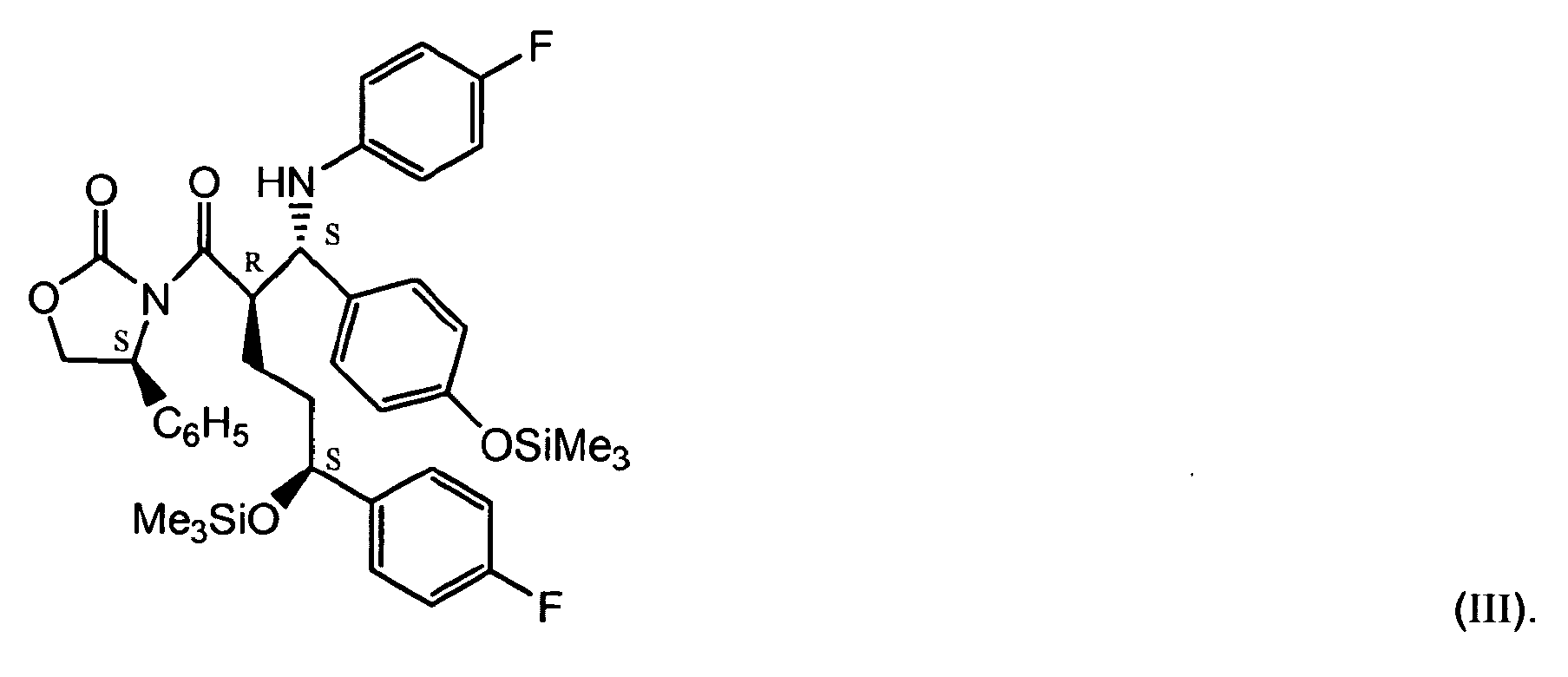
- Das Verfahren gemäß Anspruch 1 oder 2, wobei der β-(substituiertes Amino)säureester einen Carbonsäureesterteil R14-O-C(O)- umfasst, wobei R14 Alkyl oder Aryl ist.
- Das Verfahren gemäß Anspruch 1 oder 2, wobei der β-(substituiertes Amino)thiokohlensäureester einen Thiokohlensäureesterteil R14-S-C(O)- umfasst, wobei R14 Alkyl oder Aryl ist.
- Das Verfahren gemäß einem der Ansprüche 1 bis 8, wobei das Silylierungsmittel ein Silylenolether ist.
- Das Verfahren gemäß Anspruch 9, wobei das Silylierungsmittel ausgewählt ist aus der Gruppe, bestehend aus Bistrimethylsilylacetamid, N-Methyl-O-trimethylsilylacetamid oder Isopropenyloxytrimethylsilan.
- Das Verfahren gemäß einem der Ansprüche 1 bis 10, wobei das Alkalimetallcarboxylat ein Carboxylatsalz eines Alkalimetalls ist, ausgewählt aus der Gruppe, bestehend aus Lithium, Natrium, Kalium und Cäsium.
- Das Verfahren gemäß einem der Ansprüche 1 bis 11, wobei das Alkalimetallcarboxylat oder quaternäre Ammoniumcarboxylat einen Carboxylatrest umfasst, ausgewählt aus der Gruppe, bestehend aus Formiat, Acetat, Propionat, Butyrat, Valerat, Caproat, Caprylat, Laurat, Myristat, Palmitat, Stearat, Oleat, Linoleat, Linolenat, Cyclohexancarboxylat, Phenylacetat, Benzoat und Toluat.
- Das Verfahren gemäß Anspruch 12, wobei der Carboxylatrest des Alkalimetallcarboxylats Acetat ist.
- Das Verfahren gemäß einem der Ansprüche 11 bis 13, wobei das Alkalimetallcarboxylat Kaliumacetat ist.
- Das Verfahren gemäß Anspruch 12, wobei der Carboxylatrest des quaternären Ammoniumcarboxylats Acetat ist.
- Das Verfahren gemäß einem der Ansprüche 1 bis 10, 12 und 15, wobei der quaternäre Ammoniumrest des Cyclisierungsmittels Tetra-n-butylammonium ist.
- Das Verfahren gemäß Anspruch 16, wobei das quaternäre Ammoniumcarboxylat Tetra-n-butylammoniumacetat ist.
- Das Verfahren gemäß einem der Ansprüche 1 bis 10, wobei das quaternäre Ammoniumhydroxid Tetra-n-butylammoniumhydroxid ist.
- Das Verfahren gemäß Anspruch 1 oder 2, wobei das Cyclisierungsmittel das Reaktionsprodukt aus Tetra-n-butylammoniumbromid und Kaliumacetat ist.
- Das Verfahren gemäß Anspruch 1 oder 2, wobei das Reaktionsprodukt (3)(b) in situ in Gegenwart der Reaktanden (1) und (2) gebildet wird.
- Das Verfahren gemäß Anspruch 1 oder 2, ferner umfassend den Schritt des Bildens des Reaktionsprodukts (3)(b) vor der Reaktion mit den Reaktanden (1) und (2).
- Das Verfahren gemäß Anspruch 16, wobei das Silylierungsmittel Bistrimethylsilylacetamid ist und das Cyclisierungsmittel Tetra-n-butylammoniumacetat ist.
- Das Verfahren gemäß einem der Ansprüche 1 bis 22, umfassend die vorausgehende Umsetzung von Reaktant (1) mit Reaktant (2).
- Das Verfahren gemäß Anspruch 1 zur Herstellung eines Azetidinons, dargestellt durch die Strukturformel (IV):
 (1) einem β-(substituiertes Amino)amid der Formel (III)
 mit (2) wenigstens einem Silylierungsmittel und(3) wenigstens einem Cyclisierungsmittel, das(a) ausgewählt ist aus der Gruppe, bestehend aus Alkalimetallcarboxylaten, quaternären Ammoniumcarboxylaten, quaternären Ammoniumhydroxiden, quaternären Ammoniumalkoxiden, quaternären Ammoniumaryloxiden und Hydraten davon, oder(b) das Reaktionsprodukt ist von:wenigstens einem quaternären Ammoniumhalogenid, das ein quaternäres Ammoniumbromid, -chlorid oder -iodid ist, und wenigstens einem Alkalimetallcarboxylat,wobei ein quaternärer Ammoniumrest des Cyclisierungsmittels unsubstituiert oder substituiert ist durch eine bis vier Gruppen, unabhängig ausgewählt aus der Gruppe, bestehend aus Alkyl, Arylalkyl und Arylalkyl-alkyl.
 - Ein Verfahren zur Herstellung einer Verbindung, dargestellt durch die Formel (IV):
 Cyclisieren des β-(substituiertes Amino)amids der Formel XII
 wobei X -O-, -S- oder -N(C1-C6-Alkyl) ist, Y =O oder =S ist und R1 Alkyl, Aryl oder Alkoxycarbonyl ist, und wobei Prot eine Silylschutzgruppe ist,
mit wenigstens einem Silylierungsmittel und wenigstens einem Cyclisierungsmittel, das(a) ausgewählt ist aus der Gruppe, bestehend aus Alkalimetallcarboxylaten, quaternären Ammoniumcarboxylaten, quaternären Ammoniumhydroxiden, quaternären Ammoniumalkoxiden, quaternären Ammoniumaryloxiden und Hydraten davon, oder(b) das Reaktionsprodukt ist von:wenigstens einem quaternären Ammoniumhalogenid, das ein quaternäres Ammoniumbromid, -chlorid oder -iodid ist, und wenigstens einem Alkalimetallcarboxylat,wobei ein quaternärer Ammoniumrest des Cyclisierungsmittels unsubstituiert oder substituiert ist durch eine bis vier Gruppen, unabhängig ausgewählt aus der Gruppe,
bestehend aus Alkyl, Arylalkyl und Arylalkyl-alkyl.um die Verbindung der Formel XI zu erhalten: Entfernen der Silylschutzgruppen, um die Verbindung der Formel (IV) zu bilden.
 - Das Verfahren gemäß Anspruch 25, ferner umfassend die Schritte:Umsetzen eines chiralen Alkohols der Formel VIII, eines Imins der Formel IX und eines Silylschutzmittels, anschließend Kondensieren der silylgeschützten Verbindungen, um ein β-(substituiertes Amino)amid der Formel XII zu erhalten, wobei X -O-, -S- oder -N(C1-C6-Alkyl) ist, Y =O oder =S ist und R1 Alkyl, Aryl oder Alkoxycarbonyl ist, und wobei Prot eine Silylschutzgruppe ist:

- Das Verfahren gemäß Anspruch 25, ferner umfassend die Schritte:(a) Umsetzen von p-Fluorbenzoylbuttersäure der Formel V mit Pivaloylchlorid und Acylieren des Produkts mit einem chiralen Hilfsstoff der Formel VI, um ein Keton der Formel VII zu erhalten:
 (b) Reduzieren des Ketons der Formel VII in Gegenwart eines chiralen Katalysators zu einem Alkohol der Formel VIII:
 (c) Umsetzen des chiralen Alkohols der Formel VIII, eines Imins der Formel IX und eines Silylschutzmittels, dann Kondensieren der silylgeschützten Verbindungen, um ein β-(substituiertes Amino)amid der Formel XII zu erhalten, wobei Prot eine Silylschutzgruppe ist:
Priority Applications (1)
| Application Number | Priority Date | Filing Date | Title |
|---|---|---|---|
| SI200531662T SI1831162T1 (sl) | 2004-12-20 | 2005-12-19 | Postopek sinteze azetidinonov |
Applications Claiming Priority (2)
| Application Number | Priority Date | Filing Date | Title |
|---|---|---|---|
| US63759404P | 2004-12-20 | 2004-12-20 | |
| PCT/US2005/045901 WO2006068990A1 (en) | 2004-12-20 | 2005-12-19 | Process for the synthesis of azetidinones |
Publications (2)
| Publication Number | Publication Date |
|---|---|
| EP1831162A1 EP1831162A1 (de) | 2007-09-12 |
| EP1831162B1 true EP1831162B1 (de) | 2012-10-31 |
Family
ID=36218762
Family Applications (1)
| Application Number | Title | Priority Date | Filing Date |
|---|---|---|---|
| EP05854581A Expired - Lifetime EP1831162B1 (de) | 2004-12-20 | 2005-12-19 | Verfahren zur synthese von azetidinonen |
Country Status (12)
| Country | Link |
|---|---|
| US (3) | US20060135755A1 (de) |
| EP (1) | EP1831162B1 (de) |
| JP (2) | JP4890466B2 (de) |
| CN (1) | CN101119966B (de) |
| AR (1) | AR052067A1 (de) |
| CA (1) | CA2591564A1 (de) |
| HR (1) | HRP20121007T1 (de) |
| MX (1) | MX2007007473A (de) |
| SG (1) | SG158132A1 (de) |
| SI (1) | SI1831162T1 (de) |
| WO (1) | WO2006068990A1 (de) |
| ZA (1) | ZA200705130B (de) |
Families Citing this family (17)
| Publication number | Priority date | Publication date | Assignee | Title |
|---|---|---|---|---|
| GB0215579D0 (en) | 2002-07-05 | 2002-08-14 | Astrazeneca Ab | Chemical compounds |
| WO2005062824A2 (en) * | 2003-12-23 | 2005-07-14 | Merck & Co., Inc. | Anti-hypercholesterolemic compounds |
| CA2550215A1 (en) | 2003-12-23 | 2005-07-07 | Astrazeneca Ab | Diphenylazetidinone derivates possessing cholesterol absorption inhibitory activity |
| UY29607A1 (es) | 2005-06-20 | 2007-01-31 | Astrazeneca Ab | Compuestos quimicos |
| SA06270191B1 (ar) | 2005-06-22 | 2010-03-29 | استرازينيكا ايه بي | مشتقات من 2- أزيتيدينون جديدة باعتبارها مثبطات لامتصاص الكوليسترول لعلاج حالات فرط نسبة الدهون في الدم |
| MY148538A (en) | 2005-06-22 | 2013-04-30 | Astrazeneca Ab | Novel 2-azetidinone derivatives as cholesterol absorption inhibitors for the treatment of hyperlipidaemic conditions |
| US20070259845A1 (en) * | 2005-09-08 | 2007-11-08 | Kansal Vinod K | Processes for the preparation of (3R,4S)-4-((4-benzyloxy)phenyl)-1-(4-fluorophenyl)-3-((S)-3-(4-fluorophenyl)-3-hydroxypropyl)-2-azetidinone, an intermediate for the synthesis of ezetimibe |
| AR060623A1 (es) | 2006-04-27 | 2008-07-02 | Astrazeneca Ab | Compuestos derivados de 2-azetidinona y un metodo de preparacion |
| US20090047716A1 (en) * | 2007-06-07 | 2009-02-19 | Nurit Perlman | Reduction processes for the preparation of ezetimibe |
| CZ2008317A3 (cs) * | 2008-05-21 | 2009-12-02 | Zentiva, A. S. | Zpusob výroby (3R,4S)-1-(4-fluorfenyl)-3-[(3S)-3-(4-fluorfenyl)-3-hydroxypropyl)]-4-(4-hydroxyfenyl)-2-azetidinonu |
| EP2414529A2 (de) | 2009-04-01 | 2012-02-08 | Matrix Laboratories Ltd | Enzymatisches verfahren zur herstellung von (s)-5-(4-fluorphenyl)-5-hydroxy-1morpholin-4-yl-pentan-1-on, einer zwischenstufe von ezetimib, und weitere umwandlung zu ezetimib |
| WO2010141494A2 (en) * | 2009-06-02 | 2010-12-09 | Codexis, Inc. | Synthesis of ezetimibe |
| CN102234246A (zh) * | 2010-04-23 | 2011-11-09 | 浙江华海药业股份有限公司 | 一种合成依替米贝的新方法 |
| JP6711709B2 (ja) * | 2016-05-10 | 2020-06-17 | 株式会社トクヤマ | エゼチミブの製造方法 |
| CN106397292A (zh) * | 2016-09-20 | 2017-02-15 | 苏州普罗达生物科技有限公司 | 依替米贝的中间体及其合成方法与依替米贝的合成方法 |
| CN112939835A (zh) * | 2021-02-09 | 2021-06-11 | 中国科学技术大学 | 一种β-内酰胺类化合物的合成方法 |
| CN115160179A (zh) * | 2022-08-04 | 2022-10-11 | 湖南方盛堂制药有限公司 | 依折麦布中间体的制备工艺 |
Family Cites Families (12)
| Publication number | Priority date | Publication date | Assignee | Title |
|---|---|---|---|---|
| TW223059B (de) * | 1991-07-23 | 1994-05-01 | Schering Corp | |
| AU681419B2 (en) | 1993-07-09 | 1997-08-28 | Schering Corporation | Process for the synthesis of azetidinones |
| AU7472896A (en) | 1995-11-02 | 1997-05-22 | Schering Corporation | Process for preparing 1-(4-fluorophenyl)-3(r)-(3(s)-hydroxy-3-({phenyl or 4-fluorophenyl})-propyl)-4(s)-(4-hydroxyphenyl)-2-azetidinon |
| CA2353981C (en) * | 1998-12-07 | 2005-04-26 | Schering Corporation | Process for the synthesis of azetidinones |
| US6207822B1 (en) * | 1998-12-07 | 2001-03-27 | Schering Corporation | Process for the synthesis of azetidinones |
| HUP0401081A3 (en) | 2000-12-21 | 2010-06-28 | Sanofi Aventis Deutschland | Novel 1,2-diphenzylazetidinones, method for producing the same, medicaments containing said compounds, and their use |
| JP2008539255A (ja) | 2005-04-26 | 2008-11-13 | マイクロビア インコーポレーテッド | 高コレステロール血症のための4−ビアリーリル−1−フェニルアゼチジン−2−オングルクロニド誘導体 |
| AU2006249905A1 (en) | 2005-05-25 | 2006-11-30 | Microbia, Inc. | Processes for production of 4-(biphenylyl)azetidin-2-one phosphonic acids |
| CA2613239A1 (en) | 2005-06-22 | 2006-12-28 | Manne Satyanarayana Reddy | Improved process for the preparation of ezetimibe |
| US20070049748A1 (en) | 2005-08-26 | 2007-03-01 | Uppala Venkata Bhaskara R | Preparation of ezetimibe |
| HUP0501164A2 (en) | 2005-12-20 | 2007-07-30 | Richter Gedeon Nyrt | New industrial process for the production of ezetimibe |
| WO2007120824A2 (en) | 2006-04-10 | 2007-10-25 | Teva Pharmaceutical Industries Ltd. | Processes for the synthesis of azetidinone |
-
2005
- 2005-12-19 CN CN200580048205.6A patent/CN101119966B/zh not_active Expired - Lifetime
- 2005-12-19 SI SI200531662T patent/SI1831162T1/sl unknown
- 2005-12-19 MX MX2007007473A patent/MX2007007473A/es active IP Right Grant
- 2005-12-19 WO PCT/US2005/045901 patent/WO2006068990A1/en not_active Ceased
- 2005-12-19 EP EP05854581A patent/EP1831162B1/de not_active Expired - Lifetime
- 2005-12-19 JP JP2007546997A patent/JP4890466B2/ja not_active Expired - Lifetime
- 2005-12-19 CA CA002591564A patent/CA2591564A1/en not_active Abandoned
- 2005-12-19 SG SG200908264-5A patent/SG158132A1/en unknown
- 2005-12-19 HR HRP20121007TT patent/HRP20121007T1/hr unknown
- 2005-12-19 US US11/305,926 patent/US20060135755A1/en not_active Abandoned
- 2005-12-20 AR ARP050105377A patent/AR052067A1/es not_active Application Discontinuation
-
2007
- 2007-06-20 ZA ZA200705130A patent/ZA200705130B/xx unknown
-
2011
- 2011-01-18 US US13/008,458 patent/US20110144327A1/en not_active Abandoned
- 2011-11-18 JP JP2011252865A patent/JP2012036224A/ja not_active Withdrawn
- 2011-12-12 US US13/323,366 patent/US8383810B2/en not_active Expired - Lifetime
Also Published As
| Publication number | Publication date |
|---|---|
| JP4890466B2 (ja) | 2012-03-07 |
| US20060135755A1 (en) | 2006-06-22 |
| US8383810B2 (en) | 2013-02-26 |
| SG158132A1 (en) | 2010-01-29 |
| HK1102030A1 (en) | 2007-11-02 |
| WO2006068990A1 (en) | 2006-06-29 |
| SI1831162T1 (sl) | 2013-03-29 |
| EP1831162A1 (de) | 2007-09-12 |
| CN101119966A (zh) | 2008-02-06 |
| ZA200705130B (en) | 2008-09-25 |
| CN101119966B (zh) | 2014-08-13 |
| MX2007007473A (es) | 2007-09-04 |
| US20120083601A1 (en) | 2012-04-05 |
| US20110144327A1 (en) | 2011-06-16 |
| HRP20121007T1 (hr) | 2013-01-31 |
| JP2008524251A (ja) | 2008-07-10 |
| JP2012036224A (ja) | 2012-02-23 |
| CA2591564A1 (en) | 2006-06-29 |
| AR052067A1 (es) | 2007-02-28 |
Similar Documents
| Publication | Publication Date | Title |
|---|---|---|
| US8383810B2 (en) | Process for the synthesis of azetidinones | |
| EP1137634B1 (de) | Verfahren zur herstellung von azetidinonen | |
| IE64687B1 (en) | Process for the enantioselective preparation of phenylisoserine derivatives | |
| KR950013767B1 (ko) | 키랄성 아제티디논 화합물 및 이의 제조방법 | |
| CA1318321C (en) | Intermediates for the production of podophyllotoxin and related compounds and processes for the preparation and use thereof | |
| JP2897153B2 (ja) | アゼチジノン化合物及びその製法 | |
| KR890004124B1 (ko) | β-락탐 화합물의 제조방법 | |
| SU1442071A3 (ru) | Способ получени производных 4-ацетокси-3-оксиэтилазетидин-2-она (его варианты) | |
| HK1102030B (en) | Process for the synthesis of azetidinones | |
| Farina et al. | Pseudoesters and derivatives. 29. Regioselective reactions of the 5-(ethylthio) furan-2 (5H)-one anion with electrophiles | |
| KR910005230B1 (ko) | 아제티디논의 제조방법 | |
| JP2641363B2 (ja) | 新規なフェネチルアルコール及びその製法 | |
| US5973155A (en) | Process for preparing (-)-trans-N-p-fluorobenzoylmethyl-4-(p-fluorophenyl)-3-[[3,4-(methylened ioxy)phenoxy]methyl]-piperidine | |
| US5559237A (en) | Process for preparation of 2-oxo-1-piperidinyl derivatives | |
| US4940803A (en) | Process for synthesis of 1R,2R,5R-2-hydroxy-6-oxo-7-oxabicyclo[3.2.1]-octane | |
| JPH0558638B2 (de) | ||
| KR100335848B1 (ko) | 아제티디논 유도체, 그 제조방법 및 이를 이용한1-β-알킬아제티디논의 제조방법 | |
| JPS63150271A (ja) | 2−アミノ−3−ホモフラノサイド類 | |
| KR920003897B1 (ko) | 글루타콘산 유도체의 제조방법 | |
| JP2604794B2 (ja) | 4−アセトキシ−3−ヒドロキシエチルアゼチジン−2−オンの製造法 | |
| JP2831549B2 (ja) | 24―オキソコレステロール類の製造法 | |
| KR970005303B1 (ko) | 신규한 3-아자비시클로[3.1.1]헵탄 유도체 및 그의 제조방법 | |
| WO2006050634A1 (en) | A preparation method of 1-(4-fluorophenyl)-(3r)-[3-(4-fluorophenyl)-(3s)-hydroxypropyl]-(4s)-(4-hydroxyphenyl)-2-azetidinone | |
| JP3269867B2 (ja) | 4位置換アゼチジノン誘導体を製造する方法 | |
| JPH0899970A (ja) | 1−カルバペネム類および1−カルバセフェム類の中間体の合成方法 |
Legal Events
| Date | Code | Title | Description |
|---|---|---|---|
| PUAI | Public reference made under article 153(3) epc to a published international application that has entered the european phase |
Free format text: ORIGINAL CODE: 0009012 |
|
| 17P | Request for examination filed |
Effective date: 20070702 |
|
| AK | Designated contracting states |
Kind code of ref document: A1 Designated state(s): AT BE BG CH CY CZ DE DK EE ES FI FR GB GR HU IE IS IT LI LT LU LV MC NL PL PT RO SE SI SK TR |
|
| AX | Request for extension of the european patent |
Extension state: AL BA HR MK YU |
|
| REG | Reference to a national code |
Ref country code: HK Ref legal event code: DE Ref document number: 1102030 Country of ref document: HK |
|
| 17Q | First examination report despatched |
Effective date: 20091104 |
|
| GRAP | Despatch of communication of intention to grant a patent |
Free format text: ORIGINAL CODE: EPIDOSNIGR1 |
|
| RAP1 | Party data changed (applicant data changed or rights of an application transferred) |
Owner name: MERCK SHARP & DOHME CORP. |
|
| GRAS | Grant fee paid |
Free format text: ORIGINAL CODE: EPIDOSNIGR3 |
|
| GRAA | (expected) grant |
Free format text: ORIGINAL CODE: 0009210 |
|
| AK | Designated contracting states |
Kind code of ref document: B1 Designated state(s): AT BE BG CH CY CZ DE DK EE ES FI FR GB GR HU IE IS IT LI LT LU LV MC NL PL PT RO SE SI SK TR |
|
| AX | Request for extension of the european patent |
Extension state: AL BA HR MK YU |
|
| REG | Reference to a national code |
Ref country code: GB Ref legal event code: FG4D Ref country code: CH Ref legal event code: EP |
|
| REG | Reference to a national code |
Ref country code: AT Ref legal event code: REF Ref document number: 581945 Country of ref document: AT Kind code of ref document: T Effective date: 20121115 |
|
| REG | Reference to a national code |
Ref country code: IE Ref legal event code: FG4D |
|
| REG | Reference to a national code |
Ref country code: HR Ref legal event code: TUEP Ref document number: P20121007 Country of ref document: HR |
|
| REG | Reference to a national code |
Ref country code: CH Ref legal event code: NV Representative=s name: MARKS AND CLERK (LUXEMBOURG) LLP, CH |
|
| REG | Reference to a national code |
Ref country code: DE Ref legal event code: R096 Ref document number: 602005036848 Country of ref document: DE Effective date: 20130103 |
|
| REG | Reference to a national code |
Ref country code: RO Ref legal event code: EPE |
|
| REG | Reference to a national code |
Ref country code: HR Ref legal event code: T1PR Ref document number: P20121007 Country of ref document: HR |
|
| REG | Reference to a national code |
Ref country code: HK Ref legal event code: GR Ref document number: 1102030 Country of ref document: HK |
|
| REG | Reference to a national code |
Ref country code: NL Ref legal event code: T3 |
|
| REG | Reference to a national code |
Ref country code: AT Ref legal event code: MK05 Ref document number: 581945 Country of ref document: AT Kind code of ref document: T Effective date: 20121031 |
|
| REG | Reference to a national code |
Ref country code: EE Ref legal event code: FG4A Ref document number: E007599 Country of ref document: EE Effective date: 20130130 |
|
| PG25 | Lapsed in a contracting state [announced via postgrant information from national office to epo] |
Ref country code: IS Free format text: LAPSE BECAUSE OF FAILURE TO SUBMIT A TRANSLATION OF THE DESCRIPTION OR TO PAY THE FEE WITHIN THE PRESCRIBED TIME-LIMIT Effective date: 20130228 Ref country code: ES Free format text: LAPSE BECAUSE OF FAILURE TO SUBMIT A TRANSLATION OF THE DESCRIPTION OR TO PAY THE FEE WITHIN THE PRESCRIBED TIME-LIMIT Effective date: 20130211 Ref country code: SE Free format text: LAPSE BECAUSE OF FAILURE TO SUBMIT A TRANSLATION OF THE DESCRIPTION OR TO PAY THE FEE WITHIN THE PRESCRIBED TIME-LIMIT Effective date: 20121031 |
|
| PG25 | Lapsed in a contracting state [announced via postgrant information from national office to epo] |
Ref country code: PL Free format text: LAPSE BECAUSE OF FAILURE TO SUBMIT A TRANSLATION OF THE DESCRIPTION OR TO PAY THE FEE WITHIN THE PRESCRIBED TIME-LIMIT Effective date: 20121031 Ref country code: CY Free format text: LAPSE BECAUSE OF FAILURE TO SUBMIT A TRANSLATION OF THE DESCRIPTION OR TO PAY THE FEE WITHIN THE PRESCRIBED TIME-LIMIT Effective date: 20121031 Ref country code: PT Free format text: LAPSE BECAUSE OF FAILURE TO SUBMIT A TRANSLATION OF THE DESCRIPTION OR TO PAY THE FEE WITHIN THE PRESCRIBED TIME-LIMIT Effective date: 20130228 Ref country code: GR Free format text: LAPSE BECAUSE OF FAILURE TO SUBMIT A TRANSLATION OF THE DESCRIPTION OR TO PAY THE FEE WITHIN THE PRESCRIBED TIME-LIMIT Effective date: 20130201 Ref country code: BE Free format text: LAPSE BECAUSE OF FAILURE TO SUBMIT A TRANSLATION OF THE DESCRIPTION OR TO PAY THE FEE WITHIN THE PRESCRIBED TIME-LIMIT Effective date: 20121031 |
|
| PG25 | Lapsed in a contracting state [announced via postgrant information from national office to epo] |
Ref country code: AT Free format text: LAPSE BECAUSE OF FAILURE TO SUBMIT A TRANSLATION OF THE DESCRIPTION OR TO PAY THE FEE WITHIN THE PRESCRIBED TIME-LIMIT Effective date: 20121031 |
|
| PG25 | Lapsed in a contracting state [announced via postgrant information from national office to epo] |
Ref country code: MC Free format text: LAPSE BECAUSE OF NON-PAYMENT OF DUE FEES Effective date: 20121231 Ref country code: CZ Free format text: LAPSE BECAUSE OF FAILURE TO SUBMIT A TRANSLATION OF THE DESCRIPTION OR TO PAY THE FEE WITHIN THE PRESCRIBED TIME-LIMIT Effective date: 20121031 Ref country code: DK Free format text: LAPSE BECAUSE OF FAILURE TO SUBMIT A TRANSLATION OF THE DESCRIPTION OR TO PAY THE FEE WITHIN THE PRESCRIBED TIME-LIMIT Effective date: 20121031 Ref country code: SK Free format text: LAPSE BECAUSE OF FAILURE TO SUBMIT A TRANSLATION OF THE DESCRIPTION OR TO PAY THE FEE WITHIN THE PRESCRIBED TIME-LIMIT Effective date: 20121031 |
|
| PG25 | Lapsed in a contracting state [announced via postgrant information from national office to epo] |
Ref country code: IT Free format text: LAPSE BECAUSE OF FAILURE TO SUBMIT A TRANSLATION OF THE DESCRIPTION OR TO PAY THE FEE WITHIN THE PRESCRIBED TIME-LIMIT Effective date: 20121031 |
|
| PLBE | No opposition filed within time limit |
Free format text: ORIGINAL CODE: 0009261 |
|
| STAA | Information on the status of an ep patent application or granted ep patent |
Free format text: STATUS: NO OPPOSITION FILED WITHIN TIME LIMIT |
|
| REG | Reference to a national code |
Ref country code: IE Ref legal event code: MM4A |
|
| 26N | No opposition filed |
Effective date: 20130801 |
|
| PG25 | Lapsed in a contracting state [announced via postgrant information from national office to epo] |
Ref country code: IE Free format text: LAPSE BECAUSE OF NON-PAYMENT OF DUE FEES Effective date: 20121219 |
|
| REG | Reference to a national code |
Ref country code: DE Ref legal event code: R097 Ref document number: 602005036848 Country of ref document: DE Effective date: 20130801 |
|
| PG25 | Lapsed in a contracting state [announced via postgrant information from national office to epo] |
Ref country code: LU Free format text: LAPSE BECAUSE OF NON-PAYMENT OF DUE FEES Effective date: 20121219 |
|
| PG25 | Lapsed in a contracting state [announced via postgrant information from national office to epo] |
Ref country code: HU Free format text: LAPSE BECAUSE OF FAILURE TO SUBMIT A TRANSLATION OF THE DESCRIPTION OR TO PAY THE FEE WITHIN THE PRESCRIBED TIME-LIMIT Effective date: 20051219 |
|
| REG | Reference to a national code |
Ref country code: FR Ref legal event code: PLFP Year of fee payment: 11 |
|
| REG | Reference to a national code |
Ref country code: FR Ref legal event code: PLFP Year of fee payment: 12 |
|
| REG | Reference to a national code |
Ref country code: FR Ref legal event code: PLFP Year of fee payment: 13 |
|
| REG | Reference to a national code |
Ref country code: HR Ref legal event code: ODRP Ref document number: P20121007 Country of ref document: HR Payment date: 20181204 Year of fee payment: 14 |
|
| REG | Reference to a national code |
Ref country code: HR Ref legal event code: ODRP Ref document number: P20121007 Country of ref document: HR Payment date: 20191203 Year of fee payment: 15 |
|
| REG | Reference to a national code |
Ref country code: HR Ref legal event code: ODRP Ref document number: P20121007 Country of ref document: HR Payment date: 20201217 Year of fee payment: 16 |
|
| REG | Reference to a national code |
Ref country code: HR Ref legal event code: ODRP Ref document number: P20121007 Country of ref document: HR Payment date: 20211208 Year of fee payment: 17 |
|
| REG | Reference to a national code |
Ref country code: DE Ref legal event code: R081 Ref document number: 602005036848 Country of ref document: DE Owner name: MERCK SHARP & DOHME LLC, RAHWAY, US Free format text: FORMER OWNER: MERCK SHARP & DOHME CORP., RAHWAY, N.J., US |
|
| REG | Reference to a national code |
Ref country code: NL Ref legal event code: PD Owner name: MERCK SHARP & DOHME LLC; US Free format text: DETAILS ASSIGNMENT: CHANGE OF OWNER(S), MERGE; FORMER OWNER NAME: MERCK SHARP & DOHME CORP. Effective date: 20220922 Ref country code: GB Ref legal event code: 732E Free format text: REGISTERED BETWEEN 20220908 AND 20220914 |
|
| REG | Reference to a national code |
Ref country code: HR Ref legal event code: PPPP Ref document number: P20121007 Country of ref document: HR Owner name: MERCK SHARP & DOHME LLC, US Ref country code: EE Ref legal event code: GB1A Ref document number: E007599 Country of ref document: EE |
|
| REG | Reference to a national code |
Ref country code: HR Ref legal event code: ODRP Ref document number: P20121007 Country of ref document: HR Payment date: 20221208 Year of fee payment: 18 |
|
| REG | Reference to a national code |
Ref country code: SI Ref legal event code: SP73 Owner name: MERCK SHARP & DOHME LLC; US Effective date: 20221209 |
|
| P01 | Opt-out of the competence of the unified patent court (upc) registered |
Effective date: 20230518 |
|
| REG | Reference to a national code |
Ref country code: HR Ref legal event code: ODRP Ref document number: P20121007 Country of ref document: HR Payment date: 20231115 Year of fee payment: 19 |
|
| PGFP | Annual fee paid to national office [announced via postgrant information from national office to epo] |
Ref country code: BG Payment date: 20240924 Year of fee payment: 20 |
|
| PGFP | Annual fee paid to national office [announced via postgrant information from national office to epo] |
Ref country code: NL Payment date: 20241114 Year of fee payment: 20 |
|
| REG | Reference to a national code |
Ref country code: HR Ref legal event code: ODRP Ref document number: P20121007 Country of ref document: HR Payment date: 20241119 Year of fee payment: 20 |
|
| PGFP | Annual fee paid to national office [announced via postgrant information from national office to epo] |
Ref country code: LT Payment date: 20241112 Year of fee payment: 20 |
|
| PGFP | Annual fee paid to national office [announced via postgrant information from national office to epo] |
Ref country code: DE Payment date: 20241111 Year of fee payment: 20 |
|
| PGFP | Annual fee paid to national office [announced via postgrant information from national office to epo] |
Ref country code: FI Payment date: 20241126 Year of fee payment: 20 |
|
| PGFP | Annual fee paid to national office [announced via postgrant information from national office to epo] |
Ref country code: GB Payment date: 20241114 Year of fee payment: 20 |
|
| PGFP | Annual fee paid to national office [announced via postgrant information from national office to epo] |
Ref country code: FR Payment date: 20241111 Year of fee payment: 20 |
|
| PGFP | Annual fee paid to national office [announced via postgrant information from national office to epo] |
Ref country code: EE Payment date: 20241112 Year of fee payment: 20 Ref country code: LV Payment date: 20241113 Year of fee payment: 20 |
|
| PGFP | Annual fee paid to national office [announced via postgrant information from national office to epo] |
Ref country code: RO Payment date: 20241202 Year of fee payment: 20 |
|
| PGFP | Annual fee paid to national office [announced via postgrant information from national office to epo] |
Ref country code: TR Payment date: 20241121 Year of fee payment: 20 |
|
| PGFP | Annual fee paid to national office [announced via postgrant information from national office to epo] |
Ref country code: SI Payment date: 20241113 Year of fee payment: 20 |
|
| PGFP | Annual fee paid to national office [announced via postgrant information from national office to epo] |
Ref country code: CH Payment date: 20250101 Year of fee payment: 20 |
|
| REG | Reference to a national code |
Ref country code: CH Ref legal event code: H14 Free format text: ST27 STATUS EVENT CODE: U-0-0-H10-H14 (AS PROVIDED BY THE NATIONAL OFFICE) Effective date: 20251219 Ref country code: DE Ref legal event code: R071 Ref document number: 602005036848 Country of ref document: DE |
|
| REG | Reference to a national code |
Ref country code: NL Ref legal event code: MK Effective date: 20251218 |
|
| REG | Reference to a national code |
Ref country code: HR Ref legal event code: PB20 Ref document number: P20121007 Country of ref document: HR Effective date: 20251219 |
|
| REG | Reference to a national code |
Ref country code: GB Ref legal event code: PE20 Expiry date: 20251218 |
|
| REG | Reference to a national code |
Ref country code: LT Ref legal event code: MM9A Effective date: 20251219 |