EP1831659B1 - Thermometer - Google Patents
Thermometer Download PDFInfo
- Publication number
- EP1831659B1 EP1831659B1 EP05850144A EP05850144A EP1831659B1 EP 1831659 B1 EP1831659 B1 EP 1831659B1 EP 05850144 A EP05850144 A EP 05850144A EP 05850144 A EP05850144 A EP 05850144A EP 1831659 B1 EP1831659 B1 EP 1831659B1
- Authority
- EP
- European Patent Office
- Prior art keywords
- liquid
- thermometric
- thermometer
- ethanol
- ethylene glycol
- Prior art date
- Legal status (The legal status is an assumption and is not a legal conclusion. Google has not performed a legal analysis and makes no representation as to the accuracy of the status listed.)
- Expired - Lifetime
Links
Images
Classifications
-
- G—PHYSICS
- G01—MEASURING; TESTING
- G01K—MEASURING TEMPERATURE; MEASURING QUANTITY OF HEAT; THERMALLY-SENSITIVE ELEMENTS NOT OTHERWISE PROVIDED FOR
- G01K5/00—Measuring temperature based on the expansion or contraction of a material
- G01K5/02—Measuring temperature based on the expansion or contraction of a material the material being a liquid
- G01K5/20—Measuring temperature based on the expansion or contraction of a material the material being a liquid with means for indicating a maximum or a minimum or both
Definitions
- the invention relates to a thermometer according to the preamble of claim 1.
- thermometers are widely used and are referred to as capillary maxima-minima thermometers.
- these thermometers can have a U-shaped capillary tube with two legs, in which a transmitter liquid for moving a respective mark arranged in the legs is received.
- the marks themselves are arranged in a thermometric liquid which forms a phase interface with the latter on both sides of the transfer liquid.
- mercury As a transfer liquid, mercury has been proven in the past because of its good specific properties such as high density, high boiling point, low melting point and stable phase separation with the thermometric liquid.
- a disadvantage of mercury is its toxicity, due to which the use of mercury is no longer allowed in some countries.
- carrier fluids are for example in the WO 00/54014 called. Accordingly, suitable carrier liquids are composed of certain elements of the third, fourth, fifth, and sixth groups, as well as some interhalogen compounds from the seventh group of the periodic table. However, it has been found that such transmitter fluids are not a satisfactory substitute for mercury.
- the object of the invention is to provide a thermometer that is toxicologically safe and manufacturing technology is simple and inexpensive to produce.
- thermometer with the features of claim 1.
- the transfer fluid is a hydrophobic highly fluorinated compound.
- Such compounds allow for rapid and stable phase separation with the thermometric liquid, thus preventing in-dissolution of components of the thermometric liquid into the fluorinated phase.
- Particularly perfluorinated amine compounds such as perfluoro tri n-butylamine (FC-43) are suitable.
- Perfluorinated amines were originally developed as a blood substitute because of their high oxygen capacity. They are considered toxicologically safe and chemically extremely stable.
- perfluorinated amine compounds may be perfluoro tri n-pentylamine (FC70) or perfluoro tri n-butylamine (FC40) or perfluoro di-n-butylmethylamine. However, it is also conceivable to mix the individual compounds with each other.
- thermometric liquids known per se
- even faster phase separation can be achieved if the thermometric fluid is composed of a single or a mixture of the groups ethanol, ethylene glycol, glycerol and / or water.
- thermometric fluid is an ethanol / glycerin blend containing about 10% by volume glycerin.
- thermometric fluid is an ethanol / ethylene glycol mixture containing up to 20 volume percent ethylene glycol.
- thermometric fluid is pure ethanol.
- the thermometer is designed with a U-shaped capillary tube.
- the capillary tube has two legs, in each of which the thermometric fluid is recorded with a mark for indicating a maximum and a minimum temperature. Between the thermometric amounts of liquid in the legs, the transmitter liquid is arranged.
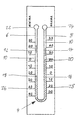
- the sole figure shows a plan view of a maxima-minima thermometer with a U-shaped capillary tube.
- the figure shows a maxima-minima thermometer 2 with a capillary tube 4.
- the capillary tube 4 is U-shaped and has a left and a right leg 6, 8 as shown.
- thermometric liquid 10 In each of the legs 6, 8 a certain amount of a thermometric liquid 10 is received, in each of which a marker 12, 16 is arranged for indicating a maximum and a minimum temperature.
- the markers 12, 14 are preferably blue, rod-shaped enamel glass bodies with a ferrite core.
- the maximum and minimum temperatures can be read off at the lower end of the markers 12, 14 in combination with temperature scales 26, 28 provided along the legs 6, 8.
- the markers 12, 14 are held by magnetic strips, not shown, behind the temperature scales 26, 28 in position. Release of the markers 12, 14, i. a reset of the thermometer 2, via a rear pivoting of the magnetic strip away from the capillary tube 4, so that the magnetic force is no longer sufficient to keep the markers 12, 14 in their fixed position and this from the representation to phase interface 18, 20th with agianeanickenkeit 16 drop.
- the left leg 6 is closed at the end by a storage container 22 for providing the thermometric liquid 10 in the left leg 6.
- the right leg 8 opens into a surge tank 26 for receiving the displaced from the leg 8 thermometric fluid 10th
- thermometric amounts of liquid 10 are separated from each other via the transfer liquid 16. That is, the heavy transfer fluid 16 is covered in each leg 6, 8 of the light thermometric liquid 10.
- phase boundary surfaces 18, 20 form in such a way that mixing of the liquids 10, 16 is prevented.
- the transmitter liquid 18 and thus the phase interfaces 18, 20 will be or become according to a volume change of the thermometric Fluid 10 shifted at a temperature change, whereby at a new maximum or minimum temperature, the corresponding phase interface 18, 20 runs onto the respective marker 12, 14 and this against the magnetic holding force by the very strong surface tension of the transfer fluid 16 entrains.
- the instantaneous, non-maximum or minimum temperature is generally determinable at the phase interface 18, 20.
- the thermometric liquid 10 is colored in color.
- the carrier fluid 16 is a hydrophobic highly fluorinated compound.
- Such compounds can be used with per se known thermometric liquids and do not require adaptation of the dimensions of the capillary 4. They have in principle a fast and stable phase separation. To increase the phase separation, compounds having a high degree of fluorination, such as perfluoro compounds, are particularly suitable.
- the compound perfluoro tri-n-butylamine (FC-43) has proven particularly advantageous.
- This liquid is toxicologically harmless, chemically and physically extremely stable, non-flammable and odorless. Furthermore, it has a density of 1.88 g / cm 3 , a high boiling point of 174 ° C and a low melting point of -50 ° C. Furthermore, FC-43 forms at the phase interfaces 18, 20 a sufficiently high surface tension, so that the high density of the mercury used so far is compensated.
- FC-70 perfluoro tri-n-pentylamine
- FC-40 perfluoro tri-n-butylamine
- FC-40 perfluoro di-n-butylmethylamine
- the thermometric fluid 10 may be a per se known thermometric fluid such as creosote.
- thermometric fluid such as creosote.
- the mercury addition of ascorbic acid as reducing agent to prevent oxidation of the transfer liquid 16, since the perfluoro compounds are not prone to oxidation.
- thermometric liquids 10 mixtures of ethanol, ethylene glycol, glycerol and / or water have been found. Such mixtures are low viscosity at room temperature, whereby increasing the viscosity at low temperatures is essentially uncritical. To avoid a long-term interaction of the water with the glass inner surface of the capillary tube 4 or the markers 12, 14, however, liquid mixtures with a low water content are desirable.
- ethanol / glycerin mixture having a glycerol content of about 10% by volume and an ethanol / ethylene glycol mixture having an ethylene glycol content of up to 20% by volume.
- An increased addition of glycerol or ethylene glycol leads to a strong, negative increase in viscosity. It is also conceivable to use pure ethanol.
- thermometric fluids 10 The following is a brief description of the experiments carried out to determine the transmitter fluids 16 and thermometric fluids 10 according to the invention.
- thermometric fluid in maximum-to-minimum thermometers by an alternative medium requires a number of specific properties such as low toxicity, odorlessness, lightfastness, chemical stability, low melting point, high boiling point, high density, low miscibility with the thermometric fluid, and most importantly the formation of a strong surface tension at the phase interface of both liquids. If you do not want to change the thermometric fluid in principle, d. H. continue to use a mixture of hydrophilic alcohols, so meet only a few highly fluorinated or perfluorinated compounds the necessary conditions. From these points of view and taking into account the costs of procurement, a selection of fluorinated liquids was made and in a first screening the mixing behavior was tested with the original thermometer liquid in the following simple test arrangement.
- phase separation experiments An essential statement of the phase separation experiments is that it is possible in principle with highly fluorinated compounds to achieve a rapid and stable phase separation from mixtures with the original thermometer liquid without a significant dissolution of components of the thermometer liquid in the fluorinated phase takes place, as the only slight shift of the phase boundary shows in some experiments. However, this requires a very high degree of fluorination of the fluorinated compound. The best results are therefore also obtained with the perfluorinated compounds (5-8).
- the clean phase separation of the perfluorinated liquids from the original thermometer fluid further shows that with the original formulation or only slightly changed composition from the side of the thermometric fluid, a mercury-free solution could be found that manages without significant changes to the sizing of the vitreous body.
- FC 43 perfluorinated tri-n-butylamine
- the filled sample was then cooled to -30 ° C and then heated in air to +50 ° C. This procedure was repeated five times with the capillary positioned three times vertically and twice horizontally. In a horizontal position, the formation of the interface shape and especially the underflow behavior could be followed with a reflected-light microscope. Based on the results of a study to replace creosote in maxima-minima thermometers, the substance spectrum was restricted to ethanol, ethylene glycol, glycerine and water. Also for the development of strong upper-voltage effects at the phase interface to the extremely hydrophobic perfluorinated liquid, which are mandatory in this system for the entrainment of marker tubes, the use is o.g. Alcohols and water with their highly hydrophilic properties particularly advantageous.
- thermometric Liquids are low viscosity at room temperature. Also with regard to long-term interactions of the water with the glass surface of the capillary liquid mixtures with low water content are desirable. For viscosity tests, therefore, only mixtures of ethanol with ethylene glycol or glycerol were used.
- a not yet bent capillary tube was filled with the respective thermometric fluid and then measured the time required for an original rod to drop a distance of 10 cm when the tube is in a vertical position. This measurement was carried out three times in succession at temperatures around 22 ° C. The average values determined are recorded as sinking times in Table 3. In order to exclude production-related tolerances as a source of error, the same capillary and the same rod were used for all investigations.
- thermometer liquid Taking the viscosity values of the original thermometer liquid as a guide for the range of practicable viscosities, besides the ascorbic acid-free ethanol / glycerine mixture with 10% by volume glycerol, ethanol mixtures with up to 20% by volume ethylene glycol and also pure ethanol can be used. Higher additions of glycerine or ethylene glycol lead to a strong increase in viscosity.
- a capillary thermometer having a transmitter liquid for shifting a maximum or minimum temperature indicia, and a thermometric liquid in which the label is disposed, the transmitter liquid being hydrophobic and highly fluorinated.
Landscapes
- Physics & Mathematics (AREA)
- General Physics & Mathematics (AREA)
- Investigating Or Analyzing Materials Using Thermal Means (AREA)
- Organic Low-Molecular-Weight Compounds And Preparation Thereof (AREA)
- Measuring And Recording Apparatus For Diagnosis (AREA)
- Measuring Temperature Or Quantity Of Heat (AREA)
Description
- Die Erfindung betrifft ein Thermometer nach dem Oberbegriff des Anspruchs 1.
- Derartige Thermometer sind weit verbreitet und werden als kapillare Maxima-Minima-Thermometer bezeichnet. Gemäß der
DE 76 31 228 U1 können diese Thermometer ein u-förmiges Kapillarrohr mit zwei Schenkeln haben, in dem eine Überträgerflüssigkeit zum Verschieben jeweils einer in den Schenkeln angeordneten Marke aufgenommen ist. Die Marken selber sind in einer thermometrischen Flüssigkeit angeordnet, die beidseits der Überträgerflüssigkeit mit dieser eine Phasengrenzfläche bildet. - Als Überträgerflüssigkeit hat sich in der Vergangenheit aufgrund seiner guten spezifischen Eigenschaften wie zum Beispiel hohen Dichte, hoher Siedepunkt, niedrigen Schmelzpunkt und stabilen Phasentrennung mit der thermometrischen Flüssigkeit Quecksilber bewährt. Nachteilig an Quecksilber ist jedoch seine Toxizität, aufgrund derer die Verwendung von Quecksilber in einigen Ländern nicht mehr erlaubt ist.
- Alternative Überträgerflüssigkeiten sind zum Beispiel in der
WO 00/54014 - Aufgabe der Erfindung ist es, ein Thermometer zu schaffen, das toxikologisch unbedenklich ist und das fertigungstechnisch einfach sowie kostengünstig herzustellen ist.
- Diese Aufgabe wird durch ein Thermometer mit den Merkmalen nach dem Anspruch 1 gelöst.
- Erfindungsgemäß ist die Überträgerflüssigkeit eine hydrophobe hochfluorierte Verbindung. Derartige Verbindungen ermöglichen eine schnelle und stabile Phasentrennung mit der thermometrischen Flüssigkeit, so daß ein Hineinlösen von Komponenten der thermometrischen Flüssigkeit in die fluorierte Phase verhindert wird. Dabei sind besonders perfluorierte Amin-Verbindungen wie zum Beispiel Perfluor Tri n-Butylamin (FC-43) geeignet. Perfluorierte Amine wurden ursprünglich wegen ihres hohen Sauerstoffvermögens als Blutersatzstoff entwickelt. Sie gelten als toxigologisch unbedenklich und chemisch außerordentlich stabil.
- Alternative perfluorierte Amin-Verbindungen können Perfluor Tri n-Pentylamin (FC70) oder Perfluor Tri n-Butylamin (FC40) bzw. Perfluor Di n-Butylmethylamin sein. Es ist jedoch auch vorstellbar, die einzelnen Verbindungen miteinander zu vermischen.
- Die erfindungsgemäßen Überträgerflüssigkeiten sind zwar mit den per se bekannten thermometrischen Flüssigkeiten verwendbar, jedoch läßt sich eine noch schnellere Phasentrennung erzielen, wenn sich die thermometrische Flüssigkeit aus einer einzelnen oder aus einer Mischung der Gruppen Ethanol, Ethylenglykol, Glyzerin und/oder Wasser zusammensetzt.
- Eine bevorzugte thermometrische Flüssigkeit besteht aus einer Ethanol/Glyzerinmischung mit etwa 10 Volumenprozent Glyzerin.
- Eine andere bevorzugte thermometrische Flüssigkeit ist eine Ethanol/Ethylenglykolmischung mit bis zu 20 Volumenprozent Ethylenglykol.
- Eine weitere bevorzugte thermometrische Flüssigkeit ist reines Ethanol.
- In einer Ausführungsform ist das Thermometer mit einem u-förmigen Kapillarrohr ausgeführt. Das Kapillarrohr hat zwei Schenkel, in denen jeweils die thermometrische Flüssigkeit mit einer Marke zum Anzeigen einer maximalen und einer minimalen Temperatur aufgenommen ist. Zwischen den thermometrischen Flüssigkeitsmengen in den Schenkeln ist die Überträgerflüssigkeit angeordnet.
- Sonstige vorteilhafte Ausführungsformen der Erfindung sind Gegenstand weiterer abhängigen Ansprüche.
- Im Folgenden erfolgt eine ausführliche Erläuterung einer bevorzugten Ausführungsform der Erfindung anhand einer schematischen Darstellung. Die einzige Figur zeigt eine Draufsicht auf ein Maxima-Minima-Thermometer mit einem u-förmigen Kapillarrohr.
- Die Figur zeigt ein Maxima-Minima-Thermometer 2 mit einem Kapillarrohr 4. Das Kapillarrohr 4 ist u-förmig ausgebildet und hat einen gemäß der Darstellung linken und einen rechten Schenkel 6, 8.
- In den Schenkeln 6, 8 ist jeweils eine bestimmte Menge einer thermometrischen Flüssigkeit 10 aufgenommen, in der jeweils ein Marker 12, 16 zum Anzeigen einer maximalen und einer minimalen Temperatur angeordnet ist.
- Die Marker 12, 14 sind vorzugsweise blaue, stabförmige Email-Glaskörper mit einem Ferritkern. Die maximale und minimale Temperatur kann an dem gemäß der Darstellung unteren Ende der Marker 12, 14 in Kombination mit entlang der Schenkel 6,8 vorgesehenen Temperaturskalen 26, 28 abgelesen werden. Die Marker 12, 14 werden über nicht dargestellte Magnetstreifen hinter den Temperaturskalen 26, 28 in ihrer Position gehalten. Ein Lösen der Marker 12, 14, d.h. ein Zurücksetzen des Thermometers 2, erfolgt über ein rückseitiges Verschwenken des Magnetstreifens weg von dem Kapillarrohr 4, so daß die magnetische Kraft nicht mehr ausreicht, die Marker 12, 14 in ihrer fixierten Position zu halten und diese aus der Darstellung bis zu Phasengrenzfläche 18, 20 mit einer Übeträgerflüssigkeit 16 absinken.
- Der linke Schenkel 6 ist endseitig von einem Vorratsbehälter 22 zur Vorhaltung der thermometrischen Flüssigkeit 10 in dem linken Schenkel 6 verschlossen. Der rechte Schenkel 8 mündet in einen Ausgleichsbehälter 26 zur Aufnahme der aus dem Schenkel 8 verdrängten thermometrischen Flüssigkeit 10.
- Die thermometrischen Flüssigkeitsmengen 10 sind über die Überträgerflüssigkeit 16 voneinander getrennt. D.h. die schwere Überträgerflüssigkeit 16 wird in jedem Schenkel 6, 8 von der leichten thermometrischen Flüssigkeit 10 überschichtet. Im Berührungsbereich der Flüssigkeiten 10, 16 bilden sich Phasengrenzflächen 18, 20 derart aus, das ein Vermischen der Flüssigkeiten 10, 16 verhindert ist. Die Überträgerflüssigkeit 18 und somit die Phasengrenzflächen 18, 20 wird bzw. werden entsprechend einer Volumenänderung der thermometrischen Flüssigkeit 10 bei einer Temperaturänderung verschoben, wodurch bei einer neuen maximalen oder minimalen Temperatur die entsprechende Phasengrenzfläche 18, 20 auf den jeweiligen Marker 12, 14 aufläuft und diesen gegen die magnetische Haltekraft durch die sehr starke Oberflächenspannung der Überträgerflüssigkeit 16 mitnimmt. Die momentane, nicht maximale oder minimale Temperatur ist allgemein an der Phasengrenzfläche 18, 20 bestimmbar. Zur visuellen Verdeutlichung der Phasengrenzflächen 18, 20 ist die thermometrische Flüssigkeit 10 farblich eingefärbt.
- Die Überträgerflüssigkeit 16 ist eine hydrophobe hochfluorierte Verbindung. Derartige Verbindungen können mit per se bekannten thermometrischen Flüssigkeiten verwendet werden und erfordern keine Anpassung der Dimensionierung des Kapillarrohrs 4. Sie weisen prinzipiell eine schnelle und stabile Phasentrennung auf. Zur Erhöhung der Phasentrennung sind Verbindungen mit einem hohen Fluorierungsgrad wie zum Beispiel Perfluor-Verbindungen besonders geeignet. Als besonders vorteilhaft hat sich die Verbindung Perfluor Tri n-Butylamin (FC-43) herausgestellt. Diese Flüssigkeit ist toxikologisch unbedenklich, chemisch und physikalisch außerordentlich stabil, unbrennbar und geruchsneutral. Ferner zeichnet sie sich durch eine Dichte von 1,88 g/cm3, einen hohen Siedepunkt von 174°C und einen niedrigen Schmelzpunkt von -50°C aus. Weiterhin bildet sich bei FC-43 an den Phasengrenzflächen 18, 20 eine genügend hohe Oberflächenspannung, so daß die hohe Dichte des bisher verwendeten Quecksilbers kompensiert wird.
- Alternative Überträgerflüssigkeiten sind Perfluor Tri n-Pentylamin (FC-70) und Perfluor Tri n-Butylamin (FC-40), sowie Perfluor Di n-Butylmethylamin. Weiterhin sind Gemische aus den genannten Perfluor-Verbindungen vorstellbar.
- Die thermometrische Flüssigkeit 10 kann eine per se bekannte thermometrische Flüssigkeit wie zum Beispiel Kreosot sein. Es hat sich jedoch zur Ausbildung einer starken Oberflächenspannung an den Phasengrenzflächen 18, 20 als besonders vorteilhaft herausgestellt, wenn die thermometrische Flüssigkeit 10 im Gegensatz zur Überträgerflüssigkeit 16 nicht starke hydrophobe, sondern starke hydrophile Eigenschaften, wie zum Beispiel Alkohol und Wasser, und ein gutes Unterlaufverhalten aufweist. Dabei kann auf die bei Quecksilber übliche Zugabe von Ascorbinsäure als Reduktionsmittel zur Verhinderung einer Oxidation der Überträgerflüssigkeit 16 verzichtet werden, da die Perfluor-Verbindungen nicht zur Oxidation neigen.
- Als geeignete thermometrische Flüssigkeiten 10 haben sich Mischungen aus Ethanol, Ethylenglykol, Glyzerin und/oder Wasser herausgestellt. Derartige Mischungen sind bei Raumtemperatur niedrigviskos, wodurch eine Erhöhung der Viskosität bei niedrigen Temperaturen im wesentlichen unkritisch ist. Zur Vermeidung einer langfristigen Wechselwirkung des Wassers mit der Glasinnenfläche des Kapillarrohrs 4 oder den Markern 12, 14 sind jedoch Flüssigkeitsgemische mit geringem Wassergehalt anzustreben.
- Beispielhaft sei eine Ethanol/Glyzerinmischung mit einem Glyzerinanteil von etwa 10 Volumenprozent und eine Ethanol/Ethylenglykolmischung mit einem Ethylenglykolanteil von bis zu 20 Volumenprozent genannt. Eine gesteigerte Zugabe von Glyzerin oder Ethylenglykol führt zu einem starken, negativen Anwachsen der Viskosität. Ebenfalls ist es vorstellbar, reines Ethanol zu verwenden.
- Im Folgenden erfolgt eine kurze Beschreibung der zur Ermittlung der erfindungsgemäßen Überträgerflüssigkeiten 16 und thermometrischen Flüssigkeiten 10 durchgeführten Versuche.
- Der Ersatz von Quecksilber als Überträgerflüssigkeit in Maxima-Minima-Thermometern durch ein alternatives Medium erfordert eine Reihe spezifischer Eigenschaften wie geringe Toxizität, Geruchlosigkeit, Lichtbeständigkeit, chemische Stabilität, niedriger Schmelzpunkt, hoher Siedepunkt, hohe Dichte, geringe Mischbarkeit mit der thermometrischen Flüssigkeit und vor allem die Herausbildung einer starken Oberflächenspannung an der Phasengrenzfläche beider Flüssigkeiten. Will man die thermometrische Flüssigkeit nicht grundsätzlich verändern, d. h. ein Gemisch hydrophiler Alkohole weiter verwenden, so erfüllen nur wenige hoch- bzw. perfluorierte Verbindungen die hierfür notwendigen Voraussetzungen. Unter diesen Gesichtspunkten und unter Berücksichtigung der Beschaffungskosten wurde eine Auswahl fluorierter Flüssigkeiten getroffen und in einem ersten Screening das Mischungsverhalten mit der Originalthermometerflüssigkeit in folgender einfachen Versuchsanordnung getestet.
- In einem NMR - Röhrchen (4 mm ∅) werden die zu untersuchenden Flüssigkeiten mit jeweils ca. 4 cm Füllhöhe übereinander geschichtet, 30 sek. geschüttelt und anschließend das Phasentrennverhalten beobachtet. Tabelle 1 zeigt die erhaltenen Ergebnisse.
Tabelle 1 Experiment fluorierte Verbindung Phasentrennung Verschiebung der Phasengrenze Dichte (g/cm3) Kp (°C) Stockpkt. (°C) 1 HFE - 7100
Methylnonafluorbutylether 20-80% Methylnonafluorisobutylether 20-80%keine;
klare Mischung- 1,5 61 -138 2 HFE - 7200
Ethylnonafluorbutylether 20-80% Ethylnonafluorisobutylether 20-80%keine;
klare Mischung- 1,43 76 -135 3 HFE - 1700
Methylnonafluorisobutylether 50-70% Methylnonafluorbutylether 30-50% Fluoraliphatisches Polymer 1-3%gut; ca. 5 mm untere Restphase 1,43 4 HFE-7500
2-trifluoromethyl-3-ethoxydodecafluorohexanegut Phasengrenze ca. 1 mm nach unten verschoben 1,61 130 -100 5 Perfluordecalin sehr gut fast keine sichtbare Verschiebung 1,9 142 6 FC 43
Perfluor tri n-butylaminsehr gut Phasengrenze <1 mm nach oben verschoben 1,88 174 -50 7 FC 70
Perfluor tri n-pentylaminsehr gut Phasengrenze <1 mm nach oben verschoben 1,93 215 -25 8 FC40
Perfluor tri n-butylamin + Perfluor di n-butylmethylaminsehr gut Phasengrenze ca. 1 mm nach oben verschoben 1,87 155 -57 - Eine wesentliche Aussage der Phasentrennversuche ist, daß es prinzipiell möglich ist, mit hochfluorierten Verbindungen eine schnelle und stabile Phasentrennung aus Gemischen mit der Originalthermometerflüssigkeit zu erreichen ohne daß ein erhebliches Hineinlösen von Komponenten der Thermometerflüssigkeit in die fluorierte Phase erfolgt, wie die nur geringe Verschiebung der Phasengrenze bei einigen Versuchen zeigt. Voraussetzung hierfür ist jedoch ein sehr hoher Fluorierungsgrad der fluorierten Verbindung. Die besten Ergebnisse werden deshalb auch mit den perfluorierten Verbindungen (5-8) erhalten. Die saubere Phasentrennung der perfluorierten Flüssigkeiten von der Originalthermometerflüssigkeit zeigt weiterhin, daß mit der Originalrezeptur oder nur geringfügig veränderter Zusammensetzung von der Seite der thermometrischen Flüssigkeit, eine quecksilberfreie Lösung gefunden werden könnte, die ohne wesentliche Veränderungen an der Dimensionierung des Glaskörpers auskommt. Unter Berücksichtigung der in Tabelle 1 aufgeführten physikalischen Daten, sowie der Toxizität, Viskosität, chemischen Stabilität (siehe beigelegte Datenblätter) und der Geruchlosigkeit erscheint das perfluorierte Tri n-Butylamin (FC 43) als die am besten geeignete Verbindung. Sie ist toxikologisch unbedenklich und chemisch außerordentlich stabil. Prinzipiell sind auch Gemische aus o.g. Verbindungen einsetzbar, jedoch erscheint die Verwendung einer reinen Verbindung vorteilhafter, um eine möglichst hohe Konstanz der physikalischen und chemischen Eigenschaften zu gewährleisten.
- Eine Originalkapillare wurde auf ca. 25 cm Länge gekürzt, abweichend vom realen Thermometer das Thermometergefäß und der darüber liegende Abschnitt der Kapillare bis zu einer Höhe von 10-15 cm mit Perfluor Tri n-Butylamin gefüllt und anschließend der obere Kapillarteil mit dem zu untersuchenden Flüssigkeitsgemisch überschichtet. Hierbei ist darauf zu achten, daß sich an der Phasengrenze keine Luftblasen befinden. Dieser vereinfachte Versuchsaufbau spiegelt die Situation im Maxima-Minima-Thermometer bezüglich der Phasengrenzsituation korrekt wieder, da auch hier die schwerere untere Phase der Überträgerflüssigkeit von der leichteren thermometrischen Flüssigkeit überschichtet wird.
- Die gefüllte Probe wurde dann auf -30 °C abgekühlt und anschließend an der Luft auf +50 °C erwärmt. Diese Prozedur wurde fünffach wiederholt, wobei die Kapillare dreimal senkrecht und zweimal waagerecht positioniert wurde. In waagerechter Position konnte die Ausbildung der Grenzflächenform und besonders das Unterlaufverhalten mit einem Auflichtmikroskop verfolgt werden. Aufbauend auf Ergebnissen einer Studie zum Ersatz von Kreosot in Maxima-Minima-Thermometern wurde das Substanzspektrum auf Ethanol, Ethylenglykol, Glyzerin und Wasser eingeschränkt. Auch für die Herausbildung starker Oberspannungseffekte an der Phasengrenzfläche zur extrem hydrophoben perfluorierten Flüssigkeit, welche in diesem System für die Mitnahme der Markerröhrchen zwingend erforderlich sind, ist die Verwendung o.g. Alkohole und Wasser mit ihren stark hydrophilen Eigenschaften besonders vorteilhaft. Da Ascorbinsäure als Reduktionsmittel zur Verhinderung der Oxidation von Quecksilber hier nicht benötigt wird und auch keine erkennbare Wirkung auf das Laufverhalten der Originalzusammensetzung erkennbar war, wurde auf den Ascorbinsäurezusatz bei den nachfolgenden Untersuchungen verzichtet. Die Stärke der Wölbung des Meniskus der Phasengrenzfläche wird als qualitatives Maß für die sich herausbildende Oberflächenspannung herangezogen (Tabelle 2).
- Bei allen Untersuchungen wurde die Herausbildung einer stark bis sehr stark gewölbten Phasengrenzfläche beobachtet. Auch das Unterlaufverhalten ist meist sehr gut. Lediglich bei höheren Wassergehalten oder in reinem, relativ hochviskosem Ethylenglykol wird eine Verschlechterung sichtbar. Da bei tiefen Temperaturen eine zusätzliche Erhöhung der Viskosität zu berücksichtigen ist, sollten geeignete thermometrische Flüssigkeiten bei Raumtemperatur niedrigviskos sein. Auch bezüglich langfristiger Wechselwirkungen des Wassers mit der Glasoberfläche der Kapillare sind Flüssigkeitsgemische mit geringem Wassergehalt anzustreben. Für Viskositätsuntersuchungen wurden deshalb nur Gemische von Ethanol mit Ethylenglykol oder Glyzerin herangezogen. Eine zusätzliche Trocknung der Alkohole erfolgte bewußt nicht, um herstellungsbedingte Restwassergehalte nicht zu entfernen, die sich bedingt durch die hygroskopischen Eigenschaften der wasserfreien Alkohole beim Arbeiten an der Luft allmählich wieder einstellen würden.
Tabelle 2 Mischung Ethanol (VOM) Wasser (VOM) Ethylenglykol (VOM) Glyzerin (Vol%) Phasengrenze (Wölbung) Unterlaufverhalten Viskosität 90 0 0 10 stark sehr gut niedrig 2 90 0 0 10 stark sehr gut niedrig 3 80 0 0 20 stark sehr gut niedrig mittel 4 50 0 0 50 sehr stark sehr gut mittel hoch 5 90 0 10 0 stark sehr gut niedrig 6 80 0 20 0 stark sehr gut niedrig 7 50 0 50 0 stark sehr gut mittel 8 50 25 0 25 stark sehr gut niedrig mittel 9 50 25 25 0 stark sehr gut niedrig 10 75 25 0 0 stark gut niedrig 11 50 50 0 0 sehr stark mäßig niedrig 12 100 0 0 0 stark sehr gut niedrig 13 0 0 100 0 stark mäßig mittel bis hoch Thermometerflüssigkeit original TFA (mit Ascorbinsäure) - Wurde die Kapillare so in senkrechter Position platziert, daß sich die perfluorierte Flüssigkeit oben und die thermometrische Flüssigkeit unten befindet, so wurde in keinem Fall ein Vorbeilaufen der schwereren an der leichteren Phase beobachtet, wie das bei größeren Röhrchendurchmessern, ganz analog zu Quecksilber, der Fall ist.
- Zur Bestimmung der Viskositäten wurde ein noch nicht gebogenes Kapillarröhrchen mit der jeweiligen thermometrischen Flüssigkeit gefüllt und dann die Zeit gemessen, die ein Originalstäbchen benötigte, um bei senkrechter Position des Röhrchens eine Strecke von 10 cm zu sinken. Diese Messung erfolgte dreimal hintereinander bei Temperaturen um 22°C. Die ermittelten Durchschnittswerte sind als Sinkzeiten in Tabelle 3 festgehalten. Um herstellungsbedingte Toleranzen als Fehlerquelle auszuschließen, wurde für alle Untersuchungen die gleiche Kapillare und das gleiche Stäbchen benutzt.
- Nimmt man die Viskositätswerte der Originalthermometerflüssigkeit als Orientierungshilfe für den Bereich praktikabler Viskositäten, so sind neben dem ascorbinsäurefreien Ethanol/Glyzeringemisch mit 10 Vol % Glyzerin, Ethanolgemische mit bis zu 20 Vol % Ethylenglykol und auch reines Ethanol einsetzbar. Höhere Zusätze an Glyzerin oder Ethylenglykol führen zu einem starken Anwachsen der Viskosität.
Tabelle 3 Mischung Ethanol
(Vol%)Ethylenglykol
(Vol%)Glyzerin
(Vol%)Sinkzeit
(sek.)1 90 0 10 6,3 2 90 0 10 6,5 3 80 0 20 11,6 4 50 0 50 93 5 90 10 0 5,1 6 80 20 0 6,9 7 50 50 0 12,5 12 100 0 0 4,2 13 0 100 0 68 Thermometerflüssigkeit original TFA (mit Ascorbinsäure) - Offenbart ist ein kapillares Thermometer mit einer Überträgerflüssigkeit zum Verschieben einer, eine maximale oder minimale Temperatur anzeigenden Marke, und mit einer thermometrischen Flüssigkeit, in der die Marke angeordnet ist, wobei die Überträgerflüssigkeit hydrophob und hochfluoriert ist.
-
- 2
- Thermometer
- 4
- Kapillarrohr
- 6
- linker Schenkel
- 8
- rechter Schenkel
- 10
- thermometrische Flüssigkeit
- 12
- Marker
- 14
- Marker
- 16
- Überträgerflüssigkeit
- 18
- Phasengrenzfläche
- 20
- Phasengrenzfläche
- 22
- Vorratsbehälter
- 24
- Ausgleichsbehälter
- 26
- Temperaturskala
- 28
- Temperaturskala
Claims (8)
- Kapillares Thermometer mit einer Überträgerflüssigkeit (16) zum Verschieben einer eine maximale oder minimale Temperatur anzeigenden Marke (12, 14), und mit einer thermometrischen Flüssigkeit (10), in der die Marke (12, 14) angeordnet ist, dadurch gekennzeichnet, daß die Überträgerflüssigkeit (16) eine hydrophobe hochfluorierte Verbindung ist.
- Thermometer nach Anspruch 1, wobei die Überträgerflüssigkeit (16) perfluoriert ist.
- Thermometer nach Anspruch 2, wobei die Überträgerflüssigkeit (16) eine einzelne Verbindung oder eine Mischung der Verbindungen Perfluor Tri n-Butylamin ist, Perfluor Tri n-Pentylamin, Perfluor Tri n-Butylamin und/oder Perfluor Di n-Butylmethylamin ist.
- Thermometer nach einem der vorhergehenden Ansprüche, wobei die thermometrische Flüssigkeit (10) aus einer oder mehreren der Gruppen Ethanol, Ethylenglykol, Glyzerin und/oder Wasser ausgewählt ist.
- Thermometer nach Anspruch 4, wobei die thermometrische Flüssigkeit (10) eine Ethanol/Glyzerinmischung mit etwa 10 Volumenprozent Glyzerin ist.
- Thermometer nach Anspruch 4, wobei die thermometrische Flüssigkeit (10) eine Ethanol/Ethylenglykolmischung mit bis zu 20 Volumenprozent Ethylenglykol ist.
- Thermometer nach Anspruch 4, wobei die thermometrische Flüssigkeit (10) reines Ethanol ist.
- Thermometer nach einem der vorhergehenden Ansprüche, wobei ein u-förmiges Kapillarrohr (4) mit zwei Schenkeln (6, 8) zur Aufnahme der Flüssigkeiten (10, 16) vorgesehen ist und die thermometrische Flüssigkeit (10) mit jeweils einer Marke (12, 14) beidseitig der Überträgerflüssigkeit (16) angeordnet ist.
Applications Claiming Priority (2)
| Application Number | Priority Date | Filing Date | Title |
|---|---|---|---|
| DE102004059534A DE102004059534B4 (de) | 2004-12-09 | 2004-12-09 | Thermometer |
| PCT/DE2005/002218 WO2006061008A1 (de) | 2004-12-09 | 2005-12-09 | Thermometer |
Publications (2)
| Publication Number | Publication Date |
|---|---|
| EP1831659A1 EP1831659A1 (de) | 2007-09-12 |
| EP1831659B1 true EP1831659B1 (de) | 2010-04-28 |
Family
ID=36096881
Family Applications (1)
| Application Number | Title | Priority Date | Filing Date |
|---|---|---|---|
| EP05850144A Expired - Lifetime EP1831659B1 (de) | 2004-12-09 | 2005-12-09 | Thermometer |
Country Status (4)
| Country | Link |
|---|---|
| EP (1) | EP1831659B1 (de) |
| AT (1) | ATE466264T1 (de) |
| DE (2) | DE102004059534B4 (de) |
| WO (1) | WO2006061008A1 (de) |
Families Citing this family (1)
| Publication number | Priority date | Publication date | Assignee | Title |
|---|---|---|---|---|
| FR3046412A1 (fr) * | 2016-01-06 | 2017-07-07 | Tegwen Naveos | Bouteille pour vin et spiritueux a indicateur d'exposition a la temperature et a la lumiere |
Family Cites Families (6)
| Publication number | Priority date | Publication date | Assignee | Title |
|---|---|---|---|---|
| US3469452A (en) * | 1968-01-02 | 1969-09-30 | Becton Dickinson Co | Clinical thermometer with non-metallic liquid medium |
| DE7631228U1 (de) * | 1976-10-06 | 1977-01-13 | Tfa Dostmann Gmbh & Co Kg, 6980 Wertheim | Thermometer mit maximum- und/oder minimumanzeige |
| DE3433222A1 (de) * | 1983-09-09 | 1985-03-28 | geb. Müller Dagmar 6980 Wertheim Faller | Maximum-minimum-thermometer |
| US5215378A (en) * | 1992-04-17 | 1993-06-01 | Introtech, Inc. | Dual temperature indicator |
| GB9905216D0 (en) * | 1999-03-09 | 1999-04-28 | Brannan & Sons Ltd S | Maximum/minimum thermometer |
| WO2003058185A1 (en) * | 2002-01-04 | 2003-07-17 | The Board Of Trustees Of The University Of Alabama | Ionic liquid temperature sensor |
-
2004
- 2004-12-09 DE DE102004059534A patent/DE102004059534B4/de not_active Expired - Lifetime
-
2005
- 2005-12-09 EP EP05850144A patent/EP1831659B1/de not_active Expired - Lifetime
- 2005-12-09 AT AT05850144T patent/ATE466264T1/de not_active IP Right Cessation
- 2005-12-09 WO PCT/DE2005/002218 patent/WO2006061008A1/de not_active Ceased
- 2005-12-09 DE DE502005009498T patent/DE502005009498D1/de not_active Expired - Lifetime
Also Published As
| Publication number | Publication date |
|---|---|
| ATE466264T1 (de) | 2010-05-15 |
| WO2006061008A1 (de) | 2006-06-15 |
| DE102004059534B4 (de) | 2010-02-11 |
| DE502005009498D1 (en) | 2010-06-10 |
| DE102004059534A1 (de) | 2006-06-14 |
| EP1831659A1 (de) | 2007-09-12 |
Similar Documents
| Publication | Publication Date | Title |
|---|---|---|
| CH661128A5 (de) | Messsonde zu potentiometrischer messung von ionenkonzentrationen, verfahren zu deren herstellung und ihre verwendung. | |
| DE19922929B4 (de) | Silikonmasse für einen Mundschleimhautabdruck | |
| DE3039729A1 (de) | Leicht entfernbarer tampon | |
| DE4204182C2 (de) | Nichtwäßrige Kugelschreiberpaste | |
| DE69427012T2 (de) | Gerät zum Anzeigen von Durchflusshöchstwerten | |
| EP1831659B1 (de) | Thermometer | |
| DE60016385T2 (de) | Maximum/minimum-thermometer | |
| DE102008057471B3 (de) | Vorrichtung zur Bestimmung des Gesamtchlorgehaltes in einer Flüssigkeit | |
| DE2162110B2 (de) | Röntgenkontrastmittel | |
| EP3046978B1 (de) | Pastenzubereitung für schreibgeräte | |
| DE102024119157B4 (de) | Ausgleichsbehälter und Fahrzeug | |
| DE10308610A1 (de) | Immersionsflüssigkeit für die Mikroskopie bei Wasserimmersion | |
| DE2111339A1 (de) | Tinte fuer Kapillarschreibvorrichtungen | |
| DE806701C (de) | Kontrastmittel fuer die roentgenographische Darstellung von Koerperhoehlen und Verfahren zu seiner Herstellung | |
| DE2246687C3 (de) | Druckrezeptor | |
| DE102013015315B4 (de) | Kugelschreiberpaste | |
| DE881047C (de) | Bimetall-Element | |
| US4171983A (en) | Capillary type ink | |
| DE959139C (de) | Thermometer | |
| EP3677242B1 (de) | Verwendung einer desinfektionszusammensetzung zur hautdesinfektion | |
| CH702985A1 (de) | Vorrichtung zur Überprüfung kontaminierter Getränke. | |
| Gietinger | Berlin im Kapp-Putsch: rechte Netzwerke und linke Abwehr. | |
| DE2049098B2 (de) | Elektrolyt für Elektrolytkondensatoren, insbesondere für Niedervolt-Elektrolytkondensatoren | |
| DE2004782A1 (de) | Tinte leitendes Rohr· für Registriergeräte | |
| Kleinlercher | Das Fragment B7 (Ovid, Tristia 4, 10, 7--35; 4, 10, 39--67; 5, 3, 41--5, 4, 3; 5, 4, 15--35) der Universitätsund Landesbibliothek Tirol in Innsbruck Datierung, Edition, philologisch-historische Einordnung. |
Legal Events
| Date | Code | Title | Description |
|---|---|---|---|
| PUAI | Public reference made under article 153(3) epc to a published international application that has entered the european phase |
Free format text: ORIGINAL CODE: 0009012 |
|
| 17P | Request for examination filed |
Effective date: 20070709 |
|
| AK | Designated contracting states |
Kind code of ref document: A1 Designated state(s): AT BE BG CH CY CZ DE DK EE ES FI FR GB GR HU IE IS IT LI LT LU LV MC NL PL PT RO SE SI SK TR |
|
| DAX | Request for extension of the european patent (deleted) | ||
| 17Q | First examination report despatched |
Effective date: 20080728 |
|
| GRAP | Despatch of communication of intention to grant a patent |
Free format text: ORIGINAL CODE: EPIDOSNIGR1 |
|
| GRAS | Grant fee paid |
Free format text: ORIGINAL CODE: EPIDOSNIGR3 |
|
| GRAL | Information related to payment of fee for publishing/printing deleted |
Free format text: ORIGINAL CODE: EPIDOSDIGR3 |
|
| GRAS | Grant fee paid |
Free format text: ORIGINAL CODE: EPIDOSNIGR3 |
|
| GRAA | (expected) grant |
Free format text: ORIGINAL CODE: 0009210 |
|
| AK | Designated contracting states |
Kind code of ref document: B1 Designated state(s): AT BE BG CH CY CZ DE DK EE ES FI FR GB GR HU IE IS IT LI LT LU LV MC NL PL PT RO SE SI SK TR |
|
| REG | Reference to a national code |
Ref country code: GB Ref legal event code: FG4D Free format text: NOT ENGLISH |
|
| REG | Reference to a national code |
Ref country code: CH Ref legal event code: EP |
|
| REG | Reference to a national code |
Ref country code: IE Ref legal event code: FG4D Free format text: LANGUAGE OF EP DOCUMENT: GERMAN |
|
| REF | Corresponds to: |
Ref document number: 502005009498 Country of ref document: DE Date of ref document: 20100610 Kind code of ref document: P |
|
| REG | Reference to a national code |
Ref country code: NL Ref legal event code: VDEP Effective date: 20100428 |
|
| LTIE | Lt: invalidation of european patent or patent extension |
Effective date: 20100428 |
|
| PG25 | Lapsed in a contracting state [announced via postgrant information from national office to epo] |
Ref country code: SE Free format text: LAPSE BECAUSE OF FAILURE TO SUBMIT A TRANSLATION OF THE DESCRIPTION OR TO PAY THE FEE WITHIN THE PRESCRIBED TIME-LIMIT Effective date: 20100428 Ref country code: NL Free format text: LAPSE BECAUSE OF FAILURE TO SUBMIT A TRANSLATION OF THE DESCRIPTION OR TO PAY THE FEE WITHIN THE PRESCRIBED TIME-LIMIT Effective date: 20100428 Ref country code: LT Free format text: LAPSE BECAUSE OF FAILURE TO SUBMIT A TRANSLATION OF THE DESCRIPTION OR TO PAY THE FEE WITHIN THE PRESCRIBED TIME-LIMIT Effective date: 20100428 Ref country code: ES Free format text: LAPSE BECAUSE OF FAILURE TO SUBMIT A TRANSLATION OF THE DESCRIPTION OR TO PAY THE FEE WITHIN THE PRESCRIBED TIME-LIMIT Effective date: 20100808 |
|
| REG | Reference to a national code |
Ref country code: IE Ref legal event code: FD4D |
|
| PG25 | Lapsed in a contracting state [announced via postgrant information from national office to epo] |
Ref country code: SI Free format text: LAPSE BECAUSE OF FAILURE TO SUBMIT A TRANSLATION OF THE DESCRIPTION OR TO PAY THE FEE WITHIN THE PRESCRIBED TIME-LIMIT Effective date: 20100428 Ref country code: FI Free format text: LAPSE BECAUSE OF FAILURE TO SUBMIT A TRANSLATION OF THE DESCRIPTION OR TO PAY THE FEE WITHIN THE PRESCRIBED TIME-LIMIT Effective date: 20100428 Ref country code: IS Free format text: LAPSE BECAUSE OF FAILURE TO SUBMIT A TRANSLATION OF THE DESCRIPTION OR TO PAY THE FEE WITHIN THE PRESCRIBED TIME-LIMIT Effective date: 20100828 Ref country code: LV Free format text: LAPSE BECAUSE OF FAILURE TO SUBMIT A TRANSLATION OF THE DESCRIPTION OR TO PAY THE FEE WITHIN THE PRESCRIBED TIME-LIMIT Effective date: 20100428 |
|
| PG25 | Lapsed in a contracting state [announced via postgrant information from national office to epo] |
Ref country code: GR Free format text: LAPSE BECAUSE OF FAILURE TO SUBMIT A TRANSLATION OF THE DESCRIPTION OR TO PAY THE FEE WITHIN THE PRESCRIBED TIME-LIMIT Effective date: 20100729 Ref country code: CY Free format text: LAPSE BECAUSE OF FAILURE TO SUBMIT A TRANSLATION OF THE DESCRIPTION OR TO PAY THE FEE WITHIN THE PRESCRIBED TIME-LIMIT Effective date: 20100519 Ref country code: PL Free format text: LAPSE BECAUSE OF FAILURE TO SUBMIT A TRANSLATION OF THE DESCRIPTION OR TO PAY THE FEE WITHIN THE PRESCRIBED TIME-LIMIT Effective date: 20100428 |
|
| PG25 | Lapsed in a contracting state [announced via postgrant information from national office to epo] |
Ref country code: PT Free format text: LAPSE BECAUSE OF FAILURE TO SUBMIT A TRANSLATION OF THE DESCRIPTION OR TO PAY THE FEE WITHIN THE PRESCRIBED TIME-LIMIT Effective date: 20100830 Ref country code: DK Free format text: LAPSE BECAUSE OF FAILURE TO SUBMIT A TRANSLATION OF THE DESCRIPTION OR TO PAY THE FEE WITHIN THE PRESCRIBED TIME-LIMIT Effective date: 20100428 Ref country code: EE Free format text: LAPSE BECAUSE OF FAILURE TO SUBMIT A TRANSLATION OF THE DESCRIPTION OR TO PAY THE FEE WITHIN THE PRESCRIBED TIME-LIMIT Effective date: 20100428 Ref country code: IE Free format text: LAPSE BECAUSE OF FAILURE TO SUBMIT A TRANSLATION OF THE DESCRIPTION OR TO PAY THE FEE WITHIN THE PRESCRIBED TIME-LIMIT Effective date: 20100428 |
|
| PG25 | Lapsed in a contracting state [announced via postgrant information from national office to epo] |
Ref country code: SK Free format text: LAPSE BECAUSE OF FAILURE TO SUBMIT A TRANSLATION OF THE DESCRIPTION OR TO PAY THE FEE WITHIN THE PRESCRIBED TIME-LIMIT Effective date: 20100428 Ref country code: RO Free format text: LAPSE BECAUSE OF FAILURE TO SUBMIT A TRANSLATION OF THE DESCRIPTION OR TO PAY THE FEE WITHIN THE PRESCRIBED TIME-LIMIT Effective date: 20100428 Ref country code: CZ Free format text: LAPSE BECAUSE OF FAILURE TO SUBMIT A TRANSLATION OF THE DESCRIPTION OR TO PAY THE FEE WITHIN THE PRESCRIBED TIME-LIMIT Effective date: 20100428 |
|
| PLBE | No opposition filed within time limit |
Free format text: ORIGINAL CODE: 0009261 |
|
| STAA | Information on the status of an ep patent application or granted ep patent |
Free format text: STATUS: NO OPPOSITION FILED WITHIN TIME LIMIT |
|
| PG25 | Lapsed in a contracting state [announced via postgrant information from national office to epo] |
Ref country code: IT Free format text: LAPSE BECAUSE OF FAILURE TO SUBMIT A TRANSLATION OF THE DESCRIPTION OR TO PAY THE FEE WITHIN THE PRESCRIBED TIME-LIMIT Effective date: 20100428 |
|
| 26N | No opposition filed |
Effective date: 20110131 |
|
| BERE | Be: lapsed |
Owner name: TFA-DOSTMAN G.M.B.H. & CO. KG Effective date: 20101231 |
|
| PG25 | Lapsed in a contracting state [announced via postgrant information from national office to epo] |
Ref country code: MC Free format text: LAPSE BECAUSE OF NON-PAYMENT OF DUE FEES Effective date: 20101231 |
|
| REG | Reference to a national code |
Ref country code: CH Ref legal event code: PL |
|
| GBPC | Gb: european patent ceased through non-payment of renewal fee |
Effective date: 20101209 |
|
| REG | Reference to a national code |
Ref country code: FR Ref legal event code: ST Effective date: 20110831 |
|
| PG25 | Lapsed in a contracting state [announced via postgrant information from national office to epo] |
Ref country code: BE Free format text: LAPSE BECAUSE OF NON-PAYMENT OF DUE FEES Effective date: 20101231 |
|
| PG25 | Lapsed in a contracting state [announced via postgrant information from national office to epo] |
Ref country code: FR Free format text: LAPSE BECAUSE OF NON-PAYMENT OF DUE FEES Effective date: 20110103 Ref country code: CH Free format text: LAPSE BECAUSE OF NON-PAYMENT OF DUE FEES Effective date: 20101231 Ref country code: LI Free format text: LAPSE BECAUSE OF NON-PAYMENT OF DUE FEES Effective date: 20101231 |
|
| REG | Reference to a national code |
Ref country code: DE Ref legal event code: R119 Ref document number: 502005009498 Country of ref document: DE Effective date: 20110701 |
|
| PG25 | Lapsed in a contracting state [announced via postgrant information from national office to epo] |
Ref country code: GB Free format text: LAPSE BECAUSE OF NON-PAYMENT OF DUE FEES Effective date: 20101209 Ref country code: DE Free format text: LAPSE BECAUSE OF NON-PAYMENT OF DUE FEES Effective date: 20110701 |
|
| PG25 | Lapsed in a contracting state [announced via postgrant information from national office to epo] |
Ref country code: AT Free format text: LAPSE BECAUSE OF NON-PAYMENT OF DUE FEES Effective date: 20101209 |
|
| REG | Reference to a national code |
Ref country code: AT Ref legal event code: MM01 Ref document number: 466264 Country of ref document: AT Kind code of ref document: T Effective date: 20101209 |
|
| PG25 | Lapsed in a contracting state [announced via postgrant information from national office to epo] |
Ref country code: HU Free format text: LAPSE BECAUSE OF FAILURE TO SUBMIT A TRANSLATION OF THE DESCRIPTION OR TO PAY THE FEE WITHIN THE PRESCRIBED TIME-LIMIT Effective date: 20101029 Ref country code: BG Free format text: LAPSE BECAUSE OF FAILURE TO SUBMIT A TRANSLATION OF THE DESCRIPTION OR TO PAY THE FEE WITHIN THE PRESCRIBED TIME-LIMIT Effective date: 20100428 Ref country code: LU Free format text: LAPSE BECAUSE OF NON-PAYMENT OF DUE FEES Effective date: 20101209 |
|
| PG25 | Lapsed in a contracting state [announced via postgrant information from national office to epo] |
Ref country code: TR Free format text: LAPSE BECAUSE OF FAILURE TO SUBMIT A TRANSLATION OF THE DESCRIPTION OR TO PAY THE FEE WITHIN THE PRESCRIBED TIME-LIMIT Effective date: 20100428 |
|
| PG25 | Lapsed in a contracting state [announced via postgrant information from national office to epo] |
Ref country code: BG Free format text: LAPSE BECAUSE OF FAILURE TO SUBMIT A TRANSLATION OF THE DESCRIPTION OR TO PAY THE FEE WITHIN THE PRESCRIBED TIME-LIMIT Effective date: 20100728 |