EP1832573A2 - Biuretverbindungen zur Rheologiesteuerung - Google Patents
Biuretverbindungen zur Rheologiesteuerung Download PDFInfo
- Publication number
- EP1832573A2 EP1832573A2 EP07004561A EP07004561A EP1832573A2 EP 1832573 A2 EP1832573 A2 EP 1832573A2 EP 07004561 A EP07004561 A EP 07004561A EP 07004561 A EP07004561 A EP 07004561A EP 1832573 A2 EP1832573 A2 EP 1832573A2
- Authority
- EP
- European Patent Office
- Prior art keywords
- radical
- acid
- alkylene
- alkyl
- polyoxyalkylene
- Prior art date
- Legal status (The legal status is an assumption and is not a legal conclusion. Google has not performed a legal analysis and makes no representation as to the accuracy of the status listed.)
- Granted
Links
Classifications
-
- C—CHEMISTRY; METALLURGY
- C08—ORGANIC MACROMOLECULAR COMPOUNDS; THEIR PREPARATION OR CHEMICAL WORKING-UP; COMPOSITIONS BASED THEREON
- C08G—MACROMOLECULAR COMPOUNDS OBTAINED OTHERWISE THAN BY REACTIONS ONLY INVOLVING UNSATURATED CARBON-TO-CARBON BONDS
- C08G18/00—Polymeric products of isocyanates or isothiocyanates
- C08G18/06—Polymeric products of isocyanates or isothiocyanates with compounds having active hydrogen
- C08G18/70—Polymeric products of isocyanates or isothiocyanates with compounds having active hydrogen characterised by the isocyanates or isothiocyanates used
- C08G18/72—Polyisocyanates or polyisothiocyanates
- C08G18/77—Polyisocyanates or polyisothiocyanates having heteroatoms in addition to the isocyanate or isothiocyanate nitrogen and oxygen or sulfur
- C08G18/78—Nitrogen
-
- C—CHEMISTRY; METALLURGY
- C07—ORGANIC CHEMISTRY
- C07C—ACYCLIC OR CARBOCYCLIC COMPOUNDS
- C07C275/00—Derivatives of urea, i.e. compounds containing any of the groups, the nitrogen atoms not being part of nitro or nitroso groups
- C07C275/46—Derivatives of urea, i.e. compounds containing any of the groups, the nitrogen atoms not being part of nitro or nitroso groups containing any of the groups, X being a hetero atom, Y being any atom, e.g. acylureas
- C07C275/58—Y being a hetero atom
- C07C275/62—Y being a nitrogen atom, e.g. biuret
-
- C—CHEMISTRY; METALLURGY
- C07—ORGANIC CHEMISTRY
- C07C—ACYCLIC OR CARBOCYCLIC COMPOUNDS
- C07C263/00—Preparation of derivatives of isocyanic acid
- C07C263/10—Preparation of derivatives of isocyanic acid by reaction of amines with carbonyl halides, e.g. with phosgene
-
- C—CHEMISTRY; METALLURGY
- C07—ORGANIC CHEMISTRY
- C07C—ACYCLIC OR CARBOCYCLIC COMPOUNDS
- C07C275/00—Derivatives of urea, i.e. compounds containing any of the groups, the nitrogen atoms not being part of nitro or nitroso groups
-
- C—CHEMISTRY; METALLURGY
- C08—ORGANIC MACROMOLECULAR COMPOUNDS; THEIR PREPARATION OR CHEMICAL WORKING-UP; COMPOSITIONS BASED THEREON
- C08G—MACROMOLECULAR COMPOUNDS OBTAINED OTHERWISE THAN BY REACTIONS ONLY INVOLVING UNSATURATED CARBON-TO-CARBON BONDS
- C08G18/00—Polymeric products of isocyanates or isothiocyanates
- C08G18/06—Polymeric products of isocyanates or isothiocyanates with compounds having active hydrogen
- C08G18/28—Polymeric products of isocyanates or isothiocyanates with compounds having active hydrogen characterised by the compounds used containing active hydrogen
- C08G18/2805—Compounds having only one group containing active hydrogen
- C08G18/2815—Monohydroxy compounds
- C08G18/282—Alkanols, cycloalkanols or arylalkanols including terpenealcohols
- C08G18/2825—Alkanols, cycloalkanols or arylalkanols including terpenealcohols having at least 6 carbon atoms
-
- C—CHEMISTRY; METALLURGY
- C08—ORGANIC MACROMOLECULAR COMPOUNDS; THEIR PREPARATION OR CHEMICAL WORKING-UP; COMPOSITIONS BASED THEREON
- C08G—MACROMOLECULAR COMPOUNDS OBTAINED OTHERWISE THAN BY REACTIONS ONLY INVOLVING UNSATURATED CARBON-TO-CARBON BONDS
- C08G18/00—Polymeric products of isocyanates or isothiocyanates
- C08G18/06—Polymeric products of isocyanates or isothiocyanates with compounds having active hydrogen
- C08G18/28—Polymeric products of isocyanates or isothiocyanates with compounds having active hydrogen characterised by the compounds used containing active hydrogen
- C08G18/2805—Compounds having only one group containing active hydrogen
- C08G18/2815—Monohydroxy compounds
- C08G18/283—Compounds containing ether groups, e.g. oxyalkylated monohydroxy compounds
-
- C—CHEMISTRY; METALLURGY
- C08—ORGANIC MACROMOLECULAR COMPOUNDS; THEIR PREPARATION OR CHEMICAL WORKING-UP; COMPOSITIONS BASED THEREON
- C08G—MACROMOLECULAR COMPOUNDS OBTAINED OTHERWISE THAN BY REACTIONS ONLY INVOLVING UNSATURATED CARBON-TO-CARBON BONDS
- C08G18/00—Polymeric products of isocyanates or isothiocyanates
- C08G18/06—Polymeric products of isocyanates or isothiocyanates with compounds having active hydrogen
- C08G18/28—Polymeric products of isocyanates or isothiocyanates with compounds having active hydrogen characterised by the compounds used containing active hydrogen
- C08G18/2805—Compounds having only one group containing active hydrogen
- C08G18/2815—Monohydroxy compounds
- C08G18/283—Compounds containing ether groups, e.g. oxyalkylated monohydroxy compounds
- C08G18/2835—Compounds containing ether groups, e.g. oxyalkylated monohydroxy compounds having less than 5 ether groups
-
- C—CHEMISTRY; METALLURGY
- C08—ORGANIC MACROMOLECULAR COMPOUNDS; THEIR PREPARATION OR CHEMICAL WORKING-UP; COMPOSITIONS BASED THEREON
- C08G—MACROMOLECULAR COMPOUNDS OBTAINED OTHERWISE THAN BY REACTIONS ONLY INVOLVING UNSATURATED CARBON-TO-CARBON BONDS
- C08G18/00—Polymeric products of isocyanates or isothiocyanates
- C08G18/06—Polymeric products of isocyanates or isothiocyanates with compounds having active hydrogen
- C08G18/28—Polymeric products of isocyanates or isothiocyanates with compounds having active hydrogen characterised by the compounds used containing active hydrogen
- C08G18/2805—Compounds having only one group containing active hydrogen
- C08G18/285—Nitrogen containing compounds
- C08G18/2865—Compounds having only one primary or secondary amino group; Ammonia
-
- C—CHEMISTRY; METALLURGY
- C08—ORGANIC MACROMOLECULAR COMPOUNDS; THEIR PREPARATION OR CHEMICAL WORKING-UP; COMPOSITIONS BASED THEREON
- C08G—MACROMOLECULAR COMPOUNDS OBTAINED OTHERWISE THAN BY REACTIONS ONLY INVOLVING UNSATURATED CARBON-TO-CARBON BONDS
- C08G18/00—Polymeric products of isocyanates or isothiocyanates
- C08G18/06—Polymeric products of isocyanates or isothiocyanates with compounds having active hydrogen
- C08G18/28—Polymeric products of isocyanates or isothiocyanates with compounds having active hydrogen characterised by the compounds used containing active hydrogen
- C08G18/40—High-molecular-weight compounds
- C08G18/48—Polyethers
- C08G18/50—Polyethers having heteroatoms other than oxygen
- C08G18/5021—Polyethers having heteroatoms other than oxygen having nitrogen
- C08G18/5024—Polyethers having heteroatoms other than oxygen having nitrogen containing primary and/or secondary amino groups
-
- C—CHEMISTRY; METALLURGY
- C08—ORGANIC MACROMOLECULAR COMPOUNDS; THEIR PREPARATION OR CHEMICAL WORKING-UP; COMPOSITIONS BASED THEREON
- C08G—MACROMOLECULAR COMPOUNDS OBTAINED OTHERWISE THAN BY REACTIONS ONLY INVOLVING UNSATURATED CARBON-TO-CARBON BONDS
- C08G18/00—Polymeric products of isocyanates or isothiocyanates
- C08G18/06—Polymeric products of isocyanates or isothiocyanates with compounds having active hydrogen
- C08G18/28—Polymeric products of isocyanates or isothiocyanates with compounds having active hydrogen characterised by the compounds used containing active hydrogen
- C08G18/40—High-molecular-weight compounds
- C08G18/60—Polyamides or polyester-amides
- C08G18/606—Polyester-amides
-
- C—CHEMISTRY; METALLURGY
- C08—ORGANIC MACROMOLECULAR COMPOUNDS; THEIR PREPARATION OR CHEMICAL WORKING-UP; COMPOSITIONS BASED THEREON
- C08G—MACROMOLECULAR COMPOUNDS OBTAINED OTHERWISE THAN BY REACTIONS ONLY INVOLVING UNSATURATED CARBON-TO-CARBON BONDS
- C08G18/00—Polymeric products of isocyanates or isothiocyanates
- C08G18/06—Polymeric products of isocyanates or isothiocyanates with compounds having active hydrogen
- C08G18/70—Polymeric products of isocyanates or isothiocyanates with compounds having active hydrogen characterised by the isocyanates or isothiocyanates used
- C08G18/72—Polyisocyanates or polyisothiocyanates
- C08G18/77—Polyisocyanates or polyisothiocyanates having heteroatoms in addition to the isocyanate or isothiocyanate nitrogen and oxygen or sulfur
- C08G18/78—Nitrogen
- C08G18/7806—Nitrogen containing -N-C=0 groups
- C08G18/7818—Nitrogen containing -N-C=0 groups containing ureum or ureum derivative groups
- C08G18/7831—Nitrogen containing -N-C=0 groups containing ureum or ureum derivative groups containing biuret groups
-
- C—CHEMISTRY; METALLURGY
- C08—ORGANIC MACROMOLECULAR COMPOUNDS; THEIR PREPARATION OR CHEMICAL WORKING-UP; COMPOSITIONS BASED THEREON
- C08G—MACROMOLECULAR COMPOUNDS OBTAINED OTHERWISE THAN BY REACTIONS ONLY INVOLVING UNSATURATED CARBON-TO-CARBON BONDS
- C08G18/00—Polymeric products of isocyanates or isothiocyanates
- C08G18/06—Polymeric products of isocyanates or isothiocyanates with compounds having active hydrogen
- C08G18/70—Polymeric products of isocyanates or isothiocyanates with compounds having active hydrogen characterised by the isocyanates or isothiocyanates used
- C08G18/72—Polyisocyanates or polyisothiocyanates
- C08G18/77—Polyisocyanates or polyisothiocyanates having heteroatoms in addition to the isocyanate or isothiocyanate nitrogen and oxygen or sulfur
- C08G18/78—Nitrogen
- C08G18/79—Nitrogen characterised by the polyisocyanates used, these having groups formed by oligomerisation of isocyanates or isothiocyanates
- C08G18/798—Nitrogen characterised by the polyisocyanates used, these having groups formed by oligomerisation of isocyanates or isothiocyanates containing urethdione groups
-
- C—CHEMISTRY; METALLURGY
- C08—ORGANIC MACROMOLECULAR COMPOUNDS; THEIR PREPARATION OR CHEMICAL WORKING-UP; COMPOSITIONS BASED THEREON
- C08G—MACROMOLECULAR COMPOUNDS OBTAINED OTHERWISE THAN BY REACTIONS ONLY INVOLVING UNSATURATED CARBON-TO-CARBON BONDS
- C08G61/00—Macromolecular compounds obtained by reactions forming a carbon-to-carbon link in the main chain of the macromolecule
- C08G61/12—Macromolecular compounds containing atoms other than carbon in the main chain of the macromolecule
-
- C—CHEMISTRY; METALLURGY
- C09—DYES; PAINTS; POLISHES; NATURAL RESINS; ADHESIVES; COMPOSITIONS NOT OTHERWISE PROVIDED FOR; APPLICATIONS OF MATERIALS NOT OTHERWISE PROVIDED FOR
- C09D—COATING COMPOSITIONS, e.g. PAINTS, VARNISHES OR LACQUERS; FILLING PASTES; CHEMICAL PAINT OR INK REMOVERS; INKS; CORRECTING FLUIDS; WOODSTAINS; PASTES OR SOLIDS FOR COLOURING OR PRINTING; USE OF MATERIALS THEREFOR
- C09D7/00—Features of coating compositions, not provided for in group C09D5/00; Processes for incorporating ingredients in coating compositions
- C09D7/40—Additives
- C09D7/43—Thickening agents
-
- C—CHEMISTRY; METALLURGY
- C09—DYES; PAINTS; POLISHES; NATURAL RESINS; ADHESIVES; COMPOSITIONS NOT OTHERWISE PROVIDED FOR; APPLICATIONS OF MATERIALS NOT OTHERWISE PROVIDED FOR
- C09D—COATING COMPOSITIONS, e.g. PAINTS, VARNISHES OR LACQUERS; FILLING PASTES; CHEMICAL PAINT OR INK REMOVERS; INKS; CORRECTING FLUIDS; WOODSTAINS; PASTES OR SOLIDS FOR COLOURING OR PRINTING; USE OF MATERIALS THEREFOR
- C09D7/00—Features of coating compositions, not provided for in group C09D5/00; Processes for incorporating ingredients in coating compositions
- C09D7/40—Additives
- C09D7/45—Anti-settling agents
-
- C—CHEMISTRY; METALLURGY
- C08—ORGANIC MACROMOLECULAR COMPOUNDS; THEIR PREPARATION OR CHEMICAL WORKING-UP; COMPOSITIONS BASED THEREON
- C08K—Use of inorganic or non-macromolecular organic substances as compounding ingredients
- C08K5/00—Use of organic ingredients
- C08K5/16—Nitrogen-containing compounds
- C08K5/21—Urea; Derivatives thereof, e.g. biuret
Definitions
- the invention relates to biuret compounds, processes for their preparation and their use as agents for rheology control of coating systems such.
- solvent-based, solvent-free and aqueous paints PVC plastisols, coatings based on epoxy and based on unsaturated polyester resins.
- a disadvantage of these substances is that they usually represent dry solids or pastes that need to be digested by means of solvents and shear forces to a semi-finished or introduced by targeted temperature control in the liquid coating system. If these temperatures are not met, crystallites occur in the finished coating system which lead to defects in the coating.
- the general disadvantage of these systems is that they lead to haze and haze in clear, transparent coatings.
- the handling of dry products that cause dusts during processing not desired.
- the polyamide esters are often liquid and therefore much less effective than the naturally solid substances.
- the proportions of these various compounds may vary depending on the accessibility of the NCO group and the reaction regime used, such as temperature and time. However, all of these adducts thus prepared contain larger amounts of unreacted diisocyanate, which leads in the further reaction with polyamines to uncontrolled chain extension of the molecule. These products then tend to precipitate or premature gelation and consequently to the formation of so-called "seeds" in the binder. In the DE 19919482 These disadvantages are avoided by removing the excess isocyanate. However, these products have the disadvantage that they only in highly polar solvents such. B. NMP with the aid of alkali metal salts stable solutions.
- the present invention has therefore set itself the task of finding a method which produces thixotropic agent of a more defined structure and thus ensures a better profile of action and a better reproducibility of the thixotropy.
- biuret compounds which can be prepared from uretdiones (component A) and monoamine-functional compounds (component B) and have the general structure A-B.
- R 1 is a (C 1 -C 22 ) -alkylene, (C 3 -C 22 ) -alkenylene, (C 5 -C 15 ) -cycloalkylene, arylene, (C 7 -C 12 ) -aralkylene-, is a polyoxyalkylene radical or a polyester radical
- R 2 is a (C 1 -C 22 ) alkyl, hydroxy (C 1 -C 22 ) alkyl, (C 3 -C 18 ) alkenyl, aryl, (C 7 -C 12 ) aralkyl -, or (C 5 -C 12 ) -cycloalkyl radical, a hydroxy, (C 1 -C 22 ) -alkoxy, (C 5 -C 12 ) -cycloalkoxy-, or (C 7 -C 12 ) - Aralkoxy-polyoxyalkylene radical,
- radicals R 1 , R 2 , R 3 , R 4 and / or R 5 contains a polyoxyalkylene moiety
- these radicals are independent of the compounds in which they are listed, preferably from ethylene oxide, propylene oxide and / or butylene oxide units, arranged randomly or in blocks, and optionally one or more of these units is substituted by styrene units.
- Particularly preferred are ethylene oxide and propylene oxide radicals.
- radicals R 1 , R 2 , R 3 , R 4 and / or R 5 comprises a polyester radical
- these radicals are independent of the compounds in which they are listed, preferably based on one or more (C 1 -C 18 ) -hydroxycarboxylic acids or one or more lactones, such as ⁇ -propiolactone, ⁇ -valerolactone, ⁇ -caprolactone and (C 1 -C 6 ) -alkyl-substituted ⁇ -caprolactone.
- R 1 is particularly preferably a hexamethylene radical.
- R 2 is preferably a (C 1 -C 22 ) -alkyl or an alkoxypolyoxyalkylene radical.
- the radicals R 3 and R 5 independently of one another preferably represent a (C 2 -C 18 ) -alkylene, (C 7 -C 15 ) -aralkylene radical, particularly preferably a (C 2 -C 12 ) -alkylene radical , (C 7 -C 12 ) -aralkylene radical, very particularly preferably a (C 2 -C 8 ) -alkylene, (C 7 -C 9 ) -aralkylene radical, for example a hexamethylene, octamethylene or m-xylylene radical.
- the radicals R 3 and R 5 are identical.
- R 4 is a (C 2 -C 40 ) -alkylene, (C 3 -C 40 ) -alkenylene, (C 5 -C 40 ) -cycloalkylene, arylene or (C 7 -C 40 ) -aralkylene Radical, preferably a (C 30 -C 40 ) -alkylene, (C 30 -C 40 ) -alkenylene, (C 30 -C 40 ) -cycloalkylene, arylene, or (C 30 -C 40 ) radical -Aralkylen radical, such as the residue between the two carboxylic acid groups of dimer acid. More preferably R 4 is a C 34 radical.
- R 6 is preferably a (C 1 -C 30 ) -alkyl or (C 3 -C 22 ) -alkenyl radical which may optionally be substituted by hydroxy groups, particularly preferably a (C 12 -C 30 ) -alkyl or a (C 12 -C 22 ) -alkenyl radical and very particularly preferably a (C 12 -C 20 ) -alkyl or a (C 12 -C 20 ) -alkenyl radical, for example a C 17 -alkyl radical - or a C 17 alkenyl radical.
- Z is particularly preferably NHCO and CONH.
- the subscript a stands for a number from 1 to 19, more preferably from 2 to 7.
- the invention also provides a process for preparing thixotropy-producing and anti-drainage biuret compounds of the general structure AB, obtainable by reacting uretdiones of the idealized general formula (A) wherein R 1 is a (C 1 -C 22 ) alkylene, (C 3 -C 22 ) alkenylene, (C 5 -C 15 ) cycloalkylene, arylene, (C 7 -C 12 ) aralkylene is a polyoxyalkylene radical or a polyester radical, R 2 is a (C 1 -C 22 ) alkyl, hydroxy (C 1 -C 22 ) alkyl, (C 3 -C 18 ) alkenyl, aryl, (C 7 -C 12 ) aralkyl -, or (C 5 -C 12 ) -cycloalkyl radical, a hydroxy,
- uretdione-containing polyisocyanates are first reacted with urethanes containing monoalcohols with monoalcohols, monoamines and / or alkanolamines and / or monohydrazides to give urea-containing and / or semicarbazide-containing polymers, and in a second step ring opening of the uretdione ring with an amine-functional compound biuret compounds of the invention.
- Uretdiones are prepared, as known to those skilled in the art, by addition of monomeric diisocyanates using certain catalysts ( Laas, HJ; Halpaap, R .; Pedain, J .; J. prakt. Chemistry 336 (1994), 185-200 ). Preference is given in addition to the TDI uretdione, available for. As Desmodur® TT / G from Rhein-Chemie, the use of HDI uretdione, which is commercially available as Desmodur® N 3400 from BAYER. These compounds are commercial products, which are often not in pure form, but represent the mixtures of compounds of similar structure.
- the monoalcohols used for compound A are aliphatic, cycloaliphatic and araliphatic alcohols.
- linear, branched or cyclic alcohols of chain length C 1 - C 22 are used, such as.
- Glycol monoether such.
- Cycloaliphatic alcohols include, for. For example, cyclopentanol and cyclohexanol. Araliphatic alcohols such. B. benzyl alcohol are also used. As representatives of the cyclic alcohols z. B. 1- (2-hydroxyethyl) imidazolidin-2-one called.
- Polymeric alcohols such as polyolefin monools, polyacrylate monools, polycarbonate monools, polycaprolactone monools, polyoxazoline monools or polysiloxane monools are likewise included in the invention, as are fatty alcohol alkoxylates with a variable degree of alkoxylation, as are known to the person skilled in the art under the trade name Lutensol from BASF.
- Particularly preferred is the use of polyoxyalkylene monoalcohols such as. MPEG 350, MPEG 500 and MPEG 750, which are methanol-started polyoxyethylenes having a terminal OH group.
- the monoalcohols can also be used in mixtures.
- the monoamines used for the preparation of the uretdione-containing compound A are aliphatic, cycloaliphatic and araliphatic amines.
- aliphatic amines linear, branched or cyclic amines of chain length C 2 - C 22 are used, such as. Ethylamine, propylamine, isopropylamine, butylamine, sec.
- polystyrene resin tert -butylamine
- 3-methyl-1-butaneamine hexylamine, 2-ethylhexylamine, octylamine, cyclopentylamine, cyclohexylamine, tridecylamine, oleylamine, octadecylamine and the mixtures of C 12 -C 22 amines known by the tradename Armeen of Akzo Nobel.
- Polyisobutyleneamines also preferably include polyoxyalkylene monoamines which contain ethylene oxide and / or propylene oxide groups and which are known under the tradenames Jeffamine® M 600, M 1000, M 2005 and M 2070 from Huntsman.
- the araliphatic amines are products such. B. benzylamine and furfurylamine. But it can also hydrazides such. B. benzoic hydrazide can be used.
- the monoamines can also be used as mixtures, as can the monoamines with the monoalcohols and the monohydrazides mixed in any ratio, can be used.
- a alkanolamines can be used for the preparation of the uretdione-containing compound.
- Examples are 2-aminoethanol, 3-amino-1-propanol, 1-amino-2-propanol, 2- (2-aminoethoxy) ethanol, diethanolamine, 3- (2-hydroxyethylamino) -1-propanol, Düsopropanolamin and on called the OH groups alkoxylated compounds thereof.
- the reaction between the uretdione-containing polyisocyanate and the monoalcohol is carried out at temperatures between 15 and 90 ° C, preferably between 20 and 75 ° C, optionally with the aid of a catalyst such as dibutyltin dilaurate (DBTL).
- DBTL dibutyltin dilaurate
- the reaction between the uretdione-containing polyisocyanate and the monoamine, and / or the alkanolamine and / or the monohydrazide is carried out at temperatures between 15 and 45 ° C, preferably between 20 and 30 ° C.
- the uretdione-containing polyisocyanate is initially charged, if appropriate in an inert solvent, and the monoalcohol, the monoamine, the alkanolamine or the monohydrazide are added dropwise.
- the monoalcohol, the monoamine, the alkanolamine or the monohydrazide can be initially charged, and the uretdione-containing polyisocyanate is added dropwise.
- component A contains both urethane and urea and / or semicarbazide groups, the uretdione-containing polyisocyanate is reacted first with the alcohol and then with the amine and / or the monohydrazide.
- reaction can also be carried out in an inert solvent, such as.
- an inert solvent such as.
- methoxypropyl acetate, cyclohexane, toluene, xylene or a higher-boiling aromatics such as.
- the monoamine-functional compounds of the general formula (B) (B) H 2 NR - [ZR -Z-RJ a -ZR are prepared under conditions known to those skilled in the art and are for example obtainable by a mixture of mono- and polycarboxylic acids, preferably dicarboxylic acids, and / or dicarboxylic anhydrides, with diamines, preferably at temperatures of 100 to 250 ° C, particularly preferred 140 to 200 ° C with water separation.
- the ratio of diamine to polycarboxylic acid to monocarboxylic acid is 3 to 2 to 1 to 20 to 19 to 1, more preferably 3 to 2 to 1 to 8 to 7 to 1.
- compounds of general formula (B) can be prepared by first preparing the dicarboxylic acid and / or the dicarboxylic acid anhydride with the diamine at temperatures of 100 to 250 ° C , more preferably 140 to 200 ° C with water separation to a condensation product of general formula (C) (C) H 2 NR 3 - [ZR 4 -ZR 5 ] a -NH 2 with an amine number of preferably 5 to 180 and particularly preferably from 15 to 100, based on 100% active substance, is reacted and then at temperatures of 100 to 250 ° C, particularly preferably 140 to 200 ° C, compound (C) with the Monocarboxylic acid is reacted with water separation to compound (B), said condensation product having an amine number of preferably 3 to 80 and more preferably from 8 to 50, based on 100% active substance.
- the diamines are preferably aliphatic, aromatic and araliphatic primary diamines, such as. Ethylenediamine, neopentanediamine, 1,2- and 1,3-propanediamine, 1,4-butanediamine, 1,5-pentanediamine, 2-butyl-2-ethyl-1,5-pentanediamine, 1,6-hexamethylenediamine (also as a solution in water), 1,8-octamethylenediamine, 1,12-dodecamethylenediamine, cyclohexyldiamine, 4,4'-diaminodicyclohexylmethane, 3,3'-dimethyl-4,4'-diaminodicyclohexylmethane, isophoronediamine, 4,7-dioxadecan-1 , 10-diamine, 4,11-dioxatetradecane-1,14-diamine, 4,7,10-trioxadecane-1,13-d
- amines of the type H 2 NR-NR-R-NH 2 where R independently represents (C 1 -C 18 ) -alkyl or (C 1 -C 4 ) -alkoxy.
- N, N'-bis (3-aminopropyl) methylamine can also Dihydrazide such.
- oxalic, succinic or adipic dihydrazide can be used.
- the use of mixtures of diamines, also with the dihydrazides, is also possible.
- the diamines can also be used as carbonate compounds which react in the condensation reaction with the polycarboxylic acids with removal of water and CO 2 cleavage to the inventively preferred Amidgrupp réelleen.
- the polycarboxylic acids are preferably aliphatic, cycloaliphatic or aromatic, linear or branched, saturated or unsaturated dicarboxylic acids having at least 2, more preferably 3 to 40 carbon atoms.
- Examples of such polycarboxylic acids are adipic acid, oxalic acid, malonic acid, succinic acid, glutaric acid, pimelic acid, suberic acid, sebacic acid, azelaic acid, undecanedioic acid, 1,11-undecanedicarboxylic acid, dodecanedioic acid, hexadecanedioic acid, docosenedioic acid maleic acid, fumaric acid, terephthalic acid or isophthalic acid, used alone or in mixtures.
- Acid anhydrides such as maleic anhydride, glutaric anhydride, phthalic anhydride and succinic anhydride, which are optionally modified with alkyl or alkylene groups such. Dodecenylsuccinic anhydride are also included in the invention.
- Polymeric polycarboxylic acids such as. As the dicarboxylic acid of polybutadiene can also be used as hydroxy-functional polycarboxylic acids such. For example, tartaric acid, citric acid and hydroxyphthalic acid.
- Oxydicarboxylic acids such as 3,6,9-trioxyundecanedioic acid and polyglycolic acid are also included.
- Dimerized fatty acids known in the art as dimer acids, having a carbon length of 36 C atoms are most preferred. These dimer acids can have both a low monomer content (usually ⁇ 8% by weight) and a proportion of not more than 25% by weight of trimer acid.
- the monocarboxylic acids are saturated, mono- to polyunsaturated, linear and branched aliphatic carboxylic acids such. Acetic, propionic, butyric, isobutyric, valeric, isovaleric, caproic, enanthic, caprylic, pelargonic, capric, undecanoic, Lauric acid, tridecanoic acid, myristic acid, pentadecanoic acid, palmitic acid, margaric acid, stearic acid, nonadecanoic acid, arachic acid, behenic acid, lignoceric acid, cerotic acid, melissinic acid, lauroleinic acid, myristoleic acid, palmitoleic acid, petroselinic acid, oleic acid, elaidic acid, vaccenic acid, erucic acid, linoleic acid, linolenic acid, arachidonic acid, clupanodonic acid, Ricinic acid,
- keto-carboxylic acids such as licanic acid, as well as aromatic monocarboxylic acids such as benzoic acid use.
- Glycolic acid, 5-hydroxyvaleric acid, 6-hydroxycaproic acid, ricinoleic fatty acid, 12-hydroxystearic acid, 12-hydroxydodecanoic acid, 5-hydroxydodecanoic acid, 5-hydroxydecanoic acid or 4-hydroxydecanoic acid may, for example, be mentioned as representatives of the hydroxycarboxylic acids. It is also possible to use mixtures of the monocarboxylic acids.
- the mono- or polycarboxylic acids can be partially replaced by mono- or diisocyanates and the diamines partially by diols, in which case ester, urethane and / or urea groups in addition to the preferred Amidgruppleiteren in the compounds of general formulas (B) and (C) can.
- the diols are preferably polyoxyalkylene diols, polyoxyalkenyl diols optionally modified with (C 1 -C 4 ) alkyl and / or alkoxy groups, polyester diols, mixed polyester polyoxyalkylene diols, polylactone diols, mixed polyoxyalkylene polylactone diols, polycarbonate diols, Polyolefindiole, polyacrylate diols, alkoxylated bisphenol A diols to diols of the type ⁇ - ⁇ -dihydroxyalkylene and also their alkoxylated compounds having an average molecular weight M n of 250 to 5000 g / mol.
- the diisocyanates used may preferably be aliphatic, cycloaliphatic and aromatic diisocyanates or mixtures thereof.
- diisocyanates are 1,4-tetramethylene diisocyanate, 1,6-hexamethylene diisocyanate, 2,2,4-trimethyl-1,6-hexamethylene diisocyanate, 1,10-decamethylene diisocyanate, 1,4-cyclohexylene diisocyanate, p-phenylene diisocyanate, m- phenylene, 2,6-tolylene diisocyanate, 2,4-tolylene diisocyanate and mixtures thereof, p- and m-xylylene diisocyanate, 1,5-naphthylene diisocyanate, isophorone diisocyanate, 4-4 ', -diisocyanatodicyclohexylmethane, 3,3'-dimethyl-4,4'- Bisphenylene diisocyanate, 3,
- the uretdiones of the general formula A and the monoamine-functional compounds of the general formula B are reacted at a reaction temperature between 60 and 120.degree. C., more preferably between 75 and 90.degree.
- the ratio of components A and B is chosen so that is used for 1 mol of compound A between 0.8 mol and 1.2 mol, preferably between 0.9 mol and 1.1 mol, particularly preferably 1 mol of compound B.
- the reaction can be carried out with or without solvent. Suitable solvents are all aliphatic, aromatic, protic and aprotic solvents such.
- the present invention relates to the use of the biuret compounds according to the invention of the general structure AB or of the biuret compounds of the general structure AB obtained by the process according to the invention as rheology control additives, in particular in solvent-based and solvent-free paints based on binders such.
- rheology control additives in particular in solvent-based and solvent-free paints based on binders such.
- polyurethanes (1 K and 2K)
- polyacrylates polyacrylates, polyester, alkyd and epoxy resins, PVC plastisols and organosols, epoxy-based coatings and unsaturated polyester resins.
- Nail varnishes can also be used under varnishes, as described, for example, in the patent US 6,156,325 are described.
- the amount used of the biuret compounds of the general structure AB according to the invention is 0.05 to 5.0% by weight of active substance, preferably 0.1 to 3.0% by weight of active substance and particularly preferably 0.2 to 2.0% by weight. Active substance, based on the weight of the total formulation.
- the invention further provides hardened and uncured polymer compositions comprising one or more of the biuret compounds according to the invention of the general structure A-B or of the biuret compounds of the general structure A-B obtained by the process according to the invention.
- Worléekyd S 365 Long oil alkyd resin, air-drying, from Worlée Disperbyk® 110: wetting and dispersing additive (solution of a copolymer with acidic groups) from BYK-Chemie RKB-2: white pigment (titanium dioxide) of BAYER AG
- BYK 066 silicone defoamer from BYK-Chemie Nuodex Combi APB: combination dryer from Sasol Servo BV Borchi Nox M2: Anti-skinning agent (Methylethylketoxim) from Borchers K 030: Mixture of paraffinic, naphthenic and aromatic Hydrocarbons in the range C 8 - C 11 , from Solvadis Germany
- Additive dosage 1% by weight of active substance,
Landscapes
- Chemical & Material Sciences (AREA)
- Organic Chemistry (AREA)
- Chemical Kinetics & Catalysis (AREA)
- Health & Medical Sciences (AREA)
- Medicinal Chemistry (AREA)
- Polymers & Plastics (AREA)
- Life Sciences & Earth Sciences (AREA)
- Engineering & Computer Science (AREA)
- Materials Engineering (AREA)
- Wood Science & Technology (AREA)
- Organic Low-Molecular-Weight Compounds And Preparation Thereof (AREA)
- Polyurethanes Or Polyureas (AREA)
- Heterocyclic Carbon Compounds Containing A Hetero Ring Having Nitrogen And Oxygen As The Only Ring Hetero Atoms (AREA)
- Preparation Of Compounds By Using Micro-Organisms (AREA)
- Macromonomer-Based Addition Polymer (AREA)
Abstract
Description
- Die Erfindung betrifft Biuretverbindungen, Verfahren zu ihrer Herstellung und ihre Verwendung als Mittel zur Rheologiesteuerung von Beschichtungssystemen wie z. B. lösungsmittelhaltige, lösungsmittelfreie und wässrige Lacke, PVC-Plastisolen, Beschichtungen auf Epoxidbasis und auf Basis ungesättigter Polyesterharze.
- Um die Rheologie von flüssigen Beschichtungssystemen zu steuern, werden vielfach Kieselsäuren, hydriertes Rizinusöl oder organisch modifizierte Bentonite, wie z. B. in den
US-Patenten 4,208,218 ;4,410,364 und4,412,018 beschrieben, eingesetzt. Desweiteren kommen vielfach Polyamidwachse zum Einsatz. Gerade auf dem Gebiet der Polyamide und Polyamidester existieren zahlreiche Patente, wie z. B.DE 69523221 ;EP 0528363 ;EP 0239419 ;US 5,510,452 undUS 5,349,011 .
Es werden aber auch Kombinationen von modifizierten Bentoniten mit Polyamiden, wie in derEP 0509202 undDE 69704691 beschrieben, eingesetzt. - Nachteilig bei diesen Stoffen ist, daß sie meist trockene Feststoffe oder Pasten darstellen, die mittels Lösungsmitteln und Scherkräften zu einem Halbfabrikat aufgeschlossen bzw. durch gezielte Temperatursteuerung in das flüssige Beschichtungssystem eingebracht werden müssen. Werden diese Temperaturen nicht eingehalten, treten im fertigen Beschichtungssytem Kristallite auf, die zu Fehlern in der Beschichtung führen. Der generelle Nachteil dieser Systeme ist, daß sie zu Trübungen und Schleierbildungen (Haze) in klaren, transparenten Beschichtungen führen. Außerdem ist der Umgang mit trockenen Produkten, die Stäube bei der Verarbeitung verursachen, nicht gewünscht.
Die Polyamidester sind zwar häufig flüssig und daher deutlich weniger wirksam als die von Natur aus festen Stoffe. - Andere Lösungen zur Rheologiesteuerung wurden dargestellt in der
EP 0 198 519 . Hier wird ein Isocyanat mit einem Amin in Gegenwart von Bindemitteln zu einem Harnstoff umgesetzt, der in feinst disperser Form nadelförmige Kristalle bildet. Diese so modifizierten Bindemittel werden als rheologiesteuernde und ablaufverhindernde Bindemittel angeboten, als sogenannte "sag control agents". - Der Nachteil dieser Produkte liegt darin begründet, daß sie immer an diese Bindemittel gebunden sind, in denen sie hergestellt wurden und nicht eine nachträgliche universelle Korrektur von fertigen Beschichtungsmitteln zulassen.
- In der
EP 0 006 252 wird ein Verfahren zur Herstellung eines Thixotropiemittels beschrieben, das einige der o. g. Nachteile ausräumt, in dem es Harnstoffurethane beschreibt, die in aprotischen Lösungsmitteln in Gegenwart von LiCI durch Umsetzung von Isocyanataddukten mit Polyaminen hergestellt werden. Der Nachteil der so hergestellten Produkte liegt in der durch das Herstellverfahren bedingten undefinierten Struktur dieser Harnstoffurethane. Bei diesem Verfahren wird 1 mol eines Diisocyanates zunächst mit 1 mol eines Monoalkohols umgesetzt. Dabei entstehen die gewünschten NCO-funktionellen Monoaddukte, aber auch nicht-NCOfunktionelle Diaddukte. Außerdem bleibt ein gewisser Anteil an monomerem Diisocyanat nicht umgesetzt. Die Anteile dieser verschiedenen Verbindungen können schwanken, je nach Zugänglichkeit der NCO-Gruppe und der angewandten Reaktionsführung, wie Temperatur und Zeit. Alle diese so hergestellten Addukte enthalten jedoch größere Mengen nicht umgesetztes Diisocyanat, welches bei der weiteren Umsetzung mit Polyaminen zu unkontrollierter Kettenverlängerung des Moleküls führt. Diese Produkte neigen dann zu Ausfällungserscheinungen oder vorzeitiger Gelierung und demzufolge zur Bildung von sogenannten "Stippen" ("seeds") im Bindemittel. In derDE 19919482 werden diese Nachteile durch Entfernen des überschüssigen Isocyanates umgangen. Diese Produkte haben jedoch den Nachteil, dass sie nur in hochpolaren Lösemitteln wie z. B. NMP unter Zuhilfenahme von Alkalisalzen stabile Lösungen liefern. - Die vorliegenden Erfindung hat sich daher die Aufgabe gestellt, ein Verfahren zu finden, welches Thixotropiemittel einer definierteren Struktur erzeugt und damit ein besseres Wirkungsprofil und eine bessere Reproduzierbarkeit der Thixotropierung gewährleistet.
- Überraschenderweise wurde gefunden, daß diese Aufgabenstellung gelöst werden kann durch Biuretverbindungen, die aus Uretdionen (Komponente A) und monoaminfunktionellen Verbindungen (Komponente B) herstellbar sind und die allgemeine Struktur A-B aufweisen.
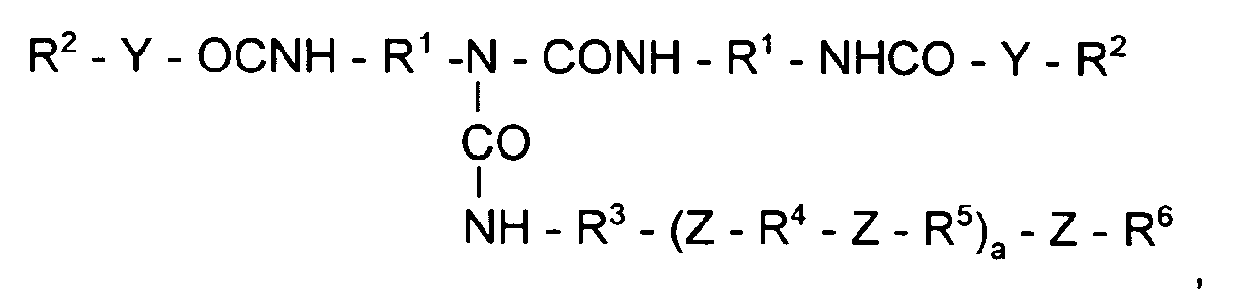
- Gegenstand der Erfindung sind daher Biuretverbindungen der idealisierten allgemeinen Formel

R1 für einen (C1-C22)-Alkylen-, (C3-C22)-Alkenylen-, (C5-C15)-Cycloalkylen-, Arylen-, (C7-C12)-Aralkylen-, einen Polyoxyalkylen-Rest oder für einen Polyester-Rest steht,
R2 für einen (C1-C22)-Alkyl-, Hydroxy-(C1-C22)-Alkyl-, (C3-C18)-Alkenyl, Aryl-, (C7-C12)-Aralkyl-, oder (C5-C12)-Cycloalkyl-Rest, einen Hydroxy-, (C1-C22)-Alkoxy-, (C5-C12)-Cycloalkoxy-, oder (C7-C12)-Aralkoxy-Polyoxyalkylen-Rest, einen (C1-C22)-Alkanol-, (C5-C12)-Cycloalkanol-, oder (C7-C12)-Aralkanol-gestarteten oder einen (C1-C22)-Alkoxy-, (C6-C12)-Cycloalkoxy-, oder (C7-C12)-Aralkoxy-Polyoxyalkylengestarteten Polyester steht,
Y für gleiche oder verschiedene Reste O, NH, CO-NH-NH oder NH-NH-CO steht
R3, R4 und R5 unabhängig voneinander für einen (C2-C40)-Alkylen-, (C3-C40)-Alkenylen-, (C5-C40)-Cycloalkylen-, Arylen-, (C7-C40)-Aralkylen- oder Polyoxyalkylen-Rest oder für einen Polyester-Rest stehen,
R6 für einen (C1-C30)-Alkyl-, (C3-C22)-Alkenyl-, Hydroxyalkyl- und -alkenyl-, (C4-C13)-Cycloalkyl-, Aryl- oder (C7-C12)-Aralkyl-Rest steht,
Z für eine oder mehrere der folgenden Gruppen COO, OCO, NHCO, CONH, NHCOO, OOCNH, NHCONH steht und
a für eine Zahl von 1 bis 19 steht. - Die Definitionen der Reste R1, R2, R3, R4, R5, R6, Y und Z sowie des Index a entsprechen im Rahmen dieser Erfindung unabhängig von den Verbindungen, in welchen diese aufgeführt sind, den obigen Definitionen. Bevorzugte Ausführungen dieser Reste finden sich in den jeweiligen Unterabschnitten.
- Im Falle, dass einer oder mehrere der Reste R1, R2, R3, R4 und/oder R5 einen Polyoxyalkylen-Anteil enthalten, sind diese Reste unabhängig von den Verbindungen, in welchen diese aufgeführt sind, vorzugsweise aus Ethylenoxid, Propylenoxid und/oder Butylenoxid-Einheiten, statistisch oder blockweise angeordnet, aufgebaut, und gegebenenfalls ist einer oder sind mehrere dieser Einheiten durch Styrol-Einheiten substituiert. Besonders bevorzugt sind Ethylenoxidund Propylenoxid-Reste.
- Im Falle, dass einer oder mehrere der Reste R1, R2, R3, R4 und/oder R5 einen Polyester-Rest umfassen, sind diese Reste unabhängig von den Verbindungen, in welchen diese aufgeführt sind, vorzugsweise auf der Basis von ein oder mehreren (C1-C18)-Hydroxycarbonsäuren oder ein oder mehreren Lactonen, wie β-Propiolacton, ö-Valerolacton, ε-Caprolacton und (C1-C6)-alkylsubstituiertem ε-Caprolacton, aufgebaut.
- R1 steht besonders bevorzugt für einen Hexamethylenrest.
- R2 steht vorzugsweise für einen (C1-C22)-Alkyl- oder einen -Alkoxypolyoxyalkylenrest.
- Die Reste R3 und R5 stehen unabhängig voneinander vorzugsweise für einen (C2-C18)-Alkylen-, (C7-C15)-Aralkylen-Rest, besonders bevorzugt für einen (C2-C12)-Alkylen-, (C7-C12)-Aralkylen-Rest, ganz besonders bevorzugt für einen (C2-C8)-Alkylen-, (C7-C9)-Aralkylen-Rest, wie beispielsweise einen Hexamethylen-, Octamethylen- oder m-Xylylen-Rest. Bevorzugt sind die Reste R3 und R5 identisch.
- R4 steht für einen (C2-C40)-Alkylen-, (C3-C40)-Alkenylen-, (C5-C40)-Cycloalkylen-, Arylen-oder (C7-C40)-Aralkylen-Rest, bevorzugt für einen (C30-C40)-Alkylen-, (C30-C40)-Alkenylen-, (C30-C40)-Cycloalkylen-, Arylen-, oder (C30-C40)-Aralkylen-Rest, wie beispielsweise den Rest zwischen den beiden Carbonsäuregruppen der Dimersäure. Besonders bevorzugt steht R4 für einen C34-Rest.
- R6 steht vorzugsweise für einen (C1-C30)-Alkyl- oder einen (C3-C22)-Alkenyl-Rest, welche eventuell mit Hydroxygruppen substituiert sein können, besonders bevorzugt einen (C12-C30)-Alkyl- oder einen (C12-C22)-Alkenyl-Rest und ganz besonders bevorzugt einen (C12-C20)-Alkyl- oder einen (C12-C20)-Alkenyl-Rest, wie beispielsweise einen C17-Alkyl- oder einen C17-Alkenyl-Rest.
- Z steht besonders bevorzugt für NHCO und CONH.
- Der Index a steht für eine Zahl von 1 bis 19, besonders bevorzugt von 2 bis 7.
Gegenstand der Erfindung ist auch ein Verfahren zur Herstellung thixotropieerzeugender und ablaufverhindernder Biuretverbindungen der allgemeinen Struktur A-B, erhältlich durch Umsetzung von Uretdionen der idealisierten allgemeinen Formel (A)
R2 für einen (C1-C22)-Alkyl-, Hydroxy-(C1-C22)-Alkyl-, (C3-C18)-Alkenyl, Aryl-, (C7-C12)-Aralkyl-, oder (C5-C12)-Cycloalkyl-Rest, einen Hydroxy-, (C1-C22)-Alkoxy-, (C5-C12)-Cycloalkoxy-, oder (C7-C12)-Aralkoxy-Polyoxyalkylen-Rest, einen (C1-C22)-Alkanol-, (C5-C12)-Cycloalkanol-, oder (C7-C12)-Aralkanol-gestarteten oder einen (C1-C22)-Alkoxy-, (C6-C12)-Cydoalkoxy-, oder (C7-C12)-Aralkoxy-Polyoxyalkylen-gestarteten Polyester steht,
Y für gleiche oder verschiedene Reste 0, NH, CO-NH-NH oder NH-NH-CO steht,
mit monoaminfunktionellen Verbindungen der idealisierten allgemeinen Struktur (B)
(B) H2N-R3-[Z-R4-Z-R5]a-Z-R6
wobei R3, R4 und R5 unabhängig voneinander für einen (C2-C40)-Alkylen-, (C3-C40)-Alkenylen-, (C5-C40)-Cycloalkylen-, Arylen-, (C7-C40)-Aralkylen- oder Polyoxyalkylen-Rest oder für einen Polyester-Rest stehen,
R6 für einen (C1-C30)-Alkyl-, (C3-C22)-Alkenyl-, Hydroxyalkyl- und -alkenyl-, (C4-C13)-Cycloalkyl-, Aryl- oder (C7-C12)-Aralkyl-Rest steht,
Z für eine oder mehrere der folgenden Gruppen COO, OCO, NHCO, CONH, NHCOO, OOCNH, NHCONH steht und
a für eine Zahl von 1 bis 19 steht. - Bei der Herstellung der erfindungsgemäßen Biuretverbindungen der allgemeinen Struktur A-B werden uretdionhaltige Polyisocyanate zunächst unter Erhalt der Uretdiongruppierung mit Monoalkoholen zu urethanhaltigen, mit Monoaminen und/oder Alkanolaminen und/oder Monohydraziden zu harnstoff- und/oder semicarbazidhaltigen Polymeren umgesetzt, und in einem 2. Schritt werden unter Ringöffung des Uretdion-Ringes mit einer aminfunktionellen Verbindung die erfindungsgemäßen Biuretverbindungen hergestellt.
- Uretdione werden, wie dem Fachmann bekannt, durch Addition von monomeren Diisocyanaten unter Verwendung bestimmter Katalysatoren hergestellt (Laas, H.J.; Halpaap, R.; Pedain,J.; J. prakt. Chemie 336 (1994), 185-200). Bevorzugt ist neben dem TDI-Uretdion, erhältlich z. B. als Desmodur® TT/G von der Rhein-Chemie, die Verwendung von HDI-Uretdion, welches kommerziell als Desmodur® N 3400 von BAYER verfügbar ist. Diese Verbindungen stellen Handelsprodukte dar, die häufig nicht in reiner Form vorliegen, sondern die Gemische von Verbindungen ähnlicher Struktur darstellen.
- Bei den für Verbindung A eingesetzten Monoalkoholen handelt es sich um aliphatische, cycloaliphatische und araliphatische Alkohole. Bei den aliphatischen Alkoholen werden lineare, verzweigte oder cyclische Alkohole der Kettenlänge C1 - C22 eingesetzt, wie z. B. Methanol, Ethanol, n-Propanol, 2-Propanol, n-Butanol, Isobutanol, tert.-Butanol, Hexanol, Oktanol, Decanol, Dodecanol, Oleylalkohol und Stearylalkohol. Glykolmonoether wie z. B. Ethylenglykol-monopropylether, Ethylenglykol-monobutylether, Ethylenglykol-mono(2-ethylhexylether) oder Ethylenglykol-monophenylether sind ebenfalls miteingeschlossen. Cycloaliphatische Alkohole umfassen z. B. Cyclopentanol und Cyclohexanol. Araliphatische Alkohole wie z. B. Benzylalkohol finden ebenfalls Verwendung. Als Vertreter der cyclischen Alkohole sei z. B. 1-(2-Hydroxyethyl)imidazolidin-2-on genannt. Polymere Alkohole wie Polyolefinmonoole, Polyacrylatmonoole, Polycarbonatmonoole, Polycaprolactonmonoole, Polyoxazolinmonoole oder Polysiloxanmonoole fallen ebenso unter die Erfindung wie Fettalkoholalkoxylate mit variablem Alkoxylierungsgrad, wie sie dem Fachmann unter dem Handelsnamen Lutensol der BASF bekannt sind. Bevorzugt werden Polyoxyalkylenmonoalkohole verwendet, welche Ethylenoxid- und/oder Propylenoxid- und/oder Butylenoxidgruppen enthalten und gegebenenfalls mit Styroloxid modifiziert sind. Besonders bevorzugt ist die Verwendung von Polyoxyalkylenmonoalkoholen wie z. B. MPEG 350, MPEG 500 und MPEG 750, bei denen es sich um Methanol gestartete Polyoxyethylene mit einer terminalen OH-Gruppe handelt. Die Monoalkohole können auch in Mischungen eingesetzt werden.
- Bei den für die Herstellung der uretdionhaltigen Verbindung A verwendeten Monoaminen handelt es sich um aliphatische, cycloaliphatische und araliphatische Amine. Bei den aliphatischen Aminen werden lineare, verzweigte oder cyclische Amine der Kettenlänge C2 - C22 eingesetzt, wie z. B. Ethylamin, Propylamin, Isopropylamin, Butylamin, sek. und tert.-Butylamin, 3-Methyl-1-butanamin, Hexylamin, 2-Ethylhexylamin, Octylamin, Cyclopentylamin, Cyclohexylamin, Tridecylamin, Oleylamin, Octadecylamin und die unter dem Handelsnamen Armeen von Akzo Nobel bekannten Mischungen von C12 - C22 Aminen. Erfindungsgemäß sind neben Polyolefinaminen wie z. B. Polyisobutylenamin auch bevorzugt Polyoxyalkylenmonoamine, welche Ethylenoxid- und/oder Propylenoxidgruppen enthalten und welche unter den Handelsnamen Jeffamine® M 600, M 1000, M 2005 und M 2070 von Huntsman bekannt sind. Bei den araliphatischen Aminen handelt es sich um Produkte, wie z. B. Benzylamin und Furfurylamin. Es können aber auch Hydrazide wie z. B. Benzoesäurehydrazid eingesetzt werden. Die Monoamine können auch als Mischungen eingesetzt werden, ebenso können die Monoamine mit den Monoalkoholen und den Monohydraziden in jedem Verhältnis gemischt, eingesetzt werden.
- Ebenfalls können für die Herstellung der uretdionhaltigen Verbindung A Alkanolamine verwendet werden. Als Beispiele seien hier 2-Aminoethanol, 3-Amino-1-propanol, 1-Amino-2-propanol, 2-(2-Aminoethoxy)ethanol, Diethanolamin, 3-(2-Hydroxyethylamino)-1-propanol, Düsopropanolamin und an den OH-Gruppen alkoxylierte Verbindungen davon genannt.
- Die Reaktion zwischen dem uretdionhaltigen Polyisocyanat und dem Monoalkohol wird bei Temperaturen zwischen 15 und 90°C, bevorzugt zwischen 20 und 75°C, gegebenenfalls unter Zuhilfenahme eines Katalysators, wie Dibutylzinndilaurat (DBTL), durchgeführt. Die Reaktion zwischen dem uretdionhaltigen Polyisocyanat und dem Monoamin, und/oder dem Alkanolamin und/oder dem Monohydrazid wird bei Temperaturen zwischen 15 und 45°C, bevorzugt zwischen 20 und 30 °C durchgeführt. Dabei ist die Reihenfolge der Zugabe der Co-Reaktanden im allgemeinen beliebig, das uretdionhaltige Polyisocyanat wird vorgelegt, gegebenenfalls in einem inerten Lösemittel, und der Monoalkohol, das Monoamin, das Alkanolamin oder das Monohydrazid werden zugetropft. Ebenso kann der Monoalkohol, das Monoamin, das Alkanolamin oder das Monohydrazid vorgelegt werden, und das uretdionhaltige Polyisocyanat wird zugetropft. Enthält Komponente A sowohl Urethan- als auch Harnstoff- und/oder Semicarbazidgrupen, so wird das uretdionhaltige Polyisocyanat zuerst mit dem Alkohol und danach mit dem Amin und/oder dem Monohydrazid umgesetzt. Gegebenenfalls kann die Reaktion auch in einem inerten Lösemittel durchgeführt werden, wie z. B. Methyoxypropylacetat, Cyclohexan, Toluol, Xylol oder einem höhersiedenden Aromaten wie z. B. Shellsol A.
- Die monoaminfunktionellen Verbindungen der allgemeinen Formel (B)
(B) H2N-R -[Z-R -Z-RJa-Z-R
werden unter Bedingungen hergestellt, wie sie dem Fachmann bekannt sind und sind beispielsweise dadurch erhältlich, dass man eine Mischung aus Mono- und Polycarbonsäuren, bevorzugt Dicarbonsäuren, und/oder Dicarbonsäureanhydriden, mit Diaminen, vorzugsweise bei Temperaturen von 100 bis 250 °C, besonders bevorzugt 140 bis 200 °C unter Wasserabscheidung umsetzt. Das Verhältnis Diamin zu Polycarbonsäure zu Monocarbonsäure beträgt 3 zu 2 zu 1 bis 20 zu 19 zu 1, besonders bevorzugt 3 zu 2 zu 1 bis 8 zu 7 zu 1. In einer bevorzugten Ausführungsform lassen sich Verbindungen der allgemeinen Formel (B) dadurch herstellen, dass zuerst die Dicarbonsäure und/oder das Dicarbonsäureanhydrid mit dem Diamin bei Temperaturen von 100 bis 250 °C, besonders bevorzugt 140 bis 200 °C unter Wasserabscheidung zu einem Kondensationsprodukt der allgemeinen Formel (C)
(C) H2N-R3-[Z-R4-Z-R5]a-NH2
mit einer Aminzahl von bevorzugt 5 bis 180 und besonders bevorzugt von 15 bis 100, bezogen auf 100 % aktive Substanz, umgesetzt wird und anschließend bei Temperaturen von 100 bis 250 °C, besonders bevorzugt 140 bis 200 °C, Verbindung (C) mit der Monocarbonsäure unter Wasserabscheidung zu Verbindung (B) umgesetzt wird, wobei dieses Kondensationsprodukt eine Aminzahl von bevorzugt 3 bis 80 und besonders bevorzugt von 8 bis 50, bezogen auf 100 % aktive Substanz, aufweist. - Bei den Diaminen handelt es sich vorzugsweise um aliphatische, aromatische und araliphatische primäre Diamine, wie z. B. Ethylendiamin, Neopentandiamin, 1,2- und 1,3-Propandiamin, 1,4-Butandiamin, 1,5-Pentandiamin, 2-Butyl-2-ethyl-1,5-Pentandiamin, 1,6-Hexamethylendiamin (auch als Lösung in Wasser), 1,8-Octamethylendiamin, 1,12-Dodecamethylendiamin, Cyclohexyldiamin, 4,4'-Diaminodicyclohexylmethan, 3,3'-Dimethyl-4,4'-Diaminodicyclohexylmethan, Isophorondiamin, 4,7-Dioxadecan-1,10-diamin, 4,11-Dioxatetradecan-1,14-diamin, 4,7,10-Trioxadecan-1,13-diamin, Polyoxyalkylen-diamine, welche Ethylenoxid- und/oder Propylenoxid-Gruppen, statistisch oder blockweise angeordnet, enthalten, ein zahlenmittleres Molekulargewicht von 148 bis 4000 g/mol besitzen und beispielsweise als Jeffamine® D 230, D 400, D 2000, D 4000 und Jeffamine® ED 600, ED 900, ED 2003 und EDR 148 von Huntsman erhältlich sind, Polytetrahydrofurandiamine wie z. B. Bis(3-Aminopropyl)polytetrahydrofuran 350, 750, 1100 und 2100 (die Zahlen geben das ungefähre Molekulargewicht an), 4,4'-Diaminodiphenylmethan, 3,3'-Diaminodiphenylsulfon sowie para- und meta-Xylylendiamin. Bevorzugt werden 1,6-Hexamethylendiamin, 1,8-Octamethylendiamin und meta-Xylylendiamin eingesetzt. Ebenfalls können Amine vom Typus H2N-R-NR-R-NH2 verwendet werden, wobei R unabhängig für (C1-C18)-Alkyl oder (C1-C4)-Alkoxy steht. Ein Beispiel hierfür ist N,N'-Bis-(3-aminopropyl)methylamin. Es können aber auch Dihydrazide wie z. B. Oxalsäuredihydrazid, Bernsteinsäuredihydrazid oder Adipinsäuredihydrazid eingesetzt werden. Der Einsatz von Mischungen der Diamine, auch mit den Dihydraziden, ist ebenfalls möglich. Die Diamine können auch als Carbonatverbindungen eingesetzt werden, die bei der Kondensationsreaktion mit den Polycarbonsäuren unter Wasserabscheidung und CO2-Abspaltung zu den erfindungsgemäß bevorzugten Amidgruppierungen reagieren.
- Bei den Polycarbonsäuren handelt es sich vorzugsweise um aliphatische, cycloaliphatische oder aromatische, lineare oder verzweigte, gesättigte oder ungesättigte Dicarbonsäuren mit wenigstens 2, besonders bevorzugt 3 bis 40 C-Atomen. Beispiele solcher Polycarbonsäuren sind Adipinsäure, Oxalsäure, Malonsäure, Bernsteinsäure, Glutarsäure, Pimelinsäure, Korksäure, Sebacinsäure, Azelainsäure, Undecandisäure, 1,11-Undecandicarbonsäure, Dodecandisäure, Hexadecandisäure, Dokosandisäure Maleinsäure, Fumarsäure, Terephthalsäure oder Isophthalsäure, alleine oder in Mischungen eingesetzt. Säureanhydride wie Maleinsäureanhydrid, Glutarsäureanhydrid, Phthalsäureanhydrid und Bernsteinsäureanhydrid, welche gegebenenfalls mit Alkyl- oder Alkylengruppen modifiziert sind wie z. B. Dodecenylbernsteinsäureanhydrid, sind ebenfalls in der Erfindung eingeschlossen. Polymere Polycarbonsäuren wie z. B. die Dicarbonsäure des Polybutadiens können ebenso verwendet werden wie hydroxyfunktionelle Polycarbonsäuren wie z. B. Weinsäure, Zitronensäure und Hydroxyphthalsäure. Oxydicarbonsäuren wie 3,6,9-Trioxyundecandisäure und Polyglykoldisäure sind ebenfalls mit eingeschlossen. Dimerisierte Fettsäuren, dem Fachmann als Dimersäuren bekannt, mit einer Kohlenstofflänge von 36 C-Atomen sind ganz besonders bevorzugt. Diese Dimersäuren können sowohl einen geringen Monomergehalt (üblicherweise < 8 Gewichtsprozent), als auch einen Anteil von nicht mehr als 25 Gewichtsprozent an Trimersäure aufweisen.
- Bei den Monocarbonsäuren handelt es sich um gesättigte, einfach bis mehrfach ungesättigte, lineare und verzweigte aliphatische Carbonsäuren wie z. B. Essigsäure, Propionsäure, Buttersäure, Isobuttersäure, Valeriansäure, Isovaleriansäure, Capronsäure, Önanthsäure, Caprylsäure, Pelargonsäure, Caprinsäure, Undecansäure, Laurinsäure, Tridecansäure, Myristinsäure, Pentadecansäure, Palmitinsäure, Margarinsäure, Stearinsäure, Nonadecansäure, Arachinsäure, Behensäure, Lignocerinsäure, Cerotinsäure, Melissinsäure, Lauroleinsäure, Myristoleinsäure, Palmitoleinsäure, Petroselinsäure, Ölsäure, Elaidinsäure, Vaccensäure, Erucasäure, Linolsäure, Linolensäure, Arachidonsäure, Clupanodonsäure, Ricinensäure, α-Elaeostearinsäure, α-Parinarsäure, Kokosölfettsäure, Palmkernölfettsäure, Kokos/Palmkernölfettsäure, Palmölfettsäure, Cottonölfettsäure, Erdnussölfettsäure, Sojaölfettsäure, Sonnenblumenölfettsäure, Rapsölfettsäure und Talgfettsäure. Ebenso finden Ketocarbonsäuren wie beispielsweise Licansäure, als auch aromatische Monocarbonsäuren wie beispielsweise Benzoesäure Verwendung. Als Vertreter der Hydroxycarbonsäuren seien zum Beispiel Glykolsäure, 5-Hydroxyvaleriansäure, 6-Hydroxycapronsäure, Ricinolfettsäure, 12-Hydroxystearinsäure, 12-Hydroxydodecansäure, 5-Hydroxydodecansäure, 5-Hydroxydecansäure oder 4-Hydroxydecansäure genannt. Auch Mischungen der Monocarbonsäuren können eingesetzt werden.
- Die Mono- bzw. Polycarbonsäuren können teilweise durch Mono- bzw. Diisocyanate und die Diamine teilweise durch Diole ersetzt werden, wobei dann Ester-, Urethanund/oder Harnstoffgruppen neben den bevorzugten Amidgruppierungen in den Verbindungen der allgemeinen Formeln (B) und (C) vorliegen können.
- Bei den Diolen handelt es sich, alleine oder in Mischungen, vorzugsweise um Polyoxyalkylendiole, Polyoxyalkenyldiole, die gegebenenfalls mit (C1-C4)-Alkylund/oder -Alkoxygruppen modifiziert sind, um Polyesterdiole, gemischte Polyesterpolyoxyalkylendiole, Polylactondiole, gemischte Polyoxyalkylenpolylactondiole, Polycarbonatdiole, Polyolefindiole, Polyacrylatdiole, alkoxylierte Bisphenol A Diole, um Diole vom Typ α-ω-Dihydroxyalkylensiloxane als auch deren alkoxylierte Verbindungen mit einem mittleren Molekulargewicht Mn von 250 bis 5000 g/mol.
- Als Diisocyanate können vorzugsweise aliphatische, cycloaliphatische und aromatische Diisocyanate, oder deren Mischungen eingesetzt werden. Beispiele solcher Diisocyanate sind 1,4-Tetramethylendiisocyanat, 1,6-Hexamethylendiisocyanat, 2,2,4-Trimethyl-1,6-Hexamethylendüsocyanat, 1,10-Decamethylendiisocyanat, 1,4-Cyclohexylendüsocyanat, p-Phenylen-DÜsocyanat, m-PhenylenDiisocyanat, 2,6-Toluylendiisocyanat, 2,4-Toluylendiisocyanat und deren Mischungen, p- und m-Xylylendüsocyanat, 1,5-Naphthylendiisocyanat, Isophorondiisocyanat, 4-4' ,-Diisocyanatodicyclohexylmethan, 3,3'-Dimethyl-4,4'-Bisphenylendiisocyanat, 3,3'-Dimethyl-Diisocyanatodiphenylmethan, die Isomerenmischungen 2,4'- und 4-4'-Diisocyanatodiphenylmethan und C36-Dimerdiisocyanat.
- Zur Herstellung der erfindungsgemäßen Biuretverbindungen der allgemeinen Struktur A-B werden die Uretdione der allgemeinen Formel A und die monoaminfunktionellen Verbindungen der allgemeinen Formel B bei einer Reaktionstemperatur zwischen 60 und 120 °C, besonders bevorzugt zwischen 75 und 90°C zur Reaktion gebracht. Dabei wird das Verhältnis der Komponenten A und B so gewählt, dass auf 1 mol Verbindung A zwischen 0,8 mol und 1,2 mol, bevorzugt zwischen 0,9 mol und 1,1 mol, besonders bevorzugt 1 mol Verbindung B eingesetzt wird. Die Reaktion kann mit oder ohne Lösemittel durchgeführt werden. Als Lösemittel geeignet sind alle aliphatischen, aromatischen, protischen und aprotischen Lösemittel wie z. B. Methyoxypropylacetat, Cyclohexan, Toluol, Xylol oder höhersiedende Lösemittel wie z. B. Shellsol A oder Exxsol D 40. N-Methylpyrrolidon oder N-Ethylpyrrolidon, aber auch Alkohole wie Ethanol, Propanol, i-Butanol oder Butylglykol sind ebenfalls geeignet. Ebenso kann die Addition in einem Polyether wie z. B. Polypropylenglykol 600 (die Zahl gibt das ungefähre Molekulargewicht an) als Lösemittel durchgeführt werden. Auch Mischungen von Lösemitteln lassen sich verwenden.
- Des Weiteren betrifft die vorliegende Erfindung die Verwendung der erfindungsgemäßen Biuretverbindungen der allgemeinen Struktur A-B beziehungsweise der durch das erfindungsgemäße Verfahren erhaltenen Biuretverbindungen der allgemeinen Struktur A-B als Rheologiesteuerungsadditive, insbesondere in lösungsmittelhaltigen und lösungsmittelfreien Lacken auf der Basis von Bindemitteln wie z. B. Polyurethanen (1 K und 2K), Polyacrylaten, Polyester-, Alkyd- und Epoxidharzen, PVC-Plastisolen und -Organosolen, Beschichtungen auf Epoxidbasis und ungesättigten Polyesterharzen. Unter Lacken können auch Nagellacke, wie sie beispielsweise in der Patentschrift
US 6,156,325 beschrieben sind, verstanden werden. - Die Einsatzmenge der erfindungsgemäßen Biuretverbindungen der allgemeinen Struktur A-B beträgt 0,05 bis 5,0 Gew.-% Wirksubstanz, bevorzugt 0,1 bis 3,0 Gew.-% Wirksubstanz und besonders bevorzugt 0,2 bis 2,0 Gew.-% Wirksubstanz, bezogen auf das Gewicht der Gesamtformulierung.
- Weiterer Gegenstand der Erfindung sind gehärtete und ungehärtete Polymer-Zusammensetzungen enthaltend ein oder mehrere der erfindungsgemäßen Biuretverbindungen der allgemeinen Struktur A-B beziehungsweise der durch das erfindungsgemäße Verfahren erhaltenen Biuretverbindungen der allgemeinen Struktur A-B.
- Im folgenden wird die Erfindung anhand von Ausführungsbeispielen näher erläutert.
- In einem 1-Liter-3-Halskolben mit Rührer, Rückflusskühler und Thermometer werden bei Raumtemperatur 195,0 g (0,5 mol) Hexamethylendüsocyanat-Uretdion (Desmodur® N3400 der Fa. Bayer, NCO-Gehalt = 21,5%) und 138,2 g (1,0 mol) Ethylenglykol-monophenylether eingefüllt und auf 70°C erwärmt. Die Reaktion wird solange geführt, bis der NCO-Gehalt kleiner 0,1 % ist. Dann wird auf 50°C abgekühlt.
Tabelle 1: Komponenten A: Beispiel Uretdion Amin-/ Alkoholkomponenten 2 Hexamethylendiisocyanat-Uretdion Decanol 3 Hexamethylendiisocyanat-Uretdion Oleylalkohol 4 Hexamethylendiisocyanat-Uretdion Polyglykol M 350 5 Hexamethylendiisocyanat-Uretdion Benzylamin 6 Hexamethylendiisocyanat-Uretdion Tridecylamin 7 Hexamethylendiisocyanat-Uretdion Jeffamine® M 600 8 Hexamethylendiisocyanat-Uretdion Jeffamine® M 1000 9 Hexamethylendiisocyanat-Uretdion Polyglykol M 500 / Tri-decylamin (Verhältnis 1 : 1) Legende1:
Jeffamine® M 600: Monoaminfunktioneller EO/PO-Polyether (EO:PO = 1:9), Mn - 600 g/mol, von Huntsman
Jeffamine® M 1000: Monoaminfunktioneller EO/PO-Polyether (EO:PO = 19:3), Mn - 1000 g/mol, von Huntsman
Polyglykol M 350, 500: Methanol gestartete monohydroxyfunktionelle EO-Polyether, Mn - 350 bzw. 500 g/mol von Clariant - In einem 1-Liter 3-Halskolben mit Rührer, Wasserabscheider und Thermometer werden nacheinander 227,8 g (0,4 mol) Dimersäure Pripol™ 1009 (Dimerisierte Fettsäure, hydriert, Uniqema, max. 1 % Trimersäure), 69,6 g (0,6 mol) Hexamethylendiamin und 152,1 g Exxsol D40 (dearomatisierter Kohlenwasserstoff, ExxonMobil Chemical) eingewogen und langsam auf 170°C erhitzt. Das bei der Reaktion langsam freiwerdende Wasser wird azeotrop über den Wasserabscheider abgetrennt. Das Kondensationsprodukt besitzt eine Aminzahl von 51. Anschließend werden 57,6 g (0,2 mol) Tallölfettsäure (Mischung von Monocarbonsäuren mit einem hohen Gehalt an Öl- und Linolsäure und ca. 2% Harzsäuren (Abietinsäure), Arizona Chemical GmbH) zugegeben und das bei dieser Reaktion freiwerdende Wasser azeotrop über den Wasserabscheider abgetrennt. Dieses Kondensationsprodukt besitzt eine Aminzahl von 22,7. Danach wird die Reaktionsmischung auf 50°C abgekühlt.
Tabelle 2: Komponenten B: Beispiel Diamin Dicarbonsäure Monocarbonsäure Molverhältnis a b c a:b:c 11 Hexamethylendiamin PripolTM 1006 Tallölfettsäure 6 : 5 : 1 12 Hexamethylendiamin PripolTM 1009 Heptansäure 7 : 6 : 1 13 Hexamethylendiamin PripolTM 1013 12-Hydroxystearinsäure 5 : 4 : 1 14 Octamethylendiamin Empol® 1062 Stearinsäure 3 : 2 : 1 15 m-Xylylendiamin PripolTM 1017 Tallölfettsäure 6 : 5 : 1 16 Jeffamine® ED 600 Adipinsäure Stearinsäure 4 : 3 : 1 17 Jeffamine® D 230 Adipinsäure / Pripol™ 1006 Verhältnis 1 : 2 Tallölfettsäure 5 : 4 : 1 18 Hexamethylendiamin Pripol™ 1006 Essigsäure 3 : 2 : 1 19 Hexamethylendiamin / m-Xylylendiamin (Verhältnis 2 : 3) Empol® 1012 Ölsäure 4:3: 1 Legende 2:
Pripol™ 1006: Dimerisierte Fettsäure (max. 4% Trimersäure), hydriert, von Uniqema
Pripol™ 1009: Dimerisierte Fettsäure (max. 1% Trimersäure), hydriert, von Uniqema
Pripol™ 1013: Dimerisierte Fettsäure (max. 4% Trimersäure), von Uniqema
Pripol™ 1017: Dimerisierte Fettsäure (max. 22% Trimersäure), von Uniqema
Empol® 1062: Dimerisierte Fettsäure (max. 3,5% Polycarbonsäure), teilhydriert, von Cognis
Empol® 1012: Dimerisierte Fettsäure (max. 5% Polycarbonsäure), hydriert, von Cognis
Jeffamine® ED 600: Diaminfunktioneller EO/PO-Polyether (EO:PO = 9:3,6), Mn - 600 g/mol, von Huntsman
Jeffamine® D 230: Diaminfunktioneller PO-Polyether, Mn - 230 g/mol, von Huntsman - In einem 1-Liter-3-Halskolben mit Rührer, Rückflusskühler und Thermometer werden bei Raumtemperatur nacheinander 66,6 g (0,1 mol) des Additionsproduktes aus Beispiel 1 und 247,1 g (0,1 mol; Aminzahl = 22,7) des Kondensationsproduktes aus Beispiel 10 eingewogen und auf 85°C erwärmt. Die Reaktionsmischung wird solange gerührt, bis die Aminzahl kleiner 1 ist. Dann wird das Produkt mit i-Butanol auf einen Festkörper von 30% verdünnt.
Tabelle 3: Biuret-Addukte: Beispiel Komponente A Komponente B 21 Beispiel 2 Beispiel 19 22 Beispiel 4 Beispiel 11 23 Beispiel 7 Beispiel 15 24 Beispiel 8 Beispiel 13 25 Beispiel 9 Beispiel 14 - Weißlackrezeptur: Worléekyd S 365 Weißlack, 64% Bindemittel, 20% Ti02
Worléekyd S 365, 70% in K 030 34,4 Disperbyk® 110 0,6 RKB-2 (TiO2) 20,0 BYK 066 0,3 - Dispergierung: 30 min. Dispermat, 50°C, 8500 U./min. 4 cm Teflonscheibe
Nuodex Combi APB 4,5 Borchi Nox M2 0,2 K 030 10,4 100 Legende 3:
Worléekyd S 365: Langölalkydharz, lufttrocknend, der Fa. Worlée
Disperbyk® 110: Netz- und Dispergieradditiv (Lösung eines Copolymeren mit sauren Gruppen) der Fa. BYK-Chemie
RKB-2: Weißpigment (Titandioxid) der BAYER AG
BYK 066: Silikonentschäumer der Fa. BYK-Chemie
Nuodex Combi APB: Kombinations Trockner von Sasol Servo BV
Borchi Nox M2: Hautverhinderungsmittel (Methylethylketoxim) der Fa. Borchers
K 030: Gemisch aus paraffinischen, naphthenischen und aromatischen
Kohlenwasserstoffen im Bereich C8 - C11, von Solvadis Deutschland
Additivdosierung: 1 Gew.-% Wirksubstanz, bezogen auf das Gewicht der Gesamtzusammensetzung
Einarbeitung: Additiv unter Rühren mit dem Dispermat zugeben Zahnscheibe 2,5 cm, 1200 U./min., 2 min. - Abprüfung: Prüfung der rheologischen Wirksamkeit in Form der Ablaufgrenze. Dazu werden die additivierten Lacksysteme mit dem Stufenrakel 50 - 500 µm und 550 - 1000 µm auf Kontrastkarten 2801 von BYK Gardner mit einer automatischer Aufziehbank von BYK Gardner (Geschwindigkeit 3 cm/sec) appliziert. Die Kontrastkarten werden vertikal hängend getrocknet. Das Standvermögen wird in µm nass abgelesen. Dieses ist ein Maß für die rheologische Wirksamkeit. Die Ergebnisse sind in Tabelle 4 dargestellt.
Tabelle 4: Additiv Ablaufgrenze [µm] Kontrolle (ohne Additiv) 150 BYK 411 1 450 Beispiel 20 900 Beispiel 21 550 Beispiel 22 800 Beispiel 23 650 Beispiel 24 1000 Beispiel 25 750 Legende 4:
BYK 411: Flüssiges Rheologieadditiv der Fa. BYK-Chemie
Claims (11)
- Biuretverbindungen der idealisierten allgemeinen Formel

R1 für einen (C1-C22)-Alkylen-, (C3-C22)-Alkenylen-, (C5-C15)-Cycloalkylen-, Arylen-, (C7-C12)-Aralkylen-, einen Polyoxyalkylen-Rest oder für einen Polyester-Rest steht,
R2 für einen (C1-C22)-Alkyl-, Hydroxy-(C1-C22)-Alkyl-, (C3-C18)-Alkenyl, Aryl-, (C7-C12)-Aralkyl-, oder (C5-C12)-Cycloalkyl-Rest, einen Hydroxy-, (C1-C22)-Alkoxy-, (C5-C12)-Cycloalkoxy-, oder (C7-C12)-Aralkoxy-Polyoxyalkylen-Rest, einen (C1-C22)-Alkanol-, (C5-C12)-Cycloalkanol-, oder (C7-C12)-Aralkanol-gestarteten oder einen (C1-C22)-Alkoxy-, (C6-C12)-Cyloalkoxy-, oder (C7-C12)-Aralkoxy-Polyoxyalkylengestarteten Polyester-Rest steht,
Y für gleiche oder verschiedene Reste 0, NH, CO-NH-NH oder NH-NH-CO steht
R3, R4 und R5 unabhängig voneinander für einen (C2-C40)-Alkylen-, (C3-C40)-Alkenylen-, (C5-C40)-Cycloalkylen-, Arylen-, (C7-C40)-Aralkylen- oder Polyoxyalkylen-Rest oder für einen Polyester-Rest stehen,
R6 für einen (C1-C30)-Alkyl-, (C3-C22)-Alkenyl-, Hydroxyalkyl- und -alkenyl-, (C4-C13)-Cycloalkyl-, Aryl- oder (C7-C12)-Aralkyl-Rest steht,
Z für eine oder mehrere der folgenden Gruppen COO, OCO, NHCO, CONH, NHCOO, OOCNH, NHCONH steht und
a für eine Zahl von 1 bis 19 steht. - Biuretverbindungen nach Anspruch 1, dadurch gekennzeichnet, daß R1 für einen Hexamethylenrest steht.
- Biuretverbindungen nach Anspruch 1 oder 2, dadurch gekennzeichnet, daß R2 für einen (C1-C22)-Alkyl- oder einen -Alkoxypolyoxyalkylenrest steht.
- Biuretverbindungen nach Anspruch 1 bis 3, dadurch gekennzeichnet, daß die Reste R3 und R5 unabhängig voneinander für einen (C2-C18)-Alkylen-, (C7-C15)-Aralkylen-Rest, besonders bevorzugt für einen (C2-C12)-Alkylen-, (C7-C12)-Aralkylen-Rest, ganz besonders bevorzugt für einen (C2-C8)-Alkylen-, (C7-C9)-Aralkylen-Rest, wie beispielsweise einen Hexamethylen-, Octamethylen- oder m-Xylylen-Rest stehen.
- Biuretverbindungen nach Anspruch 1 bis 4, dadurch gekennzeichnet, daß R4 für einen (C2-C40)-Alkylen-, (C3-C40)-Alkenylen-, (C5-C40)-Cycloalkylen-, Arylen- oder (C7-C40)-Aralkylen-Rest, bevorzugt für einen (C30-C40)-Alkylen-, (C30-C40)-Alkenylen-, (C30-C40)-Cycloalkylen-, Arylen-, oder (C30-C40)-Aralkylen-Rest steht.
- Biuretverbindungen nach Anspruch 1 bis 5, dadurch gekennzeichnet, daß R6 für einen (C1-C30)-Alkyl- oder einen (C3-C22)-Alkenyl-Rest steht.
- Biuretverbindungen nach Anspruch 1 bis 6, dadurch gekennzeichnet, daß Z für NHCO oder CONH steht.
- Biuretverbindungen nach Anspruch 1 bis 7, dadurch gekennzeichnet, daß a = 2 bis 7 ist.
- Verfahren zur Herstellung von Biuretverbindungen nach Anspruch 1 bis 8, dadurch gekennzeichnet, daß Uretdione der idealisierten allgemeinen Formel (A)

R2 für einen (C1-C22)-Alkyl-, Hydroxy-(C1-C22)-Alkyl-, (C3-C18)-Alkenyl, Aryl-, (C7-C12)-Aralkyl-, oder (C5-C12)-Cycloalkyl-Rest, einen Hydroxy-, (C1-C22)-Alkoxy-, (C5-C12)-Cycloalkoxy-, oder (C7-C12)-Aralkoxy-Polyoxyalkylen-Rest, einen (C1-C22)-Alkanol-, (C5-C12)-Cycloalkanol-, oder (C7-C12)-Aralkanol-gestarteten oder einen (C1-C22)-Alkoxy-, (C6-C12)-Cycloalkoxy-, oder (C7-C12)-Aralkoxy-Polyoxyalkylengestarteten Polyester steht,
Y für gleiche oder verschiedene Reste O, NH, CO-NH-NH oder NH-NH-CO steht,
mit monoaminfunktionellen Verbindungen der idealisierten allgemeinen Struktur (B)
(B) H2N-R3-[Z-R4-Z-R5]a-Z-R6
umgesetzt werden, wobei R3, R4 und R5 unabhängig voneinander für einen (C2-C40)-Alkylen-, (C3-C40)-Alkenylen-, (C5-C40)-Cyloalkylen-, Arylen-, (C7-C40)-Aralkylen- oder Polyoxyalkylen-Rest oder für einen Polyester-Rest stehen,
R6 für einen (C1-C30)-Alkyl-, (C3-C22)-Alkenyl-, Hydroxyalkyl- und -alkenyl-, (C4-C13)-Cycloalkyl-, Aryl- oder (C7-C12)-Aralkyl-Rest steht,
Z für eine oder mehrere der folgenden Gruppen COO, OCO, NHCO, CONH, NHCOO, OOCNH, NHCONH steht und
a für eine Zahl von 1 bis 19 steht. - Verwendung von Biuretverbindungen nach Anspruch 1 bis 8 als Mittel zur Rheologiesteuerung.
- Verwendung von Biuretverbindungen nach Anspruch 1 bis 8 zur Thixotropierung von Beschichtungssystemen, als Antiablaufmittel und/oder Antiabsetzmittel.
Applications Claiming Priority (1)
| Application Number | Priority Date | Filing Date | Title |
|---|---|---|---|
| DE102006010721A DE102006010721B4 (de) | 2006-03-08 | 2006-03-08 | Biuretverbindungen zur Rheologiesteuerung |
Publications (3)
| Publication Number | Publication Date |
|---|---|
| EP1832573A2 true EP1832573A2 (de) | 2007-09-12 |
| EP1832573A3 EP1832573A3 (de) | 2007-12-12 |
| EP1832573B1 EP1832573B1 (de) | 2011-12-21 |
Family
ID=38171661
Family Applications (1)
| Application Number | Title | Priority Date | Filing Date |
|---|---|---|---|
| EP07004561A Active EP1832573B1 (de) | 2006-03-08 | 2007-03-06 | Biuretverbindungen zur Rheologiesteuerung |
Country Status (11)
| Country | Link |
|---|---|
| US (1) | US7655815B2 (de) |
| EP (1) | EP1832573B1 (de) |
| JP (1) | JP5324045B2 (de) |
| KR (1) | KR101423747B1 (de) |
| CN (1) | CN101033204B (de) |
| AT (1) | ATE538087T1 (de) |
| CA (1) | CA2581016A1 (de) |
| DE (1) | DE102006010721B4 (de) |
| DK (1) | DK1832573T3 (de) |
| ES (1) | ES2377944T3 (de) |
| TW (1) | TWI385190B (de) |
Cited By (5)
| Publication number | Priority date | Publication date | Assignee | Title |
|---|---|---|---|---|
| EP1837355A3 (de) * | 2006-03-22 | 2008-01-02 | BYK-Chemie GmbH | Additionsverbindungen als Dispergiermittel und Dispersionsstabilisatoren |
| EP2199344A1 (de) * | 2008-12-17 | 2010-06-23 | Ems-Patent Ag | Xylylenbasierte Polyamide und deren Verwendung |
| WO2011091812A1 (de) * | 2010-01-28 | 2011-08-04 | Byk-Chemie Gmbh | Harnstoff- und amidkomponenten enthaltende lackzubereitung |
| US8362300B2 (en) | 2004-05-07 | 2013-01-29 | Byk-Chemie Gmbh | Addition compounds suitable as dispersants and dispersion stabilizers |
| US10377906B2 (en) | 2014-04-15 | 2019-08-13 | Byk-Chemie Gmbh | Composition for rheology control |
Families Citing this family (14)
| Publication number | Priority date | Publication date | Assignee | Title |
|---|---|---|---|---|
| WO2013136892A1 (ja) * | 2012-03-13 | 2013-09-19 | Dic株式会社 | ウレタン樹脂組成物、コーティング剤、物品及び皮革様シート |
| WO2014111102A2 (de) | 2012-12-15 | 2014-07-24 | Byk-Chemie Gmbh | Komposition zur rheologiesteuerung |
| ES2676442T3 (es) * | 2014-04-15 | 2018-07-19 | Byk-Chemie Gmbh | Preparaciones de urea estables al almacenamiento adecuadas como agentes para el control de la reología |
| CN110494462B (zh) | 2017-01-30 | 2021-11-16 | 毕克化学有限公司 | 作为流变控制剂和在流变控制剂中的含脲基团和/或含氨基甲酸酯基团的酰胺的制备和用途 |
| CN107226788A (zh) * | 2017-05-04 | 2017-10-03 | 明光市飞洲新材料有限公司 | 一种铸造涂料专用防流挂剂生产工艺 |
| EP3431536A1 (de) | 2017-07-20 | 2019-01-23 | Solvay Sa | Funktionalisiertes partikelförmiges bicarbonat als treibmittel, schäumbare polymerzusammensetzung damit und verwendung davon bei der herstellung von thermoplastischem aufgeschäumtem polymer |
| ES2966189T3 (es) | 2017-07-20 | 2024-04-18 | Solvay | Bicarbonato en partículas funcionalizado como agente de expansión, composición polimérica espumable que lo contiene y su uso en la fabricación de un polímero espumado termoplástico |
| CN108070066B (zh) * | 2017-12-29 | 2020-11-27 | 陈鹏 | 一种涂料油墨防沉剂及其制备方法 |
| US11655327B2 (en) | 2018-09-20 | 2023-05-23 | 3M Innovative Properties Company | Polymeric material including a uretdione-containing material and an epoxy component, two-part compositions, and methods |
| JP7436516B2 (ja) * | 2019-05-16 | 2024-02-21 | エボニック オペレーションズ ゲーエムベーハー | 硬化性組成物 |
| CN111704692B (zh) * | 2020-07-03 | 2021-11-30 | 永康市莱莉雅水性涂料科技有限公司 | 一种防沉降剂的制备方法及其在水性涂料中的应用 |
| WO2022117621A1 (en) | 2020-12-04 | 2022-06-09 | Byk-Chemie Gmbh | Rheology control agent |
| CA3241460A1 (en) | 2023-06-27 | 2025-06-09 | Evonik Operations Gmbh | Polyetheramide synergist |
| WO2026027417A1 (en) | 2024-07-30 | 2026-02-05 | Byk-Chemie Gmbh | Rheology control agent |
Family Cites Families (10)
| Publication number | Priority date | Publication date | Assignee | Title |
|---|---|---|---|---|
| US3856830A (en) * | 1971-12-23 | 1974-12-24 | Atlas Chem Ind | Polymerizable urethane compounds |
| DE2361041C3 (de) * | 1973-12-07 | 1980-08-14 | Hoechst Ag, 6000 Frankfurt | Photopolymerisierbares Gemisch |
| DE3502683A1 (de) * | 1985-01-26 | 1986-08-07 | Hüls AG, 4370 Marl | Polyurethane mit urethan- und biuretstruktur |
| DE3724555A1 (de) * | 1987-07-24 | 1989-02-02 | Basf Ag | Viskositaetsregulierende stoffe fuer einkomponentige polyurethansysteme |
| WO2000037520A1 (en) | 1998-12-22 | 2000-06-29 | Akzo Nobel N.V. | Thixotropic amino formaldehyde resin |
| DE19919482C2 (de) * | 1999-04-29 | 2001-04-26 | Byk Chemie Gmbh | Verfahren zur Herstellung eines Thixotropie-Mittels und dessen Verwendung |
| DE10039837C2 (de) * | 2000-08-16 | 2003-03-20 | Byk Chemie Gmbh | Verfahren zur Herstellung einer lagerstabilen, rheologisch wirksamen Harnstoffurethan-Lösung mit breiter Verträglichkeit |
| ES2358404T3 (es) | 2003-07-08 | 2011-05-10 | Nuplex Resins B.V. | Derivados de metilamina sustituida con carbono y su uso como agente de control de la reología. |
| DE102004022753B3 (de) | 2004-05-07 | 2006-02-16 | Byk-Chemie Gmbh | Als Dispergiermittel und Dispersionsstabilisatoren geeignete Additionsverbindungen |
| DE102005015966A1 (de) | 2005-04-07 | 2006-10-19 | Byk-Chemie Gmbh | Biuretverbindungen, ihre Herstellung und Verwendung sowie Zwischenprodukte zu ihrer Herstellung |
-
2006
- 2006-03-08 DE DE102006010721A patent/DE102006010721B4/de not_active Expired - Fee Related
-
2007
- 2007-02-27 TW TW096106712A patent/TWI385190B/zh not_active IP Right Cessation
- 2007-03-06 EP EP07004561A patent/EP1832573B1/de active Active
- 2007-03-06 AT AT07004561T patent/ATE538087T1/de active
- 2007-03-06 US US11/714,687 patent/US7655815B2/en active Active
- 2007-03-06 DK DK07004561.2T patent/DK1832573T3/da active
- 2007-03-06 ES ES07004561T patent/ES2377944T3/es active Active
- 2007-03-07 CA CA002581016A patent/CA2581016A1/en not_active Abandoned
- 2007-03-08 JP JP2007058579A patent/JP5324045B2/ja not_active Expired - Fee Related
- 2007-03-08 KR KR1020070023187A patent/KR101423747B1/ko active Active
- 2007-03-08 CN CN2007100860760A patent/CN101033204B/zh not_active Expired - Fee Related
Cited By (8)
| Publication number | Priority date | Publication date | Assignee | Title |
|---|---|---|---|---|
| US8362300B2 (en) | 2004-05-07 | 2013-01-29 | Byk-Chemie Gmbh | Addition compounds suitable as dispersants and dispersion stabilizers |
| EP1837355A3 (de) * | 2006-03-22 | 2008-01-02 | BYK-Chemie GmbH | Additionsverbindungen als Dispergiermittel und Dispersionsstabilisatoren |
| US8492499B2 (en) | 2006-03-22 | 2013-07-23 | Byk-Chemie Gmbh | Addition compounds as dispersants and dispersion stabilizers |
| KR101478329B1 (ko) * | 2006-03-22 | 2015-01-02 | 비와이케이-케미 게엠베하 | 분산제 및 분산 안정제로서의 부가 화합물 |
| EP2199344A1 (de) * | 2008-12-17 | 2010-06-23 | Ems-Patent Ag | Xylylenbasierte Polyamide und deren Verwendung |
| WO2011091812A1 (de) * | 2010-01-28 | 2011-08-04 | Byk-Chemie Gmbh | Harnstoff- und amidkomponenten enthaltende lackzubereitung |
| US9206334B2 (en) | 2010-01-28 | 2015-12-08 | Byk-Chemie Gmbh | Coating preparation containing urea components and amide components |
| US10377906B2 (en) | 2014-04-15 | 2019-08-13 | Byk-Chemie Gmbh | Composition for rheology control |
Also Published As
| Publication number | Publication date |
|---|---|
| JP2007238943A (ja) | 2007-09-20 |
| ES2377944T3 (es) | 2012-04-03 |
| CA2581016A1 (en) | 2007-09-08 |
| US7655815B2 (en) | 2010-02-02 |
| EP1832573A3 (de) | 2007-12-12 |
| DK1832573T3 (da) | 2012-02-13 |
| DE102006010721A1 (de) | 2007-09-13 |
| US20070225451A1 (en) | 2007-09-27 |
| TWI385190B (zh) | 2013-02-11 |
| EP1832573B1 (de) | 2011-12-21 |
| JP5324045B2 (ja) | 2013-10-23 |
| DE102006010721B4 (de) | 2010-04-15 |
| TW200740869A (en) | 2007-11-01 |
| CN101033204B (zh) | 2012-06-06 |
| KR20070092176A (ko) | 2007-09-12 |
| CN101033204A (zh) | 2007-09-12 |
| KR101423747B1 (ko) | 2014-08-06 |
| ATE538087T1 (de) | 2012-01-15 |
Similar Documents
| Publication | Publication Date | Title |
|---|---|---|
| EP1832573B1 (de) | Biuretverbindungen zur Rheologiesteuerung | |
| EP2475699B1 (de) | Polyharnstoffe als rheologiesteuerungsmittel | |
| EP1048681B1 (de) | Verfahren zur Herstellung eines Thixotropie-Mittels und dessen Verwendung | |
| CN1204117C (zh) | 制备广相容性、储存稳定、流变性活化的脲氨基甲酸酯溶液的方法 | |
| EP1710228B1 (de) | Biuretverbindungen, ihre Herstellung und Verwendung sowie Zwischenprodukte zu ihrer Herstellung | |
| EP2441785B1 (de) | Neue Dispersionsklebstoffe, ein Verfahren zu deren Herstellung und deren Verwendung | |
| EP3328909B1 (de) | Harnstoffurethane zur rheologiesteuerung | |
| EP3574029B1 (de) | Harnstoffgruppen- und/oder urethangruppen-haltige amide als und in rheologiesteuerungsmitteln, deren herstellung und verwendung | |
| US20080132671A1 (en) | Amide-containing polymers for rheology control | |
| DE102004039157A1 (de) | Verfahren zur Herstellung pulverförmiger Polyharnstoffe mittels Sprühtrocknung | |
| DE102004039156A1 (de) | Verfahren zur Herstellung pulverförmiger Polyharnstoffe | |
| DE102004044878A1 (de) | Verfahren zur Herstellung pulverförmiger Polyharnstoffe mittels Sprühtrocknung | |
| DE202017007751U1 (de) | Harnstoffurethane |
Legal Events
| Date | Code | Title | Description |
|---|---|---|---|
| PUAI | Public reference made under article 153(3) epc to a published international application that has entered the european phase |
Free format text: ORIGINAL CODE: 0009012 |
|
| AK | Designated contracting states |
Kind code of ref document: A2 Designated state(s): AT BE BG CH CY CZ DE DK EE ES FI FR GB GR HU IE IS IT LI LT LU LV MC MT NL PL PT RO SE SI SK TR |
|
| AX | Request for extension of the european patent |
Extension state: AL BA HR MK YU |
|
| RIN1 | Information on inventor provided before grant (corrected) |
Inventor name: MOESSMER, STEFAN, DR. Inventor name: ORTH, ULRICH, DR. Inventor name: HAUBENNESTEL, KARLHEINZ Inventor name: PICKAVE, MATTHIAS Inventor name: BETCKE, DANIELA |
|
| PUAL | Search report despatched |
Free format text: ORIGINAL CODE: 0009013 |
|
| AK | Designated contracting states |
Kind code of ref document: A3 Designated state(s): AT BE BG CH CY CZ DE DK EE ES FI FR GB GR HU IE IS IT LI LT LU LV MC MT NL PL PT RO SE SI SK TR |
|
| AX | Request for extension of the european patent |
Extension state: AL BA HR MK YU |
|
| RIC1 | Information provided on ipc code assigned before grant |
Ipc: C09D 7/12 20060101ALI20071102BHEP Ipc: C09D 7/02 20060101ALI20071102BHEP Ipc: C08G 18/79 20060101ALI20071102BHEP Ipc: C09D 5/04 20060101ALI20071102BHEP Ipc: C08G 18/28 20060101ALI20071102BHEP Ipc: C07C 275/62 20060101AFI20070629BHEP Ipc: C08G 18/32 20060101ALI20071102BHEP Ipc: C08G 18/50 20060101ALI20071102BHEP Ipc: C09D 7/00 20060101ALI20071102BHEP |
|
| 17P | Request for examination filed |
Effective date: 20080417 |
|
| 17Q | First examination report despatched |
Effective date: 20080606 |
|
| AKX | Designation fees paid |
Designated state(s): AT BE BG CH CY CZ DE DK EE ES FI FR GB GR HU IE IS IT LI LT LU LV MC MT NL PL PT RO SE SI SK TR |
|
| RIN1 | Information on inventor provided before grant (corrected) |
Inventor name: PICKAVE, MATTHIAS Inventor name: HAUBENNESTEL, KARLHEINZ Inventor name: ORTH, ULRICH, DR. Inventor name: LEUTFELD, DANIELA Inventor name: MOESSMER, STEFAN, DR. |
|
| GRAP | Despatch of communication of intention to grant a patent |
Free format text: ORIGINAL CODE: EPIDOSNIGR1 |
|
| GRAS | Grant fee paid |
Free format text: ORIGINAL CODE: EPIDOSNIGR3 |
|
| GRAA | (expected) grant |
Free format text: ORIGINAL CODE: 0009210 |
|
| AK | Designated contracting states |
Kind code of ref document: B1 Designated state(s): AT BE BG CH CY CZ DE DK EE ES FI FR GB GR HU IE IS IT LI LT LU LV MC MT NL PL PT RO SE SI SK TR |
|
| REG | Reference to a national code |
Ref country code: GB Ref legal event code: FG4D Free format text: NOT ENGLISH |
|
| REG | Reference to a national code |
Ref country code: CH Ref legal event code: EP |
|
| REG | Reference to a national code |
Ref country code: CH Ref legal event code: NV Representative=s name: E. BLUM & CO. AG PATENT- UND MARKENANWAELTE VSP |
|
| REG | Reference to a national code |
Ref country code: AT Ref legal event code: REF Ref document number: 538087 Country of ref document: AT Kind code of ref document: T Effective date: 20120115 |
|
| REG | Reference to a national code |
Ref country code: IE Ref legal event code: FG4D |
|
| REG | Reference to a national code |
Ref country code: DK Ref legal event code: T3 |
|
| REG | Reference to a national code |
Ref country code: DE Ref legal event code: R096 Ref document number: 502007008878 Country of ref document: DE Effective date: 20120308 |
|
| REG | Reference to a national code |
Ref country code: SE Ref legal event code: TRGR |
|
| REG | Reference to a national code |
Ref country code: ES Ref legal event code: FG2A Ref document number: 2377944 Country of ref document: ES Kind code of ref document: T3 Effective date: 20120403 |
|
| REG | Reference to a national code |
Ref country code: NL Ref legal event code: T3 |
|
| PG25 | Lapsed in a contracting state [announced via postgrant information from national office to epo] |
Ref country code: LT Free format text: LAPSE BECAUSE OF FAILURE TO SUBMIT A TRANSLATION OF THE DESCRIPTION OR TO PAY THE FEE WITHIN THE PRESCRIBED TIME-LIMIT Effective date: 20111221 |
|
| LTIE | Lt: invalidation of european patent or patent extension |
Effective date: 20111221 |
|
| PG25 | Lapsed in a contracting state [announced via postgrant information from national office to epo] |
Ref country code: LV Free format text: LAPSE BECAUSE OF FAILURE TO SUBMIT A TRANSLATION OF THE DESCRIPTION OR TO PAY THE FEE WITHIN THE PRESCRIBED TIME-LIMIT Effective date: 20111221 Ref country code: SI Free format text: LAPSE BECAUSE OF FAILURE TO SUBMIT A TRANSLATION OF THE DESCRIPTION OR TO PAY THE FEE WITHIN THE PRESCRIBED TIME-LIMIT Effective date: 20111221 Ref country code: GR Free format text: LAPSE BECAUSE OF FAILURE TO SUBMIT A TRANSLATION OF THE DESCRIPTION OR TO PAY THE FEE WITHIN THE PRESCRIBED TIME-LIMIT Effective date: 20120322 |
|
| PG25 | Lapsed in a contracting state [announced via postgrant information from national office to epo] |
Ref country code: CY Free format text: LAPSE BECAUSE OF FAILURE TO SUBMIT A TRANSLATION OF THE DESCRIPTION OR TO PAY THE FEE WITHIN THE PRESCRIBED TIME-LIMIT Effective date: 20111221 |
|
| REG | Reference to a national code |
Ref country code: IE Ref legal event code: FD4D |
|
| PG25 | Lapsed in a contracting state [announced via postgrant information from national office to epo] |
Ref country code: CZ Free format text: LAPSE BECAUSE OF FAILURE TO SUBMIT A TRANSLATION OF THE DESCRIPTION OR TO PAY THE FEE WITHIN THE PRESCRIBED TIME-LIMIT Effective date: 20111221 Ref country code: IS Free format text: LAPSE BECAUSE OF FAILURE TO SUBMIT A TRANSLATION OF THE DESCRIPTION OR TO PAY THE FEE WITHIN THE PRESCRIBED TIME-LIMIT Effective date: 20120421 Ref country code: SK Free format text: LAPSE BECAUSE OF FAILURE TO SUBMIT A TRANSLATION OF THE DESCRIPTION OR TO PAY THE FEE WITHIN THE PRESCRIBED TIME-LIMIT Effective date: 20111221 Ref country code: EE Free format text: LAPSE BECAUSE OF FAILURE TO SUBMIT A TRANSLATION OF THE DESCRIPTION OR TO PAY THE FEE WITHIN THE PRESCRIBED TIME-LIMIT Effective date: 20111221 Ref country code: BG Free format text: LAPSE BECAUSE OF FAILURE TO SUBMIT A TRANSLATION OF THE DESCRIPTION OR TO PAY THE FEE WITHIN THE PRESCRIBED TIME-LIMIT Effective date: 20120321 Ref country code: IE Free format text: LAPSE BECAUSE OF FAILURE TO SUBMIT A TRANSLATION OF THE DESCRIPTION OR TO PAY THE FEE WITHIN THE PRESCRIBED TIME-LIMIT Effective date: 20111221 |
|
| PG25 | Lapsed in a contracting state [announced via postgrant information from national office to epo] |
Ref country code: PL Free format text: LAPSE BECAUSE OF FAILURE TO SUBMIT A TRANSLATION OF THE DESCRIPTION OR TO PAY THE FEE WITHIN THE PRESCRIBED TIME-LIMIT Effective date: 20111221 Ref country code: RO Free format text: LAPSE BECAUSE OF FAILURE TO SUBMIT A TRANSLATION OF THE DESCRIPTION OR TO PAY THE FEE WITHIN THE PRESCRIBED TIME-LIMIT Effective date: 20111221 Ref country code: PT Free format text: LAPSE BECAUSE OF FAILURE TO SUBMIT A TRANSLATION OF THE DESCRIPTION OR TO PAY THE FEE WITHIN THE PRESCRIBED TIME-LIMIT Effective date: 20120423 |
|
| PLBE | No opposition filed within time limit |
Free format text: ORIGINAL CODE: 0009261 |
|
| STAA | Information on the status of an ep patent application or granted ep patent |
Free format text: STATUS: NO OPPOSITION FILED WITHIN TIME LIMIT |
|
| PG25 | Lapsed in a contracting state [announced via postgrant information from national office to epo] |
Ref country code: MC Free format text: LAPSE BECAUSE OF NON-PAYMENT OF DUE FEES Effective date: 20120331 |
|
| 26N | No opposition filed |
Effective date: 20120924 |
|
| REG | Reference to a national code |
Ref country code: DE Ref legal event code: R097 Ref document number: 502007008878 Country of ref document: DE Effective date: 20120924 |
|
| REG | Reference to a national code |
Ref country code: AT Ref legal event code: MM01 Ref document number: 538087 Country of ref document: AT Kind code of ref document: T Effective date: 20120306 |
|
| PG25 | Lapsed in a contracting state [announced via postgrant information from national office to epo] |
Ref country code: FI Free format text: LAPSE BECAUSE OF FAILURE TO SUBMIT A TRANSLATION OF THE DESCRIPTION OR TO PAY THE FEE WITHIN THE PRESCRIBED TIME-LIMIT Effective date: 20111221 |
|
| PG25 | Lapsed in a contracting state [announced via postgrant information from national office to epo] |
Ref country code: AT Free format text: LAPSE BECAUSE OF NON-PAYMENT OF DUE FEES Effective date: 20120306 Ref country code: MT Free format text: LAPSE BECAUSE OF FAILURE TO SUBMIT A TRANSLATION OF THE DESCRIPTION OR TO PAY THE FEE WITHIN THE PRESCRIBED TIME-LIMIT Effective date: 20111221 |
|
| PG25 | Lapsed in a contracting state [announced via postgrant information from national office to epo] |
Ref country code: LU Free format text: LAPSE BECAUSE OF NON-PAYMENT OF DUE FEES Effective date: 20120306 |
|
| PG25 | Lapsed in a contracting state [announced via postgrant information from national office to epo] |
Ref country code: HU Free format text: LAPSE BECAUSE OF FAILURE TO SUBMIT A TRANSLATION OF THE DESCRIPTION OR TO PAY THE FEE WITHIN THE PRESCRIBED TIME-LIMIT Effective date: 20070306 |
|
| REG | Reference to a national code |
Ref country code: FR Ref legal event code: PLFP Year of fee payment: 10 |
|
| REG | Reference to a national code |
Ref country code: FR Ref legal event code: PLFP Year of fee payment: 11 |
|
| PGFP | Annual fee paid to national office [announced via postgrant information from national office to epo] |
Ref country code: NL Payment date: 20170321 Year of fee payment: 11 Ref country code: CH Payment date: 20170322 Year of fee payment: 11 |
|
| PGFP | Annual fee paid to national office [announced via postgrant information from national office to epo] |
Ref country code: BE Payment date: 20170321 Year of fee payment: 11 |
|
| PGFP | Annual fee paid to national office [announced via postgrant information from national office to epo] |
Ref country code: ES Payment date: 20170315 Year of fee payment: 11 |
|
| PGFP | Annual fee paid to national office [announced via postgrant information from national office to epo] |
Ref country code: IT Payment date: 20170323 Year of fee payment: 11 |
|
| REG | Reference to a national code |
Ref country code: FR Ref legal event code: PLFP Year of fee payment: 12 |
|
| REG | Reference to a national code |
Ref country code: CH Ref legal event code: PL |
|
| REG | Reference to a national code |
Ref country code: NL Ref legal event code: MM Effective date: 20180401 |
|
| REG | Reference to a national code |
Ref country code: BE Ref legal event code: MM Effective date: 20180331 |
|
| PG25 | Lapsed in a contracting state [announced via postgrant information from national office to epo] |
Ref country code: NL Free format text: LAPSE BECAUSE OF NON-PAYMENT OF DUE FEES Effective date: 20180401 |
|
| PG25 | Lapsed in a contracting state [announced via postgrant information from national office to epo] |
Ref country code: CH Free format text: LAPSE BECAUSE OF NON-PAYMENT OF DUE FEES Effective date: 20180331 Ref country code: BE Free format text: LAPSE BECAUSE OF NON-PAYMENT OF DUE FEES Effective date: 20180331 Ref country code: IT Free format text: LAPSE BECAUSE OF NON-PAYMENT OF DUE FEES Effective date: 20180306 Ref country code: LI Free format text: LAPSE BECAUSE OF NON-PAYMENT OF DUE FEES Effective date: 20180331 |
|
| REG | Reference to a national code |
Ref country code: ES Ref legal event code: FD2A Effective date: 20190904 |
|
| PG25 | Lapsed in a contracting state [announced via postgrant information from national office to epo] |
Ref country code: ES Free format text: LAPSE BECAUSE OF NON-PAYMENT OF DUE FEES Effective date: 20180307 |
|
| PGFP | Annual fee paid to national office [announced via postgrant information from national office to epo] |
Ref country code: FR Payment date: 20210323 Year of fee payment: 15 |
|
| PGFP | Annual fee paid to national office [announced via postgrant information from national office to epo] |
Ref country code: SE Payment date: 20210319 Year of fee payment: 15 Ref country code: TR Payment date: 20210304 Year of fee payment: 15 Ref country code: DK Payment date: 20210323 Year of fee payment: 15 |
|
| REG | Reference to a national code |
Ref country code: DK Ref legal event code: EBP Effective date: 20220331 |
|
| PG25 | Lapsed in a contracting state [announced via postgrant information from national office to epo] |
Ref country code: SE Free format text: LAPSE BECAUSE OF NON-PAYMENT OF DUE FEES Effective date: 20220307 Ref country code: FR Free format text: LAPSE BECAUSE OF NON-PAYMENT OF DUE FEES Effective date: 20220331 |
|
| PG25 | Lapsed in a contracting state [announced via postgrant information from national office to epo] |
Ref country code: DK Free format text: LAPSE BECAUSE OF NON-PAYMENT OF DUE FEES Effective date: 20220331 |
|
| P01 | Opt-out of the competence of the unified patent court (upc) registered |
Effective date: 20230623 |
|
| PG25 | Lapsed in a contracting state [announced via postgrant information from national office to epo] |
Ref country code: TR Free format text: LAPSE BECAUSE OF NON-PAYMENT OF DUE FEES Effective date: 20220306 |
|
| PGFP | Annual fee paid to national office [announced via postgrant information from national office to epo] |
Ref country code: DE Payment date: 20250319 Year of fee payment: 19 |
|
| PGFP | Annual fee paid to national office [announced via postgrant information from national office to epo] |
Ref country code: GB Payment date: 20250324 Year of fee payment: 19 |