EP1832666B1 - Hochfestes Stahlmaterial mit hervorragender Beständigkeit gegen Wasserstoffversprödung - Google Patents
Hochfestes Stahlmaterial mit hervorragender Beständigkeit gegen Wasserstoffversprödung Download PDFInfo
- Publication number
- EP1832666B1 EP1832666B1 EP07011572A EP07011572A EP1832666B1 EP 1832666 B1 EP1832666 B1 EP 1832666B1 EP 07011572 A EP07011572 A EP 07011572A EP 07011572 A EP07011572 A EP 07011572A EP 1832666 B1 EP1832666 B1 EP 1832666B1
- Authority
- EP
- European Patent Office
- Prior art keywords
- hydrogen
- fcc
- steel
- steel material
- carbide
- Prior art date
- Legal status (The legal status is an assumption and is not a legal conclusion. Google has not performed a legal analysis and makes no representation as to the accuracy of the status listed.)
- Expired - Lifetime
Links
Images


Classifications
-
- C—CHEMISTRY; METALLURGY
- C22—METALLURGY; FERROUS OR NON-FERROUS ALLOYS; TREATMENT OF ALLOYS OR NON-FERROUS METALS
- C22C—ALLOYS
- C22C38/00—Ferrous alloys, e.g. steel alloys
- C22C38/02—Ferrous alloys, e.g. steel alloys containing silicon
-
- C—CHEMISTRY; METALLURGY
- C22—METALLURGY; FERROUS OR NON-FERROUS ALLOYS; TREATMENT OF ALLOYS OR NON-FERROUS METALS
- C22C—ALLOYS
- C22C38/00—Ferrous alloys, e.g. steel alloys
- C22C38/04—Ferrous alloys, e.g. steel alloys containing manganese
-
- C—CHEMISTRY; METALLURGY
- C22—METALLURGY; FERROUS OR NON-FERROUS ALLOYS; TREATMENT OF ALLOYS OR NON-FERROUS METALS
- C22C—ALLOYS
- C22C38/00—Ferrous alloys, e.g. steel alloys
- C22C38/12—Ferrous alloys, e.g. steel alloys containing tungsten, tantalum, molybdenum, vanadium, or niobium
-
- C—CHEMISTRY; METALLURGY
- C22—METALLURGY; FERROUS OR NON-FERROUS ALLOYS; TREATMENT OF ALLOYS OR NON-FERROUS METALS
- C22C—ALLOYS
- C22C38/00—Ferrous alloys, e.g. steel alloys
- C22C38/18—Ferrous alloys, e.g. steel alloys containing chromium
- C22C38/22—Ferrous alloys, e.g. steel alloys containing chromium with molybdenum or tungsten
-
- C—CHEMISTRY; METALLURGY
- C22—METALLURGY; FERROUS OR NON-FERROUS ALLOYS; TREATMENT OF ALLOYS OR NON-FERROUS METALS
- C22C—ALLOYS
- C22C38/00—Ferrous alloys, e.g. steel alloys
- C22C38/18—Ferrous alloys, e.g. steel alloys containing chromium
- C22C38/24—Ferrous alloys, e.g. steel alloys containing chromium with vanadium
-
- C—CHEMISTRY; METALLURGY
- C23—COATING METALLIC MATERIAL; COATING MATERIAL WITH METALLIC MATERIAL; CHEMICAL SURFACE TREATMENT; DIFFUSION TREATMENT OF METALLIC MATERIAL; COATING BY VACUUM EVAPORATION, BY SPUTTERING, BY ION IMPLANTATION OR BY CHEMICAL VAPOUR DEPOSITION, IN GENERAL; INHIBITING CORROSION OF METALLIC MATERIAL OR INCRUSTATION IN GENERAL
- C23C—COATING METALLIC MATERIAL; COATING MATERIAL WITH METALLIC MATERIAL; SURFACE TREATMENT OF METALLIC MATERIAL BY DIFFUSION INTO THE SURFACE, BY CHEMICAL CONVERSION OR SUBSTITUTION; COATING BY VACUUM EVAPORATION, BY SPUTTERING, BY ION IMPLANTATION OR BY CHEMICAL VAPOUR DEPOSITION, IN GENERAL
- C23C8/00—Solid state diffusion of only non-metal elements into metallic material surfaces; Chemical surface treatment of metallic material by reaction of the surface with a reactive gas, leaving reaction products of surface material in the coating, e.g. conversion coatings, passivation of metals
- C23C8/40—Solid state diffusion of only non-metal elements into metallic material surfaces; Chemical surface treatment of metallic material by reaction of the surface with a reactive gas, leaving reaction products of surface material in the coating, e.g. conversion coatings, passivation of metals using liquids, e.g. salt baths, liquid suspensions
Definitions
- the present invention relates to a steel material with excellent hydrogen embrittlement resistance, and particularly it relates to a steel material for high-strength members with excellent hydrogen embrittlement resistance, having a tensile strength of 1200 MPa or higher.
- medium carbon steel such as SCr, SCM or the like specified according to JIS G4104 and JIS G4105, having a C content of 0.20-0.35 wt%
- JP-B-3-243744 proposes the effectiveness of refinement of prior austenite grains and application of a bainite structure. While a bainite structure is indeed effective to prevent delayed fracture, bainite transformation treatment results in increased production cost. Refinement of prior austenite grains is proposed in JP-B-64-4566 and JP-B3-243745 . In addition, JP-B-61-64815 proposes addition of Ca. However, testing of these proposed solutions by the present inventors has led to the conclusion that they produce no significant improvement in the delayed fracture properties.
- JP-A-10-17985 also discloses hydrogen traps consisting of small compounds, but experimentation by the present inventors has suggested that specific conditions exist on the structures, sizes and morphology of precipitates which exhibit hydrogen trapping functions, and effective hydrogen trapping cannot be achieved based on compound sizes and number densities alone.
- JP-A-2001-288539 discloses a spring steel excellent in hydrogen fatigue resistance and having a tensile strength of more than 1700 MPa, and this spring steel has a hydrogen trap site in which activation energy for hydrogen elimination is 25 - 50 kJ/mol and hydrogen trap capacity is more than 0.2 wt ppm, and the hydrogen trap site is composed of at least one among oxides, carbides and nitrides containing one or more elements selected from V, Mo, Ti, Nb and Zr, and composite precipitates thereof.
- EP-A-1361289 discloses to a steel wire for springs excellent in coiling property while having a high strength, as a heat treated steel wire for high strength springs, comprising, in mass, C: 0.75 to 0.85%, Si: 1.5 to 2.5%, Mn: 0.5 to 1.0%, Cr: 0.3 to 1.0%, P; not more than 0.015%, S: not more than 0.015%, N: 0.001 to 0.007%, W: 0.05 to 0.3%, and the balance consisting of Fe and unavoidable impurities; having a tensile strength of not less than 2,000 MPa, spheroidal carbides composed of mainly cementite, observed in a microscopic visual field satisfying the area percentage of the spheroidal carbides not less than 0.2 ⁇ m in circle equivalent diameter being not more than 7%, the density of the spheroidal carbides 0.2 to 3 ⁇ m in circle equivalent diameter being not more than 1 piece/ ⁇ m 2 .
- the density of the spheroidal carbides over 3 ⁇ m in circle equivalent diameter being not more than 0.001 piece/ ⁇ m 2 ; the prior austenite grain size number being #10 or larger; the content of the retained austenite being not more than 12 mass%; the maximum diameter of carbides being not more than 15 ⁇ m; and the maximum diameter of oxides being not more than 15 ⁇ m.
- the present invention has been accomplished in light of these circumstances, and its object is to realize steel with satisfactory delayed fracture resistance, and especially high-strength steel with satisfactory delayed fracture resistance and a strength of 1200 MPa or higher, as well as to provide a process for production of the same.
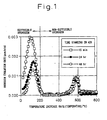
- the present inventors first analyzed in detail the delayed fracture behavior of steel of various strength levels, produced by quenching and tempering treatment. It is already well known that delayed fracture occurs due to diffusible hydrogen which is introduced into steel from the external environment and diffusing through the steel at room temperature. Diffusible hydrogen can be measured from the curve obtained from the (temperature-hydrogen evolution rate from steel) relationship obtained by heating steel at a rate of 100°C/hr, as a curve having a peak at a temperature of about 100°C.
- Fig. 1 shows an example of such measurement, for samples held for 15 minutes after hydrogen charge ( ⁇ ), for 24 hours after hydrogen charge ( ⁇ ) and for 48 hours after hydrogen charge ( ⁇ ) at room temperature.
- the present inventors have discovered that if hydrogen introduced from the environment is trapped at some sites in the steel, it is possible to render the hydrogen innocuous and inhibit delayed fracture even in the environment from which much higher amount of hydrogen is introduced into the steel.
- the absorbed hydrogen concentration was determined based on the difference between the area integral values of the hydrogen evolution rate curves obtained by heating a 10 mm ⁇ steel material at 100°C/hr, before and after hydrogen charge.
- hydrox trap sites sites which trap hydrogen
- hydrox trap concentration concentration of hydrogen trapped in a given hydrogen trap site
- hydrox trap energy activation energy required for hydrogen to dissociate from the trap site
- E ⁇ / RT ⁇ 2 Aexp ⁇ - E * RT (where ⁇ is the heating rate, A is the reaction constant for hydrogen trap dissociation, R is the gas constant and T is the peak temperature (K) of the hydrogen evolution rate curve).
- ln ⁇ / T ⁇ 2 - E / R / T + ln AR / E
- the delayed fracture resistance was evaluated by determining the "absorbed hydrogen concentration" which does not result in delayed fracture.
- diffusible hydrogen is introduced into a notched round rod test piece at different levels by electrolytic hydrogen charge, hydrochloric acid soaking and a hydrogen annealing furnace, the test piece is then Cd-plated to prevent effusion of hydrogen into the air from the sample during the delayed fracture test, and then a static load (90% of the tensile strength TS) is applied in air and the absorbed hydrogen concentration at which delayed fracture no longer occurs is evaluated.
- the hydrogen concentration is defined as the "threshold absorbed hydrogen concentration".
- a higher threshold absorbed hydrogen concentration for steel is associated with a more satisfactory delayed fracture resistance, and the value is unique to the steel material, being dependent on the steel components and the production conditions such as heat treatment.
- the absorbed hydrogen concentration in a sample is the value obtained by calculating the difference between the area integral values of the hydrogen evolution rate curves obtained by heating the steel material at 100°C/hr, before and after hydrogen charge, and it includes the hydrogen concentration trapped in the hydrogen trap sites.
- microstructure comprising at least one simple or compound precipitate of carbides which can serve as hydrogen trap sites having a hydrogen trap energy of 25-50 kJ/mol and a hydrogen trap concentration of 0.5 ppm or higher by weight, it is possible to increase the threshold absorbed hydrogen concentration even in a high-strength range exceeding 1200 MPa, and thus drastically improve the delayed fracture resistance (see Fig. 2 ).
- the present inventors also established a technique allowing formation of microstructures comprising simple or compound deposits of carbides of types and forms which can serve as such hydrogen trap sites.
- Diffusible hydrogen which causes delayed fracture is generated by corrosion or electrolytic plating, and it is absorbed steel materials at room temperature.
- the delayed fracture resistance can be improved by controlling the chemical composition and microstructure to permit occlusion of at least 0.5 ppm by weight and preferably at least 1.0 ppm by weight of hydrogen with a trap energy of 25-50 kJ/mol and preferably 30-50 kJ/mol, after dipping in 1000 cc of a 20 wt% aqueous NH 4 SCN solution at 50°C and subsequent holding for 100 hours in air at 25°C.
- An FCC (face-centered cubic) compound comprising at least 30 atomic percent V grows in a roughly quadrilateral laminar form in the [001] and [010] directions on the (100) plane of iron ferrite. Since this orientation relationship is equivalent for growth on the (010) plane and (001) plane, it is possible to observe the length and thickness of these FCC compounds growing on ⁇ 100 ⁇ planes which are parallel to the electron beam direction (observation direction), if TEM (transmission electron microscope) thin-foil observation is performed from the ⁇ 100> directions of the matrix.
- the reason for limiting the steel components according to the invention will now be explained.
- the amounts of the steel components are all expressed as weight percentages.
- C is an essential element for guaranteeing steel material strength, and the required strength cannot be obtained with a content of less than 0.10%, while a content exceeding 1.00% impairs the toughness and the delayed fracture resistance; the range is therefore limited to 0.10-1.00%.
- Si increases the strength by a solid solution hardening effect, but at less than 0.05% the effect is not exhibited, while at greater than 2.0% no effect commensurate with further addition can be expected; the range is therefore limited to 0.05-2.0%.
- Mn is an element which is not only necessary for deoxidation and desulfurization but is also effective for increasing the hardenability to obtain a martensite composition, but this effect is not achieved at less than 0.2% while a content of greater than 2.0% causes segregation at the grain boundary during heating to an austenite zone temperature, thereby embrittling the grain boundary and impairing the delayed fracture resistance; the range is therefore limited to 0.2-2.0%.
- V is an element which is effective for precipitation of fine laminar FCC compound in the steel. However, the effect is minimal unless the content is at least 0.1%, while the effect is saturated at greater than 1.5%. Also, addition at greater than 1.5% impairs the workability due to increased deformation resistance, and therefore the range is limited to 0.1-1.5%.
- W is has the effect of forming fine precipitates to inhibit softening during tempering. It also dissolves in the laminar FCC compound and serves to stabilize it. However, the effect is saturated at 3.0%, and addition in a greater amount impairs the workability due to increased deformation resistance; the range is therefore limited to 0.05-3.5%.
- the ratio of W and V is a parameter which is important for controlling the chemical composition of the FCC carbides and increasing the hydrogen trap concentration, as shown in Fig. 7 .
- a ratio of less than 0.3 will reduce the hydrogen trap concentration, while a ratio of greater than 7 will promote precipitation of carbides without an FCC structure or coarse carbides, such as M 2 C; the range is therefore limited to 0.3-7.0.
- the aforementioned steel according to the invention may also contain one or more from among Mo: 0.05-3.0%, Cr: 0.05-3.0%, Ni: 0.05-3.0% and Cu: 0.05-2.0%, as a first group, and one or more from among A1: 0.005-0.1%, Ti: 0.005-0.3%, Nb: 0.005-0.3%, B: 0.0003-0.05% and N: 0.001-0.05%, as a second group.
- Mo 0.05-3.0%
- Cr 0.05-3.0%
- Ni 0.05-3.0%
- Cu 0.05-2.0%
- Mo has an effect of forming fine precipitates to inhibit softening during tempering. It also dissolves in the laminar FCC compound and serves to stabilize it. However, the effect is saturated at 3.0%, and addition in a greater amount impairs the workability due to increased deformation resistance; the range is therefore limited to 0.05-3.0%.
- Ratio of Mo and V is a parameter which is important for controlling the chemical composition of the FCC carbides and increasing the hydrogen trap concentration.
- a Mo/V ratio of less than 0.5 will reduce the hydrogen trap concentration, while a ratio of greater than 5 will promote precipitation of coarse carbides such as M 2 C and M 6 C; thus, the range is limited to 0.5-5.
- Cr is an element which is effective for improving the hardenability and increasing the softening resistance during tempering treatment, but a content of less than 0.05% will not sufficiently exhibit the effect, while a content of greater than 3.0% will tend to impair the toughness and cold workability; the range is therefore limited to 0.05-3.0%.
- Ni is added to improve the ductility which deteriorates with higher strength, while also improving the hardenability during heat treatment to increase the tensile strength, but the effect will be minimal with a content of less than 0.05% while no commensurate effect will be exhibited with addition at greater than 3.0%; the range is therefore limited to 0.05-3.0%.
- Cu is an element which is effective for increasing the tempered softening resistance, but at less than 0.05% no effect will be exhibited and at greater than 2.0% the hot workability will be impaired; the range is therefore limited to 0.05-2.0%.
- Al forms AlN during deoxidation and heat treatment and produces an effect of preventing coarsening of austenite grains while fixing N, but these effects will not be exhibited if the content is less than 0.005%, while the effect becomes saturated at above 0.1%; the range is therefore limited to 0.005-0.1%.
- Ti forms TiN during deoxidation and heat treatment and produces an effect of preventing coarsening of austenite grains while fixing N, but these effects will not be exhibited if the content is less than 0.005%, while the effect becomes saturated at above 0.3%; the range is therefore limited to 0.005-0.3%.
- Nb is an element which is effective for rendering fine austenite grains by production of nitrides in the same manner as Ti, but at less than 0.005% the effect will be insufficient, while at greater than 0.3% the effect will be saturated; the range is therefore limited to 0.005-0.3%.
- B has the effect of inhibiting cracking at the prior austenite grain boundary and improving the delayed fracture resistance.
- B segregates at the austenite grain boundary and thus significantly increases the hardenability, but at less than 0.0003% the effect is not exhibited, and at greater than 0.05% the effect becomes saturated; the range is therefore limited to 0.0003-0.05%.
- N bonds with Al, V, Nb and Ti to form nitrides and has the effect of rendering fine austenite grains and increasing the yield strength.
- the effect is minimal at less than 0.001% while the effect becomes saturated at greater than 0.05%, and therefore the range is limited to 0.001-0.05%.
- the range is more preferably 0.005-0.01%.
- tempering at 500°C or above and isothermal transformation at 500°C or above in the pearlite transformation treatment are important, while no particular restrictions are necessary for the other production conditions. This is because if the tempering or isothermal transformation treatment is carried out at below 500°C, it will not be possible to adequately obtain a fine precipitates with an FCC (face-centered cubic) structure to serve as hydrogen trap sites. A more preferred condition is 550°C or above. While it is not particularly necessary to set an upper limit for the heat treatment temperature, it is preferably below 700°C because at 700°C and higher the precipitates will be coarse and the effect of the trap sites will be reduced.
- Test materials having the chemical compositions shown in Table 1 were heat treated under different conditions for transformation into martensite, tempered martensite, bainite, tempered bainite and pearlite structures, and then the materials were heated to various temperatures. These test materials were used for evaluation of the mechanical properties, microstructure and delayed fracture properties, yielding the results shown in Table 2. Hydrogen charge was carried out by dipping in 1000 cc of a 20 wt% aqueous NH 4 SCN solution at 50°C for 20 hours or longer, assuming hydrogen absorption by corrosion. The material was then held at room temperature for 100 hours for adequate release of diffusible hydrogen, and the remaining hydrogen concentration was evaluated as the hydrogen trap concentration.
- Tables 1 and 2 show examples corresponding to the claim, where Test Nos. 1-14 are invention examples and the others are comparative examples. As seen in these tables, all of the invention examples exhibited hydrogen trapping of 0.6 ppm or greater by weight. In contrast, the comparative example No. 15 was an example with a low hydrogen trap concentration, where the 0.1 vol% or greater FCC alloy carbide content target according to the invention could not be achieved because of a low C content.
- the comparative example No. 27 is an example in which the Si addition was too high, and therefore the workability and ductility were poor and the delayed fracture property was not improved.
- the comparative example No. 28 is an example with a low hydrogen trap concentration because of the predominance of coarse TiC carbide due to excessively high Ti addition.
- the comparative example No. 30 is an example with a low hydrogen trap concentration because of the predominance of coarse NbC carbide due to excessively high Nb addition.
- the comparative examples Nos. 19, 20, 21, 22, 23, 24, 26 and 29 are examples with low hydrogen trap concentrations, where the W/V ratio of the steel was too high and M 2 C carbides consisting mainly of W were precipitated.
- the comparative examples Nos. 17, 25, 31, and 32 are examples with low hydrogen trap concentrations, where the W/V ratio of the steel was too low.
- the comparative examples Nos. 16 and 18 are examples with low hydrogen trap concentrations where the heat treatment conditions were unsuitable and an FCC alloy carbide content of 0.1 vol% could not be obtained.
- carbides with suitable structures, sizes, components and number densities are precipitated in martensite, tempered martensite, bainite, tempered bainite and pearlite structures to improve the hydrogen trap properties of steel materials, while the diffusible hydrogen concentration which causes hydrogen embrittlement of steel materials is relatively reduced to allow improvement in hydrogen embrittlement resistance even with steel materials having high strength of 1200 MPa or greater.
Landscapes
- Chemical & Material Sciences (AREA)
- Engineering & Computer Science (AREA)
- Materials Engineering (AREA)
- Mechanical Engineering (AREA)
- Metallurgy (AREA)
- Organic Chemistry (AREA)
- Chemical Kinetics & Catalysis (AREA)
- Heat Treatment Of Steel (AREA)
- Heat Treatment Of Sheet Steel (AREA)
- Other Surface Treatments For Metallic Materials (AREA)
Claims (1)
- Stahlmaterial mit ausgezeichneter Beständigkeit gegen Wasserstoffversprödung, dadurch gekennzeichnet, daß das Stahlmaterial in Gew.-% aufweist:
C: 0,10 - 1,00 %, Si: 0,05 - 2,0 %, Mn: 0,2 - 2,0 %, W: 0,05 - 3,5 %, V: 0,1 - 1,5 %, Mo: 0,05 - 3,0 %, Cr: 0,05 - 3,0 %, Ni: 0,05 - 3,0 %, Cu: 0,05 - 2,0 %, Al: 0,005 - 0,1 %, Ti: 0,005 - 0,3 %, Nb: 0,005 - 0,3 %, B: 0,0003 - 0,05 % und/oder N: 0,001 - 0,05 % sowie als Rest Fe und unvermeidliche Verunreinigungen, und daß das Stahlmaterial mindestens 0,1 Vol.-% eines Carbids oder einer zusammengesetzten Verbindung davon und eine Teilchendichte von mindestens 5 x 10¹⁹/m3 eines Carbids oder einer zusammengesetzten Verbindung davon aufweist, wobei das Carbid oder die zusammengesetzte Verbindung in Schichtform mit einer Länge von höchstens 50 nm vorliegt und ein Längen-Dicken-Verhältnis (Aspektverhältnis) von 3 - 20 sowie eine kfz- (kubisch-flächenzentrierte) Struktur hat und das Carbid oder die zusammengesetzte Verbindung mindestens 30 Atomprozent V und mindestens 8 Atomprozent W als Metallbestandteilskomponenten aufweist.
Applications Claiming Priority (2)
| Application Number | Priority Date | Filing Date | Title |
|---|---|---|---|
| JP2003042398 | 2003-02-20 | ||
| EP04703503A EP1598437B1 (de) | 2003-02-20 | 2004-01-20 | Hochfestes stahlprodukt mit hervorragender beständigkeit gegen wasserstoffversprödung |
Related Parent Applications (2)
| Application Number | Title | Priority Date | Filing Date |
|---|---|---|---|
| EP04703503A Division EP1598437B1 (de) | 2003-02-20 | 2004-01-20 | Hochfestes stahlprodukt mit hervorragender beständigkeit gegen wasserstoffversprödung |
| EP04703503.5 Division | 2004-01-20 |
Publications (3)
| Publication Number | Publication Date |
|---|---|
| EP1832666A2 EP1832666A2 (de) | 2007-09-12 |
| EP1832666A3 EP1832666A3 (de) | 2007-12-12 |
| EP1832666B1 true EP1832666B1 (de) | 2011-04-13 |
Family
ID=32905349
Family Applications (2)
| Application Number | Title | Priority Date | Filing Date |
|---|---|---|---|
| EP04703503A Expired - Lifetime EP1598437B1 (de) | 2003-02-20 | 2004-01-20 | Hochfestes stahlprodukt mit hervorragender beständigkeit gegen wasserstoffversprödung |
| EP07011572A Expired - Lifetime EP1832666B1 (de) | 2003-02-20 | 2004-01-20 | Hochfestes Stahlmaterial mit hervorragender Beständigkeit gegen Wasserstoffversprödung |
Family Applications Before (1)
| Application Number | Title | Priority Date | Filing Date |
|---|---|---|---|
| EP04703503A Expired - Lifetime EP1598437B1 (de) | 2003-02-20 | 2004-01-20 | Hochfestes stahlprodukt mit hervorragender beständigkeit gegen wasserstoffversprödung |
Country Status (5)
| Country | Link |
|---|---|
| US (2) | US8016953B2 (de) |
| EP (2) | EP1598437B1 (de) |
| JP (1) | JPWO2004074529A1 (de) |
| DE (2) | DE602004020058D1 (de) |
| WO (1) | WO2004074529A1 (de) |
Families Citing this family (7)
| Publication number | Priority date | Publication date | Assignee | Title |
|---|---|---|---|---|
| JP5124988B2 (ja) * | 2005-05-30 | 2013-01-23 | Jfeスチール株式会社 | 耐遅れ破壊特性に優れた引張強度900MPa以上の高張力鋼板およびその製造方法 |
| JP4381355B2 (ja) | 2005-07-22 | 2009-12-09 | 新日本製鐵株式会社 | 耐遅れ破壊特性に優れた引張強さ1600MPa級以上の鋼およびその成型品の製造方法 |
| JP4867382B2 (ja) * | 2006-02-14 | 2012-02-01 | Jfeスチール株式会社 | 調質処理後に高強度および優れた耐遅れ破壊特性を有する鋼材 |
| JP5094272B2 (ja) * | 2007-08-21 | 2012-12-12 | 株式会社日本製鋼所 | 耐高圧水素環境脆化特性に優れた低合金高強度鋼およびその製造方法 |
| JP5201625B2 (ja) * | 2008-05-13 | 2013-06-05 | 株式会社日本製鋼所 | 耐高圧水素環境脆化特性に優れた高強度低合金鋼およびその製造方法 |
| EP2839048B1 (de) * | 2012-04-20 | 2018-05-02 | Aktiebolaget SKF | Stahllegierung |
| CN113046632A (zh) * | 2021-02-25 | 2021-06-29 | 石钢京诚装备技术有限公司 | 一种低铝低钛大型86CrMoV7工作辊钢及生产方法 |
Family Cites Families (26)
| Publication number | Priority date | Publication date | Assignee | Title |
|---|---|---|---|---|
| US2572191A (en) * | 1949-12-16 | 1951-10-23 | Crucible Steel Co America | Alloy steel having high strength at elevated temperature |
| JPS6160822A (ja) | 1984-08-30 | 1986-03-28 | Sumitomo Metal Ind Ltd | 耐遅れ破壊性の優れた高強度鋼の製造法 |
| JPS6164815A (ja) | 1984-09-03 | 1986-04-03 | Sumitomo Metal Ind Ltd | 耐遅れ破壊性の優れた高強度鋼の製造法 |
| JPS61130456A (ja) * | 1984-11-29 | 1986-06-18 | Honda Motor Co Ltd | 高強度ボルト及びその製造方法 |
| JP2670937B2 (ja) | 1984-11-29 | 1997-10-29 | 本田技研工業株式会社 | 高強度ボルトの製造方法 |
| JPH03173745A (ja) * | 1989-11-30 | 1991-07-29 | Aichi Steel Works Ltd | 高強度ボルト用鋼 |
| JPH03243744A (ja) | 1990-02-20 | 1991-10-30 | Sumitomo Metal Ind Ltd | 耐遅れ破壊性に優れた機械構造用鋼 |
| CN1039034C (zh) * | 1993-01-14 | 1998-07-08 | 日本钢管株式会社 | 抗延迟断裂性优良的超高强度冷轧薄钢板及其制造方法 |
| JPH07188840A (ja) * | 1993-12-28 | 1995-07-25 | Kobe Steel Ltd | 耐水素脆化特性に優れた高強度鋼およびその製法 |
| JP3358679B2 (ja) | 1994-04-14 | 2002-12-24 | 新日本製鐵株式会社 | 耐遅れ破壊特性に優れた高張力ボルト |
| JP3336573B2 (ja) * | 1994-11-04 | 2002-10-21 | 新日本製鐵株式会社 | 高強度フェライト系耐熱鋼およびその製造方法 |
| JPH08193240A (ja) * | 1994-11-18 | 1996-07-30 | Nippon Steel Corp | 耐焼戻し脆性に優れた鋼材及びその製造方法 |
| JP3400886B2 (ja) | 1995-03-16 | 2003-04-28 | 新日本製鐵株式会社 | 水素侵入阻止効果に優れた高張力ボルト用鋼 |
| JP4031068B2 (ja) * | 1996-06-27 | 2008-01-09 | 株式会社神戸製鋼所 | 耐水素脆化特性に優れた高強度ボルト用鋼 |
| US6224686B1 (en) | 1998-02-27 | 2001-05-01 | Chuo Hatsujo Kabushiki Kaisha | High-strength valve spring and it's manufacturing method |
| JP4267126B2 (ja) | 1998-05-01 | 2009-05-27 | 新日本製鐵株式会社 | 耐遅れ破壊特性に優れた鋼材およびその製造方法 |
| US6244686B1 (en) * | 1999-04-23 | 2001-06-12 | Xerox Corporation | Print head drive mechanism |
| JP2001049393A (ja) * | 1999-06-04 | 2001-02-20 | Nippon Steel Corp | 耐摩耗性に優れた焼戻しマルテンサイト系レールおよびその製造法 |
| JP4464524B2 (ja) * | 2000-04-05 | 2010-05-19 | 新日本製鐵株式会社 | 耐水素疲労特性の優れたばね用鋼、およびその製造方法 |
| JP4031607B2 (ja) * | 2000-04-05 | 2008-01-09 | 新日本製鐵株式会社 | 結晶粒の粗大化を抑制した機械構造用鋼 |
| JP4116762B2 (ja) * | 2000-09-25 | 2008-07-09 | 新日本製鐵株式会社 | 耐水素疲労特性の優れた高強度ばね用鋼およびその製造方法 |
| EP1347069B1 (de) | 2000-12-20 | 2007-11-07 | Nippon Steel Corporation | Hochfester federstahl und federstahldraht |
| JP4081234B2 (ja) * | 2000-12-21 | 2008-04-23 | 新日本製鐵株式会社 | 耐水素脆化特性の優れた高強度鋼 |
| JP3851095B2 (ja) * | 2001-02-07 | 2006-11-29 | 新日本製鐵株式会社 | 高強度ばね用熱処理鋼線 |
| JP4054179B2 (ja) * | 2001-04-26 | 2008-02-27 | 新日本製鐵株式会社 | 耐遅れ破壊特性に優れた高強度パーライト鋼 |
| US7074286B2 (en) * | 2002-12-18 | 2006-07-11 | Ut-Battelle, Llc | Wrought Cr—W—V bainitic/ferritic steel compositions |
-
2004
- 2004-01-20 DE DE602004020058T patent/DE602004020058D1/de not_active Expired - Lifetime
- 2004-01-20 EP EP04703503A patent/EP1598437B1/de not_active Expired - Lifetime
- 2004-01-20 JP JP2005502666A patent/JPWO2004074529A1/ja active Pending
- 2004-01-20 EP EP07011572A patent/EP1832666B1/de not_active Expired - Lifetime
- 2004-01-20 US US10/546,330 patent/US8016953B2/en not_active Expired - Lifetime
- 2004-01-20 DE DE602004032273T patent/DE602004032273D1/de not_active Expired - Lifetime
- 2004-01-20 WO PCT/JP2004/000414 patent/WO2004074529A1/ja not_active Ceased
-
2011
- 2011-07-15 US US13/183,710 patent/US8557060B2/en not_active Expired - Fee Related
Also Published As
| Publication number | Publication date |
|---|---|
| US8016953B2 (en) | 2011-09-13 |
| EP1598437B1 (de) | 2009-03-18 |
| US20060144474A1 (en) | 2006-07-06 |
| US8557060B2 (en) | 2013-10-15 |
| EP1832666A3 (de) | 2007-12-12 |
| EP1598437A1 (de) | 2005-11-23 |
| WO2004074529A1 (ja) | 2004-09-02 |
| EP1832666A2 (de) | 2007-09-12 |
| US20110268600A1 (en) | 2011-11-03 |
| JPWO2004074529A1 (ja) | 2006-06-01 |
| DE602004020058D1 (de) | 2009-04-30 |
| DE602004032273D1 (de) | 2011-05-26 |
| EP1598437A4 (de) | 2006-11-22 |
Similar Documents
| Publication | Publication Date | Title |
|---|---|---|
| JP4464524B2 (ja) | 耐水素疲労特性の優れたばね用鋼、およびその製造方法 | |
| US7510614B2 (en) | High strength bolt excellent in delayed fracture resistance and method of production of same | |
| US8557060B2 (en) | High-strength steel material with excellent hydrogen embrittlement resistance | |
| JP4423254B2 (ja) | コイリング性と耐水素脆化特性に優れた高強度ばね鋼線 | |
| JP4317384B2 (ja) | 耐水素脆化、溶接性および穴拡げ性に優れた高強度亜鉛めっき鋼板とその製造方法 | |
| KR101473205B1 (ko) | 배기가스 경로부재용 페라이트계 스테인레스강 | |
| US5286312A (en) | High-strength spring steel | |
| JP2003105485A (ja) | 耐水素疲労破壊特性に優れた高強度ばね用鋼およびその製造方法 | |
| KR100802237B1 (ko) | 내수소화취화특성이 우수한 스프링용 강 및 이 강으로부터얻어지는 강선 및 스프링 | |
| WO2011111872A1 (ja) | 耐遅れ破壊特性に優れた高強度鋼材と高強度ボルト、及び、その製造方法 | |
| EP1686195B1 (de) | Hochfester Federstahl mit ausgezeichneter Beständigkeit gegenüber Wasserstoffversprödung | |
| JP5251632B2 (ja) | 耐遅れ破壊特性に優れた高強度鋼材、高強度ボルト及びその製造方法 | |
| JP4116762B2 (ja) | 耐水素疲労特性の優れた高強度ばね用鋼およびその製造方法 | |
| Reguly et al. | Quench embrittlement of hardened 5160 steel as a function of austenitizing temperature | |
| JP3816721B2 (ja) | 耐遅れ破壊性と首下靭性、または耐遅れ破壊性と鍛造性および首下靭性に優れた高強度線材並びにその製造方法 | |
| JP4267126B2 (ja) | 耐遅れ破壊特性に優れた鋼材およびその製造方法 | |
| CN100410410C (zh) | 耐氢脆化性优异的高强度弹簧钢 | |
| JPH10110247A (ja) | 耐水素脆性および疲労特性に優れたばね鋼 | |
| KR20060087437A (ko) | 내수소취화 특성이 우수한 고강도 볼트 | |
| JP3749656B2 (ja) | 靭性に優れた鋼材 | |
| JP4430559B2 (ja) | 耐遅れ破壊性に優れた高強度ボルト用鋼及び高強度ボルト | |
| JP2003193183A (ja) | 耐遅れ破壊性および耐食性に優れた高強度鋼線 | |
| JP2002173739A (ja) | 耐水素脆化特性の優れた高強度鋼 | |
| JP4261760B2 (ja) | 耐水素疲労破壊特性に優れた高強度ばね用鋼およびその製造方法 | |
| JP2002327235A (ja) | 耐水素疲労破壊特性に優れた機械構造用鋼およびその製造方法 |
Legal Events
| Date | Code | Title | Description |
|---|---|---|---|
| PUAI | Public reference made under article 153(3) epc to a published international application that has entered the european phase |
Free format text: ORIGINAL CODE: 0009012 |
|
| 17P | Request for examination filed |
Effective date: 20070711 |
|
| AC | Divisional application: reference to earlier application |
Ref document number: 1598437 Country of ref document: EP Kind code of ref document: P |
|
| AK | Designated contracting states |
Kind code of ref document: A2 Designated state(s): DE FR GB |
|
| PUAL | Search report despatched |
Free format text: ORIGINAL CODE: 0009013 |
|
| AK | Designated contracting states |
Kind code of ref document: A3 Designated state(s): DE FR GB |
|
| 17Q | First examination report despatched |
Effective date: 20080703 |
|
| AKX | Designation fees paid |
Designated state(s): DE FR GB |
|
| GRAP | Despatch of communication of intention to grant a patent |
Free format text: ORIGINAL CODE: EPIDOSNIGR1 |
|
| GRAJ | Information related to disapproval of communication of intention to grant by the applicant or resumption of examination proceedings by the epo deleted |
Free format text: ORIGINAL CODE: EPIDOSDIGR1 |
|
| GRAP | Despatch of communication of intention to grant a patent |
Free format text: ORIGINAL CODE: EPIDOSNIGR1 |
|
| GRAC | Information related to communication of intention to grant a patent modified |
Free format text: ORIGINAL CODE: EPIDOSCIGR1 |
|
| GRAS | Grant fee paid |
Free format text: ORIGINAL CODE: EPIDOSNIGR3 |
|
| GRAA | (expected) grant |
Free format text: ORIGINAL CODE: 0009210 |
|
| AC | Divisional application: reference to earlier application |
Ref document number: 1598437 Country of ref document: EP Kind code of ref document: P |
|
| AK | Designated contracting states |
Kind code of ref document: B1 Designated state(s): DE FR GB |
|
| REG | Reference to a national code |
Ref country code: GB Ref legal event code: FG4D |
|
| REF | Corresponds to: |
Ref document number: 602004032273 Country of ref document: DE Date of ref document: 20110526 Kind code of ref document: P |
|
| REG | Reference to a national code |
Ref country code: DE Ref legal event code: R096 Ref document number: 602004032273 Country of ref document: DE Effective date: 20110526 |
|
| PLBE | No opposition filed within time limit |
Free format text: ORIGINAL CODE: 0009261 |
|
| STAA | Information on the status of an ep patent application or granted ep patent |
Free format text: STATUS: NO OPPOSITION FILED WITHIN TIME LIMIT |
|
| 26N | No opposition filed |
Effective date: 20120116 |
|
| REG | Reference to a national code |
Ref country code: DE Ref legal event code: R097 Ref document number: 602004032273 Country of ref document: DE Effective date: 20120116 |
|
| REG | Reference to a national code |
Ref country code: DE Ref legal event code: R082 Ref document number: 602004032273 Country of ref document: DE Representative=s name: VOSSIUS & PARTNER PATENTANWAELTE RECHTSANWAELT, DE Effective date: 20130227 Ref country code: DE Ref legal event code: R082 Ref document number: 602004032273 Country of ref document: DE Representative=s name: VOSSIUS & PARTNER, DE Effective date: 20130227 Ref country code: DE Ref legal event code: R081 Ref document number: 602004032273 Country of ref document: DE Owner name: NIPPON STEEL & SUMITOMO METAL CORPORATION, JP Free format text: FORMER OWNER: NIPPON STEEL CORP., TOKIO/TOKYO, JP Effective date: 20130227 |
|
| REG | Reference to a national code |
Ref country code: FR Ref legal event code: CD Owner name: NIPPON STEEL & SUMITOMO METAL CORPORATION, JP Effective date: 20130913 Ref country code: FR Ref legal event code: CA Effective date: 20130913 |
|
| REG | Reference to a national code |
Ref country code: FR Ref legal event code: PLFP Year of fee payment: 13 |
|
| REG | Reference to a national code |
Ref country code: FR Ref legal event code: PLFP Year of fee payment: 14 |
|
| REG | Reference to a national code |
Ref country code: FR Ref legal event code: PLFP Year of fee payment: 15 |
|
| REG | Reference to a national code |
Ref country code: DE Ref legal event code: R082 Ref document number: 602004032273 Country of ref document: DE Representative=s name: VOSSIUS & PARTNER PATENTANWAELTE RECHTSANWAELT, DE Ref country code: DE Ref legal event code: R081 Ref document number: 602004032273 Country of ref document: DE Owner name: NIPPON STEEL CORPORATION, JP Free format text: FORMER OWNER: NIPPON STEEL & SUMITOMO METAL CORPORATION, TOKYO, JP |
|
| PGFP | Annual fee paid to national office [announced via postgrant information from national office to epo] |
Ref country code: FR Payment date: 20191216 Year of fee payment: 17 |
|
| PGFP | Annual fee paid to national office [announced via postgrant information from national office to epo] |
Ref country code: DE Payment date: 20200107 Year of fee payment: 17 Ref country code: GB Payment date: 20200113 Year of fee payment: 17 |
|
| REG | Reference to a national code |
Ref country code: DE Ref legal event code: R119 Ref document number: 602004032273 Country of ref document: DE |
|
| GBPC | Gb: european patent ceased through non-payment of renewal fee |
Effective date: 20210120 |
|
| PG25 | Lapsed in a contracting state [announced via postgrant information from national office to epo] |
Ref country code: FR Free format text: LAPSE BECAUSE OF NON-PAYMENT OF DUE FEES Effective date: 20210131 |
|
| PG25 | Lapsed in a contracting state [announced via postgrant information from national office to epo] |
Ref country code: DE Free format text: LAPSE BECAUSE OF NON-PAYMENT OF DUE FEES Effective date: 20210803 Ref country code: GB Free format text: LAPSE BECAUSE OF NON-PAYMENT OF DUE FEES Effective date: 20210120 |