EP1835543B1 - Méthode de fabrication d'un dispositif semi-conducteur - Google Patents
Méthode de fabrication d'un dispositif semi-conducteur Download PDFInfo
- Publication number
- EP1835543B1 EP1835543B1 EP06005196.8A EP06005196A EP1835543B1 EP 1835543 B1 EP1835543 B1 EP 1835543B1 EP 06005196 A EP06005196 A EP 06005196A EP 1835543 B1 EP1835543 B1 EP 1835543B1
- Authority
- EP
- European Patent Office
- Prior art keywords
- hetero
- semiconductor
- region
- semiconductor body
- hetero semiconductor
- Prior art date
- Legal status (The legal status is an assumption and is not a legal conclusion. Google has not performed a legal analysis and makes no representation as to the accuracy of the status listed.)
- Expired - Lifetime
Links
Images



Classifications
-
- H—ELECTRICITY
- H10—SEMICONDUCTOR DEVICES; ELECTRIC SOLID-STATE DEVICES NOT OTHERWISE PROVIDED FOR
- H10D—INORGANIC ELECTRIC SEMICONDUCTOR DEVICES
- H10D30/00—Field-effect transistors [FET]
- H10D30/60—Insulated-gate field-effect transistors [IGFET]
- H10D30/63—Vertical IGFETs
- H10D30/635—Vertical IGFETs having no inversion channels, e.g. vertical accumulation channel FETs [ACCUFET] or normally-on vertical IGFETs
-
- H—ELECTRICITY
- H10—SEMICONDUCTOR DEVICES; ELECTRIC SOLID-STATE DEVICES NOT OTHERWISE PROVIDED FOR
- H10D—INORGANIC ELECTRIC SEMICONDUCTOR DEVICES
- H10D12/00—Bipolar devices controlled by the field effect, e.g. insulated-gate bipolar transistors [IGBT]
- H10D12/01—Manufacture or treatment
- H10D12/031—Manufacture or treatment of IGBTs
-
- H—ELECTRICITY
- H10—SEMICONDUCTOR DEVICES; ELECTRIC SOLID-STATE DEVICES NOT OTHERWISE PROVIDED FOR
- H10D—INORGANIC ELECTRIC SEMICONDUCTOR DEVICES
- H10D62/00—Semiconductor bodies, or regions thereof, of devices having potential barriers
- H10D62/80—Semiconductor bodies, or regions thereof, of devices having potential barriers characterised by the materials
- H10D62/82—Heterojunctions
-
- H—ELECTRICITY
- H10—SEMICONDUCTOR DEVICES; ELECTRIC SOLID-STATE DEVICES NOT OTHERWISE PROVIDED FOR
- H10D—INORGANIC ELECTRIC SEMICONDUCTOR DEVICES
- H10D62/00—Semiconductor bodies, or regions thereof, of devices having potential barriers
- H10D62/80—Semiconductor bodies, or regions thereof, of devices having potential barriers characterised by the materials
- H10D62/83—Semiconductor bodies, or regions thereof, of devices having potential barriers characterised by the materials being Group IV materials, e.g. B-doped Si or undoped Ge
- H10D62/832—Semiconductor bodies, or regions thereof, of devices having potential barriers characterised by the materials being Group IV materials, e.g. B-doped Si or undoped Ge being Group IV materials comprising two or more elements, e.g. SiGe
- H10D62/8325—Silicon carbide
-
- H—ELECTRICITY
- H10—SEMICONDUCTOR DEVICES; ELECTRIC SOLID-STATE DEVICES NOT OTHERWISE PROVIDED FOR
- H10D—INORGANIC ELECTRIC SEMICONDUCTOR DEVICES
- H10D30/00—Field-effect transistors [FET]
Definitions
- the present invention relates to a method of manufacturing a semiconductor device.
- an N' type polycrystalline silicon region and an N + type polycrystalline silicon region are formed so as to adjoin each other on one main surface of a semiconductor body in which an N' type silicon carbide epitaxial region is formed on an N + type silicon carbide substrate, in addition, the epitaxial region, the N - type polycrystalline silicon region and the N + type polycrystalline silicon region forms a hetero junction. Furthermore, a gate electrode is formed so as to be adjacent to a junction portion between the epitaxial layer, and the N + type polycrystalline silicon region while interposing a gate insulating film therebetween.
- the N - type polycrystalline silicon region is connected to a source electrode, and a drain electrode is formed on a backside surface of the N + type silicon carbide substrate.
- the semiconductor device of the related art having the structure as described above functions as a switching device by controlling an electric potential of the gate electrode in a state where the source electrode is grounded and a predetermined positive electric potential is applied to the drain electrode. That is, in the state where the gate electrode is grounded, reverse bias is applied to the hetero junction formed of the N' type polycrystalline silicon region, the N + type polycrystalline silicon region and the epitaxial region so that no current flows between the drain electrode and the source electrode.
- gate electric filed acts on a hetero junction interface between the N + type polycrystalline silicon region and the epitaxial region, and an energy barrier formed by the hetero junction surface on a gate oxide film interface is made to be thin.
- the device since the hetero junction portion is used as a control channel for cutting-off and flowing of the current, the device functions with a channel length having a thickness equal to that of the hetero barrier. Therefore, a conduction characteristic of low resistance can be obtained.
- JP 2005 259796 A describes a semiconductor device which includes a first conductivity type drain region, a first hetero semiconductor region and a second semiconductor region that contact one main surface of the drain region and has a different band-gap from that of the drain region, a gate electrode formed on a junction between the first hetero semiconductor region and the drain region via a gate dielectric, a source electrode connected to the first hetero semiconductor region and the second hetero semiconductor region; and a drain electrode connected to the drain region.
- the respective conductivity types of the two hetero semiconductor regions are opposite to one another.
- driving force is lowered because damages are caused on an etching surface of the silicon carbide epitaxial region when a physical etching such as a dry etching is used at the time of patterning the polycrystalline silicon region formed on the silicon carbide epitaxial region to form a channel interface between the polycrystalline silicon region and the silicon carbide epitaxial region.
- the present invention has been made to solve the above problems of the related art. Accordingly, it is an objective of the present invention to provide a method of manufacturing a semiconductor device capable of suppressing decrease of the driving force.
- said objective is solved by a method of manufacturing of a semiconductor device according to the technical teaching of independent claim 1.
- FIG. 1 shows a first embodiment of a semiconductor device according to the technical teaching.
- FIG 1 is a cross sectional diagram of two structural unit cells facing each other.
- the description is given as one example by using a semiconductor device whose substrate material is silicon carbide (SiC).
- a drain region 2 formed of an N - type silicon carbide epitaxial layer is formed on a substrate 1 formed of N + type silicon carbide in which polytype is 4H and a hetero semiconductor region 3 formed of, for example, N type polycrystalline silicon is formed so as to adjoin a main surface of the drain region 2 opposing to a junction surface with the substrate 1. That is, the junction portion between the drain region 2 and the hetero semiconductor region 3 is composed of a hetero junction formed of materials of silicon carbide and polycrystalline silicon which are different in a band gap, and an energy barrier is present on a junction interface thereof.
- a gate insulating film 4 formed of, for example, a silicon oxide film is formed so as to adjoin the junction portion between the hetero semiconductor region 3 and the drain region 2.
- a gate electrode 5 is formed on the gate insulating film 4, and a source electrode 6 is formed on the surface of the hetero semiconductor region 3 opposite to the junction surface between the hetero semiconductor region 3 and the drain region 2, and a drain electrode 7 is formed on the substrate 1 so as to be connected to the substrate 1.
- a trench 15 is formed in the drain region 2 so that a trench type structure in which the gate electrode 5 is buried is obtained.
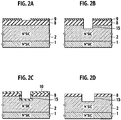
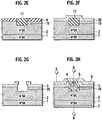
- FIGS. 2A to 2H A method of manufacturing a silicon carbide semiconductor device according to the first embodiment shown FIG. 1 will now be described by referring to FIGS. 2A to 2H .
- a nitride silicon film is deposited on an N type silicon carbide semiconductor body formed by epitaxialy growing the N - type drain region 2 on the N + type silicon carbide substrate 1.
- the silicon nitride film serves as an antioxidant film (mask layer) 8 and is formed by, for example, a Low Pressure-Chemical Vapor Deposition (LP-CVD) method.
- LP-CVD Low Pressure-Chemical Vapor Deposition
- a mask layer 9 having a predetermined opening is formed on the antioxidant film 8 formed of the nitride silicon film by photolithography and etching.
- the antioxidant film 8 and a surface layer portion of the drain region 2 are etched by using, for example, reactive ion etching (dry etching), and the drain region 2 is etched by a predetermined depth so that a trench 15 is formed.
- reactive ion etching dry etching
- other method may be used as long as it is an anisotropic etching.
- sacrificial oxidation is carried out by, for example, dry O 2 oxidation at 1100°C to remove the damages, thus forming a sacrificial oxide film 10.
- the nitride silicon film is formed by the LP-CVD method to be used as the antioxidant film 8
- an oxidation rate thereof is relatively close to that of the drain region 2 formed of silicon carbide. Therefore, the sacrificial oxide film 10 at the same level is formed also on the antioxidant film 8 of the nitride silicon film.
- an upper end portion of the side wall of the drain region 2 and an end portion of the antioxidant film 8 can be kept to be flush.
- the oxidation using the dry O 2 oxidation is given as one example, but any method may be used as long as the region damaged by etching in the drain region 2 can be buried into the oxide film.
- the sacrificial oxide film 10 ( FIG. 2C ) is removed by wet etching by use of a mixed solution of, for example, ammonium fluoride and hydrofluoric acid.
- a buried region 11 is formed by using a reflowable material such as Spin-On-Glass (SOG).
- SOG Spin-On-Glass
- the buried region 11 is formed so as to be substantially flush with the upper end portion of the trench 15 while including the trench in the antioxidant film 8.
- the trench 15 is formed so as to adjoin at least the junction interface between the drain region 2 and the antioxidant film 8, there is no problem in that it is not completely buried, or extended from the trench to the outside.
- a material for the buried region may also be formed on the antioxidant film 8, and then the buried region is formed by etchback.
- polycrystalline silicon is deposited by, for example, the LP-CVD method.
- phosphorus doping is carried out in the atmosphere of, for example, phosphoryl chloride (POCl 3 ) so that a hetero semiconductor layer 30 formed of N type polycrystalline silicon is formed.
- this polycrystalline silicon layer may be formed by laser annealing, or the like to recrystallize it after being deposited by the electronic beam evaporation method or the sputtering method, or may be formed of single crystalline silicon of hetero epitaxial growth by, for example, the molecular beam epitaxy.
- a combination of ionic implantation and activation heat treatment after the ionic implantation may be used.
- a mask layer (not shown) having a predetermined opening is formed in a predetermined region of the hetero semiconductor layer 30 of polycrystalline silicon by the photolithography and the etching, and one portion of the hetero semiconductor layer 30 is etched by, for example, reactive ion etching (dry etching) so that a hetero semiconductor region 3 is formed.
- the buried region 11 ( FIG. 2F ) formed of oxide is subjected to wet etching by a mixed solution of, for example, ammonium fluoride and hydrofluoric acid.
- a gate insulating film 4 is deposited along the inner wall of the hetero semiconductor region 3 and the drain region 2. Further, a polycrystalline silicon layer to be a gate electrode 5 is deposited. After that, phosphorus is doped into the polycrystalline silicon layer to be the gate electrode 5 by solid phase diffusion using POCl 3 .
- the gate electrode 5 is formed by the photolithography, etching, or the like before a drain electrode 7 formed of, for example, titanium (Ti) and nickel (Ni) is formed on the substrate 1 corresponding to a backside surface of the semiconductor device, and a source electrode 6 (insulated from the gate electrode 5 by the insulating film) formed by sequentially depositing titanium (Ti) and nickel (Ni) is formed in the hetero semiconductor region 3 corresponding to a front surface of the semiconductor device.
- a drain electrode 7 formed of, for example, titanium (Ti) and nickel (Ni) is formed on the substrate 1 corresponding to a backside surface of the semiconductor device
- a source electrode 6 insulated from the gate electrode 5 by the insulating film formed by sequentially depositing titanium (Ti) and nickel (Ni) is formed in the hetero semiconductor region 3 corresponding to a front surface of the semiconductor device.
- the gate electrode 5 is buried in the trench is given as one example, but it may be formed so as to extend onto the hetero semiconductor region 3 through the gate insulating film 4.
- the neighboring regions are connected each other in such a manner that the source electrode 6 covers the gate electrode through the insulating film, but they do not have to be connected.
- the present embodiment has a structure where, in a method of manufacturing a semiconductor device including a semiconductor body of a first conductivity type (a substrate 1 and a drain region 2), a hetero semiconductor region 3 adjacent to one main surface of the semiconductor body and having a band gap different from that of the semiconductor body, a gate electrode 5 formed in a junction portion between the hetero semiconductor region 3 and the semiconductor body through a gate insulating film 4, a source electrode 6 connected to the hetero semiconductor region 3, and a drain electrode 7 having an ohmic connection with the semiconductor body, the method of manufacturing the semiconductor device includes at least a first process of forming a predetermined trench 15 on the main surface side of the semiconductor body by using a mask layer 9 having a predetermined opening, a second process of forming a buried region 11 so as to adjoin at least a side wall of the trench 15 and extend from the trench 15, a third process of forming a hetero semiconductor layer 30 so as to adjoin the semiconductor body and the buried region 11, and a fourth process of forming the hetero semiconductor region 3 by pattern
- the semiconductor device according to the present embodiment can be easily obtained with an earlier manufacturing technique.
- a structure in which an upper end portion of the trench 15 of the drain region 2 with etching damage removed comes to be a substantially flush with an end portion of the hetero semiconductor region 3 can be easily formed.
- the gate electrode 5 can be formed through the gate insulating film 4 so as to oppose substantially perpendicular to a junction interface between the drain region 2 and the hetero semiconductor region 3. Therefore, an electric field effectively expands to the hetero junction interface depending on a voltage applied to the gate electrode 5 and driving force during conduction is improved.
- the upper end portion of the trench 15 in the drain region 2 can be further easily formed to be substantially flush with the end portion of the hetero semiconductor region 3.
- the hetero semiconductor region 3 may be formed by etching back the hetero semiconductor layer 30.
- the source electrode 6 can be formed on a flat surface so that reliability of the semiconductor device is improved.
- the manufacturing processes come to be easy. That is, a material which is easily etched by wet etching and has a relatively large selection ratio to the drain region 2 and the hetero semiconductor region 3 is used for the buried region 11. Therefore, the manufacturing processes come to be easy.
- a process of forming the gate insulating film 4 so as to adjoin the hetero interface between the hetero semiconductor region 3 and the semiconductor body is included. With this, it is possible to provide a hetero junction insulated gate field effect transistor with easy manufacturing processes.
- a process of sacrificial oxidation is included.
- the gate electrode 5 can be formed through the gate insulating film 4 so as to oppose substantially perpendicular to the junction interface between the drain region 2 and the hetero semiconductor region 3. Therefore, an electric field effectively expands to the hetero junction interface depending on a voltage applied to the gate electrode 5 so that driving force during conduction is improved.
- the semiconductor body is formed of silicon carbide. With this, a semiconductor with a high break down voltage can be easily obtained by using a general semiconductor material.
- the hetero semiconductor region 3 is formed of at least one of single crystalline silicon, polycrystalline silicon, and amorphous silicon. With this, a semiconductor device can be easily obtained by using a general semiconductor material.
- the antioxidant film 8 of the mask layer is formed of a material having a similar value to that of a thermal oxidation rate of silicon carbide.
- a sacrificial oxide film 10 at the same level is formed also on the antioxidant film 8 of the nitride silicon film. Therefore, the upper end portion of the side wall of the drain region 2 and the end portion of the antioxidant film 8 can retain to be substantially flush with each other.
- the source electrode 6 is grounded and a positive potential is applied to the drain electrode 7.
- the gate electrode 5 is, for example, grounded or is a negative potential, a shielding state is kept. It is because that energy barrier is formed to conduction electron on both sides of the hetero junction interface between the hetero semiconductor region 3 and the drain region 2.
- the gate electrode 5 can be formed through the gate insulating film 4 so as to oppose substantially perpendicular to the junction interface between the drain region 2 and the hetero semiconductor region 3. Therefore, the electric filed effectively expands to the hetero junction interface depending on a voltage applied to the gate electrode 5 so that high driving force can be obtained.
- the gate electrode 5 is grounded again so as to change the conducting state to the shielding state, the accumulation state of the conduction electron formed in the hetero junction interface between the hetero semiconductor region 3 and the drain region 2 is relieved, and then tunneling in the energy barrier stops. Consequently, the flow of the conduction electron from the hetero semiconductor region 3 to the drain region 2 stops. Further, the conduction electron in the drain region 2 flows to the substrate 1, and when the conduction electron is depleted, a depletion layer expands from the hetero junction portion to the drain region 2 side, resulted in the shielding state.
- reverse direction conduction (reflux operation) is possible in which, for example, the source electrode 6 is grounded and a negative potential is applied to the drain electrode 7.
- the source electrode 6 and the gate electrode 5 are grounded and a predetermined electric potential is applied to the drain electrode 7, the energy barrier for the conduction electron disappears, and the conduction electron flows from the drain region 2 side to the hetero semiconductor region 3, resulted in a reverse conduction state.
- a positive hole is not infused, and conduction is carried out only by the conduction electron. Therefore, loss of the conduction electron due to reverse recovery current is small at the time of changing the reverse conduction state to the shielding state.
- the above described gate electrode 5 is used as a control electrode without being grounded is also possible.
- a structure of FIG. 3 is different when compared with the structure of FIG. 1 in that a hetero semiconductor region 3 is flatly formed, a gate insulating film 4 is formed on a side wall of a trench 15, a gate electrode 5 is buried to be flat in the trench 15, and a source electrode 6 is flatly formed on a surface of an element.
- FIGS. 4A to 4B a method of manufacturing a semiconductor device of silicon carbide having the structure shown in FIG. 3 will be described by referring to FIGS. 4A to 4B .
- FIGS. 2A to 2F showing manufacturing processes of the structure of FIG. 1 have the same structure with that of FIG. 3 .
- the hetero semiconductor region 3 is processed to be flat by Chemical Mechanical Polishing (CMP), and as shown in FIG. 4A , a surface including the hetero semiconductor region 3 and a buried region 11 is flatly formed.
- CMP Chemical Mechanical Polishing
- the buried region 11 formed of oxidant is subjected to wet etching by a mixed solution of, for example, ammonium fluoride and hydrofluoric acid so as to be a state shown in FIG. 4B .
- a gate insulating film 4 is deposited along an inner wall of the hetero semiconductor region 3 and a drain region 2. Further, a polycrystal layer to be the gate electrode 5 is deposited. After that, phosphorus is doped into the polycrystalline silicon layer to be the gate electrode 5 by solid phase diffusion using POCl 3 .
- the gate electrode 5 is formed by the photolithography, etching, or the like before a drain electrode 7 formed of, for example, titanium (Ti) and nickel (Ni) is formed on a substrate 1 corresponding to a backside surface of the semiconductor device, and a source electrode 6 (insulated from the gate electrode 5 by the insulating film) formed by sequentially depositing titanium (Ti) and nickel (Ni) is formed in the hetero semiconductor region 3 corresponding to a front surface of the semiconductor device.
- a drain electrode 7 formed of, for example, titanium (Ti) and nickel (Ni) is formed on a substrate 1 corresponding to a backside surface of the semiconductor device
- a source electrode 6 insulated from the gate electrode 5 by the insulating film formed by sequentially depositing titanium (Ti) and nickel (Ni) is formed in the hetero semiconductor region 3 corresponding to a front surface of the semiconductor device.
- the case where the gate electrode 5 is buried in the trench is given as one example, but it may be formed through the gate insulating film 4 so as to extend onto the hetero semiconductor region 3.
- the neighboring regions are connected each other in such a manner that the source electrode 6 covers the gate electrode through the insulating film, but they do not have to be connected.
- the hetero semiconductor region 3 is formed by carrying out Chemical Mechanical Polishing (CMP) for the hetero semiconductor layer 30.
- CMP Chemical Mechanical Polishing
- FIGS. 5A to 5F another manufacturing method according to the present embodiment will be described below.
- a completed structure is the same with that of FIG. 3 .
- FIGS. 2A to 2D showing the method of manufacturing the structure of FIG. 1 have the same structure with that of FIG. 1 .
- an insulating film 4 is deposited along an inner wall of an antioxidant film (mask layer) 8 and a drain region 2.
- a polycrystalline silicon layer 50 to be a gate electrode 5 is deposited.
- phosphorus is doped into the polycrystalline silicon layer 50 to be the gate electrode 5 by solid phase diffusion using POCl 3 .
- the polycrystalline silicon layer 50 is etched back to be a state shown in FIG. 5B so that the gate electrode 5 is formed.
- a cap oxide film 16 is formed in an upper portion of the gate electrode 5 by thermal oxidation.
- the antioxidant film 8 formed of silicon nitride is removed by, for example, phosphoric acid solution before polycrystalline silicon is deposited by, for example, the LP-CVD method.
- phosphorus doping is carried out in the atmosphere of, for example, POCl 3 so that a hetero semiconductor layer 30 formed of an N - type polycrystalline silicon is formed.
- this polycrystalline silicon layer may be formed by laser annealing to recrystallize it after being deposited by the electronic beam evaporation method or the sputtering method, or may be formed of single crystalline silicon of the hetero epitaxial growth by, for example, the molecular beam epitaxy.
- a combination of ionic implantation and activation heat treatment after the ionic implantation may be used.
- the hetero semiconductor region 3 is processed to be flat by Chemical Mechanical Polishing, a drain electrode 7 formed of, for example, titanium (Ti) and nickel (Ni) is formed on a substrate 1 corresponding to a backside surface of the semiconductor device, and a source electrode 6 is formed by sequentially depositing titanium (Ti) and aluminum (Al) in the hetero semiconductor region 3 corresponding to a front surface of the semiconductor device.
- a drain electrode 7 formed of, for example, titanium (Ti) and nickel (Ni) is formed on a substrate 1 corresponding to a backside surface of the semiconductor device
- a source electrode 6 is formed by sequentially depositing titanium (Ti) and aluminum (Al) in the hetero semiconductor region 3 corresponding to a front surface of the semiconductor device.
- the present embodiment has a structure where, in a method of manufacturing the semiconductor device including the semiconductor body of a first conductivity type (the substrate 1 and the drain region 2), the hetero semiconductor region 3 adjacent to the one main surface of the semiconductor body and having a band gap different from that of the semiconductor body, the gate electrode 5 formed in the junction portion between the hetero semiconductor region 3 and the semiconductor body through the gate insulating film 4, the source electrode 6 connected to the hetero semiconductor region 3, and the drain electrode 7 having the ohmic connection with the semiconductor body, the method of manufacturing the semiconductor device includes at least a first process of forming the predetermined trench 15 on the main surface side of the semiconductor body by using the mask layer having a predetermined opening, a second process of forming the gate insulating film 4 so as to adjoin at least the side wall of the trench 15 , a third process of forming the gate electrode 5 adjacent to the gate insulating film 4, a fourth process of forming the hetero semiconductor layer 30 on the gate electrode 5 through the cap oxide film 16 which is an interlayer insulating film, and a
- the semiconductor device according to the present embodiment can be easily obtained with a conventional manufacturing technique.
- a structure in which an upper end portion of the trench 15 of the drain region 2 with etching damages removed comes to be substantially flush with an end portion of the hetero semiconductor region 3 can be easily formed.
- the gate electrode 5 can be formed through the gate insulating film 4 so as to oppose substantially perpendicular to the junction interface between the drain region 2 and the hetero semiconductor region 3. Therefore, an electric field effectively expands to the hetero junction interface depending on a voltage applied to the gate electrode 5 so that driving force during conduction is improved.
- the upper end portion of the trench 15 in the drain region 2 can be further easily formed to be substantially flush with the end portion of the hetero semiconductor region 3.
- the gate insulating film 4 includes at least a thermal oxide film formed by thermal oxidation. With this, a quality gate insulating film can be easily formed so that improvement of driving force during the conducting state can be expected and high reliability can be obtained.
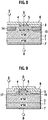
- a structure of FIG. 6 is different from that of FIG. 1 in that a hetero semiconductor region 3 formed of, for example, N - type polycrystalline silicon and a second hetero semiconductor region 12 formed of P - type polycrystalline silicon are formed so as to adjoin a main surface opposing to a junction surface between a drain region 2 and a substrate 1. That is, the junction portion of the drain 2, the hetero semiconductor region 3, and the second hetero semiconductor regions 12 has a hetero junction by materials having different band gap from that of SiC and polycrystal, and energy barriers are formed in the junction interface thereof.
- a gate insulating film 4 formed of, for example, a silicon oxide film is formed so as to adjoin the junction portion between the hetero semiconductor region 3 and the drain region 2.
- a gate electrode 5 is formed to be connected to the gate insulating film 4
- a source electrode 6 is connected on an opposite surface opposing to the junction surface of the drain region 2 with the hetero semiconductor region 3 and the second hetero semiconductor region 12, and a drain electrode 7 is connected on the substrate 1.
- the hetero semiconductor region 3 is formed before P - type impurity of reverse conductivity type that is, for example, a reverse conductivity type of the N - type hetero semiconductor region 3 is introduced into a predetermined portion (second hetero semiconductor regions 12) in the hetero semiconductor region 3.
- P - type impurity of reverse conductivity type that is, for example, a reverse conductivity type of the N - type hetero semiconductor region 3 is introduced into a predetermined portion (second hetero semiconductor regions 12) in the hetero semiconductor region 3.
- a width of a depletion layer extended from the junction interface of the drain region 2 comes to be different. That is, the width of the depletion layer extended from the junction interface with the second hetero semiconductor region 12 is larger than the width of the depletion layer expanded from the junction interface with the hetero semiconductor region 3. Therefore, higher performance of shielding can be obtained, that is, leakage current can be reduced. Further, when, for example, the impurity concentration of the second hetero semiconductor region 12 is provided to be higher than that of the hetero semiconductor region 3, the depletion layer generated by built-in electric field of P-N diode formed of the second hetero semiconductor region 12 and the hetero semiconductor region 3 extends to the hetero semiconductor region 3 side. Therefore, the leakage current in the hetero junction between the hetero semiconductor region 3 and the drain region can be further reduced.
- the shielding performance of the semiconductor device can be further increased when, for example, the gate electrode 5 is provided to be a negative potential, and a revere region is formed in, for example, an entire region of the hetero semiconductor region 3.
- FIG. 7 is such that an N + type conducting region 13 having higher concentration than that of a drain region 2 is formed in a predetermined portion between a gate insulating film 4 and the drain region 2 in the structure of FIG. 1 .
- the description of a manufacturing method thereof will be given below as one example.
- the doping of phosphorus is carried out in the atmosphere of, for example, POCl 3 with a higher temperature, the phosphorus is introduced onto the surface of silicon carbide so that an N + type conducting region 13 is formed.
- introduction of impurity with solid phase diffusion, or a method of introducing impurity with, for example, ionic implantation may be used.
- a structure of FIG. 8 is such that, in addition to the structure of FIG. 1 , an electric field relaxation region 14 is formed on a surface of a drain region 2 so as to adjoin the hetero semiconductor region 3 and space apart a predetermined distance from a portion in which a gate electrode 5 and a hetero semiconductor region 3 are opposed each other.
- an electric field relaxation region 14 is formed on a surface of a drain region 2 so as to adjoin the hetero semiconductor region 3 and space apart a predetermined distance from a portion in which a gate electrode 5 and a hetero semiconductor region 3 are opposed each other.
- the P type electric field relaxation region 14 is formed by the ionic implantation of aluminum ion or boron ion by using the mask layer having a predetermined opening as a mask. It should be noted that it may be formed by solid phase diffusion. The subsequent processes are the same with that of manufacturing the structure of FIG. 1 .
- a depletion layer spreads between the electric filed relaxation region 14 and the drain region 2 depending on a drain potential. That is, the leakage current is further reduced and the shielding performance is improved since a drain potential applied to the hetero junction between the hetero semiconductor region 3 and the drain region 2 is relieved by the electric field relaxation region 14.
- a structure of FIG. 9 is a modified example of the structure of FIG. 1 , and a trench 17 is formed in the drain region 2 before the antioxidant film 8 is formed in FIG. 2A . After that, the hetero semiconductor layer 30 is formed. The sequent processes are the same with that of manufacturing the structure of FIG. 1 . With this structure, the leakage current in the hetero semiconductor region 3 can be further reduced than the structure of FIG. 1 .
- FIGS. 6 to 9 As described above, using the basic processes of the embodiment, various structures as shown in FIGS. 6 to 9 can be formed.
- a semiconductor device using silicon carbide as a substrate material is described as one example, the material for the substrate may be other semiconductor materials such as silicon, silicon germanium, gallium nitride, and diamond.
- silicon carbide whose polytype is 4H is used as one example for the description, but it may be other polytype such as 6H and 3C.
- a transistor having so-called a vertical structure in which a drain electrode 7 and a source electrode 6 are disposed to oppose each other with the drain region 2 sandwiched therebetween so that drain current flow occurs vertically is used for the description, but a transistor having so-called a horizontal structure in which, for example, a drain electrode 7 and a source electrode 6 are disposed to be flush with each other so that drain current flow occurs horizontally, may be used.
- the description is given by using polycrystal as a material used for a hetero semiconductor region 3 or a second hetero semiconductor region 12 as one example, but the material can be any material as long as it forms a hetero junction with silicon carbide. Still furthermore, as one example, the description is given by using an N - type silicon carbide as a drain region 2 and an N - type polycrystalline silicon as a hetero semiconductor region 3, but it may be any combination of N - type silicon carbide and P - type polycrystalline silicon, P - type silicon carbide and P - type polycrystalline silicon, and P - type silicon carbide and N - type polycrystalline silicon.
- a mask layer used for forming a predetermined trench on a main surface side of a semiconductor body corresponds to a mask layer 9 and an antioxidant film 8 in the preferred embodiments.
Landscapes
- Insulated Gate Type Field-Effect Transistor (AREA)
- Electrodes Of Semiconductors (AREA)
Claims (10)
- Procédé de fabrication d'un dispositif semi-conducteur, ledit dispositif semi-conducteur comprenant un corps semi-conducteur (1, 2) d'un premier type de conductivité ; une région hétéro semi-conductrice (3) adjacente à une surface principale du corps semi-conducteur (1, 2) et présentant un espace de bande différent de celui du corps semi-conducteur (1, 2) ; une électrode de grille (5) formée dans une partie de jonction entre la région hétéro semi-conductrice (3) et le corps semi-conducteur (1, 2) à travers un film d'isolation de grille (4) ; une électrode de source (6) connectée à la région hétéro semi-conductrice (3) ; et une électrode de drain (7) ohmiquement connectée au corps semi-conducteur (1, 2), le procédé comprenant les étapes de :une première étape de formation d'une tranchée (15) dans une première couche formant masque (8) et dans une partie couche de surface du corps semi-conducteur (2) présentant une ouverture sur ledit côté de surface principale du corps semi-conducteur (1, 2) en utilisant une seconde couche formant masque (9) ;une seconde étape de formation d'un film d'oxyde sacrificiel (10) sur le corps semi-conducteur (1, 2), afin de retirer les détériorations de l'étape précédente ;une troisième étape d'élimination dudit film d'oxyde sacrificiel (10) depuis le corps semi-conducteur (1, 2) par gravure par voie humide ;une quatrième étape de formation d'une région enfouie (11) adjacente à au moins une paroi latérale de la tranchée (15) affleurant sensiblement au niveau de la partie supérieure de la tranchée (15) ;une cinquième étape de formation d'une couche hétéro semi-conductrice (30) afin de joindre le corps semi-conducteur (1, 2) et la région enfouie (11) ; etune sixième étape de formation de la région hétéro semi-conductrice (3) en structurant la couche hétéro semi-conductrice (30).
- Procédé de fabrication d'un dispositif semi-conducteur selon la revendication 1, la région hétéro semi-conductrice (3) étant formée par rétro-gravure de la couche hétéro semi-conductrice (30) dans la sixième étape.
- Procédé de fabrication d'un dispositif semi-conducteur selon la revendication 1, la région hétéro semi-conductrice (3) étant formée en effectuant un polissage mécano-chimique pour la couche hétéro semi-conductrice (30).
- Procédé de fabrication d'un dispositif semi-conducteur selon l'une quelconque des revendications 1 à 3, la région enfouie (11) étant formée d'un matériau qui est retiré après la sixième étape.
- Procédé de fabrication d'un dispositif semi-conducteur selon l'une quelconque des revendications 1 à 4, dans lequel une étape de formation du film d'isolation de grille (4) afin d'adjoindre une interface d'hétérojonction entre la région hétéro semi-conductrice (3) et le corps semi-conducteur (1, 2) est introduite après la sixième étape.
- Procédé de fabrication d'un dispositif semi-conducteur, ledit dispositif semi-conducteur comprenant un corps semi-conducteur (1, 2) d'un premier type de conductivité ; une région hétéro semi-conductrice (3) adjacente à une surface principale du corps semi-conducteur (1, 2) et présentant un espace de bande différent de celui du corps semi-conducteur (1, 2) ; une électrode de grille (5) formée dans une partie de jonction entre la région hétéro semi-conductrice (3) et le corps semi-conducteur (1, 2) à travers un film d'isolation de grille (4) ; une électrode de source (6) connectée à la région hétéro semi-conductrice (3) ; et une électrode de drain (7) ohmiquement connectée au corps semi-conducteur (1, 2), le procédé comprenant les étapes de :une première étape de formation d'une tranchée (15) dans une première couche formant masque (8) et dans une partie couche de surface du corps semi-conducteur (2) présentant une ouverture sur ledit côté de surface principale du corps semi-conducteur (1, 2) en utilisant une seconde couche formant masque (9) ;une seconde étape de formation d'un film d'oxyde sacrificiel (10) sur le corps semi-conducteur (1, 2), afin de retirer les détériorations de l'étape précédente ;une troisième étape d'élimination dudit film d'oxyde sacrificiel (10) depuis le corps semi-conducteur (1, 2) par gravure par voie humide ;une quatrième étape de formation du film d'isolation de grille (4) adjacent à au moins une paroi latérale de la tranchée (15) ;une cinquième étape de formation de l'électrode de grille (5) adjacente au film d'isolation de grille (4) ;une sixième étape de formation d'une couche hétéro semi-conductrice (30) sur le corps semi-conducteur (1, 2) et un film d'isolation d'inter-couche (16) qui est formé dans une partie supérieure de l'électrode de grille (5) ; etune septième étape de formation de la région hétéro semi-conductrice (3) par structuration de la couche hétéro semi-conductrice (30).
- Procédé de fabrication d'un dispositif semi-conducteur selon la revendication 6, le film d'isolation de grille (4) comprenant au moins un film d'oxyde thermique formé par oxydation thermique.
- Procédé de fabrication d'un dispositif semi-conducteur selon l'une quelconque des revendications 1 à 7, le corps semi-conducteur (1, 2) étant formé de carbure de silicium.
- Procédé de fabrication d'un dispositif semi-conducteur selon l'une quelconque des revendications 1 à 8, la région hétéro semi-conductrice (3) étant formée d'au moins l'un parmi le silicium monocristallin, le silicium polycristallin, et le silicium amorphe.
- Procédé de fabrication d'un dispositif semi-conducteur selon la revendication 8 ou 9, la première couche formant masque (8) étant formée d'un matériau présentant un niveau d'oxydation thermique relativement proche du niveau d'oxydation thermique du carbure de silicium.
Priority Applications (1)
| Application Number | Priority Date | Filing Date | Title |
|---|---|---|---|
| EP06005196.8A EP1835543B1 (fr) | 2006-03-14 | 2006-03-14 | Méthode de fabrication d'un dispositif semi-conducteur |
Applications Claiming Priority (1)
| Application Number | Priority Date | Filing Date | Title |
|---|---|---|---|
| EP06005196.8A EP1835543B1 (fr) | 2006-03-14 | 2006-03-14 | Méthode de fabrication d'un dispositif semi-conducteur |
Publications (2)
| Publication Number | Publication Date |
|---|---|
| EP1835543A1 EP1835543A1 (fr) | 2007-09-19 |
| EP1835543B1 true EP1835543B1 (fr) | 2018-05-09 |
Family
ID=36763024
Family Applications (1)
| Application Number | Title | Priority Date | Filing Date |
|---|---|---|---|
| EP06005196.8A Expired - Lifetime EP1835543B1 (fr) | 2006-03-14 | 2006-03-14 | Méthode de fabrication d'un dispositif semi-conducteur |
Country Status (1)
| Country | Link |
|---|---|
| EP (1) | EP1835543B1 (fr) |
Families Citing this family (2)
| Publication number | Priority date | Publication date | Assignee | Title |
|---|---|---|---|---|
| CN107086243A (zh) * | 2017-03-16 | 2017-08-22 | 西安电子科技大学 | 具有宽带隙材料与硅材料复合的u‑mosfet |
| CN114512539B (zh) * | 2022-01-25 | 2023-08-04 | 电子科技大学 | 一种新型Si-SiC异质结隧穿MOSFET器件及其集成器件 |
Family Cites Families (2)
| Publication number | Priority date | Publication date | Assignee | Title |
|---|---|---|---|---|
| JP3461274B2 (ja) * | 1996-10-16 | 2003-10-27 | 株式会社東芝 | 半導体装置 |
| JP4033150B2 (ja) | 2004-03-09 | 2008-01-16 | 日産自動車株式会社 | 半導体装置とその製造方法 |
-
2006
- 2006-03-14 EP EP06005196.8A patent/EP1835543B1/fr not_active Expired - Lifetime
Non-Patent Citations (1)
| Title |
|---|
| None * |
Also Published As
| Publication number | Publication date |
|---|---|
| EP1835543A1 (fr) | 2007-09-19 |
Similar Documents
| Publication | Publication Date | Title |
|---|---|---|
| EP1876638B1 (fr) | Procédé de fabrication d'un dispositif semi-conducteur comprenant une hétérojonction | |
| US7173307B2 (en) | Semiconductor device and manufacturing method thereof | |
| EP1845561B1 (fr) | Dispositif de semi-conducteurs comprenant une diode à hétérojonction et son procédé de fabrication | |
| JP5211468B2 (ja) | 半導体装置の製造方法 | |
| JP5034278B2 (ja) | 半導体装置の製造方法 | |
| EP3780071B1 (fr) | Dispositif à semi-conducteur et son procédé de fabrication | |
| JP4033150B2 (ja) | 半導体装置とその製造方法 | |
| JP4862254B2 (ja) | 半導体装置の製造方法 | |
| US7531396B2 (en) | Method of manufacturing semiconductor device | |
| JP5044885B2 (ja) | 半導体装置及びその製造方法 | |
| EP1835543B1 (fr) | Méthode de fabrication d'un dispositif semi-conducteur | |
| JP4736386B2 (ja) | 半導体装置の製造方法 | |
| JP2006100329A (ja) | 半導体装置の製造方法および半導体装置 | |
| JP5194575B2 (ja) | 半導体装置の製造方法 | |
| KR100691598B1 (ko) | 반도체 장치의 제조 방법 | |
| JP5211472B2 (ja) | 半導体装置及びその製造方法 | |
| JP7579687B2 (ja) | 半導体装置及びその製造方法 | |
| CN100524662C (zh) | 半导体装置的制造方法 |
Legal Events
| Date | Code | Title | Description |
|---|---|---|---|
| PUAI | Public reference made under article 153(3) epc to a published international application that has entered the european phase |
Free format text: ORIGINAL CODE: 0009012 |
|
| 17P | Request for examination filed |
Effective date: 20060314 |
|
| AK | Designated contracting states |
Kind code of ref document: A1 Designated state(s): AT BE BG CH CY CZ DE DK EE ES FI FR GB GR HU IE IS IT LI LT LU LV MC NL PL PT RO SE SI SK TR |
|
| AX | Request for extension of the european patent |
Extension state: AL BA HR MK YU |
|
| AKX | Designation fees paid |
Designated state(s): DE FR GB |
|
| 17Q | First examination report despatched |
Effective date: 20080812 |
|
| GRAP | Despatch of communication of intention to grant a patent |
Free format text: ORIGINAL CODE: EPIDOSNIGR1 |
|
| RIC1 | Information provided on ipc code assigned before grant |
Ipc: H01L 29/16 20060101ALN20171116BHEP Ipc: H01L 29/78 20060101AFI20171116BHEP Ipc: H01L 29/772 20060101ALN20171116BHEP Ipc: H01L 21/336 20060101ALI20171116BHEP Ipc: H01L 29/267 20060101ALI20171116BHEP |
|
| INTG | Intention to grant announced |
Effective date: 20171211 |
|
| GRAS | Grant fee paid |
Free format text: ORIGINAL CODE: EPIDOSNIGR3 |
|
| GRAA | (expected) grant |
Free format text: ORIGINAL CODE: 0009210 |
|
| AK | Designated contracting states |
Kind code of ref document: B1 Designated state(s): DE FR GB |
|
| REG | Reference to a national code |
Ref country code: GB Ref legal event code: FG4D |
|
| REG | Reference to a national code |
Ref country code: DE Ref legal event code: R096 Ref document number: 602006055342 Country of ref document: DE |
|
| REG | Reference to a national code |
Ref country code: DE Ref legal event code: R097 Ref document number: 602006055342 Country of ref document: DE |
|
| PLBE | No opposition filed within time limit |
Free format text: ORIGINAL CODE: 0009261 |
|
| STAA | Information on the status of an ep patent application or granted ep patent |
Free format text: STATUS: NO OPPOSITION FILED WITHIN TIME LIMIT |
|
| 26N | No opposition filed |
Effective date: 20190212 |
|
| REG | Reference to a national code |
Ref country code: DE Ref legal event code: R084 Ref document number: 602006055342 Country of ref document: DE |
|
| REG | Reference to a national code |
Ref country code: GB Ref legal event code: 746 Effective date: 20230922 |
|
| REG | Reference to a national code |
Ref country code: DE Ref legal event code: R079 Ref document number: 602006055342 Country of ref document: DE Free format text: PREVIOUS MAIN CLASS: H01L0029780000 Ipc: H10D0030600000 |
|
| PGFP | Annual fee paid to national office [announced via postgrant information from national office to epo] |
Ref country code: DE Payment date: 20250218 Year of fee payment: 20 |
|
| PGFP | Annual fee paid to national office [announced via postgrant information from national office to epo] |
Ref country code: FR Payment date: 20250219 Year of fee payment: 20 |
|
| PGFP | Annual fee paid to national office [announced via postgrant information from national office to epo] |
Ref country code: GB Payment date: 20250221 Year of fee payment: 20 |
|
| REG | Reference to a national code |
Ref country code: DE Ref legal event code: R071 Ref document number: 602006055342 Country of ref document: DE |
|
| REG | Reference to a national code |
Ref country code: GB Ref legal event code: PE20 Expiry date: 20260313 |