EP1837221B1 - Faltverdeck für ein Kraftfahrzeug - Google Patents
Faltverdeck für ein Kraftfahrzeug Download PDFInfo
- Publication number
- EP1837221B1 EP1837221B1 EP07004716.2A EP07004716A EP1837221B1 EP 1837221 B1 EP1837221 B1 EP 1837221B1 EP 07004716 A EP07004716 A EP 07004716A EP 1837221 B1 EP1837221 B1 EP 1837221B1
- Authority
- EP
- European Patent Office
- Prior art keywords
- main
- seal carrier
- folding top
- rotation
- hinges
- Prior art date
- Legal status (The legal status is an assumption and is not a legal conclusion. Google has not performed a legal analysis and makes no representation as to the accuracy of the status listed.)
- Not-in-force
Links
- 230000007246 mechanism Effects 0.000 description 6
- 230000002349 favourable effect Effects 0.000 description 4
- 239000000463 material Substances 0.000 description 4
- 230000004308 accommodation Effects 0.000 description 3
- 230000008878 coupling Effects 0.000 description 3
- 238000010168 coupling process Methods 0.000 description 3
- 238000005859 coupling reaction Methods 0.000 description 3
- 239000000969 carrier Substances 0.000 description 2
- 238000010276 construction Methods 0.000 description 2
- 239000002184 metal Substances 0.000 description 2
- 230000005540 biological transmission Effects 0.000 description 1
- 230000001419 dependent effect Effects 0.000 description 1
- 238000005516 engineering process Methods 0.000 description 1
- 239000004744 fabric Substances 0.000 description 1
- 238000004519 manufacturing process Methods 0.000 description 1
- 238000007789 sealing Methods 0.000 description 1
Images



Classifications
-
- B—PERFORMING OPERATIONS; TRANSPORTING
- B60—VEHICLES IN GENERAL
- B60J—WINDOWS, WINDSCREENS, NON-FIXED ROOFS, DOORS, OR SIMILAR DEVICES FOR VEHICLES; REMOVABLE EXTERNAL PROTECTIVE COVERINGS SPECIALLY ADAPTED FOR VEHICLES
- B60J7/00—Non-fixed roofs; Roofs with movable panels, e.g. rotary sunroofs
- B60J7/08—Non-fixed roofs; Roofs with movable panels, e.g. rotary sunroofs of non-sliding type, i.e. movable or removable roofs or panels, e.g. let-down tops or roofs capable of being easily detached or of assuming a collapsed or inoperative position
- B60J7/12—Non-fixed roofs; Roofs with movable panels, e.g. rotary sunroofs of non-sliding type, i.e. movable or removable roofs or panels, e.g. let-down tops or roofs capable of being easily detached or of assuming a collapsed or inoperative position foldable; Tensioning mechanisms therefor, e.g. struts
- B60J7/1226—Soft tops for convertible vehicles
- B60J7/1265—Soft tops for convertible vehicles characterised by kinematic movements, e.g. using parallelogram linkages
Definitions
- the present invention relates to a folding top for a motor vehicle, with a main column and a main handlebar having top linkage, wherein the main column and the main link are each mounted via a first pivot point to a body-fixed main bearing of the vehicle and via a respective second hinge point by means of a roof frame member articulated with each other and a seal carrier pivotally connected to the main pillar or main link so as to allow relative movement relative to the main pillar and the main link.
- Faltverpart An important task in the construction of Faltverpart is the space-saving accommodation of the discarded top. In particular, it is endeavored to pivot the attached to the hood frame seal carrier when placing the top in a space-saving position.
- the present invention is concerned with the arranged on the C-pillar of the folding top seal, which provides a sealing function to the rear side window of the vehicle in the closed state of the hood.
- the seal carrier is pivotally connected to the main column, and it is further articulated via a hingedly attached to the body-fixed main bearing coupling rod.
- This has the consequence that when pivoting the main column to the rear over the coupling rod, a force is exerted on the seal carrier, the latter in the stowed state of the hood in a space-saving position brings.
- the seal performs only a rotational movement about the longitudinal edge of the roof part on which it is mounted.
- the invention is therefore based on the object to improve the described systems of the prior art such that the folding top provides a movement mechanism for a seal carrier that allows flexible movements as possible and is easy to implement.
- the folding top for a motor vehicle builds on the generic state of the art in that the seal carrier is further connected in an articulated manner to the roof frame element.
- This structure is the basis for realizing a folding top, which is less sensitive to tolerances, because the introduction of force via the roof frame element allows a structure with larger lever paths than known movement mechanisms for the seal carrier.
- this design has the great advantage that it can be dispensed with 3D joints or ball joints that significantly increase the cost of the structure.
- this folding top is production and assembly technology favorable. Due to the flexible design possibility of the dimension ratio, 3D layers with a wide area can be created in this design Realize scope. In addition, this structure can be designed so that it leads to a very favorable force application. By means of the dimensional ratios of the individual articulated coupling components, adjustments can also be made with respect to the vehicle body shell.
- the folding top according to the invention can be advantageously further developed in that the seal carrier is coupled by means of a seal carrier linkage via two joints with the roof frame element, and is coupled by means of another seal carrier linkage via two further joints with the main column or the main link.
- the joints are swivel joints, which in each case only allow a two-dimensionally articulated connection.
- the folding top according to the invention can be developed such that an axis of rotation of at least two joints is in each case substantially in the same plane, such as a curve which is described by a point of the associated axis of rotation of the joints when pivoting a four-joint formed from the main column and main link ,
- the folding top according to the invention can be developed such that a rotation axis of three joints is in each case substantially in the same plane, such as a curve which is described by a point of the associated axis of rotation of the joints when pivoting a four-joint formed from the main column and main link.
- This structure leads to a particularly favorable introduction of force.
- the folding top according to the invention can be developed such that the two joints closest to the main bearing have substantially parallel axes of rotation. This design also leads to an improved introduction of force and thus to avoid excessive material stress of the top linkage.
- the folding top according to the invention can be designed so that the joint, which connects one of the seal carrier arm to the roof frame member (44), has an axis of rotation which is substantially perpendicular to the substantially parallel axes of rotation. Due to these geometric relationships, 3D movements can be realized while avoiding ball joints with a favorable force introduction.
- the folding top according to the invention builds on the generic state of the art in that the further away from the main bearing joint of the joints, which connect the seal carrier with the seal carrier links, has a rotation axis, which spans to the substantially parallel axes of rotation a maximum of 55 °. Up to an angle of maximum 55 °, the structure can be realized without the use of ball joints, without excessively high forces acting on the top linkage.
- the folding top according to the invention can be developed such that at least the axes of rotation of the two joints closest to the main bearing are substantially perpendicular to the main column or to the main link.
- Such a construction makes it possible to design the movement mechanism for the seal carrier in such a way that it is guided in front of or behind the main column or the main link relative to the vehicle longitudinal axis and thus leads to a space-saving arrangement in the folded state of the folding hood in the vertical direction.
- the folding top according to the invention can be designed so that allows a pivotal movement of the seal carrier in a transverse direction of the folding top of the joints of the further away from the main bearing seal carrier handlebar.
- the seal carrier can be moved sideways, so that it comes to rest in the stored state in a plane with other seal carriers of the folding top and thus provides a particularly space-saving, folded folding top.
- the invention further relates to a motor vehicle with a folding top according to the invention, wherein the motor vehicle offers the advantages described above in a transferred manner.
- FIG. 1 shows a side view of a motor vehicle with the folding top according to the invention in the closed state.
- the folding top 10 of a motor vehicle 12 has a top linkage 14 and a top cloth 16 held and supported by the top linkage 14.
- the top linkage 14 is constructed symmetrically to a vertical vehicle longitudinal center plane.
- the directional indication "longitudinal direction of the folding top” used in the following corresponds to the right-left direction in FIG. 1
- the direction “transverse direction of the folding top” corresponds to the viewing direction of FIG. 1 ,
- FIG. 2 shows a perspective view of a folding top according to the invention in the closed state.
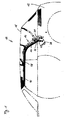
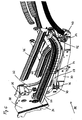
- This folding top is in the Figures 3 and 4 shown in detail, in which FIG. 3 a section I and FIG. 4 a section II FIG. 2 represents.
- the folding top 10 comprises, in the direction of travel from front to back, a front bow 18, a roof cassette 20, a main bow 22 and a corner bow 24.
- a rear window 26 and a clamping bracket 28 are further arranged.
- the bow 18, 22, 24 and the roof cassette 20 form transversely to the direction of travel extending elements of the top linkage 14, which are laterally connected to side parts of the top linkage 14.
- the rear side elements of the top linkage 14 are of particular interest.
- a main pillar 30 and a main link 32 which are articulated via pivot points 34, 36 to a main body bearing 38 fixed to the body.
- the main pillar 30 and the main link 32 via hinge points 40, 42 are connected by means of a roof frame member 44 hinged together and thus form a four-bar linkage.
- the hinge points 34, 36, 40 and 42 are preferably formed by means of swivel joints.
- the main link 32 the other middle and front lateral elements of the roof linkage 14 close.
- a front seal carrier 46 and a middle seal carrier 48 are attached.
- a rear seal carrier 50 forms a movement mechanism for the seal carrier 50.
- the seal supports 46-50 each carry a seal which preferably consists of a rubber material to seal the side windows of the motor vehicle 12 with the side windows closed and the folding top 10 closed.
- the seals are in each case attached to the seal carriers 46 - 50 or formed integrally therewith.
- the seal carrier 50 is at an upper portion as in FIG. 3 represented by means of a seal carrier arm 52 via the roof frame element 44 coupled to the main column 30 and the main link 32.
- the seal carrier link 52 is a connector, which is preferably made of metal.
- the seal carrier arm 52 has at one end portion a pivot joint 54, whereby the seal support arm 52 is pivotally connected to the roof frame member 44.
- a hinge 56 is provided to connect the rear seal carrier 50 with the seal carrier arm 52 articulated.
- the respective axes of rotation 58 and 60 of the hinges 54 and 56 are preferably perpendicular to each other.
- the pivot 56 is attached to the rear seal carrier 50 by means of a tongue-shaped protruding from the seal carrier 50 mounting flange 62.
- a tongue-shaped mounting flange 64 extends in the transverse direction of the folding top 10 in the direction of the center of the folding top 10 past the main column 30.
- the end of the mounting flange 64 facing away from the rear seal carrier 50 is provided with a hinge 66 to articulate with a seal carrier handlebar 68 produce.
- This seal carrier arm 68 is a flat elongated connector, which preferably consists of metal and is pivotally connected at one end to the mounting flange 64.
- At the other end portion of the seal carrier arm 68 is pivotally connected via a rotary joint 70 with the main column 30. More specifically, the pivot 70 engages the main pillar 30 at a tongue-shaped mounting flange 72 which extends in the opposite transverse direction of the folding roof 10 as the mounting flange 64.
- the axes of rotation 74 and 76 of the respective hinges 66 and 70 are preferably parallel and preferably also the axis of rotation 60 of the pivot 56 is parallel to the axes of rotation 74 and 76,
- the present invention is feasible up to a maximum angle of 55 ° between the parallel axes of rotation 74, 76 and the axis of rotation 60, without ball joints are required.
- the joints 54, 56, 66 and 70 are executable as sockets, in each of which a bolt is guided.
- the just-mentioned distance change between axis of rotation 58 and axis of rotation 76 leads to a pivoting movement of the rear seal carrier 50 to the outside, ie away from the main column 30.
- the seal carrier 50 pivots mainly about the axis of rotation 60. A tilting movement of the seal carrier 50 is negligible.
- FIG. 5 shows a perspective view of a folding top 10 according to FIG. 2 in an intermediate position between closed and stored state.
- To deposit the folding top 10 (not shown) drive the main column 30 and the main link 32 is pivoted backwards, due to the four-joint-like arrangement different parallelogram-like intermediate states are taken in succession.
- FIG. 6 shows a perspective view of the folding top according to FIG. 2 in the stowed state.
- FIG. 7 shows the stored state of the folding top FIG. 6 from the in FIG. 6 marked direction III considered.
- the stored state of the folding top 10 of the seal carrier 50 and thus in practice also the seal carried by this at least partially adjacent to the front and rear seal carrier 46 and 48.
- the height of the stored folding top 10 remains low.
- the stroke that brings the seal carrier 50 in its storage position is based on the relative movement between the main column 30 and the main link 32, due to the low power transmission angle comparatively small forces sufficient to bring about the advantageous storage position of the seal carrier 50.
Landscapes
- Engineering & Computer Science (AREA)
- Mechanical Engineering (AREA)
- Seal Device For Vehicle (AREA)
- Superstructure Of Vehicle (AREA)
Description
- Die vorliegende Erfindung betrifft ein Faltverdeck für ein Kraftfahrzeug, mit einem eine Hauptsäule und einen Hauptlenker aufweisenden Verdeckgestänge, wobei die Hauptsäule und der Hauptlenker über jeweils einen ersten Gelenkpunkt an einem karosseriefesten Hauptlager des Fahrzeugs gelagert sind und über jeweils einen zweiten Gelenkpunkt mittels eines Dachrahmenelements gelenkig miteinander verbunden sind, und einem Dichtungsträger, der mit der Hauptsäule oder dem Hauptlenker gelenkig so verbunden ist, dass eine Relativbewegung gegenüber der Hauptsäule und dem Hauptlenker ermöglicht wird.
- Eine wichtige Aufgabe bei der Konstruktion von Faltverdecken besteht in der Platz sparenden Unterbringung des abgelegten Verdecks. Insbesondere ist man bestrebt, die an dem Verdeckgestänge angebrachten Dichtungsträger beim Ablegen des Verdecks in eine Platz sparende Position zu verschwenken. Die vorliegende Erfindung befasst sich diesbezüglich mit der an der C-Säule des Faltverdecks angeordneten Dichtung, die im geschlossenen Zustand des Verdecks eine abdichtende Funktion zur hinteren Seitenscheibe des Fahrzeugs zur Verfügung stellt.
- In der
DE 100 51 436 A1 wird bereits eine nützliche Möglichkeit zur Platz sparenden Unterbringung der hinteren Dichtung beschrieben. Dabei ist der Dichtungsträger gelenkig mit der Hauptsäule verbunden, und er wird ferner über eine gelenkig am karosseriefesten Hauptlager befestigten Koppelstange angelenkt. Dies hat zur Folge, dass beim Verschwenken der Hauptsäule nach hinten über die Koppelstange eine Kraft auf den Dichtungsträger ausgeübt wird, die diesen im abgelegten Zustand des Verdecks in eine Platz sparende Position bringt. Die Dichtung führt jedoch lediglich eine Rotationsbewegung um die Längskante des Dachteils aus, an dem sie gelagert ist. Jedoch kann es für eine platzsparende Unterbringung des Faltverdecks erforderlich sein, den Dichtungsträger in der Querrichtung des Faltverdecks bzw. in der Querrichtung des Kraftfahrzeugs zu bewegen. - Der Erfindung liegt somit die Aufgabe zugrunde, die geschilderten Systeme des Standes der Technik derart zu verbessern, dass das Faltverdeck eine Bewegungsmechanik für einen Dichtungsträger bereitstellt, die möglichst flexible Bewegungen zulässt und einfach zu realisieren ist.
- Diese Aufgabe wird mit einem Faltverdeck für ein Kraftfahrzeug gemäß Anspruch 1 und einem Kraftfahrzeug gemäß Anspruch 11 gelöst.
- Vorteilhafte Ausführungsformen der Erfindung sind Gegenstand der abhängigen Ansprüche.
- Das erfindungsgemäße Faltverdeck für ein Kraftfahrzeug baut auf dem gattungsgemäßen Stand der Technik dadurch auf, dass der Dichtungsträger des Weiteren gelenkig mit dem Dachrahmenelement verbunden ist. Dieser Aufbau ist die Grundlage, um ein Faltverdeck zu realisieren, welches toleranzunempfindlicher ist, weil die Krafteinleitung über das Dachrahmenelement einen Aufbau mit größeren Hebelwegen ermöglicht als bekannte Bewegungsmechaniken für den Dichtungsträger. Außerdem hat dieser Aufbau den großen Vorteil, dass auf 3D-Gelenke bzw. Kugelgelenke verzichtet werden kann, die den Aufbau deutlich verteuern. Des Weiteren ist dieses Faltverdeck fertigungs- und montagetechnisch günstig. Durch die flexible Gestaltungsmöglichkeit der Abmessungsverhältniase lassen sich bei diesem Aufbau 3D-Lagen mit breitem Spielraum realisieren. Außerdem kann dieser Aufbau so gestaltet werden, dass es zu einer sehr günstigen Krafteinleitung führt. Mittels der Abmessungsverhältnisse der einzelnen gelenkig koppelnden Bauteile lassen sich auch Einstellungen gegenüber dem Fahrzeugrohbau realisieren.
- Das erfindungsgemäße Faltverdeck kann in vorteilhafter Weise dadurch weitergebildet sein, dass der Dichtungsträger mittels einem Dichtungsträgerlenker über zwei Gelenke mit dem Dachrahmenelement gekoppelt ist, und mittels einem weiteren Dichtungsträgerlenker über zwei weitere Gelenke mit der Hauptsäule oder dem Hauptlenker gekoppelt ist. Somit ist eine einfach zu realisierende Umsetzung des Faltverdecks geschaffen, welche die vorstehend beschriebenen Vorteile bietet.
- Bei einer bevorzugten Ausführungsform des erfindungsgemäßen Faltverdecks ist weiterhin vorgesehen, dass die Gelenke Drehgelenke sind, welche jeweils nur eine zweidimensional gelenkige Verbindung zulassen. Durch die Ausbildung der Bewegungsmechanik für den Dichtungsträger mittels Drehgelenken kann ein kostengünstiger Aufbau realisiert werden, da die ansonsten erforderlichen Kugelgelenke kostspieliger sind.
- Darüber hinaus kann das erfindungsgemäße Faltverdeck derart weitergebildet sein, dass eine Drehachse von mindestens zwei Gelenken jeweils im Wesentlichen in der gleichen Ebene liegt, wie eine Kurve, welche bei Verschwenkung eines aus Hauptsäule und Hauptlenker gebildeten Viergelenks von einem Punkt der zugehörigen Drehachse der Gelenke beschrieben wird. Durch diese Weiterbildung ist die Bewegung des Dichtungsträgers in Querrichtung des Faltverdecks bzw. in Querrichtung des Kraftfahrzeugs einstellbar.
- Des Weiteren kann das erfindungsgemäße Faltverdeck so weitergebildet sein, dass eine Drehachse von drei Gelenken jeweils im Wesentlichen in der gleichen Ebene liegt, wie eine Kurve, welche bei Verschwenkung eines aus Hauptsäule und Hauptlenker gebildeten Viergelenks von einem Punkt der zugehörigen Drehachse der Gelenke beschrieben wird. Dieser Aufbau führt zu einer besonders günstigen Krafteinleitung.
- Außerdem kann das erfindungsgemäße Faltverdeck so weitergebildet sein, dass die zwei zum Hauptlager nächstgelegenen Gelenke im Wesentlichen parallele Drehachsen aufweisen. Auch dieser Aufbau führt zu einer verbesserten Krafteinleitung und somit zur vermeidung einer übermäßigen Materialbeanspruchung des Verdeckgestänges.
- Weiterhin kann das erfindungsgemäße Faltverdeck so ausgebildet sein, dass das Gelenk, welches einen der Dichtungsträgerlenker mit dem Dachrahmenelement (44) verbindet, eine Drehachse aufweist, die zu den im Wesentlichen parallelen Drehachsen im Wesentlichen senkrecht ist. Durch diese Geometrieverhältnisse können 3D-Bewegungen unter Vermeidung von Kugelgelenken mit günstiger Krafteinleitung realisiert werden.
- Das erfindungsgemäße Faltverdeck baut auf dem gattungsgemäßen Stand der Technik dadurch auf, dass das weiter vom Hauptlager entfernte Gelenk der Gelenke, welche den Dichtungsträger mit den Dichtungsträgerlenkern verbinden, eine Drehachse aufweist, welche zu den im Wesentlichen parallelen Drehachsen maximal einen Winkel von 55° aufspannt. Bis zu einem Winkel von maximal 55° kann der Aufbau ohne Verwendung von Kugelgelenken realisiert werden, ohne dass übermäßig hohe Kräfte auf das Verdeckgestänge wirken.
- Darüber hinaus kann das erfindungsgemäße Faltverdeck derart weitergebildet sein, dass mindestens die Drehachsen der zwei zum Hauptlager nächstgelegenen Gelenke im Wesentlichen senkrecht zur Hauptsäule oder zum Hauptlenker sind. Durch einen derartigen Aufbau kann die Bewegungsmechanik für den Dichtungsträger derart ausgebildet werden, dass diese bezogen auf die Fahrzeugslängsachse vor oder hinter der Hauptsäule bzw. dem Hauptlenker vorbeigeführt wird und somit zu einer Platz sparenden Anordnung im zusammengeklappten Zustand des Faltverdecks in der vertikalen Richtung führt.
- Weiterhin kann das erfindungsgemäße Faltverdeck so ausgebildet werden, dass von den Gelenken des weiter vom Hauptlager entfernten Dichtungsträgerlenkers eines eine Schwenkbewegung des Dichtungsträgers in einer Querrichtung des Faltverdecks ermöglicht. Dadurch kann der Dichtungsträger seitwärts bewegt werden, so dass er im abgelegten Zustand in einer Ebene mit anderen Dichtungsträgern des Faltverdecks zum Liegen kommt und so ein besonders Platz sparendes, zusammengefaltetes Faltverdeck liefert.
- Die Erfindung betrifft weiterhin ein Kraftfahrzeug mit einem erfindungsgemäßen Faltverdeck, wobei das Kraftfahrzeug die vorstehend beschriebenen Vorteile in übertragener Weise bietet.
- Eine bevorzugte Ausführungsform der Erfindung wird nachfolgend anhand der Figuren beispielhaft erläutert.
- Es zeigen:
- Figur 1
- eine Seitenansicht eines Kraftfahrzeugs mit dem erfindungsgemäßen Faltverdeck im geschlossenen Zustand;
- Figur 2
- eine perspektivische Darstellung eines erfindungsgemäßen Faltverdecks im geschlossenen zustand;
- Figur 3
- einen Ausschnitt I aus
Figur 2 ; - Figur 4
- einen Ausschnitt II aus
Figur 2 ; - Figur 5
- eine perspektivische Darstellung eines Faltverdecks gemäß
Figur 2 in einer Zwischenstellung zwischen geschlossenem und abgelegtem Zustand; - Figur 6
- eine perspektivische Darstellung des Faltverdecks gemäß
Figur 2 im abgelegten Zustand; und - Figur 7
- den abgelegten Zustand des Faltverdecks aus
Figur 6 aus der inFigur 6 gekennzeichneten Richtung III betrachtet. -
Figur 1 zeigt eine Seitenansicht eines Kraftfahrzeugs mit dem erfindungsgemäßen Faltverdeck im geschlossenen Zustand. Das Faltverdeck 10 eines Kraftfahrzeugs 12 weist ein Verdeckgestänge 14 und einen vom Verdeckgestänge 14 gehaltenen und abgestützten Verdeckstoff 16 auf. Das Verdeckgestänge 14 ist symmetrisch zu einer vertikalen Fahrzeuglängsmittelebene aufgebaut. Die im Folgenden verwendete Richtungsangabe "Längsrichtung des Faltverdecks" entspricht der Rechts-Links-Richtung inFigur 1 , und die Richtungsangabe "Querrichtung des Faltverdecks" entspricht der Betrachtungsrichtung derFigur 1 . -
Figur 2 zeigt eine perspektivische Darstellung eines erfindungsgemäßen Faltverdecks im geschlossenen Zustand. Dieses Faltverdeck ist in denFiguren 3 und4 im Detail dargestellt, wobeiFigur 3 einen Ausschnitt I undFigur 4 einen Ausschnitt II ausFigur 2 darstellt. Das Faltverdeck 10 umfasst, in Fahrtrichtung von vorne nach hinten, einen Frontspriegel 18, eine Dachkassette 20, einen Hauptspriegel 22 sowie einen Eckspriegel 24. Im hinteren Bereich des Faltverdecks 10 sind weiterhin eine Heckscheibe 26 und ein Spannbügel 28 angeordnet. Die Spriegel 18, 22, 24 und die Dachkassette 20 bilden quer zur Fahrtrichtung verlaufende Elemente des Verdeckgestänges 14, die seitlich mit Seitenteilen des Verdeckgestänges 14 verbunden sind. Im Zusammenhang mit der vorliegenden Erfindung interessieren besonders die hinteren seitlichen Elemente des Verdeckgestänges 14. Dies sind insbesondere eine Hauptsäule 30 und ein Hauptlenker 32, die über Gelenkpunkte 34, 36 mit einem karosseriefesten Hauptlager 38 gelenkig verbunden sind. An ihren anderen Endbereichen sind die Hauptsäule 30 und der Hauptlenker 32 über Gelenkpunkte 40, 42 mittels eines Dachrahmenelementes 44 gelenkig miteinander verbunden und bilden somit ein Viergelenk aus. Die Gelenkpunkte 34, 36, 40 und 42 werden vorzugsweise mittels Drehgelenken ausgebildet. An den Hauptlenker 32 schließen sich die weiteren mittleren und vorderen seitlichen Elemente des Verdeckgestänges 14 an. An diesen vorderen und mittleren seitlichen Elementen des Verdeckgestänges 14 sind ein vorderer Dichtungsträger 46 und ein mittlerer Dichtungsträger 48 befestigt. Mit der Hauptsäule 30 bildet ein hinterer Dichtungsträger 50 eine Bewegungsmechanik für den Dichtungsträger 50 aus. Die Dichtungsträger 46 - 50 tragen jeweils eine Dichtung, die vorzugsweise aus einem Gummimaterial besteht, um die Seitenfenster des Kraftfahrzeugs 12 bei geschlossenen Seitenfenstern und geschlossenem Faltverdeck 10 abzudichten. Die Dichtungen sind dabei jeweils an den Dichtungsträgern 46 - 50 befestigt oder einstückig mit diesen ausgebildet. Der Dichtungsträger 50 ist an einem oberen Abschnitt wie inFigur 3 dargestellt, mittels eines Dichtungsträgerlenkers 52 über das Dachrahmenelement 44 an die Hauptsäule 30 und den Hauptlenker 32 gekoppelt. Der Dichtungsträgerlenker 52 ist ein Verbindungsstück, welches vorzugsweise aus Metall ist. Der Dichtungsträgerlenker 52 weist an einem Endabschnitt ein Drehgelenk 54 auf, wodurch der Dichtungsträgerlenker 52 mit dem Dachrahmenelement 44 gelenkig verbunden ist. Am anderen Endabschnitt des Dichtungsträgerlenkers 52 ist ein Drehgelenk 56 vorgesehen, um den hinteren Dichtungsträger 50 mit dem Dichtungsträgerlenker 52 gelenkig zu verbinden. Die jeweiligen Drehachsen 58 und 60 der Drehgelenke 54 und 56 stehen vorzugsweise senkrecht zueinander. Genauer ist das Drehgelenk 56 am hinteren Dichtungsträger 50 mittels eines vom Dichtungsträger 50 zungenförmig abstehenden Befestigungsflansches 62 befestigt. An einem unteren Endbereich des hinteren Dichtungsträgers 50 ist dieser gelenkig mit der Hauptsäule 30 verbunden. Für diese Verbindung erstreckt sich ein zungenförmiger Befestigungsflansch 64 in der Querrichtung des Faltverdecks 10 in Richtung zur Mitte des Faltverdecks 10 vorbei am der Hauptsäule 30. Der dem hinteren Dichtungsträger 50 abgewandte Endbereich des Befestigungsflansches 64 ist mit einem Drehgelenk 66 versehen, um eine gelenkige Verbindung mit einem Dichtungsträgerlenker 68 herzustellen. Dieser Dichtungsträgerlenker 68 ist ein flaches längliches Verbindungsstück, welches vorzugsweise aus Metall besteht und an einem Endabschnitt mit dem Befestigungsflansch 64 gelenkig verbunden ist. Am anderen Endabschnitt ist der Dichtungsträgerlenker 68 über ein Drehgelenk 70 mit der Hauptsäule 30 gelenkig verbunden. Genauer ausgedrückt greift das Drehgelenk 70 an der Hauptsäule 30 an einem zungenförmigen Befestigungsflansch 72 an, der sich in die entgegengesetzte Querrichtung des Faltverdecks 10 wie der Befestigungsflansch 64 erstreckt. Die Drehachsen 74 und 76 der jeweiligen Drehgelenke 66 und 70 sind vorzugsweise parallel und vorzugsweise ist ebenso die Drehachse 60 des Drehgelenkes 56 parallel zu den Drehachsen 74 und 76, jedoch ist die vorliegende Erfindung bis zu einem maximalen Winkel von 55° zwischen den parallelen Drehachsen 74, 76 und der Drehachse 60 realisierbar, ohne dass Kugelgelenke erforderlich sind. Die Gelenke 54, 56, 66 und 70 sind als Buchsen ausführbar, in denen jeweils ein Bolzen geführt wird. - Beim nach hinten Verschwenken des Faltdaches 10 wird durch eine Relativbewegung der Hauptsäule 30 und des Hauptlenkers 32 das Dachrahmenelement 44 über die Drehgelenke 40 und 42 gedreht. Dadurch ändert sich die Distanz zwischen Drehachse 58 und Drehachse 76, so dass dies zu einer Bewegung des hinteren Dichtungsträgers 50 führt. Über das Gelenk 54 wird somit die Kraft eingeleitet, die den Dichtungsträger 50 innerhalb einer Ebene bewegt, die senkrecht zu den Drehachsen 60, 74 und 76 ist. Die Drehachse 58 ist demnach die antreibende Achse der Bewegungsmechanik für den Dichtungsträger 50. Durch gezielte Festlegung der Abmessungen der Befestigungsflansche 62, 64, 72 und der Abmessungen der Dichtungsträgerlenker 52 und 68 kann die Bewegung des hinteren Dichtungsträgers 50 in gewünschter Weise eingestellt werden. In der bevorzugten Ausführungsform führt die eben erwähnte Distanzveränderung zwischen Drehachse 58 und Drehachse 76 zu einer Schwenkbewegung des hinteren Dichtungsträgers 50 nach außen, also weg von der Hauptsäule 30. Dabei schwenkt der Dichtungsträger 50 vor allem um die Drehachse 60. Eine Kippbewegung des Dichtungsträgers 50 ist dabei vernachlässigbar.
-
Figur 5 zeigt eine perspektivische Darstellung eines Faltverdecks 10 gemäßFigur 2 in einer Zwischenstellung zwischen geschlossenem und abgelegtem Zustand. Zum Ablegen des Faltverdecks 10 werden über einen (nicht dargestellten) Antrieb die Hauptsäule 30 und der Hauptlenker 32 nach hinten verschwenkt, wobei aufgrund der viergelenkartigen Anordnung verschiedene parallelogrammartige Zwischenzustände nacheinander eingenommen werden. -
Figur 6 zeigt eine perspektivische Darstellung des Faltverdecks gemäßFigur 2 im abgelegten Zustand. -
Figur 7 zeigt den abgelegten Zustand des Faltverdecks ausFigur 6 aus der inFigur 6 gekennzeichneten Richtung III betrachtet. Im abgelegten Zustand des Faltverdecks 10 liegen der Dichtungsträger 50 und damit in der Praxis auch die von diesem getragene Dichtung zumindest teilweise neben dem vorderen und hinteren Dichtungsträger 46 und 48. Auf diese Weise bleibt die Bauhöhe des abgelegten Faltverdecks 10 gering. Den Hub, der den Dichtungsträger 50 in seine Ablageposition bringt, wird aus der Relativbewegung zwischen der Hauptsäule 30 und dem Hauptlenker 32 bezogen, wobei aufgrund der günstigen Kraftübertragungswinkel vergleichsweise geringe Kräfte ausreichen, um die vorteilhafte Ablageposition des Dichtungsträgers 50 herbeizuführen. - In der vorliegenden Beschreibung und den Ansprüchen bedeutet die Verwendung von "im Wesentlichen", dass eine kleine Variation möglich ist, solange diese Variation nicht zu einer deutlich erhöhten Materialbelastung oder zu Verspannungen des Verdeckgestänges 14 führen.
-
- 10
- Faltverdeck
- 12
- Kraftfahrzeug
- 14
- Verdeckgestänge
- 16
- Verdeckstoff
- 18
- Frontspiegel
- 20
- Dachkassette
- 22
- Hauptspiegel
- 24
- Eckspiegel
- 26
- Heckscheibe
- 28
- Spannbügel
- 30
- Hauptsäule
- 32
- Hauptlenker
- 34
- Gelenkpunkt
- 36
- Gelenkpunkt
- 38
- Hauptlager
- 40
- Gelenkpunkt
- 42
- Gelenkpunkt
- 44
- Dachrahmenelement
- 46
- vorderer Dichtungsträger
- 48
- mittlerer Dichtungsträger
- 50
- hinterer Dichtungsträger
- 52
- Dichtungsträgerlenker
- 54
- Gelenk
- 56
- Gelenk
- 58
- Drehachse
- 60
- Drehachse
- 62
- Befestigungsflansch
- 64
- Befestigungsflansch
- 66
- Gelenk
- 68
- Dichtungsträgerlenker
- 70
- Gelenk
- 72
- Befestigungsflansch
- 74
- Drehachse
- 76
- Drehachse
Claims (11)
- Faltverdeck für ein Kraftfahrzeug, mit einem eine Hauptsäule (30) und einen Hauptlenker (32) aufweisenden Verdeckgestänge (14), wobei die Hauptsäule (30) und der Hauptlenker (32) über jeweils einen ersten Gelenkpunkt (34, 36) an einem karosseriefesten Hauptlager (38) des Fahrzeugs gelagert sind und über jeweils einen zweiten Gelenkpunkt (40, 42) mittels eines Dachrahmenelements (44) gelenkig miteinander verbunden sind, und einem Dichtungsträger (50), der mit der Hauptsäule (30) oder dem Hauptlenker (32) gelenkig (66, 70) so verbunden ist, dass eine Relativbewegung gegenüber der Hauptsäule (30) und dem Hauptlenker (32) ermöglicht wird, dadurch gekennzeichnet, dass der Dichtungsträger (50) des Weiteren gelenkig (54, 56) mit dem Dachrahmenelement (44) verbunden ist.
- Faltverdeck gemäß Anspruch 1, dadurch gekennzeichnet, dass der Dichtungsträger (50) mittels einem Dichtungsträgerlenker (52) über zwei Gelenke (54, 56) mit dem Dachrahmenelement (44) gekoppelt ist, und mittels einem weiteren Dichtungsträgerlenker (68) über zwei weitere Gelenke (66, 70) mit der Hauptsäule (30) oder dem Hauptlenker (32) gekoppelt ist.
- Faltverdeck gemäß Anspruch 2, dadurch gekenntzeichnet, dass die Gelenke (54, 56, 66, 70) Drehgelenke sind, welche jeweils nur eine zweidimensional gelenkige Verbindung zulassen.
- Faltverdeck gemäß Anspruch 3, dadurch gekennzeichnet, dass eine Drehachse (74, 76) von mindestens zwei Gelenken (66, 70) jeweils im Wesentlichen in der gleichen Ebene liegt, wie eine Kurve, welche bei verschwenkung eines aus Hauptsäule (30) und Hauptlenker (32) gebildeten Viergelenks von einem Punkt der zugehörigen Drehachse (74, 76) der Gelenke (66, 70) beschrieben wird.
- Faltverdeck gemäß Anspruch 3, dadurch gekennzeichnet, dass eine Drehachse (60, 74, 76) von drei Gelenken (56, 66, 70) jeweils im Wesentlichen in der gleichen Ebene liegt, wie eine Kurve, welche bei Verschwenkung eines aus Hauptsäule (30) und Hauptlenker (32) gebildeten Viergelenks von einem Punkt der zugehörigen Drehachse (60, 74, 76) der Gelenke (56, 66, 70) beschrieben wird.
- Faltverdeck gemäß einem der Ansprüche 3 bis 5, dadurch gekennzeichnet, dass die zwei zum Hauptlager (38) nächstgelegenen Gelenke (66, 70) im Wesentlichen parallele Drehachsen aufweisen.
- Faltverdeck gemäß Anspruch 6, dadurch gekennzeichnet, dass das Gelenk (54), welches einen der Dichtungsträgerlenker (52) mit dem Dachrahmenelement (44) verbindet, eine Drehachse (58) aufweist, die zu den im Wesentlichen parallelen Drehachsen (74, 76) im Wesentlichen senkrecht ist.
- Faltverdeck gemäß Anspruch 6, dadurch gekennzeichnet, dass das weiter vom Hauptlager (38) entfernte Gelenk (56) der Gelenke (56, 66), welche den Dichtungsträger (50) mit den Dichtungsträgerlenkern (52, 68) verbinden, eine Drehachse (60) aufweist, welche zu den im Wesentlichen parallelen Drehachsen (74, 76) maximal einen Winkel von 55° aufspannt.
- Faltverdeck gemäß einem der Ansprüche 3 bis 8, dadurch gekennzeichnet, dass mindestens die Drehachsen (74, 76) der zwei zum Hauptlager (38) nächstgelegenen Gelenke (66, 70) im Wesentlichen senkrecht zur Hauptsäule (30) oder zum Hauptlenker (32) sind.
- Faltverdeck gemäß einem der Ansprüche 2 bis 9, dadurch gekennzeichnet, dass von den Gelenken (54, 56) des weiter von Hauptlager (38) entfernten Dichtungsträgerlenkers (52) eines (56) eine Schenkbewegung des Dichtungsträgers (50) in einer Querrichtung des Faltverdecks ermöglicht.
- Kraftfahrzeug mit einem Faltverdeck gemäß einem der vorhergehenden Ansprüche.
Applications Claiming Priority (1)
| Application Number | Priority Date | Filing Date | Title |
|---|---|---|---|
| DE102006012652A DE102006012652B3 (de) | 2006-03-20 | 2006-03-20 | Faltverdeck für ein Kraftfahrzeug |
Publications (3)
| Publication Number | Publication Date |
|---|---|
| EP1837221A2 EP1837221A2 (de) | 2007-09-26 |
| EP1837221A3 EP1837221A3 (de) | 2009-01-21 |
| EP1837221B1 true EP1837221B1 (de) | 2013-09-18 |
Family
ID=38170166
Family Applications (1)
| Application Number | Title | Priority Date | Filing Date |
|---|---|---|---|
| EP07004716.2A Not-in-force EP1837221B1 (de) | 2006-03-20 | 2007-03-07 | Faltverdeck für ein Kraftfahrzeug |
Country Status (2)
| Country | Link |
|---|---|
| EP (1) | EP1837221B1 (de) |
| DE (1) | DE102006012652B3 (de) |
Family Cites Families (5)
| Publication number | Priority date | Publication date | Assignee | Title |
|---|---|---|---|---|
| DE19942427B4 (de) * | 1999-09-06 | 2006-11-09 | Webasto Ag | Faltverdeck für ein Cabriolet |
| DE10051436B4 (de) * | 2000-10-17 | 2004-06-17 | Webasto Vehicle Systems International Gmbh | Dichtungsvorrichtung für ein Dachteil eines Fahrzeugdaches |
| DE10160240B4 (de) * | 2001-12-07 | 2005-04-07 | Webasto Ag | Faltverdeck für ein Kraftfahrzeug |
| DE10317416B4 (de) * | 2003-04-15 | 2006-08-03 | Webasto Ag | Falt- oder Klappverdeck für ein Fahrzeug |
| DE102004005882B4 (de) * | 2004-02-05 | 2006-06-08 | Open Air Systems Gmbh | Verdeck eines Kraftfahrzeugs |
-
2006
- 2006-03-20 DE DE102006012652A patent/DE102006012652B3/de not_active Expired - Fee Related
-
2007
- 2007-03-07 EP EP07004716.2A patent/EP1837221B1/de not_active Not-in-force
Also Published As
| Publication number | Publication date |
|---|---|
| EP1837221A2 (de) | 2007-09-26 |
| DE102006012652B3 (de) | 2007-07-12 |
| EP1837221A3 (de) | 2009-01-21 |
Similar Documents
| Publication | Publication Date | Title |
|---|---|---|
| EP1275543B1 (de) | Abdeckvorrichtung für einen Verdeckkasten | |
| EP1308333B1 (de) | Ablegbares Fahrzeugdach für ein Cabriolet | |
| EP1840011B1 (de) | Luftleitvorrichtung für ein Fahrzeug | |
| EP2018288B1 (de) | Vorrichtung zum führen der bewegung eines windabweisers | |
| DE19936252C5 (de) | Hardtop-Fahrzeugdach | |
| EP1226044B1 (de) | Zwischen einer schliessposition und einer ablageposition verstellbares faltverdeck für ein fahrzeug | |
| EP1275544B1 (de) | Abdeckvorrichtung für einen Verdeckkasten | |
| EP1989074B1 (de) | Faltverdeck für ein kraftfahrzeug | |
| DE10258053A1 (de) | Abklappbare Dachabdeckung für Fahrzeuge, insbesondere Pkw | |
| EP1904327B1 (de) | Verstellvorrichtung eines verdeckkastendeckels eines cabriolets | |
| EP2020366A2 (de) | Dachspoileranordnung für Nutzfahrzeug-Fahrerhäuser | |
| EP1897718B1 (de) | Faltverdeck | |
| EP1735171B1 (de) | Lenkerkinematik für ein fahrzeug-hardtop | |
| EP1837221B1 (de) | Faltverdeck für ein Kraftfahrzeug | |
| EP1982858B1 (de) | Umwandelbares Dach fuer einen Personenkraftwagen | |
| WO2007115714A1 (de) | Hardtop-klappverdeck für einen offenen kraftwagen | |
| DE19960011C2 (de) | Klappverdeck für Kraftfahrzeuge, insbesondere Personenkraftwagen | |
| DE102011117371A1 (de) | Faltdach-Vorrichtung für ein Fahrzeug | |
| EP1853448B1 (de) | Antriebsvorrichtung eines schwenkbauteils eines fahrzeugs | |
| DE102007050210A1 (de) | Schwenkeinrichtung für einen Deckel | |
| DE102008036907B4 (de) | Faltverdeck für einen Personenkraftwagen | |
| DE102013103420B4 (de) | Cabriolet-Verdeck mit Antrieb für Verschlussanordnungen | |
| EP1798090B1 (de) | Hutablage eines Cabriolets | |
| DE102006058320B4 (de) | Cabriolet-Fahrzeug mit angetriebenem Hauptlenkersystem | |
| DE10349042B3 (de) | Mehrgelenkkinematik für ein verstellbares Fahrzeugdach |
Legal Events
| Date | Code | Title | Description |
|---|---|---|---|
| PUAI | Public reference made under article 153(3) epc to a published international application that has entered the european phase |
Free format text: ORIGINAL CODE: 0009012 |
|
| AK | Designated contracting states |
Kind code of ref document: A2 Designated state(s): AT BE BG CH CY CZ DE DK EE ES FI FR GB GR HU IE IS IT LI LT LU LV MC MT NL PL PT RO SE SI SK TR |
|
| AX | Request for extension of the european patent |
Extension state: AL BA HR MK YU |
|
| PUAL | Search report despatched |
Free format text: ORIGINAL CODE: 0009013 |
|
| AK | Designated contracting states |
Kind code of ref document: A3 Designated state(s): AT BE BG CH CY CZ DE DK EE ES FI FR GB GR HU IE IS IT LI LT LU LV MC MT NL PL PT RO SE SI SK TR |
|
| AX | Request for extension of the european patent |
Extension state: AL BA HR MK RS |
|
| 17P | Request for examination filed |
Effective date: 20080328 |
|
| AKX | Designation fees paid |
Designated state(s): AT BE BG CH CY CZ DE DK EE ES FI FR GB GR HU IE IS IT LI LT LU LV MC MT NL PL PT RO SE SI SK TR |
|
| GRAP | Despatch of communication of intention to grant a patent |
Free format text: ORIGINAL CODE: EPIDOSNIGR1 |
|
| INTG | Intention to grant announced |
Effective date: 20130507 |
|
| GRAS | Grant fee paid |
Free format text: ORIGINAL CODE: EPIDOSNIGR3 |
|
| GRAA | (expected) grant |
Free format text: ORIGINAL CODE: 0009210 |
|
| AK | Designated contracting states |
Kind code of ref document: B1 Designated state(s): AT BE BG CH CY CZ DE DK EE ES FI FR GB GR HU IE IS IT LI LT LU LV MC MT NL PL PT RO SE SI SK TR |
|
| REG | Reference to a national code |
Ref country code: GB Ref legal event code: FG4D Free format text: NOT ENGLISH |
|
| REG | Reference to a national code |
Ref country code: CH Ref legal event code: EP |
|
| REG | Reference to a national code |
Ref country code: IE Ref legal event code: FG4D Free format text: LANGUAGE OF EP DOCUMENT: GERMAN |
|
| REG | Reference to a national code |
Ref country code: AT Ref legal event code: REF Ref document number: 632543 Country of ref document: AT Kind code of ref document: T Effective date: 20131015 |
|
| REG | Reference to a national code |
Ref country code: DE Ref legal event code: R096 Ref document number: 502007012291 Country of ref document: DE Effective date: 20131114 |
|
| RAP2 | Party data changed (patent owner data changed or rights of a patent transferred) |
Owner name: WEBASTO SE |
|
| PG25 | Lapsed in a contracting state [announced via postgrant information from national office to epo] |
Ref country code: CY Free format text: LAPSE BECAUSE OF FAILURE TO SUBMIT A TRANSLATION OF THE DESCRIPTION OR TO PAY THE FEE WITHIN THE PRESCRIBED TIME-LIMIT Effective date: 20130724 Ref country code: SE Free format text: LAPSE BECAUSE OF FAILURE TO SUBMIT A TRANSLATION OF THE DESCRIPTION OR TO PAY THE FEE WITHIN THE PRESCRIBED TIME-LIMIT Effective date: 20130918 Ref country code: LT Free format text: LAPSE BECAUSE OF FAILURE TO SUBMIT A TRANSLATION OF THE DESCRIPTION OR TO PAY THE FEE WITHIN THE PRESCRIBED TIME-LIMIT Effective date: 20130918 |
|
| REG | Reference to a national code |
Ref country code: NL Ref legal event code: VDEP Effective date: 20130918 |
|
| REG | Reference to a national code |
Ref country code: LT Ref legal event code: MG4D |
|
| PG25 | Lapsed in a contracting state [announced via postgrant information from national office to epo] |
Ref country code: FI Free format text: LAPSE BECAUSE OF FAILURE TO SUBMIT A TRANSLATION OF THE DESCRIPTION OR TO PAY THE FEE WITHIN THE PRESCRIBED TIME-LIMIT Effective date: 20130918 Ref country code: SI Free format text: LAPSE BECAUSE OF FAILURE TO SUBMIT A TRANSLATION OF THE DESCRIPTION OR TO PAY THE FEE WITHIN THE PRESCRIBED TIME-LIMIT Effective date: 20130918 Ref country code: LV Free format text: LAPSE BECAUSE OF FAILURE TO SUBMIT A TRANSLATION OF THE DESCRIPTION OR TO PAY THE FEE WITHIN THE PRESCRIBED TIME-LIMIT Effective date: 20130918 Ref country code: ES Free format text: LAPSE BECAUSE OF FAILURE TO SUBMIT A TRANSLATION OF THE DESCRIPTION OR TO PAY THE FEE WITHIN THE PRESCRIBED TIME-LIMIT Effective date: 20130918 Ref country code: GR Free format text: LAPSE BECAUSE OF FAILURE TO SUBMIT A TRANSLATION OF THE DESCRIPTION OR TO PAY THE FEE WITHIN THE PRESCRIBED TIME-LIMIT Effective date: 20131219 |
|
| PG25 | Lapsed in a contracting state [announced via postgrant information from national office to epo] |
Ref country code: CY Free format text: LAPSE BECAUSE OF FAILURE TO SUBMIT A TRANSLATION OF THE DESCRIPTION OR TO PAY THE FEE WITHIN THE PRESCRIBED TIME-LIMIT Effective date: 20130918 |
|
| PG25 | Lapsed in a contracting state [announced via postgrant information from national office to epo] |
Ref country code: CZ Free format text: LAPSE BECAUSE OF FAILURE TO SUBMIT A TRANSLATION OF THE DESCRIPTION OR TO PAY THE FEE WITHIN THE PRESCRIBED TIME-LIMIT Effective date: 20130918 Ref country code: EE Free format text: LAPSE BECAUSE OF FAILURE TO SUBMIT A TRANSLATION OF THE DESCRIPTION OR TO PAY THE FEE WITHIN THE PRESCRIBED TIME-LIMIT Effective date: 20130918 Ref country code: RO Free format text: LAPSE BECAUSE OF FAILURE TO SUBMIT A TRANSLATION OF THE DESCRIPTION OR TO PAY THE FEE WITHIN THE PRESCRIBED TIME-LIMIT Effective date: 20130918 Ref country code: NL Free format text: LAPSE BECAUSE OF FAILURE TO SUBMIT A TRANSLATION OF THE DESCRIPTION OR TO PAY THE FEE WITHIN THE PRESCRIBED TIME-LIMIT Effective date: 20130918 Ref country code: SK Free format text: LAPSE BECAUSE OF FAILURE TO SUBMIT A TRANSLATION OF THE DESCRIPTION OR TO PAY THE FEE WITHIN THE PRESCRIBED TIME-LIMIT Effective date: 20130918 Ref country code: IS Free format text: LAPSE BECAUSE OF FAILURE TO SUBMIT A TRANSLATION OF THE DESCRIPTION OR TO PAY THE FEE WITHIN THE PRESCRIBED TIME-LIMIT Effective date: 20140118 |
|
| PGFP | Annual fee paid to national office [announced via postgrant information from national office to epo] |
Ref country code: DE Payment date: 20140325 Year of fee payment: 8 |
|
| PG25 | Lapsed in a contracting state [announced via postgrant information from national office to epo] |
Ref country code: PL Free format text: LAPSE BECAUSE OF FAILURE TO SUBMIT A TRANSLATION OF THE DESCRIPTION OR TO PAY THE FEE WITHIN THE PRESCRIBED TIME-LIMIT Effective date: 20130918 |
|
| PGFP | Annual fee paid to national office [announced via postgrant information from national office to epo] |
Ref country code: FR Payment date: 20140319 Year of fee payment: 8 |
|
| REG | Reference to a national code |
Ref country code: DE Ref legal event code: R097 Ref document number: 502007012291 Country of ref document: DE |
|
| PG25 | Lapsed in a contracting state [announced via postgrant information from national office to epo] |
Ref country code: PT Free format text: LAPSE BECAUSE OF FAILURE TO SUBMIT A TRANSLATION OF THE DESCRIPTION OR TO PAY THE FEE WITHIN THE PRESCRIBED TIME-LIMIT Effective date: 20140120 |
|
| PGFP | Annual fee paid to national office [announced via postgrant information from national office to epo] |
Ref country code: GB Payment date: 20140324 Year of fee payment: 8 |
|
| PLBE | No opposition filed within time limit |
Free format text: ORIGINAL CODE: 0009261 |
|
| STAA | Information on the status of an ep patent application or granted ep patent |
Free format text: STATUS: NO OPPOSITION FILED WITHIN TIME LIMIT |
|
| 26N | No opposition filed |
Effective date: 20140619 |
|
| PG25 | Lapsed in a contracting state [announced via postgrant information from national office to epo] |
Ref country code: IT Free format text: LAPSE BECAUSE OF FAILURE TO SUBMIT A TRANSLATION OF THE DESCRIPTION OR TO PAY THE FEE WITHIN THE PRESCRIBED TIME-LIMIT Effective date: 20130918 |
|
| PG25 | Lapsed in a contracting state [announced via postgrant information from national office to epo] |
Ref country code: DK Free format text: LAPSE BECAUSE OF FAILURE TO SUBMIT A TRANSLATION OF THE DESCRIPTION OR TO PAY THE FEE WITHIN THE PRESCRIBED TIME-LIMIT Effective date: 20130918 |
|
| REG | Reference to a national code |
Ref country code: DE Ref legal event code: R097 Ref document number: 502007012291 Country of ref document: DE Effective date: 20140619 |
|
| PG25 | Lapsed in a contracting state [announced via postgrant information from national office to epo] |
Ref country code: LU Free format text: LAPSE BECAUSE OF FAILURE TO SUBMIT A TRANSLATION OF THE DESCRIPTION OR TO PAY THE FEE WITHIN THE PRESCRIBED TIME-LIMIT Effective date: 20140307 |
|
| REG | Reference to a national code |
Ref country code: CH Ref legal event code: PL |
|
| REG | Reference to a national code |
Ref country code: IE Ref legal event code: MM4A |
|
| PG25 | Lapsed in a contracting state [announced via postgrant information from national office to epo] |
Ref country code: LI Free format text: LAPSE BECAUSE OF NON-PAYMENT OF DUE FEES Effective date: 20140331 Ref country code: IE Free format text: LAPSE BECAUSE OF NON-PAYMENT OF DUE FEES Effective date: 20140307 Ref country code: CH Free format text: LAPSE BECAUSE OF NON-PAYMENT OF DUE FEES Effective date: 20140331 |
|
| REG | Reference to a national code |
Ref country code: AT Ref legal event code: MM01 Ref document number: 632543 Country of ref document: AT Kind code of ref document: T Effective date: 20140307 |
|
| PG25 | Lapsed in a contracting state [announced via postgrant information from national office to epo] |
Ref country code: AT Free format text: LAPSE BECAUSE OF NON-PAYMENT OF DUE FEES Effective date: 20140307 |
|
| REG | Reference to a national code |
Ref country code: DE Ref legal event code: R119 Ref document number: 502007012291 Country of ref document: DE |
|
| GBPC | Gb: european patent ceased through non-payment of renewal fee |
Effective date: 20150307 |
|
| REG | Reference to a national code |
Ref country code: FR Ref legal event code: ST Effective date: 20151130 |
|
| PG25 | Lapsed in a contracting state [announced via postgrant information from national office to epo] |
Ref country code: DE Free format text: LAPSE BECAUSE OF NON-PAYMENT OF DUE FEES Effective date: 20151001 Ref country code: GB Free format text: LAPSE BECAUSE OF NON-PAYMENT OF DUE FEES Effective date: 20150307 |
|
| PG25 | Lapsed in a contracting state [announced via postgrant information from national office to epo] |
Ref country code: MT Free format text: LAPSE BECAUSE OF FAILURE TO SUBMIT A TRANSLATION OF THE DESCRIPTION OR TO PAY THE FEE WITHIN THE PRESCRIBED TIME-LIMIT Effective date: 20130918 Ref country code: FR Free format text: LAPSE BECAUSE OF NON-PAYMENT OF DUE FEES Effective date: 20150331 |
|
| PG25 | Lapsed in a contracting state [announced via postgrant information from national office to epo] |
Ref country code: MC Free format text: LAPSE BECAUSE OF FAILURE TO SUBMIT A TRANSLATION OF THE DESCRIPTION OR TO PAY THE FEE WITHIN THE PRESCRIBED TIME-LIMIT Effective date: 20130918 Ref country code: BG Free format text: LAPSE BECAUSE OF FAILURE TO SUBMIT A TRANSLATION OF THE DESCRIPTION OR TO PAY THE FEE WITHIN THE PRESCRIBED TIME-LIMIT Effective date: 20130918 |
|
| PG25 | Lapsed in a contracting state [announced via postgrant information from national office to epo] |
Ref country code: BE Free format text: LAPSE BECAUSE OF FAILURE TO SUBMIT A TRANSLATION OF THE DESCRIPTION OR TO PAY THE FEE WITHIN THE PRESCRIBED TIME-LIMIT Effective date: 20140331 Ref country code: HU Free format text: LAPSE BECAUSE OF FAILURE TO SUBMIT A TRANSLATION OF THE DESCRIPTION OR TO PAY THE FEE WITHIN THE PRESCRIBED TIME-LIMIT; INVALID AB INITIO Effective date: 20070307 Ref country code: TR Free format text: LAPSE BECAUSE OF FAILURE TO SUBMIT A TRANSLATION OF THE DESCRIPTION OR TO PAY THE FEE WITHIN THE PRESCRIBED TIME-LIMIT Effective date: 20130918 |