EP1843928B1 - Vehicule de chemin de fer a deux etages - Google Patents
Vehicule de chemin de fer a deux etages Download PDFInfo
- Publication number
- EP1843928B1 EP1843928B1 EP06706361.0A EP06706361A EP1843928B1 EP 1843928 B1 EP1843928 B1 EP 1843928B1 EP 06706361 A EP06706361 A EP 06706361A EP 1843928 B1 EP1843928 B1 EP 1843928B1
- Authority
- EP
- European Patent Office
- Prior art keywords
- deck
- double
- railway vehicle
- aisle
- vehicle according
- Prior art date
- Legal status (The legal status is an assumption and is not a legal conclusion. Google has not performed a legal analysis and makes no representation as to the accuracy of the status listed.)
- Expired - Lifetime
Links
Images


Classifications
-
- B—PERFORMING OPERATIONS; TRANSPORTING
- B61—RAILWAYS
- B61D—BODY DETAILS OR KINDS OF RAILWAY VEHICLES
- B61D1/00—Carriages for ordinary railway passenger traffic
- B61D1/06—Carriages for ordinary railway passenger traffic with multiple deck arrangement
-
- B—PERFORMING OPERATIONS; TRANSPORTING
- B61—RAILWAYS
- B61D—BODY DETAILS OR KINDS OF RAILWAY VEHICLES
- B61D1/00—Carriages for ordinary railway passenger traffic
- B61D1/06—Carriages for ordinary railway passenger traffic with multiple deck arrangement
- B61D1/08—Carriages for ordinary railway passenger traffic with multiple deck arrangement of sleeping carriages
-
- B—PERFORMING OPERATIONS; TRANSPORTING
- B61—RAILWAYS
- B61D—BODY DETAILS OR KINDS OF RAILWAY VEHICLES
- B61D31/00—Sleeping accommodation
Definitions
- the invention relates to a double-deck railway vehicle, in particular a sleeping car and/or couchette car, with a lower deck having a plurality of lower deck compartments and an upper deck located above the lower deck and having a plurality of upper deck compartments, each compartment being accessible via an aisle, respectively.
- a double-deck railway vehicle in particular a sleeping car and/or couchette car
- a lower deck having a plurality of lower deck compartments and an upper deck located above the lower deck and having a plurality of upper deck compartments, each compartment being accessible via an aisle, respectively.
- On at least one longitudinal side of the vehicle at least one entrance door is provided in the region of a vehicle end and/or in a middle section of the vehicle.
- Such a double-deck railway vehicle with upper decks and lower decks is known, for example from EP 0 384 262 B1 .
- Two upper deck compartments and two lower deck compartments, respectively, are each accessible from an aisle at an intermediate deck level via at least one staircase or lift, respectively, per compartment pair.
- This arrangement has the disadvantage that it is relatively expensive to manufacture due to its relatively high number of staircases. Furthermore, the staircases take a relatively large amount of space, such that the transport capacity of the vehicle is reduced. Furthermore, due to the staircases, at a very early point in time during manufacture of the car, a specification of the segmentation of the vehicle into compartments has to ensue, such that a later modification of the segmentation, in particular a later conversion, is only possible at rather high cost.
- the invention solves this problem with a double-deck railway vehicle having the features of claim 1.
- the invention is based on the technical teaching that a raise in the transport capacity and in the flexibility of the segmentation of the vehicle may be achieved if a lower deck aisle and a separate upper deck aisle are provided, the lower deck compartments being accessible via the lower deck aisle and the upper deck compartments being accessible via the upper deck aisle.
- the two separate aisles the numerous staircases and lifts, respectively, become superfluous, such that, on the one hand, the effort necessary for manufacturing the vehicle is greatly reduced.
- the upper deck and the lower deck due to the accessibility of the compartments via one separate aisle per deck, may be almost arbitrarily segmented into compartments just as with common single deck cars. Even at a later point in time, this segmentation may easily be modified.
- the lower deck aisle and the upper deck aisle may be arranged immediately above each other.
- the vehicle has a longitudinal axis and defines a transverse direction being arranged transverse, in particular perpendicular, to the longitudinal axis.
- the lower deck aisle and the upper deck aisle are mutually offset in the transverse direction of said vehicle.
- the upper deck aisle and the lower deck aisle may be accessible via any suitable access device.
- lifts, ramps or the like may be provided. Due to the very simple and space saving design that may be achieved herewith, the upper deck aisle is accessible at least via first stairs. Additionally or alternatively, the lower deck aisle may be accessible at least via second stairs.
- an access device preferably stairs, is provided for each aisle.
- the stairs may have any suitable orientation within the vehicle.
- the stairs may be arranged in a conventional manner to at least mainly extend in the longitudinal direction of the vehicle such that, in other words, the passengers climb the stairs in a climbing direction that lies in a vertical plane substantially parallel to the longitudinal direction of the vehicle.
- the first stairs towards the upper deck and/or the second stairs towards the lower deck at least predominantly extend in an extension direction that is inclined by less than 30°, preferably less than 20°, more preferably less than 10°, with respect to a plane perpendicular to the longitudinal direction of the vehicle. More preferably, the extension direction is parallel to a plane perpendicular to the longitudinal direction of the vehicle.
- these stairs define a climbing direction of the passengers that is only slightly inclined, preferably parallel, to a plane perpendicular to the longitudinal axis of the vehicle over the predominant part of the stairs.
- the width dimension of the stairs is substantially parallel to the longitudinal axis of the vehicle.
- Such a staircase design is different from conventional double-deck vehicles and allows a very compact staircase that does not waste transport capacity.
- the lower deck aisle and the upper deck aisle are arranged on different longitudinal sides of the vehicle.
- the upper deck aisle may for example also be arranged in the vehicle center while the lower deck aisle is arranged on one longitudinal side of the vehicle. This may for example be the case if upper deck compartments are arranged on both sides of the upper deck aisle and are provided with sleeping facilities aligned along the longitudinal direction of the vehicle.
- the floor level of the upper deck aisle is lowered with respect to the floor level of at least a part of said upper deck compartments.
- the part of the ceiling of the lower deck compartments lying below the upper deck aisle is lowered as well. But this is only associated with a comparatively small, acceptable restriction of the space available in these compartments.
- the ceiling level of the lower deck aisle is raised with respect to the ceiling level of at least a part of the lower deck compartments.
- the arrangement of the upper deck and the lower deck in the longitudinal direction of the vehicle may occur in an arbitrary manner.
- at least one intermediate deck is provided from which said upper deck and/or said lower deck is accessible. Further preferably, such an intermediate deck is provided at both vehicle ends.
- Access to the vehicle may be provided as well in an arbitrary suitable manner.
- at least one entrance door is provided in the region of a vehicle end and/or in a middle section of the vehicle.
- a running gear is provided in the region one of the vehicle ends, and the entrance door is located above the running gear.
- a running gear is provided in the region one of the vehicle ends, and the entrance door is offset with respect to the running gear along the longitudinal direction of the vehicle.
- the double-deck railway vehicle there Is provided equipment for disabled persons.
- at least one barrier-free access from the entrance door to at least one compartment there is provided at least one barrier-free access from the entrance door to the lower deck.
- at least one sanitary compartment and at least one barrier-free access from the entrance door to the sanitary compartment there is provided a lift for disabled persons in the region of the entrance door.
- the entrance door may be designed arbitrarily. For example, it may be a multi-wing door. With respect to optimum use of the available space, said entrance door preferably is a single-wing door.
- the equipment of the compartments may be chosen arbitrarily.
- at least one compartment is designed as a sleeping car and/or couchette car compartment. This then comprises at least one sleeping facility.
- at least two sleeping facilities, further preferably at least four sleeping facilities, are provided to achieve a high transport capacity.
- At least one of the sleeping facilities is foldable in order to be able to provide free space for other fixtures such as seats or the like in case of its non-use.
- Particularly high transport capacities are achieved with preferred variants of the double-deck railway vehicle according to the invention wherein, on the upper deck, at least six passenger compartments are provided, each comprising four sleeping facilities, and, additionally or alternatively, on the lower deck, at least six passenger compartments are provided, each comprising four sleeping facilities.
- Further preferred variants of the double-deck railway vehicle according to the invention with high transport capacities have at least at least 52 sleeping facilities, preferably at least 54 sleeping facilities.
- the invention further relates to a passenger train with a double-deck railway vehicle according to the invention.
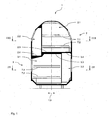
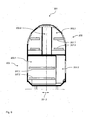
- Figure 1 shows a cross-section of the double-deck railway vehicle 1 that is arranged perpendicularly to the longitudinal axis of the vehicle along line I-I of Figure 2.
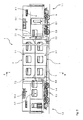
- Figure 2 shows a schematic side view of the vehicle.
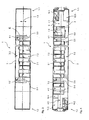
- Figure 3 and 4 show schematic sectional representations of the vehicle 1 along line III-III and IV-IV of Figure 1 , respectively.
- the vehicle 1 In its middle section between the vehicle ends 1.1 and 1.2 the vehicle 1 comprises an upper deck 2 and a lower deck 3. At both vehicle ends 1.1 and 1.2 an intermediate deck 4.1 and 4.2, respectively, is located adjacent thereto from which respective intermediate deck 4.1 and 4.2 the upper deck 2 and the lower deck 3 each are accessible via a staircase 5.1 and 5.2, respectively.
- the upper deck 2 has a plurality of upper deck compartments 2.1 as well as an upper deck aisle 2.2 via which each of the upper deck compartments 2.1 is accessible.
- the lower deck 3 also has a plurality of lower deck compartments 3.1 as well as a lower deck aisle 3.2 via which each of the lower deck compartments 3.1 is accessible.
- the upper deck aisle 2.2 is accessible from the first intermediate deck 4.1 via first stairs 5.3 of the first staircase 5.1 while it is accessible from the second intermediate deck 4.2 via first stairs 5.4 of the second staircase 5.2
- the lower deck aisle 3.2 is accessible from the first intermediate deck 4.1 via second stairs 5.5 of the first staircase 5.1 while it is accessible from the second intermediate deck 4.2 via second stairs 5.6 of the second staircase 5.2.
- a lift or the like may be provided instead of at least one of the stairs towards the upper deck.
- a ramp may be provided as it is indicated in Figure 2 by the dashed contour 6.
- a barrier-free access suitable for disabled persons would be available to the lower deck as well.
- each upper deck compartments 2.1 and the lower deck compartments 3.1 each comprise two couchette pairs each comprising two couchettes 7.1 and 7.2 arranged one above the other.
- each upper couchette 7.1 may be folded downwards in order to form, in this position, a backrest of a seat device that it forms together with the lower couchette 7.2.
- the first stairs 5.3 of the first staircase 5.1 and the first stairs 5.4 of the second staircase 5.2 both predominantly extend in an extension direction E that lies in a plane parallel to the transverse direction 1.3 of the vehicle 1 and perpendicular to the longitudinal axis of the vehicle 1.
- the stairs 5.3 and 5.4 respectively, define a climbing direction of the passengers that lies in a plane parallel to the transverse direction 1.3 of the vehicle 1 and, thus, is perpendicular to the longitudinal axis of the vehicle 1 over the predominant part of the stairs 5.3 and 5.4, respectively.
- the width dimension of the stairs 5.3 and 5.4, respectively is substantially parallel to the longitudinal axis of the vehicle 1. Only by the last two steps at the upper end of the first stairs 5.3 and 5.4, respectively, there is provided a turn by 90° in order to enter the upper deck aisle 2.2 in a direction that lies in a vertical plane parallel to the longitudinal axis of the vehicle 1.
- Such a staircase design is different from conventional double-deck vehicles where the stairs towards the upper and lower deck typically are arranged to predominantly extend in the longitudinal direction of the vehicle and, thus, conventionally define a climbing direction of the passengers that lies in a vertical plane substantially parallel to the longitudinal axis of the vehicle.
- a very compact staircase is possible that does not waste transport capacity.
- further intermediate deck compartments 4.3 and 4.4 may be arranged at the intermediate deck 4.1 and 4.2, respectively, as can be seen from Figure 4 .
- These intermediate deck compartments 4.3 and 4.4 add to the transport capacity of the vehicle 1.
- the stairs towards the upper deck may also have a few steps at the lower end providing some turn in the climbing direction.
- completely straight stairs are provided to the upper deck aisle (then eventually being somewhat steeper).
- the second stairs towards the lower deck aisle may as well at least predominantly extend in the extension direction E as outlined above (i.e. in a plane parallel to the transverse direction of the vehicle and perpendicular to the longitudinal axis of the vehicle).
- the extension direction E may also be slightly inclined with respect to a plane perpendicular to the longitudinal axis of the vehicle.
- the inclination with respect to the plane perpendicular to the longitudinal axis of the vehicle is less than 30°, preferably less than 20°, more preferably less than 10°.
- a compact and space saving design may be achieved.
- the upper deck 2 and the lower deck 3 each comprises seven compartments 2.1 and 3.1, respectively.
- the first intermediate deck 4.1 comprises an intermediate deck compartment 4.4 for train attendant staff with one couchette
- the second intermediate deck 4.2 comprises an intermediate deck compartment 4.3 with two couchette pairs 7.1 and 7.2.
- the upper deck aisle 2.2 and the lower deck aisle 3.2 are offset in the transverse direction 1.3 of the vehicle 1 and arranged on different lateral sides of the vehicle 1.
- the limited height within the vehicle 1 which is due to standardized outer boundaries of the vehicle 1, it is herewith possible to achieve large transit heights of the aisles 2.2 and 3.2, which allow convenient access to the compartments 2.1 and 3.1, respectively.
- the access to both aisles 2.2 and 3.2 may be realized in a convenient and space-saving manner, for example via the staircases 5.1 and 5.2 described above.
- the floor 2.4 of the upper deck aisle 2.2 is lowered with respect to the floor 2.3 of the upper deck compartments 2.1.
- the part of the ceiling of the lower deck compartments 3.1 lying below the upper deck aisle 2.2 is also lowered.
- this is only associated with a comparatively low and acceptable restriction of the space available in the lower deck compartments 3.1.
- the ceiling 3.4 of the lower deck aisle 3.2 is raised with respect to the ceiling of the lower deck compartments 3.1.
- the part of the floor of the upper deck compartments located above the lower deck aisle 3.2 is raised as well.
- this is only associated with a comparatively low and acceptable restriction of the space available in the upper deck compartments 2.1.
- the vehicle 1 at each one of its both ends 1.1. and 1.2, has a running gear in the form of a bogie 8.1 and 8.2, respectively.
- a single-wing entrance door 9 is provided on each longitudinal side of the vehicle 1.
- sanitary compartments 10.1 and 10.2 are provided in the region of the vehicle ends 1.1 and 1.2.
- operational compartments 10.3 to 10.7 are arranged in the region of the vehicle ends 1.1 and 1.2.
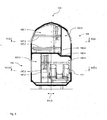
- Figure 5 shows a cross-section of the double-deck railway vehicle 101 that is arranged perpendicularly to the longitudinal axis of the vehicle along line V-V of Figure 6.
- Figure 6 shows a schematic side view of the vehicle.
- Figure 7 and 8 show schematic sectional representations of the vehicle 101 along line VII-VII and VIII-VIII of Figure 5 , respectively.
- the vehicle 101 in its basic design and functionality, corresponds to the vehicle 1 of Figure 1 to 4 .
- similar components are designated by reference numerals only raised by the amount 100. Due to the wide accordance of the embodiment of Figure 1 to 4 and of Figure 5 to 8 it is here mainly referred to the differences.
- one difference relates to the equipment of the upper deck compartments 102.1 of the upper deck 102 and of the lower deck compartments 103.1 of the lower deck 103 that are accessible via an upper deck aisle 102.2 and a lower deck aisle 103.2, respectively, that are offset in the transverse direction 101.3 of the vehicle 101.
- the upper couchette 107.1 may be folded in its middle section and may be pivoted from its couchette position shown in Figure 5 in the upper deck compartment 102.1 into the position,shown in Figure 5 in the lower deck compartment 103.1.
- the lower couchette 107.2 may be pivoted from its couchette position shown in Figure 5 in the upper deck compartment 102.1 into the position shown in Figure 5 in the lower deck compartment 103.1.
- compartments equipped with couchettes 107.1 and 107.2 exclusively may be provided as well as compartments equipped with couchettes 107.1, 107.2 and seating facilities 111 as well as compartments equipped with seating facilities 111 exclusively.
- a further difference with respect to the vehicle of Figure 1 to 4 lies within the arrangement of the entrance doors 109 which are located in the region of the first vehicle end 101.1 and offset along the longitudinal direction of the vehicle 101 with respect to the bogie 108.1.
- the entrance doors 109 which are located in the region of the first vehicle end 101.1 and offset along the longitudinal direction of the vehicle 101 with respect to the bogie 108.1.
- operational compartments 110.3, 110.6 and 110.7 are arranged in the region of the vehicle ends 1.1 and 1.2.
- an intermediate deck compartment 104.3 accessible by disabled passengers is provided that comprises a couchette pair.
- This intermediate deck compartment 104.3 has a barrier-free access to the entrance doors 109.
- sanitary compartments 110.1 and 110.2 are provided, the first sanitary compartment 110.1 of which being as well designed to be accessible by disabled passengers.
- the first sanitary compartment 110.1 as well has a barrier-free access to the intermediate deck compartment 104.3 and the entrance doors 109.
- a lift for disabled passengers may be provided.
- the entrance door or entrance doors may also be arranged at a different location.
- at least one entrance door may be provided as well in a middle section of the vehicle. This door may be located at the level of a lower deck or of a central intermediate deck.
- the equipment of which is intended for a first class vehicle each comprises seven compartments 102.1 and 103.1, respectively, six of which are equipped with two couchette pairs 107.1, 107.2 and one with one couchette pair 107.1, 107.2. Furthermore, on the first intermediate deck 104.1 an intermediate deck compartment 104.3 is provided that is accessible to disabled passengers and equipped with one couchette pair 107.1, 107.2, and, on the second intermediate deck 104.2, an intermediate deck compartment 104.4 having one couchette is provided for train attendant staff. Altogether, depending on the number of installed seating facilities, a maximum capacity of 54 passenger sleeping facilities and one sleeping facility for a train attendant is provided.
- Figure 9 shows a cross-section of the double-deck railway vehicle 1 that is arranged perpendicularly to the longitudinal axis of the vehicle 201.
- the vehicle 201 in its basic design and functionality, corresponds to the vehicle 1 of Figure 1 to 4 .
- similar components are designated by reference numerals only raised by the amount 200. Due to the wide accordance of the embodiment of Figure 1 to 4 and of Figure 9 it is here mainly referred to the differences.
- the essential difference lies within the design of the upper deck 202 that has a central upper deck aisle 202.2 while the lower deck 203 has a lower deck aisle 203.2 that is offset with respect to the former in the transverse direction 201.3 of the vehicle 201 and arranged on one longitudinal side of the vehicle 201.
- the upper deck has upper deck compartments 202.1 that are located on both sides of the upper deck aisle 202.2 and comprise couchettes 207.1 and 207.2 aligned in the longitudinal direction of the vehicle 201.
- a central lower deck aisle may be provided with such lower deck compartments located on both sides thereof.
Landscapes
- Engineering & Computer Science (AREA)
- Mechanical Engineering (AREA)
- Transportation (AREA)
- Seats For Vehicles (AREA)
- Body Structure For Vehicles (AREA)
- Cage And Drive Apparatuses For Elevators (AREA)
Claims (19)
- Véhicule de chemin de fer à deux étages, en particulier wagon-lit et/ou couchettes, ayant un étage inférieur (3; 103; 203) comprenant une pluralité de compartiments d'étage inférieur (3.1; 103.1; 203.1) et un étage supérieur (2; 102; 202) se trouvant audessus dudit étage inférieur (3; 103; 203) et comprenant une pluralité de compartiments d'étage supérieur (2.1; 102.1; 202.1), chaque compartiment étant accessible par un couloir (2.2, 3.2; 102.2, 103.2; 202.2, 203.2), respectivement, dans lequel un couloir d'étage inférieur (3.2; 103.2; 203.2) et un couloir d'étage supérieur distinct (2.2; 102.2; 202.2) sont prévus, lesdits compartiments d'étage inférieur (3.1; 103.1; 203.1) étant accessibles par ledit couloir d'étage inférieur (3.2; 103.2; 203.2) et lesdits compartiments d'étage supérieur (2.1; 102.1; 202.1) étant accessibles par ledit couloir d'étage supérieur (2.2; 102.2; 202.2), et, sur au moins un côté longitudinal dudit véhicule, au moins une porte d'entrée (9; 109) est prévue dans la zone d'une extrémité de véhicule (1.1; 101.1) et/ou dans une section centrale dudit véhicule,
caractérisé en ce que
au moins un accès sans barrière est prévu entre ladite porte d'entrée (9; 109) et ledit étage inférieur (3). - Véhicule de chemin de fer à deux étages selon la revendication 1, caractérisé en ce que- il a un axe longitudinal et définit une direction transversale (1.3; 101.3; 201.3), ladite direction transversale (1.3; 101.3; 201.3) étant transversale, en particulier perpendiculaire, par rapport audit axe longitudinal, et- ledit couloir d'étage inférieur (3.2; 103.2; 203.2) et ledit couloir d'étage supérieur (2.2; 102.2; 202.2) sont décalés l'un par rapport à l'autre dans ladite direction transversale (1.3; 101.3; 201.3) dudit véhicule.
- Véhicule de chemin de fer à deux étages selon la revendication 1 ou 2, caractérisé en ce que- ledit couloir d'étage supérieur (2.2; 102.2) est accessible au moins par des premiers escaliers (5.3, 5.4; 105.3, 105.4),
et/ou- ledit couloir d'étage inférieur (3.2; 103.2) est accessible au moins par des deuxièmes escaliers (5.5, 5.6; 105.5, 105.6). - Véhicule de chemin de fer à deux étages selon la revendication 3, caractérisé en ce que- il dispose d'un axe longitudinal, et- lesdits premiers escaliers (5.3, 5.4; 105.3, 105.4) et/ou lesdits deuxièmes escaliers (5.5, 5.6; 105.5, 105.6) s'étendent au moins principalement dans une direction d'extension (E) qui est inclinée de moins de 30° par rapport à un plan perpendiculaire audit axe longitudinal, et est, de préférence, parallèle audit plan perpendiculaire par rapport audit axe longitudinal.
- Véhicule de chemin de fer à deux étages selon l'une quelconque des revendications précédentes, caractérisé en ce que ledit couloir d'étage inférieur (3.2; 103.2) et ledit couloir d'étage supérieur (2.2; 102.2) sont disposées sur des côtés longitudinaux différents dudit véhicule.
- Véhicule de chemin de fer à deux étages selon l'une quelconque des revendications précédentes, caractérisé en ce que le niveau du sol dudit couloir d'étage supérieur (2.2; 102.2) est abaissé par rapport au niveau du sol d'au moins une partie desdits compartiments d'étage supérieur (2.1; 102.1).
- Véhicule de chemin de fer à deux étages selon l'une quelconque des revendications précédentes, caractérisé en ce que le niveau du plafond dudit couloir d'étage inférieur (3.2) est surélevé par rapport au niveau du plafond d'au moins une partie desdits compartiments d'étage inférieur (3.1).
- Véhicule de chemin de fer à deux étages selon l'une quelconque des revendications précédentes, caractérisé en ce qu'au moins un étage intermédiaire (4.1, 4.2; 104.1, 104.2) est prévu, à partir duquel ledit étage supérieur (2; 102) et/ou ledit étage inférieur (3; 103) est accessible.
- Véhicule de chemin de fer à deux étages selon l'une quelconque des revendications précédentes, caractérisé en ce que- un train de roulement (8.1) est prévu dans la zone d'une desdites extrémités de véhicule (1.1), et- ladite porte d'entrée (9) se trouve au-dessus dudit train de roulement (8.1).
- Véhicule de chemin de fer à deux étages selon l'une quelconque des revendications précédentes, caractérisé en ce que- un train de roulement (108.1) est prévu dans la zone d'une desdites extrémités de véhicule (101.1), et- ladite porte d'entrée (109) est décalée par rapport audit train de roulement (108.1) le long de la direction longitudinale dudit véhicule.
- Véhicule de chemin de fer à deux étages selon l'une quelconque des revendications précédentes, caractérisé en ce qu'au moins un accès sans barrière est prévu entre ladite porte d'entrée (109) et au moins un compartiment (104.3).
- Véhicule de chemin de fer à deux étages selon l'une quelconque des revendications précédentes, caractérisé en ce que- au moins un compartiment d'installations sanitaires (110.1) est prévu, et- au moins un accès sans barrière est prévu entre ladite porte d'entrée (109) et ledit compartiment d'installations sanitaires (110.1).
- Véhicule de chemin de fer à deux étages selon l'une quelconque des revendications précédentes, caractérisé en ce qu'un appareil élévateur pour voyageurs handicapés est prévu dans la région de ladite porte d'entrée (109).
- Véhicule de chemin de fer à deux étages selon l'une quelconque des revendications précédentes, caractérisé en ce que ladite porte d'entrée (9; 109) est une porte à un seul battant.
- Véhicule de chemin de fer à deux étages selon l'une quelconque des revendications précédentes, caractérisé en ce qu'au moins un compartiment (2.1, 3.1, 4.3; 102.1, 103.1, 104.3; 202.1, 203.1) est conçu comme un compartiment de wagon-lit et/ou couchettes, et comprend au moins un couchage (7.1, 7.2; 107.1, 107.2; 207.1, 207.2), de préférence au moins deux couchages (7.1, 7.2; 107.1, 107.2; 207.1, 207.2), et plus préférablement au moins quatre couchages (7.1, 7.2; 107.1, 107.2; 207.1, 207.2).
- Véhicule de chemin de fer à deux étages selon la revendication 15, caractérisé en ce qu'au moins un desdits couchages (7.1, 7.2; 107.1, 107.2) est pliable.
- Véhicule de chemin de fer à deux étages selon l'une quelconque des revendications précédentes, caractérisé en ce que- au moins six compartiments voyageurs (2.1; 102.1) sont prévus sur l'étage supérieur (2; 102), chacun comprenant quatre couchages (7.1, 7.2; 107.1, 107.2),
et/ou- au moins six compartiments voyageurs (3.1; 103.1) sont prévus sur l'étage inférieur (3; 103), chacun comprenant quatre couchages (7.1, 7.2; 107.1, 107.2). - Véhicule de chemin de fer à deux étages selon l'une quelconque des revendications précédentes, caractérisé en ce qu'au moins 52 couchages (7.1, 7.2; 107.1, 107.2; 207.1, 207.2) sont prévus, de préférence, au moins 54 couchages (7.1, 7.2; 107.1, 107.2; 207.1, 207.2).
- Train de voyageurs avec véhicule de chemin de fer à deux étages (1; 101; 201) selon l'une quelconque des revendications précédentes.
Priority Applications (1)
| Application Number | Priority Date | Filing Date | Title |
|---|---|---|---|
| PL06706361T PL1843928T3 (pl) | 2005-01-19 | 2006-01-19 | Dwupokładowy pojazd kolejowy |
Applications Claiming Priority (2)
| Application Number | Priority Date | Filing Date | Title |
|---|---|---|---|
| DE102005002701A DE102005002701A1 (de) | 2005-01-19 | 2005-01-19 | Doppelstock-Eisenbahwagen |
| PCT/EP2006/000557 WO2006077151A1 (fr) | 2005-01-19 | 2006-01-19 | Vehicule de chemin de fer a deux etages |
Publications (2)
| Publication Number | Publication Date |
|---|---|
| EP1843928A1 EP1843928A1 (fr) | 2007-10-17 |
| EP1843928B1 true EP1843928B1 (fr) | 2013-09-11 |
Family
ID=35912920
Family Applications (1)
| Application Number | Title | Priority Date | Filing Date |
|---|---|---|---|
| EP06706361.0A Expired - Lifetime EP1843928B1 (fr) | 2005-01-19 | 2006-01-19 | Vehicule de chemin de fer a deux etages |
Country Status (5)
| Country | Link |
|---|---|
| EP (1) | EP1843928B1 (fr) |
| CN (1) | CN101132962B (fr) |
| DE (1) | DE102005002701A1 (fr) |
| PL (1) | PL1843928T3 (fr) |
| WO (1) | WO2006077151A1 (fr) |
Cited By (1)
| Publication number | Priority date | Publication date | Assignee | Title |
|---|---|---|---|---|
| RU178176U1 (ru) * | 2017-02-21 | 2018-03-26 | Алексей Иванович Медведев | Железнодорожный двухэтажный самодвижущийся скоростной электровагон с большими боковыми колесами |
Families Citing this family (12)
| Publication number | Priority date | Publication date | Assignee | Title |
|---|---|---|---|---|
| DE102007055372A1 (de) * | 2007-11-19 | 2009-06-04 | Bombardier Transportation Gmbh | Doppelstock-Schienenfahrzeug |
| DE102007055371A1 (de) * | 2007-11-19 | 2009-05-28 | Bombardier Transportation Gmbh | Doppelstock-Schienenfahrzeug |
| FR2956640B1 (fr) * | 2010-02-24 | 2014-11-21 | Alstom Transport Sa | Voiture ferroviaire passagers a deux niveaux |
| DE102011003525A1 (de) | 2011-02-02 | 2012-08-02 | Siemens Aktiengesellschaft | Gestufte Teilfuge an einem Getriebegehäuse |
| AT12883U1 (de) * | 2011-09-28 | 2013-01-15 | Siemens Ag Oesterreich | Passagierschienenfahrzeug mit variabler inneneinrichtung für mobilitätseingeschränkte personen |
| FR2985972B1 (fr) * | 2012-01-25 | 2014-01-10 | Sncf | Vehicule etage de materiel roulant ferroviaire comprenant au moins deux pentes de circulation inclinees pour acceder a une plateforme superieure |
| CN102963367A (zh) * | 2012-11-16 | 2013-03-13 | 毛丛军 | 具有双面通道双层座椅的火车车厢 |
| DE102013201356A1 (de) * | 2013-01-29 | 2014-07-31 | Siemens Aktiengesellschaft | Schienenfahrzeug |
| CN107878484B (zh) * | 2017-10-16 | 2019-08-27 | 中车青岛四方机车车辆股份有限公司 | 一种双层车辆及交通系统 |
| CN111301443B (zh) * | 2020-02-24 | 2021-02-05 | 中车株洲电力机车有限公司 | 一种双层车辆及其中间支撑结构 |
| DE102020111722A1 (de) | 2020-04-29 | 2021-11-04 | Bombardier Transportation Gmbh | Schienenfahrzeugwagen mit Oberstock, Unterstock und Zwischenstock |
| CN113682328A (zh) * | 2020-05-19 | 2021-11-23 | 中车唐山机车车辆有限公司 | 车厢及轨道车辆 |
Family Cites Families (10)
| Publication number | Priority date | Publication date | Assignee | Title |
|---|---|---|---|---|
| DE542995C (de) * | 1929-11-02 | 1932-02-02 | Schweizerische Wagons & Aufzue | Drehgestellschlafwagen mit je einem Bett in jedem Abteil |
| CH143191A (de) * | 1929-11-02 | 1930-10-31 | Schweizerische Wagons & Aufzue | Drehgestellschlafwagen mit nur einem Bett in jedem Abteil. |
| US2312906A (en) * | 1940-03-28 | 1943-03-02 | Budd Edward G Mfg Co | Double deck sleeping car |
| DE59003988D1 (de) | 1989-02-23 | 1994-02-10 | Inventio Ag | Eisenbahn-Schlafwagen. |
| DE4309583C2 (de) * | 1993-03-24 | 1999-09-09 | Talbot Gmbh & Co Kg | Lifteinbau in einem mehrstöckigen Schienenfahrzeug |
| DE4315354C2 (de) * | 1993-05-08 | 1996-08-29 | Waggonfabrik Talbot Gmbh & Co | Inneneinrichtung eines Schlaf- oder Liegeabteils mit mindestens zwei Liegeflächen |
| DE9315830U1 (de) * | 1993-10-18 | 1993-12-23 | Mann, Michael, 64367 Mühltal | Einstieg-Bereich für zweigeschossige Schienenfahrzeuge |
| DE9421209U1 (de) * | 1994-06-09 | 1995-09-07 | Waggonbau Görlitz GmbH, 02826 Görlitz | Doppelstöckiges Schienenfahrzeug zur Beförderung von Personen im Nah- und Fernverkehr auf Strecken mit unterschiedlichen Bahnsteighöhen |
| CN2246099Y (zh) * | 1995-05-18 | 1997-01-29 | 蔡春晓 | 包箱式走廊下凹双层卧铺客车 |
| DE202004009131U1 (de) * | 2004-06-10 | 2004-11-04 | Fahrzeugtechnik Dessau Ag Railroad Technologies | Doppelstockreisezugwagen als Schienenfahrzeug mit Schlaf- und/oder Liegeabteilen |
-
2005
- 2005-01-19 DE DE102005002701A patent/DE102005002701A1/de not_active Withdrawn
-
2006
- 2006-01-19 CN CN200680006677XA patent/CN101132962B/zh not_active Expired - Fee Related
- 2006-01-19 EP EP06706361.0A patent/EP1843928B1/fr not_active Expired - Lifetime
- 2006-01-19 PL PL06706361T patent/PL1843928T3/pl unknown
- 2006-01-19 WO PCT/EP2006/000557 patent/WO2006077151A1/fr not_active Ceased
Cited By (1)
| Publication number | Priority date | Publication date | Assignee | Title |
|---|---|---|---|---|
| RU178176U1 (ru) * | 2017-02-21 | 2018-03-26 | Алексей Иванович Медведев | Железнодорожный двухэтажный самодвижущийся скоростной электровагон с большими боковыми колесами |
Also Published As
| Publication number | Publication date |
|---|---|
| DE102005002701A1 (de) | 2006-07-27 |
| PL1843928T3 (pl) | 2014-03-31 |
| WO2006077151A1 (fr) | 2006-07-27 |
| CN101132962A (zh) | 2008-02-27 |
| EP1843928A1 (fr) | 2007-10-17 |
| CN101132962B (zh) | 2013-04-10 |
Similar Documents
| Publication | Publication Date | Title |
|---|---|---|
| EP1843928B1 (fr) | Vehicule de chemin de fer a deux etages | |
| US11772686B2 (en) | Terrace railway car | |
| US10449974B2 (en) | Two-floor passenger railway car and train comprising such a car | |
| US20030056686A1 (en) | Railcar designs | |
| RU2467900C2 (ru) | Двухэтажный вагон железнодорожного транспортного средства | |
| RU2116918C1 (ru) | Транспортное средство для перевозки пассажиров, в частности пассажирский вагон | |
| FI108011B (fi) | Kaksikerroksinen matkajunavaunu | |
| ES2292005T3 (es) | Vehiculo ferroviario de dos pisos con compartimentos de literas. | |
| ES2954630T3 (es) | Vehículos ferroviarios con piso superior, piso inferior y piso intermedio | |
| EP1787883B1 (fr) | Véhicule avec deux niveaux d'accès, et une libre circulation pour un fauteuil roulant entre ces niveaux | |
| KR101595776B1 (ko) | 이층 고속열차 | |
| AU2004212556A1 (en) | Double-decker rail vehicle layout | |
| RU20894U1 (ru) | Двухэтажный железнодорожный пассажирский вагон | |
| RU72922U1 (ru) | Двухэтажный пассажирский вагон | |
| US2636452A (en) | Double-deck railway passenger car | |
| EP1458603B1 (fr) | Arrangement d'escalier dans un vehicule a voyageurs | |
| EP4360981B1 (fr) | Véhicule ferroviaire à hauteur de plancher intermédiaire avec accès de niveau à des hauteurs de plateforme intermédiaire | |
| US177795A (en) | Improvement in railway-carriages | |
| CN111703446B (zh) | 具有错位地板的多层车厢 | |
| CN101708724A (zh) | 一种双层火车客车车厢 | |
| KR101675370B1 (ko) | 이층 고속열차 | |
| GB644158A (en) | Improvements in or relating to railway vehicle bodies | |
| JPH0310960A (ja) | 2階建鉄道車両 | |
| RU34472U1 (ru) | Пассажирский вагон | |
| KR20090037408A (ko) | 통합형 승강장구조 |
Legal Events
| Date | Code | Title | Description |
|---|---|---|---|
| PUAI | Public reference made under article 153(3) epc to a published international application that has entered the european phase |
Free format text: ORIGINAL CODE: 0009012 |
|
| 17P | Request for examination filed |
Effective date: 20070820 |
|
| AK | Designated contracting states |
Kind code of ref document: A1 Designated state(s): AT BE BG CH CY CZ DE DK EE ES FI FR GB GR HU IE IS IT LI LT LU LV MC NL PL PT RO SE SI SK TR |
|
| RIN1 | Information on inventor provided before grant (corrected) |
Inventor name: SAUERMANN, INGOLF Inventor name: DUERSCHMIED, RAMONA |
|
| DAX | Request for extension of the european patent (deleted) | ||
| 17Q | First examination report despatched |
Effective date: 20090304 |
|
| GRAP | Despatch of communication of intention to grant a patent |
Free format text: ORIGINAL CODE: EPIDOSNIGR1 |
|
| INTG | Intention to grant announced |
Effective date: 20130327 |
|
| GRAS | Grant fee paid |
Free format text: ORIGINAL CODE: EPIDOSNIGR3 |
|
| GRAA | (expected) grant |
Free format text: ORIGINAL CODE: 0009210 |
|
| AK | Designated contracting states |
Kind code of ref document: B1 Designated state(s): AT BE BG CH CY CZ DE DK EE ES FI FR GB GR HU IE IS IT LI LT LU LV MC NL PL PT RO SE SI SK TR |
|
| REG | Reference to a national code |
Ref country code: GB Ref legal event code: FG4D |
|
| REG | Reference to a national code |
Ref country code: CH Ref legal event code: EP |
|
| REG | Reference to a national code |
Ref country code: AT Ref legal event code: REF Ref document number: 631450 Country of ref document: AT Kind code of ref document: T Effective date: 20130915 |
|
| REG | Reference to a national code |
Ref country code: IE Ref legal event code: FG4D |
|
| REG | Reference to a national code |
Ref country code: DE Ref legal event code: R096 Ref document number: 602006038337 Country of ref document: DE Effective date: 20131107 |
|
| PG25 | Lapsed in a contracting state [announced via postgrant information from national office to epo] |
Ref country code: LT Free format text: LAPSE BECAUSE OF FAILURE TO SUBMIT A TRANSLATION OF THE DESCRIPTION OR TO PAY THE FEE WITHIN THE PRESCRIBED TIME-LIMIT Effective date: 20130911 Ref country code: CY Free format text: LAPSE BECAUSE OF FAILURE TO SUBMIT A TRANSLATION OF THE DESCRIPTION OR TO PAY THE FEE WITHIN THE PRESCRIBED TIME-LIMIT Effective date: 20130724 Ref country code: SE Free format text: LAPSE BECAUSE OF FAILURE TO SUBMIT A TRANSLATION OF THE DESCRIPTION OR TO PAY THE FEE WITHIN THE PRESCRIBED TIME-LIMIT Effective date: 20130911 |
|
| REG | Reference to a national code |
Ref country code: NL Ref legal event code: VDEP Effective date: 20130911 |
|
| REG | Reference to a national code |
Ref country code: AT Ref legal event code: MK05 Ref document number: 631450 Country of ref document: AT Kind code of ref document: T Effective date: 20130911 |
|
| REG | Reference to a national code |
Ref country code: LT Ref legal event code: MG4D |
|
| PG25 | Lapsed in a contracting state [announced via postgrant information from national office to epo] |
Ref country code: SI Free format text: LAPSE BECAUSE OF FAILURE TO SUBMIT A TRANSLATION OF THE DESCRIPTION OR TO PAY THE FEE WITHIN THE PRESCRIBED TIME-LIMIT Effective date: 20130911 Ref country code: LV Free format text: LAPSE BECAUSE OF FAILURE TO SUBMIT A TRANSLATION OF THE DESCRIPTION OR TO PAY THE FEE WITHIN THE PRESCRIBED TIME-LIMIT Effective date: 20130911 Ref country code: FI Free format text: LAPSE BECAUSE OF FAILURE TO SUBMIT A TRANSLATION OF THE DESCRIPTION OR TO PAY THE FEE WITHIN THE PRESCRIBED TIME-LIMIT Effective date: 20130911 Ref country code: ES Free format text: LAPSE BECAUSE OF FAILURE TO SUBMIT A TRANSLATION OF THE DESCRIPTION OR TO PAY THE FEE WITHIN THE PRESCRIBED TIME-LIMIT Effective date: 20130911 Ref country code: GR Free format text: LAPSE BECAUSE OF FAILURE TO SUBMIT A TRANSLATION OF THE DESCRIPTION OR TO PAY THE FEE WITHIN THE PRESCRIBED TIME-LIMIT Effective date: 20131212 |
|
| REG | Reference to a national code |
Ref country code: CH Ref legal event code: NV Representative=s name: TROESCH SCHEIDEGGER WERNER AG, CH |
|
| PG25 | Lapsed in a contracting state [announced via postgrant information from national office to epo] |
Ref country code: CY Free format text: LAPSE BECAUSE OF FAILURE TO SUBMIT A TRANSLATION OF THE DESCRIPTION OR TO PAY THE FEE WITHIN THE PRESCRIBED TIME-LIMIT Effective date: 20130911 Ref country code: BE Free format text: LAPSE BECAUSE OF FAILURE TO SUBMIT A TRANSLATION OF THE DESCRIPTION OR TO PAY THE FEE WITHIN THE PRESCRIBED TIME-LIMIT Effective date: 20130911 |
|
| PG25 | Lapsed in a contracting state [announced via postgrant information from national office to epo] |
Ref country code: NL Free format text: LAPSE BECAUSE OF FAILURE TO SUBMIT A TRANSLATION OF THE DESCRIPTION OR TO PAY THE FEE WITHIN THE PRESCRIBED TIME-LIMIT Effective date: 20130911 Ref country code: RO Free format text: LAPSE BECAUSE OF FAILURE TO SUBMIT A TRANSLATION OF THE DESCRIPTION OR TO PAY THE FEE WITHIN THE PRESCRIBED TIME-LIMIT Effective date: 20130911 Ref country code: EE Free format text: LAPSE BECAUSE OF FAILURE TO SUBMIT A TRANSLATION OF THE DESCRIPTION OR TO PAY THE FEE WITHIN THE PRESCRIBED TIME-LIMIT Effective date: 20130911 Ref country code: SK Free format text: LAPSE BECAUSE OF FAILURE TO SUBMIT A TRANSLATION OF THE DESCRIPTION OR TO PAY THE FEE WITHIN THE PRESCRIBED TIME-LIMIT Effective date: 20130911 Ref country code: IS Free format text: LAPSE BECAUSE OF FAILURE TO SUBMIT A TRANSLATION OF THE DESCRIPTION OR TO PAY THE FEE WITHIN THE PRESCRIBED TIME-LIMIT Effective date: 20140111 |
|
| PG25 | Lapsed in a contracting state [announced via postgrant information from national office to epo] |
Ref country code: AT Free format text: LAPSE BECAUSE OF FAILURE TO SUBMIT A TRANSLATION OF THE DESCRIPTION OR TO PAY THE FEE WITHIN THE PRESCRIBED TIME-LIMIT Effective date: 20130911 |
|
| REG | Reference to a national code |
Ref country code: DE Ref legal event code: R097 Ref document number: 602006038337 Country of ref document: DE |
|
| PG25 | Lapsed in a contracting state [announced via postgrant information from national office to epo] |
Ref country code: PT Free format text: LAPSE BECAUSE OF FAILURE TO SUBMIT A TRANSLATION OF THE DESCRIPTION OR TO PAY THE FEE WITHIN THE PRESCRIBED TIME-LIMIT Effective date: 20140113 |
|
| PLBE | No opposition filed within time limit |
Free format text: ORIGINAL CODE: 0009261 |
|
| STAA | Information on the status of an ep patent application or granted ep patent |
Free format text: STATUS: NO OPPOSITION FILED WITHIN TIME LIMIT |
|
| 26N | No opposition filed |
Effective date: 20140612 |
|
| PG25 | Lapsed in a contracting state [announced via postgrant information from national office to epo] |
Ref country code: LU Free format text: LAPSE BECAUSE OF FAILURE TO SUBMIT A TRANSLATION OF THE DESCRIPTION OR TO PAY THE FEE WITHIN THE PRESCRIBED TIME-LIMIT Effective date: 20140119 Ref country code: IT Free format text: LAPSE BECAUSE OF FAILURE TO SUBMIT A TRANSLATION OF THE DESCRIPTION OR TO PAY THE FEE WITHIN THE PRESCRIBED TIME-LIMIT Effective date: 20130911 Ref country code: MC Free format text: LAPSE BECAUSE OF FAILURE TO SUBMIT A TRANSLATION OF THE DESCRIPTION OR TO PAY THE FEE WITHIN THE PRESCRIBED TIME-LIMIT Effective date: 20130911 |
|
| GBPC | Gb: european patent ceased through non-payment of renewal fee |
Effective date: 20140119 |
|
| REG | Reference to a national code |
Ref country code: DE Ref legal event code: R097 Ref document number: 602006038337 Country of ref document: DE Effective date: 20140612 |
|
| PG25 | Lapsed in a contracting state [announced via postgrant information from national office to epo] |
Ref country code: DK Free format text: LAPSE BECAUSE OF FAILURE TO SUBMIT A TRANSLATION OF THE DESCRIPTION OR TO PAY THE FEE WITHIN THE PRESCRIBED TIME-LIMIT Effective date: 20130911 |
|
| REG | Reference to a national code |
Ref country code: IE Ref legal event code: MM4A |
|
| PG25 | Lapsed in a contracting state [announced via postgrant information from national office to epo] |
Ref country code: GB Free format text: LAPSE BECAUSE OF NON-PAYMENT OF DUE FEES Effective date: 20140119 |
|
| PG25 | Lapsed in a contracting state [announced via postgrant information from national office to epo] |
Ref country code: IE Free format text: LAPSE BECAUSE OF NON-PAYMENT OF DUE FEES Effective date: 20140119 |
|
| REG | Reference to a national code |
Ref country code: FR Ref legal event code: PLFP Year of fee payment: 11 |
|
| PG25 | Lapsed in a contracting state [announced via postgrant information from national office to epo] |
Ref country code: BG Free format text: LAPSE BECAUSE OF FAILURE TO SUBMIT A TRANSLATION OF THE DESCRIPTION OR TO PAY THE FEE WITHIN THE PRESCRIBED TIME-LIMIT Effective date: 20130911 |
|
| PGFP | Annual fee paid to national office [announced via postgrant information from national office to epo] |
Ref country code: FR Payment date: 20160121 Year of fee payment: 11 |
|
| PG25 | Lapsed in a contracting state [announced via postgrant information from national office to epo] |
Ref country code: HU Free format text: LAPSE BECAUSE OF FAILURE TO SUBMIT A TRANSLATION OF THE DESCRIPTION OR TO PAY THE FEE WITHIN THE PRESCRIBED TIME-LIMIT; INVALID AB INITIO Effective date: 20060119 Ref country code: TR Free format text: LAPSE BECAUSE OF FAILURE TO SUBMIT A TRANSLATION OF THE DESCRIPTION OR TO PAY THE FEE WITHIN THE PRESCRIBED TIME-LIMIT Effective date: 20130911 |
|
| REG | Reference to a national code |
Ref country code: FR Ref legal event code: ST Effective date: 20170929 |
|
| PG25 | Lapsed in a contracting state [announced via postgrant information from national office to epo] |
Ref country code: FR Free format text: LAPSE BECAUSE OF NON-PAYMENT OF DUE FEES Effective date: 20170131 |
|
| PGFP | Annual fee paid to national office [announced via postgrant information from national office to epo] |
Ref country code: DE Payment date: 20200121 Year of fee payment: 15 Ref country code: PL Payment date: 20200110 Year of fee payment: 15 |
|
| PGFP | Annual fee paid to national office [announced via postgrant information from national office to epo] |
Ref country code: CH Payment date: 20200121 Year of fee payment: 15 Ref country code: CZ Payment date: 20200115 Year of fee payment: 15 |
|
| REG | Reference to a national code |
Ref country code: DE Ref legal event code: R119 Ref document number: 602006038337 Country of ref document: DE |
|
| REG | Reference to a national code |
Ref country code: CH Ref legal event code: PL |
|
| PG25 | Lapsed in a contracting state [announced via postgrant information from national office to epo] |
Ref country code: CZ Free format text: LAPSE BECAUSE OF NON-PAYMENT OF DUE FEES Effective date: 20210119 |
|
| PG25 | Lapsed in a contracting state [announced via postgrant information from national office to epo] |
Ref country code: LI Free format text: LAPSE BECAUSE OF NON-PAYMENT OF DUE FEES Effective date: 20210131 Ref country code: DE Free format text: LAPSE BECAUSE OF NON-PAYMENT OF DUE FEES Effective date: 20210803 Ref country code: CH Free format text: LAPSE BECAUSE OF NON-PAYMENT OF DUE FEES Effective date: 20210131 |
|
| PG25 | Lapsed in a contracting state [announced via postgrant information from national office to epo] |
Ref country code: PL Free format text: LAPSE BECAUSE OF NON-PAYMENT OF DUE FEES Effective date: 20210119 |