EP1844033B1 - Verfahren zur herstellung von isochroman und derivaten davon - Google Patents
Verfahren zur herstellung von isochroman und derivaten davon Download PDFInfo
- Publication number
- EP1844033B1 EP1844033B1 EP06707815A EP06707815A EP1844033B1 EP 1844033 B1 EP1844033 B1 EP 1844033B1 EP 06707815 A EP06707815 A EP 06707815A EP 06707815 A EP06707815 A EP 06707815A EP 1844033 B1 EP1844033 B1 EP 1844033B1
- Authority
- EP
- European Patent Office
- Prior art keywords
- mixture
- solvent
- acid
- compound
- stirred
- Prior art date
- Legal status (The legal status is an assumption and is not a legal conclusion. Google has not performed a legal analysis and makes no representation as to the accuracy of the status listed.)
- Expired - Lifetime
Links
- XAFPBWJMFWANOI-UHFFFAOYSA-N CC(C)(c(c(C(O1)=O)c2)ccc2OC)C1=O Chemical compound CC(C)(c(c(C(O1)=O)c2)ccc2OC)C1=O XAFPBWJMFWANOI-UHFFFAOYSA-N 0.000 description 1
Classifications
-
- C—CHEMISTRY; METALLURGY
- C07—ORGANIC CHEMISTRY
- C07D—HETEROCYCLIC COMPOUNDS
- C07D311/00—Heterocyclic compounds containing six-membered rings having one oxygen atom as the only hetero atom, condensed with other rings
- C07D311/02—Heterocyclic compounds containing six-membered rings having one oxygen atom as the only hetero atom, condensed with other rings ortho- or peri-condensed with carbocyclic rings or ring systems
- C07D311/76—Benzo[c]pyrans
Definitions
- the preparation of compounds of the formula 1 is described in the DE 2000339 described.
- R 1 , R 2 and R 3 each independently have the meaning of C 1-6 alkyl, more preferably C 1-4 alkyl.
- R 1 R 2 and R 3 are each independently methyl, ethyl, iso- propyl or tert- butyl, more preferably methyl.
- R 4 has the meaning of H, methyl, ethyl, iso- propyl or tert- butyl, particularly preferably H.
- C 1-6 -alkyl (even if they are part of other groups) are understood to mean branched and unbranched alkyl groups having 1 to 6 carbon atoms, corresponding to branched and unbranched alkyl groups with the term "C 1-4 alkyl” 1 to 4 carbon atoms understood. Preferred are alkyl groups having 1 to 4 carbon atoms. Examples include: methyl, ethyl, n- propyl, iso- propyl, n- butyl, iso- butyl, sec- butyl, tert- butyl, n- pentyl, iso- pentyl, neo- pentyl or hexyl.
- the abbreviations Me, Et, n -Pr, i -Pr, n -Bu, i -Bu, t -Bu, etc. are also used for the abovementioned groups.
- the definitions of propyl, butyl, pentyl and hexyl include all conceivable isomeric forms of the respective radicals.
- propyl includes n- propyl and iso -propyl
- butyl includes iso -butyl, sec -butyl and tert -butyl, etc.
- C 2-6 alkenyl (including those which are part of other radicals) are branched and unbranched alkenyl groups having 2 to 6 carbon atoms and the term “C 2-4 alkenyl” branched and unbranched alkenyl groups having 2 to 4 Carbon atoms understood, as far as they have at least one double bond.
- alkenyl groups having 2 to 4 carbon atoms examples include: ethenyl or vinyl, propenyl, butenyl, pentenyl, or hexenyl. Unless otherwise described, the definitions propenyl, butenyl, pentenyl and hexenyl include all conceivable isomeric forms of the respective radicals.
- propenyl includes 1-propenyl and 2-propenyl
- butenyl includes 1-, 2- and 3-butenyl, 1-methyl-1-propenyl, 1-methyl-2-propenyl, etc.
- C 2-6 -alkynyl (including those which are part of other radicals) are branched and unbranched alkynyl groups having 2 to 6 carbon atoms and the term “C 2-4 -alkynyl” branched and unbranched alkynyl groups having 2 to 4 Carbon atoms understood as far as they have at least one triple bond.
- alkynyl groups having 2 to 4 carbon atoms examples include: ethynyl, propynyl, butynyl, pentynyl, or hexynyl.
- propynyl, butynyl, pentynyl and hexynyl include all conceivable isomeric forms of the respective radicals.
- propynyl includes 1-propynyl and 2-propynyl
- butinyl includes 1-, 2- and 3-butynyl, 1-methyl-1-propynyl, 1-methyl-2-propynyl, etc.
- aryl (even if they are part of other radicals) are understood as meaning aromatic ring systems having 6 or 10 carbon atoms. For example: phenyl or naphthyl, more preferably aryl is phenyl. Unless otherwise stated, the aromatics may be substituted with one or more radicals selected from the group consisting of methyl, ethyl, iso-propyl, tert-butyl, hydroxy, fluorine, chlorine, bromine and iodine.
- Halogen is in the context of the present invention for fluorine, chlorine, bromine or iodine. Unless otherwise indicated, fluorine, chlorine and bromine are preferred halogens.
- an “acid” in the context of the invention is understood to mean a proton donor.
- the acid can be present in an aqueous solution of different concentrations or introduced in pure form (gaseous, liquid or solid) into a reaction solution.
- Preferred here are inorganic acids, particularly preferably mineral acids.
- concentrated or dilute aqueous solution called: HCl, HNO 3 , H 2 SO 4 , H 2 CO 3 or H 3 PO 4 .
- a "Lewis acid” is understood to mean an electron pair acceptor, preferably a neutral compound having an electron gap.
- B (CH 3 ) 3 , BF 3 , SO 3 , AlCl 3 , SiCl 4 or PF 5 are mentioned for this purpose
- C 1-8 -alcohol is understood to mean branched and unbranched alcohols having 1 to 8 carbon atoms and one or two hydroxyl groups. Accordingly, the term “C 1-4 -alcohol” is understood to mean branched and unbranched alkyl groups having 1 to 4 carbon atoms and one or two hydroxyl groups. Preferred are alcohols having 1 to 4 carbon atoms.
- Examples include: methanol, ethanol, n- propanol, iso- propanol, n- butanol, iso- butanol, sec- butanol, tert- butanol, n- pentanol, iso- pentanol, neo- pentanol or hexanol.
- MeOH, EtOH, n -PrOH, i -PrOH, n-BuOH, i -BuOH, t -BuOH, etc. used for the abovementioned molecules also the abbreviations MeOH, EtOH, n -PrOH, i -PrOH, n-BuOH, i -BuOH, t -BuOH, etc. used.
- propanol, butanol, pentanol and hexanol include all conceivable isomeric forms of the respective radicals.
- propanol comprises n-propanol and iso-propanol
- butanol includes iso- butanol, sec-butanol and tert-butanol, etc.
- the solution of a strong base is preferably formed from water and 25-75% by weight of a base.
- organic bases or inorganic bases for example, can be used as aqueous solutions.
- Suitable inorganic bases are basic alkali metal salts or alkali metal hydroxides. Preference is given to using alkali metal hydroxides. Very particular preference is given to using Na 2 CO 3 , K 2 CO 3 , LiOH, NaOH, KOH or NaHCO 3 .
- Suitable organic bases are tertiary amines, in particular tertiary alkylamines, tertiary alkyl-arylamines or pyridines.
- Triethylamine or diisopropylethylamine have proven to be very particularly preferred, for example.
- the reaction can also be carried out in the presence of basic polymers with, for example, tertiary amino functions.
- the mixture is stirred for 4 h at room temperature, then the solution is poured into 1.5 l of ice water and stirred for 80 min.
- the phases are separated and the organic phase is extracted with 250 ml of 62% hydrobromic acid. Thereafter, the organic phase is extracted with 1.51 sodium hydroxide solution at pH 10-11.
- the aqueous phase is washed twice with 350 ml of toluene.
- the aqueous phase is adjusted to pH 1 to 2 at 50 ° -60 ° C. with hydrobromic acid and extracted with 1,251 toluene in 2 portions. These toluene phases are concentrated to dryness in vacuo and the residue is crystallized at 5 ° C.
Landscapes
- Chemical & Material Sciences (AREA)
- Organic Chemistry (AREA)
- Organic Low-Molecular-Weight Compounds And Preparation Thereof (AREA)
- Pyrane Compounds (AREA)
- Low-Molecular Organic Synthesis Reactions Using Catalysts (AREA)
Description
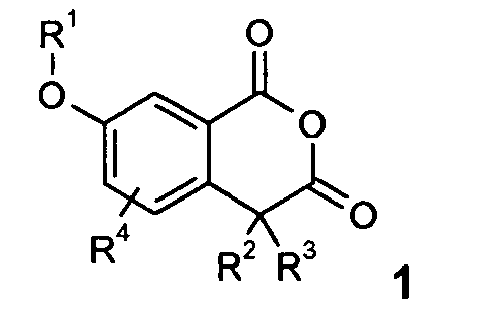
- Isochroman und seine Derivate der allgemeinen Formel 1, worin R1, R2 und R3 jeweils unabhängig voneinander die Bedeutung von C1-6-Alkyl, C2-6-Alkenyl, C2-6-Alkinyl oder Aryl und R4 die Bedeutung von H, OC1-6-Alkyl, OAryl, OH, C1-6-Alkyl, Halogen, CN oder NO2 hat,

DE 2000339 beschrieben. - Die vorliegende Erfindung betrifft ein Verfahren zur Herstellung einer Verbindung der Formel 1,
- a) Ein Acrylsäurederivat der Formel 4 mit einer HBr-Lösung behandelt


- b) die daraus erhaltene Verbindung 3,

- c) die daraus erhaltene Verbindung 2,

- Bevorzugt ist das obige Verfahren worin R1, R2 und R3 jeweils unabhängig voneinander die Bedeutung von C1-6-Alkyl, besonders bevorzugt C1-4-Akyl hat.
- Besonders bevorzugt ist das obige Verfahren worin R1 R2 und R3 jeweils unabhängig voneinander Methyl, Ethyl, iso-Propyl oder tert-Butyl, besonders bevorzugt Methyl bedeuten.
- Bevorzugt ist das obige Verfahren worin R4 die Bedeutung von H, Methyl, Ethyl, iso-Propyl oder tert-Butyl, besonders bevorzugt H hat.
- Bevorzugt ist das obige Verfahren worin in Schritt a)
- die Acrylsäure der Formel 4 mit einer 40-80%-iger HBr-Lösung behandelt wird,
- die Mischung für 20-100 min bei einer Temperatur von 0-50°C gerührt wird;
- die Mischung mit einem Lösungsmittel extrahiert wird;
- das Lösungsmittel weitestgehend oder ganz abgezogen wird;
- das Zwischenprodukt in einer Verbindung der Formel 5 mit oder ohne Zugabe eines weiteren Lösungsmittel gelöst wird;
- die Mischung nach Zugabe von Aluminiumchlorid für 2-6 Stunden bei 0-50°C gerührt wird;
- nach Beenden der Reaktion das Produkt durch Extraktion und Umkristallisieren gereinigt wird.
- Besonders bevorzugt ist das obige Verfahren worin in Schritt a)
- die Acrylsäure der Formel 4 mit einer 60-65%-iger HBr-Lösung behandelt wird,
- die Mischung für 25-70 min bei einer Temperatur von 20-35°C gerührt wird;
- die Mischung mit einem aromatischen Lösungsmittel extrahiert wird;
- das Lösungsmittel weitestgehend oder ganz abgezogen wird;
- das Zwischenprodukt in einer Verbindung der Formel 5 gelöst wird;
- die Mischung nach Zugabe von Aluminiumchlorid für 3-5 Stunden bei 20-30°C gerührt wird;
- die Reaktion durch Zugabe von Wasser beendet wird;
- das Produkt aus der organischen Phase mit der Lösung einer starken Base extrahiert wird,
- das Lösungsmittel der organischen Phase weitestgehend oder ganz abgezogen wird;
- der Rückstand aus einem aliphatischen Kohlenwasserstoff umkristallisiert wird;
- Bevorzugt ist das obige Verfahren worin in Schritt b)
- die erhaltenen Verbindung 3, mit Polyphosphorsäure vermischt wird;
- die Mischung für 10-50 min auf 50-90°C erwärmt wird;
- die Mischung mit einem Lösungsmittel, bevorzugt ein Ether, Ester, Halogenkohlenwasserstoff oder aromatischer Kohlenwasserstoff, extrahiert wird
- die organische Phase gewaschen wird;
- das Lösungsmittel weitestgehend oder ganz abgezogen wird;
- der Rückstand in einem Alkohol gelöst und mit konz. Salzsäure versetzt wird;
- zu der Mischung ein C1-6-Alklynirit, bevorzugt Isoamylnitrit, gegeben wird;
- die Mischung für 30-90 min bei 30-70°C gerührt wird;
- der entstandene Feststoff abfiltriert und gewaschen wird.
- Besonders bevorzugt ist das obige Verfahren worin in Schritt b)
- die erhaltenen Verbindung 3, mit Polyphosphorsäure vermischt wird;
- die Mischung für 20-40 min auf 60-80°C erwärmt wird;
- zu der Mischung Wasser gegeben wird;
- die Mischung mit einem aromatischen Lösungsmittel extrahiert wird
- die organische Phase mit der Lösung einer starken Base bei pH 8.5-9.5 gewaschen wird;
- die organische Phase mit verdünnter Salzsäure gewaschen wird;
- das Lösungsmittel der organischen Phase weitestgehend oder ganz abgezogen wird;
- der Rückstand in einem Alkohol gelöst und mit konz. Salzsäure versetzt wird;
- zu der Mischung Isoamylnitrit gegeben wird;
- die Mischung für 50-70 min bei 40-60°C gerührt wird;
- der entstandene Feststoff filtriert und gewaschen wird.
- Bevorzugt ist das obige Verfahren worin in Schritt c)
- die erhaltene Verbindung 2 in Wasser suspendiert wird;
- die Lösung einer starken Base zugegeben wird;
- die Mischung auf 30-70°C erwärmt wird;
- zu der Mischung Benzolsulfonylchlorid gegeben wird;
- die Mischung für 30-90 min gerührt wird;
- die Mischung mit einem aromatischen Lösungsmittel gewaschen wird;
- die Mischung mit einer Säure angesäuert wird;
- die Mischung mit einem aromatischen Lösungsmittel extrahiert wird;
- das Lösungsmittel der organischen Phase weitestgehend oder ganz abgezogen wird;
- der Rückstand aus einem C1-8-Alkohol umkristallisiert wird.
- Besonders bevorzugt ist das obige Verfahren worin in Schritt c)
- die erhaltenen Verbindung 2 in Wasser suspendiert wird;
- die Lösung einer starken Base zugegeben wird;
- die Mischung auf 40-60°C erwärmt wird;
- zu der Mischung Benzolsulfonylchlorid gegeben wird;
- die Mischung für 50-70 min gerührt wird;
- die Mischung mit einem aromatischen Lösungsmittel gewaschen wird;
- die Mischung angesäuert wird mit konz. Salzsäure;
- die Mischung mit einem aromatischen Lösungsmittel extrahiert wird;
- das Lösungsmittel weitestgehend oder ganz abgezogen wird;
- der Rückstand aus einem C1-8-Alkohol umkristallisiert wird.
- Insbesondere bevorzugt ist das obige Verfahren zur Herstellung von Isochroman der Formel 1A, worin

- a) folgende Schritte durchgeführt werden:
- Vermischen von 3,3-Dimethylacrylsäure unter Rühren mit einem Überschuss 62%iger Bromwasserstoffsäure bei 30-50°C;
- Rühren für 50-70 min bei 15°-40°C;
- Extrahieren mit Toluol;
- Einengen im Vakuum zur Trockene;
- Lösen des Rohprodukts in einem Überschuss Anisol;
- Zugabe der Mischung zu Anisol und dem 1-2-fachen molaren Überschuss von Aluminiumchlorid, bezogen auf die 3,3-Dimethyacrylsäure;
- Rühren für 3-5 h bei Raumtemperatur
- Zugabe der Lösung zu einem Überschuss Eiswasser
- Rühren für 70-90 min;
- Extrahieren der organischen Phase bei 50-60°C mit 62%iger Bromwasserstoffsäure, mit 1-2M Natronlauge, diese Natronlauge-Phase zweimal mit Toluol und anschließend mit Bromwasserstoffsäure ansäuern und weitere zweimal mit Toluol;
- Einengen der organischen Phase zur Trockene;
- Umkristallisieren des Rückstandes aus Methylcyclohexan;
- Trocknen des Rückstandes im Vakuum bei 40-60°C;
- b) Umsetzen der so erhaltenen Verbindung 3A, wobei folgende Schritte durchgeführt werden:

- Zugabe der Verbindung 3 zu einem Überschuss Polyphosphorsäure;
- Erwärmen der Mischung auf 60-80°C erwärmt;
- Rühren der Mischung für 20-40min;
- Abkühlen auf 40-60°C;
- Zugabe eines Überschuss Wasser unter Kühlung;
- Extraktion der Mischung mit Toluol;
- Waschen mit Natronlauge bei pH 8.5-9.5;
- Extrahieren der wässrigen Phase mit Toluol;
- Waschen der vereinigten Toluolphasen mit verdünnter Salzsäure;
- Einengen im Vakuum;
- Lösen des Rückstandes in einem Überschuss einer Mischung bestehend aus 4.5 bis 5.5 Volumenteilen Methanol und einem Volumenteil konz. Salzäure;
- Erwärmen auf 40-60°C;
- Zugabe von einem 2.5 bis 3 fachen molaren Überschuss an Isoamylnitrit, bezogen auf die Verbindung der Formel 3;
- Rühren für 50-70 min bei 40-60°C;
- Abkühlen und Filtrieren des Feststoffs;
- Waschen mit Methanol;
- Trocknen des Rückstandes im Vakuum bei 40-60°C;
- c) Umsetzen der so erhaltenen Verbindung 2A, wobei folgende Schritte durchgeführt werden:

- Suspendieren der Verbindung 2 in Wasser;
- Zugabe von einem 2-20 fachen molaren Überschuss an 45%iger Natronlauge, bezogen auf 2;
- Erwärmen der Lösung auf 40-60°C;
- Zugabe von einem 1 bis 2 fachen molaren Überschuss an Benzolsulfonylchlorid, bezogen auf 2, gegebenenfalls in Toluol gelöst;
- Rühren der Mischung für 50-70 min;
- Waschen der wässrige Phase mit Toluol;
- Ansäuern mit konz. Salzsäure;
- Waschen der wässrige Phase mit Toluol;
- Einengen der organischen Phase zur Trockene;
- Umkristallisieren des Rückstandes aus Isopropanol;
- Unter dem Begriff "C1-6-Alkyl" (auch soweit sie Bestandteil anderer Reste sind) werden verzweigte und unverzweigte Alkylgruppen mit 1 bis 6 Kohlenstoffatomen verstanden, dem entsprechend werden unter dem Begriff "C1-4Alkyl" verzweigte und unverzweigte Alkylgruppen mit 1 bis 4 Kohlenstoffatomen verstanden. Bevorzugt sind Alkylgruppen mit 1 bis 4 Kohlenstoffatome. Beispielsweise werden hierfür genannt: Methyl, Ethyl, n-Propyl, iso-Propyl, n-Butyl, iso-Butyl, sec-Butyl, tert-Butyl, n-Pentyl, iso-Pentyl, neo-Pentyl oder Hexyl. Gegebenenfalls werden für vorstehend genannten Gruppen auch die Abkürzungen Me, Et, n-Pr, i-Pr, n-Bu, i-Bu, t-Bu, etc. verwendet. Sofern nicht anders beschrieben, umfassen die Definitionen Propyl, Butyl, Pentyl und Hexyl alle denkbaren isomeren Formen der jeweiligen Reste. So umfasst beispielsweise Propyl n-Propyl und iso-Propyl, Butyl umfasst iso-Butyl, sec-Butyl und tert-Butyl etc.
- Unter dem Begriff "C2-6-Alkenyl" (auch soweit sie Bestandteil anderer Reste sind) werden verzweigte und unverzweigte Alkenylgruppen mit 2 bis 6 Kohlenstoffatomen und unter dem Begriff "C2-4-Alkenyl" verzweigte und unverzweigte Alkenylgruppen mit 2 bis 4 Kohlenstoffatomen verstanden, soweit sie mindestens eine Doppelbindung aufweisen. Bevorzugt sind Alkenylgruppen mit 2 bis 4 Kohlenstoffatome. Beispielsweise werden hierfür genannt: Ethenyl oder Vinyl, Propenyl, Butenyl, Pentenyl, oder Hexenyl. Sofern nicht anders beschrieben, umfassen die Definitionen Propenyl, Butenyl, Pentenyl und Hexenyl alle denkbaren isomeren Formen der jeweiligen Reste. So umfasst beispielsweise Propenyl 1-Propenyl und 2-Propenyl, Butenyl umfasst 1-, 2- und 3-Butenyl, 1-Methyl-1-propenyl, 1-Methyl-2-propenyl etc.
- Unter dem Begriff "C2-6-Alkinyl" (auch soweit sie Bestandteil anderer Reste sind) werden verzweigte und unverzweigte Alkinylgruppen mit 2 bis 6 Kohlenstoffatomen und unter dem Begriff "C2-4-Alkinyl" verzweigte und unverzweigte Alkinylgruppen mit 2 bis 4 Kohlenstoffatomen verstanden, soweit sie mindestens eine Dreifachbindung aufweisen. Bevorzugt sind Alkinylgruppen mit 2 bis 4 Kohlenstoffatome. Beispielsweise werden hierfür genannt: Ethinyl, Propinyl, Butinyl, Pentinyl, oder Hexinyl. Sofern nicht anders beschrieben, umfassen die Definitionen Propinyl, Butinyl, Pentinyl und Hexinyl alle denkbaren isomeren Formen der jeweiligen Reste. So umfasst beispielsweise Propinyl 1-Propinyl und 2-Propinyl, Butinyl umfasst 1-, 2- und 3-Butinyl, 1-Methyl-1-propinyl, 1-Methyl-2-propinyl etc.
- Unter dem Begriff "Aryl" (auch soweit sie Bestandteil anderer Reste sind) werden aromatische Ringsysteme mit 6 oder 10 Kohlenstoffatomen verstanden. Beispielsweise werden hierfür genannt: Phenyl oder Naphthyl, bevorzugter Arylrest ist Phenyl. Soweit nicht anders beschreiben, können die Aromaten substituiert sein mit einem oder mehreren Resten ausgewählt aus der Gruppe bestehend aus Methyl, Ethyl, iso-Propyl, tert-Butyl, Hydroxy, Fluor, Chlor, Brom und Jod.
- Halogen steht im Rahmen der vorliegenden Erfindung für Fluor, Chlor, Brom oder Jod. Sofern nicht gegenteilig angegeben, gelten Fluor, Chlor und Brom als bevorzugte Halogene.
- Unter einer "Säure" wird im Rahmen der Erfindung ein Protonendonor verstanden. Dabei kann die Säure in einer wässriger Lösung von unterschiedlichen Konzentrationen vorliegen oder in Reinform (gasförmig, flüssig oder fest) in eine Reaktionslösung eingeleitet werden. Bevorzugt hierbei sind anorganische Säuren, besonders bevorzugt Mineralsäuren. Beispielsweise werden hierfür in konzentrierter oder verdünnter wässriger Lösung genannt: HCl, HNO3, H2SO4, H2CO3 oder H3PO4.
- Unter einer "Lewis-Säure" wird im Rahmen der Erfindung ein Elektronenpaarakzeptor, bevorzugt eine neutrale Verbindung mit einer Elektronenlücke verstanden. Beispielsweise werden hierfür genannt: B(CH3)3, BF3, SO3, AlCl3, SiCl4 oder PF5
- Unter einem "Lösungsmittel" wird im Rahmen der Erfindung ein organsicher, niedermolekularer Stoff verstanden, der andere organische Stoffe auf physikalischem Wege zur Lösung bringen kann. Voraussetzung für die Eignung als Lösungsmittel ist, dass sich beim Lösungsvorgang weder der lösende noch der gelöste Stoff chemisch verändern, dass also die Komponenten der Lösung durch physikalische Trennverfahren wie Destillation, Kristallisation, Sublimation, Verdunstung, Adsorption in der Originalgestalt wiedergewonnen werden können. Aus verschiedenen Gründen können nicht nur die reinen Lösungsmittel, sondern Gemische, die die Lösungseigenschaften vereinigen verwendet werden. Beispielsweise seinen genannt:
- Alkohole, bevorzugt Methanol, Ethanol, Propanole, Butanole, Octanole, Cyclohexanol;
- Glykole, bevorzugt Ethylenglykol, Diethylenglykol;
- Ether / Glykolether, bevorzugt Diethylether, Dibutylether, Anisol, Dioxan, Tetrahydrofuran, Mono-, Di-, Tri-, Polyethylenglykolether;
- Ketone, bevorzugt Aceton, Butanon, Cyclohexanon;
- Ester, bevorzugt Essigsäureester, Glykolester;
- Amide u.a. Stickstoff-Verbindungen, bevorzugt Dimethylformamid, Pyridin, N-Methylpyrrolidon, Acetonitril;
- Schwefel-Verbindungen, bevorzugt Schwefelkohlenstoff, Dimethylsulfoxid, Sulfolan;
- Nitro-Verbindungen bevorzugt Nitrobenzol;
- Halogenkohlenwasserstoffe, bevorzugt Dichlormethan, Chloroform, Tetrachlormethan, Tri-, Tetrachlorethen, 1,2-Dichlorethan, Chlorfluorkohlenstoffe;
- aliphatische oder alicyclische Kohlenwasserstoffe, bevorzugt Benzine, Petrolether, Cyclohexan, Methylcyclohexan, Decalin, Terpen-L.; oder
- aromatische Kohlenwasserstoffe, bevorzugt Benzol, Toluol, Xylole; oder entsprechende Gemische davon. Bevorzugt im Rahmen dieser Erfindung sind:
- Alkohole, bevorzugt Methanol, Ethanol, Propanole, Butanole;
- Ether, bevorzugt Diethylether, Dibutylether, Tetrahydrofuran;
- Ketone, bevorzugt Aceton, Butanon, Cyclohexanon;
- Ester, bevorzugt Essigsäureester;
- Halogenkohlenwasserstoffe, bevorzugt Dichlormethan, Chloroform, Tri-, Tetrachlorethen, 1,2-Dichlorethan;
- aromatische Kohlenwasserstoffe, bevorzugt Benzol, Toluol, Xylole; oder entsprechende Gemische davon. Besonders bevorzugt im Rahmen dieser Erfindung sind Methanol, Ethanol, Propanole, Butanole, Diethylether, Dibutylether, Tetrahydrofuran, Aceton, Cyclohexanon, Essigsäureester, Dichlormethan, Chloroform, 1,2-Dichlorethan, Toluol, Xylole oder entsprechende Gemische davon.
- Unter dem Begriff "C1-8-Alkohol" werden verzweigte und unverzweigte Alkohole mit 1 bis 8 Kohlenstoffatomen verstanden und einer oder zwei Hydroxygruppen. Dem entsprechend werden unter dem Begriff "C1-4-Alkohol" verzweigte und unverzweigte Alkylgruppen mit 1 bis 4 Kohlenstoffatomen und einer oder zwei Hydroxygruppen verstanden. Bevorzugt sind Alkohole mit 1 bis 4 Kohlenstoffatome. Beispielsweise werden hierfür genannt: Methanol, Ethanol, n-Propanol, iso-Propanol, n-Butanol, iso-Butanol, sec-Butanol, tert-Butanol, n-Pentanol, iso-Pentanol, neo-Pentanol oder Hexanol. Gegebenenfalls werden für vorstehend genannten Moleküle auch die Abkürzungen MeOH, EtOH, n-PrOH, i-PrOH, n-BuOH, i-BuOH, t-BuOH, etc. verwendet. Sofern nicht anders beschrieben, umfassen die Definitionen Propanol, Butanol, Pentanol und Hexanol alle denkbaren isomeren Formen der jeweiligen Reste. So umfasst beispielsweise Propanol n-Propanol und iso-Propanol, Butanol umfasst iso-Butanol, sec-Butanol und tert-Butanol etc.
- Die Lösung einer starken Base wird vorzugsweise aus Wasser und 25-75 Gewichts% einer Base gebildet. Als Base können organische Basen oder anorganische Basen, z.B. als wässrige Lösungen verwendet werden. Als anorganische Basen eignen sich basisch reagierende Alkalisalze oder Alkalihydroxide. Bevorzugt werden Alkalihydroxiden eingesetzt. Ganz besonders bevorzugt werden Na2CO3, K2CO3, LiOH, NaOH, KOH oder NaHCO3 verwendet. Als organische Basen eignen sich tertiäre Amine, insbesondere tertiäre Alkylamine, tertiäre Alkyl-Arylamine oder Pyridine. Bevorzugt werden Trialkylamine mit verzweigten oder unverzweigten C1-6-Alkylresten eingesetzt. Als ganz besonders bevorzugt haben sich beispielsweise Triethylamin oder Düsopropylethylamin bewährt. Gegebenenfalls kann die Reaktion auch in Gegenwart von basischen Polymeren mit z.B. tertiären Aminofunktionen durchgeführt werden.
- Das erfindungsgemäße Verfahren soll nun durch die nachfolgenden Beispiele erläutert werden. Dem Fachmann ist bewusst, dass die Beispiele nur zur Veranschaulichung dienen und als nicht limitierend anzusehen sind.
-

- In 11 62%ige Bromwasserstoffsäure werden bei 20°C unter Rühren 250g 3,3-Dimethylacrylsäure eingetragen. Es wird 60 min bei 20°-35°C gerührt, anschließend wird die Mischung bei 35°C mit 900 ml Toluol in mehreren Portionen extrahiert. Die vereinigten organischen Extrakte werden im Vakuum zur Trockene eingeengt. Man erhält 417g (92%) Rohprodukt. 408g des Rohprodukts werden in 660ml Anisol gelöst und im Vakuum werden 70ml Lösungsmittel abdestilliert. Die 35°C warme Lösung wird in eine auf 20°C temperierte Mischung aus 1l Anisol und 442,4g Aluminiumchlorid gegeben. Es wird 4h bei Raumtemperatur nachgerührt, anschließend wird die Lösung in 1,51 Eiswasser gegossen und 80min nachgerührt. Die Phasen werden getrennt und die organische Phase wird mit 250ml 62%iger Bromwasserstoffsäure extrahiert. Danach wird die organische Phase mit 1,51 Natronlauge bei pH 10 - 11 extrahiert. Nach der Phasentrennung wird die wässrige Phase noch 2 mal mit je 350ml Toluol gewaschen. Die wässrige Phase wird bei 50 - 60°C mit Bromwasserstoffsäure auf pH 1 - 2 gestellt und mit 1,251 Toluol in 2 Portionen extrahiert. Diese Toluolphasen werden im Vakuum zur Trockene eingeengt und der Rückstand mit 510ml Methylcyclohexan bei 5°C kristallisiert. Der erhaltene Feststoff wird abgetrennt, mit 100ml Methylcyclohexan gewaschen und im Vakuum bei 50°C getrocknet. Ausbeute 149,8g (32%) der Verbindung 3A.
-

- In 1,11 kg Polyphosphorsäure werden 222g der Verbindung 3A eingetragen. Die Mischung wird auf 70°C erwärmt und 30min bei dieser Temperatur gerührt. Nach dem Abkühlen auf 50°C werden 1,1l Wasser unter Kühlung zugegeben. Die so entstehende Lösung wird mit 430ml Toluol extrahiert. Anschließend wird die Toluolphase mit 220ml Natronlauge bei pH 9 gewaschen und die wässrige Phase mit 80ml Toluol extrahiert. Die vereinigten Toluolphasen werden mit 120ml verdünnter Salzsäure bei etwa pH 3 gewaschen und danach im Vakuum eingeengt. Der verbliebene Rückstand wird in 650ml Methanol gelöst und mit 125ml konz. Salzsäure versetzt. Die Mischung wird auf 50°C erwärmt, portionsweise werden 326g Isoamylnitrit zugegeben und es wird 1h bei 50°C nachgerührt. Nach Abkühlen auf 20°C wird der erhaltene Feststoff abfiltriert, mit 240ml Methanol gewaschen und im Vakuum bei 50°C getrocknet. Ausbeute 142g (61 %) der Verbindung 2A.
-

- In 370ml Wasser werden 82g von 2A eingetragen. Es werden 75ml 45%iger Natronlauge zugegeben und die Lösung wird auf 50°C erwärmt. Anschließend wird eine Lösung von 72,7g Benzolsulfonylchlorid in 290ml Toluol unter Rühren zugetropft und es wird 1h bei 50°C nachgerührt. Dann werden die Phasen getrennt und die wässrige Phase wird 2 mal mit je 140ml Toluol gewaschen. Anschließend wird mit 90ml konz. Salzsäure angesäuert und 10min nachgerührt. Danach wird die wässrige Phase mit 300ml und mit 150ml Toluol extrahiert. Die Toluolphasen werden vereinigt und im Vakuum zur Trockene eingeengt. Der Rückstand wird in 360ml Isopropanol in der Siedehitze aufgenommen und nach Abkühlen auf 20°C kristallisiert. Der erhaltene Feststoff wird abgetrennt und im Vakuum bei 50°C getrocknet. Ausbeute 68g (83%) der Verbindung 1A.
Claims (10)
- Verfahren zur Herstellung einer Verbindung der Formel 1,
 a) eine Acrylsäure der Formel 4 mit einer HBr-Lösung behandelt
 b) die daraus erhaltene Verbindung 3,
 c) die daraus erhaltene Verbindung 2,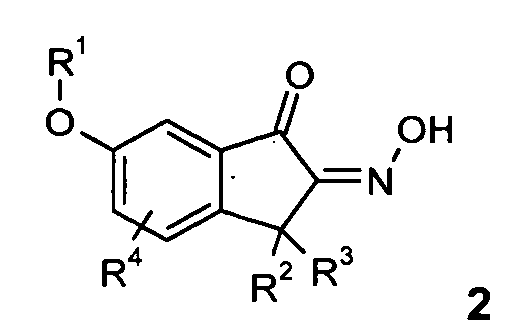
- Verfahren nach Anspruch 1 worin R1, R2 und R3 jeweils unabhängig voneinander die Bedeutung von C1-6-Alkyl hat.
- Verfahren nach Anspruch 1 oder 2, worin R1, R2 und R3 jeweils unabhängig voneinander Methyl, Ethyl, iso-Propyl oder tert-Butyl Methyl bedeuten.
- Verfahren nach einem der Ansprüche 1 bis 3, worin R4 die Bedeutung von H, Methyl, Ethyl, iso-Propyl oder tert-Butyl.
- Verfahren nach einem der Ansprüche 1 bis 4, worin in Schritt a)• die Acrylsäure der Formel 4 mit einer 40-80%-iger HBr-Lösung behandelt wird,• die Mischung für 20-100 min bei einer Temperatur von 0-50°C gerührt wird;• die Mischung mit einem Lösungsmittel extrahiert wird;• das Lösungsmittel weitestgehend oder ganz abgezogen wird;• das Zwischenprodukt in einer Verbindung der Formel 5 mit oder ohne Zugabe eines weiteren Lösungsmittels gelöst wird;• die Mischung nach Zugabe von Aluminiumchlorid für 2-6 Stunden bei 0-50°C gerührt wird;• nach Beenden der Reaktion das Produkt durch Extraktion und Umkristallisieren gereinigt wird.
- Verfahren nach einem der Ansprüche 1 bis 5, worin in Schritt a)• die Acrylsäure der Formel 4 mit einer 60-65%-iger HBr-Lösung behandelt wird,• die Mischung für 25-70 min bei einer Temperatur von 20-35°C gerührt wird;• die Mischung mit einem aromatischen Lösungsmittel extrahiert wird;• das Lösungsmittel weitestgehend oder ganz abgezogen wird;• das Zwischenprodukt in einer Verbindung der Formel 5 gelöst wird;• die Mischung nach Zugabe von Aluminiumchlorid für 3-5 Stunden bei 20-30°C gerührt wird;• die Reaktion durch Zugabe von Wasser beendet wird;• das Produkt aus der organischen Phase mit der Lösung einer starken Base extrahiert wird,• die wässrige Phase angesäuert und das Produkt mit einem Lösungsmittel extrahiert wird.• das Lösungsmittel der organischen Phase weitestgehend oder ganz abgezogen wird;• der Rückstand aus einem aliphatischen Kohlenwasserstoff umkristallisiert wird;
- Verfahren nach einem der Ansprüche 1 bis 6, worin in Schritt b)• die erhaltenen Verbindung 3, mit Polyphosphorsäure vermischt wird;• die Mischung für 10-50 min auf 50-90°C erwärmt wird;• die Mischung mit einem Lösungsmittel extrahiert wird;• die organische Phase gewaschen wird;• das Lösungsmittel weitestgehend oder ganz abgezogen wird;• der Rückstand in einem Alkohol gelöst und mit konz. Salzsäure versetzt wird;• zu der Mischung ein C1-6-Alklynirit gegeben wird;• die Mischung für 30-90 min bei 30-70°C gerührt wird;• der entstandene Feststoff filtriert und gewaschen wird.
- Verfahren nach einem der Ansprüche 1 bis 7, worin in Schritt b)• die erhaltenen Verbindung 3, mit Polyphosphorsäure vermischt wird;• die Mischung für 20-40 min auf 60-80°C erwärmt wird;• zu der Mischung Wasser gegeben wird;• die Mischung mit einem Lösungsmittel extrahiert wird• die organische Phase mit der Lösung einer starken Base bei pH 8.5-9.5 gewaschen wird;• die organische Phase mit verdünnter Salzsäure gewaschen wird;• das Lösungsmittel der organischen Phase weitestgehend oder ganz abgezogen wird;• der Rückstand in einem Alkohol gelöst und mit konz. Salzsäure versetzt wird;• zu der Mischung Isoamylnitrit gegeben wird;• die Mischung für 50-70 min bei 40-60°C gerührt wird;• der entstandene Feststoff filtriert und gewaschen wird.
- Verfahren nach einem der Ansprüche 1 bis 8, worin in Schritt c)• die erhaltenen Verbindung 2 in Wasser suspendiert wird;• die Lösung einer starken Base zugegeben wird;• die Mischung auf 30-70°C erwärmt wird;• zu der Mischung Benzolsulfonylchlorid gegeben wird;• die Mischung für 30-90 min gerührt wird;• die Mischung mit einem aromatischen Lösungsmittel gewaschen wird;• die Mischung mit einer Säure angesäuert wird;• die Mischung mit einem aromatischen Lösungsmittel extrahiert wird;• das Lösungsmittel der organischen Phase weitestgehend oder ganz abgezogen wird;• der Rückstand aus einem C1-8-Alkohol umkristallisiert wird.
- Verfahren nach einem der Ansprüche 1 bis 9, worin in Schritt c)• die erhaltenen Verbindung 2 in Wasser suspendiert wird;• die Lösung einer starken Base zugegeben wird;• die Mischung auf 40-60°C erwärmt wird;• zu der Mischung Benzolsulfonylchlorid gegeben wird;• die Mischung für 50-70 min gerührt wird;• die Mischung mit einem aromatischen Lösungsmittel gewaschen wird;• die Mischung angesäuert wird mit konz. Salzsäure;• die Mischung mit einem aromatischen Lösungsmittel extrahiert wird;• das Lösungsmittel der organischen Phase weitestgehend oder ganz abgezogen wird;• der Rückstand aus einem C1-8-Alkohol umkristallisiert wird.
Applications Claiming Priority (3)
| Application Number | Priority Date | Filing Date | Title |
|---|---|---|---|
| DE200510004021 DE102005004021A1 (de) | 2005-01-28 | 2005-01-28 | Verfahren zur Herstellung von Isochroman und Derivaten davon |
| DE200510005620 DE102005005620A1 (de) | 2005-02-08 | 2005-02-08 | Verfahren zur Herstellung von Isochroman und Derivaten davon |
| PCT/EP2006/050401 WO2006079622A2 (de) | 2005-01-28 | 2006-01-24 | Verfahren zur herstellung von isochroman und derivaten davon |
Publications (2)
| Publication Number | Publication Date |
|---|---|
| EP1844033A2 EP1844033A2 (de) | 2007-10-17 |
| EP1844033B1 true EP1844033B1 (de) | 2011-07-27 |
Family
ID=36716573
Family Applications (1)
| Application Number | Title | Priority Date | Filing Date |
|---|---|---|---|
| EP06707815A Expired - Lifetime EP1844033B1 (de) | 2005-01-28 | 2006-01-24 | Verfahren zur herstellung von isochroman und derivaten davon |
Country Status (6)
| Country | Link |
|---|---|
| US (1) | US7534812B2 (de) |
| EP (1) | EP1844033B1 (de) |
| JP (1) | JP4934055B2 (de) |
| AT (1) | ATE517880T1 (de) |
| CA (1) | CA2595339C (de) |
| WO (1) | WO2006079622A2 (de) |
Families Citing this family (1)
| Publication number | Priority date | Publication date | Assignee | Title |
|---|---|---|---|---|
| CN108084140A (zh) * | 2017-11-22 | 2018-05-29 | 河南科技大学 | 一种异色满-4-酮的制备方法 |
Family Cites Families (7)
| Publication number | Priority date | Publication date | Assignee | Title |
|---|---|---|---|---|
| DE2000339C3 (de) * | 1970-01-05 | 1979-04-19 | Dr. Karl Thomae Gmbh, 7950 Biberach | Isochinolinderivate |
| AT330777B (de) * | 1973-09-08 | 1976-07-26 | Thomae Gmbh Dr K | Verfahren zur herstellung von neuen isochinolinderivaten und deren salzen |
| US4021558A (en) * | 1973-09-08 | 1977-05-03 | Boehringer Ingelheim Gmbh | 1,3-Dioxo-2-[(methoxyphenethyl-amino)-alkyl]-4,4-dimethyl-isoquinolines and salts thereof useful as hypotensive agents |
| AT352135B (de) * | 1975-07-30 | 1979-09-10 | Thomae Gmbh Dr K | Verfahren zur herstellung neuer homophthalimide und ihrer salze |
| AU587989B2 (en) * | 1984-10-16 | 1989-09-07 | Mitsubishi Chemical Corporation | DMA fragments, expression vectors, proteins, hosts, and process for production of the proteins |
| ES2276481T3 (es) | 1997-12-12 | 2007-06-16 | The University Of Western Ontario | Peptido apoep1.b novedoso, composiciones y sus usos. |
| HRP20040952A2 (en) * | 2002-04-26 | 2005-06-30 | F. Hoffmann - La Roche Ag | Isoquinoline derivatives |
-
2006
- 2006-01-24 EP EP06707815A patent/EP1844033B1/de not_active Expired - Lifetime
- 2006-01-24 JP JP2007552629A patent/JP4934055B2/ja not_active Expired - Fee Related
- 2006-01-24 WO PCT/EP2006/050401 patent/WO2006079622A2/de not_active Ceased
- 2006-01-24 CA CA2595339A patent/CA2595339C/en not_active Expired - Fee Related
- 2006-01-24 AT AT06707815T patent/ATE517880T1/de active
- 2006-01-26 US US11/275,731 patent/US7534812B2/en not_active Expired - Fee Related
Also Published As
| Publication number | Publication date |
|---|---|
| ATE517880T1 (de) | 2011-08-15 |
| JP2008528545A (ja) | 2008-07-31 |
| WO2006079622A3 (de) | 2006-12-07 |
| EP1844033A2 (de) | 2007-10-17 |
| US20060173196A1 (en) | 2006-08-03 |
| WO2006079622A2 (de) | 2006-08-03 |
| CA2595339C (en) | 2014-08-19 |
| CA2595339A1 (en) | 2006-08-03 |
| US7534812B2 (en) | 2009-05-19 |
| JP4934055B2 (ja) | 2012-05-16 |
Similar Documents
| Publication | Publication Date | Title |
|---|---|---|
| HUE029528T2 (en) | Process for the preparation of 6- (7 - ((1-aminocyclopropyl) methoxy) -6-methoxyquinolin-4-yloxy) -N-methyl-1-naphthamide and its synthetic intermediates | |
| CN111100110A (zh) | 7-哌嗪基苯并噻吩或其盐的制备方法 | |
| NO800868L (no) | Fremgangsmaate til fremstilling av 2,6-diaminonbularin-forbindelser | |
| EP3247693B1 (de) | Verfahren zur herstellung von indanaminderivaten und neue synthesezwischenprodukte | |
| SG172267A1 (en) | Process for the preparation of anagrelide and analogues | |
| CN110818680A (zh) | 一种环己烷衍生物的制备方法 | |
| WO2006079622A2 (de) | Verfahren zur herstellung von isochroman und derivaten davon | |
| DE60022684T2 (de) | Verfahren zur Herstellung von 6-Methyl-2-(4-methyl-phenyl)-imidazo [1,2-A]pyridin-3-(N,N-dimethyl-acetamid) und Zwischenprodukte | |
| DE102005004021A1 (de) | Verfahren zur Herstellung von Isochroman und Derivaten davon | |
| CN110343117B (zh) | 青蒿素衍生物的制备方法 | |
| CN110818678B (zh) | 一种制备环己烷衍生物的方法 | |
| DE102005005620A1 (de) | Verfahren zur Herstellung von Isochroman und Derivaten davon | |
| WO2020034946A1 (zh) | 一种制备环己烷衍生物的方法 | |
| CN111100111B (zh) | 一种制备苯并噻吩衍生物的方法 | |
| BR112019027697A2 (pt) | método para preparar derivados de 4-aminoindano substituídos | |
| CN107935866A (zh) | 盐酸达泊西汀杂质的制备方法 | |
| EP4357333A1 (de) | Hybutiminib-zwischenprodukt und herstellungsverfahren dafür | |
| CN110240605B (zh) | 青蒿素二聚物的制备方法 | |
| CN114057631B (zh) | 一种3-氯-2-肼基吡啶的合成方法 | |
| EP1442010B1 (de) | Verfahren zur herstellung von biphenyl-4-carbonitril | |
| CN115572262B (zh) | 一种异喹啉衍生物及其制备方法 | |
| DE60308170T2 (de) | Verfahren zur herstellung von chinolinderivaten | |
| CN110818677A (zh) | 环己烷衍生物的制备方法 | |
| DE3880072T2 (de) | N-phenyl-2,2,6,6-tetrahalogencyclohexanimin und verfahren zur herstellung von derivaten des 2,2,6,6-tetrahalogencyclohexanimins und von derivaten des 2,6-dihalogenanilins. | |
| CN110218177B (zh) | 一种2,6-二氯-3-硝基吡啶的制备方法 |
Legal Events
| Date | Code | Title | Description |
|---|---|---|---|
| PUAI | Public reference made under article 153(3) epc to a published international application that has entered the european phase |
Free format text: ORIGINAL CODE: 0009012 |
|
| 17P | Request for examination filed |
Effective date: 20070828 |
|
| AK | Designated contracting states |
Kind code of ref document: A2 Designated state(s): AT BE BG CH CY CZ DE DK EE ES FI FR GB GR HU IE IS IT LI LT LU LV MC NL PL PT RO SE SI SK TR |
|
| DAX | Request for extension of the european patent (deleted) | ||
| 17Q | First examination report despatched |
Effective date: 20090130 |
|
| GRAP | Despatch of communication of intention to grant a patent |
Free format text: ORIGINAL CODE: EPIDOSNIGR1 |
|
| GRAS | Grant fee paid |
Free format text: ORIGINAL CODE: EPIDOSNIGR3 |
|
| GRAA | (expected) grant |
Free format text: ORIGINAL CODE: 0009210 |
|
| AK | Designated contracting states |
Kind code of ref document: B1 Designated state(s): AT BE BG CH CY CZ DE DK EE ES FI FR GB GR HU IE IS IT LI LT LU LV MC NL PL PT RO SE SI SK TR |
|
| REG | Reference to a national code |
Ref country code: GB Ref legal event code: FG4D Free format text: NOT ENGLISH |
|
| REG | Reference to a national code |
Ref country code: CH Ref legal event code: EP |
|
| REG | Reference to a national code |
Ref country code: DE Ref legal event code: R096 Ref document number: 502006009900 Country of ref document: DE Effective date: 20110915 |
|
| REG | Reference to a national code |
Ref country code: NL Ref legal event code: VDEP Effective date: 20110727 |
|
| PG25 | Lapsed in a contracting state [announced via postgrant information from national office to epo] |
Ref country code: SE Free format text: LAPSE BECAUSE OF FAILURE TO SUBMIT A TRANSLATION OF THE DESCRIPTION OR TO PAY THE FEE WITHIN THE PRESCRIBED TIME-LIMIT Effective date: 20110727 Ref country code: IS Free format text: LAPSE BECAUSE OF FAILURE TO SUBMIT A TRANSLATION OF THE DESCRIPTION OR TO PAY THE FEE WITHIN THE PRESCRIBED TIME-LIMIT Effective date: 20111127 Ref country code: FI Free format text: LAPSE BECAUSE OF FAILURE TO SUBMIT A TRANSLATION OF THE DESCRIPTION OR TO PAY THE FEE WITHIN THE PRESCRIBED TIME-LIMIT Effective date: 20110727 Ref country code: PT Free format text: LAPSE BECAUSE OF FAILURE TO SUBMIT A TRANSLATION OF THE DESCRIPTION OR TO PAY THE FEE WITHIN THE PRESCRIBED TIME-LIMIT Effective date: 20111128 Ref country code: NL Free format text: LAPSE BECAUSE OF FAILURE TO SUBMIT A TRANSLATION OF THE DESCRIPTION OR TO PAY THE FEE WITHIN THE PRESCRIBED TIME-LIMIT Effective date: 20110727 Ref country code: LT Free format text: LAPSE BECAUSE OF FAILURE TO SUBMIT A TRANSLATION OF THE DESCRIPTION OR TO PAY THE FEE WITHIN THE PRESCRIBED TIME-LIMIT Effective date: 20110727 |
|
| PG25 | Lapsed in a contracting state [announced via postgrant information from national office to epo] |
Ref country code: PL Free format text: LAPSE BECAUSE OF FAILURE TO SUBMIT A TRANSLATION OF THE DESCRIPTION OR TO PAY THE FEE WITHIN THE PRESCRIBED TIME-LIMIT Effective date: 20110727 Ref country code: SI Free format text: LAPSE BECAUSE OF FAILURE TO SUBMIT A TRANSLATION OF THE DESCRIPTION OR TO PAY THE FEE WITHIN THE PRESCRIBED TIME-LIMIT Effective date: 20110727 Ref country code: GR Free format text: LAPSE BECAUSE OF FAILURE TO SUBMIT A TRANSLATION OF THE DESCRIPTION OR TO PAY THE FEE WITHIN THE PRESCRIBED TIME-LIMIT Effective date: 20111028 Ref country code: LV Free format text: LAPSE BECAUSE OF FAILURE TO SUBMIT A TRANSLATION OF THE DESCRIPTION OR TO PAY THE FEE WITHIN THE PRESCRIBED TIME-LIMIT Effective date: 20110727 Ref country code: CY Free format text: LAPSE BECAUSE OF FAILURE TO SUBMIT A TRANSLATION OF THE DESCRIPTION OR TO PAY THE FEE WITHIN THE PRESCRIBED TIME-LIMIT Effective date: 20110727 |
|
| REG | Reference to a national code |
Ref country code: IE Ref legal event code: FD4D |
|
| PG25 | Lapsed in a contracting state [announced via postgrant information from national office to epo] |
Ref country code: IE Free format text: LAPSE BECAUSE OF FAILURE TO SUBMIT A TRANSLATION OF THE DESCRIPTION OR TO PAY THE FEE WITHIN THE PRESCRIBED TIME-LIMIT Effective date: 20110727 Ref country code: SK Free format text: LAPSE BECAUSE OF FAILURE TO SUBMIT A TRANSLATION OF THE DESCRIPTION OR TO PAY THE FEE WITHIN THE PRESCRIBED TIME-LIMIT Effective date: 20110727 Ref country code: CZ Free format text: LAPSE BECAUSE OF FAILURE TO SUBMIT A TRANSLATION OF THE DESCRIPTION OR TO PAY THE FEE WITHIN THE PRESCRIBED TIME-LIMIT Effective date: 20110727 |
|
| PG25 | Lapsed in a contracting state [announced via postgrant information from national office to epo] |
Ref country code: EE Free format text: LAPSE BECAUSE OF FAILURE TO SUBMIT A TRANSLATION OF THE DESCRIPTION OR TO PAY THE FEE WITHIN THE PRESCRIBED TIME-LIMIT Effective date: 20110727 Ref country code: RO Free format text: LAPSE BECAUSE OF FAILURE TO SUBMIT A TRANSLATION OF THE DESCRIPTION OR TO PAY THE FEE WITHIN THE PRESCRIBED TIME-LIMIT Effective date: 20110727 |
|
| PLBE | No opposition filed within time limit |
Free format text: ORIGINAL CODE: 0009261 |
|
| STAA | Information on the status of an ep patent application or granted ep patent |
Free format text: STATUS: NO OPPOSITION FILED WITHIN TIME LIMIT |
|
| PG25 | Lapsed in a contracting state [announced via postgrant information from national office to epo] |
Ref country code: DK Free format text: LAPSE BECAUSE OF FAILURE TO SUBMIT A TRANSLATION OF THE DESCRIPTION OR TO PAY THE FEE WITHIN THE PRESCRIBED TIME-LIMIT Effective date: 20110727 |
|
| 26N | No opposition filed |
Effective date: 20120502 |
|
| BERE | Be: lapsed |
Owner name: BOEHRINGER INGELHEIM PHARMA G.M.B.H. & CO. KG Effective date: 20120131 |
|
| REG | Reference to a national code |
Ref country code: DE Ref legal event code: R097 Ref document number: 502006009900 Country of ref document: DE Effective date: 20120502 |
|
| PG25 | Lapsed in a contracting state [announced via postgrant information from national office to epo] |
Ref country code: MC Free format text: LAPSE BECAUSE OF NON-PAYMENT OF DUE FEES Effective date: 20120131 |
|
| REG | Reference to a national code |
Ref country code: CH Ref legal event code: PL |
|
| PG25 | Lapsed in a contracting state [announced via postgrant information from national office to epo] |
Ref country code: LI Free format text: LAPSE BECAUSE OF NON-PAYMENT OF DUE FEES Effective date: 20120131 Ref country code: CH Free format text: LAPSE BECAUSE OF NON-PAYMENT OF DUE FEES Effective date: 20120131 |
|
| PG25 | Lapsed in a contracting state [announced via postgrant information from national office to epo] |
Ref country code: BE Free format text: LAPSE BECAUSE OF NON-PAYMENT OF DUE FEES Effective date: 20120131 |
|
| REG | Reference to a national code |
Ref country code: AT Ref legal event code: MM01 Ref document number: 517880 Country of ref document: AT Kind code of ref document: T Effective date: 20120124 |
|
| PG25 | Lapsed in a contracting state [announced via postgrant information from national office to epo] |
Ref country code: ES Free format text: LAPSE BECAUSE OF FAILURE TO SUBMIT A TRANSLATION OF THE DESCRIPTION OR TO PAY THE FEE WITHIN THE PRESCRIBED TIME-LIMIT Effective date: 20111107 |
|
| PG25 | Lapsed in a contracting state [announced via postgrant information from national office to epo] |
Ref country code: AT Free format text: LAPSE BECAUSE OF NON-PAYMENT OF DUE FEES Effective date: 20120124 Ref country code: BG Free format text: LAPSE BECAUSE OF FAILURE TO SUBMIT A TRANSLATION OF THE DESCRIPTION OR TO PAY THE FEE WITHIN THE PRESCRIBED TIME-LIMIT Effective date: 20111027 |
|
| PG25 | Lapsed in a contracting state [announced via postgrant information from national office to epo] |
Ref country code: TR Free format text: LAPSE BECAUSE OF FAILURE TO SUBMIT A TRANSLATION OF THE DESCRIPTION OR TO PAY THE FEE WITHIN THE PRESCRIBED TIME-LIMIT Effective date: 20110727 |
|
| PGFP | Annual fee paid to national office [announced via postgrant information from national office to epo] |
Ref country code: DE Payment date: 20140122 Year of fee payment: 9 |
|
| PG25 | Lapsed in a contracting state [announced via postgrant information from national office to epo] |
Ref country code: LU Free format text: LAPSE BECAUSE OF NON-PAYMENT OF DUE FEES Effective date: 20120124 |
|
| PGFP | Annual fee paid to national office [announced via postgrant information from national office to epo] |
Ref country code: FR Payment date: 20140123 Year of fee payment: 9 Ref country code: IT Payment date: 20140124 Year of fee payment: 9 |
|
| PGFP | Annual fee paid to national office [announced via postgrant information from national office to epo] |
Ref country code: GB Payment date: 20140121 Year of fee payment: 9 |
|
| PG25 | Lapsed in a contracting state [announced via postgrant information from national office to epo] |
Ref country code: HU Free format text: LAPSE BECAUSE OF FAILURE TO SUBMIT A TRANSLATION OF THE DESCRIPTION OR TO PAY THE FEE WITHIN THE PRESCRIBED TIME-LIMIT Effective date: 20060124 |
|
| REG | Reference to a national code |
Ref country code: DE Ref legal event code: R119 Ref document number: 502006009900 Country of ref document: DE |
|
| GBPC | Gb: european patent ceased through non-payment of renewal fee |
Effective date: 20150124 |
|
| PG25 | Lapsed in a contracting state [announced via postgrant information from national office to epo] |
Ref country code: GB Free format text: LAPSE BECAUSE OF NON-PAYMENT OF DUE FEES Effective date: 20150124 Ref country code: DE Free format text: LAPSE BECAUSE OF NON-PAYMENT OF DUE FEES Effective date: 20150801 |
|
| REG | Reference to a national code |
Ref country code: FR Ref legal event code: ST Effective date: 20150930 |
|
| PG25 | Lapsed in a contracting state [announced via postgrant information from national office to epo] |
Ref country code: FR Free format text: LAPSE BECAUSE OF NON-PAYMENT OF DUE FEES Effective date: 20150202 |
|
| PG25 | Lapsed in a contracting state [announced via postgrant information from national office to epo] |
Ref country code: IT Free format text: LAPSE BECAUSE OF NON-PAYMENT OF DUE FEES Effective date: 20150124 |