EP1845191A1 - Rouleau de calandre pouvant être chauffé - Google Patents
Rouleau de calandre pouvant être chauffé Download PDFInfo
- Publication number
- EP1845191A1 EP1845191A1 EP07007387A EP07007387A EP1845191A1 EP 1845191 A1 EP1845191 A1 EP 1845191A1 EP 07007387 A EP07007387 A EP 07007387A EP 07007387 A EP07007387 A EP 07007387A EP 1845191 A1 EP1845191 A1 EP 1845191A1
- Authority
- EP
- European Patent Office
- Prior art keywords
- heatable
- roll
- calender roll
- roll according
- heatable calender
- Prior art date
- Legal status (The legal status is an assumption and is not a legal conclusion. Google has not performed a legal analysis and makes no representation as to the accuracy of the status listed.)
- Withdrawn
Links
- 239000010410 layer Substances 0.000 claims abstract description 17
- 239000000463 material Substances 0.000 claims abstract description 13
- 230000035515 penetration Effects 0.000 claims abstract description 3
- 238000010438 heat treatment Methods 0.000 claims description 16
- 239000002346 layers by function Substances 0.000 claims description 15
- 229910000831 Steel Inorganic materials 0.000 claims description 6
- 230000001939 inductive effect Effects 0.000 claims description 6
- 239000010959 steel Substances 0.000 claims description 6
- 230000001965 increasing effect Effects 0.000 claims description 5
- 230000002093 peripheral effect Effects 0.000 claims description 5
- 238000000227 grinding Methods 0.000 claims description 3
- 238000001816 cooling Methods 0.000 claims description 2
- 239000012530 fluid Substances 0.000 claims 3
- 239000004744 fabric Substances 0.000 claims 1
- 239000002344 surface layer Substances 0.000 abstract 1
- 238000003466 welding Methods 0.000 description 9
- 238000004519 manufacturing process Methods 0.000 description 7
- 238000003490 calendering Methods 0.000 description 4
- 230000035882 stress Effects 0.000 description 4
- 238000000137 annealing Methods 0.000 description 3
- 230000015572 biosynthetic process Effects 0.000 description 3
- 239000000945 filler Substances 0.000 description 3
- 239000002184 metal Substances 0.000 description 3
- 238000000926 separation method Methods 0.000 description 3
- 238000005452 bending Methods 0.000 description 2
- 230000005540 biological transmission Effects 0.000 description 2
- 238000005516 engineering process Methods 0.000 description 2
- 230000006698 induction Effects 0.000 description 2
- 238000000034 method Methods 0.000 description 2
- 238000005299 abrasion Methods 0.000 description 1
- 239000000654 additive Substances 0.000 description 1
- 230000000996 additive effect Effects 0.000 description 1
- 238000005275 alloying Methods 0.000 description 1
- 230000004888 barrier function Effects 0.000 description 1
- 230000008859 change Effects 0.000 description 1
- 230000001419 dependent effect Effects 0.000 description 1
- 230000005672 electromagnetic field Effects 0.000 description 1
- 230000004927 fusion Effects 0.000 description 1
- 238000009499 grossing Methods 0.000 description 1
- 239000004615 ingredient Substances 0.000 description 1
- 239000012212 insulator Substances 0.000 description 1
- 238000005457 optimization Methods 0.000 description 1
- 239000004033 plastic Substances 0.000 description 1
- 239000006223 plastic coating Substances 0.000 description 1
- 230000008569 process Effects 0.000 description 1
- 230000001105 regulatory effect Effects 0.000 description 1
- 230000000717 retained effect Effects 0.000 description 1
- 230000002441 reversible effect Effects 0.000 description 1
- 239000004753 textile Substances 0.000 description 1
- 230000008646 thermal stress Effects 0.000 description 1
Images

Classifications
-
- D—TEXTILES; PAPER
- D21—PAPER-MAKING; PRODUCTION OF CELLULOSE
- D21G—CALENDERS; ACCESSORIES FOR PAPER-MAKING MACHINES
- D21G1/00—Calenders; Smoothing apparatus
- D21G1/02—Rolls; Their bearings
- D21G1/0246—Hard rolls
-
- D—TEXTILES; PAPER
- D21—PAPER-MAKING; PRODUCTION OF CELLULOSE
- D21G—CALENDERS; ACCESSORIES FOR PAPER-MAKING MACHINES
- D21G1/00—Calenders; Smoothing apparatus
- D21G1/02—Rolls; Their bearings
- D21G1/0253—Heating or cooling the rolls; Regulating the temperature
-
- D—TEXTILES; PAPER
- D21—PAPER-MAKING; PRODUCTION OF CELLULOSE
- D21G—CALENDERS; ACCESSORIES FOR PAPER-MAKING MACHINES
- D21G1/00—Calenders; Smoothing apparatus
- D21G1/02—Rolls; Their bearings
- D21G1/0253—Heating or cooling the rolls; Regulating the temperature
- D21G1/028—Heating or cooling the rolls; Regulating the temperature using electrical means
Definitions
- the invention relates to a heatable calender roll according to the preamble of claim 1.
- the paper web to be treated is treated between rolls using mechanical and thermal energy to treat and deform the paper to conform the paper, particularly the paper surface, to final use.
- the thermal energy required for the treatment is introduced by the heat supply from the heated roll in the nip.
- a roller is known whose roller body is made of steel or the working roller surface consists of steel.
- the presence of a thin plastic coating that penetrates the electromagnetic field is, is not excluded.
- inductive heating elements temperature-generating eddy currents are generated in the roll surface which penetrate about 1 mm into the roll body.
- Each heating element is associated with a circuit to maintain a predetermined power regulated. If, therefore, the conditions change during operation, the heat output transferred by a heating element is nevertheless retained.
- steel rollers are not sufficiently resistant to wear.
- the requirements for the heated calender roll in operation have increased significantly in recent years.
- the required heat input to be supplied has increasingly increased because of the area-related heat requirement for the calendering.
- the surface temperature of the heated roll must be raised in order to transfer the required amount of heat in the shorter by the increase in production residence time on the paper web. This means an increase in the roll surface temperature for the heated rolls in calenders in addition to increasing the heat output. Also because of this double increase, the thermo rolls used so far have reached their limits.
- the object of the invention is therefore to provide a heatable calender roll, which combines high heat output with high service life at high production speeds and is inexpensive to produce.
- a heatable calender roll in which a wear-resistant peripheral surface for the calendering process is applied to the roll body via build-up welding. So there is a separation of functions between the roller body as a supporting body and the roller body as a surface body, for example, determines the paper technology properties and the roller life.
- the inductive heating takes place almost exclusively via the functional layer. This gives you freedom in the choice of material for the support body.
- the electromagnetic properties of the support body are irrelevant to the function of the roller.
- This separation gives a great freedom in the choice of the support material for the roll body and can optimize it according to its essential properties, e.g. Optimization for good forgeability, machinability and high strength. Furthermore, the separation gives optimum utilization of the properties of the filler metal.
- the electromagnetic material for the weld metal is selected so that in addition to the tensile strength according to the invention a desired surface hardness can be achieved solely by the alloying ingredients.
- the heatable calender rolls are therefore highly resilient and have a long service life.
- the inductive power transmission can take place in a known manner via heating elements, such as hairpin inductors or induction coils, as external heating.
- roll surface temperatures of over 200 ° C can be set at production speeds of over 1500 m / min.
- the outer layer has a thermal conductivity> 20 W / m ° K as a functional layer.
- a high thermal conductivity allows the formation of a thick outer layer with a high abrasion potential, without a barrier in the heat transport occurs. Lower flow temperatures for the heat transfer medium are possible.
- the outer layer has a high specific heat capacity, so that sufficient heat is transferred to the product in the nip, without a significant temperature drop occurs.
- the roll body As a material for the roll body, a commercially available material is used.
- the roll body may be made of a virgin steel, e.g. St 52, be made. The production of a heatable calender roll is thus significantly cheaper.
- the functional layer can be formed several times nachschleifbar, wherein the thickness is controllable by a multi-layer welding. Preferred layer thicknesses are 3 to 10 mm, wherein a grinding allowance can be provided.
- the build-up welding can be renewed, which also reduces the cost of using the heatable calender roll according to the invention.
- thermo roll The heating of such a thermo roll can additionally be done in a known manner from the inside by the introduction of peripheral holes.
- the weld layers applied by melt-surfacing can be post-treated by low-stress annealing.
- the stress-relieving annealing serves to homogenize and reduce residual welding stresses in the roll body and the weld layers, thereby avoiding stress cracks from superimposed thermal stresses in the operating state.
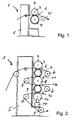
- Fig. 1 shows a calender 1 for the treatment of a web, in particular a paper or board web, textile web or plastic web.
- the calender 1 comprises for this purpose at least one roll stack 2, which here comprises two rolls 3, 4, which are arranged in a known manner on a calender stand 5.
- the rollers 3, 4 define a nip 6, the nip, which passes through a web W and in which the web is subjected to pressure and temperature.
- the treatment time of the web W in the nip depends on the length of the nip and the throughput time, which depends on the production speed in online operation.
- the length of the nip is selectable and is usually between 3 and 300 mm.
- a roller, here the roller 3, as hard roller, soft roller or shoe roller can be formed.
- the roller 3 may further be formed as a bending compensating roller.
- the other roll 4 is a heatable calender roll according to the invention, the formation of which will be described in detail below.
- the roll stack may be loadable from one or both ends to set selectable line loads in nip 6. If the roller 3 is designed as a shoe roller, the line loads can be adjusted via a stroke of the shoe. For guiding the web W between nips or after the nip 6 guide rollers 7 are provided in a known manner.
- This 1-nip calender can be used both online and offline.
- Fig. 2 shows a multi-nip calender for smoothing a paper or board web with at least one roll stack 2 with a plurality of rollers 3, 4, 8, 9, 10, the Limit nips 6, 11, 12, 13.
- the number of rolls is preferably between three and twelve rolls.
- the end rollers 3, 10 of the roller stack 2 are preferably formed as a bending compensating rollers.
- Each nip 6, 11, 12, 13 is preferably limited by a heated calender roll according to the invention. These are here the rollers 4, 9, which are formed according to the invention, as described below. All rolls can be designed as hard rolls.
- the nips 6, 11, 12, 13 are formed as soft nips, ie they are bounded by a hard and a soft roll.
- the heatable calender rolls 4, 9 according to the invention are basically hard rolls with a wear-resistant surface, so that in each case the other roll, which delimit a nip with the heatable calender roll 4, 9 according to the invention, can be soft rolls. According to Fig. 2, these are the rolls 3, 8, 10.
- the heatable calender roll according to the invention is preferably a center roll which is double-rolled in operation, i. two nips 8, 11 and 12, 13 limited.
- the roll stack 2 can be loaded from one end via a pressure cylinder 14. Between the nips, the web W is guided over guide rollers 7.
- a second, not shown, roll stack may be provided, which may be before or downstream of the roll stack 2.
- the roll stack 2 may have a changeover tip.
- the calender 1 according to FIG. 2 can be operated offline as well as online.
- the two calender embodiments of FIGS. 1 and 2 can be operated online at production speeds of over 1500 m / min, wherein the heatable calender rolls 4, 8 can be driven according to the invention with roll surface temperatures of up to 350 ° C while heating capacities of up to 200 kW / m own.
- the formation of the heatable calender rolls 4, 9 according to the invention is explained with reference to FIGS. 3 and 4 below.
- the heatable calender roll 4 will be described.
- the statements apply correspondingly to the calender roll 9.
- the statements apply equally to the heatable calender roll 4 as end roll (FIG. 1) and the heatable calender roll 4, 9 as center roll (FIG. 2).
- the heatable calender roll 4 comprises a hollow roller shell 15 having a roller shell.
- the roller body 15 carries a wear-resistant circumferential surface which is formed by at least one fusion-bonded functional layer 16 having such a weld additive-dependent tensile strength that an operational tensile stress less than or equal to is half the value of the breaking stress of the electromagnetic material.
- the functional layer 16 has a minimum layer thickness which is greater than or equal to the current penetration dimension.
- an external heating is provided, which is formed by a continuous hairpin inductor 20, which provides as a heating element for an inductive power transmission.
- induction coils can be provided, which can be controlled zonewise.
- the frequency of the inductive heating is preferably between 50 Hz and 50 KHz.
- material for the roll body is preferably a non-treated steel, e.g. St 52, provided. Particularly preferred is a material with a thermal conductivity of ⁇ 30 W / m ° K.
- the material for the functional layer 16 is preferably one with a thermal conductivity of ⁇ 20 W / m ° K and a specific heat capacity of ⁇ 400 J / kg ° K.
- the roller body 15 and the functional layer 16 preferably have the same thermal expansions.
- the welding filler from which the functional layer 16 by fusion welding is applied to the roller body 15, preferably has a hardness between 450 HV and 650 HV. Furthermore, the reversible hardness drop of the filler metal from room temperature to operating temperature is preferably less than 5%.
- the build-up welding is preferably carried out by the so-called strip welding method with welding bands of a width of for example 15 to 60 mm in order to achieve a non-porous surface and homogeneous application layer in terms of Young's modulus and wear resistance.
- the layer thickness of the functional layer 16 is at least 3 mm and is preferably in the range between 3 and 10 mm.
- the minimum layer thickness is preferably increased by a layer thickness which corresponds to a grinding allowance.
- the welded-on functional layer 16 can be treated by stress-relieved annealing.
- the roller body 15 is arranged in a known manner as a support body via roll neck 23, 24 in the calender stand.
Landscapes
- Paper (AREA)
- Rolls And Other Rotary Bodies (AREA)
Applications Claiming Priority (1)
| Application Number | Priority Date | Filing Date | Title |
|---|---|---|---|
| DE200610017460 DE102006017460B4 (de) | 2006-04-13 | 2006-04-13 | Beheizbare Kalanderwalze |
Publications (1)
| Publication Number | Publication Date |
|---|---|
| EP1845191A1 true EP1845191A1 (fr) | 2007-10-17 |
Family
ID=38268992
Family Applications (1)
| Application Number | Title | Priority Date | Filing Date |
|---|---|---|---|
| EP07007387A Withdrawn EP1845191A1 (fr) | 2006-04-13 | 2007-04-11 | Rouleau de calandre pouvant être chauffé |
Country Status (2)
| Country | Link |
|---|---|
| EP (1) | EP1845191A1 (fr) |
| DE (1) | DE102006017460B4 (fr) |
Cited By (1)
| Publication number | Priority date | Publication date | Assignee | Title |
|---|---|---|---|---|
| CN116905272A (zh) * | 2023-08-29 | 2023-10-20 | 赣州龙邦材料科技有限公司 | 一种高挺耐磨芳纶纸的制造方法 |
Citations (5)
| Publication number | Priority date | Publication date | Assignee | Title |
|---|---|---|---|---|
| EP0277905A2 (fr) * | 1987-02-03 | 1988-08-10 | Beloit Corporation | Méthode de chauffage pour le chauffage d'un rouleau de calandre |
| EP0337973A2 (fr) * | 1988-04-13 | 1989-10-18 | Valmet Paper Machinery Inc. | Procédé et dispositif de traitement par pression d'une bande de papier |
| WO1995010659A1 (fr) * | 1993-10-13 | 1995-04-20 | Beloit Technologies, Inc. | Cylindre secheur a impulsions comportant une enveloppe a diffusivite thermique elevee |
| DE10164344C1 (de) * | 2001-12-28 | 2003-06-18 | Schwaebische Huettenwerke Gmbh | Formstabilisierter Walzenkörper |
| DE202005015368U1 (de) * | 2005-09-29 | 2007-02-08 | Andritz Küsters GmbH & Co. KG | Beheizbare Kalanderwalze |
Family Cites Families (2)
| Publication number | Priority date | Publication date | Assignee | Title |
|---|---|---|---|---|
| DE4101354A1 (de) * | 1991-01-18 | 1992-07-23 | Kuesters Eduard Maschf | Vorrichtung zur indukativen beheizung von walzen |
| EP1660721A2 (fr) * | 2003-09-01 | 2006-05-31 | Metso Paper, Inc. | Cylindre thermique |
-
2006
- 2006-04-13 DE DE200610017460 patent/DE102006017460B4/de not_active Expired - Fee Related
-
2007
- 2007-04-11 EP EP07007387A patent/EP1845191A1/fr not_active Withdrawn
Patent Citations (5)
| Publication number | Priority date | Publication date | Assignee | Title |
|---|---|---|---|---|
| EP0277905A2 (fr) * | 1987-02-03 | 1988-08-10 | Beloit Corporation | Méthode de chauffage pour le chauffage d'un rouleau de calandre |
| EP0337973A2 (fr) * | 1988-04-13 | 1989-10-18 | Valmet Paper Machinery Inc. | Procédé et dispositif de traitement par pression d'une bande de papier |
| WO1995010659A1 (fr) * | 1993-10-13 | 1995-04-20 | Beloit Technologies, Inc. | Cylindre secheur a impulsions comportant une enveloppe a diffusivite thermique elevee |
| DE10164344C1 (de) * | 2001-12-28 | 2003-06-18 | Schwaebische Huettenwerke Gmbh | Formstabilisierter Walzenkörper |
| DE202005015368U1 (de) * | 2005-09-29 | 2007-02-08 | Andritz Küsters GmbH & Co. KG | Beheizbare Kalanderwalze |
Cited By (1)
| Publication number | Priority date | Publication date | Assignee | Title |
|---|---|---|---|---|
| CN116905272A (zh) * | 2023-08-29 | 2023-10-20 | 赣州龙邦材料科技有限公司 | 一种高挺耐磨芳纶纸的制造方法 |
Also Published As
| Publication number | Publication date |
|---|---|
| DE102006017460B4 (de) | 2012-10-25 |
| DE102006017460A1 (de) | 2007-10-18 |
Similar Documents
| Publication | Publication Date | Title |
|---|---|---|
| DE68923898T2 (de) | Verfahren und Vorrichtungen zur Druckbehandlung einer Papierbahn. | |
| DE3131799C2 (de) | Walzenpresse für Papier- und ähnliche Bahnen, insbesondere Kalander | |
| EP0732446B1 (fr) | Calandre pour le traitement d'une bande de papier sur deux faces | |
| DE69802672T2 (de) | Verfahren zum kalandrieren und kalander zur anwendung des verfahrens | |
| EP0735185B1 (fr) | Calandre pour le traitement des deux surfaces d'une bande de papier | |
| EP2014777A1 (fr) | Procede et dipositif pour le traitement thermique d une tole metallique | |
| DE102006017460B4 (de) | Beheizbare Kalanderwalze | |
| EP0748895B1 (fr) | Calendre | |
| EP1924741A1 (fr) | Rouleau de calandre chauffable | |
| EP2275601B1 (fr) | Calandre pour lisser un papier ou une bande de carton | |
| DE19508352B4 (de) | Kalander für die Behandlung einer Papierbahn | |
| EP2314764A1 (fr) | Calendre | |
| EP1929086B1 (fr) | Rouleau de calandre chauffable | |
| EP0631012A1 (fr) | Procédé et dispositif pour le réglage de l'épaisseur, la brillance et/ou le lisse pendant le traitement de bandes fibreuses | |
| DE60112618T2 (de) | Verfahren zur herstellung eines walzenmantels einer bei der herstellung oder weiterverarbeitung von papier und/oder pappe verwendeten walze | |
| DE102010002819A1 (de) | Satinageanordnung und Verfahren zur Satinage | |
| DE202005015368U1 (de) | Beheizbare Kalanderwalze | |
| WO2016113040A1 (fr) | Bande pour un dispositif de lissage, dispositif de lissage et procédé de lissage | |
| EP1924742A1 (fr) | Rouleau de calandre chauffable | |
| DE102005044101A1 (de) | Beheizbare Kalanderwalze | |
| DE102007055734A1 (de) | Bahnbehandlungsvorrichtung | |
| DE102005019475A1 (de) | Kalander und Verfahren zum Behandeln einer Materialbahn | |
| EP1746205B1 (fr) | Procédé de fonctionnement d'une calandre et calandre | |
| EP2135993A2 (fr) | Dispositif de chauffage destiné au chauffage inductif d'un rouleau de calandre | |
| EP1645685B1 (fr) | Rouleau de calandre et procédé d'entraînement pour un rouleau de calendre |
Legal Events
| Date | Code | Title | Description |
|---|---|---|---|
| PUAI | Public reference made under article 153(3) epc to a published international application that has entered the european phase |
Free format text: ORIGINAL CODE: 0009012 |
|
| AK | Designated contracting states |
Kind code of ref document: A1 Designated state(s): AT BE BG CH CY CZ DE DK EE ES FI FR GB GR HU IE IS IT LI LT LU LV MC MT NL PL PT RO SE SI SK TR |
|
| AX | Request for extension of the european patent |
Extension state: AL BA HR MK YU |
|
| RAP1 | Party data changed (applicant data changed or rights of an application transferred) |
Owner name: ANDRITZ KUESTERS GMBH |
|
| 17P | Request for examination filed |
Effective date: 20080225 |
|
| 17Q | First examination report despatched |
Effective date: 20080424 |
|
| AKX | Designation fees paid |
Designated state(s): AT DE FI IT |
|
| STAA | Information on the status of an ep patent application or granted ep patent |
Free format text: STATUS: THE APPLICATION HAS BEEN WITHDRAWN |
|
| 18W | Application withdrawn |
Effective date: 20111215 |