EP1847250B1 - Agents pour colorer des fibres de kératine comportant des colorants d'azométhyne zwittérionique - Google Patents
Agents pour colorer des fibres de kératine comportant des colorants d'azométhyne zwittérionique Download PDFInfo
- Publication number
- EP1847250B1 EP1847250B1 EP07105282A EP07105282A EP1847250B1 EP 1847250 B1 EP1847250 B1 EP 1847250B1 EP 07105282 A EP07105282 A EP 07105282A EP 07105282 A EP07105282 A EP 07105282A EP 1847250 B1 EP1847250 B1 EP 1847250B1
- Authority
- EP
- European Patent Office
- Prior art keywords
- methyl
- group
- hydrazono
- pyridiniumyl
- butanesulfonate
- Prior art date
- Legal status (The legal status is an assumption and is not a legal conclusion. Google has not performed a legal analysis and makes no representation as to the accuracy of the status listed.)
- Active
Links
- 0 C[C@](C(C(C)=CC(C)(*)C=*)=[N+]*)I Chemical compound C[C@](C(C(C)=CC(C)(*)C=*)=[N+]*)I 0.000 description 5
Classifications
-
- A—HUMAN NECESSITIES
- A61—MEDICAL OR VETERINARY SCIENCE; HYGIENE
- A61K—PREPARATIONS FOR MEDICAL, DENTAL OR TOILETRY PURPOSES
- A61K8/00—Cosmetics or similar toiletry preparations
- A61K8/18—Cosmetics or similar toiletry preparations characterised by the composition
- A61K8/30—Cosmetics or similar toiletry preparations characterised by the composition containing organic compounds
- A61K8/49—Cosmetics or similar toiletry preparations characterised by the composition containing organic compounds containing heterocyclic compounds
- A61K8/4906—Cosmetics or similar toiletry preparations characterised by the composition containing organic compounds containing heterocyclic compounds with one nitrogen as the only hetero atom
- A61K8/4933—Cosmetics or similar toiletry preparations characterised by the composition containing organic compounds containing heterocyclic compounds with one nitrogen as the only hetero atom having sulfur as an exocyclic substituent, e.g. pyridinethione
-
- A—HUMAN NECESSITIES
- A61—MEDICAL OR VETERINARY SCIENCE; HYGIENE
- A61K—PREPARATIONS FOR MEDICAL, DENTAL OR TOILETRY PURPOSES
- A61K8/00—Cosmetics or similar toiletry preparations
- A61K8/18—Cosmetics or similar toiletry preparations characterised by the composition
- A61K8/30—Cosmetics or similar toiletry preparations characterised by the composition containing organic compounds
- A61K8/49—Cosmetics or similar toiletry preparations characterised by the composition containing organic compounds containing heterocyclic compounds
-
- A—HUMAN NECESSITIES
- A61—MEDICAL OR VETERINARY SCIENCE; HYGIENE
- A61K—PREPARATIONS FOR MEDICAL, DENTAL OR TOILETRY PURPOSES
- A61K8/00—Cosmetics or similar toiletry preparations
- A61K8/18—Cosmetics or similar toiletry preparations characterised by the composition
- A61K8/30—Cosmetics or similar toiletry preparations characterised by the composition containing organic compounds
- A61K8/69—Cosmetics or similar toiletry preparations characterised by the composition containing organic compounds containing fluorine
-
- A—HUMAN NECESSITIES
- A61—MEDICAL OR VETERINARY SCIENCE; HYGIENE
- A61Q—SPECIFIC USE OF COSMETICS OR SIMILAR TOILETRY PREPARATIONS
- A61Q5/00—Preparations for care of the hair
- A61Q5/06—Preparations for styling the hair, e.g. by temporary shaping or colouring
- A61Q5/065—Preparations for temporary colouring the hair, e.g. direct dyes
-
- A—HUMAN NECESSITIES
- A61—MEDICAL OR VETERINARY SCIENCE; HYGIENE
- A61K—PREPARATIONS FOR MEDICAL, DENTAL OR TOILETRY PURPOSES
- A61K2800/00—Properties of cosmetic compositions or active ingredients thereof or formulation aids used therein and process related aspects
- A61K2800/40—Chemical, physico-chemical or functional or structural properties of particular ingredients
- A61K2800/42—Colour properties
- A61K2800/43—Pigments; Dyes
- A61K2800/432—Direct dyes
- A61K2800/4324—Direct dyes in preparations for permanently dyeing the hair
Definitions
- the present invention relates to agents for colouring keratin fibres, such as, for example, wool, and furs and, in particular, human hair, comprising zwitterionic azomethine dyes.
- the colouration is produced with so-called oxidative or permanent colourants using a mixture of various developer substances and coupler substances and an oxidizing agent.
- so-called direct (nonoxidative) dyes can be added to round off the colouring result or to produce particular colour effects.
- the second method uses exclusively direct dyes, which are applied to the fibres in a suitable carrier mass. This method is easy to use, exceptionally gentle and is characterized by low damage to keratin fibres.
- the direct dyes used here are subject to a large number of requirements.
- WO 95/01772 A1 discloses specific azo dyes and azomethine dyes as well as their use for dyeing keratinic fibres.
- US 3,573,287 discloses specific cationic azomethine compounds which are used for controlling infections of the urinary tract.
- the present invention therefore provides
- the present invention further provides
- the present invention further provides
- the dyes of the formula (I), (II) and (III) are present in the colourant according to the invention preferably in a total amount of from 0.01 to 10% by weight, in particular 0.1 to 8% by weight.
- the colourant (a) according to the invention may additionally also comprise further known direct synthetic dyes from the group consisting of nitro dyes, azo dyes, anthraquinone dyes, triphenylmethane dyes and basic or acidic dyes, and natural direct dyes, alone or in a mixture with one another.
- the total content of additional dyes in the colourant according to the invention is about 0.01 to 15% by weight, in particular 0.1 to 12% by weight.
- the oxidation colourant (c) according to the invention which is mixed prior to application with an oxidizing agent (in particular hydrogen peroxide or its addition compounds) comprises, besides the dyes of the general formula (I), oxidation dye precursors and if necessary one or more of the abovementioned direct dyes, provided these direct dyes are stable to the oxidizing agent used.
- an oxidizing agent in particular hydrogen peroxide or its addition compounds
- Suitable oxidation dye precursors which may be specified are, for example, the following developer substances and coupler substances and self-coupling compounds:
- the total amount of the oxidation dye precursors present in the colourant (c) according to the invention is from about 0.01 to 12% by weight, in particular from about 0.2 to 6% by weight.
- the carriers customary used in cosmetic systems can be added if required.
- Suitable compounds are described, for example, in DE-A 196 18 595 , which is herewith expressly included by reference.
- Particularly suitable carriers are, for example, benzyl alcohol, vanillin and isovanillin.
- the dyes described above are applied in a suitable colour carrier mass.
- the colourant (a) , (b) or (c) according to the invention can also comprise all additives customary and known for such preparations, for example perfume oils, complexing agents, waxes, preservatives, thickeners, antioxidants, alginates, guar gum, haircare substances, such as, for example, cationic polymers or lanolin derivatives, or anionic, nonionic, amphoteric or cationic surface-active substances.
- amphoteric or nonionic surface-active substances for example betaine surfactants, propionates and glycinates, such as, for example, cocoamphoglycinates or cocoamphodiglycinates, ethoxylated surfactants with 1 to 1000 ethylene oxide units, preferably with 1 to 300 ethylene oxide units, such as, for example, glyceride alkoxylates, for example castor oil ethoxylated with 25 ethylene oxide units, polyglycolamides, ethoxylated alcohols and ethoxylated fatty alcohols (fatty alcohol alkoxylates) and ethoxylated fatty acid sugar esters, in particular ethoxylated sorbitan fatty acid esters.
- the abovementioned constituents are used in the amounts customary for such purposes, for example the surface-active substances in a concentration of from 0.1 to 30% by weight, and the care substances in an amount of from 0.1 to 5% by weight.
- the colourant (a), (b) or (c) according to the invention can be present in the form of a powder or granules which is/are dissolved prior to application in an aqueous or aqueous-alcoholic preparation, or else in the form of an aqueous or aqueous-alcoholic solution, a cream, a gel, an emulsion or an aerosol foam, where the colourant can be formulated either in the form of a single-component preparation or else in the form of a multicomponent preparation, for example in the form of a two-component preparation in which the particular dye derivative of the general formula (I) is packaged separately from the other constituents and the ready-to-use colourant is only prepared directly prior to application by mixing the two components.
- the colourant (a), (b) or (c) according to the invention generally has a pH of from about 2 to 11, preferably from about 5 to 10.
- Both organic and inorganic acids or bases are suitable for adjusting the pH according to the invention.
- suitable acids are, in particular, the following acids: ⁇ -hydroxycarboxylic acids, such as, for example, glycolic acid, lactic acid, tartaric acid, citric acid or malic acid, ascorbic acid, gluconic acid lactone, acetic acid, hydrochloric acid or phosphoric acid, and mixtures of these acids.
- Suitable bases are, in particular, sodium carbonate, sodium hydrogencarbonate, organic amines, for example monoethanolamine, triethanolamine, 2-amino-2-methyl-1-propanol or tris(hydroxymethyl)aminomethane, ammonia, potassium hydroxide or sodium hydroxide, and mixtures thereof.
- the colourant according to the invention can be used with one or more oxidizing agents (lightening; oxidation colourants) or without an oxidizing agent (nonoxidative colourants).
- compositions according to the present invention may comprise at least one source of an oxidizing agent for developing the hair colour.
- Preferred oxidizing agents for use herein are water-soluble peroxygen oxidizing agents.
- Water-soluble as defined herein means that in standard condition at least 0.1g, preferably 1g, more preferably 10g of said oxidizing agent can be dissolved in 1 liter of deionized water.
- the oxidizing agents are valuable for the initial solubilisation and decolourisation of the melanin (bleaching) and accelerate the oxidation of the oxidative dye precursors (oxidative dyeing) in the hair shaft.
- any oxidizing agent known in the art may be utilized in the present invention.
- Preferred water-soluble oxidizing agents are inorganic peroxygen materials capable of yielding hydrogen peroxide in an aqueous solution.
- Water-soluble peroxygen oxidizing agents are well known in the art and include hydrogen peroxide, inorganic alkali metal peroxides such as sodium periodate and sodium peroxide and organic peroxides such as urea peroxide, melamine peroxide, and inorganic perhydrate salt bleaching compounds, such as the alkali metal salts of perborates, percarbonates, perphosphates, persilicates, persulphates and the like. These inorganic perhydrate salts may be incorporated as monohydrates, tetrahydrates etc.
- Alkyl and aryl peroxides, and or peroxidases may also be used. Mixtures of two or more such oxidizing agents can also be used if desired.
- the oxidizing agents may be provided in aqueous solution or as a powder which is dissolved prior to use. Preferred for use in the compositions according to the present invention are hydrogen peroxide, percarbonate, persulphates and combinations thereof.
- compositions comprise from about 0.1 % to about 15% by weight, preferably from about 1% to about 10% by weight, and most preferably from about 2% to about 7% by weight of an oxidizing agent.
- Another preferred oxidizing agent for use herein is a source of peroxymonocarbonate ions.
- a source is formed in situ from a source of hydrogen peroxide and a hydrogen carbonate ion source.
- Such an oxidizing agent has been found to be particularly effective at a pH of up to and including 9.5, preferably 7.5 to 9.5 more preferably about pH 9.
- this system is also particularly effective in combination with a source of ammonia or ammonium ions. It has been found that this oxidizing agent can deliver improvements to the desired hair colour results particularly with regard to the delivery of high lift, whilst considerably reducing the odour, skin and scalp irritation and damage to the hair fibres.
- any source of these ions may be utilized.
- Suitable sources for use herein include sodium, potassium, guanidine, arginine, lithium, calcium, magnesium, barium, ammonium salts of carbonate, carbamate and hydrocarbonate ions and mixtures thereof such as sodium carbonate, sodium hydrogen carbonate, potassium carbonate, potassium hydrogen carbonate, guanidine carbonate, guanidine hydrogen carbonate, lithium carbonate, calcium carbonate, magnesium carbonate, barium carbonate, ammonium carbonate, ammonium hydrogen carbonate and mixtures thereof.
- Percarbonate salts may also be utilized to provide both the source of carbonate ions and oxidizing agent.
- Preferred sources of carbonate ions, carbamate and hydrocarbonate ions are sodium hydrogen carbonate, potassium hydrogen carbonate, ammonium carbamate, and mixtures thereof.
- compositions comprise from about 0.1% to about 15% by weight, preferably from about 1% to about 10% by weight, and most preferably from about 1% to about 8% by weight of a hydrogencarbonate ion and from about 0.1 % to about 10% by weight, preferably from about 1% to about 7% by weight, and most preferably from about 2% to about 5% by weight of a source of hydrogen peroxide.
- oxidants for developing the hair colour are mainly hydrogen peroxide or a compound of addition of hydrogen peroxide to urea, melamine, sodium borate or sodium carbonate, in the form of a 3 to 12%, preferably 6%, aqueous solution, as well as air oxygen.
- a 6% hydrogen peroxide solution is used as the oxidant
- the weight ratio of hair colourant to oxidant is 5:1 to 2:1, and preferably 1:1. Larger amounts of oxidant are used primarily when the hair colourant contains a higher dye concentration or when stronger hair bleaching is desired at the same time.
- colourants for oxidative dyeing of hair
- said colourants are mixed with an oxidant immediately before use, and the mixture is applied to hair in an amount sufficient for hair.
- the colourant according to the invention is generally used by applying an amount of the hair colourant sufficient for the hair colouring, about 30 to 200 grams depending on hair length, to the hair, allowing the hair colourant to act at about 15 to 50 degrees Celsius for about 1 to 60 minutes, preferably 5 to 30 minutes, then rinsing the hair thoroughly with water, optionally washing with a shampoo and/or after-treating with a hair-conditioning composition and finally drying.
- the above-described colourant can comprise natural or synthetic polymers or modified polymers of natural origin customary for cosmetic compositions, as a result of which setting of the hair is achieved at the same time as the colouring.
- Such compositions are generally referred to as colour setting compositions.
- the abovementioned polymers may be present in the colourant (a) according to the invention in the amounts customary for such agents, in particular in an amount of from about 1 to 5% by weight.
- the pH of the colour setting composition or colour setting composition according to the invention is preferably about 4 to 10.
- the hair colourant with additional setting properties is used in a known and customary manner by wetting the hair with the setting composition, arranging (styling) the hair into the hairstyle and then drying.
- the colourant according to the invention permits a colouration of keratin fibres, in particular of human hair, with a very strong colour intensity and brilliance, and a very good durability (washing fastness), specially when applied together with hydrogen peroxide to natural hair or damaged hair (e.g. bleached or permed hair).
- the zwitterionic azomethine dyes according to the invention of the general formula (I), (II) or (III) can be prepared via a 2-step process, by condensation of aromatic or heteroaromatic hydrazine or the acid addition salt thereof (commercialy available or accessible via standard literature procedure) with heterocyclic aldehydes or ketones.
- the resulting azomethine dye is converted to the zwitterionic azomethine dye of the formula (I), (II) or (III) using sultones, such as, for example, butane sultone or propane sultone (Diagram 1).
- Another preparation process is a one-step process, by the condensation of an aromatic or heteroaromatic hydrazine with a previously prepared zwitterionic aldehyde or ketone (Diagram 2).
- Example 2a Synthesis of 4-(4- ⁇ [2-(3-methyl-1,3-benzothiazol-2(3 H )-ylidene)hydrazono]methyl ⁇ -1-pyridiniumyl)-1-butanesulfonate
- Example 2b Synthesis of 4-(3- ⁇ [2-(3-methyl-1,3-benzothiazol-2(3 H )-ylidene)hydrazono]methyl ⁇ -1-pyridiniumyl)-1-butanesulfonate
- the colouring solution was adjusted to the pH values given in table 1 by adding 25% ammonia.
- the hair colouring was carried out by applying an amount of the colourant sufficient for the hair colouring to the hair and distributing it evenly using a brush. After a contact time of 30 minutes at 40 °C, the hair was rinsed with lukewarm water, washed with a shampoo, rinsed with lukewarm water and then dried.
- Table 1 Ex.
- Example 12 Hair colourant with cationic surface-active substances
- the pH was adjusted to the pH values given in table 2 using 25% ammonia.
- the hair colouring was carried out by applying an amount of the colourant sufficient for the hair colouring to the hair and distributing it evenly using a brush. After a contact time of 30 minutes at 40 °C, the hair was rinsed with lukewarm water, washed with a shampoo, rinsed again with lukewarm water and then dried.
- the pH was adjusted to the pH values given in table 3 using 25% ammonia.
- the hair colouring was carried out by applying an amount of the colourant sufficient for the hair colouring to the hair and distributing it evenly using a brush. After a contact time of 30 minutes at 40 °C, the hair was rinsed with lukewarm water, washed with a shampoo, rinsed again with lukewarm water and then dried.
- Example 14 Hair colourant with anionic surface-active substances
- the pH was adjusted to the pH values given in table 4 using 25% ammonia.
- the hair colouring was carried out by applying an amount of the colourant sufficient for the hair colouring to the hair and distributing it evenly using a brush. After a contact time of 30 minutes at 40 °C, the hair was rinsed with lukewarm water, washed with a shampoo, rinsed again with lukewarm water and then dried.
- the resulting ready-to-use hair colourant was applied to the hair (yak hair) and distributed evenly using a brush. After a contact time of 30 minutes at 40 °C, the hair was rinsed with lukewarm water, washed with a shampoo, rinsed again with lukewarm water and then dried.
- the resulting ready-to-use hair colourant was applied to natural hair and distributed evenly using a brush. After a contact time of 30 minutes at 40 °C, the hair was rinsed with lukewarm water, washed with a shampoo, rinsed again with lukewarm water and then dried. The washing process was repeated five times. The colours did not change visually. Table 6: Ex.
- the L*C*h* colour measurement values given in the present examples were ascertained using a colourimeter from Minolta, model Chromameter II.
- the L value is the lightness (i.e. the lower the L value, the greater the colour intensity)
- the C value is a measure of the colorfulness ("chroma") (i.e. the greater the C value, the more lively the colour).
- the h value is the colour shade angle ("hue").
Landscapes
- Life Sciences & Earth Sciences (AREA)
- Health & Medical Sciences (AREA)
- Animal Behavior & Ethology (AREA)
- General Health & Medical Sciences (AREA)
- Public Health (AREA)
- Veterinary Medicine (AREA)
- Birds (AREA)
- Epidemiology (AREA)
- Cosmetics (AREA)
- Pyridine Compounds (AREA)
- Thiazole And Isothizaole Compounds (AREA)
- Plural Heterocyclic Compounds (AREA)
Claims (13)
- Agent pour la coloration non oxydative de fibres de kératine, caractérisé en ce qu'il comprend 0,01 à 10 % en poids d'au moins une teinture azométhine zwittérionique de formule générale (I), (II) ou (III)
 R1 et R2 peuvent être identiques ou différents et indépendamment l'un de l'autre, représentent l'hydrogène, un atome d'halogène, un groupe alkyle saturé ou insaturé en (C1 à C12), un groupe alkyle en (C1 à C12) substitué par un atome d'halogène, un groupe hydroxyle, un groupe hydroxy-alkyle en (C1 à C12), un groupe alcoxy en (C1 à C12), un groupe cyano, un groupe nitro, un groupe amino, un groupe alkylamino en (C1 à C12), un groupe dialkylamino en (C1 à C12), un groupe acide carboxylique, un groupe C(O)O-alkyle en (C1 à C12), un groupe C(O)O-phényle substitué ou un groupe C(O)O-phényle non substitué, un groupe phényle substitué ou un groupe phényle non substitué, un groupe naphtyle substitué ou un groupe naphtyle non substitué, un groupe hétéroaryle substitué ou un groupe hétéroaryle non substitué;R3 est un hydrogène, un groupe alkyle saturé ou insaturé en (C1 à C12), un groupe hydroxy-alkyle en (C2 à C12), ou forme avec un atome de carbone du cycle benzène un hétérocycle à cinq ou six éléments qui peut être substitué avec un ou plusieurs groupes alkyle en (C1 à C12);R4 est un hydrogène, un groupe alkyle saturé ou insaturé en (C1 à C12), un groupe phényle substitué ou un groupe phényle non substitué;R5 est choisi dans un groupe selon la formule générale
 R6 et R7 peuvent être identiques ou différents et, indépendamment l'un de l'autre, représentent l'hydrogène, un atome d'halogène, un groupe amino, un groupe alkylamino en (C1 à C12), un groupe dialkylamino en (C1 à C12), un groupe alkylcyano en C1 à C6, un groupe hydroxyle, un groupe nitro, un groupe alkyle saturé ou insaturé en (C1 à C12), un groupe hydroxy-alkyle en (C1 à C12), un groupe alcoxy en (C1 à C12), un groupe méthoxy-alkyle en (C1 à C12), un groupe C(O)O-alkyle en (C1 à C12);z est un hétérocycle de formule (IV) à (XII)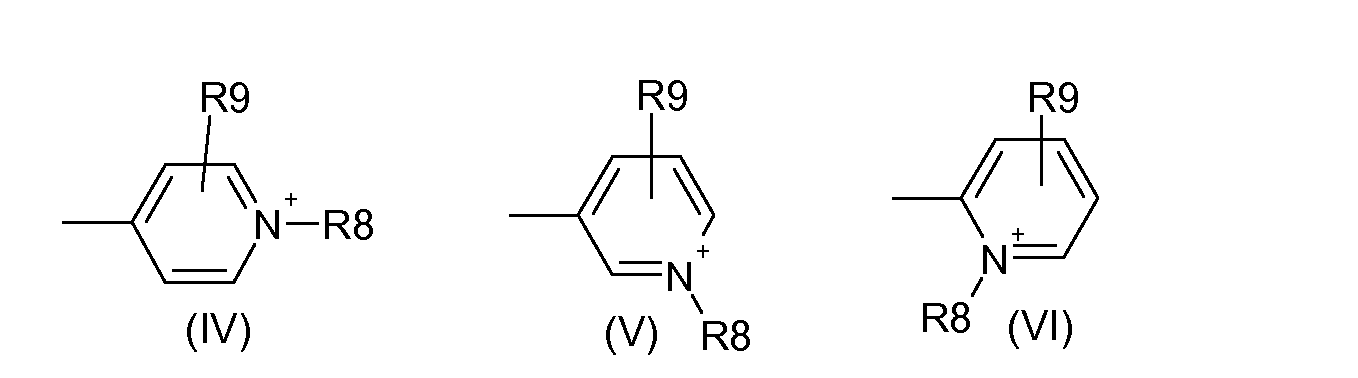

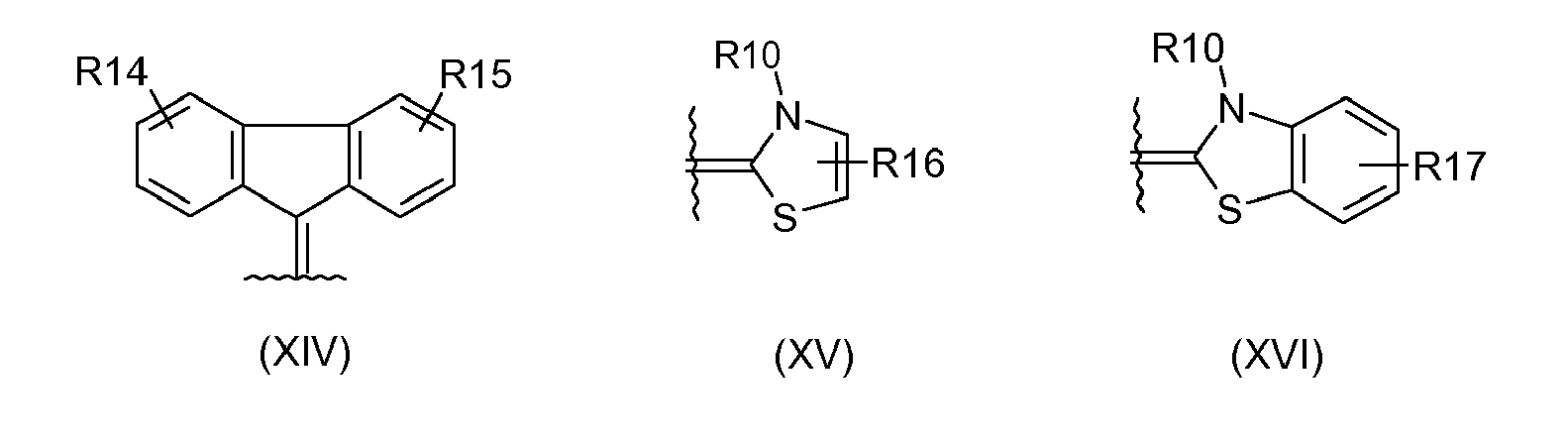
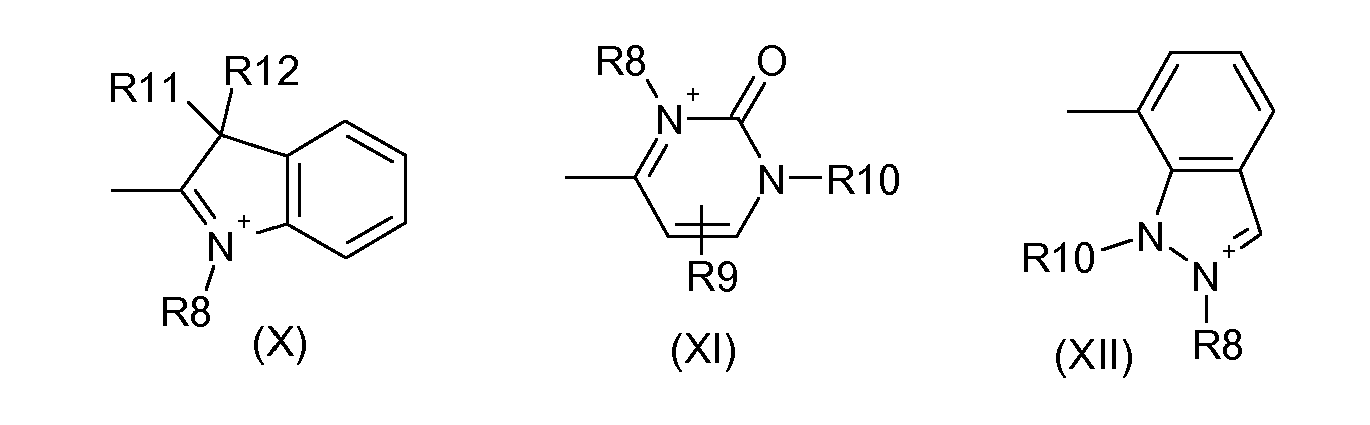 X représente l'oxygène ou le soufre ;R8 est un radical alkylsulfonate de formule (XIII);
 R9 est un hydrogène, un atome d'halogène, un groupe alkyle saturé ou insaturé en (C1 à C12), un groupe alkyle en (C1 à C12) substitué par un atome d'halogène, un groupe hydroxyle, un groupe hydroxy-alkyle en (C2 à C12), un groupe alcoxy en (C1 à C12), un groupe cyano, un groupe nitro, un groupe amino, un groupe alkylamino en (C1 à C12), un groupe dialkylamino en (C1 à C12), un groupe acide carboxylique, un groupe C(O)O-alkyle en (C1 à C12), un groupe C(O)O-phényle substitué ou non substitué, un groupe phényle substitué ou non substitué, ou un cycle benzène condensé au cycle hétéro-aromatique de formule (IV) à (XII);R10 est un groupe alkyle saturé ou insaturé en (C1 à C12) ou un groupe hydroxy-alkyle en (C1 à C12) saturé ou insaturé;R11 et R12 peuvent être identiques ou différents et indépendamment l'un de l'autre, sont un groupe alkyle saturé ou insaturé en (C1 à C12) ;R13 est un hydrogène ou un groupe hydroxyle ;R14, R15, R16 et R17 peuvent être identiques ou différents et indépendamment l'un de l'autre, représentent l'hydrogène, un atome d'halogène, un groupe alkyle saturé ou insaturé en (C1 à C12), un groupe alkyle en (C1 à C12) substitué par un atome d'halogène, un groupe hydroxyle, un groupe hydroxy-alkyle en (C1 à C12), un groupe alcoxy en (C1 à C12), un groupe cyano, un groupe nitro, un groupe amino, un groupe alkylamino en (C1 à C12), un groupe dialkylamino en (C1 à C12), un groupe acide carboxylique, un groupe C(O)O-alkyle en (C1 à C12), un groupe C(O)O-phényle substitué ou un groupe C(O)O-phényle non substitué, un groupe phényle substitué ou un groupe phényle non substitué,m est égal à 0 à (n-1);p est égal à 0 à (n-1) avec m+p = (n-1) etn est un nombre entier allant de 1 à 6.
 - Agent pour l'éclaircissement et la coloration simultanés de fibres de kératine, caractérisé en ce qu'il comprend un agent oxydant et au moins une teinture azométhine zwittérionique de formule générale (I), (II) ou (III)
 R1 et R2 peuvent être identiques ou différents et indépendamment l'un de l'autre, représentent l'hydrogène, un atome d'halogène, un groupe alkyle saturé ou insaturé en (C1 à C12), un groupe alkyle en (C1 à C12) substitué par un atome d'halogène, un groupe hydroxyle, un groupe hydroxy-alkyle en (C1 à C12), un groupe alcoxy en (C1 à C12), un groupe cyano, un groupe nitro, un groupe amino, un groupe alkylamino en (C1 à C12), un groupe dialkylamino en (C1 à C12), un groupe acide carboxylique, un groupe C(O)O-alkyle en (C1 à C12), un groupe C(O)O-phényle substitué ou un groupe C(O)O-phényle non substitué, un groupe phényle substitué ou un groupe phényle non substitué, un groupe naphtyle substitué ou un groupe naphtyle non substitué, un groupe hétéroaryle substitué ou un groupe hétéroaryle non substitué;R3 est un hydrogène, un groupe alkyle saturé ou insaturé en (C1 à C12), un groupe hydroxy-alkyle en (C2 à C12), ou forme avec un atome de carbone du cycle benzène un hétérocycle à cinq ou six éléments qui peut être substitué avec un ou plusieurs groupes alkyle en (C1 à C12) ;R4 est un hydrogène, un groupe alkyle saturé ou insaturé en (C1 à C12), un groupe phényle substitué ou un groupe phényle non substitué ;R5 est choisi dans un groupe selon la formule générale
 R6 et R7 peuvent être identiques ou différents et, indépendamment l'un de l'autre, représentent l'hydrogène, un atome d'halogène, un groupe amino, un groupe alkylamino en (C1 à C12), un groupe dialkylamino en (C1 à C12), un groupe alkylcyano en C1 à C6, un groupe hydroxyle, un groupe nitro, un groupe alkyle saturé ou insaturé en (C1 à C12), un groupe hydroxy-alkyle en (C1 à C12), un groupe alcoxy en (C1 à C12), un groupe méthoxy-alkyle en (C1 à C12), un groupe C(O)O-alkyle en (C1 à C12) ;z est un hétérocycle de formule (IV) à (XII)

 X représente l'oxygène ou le soufre ;R8 est un radical alkylsulfonate de formule (XIII) ;
 R9 est un hydrogène, un atome d'halogène, un groupe alkyle saturé ou insaturé en (C1 à C12), un groupe alkyle en (C1 à C12) substitué par un atome d'halogène, un groupe hydroxyle, un groupe hydroxy-alkyle en (C2 à C12), un groupe alcoxy en (C1 à C12), un groupe cyano, un groupe nitro, un groupe amino, un groupe alkylamino en (C1 à C12), un groupe dialkylamino en (C1 à C12), un groupe acide carboxylique, un groupe C(O)O-alkyle en (C1 à C12), un groupe C(O)O-phényle substitué ou non substitué, un groupe phényle substitué ou non substitué, ou un cycle benzène condensé au cycle hétéro-aromatique de formule (IV) à (XII) ;R10 est un groupe alkyle saturé ou insaturé en (C1 à C12) ou un groupe hydroxy-alkyle en (C1 à C12) saturé ou insaturé ;R11 et R12 peuvent être identiques ou différents et indépendamment l'un de l'autre, sont un groupe alkyle saturé ou insaturé en (C1 à C12) ;R13 est un hydrogène ou un groupe hydroxyle ;R14, R15, R16 et R17 peuvent être identiques ou différents et indépendamment l'un de l'autre, représentent l'hydrogène, un atome d'halogène, un groupe alkyle saturé ou insaturé en (C1 à C12), un groupe alkyle en (C1 à C12) substitué par un atome d'halogène, un groupe hydroxyle, un groupe hydroxy-alkyle en (C1 à C12), un groupe alcoxy en (C1 à C12), un groupe cyano, un groupe nitro, un groupe amino, un groupe alkylamino en (C1 à C12), un groupe dialkylamino en (C1 à C12), un groupe acide carboxylique, un groupe C(O)O-alkyle en (C1 à C12), un groupe C(O)O-phényle substitué ou un groupe C(O)O-phényle non substitué, un groupe phényle substitué ou un groupe phényle non substitué,m est égal à 0 à (n-1);p est égal à 0 à (n-1) avec m+p = (n-1) etn est un nombre entier allant de 1 à 6.
 - Colorant oxydatif pour colorer des fibres de kératine, caractérisé en ce qu'il comprend au moins un précurseur de teinture par oxydation et au moins une teinture azométhine zwittérionique de formule générale (I), (II) ou (III)
 R1 et R2 peuvent être identiques ou différents et indépendamment l'un de l'autre, représentent l'hydrogène, un atome d'halogène, un groupe alkyle saturé ou insaturé en (C1 à C12), un groupe alkyle en (C1 à C12) substitué par un atome d'halogène, un groupe hydroxyle, un groupe hydroxy-alkyle en (C1 à C12), un groupe alcoxy en (C1 à C12), un groupe cyano, un groupe nitro, un groupe amino, un groupe alkylamino en (C1 à C12), un groupe dialkylamino en (C1 à C12), un groupe acide carboxylique, un groupe C(O)O-alkyle en (C1 à C12), un groupe C(O)O-phényle substitué ou un groupe C(O)O-phényle non substitué, un groupe phényle substitué ou un groupe phényle non substitué, un groupe naphtyle substitué ou un groupe naphtyle non substitué, un groupe hétéroaryle substitué ou un groupe hétéroaryle non substitué ;R3 est un hydrogène, un groupe alkyle saturé ou insaturé en (C1 à C12), un groupe hydroxy-alkyle en (C2 à C12), ou forme avec un atome de carbone du cycle benzène un hétérocycle à cinq ou six éléments qui peut être substitué avec un ou plusieurs groupes alkyle en (C1 à C12) ;R4 est un hydrogène, un groupe alkyle saturé ou insaturé en (C1 à C12), un groupe phényle substitué ou un groupe phényle non substitué;R5 est choisi dans un groupe selon la formule générale
 R6 et R7 peuvent être identiques ou différents et, indépendamment l'un de l'autre, représentent l'hydrogène, un atome d'halogène, un groupe amino, un groupe alkylamino en (C1 à C12), un groupe dialkylamino en (C1 à C12), un groupe alkylcyano en C1 à C6, un groupe hydroxyle, un groupe nitro, un groupe alkyle saturé ou insaturé en (C1 à C12), un groupe hydroxy-alkyle en (C1 à C12), un groupe alcoxy en (C1 à C12), un groupe méthoxy-alkyle en (C1 à C12), un groupe C(O)O-alkyle en (C1 à C12) ;z est un hétérocycle de formule (IV) à (XII)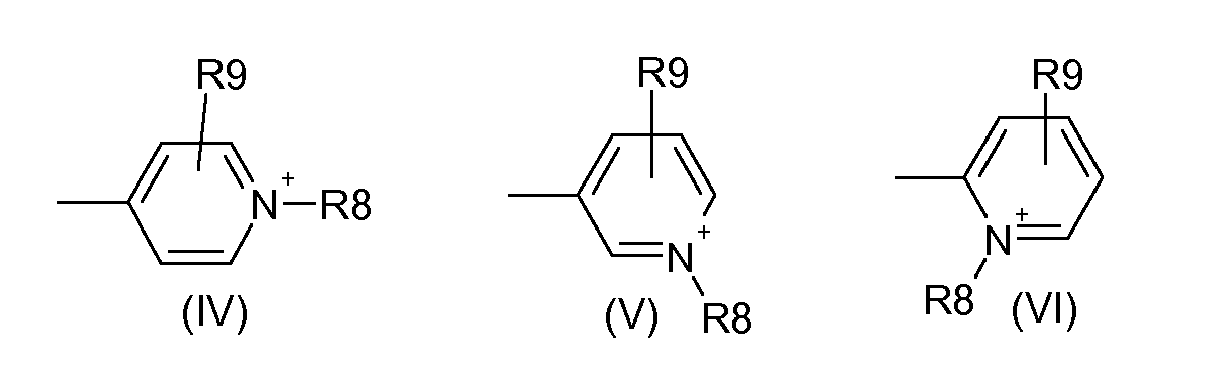

 X représente l'oxygène ou le soufre ;R8 est un radical alkylsulfonate de formule (XIII) ;
 R9 est un hydrogène, un atome d'halogène, un groupe alkyle saturé ou insaturé en (C1 à C12), un groupe alkyle en (C1 à C12) substitué par un atome d'halogène, un groupe hydroxyle, un groupe hydroxy-alkyle en (C2 à C12), un groupe alcoxy en (C1 à C12), un groupe cyano, un groupe nitro, un groupe amino, un groupe alkylamino en (C1 à C12), un groupe dialkylamino en (C1 à C12), un groupe acide carboxylique, un groupe C(O)O-alkyle en (C1 à C12), un groupe C(O)O-phényle substitué ou non substitué, un groupe phényle substitué ou non substitué, ou un cycle benzène condensé au cycle hétéro-aromatique de formule (IV) à (XII) ;R10 est un groupe alkyle saturé ou insaturé en (C1 à C12) ou un groupe hydroxy-alkyle en (C1 à C12) saturé ou insaturé ;R11 et R12 peuvent être identiques ou différents et indépendamment l'un de l'autre, sont un groupe alkyle saturé ou insaturé en (C1 à C12) ;R13 est un hydrogène ou un groupe hydroxyle ;R14, R15, R16 et R17 peuvent être identiques ou différents et indépendamment l'un de l'autre, représentent l'hydrogène, un atome d'halogène, un groupe alkyle saturé ou insaturé en (C1 à C12), un groupe alkyle en (C1 à C12) substitué par un atome d'halogène, un groupe hydroxyle, un groupe hydroxy-alkyle en (C1 à C12), un groupe alcoxy en (C1 à C12), un groupe cyano, un groupe nitro, un groupe amino, un groupe alkylamino en (C1 à C12), un groupe dialkylamino en (C1 à C12), un groupe acide carboxylique, un groupe C(O)O-alkyle en (C1 à C12), un groupe C(O)O-phényle substitué ou un groupe C(O)O-phényle non substitué, un groupe phényle substitué ou un groupe phényle non substitué,m est égal à 0 à (n-1);p est égal à 0 à (n-1) avec m+p = (n-1) etn est un nombre entier allant de 1 à 6.
 - Agent selon la revendication 1, caractérisé en ce qu'il comprend au moins un polymère choisi dans le groupe constitué de polymères naturels d'usage pour des agents cosmétiques, polymères synthétiques ou polymères modifiés d'origine naturelle, et qui est sous la forme d'une composition de fixation colorante.
- Agent selon la revendication 2, caractérisé par le fait que l'agent oxydant est choisi parmi le peroxyde d'hydrogène ou ses composés d'addition sur l'urée, la mélamine, le borate de sodium ou le carbonate de sodium.
- Agent selon la revendication 3, caractérisé par le fait que l'agent oxydant est choisi parmi le peroxyde d'hydrogène ou ses composés d'addition sur l'urée, la mélamine, le borate de sodium ou le carbonate de sodium et des persulfates.
- Agent selon l'une quelconque des revendications 1 à 6, caractérisé par le fait que dans la formule (I), (II) et (III), R13 est un hydrogène et n vaut 2 ou 3.
- Agent selon l'une quelconque des revendications 1 à 6, caractérisé par le fait que la teinture azométhine zwittérionique de formule (I), (II) ou (III) est choisie dans le groupe constitué de 4-(4-{[méthyl(phényl)hydrazono]méthyl}-1-pyridiniumyl)-1-butanesulfonate,
4-(3-{[méthyl(phényl)hydrazono]méthyl}-1-pyridiniumyl)-1-butanesulfonate,
4-(2-{[méthyl(phényl)hydrazono]méthyl}-1-pyridiniumyl)-1-butanesulfonate,
4-(4 {[(4-méthoxyphényl)(méthyl)hydrazono]méthyl}-1-pyridiniumyl)-1-butanesulfonate,
4-(3-{[(4-méthoxyphényl)(méthyl)hydrazono]méthyl}-1-pyridiniumyl)-1-butanesulfonate,
4-(2-{[(4-méthoxyphényl)(méthyl)hydrazono]méthyl}-1-pyridiniumyl)-1-butanesulfonate,
4-(4-{[(2-méthoxyphényl)(méthyl)hydrazono]méthyl}-1-pyridiniumyl)-1-butanesulfonate,
4-(3-{[(2-méthoxyphényl)(méthyl)hydrazono]méthyl}-1-pyridiniumyl)-1-butanesulfonate,
4-(2-{[(2-méthoxyphényl)(méthyl)hydrazono]méthyl}-1-pyridiniumyl)-1-butanesulfonate,
4-(4-{[(4-hydroxyphényl)(méthyl)hydrazono]méthyl}-1-pyridiniumyl)-1-butanesulfonate,
4-(3-{[(4-hydroxyphényl)(méthyl)hydrazono]méthyl}-1-pyridiniumyl)-1-butanesulfonate,
4-(2-{[(4-hydroxyphényl)(méthyl)hydrazono]méthyl}-1-pyridiniumyl)-1-butanesulfonate,
4-(4-{[méthyl(4-méthylphényl)hydrazono]méthyl}-1-pyridiniumyl)-1-butanesulfonate,
4-(3-{[méthyl(4-méthylphényl)hydrazono]méthyl}-1-pyridiniumyl)-1-butanesulfonate,
4-(2-{[méthyl(4-méthylphényl)hydrazono]méthyl}-1-pyridiniumyl)-1-butanesulfonate,
4-(4-{[(4-chlorophényl)(méthyl)hydrazono]méthyl}-1-pyridiniumyl)-1-butanesulfonate,
4-(3-{[(4-chlorophényl)(méthyl)hydrazono]méthyl}-1-pyridiniumyl)-1-butanesulfonate,
4-(2-{[(4-chlorophényl)(méthyl)hydrazono]méthyl}-1-pyridiniumyl)-1-butanesulfonate,
4-(4-{[méthyl(4-nitrophényl)hydrazono]méthyl}-1-pyridiniumyl)-1-butanesulfonate,
4-(3-{[méthyl(4-nitrophényl)hydrazono]méthyl}-1-pyridiniumyl)-1-butanesulfonate,
4-(2-{[méthyl(4-nitrophényl)hydrazono]méthyl}-1-pyridiniumyl)-1-butanesulfonate,
4-{4-[(phénylhydrazono)méthyl]-1-pyridiniumyl}-1-butanesulfonate,
4-{3-[(phénylhydrazono)méthyl]-1-pyridiniumyl}-1-butanesulfonate,
4-{2-[(phénylhydrazono)méthyl]-1-pyridiniumyl}-1-butanesulfonate,
4-(4-{[(4-méthoxyphényl)hydrazono]méthyl}-1-pyridiniumyl)-1-butanesulfonate,
4-(3-{[(4-méthoxyphényl)hydrazono]méthyl}-1-pyridiniumyl)-1-butanesulfonate,
4-(2-{[(4-méthoxyphényl)hydrazono]méthyl}-1-pyridiniumyl)-1-butanesulfonate,
4-{4-[N-méthyl-N-phényléthanehydrazonoyl]-1-pyridiniumyl}-1-butanesulfonate,
4-{3-[N-méthyl-N-phényléthanehydrazonoyl]-1-pyridiniumyl}-1-butanesulfonate,
4-{2-[N-méthyl-N-phényléthanehydrazonoyl]-1-pyridiniumyl}-1-butanesulfonate,
4-{4-[N-phényléthanehydrazonoyl]-1-pyridiniumyl}-1-butanesulfonate,
4-{3-[N-phényléthanehydrazonoyl]-1-pyridiniumyl}-1-butanesulfonate,
4-{2-[N-phényléthanehydrazonoyl]-1-pyridiniumyl}-1-butanesulfonate,
4-(2-{[méthyl(phényl)hydrazono]méthyl}-1,3-thiazol-3-ium-3-yl)-1-butanesulfonate,
4-(1-méthyl-2-{[méthyl(phényl)hydrazono]méthyl}-1H-imidazol-3-ium-3-yl)-1-butanesulfonate,
4-(2-{[méthyl(phényl)hydrazono]méthyl}-1,3-oxazol-3-ium-3-yl)-1-butanesulfonate,
4-(4-méthyl-5-{[méthyl(phényl)hydrazono]méthyl}-4H-1,2,4-triazol-1-ium-1-yl)-1-butanesulfonate,
4-(4-{[méthyl(phényl)hydrazono]méthyl}-1-quinoliniumyl)-1-butanesulfonate,
4-(2-{[méthyl(phényl)hydrazono]méthyl}-1-quinoliniumyl)-1-butanesulfonate,
4-{4-[(2,3-dihydro-1H-indol-1-ylimino)méthyl]-1-pyridiniumyl}-1-butanesulfonate,
4-(4-{[(2,2,3,3-tétraméthyl-2,3-dihydro-1H-indol-1-yl)imino]méthyl}-1-pyridiniumyl)-1-butanesulfonate,
4-(3,3-diméthyl-2-{[méthyl(phényl)hydrazono]méthyl}-3H-indolium-1-yl)-1-butanesulfonate,
4-(2-{[(4-méthoxyphényl)(méthyl)hydrazono]méthyl)-3,3-diméthyl-3H-indolium-1-yl)-1-butanesulfonate,
4-(3-méthyl-6-{[méthyl(phényl)hydrazono]méthyl}-2-oxo-2,3-dihydropyrimidin-1-ium-1-yl)-1-butanesulfonate,
4-(1-méthyl-7-{[méthyl(phényl)hydrazono]méthyl}-1H-indazol-2-ium-2-yl)-1-butanesulfonate,
3-(4-{[méthyl(phényl)hydrazono]méthyl}-1-pyridiniumyl)-1-propanesulfonate,
3-(3-{[méthyl(phényl)hydrazono]méthyl}-1-pyridiniumyl)-1-propanesulfonate,
3-(2-{[méthyl(phényl)hydrazono]méthyl}-1-pyridiniumyl)-1-propanesulfonate,
3-(4-{[(4-méthoxyphényl)(méthyl)hydrazono]méthyl}-1-pyridiniumyl)-1-propanesulfonate,
3-(3-{[(4-méthoxyphényl)(méthyl)hydrazono]méthyl}-1-pyridiniumyl)-1-propanesulfonate,
3-(2-{[(4-méthoxyphényl)(méthyl)hydrazono]méthyl}-1-pyridiniumyl)-1-propanesulfonate,
3-(4-{[(2-méthoxyphényl)(méthyl)hydrazono]méthyl}-1-pyridiniumyl)-1-propanesulfonate,
3-(3-{[(2-méthoxyphényl)(méthyl)hydrazono]méthyl}-1-pyridiniumyl)-1-propanesulfonate,
3-(2-{[(2-méthoxyphényl)(méthyl)hydrazono]méthyl}-1-pyridiniumyl)-1-propanesulfonate,
3-(4-{[(4-hydroxyphényl)(méthyl)hydrazono]méthyl}-1-pyridiniumyl)-1-propanesulfonate,
3-(3-{[(4-hydroxyphényl)(méthyl)hydrazono]méthyl}-1-pyridiniumyl)-1-propanesulfonate,
3-(2-{[(4-hydroxyphényl)(méthyl)hydrazono]méthyl}-1-pyridiniumyl)-1-propanesulfonate,
3-(4-{[méthyl(4-méthylphényl)hydrazono]méthyl}-1-pyridiniumyl)-1-propanesulfonate,
3-(3-{[méthyl(4-méthylphényl)hydrazono]méthyl}-1-pyridiniumyl)-1-propanesulfonate,
3-(2-{[méthyl(4-méthylphényl)hydrazono]méthyl}-1-pyridiniumyl)-1-propanesulfonate,
3-(4-{[(4-chlorophényl)(méthyl)hydrazono]méthyl}-1-pyridiniumyl)-1-propanesulfonate,
3-(3-{[(4-chlorophényl)(méthyl)hydrazono]méthyl}-1-pyridiniumyl)-1-propanesulfonate,
3-(2-{[(4-chlorophényl)(méthyl)hydrazono]méthyl}-1-pyridiniumyl)-1-propanesulfonate,
3-(4-{[méthyl(4-nitrophényl)hydrazono]méthyl}-1-pyridiniumyl)-1-propanesulfonate,
3-(3-{[méthyl(4-nitrophényl)hydrazono]méthyl}-1-pyridiniumyl)-1-propanesulfonate,
3-(2-{[méthyl(4-nitrophényl)hydrazono]méthyl}-1-pyridiniumyl)-1-propanesulfonate,
3-{4-[(phénylhydrazono)méthyl]-1-pyridiniumyl}-1-propanesulfonate,
3-{3-[(phénylhydrazono)méthyl]-1-pyridiniumyl}-1-propanesulfonate,
3-{2-[(phénylhydrazono)méthyl]-1-pyridiniumyl}-1-propanesulfonate,
3-(4-{[(4-méthoxyphényl)hydrazono]méthyl}-1-pyridiniumyl)-1-propanesulfonate,
3-(3-{[(4-méthoxyphényl)hydrazono]méthyl}-1-pyridiniumyl)-1-propanesulfonate,
3-(2-{[(4-méthoxyphényl)hydrazono]méthyl}-1-pyridiniumyl)-1-propanesulfonate,
3-{4-[N-méthyl-N-phényléthanehydrazonoyl]-1-pyridiniumyl}-1-propanesulfonate,
3-{3-[N-méthyl-N-phényléthanehydrazonoyl]-1-pyridiniumyl}-1-propanesulfonate,
3-{2-[N-méthyl-N-phényléthanehydrazonoyl]-1-pyridiniumyl}-1-propanesulfonate,
3-{4-[N-phényléthanehydrazonoyl]-1-pyridiniumyl}-1-propanesulfonate,
3-{3-[N-phényléthanehydrazonoyl]-1-pyridiniumyl}-1-propanesulfonate,
3-{2-[N-phényléthanehydrazonoyl]-1-pyridiniumyl}-1-propanesulfonate,
3-(2-{[méthyl(phényl)hydrazono]méthyl}-1,3-thiazol-3-ium-3-yl)-1- propanesulfonate,
3-(1-méthyl-2-{[méthyl(phényl)hydrazono]méthyl}-1H-imidazol-3-ium-3-yl)-1-propanesulfonate,
3-(2-{[méthyl(phényl)hydrazono]méthyl}-1,3-oxazol-3-ium-3-yl)-1-propanesulfonate,
3-(4-méthyl-5-{[méthyl(phényl)hydrazono]méthyl}-4H-1,2,4-triazol-1-ium-1-yl)-1-propanesulfonate,
3-(4-{[méthyl(phényl)hydrazono]méthyl}-1-quinoliniumyl)-1-propanesulfonate,
3-(2-{[méthyl(phényl)hydrazono]méthyl}-1-quinoliniumyl)-1-propanesulfonate,
3-{4-[(2,3-dihydro-1H-indol-1-ylimino)méthyl]-1-pyridiniumyl}-1-propanesulfonate
3-(4-{[(2,2,3,3-tétraméthyl-2,3-dihydro-1H-indol-1-yl)imino]méthyl}-1-pyridiniumyl)-1-propanesulfonate,
3-(3,3-diméthyl-2-{[méthyl(phényl)hydrazono]méthyl}-3H-indolium-1-yl)-1-propanesulfonate,
3-(2-{[(4-méthoxyphényl)(méthyl)hydrazono]méthyl}-3,3-diméthyl-3H-indolium-1-yl)-1-propanesulfonate,
3-(3-méthyl-6-{[méthyl(phényl)hydrazono]méthyl}-2-oxo-2,3-dihydropyrimidin-1-ium-1-yl)-1- propanesulfonate,
3-(1-méthyl-7-{[méthyl(phényl)hydrazono]méthyl}-1H-indazol-2-ium-2-yl)-1-propanesulfonate,
4-(4-{[(3-méthyl-1,3-benzothiazol-2(3H)-ylidène)hydrazono]méthyl}-1-pyridiniumyl)-1-butanesulfonate,
4-(3-{[(3-méthyl-1,3-benzothiazol-2(3H)-ylidène)hydrazono]méthyl}-1-pyridiniumyl)-1-butanesulfonate,
4-(4-{[(3,4-diméthyl-1,3-thiazol-2(3H)-ylidène)hydrazono]méthyl}-1-pyridiniumyl)-1-butanesulfonate,
4-(3-{[(3,4-diméthyl-1,3-thiazol-2(3H)-ylidène)hydrazono]méthyl}-1-pyridiniumyl)-1-butanesulfonate,
4-(4-{[(3,4,5-triméthyl-1,3-thiazol-2(3H)-ylidène)hydrazono]méthyl}-1-pyridiniumyl)-1-butanesulfonate,
4-(3-{[(3,4,5-triméthyl-1,3-thiazol-2(3H)-ylidène)hydrazono]méthyl}-1-pyridiniumyl)-1-butanesulfonate,
4-(1-méthyl-2-{[2-(3-méthyl-1,3-benzothiazol-2(3H)-ylidène)hydrazono]méthyl}-1H-imidazol-3-ium-3-yl)-1-butanesulfonate,
4-(2-{[2-(3,4-diméthyl-1,3-thiazol-2(3H)-ylidène)hydrazono]méthyl}-1-méthyl-1H-imidazol-3-ium-3-yl)-1-butanesulfonate,
4-(2-{[2-(3,4,5-triméthyl-1,3-thiazol-2(3H)-ylidène)hydrazono]méthyl}-1-méthyl-1H-imidazol-3-ium-3-yl)-1-butanesulfonate,
4-{4-[({bis[4-(diméthylamino)phényl]méthylène}hydrazono)méthyl]-1-pyridiniumyl}-1-butanesulfonate,
4-{3-[({bis[4-(diméthylamino)phényl]méthylène}hydrazono)méthyl]-1-pyridiniumyl}-1-butanesulfonate,
4-{4-[(9H-fluorén-9-ylidènehydrazono)méthyl]-1-pyridiniumyl}-1-butanesulfonate,
4-{4-[({bis[4-(diméthylamino)phényl]méthylène}hydrazono)méthyl]-1-quinoliniumyl}-1-butanesulfonate,
3-(4-{[(3-méthyl-1,3-benzothiazol-2(3H)-ylidène)hydrazono]méthyl}-1-pyridiniumyl)-1-propanesulfonate,
3-(3-{[(3-méthyl-1,3-benzothiazol-2(3H)-ylidène)hydrazono]méthyl}-1-pyridiniumyl)-1-propanesulfonate,
3-(4-{[(3,4-diméthyl-1,3-thiazol-2(3H)-ylidène)hydrazono]méthyl}-1-pyridiniumyl)-1-propanesulfonate,
3-(3-{[(3,4-diméthyl-1,3-thiazol-2(3H)-ylidène)hydrazono]méthyl}-1-pyridiniumyl)-1-propanesulfonate,
3-(4-{[(3,4,5-triméthyl-1,3-thiazo1-2(3H)-ylidène)hydrazono]méthyl}-1-pyridiniumyl)-1-propanesulfonate,
3-(3-{[(3,4,5-triméthyl-1,3-thiazol-2(3H)-ylidène)hydrazono]méthyl}-1-pyridiniumyl)-1-propanesulfonate,
3-(1-méthyl-2-{[2-(3-méthyl-1,3-benzothiazol-2(3H)-ylidène)hydrazono]méthyl}-1H-imidazol-3-ium-3-yl)-1-propanesulfonate,
3-(2-{[2-(3,4-diméthyl-1,3-thiazol-2(3H)-ylidène)hydrazono]méthyl}-1-méthyl-1H-imidazol-3-ium-3-yl)-1-propanesulfonate,
3-(2-{[2-(3,4,5-triméthyl-1,3-thiazol-2(3H)-ylidène)hydrazono]méthyl}-1-méthyl-1H-imidazol-3-ium-3-yl)-1-propanesulfonate,
3-{4-[({bis[4-(diméthylamino)phényl]méthylène}hydrazono)méthyl]-1-pyridiniumyl}-1-propanesulfonate,
3-{3-[({bis[4-(diméthylamino)phényl]méthylène}hydrazono)méthyl]-1-pyridiniumyl}-1-propanesulfonate,
3-{4-[(9H-fluorén-9-ylidènehydrazono)méthyl]-1-pyridiniumyl)-1-propanesulfonate et
3-{4-[({bis[4-(diméthylamino)phényl]méthylène}hydrazono)méthyl]-1-quinoliniumyl}-1-propanesulfonate. - Agent selon l'une quelconque des revendications 2 à 8, caractérisé par le fait que la teinture azométhine zwittérionique de formule (I), (II) ou (III) est présente en une quantité allant de 0,01 à 10 % en poids.
- Agent selon l'une quelconque des revendications 1 à 10, caractérisé par le fait qu'il comprend en outre au moins une autre teinture directe qui est choisie dans le groupe constitué de teintures nitrées, teintures azoïques, teintures anthraquinone, teintures triphénylméthane, teintures basiques et teintures acides.
- Agent selon la revendication 11, caractérisé par le fait que la teinture directe supplémentaire est présente en une quantité totale allant de 0,01 à 15 % en poids.
- Agent selon l'une quelconque des revendications 1 à 11, caractérisé par le fait qu'il a une valeur de pH allant de 2 à 11.
- Agent selon l'une quelconque des revendications 1 à 12, caractérisé par le fait que c'est un colorant capillaire.
Priority Applications (8)
| Application Number | Priority Date | Filing Date | Title |
|---|---|---|---|
| EP07105282A EP1847250B1 (fr) | 2006-04-19 | 2007-03-30 | Agents pour colorer des fibres de kératine comportant des colorants d'azométhyne zwittérionique |
| AU2007237817A AU2007237817A1 (en) | 2006-04-19 | 2007-04-19 | Agents for colouring keratin fibres comprising zwitterionic azomethine dyes |
| US11/788,065 US7513918B2 (en) | 2006-04-19 | 2007-04-19 | Agents for coloring keratin fibers comprising zwitterionic azomethine dyes |
| BRPI0710450-2A BRPI0710450A2 (pt) | 2006-04-19 | 2007-04-19 | agentes para tingimento de fibras de queratina compreendendo corantes à base de azometina zwiteriÈnica |
| MX2008013383A MX2008013383A (es) | 2006-04-19 | 2007-04-19 | Agentes para teñir fibras de queratina que comprenden colorantes zwitterionicos de azometino. |
| PCT/IB2007/051432 WO2007119228A2 (fr) | 2006-04-19 | 2007-04-19 | Agents de coloration de fibres de kératine comprenant des colorants azométhine zwitterioniques |
| JP2009503725A JP2009534477A (ja) | 2006-04-19 | 2007-04-19 | 双性イオン性アゾメチン染料を含むケラチン繊維着色用薬剤 |
| CA002649727A CA2649727A1 (fr) | 2006-04-19 | 2007-04-19 | Agents de coloration de fibres de keratine comprenant des colorants azomethine zwitterioniques |
Applications Claiming Priority (2)
| Application Number | Priority Date | Filing Date | Title |
|---|---|---|---|
| EP06008058A EP1852104A1 (fr) | 2006-04-19 | 2006-04-19 | Agents pour la coloration des fibres kératiniques comprenant des colorants azométhines zwitterioniques. |
| EP07105282A EP1847250B1 (fr) | 2006-04-19 | 2007-03-30 | Agents pour colorer des fibres de kératine comportant des colorants d'azométhyne zwittérionique |
Publications (2)
| Publication Number | Publication Date |
|---|---|
| EP1847250A1 EP1847250A1 (fr) | 2007-10-24 |
| EP1847250B1 true EP1847250B1 (fr) | 2009-12-23 |
Family
ID=36997723
Family Applications (2)
| Application Number | Title | Priority Date | Filing Date |
|---|---|---|---|
| EP06008058A Withdrawn EP1852104A1 (fr) | 2006-04-19 | 2006-04-19 | Agents pour la coloration des fibres kératiniques comprenant des colorants azométhines zwitterioniques. |
| EP07105282A Active EP1847250B1 (fr) | 2006-04-19 | 2007-03-30 | Agents pour colorer des fibres de kératine comportant des colorants d'azométhyne zwittérionique |
Family Applications Before (1)
| Application Number | Title | Priority Date | Filing Date |
|---|---|---|---|
| EP06008058A Withdrawn EP1852104A1 (fr) | 2006-04-19 | 2006-04-19 | Agents pour la coloration des fibres kératiniques comprenant des colorants azométhines zwitterioniques. |
Country Status (10)
| Country | Link |
|---|---|
| EP (2) | EP1852104A1 (fr) |
| JP (1) | JP2009534477A (fr) |
| CN (1) | CN101426471A (fr) |
| AT (1) | ATE452623T1 (fr) |
| AU (1) | AU2007237817A1 (fr) |
| BR (1) | BRPI0710450A2 (fr) |
| CA (1) | CA2649727A1 (fr) |
| DE (1) | DE602007003882D1 (fr) |
| ES (1) | ES2338713T3 (fr) |
| MX (1) | MX2008013383A (fr) |
Families Citing this family (6)
| Publication number | Priority date | Publication date | Assignee | Title |
|---|---|---|---|---|
| CA2873174A1 (fr) * | 2012-05-23 | 2013-11-28 | The Procter & Gamble Company | Objet solide soluble de coloration des cheveux |
| CN103073522B (zh) * | 2013-01-14 | 2017-06-06 | 江西师范大学 | 2,2’‑联氮‑二(3‑乙基‑苯并噻唑‑6‑磺酸)二铵盐的合成方法 |
| EP3528770A4 (fr) * | 2016-10-19 | 2020-05-20 | McKenzie, Cynthia | Kit de coloration capillaire et procédés d'utilisation et d'exploitation commerciale |
| CN115501152A (zh) * | 2022-11-08 | 2022-12-23 | 苏州中纺学面料产业研究院 | 一种天然染发剂的制备方法及天然染发剂 |
| CN116178362B (zh) * | 2023-02-20 | 2025-03-04 | 河南农业大学 | 一种基于苯并噻唑腙的聚集诱导发光材料及其制备方法和应用 |
| CN116891478B (zh) * | 2023-07-12 | 2025-09-02 | 江苏师范大学 | 一类二苯甲酮腙-tb衍生物及其合成方法和应用 |
Family Cites Families (3)
| Publication number | Priority date | Publication date | Assignee | Title |
|---|---|---|---|---|
| DE1670904A1 (de) * | 1967-08-10 | 1971-04-15 | Hoechst Ag | Substituierte p-Hydroxyphenylhydrazone und Verfahren zu ihrer Herstellung |
| TW311089B (fr) * | 1993-07-05 | 1997-07-21 | Ciba Sc Holding Ag | |
| FR2741798B1 (fr) * | 1995-12-01 | 1998-01-09 | Oreal | Composition de teinture eclaircissante pour fibres keratiniques comprenant un colorant direct specifique |
-
2006
- 2006-04-19 EP EP06008058A patent/EP1852104A1/fr not_active Withdrawn
-
2007
- 2007-03-30 DE DE602007003882T patent/DE602007003882D1/de active Active
- 2007-03-30 AT AT07105282T patent/ATE452623T1/de not_active IP Right Cessation
- 2007-03-30 EP EP07105282A patent/EP1847250B1/fr active Active
- 2007-03-30 ES ES07105282T patent/ES2338713T3/es active Active
- 2007-04-19 JP JP2009503725A patent/JP2009534477A/ja active Pending
- 2007-04-19 MX MX2008013383A patent/MX2008013383A/es active IP Right Grant
- 2007-04-19 AU AU2007237817A patent/AU2007237817A1/en not_active Abandoned
- 2007-04-19 CA CA002649727A patent/CA2649727A1/fr not_active Abandoned
- 2007-04-19 CN CNA2007800138363A patent/CN101426471A/zh active Pending
- 2007-04-19 BR BRPI0710450-2A patent/BRPI0710450A2/pt not_active IP Right Cessation
Also Published As
| Publication number | Publication date |
|---|---|
| BRPI0710450A2 (pt) | 2011-08-16 |
| AU2007237817A1 (en) | 2007-10-25 |
| CN101426471A (zh) | 2009-05-06 |
| CA2649727A1 (fr) | 2007-10-25 |
| MX2008013383A (es) | 2008-11-04 |
| ES2338713T3 (es) | 2010-05-11 |
| DE602007003882D1 (de) | 2010-02-04 |
| EP1852104A1 (fr) | 2007-11-07 |
| JP2009534477A (ja) | 2009-09-24 |
| EP1847250A1 (fr) | 2007-10-24 |
| ATE452623T1 (de) | 2010-01-15 |
Similar Documents
| Publication | Publication Date | Title |
|---|---|---|
| US7658771B2 (en) | Coloring agents for keratin fibers | |
| AU2005269029B2 (en) | Multicomponent kit and method for dyeing keratin fibres | |
| EP1847250B1 (fr) | Agents pour colorer des fibres de kératine comportant des colorants d'azométhyne zwittérionique | |
| US6773463B2 (en) | Agent and method for dyeing keratin fibers | |
| JP4507128B2 (ja) | ケラチン繊維着色剤 | |
| US7513918B2 (en) | Agents for coloring keratin fibers comprising zwitterionic azomethine dyes | |
| US20070006395A1 (en) | Agents containing 4-(2-hydroxyethyl)amino-3-nitro-1-benzotrifluoride for dyeing keratin fibers | |
| US7291183B2 (en) | Agent and method for dyeing keratin fibers | |
| AU2005249181B2 (en) | Cationic quinoxaline thiazole azo dye-containing colorants | |
| US7488353B2 (en) | Cationic heteroarylazine dyes and colorants containing these compounds | |
| EP1820537A1 (fr) | Agent de teinture de fibres keratiniques | |
| US7294151B2 (en) | Means and method for dyeing keratin fibres | |
| JP2008515937A (ja) | カチオン性インダゾリンチアゾールアゾ染料が含有されている着色剤 | |
| CA2585514A1 (fr) | Colorants azoaziniques cationiques, et agents de coloration contenant ces composes |
Legal Events
| Date | Code | Title | Description |
|---|---|---|---|
| PUAI | Public reference made under article 153(3) epc to a published international application that has entered the european phase |
Free format text: ORIGINAL CODE: 0009012 |
|
| AK | Designated contracting states |
Kind code of ref document: A1 Designated state(s): AT BE BG CH CY CZ DE DK EE ES FI FR GB GR HU IE IS IT LI LT LU LV MC MT NL PL PT RO SE SI SK TR |
|
| AX | Request for extension of the european patent |
Extension state: AL BA HR MK YU |
|
| 17P | Request for examination filed |
Effective date: 20071121 |
|
| 17Q | First examination report despatched |
Effective date: 20080111 |
|
| AKX | Designation fees paid |
Designated state(s): AT BE BG CH CY CZ DE DK EE ES FI FR GB GR HU IE IS IT LI LT LU LV MC MT NL PL PT RO SE SI SK TR |
|
| GRAP | Despatch of communication of intention to grant a patent |
Free format text: ORIGINAL CODE: EPIDOSNIGR1 |
|
| RAP1 | Party data changed (applicant data changed or rights of an application transferred) |
Owner name: THE PROCTER & GAMBLE COMPANY |
|
| GRAS | Grant fee paid |
Free format text: ORIGINAL CODE: EPIDOSNIGR3 |
|
| GRAA | (expected) grant |
Free format text: ORIGINAL CODE: 0009210 |
|
| AK | Designated contracting states |
Kind code of ref document: B1 Designated state(s): AT BE BG CH CY CZ DE DK EE ES FI FR GB GR HU IE IS IT LI LT LU LV MC MT NL PL PT RO SE SI SK TR |
|
| REG | Reference to a national code |
Ref country code: GB Ref legal event code: FG4D |
|
| REG | Reference to a national code |
Ref country code: CH Ref legal event code: EP |
|
| REG | Reference to a national code |
Ref country code: IE Ref legal event code: FG4D |
|
| REF | Corresponds to: |
Ref document number: 602007003882 Country of ref document: DE Date of ref document: 20100204 Kind code of ref document: P |
|
| REG | Reference to a national code |
Ref country code: NL Ref legal event code: VDEP Effective date: 20091223 |
|
| PG25 | Lapsed in a contracting state [announced via postgrant information from national office to epo] |
Ref country code: FI Free format text: LAPSE BECAUSE OF FAILURE TO SUBMIT A TRANSLATION OF THE DESCRIPTION OR TO PAY THE FEE WITHIN THE PRESCRIBED TIME-LIMIT Effective date: 20091223 Ref country code: LT Free format text: LAPSE BECAUSE OF FAILURE TO SUBMIT A TRANSLATION OF THE DESCRIPTION OR TO PAY THE FEE WITHIN THE PRESCRIBED TIME-LIMIT Effective date: 20091223 Ref country code: SE Free format text: LAPSE BECAUSE OF FAILURE TO SUBMIT A TRANSLATION OF THE DESCRIPTION OR TO PAY THE FEE WITHIN THE PRESCRIBED TIME-LIMIT Effective date: 20091223 |
|
| PGFP | Annual fee paid to national office [announced via postgrant information from national office to epo] |
Ref country code: ES Payment date: 20100126 Year of fee payment: 4 |
|
| REG | Reference to a national code |
Ref country code: ES Ref legal event code: FG2A Ref document number: 2338713 Country of ref document: ES Kind code of ref document: T3 |
|
| LTIE | Lt: invalidation of european patent or patent extension |
Effective date: 20091223 |
|
| PG25 | Lapsed in a contracting state [announced via postgrant information from national office to epo] |
Ref country code: SI Free format text: LAPSE BECAUSE OF FAILURE TO SUBMIT A TRANSLATION OF THE DESCRIPTION OR TO PAY THE FEE WITHIN THE PRESCRIBED TIME-LIMIT Effective date: 20091223 Ref country code: PL Free format text: LAPSE BECAUSE OF FAILURE TO SUBMIT A TRANSLATION OF THE DESCRIPTION OR TO PAY THE FEE WITHIN THE PRESCRIBED TIME-LIMIT Effective date: 20091223 Ref country code: LV Free format text: LAPSE BECAUSE OF FAILURE TO SUBMIT A TRANSLATION OF THE DESCRIPTION OR TO PAY THE FEE WITHIN THE PRESCRIBED TIME-LIMIT Effective date: 20091223 |
|
| PG25 | Lapsed in a contracting state [announced via postgrant information from national office to epo] |
Ref country code: AT Free format text: LAPSE BECAUSE OF FAILURE TO SUBMIT A TRANSLATION OF THE DESCRIPTION OR TO PAY THE FEE WITHIN THE PRESCRIBED TIME-LIMIT Effective date: 20091223 |
|
| PG25 | Lapsed in a contracting state [announced via postgrant information from national office to epo] |
Ref country code: BG Free format text: LAPSE BECAUSE OF FAILURE TO SUBMIT A TRANSLATION OF THE DESCRIPTION OR TO PAY THE FEE WITHIN THE PRESCRIBED TIME-LIMIT Effective date: 20100323 Ref country code: IS Free format text: LAPSE BECAUSE OF FAILURE TO SUBMIT A TRANSLATION OF THE DESCRIPTION OR TO PAY THE FEE WITHIN THE PRESCRIBED TIME-LIMIT Effective date: 20100423 Ref country code: NL Free format text: LAPSE BECAUSE OF FAILURE TO SUBMIT A TRANSLATION OF THE DESCRIPTION OR TO PAY THE FEE WITHIN THE PRESCRIBED TIME-LIMIT Effective date: 20091223 Ref country code: EE Free format text: LAPSE BECAUSE OF FAILURE TO SUBMIT A TRANSLATION OF THE DESCRIPTION OR TO PAY THE FEE WITHIN THE PRESCRIBED TIME-LIMIT Effective date: 20091223 Ref country code: RO Free format text: LAPSE BECAUSE OF FAILURE TO SUBMIT A TRANSLATION OF THE DESCRIPTION OR TO PAY THE FEE WITHIN THE PRESCRIBED TIME-LIMIT Effective date: 20091223 Ref country code: PT Free format text: LAPSE BECAUSE OF FAILURE TO SUBMIT A TRANSLATION OF THE DESCRIPTION OR TO PAY THE FEE WITHIN THE PRESCRIBED TIME-LIMIT Effective date: 20100423 |
|
| PG25 | Lapsed in a contracting state [announced via postgrant information from national office to epo] |
Ref country code: BE Free format text: LAPSE BECAUSE OF FAILURE TO SUBMIT A TRANSLATION OF THE DESCRIPTION OR TO PAY THE FEE WITHIN THE PRESCRIBED TIME-LIMIT Effective date: 20091223 Ref country code: SK Free format text: LAPSE BECAUSE OF FAILURE TO SUBMIT A TRANSLATION OF THE DESCRIPTION OR TO PAY THE FEE WITHIN THE PRESCRIBED TIME-LIMIT Effective date: 20091223 Ref country code: CZ Free format text: LAPSE BECAUSE OF FAILURE TO SUBMIT A TRANSLATION OF THE DESCRIPTION OR TO PAY THE FEE WITHIN THE PRESCRIBED TIME-LIMIT Effective date: 20091223 |
|
| PG25 | Lapsed in a contracting state [announced via postgrant information from national office to epo] |
Ref country code: MC Free format text: LAPSE BECAUSE OF NON-PAYMENT OF DUE FEES Effective date: 20100331 Ref country code: GR Free format text: LAPSE BECAUSE OF FAILURE TO SUBMIT A TRANSLATION OF THE DESCRIPTION OR TO PAY THE FEE WITHIN THE PRESCRIBED TIME-LIMIT Effective date: 20100324 Ref country code: CY Free format text: LAPSE BECAUSE OF FAILURE TO SUBMIT A TRANSLATION OF THE DESCRIPTION OR TO PAY THE FEE WITHIN THE PRESCRIBED TIME-LIMIT Effective date: 20091223 |
|
| PLBE | No opposition filed within time limit |
Free format text: ORIGINAL CODE: 0009261 |
|
| STAA | Information on the status of an ep patent application or granted ep patent |
Free format text: STATUS: NO OPPOSITION FILED WITHIN TIME LIMIT |
|
| 26N | No opposition filed |
Effective date: 20100924 |
|
| PG25 | Lapsed in a contracting state [announced via postgrant information from national office to epo] |
Ref country code: IE Free format text: LAPSE BECAUSE OF NON-PAYMENT OF DUE FEES Effective date: 20100330 Ref country code: DK Free format text: LAPSE BECAUSE OF FAILURE TO SUBMIT A TRANSLATION OF THE DESCRIPTION OR TO PAY THE FEE WITHIN THE PRESCRIBED TIME-LIMIT Effective date: 20091223 |
|
| PG25 | Lapsed in a contracting state [announced via postgrant information from national office to epo] |
Ref country code: MT Free format text: LAPSE BECAUSE OF FAILURE TO SUBMIT A TRANSLATION OF THE DESCRIPTION OR TO PAY THE FEE WITHIN THE PRESCRIBED TIME-LIMIT Effective date: 20091223 |
|
| PGFP | Annual fee paid to national office [announced via postgrant information from national office to epo] |
Ref country code: FR Payment date: 20110304 Year of fee payment: 5 |
|
| PGFP | Annual fee paid to national office [announced via postgrant information from national office to epo] |
Ref country code: DE Payment date: 20110331 Year of fee payment: 5 Ref country code: GB Payment date: 20110221 Year of fee payment: 5 |
|
| REG | Reference to a national code |
Ref country code: CH Ref legal event code: PL |
|
| PGFP | Annual fee paid to national office [announced via postgrant information from national office to epo] |
Ref country code: IT Payment date: 20100331 Year of fee payment: 4 |
|
| PG25 | Lapsed in a contracting state [announced via postgrant information from national office to epo] |
Ref country code: LI Free format text: LAPSE BECAUSE OF NON-PAYMENT OF DUE FEES Effective date: 20110331 Ref country code: CH Free format text: LAPSE BECAUSE OF NON-PAYMENT OF DUE FEES Effective date: 20110331 |
|
| REG | Reference to a national code |
Ref country code: ES Ref legal event code: FD2A Effective date: 20120423 |
|
| PG25 | Lapsed in a contracting state [announced via postgrant information from national office to epo] |
Ref country code: ES Free format text: LAPSE BECAUSE OF NON-PAYMENT OF DUE FEES Effective date: 20110331 |
|
| PG25 | Lapsed in a contracting state [announced via postgrant information from national office to epo] |
Ref country code: LU Free format text: LAPSE BECAUSE OF NON-PAYMENT OF DUE FEES Effective date: 20100330 Ref country code: HU Free format text: LAPSE BECAUSE OF FAILURE TO SUBMIT A TRANSLATION OF THE DESCRIPTION OR TO PAY THE FEE WITHIN THE PRESCRIBED TIME-LIMIT Effective date: 20100624 |
|
| PG25 | Lapsed in a contracting state [announced via postgrant information from national office to epo] |
Ref country code: TR Free format text: LAPSE BECAUSE OF FAILURE TO SUBMIT A TRANSLATION OF THE DESCRIPTION OR TO PAY THE FEE WITHIN THE PRESCRIBED TIME-LIMIT Effective date: 20091223 |
|
| GBPC | Gb: european patent ceased through non-payment of renewal fee |
Effective date: 20120330 |
|
| REG | Reference to a national code |
Ref country code: FR Ref legal event code: ST Effective date: 20121130 |
|
| PG25 | Lapsed in a contracting state [announced via postgrant information from national office to epo] |
Ref country code: FR Free format text: LAPSE BECAUSE OF NON-PAYMENT OF DUE FEES Effective date: 20120402 Ref country code: GB Free format text: LAPSE BECAUSE OF NON-PAYMENT OF DUE FEES Effective date: 20120330 |
|
| REG | Reference to a national code |
Ref country code: DE Ref legal event code: R119 Ref document number: 602007003882 Country of ref document: DE Effective date: 20121002 |
|
| PG25 | Lapsed in a contracting state [announced via postgrant information from national office to epo] |
Ref country code: DE Free format text: LAPSE BECAUSE OF NON-PAYMENT OF DUE FEES Effective date: 20121002 |