EP1852474A2 - Compositions de charbon noir et leurs applications - Google Patents
Compositions de charbon noir et leurs applications Download PDFInfo
- Publication number
- EP1852474A2 EP1852474A2 EP07114289A EP07114289A EP1852474A2 EP 1852474 A2 EP1852474 A2 EP 1852474A2 EP 07114289 A EP07114289 A EP 07114289A EP 07114289 A EP07114289 A EP 07114289A EP 1852474 A2 EP1852474 A2 EP 1852474A2
- Authority
- EP
- European Patent Office
- Prior art keywords
- carbon black
- nickel
- black composition
- blend
- metal
- Prior art date
- Legal status (The legal status is an assumption and is not a legal conclusion. Google has not performed a legal analysis and makes no representation as to the accuracy of the status listed.)
- Withdrawn
Links
Images


Classifications
-
- C—CHEMISTRY; METALLURGY
- C08—ORGANIC MACROMOLECULAR COMPOUNDS; THEIR PREPARATION OR CHEMICAL WORKING-UP; COMPOSITIONS BASED THEREON
- C08K—Use of inorganic or non-macromolecular organic substances as compounding ingredients
- C08K3/00—Use of inorganic substances as compounding ingredients
- C08K3/02—Elements
- C08K3/04—Carbon
-
- B—PERFORMING OPERATIONS; TRANSPORTING
- B82—NANOTECHNOLOGY
- B82Y—SPECIFIC USES OR APPLICATIONS OF NANOSTRUCTURES; MEASUREMENT OR ANALYSIS OF NANOSTRUCTURES; MANUFACTURE OR TREATMENT OF NANOSTRUCTURES
- B82Y30/00—Nanotechnology for materials or surface science, e.g. nanocomposites
-
- C—CHEMISTRY; METALLURGY
- C08—ORGANIC MACROMOLECULAR COMPOUNDS; THEIR PREPARATION OR CHEMICAL WORKING-UP; COMPOSITIONS BASED THEREON
- C08K—Use of inorganic or non-macromolecular organic substances as compounding ingredients
- C08K3/00—Use of inorganic substances as compounding ingredients
- C08K3/02—Elements
- C08K3/08—Metals
-
- C—CHEMISTRY; METALLURGY
- C09—DYES; PAINTS; POLISHES; NATURAL RESINS; ADHESIVES; COMPOSITIONS NOT OTHERWISE PROVIDED FOR; APPLICATIONS OF MATERIALS NOT OTHERWISE PROVIDED FOR
- C09C—TREATMENT OF INORGANIC MATERIALS, OTHER THAN FIBROUS FILLERS, TO ENHANCE THEIR PIGMENTING OR FILLING PROPERTIES ; PREPARATION OF CARBON BLACK ; PREPARATION OF INORGANIC MATERIALS WHICH ARE NO SINGLE CHEMICAL COMPOUNDS AND WHICH ARE MAINLY USED AS PIGMENTS OR FILLERS
- C09C1/00—Treatment of specific inorganic materials other than fibrous fillers; Preparation of carbon black
- C09C1/44—Carbon
- C09C1/48—Carbon black
- C09C1/56—Treatment of carbon black ; Purification
-
- C—CHEMISTRY; METALLURGY
- C01—INORGANIC CHEMISTRY
- C01P—INDEXING SCHEME RELATING TO STRUCTURAL AND PHYSICAL ASPECTS OF SOLID INORGANIC COMPOUNDS
- C01P2002/00—Crystal-structural characteristics
- C01P2002/70—Crystal-structural characteristics defined by measured X-ray, neutron or electron diffraction data
- C01P2002/72—Crystal-structural characteristics defined by measured X-ray, neutron or electron diffraction data by d-values or two theta-values, e.g. as X-ray diagram
-
- C—CHEMISTRY; METALLURGY
- C01—INORGANIC CHEMISTRY
- C01P—INDEXING SCHEME RELATING TO STRUCTURAL AND PHYSICAL ASPECTS OF SOLID INORGANIC COMPOUNDS
- C01P2004/00—Particle morphology
- C01P2004/01—Particle morphology depicted by an image
- C01P2004/03—Particle morphology depicted by an image obtained by SEM
-
- C—CHEMISTRY; METALLURGY
- C01—INORGANIC CHEMISTRY
- C01P—INDEXING SCHEME RELATING TO STRUCTURAL AND PHYSICAL ASPECTS OF SOLID INORGANIC COMPOUNDS
- C01P2004/00—Particle morphology
- C01P2004/01—Particle morphology depicted by an image
- C01P2004/04—Particle morphology depicted by an image obtained by TEM, STEM, STM or AFM
-
- C—CHEMISTRY; METALLURGY
- C01—INORGANIC CHEMISTRY
- C01P—INDEXING SCHEME RELATING TO STRUCTURAL AND PHYSICAL ASPECTS OF SOLID INORGANIC COMPOUNDS
- C01P2004/00—Particle morphology
- C01P2004/60—Particles characterised by their size
- C01P2004/61—Micrometer sized, i.e. from 1-100 micrometer
-
- C—CHEMISTRY; METALLURGY
- C01—INORGANIC CHEMISTRY
- C01P—INDEXING SCHEME RELATING TO STRUCTURAL AND PHYSICAL ASPECTS OF SOLID INORGANIC COMPOUNDS
- C01P2004/00—Particle morphology
- C01P2004/60—Particles characterised by their size
- C01P2004/62—Submicrometer sized, i.e. from 0.1-1 micrometer
-
- C—CHEMISTRY; METALLURGY
- C01—INORGANIC CHEMISTRY
- C01P—INDEXING SCHEME RELATING TO STRUCTURAL AND PHYSICAL ASPECTS OF SOLID INORGANIC COMPOUNDS
- C01P2004/00—Particle morphology
- C01P2004/60—Particles characterised by their size
- C01P2004/64—Nanometer sized, i.e. from 1-100 nanometer
-
- C—CHEMISTRY; METALLURGY
- C01—INORGANIC CHEMISTRY
- C01P—INDEXING SCHEME RELATING TO STRUCTURAL AND PHYSICAL ASPECTS OF SOLID INORGANIC COMPOUNDS
- C01P2006/00—Physical properties of inorganic compounds
- C01P2006/12—Surface area
-
- C—CHEMISTRY; METALLURGY
- C01—INORGANIC CHEMISTRY
- C01P—INDEXING SCHEME RELATING TO STRUCTURAL AND PHYSICAL ASPECTS OF SOLID INORGANIC COMPOUNDS
- C01P2006/00—Physical properties of inorganic compounds
- C01P2006/19—Oil-absorption capacity, e.g. DBP values
-
- C—CHEMISTRY; METALLURGY
- C01—INORGANIC CHEMISTRY
- C01P—INDEXING SCHEME RELATING TO STRUCTURAL AND PHYSICAL ASPECTS OF SOLID INORGANIC COMPOUNDS
- C01P2006/00—Physical properties of inorganic compounds
- C01P2006/42—Magnetic properties
Definitions
- the present invention relates to carbon black compositions. Furthermore, the invention relates to processes to make such carbon black compositions. A further subject matter of this invention consists in blends of carbon black compositions with various polymers. The invention also relates to the use of the carbon black compositions of this invention in a variety of applications.
- Carbon black has been coated with platinum for fuel cell applications.
- the nickel is used to modify the platinum crystal lattice dimensions, see e.g. US patent 5,759,944 column 4, line 51.
- Carbon black is a known inert material used as pigment, reinforcing material for rubber, filler in polymers.
- carbon black is used as a carbon source in processors for producing other carbon materials including nanometer carbon such as carbon nanotubes.
- novel carbon black metal compositions or respectively carbon black coated with metal are provided. These novel carbon black compositions have a variety of applications which can be divided into two groups, namely
- coated is not to be understood as limited to a continuous coating; rather, it refers to any connection of the metal component to the carbon black.
- the problem solved in accordance with this invention is broadly to provide a carrier for metal to be introduced either into polymer matrices in order to provide modification to the polymer properties or into reaction environments in which the metals function as reaction stimulating nuclei or seeds or catalytic particles.
- a first embodiment of this invention is a carbon black composition consisting essentially of carbon black and a metal component selected from the group consisting of Ni , Fe , or Co nickel ⁇ iron ⁇ or cobalt .
- the carbon black composition of this invention in accordance with this embodiment can also be characterized as comprising carbon black and the metal component listed with the proviso that in the case of the metal component being nickel, iron or cobalt the metal component is substantially free of platinum, preferably contains significantly less than 1 weight percent and in particular less than 0.1 weight percent based on the metal component as 100 weight percent, of platinum.
- the invention encompasses carbon black doped with ferromagnetic material.
- the preferred ferromagnetic material are ferromagnetic crystals of one or more of the metals Ni, Co, Fe.
- the metal component listed above under a. is one which contributes ferromagnetic properties to the carbon black composition.
- the ferromagnetic properties of the carbon black composition and of blends containing this carbon black composition can be determined by ASTM A341/A34/M-00.
- the preferred carbon black composition contains more than 1 weight percent of the metal component.
- it is characterized by containing more than 5, most preferably 30 to 85 weight percent of metal component in the composition wherein 100 weight percent is based on the carbon black and the metal component together.
- the metal component in the preferred embodiment consists of over 90, in particular over 99 weight percent of nickel, iron, and/or cobalt.
- the carbon black and the metal component are bonded, the bonding nature being not yet finally clarified.
- the bonding is, however, significant enough mechanically to prevent a substantial separation of carbon black and the metal component during the regular applications for instance in a mixer (internal or continuous, as used in the rubber and plastic industry) or a compactor or other mechanical blending devices, or during an ultrasonic dispersion.
- a further aspect of this invention relates to a process for producing a carbon black composition of this invention.
- the process comprises
- the impregnation can be done in accordance with this invention by either contacting the carbon black in an aqueous slurry with a metal compound or metal compounds present in the slurrying liquid.
- metal compounds for the metal nickel are Solubility (g/l) Concentration of nickel at the saturation (g/l) NiCl 2 .6H 2 O 2540 620 NiSO 4 .7H 2 O 750 150 Ni(NO 3 ) 2 .6H 2 O 2385 480 (CH 3 COO) 2 Ni.4H 2 O not available 100
- the nickel compounds with high solubility are the preferred ones for the impregnation step of this type.
- the drying method spin flash, infrared, solvent displacement
- the nickel compounds must be reducible to the nickel metal under conditions which do not significantly change the carbon black structure.
- the impregnation is carried out by a precipitation technique.
- the carbon black is contacted preferably in a slurry with a nickel compound which does, however, not sufficiently settle on the carbon black but requires a precipitation step.
- the slurry is contacted with a compound which causes a conversion of the nickel compound to another nickel compound which is no longer soluble and will as such settle on the slurried carbon black particles.
- the impregnated carbon black particles also have to be dried and in accordance with the preferred embodiment washed such as to remove all detrimental ingredients.
- detrimental ingredients such for instance sodium chloride as well as alkali metal ions or halogen ions can be removed.
- the crystallization in accordance with a preferred example can be carried out in the case of nickel using a solution of an acetate of nickel tetrahydrate. Crystals of nickel acetate * 4 H 2 O are not present after a thermal drying step.
- the carbon black particles impregnated with the metal compound(s) in accordance with either the regular impregnation procedure, or the specific precipitation procedure or the specific crystal growth procedure are then subjected to a reduction step.
- this reduction is carried out by contacting the dried impregnated carbon black particles with hydrogen under elevated temperatures.
- the invention comprises a process to produce the carbon black compositions of this invention.
- the carbon black particles are subjected to one or more electroless plating steps after the carbon black has been treated to render its surface capable for electroless plating.
- the carbon black may have been subjected to implanting seeds or catalytic sites on its surface. Typical active sites are obtained by the following chemicals:
- Typical electroless plating conditions include as examples contacting solutions with the following ingredients showing the temperatures of use:
- a further embodiment of this invention relates to a blend of polymer and the carbon black compositions in accordance with this invention.
- Any polymer can be used, for example a rubber or a thermoplastic polymer, in particular an olefin polymer, more specifically an ethylene - or propylene polymer or copolymer.
- Other thermoplastic polymers include poly carbonates, ABS, polyamides, polyoxy methylene.
- a particularly interesting embodiment of these blends in accordance with this invention is one which comprises rubber and the carbon black composition of this invention.
- the carbon black fulfils its reinforcing or cross-linknng function on the rubber while at the same time the metal is introduced into the rubber changing the properties of the rubber.
- the metal composition has magnetic, in particular ferromagnetic properties, mechanical properties, rheological and viscoelastic properties of the rubber can be adjusted and/or switched in a magnetic field.
- the carbon black content is preferably 1 to 60 weight percent, based on the polymer and the carbon black (excluding the metal content) as 100 weight percent.
- the carbon black content depends on the type of the carbon black coated and the overall composition of the composites. Furthermore, the invention resides in the use of the carbon black compositions herein defined and claimed in various applications.
- the applications relate to the use of the carbon black compositions in the hot gas phase of a carbon converting furnace.
- the carbon black compositions are used in a nanometer carbon forming reactor, specifically in one that is used for producing nanotubes.
- the carbon black composition in accordance with this invention can be utilized as the sole feedstock for the production of such nanotubes by injecting these carbon black composition particles into the furnace, in particular into the arc itself, wherein a vaporization occurs and due to the presence of the metal, preferably nickel or yttrium, is condensed at least in part to form a carbon nanotube shaped material.
- the metal preferably nickel or yttrium
- carbon black compositions which contain 0.5 to 60 weight percent metal component, in particular nickel, cobalt or yttrium.
- a yet further use of the carbon black compositions of this invention involves the use of the herein claimed blends of the carbon black composition with polymers.
- Such materials in the form of switching elements can be subjected to switching in a magnetic field, e.g. to open or close a valve. The latter can be of particular interest in the technology of blood vessel valves, particular heart valves.
- Precursors or catalysts for carbon nanostructures particularly carbon nanotube productions.
- the carbon blacks are .
- carbon blacks are useable from regular carbon black, (specifically from the following processes: MMM process, furnace, channel, thermal, lamp, acetylene, gasification, plasma), to nano particle size black.
- the graphite carbon can be considered as well as any carbon structure.
- the black chosen as the base material onto which the metal is coated depends on the application of the product. In the case of applications of the coated carbon black in rubber the carbon black used will be one which contributes the desired reinforcement or cross-linking to the rubber. In the case of a shielding the carbon black will be selected under criteria of optimizing the shielding properties as well as the processing.
- the carbon black will be chosen in view of this application.
- ENSACO 250 and ENSACO 350 obtained from Erachem Comilog have been used. These carbon blacks have the following properties: Ensaco 250 gr Ensaco 350 gr Nitrogen specific surface area ASTM D4820 ⁇ 65 m 2 /gr ⁇ 800 m 2 /gr Pour density ASTM D1513 ⁇ 190 kg /dm 3 ⁇ 140 kg /dm 3 pH ASTM D1512 11 11
- Both ENSACO 250 and ENSACO 350 were impregnated with nickel.
- the impregnation was done by stirring 60 g of the carbon black suspended in 600 ml of a nickel solution containing nickel in various concentrations; 10 ml of acetone were added at the beginning of the slurrying in order to speed up the dispersion.
- the pulping of the carbon black was carried at surrounding temperature when the solubility of the salt used was sufficient. In order to obtain more highly concentrated solutions a working temperature of up to 80°C was used.
- the carbon black and the impregnation solution were separated by filtration using a paper or polypropylene filter. The carbon black was then dried in an oven at 100°C during 15 hours.
- the nickel content (before the production step) of the coated carbon black is shown in Figure 1.
- This Figure also shows the quantity of nickel used in the impregnation solution.
- the values represented by a square relate to a nickel acetate-water solution
- a diamond relate to a nickel chloride-water solution
- a triangle relate to a nickel acetate-ethanol solution
- a circle relate to nickel chloride-ethanol solution.
- the solid symbols relate to ENSACO 250 as the carbon black, while the empty symbols relate to ENSACO 350.
- the impregnated carbon black was dried so that a carbon black-nickel precursor composition was obtained.
- flash evaporation can also be considered as one of the means of separating the liquid from the solid material.
- the reductions were carried out at a temperature of 500°C respectively 600°C for durations of between 2.2 and 41 hours.
- the hydrogen flow was between 20 and 40 ml/min.
- the dried material was then subjected to a reduction step.
- all techniques known in the art to reduce nickel compounds to nickel metal can be employed.
- Presently preferred is a reduction with hydrogen, preferably at elevated temperatures, also a reduction with hydrazine is possible.
- the preferred temperature range for the hydrogen reduction is 300 to 610°C and for the hydrazine reduction is 40 to 80°C.
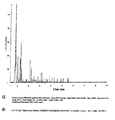
- the resulting doped carbon blacks have been investigated. It has been found that the nickel is well crystallized (nearly 100 percent). The various samples had nickel contents of between approximately 9 and approximately 50 weight percent.
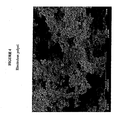
- the morphology of the nickel coated carbon black is shown exemplarily in Figure 2.
- the crystallite sizes for the nickel doping ranges between approximately 10 nanometers and approximately 10 micrometers. This is also the crystal size range for the other metals in accordance with the preferred embodiment.
- Example 2 Nickel coating of carbon black using crystallization and reduction.
- the carbon black was suspended in the nickel solution at a temperature of 80°C employing a nickel acetate solution (120 g nickel as acetate salt per liter). For higher doping more of the solution was used. The suspension of carbon black in the nickel solution is then progressively cooled to approximately surrounding temperature conditions and the solvent (water or methanol) is evaporated. Once the agitation of the suspension could no longer be carried out efficiently, the drying was finalized in an oven at 100°C.
- the reduction of the coated carbon blacks is carried out as described in example 1 at a temperature of 325°C in hydrogen.
- the SEM pictures of the product after reduction shows the doping of the carbon black with individual nickel crystals sometimes interconnected with each other. These crystals are located on the surface of the carbon black. This technique permits to obtain monocrystalline nickel.
- Example 3 Coating carbon black with nickel by precipitation and reduction
- the carbon black suspension in a nickel solution was subjected to precipitation by adding various precipitants.
- the reduction of the nickel hydroxides was thereafter carried out at 600°C in hydrogen with a consumption of 20 ml/min hydrogen employing hydrogen in a quantity of 3 times the stoichiometrically required quantity for total reduction of the nickel compound.
- the precipitation of the nickel hydroxide was carried out with various concentrations of sodium hydroxide.
- Products were obtained having a nickel content of about 8 weight percent to about 70 weight percent, the weight percent again being based on the total weight of the carbon black and the nickel.
- the carbon black was suspended in a molar solution of nickel chloride during one hour.
- the quantity of ammonia used corresponded to about 2.7 times the stoichiometrically required quantity.
- the ammonia was introduced in the form of a 25 weight percent ammonia solution. The pulp was then brought to the temperature of reaction.
- reaction water is added such as to compensate for the losses by evaporation and to maintain a constant volume of the solution.
- the product is washed and filtered. Care was taken to wet the carbon black completely with the solution prior to the precipitation step.
- the nickel compound was precipitated using ammonia. Very fine granules of nickel were obtained after reduction.
- the ammonia was employed generally in a molar ratio of ammonia to Ni between 1/1 and 6/1.
- the resulting product contained a precipitate of approximately 80 percent of the initially present nickel.
- the average granule size was in the range of 100 nm to 150 nm and the chlorine content less than 1 weight percent.
- the coated carbon black had a nickel contents which varied from 5.2 to over 85 weight percent.
- the urea was introduced into the suspension of carbon black in the nickel solution by employing an aqueous solution of urea having a urea concentration of 1 to 3 M.
- the operating conditions for these runs using urea as the precipitant are shown in the following table.
- Run Ni salt V sol Solution volume ml
- Nickel Concentration Carbon black content gCB/l
- MOlar ratio urea/nickel Stripping duration h
- temperature °C
- Precipitation % Carbon black after washing
- Initial g/l)
- Nickel content %w
- the structure of the nickel coated carbon black was comparable in these runs to the one obtained in earlier runs. Small monocrystalline nickel crystals were attached to the carbon black base. The size of the crystals appeared somewhat more uniform and in the range of 10 to 500 nanometers.
- Example 4 Nickel doping by an electroless plating methods
- the carbon black (Ensaco 250G) was subjected to a treatment in a nickel solution under conditions similar to classic electroless plating.
- the composition of the solution used for this purpose shown in the following table Nickel chloride 32 g/l Nickel sulfate 13 g/l Nickel hydrogen citrate 11,4 g/l Sodium hydrophosphite 73 g/l Ammonium chloride 100 g/l Led nitrate 2,4 g/l
- the carbon black was suspended in this electroless plating bath at room temperature. The thus obtained suspension is thereafter heated to 80°C.
- the conditions were chosen to provide 10 g or carbon black per liter of plating solution. At the end of the reaction the suspension is filtered and the filter cake is washed.
- the reaction was stopped after the solution changed from a green to a maroon colour approximately after 4 hours. At the end of the reaction the suspension is filtered and the filter cake is washed. The nickel doped carbon black was recovered. An SEM of a carbon black particle containing a fairly large magnetic nickel particle is shown in Figure 4. The nickel particle has been labeled "B". As a nickel source nickel acetate and nickel hydroxide are preferably used. A certain quantity of sulfuric acid can be used to increase the solubility of the nickel hydroxide.
- Example 5 Operating examples for the production of doped carbon black for ferromagnetic applications, EMI shielding and magneto rheological materials
- Impregnation Nickel acetate on carbon black Ensaco 250
- Electroless Nickel acetate on carbon black Ensaco 250 with Ethylene glycol
- Impregnation Nickel acetate on carbon black Ensaco 250
- Impregnation Cobalt acetate on carbon black Ensaco 250
- Impregnation Nickel acetate plus Cobalt acetate on carbon black Ensaco 250
- Polypropylene was blended in a Brabander with the metal coated carbon black at 200°C and shaped into sample plates of 20 x 50 x 2 mm for conductivity measurements. In addition disks of approximately 130 mm of diameter were shaped for coaxial measurement. In the following table the measurement results are shown. The ratio of the mass of carbon black (without nickel) to the mass of polypropylene plus carbon black is 0.2 in all the runs.
- Nickel content (Weight percent) Nickel content (Weight percent) Resistivity ( ⁇ .cm) PP1 un-doped 0 0 2.76 PP4 Impregnated with nickel chloride 9.9 2.1 2.9 PP6 Impregnated with nickel chloride 25.6 6.4 3.13 PP19 Impregnated with nickel chloride 46 16 2.6 PP26 Impregnated with nickel chloride 43.6 14.2 9 PP27 Crystallization with nickel acetate 73.6 30 3.65 PP28 Precipitation NaOH-NiCl 2 73.4 30 3.25 PP29 Precipitation NH 3 -NiCl 2 72 28.5 2.1 PP30 Precipitation NH 3 -NiCl 2 72.7 29.3 2.7
- the conductivity follows in a complex manner from the nickel content. It appears as if neither a continuos nickel phase nor a continuous carbon black phase has been established in the composites at the given concentrations.
- the samples of this example of the composite can be used for composites having magnetic properties and shielding properties.
- the ratio carbon black/polypropylene is the same for the two samples, name 2/3.
- the blend was formed into samples and the attenuation was measured in accordance with ASTM D4395-99.
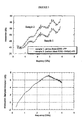
- the attenuation plotted against the measuring frequency is shown in Fig. 5.
- the lower line in the Figure is the one without nickel, the upper line is the one with nickel.
- the result shows that the nickel doped carbon black accomplishes an increase in attenuation of 1 to 7 dB in the GHz frequency range.
Landscapes
- Chemical & Material Sciences (AREA)
- Organic Chemistry (AREA)
- Engineering & Computer Science (AREA)
- Health & Medical Sciences (AREA)
- Chemical Kinetics & Catalysis (AREA)
- Medicinal Chemistry (AREA)
- Polymers & Plastics (AREA)
- Nanotechnology (AREA)
- General Physics & Mathematics (AREA)
- Condensed Matter Physics & Semiconductors (AREA)
- Composite Materials (AREA)
- Materials Engineering (AREA)
- Crystallography & Structural Chemistry (AREA)
- Physics & Mathematics (AREA)
- Compositions Of Macromolecular Compounds (AREA)
- Pigments, Carbon Blacks, Or Wood Stains (AREA)
- Carbon And Carbon Compounds (AREA)
- Manufacture Of Metal Powder And Suspensions Thereof (AREA)
- Manufacture Of Alloys Or Alloy Compounds (AREA)
- Materials For Medical Uses (AREA)
- Organic Low-Molecular-Weight Compounds And Preparation Thereof (AREA)
Applications Claiming Priority (2)
| Application Number | Priority Date | Filing Date | Title |
|---|---|---|---|
| DE10253399A DE10253399A1 (de) | 2002-11-15 | 2002-11-15 | Carbon-Black-Zusammensetzungen und ihre Anwendungen |
| EP03775364A EP1567602B1 (fr) | 2002-11-15 | 2003-11-17 | Compositions a base de noir de carbone et leurs applications |
Related Parent Applications (2)
| Application Number | Title | Priority Date | Filing Date |
|---|---|---|---|
| EP03775364A Division EP1567602B1 (fr) | 2002-11-15 | 2003-11-17 | Compositions a base de noir de carbone et leurs applications |
| EP03775364.7 Division | 2003-11-17 |
Publications (2)
| Publication Number | Publication Date |
|---|---|
| EP1852474A2 true EP1852474A2 (fr) | 2007-11-07 |
| EP1852474A3 EP1852474A3 (fr) | 2011-10-05 |
Family
ID=32185735
Family Applications (2)
| Application Number | Title | Priority Date | Filing Date |
|---|---|---|---|
| EP03775364A Expired - Lifetime EP1567602B1 (fr) | 2002-11-15 | 2003-11-17 | Compositions a base de noir de carbone et leurs applications |
| EP07114289A Withdrawn EP1852474A3 (fr) | 2002-11-15 | 2003-11-17 | Compositions de charbon noir et leurs applications |
Family Applications Before (1)
| Application Number | Title | Priority Date | Filing Date |
|---|---|---|---|
| EP03775364A Expired - Lifetime EP1567602B1 (fr) | 2002-11-15 | 2003-11-17 | Compositions a base de noir de carbone et leurs applications |
Country Status (12)
| Country | Link |
|---|---|
| US (1) | US20060116443A1 (fr) |
| EP (2) | EP1567602B1 (fr) |
| JP (1) | JP2006513120A (fr) |
| KR (1) | KR20060028381A (fr) |
| AT (1) | ATE370201T1 (fr) |
| AU (1) | AU2003283406A1 (fr) |
| CA (1) | CA2506189A1 (fr) |
| DE (2) | DE10253399A1 (fr) |
| EA (1) | EA200500825A1 (fr) |
| ES (1) | ES2291709T3 (fr) |
| PT (1) | PT1567602E (fr) |
| WO (1) | WO2004046257A2 (fr) |
Families Citing this family (38)
| Publication number | Priority date | Publication date | Assignee | Title |
|---|---|---|---|---|
| TWI381399B (zh) * | 2005-07-12 | 2013-01-01 | Sulzer Metco Canada Inc | 性能增進之導電性填料及由該填料製成的聚合物 |
| CN100515615C (zh) * | 2005-09-23 | 2009-07-22 | 上海华明高技术(集团)有限公司 | 一种炭包覆的磁性超细铁颗粒及其制造方法 |
| JP2007186544A (ja) * | 2006-01-11 | 2007-07-26 | Shin Etsu Chem Co Ltd | 導電性シリコーンゴム組成物 |
| US20080233402A1 (en) * | 2006-06-08 | 2008-09-25 | Sid Richardson Carbon & Gasoline Co. | Carbon black with attached carbon nanotubes and method of manufacture |
| US7700068B2 (en) * | 2006-07-19 | 2010-04-20 | Gm Global Technology Operations, Inc. | Method of making NiO and Ni nanostructures |
| US8780925B2 (en) * | 2006-08-17 | 2014-07-15 | Fonality, Inc. | Mobile use of a PBX system |
| KR100856137B1 (ko) * | 2007-08-08 | 2008-09-02 | 제일모직주식회사 | 전기전도성 열가소성 수지 조성물 및 그 성형품 |
| KR20100028356A (ko) * | 2008-09-04 | 2010-03-12 | 한국과학기술연구원 | 전이금속 산화물/다층벽 탄소나노튜브 나노복합체 및 이의 제조방법 |
| JP2010138015A (ja) * | 2008-12-10 | 2010-06-24 | Toshiba Corp | カーボンナノチューブの製造装置及びカーボンナノチューブを分別する方法 |
| US10279328B2 (en) * | 2009-02-27 | 2019-05-07 | Basf Corporation | Process for the preparation of metal-carbon containing bodies |
| EP2233207A1 (fr) * | 2009-02-27 | 2010-09-29 | Basf Se | Procédé pour la préparation de corps contenant du carbone et du métal |
| KR101269422B1 (ko) * | 2009-12-30 | 2013-06-04 | 제일모직주식회사 | 내마모성 및 전기전도성이 우수한 폴리카보네이트계 수지 조성물 및 그 제조방법 |
| EP2383374A1 (fr) * | 2010-04-29 | 2011-11-02 | BASF Corporation | Nanoparticules contenant du carbone et un métal ou un alliage ferromagnétique |
| KR101234317B1 (ko) * | 2011-02-21 | 2013-02-18 | 성균관대학교산학협력단 | 폐윤활유로부터 수소와 카본블랙의 제조 방법 |
| JP5706539B2 (ja) * | 2011-11-17 | 2015-04-22 | 日本電信電話株式会社 | 導電性高分子繊維、生体電極、体内埋め込み型電極、および生体信号測定装置 |
| KR101329974B1 (ko) * | 2012-01-12 | 2013-11-13 | 한화케미칼 주식회사 | 복합탄소소재를 포함하는 전자파 차폐용 수지 조성물 |
| US10023717B2 (en) | 2014-03-05 | 2018-07-17 | Penn Color, Inc. | Thermally-conductive salt-containing particles of carbon black and metal |
| WO2015168327A1 (fr) | 2014-04-29 | 2015-11-05 | Rennovia Inc. | Produits poreux mis en forme à base de noir de carbone |
| US11253839B2 (en) | 2014-04-29 | 2022-02-22 | Archer-Daniels-Midland Company | Shaped porous carbon products |
| WO2015195773A1 (fr) | 2014-06-18 | 2015-12-23 | Sid Richardson Carbon, Ltd | Noir de carbone hybride à nanopointes |
| US10722867B2 (en) | 2015-10-28 | 2020-07-28 | Archer-Daniels-Midland Company | Porous shaped carbon products |
| US10464048B2 (en) | 2015-10-28 | 2019-11-05 | Archer-Daniels-Midland Company | Porous shaped metal-carbon products |
| SE542988C2 (en) * | 2016-01-15 | 2020-09-22 | Jfe Steel Corp | Mixed powder for powder metallurgy |
| US11383213B2 (en) | 2016-03-15 | 2022-07-12 | Honda Motor Co., Ltd. | System and method of producing a composite product |
| US11171324B2 (en) | 2016-03-15 | 2021-11-09 | Honda Motor Co., Ltd. | System and method of producing a composite product |
| US11081684B2 (en) | 2017-05-24 | 2021-08-03 | Honda Motor Co., Ltd. | Production of carbon nanotube modified battery electrode powders via single step dispersion |
| CN109305879B (zh) * | 2017-07-28 | 2021-09-07 | 中国石油化工股份有限公司 | 一种醇类化合物的合成方法 |
| US20190036102A1 (en) | 2017-07-31 | 2019-01-31 | Honda Motor Co., Ltd. | Continuous production of binder and collector-less self-standing electrodes for li-ion batteries by using carbon nanotubes as an additive |
| US10658651B2 (en) | 2017-07-31 | 2020-05-19 | Honda Motor Co., Ltd. | Self standing electrodes and methods for making thereof |
| US11201318B2 (en) | 2017-09-15 | 2021-12-14 | Honda Motor Co., Ltd. | Method for battery tab attachment to a self-standing electrode |
| US11121358B2 (en) | 2017-09-15 | 2021-09-14 | Honda Motor Co., Ltd. | Method for embedding a battery tab attachment in a self-standing electrode without current collector or binder |
| US11535517B2 (en) | 2019-01-24 | 2022-12-27 | Honda Motor Co., Ltd. | Method of making self-standing electrodes supported by carbon nanostructured filaments |
| US12381275B2 (en) | 2019-01-30 | 2025-08-05 | Honda Motor Co., Ltd. | Stretchable and flexible lithium ion battery |
| US12142771B2 (en) | 2019-01-30 | 2024-11-12 | Honda Motor Co., Ltd. | Flexible battery as an integration platform for wearable sensors and processing/transmitting devices |
| US11325833B2 (en) | 2019-03-04 | 2022-05-10 | Honda Motor Co., Ltd. | Composite yarn and method of making a carbon nanotube composite yarn |
| US11352258B2 (en) | 2019-03-04 | 2022-06-07 | Honda Motor Co., Ltd. | Multifunctional conductive wire and method of making |
| US11539042B2 (en) | 2019-07-19 | 2022-12-27 | Honda Motor Co., Ltd. | Flexible packaging with embedded electrode and method of making |
| CN115229199B (zh) * | 2022-09-23 | 2022-12-27 | 西安稀有金属材料研究院有限公司 | 诱导形核制备高分散高孔隙率超细二氧化钼和钼粉的方法 |
Family Cites Families (29)
| Publication number | Priority date | Publication date | Assignee | Title |
|---|---|---|---|---|
| GB1061729A (en) * | 1962-09-28 | 1967-03-15 | Cabot Corp | Carbon black pigments |
| DE1191505B (de) * | 1962-09-28 | 1965-04-22 | Cabot Corp | Verfahren zur Herstellung von feinteiligen russhaltigen Pigmenten mit magnetischer Suszeptibilitaet |
| US3298984A (en) * | 1963-06-06 | 1967-01-17 | Goodyear Tire & Rubber | Method of reinforcing a rubber latex with carbon black by preblending said carbon black with a phenol-aldehyde resin |
| US3595614A (en) * | 1969-11-21 | 1971-07-27 | Olin Corp | Amalgam decomposition |
| US4137373A (en) | 1977-11-23 | 1979-01-30 | United Technologies Corporation | Platinum catalyst and method for making |
| US4447506A (en) | 1983-01-17 | 1984-05-08 | United Technologies Corporation | Ternary fuel cell catalysts containing platinum, cobalt and chromium |
| JPS62269751A (ja) * | 1986-05-16 | 1987-11-24 | Nippon Engeruharudo Kk | 白金−銅合金電極触媒およびそれを使用した酸電解質燃料電池用電極 |
| JPH0625312B2 (ja) * | 1987-02-13 | 1994-04-06 | 東海カ−ボン株式会社 | 強磁性カ−ボンブラツクおよびその製造方法 |
| US4900465A (en) * | 1987-02-13 | 1990-02-13 | Tokai Carbon Co., Ltd. | Process for preparing magnetic carbon black |
| JPH03167714A (ja) * | 1989-11-27 | 1991-07-19 | Nisshin:Kk | 導電性複合体 |
| JPH06122512A (ja) * | 1991-02-20 | 1994-05-06 | Mitsubishi Heavy Ind Ltd | カーボンブラックの表面処理方法 |
| JP2879870B2 (ja) * | 1992-07-17 | 1999-04-05 | 日立金属株式会社 | 画像形成方法 |
| JP3307443B2 (ja) * | 1992-11-19 | 2002-07-24 | ティーディーケイ株式会社 | 磁性粉体の選別方法 |
| US5759944A (en) | 1993-04-20 | 1998-06-02 | Johnson Matthey Public Limited Company | Catalyst material |
| US6471745B1 (en) * | 1996-06-28 | 2002-10-29 | University Of Delaware | Nanoporous carbon catalytic membranes and method for making the same |
| US6017980A (en) * | 1997-03-27 | 2000-01-25 | Cabot Corporation | Elastomeric compounds incorporating metal-treated carbon blacks |
| US6214507B1 (en) * | 1998-08-11 | 2001-04-10 | Xerox Corporation | Toner compositions |
| JP2000208985A (ja) * | 1998-11-10 | 2000-07-28 | Seiwa Electric Mfg Co Ltd | 電磁波シ―ルドパテ |
| US6284175B1 (en) * | 1999-04-29 | 2001-09-04 | Northrop Grumman Corporation | Method for reducing reflected radio frequency electromagnetic radiation |
| JP2001036285A (ja) * | 1999-07-23 | 2001-02-09 | Marunitto:Kk | 電磁シールド用ゴムシート |
| US6277510B1 (en) * | 1999-07-30 | 2001-08-21 | Industrial Technology Research Institute | Porous electrode used for conductive material-filled polymer composite |
| JP4146973B2 (ja) * | 1999-08-03 | 2008-09-10 | シーケーディ株式会社 | 電磁弁の組立方法 |
| US7122286B2 (en) * | 2000-04-05 | 2006-10-17 | Ricoh Company, Ltd. | Toner for development of electrostatic latent images, method of forming images, image formation apparatus, toner container containing the toner therein, and image formation apparatus equipped with the toner container |
| JP4154111B2 (ja) * | 2000-06-09 | 2008-09-24 | 富士フイルム株式会社 | 磁気記録媒体 |
| JP2002069689A (ja) * | 2000-08-28 | 2002-03-08 | Yuken Industry Co Ltd | 粉末の電気めっき方法 |
| JP3433172B2 (ja) * | 2000-09-22 | 2003-08-04 | 本田技研工業株式会社 | 固体高分子型燃料電池 |
| JP4360589B2 (ja) * | 2000-10-20 | 2009-11-11 | 株式会社リコー | 二成分現像剤、及びそれを使用する画像形成装置、画像形成方法 |
| US6627058B1 (en) * | 2001-01-17 | 2003-09-30 | E. I. Du Pont De Nemours And Company | Thick film conductor composition for use in biosensors |
| US6607857B2 (en) * | 2001-05-31 | 2003-08-19 | General Motors Corporation | Fuel cell separator plate having controlled fiber orientation and method of manufacture |
-
2002
- 2002-11-15 DE DE10253399A patent/DE10253399A1/de not_active Withdrawn
-
2003
- 2003-11-17 CA CA002506189A patent/CA2506189A1/fr not_active Abandoned
- 2003-11-17 EA EA200500825A patent/EA200500825A1/ru unknown
- 2003-11-17 ES ES03775364T patent/ES2291709T3/es not_active Expired - Lifetime
- 2003-11-17 JP JP2004552630A patent/JP2006513120A/ja active Pending
- 2003-11-17 PT PT03775364T patent/PT1567602E/pt unknown
- 2003-11-17 KR KR1020057008792A patent/KR20060028381A/ko not_active Ceased
- 2003-11-17 EP EP03775364A patent/EP1567602B1/fr not_active Expired - Lifetime
- 2003-11-17 EP EP07114289A patent/EP1852474A3/fr not_active Withdrawn
- 2003-11-17 DE DE60315701T patent/DE60315701T2/de not_active Expired - Lifetime
- 2003-11-17 AT AT03775364T patent/ATE370201T1/de not_active IP Right Cessation
- 2003-11-17 US US10/534,778 patent/US20060116443A1/en not_active Abandoned
- 2003-11-17 WO PCT/EP2003/012847 patent/WO2004046257A2/fr not_active Ceased
- 2003-11-17 AU AU2003283406A patent/AU2003283406A1/en not_active Abandoned
Also Published As
| Publication number | Publication date |
|---|---|
| PT1567602E (pt) | 2007-11-22 |
| EP1852474A3 (fr) | 2011-10-05 |
| DE10253399A1 (de) | 2004-05-27 |
| JP2006513120A (ja) | 2006-04-20 |
| US20060116443A1 (en) | 2006-06-01 |
| DE60315701T2 (de) | 2008-06-05 |
| EA200500825A1 (ru) | 2006-06-30 |
| WO2004046257A3 (fr) | 2004-07-29 |
| WO2004046257A2 (fr) | 2004-06-03 |
| ES2291709T3 (es) | 2008-03-01 |
| AU2003283406A1 (en) | 2004-06-15 |
| EP1567602A2 (fr) | 2005-08-31 |
| EP1567602B1 (fr) | 2007-08-15 |
| DE60315701D1 (de) | 2007-09-27 |
| KR20060028381A (ko) | 2006-03-29 |
| ATE370201T1 (de) | 2007-09-15 |
| CA2506189A1 (fr) | 2004-06-03 |
Similar Documents
| Publication | Publication Date | Title |
|---|---|---|
| EP1852474A2 (fr) | Compositions de charbon noir et leurs applications | |
| KR101004553B1 (ko) | 미소 은 입자 함유 조성물, 그 제조방법, 미소 은 입자의 제조방법 | |
| Zhu et al. | Microwave-assisted preparation of inorganic nanostructures in liquid phase | |
| KR101414560B1 (ko) | 전도성 필름의 제조방법 | |
| Ebin et al. | Production and characterization of ZnO nanoparticles and porous particles by ultrasonic spray pyrolysis using a zinc nitrate precursor | |
| KR20160040090A (ko) | 나노금속과 탄소나노소재의 복합체 제조방법 | |
| EP2525906A2 (fr) | Substance du type nano-tétrathiométallate ou nano-tétrasélénométallate | |
| Wang et al. | Solution synthesis of triangular and hexagonal nickel nanosheets with the aid of tungsten hexacarbonyl | |
| CN104338935B (zh) | 一种简单快速制备纳米WC-Co复合粉的方法 | |
| EP0758920B1 (fr) | Catalyseurs ameliores destines a la production de fibrilles en carbone et leurs procedes d'utilisation | |
| CN104070178A (zh) | 一种粒径可控的单分散铋纳米粒子的制备方法 | |
| KR101061841B1 (ko) | 화학환원법에 의한 단분산 구형 은 분말의 제조방법 | |
| Byrappa | Novel hydrothermal solution routes of advanced high melting nanomaterials processing | |
| KR100251294B1 (ko) | 염기성 금속 산화물 담지 철족 전이 금속 촉매를 이용한 미세 탄소 섬유의 제조 방법 | |
| EP2526060B1 (fr) | Procédé de préparation d'une substance du type thiométallate ou sélénométallate | |
| Sebastian et al. | Magnetically-driven selective synthesis of Au clusters on Fe 3 O 4 nanoparticles | |
| DE102008004135B4 (de) | Katalysatorpulver | |
| EP2646598B1 (fr) | Procédé de revêtement métallique de nanoparticules par des techniques de dépôt autocatalytique | |
| EP2526061A1 (fr) | Procédé de préparation d'une substance du type thiométallate ou sélénométallate | |
| CN114940511A (zh) | 十八面体钼氧化物的制备方法 | |
| Ammar et al. | Preparation and characterization of magnetic nickel nanoparticles by chemical reduction reaction | |
| Malchenko et al. | Formation of iron oxide films from stabilized magnetite sols—magnetic liquids | |
| CN109896541A (zh) | 一种超细氧化亚铜粉的制备方法 | |
| Kinka et al. | CCVD preparation of highly uniform carbon micro-and nanocoil fibers | |
| Reningtyas et al. | Effect of zinc nitrate concentration on the synthesis of zinc oxide nano particle using precipitation sonication-assisted method |
Legal Events
| Date | Code | Title | Description |
|---|---|---|---|
| PUAI | Public reference made under article 153(3) epc to a published international application that has entered the european phase |
Free format text: ORIGINAL CODE: 0009012 |
|
| AC | Divisional application: reference to earlier application |
Ref document number: 1567602 Country of ref document: EP Kind code of ref document: P |
|
| AK | Designated contracting states |
Kind code of ref document: A2 Designated state(s): AT BE BG CH CY CZ DE DK EE ES FI FR GB GR HU IE IT LI LU MC NL PT RO SE SI SK TR |
|
| RIN1 | Information on inventor provided before grant (corrected) |
Inventor name: GRIVEI, EUSEBIU Inventor name: PROBST, NICOLAS Inventor name: MINET, PHILIPPE Inventor name: VAN LIERDE, ANDRE Inventor name: FOCKEDEY, ETIENNE |
|
| PUAL | Search report despatched |
Free format text: ORIGINAL CODE: 0009013 |
|
| AK | Designated contracting states |
Kind code of ref document: A3 Designated state(s): AT BE BG CH CY CZ DE DK EE ES FI FR GB GR HU IE IT LI LU MC NL PT RO SE SI SK TR |
|
| RIC1 | Information provided on ipc code assigned before grant |
Ipc: B82Y 30/00 20110101ALI20110831BHEP Ipc: C01B 31/02 20060101ALI20110831BHEP Ipc: C09C 1/56 20060101AFI20110831BHEP Ipc: C08K 3/04 20060101ALI20110831BHEP Ipc: C08K 3/08 20060101ALI20110831BHEP |
|
| AKY | No designation fees paid | ||
| REG | Reference to a national code |
Ref country code: DE Ref legal event code: R108 |
|
| REG | Reference to a national code |
Ref country code: DE Ref legal event code: R108 Effective date: 20120613 |
|
| STAA | Information on the status of an ep patent application or granted ep patent |
Free format text: STATUS: THE APPLICATION IS DEEMED TO BE WITHDRAWN |
|
| 18D | Application deemed to be withdrawn |
Effective date: 20120406 |