EP1855211A2 - Maschinenübersetzung über elastische Stücke - Google Patents
Maschinenübersetzung über elastische Stücke Download PDFInfo
- Publication number
- EP1855211A2 EP1855211A2 EP07107680A EP07107680A EP1855211A2 EP 1855211 A2 EP1855211 A2 EP 1855211A2 EP 07107680 A EP07107680 A EP 07107680A EP 07107680 A EP07107680 A EP 07107680A EP 1855211 A2 EP1855211 A2 EP 1855211A2
- Authority
- EP
- European Patent Office
- Prior art keywords
- fragments
- text
- target
- fragment
- language
- Prior art date
- Legal status (The legal status is an assumption and is not a legal conclusion. Google has not performed a legal analysis and makes no representation as to the accuracy of the status listed.)
- Withdrawn
Links
Images


Classifications
-
- G—PHYSICS
- G06—COMPUTING OR CALCULATING; COUNTING
- G06F—ELECTRIC DIGITAL DATA PROCESSING
- G06F40/00—Handling natural language data
- G06F40/40—Processing or translation of natural language
- G06F40/42—Data-driven translation
- G06F40/44—Statistical methods, e.g. probability models
Definitions
- the present invention is directed to the field of machine translation. It finds particular application in the translation of non-contiguous bi-fragments of text.
- Example-Based Machine Translation seeks to exploit and integrate a number of knowledge resources, such as linguistics and statistics, and symbolic and numerical techniques, for integration into one framework. In this way, rule-based morphological, syntactic and/or semantic information is combined with knowledge extracted from bilingual texts which is then re-used in the translation process.
- bi-fragments are pairs of equivalent fragments of text, one in the source language (the language in which a document to be translated is expressed), one in the target language (the language into which the document is to be translated). Such methods are often collectively referred to as "phrase-based methods".
- the bi-fragments on which they operate are harvested automatically from large collections of previously translated texts ("bilingual parallel corpora"), and stored in a database. When given a new segment of text to translate, these systems search the database to extract all relevant bi-fragments, i.e., items in the database whose source-language fragment matches some portion of the new input. A subset of these matching bi-fragments is then searched for, such that each word of the input text is covered by exactly one bi-fragment in the subset, and that the combination of the target-language fragments produces a coherent translation.
- phrase-based models proposed so far only deal with multi-word units that are sequences of contiguous words on both the source and the target side.
- the quality of the resulting translation is assessed by means of a statistical translation model, which estimates the probability of observing some target-language segment of the text as the translation of the given source-language input.
- the translation problem reduces to that of finding the combination of bi-fragments which produces the most probable translation. This is a complex task, because the number of possible translations typically grows exponentially with the size of the input, and so not all solutions can be examined in practice.
- Sub-optimal search procedures are usually employed, that rely on dynamic programming, A*-like beam-search, or heuristic hill-climbing methods.
- aspects of the exemplary embodiment relate to a machine translation method and system for machine translation.
- a machine translation method for translating source text from a first language to target text in a second language.
- the method includes receiving the source text in the first language, accessing a library of bi-fragments, each of the bi-fragments including a text fragment from the first language and a text fragment from the second language. At least some of the bi-fragments are modeled as elastic bi-fragments in which words of a fragment are spaced by a gap which is able to assume a variable size corresponding to a number of other words which are to occupy the gap.
- the method further includes retrieving text fragments from the second language from the library corresponding to text fragments in the source text, and generating at least one target hypothesis.
- Each of the target hypotheses includes text fragments selected from the second language.
- the target hypothesis is evaluated with a translation scoring function which scores the target hypothesis according to a plurality of feature functions.
- At least one of the feature functions includes a gap size scoring feature which favors hypotheses with statistically more probable gap sizes over hypotheses with statically less probable gap sizes.
- a machine translation system for translating source text from a first language to target text in a second language.
- the translation system includes a library of bi-fragments.
- Each of the bi-fragments includes a text fragment from the first language and a text fragment from the second language.
- At least some of the bi-fragments are modeled as elastic bi-fragments in which words of a fragment are spaced by a gap which is able to assume a variable size corresponding to a number of other words which are to occupy the gap.
- Each of the elastic bi-fragments is associated in memory with a parameter representative of a gap size distribution for the bi-fragment.
- a processor executes instructions for retrieving text fragments from the second language from the library corresponding to text fragments in the source text and for generating at least one target hypothesis, each of the target hypotheses comprising text fragments selected from the second language, and for evaluating the hypothesis with a translation scoring function which scores the hypothesis according to a plurality of features, at least one of the features including a gap size scoring feature which favors hypotheses comprising text fragments with statistically more probable gap sizes over hypotheses with statically less probable gap sizes.
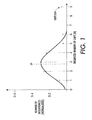
- FIGURE 1 is a simulated distribution of gaps in a target phrase of a bi-phrase for a selected number of gaps in the corresponding source phrase.
- FIGURE 2 is a block diagram of a system for machine translation of text which utilizes non-contiguous bi-fragments according to one aspect of the exemplary embodiment
- FIGU RE 3 is a flow diagram of a method for machine translation of text which utilizes elastic bi-fragments according to one aspect of the exemplary embodiment
- FIGURE 4 is an example of the combination of bi-fragments to produce a translation
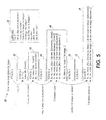
- FIGURE 5 illustrates the development of hypothesis stacks for a partial translation of the sentence illustrated in FIGURE 4.
- aspects of the exemplary embodiment relate to a method for translating source text from a first language to target text in a second language.
- the method may include receiving the source text in the first language and accessing a library of bi-fragments, each of the bi-fragments including a text fragment from the first language and a text fragment from the second language. At least some of the bi-fragments are modeled as elastic bi-fragments in which words of a fragment are spaced by a gap which is able to assume a variable size corresponding to a number of other words which are to occupy the gap.
- Text fragments from the second language are retrieved from the library. Each of the retrieved text fragments is linked in a bi-phrase in the library to a text fragment from the source text. At least one target hypothesis is generated.
- Each of the target hypotheses comprises text fragments selected from the second language.
- the hypothesis may be scored according to a plurality of feature functions, at least one of the feature functions comprising a gap size scoring feature which favors statistically more probable gap sizes over statically less probable gap sizes.
- the scoring may include maximizing a log-linear scoring function in which weights are assigned to each of the feature functions.
- bi-fragments comprising contiguous text fragments may be modeled as elastic bi-phrases.
- the generation of a target hypothesis may include generating a partial hypothesis comprising a sequence of words without gaps from the text fragments selected from the second language and storing any unconsumed words of the text fragments used in generating the sequence in a buffer.
- the generation of a hypothesis may include expanding an existing partial hypothesis by at least one of (a) adding a word of a new text fragment to the sequence of words, and (b) retrieving an unconsumed word from the buffer to the sequence of words.
- the gap size scoring feature may model gap sizes observed in a training corpus as a distribution which is expressed in terms of a parameter of the distribution.
- the distribution may comprise a Poisson distribution and the parameter of the distribution may comprise a mean value of the Poisson distribution.
- the distribution may ignore gap sizes which are determined to constitute outliers.
- Each elastic bi-fragment may be associated in the library with at least one parameter of a distribution function which is representative of a distribution of acceptable gap sizes for the elastic bi-phrase, the gap size scoring feature utilizing the parameters of the selected text fragments in the evaluation of the hypothesis.
- the generating of a target hypothesis includes performing a multiple stack beam-search.
- the generating of at least one target hypothesis may include generation of a plurality of partial translation hypotheses, scoring the partial hypotheses, and optionally pruning partial translation hypotheses according to their scores.
- the scoring of the partial hypotheses may favor adding source words to a partial translation in which a gap exists in an elastic fragment until a mean gap size of a distribution for the elastic fragment is reached and thereafter favors minimizing further increase to the gap size in the partial translation.
- the evaluation of the at least one hypothesis may include selecting a hypothesis from a plurality of hypotheses which maximizes a log-linear scoring function in which weights are assigned to each of the feature functions.
- the log-linear scoring function may further include a bi-fragment feature h bf which estimates a log of the probability of observing a bi-fragment ( s,t ) given the source phrase s from a ratio of the occurrences of the bi-fragment ( s , t ) and source phrase s in a training corpus, without consideration to the size of any gaps between words in the bi-fragment and wherein the gap size scoring feature h ELAST estimates a probability for gap sizes assigned to ( s , t ) in the translation, relative to a gap size distribution associated with the bi-fragment ( s , t ) in the training corpus.
- a bi-fragment feature h bf which estimates a log of the probability of observing a bi-fragment ( s,t ) given the source phrase s from a ratio of the occurrences of the bi-fragment ( s , t ) and source phrase s in a training corpus, without consideration to the size of
- the translation scoring function may utilize a log-linear scoring model of the form: Pr t 1 J , d 1 K
- the translation scoring function may output a translation for which the log-linear scoring model is maximized.
- the method may further include outputting a target language text string based on a scoring of the hypotheses.
- a machine translation system for translating source text from a first language to target text in a second language may include memory which stores instructions for performing the exemplary method and a processor which executes the instructions.
- An article of manufacture may be a program storage medium readable by a computer comprising instructions for executing the exemplary method.
- a machine translation system translates source text from a first language to target text in a second language.
- the translation system includes a library of bi-fragments, each of the bi-fragments including a text fragment from the first language and a text fragment from the second language. At least some of the bi-fragments are modeled as elastic bi-fragments in which words of a fragment are spaced by a gap which is able to assume a variable size corresponding to a number of other words which are to occupy the gap.
- the elastic bi-fragments are associated with a probability distribution parameter which enables statistically more probable gap sizes to be favored in a translation hypothesis gap size scoring feature.
- the system includes a processor which executes instructions for receiving the source text in the first language, accessing the library to retrieve text fragments from the second language, scoring hypotheses according to a plurality of features including the gap scoring feature.
- the translation scoring function may further include at least one of (a) a second feature function which evaluates bi-fragment discontinuities, and (b) a third feature function which evaluates bi-fragment reorderings.
- the second feature function counts gaps in the target text of the hypothesis and corresponding source text.
- the library may associates each of a plurality of elastic bi-fragments with a corresponding parameter representative of a probability distribution of gaps in at least one of the source text fragment and the target text fragment.
- the processor may include instructions for generation of a hypothesis which includes expanding an existing partial hypothesis by at least one of (a) adding a word of a new text fragment to the sequence of words, and (b) retrieving an unconsumed word from the buffer to the sequence of words.
- U.S. Application Serial No. 11/315,043, filed December 22, 2005 , entitled MACHINE TRANSLATION USING NON-CONTIGUOUS FRAGMENTS OF TEXT, discloses a computer implemented system and method for translating source text from a first language to target text in a second language different from the first language and to a method of training such a translation system.
- Cancedda, et al. discloses a computer implemented system and method for translating source text from a first language to target text in a second language different from the first language and to a method of training such a translation system.
- a phrase-based statistical machine translation method is provided, based on non-contiguous bi-phrases, i.e., source or target phrases with gaps, in which each gap represents a placeholder for a word.
- the gaps between the words are of a predefined, fixed size (represented here by the symbol ⁇ ).
- ⁇ the gap sizes
- different gap sizes can result in different hypotheses, each one being separately analyzed.
- the decoder has to store and process these different hypotheses in complete isolation from each other, although they share many characteristics and could to a large extent be factorized. Also, the decoder has a tendency to make blind predictions on the size of the gaps before it is able to evaluate the quality and compatibility of potential filling material, which depends both on the language model and on the availability of other elements of the bi-phrase library.
- the nort-contiguous bi-phrase ne ⁇ plus I not ⁇ anymore can be used for producing the following translation: je ne cola plus danserle tango / I do not want to tango anymore.
- a different bi-phrase ne ⁇ plus I not ⁇ anymore is used to produce the translation: je ne horn plus faire la vaisselle l I do not want to do the dishes anymore; in order to produce that translation the building block with a gap on the target side of size five instead of three is needed.
- the gaps can assume different sizes with certain probabilities.
- An advantage of such a model is that the bi-phrases obtained generalize over the training data. As a consequence, the model is able to consider an extended and more representative class of potential translations and to evaluate them more accurately.
- the exemplary embodiment introduces the notion of elastic bi-phrase, and provides a decoding mechanism for producing translations using the resulting model.
- a decoder for handling such "elastic" bi-phrases may buffer the parts of elastic phrases in the target text which are not yet consumed, and may use a heuristic cost function that takes into account these buffered parts in assessing the value of a partial translation hypothesis.
- a statistical translation model is provided that deals with such phrases.
- a training method is provided which is based on the maximization of translation accuracy, for example, as measured with the National Institute of Standards and Technology (NIST) evaluation metric.
- the translations may be produced by means of a beam-search decoder or other suitable optimizing function which takes into account the probabilities of various hypothetical translations being found in practice.
- the exemplary translation method translates natural language text, such as French to English, using as primary resource a collection of bi-fragments, i.e., matching pairs of source-target fragments of text. Translations are produced by combining together such bi-fragments.
- a search for the optimal combination may be performed by means of a specially adapted, multiple-stack beam search. Within this search procedure, the potential of each candidate translation is evaluated by means of a statistical model of translation.
- phrase generally refers to two or more words in either the source or target language.
- non-contiguous phrase refers to two or more words in either the source or target language wherein two of the words are separated by a gap of at least one word.
- Each non-contiguous phrase includes a first portion comprising at least one word, which is separated from a second portion, comprising at least one word, by a gap of at least one word.
- a "bi-fragment,” as used herein, generally comprises two text fragments: a first text fragment in the source language and a second text fragment in the target language, which is a translation of the first text fragment.
- the first and second text fragments may be a word or a phrase.
- the first and second fragments are associated in a word-aligned corpora, such as a library stored in memory, whereby a target fragment corresponding to an input source fragment may be retrieved. It will be appreciated that a text fragment in one language may appear in more than one bi-fragment, where multiple translations exist.
- a "non-contiguous bi-fragment,” as used herein, refers to a bi-fragment in which at least one of the text fragments comprises a non-contiguous phrase.
- both fragments of a bi-fragment are phrases (i.e., a bi-phrase) although they need not be so.
- bi-phrases it is to be appreciated that the more general case of a bi-fragment is also contemplated, unless otherwise noted.
- Each non-contiguous bi-fragment may be treated as an "elastic bi-fragment" and may be associated, in memory, with a gap function, which is related to a statistical probability of the number of gaps in the target fragment for a given number of gaps in the source fragment. This may be used to determine a cost function to a given hypothesis in a scoring model. In general, the cost decreases as the hypothesis moves toward a number of gaps which corresponds to the statistically determined most likely number of gaps. If the most likely number of gaps has already been exceeded in a partial translation, the cost favors inserting the second part of the target fragment sooner rather than later.
- the bi-fragments may be learned from a large aligned bilingual corpus comprising source text and its translation into target text.
- the statistics of bi-phrases can be established through observation of a corpus. It is to be appreciated that direct observation of a bi-phrase in a given sentence pair is not necessary, but rather the presence of such a bi-phrase can be indirectly induced through phrase-level alignment mechanisms. However, once this presence is established, the size of the gaps may be unambiguously determined.
- a probability distribution (or a mean of the probability distribution) representing the statistical probabilities of number of gaps in the target fragment for each observed number of gaps in the source may be stored and used to develop distributions.
- Each elastic bi-phrase is considered to be a pair of gapped phrases, one in the source language and one in the target language.
- Each source phrase includes k gaps and an ordered list of k+1 components, where each component comprises one or more words of the phrase.
- Each of the k gaps allows one word from another phrase to be inserted between two of the words of the elastic phrase.
- each target phrase includes / gaps and /+ 1 components. Both k and l can independently assume a positive natural number, including 0, such as 0, 1, 2, 3, 4, 5 etc. Although when k or / takes a value of zero there is no actual gap, it is convenient to model the gaps in this way.
- An elastic bi-phrase is thus a triple of the form ( s, t, dist) where s is a source gapped phrase, t is a target gapped phrase, dist is a probability distribution over N k x N 1 , where k and l are the number of gaps of s and t , respectively, and N represents the set of positive natural numbers.
- the distribution dist is used to model the conditional probability of getting specific sizes for each of the k source and l target gaps conditional on the actual use of the given gapped bi-phrase in a (sentence-level) translation.
- elastic bi-phrases is a generalized one. In particular it can be used to model the empirical distribution of gaps for a given bi-phrase, without any smoothing/generalization, by just recording a histogram of the observed gap sizes in the training corpus. It also allows the modeling of conditional dependencies between gaps. However, the main interest of this definition appears when some a priori knowledge about such distributions is available.
- gaps in source and target phrases are modeled utilizing one or more of the following simplifying assumptions:
- each phrase is considered to be a gapped phrase with a gap between each word.
- the phrase "take the train ... from ... to” is considered as take... the ... train ... from ... to, where it is assumed that gaps exist between all the words.
- the distribution for the corresponding gap size is considered to be concentrated on the single value 0 (a limit case of the Poisson distribution with mean 0).
- contiguous and discontinuous phrases can be treated under a single type, with has the advantage of avoiding the need to learn separately different combinations of contiguous/non-contiguous components with the associated sparseness issues.
- the model may include other variants.
- gaps on the source side are estimated independently of the target side. Rather than determining the mean values of a source gap by reference to the instances of ( s,t ) in the training corpus, it may be determined by pooling all the instances of bi-phrases ( s,t' ) where t ' may be different from t . The pooled estimates can than replace standard estimates, or they can be used as a back-off when too few occurrences of a bi-phrase are observed, and the standard estimates are likely to be unreliable. Gaps on the target side can be modeled analogously.
- gaps are considered to be represented by a Poisson distribution
- other distributions may be used.
- Another aspect of the modeling of the gap distribution may include the handling of outliers.
- Outliers are gap sizes for which an unusually large or unusually small number of instances are observed in the training corpus.
- An exemplary outlier is illustrated in FIGURE 1.
- outliers are ignored in determining the distribution. If, for example, for a given gap, many instances are observed in the training corpus where its value is 0, and then a single or few instances with large values, it is likely that the discrepancy is due to a defect of the chunking procedure on which the counts are based. As will be appreciated, this occurs because the alignments are constructed, and not directly observed. In such cases, it may be appropriate to discard the few suspect instances and force the distribution to have mean 0. More generally, when a few instances are observed that have significantly larger values than the mass of the other instances, it is appropriate to discard them. Standard robust statistics may be used for treating "atypical" instances as outliers.
- the target sentence "He did not catch the train to Paris this week because he had no desire to travel by train anymore” may be observed as including the non-contiguous phrase not_anymore with a gap size of 16.
- the word anymore is not semantically related to not, and thus the outlier gap size of 16 would generate a mean value ⁇ which is too large if this instance were to be used in determining the distribution. Accordingly, it is appropriate to ignore it.
- the model presupposes that, for each bi-phrase, the empirical statistics of its observed gap sizes in the training corpus are available.
- a static library of bi-chunks constructed according to the method of Cancedda, et al. is used as the information source for obtaining these statistics.
- a first step may include grouping the bi-chunks in the library according to the equivalence relation "same apart from gap sizes" (that is, belonging to the same bi-phrase), and then estimate the mean of each gap relative to the group.
- the present bi-chunk library may be obtained by combination of the elementary bi-chunks or cepts found in the library of Cancedda, et al.
- the translation of a source sentence f is produced by combining together bi-fragments so as to entirely cover the source sentence, and produce a well-formed target-language sentence, i.e., a sequence without gaps.
- FIGURE 2 a block diagram of an automated natural language translation system 10 for translating text comprising elastic bi-fragments is illustrated.
- Text is input to the system by an input device 12.
- Input text may be directly input into the natural language translation system 10 (for example, as with a person typing sentences into a computer using a keyboard).
- input text to natural language translation system 10 may be the output of another system, such as, for example, output from a speech recognition system (for example, speech input device) or from an optical character recognition system (not shown).
- the text may be input from a database or word document.
- the text may include one or more sentences, such as a paragraph or an entire document comprising multiple paragraphs.
- the translation system 10 includes a processing component 16 and a memory component 18. A part or all of the memory component 18 may be located remote from the processing component 16 and accessed by a wired or wireless link.
- the memory component stores a library of bi-fragments 20, including non-contiguous bi-fragments.
- the processing component 16 executes instructions for performing the method of FIGURE 3, which may be stored in memory 18.
- the illustrated processing component includes a translation module or decoder 22. Working on a string of contiguous words in the source language, such as a sentence of the input text, the translation module 22 accesses the library 20 to retrieve fragments in the target language corresponding to input fragments in the source language text string.
- the processing component includes a scoring module 24 which evaluates partial and/or full translation hypotheses to identify probable translations of the text string.
- a system bus 26 provides outputs to an output device 28, such as one or more of a visual display device (such as a monitor with a screen), a hard copy device (such as a printer), and an audible output device (such as, for example, an audio speaker).
- Translated strings of text and the entire text, once translated, may be stored in volatile or non-volatile memory 30.
- the system 10 may be instantiated in a personal computer in which the memory 18 may include, for example, read only memory (ROM), random access memory (RAM), flash memory, or any combination of the above as a single component or distributed components.
- the processing component 16 accesses a remote database which stores the bi-fragment library, for example, via the internet or via a network link.
- computer system 10 may be controlled by operating system software which includes a file management system, such as, for example, a disk operating system, which is part of the operating system software.
- the file management system may be stored in a non-volatile memory storage device, such as memory 18 and may be configured to cause processing component 16 to execute the various functions required by the operating system to input and output data and to store data in volatile memory 30.
- the exemplary scoring module 24 includes instructions for computing a plurality of features 32, 34, 36, 37, 38, 40, 42, 44. It is to be appreciated that the scoring module may employ fewer, more, or different features than the features shown. In various embodiments, two (or more) of these features may be combined into a single feature.
- a buffer 46 illustrated herein as located in volatile memory 30, stores unconsumed portion(s) of a target phrase in a partial translation.
- FIGURE 3 illustrates steps in an exemplary method for translation of text comprising non-contiguous bi-fragments. It will be appreciated that the method may include fewer or more steps and that the steps need not proceed in the order outlined.
- source text to be decoded is input to the system 10.
- the processing component 16 identifies a string of the source text to be translated, such as a sentence. This step may include a tokenizing procedure, in which the processing component identifies words in the text, as well as punctuation marks.
- the processing component builds a target language string comprising target fragments corresponding to fragments in the source language.
- Step S112 may include multiple sub-steps in which the processor retrieves from bi-fragment library 20 a target language fragment corresponding to a fragment of the source language (Substep S112A), builds a hypothesis which includes at least a portion of the target language fragment and one or more additional target language fragments (Substep S112B), optionally stores any unconsumed portions of the target language fragments in buffer 46 to be retrieved as the hypothesis is developed (Substep S112C), scores the partial hypothesis based on a predetermined set of scoring parameters or "features" (Substep S112D) and pursues a set of the most promising (highest scoring) partial hypotheses (Substep S112E) by eliminating low scoring hypotheses.
- Substep S112A retrieves from bi-fragment library 20 a target language fragment corresponding to a fragment of the source language
- Substep S112B builds a hypothesis which includes at least a portion of the target language fragment and one or more additional target language fragments
- Substep S112C optionally stores
- Steps S112A, 112B, 112C, 112D, 112E may be repeated multiple times in the process of generating a target language text string.
- step S112A may be replaced with step S112F, retrieving an unconsumed portion of a target language fragment (where at a previous step S112C, a portion of the fragment has been stored in buffer).
- the target language text string corresponding to the highest scoring complete hypothesis is then output at Step S114.
- the library 20 may identify an elastic bi-fragment which is retrieved by the processing component and which may ultimately used in translation of the text string.
- the library may also include contiguous bi-fragments (fragments with a gap size of 0), one or more of which may be utilized in combination with one or more elastic bi-fragments in translation of the source language text string. As discussed above, these contiguous bi-fragments may also be modeled as elastic bi-fragments.
- bi-fragment library 20 This bi-phrase library is obtained on the basis of a large training corpus of bi-sentences (source-target sentences), via several steps involving (i) word-level alignment of training bi-sentences, (ii) extraction of elementary bi-phrases (cepts) from the word-level alignments, and (iii) combinations of elementary bi-phrases which co-occur in a training bi-sentence.
- Each of the elastic bi-phrases identified in the training corpus may be stored in a library 20 in memory 18 and linked to one or more parameters (e.g., Poisson distribution mean values) representative of the distribution of source and corresponding target gaps observed in a training corpus.
- parameters e.g., Poisson distribution mean values
- a source string may be translated as multiple different target strings where multiple alternative bi-fragments exist.
- the exemplary translation system may employ a log-linear statistical translation model for identifying statistically probable translations (step S112D).
- Such models use probability functions to identify a target language string with maximum probability, i.e., a string which optimizes one or more functions which model statistically probable translations.
- Using elastic bi-fragments in phrase-based translation methods raises a number of issues for the statistical translation model, which the present method addresses by incorporation of "feature functions" into a log-linear statistical translation model.
- Some of the feature functions may be specific to elastic bi-fragments, while others may be analogous to those described in Cancedda, et al.
- the h m are thus real-valued features representing different aspects of a translation hypothesis, and the ⁇ m are weights associated with these features.
- An alignment d 1 K represents a division of the source and target sentences into non-contiguous bi-phrases a k found in the bi-phrase library.
- Additional variables can be introduced in such a log-linear model, so as to account for selected characteristics, and the feature functions can be extended accordingly. For example, if the translation t 1 J of s 1 I is produced using bi-fragments as described here, the model can be modified to take into account the actual set of decisions that lead to t 1 J .
- the present model can include the following feature functions as illustrated in FIGURE 2:
- This feature estimates the log of the probability of observing certain values of the gap sizes as the sum of the logs of the individual Poisson distributions associated with each gap. Because the sum of logs corresponds to the log of the product of these individual distributions, this corresponds to assuming independence of the individual distributions.
- the gap scoring feature h ELAST thus favors translation hypotheses which include statistically more probable gap sizes over those with statistically less probable gap sizes, where the ⁇ i ⁇ ⁇ S and ⁇ j ⁇ ⁇ S are obtained by computing the means of the observed gap sizes (for each individual gap location) in the training corpus.
- h bf h bf + H ELAST .
- two h ELAST features 34A, 34B may be utilized, one for the target side, and the other for the source side.
- h ELAST feature may not be beneficial as it would not penalize "spurious" versions of source side phrases with unlikely gap sizes. This may occur when distant words in the source sentence happen to be potential elements of a phrase (consider such examples as "ttle ... la vaisselle” in the sentence "On Guide faire difficult d'argent en important en france de lancingselle 31e's).
- other features could be utilized to account for such unlikely gap sizes.
- an object of any translation model is to provide accurate translations and each added feature may contribute to this accuracy to greater or lesser extents.
- One adaptation may include lower-bounding the value of h ELAST based on a consideration of the buffer. For each gap between two words e 1 and e 2 in a target phrase which is deployed in the current partial translation, one of three cases can occur:
- the optimistic estimate for the h ELAST feature favors adding to the number of gaps until the nearest integer number of gaps to the mean is reached. Where the mean has already been exceeded, the h ELAST feature favors consuming the next buffered word immediately.
- a conceptually simple model may be used which assumes that there are gaps between any two words.
- the decoder may first consume the first word, and only be forced to consume the second word after all competing moves (that create a gap between the two words) are seen to incur infinite cost.
- a minor adaptation of the decoder allows the second word to be consumed as soon as the first word has been consumed, which is more efficient.
- the log linear model may include analogous features to those described in Cancedda, et al, along with their associated heuristics. These may include one or more of:
- a measure of reordering is used which relies on the "source coverage vector" V of the sequence of decisions d 1 ...d K .
- This is a vector with as many elements as there are words in the source language input s 1 I ; each V i takes as value the index of the first word of the source projection of the decision d k whose source fragment covers word s i , for a decision d k of type "new bi-phrase match" or zero if d k is a decision of type "buffer consumption,” or zero again if word s i is not covered by a fragment in d 1 K .
- the coverage vector can be computed using the procedure of Cancedda, et al.
- h reord sums, for each bi-fragment used to translate s 1 I the number of source language words to the left of the beginning of the current source language fragment, that are translated by target language words from fragments that begin to the right of the current bi-fragment.
- Beam-search procedures are described, for example, in Cancedda, et al.
- a source-language sentence s 1 I and a collection of relevant bi-fragments a translation t 1 J is constructed with certain optimal characteristics.
- Decoding, as this procedure is called, is done by expanding a search graph on the fly.
- Each node of the search graph represents a partial translation, which is called a hypothesis;
- each directed edge connecting one node with another node represents a decision (i.e., which bi-fragment is instantiated in which source position for a decision of type "bi-phrase match," or which word is taken from the buffer and appended to the target sequence in a "buffer consumption” decision).
- Each node H in the graph is uniquely defined by the sequence of decisions d 1 k that connect it to an initial "null hypothesis" node H 0 (a starting hypothesis in which there are no words translated). Therefore, to each node H corresponds a pair of a target language sequence and a buffer, which can be denoted t d 1 k , or just t(H).
- the search proceeds by extending hypotheses: a hypothesis H is extended by adding an edge d (i.e., a decision) to the search graph, connecting it to a new hypothesis H', corresponding to the (possibly partial) translation resulting from the application of the decision d with H . This new hypothesis is then pushed onto a stack of hypotheses in need of being extended.
- hypotheses are scored, and the stack is periodically pruned based on these scores, i.e., only the most promising hypotheses are retained on the stack. Furthermore, hypotheses that are deemed equivalent are merged together, so that only one needs to be expanded. The search terminates when all remaining hypotheses on the stack are complete, i.e., they cover all the source words.
- decoding procedures assume bi-fragments to be contiguous.
- the following method adapts a beam search procedure to handle elastic bi-fragments.
- the decoder of the exemplary embodiment makes use of a buffer which stores non-consumed portions of partially consumed target phrases.
- the decoder performs as follows.
- the current partial translation is represented as: (1) a partial coverage of the words of the source sentence, and (2) a partial target sentence representation.
- FIGURE 4 illustrates the partial coverage of the source sentence Je ne Vietnamese plus danser le tango and the corresponding partial coverage of the target sentence in a series of hypothesis extension steps S201, S202, S203, S204, S206.
- the partial target sentence representation is a pair (sequence, buffer).
- the sequence 52 is a contiguous string of target words
- the buffer 46 comprises a set of target phrase suffixes 54.
- Each target phrase suffix 54 constitutes the non-consumed portion of a target phrase for which the ongoing hypothesis has established that a gap exists between a first portion and a second portion of the target phrase.
- the suffix thus corresponds to the words of the elastic phrase which have not yet been included in the sequence.
- the content of the buffer may vary during the extension of a hypothesis as new suffixes are added and consumed suffixes are removed. Where a suffix includes more than one word, the words may be removed from the buffer one at a time.
- the suffix 54 may be associated, in the buffer, with information 56 concerning the index of the last word included in the sequence 52 originating from the corresponding target phrase.
- the consumed portion of a target phrase do is highlighted.
- the non-consumed portion want of the phrase is stored along with the index 12, indicating that the last word of the consumed portion of the phrase is in the second position of the sequence.
- the decoder has the choice between two types of decisions (FIG. 3):
- the process ends when both the coverage of the source is complete and the buffer is empty.
- hypotheses are merged depending on the identity of their state.
- Two hypotheses may be considered to have the same state if (1) they cover the same source words, (2) the two last words of the sequences are identical ("Identical” here means that the words have the same surface forms and come from the same bi-phrases), for a trigram language model, and (3) the buffers are identical, inclusive of the sequence indexes associated with each suffix and corresponding to the last word consumed from that suffix (identical here means that the buffer contains the same words, coming from the same bi-phrases).
- the states (sometimes called "merged hypotheses") are organized in stacks, where two states are put in the same stack if they have the same number of source words covered. Then decoding progresses by considering a given stack at a time, and for each state in this stack, by considering all possible decisions starting from this state. Such a decision produces a new state, which is placed on its proper stack, at a position determined by its heuristic cost, which can be an optimistic estimate of the best complete sequence of decisions passing through this state.
- each decision results in at least a new source word being covered, and therefore the new state is placed on a stack strictly "to the right" of the current stack. In consequence, once the current stack has been traversed, it is never seen again and the decoder can move to the next stack.
- a "buffer consumption" decision does not increase coverage of the source, and therefore involves the addition of the new state to the same current stack (even though a portion of a target phrase is placed in the buffer rather than in the sequence, it is assumed that the entire corresponding source phrase has been covered).
- this addition for an admissible heuristics, is positioned in the stack below the current state, because the heuristic cost of the new state will be larger than that of other states in the current stack. The effect of the addition of the new state may then be to eject the last state of the current stack. This is because, as with the method of Cancedda, et al., the stacks are generally pruned to remove the lowest (highest cost) states, once they reach a preselected number of states.
- source coverage may not be the best way to place a hypothesis in the stack.
- One reason for this is that it does not differentiate between two hypotheses with the same coverage, but at different stages of buffer consumption. Where the decoder allows relatively large stacks, it may be reasonable to ignore the problem.
- There are various ways for accounting for the buffer consumption One alternative is to allow the stack to increase in size, beyond its predetermined maximum number of hypotheses, where a consumption decision would otherwise result in the hypothesis being expelled from the stack.
- Another approach is to give a heuristic handicap to hypotheses with a large buffer size, as compared to other hypotheses with the same source coverage.
- Yet another approach is to organize the stacks according to (1) the length of the target sequence, (2) the sum of the length of the target sequence and the number of covered source words, or (3) a two-dimensional array indexed on the number of covered source words and on the length of the target sequence.
- the decoding procedure may be analogous to the procedure outlined in Cancedda, et al. Specifically, the current stack is traversed from top to bottom, then the decoder moves to the next stack.
- extending a hypothesis H means adding an edge (i.e., a decision) to the search graph, connecting it to a new hypothesis H' , corresponding to the (possibly partial) translation resulting from the combination of a bi-fragment with H or from the consumption of a buffered word.
- FIGURE 4 illustrates this with the example sentence Je ne chili plus danser le tango.
- words in bold correspond to word of the source sentence which are covered in the decision and words of the target added to the sequence or buffer. Words in the source sentence covered in a prior decision are underlined.
- the beam search may proceed as for a conventional beam search except as otherwise noted. Hypotheses deemed equivalent may be merged together.
- FIGURE 5 illustrates, by way of example, how the stacks utilized in the beam search procedure are developed.
- the string 60 to be translated is matched to the bi-phrase library 20. It will be appreciated that only some of the possible library matches are illustrated.
- the symbol ⁇ is used to represent an elastic gap which is associated with a set of parameters, such as ⁇ for the particular bi-phrase. Words in ⁇ represent words in the buffer.
- the stacks 62, 64, 66, 68, 70, 72, 74 contain hypotheses (to the extent that they exist) of increasing source-coverage size (respectively, 0, 1, 2, 3, 4, 5, 6, and 7 words), with the last stack 74 corresponding to the number of words in the source string.
- the 0 stack by convention contains a null hypothesis.
- Stack 1 (identified as 62) contains hypotheses in which the source projection is a string of one word, such as Je and danser.
- the beam search starts with an hypothesis in the first stack and adds a bi-phrase or consumes a buffered word using the principles outlined above. Depending on the number of words in the added source bi-phrase, it may be assigned to the second stack 64 or to a further stack. Where a decision results in consumption of a buffered word, the sequence remains in the same stack. Provided that this new hypothesis is not pruned, it is reconsidered in that stack.
- the search moves to the second stack 64, expanding those hypotheses, and so forth, moving from top to bottom (in the illustrated example) across the stacks until the final stack 72 is reached.
- one or more of the stacks may reach or exceed its maximum beam size and is culled by eliminating hypotheses which are statistically less favored to bring the number of hypotheses to the maximum permitted by the beam.
- the scoring functions may also compare the scores of the hypotheses in the stack and eliminate hypotheses for which the scores differ from those of other hypotheses by more than a predetermined amount.
- the above-described translation method has advantages over conventional translation systems, which may be realized singly or in combination.
- it has the ability to make use of elastic fragments of source and/or target language text.
- it includes components within a statistical translation model to model variable gap sizes.
- it includes procedures for efficiently computing the potential of partial translations with discontinuities with regard to the statistical model.
- a search mechanism allows translation of text in almost-constant time.
Landscapes
- Engineering & Computer Science (AREA)
- Physics & Mathematics (AREA)
- Theoretical Computer Science (AREA)
- Probability & Statistics with Applications (AREA)
- Health & Medical Sciences (AREA)
- Artificial Intelligence (AREA)
- Audiology, Speech & Language Pathology (AREA)
- Computational Linguistics (AREA)
- General Health & Medical Sciences (AREA)
- General Engineering & Computer Science (AREA)
- General Physics & Mathematics (AREA)
- Machine Translation (AREA)
Applications Claiming Priority (1)
| Application Number | Priority Date | Filing Date | Title |
|---|---|---|---|
| US11/431,393 US7542893B2 (en) | 2006-05-10 | 2006-05-10 | Machine translation using elastic chunks |
Publications (2)
| Publication Number | Publication Date |
|---|---|
| EP1855211A2 true EP1855211A2 (de) | 2007-11-14 |
| EP1855211A3 EP1855211A3 (de) | 2009-01-21 |
Family
ID=38543605
Family Applications (1)
| Application Number | Title | Priority Date | Filing Date |
|---|---|---|---|
| EP07107680A Withdrawn EP1855211A3 (de) | 2006-05-10 | 2007-05-08 | Maschinenübersetzung über elastische Stücke |
Country Status (2)
| Country | Link |
|---|---|
| US (1) | US7542893B2 (de) |
| EP (1) | EP1855211A3 (de) |
Cited By (5)
| Publication number | Priority date | Publication date | Assignee | Title |
|---|---|---|---|---|
| US9530161B2 (en) | 2014-02-28 | 2016-12-27 | Ebay Inc. | Automatic extraction of multilingual dictionary items from non-parallel, multilingual, semi-structured data |
| US9569526B2 (en) | 2014-02-28 | 2017-02-14 | Ebay Inc. | Automatic machine translation using user feedback |
| US9798720B2 (en) | 2008-10-24 | 2017-10-24 | Ebay Inc. | Hybrid machine translation |
| US9881006B2 (en) | 2014-02-28 | 2018-01-30 | Paypal, Inc. | Methods for automatic generation of parallel corpora |
| US9940658B2 (en) | 2014-02-28 | 2018-04-10 | Paypal, Inc. | Cross border transaction machine translation |
Families Citing this family (62)
| Publication number | Priority date | Publication date | Assignee | Title |
|---|---|---|---|---|
| US8666725B2 (en) | 2004-04-16 | 2014-03-04 | University Of Southern California | Selection and use of nonstatistical translation components in a statistical machine translation framework |
| DE112005002534T5 (de) | 2004-10-12 | 2007-11-08 | University Of Southern California, Los Angeles | Training für eine Text-Text-Anwendung, die eine Zeichenketten-Baum-Umwandlung zum Training und Decodieren verwendet |
| US8676563B2 (en) * | 2009-10-01 | 2014-03-18 | Language Weaver, Inc. | Providing human-generated and machine-generated trusted translations |
| US8886517B2 (en) | 2005-06-17 | 2014-11-11 | Language Weaver, Inc. | Trust scoring for language translation systems |
| US10319252B2 (en) | 2005-11-09 | 2019-06-11 | Sdl Inc. | Language capability assessment and training apparatus and techniques |
| US8943080B2 (en) * | 2006-04-07 | 2015-01-27 | University Of Southern California | Systems and methods for identifying parallel documents and sentence fragments in multilingual document collections |
| US8886518B1 (en) | 2006-08-07 | 2014-11-11 | Language Weaver, Inc. | System and method for capitalizing machine translated text |
| US7624075B2 (en) * | 2006-09-15 | 2009-11-24 | Microsoft Corporation | Transformation of modular finite state transducers |
| US7627541B2 (en) * | 2006-09-15 | 2009-12-01 | Microsoft Corporation | Transformation of modular finite state transducers |
| US8433556B2 (en) * | 2006-11-02 | 2013-04-30 | University Of Southern California | Semi-supervised training for statistical word alignment |
| US9122674B1 (en) | 2006-12-15 | 2015-09-01 | Language Weaver, Inc. | Use of annotations in statistical machine translation |
| US8615389B1 (en) | 2007-03-16 | 2013-12-24 | Language Weaver, Inc. | Generation and exploitation of an approximate language model |
| US8831928B2 (en) | 2007-04-04 | 2014-09-09 | Language Weaver, Inc. | Customizable machine translation service |
| US8825466B1 (en) | 2007-06-08 | 2014-09-02 | Language Weaver, Inc. | Modification of annotated bilingual segment pairs in syntax-based machine translation |
| US8077984B2 (en) * | 2008-01-04 | 2011-12-13 | Xerox Corporation | Method for computing similarity between text spans using factored word sequence kernels |
| JP5112116B2 (ja) * | 2008-03-07 | 2013-01-09 | 株式会社東芝 | 機械翻訳する装置、方法およびプログラム |
| US8160866B2 (en) * | 2008-04-18 | 2012-04-17 | Tze Fen Li | Speech recognition method for both english and chinese |
| US20100017293A1 (en) * | 2008-07-17 | 2010-01-21 | Language Weaver, Inc. | System, method, and computer program for providing multilingual text advertisments |
| US8244519B2 (en) * | 2008-12-03 | 2012-08-14 | Xerox Corporation | Dynamic translation memory using statistical machine translation |
| US8407042B2 (en) * | 2008-12-09 | 2013-03-26 | Xerox Corporation | Cross language tool for question answering |
| US8280718B2 (en) * | 2009-03-16 | 2012-10-02 | Xerox Corporation | Method to preserve the place of parentheses and tags in statistical machine translation systems |
| US8326599B2 (en) * | 2009-04-21 | 2012-12-04 | Xerox Corporation | Bi-phrase filtering for statistical machine translation |
| US8458441B2 (en) * | 2009-05-14 | 2013-06-04 | Microsoft Corporation | Vector extensions to an interpreted general expression evaluator in a database system |
| US8990064B2 (en) * | 2009-07-28 | 2015-03-24 | Language Weaver, Inc. | Translating documents based on content |
| US8258947B2 (en) * | 2009-09-29 | 2012-09-04 | International Business Machines Corporation | Auto-translation of source strings in global verification testing in a functional testing tool |
| US8380486B2 (en) * | 2009-10-01 | 2013-02-19 | Language Weaver, Inc. | Providing machine-generated translations and corresponding trust levels |
| US8548796B2 (en) * | 2010-01-20 | 2013-10-01 | Xerox Corporation | Statistical machine translation system and method for translation of text into languages which produce closed compound words |
| US10417646B2 (en) | 2010-03-09 | 2019-09-17 | Sdl Inc. | Predicting the cost associated with translating textual content |
| US9552355B2 (en) * | 2010-05-20 | 2017-01-24 | Xerox Corporation | Dynamic bi-phrases for statistical machine translation |
| US8612205B2 (en) | 2010-06-14 | 2013-12-17 | Xerox Corporation | Word alignment method and system for improved vocabulary coverage in statistical machine translation |
| US20120035905A1 (en) | 2010-08-09 | 2012-02-09 | Xerox Corporation | System and method for handling multiple languages in text |
| US8977538B2 (en) * | 2010-09-13 | 2015-03-10 | Richard Salisbury | Constructing and analyzing a word graph |
| US8775155B2 (en) * | 2010-10-25 | 2014-07-08 | Xerox Corporation | Machine translation using overlapping biphrase alignments and sampling |
| US20120158398A1 (en) * | 2010-12-17 | 2012-06-21 | John Denero | Combining Model-Based Aligner Using Dual Decomposition |
| US8612204B1 (en) * | 2011-03-30 | 2013-12-17 | Google Inc. | Techniques for reordering words of sentences for improved translation between languages |
| US11003838B2 (en) | 2011-04-18 | 2021-05-11 | Sdl Inc. | Systems and methods for monitoring post translation editing |
| US8798984B2 (en) | 2011-04-27 | 2014-08-05 | Xerox Corporation | Method and system for confidence-weighted learning of factored discriminative language models |
| US8694303B2 (en) | 2011-06-15 | 2014-04-08 | Language Weaver, Inc. | Systems and methods for tuning parameters in statistical machine translation |
| US8713037B2 (en) * | 2011-06-30 | 2014-04-29 | Xerox Corporation | Translation system adapted for query translation via a reranking framework |
| US8781810B2 (en) | 2011-07-25 | 2014-07-15 | Xerox Corporation | System and method for productive generation of compound words in statistical machine translation |
| US8953885B1 (en) * | 2011-09-16 | 2015-02-10 | Google Inc. | Optical character recognition |
| US8886515B2 (en) | 2011-10-19 | 2014-11-11 | Language Weaver, Inc. | Systems and methods for enhancing machine translation post edit review processes |
| US9613026B2 (en) * | 2011-12-28 | 2017-04-04 | Bloomberg Finance L.P. | System and method for interactive automatic translation |
| US8942973B2 (en) | 2012-03-09 | 2015-01-27 | Language Weaver, Inc. | Content page URL translation |
| US8543563B1 (en) | 2012-05-24 | 2013-09-24 | Xerox Corporation | Domain adaptation for query translation |
| US10261994B2 (en) | 2012-05-25 | 2019-04-16 | Sdl Inc. | Method and system for automatic management of reputation of translators |
| US8868404B1 (en) * | 2012-08-20 | 2014-10-21 | Cloudwords, Inc. | Multi-tenant translation memory management |
| US9026425B2 (en) | 2012-08-28 | 2015-05-05 | Xerox Corporation | Lexical and phrasal feature domain adaptation in statistical machine translation |
| US9152622B2 (en) | 2012-11-26 | 2015-10-06 | Language Weaver, Inc. | Personalized machine translation via online adaptation |
| US9235567B2 (en) | 2013-01-14 | 2016-01-12 | Xerox Corporation | Multi-domain machine translation model adaptation |
| US9047274B2 (en) | 2013-01-21 | 2015-06-02 | Xerox Corporation | Machine translation-driven authoring system and method |
| US9213694B2 (en) | 2013-10-10 | 2015-12-15 | Language Weaver, Inc. | Efficient online domain adaptation |
| US20150134321A1 (en) * | 2013-11-08 | 2015-05-14 | Thomas Fennell | System and method for translating text |
| US20150286632A1 (en) * | 2014-04-03 | 2015-10-08 | Xerox Corporation | Predicting the quality of automatic translation of an entire document |
| US9652453B2 (en) | 2014-04-14 | 2017-05-16 | Xerox Corporation | Estimation of parameters for machine translation without in-domain parallel data |
| US9606988B2 (en) * | 2014-11-04 | 2017-03-28 | Xerox Corporation | Predicting the quality of automatic translation of an entire document |
| US9367541B1 (en) | 2015-01-20 | 2016-06-14 | Xerox Corporation | Terminological adaptation of statistical machine translation system through automatic generation of phrasal contexts for bilingual terms |
| US10025779B2 (en) | 2015-08-13 | 2018-07-17 | Xerox Corporation | System and method for predicting an optimal machine translation system for a user based on an updated user profile |
| US9836453B2 (en) | 2015-08-27 | 2017-12-05 | Conduent Business Services, Llc | Document-specific gazetteers for named entity recognition |
| US10489516B2 (en) * | 2016-07-13 | 2019-11-26 | Fujitsu Social Science Laboratory Limited | Speech recognition and translation terminal, method and non-transitory computer readable medium |
| CN107368476B (zh) * | 2017-07-25 | 2020-11-03 | 深圳市腾讯计算机系统有限公司 | 一种翻译的方法、目标信息确定的方法及相关装置 |
| CN107885729B (zh) * | 2017-09-25 | 2021-05-11 | 沈阳航空航天大学 | 基于双语片段的交互式机器翻译方法 |
Family Cites Families (24)
| Publication number | Priority date | Publication date | Assignee | Title |
|---|---|---|---|---|
| US5140522A (en) * | 1988-10-28 | 1992-08-18 | Kabushiki Kaisha Toshiba | Method and apparatus for machine translation utilizing previously translated documents |
| US5477451A (en) * | 1991-07-25 | 1995-12-19 | International Business Machines Corp. | Method and system for natural language translation |
| JPH05298360A (ja) * | 1992-04-17 | 1993-11-12 | Hitachi Ltd | 翻訳文評価方法、翻訳文評価装置、翻訳文評価機能付き機械翻訳システムおよび機械翻訳システム評価装置 |
| US5608622A (en) * | 1992-09-11 | 1997-03-04 | Lucent Technologies Inc. | System for analyzing translations |
| US6304841B1 (en) * | 1993-10-28 | 2001-10-16 | International Business Machines Corporation | Automatic construction of conditional exponential models from elementary features |
| US5991710A (en) * | 1997-05-20 | 1999-11-23 | International Business Machines Corporation | Statistical translation system with features based on phrases or groups of words |
| EP0932897B1 (de) * | 1997-06-26 | 2003-10-08 | Koninklijke Philips Electronics N.V. | Maschinenorganisiertes verfahren und vorrichtung zum übersetzen einer wortorganisierten textquelle in einen wortorganisierten zieltext |
| DE69837979T2 (de) * | 1997-06-27 | 2008-03-06 | International Business Machines Corp. | System zum Extrahieren einer mehrsprachigen Terminologie |
| EP1032896B1 (de) * | 1997-11-24 | 2002-03-27 | BRITISH TELECOMMUNICATIONS public limited company | Informationsmanagement und wiedergewinnung von schlüsselbegriffen |
| US6473896B1 (en) * | 1998-10-13 | 2002-10-29 | Parasoft, Corp. | Method and system for graphically generating user-defined rules for checking language quality |
| US6542866B1 (en) * | 1999-09-22 | 2003-04-01 | Microsoft Corporation | Speech recognition method and apparatus utilizing multiple feature streams |
| US6848080B1 (en) * | 1999-11-05 | 2005-01-25 | Microsoft Corporation | Language input architecture for converting one text form to another text form with tolerance to spelling, typographical, and conversion errors |
| US6678415B1 (en) * | 2000-05-12 | 2004-01-13 | Xerox Corporation | Document image decoding using an integrated stochastic language model |
| US6885985B2 (en) * | 2000-12-18 | 2005-04-26 | Xerox Corporation | Terminology translation for unaligned comparable corpora using category based translation probabilities |
| US6996518B2 (en) * | 2001-01-03 | 2006-02-07 | International Business Machines Corporation | Method and apparatus for automated measurement of quality for machine translation |
| US7191115B2 (en) * | 2001-06-20 | 2007-03-13 | Microsoft Corporation | Statistical method and apparatus for learning translation relationships among words |
| US20020198699A1 (en) * | 2001-06-21 | 2002-12-26 | International Business Machines Corporation | Apparatus, system and method for providing open source language translation |
| JP2005521952A (ja) * | 2002-03-27 | 2005-07-21 | ユニバーシティ・オブ・サザン・カリフォルニア | 統計的機械翻訳用の句間結合確率モデル |
| DE10392450T5 (de) * | 2002-03-28 | 2005-04-21 | University Of Southern California, Los Angeles | Statistische Maschinenübersetzung |
| US7353165B2 (en) * | 2002-06-28 | 2008-04-01 | Microsoft Corporation | Example based machine translation system |
| US7617091B2 (en) * | 2003-11-14 | 2009-11-10 | Xerox Corporation | Method and apparatus for processing natural language using tape-intersection |
| US8296127B2 (en) * | 2004-03-23 | 2012-10-23 | University Of Southern California | Discovery of parallel text portions in comparable collections of corpora and training using comparable texts |
| US7620539B2 (en) * | 2004-07-12 | 2009-11-17 | Xerox Corporation | Methods and apparatuses for identifying bilingual lexicons in comparable corpora using geometric processing |
| US7813918B2 (en) * | 2005-08-03 | 2010-10-12 | Language Weaver, Inc. | Identifying documents which form translated pairs, within a document collection |
-
2006
- 2006-05-10 US US11/431,393 patent/US7542893B2/en not_active Expired - Fee Related
-
2007
- 2007-05-08 EP EP07107680A patent/EP1855211A3/de not_active Withdrawn
Non-Patent Citations (1)
| Title |
|---|
| SIMARD ET AL.: "Translating with non-contiguous phrases" PROCEEDINGS HLT-EMNLP, [Online] October 2005 (2005-10), XP002507418 Retrieved from the Internet: URL:http://www.xrce.xerox.com/Publications/Attachments/2005-042/simard05translating.pdf> [retrieved on 2008-12-08] * |
Cited By (6)
| Publication number | Priority date | Publication date | Assignee | Title |
|---|---|---|---|---|
| US9798720B2 (en) | 2008-10-24 | 2017-10-24 | Ebay Inc. | Hybrid machine translation |
| US9530161B2 (en) | 2014-02-28 | 2016-12-27 | Ebay Inc. | Automatic extraction of multilingual dictionary items from non-parallel, multilingual, semi-structured data |
| US9569526B2 (en) | 2014-02-28 | 2017-02-14 | Ebay Inc. | Automatic machine translation using user feedback |
| US9805031B2 (en) | 2014-02-28 | 2017-10-31 | Ebay Inc. | Automatic extraction of multilingual dictionary items from non-parallel, multilingual, semi-structured data |
| US9881006B2 (en) | 2014-02-28 | 2018-01-30 | Paypal, Inc. | Methods for automatic generation of parallel corpora |
| US9940658B2 (en) | 2014-02-28 | 2018-04-10 | Paypal, Inc. | Cross border transaction machine translation |
Also Published As
| Publication number | Publication date |
|---|---|
| EP1855211A3 (de) | 2009-01-21 |
| US20070265825A1 (en) | 2007-11-15 |
| US7542893B2 (en) | 2009-06-02 |
Similar Documents
| Publication | Publication Date | Title |
|---|---|---|
| US7542893B2 (en) | Machine translation using elastic chunks | |
| US7536295B2 (en) | Machine translation using non-contiguous fragments of text | |
| US7707025B2 (en) | Method and apparatus for translation based on a repository of existing translations | |
| Dahlmeier et al. | A beam-search decoder for grammatical error correction | |
| Och | Statistical machine translation: From single word models to alignment templates | |
| US6233544B1 (en) | Method and apparatus for language translation | |
| Lei et al. | From natural language specifications to program input parsers | |
| Green et al. | A class-based agreement model for generating accurately inflected translations | |
| US20070083357A1 (en) | Weighted linear model | |
| US20080306728A1 (en) | Apparatus, method, and computer program product for machine translation | |
| WO2012039686A1 (en) | Methods and systems for automated text correction | |
| KR101130457B1 (ko) | 트리렛 번역쌍 추출 | |
| Green et al. | An empirical comparison of features and tuning for phrase-based machine translation | |
| JP2014010634A (ja) | 対訳表現抽出装置、対訳表現抽出方法及び対訳表現抽出のためのコンピュータプログラム | |
| JP5552101B2 (ja) | 並べ替え規則学習装置、方法、及びプログラム、並びに翻訳装置、方法、及びプログラム | |
| Clinchant et al. | Lexical entailment for information retrieval | |
| Cancedda et al. | A statistical machine translation primer | |
| Costa-jussà | An overview of the phrase-based statistical machine translation techniques | |
| Fukunishi et al. | A bayesian alignment approach to transliteration mining | |
| Fedchuk et al. | Mathematical model of a decision support system for identification and correction of errors in Ukrainian texts based on machine learning | |
| CN121562641B (zh) | 一种大语言模型机器翻译优化方法及系统 | |
| Irvine | Using comparable corpora to augment low resource smt models | |
| Garcia-Varea et al. | Maximum Entropy Modeling: A Suitable Framework to Learn Context-Dependent Lexicon Models for Statistical Machine Translation: Basic Instructions | |
| KR100556607B1 (ko) | 기계번역 시스템의 성능을 평가하기 위한 핵심어 전달율측정 방법 | |
| Chow | Lost in translation: Fidelity-focused machine translation evaluation |
Legal Events
| Date | Code | Title | Description |
|---|---|---|---|
| PUAI | Public reference made under article 153(3) epc to a published international application that has entered the european phase |
Free format text: ORIGINAL CODE: 0009012 |
|
| AK | Designated contracting states |
Kind code of ref document: A2 Designated state(s): AT BE BG CH CY CZ DE DK EE ES FI FR GB GR HU IE IS IT LI LT LU LV MC MT NL PL PT RO SE SI SK TR |
|
| AX | Request for extension of the european patent |
Extension state: AL BA HR MK YU |
|
| RIN1 | Information on inventor provided before grant (corrected) |
Inventor name: DYMETMAN, MARC Inventor name: GOUTTE, CYRIL Inventor name: CANCEDDA, NICOLA Inventor name: GAUSSIER, ERIC |
|
| PUAL | Search report despatched |
Free format text: ORIGINAL CODE: 0009013 |
|
| AK | Designated contracting states |
Kind code of ref document: A3 Designated state(s): AT BE BG CH CY CZ DE DK EE ES FI FR GB GR HU IE IS IT LI LT LU LV MC MT NL PL PT RO SE SI SK TR |
|
| AX | Request for extension of the european patent |
Extension state: AL BA HR MK RS |
|
| 17P | Request for examination filed |
Effective date: 20090721 |
|
| 17Q | First examination report despatched |
Effective date: 20090817 |
|
| AKX | Designation fees paid |
Designated state(s): DE FR GB |
|
| GRAP | Despatch of communication of intention to grant a patent |
Free format text: ORIGINAL CODE: EPIDOSNIGR1 |
|
| INTG | Intention to grant announced |
Effective date: 20161017 |
|
| RIN1 | Information on inventor provided before grant (corrected) |
Inventor name: DYMETMAN, MARC Inventor name: GAUSSIER, ERIC Inventor name: CANCEDDA, NICOLA Inventor name: GOUTTE, CYRIL |
|
| STAA | Information on the status of an ep patent application or granted ep patent |
Free format text: STATUS: THE APPLICATION IS DEEMED TO BE WITHDRAWN |
|
| 18D | Application deemed to be withdrawn |
Effective date: 20170228 |