EP1862402A1 - Couvercle rabattable pour conteneur de déchets - Google Patents
Couvercle rabattable pour conteneur de déchets Download PDFInfo
- Publication number
- EP1862402A1 EP1862402A1 EP07108638A EP07108638A EP1862402A1 EP 1862402 A1 EP1862402 A1 EP 1862402A1 EP 07108638 A EP07108638 A EP 07108638A EP 07108638 A EP07108638 A EP 07108638A EP 1862402 A1 EP1862402 A1 EP 1862402A1
- Authority
- EP
- European Patent Office
- Prior art keywords
- hinged lid
- component
- hinge
- refuse container
- lid
- Prior art date
- Legal status (The legal status is an assumption and is not a legal conclusion. Google has not performed a legal analysis and makes no representation as to the accuracy of the status listed.)
- Withdrawn
Links
- 239000002699 waste material Substances 0.000 title 1
- 239000000463 material Substances 0.000 claims abstract description 95
- 239000004033 plastic Substances 0.000 claims abstract description 27
- 229920003023 plastic Polymers 0.000 claims abstract description 27
- 229920000098 polyolefin Polymers 0.000 claims abstract description 6
- 239000013013 elastic material Substances 0.000 claims description 23
- 229920002725 thermoplastic elastomer Polymers 0.000 claims description 3
- 238000004519 manufacturing process Methods 0.000 description 12
- 238000013016 damping Methods 0.000 description 10
- 238000002347 injection Methods 0.000 description 6
- 239000007924 injection Substances 0.000 description 6
- 238000000034 method Methods 0.000 description 5
- 238000010276 construction Methods 0.000 description 4
- 230000000694 effects Effects 0.000 description 4
- 238000005452 bending Methods 0.000 description 3
- -1 Polyethylene Polymers 0.000 description 2
- 239000004698 Polyethylene Substances 0.000 description 2
- 239000010814 metallic waste Substances 0.000 description 2
- 229920000573 polyethylene Polymers 0.000 description 2
- 208000027418 Wounds and injury Diseases 0.000 description 1
- 239000000872 buffer Substances 0.000 description 1
- 230000009514 concussion Effects 0.000 description 1
- 238000001816 cooling Methods 0.000 description 1
- 230000007797 corrosion Effects 0.000 description 1
- 238000005260 corrosion Methods 0.000 description 1
- 230000006378 damage Effects 0.000 description 1
- 230000001419 dependent effect Effects 0.000 description 1
- 230000008030 elimination Effects 0.000 description 1
- 238000003379 elimination reaction Methods 0.000 description 1
- 238000001125 extrusion Methods 0.000 description 1
- 239000010720 hydraulic oil Substances 0.000 description 1
- 238000001746 injection moulding Methods 0.000 description 1
- 208000014674 injury Diseases 0.000 description 1
- 239000002184 metal Substances 0.000 description 1
- 239000000243 solution Substances 0.000 description 1
- 239000010421 standard material Substances 0.000 description 1
- 229920001169 thermoplastic Polymers 0.000 description 1
- 239000004416 thermosoftening plastic Substances 0.000 description 1
Images
Classifications
-
- B—PERFORMING OPERATIONS; TRANSPORTING
- B65—CONVEYING; PACKING; STORING; HANDLING THIN OR FILAMENTARY MATERIAL
- B65F—GATHERING OR REMOVAL OF DOMESTIC OR LIKE REFUSE
- B65F1/00—Refuse receptacles; Accessories therefor
- B65F1/02—Refuse receptacles; Accessories therefor without removable inserts
-
- B—PERFORMING OPERATIONS; TRANSPORTING
- B65—CONVEYING; PACKING; STORING; HANDLING THIN OR FILAMENTARY MATERIAL
- B65F—GATHERING OR REMOVAL OF DOMESTIC OR LIKE REFUSE
- B65F1/00—Refuse receptacles; Accessories therefor
- B65F1/14—Other constructional features; Accessories
- B65F1/16—Lids or covers
-
- B—PERFORMING OPERATIONS; TRANSPORTING
- B65—CONVEYING; PACKING; STORING; HANDLING THIN OR FILAMENTARY MATERIAL
- B65F—GATHERING OR REMOVAL OF DOMESTIC OR LIKE REFUSE
- B65F1/00—Refuse receptacles; Accessories therefor
- B65F1/14—Other constructional features; Accessories
- B65F1/16—Lids or covers
- B65F1/1646—Lids or covers provided with means for mounting on receptacles, e.g. hinges
-
- B—PERFORMING OPERATIONS; TRANSPORTING
- B65—CONVEYING; PACKING; STORING; HANDLING THIN OR FILAMENTARY MATERIAL
- B65F—GATHERING OR REMOVAL OF DOMESTIC OR LIKE REFUSE
- B65F1/00—Refuse receptacles; Accessories therefor
- B65F1/14—Other constructional features; Accessories
- B65F2001/1653—Constructional features of lids or covers
-
- B—PERFORMING OPERATIONS; TRANSPORTING
- B65—CONVEYING; PACKING; STORING; HANDLING THIN OR FILAMENTARY MATERIAL
- B65F—GATHERING OR REMOVAL OF DOMESTIC OR LIKE REFUSE
- B65F1/00—Refuse receptacles; Accessories therefor
- B65F1/14—Other constructional features; Accessories
- B65F2001/1653—Constructional features of lids or covers
- B65F2001/1661—Constructional features of lids or covers relating to noise reduction, e.g. during opening or closing
-
- B—PERFORMING OPERATIONS; TRANSPORTING
- B65—CONVEYING; PACKING; STORING; HANDLING THIN OR FILAMENTARY MATERIAL
- B65F—GATHERING OR REMOVAL OF DOMESTIC OR LIKE REFUSE
- B65F2250/00—Materials of refuse receptacles
Definitions
- the present invention relates to a hinged lid, in particular for a refuse container, with at least one hinge projection, the end of each of which has a recess for receiving a hinge pin. Furthermore, the invention also relates to a refuse container.
- hinged lid for refuse containers are known. From the general structure of a garbage container with hinged lid, various disadvantages arise. When opening the hinged lid this can beat against the housing of the refuse container. This striking results in a loud noise. The same applies to the closing movement of the hinged lid. Due to collisions, for example during the transport of garbage containers in the stack, during normal use, such as during a gripping and emptying operation, or the like, it may happen that the hinged lid and / or the at least one hinge projection are made to break. In many cases, these disadvantages occur when lifting and / or tilting machines, such as when emptying the garbage truck.
- hinged lid can break under the action of forces. This can result in sharp broken edges, which entail a high risk of injury.
- the lid in the cover area of the body are manufactured with a further reduced material thickness. This in turn means that the hinged lid can easily break by force or impact.
- the DE 10 2004 025 288 A1 shows a refuse container with a hinged lid and a damping system in the end region of the opening / closing movement.
- the damping system comprises a with its ends on the one hand on the refuse container and on the other hand hinged on the hinged lid damping cylinder, which prevents the striking at the end of the two movements in that the movement is hydraulically braked.
- Such a construction is costly and involves the risk of leaking hydraulic oil in itself.
- such a refuse container has the disadvantage of a breaking hinged lid by the action of force.
- the present invention is therefore based on the object to provide a lightweight hinged lid for a refuse container, which with low cost production withstands the stresses of handling and at the same time reduces the noise generated by the stop at the end of the opening movement.
- a hinged lid for a refuse container is provided with at least one hinge projection, the end of which has a recess for receiving a hinge pin, wherein the hinged lid at least partially has at least two different materials.
- the hinged lid is therefore inventively formed from at least two different materials.
- the invention is not limited to specific designs with respect to the different materials.
- the hinged lid at least partially consists of at least two different materials.
- the hinged lid at least partially consists of at least two different materials, which are processed in parallel during the manufacturing process and connect during manufacture.
- the materials can be sprayed in parallel and merge at the meeting.
- the hinged lid is produced by means of the so-called slide technique.
- slide technique the space for a second material by suitable locking slide in the tool, for example in the injection mold, during the manufacturing process closed for a first material.
- the gate valves are opened only after the end of the cooling time for the first material.
- the introduction, for example, the injection, of the second material is then not parallel, but sequential, the tool is usually not opened.
- a positive connection between the two materials is not made by fusing, but for example by the fact that the materials interlock.
- the hinged lid and / or the at least one hinge projection is first produced in the form of a base body with a basic contour of a first material, Darin may be provided in the at least one or more recesses, recesses, holes or the like second material is introduced or will.
- the hinged lid according to the invention and / or the at least one hinge projection can be produced by means of assembly.
- at least a part is made of a first material and at least a part of at least a second material. These parts are preferably first prepared separately and then assembled together to form the overall component.
- the present invention is not limited to the examples mentioned, which are exemplary in nature.
- the hinged lid is pivotably articulated to the housing of the refuse container via at least one hinged projection connected by a hinge pin to an edge of the refuse container housing.
- two such hinge projections in particular with respective hinge pins, are provided.
- the opening movement may be an approximately three-quarter circular movement, wherein the hinged lid is limited in the opening movement by the housing wall of the refuse container. If no further damping of the opening / closing movement is provided, the lid accelerates when opening after exceeding the vertical position to the stop against the housing wall by the gravitational force.
- the at least one hinge projection of the hinged lid may break due to collisions described above and the lid may be separated from the housing of the refuse container.
- the second material may be sandwiched in the first material.
- the first material may be completely replaced by the second material.
- the second material may be applied to and / or under the first material.
- the hinged lid may have a grandeur or a projection.
- the second material for example to the hinged lid on the outer handle side and / or the inside of the opening of the body zugewand side of the hinged lid, be arranged on the first material.
- the second material may have been introduced by injection into the first material. Depending on the manner of injection of the second material, it may be sandwiched in the first material, or completely replace the first material in at least one region, or applied to the first material.
- the hinged lid made of plastic. This causes a lower weight compared to a metal waste container. In particular, the forces required to open the lid are reduced by a lighter hinged lid made of plastic. Furthermore, plastic containers are more corrosion resistant than metal containers. In addition to the hinged lid, the housing of the refuse container made of plastic also preferably exists.
- the present invention is not limited to particular types of plastics.
- a hard plastic such as hard polyolefin, in particular hard HDPE (High-Denisty Polyethylene) or a similar material.
- the lid without hinge projection may consist of the aforementioned materials.
- the material of the lid may be formed with a particularly low material thickness. A small wall thickness of the lid allows cost-effective production by saving material and a lower weight of the hinged lid.
- the hinged lid and / or the at least one hinge projection consist essentially of a two- or multi-component plastic, wherein the first component is a harder Material and the at least second component is a softer and / or more flexible and / or more elastic material than the first component.
- the second component can be introduced / attached to the predetermined positions of the hinged lid during manufacture as described above and thus placed precisely at the predetermined areas.
- a two-component or multi-component plastic can be produced, for example, by means of injection molding, by means of a thermoplastic production method, by means of extrusion, by means of a production method as described above, or the like.
- An elastic material should generally be a material that does not deform plastically when stressed, but that returns to its initial state when the stress ceases.
- the at least one hinge projection consists of the second component.
- the at least one hinge projection When exposed to forces on the hinged lid, for example when loading or unloading, or during transport of the refuse container, this can easily break in the covering of the body.
- the at least one hinge projection is made of a softer and / or more flexible and / or more elastic material than the hinged lid. When large forces, the hinge projection is bent and may optionally yield, in extreme cases, possibly even break, to prevent breakage of the hinged lid in the covering of the body.
- the hinge projection may consist essentially of a two-component plastic, wherein the first component is a harder material and the second component is a softer and / or more flexible and / or more elastic material than the first component.
- Deformation regions can be formed in the hinge projection, which yield deliberately upon the action of forces on the hinged lid and allow the hinge projection to bend or give way.
- the first component is a hard plastic, such as polyolefin, especially hard HDPE, or a similar material.
- a hard plastic such as polyolefin, especially hard HDPE, or a similar material.
- Such materials are easy to process and are inexpensive to produce. It is the standard material in the production of refuse containers.
- the second component may be a more elastic material than the first component.
- the second component may be selected from the group of thermoplastic elastomers.
- the invention is not limited to these examples mentioned.
- such an elastic material is chosen for the component, which indeed has a similar stability as the material of the first component, but undergoes no plastic deformation under stress, but deformed after elimination of the stress in the initial state.
- the hinge pin consists of the same material as the second component.
- the holder of the hinged lid can yield in the hinge, if a force acts on the hinged lid.
- the hinge pin can be designed such that it acts as a break point on the hinged lid, so that the hinged lid can dodge in the covering of the body.
- the at least one hinge projection is formed such that it can yield by bending the applied force, and in extreme cases - even more force acts - the hinge pin after a no longer possible way to bend the hinge projection eventually eventually breaks.
- other areas may be formed on or in the hinged lid with the material of the softer and more flexible component.
- at least one further area may consist of the material of the second component.
- this area is arranged widely spaced from the hinge region of the hinged lid. More preferably, this area is formed as a protruding handle for lifting the hinged lid on this. The impact by the impact of the lid against the body is thus absorbed by the softer and more flexible material and only slightly forwarded to the hinged lid from the harder first component.
- the abutment region or abutment region of the hinged lid against the housing of the refuse container in the open position on the handle side of the hinged lid is formed such that the hinged lid rests against the housing of the refuse container with the top of the at least one hinge projection.
- the hinge projection may consist of the softer and / or more flexible and / or more elastic component, so that the impact absorbed by the impact of the hinged lid against the body by the softer and / or more flexible and / or more elastic material on the hinge plates and only slightly on the hinged lid from the harder first component is forwarded.
- At least one further area preferably consisting of the material of the second component, can be provided in the contact area or stop area of the hinged lid against the refuse container in the closed position on the inside of the hinged lid.
- a refuse container having a body and a hinged lid, characterized in that the refuse container comprises a hinged lid according to the invention as described above.
- the refuse container substantially at least partially consists of a two- or multi-component plastic, wherein a first component is a harder material and at least a second component is a softer and / or more flexible and / or more elastic material than the first component ,
- the two-component or multi-component plastic may advantageously be a material as described above.
- a refuse container having a body and a hinged lid, characterized in that the refuse container is substantially at least partially made of a two-component plastic, wherein a first component is a harder material and a second component is a softer and / or is more flexible and / or more elastic material than the first component, and that on the refuse container hinge projections are provided for receiving hinge pins, wherein the hinge projections of the refuse container consist essentially of the material of the second component.
- the two-component plastic may advantageously be a material as described above.
- At least one hinge projection for receiving a hinge pin can be provided on the refuse container, and this essentially consist of the material of the second component or another soft and / or flexible and / or elastic material.
- the body-side hinge projections of the refuse container can essentially consist of a two-component plastic as described above.
- the first component may be a harder material and the second component may be a softer and / or more flexible and / or more elastic material than the first component.
- the body-side hinge projections of the refuse container may preferably consist essentially of the softer or more flexible or elastic material of the second component.
- the present invention has two different aspects of advantages and peculiarities, which will be discussed below.
- the hinged lid in the covering area of the body of thinly sprayed material breaks when force is applied by various ways of handling. Rather, the force is on the existing of the softer and / or more flexible and / or more elastic material Hinge tabs on the hinged lid and optionally forwarded to the bin as well as the hinge pin.
- the hinge elements can bend initially and break only in the case of particularly high force. Thus, a fracture of the hinged lid in the covering of the body is avoided.
- a refuse container with inventive hinged lid serves to reduce the development of noise by opening or closing the hinged lid.
- the hinged lid according to the invention offers the possibility of immanent the refuse container device for noise reduction.
- By hinged areas of the hinged lid against the body of softer material allow a gentler and quieter stop, in the case of opening and closing.
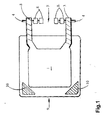
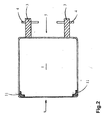
- FIG. 1 shows in plan view as well as the figure 2 in bottom view of a hinged lid 1 according to the invention for a refuse container 2 ( Figure 3) with at least two hinge projections 3.
- the ends of the hinge projections 3 each have a recess for receiving a hinge pin 4, so that the hinged lid 3 is hinged to the housing of the refuse container 2 at a hinge edge 5 pivotally.
- hinge edge 5 opposite side of the hinged lid 1 has a handle projection 6, which serves to raise or close the hinged lid 1.
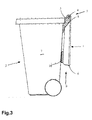
- FIG. 3 shows the refuse container 2 with unfolded cover 1 in side view.
- the hinged lid 1 is connected to the body 7 of the refuse container 2 via a hinge.
- hinge projections 8 protrude upwards on the body 7 on the hinge side 5 over the contact area for the hinged lid 1 on the body 7.
- Lid 1 and body 7 are each connected via their hinge projections 3, 8 with the hinge pin 4.
- Each hinge pin 4 is held on the body side by two hinge projections 8 and protrudes freely to one side with one end. There, the hinge pin 4 engages in a cover-side hinge projection 3 a.
- the hinged lid 1 In the closed state, the hinged lid 1 is in the covering of the body 7 is substantially flat on the body 7 and can be opened in the use position of the refuse container 2 upwards and backwards.
- the opening movement may be an approximately three-quarter circular movement, wherein the hinged lid 1 is limited in the opening movement by the hinge-side housing wall 5 of the refuse container 2. If no further damping of the opening or closing movement is provided, the hinged lid 1 accelerates when opening after exceeding the vertical position to hit against the hinge-side housing wall 5 by acting on him gravitational force.
- the hinge projections 3 of the hinged lid 1 in use for example, due to collisions, optionally break and the lid 1 are separated from the body 7 of the refuse container 2.
- the hinged lid 1 with hinge projections 3 consists of two different materials.
- the hinged lid 1 with hinge projections 3 as well as the body 7 is made of plastic. This causes a lower weight compared to a metal waste container. In particular, the forces required to open the lid 1 are reduced by a lighter hinged lid 1 made of plastic.
- the first component is a harder material, namely polyolefin and the second component is a softer and / or more flexible and / or elastic Material as the first component is.
- the first component is hard HDPE (High Denisty Polyethylene) or a similar material. Such materials are easy to process and are inexpensive to produce.
- the second component may be a thermoplastic elastomer or a similar material. Such a material can be incorporated in the manufacture, for example by injection at the predetermined positions of the hinged lid and thus can be placed precisely at the predetermined areas.
- the hinged lid 1 in the cover region of the body 7 without the hinge projections 3 made of hard HDPE is formed with a particularly low material thickness.
- a small wall thickness of the lid 1 allows cost-effective production by saving material and a lower weight of the hinged lid. 1
- the hinge projections 3 consist of the second component. When exposed to forces on the hinged lid 1, for example during loading or unloading, or during transport of the refuse container 2, this can easily break. To further direct the forces acting on the hinged lid 1, the hinge projections 3 are made of a softer and / or more flexible and / or more elastic material than the hinged lid 1. For large forces, the hinge projections 3 are bent and can yield, possibly break, to prevent breakage of the hinged lid 1.
- the hinge projections 3 may also essentially consist of the injection-molded two-component plastic, wherein the first component is the harder material, such as hard HDPE, and the second component is a softer and / or more flexible and / or more elastic material than the first component. Deformation regions can be formed in the hinge projections 3, which yield deliberately upon the action of forces on the hinged lid 1 and bend the hinge projections 3 or, in extreme cases, allow them to break.
- the hinge pin 4 also consists of the material of the second component.
- the holder of the hinged lid can also yield in the hinge, provided that a lateral force acts on the hinged lid 1.
- the hinge pin 4 therefore serves as a region that can yield, possibly as a break, on the hinged lid 1, so that the hinged lid 1 can escape.
- the hinge projections 3 yield by bending the applied force, and, in the case of even higher force effects, If necessary, the hinge pins 4 may break after a no longer possible possibility for bending the hinge projections 3. Alternatively or additionally, the hinge projections 3 may break with such high force effects.
- a stop region 10 is provided in each case ( Figure 1).
- the outer stop areas 10 on the hinged lid 1 are formed from the material of the softer and / or more flexible and / or more elastic component.
- the contact areas 10 are in the abutment region of the hinged lid 1 against the refuse container 2 in the open position on the handle side of the hinged lid 1 widely spaced from the hinge portion of the hinged lid 1. The impact by the impact of the lid against the body is thus absorbed by the softer and more flexible material and only slightly forwarded to the hinged lid 1 from the harder first component.
- the hinge projections 3 are formed on the hinged lid 1 such that they also have a contact area or stop area against the body 7 of the refuse container 1 in the open position of the hinged lid.
- the hinge projections 3 therefore consist in particular on their upper sides of the softer and / or more flexible and / or more elastic component, so that the impact by the impact of the hinged lid 1 against the body 2 by the softer and / or more flexible and / or more elastic material on the hinge plates 3 is received and only slightly forwarded to the hinged lid 1 from the harder first component.
Landscapes
- Engineering & Computer Science (AREA)
- Mechanical Engineering (AREA)
- Closures For Containers (AREA)
- Refuse Receptacles (AREA)
Applications Claiming Priority (1)
| Application Number | Priority Date | Filing Date | Title |
|---|---|---|---|
| DE102006025708A DE102006025708A1 (de) | 2006-06-01 | 2006-06-01 | Klappdeckel für Müllbehälter |
Publications (1)
| Publication Number | Publication Date |
|---|---|
| EP1862402A1 true EP1862402A1 (fr) | 2007-12-05 |
Family
ID=38330520
Family Applications (1)
| Application Number | Title | Priority Date | Filing Date |
|---|---|---|---|
| EP07108638A Withdrawn EP1862402A1 (fr) | 2006-06-01 | 2007-05-22 | Couvercle rabattable pour conteneur de déchets |
Country Status (2)
| Country | Link |
|---|---|
| EP (1) | EP1862402A1 (fr) |
| DE (1) | DE102006025708A1 (fr) |
Cited By (1)
| Publication number | Priority date | Publication date | Assignee | Title |
|---|---|---|---|---|
| EP4053047A1 (fr) * | 2021-03-01 | 2022-09-07 | Craemer GmbH | Boîte à déchets à amortissement de bruit, couvercle et procédé de fabrication d'un couvercle |
Families Citing this family (1)
| Publication number | Priority date | Publication date | Assignee | Title |
|---|---|---|---|---|
| DE102021123349B3 (de) | 2021-09-09 | 2022-10-13 | Jelenia Plast Sp. Z O.O. | Verfahren zur Herstellung eines Behälters |
Citations (2)
| Publication number | Priority date | Publication date | Assignee | Title |
|---|---|---|---|---|
| DE19811991A1 (de) * | 1998-03-19 | 1999-09-23 | Schaefer Gmbh Fritz | Behälter, insbesondere Mülltonne, mit einem Deckel |
| FR2852303A1 (fr) * | 2003-03-13 | 2004-09-17 | Otto Ind Europ B V | Couvercle pour conteneur comportant des moyens d'insonorisation |
-
2006
- 2006-06-01 DE DE102006025708A patent/DE102006025708A1/de not_active Withdrawn
-
2007
- 2007-05-22 EP EP07108638A patent/EP1862402A1/fr not_active Withdrawn
Patent Citations (2)
| Publication number | Priority date | Publication date | Assignee | Title |
|---|---|---|---|---|
| DE19811991A1 (de) * | 1998-03-19 | 1999-09-23 | Schaefer Gmbh Fritz | Behälter, insbesondere Mülltonne, mit einem Deckel |
| FR2852303A1 (fr) * | 2003-03-13 | 2004-09-17 | Otto Ind Europ B V | Couvercle pour conteneur comportant des moyens d'insonorisation |
Cited By (1)
| Publication number | Priority date | Publication date | Assignee | Title |
|---|---|---|---|---|
| EP4053047A1 (fr) * | 2021-03-01 | 2022-09-07 | Craemer GmbH | Boîte à déchets à amortissement de bruit, couvercle et procédé de fabrication d'un couvercle |
Also Published As
| Publication number | Publication date |
|---|---|
| DE102006025708A1 (de) | 2007-12-06 |
Similar Documents
| Publication | Publication Date | Title |
|---|---|---|
| EP3392438B1 (fr) | Charnière de meuble | |
| DE4240416B4 (de) | Versteifungsanordnung für einen Kraftfahrzeug-Aufbau mit einem Türträger | |
| DE10314180A1 (de) | Reversierbarer Fußgängerschutz-Aktuator | |
| DE202007002306U1 (de) | Antriebseinheit zur Betätigung einer Kraftfahrzeug-Klappe | |
| DE102015108228A1 (de) | Vorrichtung zum Verbinden eines Kupplungsschafts mit einem Wagenkasten eines spurgeführten Fahrzeuges | |
| WO1998021433A1 (fr) | Vehicule a moteur pourvu d'une carrosserie de securite | |
| DE2234092A1 (de) | Handwerkzeug | |
| DE202010005089U1 (de) | Sterilcontainer für medizinische Zwecke | |
| DE102016222096B4 (de) | Fahrzeugklappenanordnung und damit ausgestattetes kraftfahrzeug | |
| DE102009040409A1 (de) | Scharnier und Verfahren zum Betreiben eines Scharniers | |
| DE102006025708A1 (de) | Klappdeckel für Müllbehälter | |
| DE1605012C3 (de) | Fahrzeug, insbesondere Eisenbahnwagen mit aufklappbarem Dach | |
| DE10320449A1 (de) | Kraftfahrzeugtürverschluss | |
| DE202008011190U1 (de) | Scharnier und Werkzeug zur Demontage eines Lineardämpfers von einem Scharnier | |
| EP3640160A1 (fr) | Récipient collecteur encastré dans le sol pourvu de tige extérieure | |
| DE102009040405A1 (de) | Scharnier und Verfahren zum Betreiben eines Scharniers | |
| EP2384998B1 (fr) | Récipient à déchets | |
| DE102008047708B4 (de) | Scharnier | |
| WO2015110649A2 (fr) | Conteneur, en particulier benne amovible, benne à vider ou à rouler | |
| EP1591317A1 (fr) | Couverture d'espace de rangement | |
| DE202007002166U1 (de) | Abfallsammler | |
| EP1990270B1 (fr) | Sous-marin | |
| DE102024201136B3 (de) | Antriebssystem für Drehtüren | |
| EP1762411B1 (fr) | Couvercle de cadre pour un véhicule décapotable | |
| DE102019102882A1 (de) | Halterung für ein Kraftfahrzeugkennzeichen |
Legal Events
| Date | Code | Title | Description |
|---|---|---|---|
| PUAI | Public reference made under article 153(3) epc to a published international application that has entered the european phase |
Free format text: ORIGINAL CODE: 0009012 |
|
| AK | Designated contracting states |
Kind code of ref document: A1 Designated state(s): AT BE BG CH CY CZ DE DK EE ES FI FR GB GR HU IE IS IT LI LT LU LV MC MT NL PL PT RO SE SI SK TR |
|
| AX | Request for extension of the european patent |
Extension state: AL BA HR MK YU |
|
| 17P | Request for examination filed |
Effective date: 20080526 |
|
| AKX | Designation fees paid |
Designated state(s): BE DE FR GB LU NL |
|
| 17Q | First examination report despatched |
Effective date: 20090114 |
|
| STAA | Information on the status of an ep patent application or granted ep patent |
Free format text: STATUS: THE APPLICATION IS DEEMED TO BE WITHDRAWN |
|
| 18D | Application deemed to be withdrawn |
Effective date: 20090725 |