EP1865615A1 - Procédé et appareil améliorés pour la détection de changements du trajet de l'écho dans un annuleur d'écho acoustique - Google Patents
Procédé et appareil améliorés pour la détection de changements du trajet de l'écho dans un annuleur d'écho acoustique Download PDFInfo
- Publication number
- EP1865615A1 EP1865615A1 EP07252273A EP07252273A EP1865615A1 EP 1865615 A1 EP1865615 A1 EP 1865615A1 EP 07252273 A EP07252273 A EP 07252273A EP 07252273 A EP07252273 A EP 07252273A EP 1865615 A1 EP1865615 A1 EP 1865615A1
- Authority
- EP
- European Patent Office
- Prior art keywords
- echo
- adaptive filter
- echo path
- threshold
- adaptive
- Prior art date
- Legal status (The legal status is an assumption and is not a legal conclusion. Google has not performed a legal analysis and makes no representation as to the accuracy of the status listed.)
- Granted
Links
Images



Classifications
-
- H—ELECTRICITY
- H04—ELECTRIC COMMUNICATION TECHNIQUE
- H04B—TRANSMISSION
- H04B3/00—Line transmission systems
- H04B3/02—Details
- H04B3/20—Reducing echo effects or singing; Opening or closing transmitting path; Conditioning for transmission in one direction or the other
- H04B3/23—Reducing echo effects or singing; Opening or closing transmitting path; Conditioning for transmission in one direction or the other using a replica of transmitted signal in the time domain, e.g. echo cancellers
- H04B3/237—Reducing echo effects or singing; Opening or closing transmitting path; Conditioning for transmission in one direction or the other using a replica of transmitted signal in the time domain, e.g. echo cancellers using two adaptive filters, e.g. for near end and for end echo cancelling
-
- H—ELECTRICITY
- H04—ELECTRIC COMMUNICATION TECHNIQUE
- H04B—TRANSMISSION
- H04B3/00—Line transmission systems
- H04B3/02—Details
- H04B3/20—Reducing echo effects or singing; Opening or closing transmitting path; Conditioning for transmission in one direction or the other
- H04B3/23—Reducing echo effects or singing; Opening or closing transmitting path; Conditioning for transmission in one direction or the other using a replica of transmitted signal in the time domain, e.g. echo cancellers
- H04B3/234—Reducing echo effects or singing; Opening or closing transmitting path; Conditioning for transmission in one direction or the other using a replica of transmitted signal in the time domain, e.g. echo cancellers using double talk detection
Definitions
- the present invention relates generally to detection of echo path changes in echo cancellers, and more particularly to detect the echo path change (EPC) in a full duplex handsfree (FDHF) speakerphone and to mask the increased error due to the echo path change.
- EPC echo path change
- FDHF full duplex handsfree
- Line echo arises at a four- to two-wire interface, or "hybrid"
- acoustic echo occurs when sound from the telephone handsfree speaker feeds back to the microphone either directly or is reflected off of different surfaces, such as walls, tables, etc.
- Hybrid echo is created as voice signals are transmitted across the network via the hybrid connection at the two-wire/four-wire public-switched telephone network PSTN conversion points.
- the actual amount of signal that is reflected back depends on many factors including the size of the room, the "hardness" of materials that the speaker signal reflects off of, the loudness of the speaker signal, and the distance between the speaker and microphone. The majority of echo is due to the speaker signal being picked up directly by the microphone.
- the parameter for defining the effectiveness of the echo attenuation is echo-return loss (ERL).
- ERL echo-return loss
- ERL enhancement ERL enhancement
- NLP nonlinear processor
- NLMS Normalized Least Mean Square
- the coefficients of an adaptive filter converge to a certain echo path.
- a generally acceptable convergence time requires that the echo canceller achieve 27 dB of ERLE (Echo Return Loss Enhancement) in 0.5 sec.
- the echo canceller has to quickly re-converge to the new echo path or else the echo will be perceived by the user.
- Line echo path changes are infrequent and last a relatively long time.
- Acoustic echo path changes are more frequent and relatively short in duration. After an acoustic echo path change, the echo path usually returns to the previous state (i.e. after the user stops touching the touchscreen LCD or pushing a button, the echo path is the same as before the user touched the screen or pushed a button).
- Detecting the echo path changes is a difficult problem since the echo resulting from a new echo path and the echo generated by the old echo path from the converged adaptive filter can easily be misinterpreted as double talk.
- an additional short adaptive filter is provided of the same length as the default filter in CA 2,494,500 .
- This length covers only the direct echo path of the phone, which is sufficient for most applications (i.e. based on the typical echo path change scenario in which a phone user presses the keypad or touches the LCD screen of the phone, causing a change of the echo path in the direct echo path only).
- the short adaptive filter adapts very quickly whenever the reference signal is present.
- EPC Echo Path Change
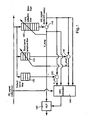
- Figure 1 is a block diagram showing an echo canceller with echo change detection, according to an embodiment of the invention
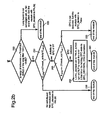
- Figure 2 is a flowchart showing method steps for detecting echo path changes according to an embodiment of the invention.
- Figure 3 is a flowchart showing the method steps of Figure 2 for method steps for detecting echo path changes and further steps for detecting double-talk, according to an alternative embodiment.
- FIG. 1 an adaptive echo canceller is shown according an embodiment of the invention.
- a reference signal (FE_signal) is applied as an input to the echo canceller and to the acoustic echo path (i.e. the signal is broadcast via a telephone speaker).
- the echo path gives rise to an Echo Return Loss (ERL), which is a measure of the actual amount of reflected signal.
- ERP Echo Return Loss
- a high ERL indicates only a relatively small signal reflected back to the talker, and vice versa, as discussed above.
- An adaptive filter (long filter 100) models an estimation of the echo introduced by the echo path using the well known NLMS algorithm (although other adaptive algorithms may be used), and subtracts the echo signal from the near-end input signal (i.e.
- NE_signal received via a telephone microphone which contains the undesirable echo, via a first subtractor 110.
- the transfer function of the model of the echo path provided by adaptive filter 100 is identical to the transfer function of the echo path, the error signal becomes zero and the filter converges to the correct transfer function, resulting in perfect echo cancellation.
- Filter 120 is non-adaptive such that it does not track echo path changes and also does not diverge during double-talk, as is known from published Canadian Patent Application 2,451,417 , referred to herein above.
- Subtractor 125 outputs an error signal resulting from echo cancellation via filter 120.
- the filter 130 is not used for echo cancellation, but only for echo path detection. Specifically, the filter 130 quickly diverges during double-talk and is able to provide an early indication of any echo path changes.
- a subtractor 135 outputs an error signal resulting from filter 130.
- Decision logic 140 distinguishes between echo path changes and double-talk based on the reference signal and the estimated error signals from all three filters 100, 120 and 130, as discussed in greater detail below.
- NLP non-linear processor 150
- non-adaptive default filter 120 and the short adaptive filter 130 differs whenever the reference signal (FE_signal) is present, whereas the default filter 120 statically models the previously captured echo path and never adapts.
- a difference between the short and long adaptive filters 130 and 100 is that the short filter 130 is an under modeled system (i.e. the short adaptive filter 130 only covers the direct echo path, and never converges as deeply as the long NLMS filter 100 when it is in the stable/converged state, or when there is no echo path change). Therefore, in a single talk scenario a measurable difference will exist in the ERLE between short and long adaptive filters 130 and 100 (i.e. the long filter 100 performs better than the short filter 130).
- the EPC detector logic 140 indicates a change of state from single talk to one of either an echo path change (EPC) or double talk (DT).
- the short adaptive filter 130 converges more quickly to the new echo path than the long adaptive filter 100, as discussed above. Consequently the difference between the two error signals output from filters 100 and 130 will be small or even negative, as the short filter 130 becomes better converged than filter 100.
- EPC detection logic 140 operation of the EPC detection logic 140 is shown according to an aspect of the invention.
- the reference signal (FE_signal) and error signals from subtractors 110, 125 and 135 are applied as inputs to EPC detection logic 140 (step 200).
- EPC detection logic 140 then calculates (step 205) the energies of the error signals output from filter 100 (E long ), filter 120 (E def ) and filter 130 (E short ).
- An EPC timer is set to a predetermined value (EPC_DECISION_HOLD) whenever an echo path change (EPC) is detected, as in step 250.
- the EPC detection logic 140 remains in an EPC detected state until this timer expires.
- the NLP 150 remains turned on such that the echo is masked, during the time between when the EPC is detected (the timer is set) and the timer has expired.
- the value EPC_DECISION_HOLD is used to hold the EPC detected state. In a successful prototype, the constant was chosen to be 600 samples (i.e. or 75ms).
- the EPC_decision is set to FALSE (step 225). This makes sure that the default- state of the EPC detection logic 140 is one in which no echo path change has been detected.
- a Threshold e.g. -32dBmo
- a determination is made (step 235) as to whether E long > (Thresh_activity * E short ), where Thresh_activity is a threshold of, for example, - 6dB in a successful implementation of an embodiment of the invention.
- Thresh_activity is a threshold of, for example, - 6dB in a successful implementation of an embodiment of the invention.
- This condition is based on the fact that the long filter 100 cancels echo much better than short filter 130 in a stable/converged single- talk scenario. However, in either a double talk or EPC scenario the long filter 100 does not achieve as good ERLE as in the stable/converged single- talk state. This makes the relation between long filter 100 and short filter 130 change significantly so that the long filter 100 does not achieve 6dB better than the short filter 130.
- a "No" event at step 235 indicates there is no double talk or EPC.
- the algorithm exits (step 220).
- a "No" event at step 245 indicates that the activity detected from step 235 is not for EPC.
- the algorithm exits (step 220).
- the EPC_decision is set to TRUE and an Echo Path Change (EPC) is detected.
- EPC Echo Path Change
- this state will be held for at least EPC_DECISION_HOLD samples (e.g. 600 samples), and the NLP 150 is set to mask the error (i.e. provide full attenuation of the signal), and the algorithm ends (step 220).
- the EPC detection logic 140 may be used to control the NLMS adaptation. Specifically, the EPC detection logic 140 may be used to freeze or slow down the adaptation of the long filter 100 when double-talk is detected and to speed up the adaptation of the long filter when an echo path change (EPC) is detected.
- analysis of the behavior between the fixed filter 120 and the short adaptive filter 130 may be used to determine when a double talk state is entered into.
- the EPC steps of Figure 3 are identical to the steps of Figure 2, and identical reference numerals are used to denote equivalent steps.
- the DT algorithm determines whether a DT timer has not yet expired, then double talk is detected whereupon a flag (DT _decision) is set to TRUE, The DT timer is updated at step 310 and the algorithm ends (step 220).
- the short adaptive filter 130 updates its coefficients based on the NE - signal (echo + near-end speech) and thus causes a divergence of the coefficients. If the adaptive filter error is consistently worse relative to the fixed filter error over a period of time a double talk condition is identified.
- the near-end (NE) speech contributes to the residue echo. That is:
- Energy_residue_echo Energy_of_Echo - Estimated echo of the NLMS filter 100.
- the EPC detector logic 140 is able to identify one of either an echo path change (as discussed above in connection with Figure 2) or a double-talk condition.
- Thresh_activity e.g. -6dB
- there is some activity either DT or EPC
- step 245 the error of the default non-adaptive (fixed) filter 120 and the error of the short adaptive filter 130 are compared.
- Thresh_dt is +1dB according to a successful prototype of the invention.
- the DECISION_TIMER_THRESH is chosen for 16 samples, according to a successful prototype. If a double talk state is finally detected this state will at least be held for DT_DECISION_HOLD samples.
- a DT_hold_timer is set to DT_DECISION_HOLD. The timer is checked at step 300 and updated at step 310 if necessary.
Landscapes
- Engineering & Computer Science (AREA)
- Computer Networks & Wireless Communication (AREA)
- Signal Processing (AREA)
- Cable Transmission Systems, Equalization Of Radio And Reduction Of Echo (AREA)
- Filters That Use Time-Delay Elements (AREA)
Applications Claiming Priority (1)
| Application Number | Priority Date | Filing Date | Title |
|---|---|---|---|
| US11/422,747 US7817797B2 (en) | 2006-06-07 | 2006-06-07 | Method and apparatus for detecting echo path changes in an acoustic echo canceller |
Publications (2)
| Publication Number | Publication Date |
|---|---|
| EP1865615A1 true EP1865615A1 (fr) | 2007-12-12 |
| EP1865615B1 EP1865615B1 (fr) | 2009-01-07 |
Family
ID=38481634
Family Applications (1)
| Application Number | Title | Priority Date | Filing Date |
|---|---|---|---|
| EP07252273A Active EP1865615B1 (fr) | 2006-06-07 | 2007-06-06 | Procédé et appareil améliorés pour la détection de changements du trajet de l'écho dans un annuleur d'écho acoustique |
Country Status (5)
| Country | Link |
|---|---|
| US (1) | US7817797B2 (fr) |
| EP (1) | EP1865615B1 (fr) |
| CN (1) | CN101087320B (fr) |
| CA (1) | CA2590745C (fr) |
| DE (1) | DE602007000453D1 (fr) |
Families Citing this family (29)
| Publication number | Priority date | Publication date | Assignee | Title |
|---|---|---|---|---|
| US20080298577A1 (en) * | 2007-05-02 | 2008-12-04 | Gn Netcom A/S | Method and system for processing communication signals in a communication system |
| US8411846B2 (en) * | 2008-05-09 | 2013-04-02 | Agere Systems Llc | Echo path change detection in telecommunications networks |
| US8170224B2 (en) * | 2008-09-22 | 2012-05-01 | Magor Communications Corporation | Wideband speakerphone |
| US8385558B2 (en) * | 2009-01-13 | 2013-02-26 | Microsoft Corporation | Echo presence determination in voice conversations |
| US9185233B2 (en) | 2010-05-25 | 2015-11-10 | Intel Deutschland Gmbh | Audio communication device and method using fixed echo cancellation filter coefficients |
| US9042535B2 (en) * | 2010-09-29 | 2015-05-26 | Cisco Technology, Inc. | Echo control optimization |
| US9076426B2 (en) * | 2011-12-20 | 2015-07-07 | Avago Technologies General Ip (Singapore) Pte. Ltd. | Training an echo canceller in severe noise |
| CN103179296B (zh) * | 2011-12-26 | 2017-02-15 | 中兴通讯股份有限公司 | 一种回波抵消器及回波抵消方法 |
| KR20130113779A (ko) * | 2012-04-06 | 2013-10-16 | 한국전자통신연구원 | 광대역 어커스틱 에코 제거 장치 및 방법 |
| CN103516921A (zh) | 2012-06-28 | 2014-01-15 | 杜比实验室特许公司 | 通过隐藏音频信号的回声控制 |
| US8953777B1 (en) * | 2013-05-30 | 2015-02-10 | Amazon Technologies, Inc. | Echo path change detector with robustness to double talk |
| GB201309773D0 (en) * | 2013-05-31 | 2013-07-17 | Microsoft Corp | Echo removal |
| GB201309771D0 (en) * | 2013-05-31 | 2013-07-17 | Microsoft Corp | Echo removal |
| GB201309779D0 (en) * | 2013-05-31 | 2013-07-17 | Microsoft Corp | Echo removal |
| GB2519392B (en) * | 2014-04-02 | 2016-02-24 | Imagination Tech Ltd | Auto-tuning of an acoustic echo canceller |
| CN105323395B (zh) * | 2014-07-31 | 2020-01-14 | 锐迪科(重庆)微电子科技有限公司 | 一种回波消除器及回波消除方法 |
| US9479650B1 (en) * | 2015-05-04 | 2016-10-25 | Captioncall, Llc | Methods and devices for updating filter coefficients during echo cancellation |
| US10014906B2 (en) * | 2015-09-25 | 2018-07-03 | Microsemi Semiconductor (U.S.) Inc. | Acoustic echo path change detection apparatus and method |
| EP3147896B1 (fr) * | 2015-09-25 | 2023-05-31 | Harman Becker Automotive Systems GmbH | Système de contrôle actif du bruit de la route avec détection de surcharge du signal de détection primaire |
| CN105744210B (zh) * | 2016-04-15 | 2018-10-12 | 北京小米移动软件有限公司 | 视频会议的回声消除方法、装置及系统 |
| US11125553B2 (en) * | 2016-06-24 | 2021-09-21 | Syracuse University | Motion sensor assisted room shape reconstruction and self-localization using first-order acoustic echoes |
| US10382092B2 (en) * | 2017-11-27 | 2019-08-13 | Verizon Patent And Licensing Inc. | Method and system for full duplex enhanced audio |
| DE102018122438A1 (de) * | 2018-09-13 | 2020-03-19 | Harman Becker Automotive Systems Gmbh | Akustische Echounterdrückung mit Raumänderungserfassung |
| CN111246035B (zh) * | 2020-01-09 | 2021-07-20 | 深圳震有科技股份有限公司 | 一种回声非线性处理的分级调整方法、终端及存储介质 |
| US10827076B1 (en) | 2020-03-11 | 2020-11-03 | Cirrus Logic, Inc. | Echo path change monitoring in an acoustic echo canceler |
| CN115280412A (zh) * | 2020-03-17 | 2022-11-01 | 杜比实验室特许公司 | 声学回声消除器中回声路径改变的宽带适应性改变 |
| CN111970610B (zh) * | 2020-08-26 | 2022-05-20 | 展讯通信(上海)有限公司 | 回声路径检测方法、音频信号处理方法及系统、存储介质、终端 |
| CN112700788B (zh) * | 2020-12-23 | 2024-05-03 | 普联国际有限公司 | 回声消除中回声路径的建模方法、装置、设备及存储介质 |
| CN115019816B (zh) * | 2021-03-03 | 2025-07-11 | 阿里巴巴创新公司 | 一种回声状态检测方法、装置、计算机存储介质及芯片 |
Citations (1)
| Publication number | Priority date | Publication date | Assignee | Title |
|---|---|---|---|---|
| EP1424846A2 (fr) * | 2002-11-29 | 2004-06-02 | Mitel Knowledge Corporation | Annuleur d'écho acoustique |
Family Cites Families (12)
| Publication number | Priority date | Publication date | Assignee | Title |
|---|---|---|---|---|
| US3787645A (en) * | 1971-05-19 | 1974-01-22 | Nippon Electric Co | Echo canceller having two echo path models |
| CA2036078C (fr) * | 1990-02-21 | 1994-07-26 | Fumio Amano | Eliminateur d'echos acoustiques sous-bande |
| JP2538176B2 (ja) * | 1993-05-28 | 1996-09-25 | 松下電器産業株式会社 | エコ―制御装置 |
| DE69532394T2 (de) * | 1994-02-10 | 2004-11-04 | Nippon Telegraph And Telephone Corp. | Verfahren und Vorrichtung zur Echokompensation mit Anwendung der "fast projection scheme" |
| FI106489B (fi) * | 1996-06-19 | 2001-02-15 | Nokia Networks Oy | Kaikusalpa ja kaiunpoistajan epälineaarinen prosessori |
| US6035034A (en) * | 1996-12-20 | 2000-03-07 | Telefonaktiebolaget L M Ericsson (Publ) | Double talk and echo path change detection in a telephony system |
| US6185300B1 (en) * | 1996-12-31 | 2001-02-06 | Ericsson Inc. | Echo canceler for use in communications system |
| US6226380B1 (en) * | 1998-02-19 | 2001-05-01 | Nortel Networks Limited | Method of distinguishing between echo path change and double talk conditions in an echo canceller |
| GB2344500B (en) * | 1998-12-02 | 2003-06-25 | Mitel Corp | Improved method of operating a full duplex speakerphone echo canceller |
| JP2000252881A (ja) * | 1999-02-25 | 2000-09-14 | Mitsubishi Electric Corp | ダブルトーク検知装置並びにエコーキャンセラ装置およびエコーサプレッサー装置 |
| US20030219113A1 (en) * | 2002-05-21 | 2003-11-27 | Bershad Neil J. | Echo canceller with double-talk and channel impulse response adaptation |
| GB0402102D0 (en) | 2004-01-30 | 2004-03-03 | Mitel Networks Corp | Method for detecting echo path changes in echo cancellers |
-
2006
- 2006-06-07 US US11/422,747 patent/US7817797B2/en active Active
-
2007
- 2007-06-06 EP EP07252273A patent/EP1865615B1/fr active Active
- 2007-06-06 DE DE602007000453T patent/DE602007000453D1/de active Active
- 2007-06-07 CN CN2007101086279A patent/CN101087320B/zh not_active Expired - Fee Related
- 2007-06-07 CA CA2590745A patent/CA2590745C/fr active Active
Patent Citations (1)
| Publication number | Priority date | Publication date | Assignee | Title |
|---|---|---|---|---|
| EP1424846A2 (fr) * | 2002-11-29 | 2004-06-02 | Mitel Knowledge Corporation | Annuleur d'écho acoustique |
Non-Patent Citations (2)
| Title |
|---|
| MADER A ET AL: "Step-size control for acoustic echo cancellation filters - an overview", SIGNAL PROCESSING, AMSTERDAM, NL, vol. 80, no. 9, September 2000 (2000-09-01), pages 1697 - 1719, XP004215534, ISSN: 0165-1684 * |
| SIHO KIM ET AL: "Applying an auxiliary filter in the adaptive echo canceller for performance improvement of double-talk detection", DIGITAL SIGNAL PROCESSING WORKSHOP, 2002 AND THE 2ND SIGNAL PROCESSING EDUCATION WORKSHOP. PROCEEDINGS OF 2002 IEEE 10TH 13-16 OCT. 2002, PISCATAWAY, NJ, USA,IEEE, 13 October 2002 (2002-10-13), pages 207 - 210, XP010657798, ISBN: 0-7803-8116-5 * |
Also Published As
| Publication number | Publication date |
|---|---|
| CN101087320A (zh) | 2007-12-12 |
| DE602007000453D1 (de) | 2009-02-26 |
| US7817797B2 (en) | 2010-10-19 |
| CA2590745A1 (fr) | 2007-12-07 |
| US20070286404A1 (en) | 2007-12-13 |
| CN101087320B (zh) | 2010-11-10 |
| EP1865615B1 (fr) | 2009-01-07 |
| CA2590745C (fr) | 2011-08-02 |
Similar Documents
| Publication | Publication Date | Title |
|---|---|---|
| EP1865615B1 (fr) | Procédé et appareil améliorés pour la détection de changements du trajet de l'écho dans un annuleur d'écho acoustique | |
| US7203308B2 (en) | Echo canceller ensuring further reduction in residual echo | |
| US6434110B1 (en) | Full-duplex speakerphone circuit including a double-talk detector | |
| US6449361B1 (en) | Control method and device for echo canceller | |
| US6212273B1 (en) | Full-duplex speakerphone circuit including a control interface | |
| EP1424846B1 (fr) | Annuleur d'écho acoustique | |
| US6282176B1 (en) | Full-duplex speakerphone circuit including a supplementary echo suppressor | |
| US6947552B2 (en) | Echo canceler with echo path change detector | |
| AU757529B2 (en) | Echo canceller having improved non-linear processor | |
| WO2005125168A1 (fr) | Appareil d'annulation d'echo, poste telephonique utilisant cet appareil et procede d'annulation d'echo | |
| US7231036B2 (en) | Anti-howling circuit detecting howling from effect of predicted echo signal | |
| CN110995951A (zh) | 基于双端发声检测的回声消除方法、装置及系统 | |
| US8831210B2 (en) | Method and system for detection of onset of near-end signal in an echo cancellation system | |
| EP1560348B1 (fr) | Procédé de détection des changements de trajet d'écho dans des annuleurs d'écho | |
| US7539300B1 (en) | Echo canceller with enhanced infinite and finite ERL detection | |
| CN100550951C (zh) | 一种回声消除装置和方法 | |
| KR101442995B1 (ko) | 반향 소거 장치 | |
| US8369512B2 (en) | Device and method for detecting a divergence of an adaptive system and use of such a device for the detection of a divergence of a digital filter | |
| KR100392365B1 (ko) | 음향 반향 제거기를 위한 동시통화 검출기에서의 동시통화 구간의 끝점 검출 지연 제거 장치 및 그 방법 | |
| EP1560441B1 (fr) | Détection de tonalités à bande étroite dans un système d'annulation d'échos | |
| Lieu | Robust line echo cancellation in complicated phone call environment | |
| JPH07303073A (ja) | ノイズ低減回路およびこの回路を用いたエコーキャンセラ | |
| JPH02264524A (ja) | エコーキャンセラ | |
| GB2439990A (en) | Double talk and echo path change discriminator for echo canceller | |
| JPH06152474A (ja) | センタクリッパ回路 |
Legal Events
| Date | Code | Title | Description |
|---|---|---|---|
| PUAI | Public reference made under article 153(3) epc to a published international application that has entered the european phase |
Free format text: ORIGINAL CODE: 0009012 |
|
| AK | Designated contracting states |
Kind code of ref document: A1 Designated state(s): AT BE BG CH CY CZ DE DK EE ES FI FR GB GR HU IE IS IT LI LT LU LV MC MT NL PL PT RO SE SI SK TR |
|
| AX | Request for extension of the european patent |
Extension state: AL BA HR MK YU |
|
| 17P | Request for examination filed |
Effective date: 20080516 |
|
| GRAP | Despatch of communication of intention to grant a patent |
Free format text: ORIGINAL CODE: EPIDOSNIGR1 |
|
| AKX | Designation fees paid |
Designated state(s): DE FR GB |
|
| GRAS | Grant fee paid |
Free format text: ORIGINAL CODE: EPIDOSNIGR3 |
|
| GRAA | (expected) grant |
Free format text: ORIGINAL CODE: 0009210 |
|
| AK | Designated contracting states |
Kind code of ref document: B1 Designated state(s): DE FR GB |
|
| REG | Reference to a national code |
Ref country code: GB Ref legal event code: FG4D |
|
| REF | Corresponds to: |
Ref document number: 602007000453 Country of ref document: DE Date of ref document: 20090226 Kind code of ref document: P |
|
| PLBE | No opposition filed within time limit |
Free format text: ORIGINAL CODE: 0009261 |
|
| STAA | Information on the status of an ep patent application or granted ep patent |
Free format text: STATUS: NO OPPOSITION FILED WITHIN TIME LIMIT |
|
| 26N | No opposition filed |
Effective date: 20091008 |
|
| REG | Reference to a national code |
Ref country code: FR Ref legal event code: PLFP Year of fee payment: 10 |
|
| REG | Reference to a national code |
Ref country code: FR Ref legal event code: PLFP Year of fee payment: 11 |
|
| REG | Reference to a national code |
Ref country code: FR Ref legal event code: PLFP Year of fee payment: 12 |
|
| REG | Reference to a national code |
Ref country code: FR Ref legal event code: PLFP Year of fee payment: 17 |
|
| PGFP | Annual fee paid to national office [announced via postgrant information from national office to epo] |
Ref country code: GB Payment date: 20260408 Year of fee payment: 20 |
|
| PGFP | Annual fee paid to national office [announced via postgrant information from national office to epo] |
Ref country code: DE Payment date: 20260331 Year of fee payment: 20 |
|
| PGFP | Annual fee paid to national office [announced via postgrant information from national office to epo] |
Ref country code: FR Payment date: 20260401 Year of fee payment: 20 |