EP1865706B1 - Texturierte Halbtonraster für ein Erscheinungsbild höherer Gleichmäßigkeit - Google Patents
Texturierte Halbtonraster für ein Erscheinungsbild höherer Gleichmäßigkeit Download PDFInfo
- Publication number
- EP1865706B1 EP1865706B1 EP07109525A EP07109525A EP1865706B1 EP 1865706 B1 EP1865706 B1 EP 1865706B1 EP 07109525 A EP07109525 A EP 07109525A EP 07109525 A EP07109525 A EP 07109525A EP 1865706 B1 EP1865706 B1 EP 1865706B1
- Authority
- EP
- European Patent Office
- Prior art keywords
- screen
- textured
- pattern
- halftone
- noise
- Prior art date
- Legal status (The legal status is an assumption and is not a legal conclusion. Google has not performed a legal analysis and makes no representation as to the accuracy of the status listed.)
- Not-in-force
Links
- 238000000034 method Methods 0.000 claims description 19
- 230000000007 visual effect Effects 0.000 claims description 8
- 238000012545 processing Methods 0.000 claims description 5
- 238000009877 rendering Methods 0.000 claims description 2
- 238000007639 printing Methods 0.000 description 8
- 230000008569 process Effects 0.000 description 7
- 230000004048 modification Effects 0.000 description 4
- 238000012986 modification Methods 0.000 description 4
- 230000000873 masking effect Effects 0.000 description 3
- 238000012216 screening Methods 0.000 description 3
- 230000008901 benefit Effects 0.000 description 2
- 238000010586 diagram Methods 0.000 description 2
- 230000006870 function Effects 0.000 description 2
- 238000002347 injection Methods 0.000 description 2
- 239000007924 injection Substances 0.000 description 2
- 206010037867 Rash macular Diseases 0.000 description 1
- 230000008859 change Effects 0.000 description 1
- 238000013461 design Methods 0.000 description 1
- 238000005516 engineering process Methods 0.000 description 1
- 238000001914 filtration Methods 0.000 description 1
- 238000013467 fragmentation Methods 0.000 description 1
- 238000006062 fragmentation reaction Methods 0.000 description 1
- 230000006872 improvement Effects 0.000 description 1
- 238000004519 manufacturing process Methods 0.000 description 1
- 238000007645 offset printing Methods 0.000 description 1
- 238000005457 optimization Methods 0.000 description 1
- 230000008447 perception Effects 0.000 description 1
- 230000000737 periodic effect Effects 0.000 description 1
- 238000003672 processing method Methods 0.000 description 1
- 230000004044 response Effects 0.000 description 1
- 230000007474 system interaction Effects 0.000 description 1
- 230000007704 transition Effects 0.000 description 1
Images





Classifications
-
- H—ELECTRICITY
- H04—ELECTRIC COMMUNICATION TECHNIQUE
- H04N—PICTORIAL COMMUNICATION, e.g. TELEVISION
- H04N1/00—Scanning, transmission or reproduction of documents or the like, e.g. facsimile transmission; Details thereof
- H04N1/40—Picture signal circuits
- H04N1/405—Halftoning, i.e. converting the picture signal of a continuous-tone original into a corresponding signal showing only two levels
- H04N1/4055—Halftoning, i.e. converting the picture signal of a continuous-tone original into a corresponding signal showing only two levels producing a clustered dots or a size modulated halftone pattern
Definitions
- the invention relates to a method of improving uniformity appearance of printed images.
- Image noise is among one of the top image quality issues for electrostatic printing when compared to offset printing.
- Noises at high and low spatial frequencies are typically referred to as graininess and mottle within the visual frequency range.
- the image noises at various spatial frequencies, namely graininess & mottle, are of particular interests to this application.
- the relative amplitudes of the image noises at different frequencies are adjusted to optimize the visual uniformity of a print.
- Visual masking is a well known phenomenon that some visual effects are less noticeable in the presence of some other more visually dominant features. Some image processing methods take advantage of this phenomenon by using noises to mask out moiré, banding and contouring. Another particular example is the visual masking of mottle by graininess: image mottle (low frequency variation) perception improves as the image graininess increases. Therefore, there is an opportunity to optimize the overall uniformity (combining both mottle & graininess) by adjusting the levels of noises at different frequencies. Although it is difficult to lower the system noise, it is possible to increase the noise levels at pre-selected frequencies to achieve the desired visual optimization.
- Image mottle is particularly troublesome for some systems. Following the visual masking principle, adding noise to the image, especially high frequency noises, such as graininess noise, have shown to improve the mottle appearance of the image. Due to the random nature of noise, noise addition to the print has only been demonstrated through manipulation of the input contone images before halftoning.
- WO 91/02426 A (INTERGRAPH CORP [US]) 21 February 1991 (1991-02-21) discloses the addition of uniform or gaussian noise to a screening tile value to reduce Moire patterns.
- EP-A-0 808 056 A (DAINIPPON SCREEN MFG [JP]) 19 November 1997 (1997-11-19) discloses adding two different screens, one with high frequency features, to produce a screen to be applied to an image.
- a method of using textured halftone (HT) screens is provided in the appended claim 1.
- the present invention improves the uniformity appearance of printed images by manipulating halftone screens wherein a noise-like pattern is generated for application to a printable image, modify an original halftone screen by applying the noisy pattern to it and printing the printable image including the modified halftone screen.
- the noisy pattern includes a texture that will enhance image print appearance and an ability to tile without the introduction of visible artifacts.
- Noise-like texture can be added to a document print through the manipulation of the halftone screens.
- a noise like pattern is generated. This pattern is produced to have the optimal texture to enhance the print appearance and is able to tile without introducing any visible artifacts.
- This noise-like pattern and an amplitude control function for the noise are then used to modify a regular halftone screen. This modified screen will be similar to the original screen in terms of screen angle and dot shape, but the dot size is modulated by the texture pattern.
- An image when rendered with this textured screen will show the noise-like pattern that was embedded during the screen modification step.
- true noise which is random in space & time
- a noise-like texture pattern reduces the implementation challenge and allows the noise addition through halftone screens.
- a halftone screen can be modified by a textured-pattern. Images rendered by this textured screen can superimpose the texture pattern onto the original image. When this textured pattern is optimized in both spatial geometry and amplitude, the output print will have improved IQ appearance.
- FIG. 8 illustrates a modified screen by using the spatial pattern and by generating the noise amplitude control curve in textured HT screens for improved uniformity appearance in accordance with a preferred embodiment.
- the gray level of each pixel represents the halftone threshold value of that pixel.
- FIG. 9 shows the binary output of a midtone density level after screening with the textured screen for improving uniformity appearance in accordance with a preferred embodiment.
- FIG.1 illustrated is a block diagram of the system 100 that shows the implementation of textured HT screens for improved uniformity appearance in which a preferred embodiment can be implemented.
- the input image 102 is interfaced via the graphical user interface (GUI) 104 and sends to the halftone (HT) screen with grainy texture 108 that is present in the input-output terminal (IOT) 106.
- the halftone screen with grainy texture is configured with the marking 114.
- a quick way to generate a halftone screen with a noise level control 110 is required.
- the noise amplitude can be adjusted easily without the base halftone redesign and has very little system interactions, e.g., such as with tone-reproduction curves (TRCs), color look up table (LUT) etc.
- TRCs tone-reproduction curves
- LUT color look up table
- This screen level noise change can be applied through a machine lQ adjustment cycle since many printing systems have already implemented some IQ related actuator changes in response to the system state 112 changes for forming the print output
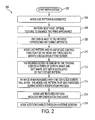
- a high-level flow chart 200 of the work flow in textured HT screens for improved uniformity appearance in which a preferred embodiment can be implemented.
- initialization occurs.
- noise-like texture is added to the print through the manipulation of the halftone screens.
- a noise like pattern is generated. This pattern has optimal texture to enhance the print appearance as described in block 206. Therefore, the pattern is able to tile without introducing any visible artifacts as indicated in block 208. Therefore as described in block 210, this noise-like pattern and an amplitude control function for the noise can then be used to modify a regular halftone screen.
- This modified screen will be similar to the original screen in terms of screen angle and dot shape but the dot size is modulated by the texture pattern as indicated in block 212.
- An image when rendered with this textured screen will show the noise-like pattern that was embedded during the screen modification step as described in block 214.
- a noise-like texture pattern reduces implementation challenge and thereafter as indicated in block 218 noise addition is enabled through halftone screens.
- initialization occurs.
- screen modification follows and as indicated in block 306 tiling regular halftone screen to reach a sufficient size in both X & Y directions.
- the minimal size will be defined in step 308 where the texture pattern is created and optimized, which will be described in detail in Fig. 4 .
- cells can be tiled in other directions.
- the resulting super tile must be able to tessellate.
- the size of the super cell might be sufficient and no tiling is required.
- a grainy noise pattern is generated by image processing.
- a noise amplitude control curve is generated to optimize the uniformity appearance.
- noise amplitudes are reduced to zero.
- the super cell is modified by using the spatial pattern and amplitude to modify the threshold values of the super cell.
- the resulting textured screen is then used for image rendering as indicated in block 314.
- a high level flow chart 400 shows the detailed process involved in creating an optimal texture pattern in textured HT screens for improved uniformity appearance in accordance with a preferred embodiment.
- creating an optimal texture pattern initialization occurs.
- a broadband noise pattern is extracted from prints or generated by computer and image processing is applied as indicated in block 406 to remove high frequency noise as depicted in block 408.
- High frequency noise can cause unexpected aliasing noise when mixed with the halftone screen.
- high frequency pattern can cause the fragmentation of the halftone dots which is not a desirable outcome from the stand point of dot robustness. In general, frequency higher than the halftone frequency should be removed from the pattern.
- image noise with frequencies equal or lower than the mottle frequency (0.5mm-5mm cycle) is also removed.
- band pass filtration i.e. low pass in and high pass
- the remaining texture has frequencies in the range roughly from 2cycle/mm to 7cycle/mm.
- a section of the pattern is selected and processed to be a base pattern that can be tiled to fill the 2D plane seamlessly.
- the size of the tile should be big enough to contain multiple "grains" and small enough to fit the size constraint of the halftone screen due to memory size limitations of the printing system.
- the size limit is roughly 3.5mmX3.5mm, which is sufficient.
- a tile size of approximately 3mmX3mm can be used in this demonstration as indicated in block 416.
- the textures around the edges are modified to remove the sharp transitions from tile to tile as described in block 418.
- the resulting base texture pattern is obtained.
- the texture pattern can be created in many ways so that to get the desired output, the pattern should satisfy the following conditions of frequency range: 2-7cycles/mm tessellates without artifacts, dimensions of the base tile matches those of the halftone super cell and the size of the base pattern should be sufficient to accommodate multiple texture grains in both directions as described in block 422.
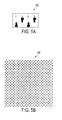
- FIGS. 5A-5B illustrate the unmodified halftone cell and super cell 500, 502 respectively upon which a texture pattern will be superimposed for improved uniformity appearance in accordance with a preferred embodiment. It illustrates that the base halftone cell 500 is used to tile in both X & Y directions to form a super tile/cell 502, which has a size of approximately 3mmx3mm.
- grainy patterns 600, 602 in textured HT screens for achieving improved uniformity appearance in accordance with a preferred embodiment.
- the base tile 600 can be repeated in X & Y directions to tile the whole 2D plane with a seamless grainy pattern 602.
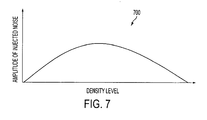
- noise amplitude control curve in textured HT screens for improved uniformity appearance in accordance with a preferred embodiment.
- noise amplitudes are reduced to zero.
- the amplitude is maximized in the midtone, where the mottle is severe and needs the greatest amount of texture.
- a modified screen 800 By using the spatial pattern as illustrated in FIG. 6 , and by generating the noise amplitude control curve in textured HT screens, improved uniformity appearance can be achieved in accordance with a preferred embodiment.
- the modified screen is formed by modifying the super cell created by tiling the regular halftone screen to reach a sufficient size in both X & Y directions.
- the spatial pattern and amplitude control curve are used to modify the threshold values of the super cell and the pixel values.
- Fig. 8 is representative of the modified threshold values with exaggerated texture amplitude.
- the HT super cell 502 as illustrated in Fig. 5B has identical size as the texture pattern 602 shown in Fig. 6B .
- Both T ij and P ij take values from 0 to 255.
- A(T) is further denoted as the amplitude control curve, which takes a threshold input with values range from 0 to 255.
- the values of the new threshold array T' ij can remain between 0 and 255, namely no clipping.
- the magnitude of A(T) at the mid-tone range should be optimized according to the need of noise injection.
- the texture pattern is reproduced in the halftone output.
- the tile which is a common periodic base for both the texture pattern and the halftone cell, is an important aspect of implementation.
- the tile is a unit base for the texture pattern but a super tile for the halftone cells.
- the tile can be a unit base for both the texture pattern and the halftone.
Landscapes
- Engineering & Computer Science (AREA)
- Multimedia (AREA)
- Signal Processing (AREA)
- Image Processing (AREA)
- Facsimile Image Signal Circuits (AREA)
Claims (7)
- Verfahren, bei dem texturierte digitale Halbtonraster (800, 900) zum Verbessern des einheitlichen Erscheinungsbildes bei Bildbearbeitung eingesetzt wird, wobei das Verfahren die folgenden Schritte umfasst:Verwenden eines Normal-Halbtonrasters (500) zum Kacheln (tiling);Ausbilden (306) einer Superzelle (502), die mehrere gekachelte Zellen des Normal-Halbtonrasters (500) umfasst;gekennzeichnet durchdie folgenden Schritte:Erzeugen (404-410, 422) eines texturierten Musters (602), das ein Breitband-Rauschmuster (600) mit Frequenzen im Bereich von ungefähr 2 Zyklen/mm bis 7 Zyklen/mm umfasst;Generieren (310) einer Rauschamplituden-Steuerkurve (600);Modifizieren (312) der Superzelle (502) durch Anwenden des entsprechend der Amplituden-Steuerkurve (700) modifizierten texturierten Musters, so dass ein texturiertes Raster (800, 900) entsteht; undVerwenden (314) des texturierten Rasters für Bildwiedergabe.
- Verfahren nach Anspruch 1, wobei der Schritt des Erzeugens eines texturierten Rasters Erzeugen (412, 422) eines texturierten Rasters umfasst, das tesseliert, ohne visuelle Artefakte zu produzieren.
- Verfahren nach Anspruch 1, wobei der Schritt des Erzeugens eines texturierten Rasters Erzeugen (414,422) eines texturierten Rasters umfasst, das mehrere Texturkörnungen sowohl in horizontaler als auch in vertikaler Richtung aufnimmt.
- Verfahren nach einem der vorangehenden Ansprüche, wobei das texturierte Raster (800, 900) bezüglich des Rasterwinkels und der Punktform dem Normal-Halbtonraster (500) ähnlich erscheint, die Punktgröße des Normal-Halbtonrasters (500) jedoch durch das texturierte Muster (600) moduliert wird.
- Verfahren nach einem der vorangehenden Ansprüche, wobei das Breitband-Rauschmuster so ausgewählt wird, dass das Druck-Erscheinungsbild verbessert wird, und die mehreren gekachelten Zellen des Normal-Halbtonrasters (500) eine Superzelle bilden, die groß genug ist, um das texturierte Muster (602) sowohl in horizontaler als auch vertikaler Richtung auszufüllen.
- Verfahren nach einem der vorangehenden Ansprüche, wobei die ausgebildete Superzelle (502) in Abhängigkeit von der Art des Rasters mehrere gekachelte Zellen des sowohl in horizontaler als auch vertikaler Richtung gekachelten Normal-Halbtonrasters umfasst.
- Verfahren nach einem der Ansprüche 1 bis 5, wobei die Superzelle erzeugt wird, indem die Halbton-Raster definiert werden, und die Größe der Superzelle (502) ausreichen kann, um das texturierte Muster (602) auszufüllen, und kein Kacheln erforderlich ist.
Applications Claiming Priority (1)
| Application Number | Priority Date | Filing Date | Title |
|---|---|---|---|
| US11/450,539 US7667875B2 (en) | 2006-06-09 | 2006-06-09 | Textured HT screens for improved uniformity appearance |
Publications (3)
| Publication Number | Publication Date |
|---|---|
| EP1865706A2 EP1865706A2 (de) | 2007-12-12 |
| EP1865706A3 EP1865706A3 (de) | 2008-12-31 |
| EP1865706B1 true EP1865706B1 (de) | 2011-12-07 |
Family
ID=38610748
Family Applications (1)
| Application Number | Title | Priority Date | Filing Date |
|---|---|---|---|
| EP07109525A Not-in-force EP1865706B1 (de) | 2006-06-09 | 2007-06-04 | Texturierte Halbtonraster für ein Erscheinungsbild höherer Gleichmäßigkeit |
Country Status (3)
| Country | Link |
|---|---|
| US (1) | US7667875B2 (de) |
| EP (1) | EP1865706B1 (de) |
| JP (1) | JP5037227B2 (de) |
Family Cites Families (8)
| Publication number | Priority date | Publication date | Assignee | Title |
|---|---|---|---|---|
| US4245258A (en) | 1979-11-05 | 1981-01-13 | Xerox Corporation | Method and apparatus for reduction of false contours in electrically screened images |
| WO1991002426A2 (en) | 1989-08-04 | 1991-02-21 | Intergraph Corporation | Rapid variable angle digital screening |
| JPH1075359A (ja) * | 1996-05-17 | 1998-03-17 | Dainippon Screen Mfg Co Ltd | 網点形成方法および装置、並びに、その処理を実行するためのプログラムを記録した記録媒体 |
| EP0808056B1 (de) | 1996-05-17 | 2006-02-15 | Dainippon Screen Mfg. Co., Ltd. | Verfahren und Gerät zur Erzeugung von Halbtonrasterpunkten |
| US6798537B1 (en) * | 1999-01-27 | 2004-09-28 | The University Of Delaware | Digital color halftoning with generalized error diffusion vector green-noise masks |
| JP3949931B2 (ja) * | 2001-10-30 | 2007-07-25 | 株式会社ルネサステクノロジ | 画像形成装置 |
| US7304770B2 (en) | 2004-08-30 | 2007-12-04 | Xerox Corporation | Reduction of differential gloss with halftoned clear toner |
| US7394572B2 (en) * | 2004-09-23 | 2008-07-01 | Kabushiki Kaisha Toshiba | Method and apparatus for processing of half-tone image |
-
2006
- 2006-06-09 US US11/450,539 patent/US7667875B2/en not_active Expired - Fee Related
-
2007
- 2007-06-04 EP EP07109525A patent/EP1865706B1/de not_active Not-in-force
- 2007-06-04 JP JP2007147828A patent/JP5037227B2/ja not_active Expired - Fee Related
Also Published As
| Publication number | Publication date |
|---|---|
| US20070285727A1 (en) | 2007-12-13 |
| JP2007329925A (ja) | 2007-12-20 |
| US7667875B2 (en) | 2010-02-23 |
| EP1865706A3 (de) | 2008-12-31 |
| EP1865706A2 (de) | 2007-12-12 |
| JP5037227B2 (ja) | 2012-09-26 |
Similar Documents
| Publication | Publication Date | Title |
|---|---|---|
| EP0838940B1 (de) | Verarbeitung mittels mehrerer räumlicher Kanäle | |
| JP3767732B2 (ja) | 適応的誤差拡散方法および画像処理装置 | |
| JP4532016B2 (ja) | 適応ハーフトーン化方法 | |
| Lau et al. | Digital color halftoning with generalized error diffusion and multichannel green-noise masks | |
| CA2368983A1 (en) | Narrow band, anisotropic stochastic halftone patterns and methods of creating and using the same | |
| JP2000333010A (ja) | 階調依存型誤差拡散ハーフトーン化方法 | |
| JP4149269B2 (ja) | 中間ドットを用いた誤差拡散方法及びシステム | |
| US7460276B2 (en) | Systems and methods for rank-order error diffusion image processing | |
| US8363280B2 (en) | System and method of halftone printing of image spot colors using ranked ordered pairing of colorants and halftone screens | |
| WO2006114031A1 (en) | Frequency modulated screening method based on the dual feedback error diffusion | |
| US8848254B2 (en) | Halftone screen producing apparatus, print controlling apparatus, image forming apparatus, method of producing halftone screen, method of controlling printing, method of forming image, and computer-readable recording medium | |
| WO2006041812A9 (en) | Method of producing improved lenticular images | |
| US9152897B1 (en) | Printing an image on a substrate | |
| Verevka et al. | Halftoning with image-based dither screens | |
| US8139267B2 (en) | Method, apparatus and program for creating a threshold value matrix | |
| US6956670B1 (en) | Method, system, program, and data structures for halftoning with line screens having different lines per inch (LPI) | |
| Zhang | Space-filling curve ordered dither | |
| US7667875B2 (en) | Textured HT screens for improved uniformity appearance | |
| JP2001203890A (ja) | 画像処理方法および誤差拡散のためのノイズパターン生成方法 | |
| US7733533B2 (en) | Generating threshold values in a dither matrix | |
| US20130176599A1 (en) | Halftone Screen Generation Mechanism | |
| Wu et al. | Supercell dither masks with constrained blue noise interpolation | |
| JP2006094489A (ja) | カラー画像処理装置 | |
| JP5464906B2 (ja) | 画像処理装置及びその制御方法 | |
| JP2024006470A (ja) | 画像処理装置、閾値マトリクス生成装置、それらの制御方法、記録装置、およびプログラム |
Legal Events
| Date | Code | Title | Description |
|---|---|---|---|
| PUAI | Public reference made under article 153(3) epc to a published international application that has entered the european phase |
Free format text: ORIGINAL CODE: 0009012 |
|
| AK | Designated contracting states |
Kind code of ref document: A2 Designated state(s): AT BE BG CH CY CZ DE DK EE ES FI FR GB GR HU IE IS IT LI LT LU LV MC MT NL PL PT RO SE SI SK TR |
|
| AX | Request for extension of the european patent |
Extension state: AL BA HR MK YU |
|
| PUAL | Search report despatched |
Free format text: ORIGINAL CODE: 0009013 |
|
| AK | Designated contracting states |
Kind code of ref document: A3 Designated state(s): AT BE BG CH CY CZ DE DK EE ES FI FR GB GR HU IE IS IT LI LT LU LV MC MT NL PL PT RO SE SI SK TR |
|
| AX | Request for extension of the european patent |
Extension state: AL BA HR MK RS |
|
| 17P | Request for examination filed |
Effective date: 20090630 |
|
| 17Q | First examination report despatched |
Effective date: 20090729 |
|
| AKX | Designation fees paid |
Designated state(s): DE FR GB |
|
| GRAP | Despatch of communication of intention to grant a patent |
Free format text: ORIGINAL CODE: EPIDOSNIGR1 |
|
| GRAS | Grant fee paid |
Free format text: ORIGINAL CODE: EPIDOSNIGR3 |
|
| GRAA | (expected) grant |
Free format text: ORIGINAL CODE: 0009210 |
|
| AK | Designated contracting states |
Kind code of ref document: B1 Designated state(s): DE FR GB |
|
| REG | Reference to a national code |
Ref country code: GB Ref legal event code: FG4D |
|
| REG | Reference to a national code |
Ref country code: DE Ref legal event code: R096 Ref document number: 602007019182 Country of ref document: DE Effective date: 20120223 |
|
| PLBE | No opposition filed within time limit |
Free format text: ORIGINAL CODE: 0009261 |
|
| STAA | Information on the status of an ep patent application or granted ep patent |
Free format text: STATUS: NO OPPOSITION FILED WITHIN TIME LIMIT |
|
| 26N | No opposition filed |
Effective date: 20120910 |
|
| REG | Reference to a national code |
Ref country code: DE Ref legal event code: R097 Ref document number: 602007019182 Country of ref document: DE Effective date: 20120910 |
|
| PGFP | Annual fee paid to national office [announced via postgrant information from national office to epo] |
Ref country code: FR Payment date: 20130724 Year of fee payment: 7 |
|
| PGFP | Annual fee paid to national office [announced via postgrant information from national office to epo] |
Ref country code: GB Payment date: 20140527 Year of fee payment: 8 |
|
| PGFP | Annual fee paid to national office [announced via postgrant information from national office to epo] |
Ref country code: DE Payment date: 20140523 Year of fee payment: 8 |
|
| REG | Reference to a national code |
Ref country code: FR Ref legal event code: ST Effective date: 20150227 |
|
| PG25 | Lapsed in a contracting state [announced via postgrant information from national office to epo] |
Ref country code: FR Free format text: LAPSE BECAUSE OF NON-PAYMENT OF DUE FEES Effective date: 20140630 |
|
| REG | Reference to a national code |
Ref country code: DE Ref legal event code: R119 Ref document number: 602007019182 Country of ref document: DE |
|
| GBPC | Gb: european patent ceased through non-payment of renewal fee |
Effective date: 20150604 |
|
| PG25 | Lapsed in a contracting state [announced via postgrant information from national office to epo] |
Ref country code: DE Free format text: LAPSE BECAUSE OF NON-PAYMENT OF DUE FEES Effective date: 20160101 Ref country code: GB Free format text: LAPSE BECAUSE OF NON-PAYMENT OF DUE FEES Effective date: 20150604 |