EP1865746A2 - Dispositif de test compact pour appareils auditifs - Google Patents
Dispositif de test compact pour appareils auditifs Download PDFInfo
- Publication number
- EP1865746A2 EP1865746A2 EP07107703A EP07107703A EP1865746A2 EP 1865746 A2 EP1865746 A2 EP 1865746A2 EP 07107703 A EP07107703 A EP 07107703A EP 07107703 A EP07107703 A EP 07107703A EP 1865746 A2 EP1865746 A2 EP 1865746A2
- Authority
- EP
- European Patent Office
- Prior art keywords
- test
- area
- hearing
- hearing aid
- microphone
- Prior art date
- Legal status (The legal status is an assumption and is not a legal conclusion. Google has not performed a legal analysis and makes no representation as to the accuracy of the status listed.)
- Withdrawn
Links
Images

Classifications
-
- H—ELECTRICITY
- H04—ELECTRIC COMMUNICATION TECHNIQUE
- H04R—LOUDSPEAKERS, MICROPHONES, GRAMOPHONE PICK-UPS OR LIKE ACOUSTIC ELECTROMECHANICAL TRANSDUCERS; ELECTRIC HEARING AIDS; PUBLIC ADDRESS SYSTEMS
- H04R25/00—Electric hearing aids
- H04R25/30—Monitoring or testing of hearing aids, e.g. functioning, settings, battery power
-
- H—ELECTRICITY
- H04—ELECTRIC COMMUNICATION TECHNIQUE
- H04R—LOUDSPEAKERS, MICROPHONES, GRAMOPHONE PICK-UPS OR LIKE ACOUSTIC ELECTROMECHANICAL TRANSDUCERS; ELECTRIC HEARING AIDS; PUBLIC ADDRESS SYSTEMS
- H04R29/00—Monitoring arrangements; Testing arrangements
- H04R29/008—Visual indication of individual signal levels
Definitions
- Hearing aids are used to restore or improve the hearing of the hearing impaired.
- different types of hearing aids are used.
- the most widely used are the so-called BTE devices (behind-the-ear devices), which are worn behind the ear. They are suitable for almost all types of deafness.
- IdO devices in-the-ear device
- all hearing aid types typically have the same technical components, namely a microphone, a receiver, an amplifier circuit and a battery.
- special circuits such as e.g. Filter circuits used with the help of which the sound can be modulated and thus adapted to the individual needs of the person concerned.
- digital hearing aids are known in which the audio signals are processed by means of microprocessors (DSP processors). This allows the sound to be better adapted to individual needs.
- DSP processors microprocessors
- Hearing aids are not only responsible for bringing the sound closer to the ear. Since hearing loss usually does not affect all frequencies equally, the frequency response of a modern hearing aid is adjusted to the respective hearing loss by means of a variety of setting options. The adaptation is usually carried out in cooperation of the doctor and hearing care professional. Regular visits to the hearing care professional as well as check-ups with the doctor are necessary to ensure the functionality of the hearing aids and optimal adaptation.
- the hearing aids themselves must be maintained and maintained by the person concerned in everyday use, since the hearing aid set using an individual audiogram can easily be affected by various factors, such as dirt or damage can be influenced. As a result, the sound of the hearing aid may be distorted, noisy or otherwise disturbed.
- the sound quality of the hearing aid can be reduced.
- soiling is critical especially at the microphone openings or at the listener outlet, as they can often not be recognized here by a simple visual inspection.
- the distortions caused by the affected person often can not be perceived, especially if they are progressive and due to the subjective feeling of the person concerned are not suitable for evoking the feeling of sound deterioration.
- a review and maintenance of the hearing aid by the user may be necessary several times a day. Especially small children are often not able to detect functional failure or a disturbed playback of the hearing aid and if necessary to remedy. Here, for example, the parents make the review of the hearing aid.
- the functional testing of hearing aids is conventionally carried out with a so-called stethoscope.
- the stethoscope a kind of stethoscope, is slipped onto the wearing hook of the hearing aid and allows the assistant to perceive the sound produced by the hearing aid listener, while e.g. speaks into the microphone of the hearing aid.
- a storage case for hearing aids is known in which a self-test of a hearing aid can be performed, for example, to detect contamination of the sound outlet openings of the hearing aid with cerumen.
- the hearing aid To perform a self-test, the hearing aid generates acoustic signals via its loudspeaker, which are received again via the microphone of the hearing aid.
- the evaluation takes place in the hearing aid itself, which requires a specially trained hearing aid. Since the container provides only the recording for the hearing aid and the acoustic path between the speaker and the microphone of the hearing aid, the feasibility of the test is mainly dependent on the functioning of the hearing aid and its components. To perform the self-test, it is necessary to activate the hearing aid accordingly. Furthermore, further devices for evaluation or display of the test are necessary. All of this requires certain knowledge and skills, which makes the test system not suitable for every user.
- a device for demonstrating the properties and transmission qualities of different hearing aids which has a plurality of holders for receiving a respective hearing device.
- a loudspeaker and a microphone are each arranged such that a hearing device placed in the holder can receive an acoustic signal from the loudspeaker of the device via its hearing device microphone and can be transmitted back to the microphone of the device via the hearing device loudspeaker.
- the device is only for demonstration of various hearing aids and their transmission characteristics and is not suitable for testing a hearing aid due to its design.
- the EP 1 251 716 B1 discloses a method of modeling transducers of digital hearing aids using a special test device.
- the hearing aid microphone and the hearing aid speaker can also be tested here.
- a device for testing a hearing device which has a housing with a test area designed for receiving a hearing device, wherein the test area comprises a microphone area and a receiver area. Furthermore, a signal generator and a loudspeaker are provided to generate a defined acoustic test signal in the microphone area. In addition, a microphone is arranged in the receiver area in order to detect an acoustic response signal emitted by the hearing device. In order to assess the functional state of the hearing aid on the basis of the response signal, an evaluation circuit is provided. The functional state of the hearing aid is finally displayed on a display device. With the aid of the test device, the functional state can be assessed objectively very simply and automatically.
- the display device is designed to display the functional state optically and / or acoustically.
- the visual display allows easy control of the test result.
- a further advantageous embodiment of the invention provides that the display device has a first light source for displaying the functional state "passed test” and a second light source for displaying the functional state "test failed". This can clearly indicate whether the hearing aid is working or not.
- the first light source is a green Light emitting diode and a red light emitting diode is used as the second light source.
- a green Light emitting diode and a red light emitting diode is used as the second light source.
- this can simplify the operability of the device.
- the signal generator generates noise as a test signal.
- This noise contains a variety of frequencies. Thus, in the evaluation frequencies from the entire spectrum of sound can be considered.
- a particularly simple evaluation circuit comprises a comparator, which assesses the functional state of the hearing aid based on a comparison between the amplitude of the response signal and a predetermined voltage value.
- Such comparators are particularly favorable as standard components.
- the evaluation circuit evaluates the functional state of the hearing device on the basis of a comparison between the test and the response signal. This makes it particularly well to detect unwanted deviations in the signal processing of the hearing aid.
- An advantageous embodiment of the invention provides to acoustically shield the handset area and the microphone area from each other. As a result, a disturbing feedback is avoided thus allowing a more accurate measurement.
- the hearing aid is acoustically shielded from its surroundings.
- the functional test is undisturbed.
- the housing in the test area is at least partially flexible educated.
- a hearing aid arranged in the test area can be subjected to mechanical stress externally during a functional test.
- the housing is formed as a storage box for the hearing aid.
- a test device is provided, which is always carried.
- FIG. 1 shows by way of example a test device 1 according to the invention with a hearing device 2 arranged therein.
- this test device 1 is designed as a compact pocket device in the form of a simple test box so that it can always be carried along.
- the housing 10 of the test device has a receiving area for a hearing device 2, referred to below as a test area 11.
- This test area 11 can be adapted specifically for receiving a specific hearing device.
- the receiving area 11 has special formations which correspond to the respective hearing device 2.
- To fix the hearing device 2 in a predetermined position in the test device 1 holding devices may further be provided (not shown here).
- the test area 11 indicated only by a dashed line in FIG. 1 comprises a microphone area 111 and a receiver area 112. These areas are preferably arranged so that the hearing device microphone 21 in the microphone area 111 and the handset 22 of the hearing aid comes to rest in the handset area 112. To clarify this arrangement, FIG. 1 already shows a hearing device 2 arranged in the test area 11.
- an acoustic signal transmitter preferably a loudspeaker 12 is arranged such that it directly illuminates the microphone openings 21 of a hearing device 2 arranged in the test device.
- a test microphone 13 which is preferably arranged such that it lies directly in front of the earpiece opening 22 of the hearing device 2 arranged in the test device. The test microphone 13 is sonicated in test mode directly from the handset 22 of the hearing aid 2.
- Both the loudspeaker 12 and the test microphone 13 are connected to an electronic test circuit 14, which is shown in simplified form in FIG. 1 as a block.
- This test circuit 14 comprises a tone generator 141 and an evaluation circuit 144.
- the tone generator 141 generates a defined acoustic test signal that is passed to the hearing aid microphone 21 via the loudspeaker 12.
- the evaluation circuit 144 serves to evaluate the response signal of the hearing device 2 received by the test microphone 12.
- the test device 1 has a display device 15, as is preferably designed as an optical display.
- the display device 15 serves to display the functional state of the hearing device 2 determined on the basis of the response signal.
- the display device 15 has only two small lamps 151, 152 for this purpose, with which it is possible to indicate whether or not the functional test has been passed. It is particularly advantageous to use a green and a red light emitting diode, wherein the red LED indicates "failed function test", while the green LED indicates "pass test”.
- the test device 1 shown in FIG. 1 is designed as an example for receiving a so-called BTE device 2.
- the microphone, earpiece and amplifier are housed in a housing that is worn behind the ear.
- the sound reaches the ear canal from the listener via the carrying hook and an earmold (earmold).
- the functional test of such a device 2 preferably takes place without the associated carrying hook, the test microphone 13 being arranged directly at the handset outlet 22 of the hearing device 2.
- a corresponding configuration of the test area 11 is useful in order to ensure a fixation of the carrying hook or the earmold in a defined distance to the test microphone 13.
- the housing 10 of the test device 1 is preferably designed such that it can accommodate the entire hearing device 2. It is particularly advantageous if the hearing device 2 is sound-isolated from the environment during a functional test. For this purpose, it is necessary that the test device housing 2 completely surrounds the hearing device 2 arranged in the test area 11.
- the test device 1 may, for example, be equipped with a folding mechanism, wherein the test device 1 is closed after inserting the hearing device 2 and the hearing device 2 is thus isolated in a soundproof manner. Alternatively, a sliding mechanism is conceivable. In order to improve the functional test and possibly to avoid feedback, it may also be necessary to acoustically isolate the microphone region 111 from the receiver region 112.
- test area 11 for example, special silicone or foam cushions can be arranged in the test area 11, so that an acoustic separation between the two areas is achieved with an inserted hearing device 2 and closed test device housing 10. Furthermore, it is possible to replicate the handset area 112 to the handset 22 of the hearing device 2 in such a way that it can be fixed in the handset area 112. Here is both a form-fitting as well a non-positive fixation conceivable. By using elastic materials, sufficient sound insulation of the receiver area 112 can be achieved by the remaining test area 11.
- the housing 10 of the test device 1 is preferably designed to be flexible at least in one part of the test area 11, so that the hearing device 2 can be mechanically stressed by mechanical pressure on the flexible part of the housing 10 during a functional test.
- This can e.g. be realized by the use of a flexible plastic material that is sufficiently soundproof at the same time.
- the microphone 21 of the hearing device 2 is sonicated directly by the test loudspeaker 12 due to the special arrangement with an acoustic test signal.
- the test microphone 13 subsequently receives the response signal produced by the hearing device 2 at the handset 22 of the hearing device 1 and forwards it to the test circuit 14 for evaluation.
- the test device 1 shown in FIG. 1 is preferably designed as a storage or transport box for the corresponding hearing device 2. Furthermore, it is possible to provide the test device 1 for a pair of hearing aids. To make the test device as simple as possible, it is advantageous if the test circuit or even the test speakers are shared by both hearing aids.
- test speaker 12 is connected to a tone generator 141, which generates a predetermined test signal.
- noise is used as the test signal.
- Simple analog test devices 1 come, for example, already with a simple noise generator 141 and a comparator as evaluation circuit 144 from.
- DSP digital-signal-processing
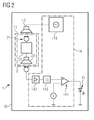
- a very simple analog test circuit 14 with a noise generator 141 as a test signal generator is shown by way of example.
- Such circuits can be produced very inexpensively.
- the signal generated by the noise generator 141 is applied to the microphone 21 of the hearing aid 2 via the loudspeaker 12 as acoustic noise.
- the amplifier circuit 23 of the activated hearing device 2 then generates a response signal that is transmitted via the handset 22 of the hearing device to the test microphone 13 of the test device 1. After an amplification of the response signal by an amplifier stage 142, it can be supplied to a signal processing circuit 143, in which the response signal can be modeled, for example, by means of specific filters.
- the processed response signal is then applied to an input of a comparator 144, which compares the amplitude of this signal with a predetermined test voltage. Depending on the result of this comparison, a specific voltage is present at the output of the comparator 144.
- the evaluation circuit is designed so that the output signal a certain LED 15 to light up brings, if the input signal exceeds a predetermined threshold.
- the evaluation circuit 144 only differentiates between two states, namely "passed test” and "test failed". Depending on the height of the output signal, a red or a green light-emitting diode is then activated (this is not shown in FIG. 2). However, it is also conceivable to use a plurality of light-emitting diodes with which the functional state of the hearing device 1 can be represented in a more differentiated manner. Equally possible is e.g. an LCD display that can display more information. These solutions require additional circuitry that is not shown here for simplicity.
Landscapes
- Health & Medical Sciences (AREA)
- General Health & Medical Sciences (AREA)
- Otolaryngology (AREA)
- Neurosurgery (AREA)
- Physics & Mathematics (AREA)
- Engineering & Computer Science (AREA)
- Acoustics & Sound (AREA)
- Signal Processing (AREA)
- Measurement Of The Respiration, Hearing Ability, Form, And Blood Characteristics Of Living Organisms (AREA)
- Measurement Of Mechanical Vibrations Or Ultrasonic Waves (AREA)
Applications Claiming Priority (1)
| Application Number | Priority Date | Filing Date | Title |
|---|---|---|---|
| DE102006026721A DE102006026721B4 (de) | 2006-06-08 | 2006-06-08 | Vorrichtung zum Testen eines Hörgerätes |
Publications (2)
| Publication Number | Publication Date |
|---|---|
| EP1865746A2 true EP1865746A2 (fr) | 2007-12-12 |
| EP1865746A3 EP1865746A3 (fr) | 2008-06-11 |
Family
ID=38422029
Family Applications (1)
| Application Number | Title | Priority Date | Filing Date |
|---|---|---|---|
| EP07107703A Withdrawn EP1865746A3 (fr) | 2006-06-08 | 2007-05-08 | Dispositif de test compact pour appareils auditifs |
Country Status (3)
| Country | Link |
|---|---|
| US (1) | US20070286429A1 (fr) |
| EP (1) | EP1865746A3 (fr) |
| DE (1) | DE102006026721B4 (fr) |
Cited By (7)
| Publication number | Priority date | Publication date | Assignee | Title |
|---|---|---|---|---|
| EP2247119A1 (fr) | 2009-04-27 | 2010-11-03 | Siemens Medical Instruments Pte. Ltd. | Dispositif d'analyse acoustique d'un dispositif auditif et procédé d'analyse |
| WO2011029959A2 (fr) | 2010-10-22 | 2011-03-17 | Phonak Ag | Procédé et système pour tester un appareil auditif |
| EP2451193A3 (fr) * | 2010-11-05 | 2013-01-09 | Siemens Medical Instruments Pte. Ltd. | Appareil auditif et procédé de fonctionnement d'un appareil auditif avec capteur d'humidité |
| WO2013007304A1 (fr) | 2011-07-13 | 2013-01-17 | Phonak Ag | Procédé et système pour tester un appareil auditif depuis un emplacement distant |
| WO2017187136A1 (fr) * | 2016-04-25 | 2017-11-02 | Soundchip Sa | Test d'écouteur |
| EP4002887A1 (fr) * | 2020-11-11 | 2022-05-25 | GN Hearing A/S | Détection de l'encrassement de filtre pour appareils auditifs |
| GB2605041B (en) * | 2019-11-04 | 2023-11-22 | Cirrus Logic Int Semiconductor Ltd | Methods, apparatus and systems for personal audio device diagnostics |
Families Citing this family (46)
| Publication number | Priority date | Publication date | Assignee | Title |
|---|---|---|---|---|
| US7867160B2 (en) | 2004-10-12 | 2011-01-11 | Earlens Corporation | Systems and methods for photo-mechanical hearing transduction |
| US8401212B2 (en) | 2007-10-12 | 2013-03-19 | Earlens Corporation | Multifunction system and method for integrated hearing and communication with noise cancellation and feedback management |
| US7668325B2 (en) | 2005-05-03 | 2010-02-23 | Earlens Corporation | Hearing system having an open chamber for housing components and reducing the occlusion effect |
| DE102008019107A1 (de) * | 2008-04-16 | 2009-10-29 | Siemens Medical Instruments Pte. Ltd. | Hörgerätemessvorrichtung und -verfahren |
| WO2009155361A1 (fr) * | 2008-06-17 | 2009-12-23 | Earlens Corporation | Dispositifs auditifs électro-mécaniques optiques présentant une architecture combinant puissance et signal |
| WO2009155358A1 (fr) | 2008-06-17 | 2009-12-23 | Earlens Corporation | Dispositifs d’audition électromécaniques optiques dotés de composants d’alimentation et de signal séparés |
| US8396239B2 (en) * | 2008-06-17 | 2013-03-12 | Earlens Corporation | Optical electro-mechanical hearing devices with combined power and signal architectures |
| EP3509324B1 (fr) | 2008-09-22 | 2023-08-16 | Earlens Corporation | Dispositifs à armature équilibrée et procédés d'écoute |
| DK2438768T3 (en) | 2009-06-05 | 2016-06-06 | Earlens Corp | Optically coupled acoustically mellemøreimplantatindretning |
| US9544700B2 (en) | 2009-06-15 | 2017-01-10 | Earlens Corporation | Optically coupled active ossicular replacement prosthesis |
| CN102640435B (zh) | 2009-06-18 | 2016-11-16 | 伊尔莱茵斯公司 | 光学耦合的耳蜗植入系统及方法 |
| CN102598713A (zh) | 2009-06-18 | 2012-07-18 | 音束有限责任公司 | 用于听力系统的耳膜可植入装置及方法 |
| WO2011005479A2 (fr) | 2009-06-22 | 2011-01-13 | SoundBeam LLC | Systèmes et procédés de conduction osseuse à couplage optique |
| BRPI1016075A2 (pt) | 2009-06-22 | 2016-05-10 | SoundBeam LLC | dispositivo para transmitir som para um ouvido de um usuário e métodos associados. |
| US8845705B2 (en) | 2009-06-24 | 2014-09-30 | Earlens Corporation | Optical cochlear stimulation devices and methods |
| US8715154B2 (en) | 2009-06-24 | 2014-05-06 | Earlens Corporation | Optically coupled cochlear actuator systems and methods |
| SG177656A1 (en) | 2009-08-11 | 2012-02-28 | Widex As | Storage system for a hearing aid |
| DE102010043413A1 (de) * | 2010-11-04 | 2012-05-10 | Siemens Medical Instruments Pte. Ltd. | Verfahren und Hörgerät zur Ermittlung von Nässe |
| EP3758394A1 (fr) | 2010-12-20 | 2020-12-30 | Earlens Corporation | Appareil auditif intra-auriculaire anatomiquement personnalisé |
| JP2012169828A (ja) * | 2011-02-14 | 2012-09-06 | Sony Corp | 音声信号出力装置、スピーカ装置、音声信号出力方法 |
| TWI469648B (zh) * | 2011-12-05 | 2015-01-11 | Inventec Corp | 音訊測試系統及待測裝置的音訊測試方法 |
| US9158891B2 (en) * | 2013-02-15 | 2015-10-13 | Cochlear Limited | Medical device diagnostics using a portable device |
| US20140270206A1 (en) * | 2013-03-15 | 2014-09-18 | Timothy Alan PORT | Acoustic transmissivity impairment determining method and apparatus |
| US9510120B2 (en) | 2013-10-30 | 2016-11-29 | Amkor Technology, Inc. | Apparatus and method for testing sound transducers |
| TWI558154B (zh) * | 2014-01-09 | 2016-11-11 | 緯創資通股份有限公司 | 音訊檢測方法及裝置 |
| US10034103B2 (en) | 2014-03-18 | 2018-07-24 | Earlens Corporation | High fidelity and reduced feedback contact hearing apparatus and methods |
| DK201470370A1 (en) * | 2014-06-20 | 2016-01-11 | Gn Otometrics As | Apparatus for testing directionality in hearing instruments |
| US9729975B2 (en) | 2014-06-20 | 2017-08-08 | Natus Medical Incorporated | Apparatus for testing directionality in hearing instruments |
| DK3169396T3 (da) | 2014-07-14 | 2021-06-28 | Earlens Corp | Glidende forspænding og peak-begrænsning for optiske høreapparater |
| JP2017524936A (ja) * | 2014-07-24 | 2017-08-31 | ヌクレウス サイエンティフィック, インク.Nucleus Scientific, Inc. | 電荷貯蔵デバイスを試験するための機器搭載パケット(instrumented packet) |
| US9924276B2 (en) | 2014-11-26 | 2018-03-20 | Earlens Corporation | Adjustable venting for hearing instruments |
| DK3888564T3 (da) | 2015-10-02 | 2025-07-14 | Earlens Corp | Indretning til tilpasset afgivelse af medicin i øregangen |
| WO2017116791A1 (fr) | 2015-12-30 | 2017-07-06 | Earlens Corporation | Systèmes, appareil et procédés auditifs reposant sur la lumière |
| US10492010B2 (en) | 2015-12-30 | 2019-11-26 | Earlens Corporations | Damping in contact hearing systems |
| US11350226B2 (en) | 2015-12-30 | 2022-05-31 | Earlens Corporation | Charging protocol for rechargeable hearing systems |
| CN112738700A (zh) | 2016-09-09 | 2021-04-30 | 伊尔兰斯公司 | 智能镜系统和方法 |
| WO2018093733A1 (fr) | 2016-11-15 | 2018-05-24 | Earlens Corporation | Procédure d'impression améliorée |
| WO2019173470A1 (fr) | 2018-03-07 | 2019-09-12 | Earlens Corporation | Dispositif auditif de contact et matériaux de structure de rétention |
| WO2019199680A1 (fr) | 2018-04-09 | 2019-10-17 | Earlens Corporation | Filtre dynamique |
| CN111447540B (zh) * | 2018-07-26 | 2021-08-10 | Oppo广东移动通信有限公司 | 麦克风堵孔检测方法及相关产品 |
| KR20220034530A (ko) * | 2020-09-11 | 2022-03-18 | 삼성전자주식회사 | 소리를 출력하는 전자 장치와 이의 동작 방법 |
| US12108213B2 (en) | 2021-06-18 | 2024-10-01 | Starkey Laboratories, Inc. | Self-check protocol for use by ear-wearable electronic devices |
| US11477582B1 (en) * | 2021-06-25 | 2022-10-18 | Eargo, Inc. | Hearing device test and diagnostics system and methods |
| DE102021208928B4 (de) * | 2021-08-13 | 2025-05-08 | Sivantos Pte. Ltd. | Verfahren zur Überprüfung eines PPG-Sensors einer Hörvorrichtung und Hörvorrichtungssystem |
| CN115790831A (zh) * | 2022-12-09 | 2023-03-14 | 重庆大学 | 一种医用听诊器声学性能测试系统 |
| US12417285B2 (en) | 2023-01-31 | 2025-09-16 | Sonova Ag | System and methods for detecting a copy of a deep neural network in a hearing device |
Family Cites Families (7)
| Publication number | Priority date | Publication date | Assignee | Title |
|---|---|---|---|---|
| DE2844218A1 (de) * | 1978-10-11 | 1980-04-24 | Bosch Gmbh Robert | Verfahren zum auswaehlen, anpassen, einstellen, messen und pruefen von hoergeraeten |
| DE19633996B4 (de) * | 1996-08-23 | 2005-10-27 | Krämer, Ulrich, Dr.med. | Gerät zur Demonstration der Eigenschaften und Übertragungsqualitäten unterschiedlicher Hörgeräte |
| US20020191800A1 (en) * | 2001-04-19 | 2002-12-19 | Armstrong Stephen W. | In-situ transducer modeling in a digital hearing instrument |
| US7003128B2 (en) * | 2003-04-07 | 2006-02-21 | Phonak Ag | Hearing device set for testing a hearing device |
| US7062056B2 (en) * | 2003-09-10 | 2006-06-13 | Etymonic Design Incorporated | Directional hearing aid tester |
| DE10354897B4 (de) * | 2003-11-24 | 2005-10-06 | Siemens Audiologische Technik Gmbh | Behälter zum Selbsttest eines Hörgeräts und entspechendes Prüfungsverfahren |
| WO2005125276A1 (fr) * | 2004-06-14 | 2005-12-29 | Johnson & Johnson Consumer Companies, Inc. | Systeme de nettoyage et de test a domicile d'une prothese auditive |
-
2006
- 2006-06-08 DE DE102006026721A patent/DE102006026721B4/de not_active Expired - Fee Related
-
2007
- 2007-05-08 EP EP07107703A patent/EP1865746A3/fr not_active Withdrawn
- 2007-06-07 US US11/810,975 patent/US20070286429A1/en not_active Abandoned
Cited By (15)
| Publication number | Priority date | Publication date | Assignee | Title |
|---|---|---|---|---|
| US8249262B2 (en) | 2009-04-27 | 2012-08-21 | Siemens Medical Instruments Pte. Ltd. | Device for acoustically analyzing a hearing device and analysis method |
| EP2247119A1 (fr) | 2009-04-27 | 2010-11-03 | Siemens Medical Instruments Pte. Ltd. | Dispositif d'analyse acoustique d'un dispositif auditif et procédé d'analyse |
| US9071915B2 (en) | 2010-10-22 | 2015-06-30 | Phonak Ag | Method for testing a hearing device as well as an arrangement for testing a hearing device |
| WO2011029959A3 (fr) * | 2010-10-22 | 2011-08-18 | Phonak Ag | Procédé et système pour tester un appareil auditif |
| WO2011029959A2 (fr) | 2010-10-22 | 2011-03-17 | Phonak Ag | Procédé et système pour tester un appareil auditif |
| EP2451193A3 (fr) * | 2010-11-05 | 2013-01-09 | Siemens Medical Instruments Pte. Ltd. | Appareil auditif et procédé de fonctionnement d'un appareil auditif avec capteur d'humidité |
| WO2013007304A1 (fr) | 2011-07-13 | 2013-01-17 | Phonak Ag | Procédé et système pour tester un appareil auditif depuis un emplacement distant |
| WO2017187136A1 (fr) * | 2016-04-25 | 2017-11-02 | Soundchip Sa | Test d'écouteur |
| CN109076300A (zh) * | 2016-04-25 | 2018-12-21 | 声奇股份公司 | 耳机测试 |
| US10655440B2 (en) | 2016-04-25 | 2020-05-19 | Soundchip Sa | Earphone testing |
| CN109076300B (zh) * | 2016-04-25 | 2021-04-30 | 声奇股份公司 | 耳机测试 |
| GB2605041B (en) * | 2019-11-04 | 2023-11-22 | Cirrus Logic Int Semiconductor Ltd | Methods, apparatus and systems for personal audio device diagnostics |
| US12223980B2 (en) | 2019-11-04 | 2025-02-11 | Cirrus Logic Inc. | Methods and apparatus for headset diagnostics |
| EP4002887A1 (fr) * | 2020-11-11 | 2022-05-25 | GN Hearing A/S | Détection de l'encrassement de filtre pour appareils auditifs |
| US11553284B2 (en) | 2020-11-11 | 2023-01-10 | Gn Hearing A/S | Detection of filter clogging for hearing devices |
Also Published As
| Publication number | Publication date |
|---|---|
| DE102006026721B4 (de) | 2008-09-11 |
| US20070286429A1 (en) | 2007-12-13 |
| DE102006026721A1 (de) | 2007-12-27 |
| EP1865746A3 (fr) | 2008-06-11 |
Similar Documents
| Publication | Publication Date | Title |
|---|---|---|
| DE102006026721B4 (de) | Vorrichtung zum Testen eines Hörgerätes | |
| DE10046098C5 (de) | Verfahren zum Prüfen eines Hörhilfegerätes sowie Hörhilfegerät | |
| EP2200346B1 (fr) | Prothèse auditive avec commutation automatique à algorithme | |
| DE102008008898B3 (de) | Verfahren und Vorrichtung zum Überwachen einer Hörhilfe | |
| EP2247119A1 (fr) | Dispositif d'analyse acoustique d'un dispositif auditif et procédé d'analyse | |
| DE102010043413A1 (de) | Verfahren und Hörgerät zur Ermittlung von Nässe | |
| DE102017215825B3 (de) | Verfahren zum Erkennen eines Defektes in einem Hörinstrument | |
| DE102005028742B3 (de) | Hörhilfegerät mit Mitteln zur Rückkopplungskompensation und Verfahren zur Rückkopplungsunterdrückung | |
| EP1453358B1 (fr) | Appareil et procédé pour ajuster une prothèse auditive | |
| EP2434779A2 (fr) | Procédé d'adaptation d'un appareil auditif avec audiométrie in situ et appareil auditif correspondant | |
| EP4134002B1 (fr) | Procédé et système de génération d'un audiogramme d'une personne soumise à l'essai au moyen d'un instrument auditif | |
| DE102009010892A1 (de) | Vorrichtung und Verfahren zur Reduzierung von Trittschallwirkungen bei Hörvorrichtungen mit aktiver Okklusionsreduktion | |
| EP1813190A1 (fr) | Appareil pour un test auditif | |
| EP2053877A1 (fr) | Procédé et dispositif destinés à l'adaptation d'un appareil auditif à l'aide de DPOAE | |
| EP2320679A2 (fr) | Appareil auditif avec simulation de perte auditive et procédé de simulation de perte auditive | |
| EP2604185A1 (fr) | Dispositif et procédé de détermination d'oto-émissions acoustiques produites par distorsion en tenant compte de produits de déformation imposés par la technologie | |
| DE102013207080B4 (de) | Binaurale Mikrofonanpassung mittels der eigenen Stimme | |
| DE102020209507A1 (de) | Verfahren zur Überprüfung von Hörgerätefunktionen, Ladebox für ein Hörgerät und Hörgerät | |
| DE102013111295A1 (de) | Vorrichtung zum Vergleichstest von Hörgeräten | |
| CH713094A2 (de) | Kuppler zum Ausmessen eines Hörgerätes sowie Verfahren zum Messen einer RECD. | |
| EP1809072A2 (fr) | Procédé et dispositif de vérification d'une situation de mesure dans un dispositif auditif | |
| CH718868A2 (de) | Verfahren für einen elektroakustischen Selbsttest eines Hörgerätes, sowie Hörgerätebehälter und Hörgerät zu seiner Ausführung. | |
| EP2897383B1 (fr) | Procédé et dispositif destinés à l'analyse de réglages d'appareil auditif | |
| DE102016104598A1 (de) | Demonstrationsvorrichtung für Hörgeräte | |
| EP0010169A1 (fr) | Procédé et dispositif pour la mesure, le contrôle et en particulier pour l'ajustage de la pression acoustique de sortie d'appareils auditifs |
Legal Events
| Date | Code | Title | Description |
|---|---|---|---|
| PUAI | Public reference made under article 153(3) epc to a published international application that has entered the european phase |
Free format text: ORIGINAL CODE: 0009012 |
|
| AK | Designated contracting states |
Kind code of ref document: A2 Designated state(s): AT BE BG CH CY CZ DE DK EE ES FI FR GB GR HU IE IS IT LI LT LU LV MC MT NL PL PT RO SE SI SK TR |
|
| AX | Request for extension of the european patent |
Extension state: AL BA HR MK YU |
|
| PUAL | Search report despatched |
Free format text: ORIGINAL CODE: 0009013 |
|
| AK | Designated contracting states |
Kind code of ref document: A3 Designated state(s): AT BE BG CH CY CZ DE DK EE ES FI FR GB GR HU IE IS IT LI LT LU LV MC MT NL PL PT RO SE SI SK TR |
|
| AX | Request for extension of the european patent |
Extension state: AL BA HR MK RS |
|
| AKX | Designation fees paid | ||
| STAA | Information on the status of an ep patent application or granted ep patent |
Free format text: STATUS: THE APPLICATION IS DEEMED TO BE WITHDRAWN |
|
| 18D | Application deemed to be withdrawn |
Effective date: 20081212 |
|
| REG | Reference to a national code |
Ref country code: DE Ref legal event code: 8566 |