EP1866976B1 - Herstellung thermoelektrischer materialien durch mechanosynthese - Google Patents
Herstellung thermoelektrischer materialien durch mechanosynthese Download PDFInfo
- Publication number
- EP1866976B1 EP1866976B1 EP06725568A EP06725568A EP1866976B1 EP 1866976 B1 EP1866976 B1 EP 1866976B1 EP 06725568 A EP06725568 A EP 06725568A EP 06725568 A EP06725568 A EP 06725568A EP 1866976 B1 EP1866976 B1 EP 1866976B1
- Authority
- EP
- European Patent Office
- Prior art keywords
- mechanosynthesis
- making
- thermoelectric
- grain
- powder
- Prior art date
- Legal status (The legal status is an assumption and is not a legal conclusion. Google has not performed a legal analysis and makes no representation as to the accuracy of the status listed.)
- Expired - Lifetime
Links
Images
Classifications
-
- H—ELECTRICITY
- H10—SEMICONDUCTOR DEVICES; ELECTRIC SOLID-STATE DEVICES NOT OTHERWISE PROVIDED FOR
- H10N—ELECTRIC SOLID-STATE DEVICES NOT OTHERWISE PROVIDED FOR
- H10N10/00—Thermoelectric devices comprising a junction of dissimilar materials, i.e. devices exhibiting Seebeck or Peltier effects
- H10N10/01—Manufacture or treatment
-
- H—ELECTRICITY
- H10—SEMICONDUCTOR DEVICES; ELECTRIC SOLID-STATE DEVICES NOT OTHERWISE PROVIDED FOR
- H10N—ELECTRIC SOLID-STATE DEVICES NOT OTHERWISE PROVIDED FOR
- H10N10/00—Thermoelectric devices comprising a junction of dissimilar materials, i.e. devices exhibiting Seebeck or Peltier effects
- H10N10/80—Constructional details
- H10N10/85—Thermoelectric active materials
- H10N10/851—Thermoelectric active materials comprising inorganic compositions
Definitions
- the invention relates to the field of thermoelectric materials of skutterudite type and processes for producing such materials.
- thermoelectric materials as well as the researches to find or to realize new thermoelectric materials or new structures of materials have mainly objective to increase the effectiveness of these.
- thermoelectric material used for the conversion of heat into electrical power
- efficiency of a thermoelectric material used for the conversion of heat into electrical power can be estimated using the merit factor, also noted ZT. This factor increases when the thermoelectric power, the electrical conductivity and the inverse of the thermal conductivity of the material increase.
- the binary skutterudites crystallize in a centered cubic structure (space group 1m3), the M atoms occupying the crystallographic positions 8c (1 ⁇ 4 1 ⁇ 4 1 ⁇ 4), and the atom X the positions 24g (0, y, z).
- the filled or partially filled skutterudites of the general simplified formula (R 1 -t R ' t ) y M x M' 4-x X z X '12 -z are among the most promising recent materials for thermoelectric applications; they can indeed have a higher merit factor than that of the binary skutterudites, "y" ⁇ ] 0; 1], "x" ⁇ [0; 4], "z” ⁇ [0; 12], M and M 'being metals of line IV, V or VI of the periodic table, X and X' being elements of column XIV, XV or XVI of the periodic table; R and R 'being elements electropositive or a mixture of electropositive elements (ie a valence element between 1 and 4, selected from alkalis, alkaline earths, rare earths and actinides in the periodic table).
- the filled skutterudites can have a more complete general formula insofar as the number of elements R, M and X is not limited. It can then be written (R, R ', .... R n ) y (M, M', ... M m ) 4 (X, X ', ... X p ) 12 or n, m , p are integers.
- the presence of the atom R differentiates filled or partially filled skutterudites from empty or binary skutterudites.
- the atom R located in the center of a large cage in position 2a (0, 0, 0), can vibrate around its equilibrium position independently of the vibrations of the network.
- Filled skutterudites thus possess high merit factors (ZT-1 at close to 400 ° C), whether they are n-type (conduction by electrons) or p-type (conduction through holes).
- the size of the grains of matter decreases, which is particularly the case for nanocrystalline material grains, whose size is of the order, or less than a few hundreds of nanometers.
- the mean free path of the phonons is limited, which reduces their contribution to the thermal conductivity.
- a first known conventional method for producing skutterudites in the powdery state consists first of all in melting and then in producing a long-lasting annealing before grinding. Production is therefore extremely long (from one to several days) and expensive in energy, especially during annealing.
- a second known method for producing skutterudites in the nanocrystalline state is the synthesis of skutterudites by solution chemistry.
- a first technique consists in producing CoSb 3 nanowires by electrochemical treatment. This first technique, however, requires subsequent annealing.
- a second synthetic technique consists of producing nanowires of NaFe 4 P 12 by hydrothermal treatment and then annealing. Inclusions and doping nickel or tellurium in the nanowires were also tried.
- a third synthetic technique consists in producing nanopowders of CoSb 3 , a nanopowder being a powder (as defined above) consisting of grains of matter each of size less than one micrometer.
- a nanopowder being a powder (as defined above) consisting of grains of matter each of size less than one micrometer.
- co-precipitation is carried out, followed by calcination in air and reduction under hydrogen. Characterization by X-ray diffraction of the material obtained is, however, insufficiently precise, and the treatment is too complex to implement ( Bertini et al. "Nanostructured Co1-xNixSb3 skutterudites: Synthesis, thermoelectric properties, and theoretical modeling", Journal of Applied Physics, 93 (1), p.438 (2003) )).
- a fourth technique consists in producing nanopowders (defined above) of CoSb 3 by jet pyrolysis (also called “spray pyrolysis”) followed by reduction in hydrogen ( Wojciechowski et al. Microstructure and transport properties of nanograined powders of CoSb3 obtained with the spray pyrolysis method ", Proc. 22nd International Conference on Thermoelectrics ICT2003, La Grande Motte, France, August 2003, p.97 ).
- a third known method of manufacturing skutterudites is the synthesis of skutterudites by mechanical grinding.
- a first known grinding technique consists in preparing skutterudites filled by means of a short and violent mechanical grinding ( Chapon et al. "Mechanical alloying of CeFe4Sb12 and substituted compounds CeFe3.5Ni0.5Sb12 and CeFe4Sb11Te” Accounts of the Academy of Sciences. Series II c, p761-763 (1998) )).
- the technique used causes significant contamination of the powder produced, in particular by the alumina from the crucible and the balls used for grinding.
- the average size of the grains of material obtained is about 10 micrometers, which is a very large size.
- a second known grinding technique consists in preparing CoSb 3 by mechanical grinding (document CN1422969 ; and "Synthesis of CoSb3 skutterudite by mechanical alloying" by Yang et al., In Journal of Alloys and Compounds, 375, p. 229 (2004 )).
- the grains obtained have an average size of between about 9 and about 20 microns, calculated from the photos taken in electron microscopy using a rule of three.
- JIYANG WANG ET AL entitled “Progress in skutterudite-based thermoelectric materials” THERMOELECTRICS, 2001. PROCEEDINGS ICT 2001.
- XX INTERNATIONAL CONFERENCE ON 8-11 JUNE 2001, PISCATAWAY, NJ, USA, IEEE, pages 89-92 discloses a grain of powder consisting mainly of a crystalline alloy having thermoelectric properties and having a cubic structure, the alloy comprising NaFe 4 P 12 nanowires having an average size of diameter 30-80nm.
- An object of the invention is to implement a technique for producing skutterudites having thermoelectric properties in the form of nanopowders (defined above) without necessarily implementing a high temperature annealing step.
- Another object of the invention is to produce skutterudites in the form of powders whose shapes and grain sizes make it possible to facilitate subsequent shaping and to equal or improve the thermoelectric properties of the material.
- Another object of the invention is to produce skutterudites having a good purity, with a low amount of spurious phases.
- Another object of the invention is to produce filled skutterudites having good purity, with a low amount of parasitic phase.
- Another object of the invention is to find a manufacturing technique skutterudites for industrial production (i.e. production in sufficient quantities on an industrial scale, and reproducibly).
- Another object of the invention is to obtain a material which remains stable up to high temperatures of the order of 600 ° C.
- thermoelectric material characterized in that it is mainly formed of a multitude of these nanocrystalline powder grains, in powdery or compacted form.
- the invention proposes to make a skutterudite alloy material with significant thermoelectric power, by mechanosynthesis.
- Mechanosynthesis can be defined as a mechanical process for the synthesis of materials (alloy compounds, etc.) by dry co-grinding or in the presence of a process control agent, from a starting material consisting of pure elements or pre-alloyed in a high energy mill, to obtain powders.
- the starting material undergoes successive violent mechanical shocks (causing exothermic reactions) and is then subjected to a succession of bonding (welding) and takeoff (decohesion) particles.
- the constituent material of the container is preferably chosen so as not to cause pollution of the worked material.
- steel will be chosen.
- the constitutive material of the beads is chosen so as to have a hardness adjusted to have a good shock transfer efficiency while avoiding excessive contamination of the material worked. It will be possible to choose steel.
- the ratio of the number of balls to the total mass of powder to be produced is further adjusted to have a shock frequency determined as optimal, for a determined ball speed.
- the mechanosynthesis device comprises internal means which create a movement, communicated to the balls, according to techniques which may be different according to the type of mill used. For example, an attritor mill, a horizontal mill, a vertical vibration mill, or a planetary mill may be used.
- the grinder used by the Applicant in the rest of this document to make the powders is a planetary mill equipped with steel jars and a tray, the jars being in relative movement with respect to the plate itself moving, then printing a movement to steel balls. Similar results could have been obtained with other types of mills.
- the skutterudite is binary or empty, of formula MX 3 + x , as defined above.
- the first component may further comprise another element chosen from transition metals, this alloy may then have the formula R y M x M ' 4-x X z X' 12 -z or (R, R ',. ... R m ) y (M, M ', ... M n ) 4 (X, X', ... X p ) 12 , as defined above.
- Said first element M and the other elements M ', ... M m optional are preferably chosen from the following elements: Fe, Co, Ni, Ru, Rh, Pd, Os, Ir, Pt, more particularly chosen from Fe, Co and Ni.
- Said second element X and the other elements X ', ..., X p optional are preferably chosen from the following elements: P, As, Sn, Sb, Si, Ge and Te, and may be more particularly Sb.
- Said third element and the other elements R ', .... R n optional are preferably chosen from the following elements: La, Ce, Pr, Nd, Eu, Yb, Ba, Ca, Na, K, TI, Sr, U and more particularly chosen from Ce and Yb.
- the alloys which have been studied in a nonlimiting manner by the Applicant are Ce y Fe 4-x Co x Sb 12 and Yb y Fe 4-x CO x Sb 12 , with x included respectively between 0 and 4, and y between 0 and 1, which are partially filled skutterudites whose thermoelectric properties are considered important.
- x included respectively between 0 and 4
- y between 0 and 1
- thermoelectric properties are considered important.
- the manufacture of partially filled skutterudites (Ce / Yb) y Fe 4-x Co x Sb 12 by mechanosynthesis is made from starting materials in the form of powders or sheets or macroscopic pieces more voluminous, the starting materials selected may be pure materials or alloys (also called pre-alloyed materials).
- Fe-Sb alloy or a powder rather than solid iron as the starting material for iron, and for rare Ce-Sb or Yb-Sb alloys rather than pure elements.
- Mischmetal which is interesting from an economic point of view.
- the Applicant has successfully implemented mechanosyntheses to obtain skutterudite powders of sizes less than 200 nanometers by bringing a workload between 85 kilojoules and 430 kilojoules.
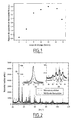
- the measurement points then suggest a curve having a skutterudite phase maximum corresponding to a grinding time of approximately 12 h.
- the skutterudite powders have been produced by the Applicant under an argon inert atmosphere with a mass impact power of about 4 Watts / gram of product.
- the Applicant used a bead mass / starting material ratio of 15/1. Good results have notably been obtained by using a rotation speed of 1020 revolutions min -1 for the jar and 510 revolutions min -1 for the plateau.
- the duration of the grinding chosen was about 12 hours.
- the grinding was carried out so that the worked material does not exceed a limit temperature corresponding to about the melting temperature of any of the elements present (here, the limiting temperature corresponds to the melting of Sb at about 630 ° C. ).
- the Applicant has carried out grinding for several periods of working time separated by periods of rest time long enough for the temperature of the worked material to drop well below said melting temperature.
- the Applicant has implemented grinding in 4-hour periods separated by periods of one hour.
- the figure 2 represents two X-ray diffractograms (giving on the ordinates the intensities "I" in arbitrary unit) of two samples of composition Ce 0.9 Fe 4 Sb 12 , one prepared by mechanosynthesis according to the invention (with the pre-detailed parameters ) corresponding to the curve 1, while the curve 2 corresponds to the other sample prepared by co-melting of the elements, grinding, and a long-time annealing at 700 ° C according to the conventional technique.
- Two windows appear showing enlarged parts of the two diffractograms, around 31 ° and 90 ° respectively diffraction angle ("2 ⁇ ").
- the mean size of the grains that coherently diffract X-rays is thus estimated to be less than 200 nanometers, of the order of 15 to 20 nanometers most often, by the Rietveld method ( HM Rietveld, Acta Cryst. 22, 151 (1967) ) and J. Applied Cryst. 2, 65 (1969) )).
- the Applicant has confirmed these values by means of observation by transmission electron microscopy.
- the grain sizes of material are of the order of 10 to 50 nanometers, these material grains are nanocrystalline or nano-polycrystalline.
- the refinements carried out by the Rietveld method have furthermore shown that the crystalline phase is composed for about 95% of skutterudite phase.
- the Applicant has therefore produced relatively pure skutterudite powders (> 95% skutterudite phase) in nanocrystalline form by mechanosynthesis.
- the grains of powders are mainly polycrystalline.
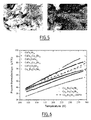
- this photo clearly shows that the grains obtained by the process according to the invention each have a generally ovoid shape, or even spherical or quasi-spherical shape. In any case, the shape obtained does not favor a particular direction of space in a clear way.
- This form is typically related to the manufacturing process used (mechanosynthesis) according to the invention.
- This form of grain improves in particular the compacting of the powder that may be subsequently operated.
- the stoichiometry results obtained are very close to the nominal stoichiometry (ie ideal stoichiometry): the atomic fraction of Sb is thus, on average on the samples, of the order of only 5% higher than that of the nominal compound, the compensation doing at the level of Fe and Co which themselves each have an average atomic fraction of the order of 2.5% lower than their nominal atomic fraction.
- the final composition of the skutterudite obtained according to the invention is therefore very close to the composition of the skutterudite desired.
- composition measured over thirty grains is very homogeneous, which means that the skutterudite powder produced according to the invention is homogeneous (all the powder grains will have similar properties).
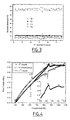
- the first heating curve 3 has no peak at the melting point of antimony (which is close to 630 ° C.).
- the sample thus contains very little unreacted antimony, the majority of Sb being then in the skutterudite phase.
- Two broad peaks 13 and 14 are then present with inflection points respectively in the vicinity of 830 ° C. and around 920 ° C., respectively corresponding to the peritectic decomposition stage of the skutterudite phase and to the decomposition stage of the Fe 4 phase.
- -x Co x Sb 12 resulting from the decomposition of the skutterudite.
- the implementation of the mechanosynthesis takes into account the result of these measurements of ATD, the grinding being carried out so that the worked material remains at a temperature below a limit temperature determined by the minimum melting temperature among the different melting temperatures.
- different elements of the thermoelectric material above, the melting temperature of Sb.
- the mechanosynthesis is carried out (ie the jars and the tray are rotated if the mechanosynthesis device is a planetary mill) during several periods of working time separated by periods of time. rest sufficiently long so that the temperature of the worked material decreases well below said limit temperature.
- thermoelectric powder is produced, it is then optionally possible to implement one or more steps intended to compact the powdery material into a single thermoelectric element.
- Known techniques for performing such an operation can then be used (hot compaction, cold, sintering, etc.).
- thermoelectric power measurement results are presented on thermoelectric elements obtained after compacting at 300 ° C. under 400 MPa of powders of different skutterudites.
- thermoelectric power S was measured from 120K to 300K on the compacted elements. According to X-ray diffraction measurements performed after compaction, no chemical evolution of the samples took place during this step. On the other hand, a slight thinning of the diffraction peaks has been observed, characterizing a growth of the powder grains, these having, however, their mean sizes less than about 500 nanometers, or even about 100 nanometers.
- thermoelectric power The evolution of thermoelectric power with temperature is presented on the figure 6 . As expected in the case of skutterudites, the thermoelectric power increases as the temperature increases.
- the values at 300K are of the same order of magnitude as those obtained for samples prepared conventionally by melt-annealing.
- the Applicant has therefore produced skutterudites with thermoelectric properties in nanocrystalline form with a very small amount of parasitic phases, with an average particle size of less than about 500 nanometers, or even less than about 100 nanometers for filled or partially filled skutterudites, which will help facilitate subsequent formatting.
- This manufacturing process does not necessarily include a high temperature annealing step after synthesis, which would increase and have a higher manufacturing cost.
- Another advantage of mechanosynthesis is that it allows a production in quantities adapted to industrial productions, and a certain reproducibility as demonstrated by the Applicant.
- thermoelectric power compared to the conventional synthesis route.
- the nanopowders obtained can be compacted at 300 ° C. without chemical evolution.
- the mechanosynthesis also makes it possible to produce skutterudite compositions filled or partially filled in the form of nanopowders, which could not be obtained otherwise because of the thermodynamic metastability they present, incompatible with conventional manufacturing methods.
- thermoelectric devices can be integrated into thermoelectric devices, using the Peltier and / or Seebeck effect for conversions of both forms of energy.
- these materials could be coupled with other types of materials to produce multimaterial structures having gradients of thermal and / or electrical conductivity.
Landscapes
- Engineering & Computer Science (AREA)
- Manufacturing & Machinery (AREA)
- Chemical & Material Sciences (AREA)
- Inorganic Chemistry (AREA)
- Powder Metallurgy (AREA)
- Crystals, And After-Treatments Of Crystals (AREA)
- Organic Low-Molecular-Weight Compounds And Preparation Thereof (AREA)
- Materials For Medical Uses (AREA)
- Manufacture Of Metal Powder And Suspensions Thereof (AREA)
- Prostheses (AREA)
Claims (31)
- Verfahren zur Herstellung eines thermoelektrischen Elements, das im Wesentlichen aus einer kristallinen Legierung mit einer kubischen Struktur besteht, wobei die Legierung umfasst:- einen ersten Bestandteil mit einem oder mehreren ersten, aus den Übergangsmetallen ausgewählten Element(en);- einen zweiten Bestandteil mit einem oder mehreren zweiten, aus den Gruppen XIV, XV oder XVI des Periodensystems ausgewählten Element(en);- einen dritten Bestandteil mit einem oder mehreren dritten, aus den Seltenerdmetallen, den Alkalimetallen, den Erdalkalimetallen oder den Aktiniden oder einer Mischung dieser Elemente ausgewählten Element(en);dadurch gekennzeichnet, dass das Verfahren die Herstellung der Legierung durch Mechanosynthese umfasst und dass die Mechanosynthese derart durchgeführt wird, dass hauptsächlich Pulver hergestellt werden, deren mittlere Korngröße unter etwa 500 Nanometer liegt.
- Verfahren zur Herstellung eines thermoelektrischen Elements nach Anspruch 1, dadurch gekennzeichnet, dass die mittlere Größe der Pulverkörner unterhalb etwa 100 Nanometer liegt.
- Verfahren zur Herstellung eines thermoelektrischen Elements nach Anspruch 1 oder 2, dadurch gekennzeichnet, dass ein erstes Element Fe ist, ein zweites Element Sb ist, ein drittes Element Ce ist, die Ausgangsmaterialien, die für die Mechanosynthese verwendet werden, Fe-Sb, Sb und Ce-Sb umfassen, deren Verhältnisse so gewählt sind, dass die Zusammensetzung der gewünschten Legierung erhalten wird.
- Verfahren zur Herstellung eines thermoelektrischen Elements nach Anspruch 1 oder 2, dadurch gekennzeichnet, dass ein erstes Element Fe ist, ein zweites Element Sb ist, ein drittes Element Yb ist, die Ausgangsmaterialien, die für die Mechanosynthese verwendet werden, Fe-Sb, Sb und Yb-Sb umfassen, deren Verhältnisse so gewählt sind, dass die Zusammensetzung der gewünschten Legierung erhalten wird.
- Verfahren zur Herstellung eines thermoelektrischen Elements nach Anspruch 1 oder 2, dadurch gekennzeichnet, dass ein verwendetes Ausgangsmaterial Mischmetall sein kann.
- Verfahren zur Herstellung eines thermoelektrischen Elements nach einem der vorangehenden Ansprüche, dadurch gekennzeichnet, dass die Mechanosynthese aus Ausgangsmaterialien in Form von Pulvern oder Blättern oder voluminöseren makroskopischen Stücken durchgeführt wird, wobei die Ausgangsmaterialien aus reinen Materialien oder Legierungen ausgewählt sein können.
- Verfahren zur Herstellung eines thermoelektrischen Elements nach einem der vorangehenden Ansprüche, dadurch gekennzeichnet, dass die Mechanosynthese so durchgeführt wird, dass man ein Pulver erhält, das aus mindestens 95 % der Legierung besteht.
- Verfahren zur Herstellung eines thermoelektrischen Elements nach einem der vorangehenden Ansprüche, dadurch gekennzeichnet, dass die Mechanosynthese so durchgeführt wird, dass das bearbeitete Material eine Temperaturgrenze, die ungefähr der Schmelztemperatur irgendeines der Elemente des Materials entspricht, nicht überschreitet.
- Verfahren zur Herstellung eines thermoelektrischen Elements nach dem vorangehenden Anspruch, dadurch gekennzeichnet, dass die verwendete Mechanosynthese-Vorrichtung kontinuierlich ohne Ruhezeit eingesetzt wird.
- Verfahren zur Herstellung eines thermoelektrischen Elements nach Anspruch 8, dadurch gekennzeichnet, dass die verwendete Mechanosynthese-Vorrichtung während mehrerer Arbeitszeitspannen eingesetzt wird, die durch ausreichend lange Ruhezeitspannen getrennt sind, damit die Temperatur des bearbeiteten Materials sich gut unter jene der Schmelztemperatur verringert.
- Verfahren zur Herstellung eines thermoelektrischen Elements nach einem der vorangehenden Ansprüche, dadurch gekennzeichnet, dass man die Mechanosynthese so einsetzt, dass sie eine Arbeit aufbringt, die zwischen etwa 85 Kilojoule und etwa 430 Kilojoule einschließlich liegt.
- Verfahren zur Herstellung eines thermoelektrischen Elements nach dem vorangehenden Anspruch, dadurch gekennzeichnet, dass man die Mechanosynthese so einsetzt, dass sie eine Massen-Stoßleistung aufbringt, die zwischen etwa 2 und etwa 10 Watt einschließlich pro Gramm Produkt liegt.
- Verfahren zur Herstellung eines thermoelektrischen Elements nach dem vorangehenden Anspruch, dadurch gekennzeichnet, dass man eine Massen-Stoßleistung von etwa 4 Watt/Gramm Produkt verwendet.
- Verfahren zur Herstellung eines thermoelektrischen Elements nach dem vorangehenden Anspruch, dadurch gekennzeichnet, dass die Mechanosynthese-Vorrichtung ein Planetenmahlwerk ist, das Kugeln, ein Gefäß und eine Scheibe einschließt und dass jede Arbeitszeitspanne zwischen 1 Stunde und 5 Stunden bei einer Rotationsgeschwindigkeit des Gefäßes zwischen etwa 750 und 1250 Umdrehungen/min, einer Rotationsgeschwindigkeit der Scheibe zwischen etwa 400 und 600 Umdrehungen/min einschließlich dauert und die Kugeln derart gewählt sind, dass das Massenverhältnis der Kugeln zur Gesamtmasse des Pulvers zwischen etwa 10 und etwa 20 einschließlich liegt.
- Verfahren zur Herstellung eines thermoelektrischen Elements nach einem der vorangehenden Ansprüche, dadurch gekennzeichnet, dass die Mechanosynthese-Vorrichtung aus einem Material ist, das angepasst ist, die Legierung während der Mechanosynthese nicht zu verunreinigen, wie Stahl.
- Verfahren zur Herstellung eines thermoelektrischen Elements nach einem der vorangehenden Ansprüche, dadurch gekennzeichnet, dass die Mechanosynthese unter Inertgasatmosphäre, wie Argon oder Stickstoff, durchgeführt wird.
- Verfahren zur Herstellung eines thermoelektrischen Elements nach einem der vorangehenden Ansprüche, dadurch gekennzeichnet, dass es darüber hinaus einen Schritt der Kompaktierung der erhaltenen Pulver nach der Mechanosynthese umfasst, um das thermoelektrische Element herzustellen.
- Pulverkorn, das hauptsächlich aus einer kristallinen Legierung mit thermoelektrischen Eigenschaften besteht und eine kubische Struktur aufweist, wobei die Legierung umfasst:- einen ersten Bestandteil mit einem oder mehreren ersten, aus den Übergangsmetallen ausgewählten Element(en);- einen zweiten Bestandteil mit einem oder mehreren zweiten, aus den Gruppen XIV, XV oder XVI des Periodensystems ausgewählten Elementen;- einen dritten Bestandteil mit einem oder mehreren dritten, aus den Seltenerdmetallen, den Alkalimetallen, den Erdalkalimetallen oder den Aktiniden oder einer Mischung dieser Elemente ausgewählten Elementen;dadurch gekennzeichnet, dass das Pulverkorn eine insgesamt eiförmige Form aufweist und dass die mittlere Größe unterhalb etwa 500 Nanometer liegt.
- Pulverkorn nach Anspruch 18, dadurch gekennzeichnet, dass ein erstes Element aus den folgenden Elementen ausgewählt ist: Fe, Co, Ni, Ru, Rh, Pd, Os, Ir, Pt.
- Pulverkorn nach einem der Ansprüche 18 bis 19, dadurch gekennzeichnet, dass der erste Bestandteil mindestens ein weiteres erstes Element aufweist, das aus den Übergangsmetallen ausgewählt ist.
- Pulverkorn nach dem vorangehenden Anspruch, dadurch gekennzeichnet, dass das andere Element des ersten Bestandteils aus den folgenden Elementen ausgewählt ist: Fe, Co, Ni, Ru, Rh, Pd, Os, Ir, Pt.
- Pulverkorn nach einem der Ansprüche 18 bis 21, dadurch gekennzeichnet, dass ein zweites Element aus den folgenden Elementen ausgewählt ist: P, As, Sn, Sb, Si, Ge und Te.
- Pulverkorn nach dem vorangehenden Anspruch, dadurch gekennzeichnet, dass der zweite Bestandteil ein weiteres zweites Element aufweisen kann, das aus den folgenden Elementen ausgewählt ist: P, As, Sn, Sb, Si, Ge und Te.
- Pulverkorn nach einem der Ansprüche 18 bis 23, dadurch gekennzeichnet, dass ein drittes Element aus den folgenden Elementen ausgewählt ist: La, Ce, Pr, Nd, Eu, Yb, Ba, Ca, Na, K, Tl, Sr, U.
- Pulverkorn nach dem vorangehenden Anspruch, dadurch gekennzeichnet, dass der dritte Bestandteil ein weiteres drittes Element aufweisen kann, das aus den folgenden Elementen ausgewählt ist: La, Ce, Pr, Nd, Eu, Yb, Ba, Ca, Na, K, Tl, Sr, U oder einer Mischung, wie Mischmetall.
- Pulverkorn nach Anspruch 18, dadurch gekennzeichnet, dass es sich bei der Legierung um CeyFe4-xCoxSb12, CeyFe4-xNixSb12, YbyFe4-xNixSb12 oder YbyFe4-xCoxSb12 handelt, wobei x jeweils zwischen 0 und 4 einschließlich liegt und y zwischen 0 und 1 einschließlich liegt.
- Pulverkorn nach einem der Ansprüche 18 bis 26, dadurch gekennzeichnet, dass es einphasig ist.
- Pulverkorn nach einem der Ansprüche 18 bis 27, dadurch gekennzeichnet, dass es polykristallin ist.
- Thermoelektrisches Material, dadurch gekennzeichnet, dass es hauptsächlich aus mehreren Pulverkörnern nach einem der Ansprüche 18 bis 28 gebildet ist.
- Thermoelektrisches Material nach Anspruch 29, dadurch gekennzeichnet, dass es in nicht-kompaktierter Form vorliegt.
- Thermoelektrisches Material nach Anspruch 29, dadurch gekennzeichnet, dass es in kompaktierter Form vorliegt.
Applications Claiming Priority (2)
| Application Number | Priority Date | Filing Date | Title |
|---|---|---|---|
| FR0503417A FR2884353B1 (fr) | 2005-04-06 | 2005-04-06 | Realisation de materiaux thermoelectriques par mecanosynthese |
| PCT/EP2006/061338 WO2006106116A2 (fr) | 2005-04-06 | 2006-04-05 | Réalisation de matériaux thermoélectriques par mécanosynthèse |
Publications (2)
| Publication Number | Publication Date |
|---|---|
| EP1866976A2 EP1866976A2 (de) | 2007-12-19 |
| EP1866976B1 true EP1866976B1 (de) | 2008-09-17 |
Family
ID=35431978
Family Applications (1)
| Application Number | Title | Priority Date | Filing Date |
|---|---|---|---|
| EP06725568A Expired - Lifetime EP1866976B1 (de) | 2005-04-06 | 2006-04-05 | Herstellung thermoelektrischer materialien durch mechanosynthese |
Country Status (7)
| Country | Link |
|---|---|
| US (1) | US8444915B2 (de) |
| EP (1) | EP1866976B1 (de) |
| JP (1) | JP2008535277A (de) |
| AT (1) | ATE408901T1 (de) |
| DE (1) | DE602006002811D1 (de) |
| FR (1) | FR2884353B1 (de) |
| WO (1) | WO2006106116A2 (de) |
Families Citing this family (8)
| Publication number | Priority date | Publication date | Assignee | Title |
|---|---|---|---|---|
| CN100427631C (zh) * | 2006-11-24 | 2008-10-22 | 清华大学 | 纳米SiC颗粒复合CoSb3基热电材料及其制备方法 |
| JP5046829B2 (ja) * | 2007-09-26 | 2012-10-10 | イビデン株式会社 | 保持シール材及び保持シール材の製造方法 |
| US10508324B2 (en) | 2008-01-23 | 2019-12-17 | Furukawa Co., Ltd. | Thermoelectric conversion material and thermoelectric conversion module |
| WO2009135013A2 (en) * | 2008-04-30 | 2009-11-05 | Massachusetts Institute Of Technology (Mit) | Thermoelectric skutterudite compositions and methods for producing the same |
| US8487178B2 (en) | 2011-01-14 | 2013-07-16 | Ut-Battelle, Llc | Alkaline earth filled nickel skutterudite antimonide thermoelectrics |
| US11001504B2 (en) * | 2014-09-29 | 2021-05-11 | Lg Chem, Ltd. | Compound semiconductor and manufacturing method thereof |
| KR102059674B1 (ko) | 2015-11-11 | 2019-12-26 | 주식회사 엘지화학 | P형 스커테루다이트 열전재료, 이의 제조 방법 및 이를 포함하는 열전 소자 |
| CN108655375A (zh) * | 2018-05-17 | 2018-10-16 | 上海大学 | 利用轴向均恒磁场制备功能梯度材料的方法及其定向凝固装置 |
Family Cites Families (8)
| Publication number | Priority date | Publication date | Assignee | Title |
|---|---|---|---|---|
| EP0874406A3 (de) * | 1997-04-23 | 2000-12-13 | Matsushita Electric Industrial Co., Ltd. | Ein, auf Co-Sb beruhendes, thermoelektrisches Material und Herstellungsverfahren dafür |
| JPH1140860A (ja) * | 1997-07-22 | 1999-02-12 | Yamaguchi Pref Gov Sangyo Gijutsu Kaihatsu Kiko | スクッテルダイト系熱電材料およびその製造方法 |
| US6222242B1 (en) * | 1998-07-27 | 2001-04-24 | Komatsu Ltd. | Thermoelectric semiconductor material and method of manufacturing same |
| JP4211318B2 (ja) * | 2002-08-13 | 2009-01-21 | 昭和電工株式会社 | フィルドスクッテルダイト系合金、その製造方法および熱電変換素子 |
| KR100924054B1 (ko) * | 2002-11-28 | 2009-10-27 | 스미토모덴키고교가부시키가이샤 | 열전 재료 및 그 제조 방법 |
| JP3533526B1 (ja) | 2003-08-12 | 2004-05-31 | 株式会社東北テクノアーチ | 高速粉体反応装置 |
| KR101087355B1 (ko) * | 2004-04-21 | 2011-11-25 | 쇼와 덴코 가부시키가이샤 | 휴슬러 합금, 반-휴슬러 합금, 채워진 스커테루다이트계합금의 제조 방법, 및 이것을 사용하는 열전변환 시스템 |
| CN1594623A (zh) * | 2004-06-29 | 2005-03-16 | 武汉理工大学 | 一种纳米方钴矿化合物热电材料的制备方法 |
-
2005
- 2005-04-06 FR FR0503417A patent/FR2884353B1/fr not_active Expired - Lifetime
-
2006
- 2006-04-05 DE DE602006002811T patent/DE602006002811D1/de not_active Expired - Lifetime
- 2006-04-05 AT AT06725568T patent/ATE408901T1/de active
- 2006-04-05 JP JP2008504761A patent/JP2008535277A/ja active Pending
- 2006-04-05 WO PCT/EP2006/061338 patent/WO2006106116A2/fr not_active Ceased
- 2006-04-05 EP EP06725568A patent/EP1866976B1/de not_active Expired - Lifetime
- 2006-04-05 US US11/887,883 patent/US8444915B2/en not_active Expired - Fee Related
Also Published As
| Publication number | Publication date |
|---|---|
| JP2008535277A (ja) | 2008-08-28 |
| DE602006002811D1 (de) | 2008-10-30 |
| FR2884353A1 (fr) | 2006-10-13 |
| US8444915B2 (en) | 2013-05-21 |
| EP1866976A2 (de) | 2007-12-19 |
| ATE408901T1 (de) | 2008-10-15 |
| FR2884353B1 (fr) | 2007-07-13 |
| US20090208364A1 (en) | 2009-08-20 |
| WO2006106116A3 (fr) | 2007-11-08 |
| WO2006106116A2 (fr) | 2006-10-12 |
Similar Documents
| Publication | Publication Date | Title |
|---|---|---|
| Bux et al. | Nanostructured materials for thermoelectric applications | |
| EP2255906B1 (de) | Herstellung von hochleistungsverdichtetem nanokristallinem thermoelektrischem Grundmaterial unter Verwendung von Hochdrucksintertechnik | |
| JP5636419B2 (ja) | 自己組織化熱電材料 | |
| US8865995B2 (en) | Methods for high figure-of-merit in nanostructured thermoelectric materials | |
| JP5333001B2 (ja) | 熱電材料及びその製造方法 | |
| JP2010512011A (ja) | ナノ構造をもつ熱電材料における高い示性数のための方法 | |
| Karati et al. | Simultaneous increase in thermopower and electrical conductivity through Ta-doping and nanostructuring in half-Heusler TiNiSn alloys | |
| EP1866976B1 (de) | Herstellung thermoelektrischer materialien durch mechanosynthese | |
| Kruszewski et al. | Review of rapid fabrication methods of skutterudite materials | |
| JP4858976B2 (ja) | 複合化した熱電変換材料 | |
| EP2855056B1 (de) | Verfahren zur herstellung eines thermoelektrischen materials | |
| JP4459400B2 (ja) | 熱電材料およびその製造方法 | |
| JP5217812B2 (ja) | ハーフホイスラー熱電材料の製造方法 | |
| JP2002033527A (ja) | 熱電材料およびその製造方法 | |
| EP3921875B1 (de) | Thermoelektrische verbindung auf der basis von n-dotiertem magnesiumantimonid | |
| Hassan et al. | The effect of preparation method on transport and thermoelectric properties of Hf1. 75Ti0. 25FeNiSb2-xInx double half-Heusler alloys | |
| JP5099976B2 (ja) | 熱電変換材料の製造方法 | |
| TWI507534B (zh) | 碲化鉍複合合金粉體、其塊體合金及其製造方法 | |
| Ivanova et al. | Microcrystalline Bi0. 5Sb1. 5Te3-based materials prepared by various methods | |
| Kovalev et al. | Synthesis of Cu2–n Se via Autowave Combustion of an Elemental Powder Mixture | |
| JP2012256901A (ja) | 熱電変換材料とそれを用いた熱電変換モジュール | |
| US11963448B2 (en) | Method for producing thermoelectric conversion element | |
| Visconti | Development of half-Heusler type thermoelectrical materials in a range of temperature from 300 to 500° C | |
| Vracar | Development of n-type and p-type Mg2Si1-xSnx alloys for thermoelectrical applications in the temperature range 300-600° C | |
| JP2005294567A (ja) | 熱電変換材料及びその製造方法、熱電変換素子 |
Legal Events
| Date | Code | Title | Description |
|---|---|---|---|
| PUAI | Public reference made under article 153(3) epc to a published international application that has entered the european phase |
Free format text: ORIGINAL CODE: 0009012 |
|
| 17P | Request for examination filed |
Effective date: 20071018 |
|
| AK | Designated contracting states |
Kind code of ref document: A2 Designated state(s): AT BE BG CH CY CZ DE DK EE ES FI FR GB GR HU IE IS IT LI LT LU LV MC NL PL PT RO SE SI SK TR |
|
| AX | Request for extension of the european patent |
Extension state: AL BA HR MK YU |
|
| GRAP | Despatch of communication of intention to grant a patent |
Free format text: ORIGINAL CODE: EPIDOSNIGR1 |
|
| DAX | Request for extension of the european patent (deleted) | ||
| RAP1 | Party data changed (applicant data changed or rights of an application transferred) |
Owner name: CENTRE NATIONAL DE LA RECHERCHE SCIENTIFIQUE (CNRS |
|
| GRAS | Grant fee paid |
Free format text: ORIGINAL CODE: EPIDOSNIGR3 |
|
| GRAA | (expected) grant |
Free format text: ORIGINAL CODE: 0009210 |
|
| AK | Designated contracting states |
Kind code of ref document: B1 Designated state(s): AT BE BG CH CY CZ DE DK EE ES FI FR GB GR HU IE IS IT LI LT LU LV MC NL PL PT RO SE SI SK TR |
|
| REG | Reference to a national code |
Ref country code: GB Ref legal event code: FG4D Free format text: NOT ENGLISH |
|
| REG | Reference to a national code |
Ref country code: CH Ref legal event code: EP |
|
| REG | Reference to a national code |
Ref country code: IE Ref legal event code: FG4D Free format text: LANGUAGE OF EP DOCUMENT: FRENCH |
|
| REF | Corresponds to: |
Ref document number: 602006002811 Country of ref document: DE Date of ref document: 20081030 Kind code of ref document: P |
|
| REG | Reference to a national code |
Ref country code: CH Ref legal event code: NV Representative=s name: MICHELI & CIE SA |
|
| PG25 | Lapsed in a contracting state [announced via postgrant information from national office to epo] |
Ref country code: LT Free format text: LAPSE BECAUSE OF FAILURE TO SUBMIT A TRANSLATION OF THE DESCRIPTION OR TO PAY THE FEE WITHIN THE PRESCRIBED TIME-LIMIT Effective date: 20080917 |
|
| PG25 | Lapsed in a contracting state [announced via postgrant information from national office to epo] |
Ref country code: SI Free format text: LAPSE BECAUSE OF FAILURE TO SUBMIT A TRANSLATION OF THE DESCRIPTION OR TO PAY THE FEE WITHIN THE PRESCRIBED TIME-LIMIT Effective date: 20080917 Ref country code: FI Free format text: LAPSE BECAUSE OF FAILURE TO SUBMIT A TRANSLATION OF THE DESCRIPTION OR TO PAY THE FEE WITHIN THE PRESCRIBED TIME-LIMIT Effective date: 20080917 Ref country code: LV Free format text: LAPSE BECAUSE OF FAILURE TO SUBMIT A TRANSLATION OF THE DESCRIPTION OR TO PAY THE FEE WITHIN THE PRESCRIBED TIME-LIMIT Effective date: 20080917 |
|
| NLV1 | Nl: lapsed or annulled due to failure to fulfill the requirements of art. 29p and 29m of the patents act | ||
| PG25 | Lapsed in a contracting state [announced via postgrant information from national office to epo] |
Ref country code: ES Free format text: LAPSE BECAUSE OF FAILURE TO SUBMIT A TRANSLATION OF THE DESCRIPTION OR TO PAY THE FEE WITHIN THE PRESCRIBED TIME-LIMIT Effective date: 20081228 Ref country code: BG Free format text: LAPSE BECAUSE OF FAILURE TO SUBMIT A TRANSLATION OF THE DESCRIPTION OR TO PAY THE FEE WITHIN THE PRESCRIBED TIME-LIMIT Effective date: 20081217 |
|
| PG25 | Lapsed in a contracting state [announced via postgrant information from national office to epo] |
Ref country code: RO Free format text: LAPSE BECAUSE OF FAILURE TO SUBMIT A TRANSLATION OF THE DESCRIPTION OR TO PAY THE FEE WITHIN THE PRESCRIBED TIME-LIMIT Effective date: 20080917 Ref country code: IS Free format text: LAPSE BECAUSE OF FAILURE TO SUBMIT A TRANSLATION OF THE DESCRIPTION OR TO PAY THE FEE WITHIN THE PRESCRIBED TIME-LIMIT Effective date: 20090117 Ref country code: NL Free format text: LAPSE BECAUSE OF FAILURE TO SUBMIT A TRANSLATION OF THE DESCRIPTION OR TO PAY THE FEE WITHIN THE PRESCRIBED TIME-LIMIT Effective date: 20080917 Ref country code: PT Free format text: LAPSE BECAUSE OF FAILURE TO SUBMIT A TRANSLATION OF THE DESCRIPTION OR TO PAY THE FEE WITHIN THE PRESCRIBED TIME-LIMIT Effective date: 20090217 Ref country code: SK Free format text: LAPSE BECAUSE OF FAILURE TO SUBMIT A TRANSLATION OF THE DESCRIPTION OR TO PAY THE FEE WITHIN THE PRESCRIBED TIME-LIMIT Effective date: 20080917 Ref country code: CZ Free format text: LAPSE BECAUSE OF FAILURE TO SUBMIT A TRANSLATION OF THE DESCRIPTION OR TO PAY THE FEE WITHIN THE PRESCRIBED TIME-LIMIT Effective date: 20080917 |
|
| PLBE | No opposition filed within time limit |
Free format text: ORIGINAL CODE: 0009261 |
|
| STAA | Information on the status of an ep patent application or granted ep patent |
Free format text: STATUS: NO OPPOSITION FILED WITHIN TIME LIMIT |
|
| PG25 | Lapsed in a contracting state [announced via postgrant information from national office to epo] |
Ref country code: DK Free format text: LAPSE BECAUSE OF FAILURE TO SUBMIT A TRANSLATION OF THE DESCRIPTION OR TO PAY THE FEE WITHIN THE PRESCRIBED TIME-LIMIT Effective date: 20080917 Ref country code: EE Free format text: LAPSE BECAUSE OF FAILURE TO SUBMIT A TRANSLATION OF THE DESCRIPTION OR TO PAY THE FEE WITHIN THE PRESCRIBED TIME-LIMIT Effective date: 20080917 |
|
| 26N | No opposition filed |
Effective date: 20090618 |
|
| PG25 | Lapsed in a contracting state [announced via postgrant information from national office to epo] |
Ref country code: IT Free format text: LAPSE BECAUSE OF FAILURE TO SUBMIT A TRANSLATION OF THE DESCRIPTION OR TO PAY THE FEE WITHIN THE PRESCRIBED TIME-LIMIT Effective date: 20080917 |
|
| PG25 | Lapsed in a contracting state [announced via postgrant information from national office to epo] |
Ref country code: SE Free format text: LAPSE BECAUSE OF FAILURE TO SUBMIT A TRANSLATION OF THE DESCRIPTION OR TO PAY THE FEE WITHIN THE PRESCRIBED TIME-LIMIT Effective date: 20081217 |
|
| PG25 | Lapsed in a contracting state [announced via postgrant information from national office to epo] |
Ref country code: PL Free format text: LAPSE BECAUSE OF FAILURE TO SUBMIT A TRANSLATION OF THE DESCRIPTION OR TO PAY THE FEE WITHIN THE PRESCRIBED TIME-LIMIT Effective date: 20080917 |
|
| PG25 | Lapsed in a contracting state [announced via postgrant information from national office to epo] |
Ref country code: GR Free format text: LAPSE BECAUSE OF FAILURE TO SUBMIT A TRANSLATION OF THE DESCRIPTION OR TO PAY THE FEE WITHIN THE PRESCRIBED TIME-LIMIT Effective date: 20081218 |
|
| PG25 | Lapsed in a contracting state [announced via postgrant information from national office to epo] |
Ref country code: HU Free format text: LAPSE BECAUSE OF FAILURE TO SUBMIT A TRANSLATION OF THE DESCRIPTION OR TO PAY THE FEE WITHIN THE PRESCRIBED TIME-LIMIT Effective date: 20090318 |
|
| PG25 | Lapsed in a contracting state [announced via postgrant information from national office to epo] |
Ref country code: TR Free format text: LAPSE BECAUSE OF FAILURE TO SUBMIT A TRANSLATION OF THE DESCRIPTION OR TO PAY THE FEE WITHIN THE PRESCRIBED TIME-LIMIT Effective date: 20080917 |
|
| PG25 | Lapsed in a contracting state [announced via postgrant information from national office to epo] |
Ref country code: CY Free format text: LAPSE BECAUSE OF FAILURE TO SUBMIT A TRANSLATION OF THE DESCRIPTION OR TO PAY THE FEE WITHIN THE PRESCRIBED TIME-LIMIT Effective date: 20080917 |
|
| REG | Reference to a national code |
Ref country code: FR Ref legal event code: PLFP Year of fee payment: 11 |
|
| REG | Reference to a national code |
Ref country code: FR Ref legal event code: PLFP Year of fee payment: 12 |
|
| PGFP | Annual fee paid to national office [announced via postgrant information from national office to epo] |
Ref country code: CH Payment date: 20170327 Year of fee payment: 12 Ref country code: FR Payment date: 20170322 Year of fee payment: 12 Ref country code: MC Payment date: 20170324 Year of fee payment: 12 |
|
| PGFP | Annual fee paid to national office [announced via postgrant information from national office to epo] |
Ref country code: GB Payment date: 20170324 Year of fee payment: 12 Ref country code: BE Payment date: 20170323 Year of fee payment: 12 Ref country code: LU Payment date: 20170322 Year of fee payment: 12 Ref country code: IE Payment date: 20170323 Year of fee payment: 12 |
|
| PGFP | Annual fee paid to national office [announced via postgrant information from national office to epo] |
Ref country code: DE Payment date: 20170321 Year of fee payment: 12 |
|
| PGFP | Annual fee paid to national office [announced via postgrant information from national office to epo] |
Ref country code: AT Payment date: 20170322 Year of fee payment: 12 |
|
| REG | Reference to a national code |
Ref country code: DE Ref legal event code: R119 Ref document number: 602006002811 Country of ref document: DE |
|
| PG25 | Lapsed in a contracting state [announced via postgrant information from national office to epo] |
Ref country code: MC Free format text: LAPSE BECAUSE OF NON-PAYMENT OF DUE FEES Effective date: 20180430 |
|
| REG | Reference to a national code |
Ref country code: CH Ref legal event code: PL |
|
| REG | Reference to a national code |
Ref country code: AT Ref legal event code: MM01 Ref document number: 408901 Country of ref document: AT Kind code of ref document: T Effective date: 20180405 |
|
| REG | Reference to a national code |
Ref country code: BE Ref legal event code: MM Effective date: 20180430 |
|
| GBPC | Gb: european patent ceased through non-payment of renewal fee |
Effective date: 20180405 |
|
| REG | Reference to a national code |
Ref country code: IE Ref legal event code: MM4A |
|
| PG25 | Lapsed in a contracting state [announced via postgrant information from national office to epo] |
Ref country code: AT Free format text: LAPSE BECAUSE OF NON-PAYMENT OF DUE FEES Effective date: 20180405 Ref country code: DE Free format text: LAPSE BECAUSE OF NON-PAYMENT OF DUE FEES Effective date: 20181101 Ref country code: LU Free format text: LAPSE BECAUSE OF NON-PAYMENT OF DUE FEES Effective date: 20180405 |
|
| PG25 | Lapsed in a contracting state [announced via postgrant information from national office to epo] |
Ref country code: GB Free format text: LAPSE BECAUSE OF NON-PAYMENT OF DUE FEES Effective date: 20180405 Ref country code: BE Free format text: LAPSE BECAUSE OF NON-PAYMENT OF DUE FEES Effective date: 20180430 Ref country code: CH Free format text: LAPSE BECAUSE OF NON-PAYMENT OF DUE FEES Effective date: 20180430 Ref country code: LI Free format text: LAPSE BECAUSE OF NON-PAYMENT OF DUE FEES Effective date: 20180430 |
|
| PG25 | Lapsed in a contracting state [announced via postgrant information from national office to epo] |
Ref country code: FR Free format text: LAPSE BECAUSE OF NON-PAYMENT OF DUE FEES Effective date: 20180430 Ref country code: IE Free format text: LAPSE BECAUSE OF NON-PAYMENT OF DUE FEES Effective date: 20180405 |