EP1868964B1 - Hydrierung von estern mittels ru/bidentatliganden komplexen - Google Patents
Hydrierung von estern mittels ru/bidentatliganden komplexen Download PDFInfo
- Publication number
- EP1868964B1 EP1868964B1 EP06727826.7A EP06727826A EP1868964B1 EP 1868964 B1 EP1868964 B1 EP 1868964B1 EP 06727826 A EP06727826 A EP 06727826A EP 1868964 B1 EP1868964 B1 EP 1868964B1
- Authority
- EP
- European Patent Office
- Prior art keywords
- optionally substituted
- group
- alkyl
- groups
- branched
- Prior art date
- Legal status (The legal status is an assumption and is not a legal conclusion. Google has not performed a legal analysis and makes no representation as to the accuracy of the status listed.)
- Expired - Lifetime
Links
- NEZSTKVIAIYERC-UHFFFAOYSA-N CC(C)(CC1)CCC1(CC1)OC1=O Chemical compound CC(C)(CC1)CCC1(CC1)OC1=O NEZSTKVIAIYERC-UHFFFAOYSA-N 0.000 description 1
- DBQGARDMYOMOOS-UHFFFAOYSA-N CN(C)c(cc1)ccc1C(OC)=O Chemical compound CN(C)c(cc1)ccc1C(OC)=O DBQGARDMYOMOOS-UHFFFAOYSA-N 0.000 description 1
- IPUNVLFESXFVFH-UHFFFAOYSA-N COC(C1CC=CCC1)=O Chemical compound COC(C1CC=CCC1)=O IPUNVLFESXFVFH-UHFFFAOYSA-N 0.000 description 1
- LXNFVVDCCWUUKC-UHFFFAOYSA-N COC(c(cc1)ccc1Cl)=O Chemical compound COC(c(cc1)ccc1Cl)=O LXNFVVDCCWUUKC-UHFFFAOYSA-N 0.000 description 1
- VAZWXPJOOFSNLB-UHFFFAOYSA-N COC(c1ccc(C(F)(F)F)cc1)=O Chemical compound COC(c1ccc(C(F)(F)F)cc1)=O VAZWXPJOOFSNLB-UHFFFAOYSA-N 0.000 description 1
Classifications
-
- C—CHEMISTRY; METALLURGY
- C07—ORGANIC CHEMISTRY
- C07B—GENERAL METHODS OF ORGANIC CHEMISTRY; APPARATUS THEREFOR
- C07B41/00—Formation or introduction of functional groups containing oxygen
- C07B41/02—Formation or introduction of functional groups containing oxygen of hydroxy or O-metal groups
-
- C—CHEMISTRY; METALLURGY
- C07—ORGANIC CHEMISTRY
- C07C—ACYCLIC OR CARBOCYCLIC COMPOUNDS
- C07C213/00—Preparation of compounds containing amino and hydroxy, amino and etherified hydroxy or amino and esterified hydroxy groups bound to the same carbon skeleton
-
- C—CHEMISTRY; METALLURGY
- C07—ORGANIC CHEMISTRY
- C07C—ACYCLIC OR CARBOCYCLIC COMPOUNDS
- C07C29/00—Preparation of compounds having hydroxy or O-metal groups bound to a carbon atom not belonging to a six-membered aromatic ring
- C07C29/132—Preparation of compounds having hydroxy or O-metal groups bound to a carbon atom not belonging to a six-membered aromatic ring by reduction of an oxygen containing functional group
- C07C29/136—Preparation of compounds having hydroxy or O-metal groups bound to a carbon atom not belonging to a six-membered aromatic ring by reduction of an oxygen containing functional group of >C=O containing groups, e.g. —COOH
- C07C29/147—Preparation of compounds having hydroxy or O-metal groups bound to a carbon atom not belonging to a six-membered aromatic ring by reduction of an oxygen containing functional group of >C=O containing groups, e.g. —COOH of carboxylic acids or derivatives thereof
- C07C29/149—Preparation of compounds having hydroxy or O-metal groups bound to a carbon atom not belonging to a six-membered aromatic ring by reduction of an oxygen containing functional group of >C=O containing groups, e.g. —COOH of carboxylic acids or derivatives thereof with hydrogen or hydrogen-containing gases
-
- C—CHEMISTRY; METALLURGY
- C07—ORGANIC CHEMISTRY
- C07F—ACYCLIC, CARBOCYCLIC OR HETEROCYCLIC COMPOUNDS CONTAINING ELEMENTS OTHER THAN CARBON, HYDROGEN, HALOGEN, OXYGEN, NITROGEN, SULFUR, SELENIUM OR TELLURIUM
- C07F15/00—Compounds containing elements of Groups 8, 9, 10 or 18 of the Periodic Table
- C07F15/0006—Compounds containing elements of Groups 8, 9, 10 or 18 of the Periodic Table compounds of the platinum group
- C07F15/0046—Ruthenium compounds
- C07F15/0053—Ruthenium compounds without a metal-carbon linkage
-
- C—CHEMISTRY; METALLURGY
- C07—ORGANIC CHEMISTRY
- C07F—ACYCLIC, CARBOCYCLIC OR HETEROCYCLIC COMPOUNDS CONTAINING ELEMENTS OTHER THAN CARBON, HYDROGEN, HALOGEN, OXYGEN, NITROGEN, SULFUR, SELENIUM OR TELLURIUM
- C07F9/00—Compounds containing elements of Groups 5 or 15 of the Periodic Table
- C07F9/02—Phosphorus compounds
- C07F9/28—Phosphorus compounds with one or more P—C bonds
- C07F9/50—Organo-phosphines
- C07F9/5004—Acyclic saturated phosphines
-
- C—CHEMISTRY; METALLURGY
- C07—ORGANIC CHEMISTRY
- C07F—ACYCLIC, CARBOCYCLIC OR HETEROCYCLIC COMPOUNDS CONTAINING ELEMENTS OTHER THAN CARBON, HYDROGEN, HALOGEN, OXYGEN, NITROGEN, SULFUR, SELENIUM OR TELLURIUM
- C07F9/00—Compounds containing elements of Groups 5 or 15 of the Periodic Table
- C07F9/02—Phosphorus compounds
- C07F9/28—Phosphorus compounds with one or more P—C bonds
- C07F9/50—Organo-phosphines
- C07F9/5022—Aromatic phosphines (P-C aromatic linkage)
-
- C—CHEMISTRY; METALLURGY
- C07—ORGANIC CHEMISTRY
- C07F—ACYCLIC, CARBOCYCLIC OR HETEROCYCLIC COMPOUNDS CONTAINING ELEMENTS OTHER THAN CARBON, HYDROGEN, HALOGEN, OXYGEN, NITROGEN, SULFUR, SELENIUM OR TELLURIUM
- C07F9/00—Compounds containing elements of Groups 5 or 15 of the Periodic Table
- C07F9/02—Phosphorus compounds
- C07F9/28—Phosphorus compounds with one or more P—C bonds
- C07F9/54—Quaternary phosphonium compounds
- C07F9/5407—Acyclic saturated phosphonium compounds
-
- C—CHEMISTRY; METALLURGY
- C07—ORGANIC CHEMISTRY
- C07F—ACYCLIC, CARBOCYCLIC OR HETEROCYCLIC COMPOUNDS CONTAINING ELEMENTS OTHER THAN CARBON, HYDROGEN, HALOGEN, OXYGEN, NITROGEN, SULFUR, SELENIUM OR TELLURIUM
- C07F9/00—Compounds containing elements of Groups 5 or 15 of the Periodic Table
- C07F9/02—Phosphorus compounds
- C07F9/547—Heterocyclic compounds, e.g. containing phosphorus as a ring hetero atom
- C07F9/553—Heterocyclic compounds, e.g. containing phosphorus as a ring hetero atom having one nitrogen atom as the only ring hetero atom
- C07F9/576—Six-membered rings
- C07F9/58—Pyridine rings
-
- C—CHEMISTRY; METALLURGY
- C12—BIOCHEMISTRY; BEER; SPIRITS; WINE; VINEGAR; MICROBIOLOGY; ENZYMOLOGY; MUTATION OR GENETIC ENGINEERING
- C12C—BEER; PREPARATION OF BEER BY FERMENTATION; PREPARATION OF MALT FOR MAKING BEER; PREPARATION OF HOPS FOR MAKING BEER
- C12C11/00—Fermentation processes for beer
- C12C11/02—Pitching yeast
-
- C—CHEMISTRY; METALLURGY
- C07—ORGANIC CHEMISTRY
- C07C—ACYCLIC OR CARBOCYCLIC COMPOUNDS
- C07C2601/00—Systems containing only non-condensed rings
- C07C2601/12—Systems containing only non-condensed rings with a six-membered ring
- C07C2601/14—The ring being saturated
-
- C—CHEMISTRY; METALLURGY
- C07—ORGANIC CHEMISTRY
- C07C—ACYCLIC OR CARBOCYCLIC COMPOUNDS
- C07C2601/00—Systems containing only non-condensed rings
- C07C2601/12—Systems containing only non-condensed rings with a six-membered ring
- C07C2601/16—Systems containing only non-condensed rings with a six-membered ring the ring being unsaturated
-
- C—CHEMISTRY; METALLURGY
- C07—ORGANIC CHEMISTRY
- C07C—ACYCLIC OR CARBOCYCLIC COMPOUNDS
- C07C2602/00—Systems containing two condensed rings
- C07C2602/02—Systems containing two condensed rings the rings having only two atoms in common
- C07C2602/04—One of the condensed rings being a six-membered aromatic ring
- C07C2602/10—One of the condensed rings being a six-membered aromatic ring the other ring being six-membered, e.g. tetraline
-
- Y—GENERAL TAGGING OF NEW TECHNOLOGICAL DEVELOPMENTS; GENERAL TAGGING OF CROSS-SECTIONAL TECHNOLOGIES SPANNING OVER SEVERAL SECTIONS OF THE IPC; TECHNICAL SUBJECTS COVERED BY FORMER USPC CROSS-REFERENCE ART COLLECTIONS [XRACs] AND DIGESTS
- Y02—TECHNOLOGIES OR APPLICATIONS FOR MITIGATION OR ADAPTATION AGAINST CLIMATE CHANGE
- Y02P—CLIMATE CHANGE MITIGATION TECHNOLOGIES IN THE PRODUCTION OR PROCESSING OF GOODS
- Y02P20/00—Technologies relating to chemical industry
- Y02P20/50—Improvements relating to the production of bulk chemicals
- Y02P20/52—Improvements relating to the production of bulk chemicals using catalysts, e.g. selective catalysts
Definitions
- the present invention relates to the field of catalytic hydrogenation and, more particularly, to the use of Ru complexes with bidentate ligands, in hydrogenation processes for the reduction of esters or lactones into the corresponding alcohol or diol respectively.
- One of the mandatory and characterizing elements of hydrogenation processes is the catalyst or the catalytic system which is used to activate the molecular hydrogen in view of the reduction.
- the development of useful catalysts or catalytic systems for the hydrogenation of an ester functional group represents still an important need in chemistry.
- ruthenium/phosphine complexes obtained by the reaction of ruthenium oxide or carboxylate precursor with a mono-, di- or tri-phosphine ligand (an example of which is described by Elsevier et al. in Chem.Commun., 1998, 1367 ).
- the ruthenium metal is coordinated only by "acac" ligands and phosphine atoms, limiting thus the diversity of the ligand structure and coordination sphere around the metal center.
- the experimental conditions require very high pressures (at least 70-130 bars) and temperatures (120-180° C).
- the present invention relates to processes for the reduction by hydrogenation, using molecular H 2 , of a C 3 -C 70 substrate containing one or two esters, or lactones, functional groups into the corresponding alcohol, or diol, characterized in that said process is carried out in the presence of a base and at least one catalyst or pre-catalyst in the form of a ruthenium complex of a bidentate ligand wherein the coordinating groups consist of one amino or imino group and one phosphino group.
- the present application is directed to a process for the reduction by hydrogenation, using molecular H 2 , of a C 3 -C 70 substrate containing one or two esters or lactones functional groups into the corresponding alcohol, or diol, characterized in that said process is carried out in the presence of a base and at least one complex of formula [Ru(L2] b (L') a Y 2 ] wherein L2 represents a C4 -C40 bidentate ligand wherein the coordinating groups consist of one amino or imino group and one phosphino group; L' represents a C3 -C70 mono-phosphine or a molecule of solvent; b is 1 and a is 1 or 2 or b is 2 and a is 0; and each Y represents, simultaneously or independently, CO, a hydrogen or halogen atom, a hydroxyl group, a BH4 or ALH4 group or a C1 -C6 alkoxy or carboxylic radical.
- said amino group is a primary (i.e. NH 2 ) or a secondary (i.e. NH) amino group.
- the substrate can be a compound of formula (I)
- the corresponding alcohols (i.e (II-a) and (II-b)), or the corresponding diol (II'), of said substrate (I), are of formula wherein R a and R b are defined as in formula (I).
- a compound of formula (II) (i.e. II-a or II-b) will be obtained in the case where R a and R b are not bonded together, while a compound of formula (II') will be obtained in the case where R a and R b are bonded together.
- a linear, branched or cyclic .....aromatic, alkyl, or alkenyl group it is meant that said R a or R b can be in the form of, e.g., a linear alkyl group or can also be in the form of a mixture of said type of groups, e.g. a specific R a may comprise a linear alkyl, a branched alkenyl, a (poly)cyclic alkyl and an aryl moiety, unless a specific limitation to only one type is mentioned.
- a group is mentioned as being in the form of more than one type of topology (e.g. linear, cyclic or branched) and/or unsaturation (e.g. alkyl, aromatic or alkenyle) it is meant also a group which may comprise moieties having any one of said topologies or unsaturations, as above explained.
- the substrate is an ester, or lactone, that will provide an alcohol, or a diol, that is useful in the pharmaceutical, agrochemical or perfumery industry as final product or as an intermediate.
- Particularly preferred substrate is an ester, or lactone, that will provide an alcohol, or diol, which is useful in the perfumery industry as final product or as an intermediate.
- the substrate is a C 5 -C 30 compound of formula (I), and in particular one may cite those wherein R a and R b represent simultaneously or independently a linear, branched or cyclic C 1 -C 30 aromatic or alkyl group optionally substituted, or a cyclic C 5 -C 30 alkenyl group optionally substituted; or R a and R b are bonded together and form a C 4 -C 20 saturated or unsaturated linear, branched, mono-, di- or tri-cyclic group, optionally substituted.
- R a and R b represent simultaneously or independently a linear, branched or cyclic C 1 -C 30 aromatic or alkyl group optionally substituted, or a cyclic C 5 -C 30 alkenyl group optionally substituted; or R a and R b are bonded together and form a C 4 -C 20 saturated or unsaturated linear, branched, mono-, di- or tri-cyclic group, optionally substituted.
- the substrate is a C 5 -C 20 compound of formula (I), wherein R a and R b represent simultaneously or independently a linear, branched or cyclic C 5 -C 18 aromatic or alkyl group, optionally substituted, or a cyclic C 5 -C 18 alkenyl group, optionally substituted; or R a and R b are bonded together and form a C 4 -C 20 saturated or unsaturated linear, branched, mono-, di- or tri-cyclic group, optionally substituted.
- R a and R b represent simultaneously or independently a linear, branched or cyclic C 5 -C 18 aromatic or alkyl group, optionally substituted, or a cyclic C 5 -C 18 alkenyl group, optionally substituted; or R a and R b are bonded together and form a C 4 -C 20 saturated or unsaturated linear, branched, mono-, di- or tri-cyclic group, optionally substituted.
- R a and/or R b represent an alkenyl group then the carbon-carbon double bond is not terminal and is not conjugated.
- R a and R b are one, two or three halogen, OR c , NR c 2 or R c groups, in which R c is a hydrogen atom, a halogenated C 1 -C 2 group or a C 1 to C 10 cyclic, linear or branched alkyl, or alkenyl group, preferably a C 1 to C 4 linear or branched alkyl or alkenyl group.
- R c is a hydrogen atom, a halogenated C 1 -C 2 group or a C 1 to C 10 cyclic, linear or branched alkyl, or alkenyl group, preferably a C 1 to C 4 linear or branched alkyl or alkenyl group.
- R c is a hydrogen atom, a halogenated C 1 -C 2 group or a C 1 to C 10 cyclic, linear or branched alkyl, or alkenyl group, preferably a C 1 to C 4 linear or branched
- Non-limiting examples of substrates are alkyl cinnamates, sorbates or salycilates, alkyl esters of natural (fatty or not) acids, Sclareolide, spirolactones, allylic ester, di alkyl diesters, (un)substituted benzoic esters, and ⁇ - ⁇ unsaturated esters.
- the substrate can be selected from the group consisting of sclareolide, C 9 -C 15 spirolactones and C 1 -C 4 alkyl esters of 4-methyl-6-(2,6,6-trimethyl-1-cyclohexen-1-yl)-3-hexenoic acid.
- the process of the invention is characterized by the use, as catalyst or pre-catalyst (hereinafter referred to as complexes unless specified otherwise), of a ruthenium complex as described above.
- the complex can be in the form of an ionic or neutral species.
- the ruthenium complex can be of the general formula [Ru(L2) b (L') a Y 2 ] (1)
- said L2 ligand may be a C 4 -C 40 compound.
- each Y represents, simultaneously or independently, a hydrogen or chlorine atom, a hydroxy radical, a C 1 to C 6 alkoxy radical, such as a methoxy, ethoxy or isopropoxy radical, or a C 1 to C 6 acyloxy radical such as a CH 3 COO or CH 3 CH 2 COO radical. More preferably, each Y represents, simultaneously or independently, a hydrogen or chlorine atom, a methoxy, ethoxy or isopropoxy radical, or a CH 3 COO or CH 3 CH 2 COO radical.
- Y may also be a solvent
- solvent has to be understood according to the usual meaning in the art and includes compounds used as diluent in the preparation of the complex or during the invention's process, non limiting examples are dimethylsulfoxide, acetonitrile, dimethylformamide, an alcohol (e.g. an C 1 -C 4 alcohol), or also THF, acetone, pyridine or a C 3 -C 8 ester or the substrate of the invention's process.
- the bidentate ligand L2 can be a compound of one of the formulae wherein the dotted line indicates a single or double bond;
- aromatic group or ring it is meant a phenyl or naphthyl derivative.
- Q represents a linear C 2 -C 5 alkylene radical optionally substituted, a ferrocenediyl optionally substituted or a biphenyldiyl or binaphthildiyl radical optionally substituted.
- R 1' , R 1" and R 1 to R 7 and Q are one or two halogen, C 1 to C 10 alkoxy or polyalkyleneglycols groups, halo- or perhalo-hydrocarbon, COOR, NR 2 , quaternary amine or R groups, wherein R is a C 1 to C 6 alkyl, or a C 5 to C 12 cycloalkyl, aralkyl (such as benzyl, phenethyl etc..) or aromatic group, the latter being also optionally substituted by one, two or three halogen, sulfonates groups or C 1 -C 8 alkyl, alkoxy, amino, nitro, sulfonates, halo- or perhalo-hydrocarbon or ester groups.
- halo- or perhalo-hydrocarbon it is meant groups such as CF 3 or CClH 2 for instance.
- the ligands of formula (2-A') are new, when the dotted line represents a double bong and z is 0, at the exception of 2-(diphenylphosphino)-N-(phenylmethylene)-cyclohexanamine, and therefore are also an object of the present invention.
- L2 is a bidentate N-P ligand of general formula
- R 1 to R 7 Possible substituents of R 1 to R 7 , in particular when said groups are or contain phenyl groups or moieties, are one or two halogen, CF 3 groups or C 1 to C 5 alkoxy or polyalkyleneglycols groups, COOR, NR 2 or R groups, wherein R is a C 1 to C 4 alkyl, or a C 5-6 cycloalkyl, aralkyl or aromatic group, the latter being also optionally substituted as above defined.
- R 1 to R 3 , R 6 and R 7 are one or two halogen, C 1 to C 5 alkoxy or polyalkyleneglycols groups, COOR, NR 2 or R groups wherein R is a C 1 to C 4 alkyl, or a C 5-6 cycloalkyl, aralkyl or aromatic group, the latter being also optionally substituted as defined above.
- the ligand of formula (2-A) is a bidentate N-P ligand of general formula
- Possible substituents of Q and R 1 to R 6 are one or two halogen, CF 3 groups or C 1 to C 5 alkoxy, or polyalkyleneglycols groups, C 1 to C 4 alkyl groups, or C 5 to C 10 cycloalkyl, aralkyl or phenyl groups, the latter being also optionally substituted as defined above.
- R 1 and R 1" when taken separately, represents a hydrogen atom, a linear or branched C 1 to C 4 alkyl group optionally substituted or a phenyl group optionally substituted; or said R 1 or R 1" , when taken together, form a saturated ring optionally substituted, having 5 to 7 atoms and including the carbon atom to which said R 1 and R 1" groups are bonded.
- R 1' , R 1" , R 2 , R 3 , Q, R 6 and R 7 are one or two halogen, CF 3 groups or C 1 to C 5 alkoxy or polyalkyleneglycols groups, C 1 to C 4 alkyl groups, or C 5 to C 10 cycloalkyl, aralkyl or phenyl groups, the latter being also optionally substituted as above defined.
- said ferrocenediyl as well as the metallocenediyl above mentioned, can be in the form of a ferrocene-1,1'-diyl or of a ferrocene-1,2-diyl.
- a particular embodiment of formula (2-E) is a ligand of formula (2-F), (2-F'), (2-G) or (2-G')
- R 1 to R 3 and R 6 Possible substituents of R 1 to R 3 and R 6 , in particular when said groups are or contains phenyl groups or moieties, are one or two halogen, C 1 to C 5 alkoxy or polyalkyleneglycols groups, C 1 to C 4 alkyl groups, or C 5 to C 10 cycloalkyl, aralkyl or phenyl groups, the latter being also optionally substituted as above defined.
- R 2 and R 3 when taken together, may form a saturated or unsaturated ring
- R 2 and R 3 when taken together, may form a saturated or unsaturated ring
- diphenyl or dinaphthyl group which will form an unsaturated 5 atom ring
- a -(CH 2 ) 5 - group which will form a saturated 6 atom ring
- said L' ligand may be a preferably C 3 -C 30 mono-phosphine, and in particular of formula PR d 3 , wherein R d is a C 1 -C 12 group, such as linear, branched or cyclic alkyl, alkoxy or aryloxy group optionally substituted, substituted or unsubstituted phenyl, diphenyl or naphthyl or di-naphthyl group, or a solvent such as THF, acetone, pyridine an C 3 -C 8 ester or an C 1 -C 4 alcohol.
- Possible substituents are those cited above for L2.
- ligands described above can be obtained by applying standard general methods which are well known in the state of the art and by the person skilled in the art. Therefore, their preparation does not require a specific description. For example one may revert to WO 02/22526 .
- the complexes can be prepared in situ , by several methods, in the hydrogenation medium, without isolation or purification, just before their use.
- a complex of formula (1) consists in reacting an appropriate Ru complex of formula [Ru("diene")("allyl") 2 ], wherein "diene” represents a cyclic or linear hydrocarbon containing two carbon-carbon double bonds, conjugated or not, such as for example 1,5-cyclooctadiene (COD) or norbornadiene, and "allyl” represents a linear or branched C 3 to C 8 hydrocarbon radical containing one carbon-carbon double bond such as methylallyl or allyl, with a non coordinating acid such as HBF 4 Et 2 O, and then treating the resulting solution with the required amount of a ligands L2, and if necessary of ligand L', such as defined previously, to give a solution of a catalyst according to formula (1).
- the mixture thus obtained can also be treated with a base in the presence of a primary or secondary alcohol.
- the complexes of formula (I) can be prepared by reacting an appropriate Ru complex such as, [RuCl 2 (PPh 3 ) 3 ], [RuCl 2 (cod)] or [RuCl 2 (arene)] 2 with the required amount of a ligands L2, and if necessary of ligand L', such as defined previously (cod representing a cyclooctadiene and arene being e.g. a benzene or naphthalene).
- the complex of formula (I) can also be obtained in situ from complexes which have a similar formula or are cationic or anionic, for examples a complex (I) wherein Y has another meaning or a complex of formula [Ru(L2) 2 (solvent) 2 ](Anion) 2 , wherein the anion is a non-coordinating one, which in presence of, for example an alcohol and a base, are converted into a compound of formula (I).
- a base can be the substrate itself, if the latter is basic, a corresponding alcoholate or any base having preferentially a pK a above 11. According to a particular embodiment of the invention said base may have a pK a above 14. It is also understood that preferably said base does not reduce itself a substrate of formula (I).
- alkaline or alkaline-earth metal carbonates such as cesium carbonate, an alkaline or alkaline-earth metal hydroxides, C 1-10 amidures, C 10-26 phosphazene or an alcoholate of formula (R 13 O) 2 M or R 13 OM', wherein M is an alkaline-earth metal, M' is an alkaline metal or an ammonium NR 14 4 + , R 13 stands for hydrogen or a C 1 to C 6 linear or branched alkyl radical and R 14 stands for a C 1 to C 10 linear or branched alkyl radical, such as sodium or potassium alcoholates.
- R 13 stands for hydrogen or a C 1 to C 6 linear or branched alkyl radical
- R 14 stands for a C 1 to C 10 linear or branched alkyl radical, such as sodium or potassium alcoholates.
- other suitable bases can be used.
- said base is an alkaline alcoholate of formula R 13 OM'.
- the processes of the invention consist in the hydrogenation of a substrate using a ruthenium complex and a base.
- a typical process implies the mixture of the substrate with the ruthenium complex, a base and optionally a solvent, and then treating such a mixture with molecular hydrogen at a chosen pressure and temperature.
- the complexes of the invention can be added to the reaction medium in a large range of concentrations.
- concentration values those ranging from 50 ppm to 50000 ppm, relative to the amount of substrate.
- the complex concentration will be comprised between 100 and 20000 ppm. It goes without saying that the optimum concentration of complex will depend, as the person skilled in the art knows, on the nature of the latter, on the nature of the substrate and on the pressure of H 2 used during the process, as well as the desired time of reaction.
- Useful quantities of base, added to the reaction mixture may be comprised in a relatively large range.
- the hydrogenation reaction can be carried out in the presence or absence of a solvent.
- a solvent is required or used for practical reasons, then any solvent current in hydrogenation reactions can be used for the purposes of the invention.
- Non-limiting examples include aromatic solvents such as toluene or xylene, hydrocarbon solvents such as hexane or cyclohexane, ethers such as tetrahydrofuran or MTBE, polar solvents such as primary or secondary alcohols such as isopropanol or ethanol, or mixtures thereof.
- aromatic solvents such as toluene or xylene
- hydrocarbon solvents such as hexane or cyclohexane
- ethers such as tetrahydrofuran or MTBE
- polar solvents such as primary or secondary alcohols such as isopropanol or ethanol, or mixtures thereof.
- the choice of the solvent is a function of the nature of the complex and the person skilled in the art is well able to
- the reaction can be carried out at a H 2 pressure comprised between 10 5 Pa and 80x10 5 Pa (1 to 80 bars) or even more if desired.
- a person skilled in the art is well able to adjust the pressure as a function of the catalyst load and of the dilution of the substrate in the solvent.
- the temperature at which the hydrogenation can be carried out is comprised between 0°C and 120°C, more preferably in the range of between 50°C and 100°C.
- a person skilled in the art is also able to select the preferred temperature as a function of the melting and boiling point of the starting and final products as well as the desired time of reaction or conversion.
- the resulting solid was triturated with a mixture of hexane (25 mLyCH 2 Cl 2 (5mL) and then filtered over a pad of Celite. The pad was further washed with hexane/CH 2 Cl 2 (5/1, 3 ⁇ 5 mL). The combined filtrate was concentrated in vacuo until precipitation of a yellow solid occured. The solid was recovered by filtration and dried in vacuo to give the desired complex (152.1 mg, 0.22 mmol, 40 %) as a yellow solid, free of triphenylphosphine.
- Ligands L-1 and L-2 are commercially available ( Fluka ) .
- Ligands L-3 and L-4 were prepared according to Rautenstrauch, V. et al. in WO 02/22526 A2 .
- Conv. conversion (in %, analysed by GC) of methyl benzoate into benzyl alcohol after 1 hour.
- Reaction conditions H 2 gas (50 bars), 100°C, solvent (1.4 M).
Landscapes
- Chemical & Material Sciences (AREA)
- Organic Chemistry (AREA)
- Life Sciences & Earth Sciences (AREA)
- Health & Medical Sciences (AREA)
- Biochemistry (AREA)
- General Health & Medical Sciences (AREA)
- Molecular Biology (AREA)
- Engineering & Computer Science (AREA)
- Mycology (AREA)
- Microbiology (AREA)
- Food Science & Technology (AREA)
- Bioinformatics & Cheminformatics (AREA)
- General Engineering & Computer Science (AREA)
- Genetics & Genomics (AREA)
- Wood Science & Technology (AREA)
- Zoology (AREA)
- Organic Low-Molecular-Weight Compounds And Preparation Thereof (AREA)
- Low-Molecular Organic Synthesis Reactions Using Catalysts (AREA)
- Catalysts (AREA)
Claims (15)
- Verfahren für die Reduktion durch Hydrierung unter Verwendung von molekularem H2 von einem C3-C70-Substrat, enthaltend eine oder zwei Ester- oder Lacton-funktionelle Gruppen, zu dem entsprechenden Alkohol oder Diol, dadurch gekennzeichnet, dass das Verfahren in Gegenwart von einer Base und mindestens einem Komplex der Formel
[Ru(L2)b(L')aY2] (1)
ausgeführt wird, wobei L2 einen zweizähnigen C4-C40-Liganden darstellt, wobei die koordinierenden Gruppen aus einer Amino- oder Iminogruppe und einer Phosphinogruppe bestehen;L' ein C3-C70-Monophosphin oder ein Molekül von Lösungsmittel darstellt;b 1 ist und a 1 oder 2 ist oder b 2 ist und a 0 ist; undjedes Y, gleichzeitig oder unabhängig, CO, ein Wasserstoff- oder Halogenatom, eine Hydroxylgruppe, eine BH4- oder AlH4-Gruppe oder einen C1-C6-Alkoxy- oder Carboxylrest darstellt. - Verfahren gemäß Anspruch 1, dadurch gekennzeichnet, dass die Aminogruppe eine NH2- oder NH-Gruppe ist.
- Verfahren gemäß Anspruch 1 oder 2, dadurch gekennzeichnet, dass der Rutheniumkomplex die Formel
[Ru(L2)2Y2] (2)
hat, wobei L2 und Y die Bedeutung, angezeigt in Anspruch 2, haben. - Verfahren gemäß einem der Ansprüche 1 bis 3, dadurch gekennzeichnet, dass L2 eine Verbindung mit einer von den Formeln
 ist, wobei die gestrichelte Linie eine einfache oder doppelte Bindung anzeigt;z 0 oder 1 ist, wenn die Kohlenstoff-Stickstoff-Bindung mit der gestrichelten Linie jeweils eine einfache oder doppelte Bindung darstellt;R1 ein Wasserstoffatom, eine lineare, verzweigte oder cyclische C1- bis C10-Alkyl- oder -Alkenylgruppe, wahlweise substituiert, darstellt;R1' und R1", wenn gesondert genommen, ein Wasserstoffatom, eine lineare, verzweigte oder cyclische C1- bis C9-Alkyl- oder -Alkenylgruppe, wahlweise substituiert, oder eine aromatische C6- bis C10-Gruppe, wahlweise substituiert, darstellen; das R1 oder R1", wenn zusammengenommen, einen gesättigten oder ungesättigten Ring, wahlweise substituiert, bilden, der 5 bis 12 Atome aufweist und das Kohlenstoffatom einschließt, an welches die R1'- und R1"-Gruppen gebunden sind;R2 und R3, wenn gesondert genommen, gleichzeitig oder unabhängig, eine lineare, verzweigte oder cyclische C1- bis C8-Alkyl- oder -Alkenylgruppe, wahlweise substituiert, eine aromatische C6- bis C10-Gruppe, wahlweise substituiert, oder eine OR2'- oder NR2'R3'-Gruppe, darstellen, wobei R2' und R3' eine C1- bis C8-Alkyl- oder -Alkenylgruppe sind; oder die Gruppen R2 und R3, wenn zusammengenommen, einen gesättigten oder ungesättigten Ring, wahlweise substituiert, bilden, der 5 bis 10 Atome aufweist und das Phosphoratom einschließt, an welches die R2- und R3-Gruppen gebunden sind;R6 und R7, gleichzeitig oder unabhängig, ein Wasserstoffatom, eine lineare, verzweigte oder cyclische C1- bis C10-Alkyl- oder -Alkenylgruppe, wahlweise substituiert, eine aromatische C6-C10-Gruppe, wahlweise substituiert, oder eine OR4'- oder NR4'R5'-Gruppe darstellen, wobei R4' und R5' eine lineare, verzweigte oder cyclische C1- bis C10-Alkyl- oder -Alkenylgruppe sind; R6 und R1 oder R6 und R1", zusammengenommen, einen gesättigten oder ungesättigten Heterocyclus, wahlweise substituiert und wahlweise enthaltend ein oder zwei zusätzliche Stickstoff- oder Sauerstoffatome, bilden können, der 5 bis 10 Atome enthält und die Kohlenstoffatome und das N-Atom einschließt, an welche die R6- oder R1- oder R1"-Gruppe jeweils gebunden sind; undQ darstellt:- eine Gruppe der Formel
R4 und R5, gleichzeitig oder unabhängig, ein Wasserstoffatom, eine lineare, verzweigte oder cyclische C1- bis C10-Alkyl- oder -Alkenylgruppe, wahlweise substituiert, eine aromatische C6-C10-Gruppe, wahlweise substituiert, oder eine OR4'- oder NR4'R5'-Gruppe darstellen, wobei R4' und R5' eine lineare, verzweigte oder cyclische C1- bis C10-Alkyl- oder -Alkenylgruppe sind; zwei unterschiedliche R4- und/oder R5-Gruppen, zusammengenommen, einen gesättigten C5- bis C10-Ring, wahlweise substituiert, bilden können, der die Kohlenstoffatome einschließt, an welche jede von den R4- oder R5-Gruppen gebunden ist; oder- eine Gruppe der Formel wobei n eine ganze Zahl von 2 bis 4 ist, undzwei unterschiedliche benachbarte R4-Gruppen, zusammengenommen, einen aromatischen C5- bis C10-Ring, wahlweise substituiert, oder ein C5-C12-Metallocendiyl, wahlweise substituiert, bilden, die die Kohlenstoffatome einschließen, an welche jede von den R4-Gruppen gebunden ist; oderdrei unterschiedliche benachbarte R4-Gruppen, zusammengenommen, einen Naphthalinring, wahlweise substituiert, bilden, der die Kohlenstoffatome einschließt, an welche jede von den R4-Gruppen gebunden ist;und wobei die Substituenten von R1', R1" und R1 bis R7 und Q ein oder zwei Halogen-, C1- bis C10-Alkoxy- oder Polyalkylenglycolgruppen, Halogen- oder Perhalogenkohlenwasserstoff-, COOR-, NR2-, quaternäre Amin- oder R-Gruppen sind, wobei R eine C1- bis C6-Alkyl- oder eine C5- bis C12-Cycloalkyl-, -Aralkyl- oder aromatische Gruppe ist, wobei die letztere ebenfalls wahlweise durch eine, zwei oder drei Halogen-, Sulfonatgruppen oder C1-C8-Alkyl-, -Alkoxy-, Amino-, Nitro-, Sulfonat-, Halogen- oder Perhalogenkohlenwasserstoff- oder Estergruppen substituiert ist.
 - Verfahren gemäß Anspruch 4, dadurch gekennzeichnet, dass L2 ein Ligand der Formel
 ist, in welcher R1 ein Wasserstoffatom, eine lineare, verzweigte oder cyclische C1-bis C6-Alkyl- oder -Alkenylgruppe, wahlweise substituiert, darstellt;R2 und R3, gleichzeitig oder unabhängig, eine lineare, verzweigte oder cyclische C1- bis C6-Alkylgruppe, wahlweise substituiert, eine Phenyl- oder Naphthylgruppe, wahlweise substituiert, darstellen; oder die Gruppen R2 und R3, zusammengenommen, einen gesättigten oder ungesättigten Ring, wahlweise substituiert, bilden, der 5, 6 oder 7 Atome aufweist und das Phosphoratom einschließt, an welches die R2- und R3-gruppen gebunden sind;R6 und R7, gleichzeitig oder unabhängig, ein Wasserstoffatom, eine lineare oder verzweigte C1- bis C4-Alkylgruppe, wahlweise substituiert, einen Phenylring, wahlweise substituiert, darstellen; R6 und R1, zusammengenommen, einen gesättigten oder ungesättigten Heterocyclus, wahlweise substituiert und wahlweise enthaltend ein zusätzliches Stickstoff- oder Sauerstoffatom, bilden können, der 5 oder 6 Atome enthält und der die Kohlenstoffatome und das N-Atom einschließt, an welche die R6- oder R1-Gruppe jeweils gebunden sind; undQ darstellt:- eine Gruppe der Formel
R4 und R5, gleichzeitig oder unabhängig, ein Wasserstoffatom, eine lineare oder verzweigte C1- bis C4-Alkylgruppe, wahlweise substituiert, einen Phenylring, wahlweise substituiert, darstellen; oder zwei unterschiedliche R4- und/oder R5-Gruppen, zusammengenommen, einen gesättigten C5- bis C10-Ring, wahlweise substituiert, bilden, der die Kohlenstoffatome einschließt, an welche jede von den R4- oder R5-Gruppen gebunden ist; oder- eine Gruppe der Formel wobei n eine ganze Zahl von 1 bis 3 ist, undzwei unterschiedliche benachbarte R4-Gruppen, zusammengenommen, einen aromatischen C5- bis C10-Ring, wahlweise substituiert, oder ein C5-C12-Ferrocendiyl, wahlweise substituiert, bilden, die die Kohlenstoffatome einschließen, an welche jede von den R4-Gruppen gebunden ist; oderdrei unterschiedliche benachbarte R4-Gruppen, zusammengenommen, einen Naphthalinring, wahlweise substituiert, bilden, der die Kohlenstoffatome einschließt, an welche jede von den R4-Gruppen gebunden ist.
 - Verfahren gemäß Anspruch 4, dadurch gekennzeichnet, dass L2 ein Ligand der Formel (2-C) oder (2-D)
 ist, wobei die gestrichelten Linien in Formel (2-D) das Vorhandensein von einer Phenyl- oder einer Naphthylgruppe anzeigen;d 1 oder 2 darstellt;R1 ein Wasserstoffatom oder eine lineare oder verzweigte C1- bis C4-Alkylgruppe, möglicherweise substituiert, darstellt;R2 und R3 eine lineare, verzweigte oder cyclische C1- bis C6-Alkylgruppe, wahlweise substituiert, oder eine Phenylgruppe, wahlweise substituiert, darstellen; undR6 und R7, gleichzeitig oder unabhängig, ein Wasserstoffatom, eine lineare oder verzweigte C1- bis C4-Alkylgruppe, wahlweise substituiert, oder eine Phenylgruppe, wahlweise substituiert, darstellen; oder R6 und R1, zusammengenommen, einen gesättigten Heterocyclus, wahlweise substituiert und wahlweise enthaltend ein zusätzliches Stickstoff- oder Sauerstoffatom, bilden.
 - Verfahren gemäß Anspruch 4, dadurch gekennzeichnet, dass L2 ein Ligand der Formel
 ist, in welcher Q, R1, R2, R3 wie in Anspruch 5 definiert sind;R6 ein Wasserstoffatom, eine lineare oder verzweigte C1- bis C4-Alkylgruppe oder eine Phenylgruppe, wahlweise substituiert, darstellt; oder R6, wenn mit R1 zusammengenommen, einen eine C=N-Funktion enthaltenden C3-C9-Heterocyclus, wahlweise substituiert und wahlweise enthaltend ein zusätzliches Stickstoff- oder Sauerstoffatom, bildet.
 - Verfahren gemäß Anspruch 4, dadurch gekennzeichnet, dass L2 ein Ligand der Formel
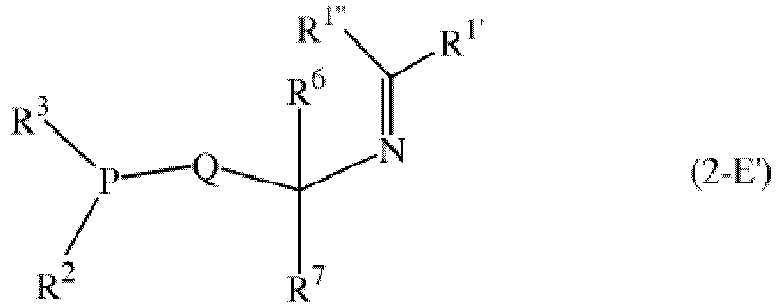 ist, wobei Q, R2, R3, R6 und R7 wie in Anspruch 5 definiert sind; undR1 und R1", wenn gesondert genommen, ein Wasserstoffatom, eine lineare, verzweigte oder cyclische C1- bis C6-Alkylgruppe, wahlweise substituiert, oder eine Phenylgruppe, wahlweise substituiert, darstellen; oder das R1' oder R1", wenn zusammengenommen, einen gesättigten Ring, wahlweise substituiert, bilden, der 5 bis 7 Atome aufweist und das Kohlenstoffatom einschließt, an welches die R1'- und R1"-Gruppen gebunden sind; R6 und R1", zusammengenommen, einen gesättigten oder ungesättigten Heterocyclus, wahlweise substituiert und wahlweise enthaltend ein oder zwei zusätzliche Stickstoff- oder Sauerstoffatome, bilden können, der 5 oder 6 Atome enthält und der die Kohlenstoffatome und das N-Atom einschließt, an welche die R6- oder R1"-Gruppe jeweils gebunden sind.
 - Verfahren gemäß Anspruch 4, dadurch gekennzeichnet, dass L2 ein Ligand der Formel (2-F), (2-F'), (2-G) oder (2-G')

 ist, wobei die gestrichelten Linien in der Formel (2-G) oder (2-G') das Vorhandensein von einer Phenyl- oder einer Naphthylgruppe anzeigen; e 1 oder 2 darstellt;R1, R2, R3 wie in Anspruch 8 definiert sind, R1' wie R1 in Anspruch 8 definiert ist; undR6 ein Wasserstoffatom, eine lineare oder verzweigte C1- bis C4-Alkylgruppe, wahlweise substituiert, oder eine Phenylgruppe, wahlweise substituiert, darstellt; oder R6, wenn mit R1 zusammengenommen, einen eine C=N-Funktion enthaltenden C3-C9-Heterocyclus, wahlweise substituiert und wahlweise enthaltend ein zusätzliches Stickstoff- oder Sauerstoffatom, bildet.
 - Verfahren gemäß einem der Ansprüche 1 bis 9, dadurch gekennzeichnet, dass die Base einen pKa oberhalb 14 hat.
- Verfahren gemäß Anspruch 10, dadurch gekennzeichnet, dass die Base ein Alkali- oder Erdalkalimetallcarbonat, ein Alkali- oder Erdalkalimetallhydroxid, C1-10-Amide, C10-26-Phosphazen oder ein Alkoholat der Formel (R13O)2M oder R13OM' ist, wobei M ein Erdalkalimetall ist, M' ein Alkalimetall oder ein Ammonium NR14 4 + ist, R13 für Wasserstoff oder einen linearen oder verzweigten C1- bis C6-Alkylrest steht und R14 für einen linearen oder verzweigten C1- bis C10-Alkylrest steht.
- Verfahren gemäß einem der Ansprüche 1 bis 11, dadurch gekennzeichnet, dass das Substrat eine Verbindung der Formel (I)
 ist, wobei Ra und Rb, gleichzeitig oder unabhängig, eine lineare, verzweigte oder cyclische aromatische C1-C30-Alkyl- oder -Alkenylgruppe, wahlweise substituiert, darstellen; oderRa und Rb aneinander gebunden sind und eine gesättigte oder ungesättigte C4-C20-Gruppe, wahlweise substituiert, bilden;und wobei die Substituenten von Ra und Rb eine COORc-Gruppe, eine, zwei oder drei Halogen-, ORc-, NRc 2 oder Rc-Gruppen sind, in welchen Rc ein Wasserstoffatom, eine halogenierte C1-C2-Gruppe oder eine cyclische, lineare oder verzweigte C1- bis C10-Alkyl- oder -Alkenylgruppe ist.
 - Verfahren gemäß Anspruch 12, dadurch gekennzeichnet, dass das Substrat eine C5-C30-Verbindung der Formel (I) ist, wobei Ra und Rb gleichzeitig oder unabhängig eine lineare, verzweigte oder cyclische aromatische oder C1-C30-Alkylgruppe, wahlweise substituiert, oder eine cyclische C5-C30-Alkenylgruppe, wahlweise substituiert, darstellen; oder Ra und Rb aneinander gebunden sind und eine gesättigte oder ungesättigte lineare, verzweigte, mono-, di- oder tricyclische C4-C20-Gruppe, wahlweise substituiert, bilden.
- Ligand der Formel (2-A')
 wobei die gestrichelte Linie einen doppelte Bindung darstellt und z 0 ist,R1 ein Wasserstoffatom, eine lineare, verzweigte oder cyclische C1- bis C10-Alkyl oder -Alkenylgruppe, wahlweise substituiert, darstellt;R1' und R1", wenn gesondert genommen, ein Wasserstoffatom, eine lineare, verzweigte oder cyclische C1- bis C9-Alkyl- oder -Alkenylgruppe, wahlweise substituiert, oder eine aromatische C6- bis C10-Gruppe, wahlweise substituiert, darstellen; das R1' oder R1", wenn zusammengenommen, einen gesättigten oder ungesättigten Ring, wahlweise substituiert, bilden, der 5 bis 12 Atome aufweist und das Kohlenstoffatom einschließt, an welches die R1'- und R1"-Gruppen gebunden sind;R2 und R3, wenn gesondert genommen, gleichzeitig oder unabhängig, eine lineare, verzweigte oder cyclische C1- bis C8-Alkyl- oder -Alkenylgruppe, wahlweise substituiert, eine aromatische C6- bis C10-Gruppe, wahlweise substituiert, oder eine OR2'- oder NR2'R3' -Gruppe darstellen, wobei R2' und R3' eine C1- bis C8-Alkyl oder -Alkenylgruppe sind; oder die Gruppen R2 und R3, wenn zusammengenommen, einen gesättigten oder ungesättigten Ring, wahlweise substituiert, bilden, der 5 bis 10 Atome aufweist und das Phosphoratom einschließt, an welches die R2 - und R3-Gruppen gebunden sind;R6 und R7, gleichzeitig oder unabhängig, ein Wasserstoffatom, eine lineare, verzweigte oder cyclische C1- bis C10-Alkyl- oder -Alkenylgruppe, wahlweise substituiert, eine aromatische C6-C10-Gruppe, wahlweise substituiert, oder eine OR4'-oder NR4'R5'-Gruppe darstellen, wobei R4' und R5' eine lineare, verzweigte oder cyclische C1- bis C10-Alkyl- oder -Alkenylgruppe sind; R6 und R1 oder R6 und R1", zusammengenommen, einen gesättigten oder ungesättigten Heterocyclus, wahlweise substituiert und wahlweise enthaltend ein oder zwei zusätzliche Stickstoff- oder Sauerstoffatome, bilden können, der 5 bis 10 Atome enthält und der die Kohlenstoffatome und das N-Atom einschließt, an welche die R6- oder R1- oder R1"-Gruppe jeweils gebunden sind; undQ darstellt:- eine Gruppe der Formel
 wobei n eine ganze Zahl von 1 bis 4 ist, undR4 und R5, gleichzeitig oder unabhängig, ein Wasserstoffatom, eine lineare, verzweigte oder cyclische C1- bis C10-Alkyl- oder -Alkenylgruppe, wahlweise substituiert, eine aromatische C6-C10-Gruppe, wahlweise substituiert, oder eine OR4'-oder NR4'R5'-Gruppe darstellen, wobei R4' und R5' eine lineare, verzweigte oder cyclische C1- bis C10-Alkyl- oder -Alkenylgruppe sind; zwei unterschiedliche R4- und/oder R5-Gruppen, zusammengenommen, einen gesättigten C5- bis C10-Ring, wahlweise substituiert, bilden können, der die Kohlenstoffatome einschließt, an welche jede von den R4- oder R5-Gruppen gebunden ist; oder- eine Gruppe der Formel
 wobei n eine ganze Zahl von 2 bis 4 ist, undzwei unterschiedliche benachbarte R4-Gruppen, zusammengenommen, einen aromatischen C5- bis C10-Ring, wahlweise substituiert, oder ein C5-C12-Metallocendiyl, wahlweise substituiert, bilden, die die Kohlenstoffatome einschließen, an welche jede von den R4-Gruppen gebunden ist; oderdrei unterschiedliche benachbarte R4-Gruppen, zusammengenommen, einen Naphthalinring, wahlweise substituiert, bilden, der die Kohlenstoffatome einschließt, an welche jede von den R4-Gruppen gebunden ist;und wobei die Substituenten von R1', R1" und R1 bis R7 sowie Q eine oder zwei Halogen-, C1- bis C10-Alkoxy- oder Polyalkylenglycolgruppen, Halogen- oder Perhalogenkohlenwasserstoff-, COOR-, NR2-, quaternäre Amin- oder R-Gruppen sind, wobei R eine C1- bis C6-Alkyl- oder eine C5- bis C12-Cycloalkyl-, -Aralkyl oder aromatische Gruppe ist, wobei die letztere ebenfalls wahlweise durch eine, zwei oder drei Halogen-, Sulfonatgruppen oder C1-C8-Alkyl-, -Alkoxy, Amino-, Nitro-, Sulfonat-, Halogen- oder Perhalogenkohlenwasserstoff- oder Estergruppen substituiert ist;mit der Maßgabe, dass 2-(Diphenylphosphino)-N-(phenylmethylen)-cyclohexanamin ausgeschlossen ist.
 - Komplex der Formel (1)
[Ru(L2)b(L')aY2] (1)
wobei L' ein C3-C70-Monophosphin oder ein Molekül von Lösungsmittel darstellt; b 1 ist und a 1 oder 2 ist oder b 2 ist und a 0 ist; undjedes Y, gleichzeitig oder unabhängig, CO, ein Wasserstoff- oder Halogenatom, eine Hydroxylgruppe, eine BH4- oder AlH4-Gruppe oder einen C1-C6-Alkoxy- oder - Carboxylrest darstellt;dadurch gekennzeichnet, dass L2 ein Ligand der Formel (2-A') ist R1 ein Wasserstoffatom, eine lineare, verzweigte oder cyclische C1- bis C10-Alkyl- oder -Alkenylgruppe, wahlweise substituiert, darstellt;R1' und R1", wenn gesondert genommen, ein Wasserstoffatom, eine lineare, verzweigte oder cyclische C1- bis C9-Alkyl- oder -Alkenylgruppe, wahlweise substituiert, oder eine aromatische C6- bis C10-Gruppe, wahlweise substituiert, darstellen; das R1 oder R1", wenn zusammengenommen, einen gesättigten oder ungesättigten Ring, wahlweise substituiert, bilden, der 5 bis 12 Atome aufweist und das Kohlenstoffatom einschließt, an welches die R1'- und R1"-Gruppen gebunden sind;R2 und R3, wenn gesondert genommen, gleichzeitig oder unabhängig, eine lineare, verzweigte oder cyclische C1- bis C8-Alkyl- oder -Alkenylgruppe, wahlweise substituiert, eine aromatische C6- bis C10-Gruppe, wahlweise substituiert, oder eine OR2'- oder NR2'R3'-Gruppe darstellen, wobei R2' und R3' eine C1- bis C8-Alkyl- oder -Alkenylgruppe sind; oder die Gruppen R2 und R3, wenn zusammengenommen, einen gesättigten oder ungesättigten Ring, wahlweise substituiert, bilden, der 5 bis 10 Atome aufweist und das Phosphoratom einschließt, an welches die R2 - und R3-Gruppen gebunden sind;R6 und R7, gleichzeitig oder unabhängig, ein Wasserstoffatom, eine lineare, verzweigte oder cyclische C1- bis C10-Alkyl- oder -Alkenylgruppe, wahlweise substituiert, eine aromatische C6-C10-Gruppe, wahlweise substituiert, oder eine OR4'-oder NR4'R5'-Gruppe darstellen, wobei R4' und R5' eine lineare, verzweigte oder cyclische C1- bis C10-Alkyl- oder -Alkenylgruppe sind; R6 und R1 oder R6 und R1", zusammengenommen, einen gesättigten oder ungesättigten Heterocyclus, wahlweise substituiert und wahlweise enthaltend ein oder zwei zusätzliche Stickstoff- oder Sauerstoffatome, bilden können, der 5 bis 10 Atome enthält und der die Kohlenstoffatome und das N-Atom einschließt, an welche die R6- oder R1- oder R1"-Gruppe jeweils gebunden sind; undQ darstellt:- eine Gruppe der Formel
 wobei n eine ganze Zahl von 1 bis 4 ist, undR4 und R5, gleichzeitig oder unabhängig, ein Wasserstoffatom, eine lineare, verzweigte oder cyclische C1- bis C10-Alkyl- oder -Alkenylgruppe, wahlweise substituiert, eine aromatische C6-C10-Gruppe, wahlweise substituiert, oder eine OR4'- oder NR4'R5'-Gruppe darstellen, wobei R4' und R5' eine lineare, verzweigte oder cyclische C1- bis C10-Alkyl- oder -Alkenylgruppe sind; zwei unterschiedliche R4- und/oder R5-Gruppen, zusammengenommen, einen gesättigten C5- bis C10-Ring, wahlweise substituiert, bilden können, der die Kohlenstoffatome einschließt, an welche jede von den R4- oder R5-Gruppen gebunden ist; oder- eine Gruppe der Formel
 wobei n eine ganze Zahl von 2 bis 4 ist, undzwei unterschiedliche benachbarte R4-Gruppen, zusammengenommen, einen aromatischen C5- bis C10-Ring, wahlweise substituiert, oder ein C5-C12-Metallocendiyl, wahlweise substituiert, bilden, die die Kohlenstoffatome einschließen, an welche jede von den R4-Gruppen gebunden ist; oderdrei unterschiedliche benachbarte R4-Gruppen, zusammengenommen, einen Naphthalinring, wahlweise substituiert, bilden, der die Kohlenstoffatome einschließt, an welche jede von den R4-Gruppen gebunden ist;und wobei die Substituenten von R1', R1" und R1 bis R7 sowie Q eine oder zwei Halogen-, C1- bis C10-Alkoxy- oder Polyalkylenglycolgruppen, Halogen- oder Perhalogenkohlenwasserstoff-, COOR-, NR2-, quaternäre Amin- oder R-Gruppen sind, wobei R eine C1- bis C6-Alkyl- oder eine C5- bis C12-Cycloalkyl-, -Aralkyl- oder aromatische Gruppe ist, wobei die letztere ebenfalls wahlweise durch eine, zwei oder drei Halogen-, Sulfonatgruppen oder C1-C8-Alkyl-, -Alkoxy-, Amino-, Nitro-, Sulfonat-, Halogen- oder Perhalogenkohlenwasserstoff- oder Estergruppen substituiert ist;mit der Maßgabe, dass Dichlor[[N(Z),1R,2R]-2-(diphenylphosphino-κP)-N-(phenylmethylen)cyclohexanamin-κN](triphenylphosphin)-ruthenium ausgeschlossen ist.
Applications Claiming Priority (2)
| Application Number | Priority Date | Filing Date | Title |
|---|---|---|---|
| IB2005000938 | 2005-04-05 | ||
| PCT/IB2006/051027 WO2006106483A1 (en) | 2005-04-05 | 2006-04-04 | Hydrogenation of esters with ru/bidentate ligands complexes |
Publications (2)
| Publication Number | Publication Date |
|---|---|
| EP1868964A1 EP1868964A1 (de) | 2007-12-26 |
| EP1868964B1 true EP1868964B1 (de) | 2016-11-23 |
Family
ID=40456225
Family Applications (1)
| Application Number | Title | Priority Date | Filing Date |
|---|---|---|---|
| EP06727826.7A Expired - Lifetime EP1868964B1 (de) | 2005-04-05 | 2006-04-04 | Hydrierung von estern mittels ru/bidentatliganden komplexen |
Country Status (9)
| Country | Link |
|---|---|
| US (2) | US7763758B2 (de) |
| EP (1) | EP1868964B1 (de) |
| JP (1) | JP5388569B2 (de) |
| CN (1) | CN101137601B (de) |
| BR (1) | BRPI0608687A2 (de) |
| ES (1) | ES2616427T3 (de) |
| IL (1) | IL186318A (de) |
| MX (1) | MX2007012299A (de) |
| WO (1) | WO2006106483A1 (de) |
Families Citing this family (29)
| Publication number | Priority date | Publication date | Assignee | Title |
|---|---|---|---|---|
| ES2339073T3 (es) | 2006-11-27 | 2010-05-14 | Firmenich Sa | Hidrogenacion de esteres con complejos de ru/ligandos bidentados. |
| JP2009096752A (ja) * | 2007-10-16 | 2009-05-07 | Takasago Internatl Corp | アルコール類の製造方法 |
| JP5283931B2 (ja) * | 2007-03-16 | 2013-09-04 | 高砂香料工業株式会社 | アルコール類の製造方法 |
| EP1970360B1 (de) | 2007-03-16 | 2016-08-31 | Takasago International Corporation | Verfahren zur Herstellung von Alkoholen |
| US8013193B2 (en) | 2007-04-03 | 2011-09-06 | Kaneka Corporation | Method for producing alcohol by hydrogenating lactone and carboxylic acid ester in liquid phase |
| JP5451209B2 (ja) * | 2008-07-08 | 2014-03-26 | 国立大学法人東京工業大学 | エステル類およびラクトン類の実用的な還元方法 |
| JP5477557B2 (ja) | 2008-09-09 | 2014-04-23 | 高砂香料工業株式会社 | エステル又はラクトン類の水素還元によるアルコール類の製造方法 |
| WO2010061350A1 (en) | 2008-11-28 | 2010-06-03 | Firmenich Sa | Hydrogenation of ester, ketone or aldehyde groups with ruthenium complexes having a di-amine and a phosphorous-nitrogen bidentate ligand |
| EP2415741A4 (de) * | 2009-03-31 | 2015-03-18 | Sumitomo Chemical Co | Verfahren zur herstellung einer alkoholverbindung |
| US20120029195A1 (en) * | 2009-03-31 | 2012-02-02 | Sumitomo Chemical Company, Limited | Method for producing alcohol compound and catalyst therefor |
| WO2013010275A1 (en) * | 2011-07-18 | 2013-01-24 | The Governors Of The University Of Alberta | Catalysts and processes for the hydrogenation of amides |
| US8969632B2 (en) * | 2012-03-23 | 2015-03-03 | Eastman Chemical Company | Passivation of a homogeneous hydrogenation catalyst for the production of ethylene glycol |
| GB201208589D0 (en) * | 2012-05-16 | 2012-06-27 | Givaudan Sa | Improvements in or relating to organic compounds |
| JP2014114257A (ja) * | 2012-12-12 | 2014-06-26 | Takasago Internatl Corp | ルテニウムカルボニル錯体を用いたハロゲン置換安息香酸エステルの還元方法 |
| ES2910942T3 (es) * | 2013-03-15 | 2022-05-17 | Dmitri Goussev | Catalizadores complejos basados en ligandos de amino-fosfina para procesos de hidrogenación y deshidrogenación |
| JP6419096B2 (ja) * | 2013-03-15 | 2018-11-07 | フイルメニツヒ ソシエテ アノニムFirmenich Sa | Ru/二座配位子錯体を用いたアルデヒドの選択水素化 |
| WO2014203963A1 (ja) | 2013-06-20 | 2014-12-24 | 株式会社クラレ | 3座アミノジカルベン配位子を有する金属錯体及びそれを用いた水素化還元方法 |
| EP3042902B1 (de) * | 2013-09-06 | 2018-10-10 | Nippon Soda Co., Ltd. | Verfahren zur herstellung eines endo-9-azabicyclo-[3,3,1-]nonan-3-ol-derivats |
| US10053475B2 (en) * | 2013-12-18 | 2018-08-21 | Firmenich Sa | Hydrogenation of esters with Fe/tridentate ligands complexes |
| GB201401230D0 (en) * | 2014-01-24 | 2014-03-12 | Givaudan Sa | Improvements in or relating to organic compounds |
| US10266466B2 (en) | 2017-08-02 | 2019-04-23 | Eastman Chemical Company | Iron-catalyzed transfer hydrogenation of esters to alcohols |
| US10435349B2 (en) | 2017-08-02 | 2019-10-08 | Eastman Chemical Company | Iron-catalyzed cross-coupling of methanol with secondary or tertiary alcohols to produce formate esters |
| US10570081B2 (en) | 2017-08-02 | 2020-02-25 | Eastman Chemical Company | Process for making formic acid utilizing lower-boiling formate esters |
| US10544077B2 (en) | 2017-08-02 | 2020-01-28 | Eastman Chemical Company | Process for making formic acid utilizing higher-boiling formate esters |
| US10266467B2 (en) | 2017-08-02 | 2019-04-23 | Eastman Chemical Company | Synthesis of glycols via transfer hydrogenation of alpha-functional esters with alcohols |
| EP3737501A1 (de) | 2018-01-10 | 2020-11-18 | Basf Se | Verwendung eines ruthenium-katalysators mit einem vierzähnigen liganden zur hydrierung von estern und/oder bildung von estern und rutheniumkomplex mit dem vierzähnigen liganden |
| CN111250168B (zh) * | 2018-11-30 | 2021-06-01 | 中国科学院大连化学物理研究所 | 一种钌基催化剂及其制备方法、应用 |
| PL3842411T3 (pl) * | 2019-12-17 | 2023-10-02 | Evonik Operations Gmbh | Ester trimetylowy kwasu 3,3',3''-(cykloheksano-1,2,4-triylo)tripropionowego |
| GB202017456D0 (en) * | 2020-11-04 | 2020-12-16 | Johnson Matthey Plc | Process |
Family Cites Families (5)
| Publication number | Priority date | Publication date | Assignee | Title |
|---|---|---|---|---|
| IT1099070B (it) * | 1978-09-14 | 1985-09-18 | Montedison Spa | Processo per la idrogenazione catalitica degli esteri ossalici |
| JP2001247499A (ja) * | 2000-03-09 | 2001-09-11 | Sumitomo Chem Co Ltd | アルコールの製造方法 |
| ES2305095T3 (es) * | 2000-09-13 | 2008-11-01 | Firmenich S.A. | Procesos de hidrogenacion catalitica. |
| US6878852B2 (en) | 2000-11-17 | 2005-04-12 | Firmenich Sa | Process for hydrogenation of carbonyl and iminocarbonyl compounds using ruthenium catalysts comprising tetradentate diimino-diphosphine ligands |
| JP2004300131A (ja) * | 2003-03-20 | 2004-10-28 | Mitsubishi Gas Chem Co Inc | エステル類の水素化によりアルコール類を製造する方法 |
-
2006
- 2006-04-04 EP EP06727826.7A patent/EP1868964B1/de not_active Expired - Lifetime
- 2006-04-04 JP JP2008504896A patent/JP5388569B2/ja not_active Expired - Lifetime
- 2006-04-04 WO PCT/IB2006/051027 patent/WO2006106483A1/en not_active Ceased
- 2006-04-04 CN CN2006800073561A patent/CN101137601B/zh not_active Expired - Lifetime
- 2006-04-04 MX MX2007012299A patent/MX2007012299A/es active IP Right Grant
- 2006-04-04 ES ES06727826.7T patent/ES2616427T3/es not_active Expired - Lifetime
- 2006-04-04 BR BRPI0608687A patent/BRPI0608687A2/pt not_active IP Right Cessation
-
2007
- 2007-09-12 US US11/854,106 patent/US7763758B2/en not_active Expired - Lifetime
- 2007-09-25 IL IL186318A patent/IL186318A/en active IP Right Grant
-
2010
- 2010-01-27 US US12/694,720 patent/US20100130754A1/en not_active Abandoned
Non-Patent Citations (1)
| Title |
|---|
| None * |
Also Published As
| Publication number | Publication date |
|---|---|
| BRPI0608687A2 (pt) | 2016-11-08 |
| ES2616427T3 (es) | 2017-06-13 |
| CN101137601B (zh) | 2011-08-10 |
| WO2006106483A1 (en) | 2006-10-12 |
| US20100130754A1 (en) | 2010-05-27 |
| US20080071121A1 (en) | 2008-03-20 |
| IL186318A0 (en) | 2008-01-20 |
| JP5388569B2 (ja) | 2014-01-15 |
| MX2007012299A (es) | 2007-10-16 |
| CN101137601A (zh) | 2008-03-05 |
| US7763758B2 (en) | 2010-07-27 |
| JP2008538352A (ja) | 2008-10-23 |
| EP1868964A1 (de) | 2007-12-26 |
| IL186318A (en) | 2011-11-30 |
Similar Documents
| Publication | Publication Date | Title |
|---|---|---|
| US7763758B2 (en) | Hydrogenation of esters with Ru/bidentate ligands complexes | |
| US8692022B2 (en) | Hydrogenation of esters with Ru/bidentate ligands complexes | |
| EP2089345B1 (de) | Hydrierung von estern mit ru/bidentat-ligand-komplexen | |
| EP3083647B1 (de) | Hydrogenierung von estern mit fe/tridentatligandkomplexen | |
| US20040063966A1 (en) | Catalytic hydrogenation processes | |
| EP3700914B1 (de) | Hydrierung von carbonylen mit tetradentatem pnnp ligand ruthenium komplexen | |
| US20220380279A1 (en) | Hydrogenation of esters to alcohols in the presence of a ru-pnn complex | |
| WO2010038209A1 (en) | Hydrogenation of esters or carbonyl groups with phosphino-oxide based ruthenium complexes | |
| EP2370207A1 (de) | Hydrierung von ester-, keton- oder aldehydgruppen mit rutheniumkomplexen mit einem diamin und einem phosphor-stickstoff-bidentatligand |
Legal Events
| Date | Code | Title | Description |
|---|---|---|---|
| PUAI | Public reference made under article 153(3) epc to a published international application that has entered the european phase |
Free format text: ORIGINAL CODE: 0009012 |
|
| 17P | Request for examination filed |
Effective date: 20071105 |
|
| AK | Designated contracting states |
Kind code of ref document: A1 Designated state(s): AT BE BG CH CY CZ DE DK EE ES FI FR GB GR HU IE IS IT LI LT LU LV MC NL PL PT RO SE SI SK TR |
|
| DAX | Request for extension of the european patent (deleted) | ||
| 17Q | First examination report despatched |
Effective date: 20090407 |
|
| REG | Reference to a national code |
Ref country code: DE Ref legal event code: R079 Ref document number: 602006050998 Country of ref document: DE Free format text: PREVIOUS MAIN CLASS: C07B0041020000 Ipc: C07F0009500000 |
|
| RIC1 | Information provided on ipc code assigned before grant |
Ipc: C07F 9/58 20060101ALI20160318BHEP Ipc: C07B 41/02 20060101ALI20160318BHEP Ipc: C07F 9/50 20060101AFI20160318BHEP Ipc: C07C 29/149 20060101ALI20160318BHEP Ipc: C07F 9/54 20060101ALI20160318BHEP Ipc: C07C 213/00 20060101ALI20160318BHEP Ipc: C12C 11/02 20060101ALI20160318BHEP Ipc: C07F 15/00 20060101ALI20160318BHEP |
|
| GRAP | Despatch of communication of intention to grant a patent |
Free format text: ORIGINAL CODE: EPIDOSNIGR1 |
|
| INTG | Intention to grant announced |
Effective date: 20160513 |
|
| GRAJ | Information related to disapproval of communication of intention to grant by the applicant or resumption of examination proceedings by the epo deleted |
Free format text: ORIGINAL CODE: EPIDOSDIGR1 |
|
| INTC | Intention to grant announced (deleted) | ||
| GRAP | Despatch of communication of intention to grant a patent |
Free format text: ORIGINAL CODE: EPIDOSNIGR1 |
|
| GRAS | Grant fee paid |
Free format text: ORIGINAL CODE: EPIDOSNIGR3 |
|
| GRAA | (expected) grant |
Free format text: ORIGINAL CODE: 0009210 |
|
| INTG | Intention to grant announced |
Effective date: 20160929 |
|
| AK | Designated contracting states |
Kind code of ref document: B1 Designated state(s): AT BE BG CH CY CZ DE DK EE ES FI FR GB GR HU IE IS IT LI LT LU LV MC NL PL PT RO SE SI SK TR |
|
| REG | Reference to a national code |
Ref country code: GB Ref legal event code: FG4D |
|
| REG | Reference to a national code |
Ref country code: CH Ref legal event code: EP |
|
| REG | Reference to a national code |
Ref country code: IE Ref legal event code: FG4D |
|
| REG | Reference to a national code |
Ref country code: AT Ref legal event code: REF Ref document number: 847808 Country of ref document: AT Kind code of ref document: T Effective date: 20161215 |
|
| REG | Reference to a national code |
Ref country code: DE Ref legal event code: R096 Ref document number: 602006050998 Country of ref document: DE |
|
| PG25 | Lapsed in a contracting state [announced via postgrant information from national office to epo] |
Ref country code: LV Free format text: LAPSE BECAUSE OF FAILURE TO SUBMIT A TRANSLATION OF THE DESCRIPTION OR TO PAY THE FEE WITHIN THE PRESCRIBED TIME-LIMIT Effective date: 20161123 |
|
| REG | Reference to a national code |
Ref country code: FR Ref legal event code: PLFP Year of fee payment: 12 |
|
| REG | Reference to a national code |
Ref country code: LT Ref legal event code: MG4D |
|
| REG | Reference to a national code |
Ref country code: NL Ref legal event code: MP Effective date: 20161123 |
|
| REG | Reference to a national code |
Ref country code: AT Ref legal event code: MK05 Ref document number: 847808 Country of ref document: AT Kind code of ref document: T Effective date: 20161123 |
|
| PG25 | Lapsed in a contracting state [announced via postgrant information from national office to epo] |
Ref country code: LT Free format text: LAPSE BECAUSE OF FAILURE TO SUBMIT A TRANSLATION OF THE DESCRIPTION OR TO PAY THE FEE WITHIN THE PRESCRIBED TIME-LIMIT Effective date: 20161123 Ref country code: NL Free format text: LAPSE BECAUSE OF FAILURE TO SUBMIT A TRANSLATION OF THE DESCRIPTION OR TO PAY THE FEE WITHIN THE PRESCRIBED TIME-LIMIT Effective date: 20161123 Ref country code: GR Free format text: LAPSE BECAUSE OF FAILURE TO SUBMIT A TRANSLATION OF THE DESCRIPTION OR TO PAY THE FEE WITHIN THE PRESCRIBED TIME-LIMIT Effective date: 20170224 Ref country code: SE Free format text: LAPSE BECAUSE OF FAILURE TO SUBMIT A TRANSLATION OF THE DESCRIPTION OR TO PAY THE FEE WITHIN THE PRESCRIBED TIME-LIMIT Effective date: 20161123 |
|
| PG25 | Lapsed in a contracting state [announced via postgrant information from national office to epo] |
Ref country code: PL Free format text: LAPSE BECAUSE OF FAILURE TO SUBMIT A TRANSLATION OF THE DESCRIPTION OR TO PAY THE FEE WITHIN THE PRESCRIBED TIME-LIMIT Effective date: 20161123 Ref country code: PT Free format text: LAPSE BECAUSE OF FAILURE TO SUBMIT A TRANSLATION OF THE DESCRIPTION OR TO PAY THE FEE WITHIN THE PRESCRIBED TIME-LIMIT Effective date: 20170323 Ref country code: FI Free format text: LAPSE BECAUSE OF FAILURE TO SUBMIT A TRANSLATION OF THE DESCRIPTION OR TO PAY THE FEE WITHIN THE PRESCRIBED TIME-LIMIT Effective date: 20161123 Ref country code: AT Free format text: LAPSE BECAUSE OF FAILURE TO SUBMIT A TRANSLATION OF THE DESCRIPTION OR TO PAY THE FEE WITHIN THE PRESCRIBED TIME-LIMIT Effective date: 20161123 |
|
| REG | Reference to a national code |
Ref country code: ES Ref legal event code: FG2A Ref document number: 2616427 Country of ref document: ES Kind code of ref document: T3 Effective date: 20170613 |
|
| PG25 | Lapsed in a contracting state [announced via postgrant information from national office to epo] |
Ref country code: EE Free format text: LAPSE BECAUSE OF FAILURE TO SUBMIT A TRANSLATION OF THE DESCRIPTION OR TO PAY THE FEE WITHIN THE PRESCRIBED TIME-LIMIT Effective date: 20161123 Ref country code: SK Free format text: LAPSE BECAUSE OF FAILURE TO SUBMIT A TRANSLATION OF THE DESCRIPTION OR TO PAY THE FEE WITHIN THE PRESCRIBED TIME-LIMIT Effective date: 20161123 Ref country code: DK Free format text: LAPSE BECAUSE OF FAILURE TO SUBMIT A TRANSLATION OF THE DESCRIPTION OR TO PAY THE FEE WITHIN THE PRESCRIBED TIME-LIMIT Effective date: 20161123 Ref country code: CZ Free format text: LAPSE BECAUSE OF FAILURE TO SUBMIT A TRANSLATION OF THE DESCRIPTION OR TO PAY THE FEE WITHIN THE PRESCRIBED TIME-LIMIT Effective date: 20161123 Ref country code: RO Free format text: LAPSE BECAUSE OF FAILURE TO SUBMIT A TRANSLATION OF THE DESCRIPTION OR TO PAY THE FEE WITHIN THE PRESCRIBED TIME-LIMIT Effective date: 20161123 |
|
| REG | Reference to a national code |
Ref country code: DE Ref legal event code: R097 Ref document number: 602006050998 Country of ref document: DE |
|
| PG25 | Lapsed in a contracting state [announced via postgrant information from national office to epo] |
Ref country code: BG Free format text: LAPSE BECAUSE OF FAILURE TO SUBMIT A TRANSLATION OF THE DESCRIPTION OR TO PAY THE FEE WITHIN THE PRESCRIBED TIME-LIMIT Effective date: 20170223 Ref country code: IT Free format text: LAPSE BECAUSE OF FAILURE TO SUBMIT A TRANSLATION OF THE DESCRIPTION OR TO PAY THE FEE WITHIN THE PRESCRIBED TIME-LIMIT Effective date: 20161123 Ref country code: BE Free format text: LAPSE BECAUSE OF FAILURE TO SUBMIT A TRANSLATION OF THE DESCRIPTION OR TO PAY THE FEE WITHIN THE PRESCRIBED TIME-LIMIT Effective date: 20161123 |
|
| PLBE | No opposition filed within time limit |
Free format text: ORIGINAL CODE: 0009261 |
|
| STAA | Information on the status of an ep patent application or granted ep patent |
Free format text: STATUS: NO OPPOSITION FILED WITHIN TIME LIMIT |
|
| 26N | No opposition filed |
Effective date: 20170824 |
|
| PG25 | Lapsed in a contracting state [announced via postgrant information from national office to epo] |
Ref country code: SI Free format text: LAPSE BECAUSE OF FAILURE TO SUBMIT A TRANSLATION OF THE DESCRIPTION OR TO PAY THE FEE WITHIN THE PRESCRIBED TIME-LIMIT Effective date: 20161123 |
|
| REG | Reference to a national code |
Ref country code: IE Ref legal event code: MM4A |
|
| PG25 | Lapsed in a contracting state [announced via postgrant information from national office to epo] |
Ref country code: MC Free format text: LAPSE BECAUSE OF FAILURE TO SUBMIT A TRANSLATION OF THE DESCRIPTION OR TO PAY THE FEE WITHIN THE PRESCRIBED TIME-LIMIT Effective date: 20161123 |
|
| PG25 | Lapsed in a contracting state [announced via postgrant information from national office to epo] |
Ref country code: LU Free format text: LAPSE BECAUSE OF NON-PAYMENT OF DUE FEES Effective date: 20170404 |
|
| REG | Reference to a national code |
Ref country code: FR Ref legal event code: PLFP Year of fee payment: 13 |
|
| PG25 | Lapsed in a contracting state [announced via postgrant information from national office to epo] |
Ref country code: IE Free format text: LAPSE BECAUSE OF NON-PAYMENT OF DUE FEES Effective date: 20170404 |
|
| PG25 | Lapsed in a contracting state [announced via postgrant information from national office to epo] |
Ref country code: HU Free format text: LAPSE BECAUSE OF FAILURE TO SUBMIT A TRANSLATION OF THE DESCRIPTION OR TO PAY THE FEE WITHIN THE PRESCRIBED TIME-LIMIT; INVALID AB INITIO Effective date: 20060404 |
|
| PG25 | Lapsed in a contracting state [announced via postgrant information from national office to epo] |
Ref country code: CY Free format text: LAPSE BECAUSE OF NON-PAYMENT OF DUE FEES Effective date: 20161123 |
|
| PG25 | Lapsed in a contracting state [announced via postgrant information from national office to epo] |
Ref country code: TR Free format text: LAPSE BECAUSE OF FAILURE TO SUBMIT A TRANSLATION OF THE DESCRIPTION OR TO PAY THE FEE WITHIN THE PRESCRIBED TIME-LIMIT Effective date: 20161123 |
|
| REG | Reference to a national code |
Ref country code: DE Ref legal event code: R081 Ref document number: 602006050998 Country of ref document: DE Owner name: FIRMENICH SA, CH Free format text: FORMER OWNER: FIRMENICH S.A., GENEVA, CH |
|
| PG25 | Lapsed in a contracting state [announced via postgrant information from national office to epo] |
Ref country code: IS Free format text: LAPSE BECAUSE OF FAILURE TO SUBMIT A TRANSLATION OF THE DESCRIPTION OR TO PAY THE FEE WITHIN THE PRESCRIBED TIME-LIMIT Effective date: 20170323 |
|
| REG | Reference to a national code |
Ref country code: CH Ref legal event code: PCOW Free format text: NEW ADDRESS: 7, RUE DE LA BERGERE, 1242 SATIGNY (CH) |
|
| REG | Reference to a national code |
Ref country code: CH Ref legal event code: PL |
|
| P01 | Opt-out of the competence of the unified patent court (upc) registered |
Effective date: 20230518 |
|
| PGFP | Annual fee paid to national office [announced via postgrant information from national office to epo] |
Ref country code: FR Payment date: 20250321 Year of fee payment: 20 |
|
| PGFP | Annual fee paid to national office [announced via postgrant information from national office to epo] |
Ref country code: GB Payment date: 20250306 Year of fee payment: 20 |
|
| PGFP | Annual fee paid to national office [announced via postgrant information from national office to epo] |
Ref country code: DE Payment date: 20250305 Year of fee payment: 20 |
|
| PGFP | Annual fee paid to national office [announced via postgrant information from national office to epo] |
Ref country code: ES Payment date: 20250506 Year of fee payment: 20 |
|
| PGFP | Annual fee paid to national office [announced via postgrant information from national office to epo] |
Ref country code: CH Payment date: 20250501 Year of fee payment: 20 |
|
| REG | Reference to a national code |
Ref country code: CH Ref legal event code: H14 Free format text: ST27 STATUS EVENT CODE: U-0-0-H10-H14 (AS PROVIDED BY THE NATIONAL OFFICE) Effective date: 20260404 Ref country code: DE Ref legal event code: R071 Ref document number: 602006050998 Country of ref document: DE |
|
| REG | Reference to a national code |
Ref country code: ES Ref legal event code: FD2A Effective date: 20260424 |
|
| REG | Reference to a national code |
Ref country code: GB Ref legal event code: PE20 Expiry date: 20260403 |