EP1874148B1 - Chaussure resistant au feu protegee contre les substances toxiques - Google Patents
Chaussure resistant au feu protegee contre les substances toxiques Download PDFInfo
- Publication number
- EP1874148B1 EP1874148B1 EP06706203A EP06706203A EP1874148B1 EP 1874148 B1 EP1874148 B1 EP 1874148B1 EP 06706203 A EP06706203 A EP 06706203A EP 06706203 A EP06706203 A EP 06706203A EP 1874148 B1 EP1874148 B1 EP 1874148B1
- Authority
- EP
- European Patent Office
- Prior art keywords
- layer
- shoewear
- adsorptive
- membrane
- fire
- Prior art date
- Legal status (The legal status is an assumption and is not a legal conclusion. Google has not performed a legal analysis and makes no representation as to the accuracy of the status listed.)
- Expired - Lifetime
Links
Images
Classifications
-
- A—HUMAN NECESSITIES
- A43—FOOTWEAR
- A43B—CHARACTERISTIC FEATURES OF FOOTWEAR; PARTS OF FOOTWEAR
- A43B7/00—Footwear with health or hygienic arrangements
- A43B7/32—Footwear with health or hygienic arrangements with shock-absorbing means
-
- A—HUMAN NECESSITIES
- A43—FOOTWEAR
- A43B—CHARACTERISTIC FEATURES OF FOOTWEAR; PARTS OF FOOTWEAR
- A43B1/00—Footwear characterised by the material
-
- A—HUMAN NECESSITIES
- A43—FOOTWEAR
- A43B—CHARACTERISTIC FEATURES OF FOOTWEAR; PARTS OF FOOTWEAR
- A43B7/00—Footwear with health or hygienic arrangements
- A43B7/34—Footwear with health or hygienic arrangements with protection against heat or cold
-
- A—HUMAN NECESSITIES
- A62—LIFE-SAVING; FIRE-FIGHTING
- A62B—DEVICES, APPARATUS OR METHODS FOR LIFE-SAVING
- A62B17/00—Protective clothing affording protection against heat or harmful chemical agents or for use at high altitudes
- A62B17/003—Fire-resistant or fire-fighters' clothes
Definitions
- the present invention relates to a fire- or flame-resistant footwear, in particular a boot for firefighters, with protective function against pollutants, in particular chemical toxins, according to the preamble of claim 1, in particular for firefighting in a chemically or biologically contaminated area or field of application.
- Firefighters such as firefighters are often exposed to adverse environmental or environmental conditions during use. Very high temperatures often prevail at the place of use and, in particular due to the action of fire, often toxic substances are created, from which the persons in use must be protected. This applies in particular to large-scale operations, for example in chemical production plants, where a large number of sometimes highly toxic substances can often be released. Persons such as firefighters, who may come into contact with such toxic substances as chemical poisons, must wear suitable protective equipment at the same time as having good flame resistance and, on the one hand, protection against toxic substances.
- the DE 295 04 365 U1 relates to a boot, which has a foot part on the front side in a shaft, leading, inclined Ristpartie, the Ristpartie is covered by a break-resistant and rigid cover. As a result, the accident protection is to be improved because the cover to accommodate high forces to be able. Special measures to improve the fire and flame resistance and protection against pollutants are also not mentioned in this document.
- the DE 201 16 043 U1 relates to a protective boot for firefighters from a conventional boot material, which should have an improved slip through the use of a pleat in the instep area.
- this document provides a textile material, which is optionally coated with a polyurethane, silicone or plastic. Equipping the rest of the shoe area with protection against harmful substances is not provided for in this document.
- the concerns DE 295 06 366 U1 a closed protective boot, the leaf and quarters are each formed in one piece, whereby the protective boots to be waterproof due to the presence of fewer seams to the ankle height and the protective boots should also allow a rapid slip. Also in this document measures are missing to equip the upper of the boot fire or flame retardant and the protective boots with improved protection against pollutants.
- WO 92/14372 describes a fire and / or flame resistant footwear, the Ausgdugs point for claim 1.
- the present invention is therefore an object of the invention to provide a fire or flame resistant footwear, especially a boot for firefighters, which is particularly suitable for firefighting or decontamination and at least partially avoids the disadvantages of the prior art described above or at least weakens.
- the present invention proposes a fire or flame resistant footwear, in particular a boot for firefighters, according to claim 1 before. Further, advantageous embodiments of the fire or flame resistant footwear according to the invention are the subject of the dependent claims.
- One aspect of the present invention is the fact that the fire or flame resistant footwear is additionally equipped with a fire or flame retardant coating or impregnation. This ensures that the footwear is resistant even at high temperatures and fire or flame, as they often occur in the context of fire fighting on site and the wearer of the shoe effectively protects against high heat or burns.
- the fire- or flame-resistant properties of the footwear according to the invention can thereby be achieved, for example, by using a special fire-resistant or flame-retardant coating or impregnation, for example based on phosphoric acid compounds, metal salts or fluorinated polymers, in particular in combination with a flame-retardant material, as a leather and / or a flame retardant textile material is used. As a result, a particularly effective fire or flame resistance is obtained, so that the footwear of the invention is ideal for firefighting use.
- a fire-resistant or flame-resistant footwear in particular a boot for firefighters, having a multilayered layer construction which has an outer layer facing away from the foot when worn and an outer layer assigned to the foot, in the wearing state the foot-facing inner layer, in particular a Schuhinnenfutter, at the same time (ie in addition to the flame or fire resistance) thereby with a protective function against pollutants, such as chemical toxins, equip that between the outer layer and the inner layer additionally an adsorption on the basis a adsorbent material adsorbing toxins, in particular activated carbon, arranged or provided.
- pollutants such as chemical toxins
- any contaminants, in particular chemical toxicants, which have penetrated through the outer layer of the footwear can not come into contact with the foot, since they are absorbed or adsorbed by the adsorption material, in particular the activated carbon, of the adsorption layer and thus harmless can be made.
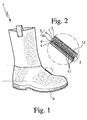
- Fig. 1 shows a fire or flame resistant footwear 1, especially a boot for firefighters, with protective function against pollutants, such as chemical toxins or biological pollutants.
- the fire-resistant or flame-resistant footwear according to the invention has a multilayered layer structure 2 with an outer layer 3 (ie, facing away from the foot when worn) and an inner layer 4 (in the wearing state facing the foot) associated with the outer layer 3, in particular a shoe lining lining. on.
- Fig. 2 further shows that between the outside 3 and the inner layer 4, an adsorption layer 5 is additionally arranged.
- the adsorbent layer 5 comprises a toxic adsorbent adsorbent material 6, wherein the adsorbent material is preferably activated carbon, as discussed in detail below. Due to this special equipment of the footwear according to the invention with the adsorption layer 5, an efficient protection against pollutants, such as chemical toxins and biological pollutants, at the same time high wearing comfort is ensured.
- Fig. 2 It is additionally provided that at least the outer layer 3 of the multi-layered layer structure 2 of the fire- or flame-resistant footwear 1 according to the invention is equipped with a fire-resistant or flame-retardant coating or impregnation 12. This ensures that the footwear 1 according to the invention is also used in the event of flame and fire, in particular in fires can be, because it has fire- or flame-resistant properties.
- fire-resistant or flame-resistant footwear 1 according to the invention is particularly suitable for firefighters, since in particular in firefighting operations often high ambient temperatures are present and the footwear often comes directly into contact with fire, flames, embers or the like.
- the fire-resistant or flame-retardant coating or impregnation 12 of the fire- or flame-resistant footwear 1 according to the invention is concerned, it is possible to use substances or chemical compounds known to the person skilled in the art - both of inorganic and organic nature, the outer layer 3 of the shoe 1 flame retardant or flame retardant equip. These include, for example, substances which prevent the ignition of the outer layer 3 or make their ignition and / or their combustion more difficult.
- flame-retardant, char-promoting or barrier-layer or intumescent substances can be used for the flame-retardant coating or impregnation 12 of the outer layer 3.
- fire-extinguishing or carbonization-promoting flame retardants insofar as they form a non-combustible or heat-insulating layer against heat and heat or increase their formation by heat, by the thermal degradation of carbon compounds so directing that the charring of the layer to be protected - in the present case, the outer layer 3 - promoted and the splitting off of combustible gases is attenuated.
- These substances include, for example, ammonium phosphate, which not only emits ammonia under the influence of heat, but also acts dehydrating because it gives off charring phosphoric acid.
- barrier-forming agents or sealants can be used according to the invention, which - without wishing to be bound by any particular theory - form under the influence of heat hardly inflammable, thin barrier layers which deny the atmospheric oxygen access to a layer impregnated therewith.
- barrier layer-forming agents include, for example, ammonium polyphosphates and expandable graphites.
- intumescent agents which-without wishing to be bound by theory-combine the properties of the carbon-promoting and barrier-layer-forming flame retardants, whereby intumescent substances can be used which expand when heated to a foamy and, for example, from 250 to 300.degree carbonize, thereby solidify and form a fine-pored, well-insulating pad.
- intumescent substances include, for example, organic phosphate compounds.
- According to the invention can be used as flame retardant or flame retardant coating or impregnation 12 and radical scavengers, which interrupt the chain reaction of the combustion.
- These may be, for example, antimony compounds, such as antimony trioxide, in particular in combination with a halogen donor act.
- the fire- or flame-retardant coating or impregnation 12 is preferably based on (i) phosphoric acid compounds, in particular phosphoric acid esters; (ii) metal salts, especially antimony or aluminum salts; or (iii) fluorinated polymers and mixtures of two or more of the aforementioned compounds.
- the fire- or flame-retardant coating or impregnation 12 can be applied in a manner known per se to the person skilled in the art, for example in the form of a solution, suspension or the like, by immersion, sputtering and / or by means of a pressure / vacuum impregnation.
- application by means of, for example, a doctor blade or roller coater, by spray coating, by calendering and / or by transfer coating by screen printing is also possible.
- the fire or flame retardant coating or impregnation 12 by means of a chemical incorporation or a grafting of flame retardant compounds, for example in the form of monomers, in or on the molecular structure of the outer layer 3 takes place
- grafting by means of vinylphosphonic acid is possible.
- the person skilled in the art knows such methods, and the person skilled in the art is in a position to select both the type and amount of the flame retardant and the manner of application of the coating or impregnation to the outer layer 3 of the footwear 1 according to the invention in the light of the present invention or perform.
- outer layer 3 of fire-resistant or flame-resistant footwear 1 is preferably made of a flame-retardant material, in particular a leather or a flame-retardant textile material.
- the flame-retardant textile materials include, for example, aramid fibers, polyamide fibers, fibers with a higher halogen content, which may be self-extinguishing, for example.
- leather is used as the material of the outer layer 3.
- the outer layer 3 of the shoe 1 according to the invention of a breathable, especially water vapor permeable material, such as z. Be as polyamides (especially nylon such. B. Codura ® by the company. DuPont) is formed.
- a breathable, especially water vapor permeable material such as z. Be as polyamides (especially nylon such. B. Codura ® by the company. DuPont)
- these are dense and resistant polyamide or nylon fabrics, in particular woven or knitted fabrics on this basis.
- an additional oleophobization and / or hydrophobing of the material of the outer layer 3 is recommended, in particular by a special impregnation in order to prevent or hinder the penetration of pollutants.
- the outer layer 3 but also consist of a plastic material, such.
- Butyl rubber, rubbers eg chloroprene rubbers such as neoprenes or fluororubbers
- fluoroelastomers eg Viton® from DuPont Dow Elastomers LLC
- the thickness of the material of the outer layer 3 is concerned, this can vary within wide ranges. According to the invention, however, it is preferable to provide a thickness of the outer layer 3 in the range from 0.5 mm to 4 mm, preferably 1 mm to 3 mm, preferably 1 to 2.5 mm.
- the footwear 1 according to the invention preferably has a low-inflammable sole 9, wherein it is preferred according to the invention that the sole 9 is at least substantially impermeable to water or air. So that pollutants, such as chemical toxins or biological pollutants, can not penetrate through the sole 9 in the footwear 1, the sole 9 is generally formed from such a material which is at least substantially impermeable to such pollutants or their passage at least delayed.
- the sole 9 for these purposes may consist of a plastic or rubber material known to those skilled in the art for these purposes.
- a material suitable for use in the sole 9 is, for example, nitrile rubber.
- the shoe sole 9 should be sealingly connected to the layer structure 2, in particular in the region of the transition of the sole 9 and the layer structure 2; This is done in a conventional manner, for example by sewing, gluing, welding, etc. In this way, the area of the sole of the foot as well as the rest of the foot area sufficiently protected against pollutants and strong flame or fire.
- any textile materials preferably air-permeable textile materials may be used, such.
- Non-limiting examples are woven, knitted, knitted, laid, nonwoven or nonwoven fabrics.
- a woven or knitted fabric or a non-woven fabric is used as the material for the inner layer 4.
- the inner layer 4 may optionally also be provided with a fire-resistant or flame-retardant coating or impregnation.
- the footwear 1 according to the invention can have at least one membrane 7 which can be arranged either between the outer layer 3 and the adsorption layer 5 or between the inner layer 4 and the adsorption layer 5.
- the membrane 7 is arranged between the outer layer 3 and the adsorption layer 5, that is to say on the side facing away from the foot in the wearing state of the adsorption layer 5.
- the membrane 7 is preferably impermeable to water or impermeable to air and preferably to toxins, such as chemical or biological poisons , at least substantially impermeable or at least their average.
- Footwear 1 is decontaminable and regenerable; because any contaminants that may have penetrated through the outer layer 3 can be removed or washed down by the membrane 7 by appropriate treatment methods, for example with suitable contamination solutions which are well known to the person skilled in the art for this purpose.
- the membrane 7 is breathable, in particular permeable to water vapor.
- the membrane 7 should have a water vapor permeability of at least 12.5 l / m 2 per 24 h, in particular at least 17.5 l / m 2 per 24 h, preferably at least 20 l / m 2 per 24 hours or even more (measured according to the "inverted cup method" according to ASTM E 96 at 25 ° C) (For more details on the measurement of water vapor transmission, WVT) be referenced McCullough et al. "A comparison of standard methods for measuring water vapor permeability of fabrics" in Meas. Sci. Technol. [Measurements Science and Technology] 14, 1402-1408, August 2003 ). This ensures a particularly high wearing comfort.
- the membrane was intended for these purposes to have a water vapor transmission resistance R et under stationary conditions - measured in accordance with DIN 31 093: 1993 of February 1994 ("Textiles - Physiological effects, measurement of the heat and water vapor transmission resistance under stationary conditions (sweating guarded-hotplate test)". ) or according to the same international standard ISO 11 092 - at 35 ° C of at most 25 (m 2 ⁇ Pascal) / watt, in particular at most 20 (m 2 ⁇ Pascal) / watt, preferably at most 13 (m 2 ⁇ Pascal) / watt , have a thickness of 50 microns.
- the optionally provided membrane 7 may be a continuous, in particular closed and possibly microporous membrane 7.
- the thickness of the membrane 7 can vary within wide ranges; In general, it is in the range of 1 to 500 .mu.m, in particular 1 to 250 .mu.m, preferably 1 to 100 .mu.m, preferably 1 to 50 .mu.m, more preferably 2.5 to 30 .mu.m, most preferably 5 to 25 microns.
- the optionally provided membrane 7 should only be swellable or water-absorbent at best.
- the swelling capacity and / or the water absorption capacity of the membrane 7 should be at most 35%, in particular at most 25%, based on the intrinsic weight of the membrane 7.
- suitable membranes 7 are at least substantially impermeable to liquids, in particular water and / or aerosols, or at least delay their passage.
- the membrane 7 should have no or substantially no strongly hydrophilic groups, in particular no hydroxyl groups.
- the membrane 7 may have weakly hydrophilic groups, especially polyether groups.
- the optionally present membrane 7 may consist of a plastic or polymer material or comprise such.
- a plastic or such a polymer may, for example, be a polyurethane, polyetheramide, polyesteramide, polyetherester, polytetrafluoroethylene or a cellulose-based polymer.
- derivatives of the aforementioned compounds can be used.
- the plastic or. the polymer is a polyetherester or a polytetrafluoroethylene.
- the optionally present membrane 7 may be formed as a multilayer laminate or as a multilayer composite.
- This laminate or this composite may consist of at least two, preferably at least three interconnected layers or layers.
- This particular embodiment of the membrane 7 makes it possible to combine barrier layer materials, each with different properties, in particular different water vapor permeabilities and barrier effects against pollutants, and thus to achieve an optimization of the properties of the membrane 7.
- the membrane 7 In order to increase the stability of the optionally present membrane 7, it is advantageous to arrange the membrane 7 on a flat carrier layer not shown in the figures (eg on a preferably air-permeable textile material, such as a textile fabric, e.g. A woven, knitted, knitted, scrim or fabric composite).
- a flat carrier layer not shown in the figures (eg on a preferably air-permeable textile material, such as a textile fabric, e.g. A woven, knitted, knitted, scrim or fabric composite).
- the membrane 7 may be laminated or laminated onto the carrier layer, in particular by means of a preferably point-wise applied adhesive.
- the planar support layer for the membrane 7 acts as a kind of support layer and increases the mechanical stability and tear resistance of the membrane 7, which is particularly important if the membrane 7 simultaneously serves as a carrier 10 for the adsorption material 6.
- the membrane 7 has a certain elasticity.
- the membrane 7 can be stretched or stretched to at least 10%, in particular to at least 20%, preferably to at least 30%, at least in one direction.
- the layer structure 2 as a whole should also have a certain elasticity for the aforementioned purposes in addition to a good flexibility; compared to the membrane 7, the elasticity of the layer structure 2 as a whole is lower, and in general the layer structure 2 is at least 5%, preferably at least 10%, stretchable in at least one direction.
- the adsorption layer 5 As far as the adsorption layer 5 is concerned, it is generally discontinuous, ie the adsorption layer 5 generally comprises discrete adsorbent particles 6 adsorbing chemical poisons (eg on the basis of activated carbon) which fixes on a carrier 10, for example by means of an adhesive 11 can be as in Fig. 2 shown.
- the adsorption material 6 of the adsorption layer 5 is in particular an adsorbent material containing or consisting of activated carbon, for example a material based on activated carbon, in particular in the form of activated carbon particles and / or activated carbon fibers.
- the good wearing properties of the footwear according to the invention, 1 are additionally improved when using an activated carbon-based adsorption layer 5 by the buffer effect of the activated carbon, because the activated carbon serves as a moisture or water storage or buffer (eg for foot perspiration).
- activated carbon serves as a moisture or water storage or buffer (eg for foot perspiration).
- activated carbon as the adsorption material for the adsorption layer runs of up to about 250 g / m 2 or more are common, so that z. B. at a sweat break about 40 g / m 2 of moisture can be stored, which can then be given back to the outside in the case of a breathable outer layer 3.
- the adsorption layer 5 is formed as an adsorption area filter.
- the adsorption layer 5 contains a chemical poisons adsorbing adsorption material 6, preferably based on activated carbon, for.
- a chemical poisons adsorbing adsorption material 6 preferably based on activated carbon, for.
- the adsorption material 6 of the adsorption layer 5 is preferably arranged on the side facing away from the foot in the wearing state of the support 10.
- the attachment of the adsorbent 6 to the carrier 10 is done in a conventional manner, for example by continuous or preferably discontinuous application of an adhesive 11 on the carrier 10, wherein then the adsorbent 6 is fixed to the adhesive 11.
- a discontinuous, in particular punctiform adhesive application is preferred, ie the carrier 10 is advantageously printed discontinuously or punctiform in a preferably regular pattern or grid with the adsorption 6.
- the actual adsorption material 6 can be laminated by a preferably air-permeable textile material, in particular a textile fabric, as cover layer, in order to reduce the mechanical loading of the adsorption material (eg with a fabric having a lower basis weight of 5 to 75 g / m 2 , in particular 10 to 50 g / m 2 , preferably 15 to 30 g / m 2 );
- a covering or laminating layer is purely optional.
- the carrier 10 For efficient adsorption performance, it is preferred if at least 50%, in particular at least 60%, preferably at least 70%, particularly preferably at least 75%, very particularly preferably at least 80%, of the carrier 10 are exposed to adsorption material 6. It should be noted that the amount and type, in particular the viscosity, of the adhesive 11 are designed such that the adsorption material 6 of the adsorption layer 5 at least 50%, in particular at least 60%, preferably at least 70%, is freely accessible to the chemical poisons to be adsorbed, ie is not completely pressed into the adhesive 11 or sinks.
- the adsorption material 6 of the adsorption layer 5 can consist, for example, of discrete particles of activated carbon, preferably in granular form ("granular carbon”), particularly preferably in spherical form (“spherical carbon").
- the Grain especially ball carbon
- the bursting pressure for a single particle of activated carbon, especially activated carbon granules is generally at least about 5 N, more preferably at least about 10 N, and may reach up to about 20 N.
- the average diameter of the activated carbon particles is less than 1.0 mm, preferably less than 0.8 mm, preferably less than 0.6 mm, but is generally at least 0.1 mm.
- the activated carbon particles are generally in an amount of 5 to 500 g / m 2 , in particular 10 to 400 g / m 2 , preferably 20 to 300 g / m 2 , preferably 25 to 250 g / m 2 , on the carrier material 10 applied.
- the adsorption layer 5 as adsorption material 6 comprise activated carbon fibers, in particular in the form of activated carbon sheets.
- Such activated carbon sheets may have, for example, a weight per unit area of 20 to 200 g / m 2 , in particular 50 to 150 g / m 2 .
- These activated carbon sheets may, for example, be activated carbon fabrics, knits, blends or composites, for example based on carbonized and activated cellulose and / or a carbonated and activated acrylonitrile.
- activated carbon particles have the advantage of a higher adsorption capacity, while activated carbon fibers have a better adsorption kinetics.
- the activated carbon used according to the invention preferably has an internal surface area (BET) of at least 800 g / m 2 , in particular of at least 900 g / m 2 , preferably of at least 1000 g / m 2 , preferably in the range of 800 to 1500 g / m 2 , on.
- BET internal surface area
- the adsorption material 6 of the adsorption layer 5, in particular the activated charcoal particles or the activated carbon fibers, can also be impregnated with at least one catalyst.
- Suitable catalysts according to the invention are, for example, enzymes and / or metal ions, preferably copper, silver, cadmium, platinum, palladium, zinc and / or mercury ions.
- the amount of catalyst can vary widely; In general, it is 0.05 to 12 wt .-%, preferably 1 to 10 wt .-%, particularly preferably 2 to 8 wt .-%, based on the weight of the adsorption layer fifth
- a spacer layer 8 is arranged which may, for example, be in the form of a nonwoven, a thin foam layer or a textile fabric (for example a knitted fabric).
- the spacer layer 8 is arranged directly adjacent to the inner layer 4 (ie, on the side of the inner layer 4 facing away from the foot in the wearing state).
- the additional spacer layer 8 has the advantage that it reduces the mechanical stress of the adsorption layer 5 and the membrane 7, because between the inner layer 4 on the one hand and the adsorption layer 5 or membrane 7 on the other hand, an additional layer is present, which intercept mechanical loads or can dampen. On the other hand prevents such an arrangement that impurities, which originate from the wearer, such. As body sweat, the adsorption material 6 of the adsorption layer 5 unnecessarily burden. In this way, therefore, the efficiency of the adsorption layer 5 is increased.
- the additional spacing layer 8 increases the wearing comfort of the footwear 1 according to the invention, in particular the soft wearing feeling.
- the individual layers 3, 4, 5, 7 and 8 of the layer structure 2 are connected to each other; This is done by methods known per se for this purpose (eg by gluing, welding, sewing, stapling etc.).
- the bonding or fixing of the individual layers 3, 4, 5, 7 and 8 of the layer structure takes place seamlessly with each other, preferably without damaging the individual layers 3, 4, 5, 7 and 8 (eg by gluing, welding, etc .).
- it is recommended to seal the seams eg, with a so-called seam sealing tape).
- the individual layers 3, 4, 5, 7 and 8 of the layer structure form a coherent composite.
- the footwear according to the invention has the decisive advantage that on the one hand - due to the fire or flame retardant coating or impregnation - fire and flame resistant properties and on the other hand - due to the adsorption - a high protection against pollutants, such as chemical toxins; in a single item of clothing. Because of these properties, the footwear according to the invention is particularly suitable for firefighting and decontamination use, and this in particular with integration into a total protection concept, for example in combination with a fire- or flame-resistant protective suit.
- the footwear can also be used in contaminated areas, for example in the context of a decontamination use, since the footwear according to the invention also has an efficient protection against chemical pollutants.
- the footwear is particularly suitable for use in the context of fire fighting at high temperatures.
- the wearer of the footwear is protected on the one hand from exposure to fire due to the good flame resistance of the shoe according to the invention; On the other hand, prevents the fire or flame retardant coating or impregnation destruction or burning of the footwear as such, so that even under such adverse conditions effective protection for the wearer of the footwear is maintained.
- the footwear according to the invention can be produced in a manner known per se. This is well-known in the manufacture of footwear expert, so that in this regard requires no further comments.
Landscapes
- Health & Medical Sciences (AREA)
- Epidemiology (AREA)
- General Health & Medical Sciences (AREA)
- Public Health (AREA)
- Footwear And Its Accessory, Manufacturing Method And Apparatuses (AREA)
Claims (14)
- Chaussure (1) résistant au feu et/ou aux flammes, notamment botte de pompier, protégée contre les substances nocives, comme les substances toxiques chimiques,- la chaussure (1) présentant une structure en couches (2) à plusieurs couches, dans laquelle la structure en couches (2) comprend une couche extérieure (3) qui se détourne du pied en l'état porté et une couche intérieure (4) coordonnée à la couche extérieure (3), tournée vers le pied en l'état porté, notamment une doublure intérieure de chaussure,- entre la couche extérieure (3) et la couche intérieure (4) une couche d'adsorption (5) comportant un matériau d'adsorption (6) à base de charbon actif adsorbant les substances nocives étant en outre disposée, la couche d'adsorption (5) contenant le matériau d'adsorption (6) sous la forme de particules discrètes de charbon actif en forme de granulés ou en forme de billes,- au moins la couche extérieure (3) étant en outre équipée d'un revêtement ou d'une imprégnation (12) résistant au feu et/ou aux flammes et- afin de diminuer la charge mécanique de la couche d'adsorption (5) entre la couche intérieure (4) et la couche d'adsorption (5), une couche d'espacement (8) étant en outre disposée sous forme d'une nappe non tissée, d'une couche de matière plastique mousse ou d'un article textile plat.
- Chaussure selon la revendication 1, caractérisée en ce que le revêtement ou l'imprégnation (12) résistant au feu et/ou aux flammes est conçu à base de (i) liaisons d'acide phosphorique, notamment d'esters d'acide phosphorique; (ii) de sels métalliques, notamment des sels d'antimoine ou d'aluminium; (iii) de polymères fluorés ; ainsi que de mélanges de deux des liaisons mentionnées ci-avant ou plus.
- Chaussure selon la revendication 1 ou 2, caractérisée en ce que la couche extérieure (3) est formée dans un matériau difficilement inflammable, notamment un cuir et/ou un matériau textile difficilement inflammable, de préférence du cuir.
- Chaussure selon une des revendications précédentes, caractérisée en ce que la chaussure (1) présente en outre au moins une membrane (7), la membrane (7) étant notamment disposée entre la couche extérieure (3) et la couche d'adsorption (5) et/ou entre la couche intérieure (4) et la couche d'adsorption (5), de préférence entre la couche extérieure (3) et la couche d'adsorption (5).
- Chaussure selon la revendication 4, caractérisée en ce que la membrane (7) est conçue comme étant imperméable à l'eau et/ou imperméable à l'air.
- Chaussure selon la revendication 4 ou 5, caractérisée en ce que la membrane (7) est conçue avec une action respirante, notamment comme étant perméable à la vapeur d'eau.
- Chaussure selon une des revendications 4 à 6, caractérisée en ce que la membrane (7) comprend une plastique et/ou un polymère et/ou est constituée de ceux-ci, le plastique et/ou le polymère pouvant notamment être sélectionnés dans le groupe des polyuréthanes, polyétheramides, polyesteramides, polyétheresters, polytétrafluoréthylènes et/ou polymères à base de cellulose et/ou dérivés des liaison mentionnées ci-avant, de préférence des polyétheresters et des polytétrafluoréthylènes.
- Chaussure selon une des revendications précédentes, caractérisée en ce que la chaussure (1) présente une semelle (9) de préférence difficilement inflammable, la semelle (9) étant notamment au moins essentiellement imperméable à l'eau et/ou à l'air et/ou la semelle (9) étant notamment constituée d'un matériau plastique et/ou caoutchouc.
- Chaussure selon une des revendications précédentes, caractérisée en ce que la couche d'adsorption (5) a une configuration discontinue et/ou en ce que la couche d'adsorption (5) est conçue comme un filtre à surface d'adsorption.
- Chaussure selon une des revendications précédentes, caractérisée en ce que le matériau d'adsorption (6) est fixé sur un support (10), notamment un support textile, le matériau d'adsorption (6) étant notamment disposé sur le côté du support (10) qui se détourne du pied en l'état porté.
- Chaussure selon une ou plusieurs des revendications précédentes, caractérisée en ce que le charbon actif présente une surface intérieure (BET) d'au moins 800 m2/g, notamment d'au moins 900 m2/g, de préférence d'au moins 1.000 m2/g, de préférence dans la plage comprise entre 800 et 1.500 m2/g.
- Chaussure selon une ou plusieurs des revendications précédentes, caractérisée en ce que les particules de charbon actif sont en outre imprégnées avec au moins un catalyseur, le catalyseur employé étant notamment des enzymes et/ou des ions métalliques, de préférence des ions de cuivre, d'argent, de cadmium, de platine, de palladium, de zinc et/ou de mercure et/ou la quantité du catalyseur étant notamment comprise entre 0,05 et 12 % en poids, de préférence 1 à 10 % en poids, de manière encore préférée 2 à 8 % en poids par rapport au poids de la couche d'adsorption (5).
- Chaussure selon une des revendications précédentes, caractérisée en ce qu'en cas de présence d'une membrane (7), la couche d'espacement (8) est disposée entre la couche intérieure (4) et la membrane (7).
- Chaussure selon une ou plusieurs des revendications précédentes, caractérisée en ce que les couches individuelles (3, 4, 5, 7, 8) de la structure en couches (2) sont respectivement reliées les unes aux autres et/ou en ce que les couches individuelles (3, 4, 5, 7, 8) de la structure en couches (2) forment un composite.
Applications Claiming Priority (3)
| Application Number | Priority Date | Filing Date | Title |
|---|---|---|---|
| DE102005020204 | 2005-04-28 | ||
| DE102005026837A DE102005026837B3 (de) | 2005-04-28 | 2005-06-10 | Feuerfestes Schuhwerk mit Schutzfunktion gegenüber Giftstoffen |
| PCT/EP2006/000215 WO2006117027A1 (fr) | 2005-04-28 | 2006-01-12 | Chaussure resistant au feu protegee contre les substances toxiques |
Publications (2)
| Publication Number | Publication Date |
|---|---|
| EP1874148A1 EP1874148A1 (fr) | 2008-01-09 |
| EP1874148B1 true EP1874148B1 (fr) | 2009-07-15 |
Family
ID=36190489
Family Applications (1)
| Application Number | Title | Priority Date | Filing Date |
|---|---|---|---|
| EP06706203A Expired - Lifetime EP1874148B1 (fr) | 2005-04-28 | 2006-01-12 | Chaussure resistant au feu protegee contre les substances toxiques |
Country Status (7)
| Country | Link |
|---|---|
| US (1) | US8402676B2 (fr) |
| EP (1) | EP1874148B1 (fr) |
| KR (1) | KR100943886B1 (fr) |
| DE (2) | DE102005026837B3 (fr) |
| ES (1) | ES2329826T3 (fr) |
| PT (1) | PT1874148E (fr) |
| WO (1) | WO2006117027A1 (fr) |
Families Citing this family (21)
| Publication number | Priority date | Publication date | Assignee | Title |
|---|---|---|---|---|
| US20080110866A1 (en) * | 2006-11-14 | 2008-05-15 | Ford Motor Company | Shield for Resistance Welding Gun |
| US7941942B2 (en) | 2007-09-13 | 2011-05-17 | Nike, Inc. | Article of footwear including a composite upper |
| US8056149B2 (en) * | 2007-12-20 | 2011-11-15 | Converse Inc. | Combination sock and shoe |
| US20100024254A1 (en) * | 2008-07-31 | 2010-02-04 | Combs William G | Waterproof, breathable shoe |
| US20100293817A1 (en) * | 2009-05-20 | 2010-11-25 | Brown Shoe Company, Inc. | Soft step top lift for shoes and method thereof |
| US20110061269A1 (en) * | 2009-09-11 | 2011-03-17 | Wolverine World Wide, Inc. | Water barrier for footwear |
| US9192210B2 (en) * | 2009-11-09 | 2015-11-24 | Globe Holding Company Llc | Protective garment having a thermally reflective layer |
| US20110258874A1 (en) * | 2010-04-21 | 2011-10-27 | Kenneth Todd Riddleberger | Disposable and/or camouflage scent encapsulating adsorption system interchangeably positionable about shoes, boots and feet further providing odor, barrier and/or contaminate protection during storage and use |
| US20110265350A1 (en) * | 2010-04-30 | 2011-11-03 | Diane Bible | Protective Boot Construction |
| DE102013111421A1 (de) | 2013-05-24 | 2014-12-11 | Contitech Elastomer-Beschichtungen Gmbh | Mehrschichtigen Stoffbahn, insbesondere Faltenbalg, mit flammhemmenden Eigenschaften |
| EP2845502A1 (fr) * | 2013-09-10 | 2015-03-11 | Honeywell International Inc. | Chaussure avec fonction de protection contre une projection métallique fondue |
| DE102015113213A1 (de) * | 2015-07-25 | 2017-01-26 | BLüCHER GMBH | Neuartiges textiles Schutzmaterial und Verfahren zu dessen Herstellung |
| US10076153B2 (en) | 2015-08-10 | 2018-09-18 | Kassel Llc | Thermal protection system and related compositions of matter |
| DE102016100159A1 (de) | 2015-11-30 | 2017-06-01 | BLüCHER GMBH | Funktionelle Fußbekleidungseinheit |
| WO2019095076A1 (fr) * | 2017-11-17 | 2019-05-23 | Stedfast Inc. | Ensemble textile multicouche destiné à être utilisé dans des articles chaussants |
| FR3075574B1 (fr) | 2017-12-26 | 2019-11-29 | Paul Boye Technologies | Vetement de protection nrbc ameliore |
| DE102018203297B4 (de) * | 2018-03-06 | 2024-03-14 | Adidas Ag | Beschichtetes Schuhoberteil |
| US20240365916A1 (en) * | 2021-09-08 | 2024-11-07 | Chairman, Defence Research & Development Organization | Multifunctional nbc protective combat boot |
| US20230248080A1 (en) * | 2022-02-07 | 2023-08-10 | Lfc, Llc | Sock with shoe-like properties and method for making the sock |
| GB2641485A (en) * | 2023-12-20 | 2025-12-10 | Nonwovenn Ltd | Use of material for adsorption of compounds, and protective garment |
| US12257819B1 (en) | 2024-01-17 | 2025-03-25 | United Tactical Supply, LLC | Multi-layer barrier fabric with extended breakthrough time |
Family Cites Families (29)
| Publication number | Priority date | Publication date | Assignee | Title |
|---|---|---|---|---|
| US1637709A (en) * | 1924-03-18 | 1927-08-02 | Preble Box Toe Co | Stiffener for boots and shoes |
| DE1095711B (de) * | 1956-08-27 | 1960-12-22 | Phoenix Gummiwerke Ag | Stiefel, insbesondere Schaftstiefel |
| US3870554A (en) * | 1972-05-04 | 1975-03-11 | Hooker Chemicals Plastics Corp | Thermal shrinkage resistance of leather |
| DE7805047U1 (de) * | 1978-02-20 | 1978-06-08 | Fa. Carl Freudenberg, 6940 Weinheim | Platte zur Herstellung einer Polsterbrandsohle |
| GB2025316B (en) * | 1978-07-05 | 1982-06-30 | Blucher H Von | Compound material for protective clothing |
| US4217386A (en) * | 1979-06-07 | 1980-08-12 | The United States Of America As Represented By The Secretary Of The Army | Laminated, highly sorbent, active carbon fabric |
| US4518650A (en) * | 1980-07-11 | 1985-05-21 | E. I. Du Pont De Nemours And Company | Protective clothing of fabric containing a layer of highly fluorinated ion exchange polymer |
| US4513047A (en) * | 1984-01-23 | 1985-04-23 | Burlington Industries, Inc. | Sorbent internally ribbed carbon-containing material and protective garment fabricated therefrom |
| US5024594A (en) * | 1986-07-23 | 1991-06-18 | Membrane Technology & Research, Inc. | Protective clothing material |
| DE3716303A1 (de) * | 1987-05-15 | 1988-11-24 | Bluecher Hubert | Schuhinnenmaterial mit adsorbierenden eigenschaften |
| ES2137161T3 (es) | 1991-02-21 | 1999-12-16 | Techboot Pty Ltd | Calzado de proteccion. |
| DE4123088A1 (de) | 1991-07-12 | 1993-01-21 | Schuhfabrik Hanrath Gmbh | Verfahren zur herstellung insbesondere hitzebestaendiger schuhe oder stiefel und schuh oder stiefel nach diesem verfahren |
| DE9302479U1 (de) | 1993-02-20 | 1993-04-15 | Norddeutsches Lederwerk GmbH, 19306 Neustadt-Glewe | Lederverbundwerkstoff |
| DE69412398T2 (de) * | 1993-09-14 | 1999-04-15 | Kuraray Chemical Co., Ltd., Bizen, Okayama | Metalloxyd tragendes, Aktivkohle enthaltendes, Deodorant |
| JP2701010B2 (ja) | 1995-01-23 | 1998-01-21 | クラウン製靴株式会社 | 消防靴 |
| DE29504265U1 (de) | 1995-03-13 | 1995-06-08 | Reinhold, Birgit, 09224 Grüna | Firstabdeckung für Dachflächen |
| DE29504365U1 (de) | 1995-03-18 | 1995-07-20 | Haix-Schuhe Produktions und Vertriebs GmbH, 84048 Mainburg | Stiefel |
| DE29506366U1 (de) | 1995-04-13 | 1995-06-14 | Hanrath, Werner, 52525 Heinsberg | Geschlossener Schutzstiefel |
| GB2313537A (en) | 1996-05-30 | 1997-12-03 | Fii Footwear Management Ltd | Footwear item |
| DE19624553A1 (de) | 1996-06-20 | 1998-01-02 | Schabsky Atlas Schuhfab | Stiefel |
| DE29904120U1 (de) | 1999-03-06 | 1999-06-17 | Friedrich Seiz GmbH, 72555 Metzingen | Schutzhandschuh |
| US6571397B1 (en) * | 2000-09-14 | 2003-06-03 | Cole Williams | Protective garments |
| DE20116043U1 (de) | 2001-09-30 | 2002-02-28 | Schneider, Otmar, Salzburg | Schutzstiefel für Feuerwehrleute |
| AU2002366292B2 (en) * | 2001-12-14 | 2006-06-22 | Hiraoka & Co., Ltd. | Antifouling waterproof sheet |
| US20040060102A1 (en) * | 2002-04-10 | 2004-04-01 | Interspiro, Inc. | Garments for biological, chemical and fire protection |
| US7114192B1 (en) * | 2003-07-29 | 2006-10-03 | Prouty Ronald L | Two sided work glove |
| DE10347673B4 (de) * | 2003-10-09 | 2012-01-12 | BLüCHER GMBH | Schuh, insbesondere Stiefel, mit ABC-Schutz |
| DE10356776B4 (de) * | 2003-12-02 | 2011-04-14 | BLüCHER GMBH | Plasmabehandeltes Adsorptionsfiltermaterial mit Schutz gegenüber chemischen Giftstoffen, dessen Verwendung und dieses Adsorptionsfiltermaterial aufweisende Schutzmaterialien |
| DE10357112A1 (de) * | 2003-12-06 | 2005-07-07 | Texplorer Gmbh | Unterbeinschutzbekleidung |
-
2005
- 2005-06-10 DE DE102005026837A patent/DE102005026837B3/de not_active Revoked
-
2006
- 2006-01-12 KR KR1020077027753A patent/KR100943886B1/ko not_active Expired - Fee Related
- 2006-01-12 PT PT06706203T patent/PT1874148E/pt unknown
- 2006-01-12 DE DE502006004236T patent/DE502006004236D1/de not_active Expired - Lifetime
- 2006-01-12 ES ES06706203T patent/ES2329826T3/es not_active Expired - Lifetime
- 2006-01-12 EP EP06706203A patent/EP1874148B1/fr not_active Expired - Lifetime
- 2006-01-12 US US11/912,600 patent/US8402676B2/en active Active
- 2006-01-12 WO PCT/EP2006/000215 patent/WO2006117027A1/fr not_active Ceased
Also Published As
| Publication number | Publication date |
|---|---|
| PT1874148E (pt) | 2009-10-19 |
| US8402676B2 (en) | 2013-03-26 |
| US20080282578A1 (en) | 2008-11-20 |
| EP1874148A1 (fr) | 2008-01-09 |
| DE502006004236D1 (de) | 2009-08-27 |
| DE102005026837B3 (de) | 2006-08-10 |
| KR100943886B1 (ko) | 2010-02-24 |
| WO2006117027A1 (fr) | 2006-11-09 |
| KR20080014979A (ko) | 2008-02-15 |
| ES2329826T3 (es) | 2009-12-01 |
Similar Documents
| Publication | Publication Date | Title |
|---|---|---|
| EP1874148B1 (fr) | Chaussure resistant au feu protegee contre les substances toxiques | |
| DE10347673B4 (de) | Schuh, insbesondere Stiefel, mit ABC-Schutz | |
| EP1677636B1 (fr) | Gant de protection respirant a protection nbc | |
| EP1675659B1 (fr) | Vetement de protection nbc | |
| EP1595599B1 (fr) | Matériau filtrant à adsorption et son utilisation | |
| EP2225005B1 (fr) | Matériau de protection fonctionnel à membrane réactive et vêtement de protection produit avec ce matériau | |
| DE10261996B4 (de) | Adsorptionsmaterial und seine Verwendung | |
| EP3352606B1 (fr) | Unité fonctionnelle d'habillement du pied | |
| EP2717973B1 (fr) | Matière de protection fonctionnelle, en particulier pour l'utilisation dans un vêtement de protection | |
| EP2262640B1 (fr) | Article vestimentaire de protection fonctionnelle | |
| DE20318069U1 (de) | Schutzbekleidung mit ABC-Schutz | |
| DE10354902C5 (de) | Atmungsaktiver Schutzhandschuh mit ABC-Schutz | |
| DE202005010411U1 (de) | Feuerfestes Schuhwerk mit Schutzfunktion gegenüber Giftstoffen | |
| DE20314754U1 (de) | Mehrlagiges Filtermaterial | |
| DE20315766U1 (de) | Schuh, insbesondere Stiefel, mit ABC-Schutz |
Legal Events
| Date | Code | Title | Description |
|---|---|---|---|
| PUAI | Public reference made under article 153(3) epc to a published international application that has entered the european phase |
Free format text: ORIGINAL CODE: 0009012 |
|
| 17P | Request for examination filed |
Effective date: 20070927 |
|
| AK | Designated contracting states |
Kind code of ref document: A1 Designated state(s): AT BE BG CH CY CZ DE DK EE ES FI FR GB GR HU IE IS IT LI LT LU LV MC NL PL PT RO SE SI SK TR |
|
| AX | Request for extension of the european patent |
Extension state: AL BA HR MK YU |
|
| GRAP | Despatch of communication of intention to grant a patent |
Free format text: ORIGINAL CODE: EPIDOSNIGR1 |
|
| GRAS | Grant fee paid |
Free format text: ORIGINAL CODE: EPIDOSNIGR3 |
|
| GRAA | (expected) grant |
Free format text: ORIGINAL CODE: 0009210 |
|
| AK | Designated contracting states |
Kind code of ref document: B1 Designated state(s): AT BE BG CH CY CZ DE DK EE ES FI FR GB GR HU IE IS IT LI LT LU LV MC NL PL PT RO SE SI SK TR |
|
| AX | Request for extension of the european patent |
Extension state: AL BA HR MK YU |
|
| REG | Reference to a national code |
Ref country code: CH Ref legal event code: EP Ref country code: GB Ref legal event code: FG4D Free format text: NOT ENGLISH |
|
| REG | Reference to a national code |
Ref country code: IE Ref legal event code: FG4D |
|
| REF | Corresponds to: |
Ref document number: 502006004236 Country of ref document: DE Date of ref document: 20090827 Kind code of ref document: P |
|
| REG | Reference to a national code |
Ref country code: PT Ref legal event code: SC4A Free format text: AVAILABILITY OF NATIONAL TRANSLATION Effective date: 20091009 |
|
| REG | Reference to a national code |
Ref country code: ES Ref legal event code: FG2A Ref document number: 2329826 Country of ref document: ES Kind code of ref document: T3 |
|
| NLV1 | Nl: lapsed or annulled due to failure to fulfill the requirements of art. 29p and 29m of the patents act | ||
| PG25 | Lapsed in a contracting state [announced via postgrant information from national office to epo] |
Ref country code: LT Free format text: LAPSE BECAUSE OF FAILURE TO SUBMIT A TRANSLATION OF THE DESCRIPTION OR TO PAY THE FEE WITHIN THE PRESCRIBED TIME-LIMIT Effective date: 20090715 Ref country code: IS Free format text: LAPSE BECAUSE OF FAILURE TO SUBMIT A TRANSLATION OF THE DESCRIPTION OR TO PAY THE FEE WITHIN THE PRESCRIBED TIME-LIMIT Effective date: 20091115 Ref country code: FI Free format text: LAPSE BECAUSE OF FAILURE TO SUBMIT A TRANSLATION OF THE DESCRIPTION OR TO PAY THE FEE WITHIN THE PRESCRIBED TIME-LIMIT Effective date: 20090715 Ref country code: SE Free format text: LAPSE BECAUSE OF FAILURE TO SUBMIT A TRANSLATION OF THE DESCRIPTION OR TO PAY THE FEE WITHIN THE PRESCRIBED TIME-LIMIT Effective date: 20090715 |
|
| REG | Reference to a national code |
Ref country code: IE Ref legal event code: FD4D |
|
| PG25 | Lapsed in a contracting state [announced via postgrant information from national office to epo] |
Ref country code: LV Free format text: LAPSE BECAUSE OF FAILURE TO SUBMIT A TRANSLATION OF THE DESCRIPTION OR TO PAY THE FEE WITHIN THE PRESCRIBED TIME-LIMIT Effective date: 20090715 Ref country code: NL Free format text: LAPSE BECAUSE OF FAILURE TO SUBMIT A TRANSLATION OF THE DESCRIPTION OR TO PAY THE FEE WITHIN THE PRESCRIBED TIME-LIMIT Effective date: 20090715 Ref country code: PL Free format text: LAPSE BECAUSE OF FAILURE TO SUBMIT A TRANSLATION OF THE DESCRIPTION OR TO PAY THE FEE WITHIN THE PRESCRIBED TIME-LIMIT Effective date: 20090715 Ref country code: SI Free format text: LAPSE BECAUSE OF FAILURE TO SUBMIT A TRANSLATION OF THE DESCRIPTION OR TO PAY THE FEE WITHIN THE PRESCRIBED TIME-LIMIT Effective date: 20090715 |
|
| REG | Reference to a national code |
Ref country code: HU Ref legal event code: AG4A Ref document number: E006837 Country of ref document: HU |
|
| PG25 | Lapsed in a contracting state [announced via postgrant information from national office to epo] |
Ref country code: BG Free format text: LAPSE BECAUSE OF FAILURE TO SUBMIT A TRANSLATION OF THE DESCRIPTION OR TO PAY THE FEE WITHIN THE PRESCRIBED TIME-LIMIT Effective date: 20091015 |
|
| PLBI | Opposition filed |
Free format text: ORIGINAL CODE: 0009260 |
|
| PG25 | Lapsed in a contracting state [announced via postgrant information from national office to epo] |
Ref country code: DK Free format text: LAPSE BECAUSE OF FAILURE TO SUBMIT A TRANSLATION OF THE DESCRIPTION OR TO PAY THE FEE WITHIN THE PRESCRIBED TIME-LIMIT Effective date: 20090715 Ref country code: RO Free format text: LAPSE BECAUSE OF FAILURE TO SUBMIT A TRANSLATION OF THE DESCRIPTION OR TO PAY THE FEE WITHIN THE PRESCRIBED TIME-LIMIT Effective date: 20090715 Ref country code: CZ Free format text: LAPSE BECAUSE OF FAILURE TO SUBMIT A TRANSLATION OF THE DESCRIPTION OR TO PAY THE FEE WITHIN THE PRESCRIBED TIME-LIMIT Effective date: 20090715 Ref country code: IE Free format text: LAPSE BECAUSE OF FAILURE TO SUBMIT A TRANSLATION OF THE DESCRIPTION OR TO PAY THE FEE WITHIN THE PRESCRIBED TIME-LIMIT Effective date: 20090715 Ref country code: EE Free format text: LAPSE BECAUSE OF FAILURE TO SUBMIT A TRANSLATION OF THE DESCRIPTION OR TO PAY THE FEE WITHIN THE PRESCRIBED TIME-LIMIT Effective date: 20090715 |
|
| 26 | Opposition filed |
Opponent name: W. L. GORE & ASSOCIATES GMBH Effective date: 20100416 |
|
| PLAX | Notice of opposition and request to file observation + time limit sent |
Free format text: ORIGINAL CODE: EPIDOSNOBS2 |
|
| PG25 | Lapsed in a contracting state [announced via postgrant information from national office to epo] |
Ref country code: SK Free format text: LAPSE BECAUSE OF FAILURE TO SUBMIT A TRANSLATION OF THE DESCRIPTION OR TO PAY THE FEE WITHIN THE PRESCRIBED TIME-LIMIT Effective date: 20090715 |
|
| BERE | Be: lapsed |
Owner name: BLUCHER G.M.B.H. Effective date: 20100131 |
|
| PG25 | Lapsed in a contracting state [announced via postgrant information from national office to epo] |
Ref country code: MC Free format text: LAPSE BECAUSE OF NON-PAYMENT OF DUE FEES Effective date: 20100131 |
|
| REG | Reference to a national code |
Ref country code: CH Ref legal event code: PL |
|
| PG25 | Lapsed in a contracting state [announced via postgrant information from national office to epo] |
Ref country code: CH Free format text: LAPSE BECAUSE OF NON-PAYMENT OF DUE FEES Effective date: 20100131 Ref country code: GR Free format text: LAPSE BECAUSE OF FAILURE TO SUBMIT A TRANSLATION OF THE DESCRIPTION OR TO PAY THE FEE WITHIN THE PRESCRIBED TIME-LIMIT Effective date: 20091016 Ref country code: LI Free format text: LAPSE BECAUSE OF NON-PAYMENT OF DUE FEES Effective date: 20100131 |
|
| PLAX | Notice of opposition and request to file observation + time limit sent |
Free format text: ORIGINAL CODE: EPIDOSNOBS2 |
|
| PG25 | Lapsed in a contracting state [announced via postgrant information from national office to epo] |
Ref country code: BE Free format text: LAPSE BECAUSE OF NON-PAYMENT OF DUE FEES Effective date: 20100131 |
|
| PLBB | Reply of patent proprietor to notice(s) of opposition received |
Free format text: ORIGINAL CODE: EPIDOSNOBS3 |
|
| PLCK | Communication despatched that opposition was rejected |
Free format text: ORIGINAL CODE: EPIDOSNREJ1 |
|
| REG | Reference to a national code |
Ref country code: AT Ref legal event code: MM01 Ref document number: 436195 Country of ref document: AT Kind code of ref document: T Effective date: 20110112 |
|
| PLBN | Opposition rejected |
Free format text: ORIGINAL CODE: 0009273 |
|
| STAA | Information on the status of an ep patent application or granted ep patent |
Free format text: STATUS: OPPOSITION REJECTED |
|
| 27O | Opposition rejected |
Effective date: 20120118 |
|
| REG | Reference to a national code |
Ref country code: DE Ref legal event code: R100 Ref document number: 502006004236 Country of ref document: DE Effective date: 20120118 |
|
| PG25 | Lapsed in a contracting state [announced via postgrant information from national office to epo] |
Ref country code: CY Free format text: LAPSE BECAUSE OF FAILURE TO SUBMIT A TRANSLATION OF THE DESCRIPTION OR TO PAY THE FEE WITHIN THE PRESCRIBED TIME-LIMIT Effective date: 20090715 |
|
| PG25 | Lapsed in a contracting state [announced via postgrant information from national office to epo] |
Ref country code: LU Free format text: LAPSE BECAUSE OF NON-PAYMENT OF DUE FEES Effective date: 20100112 |
|
| REG | Reference to a national code |
Ref country code: DE Ref legal event code: R082 Ref document number: 502006004236 Country of ref document: DE Representative=s name: VON ROHR PATENTANWAELTE PARTNERSCHAFT MBB, DE |
|
| PG25 | Lapsed in a contracting state [announced via postgrant information from national office to epo] |
Ref country code: AT Free format text: LAPSE BECAUSE OF NON-PAYMENT OF DUE FEES Effective date: 20110112 |
|
| REG | Reference to a national code |
Ref country code: FR Ref legal event code: PLFP Year of fee payment: 11 |
|
| PGFP | Annual fee paid to national office [announced via postgrant information from national office to epo] |
Ref country code: TR Payment date: 20160105 Year of fee payment: 11 Ref country code: IT Payment date: 20160127 Year of fee payment: 11 Ref country code: ES Payment date: 20160112 Year of fee payment: 11 |
|
| PGFP | Annual fee paid to national office [announced via postgrant information from national office to epo] |
Ref country code: HU Payment date: 20160120 Year of fee payment: 11 Ref country code: PT Payment date: 20160106 Year of fee payment: 11 |
|
| REG | Reference to a national code |
Ref country code: FR Ref legal event code: PLFP Year of fee payment: 12 |
|
| PG25 | Lapsed in a contracting state [announced via postgrant information from national office to epo] |
Ref country code: PT Free format text: LAPSE BECAUSE OF NON-PAYMENT OF DUE FEES Effective date: 20170712 Ref country code: HU Free format text: LAPSE BECAUSE OF NON-PAYMENT OF DUE FEES Effective date: 20170113 |
|
| REG | Reference to a national code |
Ref country code: FR Ref legal event code: PLFP Year of fee payment: 13 |
|
| PG25 | Lapsed in a contracting state [announced via postgrant information from national office to epo] |
Ref country code: IT Free format text: LAPSE BECAUSE OF NON-PAYMENT OF DUE FEES Effective date: 20170112 |
|
| PG25 | Lapsed in a contracting state [announced via postgrant information from national office to epo] |
Ref country code: ES Free format text: LAPSE BECAUSE OF NON-PAYMENT OF DUE FEES Effective date: 20170113 |
|
| REG | Reference to a national code |
Ref country code: ES Ref legal event code: FD2A Effective date: 20181116 |
|
| PG25 | Lapsed in a contracting state [announced via postgrant information from national office to epo] |
Ref country code: TR Free format text: LAPSE BECAUSE OF NON-PAYMENT OF DUE FEES Effective date: 20170112 |
|
| PGFP | Annual fee paid to national office [announced via postgrant information from national office to epo] |
Ref country code: FR Payment date: 20230124 Year of fee payment: 18 |
|
| PGFP | Annual fee paid to national office [announced via postgrant information from national office to epo] |
Ref country code: GB Payment date: 20230119 Year of fee payment: 18 Ref country code: DE Payment date: 20230127 Year of fee payment: 18 |
|
| P01 | Opt-out of the competence of the unified patent court (upc) registered |
Effective date: 20230613 |
|
| REG | Reference to a national code |
Ref country code: DE Ref legal event code: R119 Ref document number: 502006004236 Country of ref document: DE |
|
| GBPC | Gb: european patent ceased through non-payment of renewal fee |
Effective date: 20240112 |
|
| PG25 | Lapsed in a contracting state [announced via postgrant information from national office to epo] |
Ref country code: DE Free format text: LAPSE BECAUSE OF NON-PAYMENT OF DUE FEES Effective date: 20240801 |
|
| PG25 | Lapsed in a contracting state [announced via postgrant information from national office to epo] |
Ref country code: GB Free format text: LAPSE BECAUSE OF NON-PAYMENT OF DUE FEES Effective date: 20240112 |
|
| PG25 | Lapsed in a contracting state [announced via postgrant information from national office to epo] |
Ref country code: FR Free format text: LAPSE BECAUSE OF NON-PAYMENT OF DUE FEES Effective date: 20240131 |
|
| PG25 | Lapsed in a contracting state [announced via postgrant information from national office to epo] |
Ref country code: GB Free format text: LAPSE BECAUSE OF NON-PAYMENT OF DUE FEES Effective date: 20240112 Ref country code: FR Free format text: LAPSE BECAUSE OF NON-PAYMENT OF DUE FEES Effective date: 20240131 Ref country code: DE Free format text: LAPSE BECAUSE OF NON-PAYMENT OF DUE FEES Effective date: 20240801 |