EP1876146A2 - Verfahren zur Herstellung von Metallkomplex-Oxidpulver und amorphes Metallkomplexoxid - Google Patents
Verfahren zur Herstellung von Metallkomplex-Oxidpulver und amorphes Metallkomplexoxid Download PDFInfo
- Publication number
- EP1876146A2 EP1876146A2 EP07012565A EP07012565A EP1876146A2 EP 1876146 A2 EP1876146 A2 EP 1876146A2 EP 07012565 A EP07012565 A EP 07012565A EP 07012565 A EP07012565 A EP 07012565A EP 1876146 A2 EP1876146 A2 EP 1876146A2
- Authority
- EP
- European Patent Office
- Prior art keywords
- metal oxide
- complex metal
- oxide powder
- manufacturing
- raw material
- Prior art date
- Legal status (The legal status is an assumption and is not a legal conclusion. Google has not performed a legal analysis and makes no representation as to the accuracy of the status listed.)
- Withdrawn
Links
Images

Classifications
-
- C—CHEMISTRY; METALLURGY
- C01—INORGANIC CHEMISTRY
- C01G—COMPOUNDS CONTAINING METALS NOT COVERED BY SUBCLASSES C01D OR C01F
- C01G1/00—Methods of preparing compounds of metals not covered by subclasses C01B, C01C, C01D, or C01F, in general
- C01G1/02—Oxides
-
- C—CHEMISTRY; METALLURGY
- C01—INORGANIC CHEMISTRY
- C01G—COMPOUNDS CONTAINING METALS NOT COVERED BY SUBCLASSES C01D OR C01F
- C01G25/00—Compounds of zirconium
- C01G25/006—Compounds containing zirconium, with or without oxygen or hydrogen, and containing two or more other elements
-
- C—CHEMISTRY; METALLURGY
- C01—INORGANIC CHEMISTRY
- C01G—COMPOUNDS CONTAINING METALS NOT COVERED BY SUBCLASSES C01D OR C01F
- C01G33/00—Compounds of niobium
- C01G33/006—Compounds containing niobium, with or without oxygen or hydrogen, and containing two or more other elements
-
- C—CHEMISTRY; METALLURGY
- C01—INORGANIC CHEMISTRY
- C01G—COMPOUNDS CONTAINING METALS NOT COVERED BY SUBCLASSES C01D OR C01F
- C01G35/00—Compounds of tantalum
- C01G35/006—Compounds containing tantalum, with or without oxygen or hydrogen, and containing two or more other elements
-
- C—CHEMISTRY; METALLURGY
- C04—CEMENTS; CONCRETE; ARTIFICIAL STONE; CERAMICS; REFRACTORIES
- C04B—LIME, MAGNESIA; SLAG; CEMENTS; COMPOSITIONS THEREOF, e.g. MORTARS, CONCRETE OR LIKE BUILDING MATERIALS; ARTIFICIAL STONE; CERAMICS; REFRACTORIES; TREATMENT OF NATURAL STONE
- C04B35/00—Shaped ceramic products characterised by their composition; Ceramics compositions; Processing powders of inorganic compounds preparatory to the manufacturing of ceramic products
- C04B35/01—Shaped ceramic products characterised by their composition; Ceramics compositions; Processing powders of inorganic compounds preparatory to the manufacturing of ceramic products based on oxide ceramics
- C04B35/48—Shaped ceramic products characterised by their composition; Ceramics compositions; Processing powders of inorganic compounds preparatory to the manufacturing of ceramic products based on oxide ceramics based on zirconium or hafnium oxides, zirconates, zircon or hafnates
- C04B35/49—Shaped ceramic products characterised by their composition; Ceramics compositions; Processing powders of inorganic compounds preparatory to the manufacturing of ceramic products based on oxide ceramics based on zirconium or hafnium oxides, zirconates, zircon or hafnates containing also titanium oxides or titanates
- C04B35/491—Shaped ceramic products characterised by their composition; Ceramics compositions; Processing powders of inorganic compounds preparatory to the manufacturing of ceramic products based on oxide ceramics based on zirconium or hafnium oxides, zirconates, zircon or hafnates containing also titanium oxides or titanates based on lead zirconates and lead titanates, e.g. PZT
-
- C—CHEMISTRY; METALLURGY
- C04—CEMENTS; CONCRETE; ARTIFICIAL STONE; CERAMICS; REFRACTORIES
- C04B—LIME, MAGNESIA; SLAG; CEMENTS; COMPOSITIONS THEREOF, e.g. MORTARS, CONCRETE OR LIKE BUILDING MATERIALS; ARTIFICIAL STONE; CERAMICS; REFRACTORIES; TREATMENT OF NATURAL STONE
- C04B35/00—Shaped ceramic products characterised by their composition; Ceramics compositions; Processing powders of inorganic compounds preparatory to the manufacturing of ceramic products
- C04B35/01—Shaped ceramic products characterised by their composition; Ceramics compositions; Processing powders of inorganic compounds preparatory to the manufacturing of ceramic products based on oxide ceramics
- C04B35/48—Shaped ceramic products characterised by their composition; Ceramics compositions; Processing powders of inorganic compounds preparatory to the manufacturing of ceramic products based on oxide ceramics based on zirconium or hafnium oxides, zirconates, zircon or hafnates
- C04B35/49—Shaped ceramic products characterised by their composition; Ceramics compositions; Processing powders of inorganic compounds preparatory to the manufacturing of ceramic products based on oxide ceramics based on zirconium or hafnium oxides, zirconates, zircon or hafnates containing also titanium oxides or titanates
- C04B35/491—Shaped ceramic products characterised by their composition; Ceramics compositions; Processing powders of inorganic compounds preparatory to the manufacturing of ceramic products based on oxide ceramics based on zirconium or hafnium oxides, zirconates, zircon or hafnates containing also titanium oxides or titanates based on lead zirconates and lead titanates, e.g. PZT
- C04B35/493—Shaped ceramic products characterised by their composition; Ceramics compositions; Processing powders of inorganic compounds preparatory to the manufacturing of ceramic products based on oxide ceramics based on zirconium or hafnium oxides, zirconates, zircon or hafnates containing also titanium oxides or titanates based on lead zirconates and lead titanates, e.g. PZT containing also other lead compounds
-
- C—CHEMISTRY; METALLURGY
- C04—CEMENTS; CONCRETE; ARTIFICIAL STONE; CERAMICS; REFRACTORIES
- C04B—LIME, MAGNESIA; SLAG; CEMENTS; COMPOSITIONS THEREOF, e.g. MORTARS, CONCRETE OR LIKE BUILDING MATERIALS; ARTIFICIAL STONE; CERAMICS; REFRACTORIES; TREATMENT OF NATURAL STONE
- C04B35/00—Shaped ceramic products characterised by their composition; Ceramics compositions; Processing powders of inorganic compounds preparatory to the manufacturing of ceramic products
- C04B35/622—Forming processes; Processing powders of inorganic compounds preparatory to the manufacturing of ceramic products
- C04B35/624—Sol-gel processing
-
- C—CHEMISTRY; METALLURGY
- C04—CEMENTS; CONCRETE; ARTIFICIAL STONE; CERAMICS; REFRACTORIES
- C04B—LIME, MAGNESIA; SLAG; CEMENTS; COMPOSITIONS THEREOF, e.g. MORTARS, CONCRETE OR LIKE BUILDING MATERIALS; ARTIFICIAL STONE; CERAMICS; REFRACTORIES; TREATMENT OF NATURAL STONE
- C04B35/00—Shaped ceramic products characterised by their composition; Ceramics compositions; Processing powders of inorganic compounds preparatory to the manufacturing of ceramic products
- C04B35/622—Forming processes; Processing powders of inorganic compounds preparatory to the manufacturing of ceramic products
- C04B35/626—Preparing or treating the powders individually or as batches ; preparing or treating macroscopic reinforcing agents for ceramic products, e.g. fibres; mechanical aspects section B
- C04B35/62605—Treating the starting powders individually or as mixtures
- C04B35/62625—Wet mixtures
- C04B35/6264—Mixing media, e.g. organic solvents
-
- C—CHEMISTRY; METALLURGY
- C04—CEMENTS; CONCRETE; ARTIFICIAL STONE; CERAMICS; REFRACTORIES
- C04B—LIME, MAGNESIA; SLAG; CEMENTS; COMPOSITIONS THEREOF, e.g. MORTARS, CONCRETE OR LIKE BUILDING MATERIALS; ARTIFICIAL STONE; CERAMICS; REFRACTORIES; TREATMENT OF NATURAL STONE
- C04B35/00—Shaped ceramic products characterised by their composition; Ceramics compositions; Processing powders of inorganic compounds preparatory to the manufacturing of ceramic products
- C04B35/622—Forming processes; Processing powders of inorganic compounds preparatory to the manufacturing of ceramic products
- C04B35/626—Preparing or treating the powders individually or as batches ; preparing or treating macroscopic reinforcing agents for ceramic products, e.g. fibres; mechanical aspects section B
- C04B35/63—Preparing or treating the powders individually or as batches ; preparing or treating macroscopic reinforcing agents for ceramic products, e.g. fibres; mechanical aspects section B using additives specially adapted for forming the products, e.g.. binder binders
- C04B35/632—Organic additives
- C04B35/6325—Organic additives based on organo-metallic compounds
-
- C—CHEMISTRY; METALLURGY
- C01—INORGANIC CHEMISTRY
- C01P—INDEXING SCHEME RELATING TO STRUCTURAL AND PHYSICAL ASPECTS OF SOLID INORGANIC COMPOUNDS
- C01P2002/00—Crystal-structural characteristics
- C01P2002/30—Three-dimensional structures
- C01P2002/34—Three-dimensional structures perovskite-type (ABO3)
-
- C—CHEMISTRY; METALLURGY
- C04—CEMENTS; CONCRETE; ARTIFICIAL STONE; CERAMICS; REFRACTORIES
- C04B—LIME, MAGNESIA; SLAG; CEMENTS; COMPOSITIONS THEREOF, e.g. MORTARS, CONCRETE OR LIKE BUILDING MATERIALS; ARTIFICIAL STONE; CERAMICS; REFRACTORIES; TREATMENT OF NATURAL STONE
- C04B2235/00—Aspects relating to ceramic starting mixtures or sintered ceramic products
- C04B2235/02—Composition of constituents of the starting material or of secondary phases of the final product
- C04B2235/30—Constituents and secondary phases not being of a fibrous nature
- C04B2235/32—Metal oxides, mixed metal oxides, or oxide-forming salts thereof, e.g. carbonates, nitrates, (oxy)hydroxides, chlorides
- C04B2235/3231—Refractory metal oxides, their mixed metal oxides, or oxide-forming salts thereof
- C04B2235/3251—Niobium oxides, niobates, tantalum oxides, tantalates, or oxide-forming salts thereof
-
- C—CHEMISTRY; METALLURGY
- C04—CEMENTS; CONCRETE; ARTIFICIAL STONE; CERAMICS; REFRACTORIES
- C04B—LIME, MAGNESIA; SLAG; CEMENTS; COMPOSITIONS THEREOF, e.g. MORTARS, CONCRETE OR LIKE BUILDING MATERIALS; ARTIFICIAL STONE; CERAMICS; REFRACTORIES; TREATMENT OF NATURAL STONE
- C04B2235/00—Aspects relating to ceramic starting mixtures or sintered ceramic products
- C04B2235/02—Composition of constituents of the starting material or of secondary phases of the final product
- C04B2235/30—Constituents and secondary phases not being of a fibrous nature
- C04B2235/32—Metal oxides, mixed metal oxides, or oxide-forming salts thereof, e.g. carbonates, nitrates, (oxy)hydroxides, chlorides
- C04B2235/3287—Germanium oxides, germanates or oxide forming salts thereof, e.g. copper germanate
-
- C—CHEMISTRY; METALLURGY
- C04—CEMENTS; CONCRETE; ARTIFICIAL STONE; CERAMICS; REFRACTORIES
- C04B—LIME, MAGNESIA; SLAG; CEMENTS; COMPOSITIONS THEREOF, e.g. MORTARS, CONCRETE OR LIKE BUILDING MATERIALS; ARTIFICIAL STONE; CERAMICS; REFRACTORIES; TREATMENT OF NATURAL STONE
- C04B2235/00—Aspects relating to ceramic starting mixtures or sintered ceramic products
- C04B2235/02—Composition of constituents of the starting material or of secondary phases of the final product
- C04B2235/30—Constituents and secondary phases not being of a fibrous nature
- C04B2235/34—Non-metal oxides, non-metal mixed oxides, or salts thereof that form the non-metal oxides upon heating, e.g. carbonates, nitrates, (oxy)hydroxides, chlorides
- C04B2235/3418—Silicon oxide, silicic acids or oxide forming salts thereof, e.g. silica sol, fused silica, silica fume, cristobalite, quartz or flint
-
- C—CHEMISTRY; METALLURGY
- C04—CEMENTS; CONCRETE; ARTIFICIAL STONE; CERAMICS; REFRACTORIES
- C04B—LIME, MAGNESIA; SLAG; CEMENTS; COMPOSITIONS THEREOF, e.g. MORTARS, CONCRETE OR LIKE BUILDING MATERIALS; ARTIFICIAL STONE; CERAMICS; REFRACTORIES; TREATMENT OF NATURAL STONE
- C04B2235/00—Aspects relating to ceramic starting mixtures or sintered ceramic products
- C04B2235/02—Composition of constituents of the starting material or of secondary phases of the final product
- C04B2235/30—Constituents and secondary phases not being of a fibrous nature
- C04B2235/44—Metal salt constituents or additives chosen for the nature of the anions, e.g. hydrides or acetylacetonate
- C04B2235/441—Alkoxides, e.g. methoxide, tert-butoxide
-
- C—CHEMISTRY; METALLURGY
- C04—CEMENTS; CONCRETE; ARTIFICIAL STONE; CERAMICS; REFRACTORIES
- C04B—LIME, MAGNESIA; SLAG; CEMENTS; COMPOSITIONS THEREOF, e.g. MORTARS, CONCRETE OR LIKE BUILDING MATERIALS; ARTIFICIAL STONE; CERAMICS; REFRACTORIES; TREATMENT OF NATURAL STONE
- C04B2235/00—Aspects relating to ceramic starting mixtures or sintered ceramic products
- C04B2235/02—Composition of constituents of the starting material or of secondary phases of the final product
- C04B2235/30—Constituents and secondary phases not being of a fibrous nature
- C04B2235/44—Metal salt constituents or additives chosen for the nature of the anions, e.g. hydrides or acetylacetonate
- C04B2235/449—Organic acids, e.g. EDTA, citrate, acetate, oxalate
Definitions
- the present invention relates to a method of manufacturing a complex metal oxide powder and an amorphous complex metal oxide powder obtained by this manufacturing method.
- a coprecipitation method is known as a method of producing a complex metal oxide powder.
- JP-A-8-277113 discloses a method of manufacturing a lead zirconate titanate powder using a coprecipitation method.
- hydrogen peroxide is used as a masking agent (solution stabilizer).
- solution stabilizer a masking agent
- the addition of such a masking agent to each of a zirconium solution and a titanium solution allows zirconium and titanium ion complexes to be produced and the ionic concentration-pH curve to move toward a required pH range, whereby lead zirconate titanate with a uniform composition is produced.
- solution preparation is complicated.
- the above method has a problem such as a low precipitation rate.
- a method of manufacturing a complex metal oxide powder comprising:
- an amorphous complex metal oxide powder obtained by the above-described method
- the invention may provide a method of manufacturing a complex metal oxide powder using a very simple technique, and an amorphous complex metal oxide powder obtained by the manufacturing method.
- a method of manufacturing a complex metal oxide powder comprising:
- a complex metal oxide powder with excellent properties can be obtained by using a simple technique.
- the complex metal oxide may be lead zirconate titanate niobate in which the element B is Zr and Ti and the element C is Nb.
- the organic solvent may be an alcohol.
- the lead zirconate titanate niobate may be shown by a formula Pb(Zr,Ti) 1-x Nb x O 3 in which 0.05 ⁇ x ⁇ 0.3.
- the lead zirconate titanate niobate may further include silicon or silicon and germanium in an amount of 0.5 mol% or more.
- the pH of the oxidizing solution may be adjusted preferably to more than 7 and 13 or less, more preferably to 10 or more and 13 or less, and further preferably to 10 or more and 11 or less.
- the oxidizing solution may be obtained by mixing a solution of an oxidizing substance and a solution of an alkaline substance.
- the oxidizing substance may be hydrogen peroxide.
- the complex metal oxide may be amorphous.
- an amorphous complex metal oxide powder obtained by the above-described method
- a method of manufacturing a complex metal oxide powder according to one embodiment of the invention at least includes preparing a raw material composition for forming a complex metal oxide, mixing an oxidizing substance into the raw material composition to produce complex metal oxide particles to obtain a liquid dispersion of the particles, and separating the particles from the liquid dispersion to obtain a complex metal oxide powder.
- the manufacturing method according to this embodiment may include the following steps.
- the raw material composition according to this embodiment is used to produce a complex metal oxide powder.
- the complex metal oxide may be shown by the general formula AB 1-x C x O 3 , wherein the element A may include at least Pb, the element B may include at least one of Zr, Ti, V, W, and Hf, and the element C may include at least one of Nb and Ta.
- the raw material composition includes at least one of a thermally-decomposable organometallic compound including the element A, the element B, or the element C, a hydrolyzable organometallic compound including the element A, the element B, or the element C, and a partial hydrolyzate and/or a polycondensate thereof, at least one of a polycarboxylic acid and a polycarboxylic acid ester, and an organic solvent.
- the raw material composition may be prepared by mixing organometallic compounds respectively including the constituent metal of the material for the complex metal oxide or a partial hydrolyzate and/or a polycondensate thereof so that the metals are contained at a desired molar ratio, and dissolving or dispersing the components using an organic solvent such as an alcohol. It is preferable to use an organometallic compound which is stable in a solution state.
- An organometallic compound which can be used according to this embodiment is an organometallic compound which can produce a metal oxide originating in the organometallic compound upon hydrolysis or oxidation.
- the organometallic compound is selected from an alkoxide, an organic metal complex, an organic acid salt, and the like of each metal.
- organometallic compounds such as a metal alkoxide, an organic acid salt, and a beta-diketone complex
- hydrolyzable organometallic compounds respectively containing the constituent metal of the complex metal oxide organometallic compounds such as a metal alkoxide may be used.
- organometallic compounds include the following compounds.
- organometallic compound including Zr, Ti, V, W, or Hf (element B)
- an alkoxide, acetate, octylate, and the like of these elements can be given.
- organometallic compound including Pb (element A)
- lead acetate and lead octylate can be given.
- niobium octylate and lead octylate niobate can be given.
- Niobium octylate has a structure in which two Nb atoms form a covalent bond and an octyl group exists in the remaining site.
- tantalum octylate can be given as an example of the organometallic compound including Ta (element C).
- an alcohol may be used as the organic solvent.
- Use of an alcohol as the solvent allows the organometallic compounds and the polycarboxylic acid or the polycarboxylic acid ester to be advantageously dissolved.
- the alcohol is not particularly limited. Monohydric alcohols such as butanol, methanol, ethanol, and propanol, and polyhydric alcohols can be given as examples of the alcohol. As examples of such alcohols, the following compounds can be given.
- the polycarboxylic acid or the polycarboxylic acid ester may be a carboxylic acid or a carboxylic acid ester having two or more carboxyl groups.
- the polycarboxylic acid used in the invention the following compounds can be given.
- a tricarboxylic acid trans-aconitic acid, trimesic acid, and the like can be given.
- a tetracarboxylic acid pyromellitic acid, 1,2,3,4-cyclopentanetetracarboxylic acid, and the like can be given.
- dicarboxylic acid esters such as dimethyl succinate, diethyl succinate, dibutyl oxalate, dimethyl malonate, dimethyl adipate, dimethyl maleate, and diethyl fumarate
- tricarboxylic acid esters such as tributyl citrate and triethyl 1,1,2-ethanetricarboxylate
- tetracarboxylic acid esters such as tetraethyl 1,1,2,2-ethanetetracarboxylate and trimethyl 1,2,4-benzenetricarboxylate, and the like can be given.
- the dicarboxylic acid ester may be preferably at least one compound selected from a succinic acid ester, a maleic acid ester, and a malonic acid ester.
- a succinic acid ester a maleic acid ester
- a malonic acid ester a malonic acid ester.
- dimethyl succinate, dimethyl maleate, and dimethyl malonate can be given.
- the polycarboxylic acid or the polycarboxylic acid ester may have a boiling point higher than that of the organic solvent. If the polycarboxylic acid or the polycarboxylic acid ester has a boiling point higher than that of the organic solvent, the reaction of the raw material composition can proceed more promptly, as described later.
- the polycarboxylic acid ester may have a molecular weight of 150 or less. If the molecular weight of the polycarboxylic acid ester is too high, the resulting film may be damaged when the ester volatilizes during heat treatment, whereby a dense film may not be obtained.
- the polycarboxylic acid ester may be liquid at room temperature. If the polycarboxylic acid ester is solid at room temperature, gelation may occur.
- a complex metal oxide obtained using the raw material composition according to this embodiment may include Nb in the range of preferably 0.05 ⁇ x ⁇ 1, and still more preferably 0.1 ⁇ x ⁇ 0.3.
- the complex metal oxide may include Si or Si and Ge in an amount of preferably 0.5 mol% or more, and still more preferably 0.5 mol% or more and 5 mol% or less.
- the element B may be Zr and Ti.
- the complex metal oxide according to this embodiment may be Pb(Zr,Ti,Nb)O 3 (PZTN) in which the Ti site is doped with Nb.
- Nb has an atomic size approximately equal to that of Ti (i.e. Nb and Ti have similar ionic radii and have the same atomic radius) and has an atomic weight twice the atomic weight of Ti. Therefore, Nb is not easily released from the lattice even if a collision occurs between atoms due to a lattice vibration. Since Nb is stable at a valence of +5, the valence of Pb can be compensated for by Nb 5+ even if Pb is released. Moreover, even if Pb is released during crystallization, it is easier for Nb with a small atomic size to enter the lattice than for O with a large atomic size to be released.
- Nb 4+ also exists, Nb can replace Ti 4+ .
- Pb is not easily released due to the very strong covalent bonding properties of Nb ( H. Miyazawa, E. Natori, S. Miyashita; Jpn. J. Appl. Phys. 39 (2000) 5679 ).
- the complex metal oxide (particularly PZTN) obtained using the raw material composition according to this embodiment includes a specific amount of Nb, the complex metal oxide exhibits excellent composition controllability due to the absence of adverse effects of Pb deficiency.
- PZTN exhibits excellent hysteresis characteristics, leakage characteristics, reduction resistance, piezoelectricity, insulating properties, and the like in comparison with PZT (see Japanese Patent Application No. 2005-344700 , for example).
- Nb has been doped into PZT mainly in the Zr-rich rhombohedral region.
- the amount of doping is as small as about 0.2 to 0.025 mol% ( J. Am. Ceram. Soc, 84 (2001) 902 ; Phys. Rev. Let, 83 (1999) 1347 ). This is because the crystallization temperature is increased when adding a large amount of Nb (e.g. the crystallization temperature is increased to 800°C or more when adding Nb in an amount of 10 mol%).
- the crystallization energy of PZTN can be reduced by incorporating Si or Si and Ge in the complex metal oxide in an amount of 0.5 to 5 mol%, for example.
- the crystallization temperature of PZTN can be reduced by adding Si or Si and Ge in addition to Nb.
- the inventors of the invention have confirmed that Si partially forms the crystal as the A-site ion after functioning as a sintering agent.
- Si to lead titanate a change occurred in the Raman vibration mode E (1TO) of the A-site ion.
- a change in Raman vibration mode was observed when adding Si in an amount of 8 mol% or less. Therefore, it was confirmed that Si exists in the A site of the perovskite when adding a specific amount of Si.
- Ta may be used instead of Nb, or may be used together with Nb. Ta shows a tendency similar to that of Nb.
- the amount of the polycarboxylic acid or the polycarboxylic acid ester used varies depending on the composition of the complex metal oxide.
- the total molar ionic concentration of the metals for forming the complex metal oxide and the molar ionic concentration of the polycarboxylic acid (ester) may be preferably set at 1 ⁇ (molar ionic concentration of polycarboxylic acid (ester)) / (total molar ionic concentration of metals in raw material solution).
- the number of moles of the polycarboxylic acid or the polycarboxylic acid ester used herein refers to the number of carboxyl groups. Specifically, when using a dicarboxylic acid or a dicarboxylic acid ester, the ratio is 1:1 when the amount of dicarboxylic acid or dicarboxylic acid ester is 0.5 mol for 1 mol of metals in the raw material solution.
- the oxidizing solution includes at least an oxidizing substance.
- the oxidizing solution may be obtained by mixing a solution of an oxidizing substance, a solution of an alkaline substance (hereinafter may be called "alkaline solution"), and a solvent such as water optionally used, for example.
- alkaline solution a solution of an alkaline substance
- water, a mixed liquid of water and an alcohol, or the like may be used as the solvent for the solution of an oxidizing substance, the alkaline solution, and the oxidizing solution.
- the oxidizing solution is prepared to have a pH of preferably more than 7 and 13 or less, more preferably 10 or more and 13 or less, and still more preferably 10 or more and 11 or less by adding the alkaline solution.
- oxidizing substance As the oxidizing substance (acidic substance), hydrogen peroxide, an organic acid such as citric acid, an inorganic acid such as hydrochloric acid, or the like may be used. Hydrogen peroxide is preferably used as the oxidizing substance. Hydrogen peroxide allows the complex metal oxide particles to be produced in a short period of time due to a high rate of oxidation.
- alkaline substance a known alkaline substance may be used.
- alkaline substance ammonia, dimethylaminomethanol, diethylaminomethanol, dimethylaminoethanol, diethylaminoethanol, or the like may be used.
- Formation of pyrochlore which is formed when crystallizing the complex metal oxide powder, can be reduced by adjusting the pH of the oxidizing solution to the above value, whereby a crystal can be obtained which exhibits excellent reproducibility in terms of the composition ratio and the like.
- the alkaline substance functions as a catalyst for hydrogen peroxide.
- Amorphous complex metal oxide particles are more stably produced with high reproducibility in the subsequent mixing step (3) by using the oxidizing solution which is prepared by mixing the oxidizing substance and the alkaline substance and of which the pH is adjusted to a specific value.
- the oxidizing solution adjusted to the specific pH obtained in (2) is mixed with the raw material composition.
- amorphous complex metal oxide particles are produced.
- a liquid dispersion is obtained in which amorphous PZTN (alpha-PZTN) particles are precipitated.
- complex metal oxide particles are produced in a short time of several seconds when adding the oxidizing solution using hydrogen peroxide as the oxidizing substance.
- the amount of the oxidizing solution used is appropriately selected depending on the concentration of the oxidizing substance, the pH of the oxidizing solution, and the like.
- the oxidizing solution may be used in an amount of preferably 100 vol % to 1000 vol%, and more preferably 200 vol% to 600 vol% of the raw material composition.
- the particles are collected from the complex metal oxide particle liquid dispersion obtained in (3) and dried.
- a complex metal oxide powder is obtained by this step.
- the method of collecting the particles a known method of separating a solid from a liquid such as filtration may be used.
- the particles thus obtained have a particle diameter of 10 nm to 500 nm, for example, although the particle diameter varies depending on the conditions.
- an alpha-PZTN powder is obtained.
- the alpha-PZTN powder may be directly used as a sintered material. If necessary, the alpha-PZTN powder may be ground.
- This embodiment may be modified as follows.
- the oxidizing solution is used which is prepared by mixing the oxidizing substance and the alkaline substance and of which the pH is adjusted in the step (2).
- the mixing method of the raw material composition and the oxidizing substance is not limited thereto.
- the alkaline solution and an optional solvent such as water may be added to the raw material composition to adjust the pH of the mixed liquid, and the solution of the oxidizing substance may be added to the mixed liquid.
- the complex metal oxide powder obtained by the above-described method has the following features.
- the complex metal oxide is amorphous, the complex metal oxide can be crystallized by heat treatment such as sintering.
- the crystallized complex metal oxide exhibits excellent crystallinity with a small amount of pyrochlore.
- a complex metal oxide powder is obtained by the manufacturing method according to this embodiment.
- the complex metal oxide powder may be directly sintered to form a crystallized complex metal oxide, or may be mixed with other complex metal oxide particles and sintered to form a crystallized complex metal oxide.
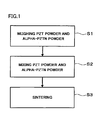
- PZT lead zirconate titanate
- the PZT powder and the alpha-PZTN powder are mixed to obtain a raw material powder (step S2).
- the particle diameters of the PZT powder and the alpha-PZTN powder are not particularly limited.
- the particle diameters may be 1 micrometer to 100 micrometers.
- the alpha-PZTN is used in an amount of 5 wt% to 25 wt% based on the raw material powder, for example. If the amount of the alpha-PZTN is within this range, a bulk PZT exhibiting excellent properties can be obtained without using an organic binder. Specifically, since the alpha-PZTN is in a state in which the atoms easily move (i.e. soft), the alpha-PZTN has a function of a binder for the PZT crystal powder. Since PZTN has a perovskite structure in the same manner as PZT, the alpha-PZTN is easily crystallized due to the crystallinity of PZT.
- the sintering temperature can be reduced in comparison with the case of using only PZTN.
- PZTN exhibits excellent piezoelectric properties, ferroelectric properties, and insulating properties
- PZTN can provide the bulk PZT with more excellent properties without adversely affecting the properties of the bulk PZT.
- an organic binder it is difficult to completely remove the organic binder, whereby the bulk PZT may be affected. According to the above method, since the alpha-PZTN functions as a binder, such a problem does not occur.
- the raw material powder is sintered.
- the raw material powder may be sintered using a known method.
- the raw material powder may be placed in a die and sintered using a vacuum hot pressing method.
- the raw material powder may be sintered at 800 to 1200°C. A bulk PZT may be thus obtained.
- a bulk PZT can be obtained without using an organic binder such as polyvinyl alcohol by using the raw material powder prepared by mixing the PZT powder and the alpha-PZTN powder.
- the bulk PZT exhibits excellent bulk crystal properties due to the absence of impurities such as an organic binder. Since the bulk PZT includes PZTN exhibiting excellent piezoelectric properties, ferroelectric properties, insulating properties, and the like, the bulk PZT exhibits excellent properties in comparison with PZT.
- the bulk PZT may be used in various applications.
- the bulk PZT may be suitably applied to a piezoelectric motor, a SAW device, a gyroscope, and the like.
- An alpha-PZTN powder raw material composition was obtained by mixing first to third raw material solutions respectively containing at least one of Pb, Zr, Ti, and Nb, dimethyl succinate as a polycarboxylic acid ester, and n-butanol as an organic solvent.
- the mixed liquid was prepared by dissolving the sol-gel raw material and dimethyl succinate in n-butanol at a ratio of 1:1.
- a solution was used in which a polycondensation product for forming a PbZrO 3 perovskite crystal containing Pb and Zr was dissolved in n-butanol in an anhydrous state.
- a solution was used in which a polycondensation product for forming a PbTiO 3 perovskite crystal containing Pb and Ti was dissolved in n-butanol in an anhydrous state.
- a solution was used in which a polycondensation product for forming a PbNbO 3 perovskite crystal containing Pb and Nb was dissolved in n-butanol in an anhydrous state.
- the first raw material solution, the second raw material solution, and the third raw material solution are mixed at a ratio of 33:47:20.
- a solution prepared by dissolving a polycondensate for forming a PbSiO 3 crystal in n-butanol in an anhydrous state was added to the above mixed liquid as a fourth raw material solution in an amount of 2 mol% to obtain a raw material composition.
- An oxidizing solution was prepared by mixing a 30% hydrogen peroxide aqueous solution, a 20% aqueous ammonia, and pure water. The pH of the oxidizing solution was adjusted to 13. The oxidizing solution was mixed with the raw material composition in an amount of 600 vol%. As a result, particles were precipitated in the mixed liquid. The particles were collected and dried to obtain powder. The average particle diameter of the powder was about 100 micrometers. The resulting powder was analyzed by XRD to confirm that the powder was alpha-PZTN.
- the alpha-PZTN powder was sintered at 600°C to obtain crystallized PZTN.
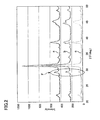
- the XRD results of the crystallized PZTN are indicated by the symbol "c" in FIG 2.
- the PZTN obtained in this example had excellent crystallinity with a small amount of pyrochlore (indicated by P).
- FIG. 2 shows the XRD results of these samples.
- the data indicated by the symbol “b” indicates the example in which the pH of the oxidizing solution is 11
- the data indicated by the symbol “a” indicates the example in which the pH of the oxidizing solution is 9.
- FIG 2 it was confirmed that the pyrochlore peak of the crystallized PZTN increases as the pH of the oxidizing solution decreases. This is estimated to be because diffusion of lead ions into the raw material composition is suppressed as the pH of the oxidizing solution becomes more alkaline, whereby production of pyrochlore due to lead is reduced.
- Three types of alpha-PZTN were obtained using three types of oxidizing solutions in the same manner as in Example 1 except for changing the pH of the oxidizing solution to about 10 by changing the amounts of hydrogen peroxide and ammonia in the oxidizing solution and changing the amount of the oxidizing solution added.
- a 30% hydrogen peroxide aqueous solution and a 29% aqueous ammonia were used.
- a first oxidizing solution was prepared by mixing the hydrogen peroxide solution and the ammonia solution at ratio of about 1:2.5, and the pH of the solution was adjusted to about 10 by adding pure water.
- a second oxidizing solution was prepared by mixing the hydrogen peroxide solution and the ammonia solution at ratio of about 2:1, and the pH of the solution was adjusted to about 10 by adding pure water.
- a third oxidizing solution was prepared by mixing the hydrogen peroxide solution and the ammonia solution at ratio of about 3:1, and the pH of the solution was adjusted to about 10 by adding pure water.
- the oxidizing solution was added to the raw material composition in an amount of about 230 vol% in the same manner as in Example 1. As a result, a powder was precipitated in the mixed liquid. The resulting powder was analyzed by XRD to confirm that the powder was alpha-PZTN.
- the alpha-PZTN powder was sintered at 600°C in the same manner as in Example 1 to obtain a crystallized PZTN sample. Each sample was analyzed by XRD to obtain the results shown in FIG 3.
- the data indicated by the symbol “a” indicates the case of using the first oxidizing solution
- the data indicated by the symbol “b” indicates the case of using the second oxidizing solution
- the data indicated by the symbol “c” indicates the case of using the third oxidizing solution.
- the peak indicated by the symbol P is the pyrochlore peak.
- the invention includes various other configurations substantially the same as the configurations described in the embodiments (in function, method and result, or in objective and result, for example).
- the invention also includes a configuration in which an unsubstantial portion in the described embodiments is replaced.
- the invention also includes a configuration having the same effects as the configurations described in the embodiments, or a configuration able to achieve the same objective.
- the invention includes a configuration in which a publicly known technique is added to the configurations in the embodiments.
Landscapes
- Chemical & Material Sciences (AREA)
- Engineering & Computer Science (AREA)
- Organic Chemistry (AREA)
- Ceramic Engineering (AREA)
- Inorganic Chemistry (AREA)
- Manufacturing & Machinery (AREA)
- Structural Engineering (AREA)
- Materials Engineering (AREA)
- Composite Materials (AREA)
- Dispersion Chemistry (AREA)
- Inorganic Compounds Of Heavy Metals (AREA)
- Compositions Of Oxide Ceramics (AREA)
- Oxygen, Ozone, And Oxides In General (AREA)
Applications Claiming Priority (2)
| Application Number | Priority Date | Filing Date | Title |
|---|---|---|---|
| JP2006177788 | 2006-06-28 | ||
| JP2007117642A JP2008031029A (ja) | 2006-06-28 | 2007-04-26 | 粉体状の複合金属酸化物の製造方法およびアモルファス複合金属酸化物 |
Publications (2)
| Publication Number | Publication Date |
|---|---|
| EP1876146A2 true EP1876146A2 (de) | 2008-01-09 |
| EP1876146A3 EP1876146A3 (de) | 2008-08-06 |
Family
ID=38704501
Family Applications (1)
| Application Number | Title | Priority Date | Filing Date |
|---|---|---|---|
| EP07012565A Withdrawn EP1876146A3 (de) | 2006-06-28 | 2007-06-27 | Verfahren zur Herstellung von Metallkomplex-Oxidpulver und amorphes Metallkomplexoxid |
Country Status (5)
| Country | Link |
|---|---|
| US (1) | US8012449B2 (de) |
| EP (1) | EP1876146A3 (de) |
| JP (1) | JP2008031029A (de) |
| KR (1) | KR100904934B1 (de) |
| TW (1) | TW200821263A (de) |
Families Citing this family (5)
| Publication number | Priority date | Publication date | Assignee | Title |
|---|---|---|---|---|
| JP5903578B2 (ja) * | 2010-01-21 | 2016-04-13 | 株式会社ユーテック | Pbnzt強誘電体膜及び強誘電体膜の製造方法 |
| RU2515447C2 (ru) * | 2011-05-05 | 2014-05-10 | Российская Федерация в лице Министерства образования и науки | Способ получения порошков фаз кислородно-октаэдрического типа, содержащих ионы свинца (ii) в позиции (а) |
| JP6259433B2 (ja) * | 2015-09-14 | 2018-01-10 | 太平洋セメント株式会社 | 二次電池用負極活物質の製造方法 |
| SG11202100439PA (en) * | 2018-07-17 | 2021-02-25 | Kokusai Electric Corp | Method of manufacturing semiconductor device, substrate processing apparatus and program |
| CN119873751B (zh) * | 2025-03-27 | 2025-08-15 | 中国科学技术大学 | 一种金属氧化物材料的合成方法 |
Family Cites Families (12)
| Publication number | Priority date | Publication date | Assignee | Title |
|---|---|---|---|---|
| US4061583A (en) * | 1974-03-13 | 1977-12-06 | Murata Manufacturing Co., Ltd. | Preparation of titanates |
| JPH0769645A (ja) | 1993-08-27 | 1995-03-14 | Murata Mfg Co Ltd | 鉛含有複合酸化物の製造方法 |
| JP3216772B2 (ja) | 1995-04-03 | 2001-10-09 | 科学技術振興事業団 | チタン酸ジルコン酸鉛粉末の製造方法 |
| DE19515820A1 (de) | 1995-04-29 | 1996-10-31 | Inst Neue Mat Gemein Gmbh | Verfahren zur Herstellung schwach agglomerierter nanoskaliger Teilchen |
| US5908802A (en) * | 1997-10-30 | 1999-06-01 | Sandia Corporation | Nonaqueous solution synthesis process for preparing oxide powders of lead zirconate titanate and related materials |
| US20050020699A1 (en) * | 2001-12-25 | 2005-01-27 | Yasuhide Isobe | Inorganic porous fine particles |
| JP3791614B2 (ja) * | 2002-10-24 | 2006-06-28 | セイコーエプソン株式会社 | 強誘電体膜、強誘電体メモリ装置、圧電素子、半導体素子、圧電アクチュエータ、液体噴射ヘッド及びプリンタ |
| JP2004311924A (ja) * | 2003-03-26 | 2004-11-04 | Seiko Epson Corp | 強誘電体キャパシタおよびその製造方法、強誘電体メモリ、圧電素子。 |
| JP4182223B2 (ja) | 2004-03-31 | 2008-11-19 | 独立行政法人産業技術総合研究所 | 発泡焼結体の製造方法 |
| JP4709544B2 (ja) | 2004-05-31 | 2011-06-22 | セイコーエプソン株式会社 | 前駆体組成物、前駆体組成物の製造方法、強誘電体膜の製造方法、圧電素子、半導体装置、圧電アクチュエータ、インクジェット式記録ヘッド、およびインクジェットプリンタ |
| JP4217906B2 (ja) * | 2004-09-17 | 2009-02-04 | セイコーエプソン株式会社 | 前駆体溶液の製造方法 |
| JP2007145672A (ja) | 2005-11-29 | 2007-06-14 | Seiko Epson Corp | 複合金属酸化物用原料組成物 |
-
2007
- 2007-04-26 JP JP2007117642A patent/JP2008031029A/ja not_active Withdrawn
- 2007-06-26 US US11/821,882 patent/US8012449B2/en not_active Expired - Fee Related
- 2007-06-27 EP EP07012565A patent/EP1876146A3/de not_active Withdrawn
- 2007-06-27 KR KR1020070063431A patent/KR100904934B1/ko not_active Expired - Fee Related
- 2007-06-28 TW TW096123406A patent/TW200821263A/zh unknown
Also Published As
| Publication number | Publication date |
|---|---|
| JP2008031029A (ja) | 2008-02-14 |
| KR100904934B1 (ko) | 2009-06-29 |
| KR20080001631A (ko) | 2008-01-03 |
| US8012449B2 (en) | 2011-09-06 |
| TW200821263A (en) | 2008-05-16 |
| US20080003161A1 (en) | 2008-01-03 |
| EP1876146A3 (de) | 2008-08-06 |
Similar Documents
| Publication | Publication Date | Title |
|---|---|---|
| TWI380970B (zh) | 使用二羧酸鎓鹽製備高級陶瓷粉末之方法 | |
| Garnweitner et al. | Nonaqueous synthesis of amorphous powder precursors for nanocrystalline PbTiO3, Pb (Zr, Ti) O3, and PbZrO3 | |
| KR100726319B1 (ko) | 전구체 용액, 전구체 용액의 제조 방법, pztn 복합 산화물, pztn 복합 산화물의 제조 방법, 압전 소자, 잉크제트 프린터, 강유전체 캐패시터, 강유전체 메모리 | |
| US8012449B2 (en) | Method of manufacturing complex metal oxide powder and amorphous complex metal oxide | |
| CN101714579B (zh) | 铁电体电容器、铁电体电容器的制造方法、铁电体存储器 | |
| JP6993058B2 (ja) | 直方体状の単結晶ニオブ酸ナトリウム粒子およびその製造方法 | |
| JP4329287B2 (ja) | Plzt又はpzt強誘電体薄膜、その形成用組成物及び形成方法 | |
| JPWO2015146607A1 (ja) | Mn及びNbドープのPZT系圧電体膜形成用組成物 | |
| US7569400B2 (en) | Ferroelectric film, method of manufacturing ferroelectric film, ferroelectric capacitor, and ferroelectric memory | |
| CN106104826B (zh) | 掺杂Mn的PZT系压电膜形成用组合物及掺杂Mn的PZT系压电膜 | |
| JP6237407B2 (ja) | Mn及びNbドープのPZT系圧電体膜の形成方法 | |
| JP2006501119A (ja) | 圧電セラミック組成物、前記組成物を含有する圧電セラミック体並びに前記組成物及び前記物体の製造方法 | |
| JP6950404B2 (ja) | 圧電体膜形成用液組成物の製造方法及びこの液組成物を用いて圧電体膜を形成する方法 | |
| JP4311134B2 (ja) | 金属酸化物超微粒子分散溶液、及び金属酸化物超微粒子薄膜 | |
| CN101096270A (zh) | 粉末状复合金属氧化物的制造方法及非晶体复合金属氧化物 | |
| JP2013253002A (ja) | Li含有圧電セラミックス粉末材料およびその製造方法 | |
| JP2006199578A (ja) | ペロブスカイト型チタン含有複合酸化物およびその製造方法並びにコンデンサ | |
| EP1790622A1 (de) | Ausgangsmaterialzusammensetzung für Metaloxidcomplex | |
| JP2008007397A (ja) | バルク状チタン酸ジルコン酸鉛の製造方法 | |
| JP2007527836A (ja) | 前駆体溶液、前駆体溶液を準備する方法、及び前駆体溶液の使用 | |
| JP2008013395A (ja) | 結晶配向セラミックスの製造方法 | |
| JP3041411B2 (ja) | 圧電セラミックス用原料粉体の製造方法 | |
| JP6237399B2 (ja) | CeドープのPZT系圧電体膜 | |
| JP2000281441A (ja) | 誘電体薄膜 | |
| 郭泉泳 et al. | Low Temperature Synthesis of (Pb, La)(Zr, Sn, Ti) O_3 Powders by Citrate Process |
Legal Events
| Date | Code | Title | Description |
|---|---|---|---|
| PUAI | Public reference made under article 153(3) epc to a published international application that has entered the european phase |
Free format text: ORIGINAL CODE: 0009012 |
|
| AK | Designated contracting states |
Kind code of ref document: A2 Designated state(s): AT BE BG CH CY CZ DE DK EE ES FI FR GB GR HU IE IS IT LI LT LU LV MC MT NL PL PT RO SE SI SK TR |
|
| AX | Request for extension of the european patent |
Extension state: AL BA HR MK YU |
|
| PUAL | Search report despatched |
Free format text: ORIGINAL CODE: 0009013 |
|
| AK | Designated contracting states |
Kind code of ref document: A3 Designated state(s): AT BE BG CH CY CZ DE DK EE ES FI FR GB GR HU IE IS IT LI LT LU LV MC MT NL PL PT RO SE SI SK TR |
|
| AX | Request for extension of the european patent |
Extension state: AL BA HR MK RS |
|
| 17P | Request for examination filed |
Effective date: 20090126 |
|
| AKX | Designation fees paid |
Designated state(s): DE FR GB NL |
|
| 17Q | First examination report despatched |
Effective date: 20130228 |
|
| STAA | Information on the status of an ep patent application or granted ep patent |
Free format text: STATUS: THE APPLICATION IS DEEMED TO BE WITHDRAWN |
|
| 18D | Application deemed to be withdrawn |
Effective date: 20130511 |