EP1877389B1 - Synthese von cyclenderivaten - Google Patents
Synthese von cyclenderivaten Download PDFInfo
- Publication number
- EP1877389B1 EP1877389B1 EP06733113A EP06733113A EP1877389B1 EP 1877389 B1 EP1877389 B1 EP 1877389B1 EP 06733113 A EP06733113 A EP 06733113A EP 06733113 A EP06733113 A EP 06733113A EP 1877389 B1 EP1877389 B1 EP 1877389B1
- Authority
- EP
- European Patent Office
- Prior art keywords
- salt
- formula
- tri
- product
- group
- Prior art date
- Legal status (The legal status is an assumption and is not a legal conclusion. Google has not performed a legal analysis and makes no representation as to the accuracy of the status listed.)
- Expired - Lifetime
Links
Classifications
-
- C—CHEMISTRY; METALLURGY
- C07—ORGANIC CHEMISTRY
- C07D—HETEROCYCLIC COMPOUNDS
- C07D257/00—Heterocyclic compounds containing rings having four nitrogen atoms as the only ring hetero atoms
- C07D257/02—Heterocyclic compounds containing rings having four nitrogen atoms as the only ring hetero atoms not condensed with other rings
Definitions
- the invention relates to a process for the preparation of salts of protected D03A, such as salts of DO3A-tri-t-butyl ester.
- Magnetic Resonance Imaging is a well-established and powerful technique for studying the internal structure of the human body.
- various lanthanide chelates of cyclen-based macrocyclic chelating agents have been proposed as contrast agents.
- Such macrocyclic chelating agents form particularly stable chelate complexes with the contrast-generating paramagnetic metal ions, such as gadolinium or dysprosium, and thus are suitable carriers for the metal ions to ensure appropriate biodistribution and elimination.
- Cyclen (1,4,7,10-tetraazacyclododecane) is a key compound in the preparation of many of these macrocyclic chelants.
- the group of tri-N-alkylated cyclens constitutes another important group of compounds for the preparation of such macrocyclic chelants.
- D03A (1,4,7,10-tetraazacyclododecane-N,N',N"-triacetic acid) is one such tri-N-alkylated cyclen compound that forms basis for Magnetic Resonance (MR) contrast agents.
- a group of related compounds is the protected forms of the D03A compound, such as DO3A-tri-t-butyl ester (1,4,7,10-tetraazacyclododecane-1,4,7-triacetic acid tri-t-butyl ester), wherein the three carboxyl groups are protected.
- DO3A-tri-t-butyl ester (1,4,7,10-tetraazacyclododecane-1,4,7-triacetic acid tri-t-butyl ester
- Protected D03A compounds such as D03A-tri-t-butyl ester, and the salts thereof, are valuable intermediates in the preparation of MR contrast agents based on D03A, such as e.g. Gd(HP-DO3A) (ProHance TM ), and Gd(DO3A-butrol) (Gadovist TM ).
- D03A-tri-t-butyl ester is a commercially available product, but in addition to being expensive the commercially available products contain impurities of both the di-alkylated and tetra-alkylated cyclen. Some methods for preparation of the compound are known from the prior art.
- US 5,419,893 is directed to chelating agents; such as cyclene based compounds, and the preparation thereof.
- a preparation of DO3A-tri-t-butyl ester from cyclen and t-butylbromo acetate is presented. The preparation includes purification by flash chromatography. The products are prepared as free bases.
- WO 2005/003105 presents a method of preparing tri-alkylated 1,4,7,10-tetraazacyclododecanes by reaction of cyclen and appropriate electrophiles.
- the reaction takes place in an aprotic solvent such as chloroform.
- the product is purified by column chromatography.
- the products are prepared as free bases.
- WO 93/02045 discloses an alternative process for the preparation of cyclen salts. In this process pH is not adjusted and no salt is added. The mixture is stirred for 19 days and the product precipitates during this period.
- D03A-tri-t-butyl ester is an important starting material for the preparation of macrocyclic chelating agents and MR contrast agents.
- Commercially available D03A-tri-t-butyl ester is expensive and comprises impurities.
- Existing synthetic routes require expensive and time consuming purification, such as chromatography, being a particular drawback when producing in large scale.
- a new process for preparation of DO3A-tri-tert-butyl ester, which is less expensive and which provides a product of improved purity is hence sought.
- the present invention provides an improved process for preparation of protected D03A, such as D03A-tri-t-butyl ester (1,4,7,10-tetraazacyclododecane-1,4,7-triacetic acid tri-t-butyl ester).
- the compounds are prepared as salts.
- the process includes a work-up procedure providing D03A-tri-t-butyl ester as a salt of improved purity.
- the invention provides a process for preparation of a protected DO3A salt of formula I, wherein R represents a carboxyl protective group, e.g. selected from the group of alkyls, such as C 1 -C 6 alkyls, aryls and substituted aryls. Methyl, propyl, benzyl and t-butyl are preferred R-groups. Most preferably R is t-butyl.
- X represents a chlorine, bromine or iodine anion or a sulphonate- or phosphate-containing group, and is preferably a bromine anion.
- y represents an integer of from 1 to 4 and is preferably 1.
- X comprises a phosphate group
- the salt formed is based on a phosphoric acid (H 3 PO 4 ), phosphonic acid (R'PO 3 H 2 ) or a phosphinic acid (R' R" PO 2 H), wherein R' and R" are lower alkyl groups, such as a C1-C6 alkyl.
- R' and R" are lower alkyl groups, such as a C1-C6 alkyl.
- this group may further include a lower alkyl group, such as C 1 -C 6 alkyl, e.g. forming the methyl-SO 3 H salt.
- the invention provides a process for preparation of D03A-tri-t-butyl ester, of formula II, as a salt.
- the invention provides a process for preparation of a mono salt of the compounds of formula I, such as the HBr salt of D03A-tri-t-butyl ester (4,7-bis-tert-butoxycarbonylmethyl-1,4,7,10-tetraaza-cyclododec-1-yl)-acetic acid tert-butyl ester hydrobromide).
- a mono salt of the compounds of formula I such as the HBr salt of D03A-tri-t-butyl ester (4,7-bis-tert-butoxycarbonylmethyl-1,4,7,10-tetraaza-cyclododec-1-yl)-acetic acid tert-butyl ester hydrobromide).
- the process for the preparation of compounds of formula (I) according to the invention provides a new work-up procedure involving an optimised precipitation providing material of high purity and in high yields.
- the new work-up procedure selectively provides high yields of the tri-N-alkylated product as a salt. It has been found that it is much simpler to prepare protected DO3A of formula I, such as D03A-tri-t-butyl ester, of high purity when preparing this as a salt, compared to preparations of the free base. Obtaining the tri-N-alkylated product in pure form is found to be greatly increased when precipitating the product in its salt form.
- a great advantage of the process of the invention is that the salt of tri-alkylated product can be separated from by-products by precipitation and that no, or minimal, further purification of the precipitated salt end product is needed.
- the simple process is especially beneficial when producing the product in large quantities.
- step (2) and (3) may be changed, such that the addition of the salt (3) is carried out prior to adjusting the pH (2).
- the steps are preferably carried out in the order as given. All steps are further outlined below.
- a crystalline material starts precipitating.
- the process further comprises optional steps accelerating and completing the precipitation in addition to collecting and drying the precipitate, to obtain a salt of protected D03A of formula (I) of high purity and in a high yield.
- the selective precipitation of the tri-alkylated product of formula (I) is a result of the combination of optimising the alkylation in step (1) and adjusting the pH in step (2).
- Step (1) comprises reacting 1,4,7,10-tetraazacyclododecane (cyclen) of formula (III) with an activated acetic acid ester of formula (IV), acting as an alkylation agent, (IV)wherein X' is a readily displaceable group selected from the group of chlorine, bromine, iodine, sulphonates, and phosphates. Preferably X' is bromine.
- R is a carboxyl protective group selected from the group of alkyls, such as C 1 -C 6 alkyls, aryls and substituted aryls. Methyl, propyl, benzyl and t-butyl are preferred R-groups. More preferably R is t-butyl.
- the alkylation agent of formula IV is tert-butylbromo acetate of formula (V) .
- step (1) is carried out in the presence of a solvent.
- a solvent e.g. comprising amide, nitrile, ketone or alcohol groups.
- the solvent is N,N-dimethylacetamide.
- a suspension of cyclen and an auxiliary weak base, in a water-miscible, polar solvent is prepared.
- the solvent for cyclen is preferably the same solvent as used for the alkylation agent, i.e. preferably N,N-dimethylacetamide.
- the weak base is e.g triethylamine or sodium acetate. The role of the base is to remove cyclen protons.
- the solution of the alkylation agent is added to the suspension of cyclen, preferably drop wise under stirring.
- the amounts of the components are selected in amounts sufficient to trialkylate the cyclen.
- the ratio between the reaction components in step (1) is preferably about 3 molar equivalents of the alkylation agent, 3 molar equivalents weak base to one molar equivalent cyclen.
- reaction vessel comprising the reaction mixture of step (1) is sealed and the suspension is preferably left until the reaction is completed, usually for several days, such as 1-8 days, e.g. 3-5 days. 3 days have been found to be sufficient for preparation of a salt of D03A-tri-t-butyl ester.
- the reaction suspension is kept under stirring for this period.
- the reaction of step (1) can be carried out within a broad temperature range, e.g. at a temperature between 0-30°C.
- the temperature is preferably held between 0-10 °C, e.g. between 0-5 °C.
- the temperature of the reaction suspension is preferably raised to about ambient temperature, e.g. to a temperature between 18-30 °C, more preferably to a temperature between 20-25 °C, and is kept at this temperature level during the completion of the reaction. If the temperature is increased significantly above this level, over-alkylation becomes more frequent and impurities such as tetra-alkylated products are more likely to be produced.
- the amounts of tetra-alkylated product generated in step (1) is kept at a minimum level. Especially in a large scale procedure it is advised to lower the temperature when performing the initial addition of the alkylation agent to avoid impurities of the tetra-alkylated product.
- the main product from the alkylation step (1) is the tri-alkylated cyclen of formula (I) in its non-salt form.
- the main by-product is the di-alkylated product. This by-product is however more soluble in the mixture of step (1) than the tri-alkylated product, and will not precipitate when adjusting pH and adding a salt in the next steps.
- step (1) which is a suspension or slurry
- solvents and auxiliaries may be prepared under other conditions using different solvents and auxiliaries than outlined above, depending on which product of formula (I), of the non-salt form, is prepared.
- Alternative solvents may e.g. be chosen based on which carboxyl protective groups are used.
- the reaction mixture of step (1) is optionally poured into water.
- the addition of water is preferred as this provides a homogenous clear solution.
- the amount of water is e.g. 1-10 times the volume of the reaction suspension, or more preferably 3-8 times the volume of the reaction suspension.
- the amount of water may beneficially be kept in the lower part of the suggested range when producing large quantities, as the main object is to obtain a homogenous solution.
- the temperature of the water is about ambient temperature, e.g. 18-30°C, or between 20-25 °C.
- step (2) pH is adjusted to 9.0 ⁇ 0.5, preferably to 8.7-9.3, more preferably to 8.9-9.1 and most preferably to about 9.0, by addition of a base.
- the pKa values of the nitrogen molecules of mono-, di-, tri- and tetra-alkylated products are different. It has been found that optimisation of the pH to the provided range ensures separation of the tri-alkylated product from any lower or higher alkylated by-products present in the reaction mixture of step (1), as mono-, di-, tri- and tetra-alkylated products precipitate to different extents at a given pH.
- the base used is preferably added in its solid form and is selected from the group of sodium carbonate, sodium bicarbonate, potassium carbonate, potassium bicarbonate, alkali hydroxides or sodium phosphate. More preferred is addition of NaHCO 3 in solid form.
- a salt comprising an anion X is added to the mixture, such as to the solution of step (2), wherein X is selected from the group of chlorine, bromine and iodine anions, or a sulphonate- or phosphate-containing group, and is preferably a bromine anion.
- the sulphonate and phosphate groups may comprise a lower alkyl group, such as a C 1 -C 6 alkyl chain.
- X is preferably the same moiety as X' in the activated acetic acid ester of formulas IV.
- the added salt is e.g. a potassium salt (i.e. KX), as potassium salts generally have a good stability.
- KX potassium salt
- Most KBr is added in step (3) and tert-butylbromo acetate is preferably used in step (1).
- step (3) comprises adding a salt to the mixture from step (1), prior to adjusting the pH (step (2)).
- the reaction mixture of step (1) is preferably poured into water comprising the salt.
- the water has a temperature which enables dissolution of the salt or which allows for Ostwald ripening.
- the temperature of the water is e.g. 26-100 °C, more preferably 40-100 °C, and most preferably 45-55 °C.
- a clear solution is preferably obtained.
- step (4) comprising collecting the product will speed up, in that the filtration process is simplified due to preparation of larger particles.
- the amount of salt added in step (3) is e.g. 0.3-4 times the molar amount of the alkylation agent in step (1), and is preferably 0.6-3 times the molar amount of the alkylation agent.
- step (4) preferably comprises an optional additional step adding a non-polar solvent, such as an ether, to the salt solution of step (3).
- a non-polar solvent such as an ether
- the ether compound is preferably added when the salt added in step (3) is fully dissolved.
- the ether is e.g. selected from standard ethers such as lower alkyl ethers, dimethoxy ethane, diglyme, triglyme, THF, t-BuOMe, isopropyl ether and diethyl ether. More preferred is addition of diethyl ether. An amount of from about 10 % to 20 % by volume of the total solvent volume is appropriate. Addition of ether is found to improve both the yield on large scale synthesis and also increases the speed of precipitation of the polar salt.
- Step (4) comprises the step of collecting the precipitated salt, e.g. by filtration or centrifugation, e.g. after 0.5-4 hours, for example after about 2 hours. Subsequently, the solvents used are removed from the collected product, preferably by evaporation, e.g. by evaporation at elevated temperature and/or reduced pressure (e.g. vacuum) to obtain the product in dry form.
- the solvents used are removed from the collected product, preferably by evaporation, e.g. by evaporation at elevated temperature and/or reduced pressure (e.g. vacuum) to obtain the product in dry form.
- DO3A-tri-t-butyl ester contains some impurities of the tetra-alkylated cyclen (1,4,7,10-tetraaza-cyclododecane-tetraacetic acid tetra-t-butyl) and some di-alkylated cyclen (1,4,7,10-tetraazacyclododecane-diacetic acid di-t-butyl).
- the work-up procedure of the invention provides a salt of D03A-tri-t-butyl ester of high purity.
- the work-up procedure as disclosed ensures that the desired tri-substituted product is separated from the reaction mixture, which may also include mono-, di- and tetra-substituted derivatives.
- the obtained product is, from standard levels of detection, free from the dialkylated product found in unwanted quantities in commercially available D03A-tri-t-butyl ester. Any impurities of the tetra-alkylated product from step (1) do not precipitate as a salt.
- the purity of the product obtained may be controlled by various analytical methods like for instance NMR to confirm the structure and determine purity of the product, HPLC to determine purity and GC to determine residual solvents.
- the product prepared by the disclosed process such as D03A-tri-t-butyl ester HBr salt, has a purity of at least 95 %, more preferably at least 99 % and most preferably at least 99.9 %.
- the process of preparation according to the invention provides protected DO3A salt of formula (I) in good yield, preferably in a yield above 60 % and more preferably above 70 %, and most preferably above 80 %, based on the molar amount of cyclen. Yields as high as 81.5 % of D03A-tri-t-butyl ester as the HBr salt have been achieved. A typical result is a yield of 73 %.
- the protected DO3A, or the salt thereof, can be used in the preparation of DO3A by deprotecting the acetic acid groups.
- the protecting groups may be removed by standard techniques, for example hydrolysis, hydrogenolysis, etc. such as e.g. treating with trifluoroacetic acid or formic acid to give the free acids.
- D03A, and derivatives can be complexed with a paramagnetic metal atom and used as relaxation enhancement agents for magnetic resonance imaging.
- MR contrast agents such as the commercially available product ProHance TM , can be prepared from a salt of D03A-tri-t-butyl ester, e.g.
- the alkylation includes e.g. attaching a hydroxypropyl group at the reactive secondary amine. This may be followed by deprotection and finally complexation with Gd 3+ or another paramagnetic metal ion.
- Example 2 Alternative preparation of the HBr salt of DO3A-tri-t-butyl ester
- reaction slurry was poured out in warm water (50°C, 2000 ml) contaning dissolved KBr (30.0g, 252mmol), to give a clear yellow solution.
Landscapes
- Chemical & Material Sciences (AREA)
- Organic Chemistry (AREA)
- Pharmaceuticals Containing Other Organic And Inorganic Compounds (AREA)
- Organic Low-Molecular-Weight Compounds And Preparation Thereof (AREA)
- Low-Molecular Organic Synthesis Reactions Using Catalysts (AREA)
Claims (12)
- Verfahren zur Herstellung von Verbindungen der Formel (I)
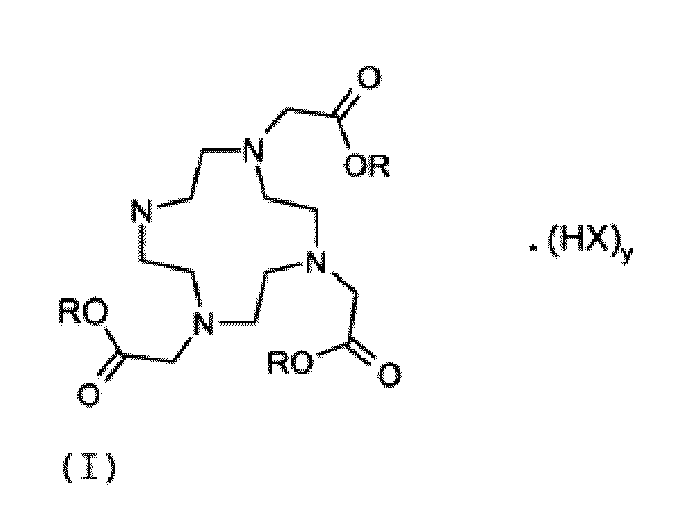
X ein Chlor-, Brom- oder lodanion oder eine Sulfonat- oder Phosphat-haltige Gruppe bedeutet; und
y eine ganze Zahl von 1 bis 4 bedeutet; umfassend die Schritte:(1) Umsetzen von Cyclen und einem aktivierten Essigsäureester der Formel (IV)
um ein Gemisch herzustellen;(2) Regulieren des pH-Werts des Gemischs auf 9,0 ± 0,5;(3) Zugeben eines Salzes, umfassend ein Anion X, gewählt aus der Gruppe von Chlor, Brom, Iod und einer Sulfonat- oder Phosphathaltigen Gruppe, zum Gemisch;(4) Sammeln des präzipitierten Produkts,wobei Schritt (3) vor, oder nach, Schritt (2) ausgeführt wird. - Verfahren nach Anspruch 1, wobei Schritt (2) vor Schritt (3) ausgeführt wird.
- Verfahren nach Anspruch 1, wobei Schritt (3) vor Schritt (2) ausgeführt wird.
- Verfahren nach einem der Ansprüche 1 bis 3 zur Herstellung einer Verbindung der Formel (I), wobei R t-Butyl bedeutet, X Brom bedeutet und y für 1 steht.
- Verfahren nach einem der Ansprüche 1 bis 4, wobei Schritt (1) bei Vorhandensein eines wassermischbaren polaren Lösungsmittels ausgeführt wird.
- Verfahren nach Anspruch 5, wobei das Lösungsmittel N,N-Dimethylacetamid ist.
- Verfahren nach einem der Ansprüche 1 bis 6, wobei Schritt (2) das Regulieren des pH-Werts durch Zugabe von Natriumcarbonat, Natriumbicarbonat, Kaliumcarbonat, Kaliumbicarbonat, Alkalihydroxiden oder Natriumphosphat umfasst.
- Verfahren nach einem der Ansprüche 1 bis 7, wobei das in Schritt (3) zugegebene Salz KBr ist.
- Verfahren nach einem der Ansprüche 1 bis 8, wobei Schritt (4) das Zugeben eines nicht polaren Lösungsmittels zum Gemisch aus Schritt (3) umfasst.
- Verfahren nach einem der Ansprüche 1 bis 9, wobei Schritt (4) das Sammeln des Produkts durch Filtration oder Zentrifugierung, gefolgt vom Trocknen des Produkts, umfasst.
- Verfahren nach einem der Ansprüche 1 bis 10, wobei die erhaltene Ausbeute der Verbindung der Formel (I) über 60% basierend auf der molaren Menge des Cyclenausgangsmaterials liegt.
- Verfahren nach einem der Ansprüche 1 bis 10, das eine Verbindung der Formel (I) mit einer Reinheit von mindestens 95% liefert.
Applications Claiming Priority (2)
| Application Number | Priority Date | Filing Date | Title |
|---|---|---|---|
| NO20051911A NO20051911D0 (no) | 2005-04-19 | 2005-04-19 | Synthesis |
| PCT/NO2006/000141 WO2006112723A1 (en) | 2005-04-19 | 2006-04-18 | Synthesis of cyclen derivatives |
Publications (2)
| Publication Number | Publication Date |
|---|---|
| EP1877389A1 EP1877389A1 (de) | 2008-01-16 |
| EP1877389B1 true EP1877389B1 (de) | 2012-02-15 |
Family
ID=35267069
Family Applications (1)
| Application Number | Title | Priority Date | Filing Date |
|---|---|---|---|
| EP06733113A Expired - Lifetime EP1877389B1 (de) | 2005-04-19 | 2006-04-18 | Synthese von cyclenderivaten |
Country Status (14)
| Country | Link |
|---|---|
| US (1) | US8138332B2 (de) |
| EP (1) | EP1877389B1 (de) |
| JP (1) | JP2008538371A (de) |
| KR (1) | KR20080003816A (de) |
| CN (1) | CN101160292B (de) |
| AT (1) | ATE545636T1 (de) |
| AU (1) | AU2006237745B2 (de) |
| BR (1) | BRPI0610730A2 (de) |
| CA (1) | CA2604219A1 (de) |
| ES (1) | ES2379004T3 (de) |
| MX (1) | MX2007013113A (de) |
| NO (2) | NO20051911D0 (de) |
| RU (1) | RU2405776C2 (de) |
| WO (1) | WO2006112723A1 (de) |
Families Citing this family (7)
| Publication number | Priority date | Publication date | Assignee | Title |
|---|---|---|---|---|
| JP2009266944A (ja) | 2008-04-23 | 2009-11-12 | Toshiba Corp | 三次元積層不揮発性半導体メモリ |
| KR101253100B1 (ko) * | 2010-02-16 | 2013-04-10 | 경북대학교 산학협력단 | 폴리아자마크로사이클릭 화합물, 그 제조 방법 및 생의학적 적용 |
| US10994016B2 (en) | 2015-09-15 | 2021-05-04 | Northwestern University | Graphene oxide mediated cellular delivery of gadolinium-labeled molecules |
| BR112018011541B1 (pt) * | 2015-12-10 | 2022-02-15 | Bracco Imaging Spa | Compostos de agentes de contraste, complexo quelado e composição farmacêutica compreendendo o referido complexo quelado |
| GB201522412D0 (en) | 2015-12-18 | 2016-02-03 | Ge Healthcare As | Dota synthesis |
| CN110835326B (zh) * | 2018-08-15 | 2023-04-14 | 正大天晴药业集团股份有限公司 | 大环螯合剂及其中间体的制备方法 |
| US12297180B2 (en) * | 2019-12-13 | 2025-05-13 | Bracco Imaging S.P.A. | Manufacturing of protected DO3A |
Family Cites Families (4)
| Publication number | Priority date | Publication date | Assignee | Title |
|---|---|---|---|---|
| GB9320277D0 (en) * | 1993-10-01 | 1993-11-17 | Nycomed Salutar Inc | Chelants |
| GB9115375D0 (en) * | 1991-07-17 | 1991-09-04 | Salutar Inc | Compounds |
| DE60136476D1 (de) * | 2000-09-29 | 2008-12-18 | Anormed Inc | -stickstoffhaltigen zyklischen polyaminen und deren verbindungen |
| WO2005003105A1 (en) * | 2003-07-08 | 2005-01-13 | The University Of Hong Kong | Synthesis of tris n-alkylated 1,4,7,10-tetraazacyclododecanes |
-
2005
- 2005-04-19 NO NO20051911A patent/NO20051911D0/no unknown
-
2006
- 2006-04-18 AU AU2006237745A patent/AU2006237745B2/en not_active Ceased
- 2006-04-18 ES ES06733113T patent/ES2379004T3/es not_active Expired - Lifetime
- 2006-04-18 CA CA002604219A patent/CA2604219A1/en not_active Abandoned
- 2006-04-18 EP EP06733113A patent/EP1877389B1/de not_active Expired - Lifetime
- 2006-04-18 US US11/911,848 patent/US8138332B2/en not_active Expired - Fee Related
- 2006-04-18 BR BRPI0610730-3A patent/BRPI0610730A2/pt not_active IP Right Cessation
- 2006-04-18 RU RU2007137806/04A patent/RU2405776C2/ru not_active IP Right Cessation
- 2006-04-18 WO PCT/NO2006/000141 patent/WO2006112723A1/en not_active Ceased
- 2006-04-18 JP JP2008507582A patent/JP2008538371A/ja not_active Ceased
- 2006-04-18 AT AT06733113T patent/ATE545636T1/de active
- 2006-04-18 KR KR1020077023901A patent/KR20080003816A/ko not_active Abandoned
- 2006-04-18 CN CN2006800127928A patent/CN101160292B/zh not_active Expired - Fee Related
- 2006-04-18 MX MX2007013113A patent/MX2007013113A/es active IP Right Grant
-
2007
- 2007-11-13 NO NO20075829A patent/NO20075829L/no not_active Application Discontinuation
Also Published As
| Publication number | Publication date |
|---|---|
| ATE545636T1 (de) | 2012-03-15 |
| NO20051911D0 (no) | 2005-04-19 |
| WO2006112723A1 (en) | 2006-10-26 |
| JP2008538371A (ja) | 2008-10-23 |
| KR20080003816A (ko) | 2008-01-08 |
| CN101160292A (zh) | 2008-04-09 |
| US20090216011A1 (en) | 2009-08-27 |
| NO20075829L (no) | 2007-11-13 |
| AU2006237745A1 (en) | 2006-10-26 |
| US8138332B2 (en) | 2012-03-20 |
| AU2006237745B2 (en) | 2012-02-23 |
| MX2007013113A (es) | 2008-01-11 |
| BRPI0610730A2 (pt) | 2012-10-30 |
| EP1877389A1 (de) | 2008-01-16 |
| RU2007137806A (ru) | 2009-05-27 |
| ES2379004T3 (es) | 2012-04-19 |
| CN101160292B (zh) | 2010-11-03 |
| RU2405776C2 (ru) | 2010-12-10 |
| CA2604219A1 (en) | 2006-10-26 |
Similar Documents
| Publication | Publication Date | Title |
|---|---|---|
| JP5204724B2 (ja) | 1,4,7,10−テトラアザシクロドデカン−1,4,7−三酢酸及びその誘導体の調製のための方法 | |
| US5386028A (en) | Process for the production of N-β-hydroxyalkyl-tri-N-carboxyalkyl-1,4,7,10-tetraazacyclododecane and N-β-hydroxyalkyl-tri-N-carboxyalkyl-1,4,8,11-tetraazacyclotetradecane derivatives and their metal complexes | |
| JP2002510296A (ja) | 大環状キレート化剤の製造方法およびその常磁性金属イオンとのキレート化合物 | |
| KR102265637B1 (ko) | 1,4,7,10-테트라아자시클로도데칸-1,4,7,10-테트라아세트산의 제조 방법 | |
| EP1877389B1 (de) | Synthese von cyclenderivaten | |
| CA2431976C (en) | Lithium complexes of n-(1-hydroxymethyl-2,3-dihydroxypropyl)-1,4,7-triscarboxymethyl-1,4,7,10-tetraazacyclododecane, their production and use | |
| JP7588645B2 (ja) | 保護されたdo3aの製造 | |
| CZ285411B6 (cs) | Způsob výroby kovových komplexů N-beta-hydroxyalkyltri-N-karboxyalkyl-1,4,7,10-tetraazacyklododekanových a N-beta-hydroxyalkyltri-N-karboxyalkyl-1, 4,8,11-tetraazacyklotetradekanových derivátů | |
| RU2828009C1 (ru) | Получение защищенного do3a |
Legal Events
| Date | Code | Title | Description |
|---|---|---|---|
| PUAI | Public reference made under article 153(3) epc to a published international application that has entered the european phase |
Free format text: ORIGINAL CODE: 0009012 |
|
| 17P | Request for examination filed |
Effective date: 20071101 |
|
| AK | Designated contracting states |
Kind code of ref document: A1 Designated state(s): AT BE BG CH CY CZ DE DK EE ES FI FR GB GR HU IE IS IT LI LT LU LV MC NL PL PT RO SE SI SK TR |
|
| DAX | Request for extension of the european patent (deleted) | ||
| RIN1 | Information on inventor provided before grant (corrected) |
Inventor name: AXELSSON, OSKAR,SPAGO IMAGING AB Inventor name: OLSSON, ANDREASGE HEALTHCARE AS |
|
| 17Q | First examination report despatched |
Effective date: 20100217 |
|
| GRAP | Despatch of communication of intention to grant a patent |
Free format text: ORIGINAL CODE: EPIDOSNIGR1 |
|
| GRAS | Grant fee paid |
Free format text: ORIGINAL CODE: EPIDOSNIGR3 |
|
| GRAA | (expected) grant |
Free format text: ORIGINAL CODE: 0009210 |
|
| AK | Designated contracting states |
Kind code of ref document: B1 Designated state(s): AT BE BG CH CY CZ DE DK EE ES FI FR GB GR HU IE IS IT LI LT LU LV MC NL PL PT RO SE SI SK TR |
|
| REG | Reference to a national code |
Ref country code: GB Ref legal event code: FG4D Ref country code: CH Ref legal event code: EP |
|
| REG | Reference to a national code |
Ref country code: IE Ref legal event code: FG4D |
|
| REG | Reference to a national code |
Ref country code: AT Ref legal event code: REF Ref document number: 545636 Country of ref document: AT Kind code of ref document: T Effective date: 20120315 |
|
| REG | Reference to a national code |
Ref country code: DE Ref legal event code: R096 Ref document number: 602006027633 Country of ref document: DE Effective date: 20120412 |
|
| REG | Reference to a national code |
Ref country code: ES Ref legal event code: FG2A Ref document number: 2379004 Country of ref document: ES Kind code of ref document: T3 Effective date: 20120419 |
|
| REG | Reference to a national code |
Ref country code: NL Ref legal event code: VDEP Effective date: 20120215 |
|
| LTIE | Lt: invalidation of european patent or patent extension |
Effective date: 20120215 |
|
| PG25 | Lapsed in a contracting state [announced via postgrant information from national office to epo] |
Ref country code: IS Free format text: LAPSE BECAUSE OF FAILURE TO SUBMIT A TRANSLATION OF THE DESCRIPTION OR TO PAY THE FEE WITHIN THE PRESCRIBED TIME-LIMIT Effective date: 20120615 Ref country code: LT Free format text: LAPSE BECAUSE OF FAILURE TO SUBMIT A TRANSLATION OF THE DESCRIPTION OR TO PAY THE FEE WITHIN THE PRESCRIBED TIME-LIMIT Effective date: 20120215 Ref country code: NL Free format text: LAPSE BECAUSE OF FAILURE TO SUBMIT A TRANSLATION OF THE DESCRIPTION OR TO PAY THE FEE WITHIN THE PRESCRIBED TIME-LIMIT Effective date: 20120215 |
|
| PG25 | Lapsed in a contracting state [announced via postgrant information from national office to epo] |
Ref country code: FI Free format text: LAPSE BECAUSE OF FAILURE TO SUBMIT A TRANSLATION OF THE DESCRIPTION OR TO PAY THE FEE WITHIN THE PRESCRIBED TIME-LIMIT Effective date: 20120215 Ref country code: PL Free format text: LAPSE BECAUSE OF FAILURE TO SUBMIT A TRANSLATION OF THE DESCRIPTION OR TO PAY THE FEE WITHIN THE PRESCRIBED TIME-LIMIT Effective date: 20120215 Ref country code: LV Free format text: LAPSE BECAUSE OF FAILURE TO SUBMIT A TRANSLATION OF THE DESCRIPTION OR TO PAY THE FEE WITHIN THE PRESCRIBED TIME-LIMIT Effective date: 20120215 Ref country code: PT Free format text: LAPSE BECAUSE OF FAILURE TO SUBMIT A TRANSLATION OF THE DESCRIPTION OR TO PAY THE FEE WITHIN THE PRESCRIBED TIME-LIMIT Effective date: 20120615 Ref country code: GR Free format text: LAPSE BECAUSE OF FAILURE TO SUBMIT A TRANSLATION OF THE DESCRIPTION OR TO PAY THE FEE WITHIN THE PRESCRIBED TIME-LIMIT Effective date: 20120516 Ref country code: BE Free format text: LAPSE BECAUSE OF FAILURE TO SUBMIT A TRANSLATION OF THE DESCRIPTION OR TO PAY THE FEE WITHIN THE PRESCRIBED TIME-LIMIT Effective date: 20120215 |
|
| REG | Reference to a national code |
Ref country code: AT Ref legal event code: MK05 Ref document number: 545636 Country of ref document: AT Kind code of ref document: T Effective date: 20120215 |
|
| PG25 | Lapsed in a contracting state [announced via postgrant information from national office to epo] |
Ref country code: CY Free format text: LAPSE BECAUSE OF FAILURE TO SUBMIT A TRANSLATION OF THE DESCRIPTION OR TO PAY THE FEE WITHIN THE PRESCRIBED TIME-LIMIT Effective date: 20120215 |
|
| PG25 | Lapsed in a contracting state [announced via postgrant information from national office to epo] |
Ref country code: CZ Free format text: LAPSE BECAUSE OF FAILURE TO SUBMIT A TRANSLATION OF THE DESCRIPTION OR TO PAY THE FEE WITHIN THE PRESCRIBED TIME-LIMIT Effective date: 20120215 Ref country code: DK Free format text: LAPSE BECAUSE OF FAILURE TO SUBMIT A TRANSLATION OF THE DESCRIPTION OR TO PAY THE FEE WITHIN THE PRESCRIBED TIME-LIMIT Effective date: 20120215 Ref country code: SE Free format text: LAPSE BECAUSE OF FAILURE TO SUBMIT A TRANSLATION OF THE DESCRIPTION OR TO PAY THE FEE WITHIN THE PRESCRIBED TIME-LIMIT Effective date: 20120215 Ref country code: EE Free format text: LAPSE BECAUSE OF FAILURE TO SUBMIT A TRANSLATION OF THE DESCRIPTION OR TO PAY THE FEE WITHIN THE PRESCRIBED TIME-LIMIT Effective date: 20120215 Ref country code: SI Free format text: LAPSE BECAUSE OF FAILURE TO SUBMIT A TRANSLATION OF THE DESCRIPTION OR TO PAY THE FEE WITHIN THE PRESCRIBED TIME-LIMIT Effective date: 20120215 Ref country code: RO Free format text: LAPSE BECAUSE OF FAILURE TO SUBMIT A TRANSLATION OF THE DESCRIPTION OR TO PAY THE FEE WITHIN THE PRESCRIBED TIME-LIMIT Effective date: 20120215 |
|
| PG25 | Lapsed in a contracting state [announced via postgrant information from national office to epo] |
Ref country code: SK Free format text: LAPSE BECAUSE OF FAILURE TO SUBMIT A TRANSLATION OF THE DESCRIPTION OR TO PAY THE FEE WITHIN THE PRESCRIBED TIME-LIMIT Effective date: 20120215 Ref country code: MC Free format text: LAPSE BECAUSE OF NON-PAYMENT OF DUE FEES Effective date: 20120430 |
|
| REG | Reference to a national code |
Ref country code: CH Ref legal event code: PL |
|
| PLBE | No opposition filed within time limit |
Free format text: ORIGINAL CODE: 0009261 |
|
| STAA | Information on the status of an ep patent application or granted ep patent |
Free format text: STATUS: NO OPPOSITION FILED WITHIN TIME LIMIT |
|
| PGFP | Annual fee paid to national office [announced via postgrant information from national office to epo] |
Ref country code: ES Payment date: 20120426 Year of fee payment: 7 |
|
| REG | Reference to a national code |
Ref country code: IE Ref legal event code: MM4A |
|
| 26N | No opposition filed |
Effective date: 20121116 |
|
| PG25 | Lapsed in a contracting state [announced via postgrant information from national office to epo] |
Ref country code: LI Free format text: LAPSE BECAUSE OF NON-PAYMENT OF DUE FEES Effective date: 20120430 Ref country code: CH Free format text: LAPSE BECAUSE OF NON-PAYMENT OF DUE FEES Effective date: 20120430 Ref country code: AT Free format text: LAPSE BECAUSE OF FAILURE TO SUBMIT A TRANSLATION OF THE DESCRIPTION OR TO PAY THE FEE WITHIN THE PRESCRIBED TIME-LIMIT Effective date: 20120215 Ref country code: IE Free format text: LAPSE BECAUSE OF NON-PAYMENT OF DUE FEES Effective date: 20120418 |
|
| REG | Reference to a national code |
Ref country code: DE Ref legal event code: R097 Ref document number: 602006027633 Country of ref document: DE Effective date: 20121116 |
|
| PG25 | Lapsed in a contracting state [announced via postgrant information from national office to epo] |
Ref country code: BG Free format text: LAPSE BECAUSE OF FAILURE TO SUBMIT A TRANSLATION OF THE DESCRIPTION OR TO PAY THE FEE WITHIN THE PRESCRIBED TIME-LIMIT Effective date: 20120515 |
|
| PGFP | Annual fee paid to national office [announced via postgrant information from national office to epo] |
Ref country code: DE Payment date: 20130429 Year of fee payment: 8 Ref country code: GB Payment date: 20130429 Year of fee payment: 8 |
|
| PGFP | Annual fee paid to national office [announced via postgrant information from national office to epo] |
Ref country code: IT Payment date: 20130422 Year of fee payment: 8 Ref country code: FR Payment date: 20130506 Year of fee payment: 8 |
|
| PG25 | Lapsed in a contracting state [announced via postgrant information from national office to epo] |
Ref country code: TR Free format text: LAPSE BECAUSE OF FAILURE TO SUBMIT A TRANSLATION OF THE DESCRIPTION OR TO PAY THE FEE WITHIN THE PRESCRIBED TIME-LIMIT Effective date: 20120215 |
|
| PG25 | Lapsed in a contracting state [announced via postgrant information from national office to epo] |
Ref country code: LU Free format text: LAPSE BECAUSE OF NON-PAYMENT OF DUE FEES Effective date: 20120418 |
|
| PG25 | Lapsed in a contracting state [announced via postgrant information from national office to epo] |
Ref country code: HU Free format text: LAPSE BECAUSE OF FAILURE TO SUBMIT A TRANSLATION OF THE DESCRIPTION OR TO PAY THE FEE WITHIN THE PRESCRIBED TIME-LIMIT Effective date: 20060418 |
|
| REG | Reference to a national code |
Ref country code: DE Ref legal event code: R119 Ref document number: 602006027633 Country of ref document: DE |
|
| GBPC | Gb: european patent ceased through non-payment of renewal fee |
Effective date: 20140418 |
|
| REG | Reference to a national code |
Ref country code: FR Ref legal event code: ST Effective date: 20141231 |
|
| REG | Reference to a national code |
Ref country code: DE Ref legal event code: R119 Ref document number: 602006027633 Country of ref document: DE Effective date: 20141101 |
|
| PG25 | Lapsed in a contracting state [announced via postgrant information from national office to epo] |
Ref country code: GB Free format text: LAPSE BECAUSE OF NON-PAYMENT OF DUE FEES Effective date: 20140418 Ref country code: DE Free format text: LAPSE BECAUSE OF NON-PAYMENT OF DUE FEES Effective date: 20141101 |
|
| PG25 | Lapsed in a contracting state [announced via postgrant information from national office to epo] |
Ref country code: FR Free format text: LAPSE BECAUSE OF NON-PAYMENT OF DUE FEES Effective date: 20140430 |
|
| PG25 | Lapsed in a contracting state [announced via postgrant information from national office to epo] |
Ref country code: IT Free format text: LAPSE BECAUSE OF NON-PAYMENT OF DUE FEES Effective date: 20140418 |
|
| REG | Reference to a national code |
Ref country code: ES Ref legal event code: FD2A Effective date: 20150527 |
|
| PG25 | Lapsed in a contracting state [announced via postgrant information from national office to epo] |
Ref country code: ES Free format text: LAPSE BECAUSE OF NON-PAYMENT OF DUE FEES Effective date: 20140419 |