EP1879341A2 - Detection de donnée avec la reduction de lattice en utilisant un algorithme modifié de Lenstra-Lenstra-Lovasz (LLL) - Google Patents
Detection de donnée avec la reduction de lattice en utilisant un algorithme modifié de Lenstra-Lenstra-Lovasz (LLL) Download PDFInfo
- Publication number
- EP1879341A2 EP1879341A2 EP07251612A EP07251612A EP1879341A2 EP 1879341 A2 EP1879341 A2 EP 1879341A2 EP 07251612 A EP07251612 A EP 07251612A EP 07251612 A EP07251612 A EP 07251612A EP 1879341 A2 EP1879341 A2 EP 1879341A2
- Authority
- EP
- European Patent Office
- Prior art keywords
- lattice reduction
- accordance
- lattice
- determining
- inverse
- Prior art date
- Legal status (The legal status is an assumption and is not a legal conclusion. Google has not performed a legal analysis and makes no representation as to the accuracy of the status listed.)
- Withdrawn
Links
Images

Classifications
-
- H—ELECTRICITY
- H04—ELECTRIC COMMUNICATION TECHNIQUE
- H04L—TRANSMISSION OF DIGITAL INFORMATION, e.g. TELEGRAPHIC COMMUNICATION
- H04L1/00—Arrangements for detecting or preventing errors in the information received
- H04L1/02—Arrangements for detecting or preventing errors in the information received by diversity reception
- H04L1/06—Arrangements for detecting or preventing errors in the information received by diversity reception using space diversity
- H04L1/0618—Space-time coding
- H04L1/0631—Receiver arrangements
-
- H—ELECTRICITY
- H04—ELECTRIC COMMUNICATION TECHNIQUE
- H04L—TRANSMISSION OF DIGITAL INFORMATION, e.g. TELEGRAPHIC COMMUNICATION
- H04L25/00—Baseband systems
- H04L25/02—Details ; arrangements for supplying electrical power along data transmission lines
- H04L25/0202—Channel estimation
- H04L25/024—Channel estimation channel estimation algorithms
- H04L25/0242—Channel estimation channel estimation algorithms using matrix methods
- H04L25/0244—Channel estimation channel estimation algorithms using matrix methods with inversion
-
- H—ELECTRICITY
- H04—ELECTRIC COMMUNICATION TECHNIQUE
- H04L—TRANSMISSION OF DIGITAL INFORMATION, e.g. TELEGRAPHIC COMMUNICATION
- H04L25/00—Baseband systems
- H04L25/02—Details ; arrangements for supplying electrical power along data transmission lines
- H04L25/03—Shaping networks in transmitter or receiver, e.g. adaptive shaping networks
- H04L25/03006—Arrangements for removing intersymbol interference
- H04L2025/03592—Adaptation methods
- H04L2025/03598—Algorithms
- H04L2025/03611—Iterative algorithms
- H04L2025/03617—Time recursive algorithms
- H04L2025/03624—Zero-forcing
-
- H—ELECTRICITY
- H04—ELECTRIC COMMUNICATION TECHNIQUE
- H04L—TRANSMISSION OF DIGITAL INFORMATION, e.g. TELEGRAPHIC COMMUNICATION
- H04L25/00—Baseband systems
- H04L25/02—Details ; arrangements for supplying electrical power along data transmission lines
- H04L25/0202—Channel estimation
- H04L25/024—Channel estimation channel estimation algorithms
- H04L25/0242—Channel estimation channel estimation algorithms using matrix methods
- H04L25/0246—Channel estimation channel estimation algorithms using matrix methods with factorisation
Definitions
- the present invention is in the field of wireless communication, and particularly, but not exclusively, the field of multiple input, multiple output (MIMO) communications systems.
- MIMO multiple input, multiple output
- y Hx + v in which, for a MIMO communication system, y is an n -by-1 vector representing the received signal, H is an n -by- m channel matrix modelling the transmission characteristics of the communications channel, x is an m -by-1 vector representing transmit symbols, v is an n -by-1 noise vector and wherein m and n denote the number of transmit and receive antennas respectively.
- Lattice-Reduction-Aided Detectors for MIMO Communication Systems (H. Yao and G.W. Wornell, Proc. IEEE Globecom, Nov 2002, pp. 424-428 ) describes Lattice-reduction (LR) techniques for enhancing the performance of multiple-input multiple-output (MIMO) digital communication systems.
- LR Lattice-reduction
- Berenguer et al. Lattice-Reduction-Aided Receivers for MIMO-OFDM in Spatial Multiplexing Systems
- Berenguer et al. describes the use of Orthogonal Frequency Division Multiplexing (OFDM) to significantly reduce receiver complexity in wireless systems with Multipath propagation, and notes its proposed use in wireless broadband multi-antenna (MIMO) systems.
- OFDM Orthogonal Frequency Division Multiplexing
- This process comprises the steps described as follows:
- the matrix T contains only integer entries and its determinant is +/-1.
- LLL Lenstra-Lenstra-Lovasz
- the received signal, y r in this redefined system is then equalised to obtain an estimate of z r .
- H ⁇ r Since H ⁇ r is close to orthogonal, z ⁇ r should suffer much less noise enhancement than if the receiver directly equalised the channel H r .
- x r ⁇ ⁇ s + ⁇ where s is taken from the set of integers (limited by the dimension of the constellation) and ⁇ and ⁇ are scalar values.
- the equalised signal, z ⁇ r can then be quantised by transformation thereof to an integer lattice.
- This uses a shifting and scaling operation, as follows: z ⁇ r ⁇ ⁇ Q 1 ⁇ ⁇ z ⁇ r - T - 1 ⁇ 1 ⁇ ⁇ + T - 1 ⁇ 1 ⁇ ⁇
- Q ⁇ is the quantisation function that rounds each element of its argument to the nearest integer
- 1 is a column vector of ones.
- the remaining operations are a result of M-QAM constellations being scaled and translated versions of the integer lattice.
- the integer quantisation therefore requires the same simple scaling and translation operations.
- this approach takes the quantised estimate of the transmitted lattice point in the reduced basis, z ⁇ r , as defined above.
- the vector z ⁇ r is treated as the first entry in a list of candidate vectors.
- Other candidate vectors are then obtained by modifying one or more elements of the vector z ⁇ r and adding these as new candidate vectors to the list.
- any of these additional candidate vectors may differ from z ⁇ r in more than one element, this approach generates candidates by only ever allowing these to vary one element of z ⁇ r .
- the effect of perturbing elements of z ⁇ r is to generate other points in the reduced lattice.
- the perturbations by +/- a give the closest points in the lattice as a is the distance between any two neighbouring points.
- An alternative implementation may involve increasing the list of candidates through perturbing elements of z ⁇ r by multiples of a (i.e. to not just the closest point, but the closest few points), and/or by perturbing multiple elements of z ⁇ r simultaneously rather than just one element at a time.
- P may not be specified for all values of k and x '.
- P is set to a default (small) value.
- This default can be a fixed value or it could varied according to a method such as that described in " Adaptive Selection of Surviving Symbol Replica Candidates Based on Maximum Reliability in QRM-MLD for OFCDM MIMO Multiplexing" (K. Higuchi, H. Kawai, N. Maeda and M. Sawahashi, in Proc. IEEE Globecom, Dallas, Dec. 2004 ), or by any other appropriate method.
- the MIMO decoder described above doesn't actually need the matrix T -1 but instead requires only the product T -1 1 . Hence it is desirable to provide a decoder invoking a modified LLL algorithm which can thus provide either (or both) of these variables.
- a first aspect of the invention provides a method of decoding a received signal in a wireless communications system, the method comprising obtaining an estimate of channel response in said system, applying lattice reduction to said channel response, and applying equalisation of said received signal in accordance with the reduced basis channel, the step of applying lattice reduction being in accordance with the LLL algorithm and including, in each operation of the lattice reduction step in accordance with the LLL algorithm, determining a lattice reduction inverse by derivation from an initial condition or a previous operation of the lattice reduction step.
- the step of determining a lattice reduction inverse may include the step of initialising a calculation matrix to an identity matrix and processing said calculation matrix in correspondence with processing of said lattice reduction step so as to mirror processing of a matrix representing the lattice reduction, so as to generate an inverse thereof.
- the step of processing said calculation matrix in correspondence with processing of said lattice reduction step may comprise linear combination of rows in correspondence with linear combination of columns in the LLL algorithm, and/or swapping rows in correspondence with swapping columns in the LLL algorithm.
- the method may comprise determining a row-wise sum of a lattice reduction inverse by derivation from an initial condition or a previous operation of the lattice reduction step.
- a method of decoding a received signal in a wireless communications system comprising obtaining an estimate of channel response in said system, applying lattice reduction to said channel response and applying equalisation of said received signal in accordance with the reduced basis channel, the step of applying lattice reduction being in accordance with the LLL algorithm and including, in each operation of the lattice reduction step in accordance with the LLL algorithm, determining a row-wise sum of a lattice reduction inverse by derivation from an initial condition or a previous operation of the lattice reduction step.
- the method may comprise determining a row-wise sum of a lattice reduction inverse includes the step of initialising a calculation vector and processing said calculation vector in correspondence with processing of said lattice reduction step, said processed calculation vector thereby resulting in said row-wise sum.
- the step of processing said calculation vector in correspondence with processing of said lattice reduction step may comprise linear combination of elements of said vector in correspondence with linear combination of columns in the LLL algorithm, and/or swapping elements of said calculation vector in correspondence with swapping columns in the LLL algorithm.
- the invention may also be provided by computer implemented means, such as software configuring a general purpose communications configured computer apparatus, or more application specific apparatus such as an ASIC, an FPGA or a DSP.
- the invention may be embodied in a software product, which may be delivered on computer readable storage media, such as optical or magnetic media or flash memory storage media, or by means of a computer receivable signal, such as a downloaded file or collection of files.
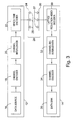
- FIG. 3 illustrates such a system, comprising a MIMO data communications system 10 of generally known construction. New components, in accordance with a specific embodiment of the invention, will be evident from the following description.
- the communications system 10 comprises a transmitter device 12 and a receiver device 14. It will be appreciated that in many circumstances, a wireless communications device will be provided with the facilities of a transmitter and a receiver in combination but, for this example, the devices have been illustrated as one way communications devices for reasons of simplicity.
- the transmitter device 12 comprises a data source 16, which provides data (comprising information bits or symbols) to a channel encoder 18.
- the channel encoder 18 is followed by a channel interleaver 20 and, in the illustrated example, a space-time encoder 22.
- the space-time encoder 22 encodes an incoming symbol or symbols as a plurality of code symbols for simultaneous transmission from a transmitter antenna array 24 comprising a plurality of transmit antennas 25. In this illustrated example, three transmit antennas 25 are provided, though practical implementations may include more, or less antennas depending on the application.
- the encoded transmitted signals propagate through a MIMO channel 28 defined between the transmit antenna array 24 and a corresponding receive antenna array 26 of the receiver device 14.
- the receive antenna array 26 comprises a plurality of receive antennas 27 which provide a plurality of inputs to a lattice-reduction-aided decoder 30 of the receiver device 14.
- the receive antenna array 26 comprises three receive antennas 27.
- the lattice-reduction-aided decoder 30 has the task of removing the effect of the MIMO channel 28.
- the output of the lattice-reduction-aided decoder 30 comprises a plurality of signal streams, one for each transmit antenna 25, each carrying so-called soft or likelihood data on the probability of a transmitted bit having a particular value.
- This data is provided to a channel de-interleaver 32 which reverses the effect of the channel interleaver 20, and the de-interleaved bits output by this channel de-interleaver 32 are then presented to a channel decoder 34, in this example a Viterbi decoder, which decodes the convolutional code.
- the output of channel decoder 34 is provided to a data sink 36, for further processing of the data in any desired manner.
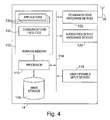
- FIG. 4 illustrates schematically hardware operably configured (by means of software or application specific hardware components) as the receiver device 16.
- the receiver device 16 comprises a processor 110 operable to execute machine code instructions stored in a working memory 112 and/or retrievable from a mass storage device 116.
- user operable input devices 118 are capable of communication with the processor 110.
- the user operable input devices 118 comprise, in this example, a keyboard and a mouse though it will be appreciated that any other input devices could also or alternatively be provided, such as another type of pointing device, a writing tablet, speech recognition means, or any other means by which a user input action can be interpreted and converted into data signals.
- Audio/video output hardware devices 120 are further connected to the general purpose bus 114, for the output of information to a user.
- Audio/video output hardware devices 120 can include a visual display unit, a speaker or any other device capable of presenting information to a user.
- Communications hardware devices 122 connected to the general purpose bus 114, are connected to the antenna 26.
- the working memory 112 stores user applications 130 which, when executed by the processor 110, cause the establishment of a user interface to enable communication of data to and from a user.
- the applications in this embodiment establish general purpose or specific computer implemented utilities that might habitually be used by a user.
- Communications facilities 132 in accordance with the specific embodiment are also stored in the working memory 112, for establishing a communications protocol to enable data generated in the execution of one of the applications 130 to be processed and then passed to the communications hardware devices 122 for transmission and communication with another communications device.
- the software defining the applications 130 and the communications facilities 132 may be partly stored in the working memory 112 and the mass storage device 116, for convenience.
- a memory manager could optionally be provided to enable this to be managed effectively, to take account of the possible different speeds of access to data stored in the working memory 112 and the mass storage device 116.
- the processor 110 On execution by the processor 110 of processor executable instructions corresponding with the communications facilities 132, the processor 110 is operable to establish communication with another device in accordance with a recognised communications protocol.
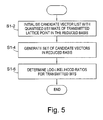
- step S1-2 this employs a modified LLL algorithm to convert the input channel matrix into a reduced basis.
- the LLL algorithm as set out above operates by either replacing columns of the channel matrix with a linear combinations of columns (line 8) or by swapping columns (line 12).
- a set of candidate vectors in the reduced lattice is determined, in step S1-4.
- the method of generating a list of candidates described in the introduction, perturbing each element of ⁇ r in turn, is used.
- log likelihood ratios L ( b k,i ) are derived as set out in the introduction to the field of the invention, detailed above.
- the graph of figure 2 sets out experimental performance data of the present method in comparison with prior art decoding methods aiming to provide hard information for the channel decoder.
- Figure 2 demonstrates the benefit that can be obtained by providing a lattice reduction detection scheme to output soft information for the channel decoder.
- the invention has been described by way of a software implementation.
- This software implementation can be introduced as a stand alone software product, such as borne on a storage medium, e.g. an optical disk, or by means of a signal. Further, the implementation could be by means of an upgrade or plug-in to existing software.
Landscapes
- Engineering & Computer Science (AREA)
- Computer Networks & Wireless Communication (AREA)
- Signal Processing (AREA)
- Physics & Mathematics (AREA)
- Mathematical Physics (AREA)
- Power Engineering (AREA)
- Radio Transmission System (AREA)
- Radar Systems Or Details Thereof (AREA)
- Complex Calculations (AREA)
- Radio Relay Systems (AREA)
Applications Claiming Priority (1)
| Application Number | Priority Date | Filing Date | Title |
|---|---|---|---|
| GB0614088A GB2440196B (en) | 2006-07-14 | 2006-07-14 | Wireless Communications Apparatus |
Publications (2)
| Publication Number | Publication Date |
|---|---|
| EP1879341A2 true EP1879341A2 (fr) | 2008-01-16 |
| EP1879341A3 EP1879341A3 (fr) | 2008-01-23 |
Family
ID=36955720
Family Applications (1)
| Application Number | Title | Priority Date | Filing Date |
|---|---|---|---|
| EP07251612A Withdrawn EP1879341A3 (fr) | 2006-07-14 | 2007-04-17 | Detection de donnée avec la reduction de Lattice en utilisant un algorithme modifié de Lenstra-Lenstra-Lovasz (LLL). |
Country Status (6)
| Country | Link |
|---|---|
| US (1) | US20080013444A1 (fr) |
| EP (1) | EP1879341A3 (fr) |
| JP (1) | JP2009543385A (fr) |
| CN (1) | CN101356785A (fr) |
| GB (1) | GB2440196B (fr) |
| WO (1) | WO2008007802A2 (fr) |
Cited By (1)
| Publication number | Priority date | Publication date | Assignee | Title |
|---|---|---|---|---|
| US11309992B2 (en) * | 2018-07-17 | 2022-04-19 | Qualcomm Incorporated | Using lattice reduction for reduced decoder complexity |
Families Citing this family (8)
| Publication number | Priority date | Publication date | Assignee | Title |
|---|---|---|---|---|
| GB2457507A (en) * | 2008-02-18 | 2009-08-19 | Toshiba Res Europ Ltd | Lattice reduction for detection of MIMO systems using an LLL-based algorithm |
| EP2502392B1 (fr) * | 2009-11-16 | 2013-09-25 | Fujitsu Limited | Systèmes de communication sans fil mimo |
| FR2954180B1 (fr) | 2009-12-18 | 2012-02-24 | Commissariat Energie Atomique | Membrane echangeuse de cations a selectivite amelioree, son procede de preparation et ses utilisations. |
| IL204565A0 (en) | 2010-03-17 | 2010-11-30 | Nds Ltd | Data expansion using an approximate method |
| CN103166742B (zh) * | 2013-01-16 | 2016-03-23 | 南京信息工程大学 | Mimo信号的对偶格约减辅助检测方法 |
| KR20140109726A (ko) | 2013-03-06 | 2014-09-16 | 삼성전자주식회사 | 적은 연산량을 갖는 래티스 리덕션 방법 및 장치 |
| GB2511370B (en) * | 2013-08-29 | 2015-07-08 | Imagination Tech Ltd | Low complexity soft output MIMO decoder |
| KR102387182B1 (ko) | 2015-10-21 | 2022-04-15 | 삼성전자주식회사 | 무선 통신 시스템에서 신호 검출 장치 및 방법 |
Family Cites Families (3)
| Publication number | Priority date | Publication date | Assignee | Title |
|---|---|---|---|---|
| US6724843B1 (en) * | 1999-10-08 | 2004-04-20 | Lucent Technologies Inc. | Method and apparatus for fast decoding in a multiple-antenna wireless communication system |
| US7349496B2 (en) * | 2003-06-27 | 2008-03-25 | Nortel Networks Limited | Fast space-time decoding using soft demapping with table look-up |
| GB2411328B (en) * | 2004-02-23 | 2007-05-16 | Toshiba Res Europ Ltd | Adaptive MIMO systems |
-
2006
- 2006-07-14 GB GB0614088A patent/GB2440196B/en not_active Expired - Fee Related
-
2007
- 2007-04-17 EP EP07251612A patent/EP1879341A3/fr not_active Withdrawn
- 2007-06-28 US US11/770,002 patent/US20080013444A1/en not_active Abandoned
- 2007-07-11 CN CNA2007800007812A patent/CN101356785A/zh active Pending
- 2007-07-11 WO PCT/JP2007/064126 patent/WO2008007802A2/fr not_active Ceased
- 2007-07-11 JP JP2009501644A patent/JP2009543385A/ja not_active Abandoned
Cited By (1)
| Publication number | Priority date | Publication date | Assignee | Title |
|---|---|---|---|---|
| US11309992B2 (en) * | 2018-07-17 | 2022-04-19 | Qualcomm Incorporated | Using lattice reduction for reduced decoder complexity |
Also Published As
| Publication number | Publication date |
|---|---|
| GB0614088D0 (en) | 2006-08-23 |
| US20080013444A1 (en) | 2008-01-17 |
| CN101356785A (zh) | 2009-01-28 |
| WO2008007802A3 (fr) | 2008-04-03 |
| EP1879341A3 (fr) | 2008-01-23 |
| WO2008007802A2 (fr) | 2008-01-17 |
| GB2440196B (en) | 2008-10-08 |
| JP2009543385A (ja) | 2009-12-03 |
| GB2440196A (en) | 2008-01-23 |
Similar Documents
| Publication | Publication Date | Title |
|---|---|---|
| EP1895730A1 (fr) | Génération de décisions douces dans un système MIMO à réduction de réseau | |
| EP1879341A2 (fr) | Detection de donnée avec la reduction de lattice en utilisant un algorithme modifié de Lenstra-Lenstra-Lovasz (LLL) | |
| EP1912371A2 (fr) | Appareil de communication sans fil | |
| US20070121753A1 (en) | Wireless communications apparatus | |
| EP0564849A1 (fr) | Système et procédé d'estimation robuste de séquence en présence de conditions de désadaptation du canal | |
| US20060227903A1 (en) | Method of soft bit metric calculation with direct matrix inversion MIMO detection | |
| EP1912396A2 (fr) | Appareil de communication sans fil | |
| EP1901505A2 (fr) | Appareil de communication sans fil | |
| Tang et al. | Time-multiplexed training for time-selective channels | |
| Ling et al. | Multiple-antenna differential lattice decoding | |
| Rekaya et al. | A very efficient lattice reduction tool on fast fading channels | |
| GB2457507A (en) | Lattice reduction for detection of MIMO systems using an LLL-based algorithm | |
| Wang et al. | Sphere Decoding Revisited | |
| Bouvet et al. | Optimal space-time coding under iterative processing | |
| GB2446659A (en) | Controlling LLL Lattice reduction runtimes in wireless MIMO receivers | |
| GB2426419A (en) | A hardware accelerator for a signal decoder | |
| WO2015046026A1 (fr) | Procédé et dispositif pour décoder des symboles reçus correspondant à des symboles de constellation pam tels que transmis via un canal mimo | |
| Veludandi et al. | Linear prediction based data detection of convolutional coded DQPSK in SIMO-OFDM | |
| Gaffney et al. | Iterative decision feedback equalisation of linearly precoded OFDM systems | |
| Park et al. | Novel soft decision generation technique for performance improvement of 3GPP LTE-Advanced systems with multiple antennas | |
| Lampe et al. | Application of sphere decoding to MSDD | |
| Singh et al. | SOVA decoding with blind channel estimation in a SIMO FIR channel | |
| Willett | Multiuser detection with joint channel estimation for asynchronous cdma hat rayleigh fading channels | |
| Bai et al. | Bit-Wise MIMO-BICM-ID Using Lattice Reduction | |
| Daneshgaran et al. | Iterative LBG clustering for SIMO channel identification |
Legal Events
| Date | Code | Title | Description |
|---|---|---|---|
| PUAI | Public reference made under article 153(3) epc to a published international application that has entered the european phase |
Free format text: ORIGINAL CODE: 0009012 |
|
| PUAL | Search report despatched |
Free format text: ORIGINAL CODE: 0009013 |
|
| 17P | Request for examination filed |
Effective date: 20070423 |
|
| AK | Designated contracting states |
Kind code of ref document: A2 Designated state(s): AT BE BG CH CY CZ DE DK EE ES FI FR GB GR HU IE IS IT LI LT LU LV MC MT NL PL PT RO SE SI SK TR |
|
| AX | Request for extension of the european patent |
Extension state: AL BA HR MK YU |
|
| AK | Designated contracting states |
Kind code of ref document: A3 Designated state(s): AT BE BG CH CY CZ DE DK EE ES FI FR GB GR HU IE IS IT LI LT LU LV MC MT NL PL PT RO SE SI SK TR |
|
| AX | Request for extension of the european patent |
Extension state: AL BA HR MK YU |
|
| RTI1 | Title (correction) |
Free format text: LATTICE-REDUCTION-AIDED DETECTION APPLYING A MODIFIED LENSTRA-LENSTRA-LOVASZ (LLL) ALGORITHM |
|
| AKX | Designation fees paid |
Designated state(s): DE FR |
|
| 17Q | First examination report despatched |
Effective date: 20080908 |
|
| GRAP | Despatch of communication of intention to grant a patent |
Free format text: ORIGINAL CODE: EPIDOSNIGR1 |
|
| STAA | Information on the status of an ep patent application or granted ep patent |
Free format text: STATUS: THE APPLICATION IS DEEMED TO BE WITHDRAWN |
|
| 18D | Application deemed to be withdrawn |
Effective date: 20090827 |