EP1880896A2 - Système lombaire intégré et d'appuie-tête actif - Google Patents
Système lombaire intégré et d'appuie-tête actif Download PDFInfo
- Publication number
- EP1880896A2 EP1880896A2 EP07021803A EP07021803A EP1880896A2 EP 1880896 A2 EP1880896 A2 EP 1880896A2 EP 07021803 A EP07021803 A EP 07021803A EP 07021803 A EP07021803 A EP 07021803A EP 1880896 A2 EP1880896 A2 EP 1880896A2
- Authority
- EP
- European Patent Office
- Prior art keywords
- lumbar support
- crossbar
- pair
- support
- lumbar
- Prior art date
- Legal status (The legal status is an assumption and is not a legal conclusion. Google has not performed a legal analysis and makes no representation as to the accuracy of the status listed.)
- Withdrawn
Links
- 238000012546 transfer Methods 0.000 claims abstract description 39
- 230000007246 mechanism Effects 0.000 claims abstract description 37
- 238000006243 chemical reaction Methods 0.000 description 12
- 230000000712 assembly Effects 0.000 description 2
- 238000000429 assembly Methods 0.000 description 2
- 230000008901 benefit Effects 0.000 description 2
- 238000013461 design Methods 0.000 description 2
- 230000000694 effects Effects 0.000 description 2
- 238000000034 method Methods 0.000 description 2
- 210000000115 thoracic cavity Anatomy 0.000 description 2
- 230000004913 activation Effects 0.000 description 1
- 230000015572 biosynthetic process Effects 0.000 description 1
- 238000010276 construction Methods 0.000 description 1
- 230000006378 damage Effects 0.000 description 1
- 238000012938 design process Methods 0.000 description 1
- 238000011161 development Methods 0.000 description 1
- 230000008030 elimination Effects 0.000 description 1
- 238000003379 elimination reaction Methods 0.000 description 1
- 238000005755 formation reaction Methods 0.000 description 1
- 210000004705 lumbosacral region Anatomy 0.000 description 1
- 238000012423 maintenance Methods 0.000 description 1
- 238000004519 manufacturing process Methods 0.000 description 1
- 239000000463 material Substances 0.000 description 1
- 239000002184 metal Substances 0.000 description 1
- 238000012986 modification Methods 0.000 description 1
- 230000004048 modification Effects 0.000 description 1
- 210000004197 pelvis Anatomy 0.000 description 1
- 239000004033 plastic Substances 0.000 description 1
- 238000011160 research Methods 0.000 description 1
- 238000000926 separation method Methods 0.000 description 1
- 239000004616 structural foam Substances 0.000 description 1
- 238000013519 translation Methods 0.000 description 1
Images


Classifications
-
- B—PERFORMING OPERATIONS; TRANSPORTING
- B60—VEHICLES IN GENERAL
- B60N—SEATS SPECIALLY ADAPTED FOR VEHICLES; VEHICLE PASSENGER ACCOMMODATION NOT OTHERWISE PROVIDED FOR
- B60N2/00—Seats specially adapted for vehicles; Arrangement or mounting of seats in vehicles
- B60N2/64—Back-rests or cushions
- B60N2/66—Lumbar supports
-
- B—PERFORMING OPERATIONS; TRANSPORTING
- B60—VEHICLES IN GENERAL
- B60N—SEATS SPECIALLY ADAPTED FOR VEHICLES; VEHICLE PASSENGER ACCOMMODATION NOT OTHERWISE PROVIDED FOR
- B60N2/00—Seats specially adapted for vehicles; Arrangement or mounting of seats in vehicles
- B60N2/24—Seats specially adapted for vehicles; Arrangement or mounting of seats in vehicles for particular purposes or particular vehicles
- B60N2/42—Seats specially adapted for vehicles; Arrangement or mounting of seats in vehicles for particular purposes or particular vehicles the seat constructed to protect the occupant from the effect of abnormal g-forces, e.g. crash or safety seats
- B60N2/427—Seats or parts thereof displaced during a crash
- B60N2/42727—Seats or parts thereof displaced during a crash involving substantially rigid displacement
-
- B—PERFORMING OPERATIONS; TRANSPORTING
- B60—VEHICLES IN GENERAL
- B60N—SEATS SPECIALLY ADAPTED FOR VEHICLES; VEHICLE PASSENGER ACCOMMODATION NOT OTHERWISE PROVIDED FOR
- B60N2/00—Seats specially adapted for vehicles; Arrangement or mounting of seats in vehicles
- B60N2/24—Seats specially adapted for vehicles; Arrangement or mounting of seats in vehicles for particular purposes or particular vehicles
- B60N2/42—Seats specially adapted for vehicles; Arrangement or mounting of seats in vehicles for particular purposes or particular vehicles the seat constructed to protect the occupant from the effect of abnormal g-forces, e.g. crash or safety seats
- B60N2/427—Seats or parts thereof displaced during a crash
- B60N2/42772—Seats or parts thereof displaced during a crash characterised by the triggering system
- B60N2/42781—Seats or parts thereof displaced during a crash characterised by the triggering system mechanical triggering
-
- B—PERFORMING OPERATIONS; TRANSPORTING
- B60—VEHICLES IN GENERAL
- B60N—SEATS SPECIALLY ADAPTED FOR VEHICLES; VEHICLE PASSENGER ACCOMMODATION NOT OTHERWISE PROVIDED FOR
- B60N2/00—Seats specially adapted for vehicles; Arrangement or mounting of seats in vehicles
- B60N2/64—Back-rests or cushions
- B60N2/66—Lumbar supports
- B60N2/667—Lumbar supports having flexible support member bowed by applied forces
- B60N2/6671—Lumbar supports having flexible support member bowed by applied forces with cable actuators
-
- B—PERFORMING OPERATIONS; TRANSPORTING
- B60—VEHICLES IN GENERAL
- B60N—SEATS SPECIALLY ADAPTED FOR VEHICLES; VEHICLE PASSENGER ACCOMMODATION NOT OTHERWISE PROVIDED FOR
- B60N2/00—Seats specially adapted for vehicles; Arrangement or mounting of seats in vehicles
- B60N2/64—Back-rests or cushions
- B60N2/66—Lumbar supports
- B60N2/667—Lumbar supports having flexible support member bowed by applied forces
- B60N2/6673—Lumbar supports having flexible support member bowed by applied forces with motor driven adjustments
-
- B—PERFORMING OPERATIONS; TRANSPORTING
- B60—VEHICLES IN GENERAL
- B60N—SEATS SPECIALLY ADAPTED FOR VEHICLES; VEHICLE PASSENGER ACCOMMODATION NOT OTHERWISE PROVIDED FOR
- B60N2/00—Seats specially adapted for vehicles; Arrangement or mounting of seats in vehicles
- B60N2/80—Head-rests
- B60N2/888—Head-rests with arrangements for protecting against abnormal g-forces, e.g. by displacement of the head-rest
Definitions
- This invention relates generally to active headrest systems and, more particularly, to active headrest systems combined with lumbar support devices.
- AHRS Active headrest systems
- seat support systems to improve the safety of vehicle passengers in the event of a collision
- improvements have been made to reduce injuries to the neck region of the passenger.
- the occupant of a seat in the vehicle is forced against the seat.
- the pelvis and lumbar regions of the occupant initially exert more force on the seatback than do the thoracic or shoulder regions of the occupant, and this initial reaction may separate the seatback from the thoracic, neck, and head regions of the occupant.
- the upper torso, neck, and head of the passenger can then be forced back into the seatback, resulting in a whiplash effect.
- dynamic or active headrest mechanisms have been developed to reduce the negative effects of a rearward collision.
- Most head restraint systems include a reaction plate or a reaction bar that is supported by the seatback frame in the region generally corresponding to the shoulder position of the occupant.
- the reaction device is pivotally mounted to a linkage which connects to the headrest. During a rearward collision, the force of the occupant pushes on the plate or bar and actuates the linkage to move the headrest upward and forward toward the head of the occupant, thereby reducing the separation between the seatback and the occupant.
- a number of active head restraint systems such as disclosed in U.S. Patent Nos. 5,378,043 , 6,199,947 and 6,565,150 , do not integrate a lumbar support with the reaction device whereas other active headrest systems have been combined with lumbar support devices, such as disclosed in U.S. Patent Nos. 5,884,968 , 6,375,262 and 6,837,541 .
- Most combinations of active headrest systems with lumbar support devices still require the same discrete energy transfer mechanism and do not use the lumbar support device as an integral part of active headrest system when in a collision mode of operation. Additionally, these combinations are usually limited to a particular type of lumbar device that must be designed specifically according to the active headrest system which can limit the flexibility and range of travel of any such lumbar support system that is incorporated into the AHRS.
- a lumbar support system to be integrated with an AHRS in a manner that will not limit the flexibility and range of travel of the lumbar support.
- AHRS AHRS
- the invention is an improved active headrest system having a headrest, an energy transfer mechanism, and a lumbar device.
- the lumbar support has a set of operating positions that are not in direct contact with the energy transfer mechanism and another set of impact positions that are in contact with the energy transfer mechanism.
- the lumbar support is in a cooperative relationship with a crossbar in the energy transfer mechanism.
- the lumbar support moves the crossbar which extends inwardly from a pair of side bars.
- the lumbar support of the present invention is also different from the prior art because the side bars are outside the periphery of the lumbar support. With the side bars outside the lumbar support periphery, the range of travel of the lumbar support is increased and the flexibility of the lumbar support is improved in that different types of devices can be used within the allotted space for the lumbar support.
- the present invention discloses an energy transfer mechanism which has side bars outside the periphery of the lumbar support.
- the lumbar support acts against a crossbar that extends inwardly from the side bars which extend along the seat frame.
- a seating system comprises a seat frame comprising a pair of side rails and a top beam, a plurality of support wire sections connected to the seat frame, an energy transfer mechanism comprising a pair of side bars, a pair of linkages, and a crossbar connected between said pair of side bars, wherein said pair of side bars extend along said side rails from a pair of linkages proximate to said top beam to said crossbar distal from said top beam, a head rest supported by said top beam of said seat frame and connected to said energy transfer mechanism through said pair of linkages, a lumbar support attached to said frame through said plurality of support wire sections and spaced from said crossbar by said support wire sections, and an actuator operatively connected to said lumbar support, said actuator moving said lumbar support from a first position to a second position.
- the lumbar support comprises a front side, a back side, a top section, a bottom section and a middle section therebetween, where a periphery of said lumbar support is located inside said pair of side bars, said crossbar connecting said pair of side bars.
- the middle section may be located proximate to said crossbar.
- said support wire sections surround said periphery of said lumbar support and attach said crossbar to said lumbar support, said crossbar comprising a pair of crossbar sections connected between said pair of side bars through said support wire sections.
- a seat support system comprises a headrest, an energy transfer mechanism operatively connected to said headrest, a lumbar support, said lumbar support having a set of operating positions and a set of impact positions, wherein said set of operating positions is not in contact with said energy transfer mechanism and wherein said set of impact positions is in contact with said energy transfer mechanism, and an actuator operatively connected to said lumbar support, said actuator moving said lumbar support through said set of operating positions.
- the seat support further comprises a plurality of support wire sections connected to said lumbar support.
- said energy transfer mechanism may comprise a crossbar connecting a pair of side bars, said pair of side bars connected to said headrest through a pair of linkages, said crossbar situated behind said wire sections and said lumbar support, wherein said lumbar support contacts said energy transfer mechanism through said crossbar in said set of impact positions.
- each of the embodiments described below with reference to the corresponding illustrations is for an active headrest system 10 that can be adapted to fit into the seat frame 12 of any vehicle.
- the active headrest system 10 is shown to include an energy transfer mechanism 14 that connects the headrest 16 to the lumbar support 18.
- the lumbar support 18 is operated by an actuator 20.
- the active headrest system 10 combined with the seat frame 12 and the actuator 20 is an integrated active headrest/lumbar seating system 22.
- a pair of linkages 26 connects the energy transfer mechanism 14 to the headrest 16 which is supported at the upper end 24 by a top beam 28.
- a pair of side bars 30 extend from the corresponding pair of linkages 26 along the side rails 32 of the seat frame 12 to a crossbar 34.
- the crossbar 34 connects the pair of side bars 30 at the lower end 36 of the seat frame 12. Accordingly, the pair of linkages 26 are closer to the top beam 24 the upper end 24 of the seat frame 12, closer to the top beam 28, whereas the crossbar 34 is positioned in the lower end 36 of the seat frame 12.
- the lumbar support 18 is integrated into the active headrest system 10 through its placement in the seat frame 12 relative to the side bars 30 and the crossbar 34. Specifically, the middle section 40 of the lumbar support 18 is situated proximate to the crossbar 34. The lumbar support 18 fits entirely within the side bars 30 such that the pair of side bars 30 are outside the periphery 42 of the lumbar support 18. Therefore, according to the present invention, the lumbar support 18 can be selected from many designs and still function in the active headrest system 10. As respectively illustrated in Figures 1A and 1B, the lumbar support 18 is moved from a retracted position 44 to an extended position 46. Similarly, the actuator 20 can operate the lumbar support 18 illustrated in each of the other drawings.
- a front side 48 of the lumbar support 18 is shown in Figure 2A and the back side 50 of the lumbar support 18 is shown in Figure 2B.
- the front side of the lumbar support is also shown in Figure 2C with a bottom view of the seating system 22. Additionally, the front side is shown in Figures 1 and 3, and the back side is shown in Figures 4 and 5.
- the top section 52 and the bottom section 54 of the lumbar support 18 are connected to the seat frame 12 through support wire sections 56.
- the support wire sections 56 can attach the lumbar support to the seat frame by any number of formations. As illustrated in Figure 1, the support wire sections 56 can completely surround the periphery 42 of the lumbar support 18, having sections on the top, bottom and each side that are preferably connected to each other.
- coil springs 58 connect the wire sections 56 to the seat frame 12, and the support wire sections 56 connect the lumbar support 18 to a pair of crossbar sections 34a, 34 b.
- the crossbar 34 is situated behind the lumbar support 18 and the support wire sections 56 are located between the crossbar 34 and the lumbar support 18.
- a continuous support wire 60 can be doubled over and formed into a u-shape that is attached to the seat frame 12 at the top beam 28.
- a pair of support wires 62 can span the seat frame 12 between the side rails 32, with the upper support wire being connected to the top section 52 of the lumbar support 18 and the lower support wire being connected to the bottom section 52 of the lumbar support 18.
- the upper support wire is angled which allows the top section of the lumbar support to slide.
- the support wire sections 56 space the lumbar support 18 from the crossbar 34.
- the spacing is on the sides of the lumbar support 18, whereas in the other embodiments, the spacing is behind the lumbar support 18.
- clips 64 can be used to attachment the support wire sections 56 to the crossbar 34.
- clips can also attach a reaction plate 66 to the lumbar support 18. With the reaction plate situated between the lumbar support 18 and the crossbar 34, the reaction plate 66 can be attached to or integrally formed with the crossbar or it may not have any attachment to the crossbar.
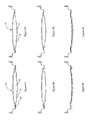
- Figures 8A and 9A illustrate the normal operating mode of the lumbar support, in which the support wire sections 56 provide a spatial distance 68 between the lumbar support 18 and the crossbar 34.
- the clips 64 attach the support wire sections 56 to the crossbar 34, whereas there is no connection between the crossbar 34 and the support wire sections 56 in Figure 9A.
- Figures 8B and 9B illustrate the impact condition where the support wire sections 56 have been driven back toward the crossbar 34 and there is no longer any spatial distance between the support wire sections 56 and the crossbar 34.
- the clips 64 are driven further into the crossbar 34.
- Figures 8C and 9C illustrate the impact condition where the lumbar support 18 has been driven back such that there is no longer any spatial distance and the lumbar support 18 impacts the cross bar 34.
- the energy transfer mechanism typically includes a reaction plate and/or a reaction bar.
- the lumbar support 18 can include a plate 70 which is operated during the normal modes of operation and which serves as a reaction plate to transfer the impact forces through the lumbar support 18 and to the crossbar 34 and the remainder of the energy transfer system.
- the lumbar support is an integral part of the energy transfer system.
- the lumbar support 18 has a set of operating positions do not engage the side bars 30 in the energy transfer mechanism and another set of impact positions that are enga ge the side bars 30 in the energy transfer mechanism.
- FIG 3B a side view of the lumbar 18 is shown relative to the crossbar 34 with one side of the seat frame 12 cut-away.
- Figure 3C the lumbar support 18 is removed from the illustration to particularly show the crossbar 34 within the seat frame 12.
- the lumbar support 18 can be integral with the active headrest system, but in the normal modes of operation for the lumbar support, there is no physical link with the energy transfer mechanism. Instead, the lumbar support has a spatial relationship, or a spatial link, with the energy transfer mechanism. The spatial link closes due to the force of a collision, thereby bringing the lumbar into direct contact with energy transfer mechanism.
- the lumbar support 18 in Figure 7 is also spaced from the energy transfer mechanism by the reaction plate 66 which may also be spaced from the energy transfer mechanism.
- connection between the seat frame 12 and the lumbar support 18 can be any type of hardware, such as links, brackets, snap-fit clips, springs, or any other equivalent fastener.
- a bowden cable to connect the lumbar to any actuator that may be used for translation and/or curvature.
- Such an actuator can be a motorized actuator or a manual actuator.
- any suitable energy transfer mechanism would be acceptable for the operation of the seating system.
- the structural elements can be made from metal, plastic, structural foam or any other equivalent material. Generally, the structure allows sufficient energy to be transferred through the lumbar support to the active headrest system for its proper activation.
Landscapes
- Engineering & Computer Science (AREA)
- Aviation & Aerospace Engineering (AREA)
- Transportation (AREA)
- Mechanical Engineering (AREA)
- Seats For Vehicles (AREA)
Applications Claiming Priority (2)
| Application Number | Priority Date | Filing Date | Title |
|---|---|---|---|
| US56723804P | 2004-04-30 | 2004-04-30 | |
| EP05740941A EP1744931B1 (fr) | 2004-04-30 | 2005-04-29 | Support lombaire et systeme d'appui-tete actif integres |
Related Parent Applications (1)
| Application Number | Title | Priority Date | Filing Date |
|---|---|---|---|
| EP05740941A Division EP1744931B1 (fr) | 2004-04-30 | 2005-04-29 | Support lombaire et systeme d'appui-tete actif integres |
Publications (1)
| Publication Number | Publication Date |
|---|---|
| EP1880896A2 true EP1880896A2 (fr) | 2008-01-23 |
Family
ID=38872017
Family Applications (1)
| Application Number | Title | Priority Date | Filing Date |
|---|---|---|---|
| EP07021803A Withdrawn EP1880896A2 (fr) | 2004-04-30 | 2005-04-29 | Système lombaire intégré et d'appuie-tête actif |
Country Status (1)
| Country | Link |
|---|---|
| EP (1) | EP1880896A2 (fr) |
Cited By (2)
| Publication number | Priority date | Publication date | Assignee | Title |
|---|---|---|---|---|
| CN103303170A (zh) * | 2013-05-21 | 2013-09-18 | 江苏大学 | 机动车多功能碰撞安全座椅 |
| CN103273862B (zh) * | 2013-05-29 | 2016-01-27 | 江苏大学 | 机动车追尾碰撞安全座椅 |
Citations (6)
| Publication number | Priority date | Publication date | Assignee | Title |
|---|---|---|---|---|
| US5378043A (en) | 1993-06-01 | 1995-01-03 | General Motors Corporation | Vehicle pivotal headrest |
| US5884968A (en) | 1997-01-23 | 1999-03-23 | Lear Corporation | Seat assembly with pneumatically adjustable contour and energy absorption |
| US6199947B1 (en) | 1996-09-06 | 2001-03-13 | Saab Automobile Ab | Vehicle seat provided with a headrest |
| US6375262B1 (en) | 2000-03-14 | 2002-04-23 | Ikeda Bussan Co., Ltd. | Automotive seat-back structure |
| US6565150B2 (en) | 2001-02-19 | 2003-05-20 | Lear Corporation | Active headrest for a vehicle seat |
| US6837541B2 (en) | 2002-09-30 | 2005-01-04 | Lear Corporation | Vehicle seat having a lumbar support system |
-
2005
- 2005-04-29 EP EP07021803A patent/EP1880896A2/fr not_active Withdrawn
Patent Citations (6)
| Publication number | Priority date | Publication date | Assignee | Title |
|---|---|---|---|---|
| US5378043A (en) | 1993-06-01 | 1995-01-03 | General Motors Corporation | Vehicle pivotal headrest |
| US6199947B1 (en) | 1996-09-06 | 2001-03-13 | Saab Automobile Ab | Vehicle seat provided with a headrest |
| US5884968A (en) | 1997-01-23 | 1999-03-23 | Lear Corporation | Seat assembly with pneumatically adjustable contour and energy absorption |
| US6375262B1 (en) | 2000-03-14 | 2002-04-23 | Ikeda Bussan Co., Ltd. | Automotive seat-back structure |
| US6565150B2 (en) | 2001-02-19 | 2003-05-20 | Lear Corporation | Active headrest for a vehicle seat |
| US6837541B2 (en) | 2002-09-30 | 2005-01-04 | Lear Corporation | Vehicle seat having a lumbar support system |
Cited By (3)
| Publication number | Priority date | Publication date | Assignee | Title |
|---|---|---|---|---|
| CN103303170A (zh) * | 2013-05-21 | 2013-09-18 | 江苏大学 | 机动车多功能碰撞安全座椅 |
| CN103303170B (zh) * | 2013-05-21 | 2015-06-10 | 江苏大学 | 机动车多功能碰撞安全座椅 |
| CN103273862B (zh) * | 2013-05-29 | 2016-01-27 | 江苏大学 | 机动车追尾碰撞安全座椅 |
Similar Documents
| Publication | Publication Date | Title |
|---|---|---|
| EP1744931B1 (fr) | Support lombaire et systeme d'appui-tete actif integres | |
| US8434818B2 (en) | Vehicle seat having active head restraint | |
| JP5452858B2 (ja) | 車両用シート | |
| CN102205809B (zh) | 车辆座椅靠背和设置有车辆座椅靠背的车辆座椅 | |
| US6565150B2 (en) | Active headrest for a vehicle seat | |
| US8911014B2 (en) | Vehicle seat | |
| CN101272930B (zh) | 车辆座椅的头枕用连结机构 | |
| EP2030835B1 (fr) | Siège de véhicule | |
| US8727437B2 (en) | Actuator for crash activated head restraint | |
| EP1636065B1 (fr) | Siege de vehicule | |
| JP5231384B2 (ja) | 車両用シート | |
| WO2006095454A1 (fr) | Dossier rembourre pour siege automobile | |
| EP1880896A2 (fr) | Système lombaire intégré et d'appuie-tête actif | |
| JP4825010B2 (ja) | アクティブヘッドレストシステムを備えた車両シート | |
| JP5156191B2 (ja) | アクティブヘッドレストシステムを備えた車両シート | |
| JP4488854B2 (ja) | 車両用シート | |
| JP4819506B2 (ja) | アクティブヘッドレストシステムを備えた車両シート組立体 | |
| KR20070054282A (ko) | 차량용 시트의 액티브 헤드레스트 | |
| JP2012148772A (ja) | アクティブヘッドレストシステムを備えた車両シート |
Legal Events
| Date | Code | Title | Description |
|---|---|---|---|
| PUAI | Public reference made under article 153(3) epc to a published international application that has entered the european phase |
Free format text: ORIGINAL CODE: 0009012 |
|
| AC | Divisional application: reference to earlier application |
Ref document number: 1744931 Country of ref document: EP Kind code of ref document: P |
|
| AK | Designated contracting states |
Kind code of ref document: A2 Designated state(s): AT BE BG CH CY CZ DE DK EE ES FI FR GB GR HU IE IS IT LI LT LU MC NL PL PT RO SE SI SK TR |
|
| 17P | Request for examination filed |
Effective date: 20080627 |
|
| STAA | Information on the status of an ep patent application or granted ep patent |
Free format text: STATUS: THE APPLICATION HAS BEEN WITHDRAWN |
|
| 18W | Application withdrawn |
Effective date: 20090715 |