EP1881994B1 - Lösungen von cellulose in ionischen flüssigkeiten - Google Patents
Lösungen von cellulose in ionischen flüssigkeiten Download PDFInfo
- Publication number
- EP1881994B1 EP1881994B1 EP06847012.9A EP06847012A EP1881994B1 EP 1881994 B1 EP1881994 B1 EP 1881994B1 EP 06847012 A EP06847012 A EP 06847012A EP 1881994 B1 EP1881994 B1 EP 1881994B1
- Authority
- EP
- European Patent Office
- Prior art keywords
- group
- methyl
- sio
- und
- oder
- Prior art date
- Legal status (The legal status is an assumption and is not a legal conclusion. Google has not performed a legal analysis and makes no representation as to the accuracy of the status listed.)
- Expired - Lifetime
Links
- 0 *C(C(*)*1CC*=C)*(*)*1C1CCCCC1 Chemical compound *C(C(*)*1CC*=C)*(*)*1C1CCCCC1 0.000 description 6
- DRUOYXQMVSLHAR-UHFFFAOYSA-N CCN1C(C)C1 Chemical compound CCN1C(C)C1 DRUOYXQMVSLHAR-UHFFFAOYSA-N 0.000 description 1
Classifications
-
- C—CHEMISTRY; METALLURGY
- C08—ORGANIC MACROMOLECULAR COMPOUNDS; THEIR PREPARATION OR CHEMICAL WORKING-UP; COMPOSITIONS BASED THEREON
- C08B—POLYSACCHARIDES; DERIVATIVES THEREOF
- C08B1/00—Preparatory treatment of cellulose for making derivatives thereof, e.g. pre-treatment, pre-soaking, activation
- C08B1/003—Preparation of cellulose solutions, i.e. dopes, with different possible solvents, e.g. ionic liquids
-
- D—TEXTILES; PAPER
- D21—PAPER-MAKING; PRODUCTION OF CELLULOSE
- D21C—PRODUCTION OF CELLULOSE BY REMOVING NON-CELLULOSE SUBSTANCES FROM CELLULOSE-CONTAINING MATERIALS; REGENERATION OF PULPING LIQUORS; APPARATUS THEREFOR
- D21C3/00—Pulping cellulose-containing materials
- D21C3/04—Pulping cellulose-containing materials with acids, acid salts or acid anhydrides
-
- C—CHEMISTRY; METALLURGY
- C08—ORGANIC MACROMOLECULAR COMPOUNDS; THEIR PREPARATION OR CHEMICAL WORKING-UP; COMPOSITIONS BASED THEREON
- C08J—WORKING-UP; GENERAL PROCESSES OF COMPOUNDING; AFTER-TREATMENT NOT COVERED BY SUBCLASSES C08B, C08C, C08F, C08G or C08H
- C08J3/00—Processes of treating or compounding macromolecular substances
- C08J3/02—Making solutions, dispersions, lattices or gels by other methods than by solution, emulsion or suspension polymerisation techniques
- C08J3/09—Making solutions, dispersions, lattices or gels by other methods than by solution, emulsion or suspension polymerisation techniques in organic liquids
- C08J3/091—Making solutions, dispersions, lattices or gels by other methods than by solution, emulsion or suspension polymerisation techniques in organic liquids characterised by the chemical constitution of the organic liquid
-
- D—TEXTILES; PAPER
- D21—PAPER-MAKING; PRODUCTION OF CELLULOSE
- D21C—PRODUCTION OF CELLULOSE BY REMOVING NON-CELLULOSE SUBSTANCES FROM CELLULOSE-CONTAINING MATERIALS; REGENERATION OF PULPING LIQUORS; APPARATUS THEREFOR
- D21C3/00—Pulping cellulose-containing materials
-
- D—TEXTILES; PAPER
- D21—PAPER-MAKING; PRODUCTION OF CELLULOSE
- D21C—PRODUCTION OF CELLULOSE BY REMOVING NON-CELLULOSE SUBSTANCES FROM CELLULOSE-CONTAINING MATERIALS; REGENERATION OF PULPING LIQUORS; APPARATUS THEREFOR
- D21C3/00—Pulping cellulose-containing materials
- D21C3/02—Pulping cellulose-containing materials with inorganic bases or alkaline reacting compounds, e.g. sulfate processes
-
- C—CHEMISTRY; METALLURGY
- C08—ORGANIC MACROMOLECULAR COMPOUNDS; THEIR PREPARATION OR CHEMICAL WORKING-UP; COMPOSITIONS BASED THEREON
- C08J—WORKING-UP; GENERAL PROCESSES OF COMPOUNDING; AFTER-TREATMENT NOT COVERED BY SUBCLASSES C08B, C08C, C08F, C08G or C08H
- C08J2301/00—Characterised by the use of cellulose, modified cellulose or cellulose derivatives
- C08J2301/02—Cellulose; Modified cellulose
-
- Y—GENERAL TAGGING OF NEW TECHNOLOGICAL DEVELOPMENTS; GENERAL TAGGING OF CROSS-SECTIONAL TECHNOLOGIES SPANNING OVER SEVERAL SECTIONS OF THE IPC; TECHNICAL SUBJECTS COVERED BY FORMER USPC CROSS-REFERENCE ART COLLECTIONS [XRACs] AND DIGESTS
- Y02—TECHNOLOGIES OR APPLICATIONS FOR MITIGATION OR ADAPTATION AGAINST CLIMATE CHANGE
- Y02P—CLIMATE CHANGE MITIGATION TECHNOLOGIES IN THE PRODUCTION OR PROCESSING OF GOODS
- Y02P20/00—Technologies relating to chemical industry
- Y02P20/50—Improvements relating to the production of bulk chemicals
- Y02P20/54—Improvements relating to the production of bulk chemicals using solvents, e.g. supercritical solvents or ionic liquids
-
- Y—GENERAL TAGGING OF NEW TECHNOLOGICAL DEVELOPMENTS; GENERAL TAGGING OF CROSS-SECTIONAL TECHNOLOGIES SPANNING OVER SEVERAL SECTIONS OF THE IPC; TECHNICAL SUBJECTS COVERED BY FORMER USPC CROSS-REFERENCE ART COLLECTIONS [XRACs] AND DIGESTS
- Y10—TECHNICAL SUBJECTS COVERED BY FORMER USPC
- Y10T—TECHNICAL SUBJECTS COVERED BY FORMER US CLASSIFICATION
- Y10T428/00—Stock material or miscellaneous articles
- Y10T428/29—Coated or structually defined flake, particle, cell, strand, strand portion, rod, filament, macroscopic fiber or mass thereof
- Y10T428/2982—Particulate matter [e.g., sphere, flake, etc.]
- Y10T428/2989—Microcapsule with solid core [includes liposome]
Definitions
- the present invention relates to a solution of cellulose and an ionic liquid as solvent, process for their preparation and their use.
- Cellulose is a very versatile raw material.
- cellulose is the most important constituent of the fiber raw materials, in particular cotton.
- Cellulose can be used unchanged or after physical or chemical treatment. For the two latter cases, it is advantageous if cellulose is present in a solvent in as completely dissolved form as possible. However, cellulose is insoluble in most solvents.
- cellulose is soluble as a copper-chelate complex. By precipitation of the cellulose, the so-called regenerated cellulose can be obtained.
- copper solutions are poorly suited to serve as a solvent for cellulose in their physical or chemical treatment.
- Benzylpyridinium chloride which is an example of an ionic liquid, is a salt which, even at comparatively low temperatures, is present in molten form and thus as a liquid.
- Ionic liquids are becoming increasingly important as solvents, for example when carrying out chemical reactions. Peter Wasserscheidt, Angew. Chem. 2000, 112, 3926-3945 For example, gives an overview of the use of ionic liquids in transition metal catalysis.
- Ionic liquids which are already in a liquid state at room temperature, are used, for example, by KN Marsh et al., Fluid Phase Equilibria 219 (2004), 93-98 and JG Huddleston et al., Green Chemistry 2001, 3, 156-164 described.
- DE-A 102 02 838 describes the use of ionic liquids to separate acids from chemical mixtures.
- US-A-4,367,191 discloses a solution containing cellulose and an ionic liquid containing ammonia (NH 3 ) and a salt (preferably NH 4 SCN) as a solvent.
- ionic liquids Due to the good solvent properties of ionic liquids is also in the recent international application WO-A 03/029329 proposed their use for dissolving cellulose. However, it is emphasized that the ionic liquids should consist of cations having a quaternary ammonium ion, which should be quaternized by alkyl groups, especially methyl. Although the in WO-A 03/029329 described characteristics of the cellulose-containing solution and their production have good results, there is a need to provide improved solutions.
- the object is achieved by a solution comprising cellulose and an ionic liquid containing anions and cations as solvent, wherein the cations have at least one atom selected from the group consisting of nitrogen, oxygen, sulfur and phosphorus, which is present in protonated form, and wherein the ionic liquid contains at least one cation which is selected from the group consisting of cations of the formulas (IVe) to (IVt) according to appended claim 1.
- the protonation can take place on one or more identical or different heteroatoms (N, O, S, P).
- heteroatoms N, O, S, P
- other positive charges in the cations may be present, for example by alkylation of a nitrogen.
- the cations have at least one nitrogen atom present in protonated form as an ammonium cation.
- the cellulose to be dissolved may be derived, for example, from regenerated cellulose, fibrous cellulose, wood fibers, linter, cotton or paper.
- cellulose is completely dissolved at more than 1% by weight based on the total weight of the solution become. More preferably, more than 3% by weight, more preferably more than 5% by weight, and most preferably at least 7% by weight, based on the total weight of the solution, will be completely dissolved.
- cellulose based on the total weight of the solution can be completely dissolved.
- up to 25% by weight of cellulose based on the total weight of the solution can be completely dissolved.
- Particularly suitable for certain applications are solutions in which cellulose with up to 15 wt .-% are completely dissolved.
- the ionic liquids have a melting point of less than 180 ° C. Further preferably, the melting point is in a range of -50 ° C to 150 ° C, more preferably in the range of -20 ° C to 120 ° C, and further more preferably, less than 100 ° C.
- Such compounds may contain oxygen, phosphorus, sulfur or in particular nitrogen atoms, for example at least one nitrogen atom, preferably 1-10 nitrogen atoms, particularly preferably 1-5, very particularly preferably 1-3 and in particular 1-2 nitrogen atoms.
- nitrogen atom is a suitable carrier of the positive charge in the cation of the ionic liquid from which, in equilibrium, a proton or an alkyl radical can then be transferred to the anion to produce an electrically neutral molecule.
- a cation can first be generated by quaternization on the nitrogen atom of, for example, an amine or nitrogen heterocycle.
- the quaternization can be carried out by protonation of the nitrogen atom.
- salts with different anions are obtained.
- this can be done in a further synthesis step.
- the halide can be reacted with a Lewis acid to form a complex anion from halide and Lewis acid.
- replacement of a halide ion with the desired anion is possible. This can be done by adding a metal salt to precipitate the metal halide formed, via an ion exchanger, or by displacing the halide ion with a strong acid (to release the hydrohalic acid). Suitable methods are, for example, in Angew. Chem. 2000, 112, p. 3926-3945 and the literature cited therein.
- those compounds which contain at least one five- to six-membered heterocycle in particular a five-membered heterocycle, which has at least one nitrogen atom and optionally an oxygen or sulfur atom
- aromatic heterocycles are particularly preferred.
- Particularly preferred compounds are those which have a molecular weight below 1000 g / mol, very particularly preferably below 500 g / mol and in particular below 250 g / mol.
- the ionic liquid contains at least one cation selected from the group consisting of cations of the formulas (IVe) to (IVt): and oligomers containing these structures.
- the radical R is hydrogen; and the radicals R 1 to R 9 independently of one another are hydrogen, a sulfo group or a carbon-containing organic, saturated or unsaturated, acyclic or cyclic, aliphatic, aromatic or araliphatic, unsubstituted or interrupted by 1 to 5 heteroatoms or functional groups having 1 to 20 carbon atoms, wherein the radicals R 1 to R 9 , which in the abovementioned formulas (IV) are bonded to a carbon atom (and not to a heteroatom), additionally may also stand for halogen or a functional group; or two adjacent radicals from the series R 1 to R 9 together also for a divalent, carbon-containing organic, saturated or unsaturated, acyclic or cyclic, aliphatic, aromatic or araliphatic, unsubstituted or interrupted by 1 to 5 heteroatoms or functional groups radical or substituted 1 to 30 carbon atoms.
- the carbon-containing group contains heteroatoms, oxygen, nitrogen, sulfur, phosphorus and silicon are preferable.
- the radicals R 1 to R 9 are, in the cases in which those in the above formulas (IV) to a carbon atom (and not to a heteroatom) bound also be bound directly via the heteroatom.
- Suitable functional groups are in principle all functional groups which may be bonded to a carbon atom or a heteroatom.
- -OH (hydroxy), O (especially as carbonyl group)
- - NH 2 (amino), NH (imino), -COOH (carboxy), -CONH 2 (carboxamide), -SO 3 H (sulfo) and -CN (cyano).
- Functional groups and heteroatoms can also be directly adjacent, so that combinations of several adjacent atoms, such as -O- (ether), -S- (thioether), -COO- (ester), -CONH- (secondary amide) or -CONR'- (tertiary amide) are included, for example di (C 1 -C 4 alkyl) amino, C 1 -C 4 alkyloxycarbonyl or C 1 -C 4 alkyloxy.
- Halogens are fluorine, chlorine, bromine and iodine.
- aryl, alkyl, aryloxy, alkyloxy, halogen, heteroatoms and / or heterocycles C 1 - to C 18 -alkyl it is preferably methyl, ethyl, 1-propyl, 2-propyl, 1-butyl , 2-butyl, 2-methyl-1-propyl (isobutyl), 2-methyl-2-propyl (tert-butyl), 1-pentyl, 2-pentyl, 3-pentyl, 2-methyl-1-butyl, 3-methyl-1-butyl, 2-methyl-2-butyl, 3-methyl-2-butyl, 2,2-dimethyl-1-propyl, 1-hexyl, 2-hexyl, 3-hexyl, 2-methyl 1-pentyl, 3-methyl-1-pentyl, 4-methyl-1-pentyl, 2-methyl-2-pentyl, 3-methyl-2-pentyl, 4-methyl-2-pentyl, 2-methyl-3 pentyl
- aryl, alkyl, aryloxy, alkyloxy, halogen, heteroatoms and / or heterocycles C 6 -C 12 aryl is preferably phenyl, tolyl, xylyl, ⁇ -naphthyl, ⁇ -naphthyl, 4- Diphenylyl, chlorophenyl, dichlorophenyl, trichlorophenyl, difluorophenyl, methylphenyl, dimethylphenyl, trimethylphenyl, ethylphenyl, diethylphenyl, iso -propylphenyl, tert-butylphenyl, dodecylphenyl, methoxyphenyl, dimethoxyphenyl, ethoxyphenyl, hexyloxyphenyl, methylnaphthyl, isopropylnaphthyl, chloronaphth
- C 5 -C 12 -cycloalkyl optionally substituted by functional groups, aryl, alkyl, aryloxy, alkyloxy, halogen, heteroatoms and / or heterocycles is preferably cyclopentyl, cyclohexyl, cyclooctyl, cyclododecyl, methylcyclopentyl, dimethylcyclopentyl, methylcyclohexyl, dimethylcyclohexyl , Diethylcyclohexyl, butylcyclohexyl, methoxycyclohexyl, dimethoxycyclohexyl, diethoxycyclohexyl, butylthiocyclohexyl, chlorocyclohexyl, dichlorocyclohexyl, dichlorocyclopentyl, C n F 2 ( n ) - (1-b ) H 2a-b with n ⁇ 30, 0 ⁇ a ⁇
- An optionally substituted by functional groups, aryl, alkyl, aryloxy, alkyloxy, halogen, heteroatoms and / or heterocycles substituted five- to six-membered, oxygen, nitrogen and / or sulfur atoms containing heterocycle is preferably furyl, thiophenyl, pyrryl, Pyridyl, indolyl, benzoxazolyl, dioxolyl, dioxo, benzimidazolyl, benzthiazolyl, dimethylpyridyl, methylquinolyl, dimethylpyrryl, methoxyfuryl, dimethoxypyridyl or difluoropyridyl.
- Two adjacent radicals together form an unsaturated, saturated or aromatic, optionally substituted by functional groups, aryl, alkyl, aryloxy, alkyloxy, halogen, heteroatoms and / or heterocycles and optionally substituted by one or more oxygen and / or sulfur atoms and / or one or more several substituted or unsubstituted imino groups interrupted ring, it is preferably 1,3-propylene, 1,4-butylene, 1,5-pentylene, 2-oxa-1,3-propylene, 1-oxa-1,3- propylene, 2-oxa-1,3-propylene, 1-oxa-1,3-propenylene, 3-oxa-1,5-pentylene, 1-aza-1,3-propenylene, 1-C 1 -C 4 - Alkyl 1-aza-1,3-propenylene, 1,4-buta-1,3-dienylene, 1-aza-1,4-buta-1,3-dienylene or 2-aza-1,
- radicals contain oxygen and / or sulfur atoms and / or substituted or unsubstituted imino groups
- the number of oxygen and / or sulfur atoms and / or imino groups is not restricted. As a rule, it is not more than 5 in the radical, preferably not more than 4, and very particularly preferably not more than 3.
- radicals contain heteroatoms, then between two heteroatoms there are generally at least one carbon atom, preferably at least two carbon atoms.
- the radicals R 1 to R 9 independently of one another are hydrogen or C 1 - to C 18 -alkyl, such as, for example, methyl, ethyl, 1-butyl, 1-pentyl, 1-hexyl, 1-heptyl, 1-octyl , for phenyl, for 2-hydroxyethyl, for 2-cyanoethyl, for 2- (methoxycarbonyl) ethyl, for 2- (ethoxycarbonyl) ethyl, for 2- (n-butoxycarbonyl) ethyl, for N, N-dimethylamino, for N, N-diethylamino, for chlorine and for CH 3 O- (CH 2 CH 2 O) n -CH 2 CH 2 - and CH 3 CH 2 O- (CH 2 CH 2 O) n -CH 2 CH 2 - where n is the same 0 to 3.
- C 1 - to C 18 -alkyl such as, for example, methyl, e
- pyridinium ions (IVa) its called pyridinium, 2-methylpyridinium, 2-ethylpyridinium, 5-ethyl-2-methylpyridinium and 2-methyl-3-ethylpyridinium.
- imidazolimions (IVe) which may be mentioned are 1-methylimidazolium, 1-ethylimidazolium, 1-n-butylimidazolium, 1-n-octylimidazolium, 1-n-dodecylimidazolium, 1-n-tetradecylimidazolium, 1-n-hexadecylimidazolium, 1 2-dimethylimidazolium, 1,4-dimethylimidazolium, 2-methylimidazolium, 3-methylimidazolium, 3-ethylimidazolium, 3-n-butylimidazolium, 3-octylimidazolium, 4-methylimidazolium, 2-ethylimidazolium, 1-vinylimidazolium, 1-n-octyl 4-methylimidazolium and 1,4,5-trimethylimidazolium.
- pyrazolium ions are pyrazolium and 1,4-dimethylpyrazolium.
- tertiary amines of which the quaternary ammonium ions of the general formula (IVu) are derived by quaternization with the radical R mentioned are diethyl-n-butylamine, diethyl-tert-butylamine, diethyl-n-pentylamine, diethylhexylamine, diethyloctylamine, Diethyl (2-ethylhexyl) amine, di-n-propylbutylamine, di-n-propyl-n-pentylamine, di-n-propylhexylamine, di-n-propyloctylamine, di-n-propyl (2-ethylhexyl) - amine, diisopropylethylamine, di-iso-propyl-n-propylamine, di-isopropyl-butylamine, di-isopropylpentylamine, di-iso-propyle
- Preferred tertiary amines (IVu) are di-iso-propylethylamine, diethyl-tert-butylamine, di-iso-propylbutylamine, di-n-butyl-n-pentylamine, N, N-di-n-butylcyclohexylamine and tertiary amines of pentyl isomers.
- tertiary amines are di-n-butyl-n-pentylamine and tertiary amines of pentyl isomers.
- Another preferred tertiary amine having three identical residues is triallylamine.
- Particularly preferred cholinium ions are those in which R 3 is selected from hydrogen, methyl, ethyl, acetyl, 5-methoxy-3-oxa-pentyl, 8-methoxy-3,6-dioxaoctyl, 11-methoxy-3, 6,9-trioxa undecyl, 7-methoxy-4-oxa-heptyl, 11-methoxy-4,8-dioxaundecyl, 15-methoxy-4,8,12-trioxa-pentadecyl, 9-methoxy-5-oxo nonyl, 14-methoxy-5,10-oxa-tetradecyl, 5-ethoxy-3-oxa-pentyl, 8-ethoxy-3,6-dioxa-octyl, 11-ethoxy-3,6,9-trioxa-undecyl, 7-ethoxy-4-oxa-h
- the pyridinium ions, pyrazolinium, pyrazolium ions and imidazolinium and imidazolium ions are preferable. Also preferred are ammonium ions.
- the metal cations [M 1 ] + , [M 2 ] + , [M 3 ] + , [M 4 ] 2+ and [M 5 ] 3+ mentioned in formulas (IIIa) to (IIIj) are generally to metal cations of the 1st, 2nd, 6th, 7th, 8th, 9th, 10th, 11th, 12th and 13th group of the periodic table.
- Suitable metal cations are, for example, Li + , Na + , K + , Cs + , Mg 2+ , Ca 2+ , Ba 2+ , Cr 3+ , Fe 2+ , Fe 3+ , Co 2+ , Ni 2+ , Cu 2+ , Ag + , Zn 2+ and Al 3+ .
- R a , R b , R c and R d are each independently hydrogen, C 1 -C 30 -alkyl, optionally by one or more non-adjacent oxygen and / or sulfur atoms and / or one or more substituted or unsubstituted imino groups interrupted C 2 -C 18 alkyl, C 6 -C 14 aryl, C 5 -C 12 cycloalkyl or a five- to six-membered, oxygen, nitrogen and / or sulfur atoms containing heterocycle, wherein two of them together form an unsaturated , saturated or aromatic, optionally interrupted by one or more oxygen and / or sulfur atoms and / or one or more unsubstituted or substituted imino groups interrupted ring, said radicals each additionally by functional groups, aryl, alkyl, aryloxy, alkoxy, halogen , Heteroatoms and / or heterocycles may be substituted.
- aryl optionally substituted by functional groups, aryl, alkyl, aryloxy, alkyloxy, halogen, heteroatoms and / or heterocycles, substituted C 1 -C 18 -alkyl, for example methyl, ethyl, propyl, isopropyl, n-butyl, sec-butyl, tert.
- C 2 -C 18 -alkyl which is interrupted by one or more non-adjacent oxygen and / or sulfur atoms and / or one or more substituted or unsubstituted imino groups are, for example, 5-hydroxy-3-oxapentyl, 8-hydroxy-3,6- dioxaoctyl, 11-hydroxy-3,6,9-trioxaundecyl, 7-hydroxy-4-oxaheptyl, 11-hydroxy-4,8-dioxaundecyl, 15-hydroxy-4,8,12-trioxapentadecyl, 9-hydroxy-5-oxanonyl, 14-hydroxy-5,10-oxatetradecyl, 5-methoxy-3-oxapentyl, 8-methoxy-3,6-dioxaoctyl, 11- Methoxy-3,6,9-trioxaundecyl, 7-methoxy-4-oxaheptyl, 11
- radicals When two radicals form a ring, these radicals can be taken together, for example, as fused building blocks, 1,3-propylene, 1,4-butylene, 2-oxa-1,3-propylene, 1-oxa-1,3-propylene, 2-oxa 1,3-propenylene, 1-aza-1,3-propenylene, 1-C 1 -C 4 -alkyl-1-aza-1,3-propenylene, 1,4-buta-1,3-dienylene, 1 -Aza-1,4-buta-1,3-dienylene or 2-aza-1,4-buta-1,3-dienylene mean.
- the number of non-adjacent oxygen and / or sulfur atoms and / or imino groups is basically not limited, or is automatically limited by the size of the remainder or of the ring building block. As a rule, it is not more than 5 in the respective radical, preferably not more than 4 or very particularly preferably not more than 3. Furthermore, at least one, preferably at least two, carbon atoms (e) are generally present between two heteroatoms.
- Substituted and unsubstituted imino groups may be, for example, imino, methylimino, iso-propylimino, n-butylimino or tert-butylimino.
- C 1 to C 4 alkyl is methyl, ethyl, propyl, isopropyl, n-butyl, sec-butyl or tert-butyl.
- C 6 -C 14 -aryl substituted by functional groups are, for example, phenyl, tolyl, xylyl, ⁇ -naphthyl, ⁇ -naphthyl, 4-diphenylyl, chlorophenyl, Dichlorophenyl, trichlorophenyl, difluorophenyl, methylphenyl, dimethylphenyl, trimethylphenyl, ethylphenyl, diethylphenyl, iso-propylphenyl, tert-butylphenyl, dodecylphenyl, methoxyphenyl, dimethoxyphenyl, ethoxyphenyl, hexyloxyphenyl, methylnaphthyl, isopropylnaphthyl, chloronaph
- C 5 -C 12 -cycloalkyl which is substituted by functional groups, aryl, alkyl, aryloxy, halogen, heteroatoms and / or heterocycles are, for example, cyclopentyl, cyclohexyl, cyclooctyl, cyclododecyl, methylcyclopentyl, dimethylcyclopentyl, methylcyclohexyl, dimethylcyclohexyl, diethylcyclohexyl, butylcyclohexyl, methoxycyclohexyl, Dimethoxycyclohexyl, diethoxycyclohexyl, butylthiocyclohexyl, chlorocyclohexyl, dichlorocyclohexyl, dichlorocyclopentyl and a saturated or unsaturated bicyclic system such as norbornyl or norbornenyl.
- a five- to six-membered oxygen, nitrogen and / or sulfur heterocycle is, for example, furyl, thiophenyl, pyryl, pyridyl, indolyl, benzoxazolyl, dioxolyl, dioxy, benzimidazolyl, benzthiazolyl, dimethylpyridyl, methylquinolyl, dimethylpyryl, methoxifuryl, dimethoxypyridyl, diflouropyridyl , Methylthiophenyl, isopropylthiophenyl or tert-butylthiophenyl.
- Preferred anions are selected from the group of halides and halogen-containing compounds, the group of carboxylic acids, the group of sulfates, sulfites and sulfonates and the group of phosphates.
- Preferred anions are chloride, bromide, iodide, SCN -, OCN -, CN -, acetate, C 1 -C 4 alkyl, R a -COO -, R a SO 3 -, R a R b PO 4 -, methanesulfonate, tosylate , C 1 -C 4 dialkyl phosphates, hydrogen sulfate or tetrachloroaluminate.
- Particularly preferred anions are Cl-, CH 3 COO or CH 3 SO 3 - .
- Cations and anions are present in the ionic liquid.
- a proton or an alkyl radical is transferred from the cation to the anion. This creates two neutral molecules.
- the solution has a temperature of at most 180 ° C. More preferably, the solution of the present invention has a temperature of at most 160 ° C, more preferably at most 120 ° C, and most preferably at most 100 ° C.
- the mixing is preferably carried out by stirring, shaking and / or with the aid of microwaves.
- the dissolution occurs within 3 days, more preferably within one day, and most preferably within 12 hours.
- Another object of the present invention is the use of a solution according to the present invention for the physical or chemical treatment of cellulose.
- the chemical treatment may include oxidation, reduction, pyrolysis, hydrolysis, isomerization, esterification, alkoxylation or copolymerization.
- filter paper (Blauband filter) are cut into pieces of about 1 cm 2 , mixed with 100 g of 1-methylimidazole hydrochloride and stirred at 95 ° C. After 72 hours, the paper has completely dissolved.
Landscapes
- Chemical & Material Sciences (AREA)
- Organic Chemistry (AREA)
- Medicinal Chemistry (AREA)
- Polymers & Plastics (AREA)
- Health & Medical Sciences (AREA)
- Chemical Kinetics & Catalysis (AREA)
- Biochemistry (AREA)
- General Chemical & Material Sciences (AREA)
- Life Sciences & Earth Sciences (AREA)
- Dispersion Chemistry (AREA)
- Engineering & Computer Science (AREA)
- Materials Engineering (AREA)
- Inorganic Chemistry (AREA)
- Organic Low-Molecular-Weight Compounds And Preparation Thereof (AREA)
- Polysaccharides And Polysaccharide Derivatives (AREA)
- Compositions Of Macromolecular Compounds (AREA)
Description
- Die vorliegende Erfindung betrifft eine Lösung aus Cellulose und einer ionischen Flüssigkeit als Lösemittel, Verfahren zur deren Herstellung sowie deren Verwendung.
- Cellulose ist ein sehr vielseitig verwendbarer Rohstoff. Für die Textilindustrie ist Cellulose beispielsweise der wichtigste Bestandteil der Faserrohstoffe, insbesondere der Baumwolle.
- Cellulose kann unverändert oder nach physikalischer oder chemischer Behandlung eingesetzt werden. Für die beiden letzt genannten Fällen ist dabei von Vorteil, wenn Cellulose in einem Lösemittel in möglichst vollständig gelöster Form vorliegt. In den meisten Lösemitteln ist Cellulose jedoch unlöslich.
- In manchen Kupferlösungen ist Cellulose als Kupfer-Chelat-Komplex löslich. Durch Ausfällen der Cellulose kann die so genannte regenerierte Cellulose erhalten werden. Solche Kupferlösungen sind jedoch wenig geeignet, um als Lösemittel für Cellulose bei deren physikalischer oder chemischer Behandlung zu dienen.
- Daher wurde sehr früh schon als Lösemittel für Cellulose die in der Literatur unter anderem als ionische Flüssigkeiten bekannten Systeme vorgeschlagen.
- So beschreibt
US-A 1,943,176 die Auflösung von Cellulose in Benzylpyridiniumchlorid. - Bei Benzylpyridiniumchlorid als Beispiel einer ionischen Flüssigkeit handelt es sich um ein Salz, das schon bei vergleichsweise geringen Temperaturen in geschmolzener Form und somit als Flüssigkeit vorliegt.
- Ionische Flüssigkeiten gewinnen als Lösungsmittel, z.B. bei Durchführung chemischer Reaktionen, zunehmend an Bedeutung. Peter Wasserscheidt, Angew. Chem. 2000, 112, 3926-3945 gibt beispielsweise einen Überblick über den Einsatz ionischer Flüssigkeiten bei der Übergangsmetallkatalyse.
- Ionische Flüssigkeiten, die bereits bei Raumtemperatur in flüssigem Aggregatszustand vorliegen, werden beispielsweise von K.N. Marsh et al., Fluid Phase Equilibria 219 (2004), 93-98 und J.G. Huddleston et al., Green Chemistry 2001, 3, 156-164 beschrieben.
-
DE-A 102 02 838 beschreibt die Verwendung von ionischen Flüssigkeiten zur Abtrennung von Säuren aus chemischen Gemischen. -
US-A-4 367 191 offenbart eine Lösung enthaltend Cellulose und eine ionische Flüssigkeit enthaltend Ammoniak (NH3) und ein Salz (vorzugsweise NH4SCN) als Lösemittel. - Aufgrund der guten Lösemitteleigenschaften ionischer Flüssigkeiten wird auch in der neueren internationalen Anmeldung
WO-A 03/029329 WO-A 03/029329 - Eine Aufgabe der vorliegenden Erfindung liegt somit darin, eine Lösung aus aufgelöster Cellulose bereitzustellen, die verbesserte Eigenschaften zeigt.
- Die Aufgabe wird gelöst durch eine Lösung enthaltend Cellulose und eine ionische Flüssigkeit enthaltend Anionen und Kationen als Lösemittel, wobei die Kationen mindestens ein Atom ausgewählt aus der Gruppe bestehend aus Stickstoff, Sauerstoff, Schwefel und Phosphor aufweisen, das in protonierter Form vorliegt, und wobei die ionische Flüssigkeit mindestens ein Kation enthält, das ausgewählt ist aus der Gruppe bestehend aus Kationen der Formeln (IVe) bis (IVt) gemäß anhängendem Anspruch 1.
- Es wurde nämlich gefunden, dass durch die Herstellung von Kationen durch Wasserstoff (Protonierung), insbesondere durch die Quarternisierung des Stickstoffs, verbesserte Eigenschaften damit verbunden sein können. Insbesondere hat sich gezeigt, dass solche Lösungen, die ionische Flüssigkeiten enthalten, leichter aufarbeitbar sind. So können die ionischen Flüssigkeiten durch Zugabe einer Base in eine destillierbare Form überführt werden, was deren leichte Abtrennbarkeit bewirkt.
- Die Protonierung kann an einem oder mehreren gleichen oder unterschiedlichen Heteroatomen (N, O, S, P) erfolgen. Neben der Erzeugung positiver Ladung durch Protonierung können auch weitere positive Ladungen in den Kationen beispielsweise durch Alkylierung eines Stickstoffs vorhanden sein.
- Vorzugsweise weisen jedoch die Kationen mindestens ein Stickstoffatom auf, das in protonierter Form als Ammoniumkation vorliegt.
- Die zu lösende Cellulose kann beispielsweise aus regenerierter Cellulose, faseriger Cellulose, Holzfasern, Linterstoff, Baumwolle oder Papier stammen.
- Es ist bevorzugt, dass in der Lösung gemäß der vorliegenden Erfindung Cellulose mit mehr als 1 Gew.-% bezogen auf das Gesamtgewicht der Lösung vollständig gelöst werden. Mehr bevorzugt werden mehr als 3% Gew.-%, besonders bevorzugt mehr als 5 Gew.-% und insbesondere bevorzugt mindestens 7 Gew.-% bezogen auf das Gesamtgewicht der Lösung vollständig gelöst werden.
- Geeigneterweise können bis zu 35 Gew.-% Cellulose bezogen auf das Gesamtgewicht der Lösung vollständig gelöst werden. Weiterhin können bis zu 25 Gew.-% Cellulose bezogen auf das Gesamtgewicht der Lösung vollständig gelöst werden. Insbesondere geeignet für bestimmte Anwendungen sind Lösungen, bei denen Cellulose mit bis zu 15 Gew.-% vollständig gelöst sind.
- Ionische Flüssigkeiten im Sinne der vorliegenden Erfindung sind vorzugsweise Salze der allgemeinen Formel
- (A) Salze der allgemeinen Formel (I)
[A]+ [Y]n- (I),
in der n für 1, 2, 3 oder 4 steht, [A]+ für ein quartäres Ammonium-Kation, ein Oxonium-Kation, ein Sulfonium-Kation oder ein Phosphonium-Kation und [Y]n- für ein ein-, zwei-, drei- oder vierwertiges Anion steht; - (B) gemischte Salze der allgemeinen Formeln (II)
[A1]+[A2]+ [Y]n- (IIa),
wobei n = 2;
[A1]+[A2]+[A3]+ [Y]n- (IIb),
wobei n = 3; oder
[A1][A2][A3]+[A4]+ [Y]n- (IIc),
wobei n = 4 und wobei [A1]+, [A2]+, [A3]+ und [A4]+ unabhängig voneinander aus den für [A]+ genannten Gruppen ausgewählt sind und [Y]n- die unter (A) genannte Bedeutung besitzt; oder - (C) gemischte Salze der allgemeinen Formeln (III)
[A1]+[A2]+[A3]+[M1]+ [Y]n- (IIIa),
wobei n = 4;
[A1]+[A2]+[M1]+[M2]+ [Y]n- (IIIb),
wobei n = 4;
[A1]+[M1]+[M2]+[M3]+ [Y]n- (IIIc),
wobei n = 4;
[A1]+[A2]+[M1]+ [Y]n- (IIId),
wobei n = 3;
[A1]+[M1]+[M2]+ [Y]n- (IIIe),
wobei n = 3;
[A1][M1]+ [Y]n- (IIIf),
wobei n = 2;
[A1]+[A2]+[M4]2+ [Y]n- (IIIg),
wobei n = 4;
[A1]+[M1]+[M4]2+ [Y]n- (IIIh),
wobei n = 4;
[A1]+[M5]3+ [Y]n- (Illi),
wobei n = 4; oder
[A1]+[M4]2+ [Y]n- (IIIj),
wobei n = 3 und - Vorzugsweise besitzen die ionischen Flüssigkeiten einen Schmelzpunkt von weniger als 180°C. Weiterhin bevorzugt liegt der Schmelzpunkt in einem Bereich von -50°C bis 150°C, mehr bevorzugt im Bereich von -20°C bis 120°C und weiterhin mehr bevorzugt unter 100°C.
- Verbindungen, die sich zur Bildung des Kations [A]+ von ionischen Flüssigkeiten eignen, sind z.B. aus
DE 102 02 838 A1 bekannt. So können solche Verbindungen Sauerstoff-, Phosphor-, Schwefel- oder insbesondere Stickstoffatome enthalten, beispielsweise mindestens ein Stickstoffatom, bevorzugt 1-10 Stickstoffatome, besonders bevorzugt 1-5, ganz besonders bevorzugt 1-3 und insbesondere 1-2 Stickstoffatome. Gegebenenfalls können auch weitere Heteroatome wie Sauerstoff-, Schwefel- oder Phosphoratome enthalten sein. Das Stickstoffatom ist ein geeigneter Träger der positiven Ladung im Kation der ionischen Flüssigkeit, von dem im Gleichgewicht dann ein Proton bzw. ein Alkylrest auf das Anion übergehen kann, um ein elektrisch neutrales Molekül zu erzeugen. - Für den Fall, dass das Stickstoffatom der Träger der positiven Ladung im Kation der ionischen Flüssigkeit ist, kann bei der Synthese der ionischen Flüssigkeiten zunächst durch Quaternisierung am Stickstoffatom etwa eines Amins oder StickstoffHeterocyclus' ein Kation erzeugt werden. Die Quaternisierung kann durch Protonierung des Stickstoffatoms erfolgen. Je nach verwendetem Protonierungsreagens werden Salze mit unterschiedlichen Anionen erhalten. In Fällen, in denen es nicht möglich ist, das gewünschte Anion bereits bei der Quaternisierung zu bilden, kann dies in einem weiteren Syntheseschritt erfolgen. Ausgehend beispielsweise von einem Ammoniumhalogenid kann das Halogenid mit einer Lewissäure umgesetzt werden, wobei aus Halogenid und Lewissäure ein komplexes Anion gebildet wird. Alternativ dazu ist der Austausch eines Halogenidions gegen das gewünschte Anion möglich. Dies kann durch Zugabe eines Metallsalzes unter Ausfällung des gebildeten Metallhalogenids, über einen Ionenaustauscher oder durch Verdrängung des Halogenidions durch eine starke Säure (unter Freisetzung der Halogenwasserstoffsäure) geschehen. Geeignete Verfahren sind beispielsweise in Angew. Chem. 2000, 112, S. 3926 - 3945 und der darin zitierten Literatur beschrieben. Bevorzugt sind solche Verbindungen, die mindestens einen fünf- bis sechsgliedrigen Heterocyclus, insbesondere einen fünfgliedrigen Heterocyclus, enthalten, der mindestens ein Stickstoffatom sowie gegebenenfalls ein Sauerstoff- oder Schwefelatom aufweist, besonders bevorzugt sind solche Verbindungen, die mindestens einen fünf- bis sechsgliedrigen Heterocyclus enthalten, der ein, zwei oder drei Stickstoffatome und ein Schwefel- oder ein Sauerstoffatom aufweist, ganz besonders bevorzugt solche mit zwei Stickstoffatomen. Weiterhin bevorzugt sind aromatische Heterocyclen.
- Besonders bevorzugte Verbindungen sind solche, die ein Molgewicht unter 1000 g/mol aufweisen, ganz besonders bevorzugt unter 500 g/mol und insbesondere unter 250 g/mol.
- Die ionische Flüssigkeit enthält mindestens ein Kation, das ausgewählt ist aus der Gruppe bestehend aus Kationen der Formeln (IVe) bis (IVt):


- In den oben genannten Formeln (IVe) bis (IVt) stehen der Rest R für Wasserstoff; und
die Reste R1 bis R9 unabhängig voneinander für Wasserstoff, eine Sulfo-Gruppe oder einen Kohlenstoff enthaltenden organischen, gesättigten oder ungesättigten, acyclischen oder cyclischen, aliphatischen, aromatischen oder araliphatischen, unsubstituierten oder durch 1 bis 5 Heteroatome oder funktionelle Gruppen unterbrochenen oder substituierten Rest mit 1 bis 20 Kohlenstoffatomen, wobei die Reste R1 bis R9, welche in den oben genannten Formeln (IV) an ein Kohlenstoffatom (und nicht an ein Heteroatom) gebunden sind, zusätzlich auch für Halogen oder eine funktionelle Gruppe stehen können; oder
zwei benachbarte Reste aus der Reihe R1 bis R9 zusammen auch für einen zweibindigen, Kohlenstoff enthaltenden organischen, gesättigten oder ungesättigten, acyclischen oder cyclischen, aliphatischen, aromatischen oder araliphatischen, unsubstituierten oder durch 1 bis 5 Heteroatome oder funktionelle Gruppen unterbrochenen oder substituierten Rest mit 1 bis 30 Kohlenstoffatomen. - Als Heteroatome kommen bei der Definition der Reste R1 bis R9 prinzipiell alle Heteroatome in Frage, welche in der Lage sind, formell eine -CH2-, eine -CH=, eine -C≡ oder eine =C= -Gruppe zu ersetzen. Enthält der Kohlenstoff enthaltende Rest Heteroatome, so sind Sauerstoff, Stickstoff, Schwefel, Phosphor und Silizium bevorzugt. Als bevorzugte Gruppen seien insbesondere -O-, -S-, -SO-, -SO2-, -NR'-,-N=, -PR'-, -PR'2 und -SiR'2- genannt, wobei es sich bei den Resten R' um den verbleibenden Teil des Kohlenstoff enthaltenden Rests handelt. Die Reste R1 bis R9 können dabei in den Fällen, in denen diese in den oben genannten Formeln (IV) an ein Kohlenstoffatom (und nicht an ein Heteroatom) gebunden sind, auch direkt über das Heteroatom gebunden sein.
- Als funktionelle Gruppen kommen prinzipiell alle funktionellen Gruppen in Frage, welche an ein Kohlenstoffatom oder ein Heteroatom gebunden sein können. Als geeignete Beispiele seien -OH (Hydroxy), =O (insbesondere als Carbonylgruppe),-NH2 (Amino), =NH (Imino), -COOH (Carboxy), -CONH2 (Carboxamid), -SO3H (Sulfo) und -CN (Cyano) genannt. Funktionelle Gruppen und Heteroatome können auch direkt benachbart sein, so dass auch Kombinationen aus mehreren benachbarten Atomen, wie etwa -O- (Ether), -S- (Thioether), -COO- (Ester), -CONH- (sekundäres Amid) oder -CONR'- (tertiäres Amid) mit umfasst sind, beispielsweise Di-(C1-C4-Alkyl)-amino, C1-C4-Alkyloxycarbonyl oder C1-C4-Alkyloxy.
- Als Halogene seien Fluor, Chlor, Brom und Iod genannt.
- Bevorzugt stehen die Reste R1 bis R9 unabhängig voneinander für
- Wasserstoff;
- Halogen;
- eine funktionelle Gruppe;
- gegebenenfalls durch funktionelle Gruppen, Aryl, Alkyl, Aryloxy, Alkyloxy, Halogen, Heteroatome und/oder Heterocyclen substituiertes und/oder durch ein oder mehrere Sauerstoff- und/oder Schwefelatome und/oder ein oder mehrere substituierte oder unsubstituierte Iminogruppen unterbrochenes C1-C18-Alkyl-,
- gegebenenfalls durch funktionelle Gruppen, Aryl, Alkyl, Aryloxy, Alkyloxy, Halogen, Heteroatome und/oder Heterocyclen substituiertes und/oder durch ein oder mehrere Sauerstoff- und/oder Schwefelatome und/oder ein oder mehrere substituierte oder unsubstituierte Iminogruppen unterbrochenes C2-C18-Alkenyl-,
- gegebenenfalls durch funktionelle Gruppen, Aryl, Alkyl, Aryloxy, Alkyloxy, Halogen, Heteroatome und/oder Heterocyclen substituiertes C6-C12-Aryl,
- gegebenenfalls durch funktionelle Gruppen, Aryl, Alkyl, Aryloxy, Alkyloxy, Halogen, Heteroatome und/oder Heterocyclen substituiertes C5-C12-Cycloalkyl;
- gegebenenfalls durch funktionelle Gruppen, Aryl, Alkyl, Aryloxy, Alkyloxy, Halogen, Heteroatome und/oder Heterocyclen substituiertes C5-C12-Cycloalkenyl; oder
- einen gegebenenfalls durch funktionelle Gruppen, Aryl, Alkyl, Aryloxy, Alkyloxy, Halogen, Heteroatome und/oder Heterocyclen substituierten fünf- bis sechsgliedrigen, Sauerstoff-, Stickstoff- und/oder Schwefelatome aufweisenden Heterocyclus bedeuten; oder
- einen ungesättigten, gesättigten oder aromatischen, gegebenenfalls durch funktionelle Gruppen, Aryl, Alkyl, Aryloxy, Alkyloxy, Halogen, Heteroatome und/oder Heterocyclen substituierten und gegebenenfalls durch ein oder mehrere Sauerstoff- und/oder Schwefelatome und/oder ein oder mehrere substituierte oder unsubstituierte Iminogruppen unterbrochenen Ring.
- Bei gegebenenfalls durch funktionelle Gruppen, Aryl, Alkyl, Aryloxy, Alkyloxy, Halogen, Heteroatome und/oder Heterocyclen substituiertem C1- bis C18-Alkyl handelt es sich bevorzugt um Methyl, Ethyl, 1-Propyl, 2-Propyl, 1-Butyl, 2-Butyl, 2-Methyl-1-propyl (Isobutyl), 2-Methyl-2-propyl (tert.-Butyl), 1-Pentyl, 2-Pentyl, 3-Pentyl, 2-Methyl-1-butyl, 3-Methyl-1-butyl, 2-Methyl-2-butyl, 3-Methyl-2-butyl, 2,2-Dimethyl-1-propyl, 1-Hexyl, 2-Hexyl, 3-Hexyl, 2-Methyl-1-pentyl, 3-Methyl-1-pentyl, 4-Methyl-1-pentyl, 2-Methyl-2-pentyl, 3-Methyl-2-pentyl, 4-Methyl-2-pentyl, 2-Methyl-3-pentyl, 3-Methyl-3-pentyl, 2,2-Dimethyl-1-butyl, 2,3-Dimethyl-1-butyl, 3,3-Dimethyl-1-butyl, 2-Ethyl-1-butyl, 2,3-Dimethyl-2-butyl, 3,3-Dimethyl-2-butyl, Heptyl, Octyl, 2-Etylhexyl, 2,4,4-Trimethylpentyl, 1,1,3,3-Tetramethylbutyl, 1-Nonyl, 1-Decyl, 1-Undecyl, 1-Dodecyl, 1-Tridecyl, 1-Tetradecyl, 1-Pentadecyl, 1-Hexadecyl, 1-Heptadecyl, 1-Octadecyl, Cyclopentylmethyl, 2-Cyclopentylethyl, 3-Cyclopentylpropyl, Cyclohexylmethyl, 2-Cyclohexylethyl, 3-Cyclohexylpropyl, Benzyl (Phenylmethyl), Diphenylmethyl (Benzhydryl), Triphenylmethyl, 1-Phenylethyl, 2-Phenylethyl, 3-Phenylpropyl, α,α-Dimethylbenzyl, p-Tolylmethyl, 1-(p-Butylphenyl)-ethyl, p-Chlorbenzyl, 2,4-Dichlorbenzyl, p-Methoxybenzyl, m-Ethoxybenzyl, 2-Cyanoethyl, 2-Cyanopropyl, 2-Methoxycarbonylethyl, 2-Ethoxycarbonylethyl, 2-Butoxycarbonylpropyl, 1,2-Di-(methoxycarbonyl)-ethyl, Methoxy, Ethoxy, Formyl, 1,3-Dioxolan-2-yl, 1,3-Dioxan-2-yl, 2-Methyl-1,3-dioxolan-2-yl, 4-Methyl-1,3-dioxolan-2-yl, 2-Hydroxyethyl, 2-Hydroxypropyl, 3-Hydroxypropyl, 4-Hydroxybutyl, 6-Hydroxyhexyl, 2-Aminoethyl, 2-Aminopropyl, 3-Aminopropyl, 4-Aminobutyl, 6-Aminohexyl, 2-Methylaminoethyl, 2-Methylaminopropyl, 3-Methylaminopropyl, 4-Methylaminobutyl, 6-Methylaminohexyl, 2-Dimethylaminoethyl, 2-Dimethylaminopropyl, 3-Dimethylaminopropyl, 4-Dimethylaminobutyl, 6-Dimethylaminohexyl, 2-Hydroxy-2,2-dimethylethyl, 2-Phenoxyethyl, 2-Phenoxypropyl, 3-Phenoxypropyl, 4-Phenoxybutyl, 6-Phenoxyhexyl, 2-Methoxyethyl, 2-Methoxypropyl, 3-Methoxypropyl, 4-Methoxybutyl, 6-Methoxyhexyl, 2-Ethoxyethyl, 2-Ethoxypropyl, 3-Ethoxypropyl, 4-Ethoxybutyl, 6-Ethoxyhexyl, Acetyl, CnF2(n-a)+(1-b)H2a+b mit n gleich 1 bis 30, 0 ≤ a ≤ n und b = 0 oder 1 (beispielsweise CF3, C2F5, CH2CH2-C(n-2)F2(n-2)+1, C6F13, C8F17, C10F21, C12F25), Chlormethyl, 2-Chlorethyl, Trichlormethyl, 1,1-Dimethyl-2-chlorethyl, Methoxymethyl, 2-Butoxyethyl, Diethoxymethyl, Diethoxyethyl, 2-Isopropoxyethyl, 2-Butoxypropyl, 2-Octyloxyethyl, 2-Methoxyisopropyl, 2-(Methoxycarbonyl)-ethyl, 2-(Ethoxycarbonyl)-ethyl, 2-(n-Butoxycarbonyl)-ethyl, Butylthiomethyl, 2-Dodecylthioethyl, 2-Phenylthioethyl, 5-Hydroxy-3-oxa-pentyl, 8-Hydroxy-3,6-dioxa-octyl, 11-Hydroxy-3,6,9-trioxa-undecyl, 7-Hydroxy-4-oxa-heptyl, 11-Hydroxy-4,8-dioxa-undecyl, 15-Hydroxy-4,8,12-trioxapentadecyl, 9-Hydroxy-5-oxa-nonyl, 14-Hydroxy-5,10-dioxa-tetradecyl, 5-Methoxy-3-oxa-pentyl, 8-Methoxy-3,6-dioxa-octyl, 11-Methoxy-3,6,9-trioxa-undecyl, 7-Methoxy-4-oxa-heptyl, 11-Methoxy-4,8-dioxa-undecyl, 15-Methoxy-4,8,12-trioxa-pentadecyl, 9-Methoxy-5-oxa-nonyl, 14-Methoxy-5,10-dioxa-tetradecyl, 5-Ethoxy-3-oxa-pentyl, 8-Ethoxy-3,6-dioxa-octyl, 11-Ethoxy-3,6,9-trioxa-undecyl, 7-Ethoxy-4-oxa-heptyl, 11-Ethoxy-4,8-dioxa-undecyl, 15-Ethoxy-4,8,12-trioxa-pentadecyl, 9-Ethoxy-5-oxa-nonyl oder 14-Ethoxy-5,10-oxa-tetradecyl.
- Bei gegebenenfalls durch funktionelle Gruppen, Aryl, Alkyl, Aryloxy, Alkyloxy, Halogen, Heteroatome und/oder Heterocyclen substituiertes und/oder durch ein oder mehrere Sauerstoff- und/oder Schwefelatome und/oder ein oder mehrere substituierte oder unsubstituierte Iminogruppen unterbrochenes C2- bis C18-Alkenyl handelt es sich bevorzugt um Vinyl, 2-Propenyl, 3-Butenyl, cis-2-Butenyl, trans-2-Butenyl oder CnF2(n-a)-(1-b)H2a-b mit n ≤ 30, 0 ≤ a ≤ n und b = 0 oder 1.
- Bei gegebenenfalls durch funktionelle Guppen, Aryl, Alkyl, Aryloxy, Alkyloxy, Halogen, Heteroatome und/oder Heterocyclen substituiertes C6-C12-Aryl handelt es sich bevorzugt um Phenyl, Tolyl, Xylyl, α-Naphthyl, β-Naphthyl, 4-Diphenylyl, Chlorphenyl, Dichlorphenyl, Trichlorphenyl, Difluorphenyl, Methylphenyl, Dimethylphenyl, Trimethylphenyl, Ethylphenyl, Diethylphenyl, iso-Propylphenyl, tert.-Butylphenyl, Dodecylphenyl, Methoxyphenyl, Dimethoxyphenyl, Ethoxyphenyl, Hexyloxyphenyl, Methylnaphthyl, Isopropylnaphthyl, Chlornaphthyl, Ethoxynaphthyl, 2,6-Dimethylphenyl, 2,4,6-Trimethylphenyl, 2,6-Dimethoxyphenyl, 2,6-Dichlorphenyl, 4-Bromphenyl, 2-Nitrophenyl, 4-Nitro-phenyl, 2,4-Dinitrophenyl, 2,6-Dinitrophenyl, 4-Dimethylaminophenyl, 4-Acetylphenyl, Methoxyethylphenyl, Ethoxymethylphenyl, Methylthiophenyl, Isopropylthiophenyl oder tert.-Butylthiophenyl oder C6F(5-a)Ha mit 0 ≤ a ≤ 5.
- Bei gegebenenfalls durch funktionelle Gruppen, Aryl, Alkyl, Aryloxy, Alkyloxy, Halogen, Heteroatome und/oder Heterocyclen substituiertes C5- bis C12-Cycloalkyl handelt es sich bevorzugt um Cyclopentyl, Cyclohexyl, Cyclooctyl, Cyclododecyl, Methylcyclopentyl, Dimethylcyclopentyl, Methylcyclohexyl, Dimethylcyclohexyl, Diethylcyclohexyl, Butylcyclohexyl, Methoxycyclohexyl, Dimethoxycyclohexyl, Diethoxycyclohexyl, Butylthiocyclohexyl, Chlorcyclohexyl, Dichlorcyclohexyl, Dichlorcyclopentyl, CnF2(n-a)-(1-b)H2a-b mit n ≤ 30, 0 ≤ a ≤ n und b = 0 oder 1 sowie ein gesättigtes oder ungesättigtes bicyclisches System wie z.B. Norbornyl oder Norbornenyl.
- Bei gegebenenfalls durch funktionelle Gruppen, Aryl, Alkyl, Aryloxy, Alkyloxy, Halogen, Heteroatome und/oder Heterocyclen substituiertes C5- bis C12-Cycloalkenyl handelt es sich bevorzugt um 3-Cyclopentenyl, 2-Cyclohexenyl, 3-Cyclohexenyl, 2,5-Cyclohexadienyl oder CnF2(n-a)-3(1-b)H2a-3b mit n ≤ 30, 0 ≤ a ≤ n und b = 0 oder 1.
- Bei einen gegebenenfalls durch funktionelle Gruppen, Aryl, Alkyl, Aryloxy, Alkyloxy, Halogen, Heteroatome und/oder Heterocyclen substituierten fünf- bis sechsgliedrigen, Sauerstoff-, Stickstoff- und/oder Schwefelatome aufweisenden Heterocyclus handelt es sich bevorzugt um Furyl, Thiophenyl, Pyrryl, Pyridyl, Indolyl, Benzoxazolyl, Dioxolyl, Dioxyl, Benzimidazolyl, Benzthiazolyl, Dimethylpyridyl, Methylchinolyl, Dimethylpyrryl, Methoxyfuryl, Dimethoxypyridyl oder Difluorpyridyl.
- Bilden zwei benachbarte Reste gemeinsam einen ungesättigten, gesättigten oder aromatischen, gegebenenfalls durch funktionelle Gruppen, Aryl, Alkyl, Aryloxy, Alkyloxy, Halogen, Heteroatome und/oder Heterocyclen substituierten und gegebenenfalls durch ein oder mehrere Sauerstoff- und/oder Schwefelatome und/oder ein oder mehrere substituierte oder unsubstituierte Iminogruppen unterbrochenen Ring, so handelt es sich bevorzugt um 1,3-Propylen, 1,4-Butylen, 1,5-Pentylen, 2-Oxa-1,3-propylen, 1-Oxa-1,3-propylen, 2-Oxa-1,3-propylen, 1-Oxa-1,3-propenylen, 3-Oxa-1,5-pentylen, 1-Aza-1,3-propenylen, 1-C1-C4-Alkyl-1-aza-1,3-propenylen, 1,4-Buta-1,3-dienylen, 1-Aza-1,4-buta-1,3-dienylen oder 2-Aza-1,4-buta-1,3-dienylen.
- Enthalten die oben genannten Reste Sauerstoff- und/oder Schwefelatome und/oder substituierte oder unsubstituierte Iminogruppen, so ist die Anzahl der Sauerstoff- und/oder Schwefelatome und/oder Iminogruppen nicht beschränkt. In der Regel beträgt sie nicht mehr als 5 in dem Rest, bevorzugt nicht mehr als 4 und ganz besonders bevorzugt nicht mehr als 3.
- Enthalten die oben genannten Reste Heteroatome, so befinden sich zwischen zwei Heteroatomen in der Regel mindestens ein Kohlenstoffatom, bevorzugt mindestens zwei Kohlenstoffatome.
- Besonders bevorzugt stehen die Reste R1 bis R9 unabhängig voneinander für
- Wasserstoff;
- unverzweigtes oder verzweigtes, unsubstituiertes oder ein bis mehrfach mit Hydroxy, Halogen, Phenyl, Cyano, C1- bis C6-Alkoxycarbonyl und/oder Sulfonsäure substituiertes C1- bis C18-Alkyl mit insgesamt 1 bis 20 Kohlenstoffatomen, wie beispielsweise Methyl, Ethyl, 1-Propyl, 2-Propyl, 1-Butyl, 2-Butyl, 2-Methyl-1-propyl (Isobutyl), 2-Methyl-2-propyl (tert.-Butyl), 1-Pentyl, 2-Pentyl, 3-Pentyl, 2-Methyl-1-butyl, 3-Methyl-1-butyl, 2-Methyl-2-butyl, 3-Methyl-2-butyl, 2,2-Dimethyl-1-propyl, 1-Hexyl, 2-Hexyl, 3-Hexyl, 2-Methyl-1-pentyl, 3-Methyl-1-pentyl, 4-Methyl-1-pentyl, 2-Methyl-2-pentyl, 3-Methyl-2-pentyl, 4-Methyl-2-pentyl, 2-Methyl-3-pentyl, 3-Methyl-3-pentyl, 2,2-Dimethyl-1-butyl, 2,3-Dimethyl-1-butyl, 3,3-Dimethyl-1-butyl, 2-Ethyl-1-butyl, 2,3-Dimethyl-2-butyl, 3,3-Dimethyl-2-butyl, 1-Heptyl, 1-Octyl, 1-Nonyl, 1-Decyl, 1-Undecyl, 1-Dodecyl, 1-Tetradecyl, 1-Hexadecyl, 1-Octadecyl, 2-Hydroxyethyl, Benzyl, 3-Phenylpropyl, 2-Cyanoethyl, 2-(Methoxycarbonyl)-ethyl, 2-(Ethoxycarbonyl)-ethyl, 2-(n-Butoxy-carbonyl)-ethyl, Trifluormethyl, Difluormethyl, Fluormethyl, Pentafluorethyl, Heptafluorpropyl, Heptafluorisopropyl, Nonafluorbutyl, Nonafluorisobutyl, Undecylfluorpentyl, Undecylfluorisopentyl, 6-Hydroxyhexyl und Propylsulfonsäure;
- Glykole, Butylenglykole und deren Oligomere mit 1 bis 100 Einheiten und einem Wasserstoff oder einem C1- bis C8-Alkyl als Endgruppe, wie beispielsweise RAO-(CHRB-CH2-O)n-CHRB-CH2- oder RAO-(CH2CH2CH2CH2O)n-CH2CH2CH2CH2O- mit RA und RB bevorzugt Wasserstoff, Methyl oder Ethyl und n bevorzugt 0 bis 3, insbesondere 3-Oxabutyl, 3-Oxapentyl, 3,6-Dioxaheptyl, 3,6-Dioxaoctyl, 3,6,9-Trioxadecyl, 3,6,9-Trioxaundecyl, 3,6,9,12-Tetraoxatridecyl und 3,6,9,12-Tetraoxatetradecyl;
- Vinyl; und
- N,N-Di-C1- bis C6-alkyl-amino, wie beispielsweise N,N-Dimethylamino und N,N-Diethylamino.
- Ganz besonders bevorzugt stehen die Reste R1 bis R9 unabhängig voneinander für Wasserstoff oder C1- bis C18-Alkyl, wie beispielsweise Methyl, Ethyl, 1-Butyl, 1-Pentyl, 1-Hexyl, 1-Heptyl, 1-Octyl, für Phenyl, für 2-Hydroxyethyl, für 2-Cyanoethyl, für 2-(Methoxycarbonyl)ethyl, für 2-(Ethoxycarbonyl)ethyl, für 2-(n-Butoxycarbonyl)ethyl, für N,N-Dimethylamino, für N,N-Diethylamino, für Chlor sowie für CH3O-(CH2CH2O)n-CH2CH2- und CH3CH2O-(CH2CH2O)n-CH2CH2- mit n gleich 0 bis 3.
- Ganz besonders bevorzugt setzt man als Pyridiniumionen (IVa) solche ein, bei denen
- einer der Reste R1 bis R5 Methyl, Ethyl oder Chlor ist und die verbleibenden Reste R1 bis R5 Wasserstoff sind;
- R3 Dimethylamino ist und die verbleibenden Reste R1, R2, R4 und R5 Wasserstoff sind;
- alle Reste R1 bis R5 Wasserstoff sind;
- R2 Carboxy oder Carboxamid ist und die verbleibenden Reste R1, R2, R4 und R5 Wasserstoff sind; oder
- R1 und R2 oder R2 und R3 1,4-Buta-1,3-dienylen ist und die verbleibenden Reste R1, R2, R4 und R5 Wasserstoff sind;
- R1 bis R5 Wasserstoff sind; oder
- einer der Reste R1 bis R5 Methyl oder Ethyl ist und die verbleibenden Reste R1 bis R5 Wasserstoff sind.
- Als ganz besonders bevorzugte Pyridiniumionen (IVa) seine genannt Pyridinium, 2-Methylpyridinium, 2-Ethylpyridinium, 5-Etyl-2-methylpyridinium und 2-Methyl-3-ethylpyridinium.
- Ganz besonders bevorzugt setzt man als Pyridaziniumionen (IVb) solche ein, bei denen
- R1 bis R4 Wasserstoff sind; oder
- einer der Reste R1 bis R4 Methyl oder Ethyl ist und die verbleibenden Reste R1 bis R4 Wasserstoff sind.
- Ganz besonders bevorzugt setzt man als Pyrimidiniumionen (IVc) solche ein, bei denen
- R1 Wasserstoff, Methyl oder Ethyl ist und R2 bis R4 unabhängig voneinander Wasserstoff oder Methyl sind; oder
- R1 Wasserstoff, Methyl oder Ethyl ist, R2 und R4 Methyl sind und R3 Wasserstoff ist.
- Ganz besonders bevorzugt setzt man als Pyraziniumionen (IVd) solche ein, bei denen
- R1 Wasserstoff, Methyl oder Ethyl ist und R2 bis R4 unabhängig voneinander Wasserstoff oder Methyl sind;
- R1 Wasserstoff, Methyl oder Ethyl ist, R2 und R4 Methyl sind und R3 Wasserstoff ist;
- R1 bis R4 Methyl sind; oder
- R1 bis R4 Methyl Wasserstoff sind.
- Ganz besonders bevorzugt setzt man als Imidazoliumionen (IVe) solche ein, bei denen
- R1 Wasserstoff, Methyl, Ethyl, 1-Propyl, 1-Butyl, 1-Pentyl, 1-Hexyl, 1-Octyl, 2-Hydroxyethyl oder 2-Cyanoethyl und R2 bis R4 unabhängig voneinander Wasserstoff, Methyl oder Ethyl sind.
- Als ganz besonders geeignete Imidazolimionen (IVe) seien genannt 1-Methylimidazolium, 1-Ethylimidazolium, 1-n-Butylimidazolium, 1-n-Octylimidazolium, 1-n-Dodecylimidazolium, 1-n-Tetradecylimidazolium, 1-n-Hexadecylimidazolium, 1,2-Dimethylimidazolium, 1,4-Dimethylimidazolium, 2-Methylimidazolium, 3-Methylimidazolium, 3-Etylimidazolium, 3-n-butylimidazolium, 3-Octylimidazolium, 4-Methylimidazolium, 2-Ethylimidazolium, 1-Vinylimidazolium, 1-n-Octyl-4-methylimidazolium und 1,4,5-Trimethyl-imidazolium.
- Ganz besonders bevorzugt setzt man als Pyrazoliumionen (IVf), (IVg) beziehungsweise (IVg') solche ein, bei denen
- R1 Wasserstoff, Methyl oder Ethyl ist und R2 bis R4 unabhängig voneinander Wasserstoff oder Methyl sind.
- Ganz besonders bevorzugt setzt man als Pyrazoliumionen (IVh) solche ein, bei denen
- R1 bis R4 unabhängig voneinander Wasserstoff oder Methyl sind.
- Als ganz besonders bevorzugte Pyrazoliumionen seinen Pyrazolium und 1,4-Dimethylpyrazolium genannt.
- Ganz besonders bevorzugt setzt man beim erfindungsgemäßen Verfahren als 1-Pyrazoliniumionen (IVi) solche ein, bei denen
- unabhängig voneinander R1 bis R6 Wasserstoff oder Methyl sind.
- Ganz besonders bevorzugt setzt man als 2-Pyrazoliniumionen (IVj) beziehungsweise (IVj') solche ein, bei denen
- R1 Wasserstoff, Methyl, Ethyl oder Phenyl ist und R2 bis R6 unabhängig voneinander Wasserstoff oder Methyl sind.
- Ganz besonders bevorzugt setzt man als 3-Pyrazoliniumionen (IVk) beziehungsweise (IVk') solche ein, bei denen
- R1 und R2 unabhängig voneinander Wasserstoff, Methyl, Ethyl oder Phenyl sind und R3 bis R6 unabhängig voneinander Wasserstoff oder Methyl sind.
- Ganz besonders bevorzugt setzt man als Imidazoliniumionen (IVI) solche ein, bei denen
- R1 und R2 unabhängig voneinander Wasserstoff, Methyl, Ethyl, 1-Butyl oder Phenyl sind, R3 und R4 unabhängig voneinander Wasserstoff, Methyl oder Ethyl sind und R5 und R6 unabhängig voneinander Wasserstoff oder Methyl sind.
- Ganz besonders bevorzugt setzt man als Imidazoliniumionen (IVm) beziehungsweise (IVm') solche ein, bei denen
- R1 und R2 unabhängig voneinander Wasserstoff, Methyl oder Ethyl sind und R3 bis R6 unabhängig voneinander Wasserstoff oder Methyl sind.
- Ganz besonders bevorzugt setzt man als Imidazoliniumionen (IVn) beziehungsweise (IVn') solche ein, bei denen
- R1 bis R3 unabhängig voneinander Wasserstoff, Methyl oder Ethyl sind und R4 bis R6 unabhängig voneinander Wasserstoff oder Methyl sind.
- Ganz besonders bevorzugt setzt man als Thiazoliumionen (IVo) beziehungsweise (IVo') sowie als Oxazoliumionen (IVp) solche ein, bei denen
- R1 Wasserstoff, Methyl, Ethyl oder Phenyl ist und R2 und R3 unabhängig voneinander Wasserstoff oder Methyl sind.
- Ganz besonders bevorzugt setzt man beim als 1,2,4-Triazoliumionen (IVq), (IVq') beziehungsweise (IVq") solche ein, bei denen
- R1 und R2 unabhängig voneinander Wasserstoff, Methyl, Ethyl oder Phenyl sind und R3 Wasserstoff, Methyl oder Phenyl ist.
- Ganz besonders bevorzugt setzt man als 1,2,3-Triazoliumionen (IVr), (IVr') beziehungsweise (IVr") solche ein, bei denen
- R1 Wasserstoff, Methyl oder Ethyl ist und R2 und R3 unabhängig voneinander Wasserstoff oder Methyl sind, oder R2 und R3 zusammen 1,4-Buta-1,3-dienylen ist.
- Ganz besonders bevorzugt setzt man als Pyrrolidiniumionen (IVs) solche ein, bei denen
- R1 Wasserstoff, Methyl, Ethyl oder Phenyl ist und R2 bis R9 unabhängig voneinander Wasserstoff oder Methyl sind.
- Ganz besonders bevorzugt setzt man als Imidazolidiniumionen (IVt) solche ein, bei denen
- R1 und R4 unabhängig voneinander Wasserstoff, Methyl, Ethyl oder Phenyl sind und R2 und R3 sowie R5 bis R8 unabhängig voneinander Wasserstoff oder Methyl sind.
- Ganz besonders bevorzugt setzt man als Ammoniumionen (IVu) solche ein, bei denen
- R1 bis R3 unabhängig voneinander C1- bis C18-Alkyl sind; oder
- R1 und R2 zusammen 1,5-Pentylen oder 3-Oxa-1,5-pentylen sind und R3 C1-C18-Alkyl, 2-Hydroxyethyl oder 2-Cyanoethyl ist.
- Beispiele für die tertiären Amine, von denen sich die quartären Ammoniumionen der allgemeinen Formel (IVu) durch Quaternisierung mit dem genannten Rest R ableiten, sind Diethyl-n-butylamin, Diethyl-tert-butylamin, Diethyl-n-pentylamin, Diethylhexylamin, Diethyloctylamin, Diethyl-(2-ethylhexyl)-amin, Di-n-propylbutylamin, Di-n-propyl-n-pentylamin, Di-n-propylhexylamin, Di-n-propyloctylamin, Di-n-propyl-(2-ethylhexyl)-amin, Di-isopropylethylamin, Di-iso-propyl-n-propylamin, Di-isopropyl-butylamin, Di-isopropylpentylamin, Di-iso-propylhexylamin, Di-isopropyloctylamin, Di-iso-propyl-(2-ethylhexyl)-amin, Di-n-butylethylamin, Di-n-butyl-n-propylamin, Di-n-butyl-n-pentylamin, Di-n-butylhexylamin, Di-n-butyloctylamin, Di-n-butyl-(2-ethylhexyl)-amin, N-n-Butylpyrrolidin, N-sek-Butylpyrrodidin, N-tert-Butylpyrrolidin, N-n-Pentylpyrrolidin, N,N-Dimethylcyclohexylamin, N,N-Diethylcyclohexylamin, N,N-Di-n-butylcyclohexylamin, N-n-Propylpiperidin, N-iso-Propylpiperidin, N-n-Butyl-piperidin, N-sek-Butylpiperidin, N-tert-Butylpiperidin, N-n-Pentylpiperidin, N-n-Butylmorpholin, N-sek-Butylmorpholin, N-tert-Butylmorpholin, N-n-Pentylmorpholin, N-Benzyl-N-ethylanilin, N-Benzyl-N-n-propylanilin, N-Benzyl-N-iso-propylanilin, N-Benzyl-N-n-butylanilin, N,N-Dimethyl-p-toluidin, N,N-Diethyl-p-toluidin, N,N-Di-n-butyl-p-toluidin, Diethylbenzylamin, Di-n-propylbenzylamin, Di-n-butylbenzylamin, Diethylphenylamin, Di-n-Propylphenylamin und Din-Butylphenylamin.
- Bevorzugte tertiäre Amine (IVu) sind Di-iso-propylethylamin, Diethyl-tert-butylamin, Di-iso-propylbutylamin, Di-n-butyl-n-pentylamin, N,N-Di-n-butylcyclohexylamin sowie tertiäre Amine aus Pentylisomeren.
- Besonders bevorzugte tertiäre Amine sind Di-n-butyl-n-pentylamin und tertiäre Amine aus Pentylisomeren. Ein weiteres bevorzugtes tertiäres Amin, das drei identische Reste aufweist, ist Triallylamin.
- Ganz besonders bevorzugt setzt man als Guanidiniumionen (IVv) solche ein, bei denen
- R1 bis R5 Methyl sind.
- Ganz besonders bevorzugt setzt man als Choliniumionen (IVw) solche ein, bei denen
- R1 und R2 unabhängig voneinander Methyl, Ethyl, 1-Butyl oder 1-Octyl sind und R3 Wasserstoff, Methyl, Ethyl, Acetyl, -SO2OH oder -PO(OH)2 ist;
- R1 Methyl, Ethyl, 1-Butyl oder 1-Octyl ist, R2 eine -CH2-CH2-OR4-Gruppe ist und R3 und R4 unabhängig voneinander Wasserstoff, Methyl, Ethyl, Acetyl, -SO2OH oder-PO(OH)2 sind; oder
- R1 eine -CH2-CH2-OR4-Gruppe ist, R2 eine -CH2-CH2-OR5-Gruppe ist und R3 bis R5 unabhängig voneinander Wasserstoff, Methyl, Ethyl, Acetyl, -SO2OH oder -PO(OH)2 sind.
- Besonders bevorzugte Choliniumionen (IVw) sind solche, bei denen R3 ausgewählt ist aus Wasserstoff, Methyl, Ethyl, Acetyl, 5-Methoxy-3-oxa-pentyl, 8-Methoxy-3,6-dioxaoctyl, 11-Methoxy-3,6,9-trioxa-undecyl, 7-Methoxy-4-oxa-heptyl, 11-Methoxy-4,8-dioxaundecyl, 15-Methoxy-4,8,12-trioxa-pentadecyl, 9-Methoxy-5-oxa-nonyl, 14-Methoxy-5,10-oxa-tetradecyl, 5-Ethoxy-3-oxa-pentyl, 8-Ethoxy-3,6-dioxa-octyl, 11-Ethoxy-3,6,9-trioxa-undecyl, 7-Ethoxy-4-oxa-heptyl, 11-Ethoxy-4,8-dioxa-undecyl, 15-Ethoxy-4,8,12-trioxa-pentadecyl, 9-Ethoxy-5-oxa-nonyl oder 14-Ethoxy-5,10-oxa-tetradecyl.
- Ganz besonders bevorzugt setzt man als Phosphoniumionen (IVx) solche ein, bei denen
- R1 bis R3 unabhängig voneinander C1-C18-Alkyl, insbesondere Butyl, Isobutyl, 1-Hexyl oder 1-Octyl sind.
- Unter den vorstehend genannten heterocyclischen Kationen sind die Pyridiniumionen, Pyrazolinium-, Pyrazoliumionen und die Imidazolinium- sowie die Imidazoliumionen bevorzugt. Ebenfalls bevorzugt sind Ammoniumionen.
- Bei den in den Formeln (IIIa) bis (IIIj) genannten Metallkationen [M1]+, [M2]+, [M3]+, [M4]2+ und [M5]3+ handelt es sich im Allgemeinen um Metallkationen der 1., 2., 6., 7., 8., 9., 10., 11., 12. und 13. Gruppe des Periodensystems. Geeignete Metallkationen sind beispielsweise Li+, Na+, K+, Cs+, Mg2+, Ca2+, Ba2+, Cr3+, Fe2+, Fe3+, Co2+, Ni2+, Cu2+, Ag+, Zn2+ und Al3+.
- Als Anionen sind prinzipiell alle Anionen einsetzbar.
- Das Anion [Y]n- der ionischen Flüssigkeit ist beispielsweise ausgewählt aus
- der Gruppe der Halogenide und halogenhaltigen Verbindungen der Formel:
- F-, Cl-, Br-, I-, BF4-, PF6 -, AlCl4 -, Al2Cl7 -, Al3Cl10 -, AlBr4 -, FeCl4 -, BCl4 -, SbF6 -, AsF6,-ZnCl3 -, SnCl3 -, CuCl2 -, CF3SO3 -, (CF3SO3)2N-, CF3CO2 -, CCl3CO2 -, CN-, SCN-, OCN-
- der Gruppe der Sulfate, Sulfite und Sulfonate der allgemeinen Formel:
- SO4 2-, HSO4 -, SO3 2-, HSO3 -, RaOSO3 -, RaSO3 -
- der Gruppe der Phosphate der allgemeinen Formel
- PO4 3-, HPO4 2-, H2PO4 -, RaPO4 2-, HRaPO4 -, RaRbPO4 -
- der Gruppe der Phosphonate und Phosphinate der allgemeinen Formel:
- RaHPO3 -,RaRbPO2 -, RaRbPO3 -
- der Gruppe der Phosphite der allgemeinen Formel:
- PO3 3-, HPO3 2-, H2PO3 -, RaPO3 2-, RaHPO3 -, RaRbPO3 -
- der Gruppe der Phosphonite und Phosphinite der allgemeinen Formel:
- RaRbPO2 -, RaHPO2 -, RaRbPO-, RaHPO-
- der Gruppe der Carbonsäuren der allgemeinen Formel:
- RaCOO-
- der Gruppe der Borate der allgemeinen Formel:
- BO3 3-, HBO3 2-, H2BO3 -, RaRbBO3 -, RaHBO3 -, RaBO3 2-, B(ORa)(ORb)(ORc)(ORd), B(HSO4)-, B(RaSO4)-
- der Gruppe der Boronate der allgemeinen Formel:
- RaBO2 2-, RaRbBO-
- der Gruppe der Carbonate und Kohlensäureester der allgemeinen Formel:
- HCO3 -, CO3 2, RaCO3 -
- der Gruppe der Silikate und Kieselsäuresäureester der allgemeinen Formel:
- SiO4 4-, HSiO4 3-, H2SiO4 2-, H3SiO4 -, RaSiO4 3-, RaRbSiO4 2-, RaRbRcSiO4 -, HRaSiO4 2-, H2RaSiO4 -, HRaRbSiO4 -
- der Gruppe der Alkyl- bzw. Arylsilan-Salze der allgemeinen Formel:
- RaSiO3 3-, RaRbSiO2 2-, RaRbRcSiO-, RaRbRcSiO3, RaRbRcSiO2 -, RaRbSiO3 2-
- der Gruppe der Carbonsäureimide, Bis(sulfonyl)imide und Sulfonylimide der allgemeinen Formel:

- der Gruppe der Methide der allgemeinen Formel:

- der Gruppe der Alkoxide und Aryloxide der allgemeinen Formel RaO-;
- der Gruppe der Halometallate der allgemeinen Formel[MqHalr]s-,
wobei M für ein Metall und Hal für Fluor, Chlor, Brom oder Iod steht, q und r ganze positive Zahlen sind und die Stöchiometrie des Komplexes angeben und s eine ganze positive Zahl ist und die Ladung des Komplexes angibt; - der Gruppe der Sulfide, Hydrogensulfide, Polysulfide, Hydrogenpolysulfide und Thiolate der allgemeinen Formeln:
- S2-, HS-, [Sv]2-, [HSv]-, [RaS]-,
- der Gruppe der komplexen Metallionen wie Fe(CN)6 3-, Fe(CN)6 4-, MnO4 -, Fe(CO)4 -.
- Darin bedeuten Ra, Rb, Rc und Rd unabhängig voneinander jeweils Wasserstoff, C1-C30-Alkyl, gegebenenfalls durch ein oder mehrere nicht-benachbarte Sauerstoff- und/oder Schwefelatome und/oder ein oder mehrere substituierte oder unsubstituierte Iminogruppen unterbrochenes C2-C18-Alkyl, C6-C14-Aryl, C5-C12-Cycloalkyl oder einen fünf- bis sechsgliedrigen, Sauerstoff-, Stickstoff- und/oder Schwefelatome aufweisenden Heterocyclus, wobei zwei von ihnen gemeinsam einen ungesättigten, gesättigten oder aromatischen, gegebenenfalls durch ein oder mehrere Sauerstoff- und/oder Schwefelatome und/oder ein oder mehrere unsubstituierte oder substituierte Iminogruppen unterbrochenen Ring bilden können, wobei die genannten Reste jeweils zusätzlich durch funktionelle Gruppen, Aryl, Alkyl, Aryloxy, Alkyloxy, Halogen, Heteroatome und/oder Heterocyclen substituiert sein können.
- Darin sind gegebenenfalls durch funktionelle Gruppen, Aryl, Alkyl, Aryloxy, Alkyloxy, Halogen, Heteroatome und/oder Heterocyclen substituiertes C1-C18-Alkyl beispielsweise Methyl, Ethyl, Propyl, Isopropyl, n-Butyl, sec-Butyl, tert.-Butyl, Pentyl, Hexyl, Heptyl, Octyl, 2-Ethylhexyl, 2,4,4-Trimethylpentyl, Decyl, Dodecyl, Tetradecyl, Headecyl, Octadecyl, 1,1-Dimethylpropyl, 1,1-Dimethylbutyl, 1,1,3,3-Tetramethylbutyl, Benzyl, 1-Phenylethyl, α,α-Dimethylbenzyl, Benzhydryl, p-Tolylmethyl, 1-(p-Butylphenyl)-ethyl, p-Chlorbenzyl, 2,4-Dichlorbenzyl, p-Methoxybenzyl, m-Ethoxybenzyl, 2-Cyanoethyl, 2-Cyanopropyl, 2-Methoxycarbonethyl, 2-Ethoxycarbonylethyl, 2-Butoxycarbonylpropyl, 1,2-Di-(methoxycarbonyl)-ethyl, 2-Methoxyethyl, 2-Ethoxyethyl, 2-Butoxyethyl, Diethoxymethyl, Diethoxyethyl, 1,3-Dioxolan-2-yl, 1,3-Dioxan-2-yl, 2-Methyl-1,3-dioxolan-2-yl, 4-Methyl-1,3-dioxolan-2-yl, 2-Isopropoxyethyl, 2-Butoxypropyl, 2-Octyloxyethyl, Chlormethyl, Trichlormethyl, Trifluormethyl, 1,1-Dimethyl-2-chlorethyl, 2-Methoxyisopropyl, 2-Ethoxyethyl, Butylthiomethyl, 2-Dodecylthioethyl, 2-Phenlythioethyl, 2,2,2-Trifluorethyl, 2-Hydroxyethyl, 2-Hydroxypropyl, 3-Hydroxypropyl, 4-Hydroxybutyl, 6-Hydroxyhexyl, 2-Aminoethyl, 2-Aminopropyl, 4-Aminobutyl, 6-Aminohexyl, 2-Methylaminoethyl, 2-Methylaminopropyl, 3-Methylaminopropyl, 4-Methylaminobutyl, 6-Methylaminohexyl, 2-Dimethylaminoethyl, 2-Dimethylaminopropyl, 3-Dimethylaminopropyl, 4-Dimethylaminobutyl, 6-Dimethylaminohexyl, 2-Hydroxy-2,2-dimethylethyl, 2-Phenoxyethyl, 2-Phenoxypropyl, 3-Phenoxypropyl, 4-Phenoxybutyl, 6-Phenoxyhexyl, 2-Methoxyethyl, 2-Methoxypropyl, 3-Methoxypropyl, 4-Methoxybutyl, 6-Methoxyhexyl, 2-Ethoxyethyl, 2-Ethoxypropyl, 3-Ethoxypropyl, 4-Ethoxybutyl oder 6-Ethoxyhexyl.
- Gegebenenfalls durch ein oder mehrere nicht-benachbarte Sauerstoff- und/oder Schwefelatome und/oder ein oder mehrere substituierte oder unsubstituierte Iminogruppen unterbrochenes C2-C18-Alkyl sind beispielsweise 5-Hydroxy-3-oxapentyl, 8-Hydroxy-3,6-dioxaoctyl, 11-Hydroxy-3,6,9-trioxaundecyl, 7-Hydroxy-4-oxaheptyl, 11-Hydroxy-4,8-dioxaundecyl, 15-Hydroxy-4,8,12-trioxapentadecyl, 9-Hydroxy-5-oxanonyl, 14-Hydroxy-5,10-oxatetradecyl, 5-Methoxy-3-oxapentyl, 8-Methoxy-3,6-dioxaoctyl, 11-Methoxy-3,6,9-trioxaundecyl, 7-Methoxy-4-oxaheptyl, 11-Methoxy-4,8-dioxaundecyl, 15-Methoxy-4,8,12-trioxapentadecyl, 9-Methoxy-5-oxanonyl, 14-Methoxy-5,10-oxatetradecyl, 5-Ethoxy-3-oxapentyl, 8-Ethoxy-3,6-dioxaoctyl, 11-Ethoxy-3,6,9-trioxaundecyl, 7-Ethoxy-4-oxaheptyl, 11-Ethoxy-4,8-dioxaundecyl, 15-Ethoxy-4,8,12-trioxapentadecyl, 9-Ethoxy-5-oxanonyl oder 14-Ethoxy-5,10-oxatetradecyl.
- Bilden zwei Reste einen Ring, so können diese Reste gemeinsam beispielsweise als anellierter Baustein 1,3-Propylen, 1,4-Butylen, 2-Oxa-1,3-propylen, 1-Oxa-1,3-propylen, 2-Oxa-1,3-propenylen, 1-Aza-1,3-propenylen, 1-C1-C4-Alkyl-1-aza-1,3-propenylen, 1,4-Buta-1,3-dienylen, 1-Aza-1,4-buta-1,3-dienylen oder 2-Aza-1,4-buta-1,3-dienylen bedeuten.
- Die Anzahl der nicht-benachbarten Sauerstoff- und/oder Schwefelatome und/oder Iminogruppen ist grundsätzlich nicht beschränkt, bzw. beschränkt sich automatisch durch die Größe des Rests oder des Ringbausteins. In der Regel beträgt sie nicht mehr als 5 in dem jeweiligen Rest, bevorzugt nicht mehr als 4 oder ganz besonders bevorzugt nicht mehr als 3. Weiterhin befinden sich zwischen zwei Heteroatomen in der Regel mindestens ein, bevorzugt mindestens zwei Kohlenstoffatom(e).
- Substituierte und unsubstituierte Iminogruppen können beispielsweise Imino-, Methylimino-, iso-Propylimino, n-Butylimino oder tert-Butylimino sein.
- Unter dem Begriff "funktionelle Gruppen" sind beispielsweise die folgenden zu verstehen: Carboxy, Carboxamid, Hydroxy, Di-(C1-C4-Alkyl)-amino, C1-C4-Alkyloxycarbonyl, Cyano oder C1-C4-Alkoxy. Dabei ist C1 bis C4-Alkyl Methyl, Ethyl, Propyl, Isopropyl, n-Butyl, sec-Butyl oder tert.-Butyl.
- Gegebenenfalls durch funktionelle Gruppen, Aryl, Alkyl, Aryloxy, Alkyloxy, Halogen, Heteroatome und/oder Heterocyclen substituiertes C6-C14-Aryl sind beispielsweise Phenyl, Tolyl, Xylyl, α-Naphthyl, β-Naphthyl, 4-Diphenylyl, Chlorphenyl, Dichlorphenyl, Trichlorphenyl, Difluorphenyl, Methylphenyl, Dimethylphenyl, Trimethylphenyl, Ethylphenyl, Diethylphenyl, iso-Propylphenyl, tert.-Butylphenyl, Dodecylphenyl, Methoxyphenyl, Dimethoxyphenyl, Ethoxyphenyl, Hexyloxyphenyl, Methylnaphthyl, Isopropylnaphthyl, Chlornaphthyl, Ethoxynaphthyl, 2,6-Dimethylphenyl, 2,4,6-Trimethylphenyl, 2,6-Dimethoxyphenyl, 2,6-Dichlorphenyl, 4-Bromphenyl, 2- oder 4-Nitrophenyl, 2,4- oder 2,6-Dinitrophenyl, 4-Dimethylaminophenyl, 4-Acetylphenyl, Methoxyethylphenyl oder Ethoxymethylphenyl.
- Gegebenenfalls durch funktionelle Gruppen, Aryl, Alkyl, Aryloxy, Halogen, Heteroatome und/oder Heterocyclen substituiertes C5-C12-Cycloalkyl sind beispielsweise Cyclopentyl, Cyclohexyl, Cyclooctyl, Cyclododecyl, Methylcyclopentyl, Dimethylcyclopentyl, Methylcyclohexyl, Dimethylcyclohexyl, Diethylcyclohexyl, Butylcyclohexyl, Methoxycyclohexyl, Dimethoxycyclohexyl, Diethoxycyclohexyl, Butylthiocyclohexyl, Chlorcyclohexyl, Dichlorcyclohexyl, Dichlorcyclopentyl sowie ein gesättigtes oder ungesättigtes bicyclisches System wie Norbornyl oder Norbornenyl.
- Ein fünf- bis sechsgliedriger, Sauerstoff-, Stickstoff- und/oder Schwefelatome aufweisender Heterocyclus ist beispielsweise Furyl , Thiophenyl, Pyryl, Pyridyl, Indolyl, Benzoxazolyl, Dioxolyl, Dioxyl, Benzimidazolyl, Benzthiazolyl, Dimethylpyridyl, Methylchinolyl, Dimethylpyryl, Methoxifuryl, Dimethoxipyridyl, Diflourpyridyl, Methylthiophenyl, Isopropylthiophenyl oder tert.-Butylthiophenyl.
- Bevorzugte Anionen sind ausgewählt aus der Gruppe der Halogenide und halogenhaltigen Verbindungen, der Gruppe der Carbonsäuren, der Gruppe der Sulfate, Sulfite und Sulfonate sowie der Gruppe der Phosphate.
- Bevorzugte Anionen sind Chlorid, Bromid, Iodid, SCN-, OCN-, CN-, Acetat, C1-C4 Alkylsulfate, Ra-COO-, RaSO3 -, RaRbPO4 -, Methansulfonate, Tosylat, C1-C4 Dialkylphosphate, Hydrogensulfat oder Tetrachloroaluminat.
- Besonders bevorzugte Anionen sind Cl-, CH3COO oder CH3SO3 -.
- In der ionischen Flüssigkeit liegen Kationen sowie Anionen vor. Innerhalb der ionischen Flüssigkeit wird vom Kation ein Proton oder ein Alkylrest an das Anion übertragen. Hierdurch entstehen zwei neutrale Moleküle. Es liegt also ein Gleichgewicht vor, in welchem Anionen, Kationen und die zwei daraus gebildeten neutralen Moleküle vorliegen.
- Vorzugsweise weist die Lösung eine Temperatur von höchstens 180°C auf. Mehr bevorzugt weist die Lösung der vorliegenden Erfindung eine Temperatur von höchstens 160°C, weiterhin mehr bevorzugt von höchstens 120°C und besonders bevorzugt von höchstens 100°C auf.
- Ein weiterer Gegenstand der vorliegenden Erfindung ist ein Verfahren zur Herstellung einer erfindungsgemäßen Lösung die Schritte enthaltend
- a) Zugeben von Cellulose zu einer Lösung enthaltend eine ionische Flüssigkeit enthaltend Anionen und Kationen als Lösemittel, wobei die Kationen mindestens ein Stickstoffatom aufweisen, das in protonierter Form als Ammoniumkation vorliegt und
- b) Vermischen der Lösung, bis die Cellulose vollständig aufgelöst ist.
- Das Vermischen erfolgt vorzugsweise durch Rühren, Schütteln und/oder mit Hilfe von Mikrowellen.
- Vorzugsweise erfolgt das Auflösen innerhalb von 3 Tagen, mehr bevorzugt innerhalb eines Tages und besonders bevorzugt innerhalb von 12 Stunden.
- Ein weiterer Gegenstand der vorliegenden Erfindung ist die Verwendung einer Lösung gemäß der vorliegenden Erfindung zur physikalischen oder chemischen Behandlung von Cellulose.
- Die chemische Behandlung kann die Oxidation, Reduktion, Pyrolyse, Hydrolyse, Isomerisierung, Versterung, Alkoxylierung oder Copolymerisation umfassen.
- Die vorliegende Erfindung wird anhand der nachfolgenden Beispiele näher erläutert.
- 0,78 g Zeitungspapier werden in Stücke von ca. 1cm2 geschnitten, mit 10,0 g 1-Methylimidazol Hydrochlorid (1-Methylimidazoliumchlorid) versetzt und bei 120°C gerührt. Nach 23 h hat sich das Papier vollständig aufgelöst.
- 7,8 g Filterpapier (Blaubandfilter) werden in Stücke von ca. 1 cm2 geschnitten, mit 100 g 1-Methylimidazol Hydrochlorid versetzt und bei 95°C gerührt. Nach 72 h hat sich das Papier vollständig aufgelöst.
Claims (8)
- Eine Lösung enthaltend Cellulose und eine ionische Flüssigkeit enthaltend Anionen und Kationen als Lösemittel, wobei die Kationen mindestens ein Atom ausgewählt aus der Gruppe bestehend aus Stickstoff, Sauerstoff, Schwefel und Phosphor aufweisen, das in protonierter Form vorliegt und wobei die ionische Flüssigkeit mindestens ein Kation enthält, das ausgewählt ist aus der Gruppe bestehend aus Kationen der Formeln (IVe) bis (IVt):

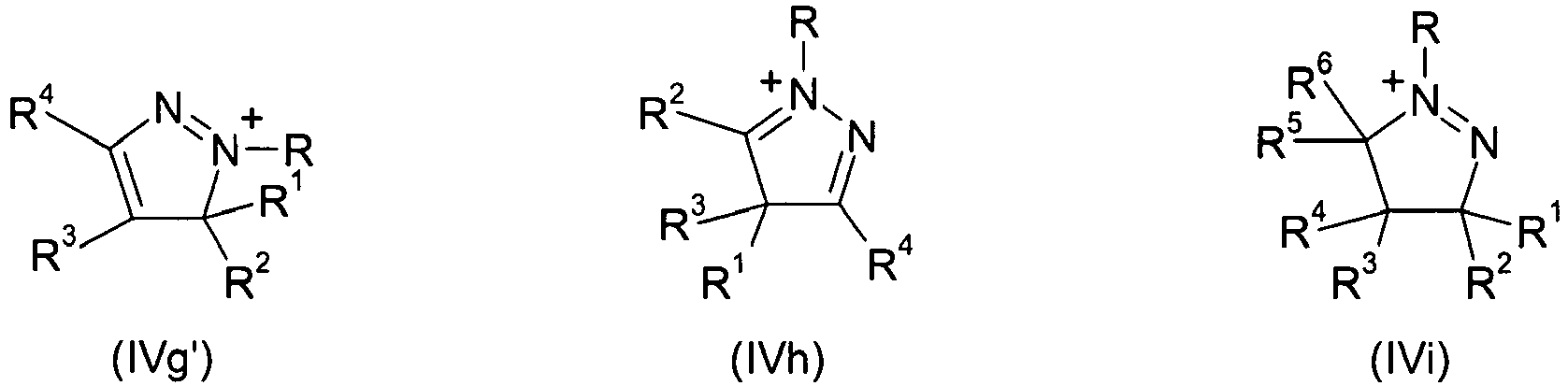


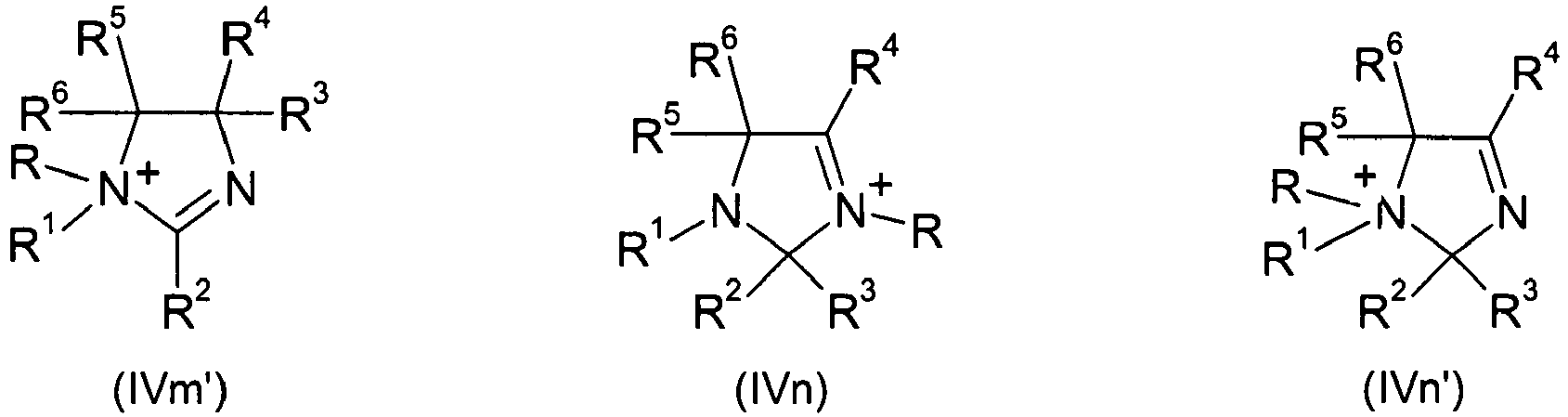

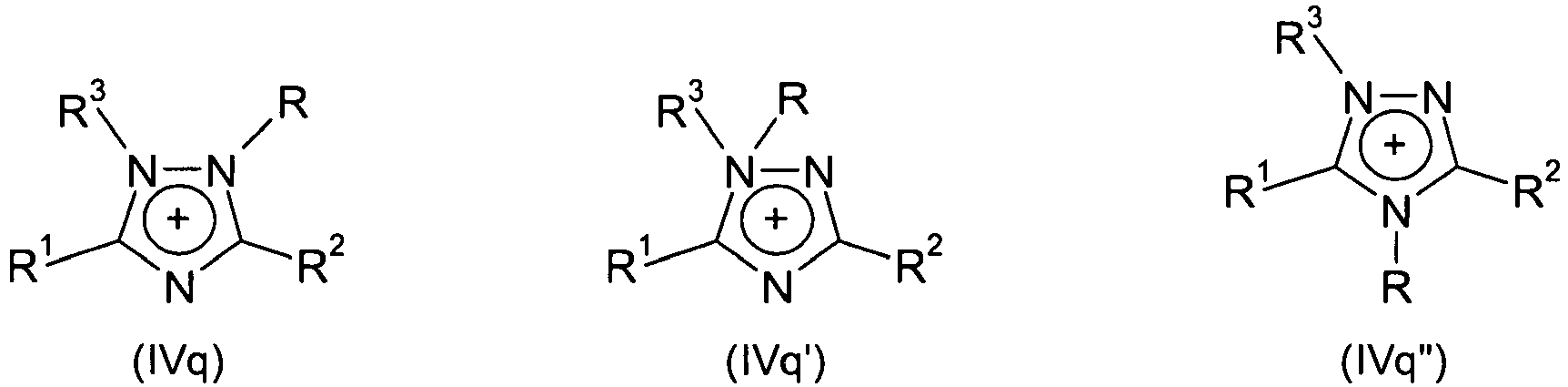


der Rest R für Wasserstoff, und
die Reste R1 bis R9 unabhängig voneinander für Wasserstoff, eine Sulfo-Gruppe oder einen Kohlenstoff enthaltenden organischen, gesättigten oder ungesättigten, acyclischen oder cyclischen, aliphatischen, aromatischen oder araliphatischen, unsubstituierten oder durch 1 bis 5 Heteroatome oder funktionelle Gruppen unterbrochenen oder substituierten Rest mit 1 bis 20 Kohlenstoffatomen stehen, wobei die Reste R1 bis R9, welche in den oben genannten Formeln (IV) an ein Kohlenstoffatom (und nicht an ein Heteroatom) gebunden sind, zusätzlich auch für Halogen oder eine funktionelle Gruppe stehen können; oder
zwei benachbarte Reste aus der Reihe R1 bis R9 zusammen auch für einen zweibindigen, Kohlenstoff enthaltenden organischen, gesättigten oder ungesättigten, acyclischen oder cyclischen, aliphatischen, aromatischen oder araliphatischen, unsubstituierten oder durch 1 bis 5 Heteroatome oder funktionelle Gruppen unterbrochenen oder substituierten Rest mit 1 bis 30 Kohlenstoffatomen stehen können. - Lösung nach Anspruch 1, dadurch gekennzeichnet, dass die Kationen mindestens ein Stickstoffatom aufweisen, das in protonierter Form als Ammoniumkation vorliegt.
- Lösung nach Anspruch 1 oder 2, dadurch gekennzeichnet, dass Cellulose mit mehr als 1 Gew.-% bezogen auf das Gesamtgewicht der Lösung in der Lösung enthalten ist.
- Lösung nach einem der Ansprüche 1 bis 3, dadurch gekennzeichnet, dass Anionen und Kationen ein Salz der allgemeinen Formel (I)

in der n für 1, 2, 3 oder 4 steht, [A]+ für ein quartäres Ammonium-Kation, ein Oxonium-Kation, ein Sulfonium-Kation oder ein Phosphonium-Kation und [Y]n- für ein ein-, zwei-, drei- oder vierwertiges Anion steht;
gemischte Salze der allgemeinen Formeln (II)
[A1][A2] [Y]n- (IIa),
wobei n = 2;
[A1]+[A2]+[A3]+ [Y]n- (IIb),
wobei n = 3; oder
[A1]+[A2]+[A3]+[A4]+ [Y]n- (IIc),
wobei n = 4 und wobei [A1]+, [A2]+, [A3]+ und [A4]+ unabhängig voneinander aus den für [A]+ genannten Gruppen ausgewählt sind und [Y]n- die zu Formel (I) genannte Bedeutung besitzt; oder
gemischte Salze der allgemeinen Formeln (III)
[A1]+[A2]+[A3]+[M1]+ [Y]n- (IIIa),
wobei n = 4;
[A1]+[A2]+[M1]+[M2]+ [Y]n- (IIIb),
wobei n = 4;
[A1]+[M1]+[M2]+[M3]+ [Y]n- (IIIc),
wobei n = 4;
[A1]+[A2]+[M1]+ [Y]n- (IIId),
wobei n = 3;
[A1]+[M1]+[M2]+ [Y]n- (IIIe),
wobei n = 3;
[A1]+[M1]+ [Y]n- (IIIf),
wobei n = 2;
[A1]+[A2]+[M4]2+ [Y]n- (IIIg),
wobei n = 4;
[A1]+[M1]+[M4]2+ [Y]n- (IIIh),
wobei n = 4;
[A1]+[M5]3+ [Y]n- (Illi),
wobei n = 4; oder
[A1]+[M4]2+ [Y]n- (IIIj),
wobei n = 3 und wobei [A1], [A2]+ und [A3]+ unabhängig voneinander aus den für [A]+ genannten Gruppen ausgewählt sind, [Y]n- die zu Formel (I) genannte Bedeutung besitzt und [M1]+, [M2]+, [M3]+ einwertige Metallkationen, [M4]2+ zweiwertige Metallkationen und [M5]3+ dreiwertige Metallkationen bedeuten, bilden. - Lösung nach einem der Ansprüche 1 bis 4, dadurch gekennzeichnet, dass die ionische Flüssigkeit mindestens ein Anion enthält, das ausgewählt ist aus der Gruppe bestehend ausder Gruppe der Halogenide und halogenhaltigen Verbindungen der Formel:F-, Cl-, Br-, I-, BF4 -, PF6 -, AlCl4 -, Al2Cl7 -, Al3Cl10 -, AlBr4 -, FeCl4 -, BCl4 -, SbF6-, AsF6,-ZnCl3 -, SnCl3 -, CuCl2 -, CF3SO3 -, (CF3SO3)2N-, CF3CO2 -, CCl3CO2 -, CN-, SCN-, OCN-,der Gruppe der Sulfate, Sulfite und Sulfonate der allgemeinen Formel:SO4 2-, HSO4 -, SO3 2-, HSO3 -, RaOSO3 -, RaSO3 -,der Gruppe der Phosphate der allgemeinen FormelPO4 3-, HPO4 2-, H2PO4 -, RaPO4 2-, HRaPO4 -, RaRbPO4 -,der Gruppe der Phosphonate und Phosphinate der allgemeinen Formel:RaHPO3 -,RaRbPO2 -, RaRbPO3 -,der Gruppe der Phosphite der allgemeinen Formel:PO3 3-, HPO3 2-, H2PO3 -, RaPO3 2-, RaHPO3 -, RaRbPO3 -,der Gruppe der Phosphonite und Phosphinite der allgemeinen Formel:RaRbPO2 -, RaHPO2 -, RaRbPO-, RaHPO-,der Gruppe der Carbonsäuren der allgemeinen Formel: RaCOO-,der Gruppe der Borate der allgemeinen Formel:BO3 3-, HBO3 2-, H2BO3 -, RaRbBO3 -, RaHBO3 -, RaBO3 2-, B(ORa)(ORb)(ORC)(ORd)-, B(HSO4)-, B(RaSO4)-,der Gruppe der Boronate der allgemeinen Formel RaBO2 2-, RaRbBO-,der Gruppe der Carbonate und Kohlensäureester der allgemeinen Formel:HCO3-, CO3 2-, RaCO3 -,der Gruppe der Silikate und Kieselsäuresäureester der allgemeinen Formel:SiO4 4-, HSiO4 3-, H2SiO4 2-, H3SiO4 -, RaSiO4 3-, RaRbSiO4 2-, RaRbRcSiO4 -, HRaSiO4 2-, H2RaSiO4 -, HRaRbSiO4 -,der Gruppe der Alkyl- bzw. Arylsilan-Salze der allgemeinen Formel:RaSiO3 3-, RaRbSiO2 2-, RaRbRcSiO-, RaRbRcSiO3 -, RaRbRcSiO2 -, RaRbSiO3 2-,der Gruppe der Carbonsäureimide, Bis(sulfonyl)imide und Sulfonylimide der allgemeinen Formel:
 der Gruppe der Methide der allgemeinen Formel:
 der Gruppe der Alkoxide und Aryloxide der allgemeinen Formel RaO-,der Gruppe der Halometallate der allgemeinen Formel [MqHalr]s-,
wobei M für ein Metall und Hal für Fluor, Chlor, Brom oder Iod steht, q und r ganze positive Zahlen sind und die Stöchiometrie des Komplexes angeben und s eine ganze positive Zahl ist und die Ladung des Komplexes angibt,der Gruppe der Sulfide, Hydrogensulfide, Polysulfide, Hydrogenpolysulfide und Thiolate der allgemeinen Formeln:S2-, HS-, [Sv]2-, [HSv]-, [RaS]-, wobei v eine ganze positive Zahl von 2 bis 10 ist, undder Gruppe der komplexen Metallionen wie Fe(CN)6 3-, Fe(CN)6 4-, MnO4 -, Fe(CO)4 -, wobeiRa, Rb, Rc und Rd unabhängig voneinander jeweils Wasserstoff, C1-C18-Alkyl, gegebenenfalls durch ein oder mehrere nicht-benachbarte Sauerstoff- und/oder Schwefelatome und/oder ein oder mehrere substituierte oder unsubstituierte Iminogruppen unterbrochenes C2-C,8-Alkyl, C6-C14-Aryl, C5-C12-Cycloalkyl oder einen fünf- bis sechsgliedrigen, Sauerstoff-, Stickstoff- und/oder Schwefelatome aufweisenden Heterocyclus sind, und wobei zwei von ihnen gemeinsam einen ungesättigten, gesättigten oder aromatischen, gegebenenfalls durch ein oder mehrere Sauerstoff- und/oder Schwefelatome und/oder ein oder mehrere unsubstituierte oder substituierte Iminogruppen unterbrochenen Ring bilden können, wobei die genannten Reste jeweils zusätzlich durch funktionelle Gruppen, Aryl, Alkyl, Aryloxy, Alkyloxy, Halogen, Heteroatome und/oder Heterocyclen substituiert sein können. - Lösung nach einem der Ansprüche 1 bis 5, dadurch gekennzeichnet, dass die Lösung eine Temperatur von höchstens 180°C aufweist.
- Verfahren zur Herstellung einer Lösung nach einem der Ansprüche 1 bis 6 die Schritte enthaltenda) Zugeben von Cellulose zu einer Lösung enthaltend eine ionische Flüssigkeit, wie in einem der Ansprüche 1 bis 6 angegeben undb) Vermischen der Lösung, bis die Cellulose vollständig aufgelöst ist.
- Verwendung einer Lösung nach einem der Ansprüche 1 bits 6 zur physikalischen oder chemischen Behandlung von Cellulose.
Applications Claiming Priority (2)
| Application Number | Priority Date | Filing Date | Title |
|---|---|---|---|
| DE102005017715A DE102005017715A1 (de) | 2005-04-15 | 2005-04-15 | Lösungen von Cellulose in ionischen Flüssigkeiten |
| PCT/EP2006/061422 WO2007057235A2 (de) | 2005-04-15 | 2006-04-07 | Lösungen von cellulose in ionischen flüssigkeiten |
Publications (2)
| Publication Number | Publication Date |
|---|---|
| EP1881994A2 EP1881994A2 (de) | 2008-01-30 |
| EP1881994B1 true EP1881994B1 (de) | 2016-08-24 |
Family
ID=37055478
Family Applications (1)
| Application Number | Title | Priority Date | Filing Date |
|---|---|---|---|
| EP06847012.9A Expired - Lifetime EP1881994B1 (de) | 2005-04-15 | 2006-04-07 | Lösungen von cellulose in ionischen flüssigkeiten |
Country Status (15)
| Country | Link |
|---|---|
| US (1) | US7749318B2 (de) |
| EP (1) | EP1881994B1 (de) |
| JP (1) | JP5260276B2 (de) |
| KR (1) | KR101376011B1 (de) |
| CN (1) | CN101160325B (de) |
| AU (1) | AU2006314736B2 (de) |
| BR (1) | BRPI0609083A2 (de) |
| CA (1) | CA2604557C (de) |
| DE (1) | DE102005017715A1 (de) |
| EA (1) | EA016748B1 (de) |
| IL (1) | IL185441A (de) |
| NO (1) | NO20074302L (de) |
| NZ (1) | NZ560914A (de) |
| WO (1) | WO2007057235A2 (de) |
| ZA (1) | ZA200708723B (de) |
Families Citing this family (63)
| Publication number | Priority date | Publication date | Assignee | Title |
|---|---|---|---|---|
| WO2008043837A1 (en) | 2006-10-13 | 2008-04-17 | Basf Se | Ionic liquids for solubilizing polymers |
| CN101589153A (zh) | 2007-01-23 | 2009-11-25 | 巴斯夫欧洲公司 | 通过对可用含多原子阴离子的离子液体预处理的纤维素进行酶促水解制备葡萄糖的方法 |
| BRPI0806908A2 (pt) * | 2007-01-23 | 2014-04-29 | Basf Se | Processos para a prepração de um produto de glicose a partir de um material lignocelulósico, e para a preparação de um produto de metabolismo microbiano, produto de glicose, e, produto de lignina |
| US8182557B2 (en) | 2007-02-06 | 2012-05-22 | North Carolina State University | Use of lignocellulosics solvated in ionic liquids for production of biofuels |
| WO2008098036A1 (en) * | 2007-02-06 | 2008-08-14 | North Carolina State University | Product preparation and recovery from thermolysis of lignocellulosics in ionic liquids |
| WO2008098037A2 (en) * | 2007-02-06 | 2008-08-14 | North Carolina State University | Polymer derivatives and composites from the dissolution of lignocellulosics in ionic liquids |
| US10174129B2 (en) | 2007-02-14 | 2019-01-08 | Eastman Chemical Company | Regioselectively substituted cellulose esters produced in a carboxylated ionic liquid process and products produced therefrom |
| US9834516B2 (en) * | 2007-02-14 | 2017-12-05 | Eastman Chemical Company | Regioselectively substituted cellulose esters produced in a carboxylated ionic liquid process and products produced therefrom |
| US7919631B2 (en) * | 2007-02-14 | 2011-04-05 | Eastman Chemical Company | Production of ionic liquids |
| FR2912748B1 (fr) | 2007-02-16 | 2009-11-13 | Centre Nat Rech Scient | Alkyl h-phosphonates de n,n'-dialkylimidazouliums, d'ammoniums quaternaires et leurs utilisations |
| US7674608B2 (en) | 2007-02-23 | 2010-03-09 | The University Of Toledo | Saccharifying cellulose |
| CN104232704A (zh) * | 2007-03-14 | 2014-12-24 | 托莱多大学 | 生物质预处理 |
| EP2146949B1 (de) | 2007-05-05 | 2017-03-01 | Basf Se | Ionische flüssigkeiten mit polyethercarboxylaten als anionen, deren herstellung und verwendung |
| EP2033973A1 (de) * | 2007-09-06 | 2009-03-11 | The Queen's University of Belfast | Konversionsverfahren |
| EP2033974A1 (de) | 2007-09-06 | 2009-03-11 | The Queens University of Belfast | Konversionsverfahren |
| EP2062922A1 (de) * | 2007-11-14 | 2009-05-27 | Basf Se | Verfahren zur Herstellung von regenerierten Biopolymeren und die danach erhältlichen regenerierten Erzeugnisse |
| US8354525B2 (en) | 2008-02-13 | 2013-01-15 | Eastman Chemical Company | Regioselectively substituted cellulose esters produced in a halogenated ionic liquid process and products produced therefrom |
| US8158777B2 (en) | 2008-02-13 | 2012-04-17 | Eastman Chemical Company | Cellulose esters and their production in halogenated ionic liquids |
| US9777074B2 (en) | 2008-02-13 | 2017-10-03 | Eastman Chemical Company | Regioselectively substituted cellulose esters produced in a halogenated ionic liquid process and products produced therefrom |
| US8188267B2 (en) | 2008-02-13 | 2012-05-29 | Eastman Chemical Company | Treatment of cellulose esters |
| US8198219B2 (en) | 2008-02-22 | 2012-06-12 | Basf Se | Method for producing solid materials on the basis of synthetic polymers and/or biopolymers and use thereof |
| DE102008014735A1 (de) | 2008-03-18 | 2009-09-24 | Studiengesellschaft Kohle Mbh | Verfahren zur Depolymerisation von Zellulose |
| DE102008029927B4 (de) * | 2008-06-26 | 2013-06-20 | Projektentwicklung Energie Und Umwelt Leipzig Gmbh | Flash-Pyrolyse von organischen Stoffen mit ionischer Flüssigkeit als Wärmeträger zur Herstellung von öligen bzw. gasförmigen Zwischenprodukten |
| US7999355B2 (en) * | 2008-07-11 | 2011-08-16 | Air Products And Chemicals, Inc. | Aminosilanes for shallow trench isolation films |
| US8435355B2 (en) | 2008-12-29 | 2013-05-07 | Weyerhaeuser Nr Company | Fractionation of lignocellulosic material using ionic liquids |
| DE102009016001A1 (de) | 2009-04-02 | 2010-10-07 | Rheinisch-Westfälische Technische Hochschule Aachen | Verfahren zur Hydrolyse von Celluloserohstoffen |
| US8524887B2 (en) | 2009-04-15 | 2013-09-03 | Eastman Chemical Company | Regioselectively substituted cellulose esters produced in a tetraalkylammonium alkylphosphate ionic liquid process and products produced therefrom |
| DE102009023458A1 (de) * | 2009-06-02 | 2010-12-30 | Carl Freudenberg Kg | Lösung, umfassend Cellulose, Verfahren zu deren Herstellung sowie deren Verwendung |
| EP2486175B1 (de) * | 2009-10-07 | 2015-05-20 | Grasim Industries Limited | Verfahren zur herstellung von niedrig fibrillierenden cellulosefasern |
| FI20105272L (fi) | 2010-03-18 | 2011-09-19 | Univ Helsinki | Menetelmä lignoselluloosamateriaalin fibrilloimiseksi, kuidut ja niiden käyttö |
| DE102010024827A1 (de) | 2010-06-23 | 2011-12-29 | Studiengesellschaft Kohle Mbh | Verfahren zum Auflösen von Zellulose |
| FI125827B (fi) | 2010-06-23 | 2016-02-29 | Stora Enso Oyj | Menetelmä lignoselluloosamateriaalien liuottamiseksi |
| US8980050B2 (en) | 2012-08-20 | 2015-03-17 | Celanese International Corporation | Methods for removing hemicellulose |
| DE102011119840A1 (de) | 2010-12-01 | 2012-06-06 | Technische Universität Ilmenau | Polymerlösungen in ionischen Flüssigkeiten mit verbesserter thermischer und rheologischer Stabilität |
| DE102010061485A1 (de) | 2010-12-22 | 2012-06-28 | Chemetall Gmbh | Elektroden für Lithium-Batterien |
| US9096691B2 (en) | 2011-04-13 | 2015-08-04 | Eastman Chemical Company | Cellulose ester optical films |
| JP6120266B2 (ja) * | 2011-12-09 | 2017-04-26 | 国立大学法人 岡山大学 | セルロース水溶液の製造方法およびセルロース誘導体の製造方法 |
| CN103183832B (zh) * | 2011-12-28 | 2015-11-18 | 中国科学院青岛生物能源与过程研究所 | 一种磁性纤维素壳聚糖复合微球的制备方法 |
| WO2013188966A1 (en) * | 2012-06-21 | 2013-12-27 | Chemgreen Innovation Inc. | Cellulose-polymer composites for solar cells |
| US8986501B2 (en) | 2012-08-20 | 2015-03-24 | Celanese International Corporation | Methods for removing hemicellulose |
| CN102838761B (zh) * | 2012-08-27 | 2014-05-07 | 中国热带农业科学院农产品加工研究所 | 一种防止纤维素在离子液体中降解的方法 |
| CN103833620A (zh) * | 2012-11-26 | 2014-06-04 | 海洋王照明科技股份有限公司 | 含硫类离子液体及其制备方法和应用 |
| WO2014106650A2 (de) | 2013-01-03 | 2014-07-10 | EZER, Argun | Verfahren und vorrichtungen zur verölung von kohlenwasserstoffhaltigem eingangsmaterial |
| US11118308B2 (en) | 2013-03-15 | 2021-09-14 | Ip2Ipo Innovations Limited | Treatment of lignocellulosic biomass with ionic liquid |
| US10240259B2 (en) | 2013-04-04 | 2019-03-26 | Aalto University Foundation Sr | Process for the production of shaped cellulose articles |
| CN113292661B (zh) * | 2013-05-24 | 2022-09-23 | 美真泉公司 | 改性聚合物的方法 |
| CN104610557B (zh) | 2013-11-01 | 2018-03-02 | 中国科学院化学研究所 | 一种再生纤维素膜、功能膜及其制备方法 |
| US9708760B2 (en) | 2014-06-30 | 2017-07-18 | International Paper Company | Esterified cellulose pulp compositions and related methods |
| US9222223B1 (en) | 2014-06-30 | 2015-12-29 | Weyerhaeuser Nr Company | Esterified cellulose pulp compositions and related methods |
| GB201520453D0 (en) | 2015-11-20 | 2016-01-06 | Imp Innovations Ltd | Process |
| CN105396561A (zh) * | 2015-12-12 | 2016-03-16 | 常州大学 | 一种综纤维素/壳聚糖微球吸附剂的制备方法 |
| EP3574136A1 (de) | 2017-01-30 | 2019-12-04 | Aalto University Foundation sr | Verfahren zur herstellung einer cellulosefaser oder -folie |
| EP3684571A4 (de) | 2017-09-08 | 2021-07-14 | DTE Materials Incorporated | Selektiv depolymerisierende cellulosematerialien zur verwendung als thermische und akustische isolatoren |
| GB2583719B (en) | 2019-05-02 | 2023-05-31 | Worn Again Tech Ltd | Recycling process |
| CN111945455A (zh) * | 2020-07-29 | 2020-11-17 | 中北大学 | 一种谷糠纤维素的提取方法及谷糠纤维膜的制备方法 |
| EP3978038A1 (de) | 2020-10-04 | 2022-04-06 | Elke Münch | Durch eine temperaturdifferenz betreibbare, mobile vorrichtung zur reinigung und desinfizierung von raumluft und eine testvorrichtung hierfür |
| DE102020125919B4 (de) | 2020-10-04 | 2022-06-23 | Elke Münch | Durch eine Temperaturdifferenz betreibbare, mobile Vorrichtung zur Reinigung und Desinfizierung von Raumluft und eine Testvorrichtung hierfür |
| DE102020125920B4 (de) | 2020-10-04 | 2022-05-19 | Elke Münch | Durch eine Temperaturdifferenz betreibbare, mobile Vorrichtung zur Reinigung und Desinfizierung von Raumluft |
| EP3981442A1 (de) | 2020-10-04 | 2022-04-13 | Elke Münch | Durch eine temperaturdifferenz betreibbare, mobile vorrichtung zur reinigung und desinfizierung von raumluft |
| DE102020125922B4 (de) | 2020-10-04 | 2022-06-02 | Elke Münch | Mobile Vorrichtung zur Reinigung und Desinfizierung von Raumluft |
| DE102020125921B4 (de) | 2020-10-04 | 2022-05-19 | Elke Münch | Durch eine Temperaturdifferenz betreibbare, mobile Vorrichtung zur Reinigung und Desinfizierung von Raumluft |
| DE102020006226B4 (de) | 2020-10-10 | 2023-05-25 | LUCRAT GmbH | Mobile Vorichtung für die Reinigung und Desinfektion von Raumluft, Bausätze für ihren Zusammenbau und ihre Verwendung |
| DE102024102529B3 (de) | 2024-01-30 | 2025-01-09 | Elke Münch | Vorrichtung und Verfahren für die reversible Adsorption und Desorption des Kohlendioxids in Verbrennungsabgasen |
Family Cites Families (11)
| Publication number | Priority date | Publication date | Assignee | Title |
|---|---|---|---|---|
| US1943176A (en) * | 1930-09-27 | 1934-01-09 | Chem Ind Basel | Cellulose solution |
| US4367191A (en) * | 1981-03-25 | 1983-01-04 | Research Corporation | Preparation of cellulose films or fibers from cellulose solutions |
| US4750939A (en) | 1986-12-02 | 1988-06-14 | North Carolina State University | Anisotropic cellulose solutions, fibers, and films formed therefrom |
| FR2617511B1 (fr) | 1987-07-01 | 1989-12-15 | Inst Textile De France | Procede de preparation d'une solution de filage de cellulose en presence d'oxyde d'amine tertiaire et d'additif |
| US6824599B2 (en) * | 2001-10-03 | 2004-11-30 | The University Of Alabama | Dissolution and processing of cellulose using ionic liquids |
| US6808557B2 (en) * | 2001-10-03 | 2004-10-26 | The University Of Alabama | Cellulose matrix encapsulation and method |
| DE10202838A1 (de) | 2002-01-24 | 2003-08-07 | Basf Ag | Verfahren zur Abtrennung von Säuren aus chemischen Reaktionsgemischen mit Hilfe von ionischen Flüssigkeiten |
| AR038161A1 (es) * | 2002-01-24 | 2004-12-29 | Basf Ag | Procedimiento para separar acidos de mezclas de reaccion quimicas con la ayuda de liquidos ionicos |
| JP4186063B2 (ja) * | 2003-09-19 | 2008-11-26 | 富士フイルム株式会社 | セルロース組成物、セルロースフィルム、およびセルロースフィルム用の改質剤 |
| DE102005017733A1 (de) | 2005-04-15 | 2006-10-19 | Basf Ag | Löslichkeit von Cellulose in ionischen Flüssigkeiten unter Zugabe von Aminbase |
| DE102005062608A1 (de) * | 2005-12-23 | 2007-07-05 | Basf Ag | Lösungssystem auf der Basis geschmolzener ionischer Flüssigkeiten ein Verfahren zu dessen Herstellung sowie zur Herstellung regenerierter Kohlenydrate |
-
2005
- 2005-04-15 DE DE102005017715A patent/DE102005017715A1/de not_active Withdrawn
-
2006
- 2006-04-07 BR BRPI0609083-4A patent/BRPI0609083A2/pt not_active IP Right Cessation
- 2006-04-07 EA EA200701783A patent/EA016748B1/ru not_active IP Right Cessation
- 2006-04-07 CN CN200680012598XA patent/CN101160325B/zh not_active Expired - Fee Related
- 2006-04-07 CA CA2604557A patent/CA2604557C/en not_active Expired - Fee Related
- 2006-04-07 US US11/908,969 patent/US7749318B2/en not_active Expired - Fee Related
- 2006-04-07 WO PCT/EP2006/061422 patent/WO2007057235A2/de not_active Ceased
- 2006-04-07 NZ NZ560914A patent/NZ560914A/en not_active IP Right Cessation
- 2006-04-07 EP EP06847012.9A patent/EP1881994B1/de not_active Expired - Lifetime
- 2006-04-07 JP JP2008505869A patent/JP5260276B2/ja not_active Expired - Fee Related
- 2006-04-07 AU AU2006314736A patent/AU2006314736B2/en not_active Ceased
- 2006-04-07 KR KR1020077023408A patent/KR101376011B1/ko not_active Expired - Fee Related
-
2007
- 2007-08-22 IL IL185441A patent/IL185441A/en not_active IP Right Cessation
- 2007-08-22 NO NO20074302A patent/NO20074302L/no not_active Application Discontinuation
- 2007-10-12 ZA ZA200708723A patent/ZA200708723B/xx unknown
Also Published As
| Publication number | Publication date |
|---|---|
| JP2008536972A (ja) | 2008-09-11 |
| EA200701783A1 (ru) | 2008-04-28 |
| ZA200708723B (en) | 2009-08-26 |
| CA2604557C (en) | 2016-06-21 |
| CA2604557A1 (en) | 2007-05-24 |
| WO2007057235A2 (de) | 2007-05-24 |
| IL185441A (en) | 2013-04-30 |
| KR20080006550A (ko) | 2008-01-16 |
| NO20074302L (no) | 2008-01-09 |
| AU2006314736A1 (en) | 2007-05-24 |
| US20080190321A1 (en) | 2008-08-14 |
| BRPI0609083A2 (pt) | 2010-11-16 |
| WO2007057235A3 (de) | 2007-12-13 |
| DE102005017715A1 (de) | 2006-10-19 |
| IL185441A0 (en) | 2008-08-07 |
| JP5260276B2 (ja) | 2013-08-14 |
| AU2006314736B2 (en) | 2012-02-23 |
| EA016748B1 (ru) | 2012-07-30 |
| CN101160325A (zh) | 2008-04-09 |
| NZ560914A (en) | 2011-02-25 |
| US7749318B2 (en) | 2010-07-06 |
| KR101376011B1 (ko) | 2014-03-19 |
| EP1881994A2 (de) | 2008-01-30 |
| CN101160325B (zh) | 2012-04-04 |
Similar Documents
| Publication | Publication Date | Title |
|---|---|---|
| EP1881994B1 (de) | Lösungen von cellulose in ionischen flüssigkeiten | |
| EP1893651B1 (de) | Löslichkeit von cellulose in ionischen flüssigkeiten unter zugabe von aminbase | |
| EP3824012B1 (de) | Bulkpolymerisierung von polyoxazolidon | |
| DE102005062608A1 (de) | Lösungssystem auf der Basis geschmolzener ionischer Flüssigkeiten ein Verfahren zu dessen Herstellung sowie zur Herstellung regenerierter Kohlenydrate | |
| EP2038307A1 (de) | Verfahren zur acylierung von cellulose mit gezieltem durchschnittlichen polymerisationsgrad | |
| EP1994060A1 (de) | Verfahren zum abbau von cellulose | |
| EP2035458A1 (de) | Verfahren zur acylierung von cellulose | |
| DE102006011075A1 (de) | Verfahren zum Abbau von Cellulose in Lösung | |
| DE102005055815A1 (de) | Verfahren zur Herstellung von ionischen Flüssigkeiten | |
| EP1994058A1 (de) | Verfahren zum abbau von cellulose mit nucleophilen | |
| DE102010028583B4 (de) | Abbau von Polyurethanen in Gegenwart spezieller ionischer Flüssigkeiten und einem geringen Wasseranteil | |
| WO2008022983A2 (de) | Leitfähige polymergele | |
| DE102009003011A1 (de) | Verwendung von ionischen Flüssigkeiten als Klebstoff | |
| DE102006035830A9 (de) | Lösungssystem auf der Basis geschmolzener ionischer Flüssigkeiten, dessen Herstellung sowie Verwendung zur Herstellung regenerierter Kohlenhydrate | |
| DE102006011076A1 (de) | Verfahren zum Abbau von Cellulose | |
| DE102009027094A1 (de) | Verfahren zur Zementation von Nickel und/oder Kobalt auf Kupfer | |
| DE102006031810A1 (de) | Verfahren zur Darstellung von Celluloseacetalen | |
| DE102006042892A1 (de) | Verfahren zur Acylierung von Cellulose mit gezieltem durchschnittlichen Polymerisationsgrad | |
| DE102006030696A1 (de) | Verfahren zur Acylierung von Cellulose mit gezieltem durchschnittlichen Polymerisationsgrad | |
| DE102006054213A1 (de) | Verfahren zur Darstellung von Celluloseacetalen | |
| DE102006042891A1 (de) | Verfahren zum Abbau von Cellulose | |
| WO2007088152A1 (de) | Verfahren zur herstellung von isocyanaten |
Legal Events
| Date | Code | Title | Description |
|---|---|---|---|
| PUAI | Public reference made under article 153(3) epc to a published international application that has entered the european phase |
Free format text: ORIGINAL CODE: 0009012 |
|
| AK | Designated contracting states |
Kind code of ref document: A2 Designated state(s): AT BE BG CH CY CZ DE DK EE ES FI FR GB GR HU IE IS IT LI LT LU LV MC NL PL PT RO SE SI SK TR |
|
| AX | Request for extension of the european patent |
Extension state: AL BA HR MK YU |
|
| RAP1 | Party data changed (applicant data changed or rights of an application transferred) |
Owner name: BASF SE |
|
| RIC1 | Information provided on ipc code assigned before grant |
Ipc: C08B 1/00 20060101AFI20080214BHEP Ipc: C08L 1/02 20060101ALI20080214BHEP |
|
| DAX | Request for extension of the european patent (deleted) | ||
| 17P | Request for examination filed |
Effective date: 20080613 |
|
| RBV | Designated contracting states (corrected) |
Designated state(s): AT BE BG CH CY CZ DE DK EE ES FI FR GB GR HU IE IS IT LI LT LU LV MC NL PL PT RO SE SI SK TR |
|
| REG | Reference to a national code |
Ref country code: DE Ref legal event code: 8566 |
|
| 17Q | First examination report despatched |
Effective date: 20080904 |
|
| GRAP | Despatch of communication of intention to grant a patent |
Free format text: ORIGINAL CODE: EPIDOSNIGR1 |
|
| INTG | Intention to grant announced |
Effective date: 20160510 |
|
| GRAS | Grant fee paid |
Free format text: ORIGINAL CODE: EPIDOSNIGR3 |
|
| GRAA | (expected) grant |
Free format text: ORIGINAL CODE: 0009210 |
|
| AK | Designated contracting states |
Kind code of ref document: B1 Designated state(s): AT BE BG CH CY CZ DE DK EE ES FI FR GB GR HU IE IS IT LI LT LU LV MC NL PL PT RO SE SI SK TR |
|
| REG | Reference to a national code |
Ref country code: GB Ref legal event code: FG4D Free format text: NOT ENGLISH |
|
| REG | Reference to a national code |
Ref country code: CH Ref legal event code: EP |
|
| REG | Reference to a national code |
Ref country code: AT Ref legal event code: REF Ref document number: 823028 Country of ref document: AT Kind code of ref document: T Effective date: 20160915 |
|
| REG | Reference to a national code |
Ref country code: IE Ref legal event code: FG4D Free format text: LANGUAGE OF EP DOCUMENT: GERMAN |
|
| REG | Reference to a national code |
Ref country code: DE Ref legal event code: R096 Ref document number: 502006015129 Country of ref document: DE |
|
| REG | Reference to a national code |
Ref country code: SE Ref legal event code: TRGR |
|
| REG | Reference to a national code |
Ref country code: LT Ref legal event code: MG4D |
|
| REG | Reference to a national code |
Ref country code: NL Ref legal event code: MP Effective date: 20160824 |
|
| PG25 | Lapsed in a contracting state [announced via postgrant information from national office to epo] |
Ref country code: IT Free format text: LAPSE BECAUSE OF FAILURE TO SUBMIT A TRANSLATION OF THE DESCRIPTION OR TO PAY THE FEE WITHIN THE PRESCRIBED TIME-LIMIT Effective date: 20160824 Ref country code: LT Free format text: LAPSE BECAUSE OF FAILURE TO SUBMIT A TRANSLATION OF THE DESCRIPTION OR TO PAY THE FEE WITHIN THE PRESCRIBED TIME-LIMIT Effective date: 20160824 Ref country code: NL Free format text: LAPSE BECAUSE OF FAILURE TO SUBMIT A TRANSLATION OF THE DESCRIPTION OR TO PAY THE FEE WITHIN THE PRESCRIBED TIME-LIMIT Effective date: 20160824 |
|
| PG25 | Lapsed in a contracting state [announced via postgrant information from national office to epo] |
Ref country code: GR Free format text: LAPSE BECAUSE OF FAILURE TO SUBMIT A TRANSLATION OF THE DESCRIPTION OR TO PAY THE FEE WITHIN THE PRESCRIBED TIME-LIMIT Effective date: 20161125 Ref country code: LV Free format text: LAPSE BECAUSE OF FAILURE TO SUBMIT A TRANSLATION OF THE DESCRIPTION OR TO PAY THE FEE WITHIN THE PRESCRIBED TIME-LIMIT Effective date: 20160824 Ref country code: ES Free format text: LAPSE BECAUSE OF FAILURE TO SUBMIT A TRANSLATION OF THE DESCRIPTION OR TO PAY THE FEE WITHIN THE PRESCRIBED TIME-LIMIT Effective date: 20160824 Ref country code: PT Free format text: LAPSE BECAUSE OF FAILURE TO SUBMIT A TRANSLATION OF THE DESCRIPTION OR TO PAY THE FEE WITHIN THE PRESCRIBED TIME-LIMIT Effective date: 20161226 |
|
| PG25 | Lapsed in a contracting state [announced via postgrant information from national office to epo] |
Ref country code: EE Free format text: LAPSE BECAUSE OF FAILURE TO SUBMIT A TRANSLATION OF THE DESCRIPTION OR TO PAY THE FEE WITHIN THE PRESCRIBED TIME-LIMIT Effective date: 20160824 Ref country code: RO Free format text: LAPSE BECAUSE OF FAILURE TO SUBMIT A TRANSLATION OF THE DESCRIPTION OR TO PAY THE FEE WITHIN THE PRESCRIBED TIME-LIMIT Effective date: 20160824 |
|
| REG | Reference to a national code |
Ref country code: DE Ref legal event code: R097 Ref document number: 502006015129 Country of ref document: DE |
|
| PG25 | Lapsed in a contracting state [announced via postgrant information from national office to epo] |
Ref country code: BG Free format text: LAPSE BECAUSE OF FAILURE TO SUBMIT A TRANSLATION OF THE DESCRIPTION OR TO PAY THE FEE WITHIN THE PRESCRIBED TIME-LIMIT Effective date: 20161124 Ref country code: DK Free format text: LAPSE BECAUSE OF FAILURE TO SUBMIT A TRANSLATION OF THE DESCRIPTION OR TO PAY THE FEE WITHIN THE PRESCRIBED TIME-LIMIT Effective date: 20160824 Ref country code: CZ Free format text: LAPSE BECAUSE OF FAILURE TO SUBMIT A TRANSLATION OF THE DESCRIPTION OR TO PAY THE FEE WITHIN THE PRESCRIBED TIME-LIMIT Effective date: 20160824 Ref country code: SK Free format text: LAPSE BECAUSE OF FAILURE TO SUBMIT A TRANSLATION OF THE DESCRIPTION OR TO PAY THE FEE WITHIN THE PRESCRIBED TIME-LIMIT Effective date: 20160824 Ref country code: PL Free format text: LAPSE BECAUSE OF FAILURE TO SUBMIT A TRANSLATION OF THE DESCRIPTION OR TO PAY THE FEE WITHIN THE PRESCRIBED TIME-LIMIT Effective date: 20160824 |
|
| PLBE | No opposition filed within time limit |
Free format text: ORIGINAL CODE: 0009261 |
|
| STAA | Information on the status of an ep patent application or granted ep patent |
Free format text: STATUS: NO OPPOSITION FILED WITHIN TIME LIMIT |
|
| 26N | No opposition filed |
Effective date: 20170526 |
|
| PG25 | Lapsed in a contracting state [announced via postgrant information from national office to epo] |
Ref country code: SI Free format text: LAPSE BECAUSE OF FAILURE TO SUBMIT A TRANSLATION OF THE DESCRIPTION OR TO PAY THE FEE WITHIN THE PRESCRIBED TIME-LIMIT Effective date: 20160824 |
|
| REG | Reference to a national code |
Ref country code: CH Ref legal event code: PL |
|
| GBPC | Gb: european patent ceased through non-payment of renewal fee |
Effective date: 20170407 |
|
| REG | Reference to a national code |
Ref country code: IE Ref legal event code: MM4A |
|
| REG | Reference to a national code |
Ref country code: FR Ref legal event code: ST Effective date: 20171229 |
|
| PG25 | Lapsed in a contracting state [announced via postgrant information from national office to epo] |
Ref country code: MC Free format text: LAPSE BECAUSE OF FAILURE TO SUBMIT A TRANSLATION OF THE DESCRIPTION OR TO PAY THE FEE WITHIN THE PRESCRIBED TIME-LIMIT Effective date: 20160824 Ref country code: FR Free format text: LAPSE BECAUSE OF NON-PAYMENT OF DUE FEES Effective date: 20170502 |
|
| PG25 | Lapsed in a contracting state [announced via postgrant information from national office to epo] |
Ref country code: CH Free format text: LAPSE BECAUSE OF NON-PAYMENT OF DUE FEES Effective date: 20170430 Ref country code: GB Free format text: LAPSE BECAUSE OF NON-PAYMENT OF DUE FEES Effective date: 20170407 Ref country code: LU Free format text: LAPSE BECAUSE OF NON-PAYMENT OF DUE FEES Effective date: 20170407 Ref country code: LI Free format text: LAPSE BECAUSE OF NON-PAYMENT OF DUE FEES Effective date: 20170430 |
|
| REG | Reference to a national code |
Ref country code: BE Ref legal event code: MM Effective date: 20170430 |
|
| PG25 | Lapsed in a contracting state [announced via postgrant information from national office to epo] |
Ref country code: IE Free format text: LAPSE BECAUSE OF NON-PAYMENT OF DUE FEES Effective date: 20170407 |
|
| PG25 | Lapsed in a contracting state [announced via postgrant information from national office to epo] |
Ref country code: BE Free format text: LAPSE BECAUSE OF NON-PAYMENT OF DUE FEES Effective date: 20170430 |
|
| PGFP | Annual fee paid to national office [announced via postgrant information from national office to epo] |
Ref country code: FI Payment date: 20180420 Year of fee payment: 13 |
|
| PGFP | Annual fee paid to national office [announced via postgrant information from national office to epo] |
Ref country code: AT Payment date: 20180426 Year of fee payment: 13 |
|
| PGFP | Annual fee paid to national office [announced via postgrant information from national office to epo] |
Ref country code: SE Payment date: 20180427 Year of fee payment: 13 |
|
| PGFP | Annual fee paid to national office [announced via postgrant information from national office to epo] |
Ref country code: DE Payment date: 20180629 Year of fee payment: 13 |
|
| PG25 | Lapsed in a contracting state [announced via postgrant information from national office to epo] |
Ref country code: HU Free format text: LAPSE BECAUSE OF FAILURE TO SUBMIT A TRANSLATION OF THE DESCRIPTION OR TO PAY THE FEE WITHIN THE PRESCRIBED TIME-LIMIT; INVALID AB INITIO Effective date: 20060407 |
|
| PG25 | Lapsed in a contracting state [announced via postgrant information from national office to epo] |
Ref country code: CY Free format text: LAPSE BECAUSE OF NON-PAYMENT OF DUE FEES Effective date: 20160824 |
|
| REG | Reference to a national code |
Ref country code: DE Ref legal event code: R119 Ref document number: 502006015129 Country of ref document: DE |
|
| REG | Reference to a national code |
Ref country code: SE Ref legal event code: EUG |
|
| REG | Reference to a national code |
Ref country code: AT Ref legal event code: MM01 Ref document number: 823028 Country of ref document: AT Kind code of ref document: T Effective date: 20190407 |
|
| PG25 | Lapsed in a contracting state [announced via postgrant information from national office to epo] |
Ref country code: AT Free format text: LAPSE BECAUSE OF NON-PAYMENT OF DUE FEES Effective date: 20190407 Ref country code: DE Free format text: LAPSE BECAUSE OF NON-PAYMENT OF DUE FEES Effective date: 20191101 Ref country code: SE Free format text: LAPSE BECAUSE OF NON-PAYMENT OF DUE FEES Effective date: 20190408 Ref country code: FI Free format text: LAPSE BECAUSE OF NON-PAYMENT OF DUE FEES Effective date: 20190407 |
|
| PG25 | Lapsed in a contracting state [announced via postgrant information from national office to epo] |
Ref country code: TR Free format text: LAPSE BECAUSE OF FAILURE TO SUBMIT A TRANSLATION OF THE DESCRIPTION OR TO PAY THE FEE WITHIN THE PRESCRIBED TIME-LIMIT Effective date: 20160824 |
|
| PG25 | Lapsed in a contracting state [announced via postgrant information from national office to epo] |
Ref country code: IS Free format text: LAPSE BECAUSE OF FAILURE TO SUBMIT A TRANSLATION OF THE DESCRIPTION OR TO PAY THE FEE WITHIN THE PRESCRIBED TIME-LIMIT Effective date: 20161224 |