EP1882901A2 - Méthode et dispositif pour la manipulation des données d'itinéraire dans un véhicule - Google Patents
Méthode et dispositif pour la manipulation des données d'itinéraire dans un véhicule Download PDFInfo
- Publication number
- EP1882901A2 EP1882901A2 EP07112690A EP07112690A EP1882901A2 EP 1882901 A2 EP1882901 A2 EP 1882901A2 EP 07112690 A EP07112690 A EP 07112690A EP 07112690 A EP07112690 A EP 07112690A EP 1882901 A2 EP1882901 A2 EP 1882901A2
- Authority
- EP
- European Patent Office
- Prior art keywords
- segment
- vehicle
- route
- database
- traveled
- Prior art date
- Legal status (The legal status is an assumption and is not a legal conclusion. Google has not performed a legal analysis and makes no representation as to the accuracy of the status listed.)
- Granted
Links
Images



Classifications
-
- G—PHYSICS
- G01—MEASURING; TESTING
- G01C—MEASURING DISTANCES, LEVELS OR BEARINGS; SURVEYING; NAVIGATION; GYROSCOPIC INSTRUMENTS; PHOTOGRAMMETRY OR VIDEOGRAMMETRY
- G01C21/00—Navigation; Navigational instruments not provided for in groups G01C1/00 - G01C19/00
- G01C21/26—Navigation; Navigational instruments not provided for in groups G01C1/00 - G01C19/00 specially adapted for navigation in a road network
- G01C21/34—Route searching; Route guidance
- G01C21/3453—Special cost functions, i.e. other than distance or default speed limit of road segments
- G01C21/3484—Personalized, e.g. from learned user behaviour or user-defined profiles
Definitions
- the present invention relates to a method and apparatus for processing trip information in a vehicle.
- EP 0 697 686 A2 A navigation method is known in which the existing from the current location of previous routes are kept in order to free the driver when entering the same route repeatedly from the input of the destination. For this purpose, the earlier routes are displayed to the driver and optionally weighted according to their frequency.
- Out DE 195 35 576 A1 It is known to derive the respective target position automatically to probability factors based on stored driving information from the past to minimize the input effort by the driver.
- Such accumulation of position information is done in a conventional manner such that from the start of the vehicle (location) until the shutdown of Motors (destination) complete routes are stored in a database, so that a correspondingly large database is generated.
- To detect a routine trip the current segment on which the vehicle is currently located is read from the digital map and compared with the routes in the database. Accordingly, a considerable storage space is required and the data processing becomes computationally intensive and complicated.
- the data record can be supplied to a database, for example, in which it is used by the vehicle before it reaches the relevant node Distance segment is assigned.
- the detection of the spatial positions is satellite navigation-based, for example by means of a GPS navigation system.
- a database of route segment transitions is thus initially set up by generating a data record for each route segment transition.
- Each of these data records contains the current route segment (hereinafter also the starting segment) and the following segment for the definition of the route segment transition. From the determination of the starting segment and the following segment, the direction of travel can be calculated directly.
- the database constructed according to the invention thus already contains all information necessary for a statistical route forecast. The fact that this information does not contain the complete route, but only fragments, the required storage space and computational effort is significantly reduced.
- the records stored in the database are managed independently of each other.
- the data sets for a trip route prediction performed on the basis of the database can be retrieved and evaluated independently of one another and thus, in particular, independently of the route on which they were generated, individually and detached from one another.
- Storage space and computation time can be saved by having segments that are traversed in the same way in the case of several different routes (ie with the same source and destination segments), in principle only need to be stored once. It is also possible to monitor individual data records as to how often the associated source and subsequent segments are passed through. Rarely affected data records can be deleted from the database after a certain "expiration time". It does not necessarily delete entire routes, but it will from a once recorded route individual records deleted, while other records of this route that have been touched during the course of other routes can be preserved.
- each record generated after passing through a node preferably comprises the output link segment and the following segment after the node, but not the link segment last traveled before the output link segment.
- the data structure is thus simply concatenated and not concatenated twice (ie in the forward and backward direction).
- the predictive quality can be further improved or further data can be provided for additional applications, even if they are not used directly for pure route prediction.
- one or more of the following data fields can be provided for each route segment transition or data record: current driver of the vehicle; The time of day when the route segment concerned was used; Day of the week on which the route segment in question was traveled; the frequency with which track segments accessible by the segment in question have been traveled in the past; Turn signal activity of the vehicle; Tank contents of the vehicle during the passage of the route segment; Weather in which the route segment in question was traveled; and current traffic situation (presence of construction sites etc.).
- the data record preferably has a so-called count value as an additional data field, wherein the count value of a data record stored in the database is increased if the segment stored in the first data field and the succeeding segment stored in the second data field are determined using a route currently being traveled Record (ie, stored segment and the next segment are passed through again), where further conditions may be provided, which must be additionally met to increase the count.
- These conditions may consist in the fact that the stored "old” and just passed "new" segment must be in a certain temporal correlation, eg at the same time Weekday or approximately at the same time. It may also make sense to limit the value range of the count value (eg 0 ... 255) so that it can not be increased further when the maximum value is reached.
- the count value is reduced if a data record has not been affected for a long time. For example, all counts with each week passed since the record was created may be decremented by the value of one. If a given threshold value (eg 0) is reached or undershot for a data record, the data record can be deleted. This means that the "memory" of the database fades for once or very rarely used routes (or individual route sections).
- a route prediction is carried out by ascertaining for each distance segment currently being traveled by the vehicle a subsequent route segment to be expected on the basis of the database under probabilistic aspects.
- only those data records of the database are used in which the content of the first data field matches the identifier of the segment segment currently being traveled by the vehicle.
- only those data sets of the database are used in which the content of the second data field coincides with the identifier of at least one of the route segment currently being traveled by the vehicle, taking into account the route segment which is directly accessible by the vehicle for the current direction of travel.
- the method is performed regardless of whether a navigation system of the vehicle is activated by the driver.
- This has the advantage that with regard to the construction of the database, all routes traveled by the vehicle are detected.
- the information obtained by means of the route forecast is advantageous Optimization of the behavior of the engine control, to increase the life of the battery or vehicle systems, such as a lane keeping system, can be provided and used.
- the invention further relates to a device for processing travel information in a vehicle, which is designed to carry out a method with the features described above.
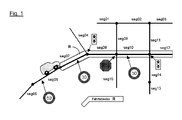
- Zurr illustration is shown schematically in Fig. 1 on the basis of a diagram, as a stored in the navigation system in digital form road map can be decomposed into individual route segments.
- the individual route segments are each assigned an identifier "seg01", “seg02",..., Whereby these route segments seg01, seg02,... Are each separated from one another by likewise marked nodes.
- the route with the highest probability is framed and labeled "R".
- data sets are now set up at the individual nodes (ie, at each transition between) to set up a database, which is suitable in particular for route prediction Link segments), an exemplary structure of this database being explained below with reference to FIG. 2.
- the route segment branches with an identifier designated here as SegID 1 at a node in route segments SegID 2 and SegID 3.
- SegID 1 an identifier designated here as SegID 1 at a node in route segments SegID 2 and SegID 3.
- a new data record is created for the transition to SegID 2.
- a new record is created for the transition to SegID 3.
- NextID the identifier of the next segment
- no further data is stored for each route segment transition for each route segment transition for minimizing the memory requirement and the computational effort in the database for the immediate characterization of the particular distance traveled by the vehicle, in particular not the Segment ID of the previously traveled segment.
- This database already contains all the information necessary for a statistical route prediction.
- each data record contains further data fields for optimizing the prediction quality.
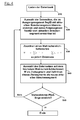
- step S10 the database established on the past voyages of the vehicle is loaded in step S10.
- a comparison of the current route segment (and possibly the current direction of travel) with all data records in the database is performed.
- those data sets of the database are selected which have the same starting segment and whose subsequent segment can be reached from the actual current route segment, taking into account the current direction of travel.
- W probability
- p i * ⁇ i indicates a probability value p i weighted with a weighting value ⁇ i .
- the probability values p.sub.i are determined on the basis of a comparison of a data field of the respective data set used from the database with the corresponding data field of the route segment currently being traveled by the vehicle. Furthermore, these probability values p i are respectively multiplied by a weighting value ⁇ i , where all weighting values ⁇ i have a value between 0 and 1 and the sum of the weighting values ⁇ i is one. To increase the predictive quality, the algorithm can thus be configured with different weights.
- the present embodiment include for determining the probability values p i evaluated data fields of the relied records parameters for characterizing the mentioned above under a) to d) parameters, ie, they affect the current driver of the vehicle (corresponding probability value: p FID), time of day, to which the route segment in question has been traveled (associated probability value: p TIM ), the day of the week on which the route segment concerned was traveled (associated probability value : p DOW ), and the frequency with which route segments which can be reached from the relevant route segment are in each case in the past (associated probability value: p CNT ).
- next step S40 the record with the highest probability W is selected to set the next target segment. This takes place until (according to query in step S50) either a predetermined path length or travel time has been exceeded or the available computing time has been used up.
- steps S20-S50 are repeated by defining the thus-determined target segment as an output segment for re-comparison with all the data records of the database until reaching the predetermined path length or travel time.
- a nonlinear relationship can also be selected for the function.
- the function f (x) for weekly recurring events or segment transitions reaches the maximum of 255 after 34 weeks.
- An event which is repeated every two weeks reaches a maximum of 251 after 86 weeks Since the event does not occur every other week, the count value is decremented by one so that the value varies between 251 and 250.
- a maximum of 221 and a minimum of 218 is reached after 136 weeks.
- the "start” and “stop” information are indications of whether the segment under consideration is a segment from which a journey started (start of a journey) or on which a journey ended ( Destination of a ride) has been. Based on the stop information, possible goals can be predicted. For this purpose, a next segment is searched until a matching segment transition with stop marking is found. "Fitting” means taking into account the time of the day and the day of the week and deriving therefrom a probability of the possible goal and comparing it to the probability that one will not stop taking all the data into account.
- direction indicates a direction of travel direction of the particular road segment.
- Each road segment in the digital map has an input node and an output node.
- Direction determines the order in which the road segment has been traveled on the stored data record. This acts as a filter when detecting the route and results in considering only those records whose directions match the current direction of travel.
- each record is 176 bits and 22 bytes, respectively.
- a number of 6 can be assumed as a realistic value for the number of route segments traveled.
- a storage space of 5 megabytes should be sufficient for a period of 3 years.
- a driver who exclusively and regularly travels short distances, should also get along for longer periods with about 1 megabyte.
- the database contains more segment transitions than is necessary to store pure turn situations.
- such a simplification has the disadvantage that additional information can not be stored and assigned in detail.
Landscapes
- Engineering & Computer Science (AREA)
- Radar, Positioning & Navigation (AREA)
- Remote Sensing (AREA)
- Health & Medical Sciences (AREA)
- General Health & Medical Sciences (AREA)
- Social Psychology (AREA)
- Automation & Control Theory (AREA)
- Physics & Mathematics (AREA)
- General Physics & Mathematics (AREA)
- Navigation (AREA)
Applications Claiming Priority (1)
| Application Number | Priority Date | Filing Date | Title |
|---|---|---|---|
| DE102006034616 | 2006-07-27 |
Publications (3)
| Publication Number | Publication Date |
|---|---|
| EP1882901A2 true EP1882901A2 (fr) | 2008-01-30 |
| EP1882901A3 EP1882901A3 (fr) | 2012-08-15 |
| EP1882901B1 EP1882901B1 (fr) | 2014-09-10 |
Family
ID=38721793
Family Applications (1)
| Application Number | Title | Priority Date | Filing Date |
|---|---|---|---|
| EP20070112690 Ceased EP1882901B1 (fr) | 2006-07-27 | 2007-07-18 | Méthode et dispositif pour la manipulation des données d'itinéraire dans un véhicule |
Country Status (1)
| Country | Link |
|---|---|
| EP (1) | EP1882901B1 (fr) |
Cited By (1)
| Publication number | Priority date | Publication date | Assignee | Title |
|---|---|---|---|---|
| CN114935905A (zh) * | 2022-06-15 | 2022-08-23 | 中国第一汽车股份有限公司 | 泊车方法、装置、车辆及存储介质 |
Citations (6)
| Publication number | Priority date | Publication date | Assignee | Title |
|---|---|---|---|---|
| EP0697686A2 (fr) | 1994-08-18 | 1996-02-21 | Bayerische Motoren Werke Aktiengesellschaft, Patentabteilung AJ-3 | Méthode de navigation pour véhicule à moteur |
| DE19535576A1 (de) | 1994-10-07 | 1996-04-11 | Mannesmann Ag | Verfahren und Vorrichtung zur Zielführungsunterstützung |
| US6256579B1 (en) | 1999-07-13 | 2001-07-03 | Alpine Electronics, Inc. | Vehicle navigation system with road link re-costing |
| EP1380813A1 (fr) | 2001-08-06 | 2004-01-14 | Matsushita Electric Industrial Co., Ltd. | Procede et dispositif permettant de fournir des informations |
| EP1551195A1 (fr) | 2002-10-10 | 2005-07-06 | Matsushita Electric Industrial Co., Ltd. | Procede d'acquisition d'informations, procede de distribution d'informations et dispositif d'acquisition d'informations |
| EP1865287A1 (fr) | 2005-03-30 | 2007-12-12 | Pioneer Corporation | Dispositif, procede et programme de guidage et support d'enregistrement |
Family Cites Families (3)
| Publication number | Priority date | Publication date | Assignee | Title |
|---|---|---|---|---|
| JP3417462B2 (ja) * | 1998-03-06 | 2003-06-16 | 三菱自動車工業株式会社 | 車両の進路推定装置 |
| US7493214B2 (en) * | 2004-09-24 | 2009-02-17 | Lg Electronics Inc. | Travel route searching method of mobile object |
| JP4543893B2 (ja) * | 2004-11-17 | 2010-09-15 | 株式会社デンソー | 周回走行事前検出装置および周回走行事前検出プログラム |
-
2007
- 2007-07-18 EP EP20070112690 patent/EP1882901B1/fr not_active Ceased
Patent Citations (6)
| Publication number | Priority date | Publication date | Assignee | Title |
|---|---|---|---|---|
| EP0697686A2 (fr) | 1994-08-18 | 1996-02-21 | Bayerische Motoren Werke Aktiengesellschaft, Patentabteilung AJ-3 | Méthode de navigation pour véhicule à moteur |
| DE19535576A1 (de) | 1994-10-07 | 1996-04-11 | Mannesmann Ag | Verfahren und Vorrichtung zur Zielführungsunterstützung |
| US6256579B1 (en) | 1999-07-13 | 2001-07-03 | Alpine Electronics, Inc. | Vehicle navigation system with road link re-costing |
| EP1380813A1 (fr) | 2001-08-06 | 2004-01-14 | Matsushita Electric Industrial Co., Ltd. | Procede et dispositif permettant de fournir des informations |
| EP1551195A1 (fr) | 2002-10-10 | 2005-07-06 | Matsushita Electric Industrial Co., Ltd. | Procede d'acquisition d'informations, procede de distribution d'informations et dispositif d'acquisition d'informations |
| EP1865287A1 (fr) | 2005-03-30 | 2007-12-12 | Pioneer Corporation | Dispositif, procede et programme de guidage et support d'enregistrement |
Cited By (1)
| Publication number | Priority date | Publication date | Assignee | Title |
|---|---|---|---|---|
| CN114935905A (zh) * | 2022-06-15 | 2022-08-23 | 中国第一汽车股份有限公司 | 泊车方法、装置、车辆及存储介质 |
Also Published As
| Publication number | Publication date |
|---|---|
| EP1882901B1 (fr) | 2014-09-10 |
| EP1882901A3 (fr) | 2012-08-15 |
Similar Documents
| Publication | Publication Date | Title |
|---|---|---|
| DE69329119T2 (de) | Vorhersageverfahren für strassenverkehrparameter | |
| EP1026649B1 (fr) | Procédé et dispositif de préparation d'information de circulation | |
| DE102012201472B4 (de) | Verfahren zur Bereitstellung von Parkinformationen zu freien Parkplätzen | |
| EP2842087B1 (fr) | Procédé de détermination d'une valeur attendue de consommation d'un véhicule automobile | |
| DE102019002790B4 (de) | Verfahren zur Prädiktion einer Verkehrssituation für ein Fahrzeug | |
| DE10133945A1 (de) | Verfahren und Vorrichtung zum Austausch und zur Verarbeitung von Daten | |
| EP1154389A1 (fr) | Procédé de détermination de l'état du trafic sur un réseau routier | |
| EP2280383B1 (fr) | Procédé d'établissement d'informations de circulation pour un traject routier d'un réseau routier et calculateur de circulation destiné à l'exécution du procédé | |
| DE102012220134A1 (de) | Verfahren und Informationsgerät zum Erkennen einer absichtlichen Abweichung von einer optimalen Fahrroute eines Fahrzeugs zwischen einem Startpunkt und einem Zielpunkt | |
| DE102015212027A1 (de) | Verfahren und Vorrichtung zum automatischen Ermitteln von Verkehrsregelungen an Straßenkreuzungen | |
| DE102022208501A1 (de) | Verfahren und System zur Generierung von Empfehlungen von Parkplätzen | |
| EP1614996B1 (fr) | Procédé et système de planification dynamique d'itinéraire | |
| EP2116981A2 (fr) | Procédé et dispositif de détermination de longueurs de retenue sur des installations de signaux lumineux | |
| DE10201106A1 (de) | Verfahren zum Bestimmen einer Reisezeit | |
| DE102019211098A1 (de) | Verfahren, Vorrichtung und Computerprogramm zum Bestimmen einer Ampelphase einer Ampel einer Ampelanlage | |
| DE102012218152A1 (de) | System und Verfahren zur Vorhersage energetisch relevanter Fahrsituationen ohne Straßenkarte | |
| WO2023222276A1 (fr) | Procédé de demande d'itinéraires prédits à partir d'un serveur dorsal au moyen d'un véhicule, support lisible par ordinateur, système et véhicule | |
| EP1882901B1 (fr) | Méthode et dispositif pour la manipulation des données d'itinéraire dans un véhicule | |
| EP3923027B1 (fr) | Procédé de détermination d'un état d'occupation d'une place de stationnement ainsi que de détermination de l'état d'occupation d'une pluralité de places de stationnement le long d'une rue | |
| DE102016010028A1 (de) | Technik zum Auswählen einer Route in einem Verkehrsnetz durch ein Fahrzeugnavigationsgerät | |
| EP3437958A1 (fr) | Évaluation d'un temps de conduite prévisionnel d'un véhicule ferroviaire | |
| DE102022112169A1 (de) | Verfahren zum Bereitstellen einer Menge von Entscheidungspunkten während einer Fahrt mit einem Fahrzeug von einem Backend-Server an das Fahrzeug, computerlesbares Medium, System und Fahrzeug | |
| EP1614995B1 (fr) | Procédé et système de génération de données nécessaires pour une planification dynamique d'itinéraire | |
| DE102014223331B4 (de) | Verbesserung eines Fahrhorizontsystems durch Selbstlernen des höchstwahrscheinlichen Fahrpfades | |
| DE102009027544A1 (de) | Verfahren und Vorrichtung zur Ermittlung einer Verkehrsprognose |
Legal Events
| Date | Code | Title | Description |
|---|---|---|---|
| PUAI | Public reference made under article 153(3) epc to a published international application that has entered the european phase |
Free format text: ORIGINAL CODE: 0009012 |
|
| AK | Designated contracting states |
Kind code of ref document: A2 Designated state(s): AT BE BG CH CY CZ DE DK EE ES FI FR GB GR HU IE IS IT LI LT LU LV MC MT NL PL PT RO SE SI SK TR |
|
| AX | Request for extension of the european patent |
Extension state: AL BA HR MK YU |
|
| RIC1 | Information provided on ipc code assigned before grant |
Ipc: G01C 21/34 20060101AFI20120309BHEP |
|
| PUAL | Search report despatched |
Free format text: ORIGINAL CODE: 0009013 |
|
| AK | Designated contracting states |
Kind code of ref document: A3 Designated state(s): AT BE BG CH CY CZ DE DK EE ES FI FR GB GR HU IE IS IT LI LT LU LV MC MT NL PL PT RO SE SI SK TR |
|
| AX | Request for extension of the european patent |
Extension state: AL BA HR MK RS |
|
| RIC1 | Information provided on ipc code assigned before grant |
Ipc: G01C 21/34 20060101AFI20120712BHEP |
|
| 17P | Request for examination filed |
Effective date: 20130215 |
|
| AKX | Designation fees paid |
Designated state(s): DE FR GB |
|
| GRAP | Despatch of communication of intention to grant a patent |
Free format text: ORIGINAL CODE: EPIDOSNIGR1 |
|
| INTG | Intention to grant announced |
Effective date: 20140519 |
|
| GRAS | Grant fee paid |
Free format text: ORIGINAL CODE: EPIDOSNIGR3 |
|
| GRAA | (expected) grant |
Free format text: ORIGINAL CODE: 0009210 |
|
| AK | Designated contracting states |
Kind code of ref document: B1 Designated state(s): DE FR GB |
|
| REG | Reference to a national code |
Ref country code: GB Ref legal event code: FG4D Free format text: NOT ENGLISH |
|
| REG | Reference to a national code |
Ref country code: DE Ref legal event code: R096 Ref document number: 502007013436 Country of ref document: DE Effective date: 20141023 |
|
| REG | Reference to a national code |
Ref country code: DE Ref legal event code: R097 Ref document number: 502007013436 Country of ref document: DE |
|
| REG | Reference to a national code |
Ref country code: FR Ref legal event code: PLFP Year of fee payment: 9 |
|
| PLBE | No opposition filed within time limit |
Free format text: ORIGINAL CODE: 0009261 |
|
| STAA | Information on the status of an ep patent application or granted ep patent |
Free format text: STATUS: NO OPPOSITION FILED WITHIN TIME LIMIT |
|
| 26N | No opposition filed |
Effective date: 20150611 |
|
| REG | Reference to a national code |
Ref country code: FR Ref legal event code: PLFP Year of fee payment: 10 |
|
| REG | Reference to a national code |
Ref country code: FR Ref legal event code: PLFP Year of fee payment: 11 |
|
| REG | Reference to a national code |
Ref country code: FR Ref legal event code: PLFP Year of fee payment: 12 |
|
| PGFP | Annual fee paid to national office [announced via postgrant information from national office to epo] |
Ref country code: FR Payment date: 20190621 Year of fee payment: 13 |
|
| PG25 | Lapsed in a contracting state [announced via postgrant information from national office to epo] |
Ref country code: FR Free format text: LAPSE BECAUSE OF NON-PAYMENT OF DUE FEES Effective date: 20200731 |
|
| PGFP | Annual fee paid to national office [announced via postgrant information from national office to epo] |
Ref country code: GB Payment date: 20220627 Year of fee payment: 16 |
|
| P01 | Opt-out of the competence of the unified patent court (upc) registered |
Effective date: 20230620 |
|
| GBPC | Gb: european patent ceased through non-payment of renewal fee |
Effective date: 20230718 |
|
| PG25 | Lapsed in a contracting state [announced via postgrant information from national office to epo] |
Ref country code: GB Free format text: LAPSE BECAUSE OF NON-PAYMENT OF DUE FEES Effective date: 20230718 |
|
| REG | Reference to a national code |
Ref country code: DE Ref legal event code: R084 Ref document number: 502007013436 Country of ref document: DE |
|
| PGFP | Annual fee paid to national office [announced via postgrant information from national office to epo] |
Ref country code: DE Payment date: 20240613 Year of fee payment: 18 |
|
| REG | Reference to a national code |
Ref country code: DE Ref legal event code: R119 Ref document number: 502007013436 Country of ref document: DE |
|
| PG25 | Lapsed in a contracting state [announced via postgrant information from national office to epo] |
Ref country code: DE Free format text: LAPSE BECAUSE OF NON-PAYMENT OF DUE FEES Effective date: 20260203 |