EP1886708B1 - Eclairage à effet augmentant la mélatonine - Google Patents
Eclairage à effet augmentant la mélatonine Download PDFInfo
- Publication number
- EP1886708B1 EP1886708B1 EP07108143A EP07108143A EP1886708B1 EP 1886708 B1 EP1886708 B1 EP 1886708B1 EP 07108143 A EP07108143 A EP 07108143A EP 07108143 A EP07108143 A EP 07108143A EP 1886708 B1 EP1886708 B1 EP 1886708B1
- Authority
- EP
- European Patent Office
- Prior art keywords
- light
- luminaire
- special light
- intensity
- threshold value
- Prior art date
- Legal status (The legal status is an assumption and is not a legal conclusion. Google has not performed a legal analysis and makes no representation as to the accuracy of the status listed.)
- Active
Links
Images


Classifications
-
- A—HUMAN NECESSITIES
- A61—MEDICAL OR VETERINARY SCIENCE; HYGIENE
- A61M—DEVICES FOR INTRODUCING MEDIA INTO, OR ONTO, THE BODY; DEVICES FOR TRANSDUCING BODY MEDIA OR FOR TAKING MEDIA FROM THE BODY; DEVICES FOR PRODUCING OR ENDING SLEEP OR STUPOR
- A61M21/00—Other devices or methods to cause a change in the state of consciousness; Devices for producing or ending sleep by mechanical, optical, or acoustical means, e.g. for hypnosis
-
- H—ELECTRICITY
- H05—ELECTRIC TECHNIQUES NOT OTHERWISE PROVIDED FOR
- H05B—ELECTRIC HEATING; ELECTRIC LIGHT SOURCES NOT OTHERWISE PROVIDED FOR; CIRCUIT ARRANGEMENTS FOR ELECTRIC LIGHT SOURCES, IN GENERAL
- H05B41/00—Circuit arrangements or apparatus for igniting or operating discharge lamps
- H05B41/14—Circuit arrangements
- H05B41/36—Controlling
-
- H—ELECTRICITY
- H05—ELECTRIC TECHNIQUES NOT OTHERWISE PROVIDED FOR
- H05B—ELECTRIC HEATING; ELECTRIC LIGHT SOURCES NOT OTHERWISE PROVIDED FOR; CIRCUIT ARRANGEMENTS FOR ELECTRIC LIGHT SOURCES, IN GENERAL
- H05B47/00—Circuit arrangements for operating light sources in general, i.e. where the type of light source is not relevant
- H05B47/10—Controlling the light source
-
- H—ELECTRICITY
- H05—ELECTRIC TECHNIQUES NOT OTHERWISE PROVIDED FOR
- H05B—ELECTRIC HEATING; ELECTRIC LIGHT SOURCES NOT OTHERWISE PROVIDED FOR; CIRCUIT ARRANGEMENTS FOR ELECTRIC LIGHT SOURCES, IN GENERAL
- H05B47/00—Circuit arrangements for operating light sources in general, i.e. where the type of light source is not relevant
- H05B47/10—Controlling the light source
- H05B47/16—Controlling the light source by timing means
-
- A—HUMAN NECESSITIES
- A61—MEDICAL OR VETERINARY SCIENCE; HYGIENE
- A61M—DEVICES FOR INTRODUCING MEDIA INTO, OR ONTO, THE BODY; DEVICES FOR TRANSDUCING BODY MEDIA OR FOR TAKING MEDIA FROM THE BODY; DEVICES FOR PRODUCING OR ENDING SLEEP OR STUPOR
- A61M21/00—Other devices or methods to cause a change in the state of consciousness; Devices for producing or ending sleep by mechanical, optical, or acoustical means, e.g. for hypnosis
- A61M2021/0005—Other devices or methods to cause a change in the state of consciousness; Devices for producing or ending sleep by mechanical, optical, or acoustical means, e.g. for hypnosis by the use of a particular sense, or stimulus
- A61M2021/0044—Other devices or methods to cause a change in the state of consciousness; Devices for producing or ending sleep by mechanical, optical, or acoustical means, e.g. for hypnosis by the use of a particular sense, or stimulus by the sight sense
-
- Y—GENERAL TAGGING OF NEW TECHNOLOGICAL DEVELOPMENTS; GENERAL TAGGING OF CROSS-SECTIONAL TECHNOLOGIES SPANNING OVER SEVERAL SECTIONS OF THE IPC; TECHNICAL SUBJECTS COVERED BY FORMER USPC CROSS-REFERENCE ART COLLECTIONS [XRACs] AND DIGESTS
- Y02—TECHNOLOGIES OR APPLICATIONS FOR MITIGATION OR ADAPTATION AGAINST CLIMATE CHANGE
- Y02B—CLIMATE CHANGE MITIGATION TECHNOLOGIES RELATED TO BUILDINGS, e.g. HOUSING, HOUSE APPLIANCES OR RELATED END-USER APPLICATIONS
- Y02B20/00—Energy efficient lighting technologies, e.g. halogen lamps or gas discharge lamps
- Y02B20/40—Control techniques providing energy savings, e.g. smart controller or presence detection
Definitions
- the present invention relates to a method for driving a luminaire, with which light can be produced in different spectral compositions, and a corresponding lamp.
- Fig. 2 is a typical course of melatonin levels in human blood as a function of the time of day. It can be seen that the melatonin level is significantly higher during the night than during the day. At night, so comparatively much melatonin is released from the epiphysis, by day, however, very little.
- the human brain has an "internal” (controlled by the rhythmic activity of certain genes) circadian clock, the so-called suprachiasmatic nucleus, which is connected to the retina via optical nerve fibers. Under natural conditions, the oscillation period of this clock is constantly adjusted to the natural daily rhythm by light that hits the retina.
- the suprachiasmatic nucleus sends - among other things - impulses to the epiphysis, which then imprinted on the release of melatonin hormonally systems of the human organism circadian rhythm.
- the spectrum or color temperature of natural daylight generally changes over the course of a day.
- the daylight has a comparatively high color temperature, thus a relatively high proportion in the blue region of the spectrum, while at dusk or at sunrise or sunset, the natural light has a low color temperature and thus a comparatively low Blue portion has.
- melatonin suppression a wavelength maximum in the range of about 480 nm, more precisely to Brainard 464 nm or Taphan 468 nm, ie in the blue region of the spectrum, and a significant decrease between about 520 nm and 560 nm. Radiation with wavelengths of more as about 560 nm therefore has very little potential to suppress the melatonin secretion.
- RGB luminaires With reference to luminaires that can emit light in different spectral compositions, so-called “RGB luminaires” are known from the prior art, which have three light sources that can emit light in different colors or color temperatures.
- the colors of the light sources are usually red (R), yellow (G) and blue (B).
- R red
- G yellow
- B blue
- such lights are known with which certain effects or effects should be achieved by appropriate light mixtures at certain times.
- lamps are known from the prior art that emit light with a spectrum that is modeled on the natural light spectrum.
- the aim of such lights is, inter alia, to inhibit the release of melatonin during the day, for example, to counteract winter depressions caused by lack of light.
- an irradiation apparatus for increasing the vigilance of a driver of a vehicle is known.
- a light is provided in the head area of the driver to suppress melatonin production and increase alertness.
- a screen unit is known in which light is emitted at night with reduced blue content and during the day light with increased blue content; This can be used to influence the bio-rhythm of the viewer. It can be provided that with increasing intensity of the emitted light, the blue component does not increase in proportion to the total light.
- a luminaire is known with which different types of light with different color temperatures can be generated at certain times, so that can cause different moods.
- a luminaire is known with which light can be generated which has alternating color temperatures in alternating form, for example between 3000 K and 6700 K.
- a method for driving a luminaire, with which light can be generated in different spectral compositions.
- the spectral composition of the light generated in response to a predetermined time scheme is selected in the control.
- a particular light is generated in a pre-defined period of time, which with respect to its spectral composition and intensity is such that it can be viewed by a viewer of the special light, a release of the hormone melatonin at least largely does not inhibit.
- a lighting can be provided with which a possible negative effect with respect to the circadian rhythm of humans can be counteracted or a specific circadian rhythm can be supported.
- the phrase "viewer of the special light” is intended to express that the viewer, at least essentially, does not look at light that is not produced by the light.
- the fictive viewer is thus at least essentially exposed to a light, which is generated by the lamp.
- a luminaire may be provided, which is located on a ceiling of a room in which the viewer resides, in such a way that the viewer does not look directly into the luminaire, unless he turns the head upwards.
- the melatonin discharge is not inhibited even when the viewer is exposed to the particular light for a certain extended period of time, for example for a period of at least 30 minutes or at least two hours.
- a plurality of time intervals spaced apart from one another may be defined as a predetermined period, for example "nocturnal" times.
- the times of sunrises and / or sunsets can be used.
- the location can be used as the basis, on which the operation of the lamp is provided. It can therefore be provided, for example, to choose as a pre-defined period of time between sunsets and the respective subsequent sunrises.
- one place or several places may be chosen which are not the place of the Operation of the lamp is or are. This would be useful, for example, if a shift of the circadian rhythm is desired in the viewer, for example, to prevent jet lag or to mitigate the symptoms of jet lag. In this case, it may also be advantageous if time intervals spaced apart from one another are selected, which are accordingly longer or shorter than 24 hours.
- the wavelength threshold may be between about 480 nm and 600 nm, preferably between about 500 nm and 560 nm. This is advantageous when using the method described above in connection with FIG Fig. 3 illustrated action spectrum for the suppression of melatonin secretion based. It should be noted, however, that in this context, based on future findings, corresponding deviations from these areas may result. More generally, it is advantageous if the wavelength threshold value is determined as a function of the action spectrum for the suppression of the melatonin secretion.
- the proportion threshold value is chosen to be less than 10%, preferably less than 5%. Of course, 0% can also be selected for the share threshold. However, it should be remembered in this context that a certain amount of blue light is quite advantageous for the quality of color perception. Therefore, a compromise may be provided, which is to provide a certain, but small, proportion of blue light for the particular light, for example, it may thus be provided that the particular light also has a predetermined minimum value for the said portion, for example, may be between about 1% and 5%.
- the particular light has a color temperature that is below a predetermined color temperature threshold.
- a predetermined color temperature threshold For example, 2000 K, preferably 1500 K or even less, may be provided as the corresponding threshold value.
- the spectral composition of the light generated not only as a function of the advance defined period, but also depending on the intensity of the particular light is selected.
- the proportion of the intensity of the particular light generated by radiation having wavelengths which are smaller than the predetermined wavelength threshold ("blue fraction" for short) in the case of a first intensity of the particular light smaller than in the case of a second intensity of the particular light which is less than the first intensity of the particular light.
- the luminaire used may be a luminaire with three light sources, preferably in the form of fluorescent lamps, each capable of producing light of a different color or color temperature. It is advantageous if the special light of (only) one of the three light sources can be generated.
- the luminaire may be an RGB luminaire.
- a luminaire which is designed to emit light in different spectral compositions.
- the luminaire has at least two light sources and a control device for the light sources.
- the control device is designed to control the lamp such that a particular light is emitted by the lamp in a pre-defined period of time, which is in terms of its spectral composition and intensity such that it is a release of the hormone in a viewer of the particular light Melatonin at least largely does not inhibit.
- the light sources may advantageously comprise fluorescent lamps.
- the light has three light sources that can emit light in different colors or color temperatures.
- the lamp may have three control channels for the three light sources.
- light with a color temperature of more than 5000 K can be emitted with a first of the three light sources, and light with a color temperature of less than 5000 K with a second of the three light sources, and with the third light source the special light.
- the wavelength threshold may be approximately between 480 nm and 600 nm, preferably between 500 nm and 560 nm.
- the content threshold value may be selected to be less than 10%, preferably less than 5%.
- the particular light has a color temperature that is below a predetermined color temperature threshold.
- This threshold value can amount to a maximum of about 2000 K, preferably less than 1500 K.
- the luminaire can advantageously also be designed to emit light in different intensities, the control device furthermore being designed to control the luminaire in such a way that the spectral composition of the particular light (also) is selected as a function of the intensity of the particular light becomes. It can be provided that the control device is designed to control the lamp such that applies to the particular light: the proportion of the intensity of the particular light, which is generated by radiation at wavelengths that are smaller than the predetermined wavelength threshold , is smaller in the case of a first intensity of the particular light than in the case of a second intensity of the particular light which is less than the first intensity of the particular light.
- the luminaire 1 comprises three light sources 2, 3, 4, for example in the form of a plurality of fluorescent lamps in each case, which can emit light in three different color temperatures.
- the first light source 2 can emit light of the highest possible color temperature, for example about 8000 K
- the second light source "warm white” light, for example with a color temperature of about 2700 K.
- the third light source 4 can emit a special light, hereinafter referred to as "melatonin light".
- the melatonin light is chosen in terms of its spectral composition and intensity such that it at least largely does not inhibit a release of the hormone melatonin in a viewer.
- the properties of melatonin light will be discussed below.
- the lamp 1 has a control device 5, with which the three light sources 2, 3, 4 can be controlled.
- the control device 5 has three control channels, by means of which the three light sources 2, 3, 4 can be controlled independently of one another, comparable to the conditions with an RGB light.
- the intensities of the three light sources 2, 3, 4 are thus independently adjustable.
- a period is defined in advance, which according to this embodiment, this nocturnal time intervals are set with the help of the times of sunrise and sunset.
- the period thus includes "nocturnal times".
- the melatonin light is emitted by the luminaire 1. If at a time that is not in the defined period, so here "daytime” the light 1 is turned on, “normal” light is emitted from the light 1. Furthermore, it can be provided that in the case in which the lamp 1 within the defined period, here “night”, is turned on and remains turned on until the period is left, ie here until the following "day” Time of leaving, so “morning” automatically (for example, flowing) change of melatonin light in "normal” light takes place. The same can be provided for the transition from "day” to "night”.
- a light is selected, which triggers an activating mood in a viewer, so for example a light of a certain minimum brightness, for example in the range of at least 1000 lux or a light whose blue component exceeds a certain minimum value.
- the melatonin light is thus stored for the control device.
- the circadian curve is backed by control technology and defines, depending on the time of day, when which light is emitted by the luminaire 1.
- the melatonin light has a particular spectral composition, which can be determined, for example, by means of that portion of the intensity of the melatonin light which is produced by radiation having wavelengths which are smaller than a predetermined wavelength threshold, in short "blue". Share "A called BLUE . According to a first example, this blue component is smaller than a predetermined component threshold value A S. It is known from research that the blue portion of the spectrum of a light has far more potential to inhibit the melatonin release of a viewer of that light than the remainder of the spectrum, with the precise spectral transitions being fluid. In the exemplary embodiment illustrated here, 550 nm can be selected as the wavelength threshold value and 5% for the proportion threshold value.
- a color temperature of less than 1500 K may be selected for the melatonin light.
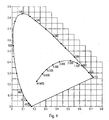
- CIE Commission Internationale de l'Eclairage
- Planckian curve for the blackbody radiation entered.
- various (color) locations are assigned to the curve, which are assigned to different color temperatures. The corresponding values of the color temperatures are entered in the unit Kelvin.
- a special lamp or a corresponding combination of a lamp and a filter is provided in this exemplary embodiment.
- a filter a plastic tube can be used, which is pulled over the lamp and the color or the spectrum of the emitted light changes accordingly.
- all parts of the light can be considered, which interact with the light, such as any reflectors, glass covers, plastic parts and the like. Such parts may affect the spectrum or the color or color temperature of the emitted light.
- the melatonin light is dimmable at least within certain limits, wherein above a certain brightness limit, a light with the above-mentioned spectral properties of the melatonin light is generated and below the brightness limit a "normal" spectrum, ie in particular a Spectrum with a significant amount of blue. This can ensure that at comparatively very low intensities of the melatonin light colors can be distinguished better from a viewer, which in particular facilitates orientation.
- a modulation of the light in the room in which the luminaire is operated is taken into account.
- modulation generally takes place on surfaces such as walls, etc., which modulation depends on the material of the surfaces and their optical properties.
- it can be provided to change the spectrum of the melatonin light by mixing in additional light lamps and adapt them to the corresponding room.
- the aim of this calibration can be a compromise between "melatonin-schondener" effect on the one hand and good color rendering on the other hand.
- the technology presented here allows for a relatively simple adaptation of the temporal control curve and the spectrum of melatonin light, as might be required by corresponding future new scientific findings. For example, an adjustment could be made by appropriate selection of the lamps and / or filters.
- the lamp special requirements with respect to the viewer. For example, when used in a nursing home, it could be taken into account that the transmission of the eye lens of the observer has changed due to age.
- the use of the invention may be useful in facilities that have several or many rooms to be illuminated, such as hotels, hospitals, retirement homes and the like.
- lights are provided according to the invention for illuminating the rooms, which lights can be controlled by means of a central control.
Landscapes
- Health & Medical Sciences (AREA)
- Hematology (AREA)
- Animal Behavior & Ethology (AREA)
- Psychology (AREA)
- Engineering & Computer Science (AREA)
- Anesthesiology (AREA)
- Biomedical Technology (AREA)
- Acoustics & Sound (AREA)
- Heart & Thoracic Surgery (AREA)
- Life Sciences & Earth Sciences (AREA)
- Physics & Mathematics (AREA)
- General Health & Medical Sciences (AREA)
- Public Health (AREA)
- Veterinary Medicine (AREA)
- Circuit Arrangement For Electric Light Sources In General (AREA)
- Pharmaceuticals Containing Other Organic And Inorganic Compounds (AREA)
- Spectrometry And Color Measurement (AREA)
Claims (18)
- Procédé pour la commande d'un luminaire, lequel permet de générer de la lumière dans différentes compositions spectrales,
dans lequel, lors de la commande, la composition spectrale de la lumière générée est choisie en fonction d'un schéma de temps prédéfini,
dans lequel, dans un laps de temps défini auparavant, on génère une lumière particulière qui est de nature, en ce qui concerne sa composition spectrale et son intensité, à ce que qu'elle n'empêche pas au moins très largement un déversement de l'hormone mélatonine chez un observateur de la lumière particulière,
dans lequel la lumière particulière présente une composition spectrale pour laquelle :la fraction (ABLAU) de l'intensité de la lumière particulière, qui est générée par du rayonnement avec des longueurs d'ondes inférieures à une valeur seuil de longueur d'onde prédéfinie, est inférieure à une valeur seuil de fraction (AS) prédéfinie,dans lequel, lors de la commande du luminaire, la composition spectrale de la lumière particulière est choisie d'autre part en fonction de l'intensité de la lumière particulière,caractérisé en ce que la fraction (ABLAU) de l'intensité de la lumière particulière, qui est générée par du rayonnement avec des longueurs d'onde inférieures à la valeur seuil de longueur d'onde prédéfinie, est inférieure, dans le cas d'une première intensité de la lumière particulière, par rapport au cas d'une seconde intensité de la lumière particulière, qui est inférieure à la première intensité de la lumière particulière. - Procédé selon la revendication 1,
dans lequel les heures de coucher du soleil et/ou de lever du soleil sont utilisées pour définir la période définie auparavant. - Procédé selon la revendication 1 ou 2,
dans lequel la valeur seuil de longueur d'onde se situe à peu près entre 480 nm et 600 nm, de préférence entre 500 nm et 560 nm. - Procédé selon l'une quelconque des revendications précédentes, dans lequel la valeur seuil de fraction (AS) est choisie inférieure à 10 %, de préférence inférieure à 5 %.
- Procédé selon l'une quelconque des revendications précédentes, dans lequel la lumière particulière présente une température de couleur qui est inférieure à une valeur seuil de température de couleur définie auparavant.
- Procédé selon la revendication 5,
dans lequel la valeur seuil de température de couleur est au maximum d'environ 2.000 K, de préférence inférieure à 1.500 K. - Procédé selon l'une quelconque des revendications précédentes, dans lequel on utilise comme luminaire (1) un luminaire avec trois sources de lumière (2, 3, 4), de préférence sous forme de tubes fluorescents, qui peuvent générer chacun de la lumière dans une autre couleur ou une autre température de couleur, la lumière particulière pouvant être générée par l'une des trois sources de lumière (2, 3, 4).
- Procédé selon l'une quelconque des revendications précédentes, dans lequel le luminaire est un luminaire RGB.
- Luminaire, qui est conçu pour délivrer de la lumière dans différentes compositions spectrales, présentant :- au moins deux sources de lumière, et- un dispositif de commande (5) pour les sources de lumière,sur lequel le dispositif de commande (5) est conçu pour commander le luminaire (1) de telle sorte que le luminaire (1) délivre dans un laps de temps défini auparavant une lumière particulière qui, en ce qui concerne sa composition spectrale et son intensité, est de nature à ne pas empêcher au moins très largement un déversement de l'hormone mélatonine chez un observateur de la lumière particulière,
sur lequel la lumière particulière présente une composition spectrale pour laquelle :la fraction (ABLAU) de l'intensité de la lumière particulière, qui est générée par du rayonnement avec des longueurs d'ondes inférieures à une valeur seuil de longueur d'onde prédéfinie, est si faible qu'elle est inférieure à une valeur seuil de fraction (AS) prédéfinie,le luminaire étant conçu également pour délivrer de la lumière dans différentes intensités,le dispositif de commande (5) étant conçu également pour commander le luminaire (1) de telle sorte que, lors de la commande, la composition spectrale de la lumière particulière est choisie en fonction de l'intensité de la lumière particulière,caractérisé en ce que le dispositif de commande (5) est conçu pour commander le luminaire (1) de telle sorte que, pour la lumière particulière :la fraction (ABLAU) de l'intensité de la lumière particulière, qui est générée par rayonnement avec des longueurs d'onde inférieures à la valeur seuil de longueur d'onde prédéfinie, est inférieure, dans le cas d'une première intensité de la lumière particulière, par rapport au cas d'une seconde intensité de la lumière particulière, qui est inférieure à la première intensité de la lumière particulière. - Luminaire selon la revendication 9,
sur lequel la lumière particulière est générée par l'une des sources de lumière. - Luminaire selon la revendication 9 ou 10,
sur lequel les sources de lumière comprennent des tubes fluorescents. - Luminaire selon l'une quelconque des revendications 9 à 11,
le luminaire présentant trois sources de lumière (2, 3, 4), qui peuvent diffuser de la lumière dans différentes couleurs ou températures de couleur. - Luminaire selon la revendication 12,
présentant trois canaux de commande pour les trois sources de lumière (2, 3, 4). - Luminaire selon la revendication 12 ou 13,
sur lequel de la lumière avec une température de couleur supérieure à 5.000 K peut être diffusée avec une première (2) des trois sources de lumière (2, 3, 4), et de la lumière avec une température de couleur inférieure à 5.000 K avec une seconde (3) des trois sources de lumière (2, 3, 4), et la lumière particulière avec la troisième source de lumière (4). - Luminaire selon l'une quelconque des revendications 9 à 14,
sur lequel la valeur seuil de longueur d'onde se situe environ entre 480 nm et 600 nm, de préférence entre 500 nm et 560 nm. - Procédé selon l'une quelconque des revendications 9 à 15,
sur lequel la valeur seuil de fraction est inférieure à 10 %, de préférence inférieure à 5 %. - Luminaire selon l'une quelconque des revendications 9 à 16,
sur lequel la lumière particulière présente une température de couleur qui est inférieure à une valeur seuil de température de couleur fixée auparavant. - Luminaire selon la revendication 17,
sur lequel la valeur seuil de température de couleur se situe au maximum aux environs de 2.000 K, de préférence au-dessous de 1.500 K.
Applications Claiming Priority (1)
| Application Number | Priority Date | Filing Date | Title |
|---|---|---|---|
| DE102006037222A DE102006037222A1 (de) | 2006-08-09 | 2006-08-09 | Leuchte mit "Melatonin-schonender" Wirkung |
Publications (2)
| Publication Number | Publication Date |
|---|---|
| EP1886708A1 EP1886708A1 (fr) | 2008-02-13 |
| EP1886708B1 true EP1886708B1 (fr) | 2010-10-06 |
Family
ID=37812330
Family Applications (1)
| Application Number | Title | Priority Date | Filing Date |
|---|---|---|---|
| EP07108143A Active EP1886708B1 (fr) | 2006-08-09 | 2007-05-14 | Eclairage à effet augmentant la mélatonine |
Country Status (3)
| Country | Link |
|---|---|
| EP (1) | EP1886708B1 (fr) |
| AT (1) | ATE483491T1 (fr) |
| DE (2) | DE102006037222A1 (fr) |
Cited By (2)
| Publication number | Priority date | Publication date | Assignee | Title |
|---|---|---|---|---|
| TWI704315B (zh) * | 2019-07-12 | 2020-09-11 | 國立清華大學 | 光源於抑制褪黑激素分泌的用途與適於應用在冬季憂鬱症之燈光療法的照明裝置 |
| US10907095B2 (en) | 2017-03-08 | 2021-02-02 | Litec-Vermogensverwaltungsgesellschaft Mbh | Luminophore mixtures for use in dynamic lighting systems |
Families Citing this family (9)
| Publication number | Priority date | Publication date | Assignee | Title |
|---|---|---|---|---|
| DE102008017606A1 (de) | 2008-04-08 | 2009-10-15 | Litec-Lll Gmbh | Niederdruckgasentladungslampe zur Beeinflussung des körpereigenen Melatoninhaushaltes |
| KR102029563B1 (ko) | 2008-12-11 | 2019-10-07 | 오스람 오엘이디 게엠베하 | 유기발광다이오드 및 조명수단 |
| DE102010003806A1 (de) | 2010-04-09 | 2011-10-13 | Zumtobel Lighting Gmbh | Verfahren und Anordnung zum Betreiben einer in ihrer Lichtabgabe veränderlichen Lichtquelle |
| US8686641B2 (en) * | 2011-12-05 | 2014-04-01 | Biological Illumination, Llc | Tunable LED lamp for producing biologically-adjusted light |
| ES2400590B1 (es) * | 2011-03-31 | 2013-12-17 | Universidad De Murcia | Dispositivo de iluminación circadiano. |
| DE102012009581A1 (de) | 2011-05-15 | 2012-11-15 | Julia von Chamier | Verfahren und Vorrichtung zur Beleuchtung von Räumen |
| RU2707881C2 (ru) | 2014-07-17 | 2019-12-02 | Филипс Лайтинг Холдинг Б.В. | Система освещения |
| DE102017005868A1 (de) * | 2017-06-21 | 2018-12-27 | Sven Hädel | Verfahren zur Herstellung von Lichtverhältnissen in geschlossenen Räumen |
| EP3490344A1 (fr) * | 2017-11-23 | 2019-05-29 | BrainLit AB | Procédé de génération d'une base de données |
Family Cites Families (9)
| Publication number | Priority date | Publication date | Assignee | Title |
|---|---|---|---|---|
| JP3944972B2 (ja) | 1997-10-28 | 2007-07-18 | 松下電工株式会社 | 色温度制御照明装置とこれを用いた入眠装置、覚醒装置及び入眠覚醒装置 |
| JPH11144510A (ja) | 1997-11-06 | 1999-05-28 | Matsushita Electric Ind Co Ltd | 照明装置 |
| JP2001149478A (ja) * | 1999-11-29 | 2001-06-05 | Shinichi Daitoku | 光刺激装置 |
| JP2003288995A (ja) * | 2002-03-27 | 2003-10-10 | Toto Ltd | 浴室照明システム |
| WO2004088616A1 (fr) | 2003-03-28 | 2004-10-14 | Sharp Kabushiki Kaisha | Dispositif d'affichage |
| DE102004012922A1 (de) | 2004-03-17 | 2005-10-06 | Siegfried Wiemers | Bestrahlungsvorrichtung |
| JP2005310654A (ja) * | 2004-04-23 | 2005-11-04 | Matsushita Electric Works Ltd | 照明方法及び照明装置 |
| US20060152525A1 (en) * | 2005-01-13 | 2006-07-13 | Woog Kenneth M | Viewing screen color limiting device and method |
| JP4878439B2 (ja) * | 2005-03-10 | 2012-02-15 | 東芝ライテック株式会社 | 照明装置 |
-
2006
- 2006-08-09 DE DE102006037222A patent/DE102006037222A1/de not_active Ceased
-
2007
- 2007-05-14 AT AT07108143T patent/ATE483491T1/de active
- 2007-05-14 EP EP07108143A patent/EP1886708B1/fr active Active
- 2007-05-14 DE DE502007005251T patent/DE502007005251D1/de active Active
Cited By (2)
| Publication number | Priority date | Publication date | Assignee | Title |
|---|---|---|---|---|
| US10907095B2 (en) | 2017-03-08 | 2021-02-02 | Litec-Vermogensverwaltungsgesellschaft Mbh | Luminophore mixtures for use in dynamic lighting systems |
| TWI704315B (zh) * | 2019-07-12 | 2020-09-11 | 國立清華大學 | 光源於抑制褪黑激素分泌的用途與適於應用在冬季憂鬱症之燈光療法的照明裝置 |
Also Published As
| Publication number | Publication date |
|---|---|
| DE102006037222A1 (de) | 2008-02-14 |
| DE502007005251D1 (de) | 2010-11-18 |
| EP1886708A1 (fr) | 2008-02-13 |
| ATE483491T1 (de) | 2010-10-15 |
Similar Documents
| Publication | Publication Date | Title |
|---|---|---|
| EP1886708B1 (fr) | Eclairage à effet augmentant la mélatonine | |
| DE102005059362A1 (de) | Farblich einstellbare Tageslichtquelle | |
| EP3061321B1 (fr) | Appareil d'éclairage mélanopique | |
| WO2010072415A1 (fr) | Système d'affichage à action circadienne sur l'être humain | |
| WO2019175403A1 (fr) | Système d'éclairage pour commande dynamique d'éclairage | |
| DE102016006765B4 (de) | Lichtprogramm für eine Innenraumbeleuchtung in einem Flugzeug | |
| DE102010030501A1 (de) | Vorrichtung und Verfahren zum Anpassen eines Circadianen Rhythmus | |
| WO2012020081A1 (fr) | Ensemble d'éclairage comportant des sources lumineuses de différentes couleurs et procédé de fonctionnement d'un ensemble d'éclairage de ce type | |
| DE202005001540U1 (de) | Farblich einstellbare Tageslichtquelle | |
| EP2308560B1 (fr) | Dispositif de luminothérapie | |
| EP3418628B1 (fr) | Éclairage doté de fonctions multiples | |
| EP2375869A2 (fr) | Procédé et agencement de fonctionnement d'une source lumineuse à émission de lumière modifiable | |
| EP2981759B1 (fr) | Systeme d'eclairage a diodes, lampe equipee d'un tel systeme et methode de reglage du spectre d'ondes d'un tel systeme d'eclairage | |
| EP2981760B1 (fr) | Systeme d'eclairage a diodes, lampe equipee d'un tel systeme et methode de reglage du spectre d'ondes d'un tel systeme. | |
| DE4433291A1 (de) | Therapieleuchte zur Behandlung lichtabhängiger Beschwerden und Erkrankungen | |
| EP2375870B1 (fr) | Procédé et système de commande d'éclairage | |
| DE102016002962A1 (de) | Verfahren zur Einstellung eines Lichtprofils und ein Beleuchtungssystem zur Durchführung des Verfahrens | |
| WO2017081313A1 (fr) | Dispositif d'éclairage à del et procédé permettant d'agir sur la répartition sectrale des dispositifs d'éclairage à del | |
| DE202022106365U1 (de) | Beleuchtungssystem für die Schweinezucht | |
| EP3426025B1 (fr) | Lampe et méthode pour controler la répartition spectrale de la lampe | |
| DE102016214048A1 (de) | Beleuchtungssystem und Verfahren zum Betreiben eines Beleuchtungssystems | |
| EP3921874A1 (fr) | Module del | |
| EP2757312B1 (fr) | Système d'éclairage pour intérieur | |
| DE102015208006A1 (de) | Leuchte und Verfahren zum Betreiben der Leuchte | |
| DE202020103695U1 (de) | Beleuchtungseinrichtung |
Legal Events
| Date | Code | Title | Description |
|---|---|---|---|
| PUAI | Public reference made under article 153(3) epc to a published international application that has entered the european phase |
Free format text: ORIGINAL CODE: 0009012 |
|
| AK | Designated contracting states |
Kind code of ref document: A1 Designated state(s): AT BE BG CH CY CZ DE DK EE ES FI FR GB GR HU IE IS IT LI LT LU LV MC MT NL PL PT RO SE SI SK TR |
|
| AX | Request for extension of the european patent |
Extension state: AL BA HR MK YU |
|
| 17P | Request for examination filed |
Effective date: 20080812 |
|
| 17Q | First examination report despatched |
Effective date: 20080915 |
|
| AKX | Designation fees paid |
Designated state(s): AT BE BG CH CY CZ DE DK EE ES FI FR GB GR HU IE IS IT LI LT LU LV MC MT NL PL PT RO SE SI SK TR |
|
| GRAP | Despatch of communication of intention to grant a patent |
Free format text: ORIGINAL CODE: EPIDOSNIGR1 |
|
| GRAS | Grant fee paid |
Free format text: ORIGINAL CODE: EPIDOSNIGR3 |
|
| GRAA | (expected) grant |
Free format text: ORIGINAL CODE: 0009210 |
|
| AK | Designated contracting states |
Kind code of ref document: B1 Designated state(s): AT BE BG CH CY CZ DE DK EE ES FI FR GB GR HU IE IS IT LI LT LU LV MC MT NL PL PT RO SE SI SK TR |
|
| REG | Reference to a national code |
Ref country code: GB Ref legal event code: FG4D Free format text: NOT ENGLISH |
|
| REG | Reference to a national code |
Ref country code: CH Ref legal event code: EP Ref country code: CH Ref legal event code: NV Representative=s name: RIEDERER HASLER & PARTNER PATENTANWAELTE AG |
|
| REG | Reference to a national code |
Ref country code: IE Ref legal event code: FG4D Free format text: LANGUAGE OF EP DOCUMENT: GERMAN |
|
| REF | Corresponds to: |
Ref document number: 502007005251 Country of ref document: DE Date of ref document: 20101118 Kind code of ref document: P |
|
| REG | Reference to a national code |
Ref country code: NL Ref legal event code: VDEP Effective date: 20101006 |
|
| PG25 | Lapsed in a contracting state [announced via postgrant information from national office to epo] |
Ref country code: SI Free format text: LAPSE BECAUSE OF FAILURE TO SUBMIT A TRANSLATION OF THE DESCRIPTION OR TO PAY THE FEE WITHIN THE PRESCRIBED TIME-LIMIT Effective date: 20101006 |
|
| LTIE | Lt: invalidation of european patent or patent extension |
Effective date: 20101006 |
|
| REG | Reference to a national code |
Ref country code: IE Ref legal event code: FD4D |
|
| PG25 | Lapsed in a contracting state [announced via postgrant information from national office to epo] |
Ref country code: LT Free format text: LAPSE BECAUSE OF FAILURE TO SUBMIT A TRANSLATION OF THE DESCRIPTION OR TO PAY THE FEE WITHIN THE PRESCRIBED TIME-LIMIT Effective date: 20101006 |
|
| PG25 | Lapsed in a contracting state [announced via postgrant information from national office to epo] |
Ref country code: SE Free format text: LAPSE BECAUSE OF FAILURE TO SUBMIT A TRANSLATION OF THE DESCRIPTION OR TO PAY THE FEE WITHIN THE PRESCRIBED TIME-LIMIT Effective date: 20101006 Ref country code: NL Free format text: LAPSE BECAUSE OF FAILURE TO SUBMIT A TRANSLATION OF THE DESCRIPTION OR TO PAY THE FEE WITHIN THE PRESCRIBED TIME-LIMIT Effective date: 20101006 Ref country code: IS Free format text: LAPSE BECAUSE OF FAILURE TO SUBMIT A TRANSLATION OF THE DESCRIPTION OR TO PAY THE FEE WITHIN THE PRESCRIBED TIME-LIMIT Effective date: 20110206 Ref country code: PT Free format text: LAPSE BECAUSE OF FAILURE TO SUBMIT A TRANSLATION OF THE DESCRIPTION OR TO PAY THE FEE WITHIN THE PRESCRIBED TIME-LIMIT Effective date: 20110207 Ref country code: BG Free format text: LAPSE BECAUSE OF FAILURE TO SUBMIT A TRANSLATION OF THE DESCRIPTION OR TO PAY THE FEE WITHIN THE PRESCRIBED TIME-LIMIT Effective date: 20110106 Ref country code: FI Free format text: LAPSE BECAUSE OF FAILURE TO SUBMIT A TRANSLATION OF THE DESCRIPTION OR TO PAY THE FEE WITHIN THE PRESCRIBED TIME-LIMIT Effective date: 20101006 Ref country code: LV Free format text: LAPSE BECAUSE OF FAILURE TO SUBMIT A TRANSLATION OF THE DESCRIPTION OR TO PAY THE FEE WITHIN THE PRESCRIBED TIME-LIMIT Effective date: 20101006 |
|
| PG25 | Lapsed in a contracting state [announced via postgrant information from national office to epo] |
Ref country code: GR Free format text: LAPSE BECAUSE OF FAILURE TO SUBMIT A TRANSLATION OF THE DESCRIPTION OR TO PAY THE FEE WITHIN THE PRESCRIBED TIME-LIMIT Effective date: 20110107 |
|
| PLBI | Opposition filed |
Free format text: ORIGINAL CODE: 0009260 |
|
| PG25 | Lapsed in a contracting state [announced via postgrant information from national office to epo] |
Ref country code: CZ Free format text: LAPSE BECAUSE OF FAILURE TO SUBMIT A TRANSLATION OF THE DESCRIPTION OR TO PAY THE FEE WITHIN THE PRESCRIBED TIME-LIMIT Effective date: 20101006 Ref country code: IE Free format text: LAPSE BECAUSE OF FAILURE TO SUBMIT A TRANSLATION OF THE DESCRIPTION OR TO PAY THE FEE WITHIN THE PRESCRIBED TIME-LIMIT Effective date: 20101006 Ref country code: EE Free format text: LAPSE BECAUSE OF FAILURE TO SUBMIT A TRANSLATION OF THE DESCRIPTION OR TO PAY THE FEE WITHIN THE PRESCRIBED TIME-LIMIT Effective date: 20101006 Ref country code: ES Free format text: LAPSE BECAUSE OF FAILURE TO SUBMIT A TRANSLATION OF THE DESCRIPTION OR TO PAY THE FEE WITHIN THE PRESCRIBED TIME-LIMIT Effective date: 20110117 |
|
| PLAX | Notice of opposition and request to file observation + time limit sent |
Free format text: ORIGINAL CODE: EPIDOSNOBS2 |
|
| 26 | Opposition filed |
Opponent name: TRILUX GMBH & CO. KG Effective date: 20110705 |
|
| PG25 | Lapsed in a contracting state [announced via postgrant information from national office to epo] |
Ref country code: RO Free format text: LAPSE BECAUSE OF FAILURE TO SUBMIT A TRANSLATION OF THE DESCRIPTION OR TO PAY THE FEE WITHIN THE PRESCRIBED TIME-LIMIT Effective date: 20101006 Ref country code: SK Free format text: LAPSE BECAUSE OF FAILURE TO SUBMIT A TRANSLATION OF THE DESCRIPTION OR TO PAY THE FEE WITHIN THE PRESCRIBED TIME-LIMIT Effective date: 20101006 Ref country code: DK Free format text: LAPSE BECAUSE OF FAILURE TO SUBMIT A TRANSLATION OF THE DESCRIPTION OR TO PAY THE FEE WITHIN THE PRESCRIBED TIME-LIMIT Effective date: 20101006 Ref country code: PL Free format text: LAPSE BECAUSE OF FAILURE TO SUBMIT A TRANSLATION OF THE DESCRIPTION OR TO PAY THE FEE WITHIN THE PRESCRIBED TIME-LIMIT Effective date: 20101006 |
|
| REG | Reference to a national code |
Ref country code: DE Ref legal event code: R026 Ref document number: 502007005251 Country of ref document: DE Effective date: 20110705 |
|
| PLBB | Reply of patent proprietor to notice(s) of opposition received |
Free format text: ORIGINAL CODE: EPIDOSNOBS3 |
|
| BERE | Be: lapsed |
Owner name: ZUMTOBEL LIGHTING GMBH Effective date: 20110531 |
|
| PG25 | Lapsed in a contracting state [announced via postgrant information from national office to epo] |
Ref country code: MC Free format text: LAPSE BECAUSE OF NON-PAYMENT OF DUE FEES Effective date: 20110531 Ref country code: IT Free format text: LAPSE BECAUSE OF FAILURE TO SUBMIT A TRANSLATION OF THE DESCRIPTION OR TO PAY THE FEE WITHIN THE PRESCRIBED TIME-LIMIT Effective date: 20101006 Ref country code: MT Free format text: LAPSE BECAUSE OF FAILURE TO SUBMIT A TRANSLATION OF THE DESCRIPTION OR TO PAY THE FEE WITHIN THE PRESCRIBED TIME-LIMIT Effective date: 20101006 |
|
| REG | Reference to a national code |
Ref country code: FR Ref legal event code: ST Effective date: 20120131 |
|
| PG25 | Lapsed in a contracting state [announced via postgrant information from national office to epo] |
Ref country code: BE Free format text: LAPSE BECAUSE OF NON-PAYMENT OF DUE FEES Effective date: 20110531 |
|
| PG25 | Lapsed in a contracting state [announced via postgrant information from national office to epo] |
Ref country code: FR Free format text: LAPSE BECAUSE OF NON-PAYMENT OF DUE FEES Effective date: 20110531 |
|
| PG25 | Lapsed in a contracting state [announced via postgrant information from national office to epo] |
Ref country code: LU Free format text: LAPSE BECAUSE OF NON-PAYMENT OF DUE FEES Effective date: 20110514 Ref country code: CY Free format text: LAPSE BECAUSE OF FAILURE TO SUBMIT A TRANSLATION OF THE DESCRIPTION OR TO PAY THE FEE WITHIN THE PRESCRIBED TIME-LIMIT Effective date: 20101006 |
|
| PG25 | Lapsed in a contracting state [announced via postgrant information from national office to epo] |
Ref country code: TR Free format text: LAPSE BECAUSE OF FAILURE TO SUBMIT A TRANSLATION OF THE DESCRIPTION OR TO PAY THE FEE WITHIN THE PRESCRIBED TIME-LIMIT Effective date: 20101006 |
|
| PG25 | Lapsed in a contracting state [announced via postgrant information from national office to epo] |
Ref country code: HU Free format text: LAPSE BECAUSE OF FAILURE TO SUBMIT A TRANSLATION OF THE DESCRIPTION OR TO PAY THE FEE WITHIN THE PRESCRIBED TIME-LIMIT Effective date: 20101006 |
|
| PLCK | Communication despatched that opposition was rejected |
Free format text: ORIGINAL CODE: EPIDOSNREJ1 |
|
| APBM | Appeal reference recorded |
Free format text: ORIGINAL CODE: EPIDOSNREFNO |
|
| APBP | Date of receipt of notice of appeal recorded |
Free format text: ORIGINAL CODE: EPIDOSNNOA2O |
|
| APAH | Appeal reference modified |
Free format text: ORIGINAL CODE: EPIDOSCREFNO |
|
| APBQ | Date of receipt of statement of grounds of appeal recorded |
Free format text: ORIGINAL CODE: EPIDOSNNOA3O |
|
| PGFP | Annual fee paid to national office [announced via postgrant information from national office to epo] |
Ref country code: AT Payment date: 20180529 Year of fee payment: 12 |
|
| REG | Reference to a national code |
Ref country code: DE Ref legal event code: R100 Ref document number: 502007005251 Country of ref document: DE |
|
| APBU | Appeal procedure closed |
Free format text: ORIGINAL CODE: EPIDOSNNOA9O |
|
| REG | Reference to a national code |
Ref country code: AT Ref legal event code: MM01 Ref document number: 483491 Country of ref document: AT Kind code of ref document: T Effective date: 20190514 |
|
| PG25 | Lapsed in a contracting state [announced via postgrant information from national office to epo] |
Ref country code: AT Free format text: LAPSE BECAUSE OF NON-PAYMENT OF DUE FEES Effective date: 20190514 |
|
| PLBN | Opposition rejected |
Free format text: ORIGINAL CODE: 0009273 |
|
| STAA | Information on the status of an ep patent application or granted ep patent |
Free format text: STATUS: OPPOSITION REJECTED |
|
| 27O | Opposition rejected |
Effective date: 20190920 |
|
| REG | Reference to a national code |
Ref country code: DE Ref legal event code: R084 Ref document number: 502007005251 Country of ref document: DE |
|
| P01 | Opt-out of the competence of the unified patent court (upc) registered |
Effective date: 20230530 |
|
| PGFP | Annual fee paid to national office [announced via postgrant information from national office to epo] |
Ref country code: CH Payment date: 20230602 Year of fee payment: 17 |
|
| PGFP | Annual fee paid to national office [announced via postgrant information from national office to epo] |
Ref country code: GB Payment date: 20240521 Year of fee payment: 18 |
|
| PGFP | Annual fee paid to national office [announced via postgrant information from national office to epo] |
Ref country code: DE Payment date: 20240529 Year of fee payment: 18 |
|
| REG | Reference to a national code |
Ref country code: CH Ref legal event code: PL |
|
| PG25 | Lapsed in a contracting state [announced via postgrant information from national office to epo] |
Ref country code: CH Free format text: LAPSE BECAUSE OF NON-PAYMENT OF DUE FEES Effective date: 20240531 |
|
| REG | Reference to a national code |
Ref country code: DE Ref legal event code: R119 Ref document number: 502007005251 Country of ref document: DE |
|
| GBPC | Gb: european patent ceased through non-payment of renewal fee |
Effective date: 20250514 |
|
| PG25 | Lapsed in a contracting state [announced via postgrant information from national office to epo] |
Ref country code: GB Free format text: LAPSE BECAUSE OF NON-PAYMENT OF DUE FEES Effective date: 20250514 |
|
| PG25 | Lapsed in a contracting state [announced via postgrant information from national office to epo] |
Ref country code: DE Free format text: LAPSE BECAUSE OF NON-PAYMENT OF DUE FEES Effective date: 20251202 |